
Exodus 18:1

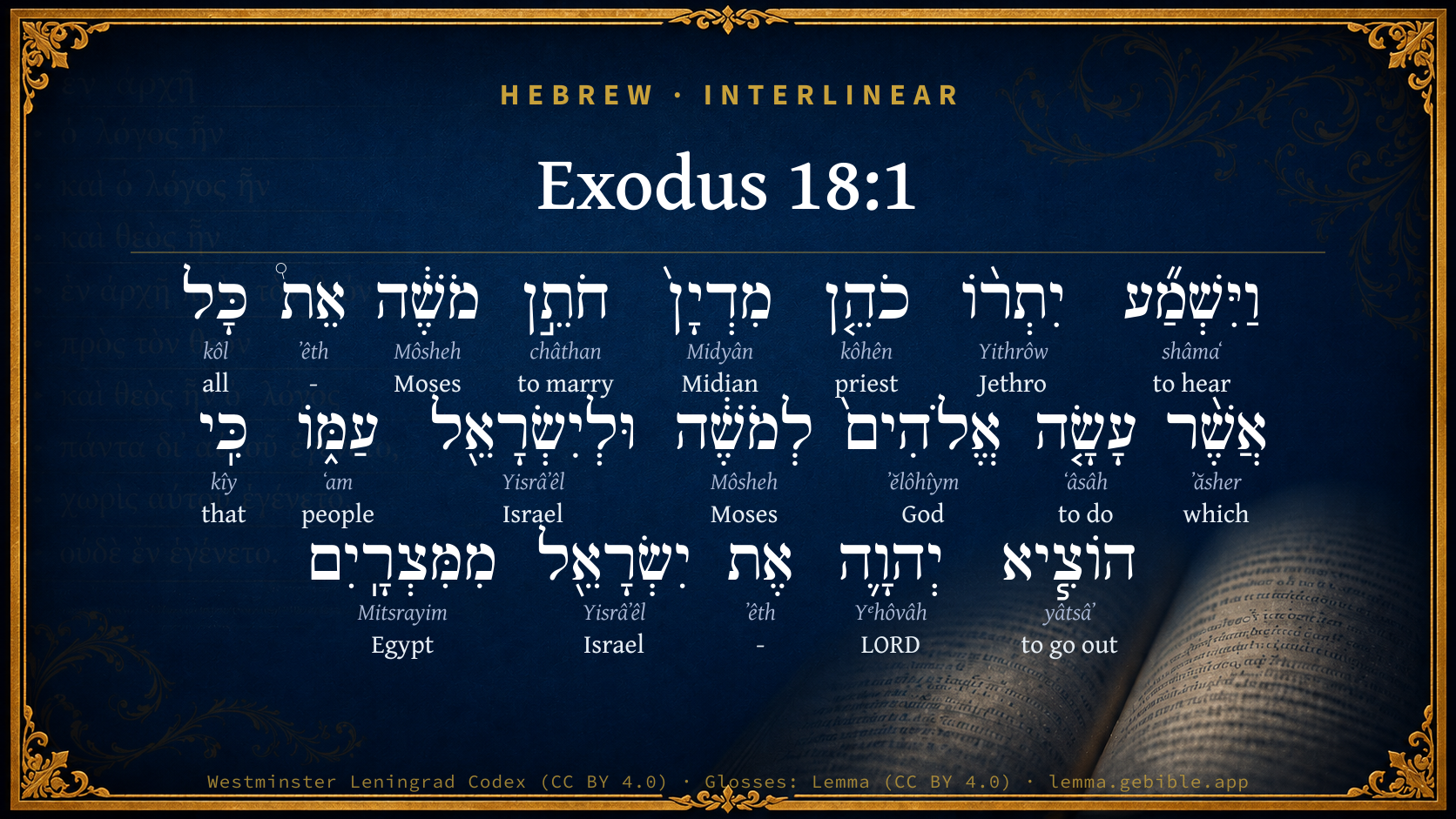
Hebrew (Westminster Leningrad Codex) Exodus 18:1 appears in the Hebrew Old Testament. The text above is from the Westminster Leningrad Codex. Each word links to its Strong’s number, a concise gloss, and parsing drawn from the Open Scriptures Hebrew Bible morphology. Click any word for its full Brown-Driver-Briggs (BDB) entry.
Download image
Cite this verse

Exodus 18:1 (World English Bible). Public Domain. Lemma interlinear Bible study tool, https://lemma.gebible.app/v/exodus/18/1.

Show BibTeX & RIS
BibTeX
RIS
English Translation
Now Jethro, the priest of Midian, Moses' father-in-law, heard of all that God had done for Moses, and for Israel his people, how that Yahweh had brought Israel out of Egypt.
World English Bible · Public Domain
Download a study sheet

One document with this verse’s original text, its word-by-word gloss line, the meaning frame, cross-references with their text, attributed commentary, and full source and license credits — printable, and it pastes into notes with its structure intact.

This verse Autodidact and up

Study sheet (.html) Plain text (.txt)

A passage Seminary Student

Up to 50 verses in one chapter. A passage sheet keeps up to 6 commentary sources and 12 cross-references per verse, in the order this page ranks them, and says so on the sheet whenever that leaves anything out. Ask for a single verse and you get the Autodidact verse sheet above.

Everything on this page stays free to read, with no account — the sheet is a download of what is already on screen, not access to it.

Want to remove ads? Support Godless Engineer
Compare translations 3

The same verse in 3 English versions, stacked beneath the original-language interlinear above. Click any original word for its lexicon entry.

Each is an independent rendering of the whole verse — the interlinear is not word-aligned to these translations.

Highlighted words mark where these versions differ — a whole-verse word diff, not a word-by-word alignment.

  • World English Bible Public Domain
    Now Jethro, the priest of Midian, Moses' father-in-law, heard of all that God had done for Moses, and for Israel his people, how that Yahweh had brought Israel out of Egypt.
  • King James Version Public Domain
    When Jethro, the priest of Midian, Moses' father in law, heard of all that God had done for Moses, and for Israel his people, and that the LORD had brought Israel out of Egypt;
  • unfoldingWord Literal Text CC BY-SA 4.0
    And Jethro, the priest of Midian, father-in-law of Moses, heard all that God had done for Moses and for Israel his people; that Yahweh brought Israel out from Egypt.

unfoldingWord Literal Text — © unfoldingWord, licensed CC BY-SA 4.0. Word-aligned USFM3 via Door43 (git.door43.org/unfoldingWord/en_ult).

Versions to compare (up to 4)

3 of 4 selected

Show all 18 translations

Every available English version of this verse, each an independent rendering of the whole verse.

  • World English Bible Public Domain
    Now Jethro, the priest of Midian, Moses' father-in-law, heard of all that God had done for Moses, and for Israel his people, how that Yahweh had brought Israel out of Egypt.
  • Berean Standard Bible Public Domain
    Now Moses’ father-in-law Jethro, the priest of Midian, heard about all that God had done for Moses and His people Israel, and how the LORD had brought Israel out of Egypt.
  • Majority Standard Bible Public Domain
    Now Moses’ father-in-law Jethro, the priest of Midian, heard about all that God had done for Moses and His people Israel, and how the LORD had brought Israel out of Egypt.
  • King James Version Public Domain
    When Jethro, the priest of Midian, Moses' father in law, heard of all that God had done for Moses, and for Israel his people, and that the LORD had brought Israel out of Egypt;
  • American Standard Version (1901) Public Domain
    Now Jethro, the priest of Midian, Moses' father-in-law, heard of all that God had done for Moses, and for Israel his people, how that Jehovah had brought Israel out of Egypt.
  • Revised Version (1885) Public Domain
    Now Jethro, the priest of Midian, Moses’ father in law, heard of all that God had done for Moses, and for Israel his people, how that the LORD had brought Israel out of Egypt.
  • Geneva Bible (1599) Public Domain
    When Iethro the Priest of Midian Moses father in lawe heard all that God had done for Moses, and for Israel his people, and howe the Lord had brought Israel out of Egypt,
  • Douay-Rheims (1899) Public Domain
    And when Jethro the priest of Madian, the kinsman of Moses, had heard all the things that God had done to Moses, and to Israel his people, and that the Lord had brought forth Israel out of Egypt,
  • Young's Literal Translation Public Domain
    And Jethro priest of Midian, father-in-law of Moses, heareth all that God hath done for Moses, and for Israel his people, that Jehovah hath brought out Israel from Egypt,
  • Literal Standard Version CC BY-SA 4.0
    And Jethro priest of Midian, father-in-law of Moses, hears all that God has done for Moses and for His people Israel, that YHWH has brought out Israel from Egypt,
  • Unlocked Literal Bible CC BY-SA 4.0
    Jethro, the priest of Midian, Moses' father-in-law, heard of all that God had done for Moses and for Israel his people. He heard that Yahweh had brought Israel out of Egypt.
  • unfoldingWord Literal Text CC BY-SA 4.0
    And Jethro, the priest of Midian, father-in-law of Moses, heard all that God had done for Moses and for Israel his people; that Yahweh brought Israel out from Egypt.
  • Darby Bible Public Domain
    And Jethro the priest of Midian, Moses' father-in-law, heard of all that God had done to Moses, and to Israel his people; that Jehovah had brought Israel out of Egypt.
  • World Messianic Bible Public Domain
    Now Jethro, the priest of Midian, Moses’ father-in-law, heard of all that God had done for Moses and for Israel his people, how the LORD had brought Israel out of Egypt.
  • Webster's Bible Public Domain
    When Jethro the priest of Midian, Moses's father-in-law, heard of all that God had done for Moses, and for Israel his people, and that the LORD had brought Israel out of Egypt:
  • Free Bible Version CC BY-SA 4.0
    Moses' father-in-law Jethro, the priest of Midian, heard about everything God had done for Moses and his people the Israelites, and how the Lord had led them out of Egypt.
  • Bible in Basic English Public Domain
    Now news came to Jethro, the priest of Midian, Moses' father-in-law, of all God had done for Moses and for Israel his people, and how the Lord had taken Israel out of Egypt.
  • JPS Tanakh (1917) Public Domain
    Now Jethro, the priest of Midian, Moses' father-in-law, heard of all that God had done for Moses, and for Israel His people, how that the LORD had brought Israel out of Egypt.

Literal Standard Version (2020), Covenant Press — licensed CC BY-SA 4.0. Text via the HelloAO Bible API (eBible.org). Unlocked Literal Bible (unfoldingWord) — licensed CC BY-SA 4.0. Text via the HelloAO Bible API (eBible.org). unfoldingWord Literal Text — © unfoldingWord, licensed CC BY-SA 4.0. Word-aligned USFM3 via Door43 (git.door43.org/unfoldingWord/en_ult). Free Bible Version, Dr. Jonathan Gallagher — licensed CC BY-SA 4.0. Text via the HelloAO Bible API (eBible.org).

Word by word

More ways to search: Search by grammar → Find every occurrence → Compare this word →

Practice this passage: Drill this verse → Learn its vocabulary →

יִתְר֨וֹ
Yithrôw
H3503
“Jethro”
Noun, Proper
Part of Speech
Noun
Type
Proper
Full BDB Definition

Origin: from H3499 with pron. suffix

TWOT: None

Jethro = "his abundance" - father-in-law of Moses; also 'Jether'
  1. וַיִּשְׁמַ֞ע shâmaʻ H8085 “and · to hear” Conjunction + Verb, Qal, Sequential Imperfect, 3rd Person, Masculine, Singular
  2. כֹהֵ֤ן kôhên H3548 “priest of” Noun, Common, Masculine, Singular, Construct
  3. מִדְיָן֙ Midyân H4080 “Midian” Noun, Proper
  4. חֹתֵ֣ן châthan H2859 “marrying” Verb, Qal, Participle Active, Masculine, Singular, Construct
  5. מֹשֶׁ֔ה Môsheh H4872 “Moses” Noun, Proper
  6. אֵת֩ ʼêth H853 “-” Particle, Direct Object
  7. כָּל kôl H3605 “all of” Noun, Common, Masculine, Singular, Construct
  8. אֲשֶׁ֨ר ʼăsher H834 “which” Particle, Relative
  9. עָשָׂ֤ה ʻâsâh H6213 “to do” Verb, Qal, Perfect, 3rd Person, Masculine, Singular
  10. אֱלֹהִים֙ ʼĕlôhîym H430 “God(s)” Noun, Common, Masculine, Plural, Absolute
  11. לְמֹשֶׁ֔ה Môsheh H4872 “to/for · Moses” Preposition + Noun, Proper
  12. וּלְיִשְׂרָאֵ֖ל Yisrâʼêl H3478 “and · to/for · Israel” Conjunction + Preposition + Noun, Proper
  13. עַמּ֑וֹ ʻam H5971 “people · his” Noun, Common, Masculine, Singular, Construct + Suffix, Personal, 3rd Person, Masculine, Singular
  14. כִּֽי kîy H3588 “that” Conjunction
  15. הוֹצִ֧יא yâtsâʼ H3318 “to go out” Verb, Hiphil, Perfect, 3rd Person, Masculine, Singular
  16. יְהוָ֛ה Yᵉhôvâh H3068 “LORD” Noun, Proper
  17. אֶת ʼêth H853 “-” Particle, Direct Object
  18. יִשְׂרָאֵ֖ל Yisrâʼêl H3478 “Israel” Noun, Proper
  19. מִמִּצְרָֽיִם Mitsrayim H4714 “from · Egypt” Preposition + Noun, Proper

About this verse

These counts appear in no published source. They are computed here, from the morphology-tagged text and Lemma’s own curated glosses. What Lemma adds →

20
words
17
distinct lemmas
Pentateuch
section

Notable vocabulary

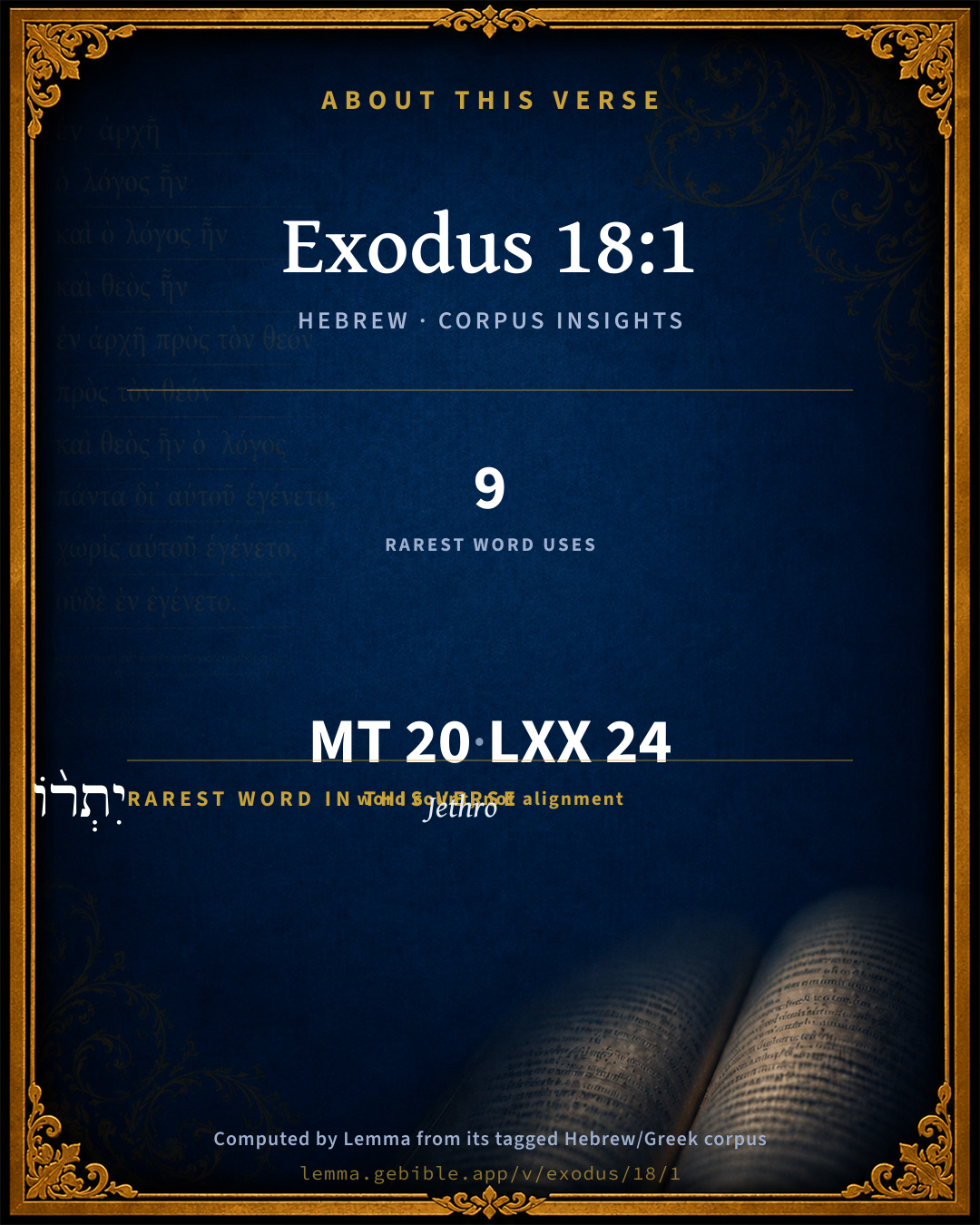
The rarest word here is יִתְר֨וֹ Jethro H3503 — appearing just 9 times in the whole Hebrew Bible.

Shared distinctive vocabulary

יִתְר֨וֹ Jethro H3503 occurs in 9 verses of the Hebrew Bible. Also found in:

Grammatical profile

  • 4 verbs
  • 12 nouns
  • 1 conjunction
  • 3 particles

Verb forms

  • וַיִּשְׁמַ֞ע Qal · Sequential Imperfect
  • חֹתֵ֣ן Qal · Participle Active
  • עָשָׂ֤ה Qal · Perfect
  • הוֹצִ֧יא Hiphil · Perfect

Repetition

Words recur within this verse — often emphatic in Hebrew:

  • מֹשֶׁ֔ה Moses H4872 ×2
  • וּלְיִשְׂרָאֵ֖ל Israel H3478 ×2

Hebrew & Septuagint length

In English translation the verse runs 31 words from the Hebrew and 29 from the Septuagint (LXX English) — closely comparable.

A rough comparison of the two English renderings, which tokenize alike — not a word-level alignment.

Word counts can differ between the Hebrew and the Greek without any difference in meaning — e.g. the Hebrew direct-object marker אֵת has no separate Greek word, and Greek often adds the article ὁ.

In the original languages it is 20 Hebrew tokens and 24 Greek tokens — but the two are counted differently (Hebrew bundles its prefixes and suffixes into one token; the Greek is in lemma form), so that isn’t a like-for-like length.

Cross-references

31

Topical passages linked to Exodus 18:1 in the Treasury of Scripture Knowledge — connected by theme and wording, ordered by reader-vote popularity; previews shown in the World English Bible.

  • Exodus 2:16 Now the priest of Midian had seven daughters. They came and drew water, and filled the troughs to water their father's flock.
  • Exodus 3:1 Now Moses was keeping the flock of Jethro, his father-in-law, the priest of Midian, and he led the flock to the back of the wilderness, and came to God's mountain, to Horeb.
  • Psalms 77:14–15 You are the God who does wonders. You have made your strength known among the peoples.
  • Joshua 2:10 For we have heard how Yahweh dried up the water of the Red Sea before you, when you came out of Egypt; and what you did to the two kings of the Amorites, who were beyond the Jordan, to Sihon and to Og, whom you utterly destroyed.
  • Joshua 9:9 They said to him, From a very far country your servants are come because of the name of Yahweh your God: for we have heard the fame of him, and all that he did in Egypt,
  • Psalms 34:2 My soul shall boast in Yahweh. The humble shall hear of it, and be glad.
  • Psalms 44:1 We have heard with our ears, God; Our fathers have told us, What work you did in their days, In the days of old.
  • Psalms 78:4 We will not hide them from their children, Telling to the generation to come the praises of Yahweh, His strength, and his wondrous works that he has done.
  • Psalms 78:50–53 He made a path for his anger. He didn't spare their soul from death, But gave their life over to the pestilence,
  • Psalms 105:36–41 He struck also all the firstborn in their land, The first fruits of all their manhood.
  • Psalms 105:43 He brought forth his people with joy, His chosen with singing.
  • Psalms 106:2 Who can utter the mighty acts of Yahweh, Or fully declare all his praise?
  • Psalms 106:8–11 Nevertheless he saved them for his name's sake, That he might make his mighty power known.
  • Psalms 136:10–16 To him who struck down the Egyptian firstborn; For his loving kindness endures forever;
  • Isaiah 63:11–13 Then he remembered the days of old, Moses [and] his people, [saying], Where is he who brought them up out of the sea with the shepherds of his flock? where is he who put his holy Spirit in the midst of them?
  • Zechariah 8:23 Thus says Yahweh of Hosts: "In those days, ten men will take hold, out of all the languages of the nations, they will take hold of the skirt of him who is a Jew, saying, 'We will go with you, for we have heard that God is with you.'"
  • Acts 7:35–36 "This Moses, whom they refused, saying, 'Who made you a ruler and a judge?'--God has sent him as both a ruler and a deliverer by the hand of the angel who appeared to him in the bush.
  • Acts 14:27 When they had arrived, and had gathered the assembly together, they reported all the things that God had done with them, and that he had opened a door of faith to the Gentiles.
  • Galatians 1:23–24 but they only heard: "He who once persecuted us now preaches the faith that he once tried to destroy."
  • Exodus 2:18 When they came to Reuel, their father, he said, "How is it that you have returned so early today?"
  • Exodus 2:21 Moses was content to dwell with the man. He gave Moses Zipporah, his daughter.
  • Exodus 4:18 Moses went and returned to Jethro his father-in-law, and said to him, "Please let me go and return to my brothers who are in Egypt, and see whether they are still alive." Jethro said to Moses, "Go in peace."
  • Exodus 7:1–15 Yahweh said to Moses, "Behold, I have made you as God to Pharaoh; and Aaron your brother shall be your prophet.
  • Numbers 10:29 Moses said to Hobab, the son of Reuel the Midianite, Moses' father-in-law, We are journeying to the place of which Yahweh said, I will give it you: come you with us, and we will do you good; for Yahweh has spoken good concerning Israel.
  • Judges 4:11 Now Heber the Kenite had separated himself from the Kenites, even from the children of Hobab the brother-in-law of Moses, and had pitched his tent as far as the oak in Zaanannim, which is by Kedesh.
  • Nehemiah 9:10–11 and shown signs and wonders on Pharaoh, and on all his servants, and on all the people of his land; for you knew that they dealt proudly against them, and did get you a name, as it is this day.
  • Psalms 105:5 Remember his marvelous works that he has done; His wonders, and the judgments of his mouth,
  • Jeremiah 33:9 [This city] shall be to me for a name of joy, for a praise and for a glory, before all the nations of the earth, which shall hear all the good that I do to them, and shall fear and tremble for all the good and for all the peace that I procure to it.
  • Acts 15:12 All the multitude kept silence, and they listened to Barnabas and Paul reporting what signs and wonders God had done among the Gentiles through them.
  • Acts 21:19–20 When he had greeted them, he reported one by one the things which God had worked among the Gentiles through his ministry.
  • Romans 15:18 For I will not dare to speak of any things except those which Christ worked through me, for the obedience of the Gentiles, by word and deed,

Cross-references courtesy of OpenBible.info (CC BY 4.0).

Hebrew and Greek witnesses Masoretic Hebrew ↔ Greek Septuagint

The same verse in the two great witnesses to the Old Testament, shown verse-for-verse.

These are two independent witnesses, not word-aligned to each other, and the Septuagint is shown in lemma (dictionary) form.

Hebrew Exodus 18:1 Masoretic · Westminster Leningrad Codex

וַיִּשְׁמַ֞ע יִתְר֨וֹ כֹהֵ֤ן מִדְיָן֙ חֹתֵ֣ן מֹשֶׁ֔ה אֵת֩ כָּל אֲשֶׁ֨ר עָשָׂ֤ה אֱלֹהִים֙ לְמֹשֶׁ֔ה וּלְיִשְׂרָאֵ֖ל עַמּ֑וֹ כִּֽי הוֹצִ֧יא יְהוָ֛ה אֶת יִשְׂרָאֵ֖ל מִמִּצְרָֽיִם

Now Jethro, the priest of Midian, Moses' father-in-law, heard of all that God had done for Moses, and for Israel his people, how that Yahweh had brought Israel out of Egypt.

World English Bible · Public Domain

Greek LXX Exodus 18:1 Septuagint · lemma form

ἀκούω δέ ιοθορ ὁ ἱερεύς μαδιαμ ὁ γαμβρός μωυσῆς πᾶς ὅσος ποιέω κύριος ἰσραήλ ὁ ἑαυτοῦ λαός ἐκἄγω γάρ κύριος ὁ ἰσραήλ ἐκ αἴγυπτος

And Jothor the priest of Madiam, the father-in-law of Moses, heard of all that the Lord did to his people Israel; for the Lord brought Israel out of Egypt.

LXX2012 (modern English Septuagint) · Public Domain

Hebrew: Westminster Leningrad Codex (CC BY 4.0). Greek: Septuagint (public domain); English from LXX2012 (modern English Septuagint) (Public Domain). How the Septuagint differs from the Hebrew →

Targum (Aramaic paraphrase)

2

The Targum is the ancient Jewish Aramaic paraphrase of the Hebrew Scriptures — an interpretive translation, not the Hebrew text itself. Onkelos (literal) and Pseudo-Jonathan (expansive) render the Torah, and Jonathan the Prophets. Coverage is partial: where no permissively-licensed English translation exists for a verse, only the Aramaic is shown. This is verse-level text, not a word-by-word alignment to the Hebrew.

  1. Targum Onkelos Torah (Genesis–Deuteronomy)
    וּשְׁמַע יִתְרוֹ רַבָּא דְמִדְיָן חֲמוּהִי דְמשֶׁה יַת כָּל דִי עֲבַד יְיָ לְמשֶׁה וּלְיִשְׂרָאֵל עַמֵהּ אֲרֵי אַפִּיק יְיָ יָת יִשְׂרָאֵל מִמִצְרָיִם:

    (no public-domain English translation for this verse)

    Targum Onkelos — Aramaic: “Onkelos Genesis” (public domain); “Onkelos Exodus” (public domain); “Onkelos Leviticus” (public domain); “Onkelos Numbers” (public domain); “Onkelos Deuteronomy” (public domain). English: “Sefaria Community Translation” (CC0 1.0 (public-domain dedication)); “J.W. Etheridge. The Targums of Onkelos and Jonathan Ben Uzziel on the Pentateuch. London: Longmans, Green, 1862” (public domain). Text via Sefaria.

  2. Targum Pseudo-Jonathan Torah (Genesis–Deuteronomy)
    וישמע וּשְׁמַע יִתְרוֹ אוֹנוֹס מִדְיָן חָמוּי דְמשֶׁה יַת כָּל מַאן דְּעָבִיד יְיָ לְמשֶׁה וּלְיִשְרָאֵל עַמֵּיהּ אֲרוּם אַפֵּיק יְיָ יַת יִשְרָאֵל מִמִּצְרָיִם

    And Jethro, prince of Midian, the father-in-law of Mosheh, heard all that the Lord had done for Mosheh and for Israel His people, and that the Lord had brought forth Israel from Mizraim.

    Targum Pseudo-Jonathan — Aramaic: “Targum Jonathan on Genesis” (public domain); “Targum Jonathan on Exodus” (public domain); “Targum Jonathan on Leviticus” (public domain); “Targum Jonathan on Numbers” (public domain); “Targum Jonathan on Deuteronomy” (public domain). English: “The Targum of Jonathan ben Uzziel, trans. J. W. Etheridge, London, 1862” (public domain). Text via Sefaria.

Commentary

Notes on Exodus 18:1 from classic Christian and Jewish commentators (each source and its license shown beneath its notes). The classic Christian expositions comment on the surrounding passage and are grouped to its opening verse, so a note may address several verses; the Jewish commentaries on the Tanakh (Rashi and others) are per-verse, so they appear only where the commentator wrote on this verse.

Lemma curates 59 commentaries, every one of them public domain or Creative Commons licensed, each selected and text-cleaned for this edition rather than reprinted as found. About our sources →

Matthew Henry's Commentary

This incident may very well be allowed to have happened as it is placed here, before the giving of the law, and not, as some place it, in connection with what is recorded, Num 10:11, Num 10:29, etc. Sacrifices were offered before; in these mentioned here (Exo 18:12) it is observable that Jethro is said to take them, not Aaron. And as to Jethro's advising Moses to constitute judges under him, though it is intimate (Exo 18:13) that the occasion of his giving that advice was on the morrow, yet it does not follow but that Moses's settlement of that affair might be some time after, when the law was given, as it is placed, Deu 1:9. It is plain that Jethro himself would not have him make this alteration in the government till he had received instructions from God about it (Exo 18:23), which he did not till some time after. Jethro comes,

I. To congratulate the happiness of Israel, and particularly the honour of Moses his son-in-law; and now Jethro thinks himself well paid for all the kindness he had shown to Moses in his distress, and his daughter better matched than he could have expected. Jethro could not but hear what all the country rang of, the glorious appearances of God for his people Israel (Exo 18:1); and he comes to enquire, and inform himself more fully thereof (see Psa 111:2), and to rejoice with them as one that had a true respect both for them and for their God. Though he, as a Midianite, was not to share with them in the promised land, yet he shared with them in the joy of their deliverance. We may thus make the comforts of others our own, by taking pleasure, as God does, in the prosperity of the righteous.

II. To bring Moses's wife and children to him. It seems, he had sent them back, probably from the inn where his wife's aversion to the circumcision of her son had like to have cost him his life (Exo 4:25); fearing lest they should prove a further hindrance, he sent them home to his father-in-law. He foresaw what discouragements he was likely to meet with in the court of Pharaoh, and therefore would not take any with him in his own family. He was of that tribe that said to his father, I have not known him, when service was to be done for God, Deu 33:9. Thus Christ's disciples, when they were to go upon an expedition not much unlike that of Moses, were to forsake wife and children, Mat 19:29. But though there might be reason for the separation that was between Moses and his wife for a time, yet they must come together again, as soon as ever they could with any convenience. It is the law of the relation. You husbands, dwell with your wives, Pe1 3:7. Jethro, we may suppose, was glad of his daughter's company, and fond of her children, yet he would not keep her from her husband, nor them from their father, Exo 18:5, Exo 18:6. Moses must have his family with him, that while he ruled the church of God he might set a good example of prudence in family-government, Ti1 3:5. Moses had now a great deal both of honour and care put upon him, and it was fit that his wife should be with him to share with him in both. Notice is taken of the significant names of his two sons. 1. The eldest was called Gershom (Exo 18:3), a stranger, Moses designing thereby, not only a memorial of his own condition, but a memorandum to his son of his condition also: for we are all strangers upon earth, as all our fathers were. Moses had a great uncle almost of the same name, Gershon, a stranger; for though he was born in Canaan (Gen 46:11), yet even there the patriarchs confessed themselves strangers. 2. The other he called Eliezer (Exo 18:4), My God a help, as we translate it; it looks back to his deliverance from Pharaoh, when he made his escape, after the slaying of the Egyptian; but, if this was (as some think) the son that was circumcised at the inn as he was going, I would rather translate it so as to look forward, which the original will bear, The Lord is my help, and will deliver me from the sword of Pharaoh, which he had reason to expect would be drawn against him when he was going to fetch Israel out of bondage. Note, When we are undertaking any difficult service for God and our generation, it is good for us to encourage ourselves in God as our help: he that has delivered does and will deliver.

Matthew Henry's Commentary on the Whole Bible (1708–1710) — public domain (CC PDM 1.0). Text via the HelloAO Bible API.

Trapp's Complete Commentary

John Trapp

Exo 18:1 When Jethro, the priest of Midian, Moses’ father in law, heard of all that God had done for Moses, and for Israel his people, [and] that the LORD had brought Israel out of Egypt;

Ver. 1. Heard of all.] And thereby was converted, say the Rabbis, being the first proselyte to the Jewish Church that we read of in the Scripture.

John Trapp, A Commentary or Exposition upon All the Books of the Old and New Testament (1647–1656) — public domain. Text from a community e-Sword module.

The Biblical Illustrator

Joseph S. Exell

Exo_18:1-6

I, thy father-in-law, Jethro, am come unto thee.

Family gatherings

I. That this family gathering was permitted after long absence, and after the occurrence of great events.

II. That this family gathering was characterized by courtesy, by a religious spirit, and by devout conversation.

III. That this family gathering derived its highest joy from the moral experiences with which it was favoured.

IV. That this family gathering was made the occasion of a sacramental offering to God. Lessons:

1. That God can watch over the interests of a separate family.

2. That God unites families in a providential manner.

3. That united families should rejoice in God.

4. That the families of the good will meet in heaven, never more to part.

5. Pray for the completion of the Divine family in the Fathers house. (J. S. Exell, M. A.)

Character not deteriorated by honour

Nothing tests a man more than his bearing toward his former friends after he has passed through some experiences which have brought him great honour and prosperity; and when, as in the present instance, he comes back with his old frankness and cordiality, and is not ashamed of his old piety, he is a great man indeed. Too often, however, prosperity deteriorates character, and honour freezes the heart. The head swims on the giddy height, and the son returns a comparative stranger even to his fathers house; while the family worship, which used to be so enjoyed, is smiled at as a weakness of the old peoples, and avoided as a weariness to himself. Old companions, too, are passed without recognition; or, if recognized at all, it is with an air of condescension, and with an effort like that which one makes to stoop for something that is far beneath him. The development of character also estranges us from those whom we once knew intimately, and who were once, it may be, the better for our fellowship. But the consolation in all such cases is, that there can be no value in the further friendship of those who can thus forget the past. He is the really good friend--as well as the, truly great man--who, in spite of his deserved eminence, resumes with us at the point at which we separated, and carries us at length with him to the throne of grace, to acknowledge there our obligations to the Lord. There are men whom one meets from time to time with whom he has always to begin anew. They are like a book in which you never get fully interested, and which, whenever you take it up, you must commence to read again at the very preface; until, in absolute disgust, you cast it away from you, and never lift it more. There are others who are like a well-beloved volume, with a bookmark in it, which you can open at any moment, and resume where you broke off; and which, though you may be often interrupted, you contrive to read through to the end. Such a friend was Moses to Jethro, and Jethro to Moses; and though there came a final separation of the one from the other on earth, they would renew their conference in heaven. (W. M. Taylor, D. D.)

Ashamed of parents

A fellow student of mine had very poor parents, but they had a great desire to give their son the very best possible education; and if you had looked into that home, you would have seen much pinching and self-denying on the part of those parents to give their boy a university training. Once, when he was away at college, they went up with proud hearts to see him, for was it not with great efforts on their part that he was there? He was walking in the street with a fellow student when he met them, and he tried to avoid them. You ask me, why? Because he was ashamed of them in their simple dress, and he was not going to own them until his friend had gone. That man reached the Presbyterian ministry, but he did not long stay in it, He fell from his position, and the brokenhearted parents followed him step by step. He went down lower and lower until a fellow minister and myself have rescued him again and again from police cells. Oh, the foulness of heart of one who is ashamed to own his mother, however poor. And yet there is still a greater sin; to be ashamed of That self-sacrificing love that nailed to the Cross the Son of God. (J. Carstairs.)

The Biblical Illustrator, edited by Joseph S. Exell (c. 1880s–1900s) — public domain. Text from a community e-Sword module.

Joseph Benson's Commentary

Exo 18:1. Jethro, to congratulate the happiness of Israel, and particularly the honour of Moses his son-in-law, comes to rejoice with them, as one that had a true respect both for them and for their God: and also to bring Moses’s wife and children to him. It seems he had sent them back, probably from the inn where his wife’s unwillingness to have her son circumcised had like to have cost him his life, Exo 4:25.

Joseph Benson's Commentary on the Old and New Testaments (1811–1818) — public domain. Text from a community e-Sword module.

The Preacher's Complete Homiletical Commentary

Joseph S. Exell (gen. ed.)

CRITICAL NOTES.—

Exo_18:1. Midian.]—If we mar assume that these Midianites were descendants of Midian, son of Abraham by Keturah (Gen_25:2), our wonder will be lessened that among this Arabian people we should find the knowledge and worship of Jehovah had been preserved, as seen in this narrative. Thus this episode may be added to other incidental proofs of the continuance of pure religion among Gentile nations.

Exo_18:6. Am come.] More exactly, “Am coming;” i.e., “Am on my way; am at hand.” This intelligence, sent forward by a messenger, would give Moses time to go forth to meet his father in-law, as we find he did. We have here a beautiful picture of Eastern manners. The relatives meet, embrace each other, and, after due inquiries as to each other’s welfare, turn at the head of their groups of attendants, and move on in conversation towards the camp of Israel and the tent of Moses. Nor may we takes the absence of any remark on the meeting of Moses and Zipporah as implying anything unfavourable to their cordial relationship to each other. It is much in the manner of the Eastern delicacy of feeling to pass by the matrimonial connection without remark. It is pleasant to find Zipporah restored to her husband. They have been parted but for a few months at most: in the interval, “What hath God wrought!”

MAIN HOMILETICS OF THE PARAGRAPH.—Exo_18:1-12

FAMILY GATHERINGS

IT seems that Jethro, the priest of Midian, had heard of all that God had done for Moses, and became anxious again to see his son-in-law. It is well when men have their ears open to the tidings of God’s providential mercies to the good. The senses should be avenues of the Divine to the soul. Jethro was a Gentile, and resided at a distance, but national peculiarities and distance from great events will not silence the voice of heaven to a faithful soul. Gentiles hear of God when Jews will not. The distant magi come to seek Him when they at Jerusalem are ignorant of Him. Now we see the little party setting out on their glad journey. There is the old father, the wife, and two sons of Moses going to meet the relative from whom they had been a long time separated. The journey is long, but they are sustained in it by the glad prospect of reunion. We have heard tidings of the world beyond the grave; thither are we travelling, and shall soon join those who have gone before us.

I. That this family gathering was permitted after long absence and after the occurrence of great events. Moses had parted from his father-in-law some forty years ago, in order that he might go to Pharaoh and demand the release of the Israelites. He had not seen his wife and sons since the day he had sent them back, when a great peril threatened his life. Moses had left all behind that he might with greater fidelity and zeal execute the great work intrusted to him. During these years of absence God had done great things for the Israelites. He had manifested His omnipotent power on their behalf in the dire plagues which had fallen on Egypt. He had shown His faithfulness and mercy in their deliverance from bondage, and in the supply of their needs in the wilderness. He had given manna from the skies. He had given water from the rock. He had given the cloud to guide them. Now the tent is pitched. It is a time of rest. Families are often separated on earth, sometimes by stern need, in order to win daily bread; sometimes by the call of the Gospel, in order thereby to promote the welfare of God’s word and kingdom; and one separation awaits all families, even that occasioned by death. These separations are fraught with pain. But the time of meeting draws near; then what histories will there be to narrate, and what joys will compensate the sorrow past. Christ is gathering His family to the house not made with hands, eternal in the heavens.

II. That this family gathering was characterised by courtesy, by a religious spirit, and by devout conversation.

1. There was true courtesy. “And he said unto Moses, I, thy father-in-law, Jethro, am come unto thee, and thy wife, and her two sons with her” (Exo_18:6). Thus Jethro sent a message to herald his advent to the tent of Moses. He might justly have approached Moses without this, but he had respect unto the official position and to the moral history of his son-in-law; hence the modesty which characterised his approach. A due respect for social position, for mental attainment, for moral character, and for providential circumstance, should exist even amongst members of the same family. The respect we pay to strangers is much more due to our nearest relatives. Discourtesy is never more out of place than in the midst of the tender relationship of life. This old priest of Midian would not be guilty of it. Reverence is due to authority.

2. There was a deeply religious spirit. Moses did not receive his father-in-law with proud and stately manner. He kissed him. The honours of office had not frozen up the tender feelings of his nature. He did not laud his own skill as a commander; he gave God the praise of all his victories. He indulged in no idle talk. He indulged no spirit of levity. In the midst of this family there was sacred joy, pure gratitude, and devout worship. There was no word of murmuring uttered at the long separation or in review of severe trials; but all hearts in that tent were true to that God who had watched over and brought them together once more. Family gatherings should be pervaded by a religious spirit; then the tent will become a sanctuary.

3. There was devout conversation. Moses told his father-in-law of all that God had done for Israel, also of the “travail that had come upon them by the way, and how the Lord had delivered them.” The Great Leader did not forget the sorrowful experiences of his life; great trials make a deep impression on the soul. But he remembered his God-wrought deliverances. We should not talk more of trials than of the aid we have received in them. We should not indulge gloomy conversation, but a conversation which derives gladness from its mention of Divine help. What happy communings will there be amongst the redeemed as the members of the heavenly family come from the east and the west to their great home.

III. That this family gathering derived its highest joy from the moral experiences with which it was favoured. “And Jethro rejoiced for all the goodness which the Lord had done to Israel, whom He had delivered out of the hand of the Egyptians. And Jethro said, ‘Blessed be the Lord, who hath delivered you out of the hand of the Egyptians, and out of the hand of Pharaoh, who hath delivered the people from under the hand of the Egyptians. Now I know that the Lord is greater than all gods.’ ” Thus the supreme joy of this united family was not derived from its merely social intercourse, not from intellectual and pleasing conversation, not from the coming together of congenial souls, but from the moral experiences of each and from the devotion of all to the great God. This is the ideal of social intercourse. Not a cant reference to the mercy of God, but a sincere reference to God in the unfoldings of the heart to each other. Such intercourse can never fail to give joy, as the Infinite is the source of its rejoicing.

IV. That this family gathering was made the occasion of a sacramental offering to God. “And Jethro, Moses’ father-in-law, took a burnt-offering and sacrifices for God: and Aaron came, and all the elders of Israel, to eat bread with Moses’ father-in-law before God.” Jethro was not content to express his joy and gratitude in mere words, but in specific and solemn action. He was a worshipper of the true God; he had come to learn that none other was worthy of praise. The family had communed with each other; it now communes with God. Earthly communion should naturally suggest Divine communion. Jethro was joined by Aaron and the elders of Israel. Here is sweet concord in worship. Prayer intensifies the family relationship; it also enlarges it. All the elders of the Church will one day worship God together. Sweet is the bread broken at the table of the Lord. Let us thus worship before God. LESSONS:—

1. That God can watch over the interests of a separated family.

2. That God unites families in a providential manner.

3. That united families should rejoice in God.

4. That the families of the good will meet in heaven, never more to part.

5. Let us pray for the completion of the Divine family in the Father’s house.

SUGGESTIVE COMMENTS ON THE VERSES

Exo_18:1-12. God moved strangers and heads of nations sometimes to listen after His providences to His Church.

The fame of God’s stupendous works to His Church may affect strangers to come and see them.

Relations hearing of God’s goodness to their loved ones are justly moved to visit them.

Friends to Israel’s good cannot but be moved with the tidings of God’s great works for them.

The fame of Israel’s deliverance from Egypt may justify men to inquire after God.

Prudence may send away the dearest pledges from hindering God’s work.

As children are great mercies, so it is good to make them the memorials of God’s mercies to us.

The mercies of pilgrimage must not be forgotten by God’s servants.

Wilderness condition do not deter the true relations of the Church from coming to them.

In the wilderness God may have His mount, His stony place for His Church.

It is sweet meeting of Church relations after the defeat of enemies.

It is not unbecoming the highest places or persons in the Church of Christ to give due respect to their relations.

Grace does not unteach men manners and civil respect unto men.

It is a natural duty for relations to inquire of each other’s peace.

God’s servants filled with a sense of mercies cannot but declare them to others.

The friends of Israel are the fittest to hear of God’s wondrous works.

Great distress may befall God’s Church in the way of its redemption.

The friends of the Church rejoice in all the good that is done for it.

As Jehovah is the cause of good to the Church, so He is the object of joy and gratitude.

The great works of God set Him above all other gods. Holy teaching is consistent with holy worship.

Exo_18:12 (last clause).

I. A common and necessary act.

II. A common and necessary act done in a social spirit.

III. A common and necessary act done in a pious manner.

Leaving now this illustrious example of friendship, we may proceed to make a few general observations. One obvious one is, that this world is not a scene adapted or intended to afford the pleasure and benefit of friendship entire. Jethro was to lose his inestimable friend, after long, and what must have been the happiest intimacy, was to see him once again; again to lose him, to see him on earth, probably, no more. What a measure, we may almost say, of his vital existence, he was to lose! Providence has, in numerous instances, interposed wide spaces of land, or even sea, between persons who might be inestimable to one another in near and habitual association. The one mind, and the other, and the third, and many more are filled with exercises of thought, with emotions, with affections which would glow with social and sympathetic animation, if they could be one another’s companions. But they have each their own assigned positions to occupy—their own moral track to cultivate, their own duties, labours, trials—and sometimes little happy in their actual associates; they have to fulfil their vocation amidst coldness, perversity, or imbecility, thinking, sometimes, how different the case would be if such-and-such were their companions and co-operators.

Inquisitiveness. “Asked each other.” And the mutual inquiries respecting “welfare” are made in a spirit very different from unmeaning complacence. When a friend is far away, it will sometimes occur to wonder and to imagine how he may be situated—how employed. What at this time is the exercise of his mind? what part is he in of the process of an undertaking? what evil dispositions of his fellow-mortals is he conflicting with? what temptations is he beset by? When they meet the inquiry goes back over things, and it is gratifying to give the history to one who is so kindly interested in it at every step. And friendship will suggest many comments which would not occur to the thoughts of an indifferent person. It may be very advantageous for the instruction and improvement of the friends that they have moved a great deal apart, so as to have had a very different experience, different views of the world and of providence. Thus they bring in a much larger store to the combined account, enlarge one another’s knowledge, correct and mature one another’s judgment.

The last thing is serious anticipation. Each meeting should admonish them that their life is shortened (sometimes much shortened) since they met before. Sometimes they are forcibly struck by the change in each other’s appearance. After a considerable absence they can hardly meet without having to name some one who has shared their society, but meets them no more. When they part confessedly for a considerable absence, how possible is it they are looking at each other for the last time! Let it be considered what a melancholy thing any friendship would be that should be destined to expire with all its pleasures and advantages at death. That is worthy and happy friendship, and that alone where the parties are zealously preparing and have a good hope to meet in a nobler scene.—(John Foster.)

ILLUSTRATIONS

BY

REV. W. ADAMSON

Jethro and Moses! Exo_18:1-12. Here we have

1. Family gatherings, their

(1) Causes, and

(2) Customs.

2. Friendly greetings, their

(1) Courtesy, and

(2) Communion. These are capable of illustration from the Scripture histories of Job’s family and the prodigal son. Christmas festivities suggest another source of illustration in their (a) Pleasant and (b) Profitable aspects. Illustrations may also be drawn from the life of Bishop Crowther, or of Uncle Tom, or of Jesus and His disciples on the Galilean shore and in the upper room, or of Joseph and his brethren;—when the pent-up thoughts

“Of many years flow’d from his eager lips,

As waters from a secret spring unseal’d.”

Family Gatherings! Exo_18:7. In the year 1690, the Vaudois fugitives from De Catinat and Fenguieres received tidings, as they lay encamped in Angrogna, the loveliest and most romantic of all the valleys of Piedmont, from the Duke of Savoy’s ambassadors that peace was theirs unconditionally. Day after day the prisons, in which hundreds of the sufferers had for years scarcely seen the light of the sun, were emptied of their captives, who were restored to liberty. A detachment was deputed to proceed to the Swiss canions, to bring back the female refugees who had been left behind. Never can that night be forgotten in the annals of Lucerna, when, under a bright setting sun, the returning wanderers were seen wending their way up the lovely valley. Wives restored to the embrace of their husbands, children to parents, brothers to sisters, friends to friends! Gratitude for present mercies softened and alleviated the bitter recollections of the past. Not unlike were the circumstances of Jethro’s visit to Israel, with Zipporah and her children. Such questionings

“Of things that had befallen him since last

They met, and of his pathway thitherwards,

And of the freed host he had led behind:

Words with embraces interspersed.”

Friend-Communion! Exo_18:8-12. In March 1878 the Duke of Sutherland gave a complimentary banquet to Baker Pacha, on his return from the recent seat of war in the East, at Stafford House, St. James’s. Amongst the noblemen and gentlemen who accepted the Duke’s invitation were Musurus Pacha (the Turkish Ambassador), Field Marshal Lord Strathnairn, G.C.B.; Lord Houghton, Lord Eglinton, General Sir Alexander Horsford, G.C.B.; General Sir Charles Ellice, K.C.B., Major-General Sir Henry Green, K.C.S.I., C.B., General Foster, C.B., General S. Brownrigg, Major-General Hon. James Macdonald, Major-General Marshall, Colonel Wellesley, Sir Samuel Baker, Colonel J. Baker, Mr. W. H. Russell, and the Marquis of Stafford. After dinner, at the Duke’s invitation, a number of guests assembled expressly to meet the guest of the evening, including the Duke of Teck, Prince Edward of Saxe-Weimar, the Persian Minister, Prince Ibraham, Midhat Pacha, the Marquis of Exeter, the Earl of Feversham, the Earl of Denbigh, the Earl of Orkney, Baron Hy. de Worms, and many others. It is noteworthy that when Moses entertained Jethro, everything was ascribed to the goodness of God. It is interesting to consider how far friends in holding communion praise God for past mercies. Moses acknowledged the hand of God in all the events which had befallen Israel. May we not here contrast this joyful feast before God, with such meetings for pleasure and social intercourse which take place in all ranks of life, but in which too often the element of lasting satisfaction is wanting—we mean, recognition of the Divine Providence.

“ ‘Not unto us!’ How sweet to join the strain,

In self-deliverance blissful and complete;

And all our toils, successes, failures, pain,

To lose, O Christ Jehovah, at Thy feet.”

—Taylor.

Christian Converse! Exo_18:9. In a house in the city of Zurich which crowns the northern extremity of the “lake of blue waters” sat a family group. The house-room was long and low, occupying the entire centre of the house—one large window looked into the street, two others into the garden at the back. Through these the last crimson rays of the sun were streaming upon a singular group. Some of the members of this family had been absent in God’s service for several years; and this was the family’s earth-reunion. Sweet fellowship was theirs, but not without its tinge of shadow. They communed of the past—of the wonderful works of God in Germany and Switzerland, and the Low Countries, and of the gracious deliverances vouchsafed to themselves personally. Then came the song of praise to God for the mercies of the past; blended with prayer to Him for grace in the future to press onwards towards the mark. Such Christian converse was that of Jethro and Moses, in which hearts thrilled with holy joy, and spirits gushed over with grateful song.

“Children and kith and friends; all in a breath

Ask of his welfare, and with joyous tongues

Pour all their love into his thirsty ear.”

Mutual Sympathy! Exo_18:9. A gentleman travelling on one of the river steamers to Philadelphia mentions his sensations over the rescue of a fellow-passenger from a watery grave. It was a cold winter night, and every one was impatient to be ashore. Before the boat reached the wharfs a man slipped into the water. The icicles had frozen on the wharf and they had frozen on the steamer. The ropes were lowered, and all stood with anxiety lest the man should not be able to grasp the rope owing to the cold. When he grasped it and was pulled on to the deck and we saw he was safe, although we had never seen him before, how we congratulated him. A life saved! With what fervency, then, must Jethro have congratulated Moses and his liberated host! The greater the peril, the fuller the tide of exultancy! The more hopeless the prospect of success and reunion, the deeper the fount of gladness!

“Their streaming tears together flow

For human guilt and mortal woe;

Their joyful songs together rise

Like mingling flames in sacrifice.”

—Barbauld.

Life Lessons! Exo_18:11. In Singapore, that wonderful emporium of the commerce of the East, established by the sagacious foresight of Sir Stamford Raffles, stood a house surrounded by an open verandah fenced with large tree ferns. At the time, a group of friends, the long-sundered members of an English family, sat together narrating their adventures, Separated by shipwreck from one another, sundered by the terrible typhoon of Indian seas, they had once again been united, after several of them had succeeded in escaping from the clutches of Malay pirates. All felt, as the hairbreadth escapes were related and the remarkable deliverances recounted, that truly the special Providence of God had guided and interposed. It was the first night of their reunion, and they sat holding fellowship one with the other. “Should we not return thanks to Him who has preserved us!” Then together they knelt in thankful acknowledgment of the Divine mercy. On rising, one of the family said that he had that night learned more about God—that He was indeed a personal God caring for each, while He cared for all. Jethro here acknowledges that the recital by Moses of Divine deliverance and direction had given him a new view of Jehovah, “Now I know that the Lord Jehovah is greater than all gods.”

“O Thou Eternal One, whose presence bright

All space doth occupy, all motion guide;

Unchanged through time’s all-devastating flight;

Thou only God! There is no God beside.”

—Derzhavin.

Family Religion! Exo_18:12. Religion not only hallows and brightens the joys of life; it is also the true basis and crown of them all. Hence the gladness of Jethro. His gladness was not because of any advantage he himself had gained, “but because of all the goodness which the Lord had done to Israel.” Here we see the sympathy which flows from a heart ruled by the love of God. In this spirit Jethro offered sacrifices to God in the sight of the vast multitude. Thus the host of Israel shared in the family-joys of Moses. Even so in Paradise,—all will share the feast of one another’s gladness. Not that love can be

“Without the chosen specialties of love,

The nearest to the nearest most akin.

But none are strangers there,—none sojourners;

And as the cloudless ages glide away,

New fountains of delight to them—to all,

Will open in the fellowship of hearts.”

—Bickersteth.

The Preacher's Complete Homiletical Commentary (gen. ed. Joseph S. Exell; Funk & Wagnalls, c. 1892) — public domain (pre-1929). A full-Bible homiletical/sermon-outline anthology covering 65 of 66 books (2 John is absent from the source module). Text from a community e-Sword module.

Keil & Delitzsch

C. F. Keil & F. Delitzsch

The Amalekites had met Israel with hostility, as the prototype of the heathen who would strive against the people and kingdom of God. But Jethro, the Midianitish priest, appeared immediately after in the camp of Israel, not only as Moses' father-in-law, to bring back his wife and children, but also with a joyful acknowledgement of all that Jehovah had done to the Israelites in delivering them from Egypt, to offer burnt-offerings to the God of Israel, and to celebrate a sacrificial meal with Moses, Aaron, and all the elders of Israel; so that in the person of Jethro the first-fruits of the heathen, who would hereafter seek the living God, entered into religious fellowship with the people of God. As both the Amalekites and Midianites were descended from Abraham, and stood in blood-relationship to Israel, the different attitudes which they assumed towards the Israelites foreshadowed and typified the twofold attitude which the heathen world would assume towards the kingdom of God. (On Jethro, see Exo 2:18; on Moses' wife and sons, see Exo 2:21-22; and on the expression in Exo 18:2, "after he had sent her back," Exo 4:26.) - Jethro came to Moses "into the wilderness, where he encamped at the mount of God." The mount of God is Horeb (Exo 3:1); and the place of encampment is Rephidim, at Horeb, i.e., at the spot where the Sheikh valley opens into the plain of er Rahah (Exo 17:1). This part is designated as a wilderness; and according to Robinson (1, pp. 130, 131) the district round this valley and plain is "naked desert," and "wild and desolate." The occasion for Jethro the priest to bring back to his son-in-law his wife and children was furnished by the intelligence which had reached him, that Jehovah had brought Israel out of Egypt (Exo 18:1), and, as we may obviously supply, had led them to Horeb. When Moses sent his wife and sons back to Jethro, he probably stipulated that they were to return to him on the arrival of the Israelites at Horeb. For when God first called Moses at Horeb, He foretold to him that Israel would be brought to this mountain on its deliverance from Egypt (Exo 3:12).

(Note: Kurtz (Hist. of O. C. iii. 46, 53) supposes that it was chiefly the report of the glorious result of the battle with Amalek which led Jethro to resolve to bring Moses' family back to him. There is no statement, however, to this effect in the biblical text, but rather the opposite, namely, that what Jethro had heard of all that God had done to Moses and Israel consisted of the fact that Jehovah had brought Israel out of Egypt. Again, there are not sufficient grounds for placing the arrival of Jethro at the camp of Israel, in the desert of Sinai and after the giving of the law, as Ranke has done. For the fact that the mount of God is mentioned as the place of encampment at the time, is an argument in favour of Rephidim, rather than against it, as we have already shown. And we can see no force in the assertion that the circumstances, in which we find the people, point rather to the longer stay at Sinai, than to the passing halt at Rephidim. For how do we know that the stay at Rephidim was such a passing one, that it would not afford time enough for Jethro's visit? It is true that, according to the ordinary assumption, only half a month intervened between the arrival of the Israelites in the desert of Sin and their arrival in the desert of Sinai; but within this space of time everything might have taken place that is said to have occurred on the march from the former to the latter place of encampment. It is not stated in the biblical text that seven days were absorbed in the desert of Sin alone, but only that the Israelites spent a Sabbath there, and had received manna a few days before, so that three or four days (say from Thursday to Saturday inclusive) would amply suffice for all that took place. If the Israelites, therefore, encamped there in the evening of the 15th, they might have moved farther on the morning of the 19th or 20th, and after a two days' journey by Dofkah and Alush have reached Rephidim on the 21st or 22nd. They could then have fought the battle with the Amalekites the following day, so that Jethro might have come to the camp on the 24th or 25th, and held the sacrificial meal with the Israelites the next day. In that case there would still be four or five days left for him to see Moses sitting in judgment a whole day long (Exo 18:13), and for the introduction of the judicial arrangements proposed by Jethro; - amply sufficient time, inasmuch as one whole day would suffice for the sight of the judicial sitting, which is said to have taken place the day after the sacrificial meal (Exo 18:13). And the election of judges on the part of the people, for which Moses gave directions in accordance with Jethro's advice, might easily have been carried out in two days. For, on the one hand, it is most probable that after Jethro had watched this severe and exhausting occupation of Moses for a whole day, he spoke to Moses on the subject the very same evening, and laid his plan before him; and on the other hand, the execution of this plan did not require a very long time, as the people were not scattered over a whole country, but were collected together in one camp. Moreover, Moses carried on all his negotiations with the people through the elders as their representatives; and the judges were not elected in modern fashion by universal suffrage, but were nominated by the people, i.e., by the natural representatives of the nation, from the body of elders, according to their tribes, and then appointed by Moses himself. - Again, it is by no means certain that Israel arrived at the desert of Sinai on the first day of the third month, and that only half a month (15 or 16 days) elapsed between their arrival in the desert of sin and their encamping at Sinai (cf. Exo 19:1). And lastly, though Kurtz still affirms that Jethro lived on the other side of the Elanitic Gulf, and did not set out till he heard of the defeat of the Amalekites, in which case a whole month might easily intervene between the victory of Israel and the arrival of Jethro, the two premises upon which this conclusion is based, are assumptions without foundation, as we have already shown at Exo 3:1 in relation to the former, and have just shown in relation to the latter.)

Keil & Delitzsch — Biblical Commentary on the Old Testament (1861–1891) — public domain (CC PDM 1.0). Text via the HelloAO Bible API. (Old Testament only.)

The Annotated Bible

Arno C. Gaebelein

CHAPTER 18 Moses and Jethro

1. The coming of Jethro (Exo 18:1-5)

2. Moses’ and Jethro’s communion (Exo 18:6-12)

3. Jethro’s advice (Exo 18:13-23)

4. Moses’ action (Exo 18:24-27)

This chapter concludes the first section of the second part of Exodus. We have in it a beautiful dispensational foreshadowing of things to come. God had redeemed Israel , delivered them from Pharaoh’s host, manifested His power and had given them victory. The priest of Midian, a Gentile, now comes, having heard all that Jehovah had done for Moses and for Israel , his people. Zipporah, Moses’ wife, and his two sons are with him. What a happy reunion. And there was praise unto Jehovah from the lips of the Gentile as well as burnt offering and sacrifices for God. It foreshadows what will take place when Israel is finally restored and delivered. Then the Gentiles will come and “many nations shall be joined unto the Lord in that day” (Zec 2:11). Read Jer 16:14-21. First Jehovah’s power in the restoration of His scattered people is mentioned; then the coming of the Gentiles is announced. “The Gentiles shall come unto thee from the ends of the earth.”

Moses judging, and the faithful men, fearing God, judging with him, may well remind us of that day, when He who is greater than Moses will judge the earth in righteousness. Then we shall have share with Him. “Do ye not know that the saints shall judge the world?” (1Co 6:2).

what grace is and grace has done and will do is the most beautiful and precious revelation of Exodus up to the end of the eighteenth chapter. Jehovah took notice of the poor slaves. He heard their cry. He sent them a deliverer. He smote Egypt with great tribulation and judgment. He sheltered His people under the blood. He led them forth as His redeemed people. Their enemies perished through His power and He brought them through the Red Sea . He gave them bread from heaven and water out of the rock. Victory was on their side and the glory of His name extended to the Gentiles. But over our brief and imperfect annotations we have to write, “Not the half has been told.”

Exodus19:1-25

2. At Sinai: The Covenant and the Law

CHAPTER 19 Israel at Sinai and the Covenant

1. Israel before Mount Sinai (Exo 19:1-2)

2. The covenant and calling of Israel stated (Exo 19:3-6)

3. The covenant accepted (Exo 19:7-15)

4. The glory of the Lord at Sinai (Exo 19:16-25)

Sinai is mentioned 31 times in the Pentateuch and only three times more in the rest of the Old Testament. In the New Testament the word occurs only in Act 7:30; Act 7:38 and Gal 4:24-25. The place where the law was given is a barren wilderness of high towering rocks. Moses went up to God and Jehovah reminded the people first of all of His gracious dealing with them. Then He revealed His purposes concerning them as a nation. They were to be His peculiar treasure above all people and to be unto Him a kingdom of priests and an holy nation. This purpose is founded upon a theocracy, that is, He Himself would reign over them as King. For this He must ask obedience from them. How else could they be a kingdom of priests and a separated people, unless they harkened to His voice, and kept His covenant? But it is still the purpose of grace. Jehovah in His grace would make all this possible if they had received it. The law which followed, with its principle, obedience, as the place of blessing, never led to the realization of Israel ‘s calling, nor ever will. When at least Israel becomes the kingdom of priests, it will be through grace and not of works.

It was a fatal thing, which all the people did when they answered together, “all that the Lord hath spoken we will do.” It was a presumptuous declaration, which sprang from self-confidence and showed clearly that they had no appreciation for that grace which had visited them in Egypt and brought them hitherto. They had received grace, they needed grace. With the vow they had made, they had put themselves under the law. The legal covenant had its beginning with the rejection of the covenant of grace, and the legal covenant ends with the acceptance of grace. God permitted all this for a wise purpose. For what the law serves, why it was given, is fully answered in the New Testament (See Romans 7 and Galatians 3). In this we cannot enter here.

At once the scene changes. The character of the law they had chosen and its ministration unto death is manifested in the outward phenomena of clouds and darkness and in the first mention of death since they had left Egypt . “Whosoever toucheth the mount shall surely be put to death.” On the third day the glory of the Lord appeared. The thunderings, lightnings, the trumpet, the trembling of the mountain, the voice of God, which accompany the manifestation of Jehovah, may be traced throughout the Bible. All this will be repeated in His glorious second coming. (Deu 33:1-3; 1Sa 2:10; Psa 18:7-16; Heb. 3; Rev 10:4, etc.)

Arno C. Gaebelein, The Annotated Bible (1913–1922) — public domain. Text from a community e-Sword module.

The Expositor's Bible

CHAPTER XVIII.

JETHRO.

Exo_18:1-27.

The defeat of Amalek is followed by the visit of Jethro; the opposite pole of the relation between Israel and the nations, the coming of the Gentiles to his brightness. And already that is true which repeats itself all through the history of the Church, that much secular wisdom, the art of organisation, the structure and discipline of societies, may be drawn from the experience and wisdom of the world.

Moses was under the special guidance of God, as really as any modern enthusiast can claim to be. When he turned for aid or direction to heaven, he was always answered. And yet he did not think scorn of the counsel of his kinsman. And although eighty years had not dimmed the fire of his eyes, nor wasted his strength, he neglected not the warning which taught him to economise his force; not to waste on every paltry dispute the attention and wisdom which could govern the new-born state.

Jethro is the kinsman, and probably the brother-in-law of Moses; for if he were the father-in-law, and the same as Reuel in the second chapter, why should a new name be introduced without any mark of identification? When he hears of the emancipation of Israel from Egypt, he brings back to Moses his two sons and Zipporah, who had been sent away, after the angry scene at the circumcision of the younger, and before he entered Egypt with his life in his hand. Now he was a great personage, the leader of a new nation, and the conqueror of the proudest monarch in the world. With what feelings would the wife and husband meet? We are told nothing of their interview, nor have we any reason to qualify the unfavourable impression produced by the circumstances of their parting, by the schismatic worship founded by their grandchildren, and by the loneliness implied in the very names of Gershom and Eliezer--"A-stranger-there," and "God-a-Help."

But the relations between Moses and Jethro are charming, whether we look at the obeisance rendered to the official minister of God by him whom God had honoured so specially, by the prosperous man to the friend of his adversity, or at the interest felt by the priest of Midian in all the details of the great deliverance of which he had heard already, or his joy in a Divine manifestation, probably not in all respects according to the prejudices of his race, or his praise of Jehovah as "greater than all gods, yea, in the thing wherein they dealt proudly against them" (Exo_18:11, R.V.). The meaning of this phrase is either that the gods were plagued in their own domains, or that Jehovah had finally vanquished the Egyptians by the very element in which they were most oppressive, as when Moses himself had been exposed to drown.

There is another expression, in the first verse, which deserves to be remarked. How do the friends of a successful man think of the scenes in which he has borne a memorable part? They chiefly think of them in connection with their own hero. And amid all the story of the Exodus, in which so little honour is given to the human actor, the one trace of personal exultation is where it is most natural and becoming; it is in the heart of his relative: "When Jethro ... heard of all that the Lord had done for Moses and for Israel."

We are told, with marked emphasis, that this Midianite, a priest, and accustomed to act as such with Moses in his family, "took a burnt-offering and sacrifices for God; and Aaron came, and all the elders of Israel, to eat bread with Moses' father-in-law before God." Nor can we doubt that the writer of the Epistle to the Hebrews, who laid such stress upon the subordination of Abraham to Melchizedek, would have discerned in the relative position of Jethro and Aaron another evidence that the ascendency of the Aaronic priesthood was only temporary. We shall hereafter see that priesthood is a function of redeemed humanity, and that all limitations upon it were for a season, and due to human shortcoming. But for this very reason (if there were no other) the chief priest could only be He Who represents and embodies all humanity, in Whom is neither Jew nor Greek, barbarian, Scythian, bond nor free, because He is all and in all.

In the meantime, here is recognised, in the history of Israel, a Gentile priesthood.

And, as at the passover, so now, the sacrifice to God is partaken of by His people, who are conscious of acceptance by Him. Happy was the union of innocent festivity with a sacramental recognition of God. It is the same sentiment which was aimed at by the primitive Christian Church in her feasts of love, genuine meals in the house of God, until licence and appetite spoiled them, and the apostle asked "Have ye not houses to eat and drink in?" (1Co_11:22). Shall there never come a time when the victorious and pure Church of the latter days shall regain what we have forfeited, when the doctrine of the consecration of what is called "secular life" shall be embodied again in forms like these? It speaks to us meanwhile in a form which is easily ridiculed (as in Lamb's well-known essay), and yet singularly touching and edifying if rightly considered, in the asking for a blessing upon our meals.

On the morrow, Jethro saw Moses, all day long, deciding the small matters and great which needed already to be adjudicated for the nation. He who had striven, without a commission, himself to smite the Egyptian and lead out Israel, is the same self-reliant, heroic, not too discreet person still.

But the true statesman and administrator is he who employs to the utmost all the capabilities and energies of his subordinates. And Jethro made a deep mark in history when he taught Moses the distinction between the lawgiver and the judge, between him who sought from God and proclaimed to the people the principles of justice and their form, and him who applied the law to each problem as it arose.

"It is supposed, and with probability," writes Kalisch (in loco), "that Alfred the Great, who was well versed in the Bible, based his own Saxon constitution of sheriffs in counties, etc., on the example of the Mosaic division (comp. Bacon on English Government, i. 70)." And thus it may be that our own nation owes its free institutions almost directly to the generous interest in the well-being of his relative, felt by an Arabian priest, who cherished, amid the growth of idolatries all around him, the primitive belief in God, and who rightly held that the first qualifications of a capable judge were ability, and the fear of God, truthfulness and hatred of unjust gain.

We learn from Deuteronomy (Deu_1:9-15), that Moses allowed the people themselves to elect these officials, who became not only their judges but their captains.

From the whole of this narrative we see clearly that the intervention of God for Israel is no more to be regarded as superseding the exercise of human prudence and common-sense, than as dispensing with valour in the repulse of Amalek, and with patience in journeying through the wilderness.

THE TYPICAL BEARINGS OF THE HISTORY.

We are now about to pass from history to legislation. And this is a convenient stage at which to pause, and ask how it comes to pass that all this narrative is also, in some sense, an allegory. It is a discussion full of pitfalls. Countless volumes of arbitrary and fanciful interpretation have done their worst to discredit every attempt, however cautious and sober, at finding more than the primary signification in any narrative.[32] And whoever considers the reckless, violent and inconsistent methods of the mystical commentators may be forgiven if he recoils from occupying the ground which they have wasted, and contents himself with simply drawing the lessons which the story directly suggests.

But the New Testament does not warrant such a surrender. It tells us that leaven answers to malice, and unleavened bread to sincerity; that at the Red Sea the people were baptized; that the tabernacle and the altar, the sacrifice and the priest, the mercy-seat and the manna, were all types and shadows of abiding Christian realities.

It is more surprising to find the return of the infant Jesus connected with the words "When Israel was a child then I loved him, and I called My son out of Egypt,"--for it is impossible to doubt that the prophet was here speaking of the Exodus, and had in mind the phrase "Israel is My son, My firstborn: let My son go, that he may serve Me" (Mat_1:15; Hos_11:1; Exo_4:22).

How are such passages to be explained? Surely not by finding a superficial resemblance between two things, and thereupon transferring to one of them whatever is true of the other. No thought can attain accuracy except by taking care not to confuse in this way things which superficially resemble each other.

But no thought can be fertilising and suggestive which neglects real and deep resemblances, resemblances of principle as well as incident, resemblances which are due to the mind of God or the character of man.

In the structure and furniture of the tabernacle, and the order of its services, there are analogies deliberately planned, and such as every one would expect, between religious truth shadowed forth in Judaism, and the same truth spoken in these latter days unto us in the Son.

But in the emancipation, the progress, and alas! the sins and chastisements of Israel, there are analogies of another kind, since here it is history which resembles theology, and chiefly secular things which are compared with spiritual. But the analogies are not capricious; they are based upon the obvious fact that the same God Who pitied Israel in bondage sees, with the same tender heart, a worse tyranny. For it is not a figure of speech to say that sin is slavery. Sin does outrage the will, and degrade and spoil the life. The sinner does obey a hard and merciless master. If his true home is in the kingdom of God, he is, like Israel, not only a slave but an exile. Is God the God of the Jew only? for otherwise He must, being immutable, deal with us and our tyrant as He dealt with Israel and Pharaoh. If He did not, by an exertion of omnipotence, transplant them from Egypt to their inheritance at one stroke, but required of them obedience, co-operation, patient discipline, and a gradual advance, why should we expect the whole work and process of grace to be summed up in the one experience which we call conversion? Yet if He did, promptly and completely, break their chains and consummate their emancipation, then the fact that grace is a progressive and gradual experience does not forbid us to reckon ourselves dead unto sin. If the region through which they were led, during their time of discipline, was very unlike the land of milk and honey which awaited the close of their pilgrimage, it is not unlikely that the same God will educate his later Church by the same means, leading us also by a way that we know not, to humble and prove us, that He may do us good at the latter end.

And if He marks, by a solemn institution, the period when we enter into covenant relations with Himself, and renounce the kingdom and tyranny of His foe, is it marvellous that the apostle found an analogy for this in the great event by which God punctuated the emancipation of Israel, leading them out of Egypt through the sea depths and beneath the protecting cloud?

If privilege, and adoption, and the Divine good-will, did not shelter them from the consequences of ingratitude and rebellion, if He spared not the natural branches, we should take heed lest He spare not us.

Such analogies are really arguments, as solid as those of Bishop Butler.

But the same cannot be maintained so easily of some others. When that is quoted of our Lord upon the cross which was written of the paschal lamb, "a bone shall not be broken" (Exo_12:46, Joh_19:36), we feel that the citation needs to be justified upon different grounds. But such grounds are available. He was the true Lamb of God. For His sake the avenger passes over all His followers. His flesh is meat indeed. And therefore, although no analogy can be absolutely perfect, and the type has nothing to declare that His blood is drink indeed, yet there is an admirable fitness, worthy of inspired record, in the consummating and fulfilment in Him, and in Him alone of three sufferers, of the precept "A bone of Him shall not be broken." It may not be an express prophecy which is brought to pass, but it is a beautiful and appropriate correspondence, wrought out by Providence, not available for the coercion of sceptics, but good for the edifying of believers.

And so it is with the calling of the Son out of Egypt. Unquestionably Hosea spoke of Israel. But unquestionably too the phrase "My Son, My Firstborn" is a startling one. Here is already a suggestive difference between the monotheism of the Old Testament and the austere jealous logical orthodoxy of the Koran, which protests "It is not meet for God to have any Son, God forbid" (Sura 19:36). Jesus argued that such a rigid and lifeless orthodoxy as that of later Judaism, ought to have been scandalised, long before it came to consider His claims, by the ancient and recognised inspiration which gave the name of gods to men who sat in judgment as the representatives of Heaven. He claimed the right to carry still further the same principle--namely, that deity is not selfish and incommunicable, but practically gives itself away, in transferring the exercise of its functions. From such condescension everything may be expected, for God does not halt in the middle of a path He has begun to tread.

But if this argument of Jesus were a valid one (and the more it is examined the more profound it will be seen to be), how significant will then appear the term "My Son," as applied to Israel!

In condescending so far, God almost pledged Himself to the Incarnation, being no dealer in half measures, nor likely to assume rhetorically a relation to mankind to which in fact He would not stoop.

Every Christian feels, moreover, that it is by virtue of the grand and final condescension that all the preliminary steps are possible. Because Abraham's seed was one, that is Christ, therefore ye (all) if ye are Christ's, are Abraham's seed, heirs according to promise (Gal_3:16, Gal_3:29).

But when this great harmony comes to be devoutly recognised, a hundred minor and incidental points of contact are invested with a sacred interest.

No doctrinal injury would have resulted, if the Child Jesus had never left the Holy Land. No infidel could have served his cause by quoting the words of Hosea. Nor can we now cite them against infidels as a prophecy fulfilled. But when He does return from Egypt our devotions, not our polemics, hail and rejoice in the coincidence. It reminds us, although it does not demonstrate, that He who is thus called out of Egypt is indeed the Son.

The sober historian cannot prove anything, logically and to demonstration, by the reiterated interventions in history of atmospheric phenomena. And yet no devout thinker can fail to recognise that God has reserved the hail against the time of trouble and war.

In short, it is absurd and hopeless to bid us limit our contemplation, in a divine narrative, to what can be demonstrated like the propositions of Euclid. We laugh at the French for trying to make colonies and constitutions according to abstract principles, and proposing, as they once did, to reform Europe "after the Chinese manner." Well, religion also is not a theory: it is the true history of the past of humanity, and it is the formative principle in the history of the present and the future.

And hence it follows that we may dwell with interest and edification upon analogies, as every great thinker confesses the existence of truths, "which never can be proved."

In the meantime it is easy to recognise the much simpler fact, that these things happened unto them by way of example, and they were written for our admonition.

FOOTNOTES:

[32] Take as an example the assertion of Bunyan that the sea in the Revelation is a sea of glass, because the laver in the tabernacle was made of the brazen looking-glasses of the women. (Solomon's Temple, 36:1.)

William Robertson Nicoll, ed., The Expositor's Bible (London: Hodder & Stoughton, 1887–1910) — public domain. 65 of 66 books (1 Corinthians is not separately keyed, as that volume carries no machine-parseable verse references); section-level commentary keyed to the opening verse. Introductory and overview sections not keyed to a specific passage are excluded.

Tyndale Open Study Notes

Tyndale Open Resources

18:1-12 Moses had apparently sent his wife and children back from Egypt at some point to stay with his father-in-law. In the intense confrontation with Pharaoh, Moses might have been afraid for their lives. Jethro now came to meet Moses and the Israelites, bringing Moses’ family with him (18:2-6). In the context of the visit, Moses gave him a report, and Jethro was brought to faith through the testimony of the Lord’s work.

Tyndale Open Study Notes — © Tyndale Open Resources, licensed CC BY-SA 4.0. Text via the HelloAO Bible API.

Adam Clarke's Commentary

CHAPTER XVIII

Jethro, called the father-in-law of Moses, hearing of the

deliverance which God had granted to Israel, 1,

took Zipporah and her two sons, Gershom and Eliezer, and brought

them to Moses, when the Israelites were encamped near Horeb, 2-5.

He sends to Moses, announcing his arrival, 6.

Moses goes out to meet him, 7,

and gives him a history of God's dealings with the Israelites, 8.

Jethro greatly rejoices, and makes striking observations on the

power and goodness of God, 9-11.

He offers burnt-offerings and sacrifices to Jehovah, and Aaron and

all the elders of Israel feast with him, 12.

The next day Jethro, observing how much Moses was fatigued by being

obliged to sit as judge and hear causes from morning to evening, 13,

inquires why he did so, 14.

Moses answers, and shows that he is obliged to determine causes

between man and man, and to teach them the statutes and laws of

God, 15, 16.

Jethro finds fault, and counsels him to appoint men who fear God,

love truth, and hate covetousness, to be judges over thousands,

hundreds, fifties, and tens, to judge and determine in all smaller

matters, and refer only the greater and most important to himself,

17-22;

and shows that this plan will be advantageous both to himself and to

the people, 23.

Moses hearkens to the counsel of Jethro, and appoints proper officers

over the people, who enter upon their functions, determine all minor

causes, and refer only the most difficult to Moses, 24-26.

Moses dismisses Jethro, who returns to his own country, 27.

NOTES ON CHAP. XVIII

Verse 1. When Jethro, the priest of Midian, c.] Concerning this person and his several names, See Clarke on Ex 2:15 "Ex 2:16"; "Ex 2:18"; "Ex 3:1"; See Clarke on Ex 4:20; "Ex 4:24". Jethro was probably the son of Reuel, the father-in-law of Moses, and consequently the brother-in-law of Moses; for the word חתן chothen, which we translate father-in-law, in this chapter means simply a relative by marriage. See Clarke on Ex 3:1.

Adam Clarke's Commentary on the Bible (1810–1826) — public domain. Text from a community e-Sword/MySword module.

Ellicott's Commentary for English Readers

XVIII.

THE VISIT OF JETHRO.

(1) Jethro, the priest of Midian, Moses’ father in law.—On Jethro’s probable relationship to Moses, see the second Note on Exo_3:1. On the priesthood of Reuel, which Jethro seems to have inherited, see Note on Exo_2:16. It has been very unnecessarily supposed that the chronological order of the narrative is here deranged, Jethro’s visit having been really paid after the legislation of Sinai and the setting up of the Tabernacle (Aben Ezra, Ranke, Kurtz). Both the position of the chapter and its contents are against this theory.

And that the Lord had brought Israel out.—Rather, in that the Lord had brought Israel out, It was this fact especially which Jethro had heard, and which induced him to set out on his journey.

(1) The people want decisions which they can feel to have Divine sanction—they “come to him to enquire of God”—and the ruling of inferior judges would not be regarded by them as equally authoritative.

A Bible Commentary for English Readers, edited by Charles John Ellicott (1878–1897) — public domain. Text from a community e-Sword module.

The Cambridge Bible for Schools and Colleges

gen. ed. J. J. S. Perowne

1. Jethro (Exo_3:1), the priest of Midian] See on Exo_2:15-16.

how that] for.

1–7. Meeting of Jethro and Moses.

The Cambridge Bible for Schools and Colleges (gen. ed. J. J. S. Perowne; Cambridge University Press, 1878–1918) — public domain. Text from a community e-Sword module.

John Gill's Exposition

When Jethro the priest of Midian, Moses's father-in-law,.... The Targums of Onkelos and Jonathan call him the prince of Midian, and so the word (e) is rendered in some versions; whose daughter Moses had married, and so was his father-in-law, of which see more in Exo 2:16.

heard of all that God had done for Moses, and for Israel his people; the miracles he had wrought for them in Egypt, the dividing of the Red sea to make a way for them, the destruction of the Egyptians, providing them with bread and water in such a miraculous manner in the wilderness, and giving them victory over Amalek, and appearing always at the head of them in a pillar of cloud and fire:

and that the Lord had brought Israel out of Egypt: which was the greatest blessing of all, and for the sake of which so many wonderful things had been done to Pharaoh and the Egyptians. And now Midian being near to Egypt, it is not to be wondered at that Jethro should hear of these things, the fame of which went through all the countries round about, see Exo 15:14, though it is not improbable that Moses might send messengers to Midian to acquaint his father-in-law, his wife, and sons, of what the Lord had done for him, and by him.

(e) "praeses", Junius & Tremellius, Piscator.

John Gill's Exposition of the Whole Bible (1746–1763) — public domain (CC PDM 1.0). Text via the HelloAO Bible API.

Albert Barnes' Notes on the Bible

Jethro was, in all probability, the “brother-in-law” of Moses Exo 3:1. On the parting from Zipporah, see Exo 4:26.

Albert Barnes' Notes on the Bible (1834–1885) — public domain. Text from a community e-Sword/MySword module.

Haydock's Catholic Bible Commentary

Jethro. See chap. ii. 18. --- Priest. Hebrew Cohen means also a prince. Both offices were performed by the heads of families, in the law of nature. (Worthington) --- It is supposed that this interview took place later, and should be placed [at?] Numbers x. 10. (Calmet)

George Leo Haydock (1774–1849), Haydock's Catholic Family Bible and Commentary, 1859 edition — public domain. Excludes Psalms (Douay-Rheims chapter numbering differs from Protestant) and Deuterocanonical books (Catholic canon only).

Dummelow's Commentary on the Holy Bible

J. R. Dummelow

The Visit of Jethro

1. On the name Jethro, see Exo_2:16, and on Midian, Exo_2:15.

2. Sent her back] see on Exo_4:26.

3, 4. See on Exo_2:22.

5. The mount of God] Horeb or Sinai: see on Exo_3:1.

11. See on Exo_15:11. The second half of the v. is obscure. RV reads, 'yea, in the thing wherein they (the Egyptians) dealt proudly against them (the Israelites).'

12. The burnt offering was wholly consumed upon the altar, and signified the complete devotion of the offerer to God: see Leviticus 1. The sacrifices were peace offerings, and were consumed by the offerers in token of fellowship with God and each other: see Leviticus 3 and on Num_22:40. Before God] at the place consecrated by the offering of the sacrifices: see on Exo_16:9 and Exo_19:22.

15. To enquire of God] This phrase is explained by the words that follow at the end of the next v., I do make them know the statutes of God, and his laws: cp. 1Sa_9:9. Already we see that the decisions given by Moses are regarded by the people as possessing divine sanction.

19. And God shall be with thee] RV 'and God be with thee,' i.e. may God grant thee the needed wisdom.

21. Hating covetousness] A judge must be above bribery. Bribery was, and still is, a common Oriental vice, and is frequently referred to in Scripture: cp. Exo_23:8; 1Sa_8:3; 1Sa_12:3; Psa_15:5; Isa_1:23; Amo_5:12; Mic_3:9-11.

23. If. God command thee so] Jethro does not presume to dictate to Moses. The matter must be referred to God for sanction: cp. Deu_1:9-18. To their place] Each one to his tent, satisfied with the expeditious settlement of his case, instead of waiting all day, as hitherto: see Exo_18:13.

25. According to Deu_1:13 it appears that Moses left the selection of the 'able men' to the people. Cp. Act_6:3.

J. R. Dummelow, A Commentary on the Holy Bible (Macmillan, 1909) — public domain. Text from a community e-Sword module.

Whedon's Commentary on the Bible

Daniel D. Whedon

1. Jethro — See note on Exo_2:18, and concluding note at the end of that chapter. He was, like Melchizedek, a patriarchal priest, and, as Exo_18:12 shows, was wont to offer burnt offerings and sacrifices unto God.

Heard of all that God had done — The marvels of the Exodus sounded out among the heathen far and wide. Compare Jos_2:10. Such wonders made it conspicuous that no human hand or power, but Jehovah, had brought Israel out of Egypt. Thus was the name of Israel’s God magnified among the nations.

Daniel D. Whedon (gen. ed.), Commentary on the Old and New Testaments (1874–1909) — public domain. Text from a community e-Sword module.

The Pulpit Commentary

JETHRO"S VISIT TO MOSES.

Vers 1-12. JETHRO"S VISIT TO MOSES. It has been noticed, in the comment on ch. 4., that shortly after the circumcision of Eliezer, Moses" second son, he sent back his wife, Zipporah, to her own kinsfolk, the Midianites, together with her two sons, Eliezer and Gershom. Reuel, Zipporah"s father, was then dead (Exodus and had been succeeded in his priesthood and headship of the tribe by Jethro, probably his son, and therefore the brother-in-law, and not the father-in-law, of Moses. (The Hebrew word used, as already observed, has both meanings.) Jethro gave protection to his sister and her children until he heard of the passage of the Red Sea, when he set forth to meet and congratulate his kinsman, and to convey back to him his wife and his sons. The meeting took place "at the mount of God" (verse 5), or in the near vicinity of Sinai, probably in some part of the plain Er-Rahah, which extends for five miles, or more, to the north-west of the Sinaitic mountain-group.

Jethro, the priest of Midian, Moses" father-in-law. Rather, "Jethro, priest of Midian, Moses" brother-in-law." See the comment on Exo_3:1; and note that the Seventy use the ambiguous word gambro) while the Vulgate has cognatus. And that. Rather "in that." The clause is exegetical of the preceding one.

Vers. 1-12. The blessedness of family reunions, when rightly ordered.

The family is God"s ordinance, and among the most sacred and blessed of his ordinances. All fatherhood is based upon his; (Eph_3:15) and human family ties reproduce those of the celestial region. Upon earth partings must and will occur, the family bond being thereby not broken, but strained and impaired. Sometimes necessity breaks up the household. Wife and children may not go whither the husband and father is ordered to proceed, as in the naval and military services. Sometimes prudential considerations assert themselves, and the children must quit the domestic hearth to get their own living, or even the wife and husband must seek separate employments with the same object. Occasionally, the husband, having to go on a difficult or dangerous mission, where wife and children would be encumbrances, has to part from them temporarily, and to provide for their support and sustenance during his absence. This last was the case of Moses. In returning to Egypt, and coming forward as the champion of his nation, he confronted great dangers. The presence of wife and children would have hampered him, and, therefore, he resolved to return alone. Zipporah and his infant sons were left with her nearest male relative. But now the time had come for re-union. We may note as blissful elements in the re-union

I THAT IT WAS COMPLETE, NO DEATHS HAVING OCCURRED SINCE THE PARTING. The bitterness of parting is especially in the uncertainty whether we shall ever see again in this life the individuals from whom we part. Death comes suddenly, and without warning; infants are especially subject to his attack; and when Moses, having recently parted from Jethro, (Exo_4:8) sent back his wife and two young sons to be under his charge, he must have felt that it was exceedingly doubtful whether there would ever again be a meeting of the five near relations. But God brought it to pass. Jethro, with a promptitude which indicates a warm heart, no sooner heard of his kinsman"s safe arrival in the region of the "wilderness," than he put himself to the trouble of a long journey, partly to congratulate him, but mainly to restore to him the wife and children, whom he had received as a sacred trust. He could not be content unless he himself delivered them safe into the hands of Moses, and thus "gave a good account of his stewardship." And he was fortunate in being able to deliver them all safe and sound, and apparently in good health. No insidious disease had nipped the life of either child in the bud; no unlucky accident had removed either from the land of the living. Moses was able to greet, at one and the same moment, his wife, his two sons, and his brother-in-law. Doubtless, he felt that God had been specially good and gracious to him in restoring to him all his treasures.

II THAT IT WAS CHARACTERISED BY COURTESY AND GOOD FEELING, AND FREE FROM ANY REPROACH ON EITHER SIDE. Jethro sent a message to announce his arrival, which was a courteous act, not strictly necessary. He relieved at once any anxiety which Moses might naturally feel, by letting him know that he had brought with him his wife and both his sons. That they had been able to make the long journey implied that they were well. Moses, on his part, responded by going out to meet his brother-in-law, thus requiting courtesy with courtesy; when he met him, he "did obeisance," not standing upon his own present dignity; having done obeisance, he rose and "kissed him," thus showing tender affection. Greetings by word of mouth followed, and then friendly conversation. The great leader had much to relate, and gave a full account, both of his perils and hair-breadth escapes, and of his divinely-wrought deliverances. Hereat Jethro "rejoiced." No word of reproach or blame seems to have been uttered on either side. No discord marred the perfect harmony. Over the still tenderer meeting of the husband and father with his wife and children, the sacred historian, with a wise reticence, draws the veil. There are scenes which are at once too private and too sacred for description; and this was one of them.

III THAT IT WAS CROWNED BY AN ACT OF RELIGIOUS THANKFULNESS AND ACKNOWLEDGMENT OF THE GOODNESS OF GOD. The sense that God has been good to us should lead in all cases to an act of acknowledgment. Jethro was not content with mere words of joy and gratitude not even with a solemn ascription of praise and blessing to Jehovah (ver. 10). He must shew his feelings by an act; so, in accordance with the ritual of the time, he "took a burnt-offering and sacrifices." Christians should similarly signalise their own re-unions, and other important events in their lives, by joining together in the highest act of Christian worship the Holy Communion. Joint participation in the "bread of life" and "cup of the Lord" brings home to us the sense of family oneness, as nothing else has the power to do. Prayers uttered side by side bind men"s hearts together in indissoluble union; participation in the same precious gifts gives the sense of unity in him who is the source of unity to all who are his. Aaron and the elders do well to join; their presence does not mar the family concord; it does but enlarge the family circle, and add new links to the chain that binds Heaven to earth. Some day the whole Church will be one family, of which all the members will worship God perpetually in the Father"s house. The nearest approach to happiness on earth is that anticipation of the final bliss which Holy Communion furnishes.

HOMILIES BY J. ORR Vers. 1-13. The visit of Jethro.

When Jethro heard of all that God had done for Moses, a hint that the news of the great events of the past few weeks had spread far and wide through the Sinaitic peninsula, and when he learned that the Israelites were encamped at the Mount of God, within reachable distance of the Midianitish settlement, (cf. Exo_3:1) he at once resolved on paying his former friend, who had so suddenly blazed into an unexpected greatness, a personal visit. He came, accordingly, accompanied by Moses" wife and two sons.

I JETHRO"S COMING (vers. 1-7). This visit of Jethro to Moses may be considered with reference to the following particulars. He came

1. Cordially recognising the honour which God had put on Moses (ver. 1). Moses had stood to Jethro for years in a relation of dependence. He had kept the priest"s flocks. (Exo_3:1) Yet Jethro was not offended or made envious by this sudden greatness which had fallen to the lot of his old associate. The proverb was for once falsified that "a prophet is not without honour, save in his own country, and in his own house", (Mat_13:5-7) for Jethro heartily acknowledged and rejoiced in all that the Lord had done for Moses and for Israel. It might have been otherwise. He might, like the Nazarenes in their slighting of Christ, have asked not this my shepherd? Is not his wife called Zipporah? and his sons, Gershom and Eliezer, are they not with us? Whence then hath this man all these things?" But a far different spirit possessed him. In this, Jethro showed his freedom from a very common littleness of nature.

2. As an act of personal friendship. A large part of the joy of life springs from friendship. We see friendship at its best in the case of those who are thrown much into each other"s society, and who cherish for each other, under the conditions which most of all reveal and test character, a cordial respect and esteem. "Friendship," says Cicero, "is nothing else than a perfect concurrence on all subjects Divine and human, accompanied by a feeling of kindness and attachment, and I am not sure that any better boon than this, with the exception of wisdom, could be conferred on man by the immortal Gods." The bond of attachment thus created between good men makes association a pleasure, and, of necessity, causes pain at parting. While separation lasts, longings do not cease to be felt for a renewal of the prized intercourse, and when, after years of severance, an opening for such renewal of intercourse is presented, the opportunity is eagerly and joyfully embraced. Such friendship may be presumed, to have existed between Jethro and Moses. The two had lived in close intimacy for the space of forty years. According to the text, Moses was Jethro"s son-in-law; according to the more probable view, his brother-in-law. Jethro, with his stores of practical wisdom, his desert courtesy, and his evidently sincere piety, was a man whom Moses would early learn to respect, and with whom he would find it pleasant and profitable to associate; and the Midianitish priest, in turn, would never weary of the companionship of Moses, whose learning was so ripe, whose spirit was so excellent, whose early life had been spent under such different conditions from his own, and who had consequently so much to tell, which he (Jethro) would delight to hear. This intercourse had been suddenly broken up by Moses" determination to return to Egypt; (Exo_4:18) but an opportunity now presented itself of renewing it, and of this Jethro gladly availed himself.

3. Desirous of hearing more perfectly of the wonderful works of God. This, as is apparent from the sequel (ver. 8), was another motive of Jethro"s visit. He had come to be more fully and exactly instructed in the wonders which God had wrought "for Moses, and for Israel, his people" (ver. 1). Something of these "mighty acts" he had heard from current report, but what he had heard only whetted his appetite to hear more. It is the mark of the good man that he earnestly desires to grow in the knowledge of God and of his ways.

4. With the intention of restoring to Moses his wife and two sons (vers. 26). In taking this earliest opportunity of bringing Zipporah and her two sons to Moses, Jethro acted rightly. A wife"s proper place is with her husband. Sons, again, in view of the special responsibility resting on the father in connection with their proper up-bringing, should be as much as possible under direct paternal influence. The kingdom of God, doubtless, is to be more to us than father, or mother, or wife, or child; and should its interests imperatively demand separation, this must be submitted to: (Mat_8:21, Mat_8:22) but relationships are not thereby dissolved, and the active discharge of the duties connected with them should be resumed at the earliest opportunity. For the sake of Moses himself, reunion was desirable. He was not a man who spurned the joys of domestic existence, but, like Peter, led about a wife. (cf. Num_12:1; 1Co_9:5) It would contribute to his happiness to have his family beside him. Attention is anew called to the significant names of his sons (vers. 3, 4). These noteworthy names would be perpetual reminders to Moses of the lessons of his stay in Midian. The one spoke of human weakness, the other of Divine aid. If the one embalmed the memory of his heart-loneliness in a strange land, the other told of how God had been his help even there. The one recalled trials, the other mercies. While in both was embodied a memorial of the heart-discipline, of the solitary communion with God, of the lonely days and nights of prayer, watching, and spiritual meditation, which had helped so largely during the forty years of that weary but precious exile, to make him the man he was.

II JETHRO AND MOSES (vers. 7-13). The visit here described is a model of brotherly and religious intercourse. Christians would do well to study and imitate it. Observe

1. The courtesy of their greeting (ver. 7). The two men stood on a very different moral and intellectual level, but, in their exchanges of civility, Jethro is treated as the superior, and is received by Moses with every outward demonstration of respect. As on Jethro"s side there is no trace of mortification or jealousy at finding Moses, once the keeper of his sheep, in so exalted a position, so, on the side of Moses now Israel"s deliverer and leader, there is an utter absence of pride and hauteur, and a painstaking desire to put Jethro a plain wilderness priest as fully as possible at his ease. Everything is real. The greetings of the friends are unaffectedly cordial their behaviour towards each other studiously polite. Lesson the duty of courtesy. Courtesy is an essential part of what has been defined as the outward grace of life. "By the grace of life is meant all that embellishes, softens, and brightens our present existence. It is that which is to human life what the shape and bloom and odour are to the plant. The flower is not simply useful. It is pleasing. There is grace about it The grace of life has its simplest manifestation in our external behaviour in our manners. There is a joy to observed and observer in graceful motion and pleasant phrase Politeness is the science and art of the outward grace of life. It enunciates that strange code of salutations and farewells those buffers which soften approach, and with a last gentle touch make parting easy. Under the fiction of giving information as to the weather, one spirit expresses to its fellow respect and continued friendship. That spirit, in turn, under the form of confirming the afore said meteorological intelligence, reciprocates the kindly feeling. In such queer fashion is human kindliness flashed from heart to heart." (Rev. David Burns.)

2. Their affectionate interest in each other"s welfare. "They asked each other of their welfare" (ver. 7). Burdened as he was, almost beyond endurance, with "the cumbrance, and burden, and strife" (Deu_10:12) of the congregation, Moses could unbend to show his kindly interest in what was taking place in the quiet tents at Midian. This is a point of greatness. The greatest man is not he who occupies so serene an elevation of spirit, or whose mind is so engrossed with the duties of an exalted station, that he cannot stoop to share in, and, as occasion offers, to testify his sympathy with, the joys and sorrows of humbler people. No deficiency of this kind is seen in Moses or in Jesus. It is well to cultivate the habit of putting ourselves in the place of others, however remote in station from ourselves, and of trying to feel a kindly interest in all that concerns them. This will prevent us from becoming self-absorbed and egoistic. Their lives, we should remember, are of as much importance to thegn as ours are to us, and the interest we show in them will be proportionately valued. A minister once wrote in his note-book: "Don"t pretend an interest in the members of your congregation, but try to feel it." "Be kindly affectioned one to another with brotherly love". (Rom_12:10)

3. The theme of their converse. "Moses told his father-in-law (brother-in-law) all that the Lord had done to Pharaoh, etc. (ver. 8). As under a former head we had a model meeting, so here we have a model conversation. Jethro and Moses conversed on the affairs of God"s kingdom. No greater subject could have occupied their thoughts. It is the subject of deepest and most central interest in history the grandest in its essential nature, the widest in its relations, the most momentous in its issues. All other movements in time are side issues as compared with this one. In considering it man passes out of sight, and the only question is, What hath God wrought!. (Num_23:23) We renew this conversation of Jethro and Moses every time we "speak of the glory of (God"s) kingdom and talk of (his) power". (Psa_145:11) Cf. the conversation of Christian with Prudence, Piety, and Charity in the House Beautiful: the table was furnished with fat things, and wine that was well refined; and all their talk at the table was about the Lord of the Hill; as, namely, about what he had done, and wherefore he did what he did," etc. (Pilgrim"s Progress.) Converse in heaven will turn on the same themes. Note

(1) It is profit able for Christians to exchange experiences as to the manner of the Lord"s dealings with them. Few but can tell something of "the travail that has come upon them by the way, and how the Lord delivered them.

(2) It is a mark of grace to feel an interest in what relates to God"s work, and to the progress of his kingdom at home and abroad. This will show itself in a desire to read, hear, and converse on such subjects, and in the interest discovered, and zeal shown, in the general work of the Church, in special spiritual movements, in the success of missions, in spiritual operations in our own town and neighbourhood.

(3) Some are called to more active service in God"s work than others. There are those that fight the battle, and there are those who tarry at home and divide the spoil. (Psa_68:12) And those who have been personally engaged in God"s work especially those who have returned from the high places of the field (missionaries, etc.) have always much to tell which it is of interest to hear, and which will enkindle our hearts with new ardour in the cause of the Gospel. We should seek the society of such, and take the opportunity of hearing them when they are to be heard, that we may be instructed and profited. What a thrilling history, e.g. , is that of Christian missions, but what an additional interest it gives to its narrations when we hear the story from the lips of the men who have actually fought the battles!

(4) Christian workers cannot converse together on the plans, methods, difficulties, conflicts, and successes of their work without being mutually helped and edified.

4. Jethro"s joy in the relation (vers. 9-11). We are reminded of Barnabas, who, "when he came" to Antioch, "and had seen the grace of God, was glad For he was a good man, and full of the Holy Ghost and of faith". (Act_11:23) The history which Moses gave to Jethro

(1) Filled Jethro with joy;

(2) Strengthened his faith in God i know that the Lord is greater than all gods" (ver. 11);

(3) Incited him to praise Jethro said, Blessed be the Lord," etc. (ver. 10). It will be observed how distinctly in ver. 11 Jethro seizes the point in the contest between Jehovah and Pharaoh, and draws the proper inference from it. God had chosen as a field for the display of his perfections a case in which all the pride and power of man were arrayed against him in a determined effort to resist, oppose, and make void his will, and he had demonstrated his supremacy by completely annihilating that opposition, and overwhelming the Egyptians, who embodied it, in the Red Sea. The army of Egypt was in some sense the country"s pride and boast, so that (though the translation in ver. 11 is apparently incorrect) it was literally true that "in the thing wherein they dealt proudly" Jehovah was "above them." God exalts himself by discomfiting his enemies in what they deem their points of special strength. "Poor perfection which one sees an end of! yet such are all those things in this world which pass for perfections. David, in his time, had seen Goliath, the strongest, overcome; Asahel, the swiftest, overtaken; Ahithophel, the wisest, befooled; Absalom, the fairest, deformed". (M. Henry on Psa_119:96) "It is written, I will destroy the wisdom of the wise, and will bring to nothing the understanding of the prudent". (1Co_1:19)

5. The sacrificial.feast (ver. 16). We have here

(1) Friendship cemented by an act of worship;

(2) Religious converse culminating in devotion;

(3) A feast sanctified by the enjoyment of the Divine presence God;

(4) A foreshadowing of the union of Jews and Gentiles in the fellowship of the church;

(5) An instance of catholicity in worship. Moses did not scruple to join in sacrifice or to sit down at the same festival board with the Midianitish Jethro. The lesson is thus enunciated by Peter: "Of a truth I perceive that God is no respecter of persons; but in every nation he that feareth him, and worketh righteousness, is accepted with him". J.O. (Act_10:34, Act_10:35)

HOMILIES BY H. T. ROBJOHNS Vers. 1-5. The claims of home.

Jethro, Moses" kinsnian (not father-in-law) came with his sons and his wife unto Moses into the wilderness, where he encamped at the mount of God". (Exo_18:5)

I CIRCUMSTANCES MAY JUSTIFY THE TEMPORARY REMISSION OF HOME RESPONSIBILITIES UPON OTHERS (ver. 2). For example and the history of Moses will illustrate each point we may be justified by

1. The nature of external duty. We may be providentially called away from home; or the discharge of public responsibilities nay for the time be incompatible with our usual attention to the interests of the domestic circle, e.g. , Moses going to Egypt. (Ex 4 compare with Exo_18:2)

2. The probability of danger.

3. Defective sympathy. It is clear that Zipporah was not in sympathy with the religious object of Moses, nor yet with his specific mission, indeed, however, to be on our guard against making this a reason for withdrawal permanently from home responsibility. Want of perfect compatibility in domestic life makes marriage to be an occasion for self-discipline, and is thus converted into a means of grace. (Eph_5:25-27)

II CIRCUMSTANCES SCARCELY EVER JUSTIFY THE PERMANENT REMISSION. There are a few cases, perhaps, in which this responsibility may be devolved: e.g. , the case of the missionary who must, fur various reasons, send home from his station his children to be educated; and not seldom the wife with them. Other cases there are, no doubt. But generally the father may not devolve this obligation. It is one

1. Of necessity. No one else can meet the responsibility as the natural head of the family this is true in all cases even in that of the missionary named above for the children suffer.

2. Of duty:

(1) To ourselves. We owe it to our own convictions of truth, as to thought, life, and work, to perpetuate them.

(2) To dependents. Whether wife, children, or servants. On this point some valuable suggestions in Dr. Taylor"s "Moses the Lawgiver," pp. 173176.

(3) To our generation; and

(4) to the Great Father in heaven.

III IF TEMPTED TO THIS REMISSION GOD WILL BRING HOME TO US OUR DUTY. Probably by some providence, may be painful or otherwise. At such a time, on such an occasion (Moses face to face with Sinai and the giving of the law) in such a place, Jethro re-introduced to Moses wife and children. Even such duties as his could not exempt him from domestic responsibility. R.

HOMILIES BY J. URQUHART Vers. 1-12. The Consolations of those who suffer loss for the Kingdom of God.

I THE REUNION OF THE SEPARATED. To Moses, who had to leave behind him wife and children because God"s errand would brook no delay, these are now restored.

1. There is no loss to those who suffer for the kingdom of God"s sake.

2. God fills the cup of his servants with consolations. God"s care had beenexercised not only over him in Egypt, but also over wife and children in Midian.

II THE THEME OF THOSE WHO FEAR GOD. God"s marvellous works (vers. 8, 9). It was not the subject of public discourse or formal greeting, but of private converse within "the tent." This is a mark of the true servant of God; to him God and his goodness are the most real and wondrous of all things.

III THE RESULT OF THE TESTIMONY.

1. Jethro"s confession of Jehovah.

2. His sacrifice to him. The stranger makes a feast before Israel"s God forthe princes of Israel. Those whom we bring to God make a feast, in their faith and love, for our soul before the Lord. U.

HOMILIES BY D. YOUNG Vers. 1-12. Jethro"s visit Moses in his domestic relations.

In this visit of Jethro three persons are brought prominently before us Moses, Jethro, his father-in-law, and Zipperah, his wife. Let us consider the details of the visit in their bearing on all these three Persons.

I ON MOSES. Moses is usually seen either in the presence of God or in the presence of the people; but here we get a peep at his private and domestic life, and nothing is revealed but what adds dignity and beauty to his character. A servant of God must have the same character, in all circumstances. It is not every public man that could afford to have his private life laid open; and only too often an earnest plea for pity has to be based on the remembrance of how frail and infirm a thing human nature is. But in the instance of Moses neither veil nor plea are needed. This meeting with Jethro has to take place, and there was no reason to evade it; it had also to be mentioned, and there was no reason to conceal it. Moses had done nothing in his past residence in Midian to make him ashamed or afraid of returning to it. He had been a faithful shepherd to Jethro; a loving husband to Zipporah; an equally loving father to Gershom and Eliezer. It was Zipporah who had forsaken him, and not he Zipporah. He returned as a prophet into what, in a certain sense, was his own country, and, if not exactly honoured neither could he be dishonoured. Again we behold Moses showing, in the most practical way, his respect for the family relation and the ties of kinship generally. The importance of the family relation we have seen already brought out in the institution of the Passover and the provision of the manna. Here Moses puts emphasis on the relation by his own example. He showed himself one who regarded domestic obligations as of the first importance Zipporah has failed him once, and that in circumstances of great perplexity; but he does not make this a plea for getting rid of her. He knows his duties towards her, and by undertaking them in a manful and conscientious way, he may bring her to a full recognition of her duty towards him. A truly great nation, having a strong and beneficial society, is only possible by an aggregation of households where household claims are respected by all. And evidently he who must lead the way in acknowledging the claim is he who stands at the head. So Moses did here. Lastly, Moses makes clear by his reception of Jethro and Zipporah that he was the same kind of man as in the old shepherd days. Altered circumstances with all their temptations had not made alterations for the worse in character. How many there are who while lifted in one way are lowered in another! They become bigger men; but, alas! not better. Everything that reminds them of former and humbler scenes is as wormwood to the taste. To all such Moses, by his conduct here, teaches a most powerful lesson. His strength among the thousands of Israel was not that of a human ruler who was to be girt about with all the paraphernalia of government, in order to overawe the populace. Moses can step out of his tent, as if he were one of the humblest of Israel, not only in character, but also in position. He can go out and welcome his kindred, show to Jethro the outward signs of filial respect, talk to them all in the old familiar way, and do it without the slightest fear that his authority as leader is in any way affected. And this conduct would be all the more beautiful if, as we may easily imagine, Zipporah came back to him rather lifted up because of her husband"s new position, and disposed with feminine vanity to make the most of it for her own satisfaction.

II ON JETHRO. This chapter, full as it is of Jethro, is another forcible illustration as to how much revelation of character the Scripture record can put into a small space. Jethro, hitherto known only as the near connection of Moses, stands before us here as a noble, pious, and truly affectionate and considerate man. Much, indeed, he has had to try and perplex him. Moses, who had made his first acquaintance with him under prepossessing circumstances, who had become his brother-in-law and faithful shepherd, all at once comes to him, without any previous notice, and asks his permission to return to Egypt. Moses, we know, had been sternly shut up to this course by Jehovah, and to Jethro it must have seemed entirely inexplicable. He had to part with his near relations; and a great void must thus have been left in his heart. Then presently Zipporah returns, with her sons, in a very sore and rebellious frame of mind. All Jethro can yet see is that this departure of Moses has brought nothing but domestic discord. And yet it is impossible for him to say that Moses has not done right. He can only wait for the unfoldings of time, listening meanwhile with what patience he can muster to reproaches from neighbours and daughter and perhaps grandsons, with respect to the unaccountable vagaries of Moses. And at last relief comes, and not only relief, but abundant justification. The information is such as to make Moses stand out in the esteem of his father-in-law more highly than ever. All suspense as to Zipporah"s duty is removed; she must rejoin her husband. It was Moses and not Jethro who was responsible for her; and, besides, Moses and Zipporah had a joint responsibility for their offspring. Jethro is commonly set before us, in contrast to Amalek, as the illustration of heathenism, looking favourably and amicably upon Israel. But even more let us look upon him as the great illustration of those noble souls who strive to unite what sin divides. Jesus in his teaching had occasion to lay emphasis on the dividing effect of discipleship to himself. He intimated that the acceptance of himself would only too often rupture, or at least strain, natural ties. But this of course was not presented as a thing to cause satisfaction, it was only another sad evidence of how sin turns to evil what God meant for good. And yet here we see the other side, reunion as well as separation. The liberation of Israel, glorious in its total result, and lifting Moses to high eminence in respect of personal character, has vet involved at the same time the wreck of his domestic peace. Whatever the comforts of wife and children in this world may be, he has lost them. But now these comforts are coming again, and coming in the most satisfactory of all ways, by the voluntary entrance of his old friend Jethro on the scene. Blessed are the peacemakers; and surely of all peacemaking, that is not the least fruitful of good which reunites and reconstitutes a separated family. Moses acting with a single eye to what is right has to part from his wife, and let her go back to her own family. Jethro acting in the same spirit, brings the wife to her husband again. Often we may have to become agents and helpers in division; but if we only go on, union and harmony will return. What Zipporah"s future was we know not; but Jethro had done his utmost to put matters right.

III ON ZIPPORAH Her name occurs but little, and her appearance hitherto has not been such as to make us think she would prove a helpful companion to Moses. (Exo_4:25, Exo_4:26) Still we must not judge too hastily from silence. It is not for Zipporah"s sake she happens to be mentioned here. It is sufficient to learn, by the way, that an opportunity for repentance and for devotion to him who had such a burden to bear, was now given her. Y.

The Pulpit Commentary (1880–1919), ed. H.D.M. Spence-Jones & Joseph S. Exell — public domain. Text from a community e-Sword module.

John Wesley's Explanatory Notes

This chapter is concerning Moses himself, and the affairs of his own family.

I. Jethro his father-in-law brings him his wife and children, ver. 1- 6.

II. Moses entertains his father-in-law with great respect, ver. 7. with good discourse, ver. 8-11. with a sacrifice and a feast, ver. 12.

III. Jethro adviseth him about the management of his business as a judge in Israel, to take other Judg. in to his assistance, ver. 13-23. and Moses after some time takes his counsel, ver. 24-26. They part, ver. 27.

Jethro to congratulate the happiness of Israel, and particularly the honour of Moses his son-in-law; comes to rejoice with them, as one that had a true respect both for them and for their God. And also to bring Moses's wife and children to him. It seems he had sent them back, probably from the inn where his wife's lothness to have her son circumcised had like to have cost him his life, chap. iv, 25.

John Wesley, Explanatory Notes Upon the Whole Bible (1754–1765) — public domain. Text via the GEBible commentary corpus.

Mackintosh's Notes on the Pentateuch

C. H. Mackintosh

Exodus 18

We here arrive at the close of a very marked division of the book of Exodus. We have seen God, in the exercise of His perfect grace, visiting and redeeming His people; bringing them forth out of the land of Egypt; delivering them, first, from the hand of Pharaoh and then from the hand of Amalek. Furthermore, we have seen, in the manna, a type of Christ come down from heaven; in the rock, a type of Christ smitten for His people; and in the gushing stream, a type of the Spirit given. Then follows, in striking and beautiful order, a picture of the future glory, divided into its three grand departments, namely, the Jew, the Gentile, and the Church of God.

"During the period of Moses’ rejection by his brethren he was taken apart and presented with a bride - the companion of his rejection. We were led to see, at the opening of this book, the character of Moses’ relationship with this bride. He was "a husband by blood" to her. This is precisely what Christ is to the Church Her connection with Him is founded upon death and resurrection; and she is called to fellowship with His sufferings. It is, as we know, during the period of Israel’s unbelief, and of Christ’s rejection, that the Church is called out; and when the Church is complete, according to the divine counsels, when the "fullness of the Gentiles is come in," Israel shall again be brought into notice.

Thus it was with Zipporah and Israel of old. Moses had sent her back, during the period of his mission to Israel; and when the latter were brought forth as a fully delivered people, we read that "Jethro, Moses’ father in-law, took Zipporah, Moses’ wife, after he had sent her back, and her two sons, of which the name of the one was Gershom; for he said, I have been an alien in a strange land; and the name of the other was Eliezer; for the God of my fathers, said he, was mine help, and delivered me from the sword of Pharaoh. And Jethro, Moses’ father-in-law, came with his sons and his wife unto Moses into the wilderness, where he encamped at the mount of God. And he said unto Moses, I thy father-in-law, Jethro, am come unto thee, and thy wife and her two sons with her. And Moses went out to meet his father-in-law, and did obeisance, and kissed him; and they asked each other of their welfare; and they came into the tent. And Moses told his father. in-law all that the Lord had done unto Pharaoh, and the Egyptians, for Israel’s sake, and all the travail that had come upon them by the way, and how the Lord delivered them. And Jethro rejoiced for all the goodness which the Lord had done to Israel, whom he had delivered from the hand of the Egyptians. And Jethro said, Blessed be the Lord, who hath delivered you out of the hand of the Egyptians, and out of the hand of Pharaoh; who hath delivered the people from under the hand of the Egyptians. Now I know that the Lord is greater than all gods; for in the thing wherein they dealt proudly he was above them. And Jethro Moses’ father-in-law, took a burnt-offering and sacrifices for God: and Aaron came, and all. the elders of Israel, to eat bread with Moses’ father-in-law before God." (Ex. 18: 2-12)

This is a deeply interesting scene. The whole congregation assembled, in triumph before the Lord - the Gentile presenting sacrifice - and in addition, to complete the picture, the bride of the deliverer, together with the children whom God had given him, are all introduced. It is, in short, a singularly striking foreshadowing of the coming kingdom. "The Lord will give grace and glory." We have already seen, in what we have travelled over of this book, very much of the actings of "grace;" and here we have, From the pencil of the Holy Ghost, a beauteous picture of "glory," - a picture which must be regarded as peculiarly important, as exhibiting the varied fields in which that glory shall be manifested.

"The Jew, the Gentile, and the Church of God" are scriptural distinctions which can never be overlooked without marring that perfect range of truth which God has revealed in His holy Word. They have existed ever since the mystery of the Church was fully developed by the ministry of the Apostle Paul, and they shall exist throughout the millennial age. Hence, every spiritual student of Scripture will give them their due place in his mind.

The apostle expressly teaches us, in his Epistle to the Ephesians, that the mystery of the Church had not been made known, in other ages, to the sons of men, as it was revealed to him. But, though not directly revealed, it had been shadowed forth in one way or another; as, for example, in Joseph’s marriage with an Egyptian, and in Moses’ marriage with an Ethiopian. The type or shadow of a truth is a very different thing from a direct and positive revelation of it. The great mystery of the Church was not revealed until Christ, in heavenly glory, revealed it to Saul of Tarsus. Hence, all who look for the full unfolding of this mystery in the law, the prophets, or the psalms, will find themselves engaged in unintelligent labour. When, however, they find it distinctly revealed in the Epistle to the Ephesians, they will be able, with interest and profit, to trace its foreshadowing in Old Testament Scripture.

Thus we have, in the opening of our chapter, a millennial scene. All the fields of glory lie open in vision before us. "The Jew" stands forth as the great earthly witness of Jehovah’s faithfulness, His mercy, and His power. This is what the Jew has been in bygone ages, it is what he is now, and what he will be, world without end. "The Gentile" reads, in the book of God’s dealings with the Jew, his deepest lessons. He traces the marvellous history of that peculiar and elect people - "a people terrible from their beginning hitherto." He sees thrones and empires overturned - nations shaken to their centre-every one and everything compelled to give way, in order to establish the supremacy of that people on whom Jehovah has set His love. "Now I know," he says, "that the Lord is greater than all gods: for in the thing wherein they dealt proudly he was above them." (Ver. 11) Such is the confession of "the Gentile," when the wondrous page of Jewish history lies open before him.

Lastly, "The Church of God collectively, as prefigured by Zipporah, and the members thereof individually, as seen in Zipporah’s sons, are presented as occupying the most intimate relationship with the deliverer. All this is perfect in its way. We may be asked for our proofs. The answer is, "I speak as unto wise men; judge ye what I say." We can never build a doctrine upon a type; but when a doctrine is revealed a type thereof may be discerned with accuracy and studied with profit. In every case, a spiritual mind is essentially necessary, either to understand the doctrine or discern the type. "The natural man receiveth not the things of the Spirit of God: for they are foolishness unto him: neither can he know them, because they are spiritually discerned." (1 Cor. 2: 14)

From verse 13 to the end of our chapter, we have the appointment of rulers, who were to assist Moses in the management of the affairs of the congregation. This was the suggestion of Jethro, who feared that Moses would "wear away" in consequence of his labours. In connection with this, it may be profitable to look at the appointment of the seventy elders in Numbers 11. Here we find the spirit of Moses crushed beneath the ponderous responsibility which devolved upon him, and he gives utterance to the anguish of his heart in the following accents. "And Moses said unto the Lord, Wherefore hast thou afflicted thy servant? And wherefore have I not found favour in thy sight, that thou layest the burden of all this people upon me? Have I conceived all this people ? have I begotten them that thou shouldst say unto me, Carry them in thy bosom, as a nursing father beareth the sucking child, unto the land which thou swarest unto their fathers. . . . . I am not able to bear all this people alone because it is too heavy for me. And if thou deal thus with me, kill me, I pray thee, out of hand, if I have found favour in thy sight; and let me not see my wretchedness." (Num. 11: 11-15)

In all this we see Moses evidently retiring from a post of honour. If God were pleased to make him the sole instrument in managing the assembly, it was only so much the more dignity and privilege conferred upon him. True, the responsibility was immense; but faith would own that God was amply sufficient for that. Here, however, the heart of Moses failed him (blessed servant as he was), and he says, " I am not able to bear all this people alone, because it is too heavy for me." But he was not asked to bear them alone; for God was with him. They were not too heavy for God. It was He that was bearing them; Moses was but the instrument. He might just as well have spoken of his rod as bearing the people; for what was he but a mere instrument in God’s hand, as the rod was in his? It is here the servants of Christ constantly fail; and the failure is all the more dangerous because it wears the appearance of humility. It seems like distrust of ones self and deep lowliness of spirit, to shrink from heavy responsibility; but all we need to inquire is, has God imposed that responsibility? If so, He will assuredly be with me in sustaining it; and having Him with me, I can sustain anything. With Him, the weight of a mountain is nothing; without Him, the weight of a feather is overwhelming. It is a totally different thing if a man, in the vanity of his mind, thrust himself forward and take a burden upon his shoulder which God never intended him to bear, and, therefore, never fitted him to bear it; we may then, surely, expect to see him crushed beneath the weight; but if God lays it upon him, He will qualify and strengthen him to carry it.

It is never the fruit of humility to depart from a divinely-appointed post. On the contrary, the deepest humility will express itself by remaining there in simple dependence upon God. It is a sure evidence of being occupied about self when we shrink from service on the ground of inability. God does not call us unto service on the ground of our ability, but of His own; hence, unless I am filled with thoughts about myself, or with positive distrust of Him, I need not relinquish any position of service or testimony because of the heavy responsibilities attaching thereto. all power belongs to God, and it is quite the same whether that power acts through one agent or through seventy; the power is still the same: but if one agent refuse the dignity, it is only so much the worse for him. God will not force people to abide in a place of honour, if they cannot trust Him to sustain them there. The way lies always open to them to step down from their dignity, and sink into the place where base unbelief is sure to put us.

Thus it was with Moses. He complained of the burden, and the burden was speedily removed; but with it the high honour of being allowed to carry it. "And the Lord said unto Moses, Gather unto me seventy men of the elders of Israel whom thou knowest to be the elders of the people, and officers over them; and bring them unto the tabernacle of the congregation, that they may stand there with thee. And I will come down and talk with thee there; and I will take of the spirit which is upon thee, and will put it upon them; and they shall bear the burden of the people with thee, that thou bear it not thyself alone." (Num. 11: 16, 17) There was no fresh power introduced. It was the same Spirit, whether in one or in seventy. There was no more value or virtue in the flesh of seventy men than in the flesh of one man. "It is the Spirit that quickeneth; the flesh profiteth nothing." (John 6: 63) There was nothing, in the way of power, gained; but a great deal, in the way of dignity, lost by this movement on the part of Moses.

In the after part of Numbers 11 we find Moses giving utterance to accents of unbelief, which called forth from the Lord a sharp rebuke. "Is the Lord’s hand waxed short? Thou shalt see now whether my word shall come to pass unto thee or not." If my reader will compare Num. 11-15 with Num. 21, 22, he will see a marked and solemn connection. The man who shrinks from responsibility, on the ground of his own feebleness, is in great danger of calling in question the fullness and sufficiency of God’s resources. This entire scene teaches a most valuable lesson to every servant of Christ who may be tempted to feel himself alone or overburdened in his work. Let such an one bear in mind that, where the Holy Ghost is working, one instrument is as good and as efficient as seventy; and where He is not working seventy are of no more value than one. It all depends upon the energy of the Holy Ghost. With Him, one man can do all, endure all, sustain all. Without Him, seventy men can do nothing. Let the lonely servant remember, for the comfort and encouragement of his sinking heart, that, provided he has the presence and power of the Holy Ghost with him, he need not complain of his burden, nor sigh for a division of labour. If God honour a man by giving him a great deal of work to do, let him rejoice therein and not murmur; for if he murmur, he can very speedily lose his honour. God is at no loss for instruments. He could, from the stones, raise up children unto Abraham; and He can raise up, from the same, the needed agents to carry on His glorious work.

Oh! for a heart to serve Him! A patient, humble, self-emptied, devoted heart! A heart ready to serve in company, ready to serve alone, a heart so filled with love to Christ that it will find its joy - its chief joy - in serving Him, let the sphere or character of service be what it may. This assuredly is the special need of the day in which out lot is cast. May the Holy Ghost stir up our hearts to a deeper sense of the exceeding preciousness of the name of Jesus, and enable us to yield a fuller, clearer, more unequivocal response to the changeless love of His heart!

C. H. Mackintosh, Notes on the Pentateuch — public domain. Text from a community e-Sword module.

Kretzmann's Popular Commentary

Paul E. Kretzmann

Jethro Arrives with Zipporah

v. 1. When Jethro, the priest of Midian, Moses’ father-in-law, his given name being Reuel and his official title Jethro, heard all that God had done for Moses and for Israel, His people, and that the Lord had brought Israel out of Egypt,

v. 2. then Jethro, Moses’ father-in-law, took Zipporah, Moses’ wife, after he had sent her back, which probably happened after the adventure in the inn, Exo 4:24-26,

v. 3. and her two sons; of which the name of the one was Gershom (a stranger I am); for he said, I have been an alien in a strange land;

v. 4. and the name of the other was Eliezer (God my Helper ); for the God of my father, said he, was mine Help, and delivered me from the sword of Pharaoh. These two sons had been born to Moses in the land of Midian while he lived with his father-in-law Reuel, Exo 2:22; Exo 4:25. It seems that Moses had agreed with his wife that she should meet him when he would return with the children of Israel; for he had had, even at that time, the promise of the Lord that Israel would be delivered out of the house of bondage, and that they would worship God on Mount Horeb. As the news of the mighty deeds of God, therefore, went out into the surrounding countries, Jethro also heard it and acted accordingly.

v. 5. And Jethro, Moses’ father-in-law, came with his sons and his wife unto Moses into the wilderness, where he encamped at the mount of God; for the children of Israel had now established their camp in the foot-hills of Mount Horeb.

v. 6. And he said unto Moses, sent him a message before reaching the camp, I, thy father-in-law Jethro, am come unto thee, and thy wife and her two sons with her.

v. 7. And Moses went out to meet his father-in-law, and did obeisance, and kissed him, he welcomed him in a manner befitting his station; and they asked each other of their welfare, whether peace in the best sense of the word had been granted them. And they came into the tent. "Notice the delicate discretion which both men observe, with all their friendship towards each other. Jethro does not rush impetuously forward; he sends word of his approach. Moses receives him with appropriate reverence, but first leads him into his tent; for whether and how he may introduce him to his people is yet to be determined. " (Lange. )

v. 8. And Moses told his father-in-law all that the Lord had done unto Pharaoh and to the Egyptians for Israel’s sake while they were still in bondage in Egypt, and all the travail that had come upon them, that had found or struck them, by the way, since their departure out of Egypt, and how the Lord delivered them, how He had shown them His salvation in every instance, given them evidence of His almighty and gracious presence.

v. 9. And Jethro rejoiced for all the goodness which the Lord had done to Israel, whom He had delivered out of the hand of the Egyptians. It was not the mere polite interest of a visitor, but the genuine, sympathetic rejoicing of a man who felt that the God of Israel was the true God. Jethro here appears as the representative of a heathen nation, of the Midianites or Kenites, the first heathen nation to show kindness to the people of God.

v. 10. And Jethro said, Blessed be the Lord, Jehovah, the true God, who hath delivered you out of the hand of the Egyptians and out of the hand of Pharaoh, who hath delivered the people from under the hand of the Egyptians; it had been a salvation from galling bondage.

v. 11. Now I know that the Lord, Jehovah, the God whom Moses and the children of Israel worshiped, is greater than all gods, having manifested Himself as being exalted above all so-called gods, the idols of the heathen; for in the thing wherein they dealt proudly He was above them. The Egyptians, foolishly trusting in their idols, had acted wickedly in all their dealings with the Israelites, but the Lord had shown His superiority in the plagues which He had sent, down to the final annihilation of Pharaoh’s host in the Red Sea.

v. 12. And Jethro, Moses’ father-in-law, took a burnt offering and sacrifices for God, the belief in whom he had so openly confessed, giving evidence of his faith by this act of sacrifice. And Aaron came and all the elders of Israel to eat bread with Moses’ father-in-law before God. The children of Israel could enter into both religious and social fellowship with the man who had so openly confessed his belief in the true God. Eating bread before God was said of the sacrificial meal, the Lord being present as the invisible Guest. As Jethro here partook of the blessings of Israel, so heathen nations in after-years were called to the enjoyment of the Messianic hope and promises.

Paul E. Kretzmann, Popular Commentary of the Bible (1921–1924) — public domain. Text from a community e-Sword module.

The Sermon Bible

William Robertson Nicoll (ed.)

Exo 18:7

I. This world is not a scene adapted or intended to afford the pleasure and benefit of friendship entire. Men cannot collect and keep around them an assemblage of congenial spirits, to constitute, as it were, a bright social fire, ever glowing, ever burning, amidst the winter of this world. They cannot surround themselves with the selectest portion of humanity, so as to keep out of sight and interference the general character of human nature. They are left to be pressed upon by an intimate perception of what a depraved and unhappy world it is. And so they feel themselves strangers and pilgrims upon earth.

II. It is contrary to the design of God that the more excellent of this world’s inhabitants should form together little close assemblages and bands, within exclusive circles, detached as much as possible from the general multitude. On the contrary, it is appointed that they should be scattered and diffused hither and thither, to be useful and exemplary in a great number of situations; that there should be no large space without some of them. Thus it is a world that dissociates friends. Nevertheless friends do sometimes meet; and then it is quite natural to do as Moses and Jethro did: "ask each other of their welfare."

In the meeting of genuine friends, after considerable absence, these feelings will be present: (1) Kind affection. (2) Inquisitiveness. "They asked each other." (3) Reflective comparison; not an invidious, but an instructive, one. (4) Gratitude to God for watching over them both. (5) Faithful admonition and serious anticipation.

J. Foster, Lectures, 2nd series, p. 208

References: Exo 18:7.—A. K. H. B., Towards the Sunset, p. 127. Exo 18:13-26.—S. Cox, Expositor’s Notebook, p. 52. 28—Parker, vol. ii., p. 141.

Exo 18:17-18

Various lessons may be gathered from the fact that Moses was wearing himself away by undue application to the duties of his office, and that by adopting Jethro’s suggestion and dividing the labour he was able to spare himself and nevertheless equally secure the administration of justice.

I. We see the goodness of God in His dealings with our race in the fact that labour may be so divided that man’s strength shall not be overpassed, but cannot be so divided that man’s strength shall be dispensed with.

II. It is a principle sufficiently evident in the infirmity of man that he cannot give himself incessantly to labour, whether bodily or mental, but must have seasons of repose. We shrink from the thought and the mention of suicide, but there are other modes of self-destruction than that of laying hands on one’s own person. There is the suicide of intemperance; there is also the suicide of overlabour. It is as much our duty to relax when we feel our strength overpassed, as to persevere while that strength is sufficient.

III. God has, with tender consideration, provided intervals of repose, and so made it a man’s own fault if he sink beneath excessive labour. What a beautiful ordinance is that of day and night! What a gracious appointment is that of Sunday 1 When the Sabbath is spent in the duties that belong to it, its influence gives fresh edge to the blunted human powers.

IV. Each one of us is apt to be engrossed with worldly things. It is well that some Jethro, some rough man from the wilderness, perhaps some startling calamity, should approach us with the message, "The thing that thou doest is not good; thou wilt surely wear away."

V. At last we must all wear away, but our comfort is that, though the outer man perish, the inner man shall be renewed day by day.

H. Melvill, Penny Pulpit, No. 1512.

References: Exo 19:1.—W. M. Taylor, Moses the Lawgiver, p. 182; Parker, vol. ii., p. 147. Exo 19:1-6.—D. J. Vaughan, The Days of the Son of Man, p. 197. 19—Preacher’s Monthly, vol. ii., p. 202. 19, 20—Ibid., p. 204.

The Sermon Bible, ed. William Robertson Nicoll (1888–1900) — public domain. Text from a community e-Sword module.

unfoldingWord translationNotes

Door43 World Missions Community

Moses' father-in-law

This refers to the father of the wife of Moses.

took Zipporah, Moses' wife ... and her two sons

Possible meanings are 1) Jethro took Zipporah and her two sons to Moses, or 2) Jethro had earlier welcomed back Zipporah and her two sons.

after he had sent her home

This is something Moses had done earlier. The full meaning of the can be made explicit. AT: "after Moses had sent her home to her parents" (See: Assumed Knowledge and Implicit Information)

Gershom

This is a son of Moses and Zipporah, whose name means "foreigner." (See: How to Translate Names)

Eliezer

This is a son of Moses and Zipporah, whose name means "God is the one who helps me." (See: How to Translate Names)

Pharaoh's sword

This represents being killed by Pharaoh or Pharaoh's army. AT: "being killed by Pharaoh" or "being killed by Pharaoh's army" (See: Metonymy)

translationWords

Jethro

priest

Midian

Moses

God

Israel

people of God

Yahweh

Egypt

send

name

alien

ancestor

Pharaoh

sword

unfoldingWord translationNotes — © Distant Shores Media and the Door43 World Missions Community, licensed CC BY-SA 4.0. Source: git.door43.org/Door43/en_tn.

Rashi

Rabbi Shlomo Yitzchaki (Rashi)

וישמע יתרו AND JETHRO HEARD — What was the particular report which he heard so that he came? — The division of the Red Sea and the war with Amalek (cf. (Mekhilta; Zevachim 116a).

יתרו JETHRO — He was called by seven names: Reuel, Jether, Jethro, Hobab, Heber, Keni and Putiel. He was called Jether (from יִתֵּר “to add”) because he added (it was through him that there was added) a section to the Torah; viz., that beginning at (21 ff.) “Moreover thou shalt provide”. Jethro — so was he called because when he became a proselyte and fulfilled the divine precepts one more letter was added to his name (יתר). Hobab — because he loved (חִבֵּב) the Torah (cf. Mekhilta). — Hobab is certainly identical with Jethro, as it is said, (Judges 4:11) “of the sons of Hobab, the father-in-law of Moses” and therefore it is correct to say that Hobab is one of his names. But as to Reuel there are some who say that he is not identical with Jethro, but that he was Hobab’s (Jethro’s) father, as may be seen from Numbers 10:29. Then what, according to this view, would be the meaning of (Exodus 2:18) “And they came to Reuel, their father” (from which it would appear that Reuel and Jethro are the same)? It means their grandfather, for children call their grandfather: father. This is to be found in Sifrei Bamidbar 78 (on Numbers 10:29).

חתן משה MOSES’ FATHER-IN-LAW — Here Jethro prided himself on his relationship to Moses: I, the father-in-law of the king. Previously, however, Moses had made whatever greatness he had hinge upon his relationship to his father-in-law, the chieftain of Midian, as it is said, (Exodus 4:18) “And he returned to Jethro, his father-in-law” (Mekhilta).

למשה ולישראל TO MOSES AND TO ISRAEL — Moses alone is of equal in importance to all Israel (Mekhilta).

את כל אשר עשה ALL THAT [GOD] HAD DONE for them through the falling of the Manna and through the well (cf. Rashi on Numbers 21:17) and by the defeat of Amalek.

כי הוציא ה׳ וגו׳ THAT THE LORD HAD BROUGHT FORTH etc. — this was greater than all other things, and is therefore singled out for mention (cf. Mekhilta).

Rashi on the Tanakh — English translations: “The Judaica Press complete Tanach with Rashi, translated by A. J. Rosenberg” (CC BY 4.0); “Pentateuch with Rashi's commentary by M. Rosenbaum and A.M. Silbermann, 1929-1934” (public domain); “The Metsudah Tanach series, Lakewood, N.J” (CC BY 4.0); and “The Book of Joshua, Metsudah Publications, 1997” (CC BY 4.0). Text via Sefaria.

Ramban (Nachmanides)

Rabbi Moshe ben Nachman (Ramban / Nachmanides)

Our Rabbis have already differed concerning this section.. The difference of opinion is between Rabbi Yehoshua and Rabbi Eleazar of Modi’im, Rabbi Yehoshua maintaining that Jethro arrived before the Giving of the Torah, and Rabbi Eleazar saying that he came after the Torah had been given. Some say that Jethro came to Moses before the Giving of the Torah, as the sequence of the sections of the Torah indicate, and some say that he came after the Giving of the Torah. Now this [latter] opinion [that he came after the Giving of the Torah] is certainly assisted by the verse [here] which states, And Jethro, Moses’ father-in-law, came with his sons and his wife unto Moses into the wilderness where he was encamped, at the mount of G-d. Thus Scripture states that Jethro came to Moses when he was encamped before Mount Sinai, the place in which the Israelites camped for one year, this being the meaning of the expression, where he was encamped. Moreover, Moses said to Jethro, and I make them know the statutes of G-d, and His laws, [thus indicating that the Torah had already been given]. Besides, it says here, And Moses let his father-in-law depart; and he went his way unto his own land., Verse 27. This had taken place in the second year when they journeyed from Mount Sinai, as it is said in the parashah (section) of Beha’alothcha: And Moses said unto Hobab, the son of Reuel the Midianite, Moses’ father-in-law: we are journeying, 10:29. Hobab is identified as Jethro (Rashi). Now if all this happened before the Giving of the Torah, how could Moses say, We are journeying, etc.? There it is written: And he [Hobab] said unto him [Moses]: I will not go; but I will depart to mine own land and to my kindred, Verse 30. this being identical with the departure mentioned here, and he went his way unto his own land., Verse 27.They have further brought proof [that Jethro came after the Torah had been given] from that which Scripture says, The Eternal our G-d spoke unto us in Horeb, saying: Ye have dwelt long enough in this mountain; turn you, and take your journey. There it is said, And I spoke unto you at that time, saying: I am not able to bear you myself alone… So I took the heads of your tribes, wise men, etc., Verses 9-15. This is the advice that Jethro [gave Moses on the morning after he arrived at the camp, as mentioned here further on in Verse 13]. There — [in Moses’ narration of the account in the Book of Deuteronomy] — it is written, And we journeyed from Horeb, Verse 19. for they journeyed immediately [after they appointed judges in accordance with Jethro’s advice. All of this serves to prove that Jethro came to Moses after the Giving of the Torah]. And if this is so, we are in need of a reason for this section being written here before [the account of the Giving of the Torah]!Now Rabbi Abraham ibn Ezra wrote that this was because of the affair of Amalek. Having mentioned the evil which Amalek inflicted upon us and how G-d commanded us to requite him accordingly, Scripture [by way of contrast], now mentioned the good which Jethro did for us in order to instruct us that we should show him kindness. When we will come to exterminate Amalek, as is mandatory upon us, we should warn the Kenites, [the descendants of Jethro], who dwelt near Amalek, and not destroy them together with Amalek. This was indeed done by Saul when he so spoke to the Kenites..Yet with all this, I find it difficult to understand this opinion [that Jethro came after the Revelation, for the following reasons]: When Scripture says, Now Jethro…heard of all that G-d had done for Moses, and for Israel His people, how that the Eternal had brought Israel out of Egypt, why does it not say that he heard what G-d had done to Moses and to Israel by giving the Torah, which is among the great wonders that were done for them, as He said: For ask now of the days past, which were before thee, since the day that G-d created man upon the earth, and from the one end of heaven unto the other, whether there had been any such thing as this great thing is, or hath been heard like it? Did ever a people hear the voice of G-d speaking out of the midst of the fire, as thou hast heard, and live? And when Scripture states, And Moses told his father-in-law all that the Eternal had done unto Pharaoh and to the Egyptians for Israel’s sake, all the travail that had come upon them by the way, on the basis of which Jethro said, Now I know that the Eternal is greater than all gods, Verse 11. why did not Moses tell him about the Revelation ) at Mount Sinai,” or “the Revelation on Mount Sinai.” It is based on Deuteronomy 4:10, the day that thou ‘stoodest’ before the Eternal thy G-d in Horeb. The expression ma’amad har sinai appears in Rambam’s Mishneh Torah, Hilchoth Yesodei Hatorah 8:1. on Sinai? Jethro would thereby know that the Eternal is the true G-d and that His Torah is the truth, there being no other but He, as Moses said, Unto thee it was shown, that thou mightest know that the Eternal He is G-d, there is none else beside Him. Out of Heaven He made thee to hear His voice, etc. Perhaps we may say that while he was yet in his country, Jethro immediately heard that G-d had brought Israel out of Egypt, whereupon he left his country and reached Moses where he camped before Mount Sinai following the Giving of the Torah. Scripture, however, does not narrate that Moses related the matter of the Revelation ) at Mount Sinai,” or “the Revelation on Mount Sinai.” It is based on Deuteronomy 4:10, the day that thou ‘stoodest’ before the Eternal thy G-d in Horeb. The expression ma’amad har sinai appears in Rambam’s Mishneh Torah, Hilchoth Yesodei Hatorah 8:1. to him, for it had just happened and they were still at that site, and it is self-understood that he told him about it.The most likely explanation seems to me to be to follow the sequence of the sections of the Torah, i.e., that Jethro came before the Giving of the Torah when the Israelites were yet in Rephidim, just as the Rabbis have said in the Mechilta:, Note 205. “Rabbi Yehoshua says, ‘[Now Jethro…heard. What particular event did he hear of that he came?] He heard of the war of Amalek, as mentioned in the preceding passage, and he came.’” He then journeyed with the Israelites from Rephidim to Mount Sinai. The purport of the verse which states [that Jethro came] unto the wilderness where he was encamped, at the mount of G-d, is that Mount Sinai was on the way from Midian, near that country. Moses went there to feed the flock of Midian, and in connection with Aaron’s [going forth to meet Moses upon his arrival in Egypt], it is said, And he met him in the mountain of G-d., 4:27. Thus Jethro left Midian with his daughter and the children and came to Mount Sinai.At that time, Moses was in Rephidim, which is a locale in the wilderness of Sin. Scripture says, And they took their journey from Elim, and all the congregation of the children of Israel came unto the wilderness of Sin, which is between Elim and Sinai, 16:1. thus stating that the wilderness of Sin stretches until Mount Sinai and includes the locales of Dophkah, Alush, and Rephidim. Even though it says, And they journeyed…from the wilderness of Sin…and encamped in Rephidim, [which would seem to indicate that Rephidim was not in the wilderness of Sin], it nevertheless also says, And they journeyed from the wilderness of Sin, and pitched in Dophkah, [and from Dophkah they came to Alush, and from Alush to Rephidim, as stated in the following verses, Verses 13-14. there]. Alush and Rephidim are all part of the wilderness of Sin itself, and came to Rephidim! But how could this be, for it says in the Book of Numbers that they journeyed from the wilderness of Sin and came to Dophkah and then to Alush and finally to Rephidim? It must be, Ramban concludes, that the name “wilderness of Sin” applies in general to an entire area, as well as to one particular locale, as explained in the text. as the whole desert there was called “the wilderness of Sin,” and the place before Mount Sinai was [also] called “the wilderness of Sin.” A similar case is the verse, And they returned unto the land of the Philistines. (above, 17:1), is that they encamped in Rephidim, which was in the wilderness of Sin.Thus, the explanation of the verse here is: And Jethro, Moses’ father-in-law, came with his sons and his wife unto Moses unto the wilderness where he was encamped, and he [Jethro] came to the mountain of G-d. It was to the mountain that he [Jethro] came, and he stopped there, this being similar in meaning to the expression, and he came to the mountain of G-d, [which means that he stopped there]. In a similar sense also is the verse, Ye have sat long enough at this mountain, [which means “you have dwelt long enough at this place”]. From Mount Sinai, Jethro sent [a message] to Moses, [who was in Rephidim], saying, ‘I thy father-in-law Jethro am coming unto thee,’ and Moses went out to meet him. In this case, it would not be necessary for us to say, [as Ibn Ezra did], that the expression, And he [Jethro] said to Moses: ‘I thy father-in-law Jethro am coming,’ means that he said so before [he arrived at the mount of G-d, as stated in the preceding verse].. In order to show respect to him, Moses went out to meet him, as related in Verse 7. Even if Rephidim was not in the wilderness of Sin, it was at any event in the desert, for Israel did not come to an inhabited land during all of the forty years. Further, Rephidim was near Mount Sinai, as [is evidenced by the fact] that a great multitude of people like them came from Rephidim to the mount of G-d in one day, and as has been explained in the matter of the rock from which they drank in Rephidim, as I elucidated the subject there. Thus the explanation I have offered here is correct.I have also seen this text in the Mechilta: “Into the wilderness where he was encamped. Scripture thus expresses surprise at him. Here is a man who dwells in the midst of the glory of the world and yet desires to go out into a desolate wilderness which has nothing to offer.” The Rabbis’ intent was to explain the phrase, unto the wilderness where he was encamped, as referring to [that part of] the wilderness where the mount of G-d was, for the wilderness of Sin extended from Elim, 16:1. until Mount Sinai. Thus, Scripture here relates that Jethro came to the edge of the wilderness where Moses was camped, this being the desert where the mount of G-d was, i.e., unto Horeb. Scripture mentioned this in praise of Jethro, who left his country and came to the wilderness where Moses was, because he knew that this was the mount of G-d, for on it G-d had appeared to Moses. He [Jethro] had already heard of the entire affair, i.e., that Israel went out from Egypt in order to serve G-d upon this mountain, Verse 12. and he came for the Name of the Eternal, the G-d of Israel. This too is correct.It also appears to me concerning that which the verse states here, And Moses let his father-in-law depart; and he went his way unto his own land, that this took place in the first year [of the exodus] and he betook himself to his own land and returned there. It is possible that he went there to convert his family and then returned to Moses while he was yet at Mount Sinai, since it was near to Midian, as I have mentioned. When they broke camp in Iyar of the second year, and Moses said to him, We are journeying… come thou with us, Verse 29. and he answered him, I will not go; but I will depart to mine own land, and to my kindred, Verse 30. Moses in turn pleaded with him very much and said to him, Leave us not, I pray thee… and thou shalt be to us instead of eyes. And it shall be, if thou go with us, yea, it shall be, that what good soever the Eternal shall do unto us, the same will we do unto thee., Verses 31-32. and he did not answer him at all. It would appear then that he accepted Moses’ plea and did according to his will and did not leave them. However, in the days of Saul, we find Jethro’s descendants with Amalek, and [after they departed from the Amalekites], they came and attached themselves again to Israel. [We also find that] the sons of Jonadab the son of Rechab — [i.e., descendants of Jethro] — were in Jerusalem. Perhaps Jethro or his sons returned to their land after the death of Moses. It is possible also that the Kenite that dwelled with Amalek were of the family of Jethro but not his direct descendants, and Saul showed kindness unto the entire family on account of Jethro, just as Joshua dealt kindly with the [whole] family of Rahab [because of her]. The opinion of our Rabbis is thus that Jethro did go along with the Israelites [in the wilderness]. Thus they said in the Sifre, 81. The Sifre is to be distinguished from the Sifra, which is a work of a similar nature on the Book of Leviticus. The Sifra is also referred to as Torath Kohanim [literally: “the law of the priests”]. that [at the time they divided up the land], the Israelites gave him the most fertile part of Jericho, and they [Jethro’s descendants] used it until the Sanctuary was built four hundred and forty years later. [It was then given as a substitute to him who gave up the land upon which the Sanctuary was to be built.] Rashi himself wrote this tradition in Seder Beha’alothcha. Thus it is clear that Jethro returned to Moses, [as we have explained above, after he had returned to his land in the first year of the exodus]. In the Mechilta, we also find: “Jethro said to Moses: ‘I am going to my land to convert the people of my country, for I shall bring them under the wings of Heaven.’ I might think that he merely went back and did not return; Scripture therefore says, And the children of the Kenite, Moses’ father-in-law, went up out of the city of palm-trees, etc.”

ALL THAT G-D HAD DONE TO. Ramban first explains it as meaning “‘to’ Moses and ‘to’ Israel.” Hence he proceeds to mention the wonders that G-d did to Moses, etc. Further on, he will mention the explanation of Ibn Ezra, who interpreted the verse as meaning “‘for’ Moses and ‘for’ Israel.” MOSES, AND TO. Ramban first explains it as meaning “‘to’ Moses and ‘to’ Israel.” Hence he proceeds to mention the wonders that G-d did to Moses, etc. Further on, he will mention the explanation of Ibn Ezra, who interpreted the verse as meaning “‘for’ Moses and ‘for’ Israel.” ISRAEL HIS PEOPLE. The marvels He did for Moses were the kindness and goodness He wrought with him, i.e., that he should always be able to come before Pharaoh and not be afraid of him, and that he should inflict the plagues upon him until they went out from Egypt — he and the people with him — Moses being a king to them.And Rabbi ibn Ezra wrote, “l’Mosheh ul’Yisrael means ‘for Moses and Israel.’ The intent is with regard to the plagues and the drowning of Pharaoh” [which G-d wrought for the sake of Moses and Israel, His people]. And so it appears from the opinion of our Rabbis, who said: “Moses was equal to Israel, and Israel to Moses.” in the words l’Mosheh ul’Yisrael means “‘for’ Moses and ‘for’ Israel.” The Rabbis could then comment upon this that all the wonders were done for the sake of Moses alone or Israel alone, for Moses alone is equal in importance to Israel, and Israel alone to Moses. But if they interpreted the verse to mean “to Moses and to Israel,” the above statement is incongruous.

ALL THAT G-D HAD DONE… HOW THAT THE ETERNAL HAD BROUGHT ISRAEL OUT OF EGYPT. The reason [for the use of these two Divine Names] is that Scripture first mentions the Name Elokim (G-d) that Jethro knew from before, and then states that the Eternal had brought Israel out, for that was the Name that now came to be known through Moses and through which the signs were performed [before Pharaoh and Israel]

Ramban (Nachmanides) on the Tanakh — English translation: “Commentary on the Torah by Ramban (Nachmanides). Translated and annotated by Charles B. Chavel. New York, Shilo Pub. House, 1971-1976” (CC BY 4.0). Text via Sefaria.

Lesson kit

Teaching starters — assembled from the data on this page, not authored interpretation. Every prompt links to the verse data it draws on. Edit before teaching.

Exodus, in the Pentateuch, opens this verse with 20 words (17 distinct Hebrew lemmas). Its most distinctive word is Yithrôw (“Jethro”). A historical commentator’s framing appears above. Read the whole chapter for the surrounding context.

Discussion questions

  1. What does “Jethro” (Yithrôw) contribute to the verse as a whole?
  2. Exodus 3:1 shares the word «Jethro» with this verse. How do the two illuminate each other?
  3. “Moses” occurs 2× in this one verse. What is the effect of the repetition?
  4. These translations render this verse differently. What is at stake in choosing one wording over another?
  5. The verb «וַיִּשְׁמַ֞ע» is Qal Sequential Imperfect. How does its form color the action?
  6. Reading how Matthew Henry's Commentary and Trapp's Complete Commentary read this verse, where do the two commentators agree and where do they part?

Things to notice

Reading settings

Reading text

Shown beneath each verse's original-language words.

Old Testament
Old Testament edition

Read the OT as the Masoretic Hebrew (MT) or the Greek Septuagint (LXX).

English shown for the Greek Septuagint (in the Hebrew ↔ Greek comparison).

Comparing translations? Open the Compare panel on any verse page to stack up to four side by side.