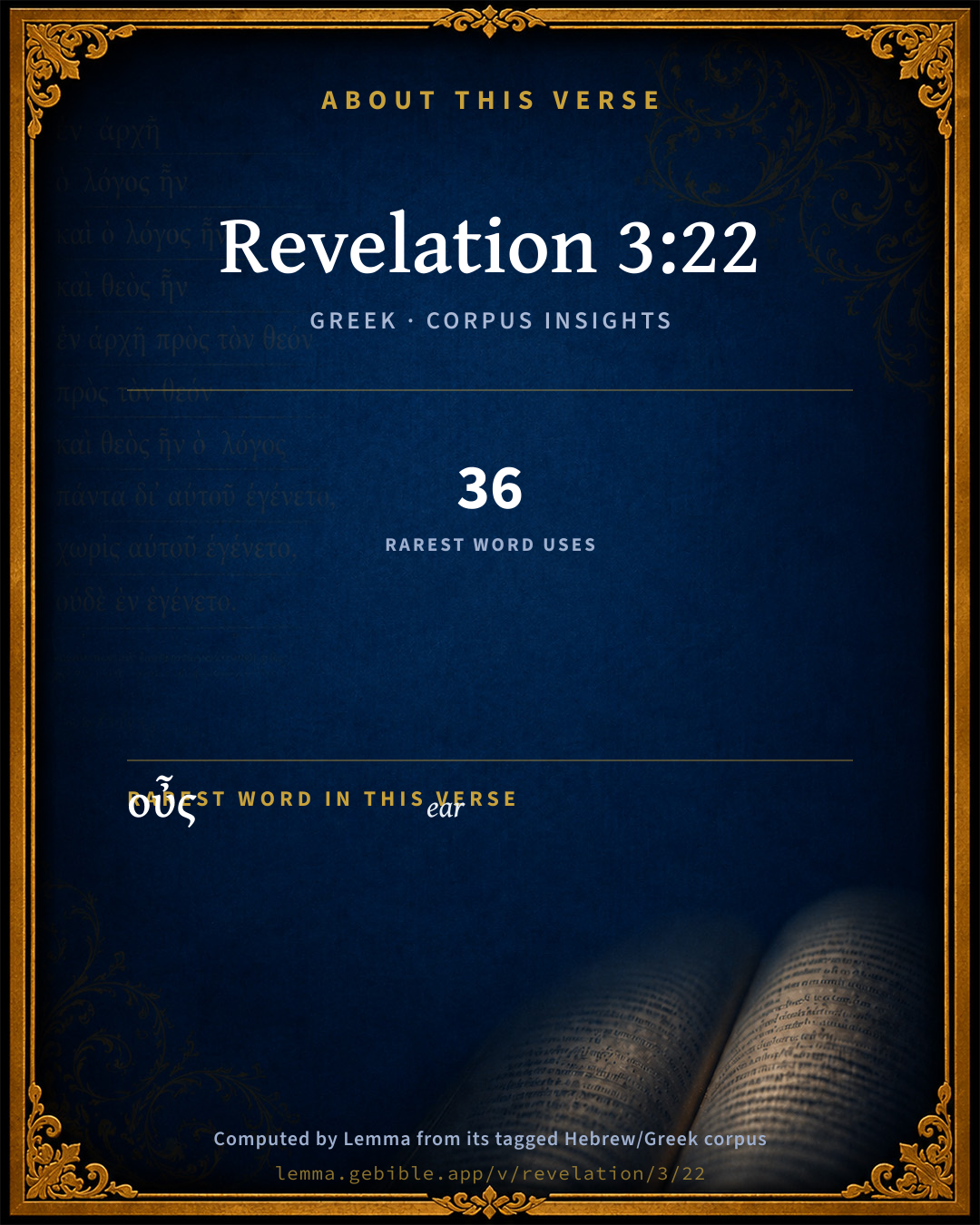
Revelation 3:22

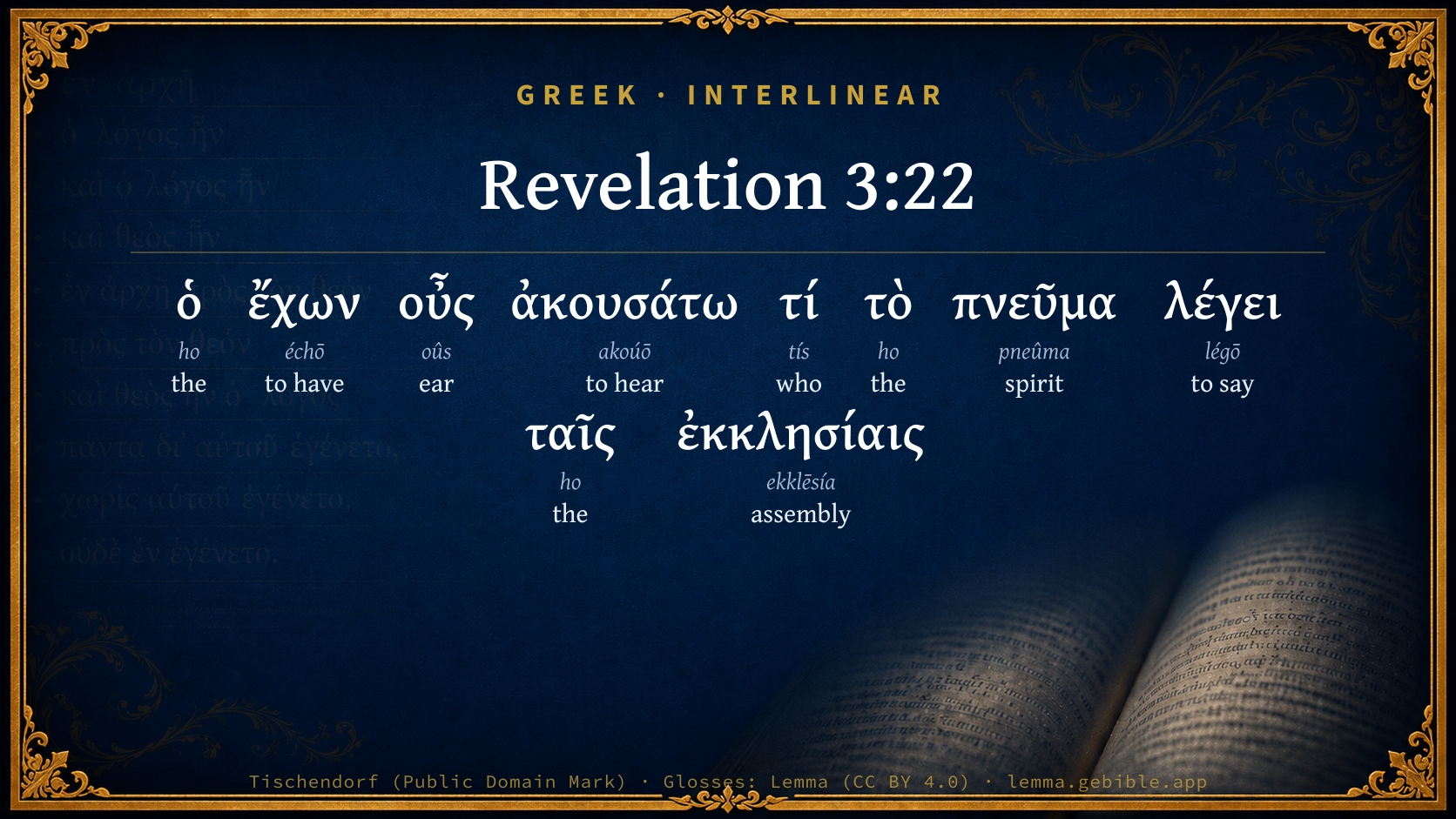
Greek (Tischendorf 8th ed.) Revelation 3:22 appears in the Greek New Testament. The text above is from the Tischendorf 8th edition. Each word links to its Strong’s number and a concise gloss. Click any word for its full Thayer’s Greek Lexicon entry.
Download image
Cite this verse

Revelation 3:22 (World English Bible). Public Domain. Lemma interlinear Bible study tool, https://lemma.gebible.app/v/revelation/3/22.

Show BibTeX & RIS
BibTeX
RIS
English Translation
He who has an ear, let him hear what the Spirit says to the assemblies."
World English Bible · Public Domain
Download a study sheet

One document with this verse’s original text, its word-by-word gloss line, the meaning frame, cross-references with their text, attributed commentary, and full source and license credits — printable, and it pastes into notes with its structure intact.

This verse Autodidact and up

Study sheet (.html) Plain text (.txt)

A passage Seminary Student

Up to 50 verses in one chapter. A passage sheet keeps up to 6 commentary sources and 12 cross-references per verse, in the order this page ranks them, and says so on the sheet whenever that leaves anything out. Ask for a single verse and you get the Autodidact verse sheet above.

Everything on this page stays free to read, with no account — the sheet is a download of what is already on screen, not access to it.

Want to remove ads? Support Godless Engineer
Compare translations 3

The same verse in 3 English versions, stacked beneath the original-language interlinear above. Click any original word for its lexicon entry.

Each is an independent rendering of the whole verse — the interlinear is not word-aligned to these translations.

Highlighted words mark where these versions differ — a whole-verse word diff, not a word-by-word alignment.

  • World English Bible Public Domain
    He who has an ear, let him hear what the Spirit says to the assemblies."
  • King James Version Public Domain
    He that hath an ear, let him hear what the Spirit saith unto the churches.
  • unfoldingWord Literal Text CC BY-SA 4.0
    Let the one having an ear hear what the Spirit is saying to the churches.”’”

unfoldingWord Literal Text — © unfoldingWord, licensed CC BY-SA 4.0. Word-aligned USFM3 via Door43 (git.door43.org/unfoldingWord/en_ult).

Versions to compare (up to 4)

3 of 4 selected

Show all 19 translations

Every available English version of this verse, each an independent rendering of the whole verse.

  • World English Bible Public Domain
    He who has an ear, let him hear what the Spirit says to the assemblies."
  • Berean Standard Bible Public Domain
    He who has an ear, let him hear what the Spirit says to the churches.”
  • Majority Standard Bible Public Domain
    He who has an ear, let him hear what the Spirit says to the churches.”
  • King James Version Public Domain
    He that hath an ear, let him hear what the Spirit saith unto the churches.
  • American Standard Version (1901) Public Domain
    He that hath an ear, let him hear what the Spirit saith to the churches.
  • Revised Version (1885) Public Domain
    He that hath an ear, let him hear what the Spirit saith to the churches.
  • Geneva Bible (1599) Public Domain
    Let him that hath an eare, heare what the Spirit saieth vnto the Churches.
  • Douay-Rheims (1899) Public Domain
    He that hath an ear, let him hear what the Spirit saith to the churches.
  • Young's Literal Translation Public Domain
    He who is having an ear -- let him hear what the Spirit saith to the assemblies.'
  • Literal Standard Version CC BY-SA 4.0
    He who is having an ear—let him hear what the Spirit says to the assemblies.”
  • Unlocked Literal Bible CC BY-SA 4.0
    Let the one who has an ear listen to what the Spirit is saying to the churches.”'”
  • unfoldingWord Literal Text CC BY-SA 4.0
    Let the one having an ear hear what the Spirit is saying to the churches.”’”
  • Darby Bible Public Domain
    He that has an ear, let him hear what the Spirit says to the assemblies.
  • World Messianic Bible Public Domain
    He who has an ear, let him hear what the Spirit says to the assemblies.”
  • Webster's Bible Public Domain
    He that hath an ear, let him hear what the Spirit saith to the churches.
  • Free Bible Version CC BY-SA 4.0
    If you have ears, listen to what the Spirit is telling the churches.”
  • Bible in Basic English Public Domain
    He who has ears, let him give ear to what the Spirit says to the churches.
  • Text-Critical English NT CC BY 4.0
    He who has an ear, let him hear what the Spirit is saying to the churches.’ ”
  • Tyndale New Testament (1534) Public Domain
    Lett him that hath eares heare what the sprete sayth vnto the congregacions.

Literal Standard Version (2020), Covenant Press — licensed CC BY-SA 4.0. Text via the HelloAO Bible API (eBible.org). Unlocked Literal Bible (unfoldingWord) — licensed CC BY-SA 4.0. Text via the HelloAO Bible API (eBible.org). unfoldingWord Literal Text — © unfoldingWord, licensed CC BY-SA 4.0. Word-aligned USFM3 via Door43 (git.door43.org/unfoldingWord/en_ult). Free Bible Version, Dr. Jonathan Gallagher — licensed CC BY-SA 4.0. Text via the HelloAO Bible API (eBible.org).

Word by word

More ways to search: Search by grammar → Find every occurrence → Compare this word →

Practice this passage: Drill this verse → Learn its vocabulary →

About this verse

These counts appear in no published source. They are computed here, from the morphology-tagged text and Lemma’s own curated glosses. What Lemma adds →

10
words
8
distinct lemmas
Revelation
section

Shared distinctive vocabulary

οὖς ear G3775 occurs in 34 verses of the Greek New Testament. Also found in:

Repetition

A word recurs within this verse:

Cross-references

5

Topical passages linked to Revelation 3:22 in the Treasury of Scripture Knowledge — connected by theme and wording, ordered by reader-vote popularity; previews shown in the World English Bible.

  • Revelation 2:7 He who has an ear, let him hear what the Spirit says to the assemblies. To him who overcomes I will give to eat of the tree of life, which is in the Paradise of my God.
  • Revelation 2:11 He who has an ear, let him hear what the Spirit says to the assemblies. He who overcomes won't be harmed by the second death.
  • Revelation 2:17 He who has an ear, let him hear what the Spirit says to the assemblies. To him who overcomes, to him I will give of the hidden manna, and I will give him a white stone, and on the stone a new name written, which no one knows but he who receives it.
  • Revelation 3:6 He who has an ear, let him hear what the Spirit says to the assemblies.
  • Revelation 3:13 He who has an ear, let him hear what the Spirit says to the assemblies.

Cross-references courtesy of OpenBible.info (CC BY 4.0).

Commentary

Notes on Revelation 3:22 from classic Christian and Jewish commentators (each source and its license shown beneath its notes). The classic Christian expositions comment on the surrounding passage and are grouped to its opening verse, so a note may address several verses; the Jewish commentaries on the Tanakh (Rashi and others) are per-verse, so they appear only where the commentator wrote on this verse.

Lemma curates 59 commentaries, every one of them public domain or Creative Commons licensed, each selected and text-cleaned for this edition rather than reprinted as found. About our sources →

The Biblical Illustrator

Joseph S. Exell

Rev_3:22

Hear what the Spirit saith unto the Churches

The Spirit speaking the Church

I.

That there are certain great moral elements by which alone we can determine the character of individuals or of communities.

II. That in proportion to the depth and vitality of holy character will be the struggle with error and with evil.

III. That the rewards and honours of the heavenly state will be determined by the struggles and the conquests of earth. (R. Ferguson, LL. D.)

Visible Churches warned

1. Let me warn all who are living only for the world to take heed what they are doing. You are enemies to Christ, though you may not know it.

2. Let me warn all formalists and self-righteous people to take heed that they are not deceived. Where is your faith? Where are your evidences of a new heart? Where is the work of the Spirit?

3. Let me warn all careless members of Churches to beware lest they trifle their souls into hell.

4. Let me warn every one who wants to be saved not to be content with the worlds standard of religion.

5. Let me warn every one who professes to be a believer in the Lord Jesus not to be content with a little religion. (Bp. Ryle.)

.

The Biblical Illustrator, edited by Joseph S. Exell (c. 1880s–1900s) — public domain. Text from a community e-Sword module.

Joseph Benson's Commentary

Rev 3:22. He that hath an ear, let him hear, &c. — This stands in the three former letters before the promise; in the four latter, after it; clearly dividing the seven into two parts; the first containing three, the last four letters. The titles given our Lord in the three former letters peculiarly respect his power after his resurrection and ascension, particularly over his church; those in the four latter, his divine glory and unity with the Father and the Holy Spirit. Again, this word being placed before the promises in the three former letters, excludes the false apostles at Ephesus, the false Jews at Smyrna, and the partakers with the heathen at Pergamos, from having any share therein. In the four latter being placed after them, it leaves the promises immediately joined with Christ’s address to the angel of the church, to show that the fulfilling of these was near: whereas the others reach beyond the end of the world. It should be observed, that the overcoming or victory (to which alone these peculiar promises are annexed) is not the ordinary victory obtained by every believer, but a special victory obtained over great and peculiar temptations by those that are strong in faith. “Such,” says Bishop Newton on the close of these chapters, “is the state and condition of these seven once glorious and flourishing churches; and there cannot be a stronger proof of the truth of prophecy, nor a more effectual warning to other Christians. ‘These objects,’ Wheeler justly observes, ‘ought to make us, who yet enjoy the divine mercies, to tremble, and earnestly contend to find out from whence we are fallen, and do daily fall from bad to worse; that God is a God of purer eyes than to behold iniquity; and seeing the axe is thus long since put to the root of the tree, should it not make us repent and turn to God, lest we likewise perish? We see here what destruction the Lord hath brought upon the earth. But it is the Lord’s doing: and thence we may reap no small advantage by considering how just he is in all his judgments, and faithful in all his promises.’ We may truly say, (1Co 10:11-12,) that all these things happened unto them for ensamples; and they are written for our admonition, upon whom the ends of the world are come. Wherefore, let him that thinketh he standeth take heed lest he fall.”

Joseph Benson's Commentary on the Old and New Testaments (1811–1818) — public domain. Text from a community e-Sword module.

Adam Clarke's Commentary

Verse 22. He that hath an ear, let him hear] Mr. Wesley has a very judicious note on the conclusion of this chapter, and particularly on this last verse, He that hath an ear, c. "This (counsel) stands in three former letters before the promise, in the four latter after it clearly dividing the seven into two parts, the first containing three, the last four letters. The titles given our Lord in the three former letters peculiarly respect his power after his resurrection and ascension, particularly over his Church; those in the four latter, his Divine glory and unity with the Father and the Holy Spirit. Again, this word being placed before the promises in the three former letters excludes the false apostles at Ephesus, the false Jews at Smyrna, and the partakers with the heathens at Pergamos, from having any share therein. In the four latter, being placed after them, it leaves the promises immediately joined with Christ's address to the angel of the Church, to show that the fulfilling of these was near; whereas the others reach beyond the end of the world. It should be observed that the overcoming or victory (to which alone these peculiar promises are annexed) is not the ordinary victory obtained by every believer, but a special victory obtained over great and peculiar temptations, by those that are strong in faith."

The latest account we have of the state of the seven Asiatic Churches is in a letter from the Rev. Henry Lindsay, chaplain to the British embassy at Constantinople, to a member of the British and Foreign Bible Society, by which society Mr. Lindsay had been solicited to distribute some copies of the New Testament in modern Greek among the Christians in Asia Minor. The following is his communication, dated:-

"Constantinople, January 10, 1816.

"When I last wrote to you, I was on the point of setting out on a short excursion into Asia Minor. Travelling hastily, as I was constrained to do from the circumstances of my situation, the information I could procure was necessarily superficial and unsatisfactory. As, however, I distributed the few books of the society which I was able to carry with me, I think it necessary to give some account of the course I took:

"1. The regular intercourse of England with SMYRNA will enable you to procure as accurate intelligence of its present state as any I can pretend to offer. From the conversations I had with the Greek bishop and his clergy, as well as various well-informed individuals, I am led to suppose that, if the population of Smyrna be estimated at one hundred and forty thousand inhabitants, there are from fifteen to twenty thousand Greeks, six thousand Armenians, five thousand Catholics, one hundred and forty Protestants, and eleven thousand Jews.

"2. After Smyrna, the first place I visited was EPHESUS, or rather (as the site is not quite the same) Aiasalick, which consists of about fifteen poor cottages. I found there but three Christians, two brothers who keep a small shop, and a gardener. They are all three Greeks, and their ignorance is lamentable indeed. In that place, which was blessed so long with an apostle's labours, and those of his zealous assistants are Christians who have not so much as heard of that apostle, or seem only to recognize the name of Paul as one in the calendar of their saints. One of them I found able to read a little, and left with him the New Testament, in ancient and modern Greek, which he expressed a strong desire to read, and promised me he would not only study it himself, but lend it to his friends in the neighbouring villages.

"3. My next object was to see LAODICEA; in the road to this is Guzel-hisar, a large town, with one church, and about seven hundred Christians. In conversing with the priests here, I found them so little acquainted with the Bible, or even the New Testament in an entire form, that they had no distinct knowledge of the books it contained beyond the four gospels, but mentioned them indiscriminately with various idle legends and lives of saints. I have sent thither three copies of the modern Greek Testament since my return. About three miles from Laodicea is Denizli, which has been styled (but I am inclined to think erroneously) the ancient Colosse; it is a considerable town, with about four hundred Christians, Greeks, and Armenians, each of whom has a church. I regret however to say that here also the most extravagant tales of miracles, and fabulous accounts of angels, saints, and relics, had so usurped the place of the Scriptures as to render it very difficult to separate in their minds Divine truths from human inventions. I felt that here that unhappy time was come when men should 'turn away their ears from the truth, and be turned unto fables.' I had with me some copies of the gospels in ancient Greek which I distributed here, as in some other places through which I had passed. Eski-hisar, close to which are the remains of ancient Laodicea, contains about fifty poor inhabitants, in which number are but two Christians, who live together in a small mill; unhappily neither could read at all; the copy therefore of the New Testament, which I intended for this Church, I left with that of Denizli, the offspring and poor remains of Laodicea and Colosse. The prayers of the mosque are the only prayers which are heard near the ruins of Laodicea, on which the threat seems to have been fully executed in its utter rejection as a Church.

"4. I left it for PHILADELPHIA, now Alah-shehr. It was gratifying to find at last some surviving fruits of early zeal; and here, at least, whatever may be the loss of the spirit of Christianity, there is still the form of a Christian Church; this has been kept from the 'hour of temptation,' which came upon all the Christian world. There are here about one thousand Christians, chiefly Greeks, who for the most part speak only Turkish; there are twenty-five places of public worship, five of which are large regular churches; to these there is a resident bishop, with twenty inferior clergy. A copy of the modern Greek Testament was received by the bishop with great thankfulness.

"5. I quitted Alah-shehr, deeply disappointed at the statement I received there of the Church of SARDIS. I trusted that in its utmost trials it would not have been suffered to perish utterly, and I heard with surprise that not a vestige of it remained. With what satisfaction then did I find on the plains of Sardis a small Church establishment; the few Christians who dwell around modern Sart were anxious to settle there and erect a church, as they were in the habit of meeting at each other's houses for the exercise of religion. From this design they were prohibited by Kar Osman Oglu, the Turkish governor of the district; and in consequence, about five years ago they built a church upon the plain, within view of ancient Sardis, and there they maintain a priest. The place has gradually risen into a little village, now called Tatar-keny; thither the few Christians of Sart, who amount to seven, and those in its immediate vicinity, resort for public worship, and form together a congregation of about forty. There appears then still a remnant, 'a few names even in Sardis,' which have been preserved. I cannot repeat the expressions of gratitude with which they received a copy of the New Testament in a language with which they were familiar. Several crowded about the priest to hear it on the spot, and I left them thus engaged.

"6. Ak-hisar, the ancient THYATIRA, is said to contain about thirty thousand inhabitants, of whom three thousand are Christians, all Greeks except about two hundred Armenians. There is, however, but one Greek church and one Armenian. The superior of the Greek Church to whom I presented the Romaic Testament esteemed it so great a treasure that he earnestly pressed me, if possible, to spare another, that one might be secured to the Church and free from accidents, while the other went round among the people for their private reading. I have, therefore, since my return hither, sent him four copies.

"7. The Church of PERGAMOS, in respect to numbers, may be said to flourish still in Bergamo. The town is less than Ak-hisar, but the number of Christians is about as great, the proportion of Armenians to Greeks nearly the same, and each nation also has one church. The bishop of the district, who occasionally resides there, was at that time absent, and I experienced with deep regret that the resident clergy were totally incapable of estimating the gift I intended them; I therefore delivered the Testament to the lay vicar of the bishop at his urgent request, he having assured me that the bishop would highly prize so valuable an acquisition to the Church. He seemed much pleased that the benighted state of his nation had excited the attention of strangers.

"Thus, sir, I have left at least one copy of the unadulterated word of God at each of the seven Asiatic Churches of the Apocalypse, and I trust they are not utterly thrown away; but whoever may plant, it is God only who can give the increase, and from his goodness we may hope they will in due time bring forth fruit, 'some thirty, some sixty, and some a hundred fold.'

"HENRY LINDSAY."

In my note on Ac 19:24, I have given an account of the celebrated temple of Diana at Ephesus, to which building, called one of the seven wonders of the world, St. Paul is supposed to allude in his epistle to this Church, particularly at Eph 3:18, where I have again given the measurement of this temple.

Adam Clarke's Commentary on the Bible (1810–1826) — public domain. Text from a community e-Sword/MySword module.

Trapp's Complete Commentary

John Trapp

See Rev 4:1

John Trapp, A Commentary or Exposition upon All the Books of the Old and New Testament (1647–1656) — public domain. Text from a community e-Sword module.

Albert Barnes' Notes on the Bible

He that hath an ear ... - See the notes on Rev 2:7.

This closes the epistolary part of this book, and the “visions” properly commence with the next chapter. Two remarks may be made in the conclusion of this exposition:

(1) The first relates to the truthfulness of the predictions in these epistles. is an illustration of that truthfulness, and of the present correspondence of the condition of those churches with what the Saviour said to John they would be, the following striking passage may be introduced from Mr. Gibbon. It occurs in his description of the conquests of the Turks (“Decline and Fall,” iv. 260, 261). “Two Turkish chieftains, Sarukhan and Aidin left their names to their conquests, and their conquests to their posterity. The captivity or ruin of the seven churches of Asia was consummated; and the barbarous lords of Ionia and Lydia still trample on the monuments of classic and Christian antiquity. In the loss of Ephesus, the Christians deplored the fall of the first angel, the extinction of the first candlestick of the Revelations: the desolation is complete; and the temple of Diana, or the church of Mary, will equally elude the search of the curious traveler. The circus and three stately theaters of Laodicea are now populated with wolves and foxes; Sardis is reduced to a miserable village; the God of Muhammed, without a rival or a son, is invoked in the mosques of Thyatira and Pergamos; and the populousness of Smyrna is supported by the foreign trade of Franks and Armenians. Philadelphia alone has been saved by prophecy or courage. At a distance from the sea, forgotten by the emperors, encompassed on all sides by the Turks, her valiant citizens defended their religion and freedom above fourscore years, and at length capitulated with the proudest of the Ottomans. Among the Greek colonies and churches of Asia, Philadelphia is still erect, a column in a scene of ruins; a pleasing example that the paths of honor and safety may sometimes be the same.”

(2) The second remark relates to the applicability of these important truths to us. There is perhaps no part of the New Testament more searching than these brief epistles to the seven churches; and though those to whom they were addressed have long since passed away, and the churches have long since become extinct; though darkness, error, and desolation have come over the places where these churches once stood, yet the principles laid down in these epistles still live, and they are full of admonition to Christians in all ages and all lands. It is a consideration of as much importance to us as it was to these churches, that the Saviour now knows our works; that he sees in the church, and in any individual, all that there is to commend and all that there is to reprove; that he has power to reward or punish now as he had then; that the same rules in apportioning rewards and punishments will still be acted on; that he who overcomes the temptations of the world will find an appropriate reward; that those who live in sin must meet with the proper recompense, and that those who are lukewarm in his service will be spurned with unutterable loathing. His rebukes are awful; but his promises are full of tenderness and kindness. While they who have embraced error, and they who are living in sin, have occasion to tremble before him, they who are endeavoring to perform their duty may find in these epistles enough to cheer their hearts, and to animate them with the hope of final victory, and of the most ample and glorious reward.

Albert Barnes' Notes on the Bible (1834–1885) — public domain. Text from a community e-Sword/MySword module.

Matthew Poole's English Annotations

We have had this in the conclusion of every epistle before: see Rev 2:7,11,17,29, and in Rev 3:6,13.

Those who make these churches typical of all Christian churches, from the time John had this Revelation, and prophetical of the complexion of the Christian churches in all ages, say, that the church of Laodicea typifieth the churches towards the end of the world till Christ cometh; but this necessitateth them to think there shall be no such pure and glorious state of the church just before the end of the world, as many believe there shall be, but that the state thereof shall grow yet worse and worse, of a Laodicean temper, so as when Christ cometh he shall hardly find faith on the earth.

For my part, I could allow the seven epistles to be typical and prophetical, but can by no means judge them to be purely prophetical; believing there were such churches when John wrote, and that their complexion is in the first place described in these epistles; though possibly, as face answers face in a glass, so succeeding churches have answered, and shall answer, the face of these churches, even to the last day.

This chapter concludes John’s first vision. In the following chapters we have a representation in visions of what was to happen in the world more remarkably, with reference to the church of God, from the year 95, to the end of the world.

There are very different opinions about the epocha, or the time, when the visions began to be fulfilled. My opinion is, it began soon after John had the vision; for it is twice said, Rev 1:1; 22:6, that the visions were to be about things that shall come to pass, (not that were come to pass), and that shortly; but we cannot fix the certain year, which maketh the interpretation difficult.

There are also divers opinions how far in this book the revelations go that concern the state of the church under Rome pagan, and where they begin that foretell the state of the church under antichrist. But of these we shall speak more particularly as we go along with the several chapters.

Matthew Poole's English Annotations on the Holy Bible (1683–1685) — public domain. Text from a community e-Sword/MySword module.

Whedon's Commentary on the Bible

Daniel D. Whedon

22. He that hath an ear—The last clear ring of this refrain sounding through the world and through the ages.

Daniel D. Whedon (gen. ed.), Commentary on the Old and New Testaments (1874–1909) — public domain. Text from a community e-Sword module.

The Pulpit Commentary

He that hath an ear, let him hear what the Spirit saith unto the Churches. The seven messages were not merely separate admonitions addressed only to each particular Church, but all the epistles were meant for all the seven Churches, and, after them, for the universal Church. Each Church had an especial failing brought more emphatically before it; but still the seven warnings are one whole, for the edification of all. As it behoves the individual Christian to avoid and repent of all sin, and yet to fix his attention on the cure of some besetting sin to which he is peculiarly liable, so these messages, though intended to be read by all, and heeded by all, place vividly before each Church its besetting sin, which more particularly requires attention. And as the sins to be avoided are to be avoided by all, so the separate rewards arc promised to all who overcome. They are, therefore, not really distinct rewards, but rather different phases and views of one great whole, which shall be enjoyed in its entirety by those who have struggled victoriously with the trials and temptations of the world.

The Pulpit Commentary (1880–1919), ed. H.D.M. Spence-Jones & Joseph S. Exell — public domain. Text from a community e-Sword module.

John Wesley's Explanatory Notes

He that hath an ear, let him hear, &c. - This stands in the three former letters before the promise; in the four latter, after it; clearly dividing the seven into two parts; the first containing three, the last, four letters. The titles given our Lord in the three former letters peculiarly respect his power after his resurrection and ascension, particularly over his church; those in the four latter, his divine glory, and unity with the Father and the Holy Spirit. Again, this word being placed before the promises in the three former letters, excludes the false apostles at Ephesus, the false Jews at Smyrna, and the partakers with the heathens at Pergamos, from having any share therein. In the four latter, being placed after them, it leaves the promises immediately joined with Christ's address to the angel of the church, to show that the fulfilling of these was near; whereas the others reach beyond the end of the world. It should be observed, that the overcoming, or victory, (to which alone these peculiar promises are annexed,) is not the ordinary victory obtained by every believer; but a special victory over great and peculiar temptations, by those that are strong in faith.

John Wesley, Explanatory Notes Upon the Whole Bible (1754–1765) — public domain. Text via the GEBible commentary corpus.

Burkitt's Expository Notes on the New Testament

William Burkitt

Thus Christ shuts up this, as he did all the preceding epistles before, with a repeated exhortation to all Christians to the end of the world, to hear, read, attend unto, and observe, all the cautions and warnings, all the reproofs and counsels, all the promises and threatenings, contained in this and the other epistles, as matters that do greatly concern all Christians to understand and know, Let him that hath an ear, hear.

William Burkitt's Expository Notes on the New Testament (1700–1703) — public domain. Text from a community e-Sword module.

Alford’s Greek Testament

Henry Alford

22.] See on ch. 2:7.

From this point begins the Revelation proper, extending to the end of the book. And herein we have a first great portion, embracing chapp. 4-11., the opening of the seals and the sounding of the trumpets. But preparatory to both these series of revelations, we have described to us in chapp. 4:5, the heavenly scenery which furnishes the local ground for these visions. Of these, chap. 4 is properly the scene itself: chap. 5 being a further unfolding of its details with a view to the vision of the seals which is to follow. So that we have,—

Henry Alford, The Greek Testament (1849–1861) — public domain. Text from a community e-Sword module.

Lesson kit

Teaching starters — assembled from the data on this page, not authored interpretation. Every prompt links to the verse data it draws on. Edit before teaching.

Revelation, in the Revelation, opens this verse with 10 words (8 distinct Greek lemmas). Its most distinctive word is oûs (“ear”). A historical commentator’s framing appears above. Read the whole chapter for the surrounding context.

Discussion questions

  1. What does “ear” (oûs) contribute to the verse as a whole?
  2. Matthew 10:27 shares the word «ear» with this verse. How do the two illuminate each other?
  3. “the” occurs 3× in this one verse. What is the effect of the repetition?
  4. These translations render this verse differently; the difference is in the English rendering, not the original. What questions does that raise?
  5. Reading how The Biblical Illustrator and Joseph Benson's Commentary read this verse, where do the two commentators agree and where do they part?

Things to notice

  • These translations choose different wording for 9 words in this verse.
  • “the” occurs 3× in this single verse.
  • 8 distinct Greek lemmas span 10 words in this verse.

Reading settings

Reading text

Shown beneath each verse's original-language words.

Old Testament
Old Testament edition

Read the OT as the Masoretic Hebrew (MT) or the Greek Septuagint (LXX).

English shown for the Greek Septuagint (in the Hebrew ↔ Greek comparison).

Comparing translations? Open the Compare panel on any verse page to stack up to four side by side.