Revelation 5:13

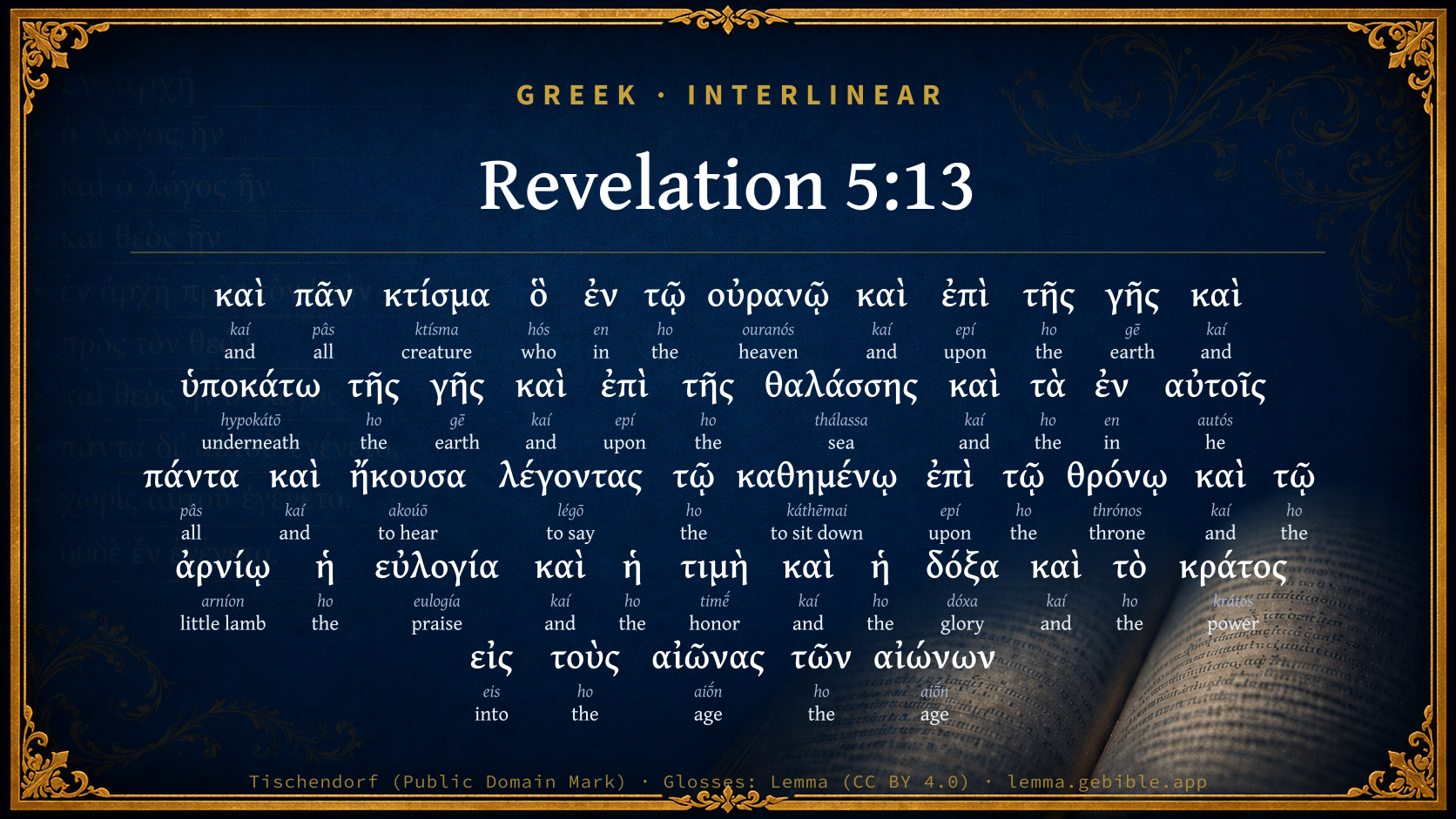
Greek (Tischendorf 8th ed.) Revelation 5:13 appears in the Greek New Testament. The text above is from the Tischendorf 8th edition. Each word links to its Strong’s number and a concise gloss. Click any word for its full Thayer’s Greek Lexicon entry.
Download image
Cite this verse

Revelation 5:13 (World English Bible). Public Domain. Lemma interlinear Bible study tool, https://lemma.gebible.app/v/revelation/5/13.

Show BibTeX & RIS
BibTeX
RIS
English Translation
I heard every created thing which is in heaven, on the earth, under the earth, on the sea, and everything in them, saying, "To him who sits on the throne, and to the Lamb be the blessing, the honor, the glory, and the dominion, forever and ever! Amen!"
World English Bible · Public Domain
Download a study sheet

One document with this verse’s original text, its word-by-word gloss line, the meaning frame, cross-references with their text, attributed commentary, and full source and license credits — printable, and it pastes into notes with its structure intact.

This verse Autodidact and up

Study sheet (.html) Plain text (.txt)

A passage Seminary Student

Up to 50 verses in one chapter. A passage sheet keeps up to 6 commentary sources and 12 cross-references per verse, in the order this page ranks them, and says so on the sheet whenever that leaves anything out. Ask for a single verse and you get the Autodidact verse sheet above.

Everything on this page stays free to read, with no account — the sheet is a download of what is already on screen, not access to it.

Want to remove ads? Support Godless Engineer
Compare translations 3

The same verse in 3 English versions, stacked beneath the original-language interlinear above. Click any original word for its lexicon entry.

Each is an independent rendering of the whole verse — the interlinear is not word-aligned to these translations.

Highlighted words mark where these versions differ — a whole-verse word diff, not a word-by-word alignment.

  • World English Bible Public Domain
    I heard every created thing which is in heaven, on the earth, under the earth, on the sea, and everything in them, saying, "To him who sits on the throne, and to the Lamb be the blessing, the honor, the glory, and the dominion, forever and ever! Amen!"
  • King James Version Public Domain
    And every creature which is in heaven, and on the earth, and under the earth, and such as are in the sea, and all that are in them, heard I saying, Blessing, and honour, and glory, and power, be unto him that sitteth upon the throne, and unto the Lamb for ever and ever.
  • unfoldingWord Literal Text CC BY-SA 4.0
    And I heard every creature in heaven and on earth and under the earth and on the sea and everything in them saying, “To the one sitting on the throne and to the Lamb praise and honor and glory and power to the ages of the ages.”

unfoldingWord Literal Text — © unfoldingWord, licensed CC BY-SA 4.0. Word-aligned USFM3 via Door43 (git.door43.org/unfoldingWord/en_ult).

Versions to compare (up to 4)

3 of 4 selected

Show all 19 translations

Every available English version of this verse, each an independent rendering of the whole verse.

  • World English Bible Public Domain
    I heard every created thing which is in heaven, on the earth, under the earth, on the sea, and everything in them, saying, "To him who sits on the throne, and to the Lamb be the blessing, the honor, the glory, and the dominion, forever and ever! Amen!"
  • Berean Standard Bible Public Domain
    And I heard every creature in heaven and on earth and under the earth and in the sea, and all that is in them, saying: “To Him who sits on the throne and to the Lamb be praise and honor and glory and power forever and ever!”
  • Majority Standard Bible Public Domain
    And I heard every creature in heaven and on earth and under the earth and in the sea, and all that is in them, saying: “To Him who sits on the throne and to the Lamb be praise and honor and glory and power forever and ever. Amen!”
  • King James Version Public Domain
    And every creature which is in heaven, and on the earth, and under the earth, and such as are in the sea, and all that are in them, heard I saying, Blessing, and honour, and glory, and power, be unto him that sitteth upon the throne, and unto the Lamb for ever and ever.
  • American Standard Version (1901) Public Domain
    And every created thing which is in the heaven, and on the earth, and under the earth, and on the sea, and all things are in them, heard I saying, Unto him that sitteth on the throne, and unto the Lamb, `be' the blessing, and the honor, and the glory, and the dominion, for ever and ever.
  • Revised Version (1885) Public Domain
    And every created thing which is in the heaven, and on the earth, and under the earth, and on the sea, and all things that are in them, heard I saying, Unto him that sitteth on the throne, and unto the Lamb, be the blessing, and the honour, and the glory, and the dominion, for ever and ever.
  • Geneva Bible (1599) Public Domain
    And al the creatures which are in heauen, and on the earth, and vnder the earth, and in the sea, and al that are in them, heard I, saying, Praise, and honour, and glory, and power be vnto him, that sitteth vpon the throne, and vnto the Lambe for euermore.
  • Douay-Rheims (1899) Public Domain
    And every creature, which is in heaven, and on the earth, and under the earth, and such as are in the sea, and all that are in them: I heard all saying: To him that sitteth on the throne, and to the Lamb, benediction, and honour, and glory, and power, for ever and ever.
  • Young's Literal Translation Public Domain
    and every creature that is in the heaven, and in the earth, and under the earth, and the things that are upon the sea, and the all things in them, heard I saying, `To Him who is sitting upon the throne, and to the Lamb, `is' the blessing, and the honour, and the glory, and the might -- to the ages of the ages!'
  • Literal Standard Version CC BY-SA 4.0
    And every creature that is in Heaven, and on the earth, and under the earth, and the things that are on the sea, and all things in them, I heard saying, “To Him who is sitting on the throne and to the Lamb—the blessing, and the honor, and the glory, and the might—through the ages of the ages!”
  • Unlocked Literal Bible CC BY-SA 4.0
    I heard every created thing that was in heaven and on the earth and under the earth and on the sea—everything in them—saying, “To the one who sits on the throne and to the Lamb be praise, honor, glory, and the power to rule, forever and ever.”
  • unfoldingWord Literal Text CC BY-SA 4.0
    And I heard every creature in heaven and on earth and under the earth and on the sea and everything in them saying, “To the one sitting on the throne and to the Lamb praise and honor and glory and power to the ages of the ages.”
  • Darby Bible Public Domain
    And every creature which is in the heaven and upon the earth and under the earth, and [those that are] upon the sea, and all things in them, heard I saying, To him that sits upon the throne, and to the Lamb, blessing, and honour, and glory, and might, to the ages of ages.
  • World Messianic Bible Public Domain
    I heard every created thing which is in heaven, on the earth, under the earth, on the sea, and everything in them, saying, “To him who sits on the throne and to the Lamb be the blessing, the honor, the glory, and the dominion, forever and ever! Amen!”
  • Webster's Bible Public Domain
    And every creature which is in heaven, and on the earth, and under the earth, and such as are in the sea, and all that are in them, I heard saying, Blessing, and honor, and glory, and power, be to him that sitteth upon the throne, and to the Lamb for ever and ever.
  • Free Bible Version CC BY-SA 4.0
    Then I heard every creature in heaven, on earth, and under the earth, in the sea—every creature everywhere—replying: “To the one who sits on the throne, and to the Lamb be blessing, honor, glory, and authority, for ever and ever.”
  • Bible in Basic English Public Domain
    And to my ears came the voice of everything in heaven and on earth and under the earth and in the sea, and of all things which are in them, saying, To him who is seated on the high seat, and to the Lamb, may blessing and honour and glory and power be given for ever and ever.
  • Text-Critical English NT CC BY 4.0
    Then I heard every creature in heaven, on earth, under the earth, in the sea, and all that is in them, saying, “To him who sits on the throne and to the Lamb, be blessing and honor, glory and power, forever and ever! Amen.”
  • Tyndale New Testament (1534) Public Domain
    And all creatures which are in heven and on the erth and vnder the erth and in the see and all that are in them herd I sayinge: blyssinge honour glory and power be vnto hym that sytteth apon the seate and vnto the lambe for ever more.

Literal Standard Version (2020), Covenant Press — licensed CC BY-SA 4.0. Text via the HelloAO Bible API (eBible.org). Unlocked Literal Bible (unfoldingWord) — licensed CC BY-SA 4.0. Text via the HelloAO Bible API (eBible.org). unfoldingWord Literal Text — © unfoldingWord, licensed CC BY-SA 4.0. Word-aligned USFM3 via Door43 (git.door43.org/unfoldingWord/en_ult). Free Bible Version, Dr. Jonathan Gallagher — licensed CC BY-SA 4.0. Text via the HelloAO Bible API (eBible.org).

Word by word

More ways to search: Search by grammar → Find every occurrence → Compare this word →

Practice this passage: Drill this verse → Learn its vocabulary →

κτίσμα
ktísma
G2938
“creature”
Noun, Accusative, Singular, Neuter
Part of Speech
Noun
Case
Accusative
Number
Singular
Gender
Neuter
Full Thayer's Definition

Origin: from G2936

TDNT: 19:40,5

1. thing founded 2. created thing
  1. καὶ kaí G2532 “and” Conjunction
  2. πᾶν pâs G3956 “all” Adjective, Accusative, Singular, Neuter
  3. ὃ hós G3739 “who” Relative pronoun, Nominative, Singular, Neuter
  4. ἐν en G1722 “in” Preposition
  5. τῷ ho G3588 “the” Article, Dative, Singular, Masculine
  6. οὐρανῷ ouranós G3772 “heaven” Noun, Dative, Singular, Masculine
  7. καὶ kaí G2532 “and” Conjunction
  8. ἐπὶ epí G1909 “upon” Preposition
  9. τῆς ho G3588 “the” Article, Genitive, Singular, Feminine
  10. γῆς gē G1093 “earth” Noun, Genitive, Singular, Feminine
  11. καὶ kaí G2532 “and” Conjunction
  12. ὑποκάτω hypokátō G5270 “underneath” Adverb
  13. τῆς ho G3588 “the” Article, Genitive, Singular, Feminine
  14. γῆς gē G1093 “earth” Noun, Genitive, Singular, Feminine
  15. καὶ kaí G2532 “and” Conjunction
  16. ἐπὶ epí G1909 “upon” Preposition
  17. τῆς ho G3588 “the” Article, Genitive, Singular, Feminine
  18. θαλάσσης thálassa G2281 “sea” Noun, Genitive, Singular, Feminine
  19. καὶ kaí G2532 “and” Conjunction
  20. τὰ ho G3588 “the” Article, Accusative, Plural, Neuter
  21. ἐν en G1722 “in” Preposition
  22. αὐτοῖς autós G846 “he” Personal pronoun, Dative, Plural, Masculine
  23. πάντα pâs G3956 “all” Adjective, Accusative, Plural, Neuter
  24. καὶ kaí G2532 “and” Conjunction
  25. ἤκουσα akoúō G191 “to hear” Verb, Aorist, Active, Indicative, 1st person, Singular
  26. λέγοντας légō G3004 “to say” Verb, Present, Active, Participle, Accusative, Plural, Masculine
  27. τῷ ho G3588 “the” Article, Dative, Singular, Masculine
  28. καθημένῳ káthēmai G2521 “to sit down” Verb, Present, Middle or Passive deponent, Participle, Dative, Singular, Masculine
  29. ἐπὶ epí G1909 “upon” Preposition
  30. τῷ ho G3588 “the” Article, Dative, Singular, Masculine
  31. θρόνῳ thrónos G2362 “throne” Noun, Dative, Singular, Masculine
  32. καὶ kaí G2532 “and” Conjunction
  33. τῷ ho G3588 “the” Article, Dative, Singular, Neuter
  34. ἀρνίῳ arníon G721 “little lamb” Noun, Dative, Singular, Neuter
  35. ἡ ho G3588 “the” Article, Nominative, Singular, Feminine
  36. εὐλογία eulogía G2129 “praise” Noun, Nominative, Singular, Feminine
  37. καὶ kaí G2532 “and” Conjunction
  38. ἡ ho G3588 “the” Article, Nominative, Singular, Feminine
  39. τιμὴ timḗ G5092 “honor” Noun, Nominative, Singular, Feminine
  40. καὶ kaí G2532 “and” Conjunction
  41. ἡ ho G3588 “the” Article, Nominative, Singular, Feminine
  42. δόξα dóxa G1391 “glory” Noun, Nominative, Singular, Feminine
  43. καὶ kaí G2532 “and” Conjunction
  44. τὸ ho G3588 “the” Article, Nominative, Singular, Neuter
  45. κράτος krátos G2904 “power” Noun, Nominative, Singular, Neuter
  46. εἰς eis G1519 “into” Preposition
  47. τοὺς ho G3588 “the” Article, Accusative, Plural, Masculine
  48. αἰῶνας aiṓn G165 “age” Noun, Accusative, Plural, Masculine
  49. τῶν ho G3588 “the” Article, Genitive, Plural, Masculine
  50. αἰώνων aiṓn G165 “age” Noun, Genitive, Plural, Masculine

About this verse

These counts appear in no published source. They are computed here, from the morphology-tagged text and Lemma’s own curated glosses. What Lemma adds →

51
words
23
distinct lemmas
Revelation
section

Notable vocabulary

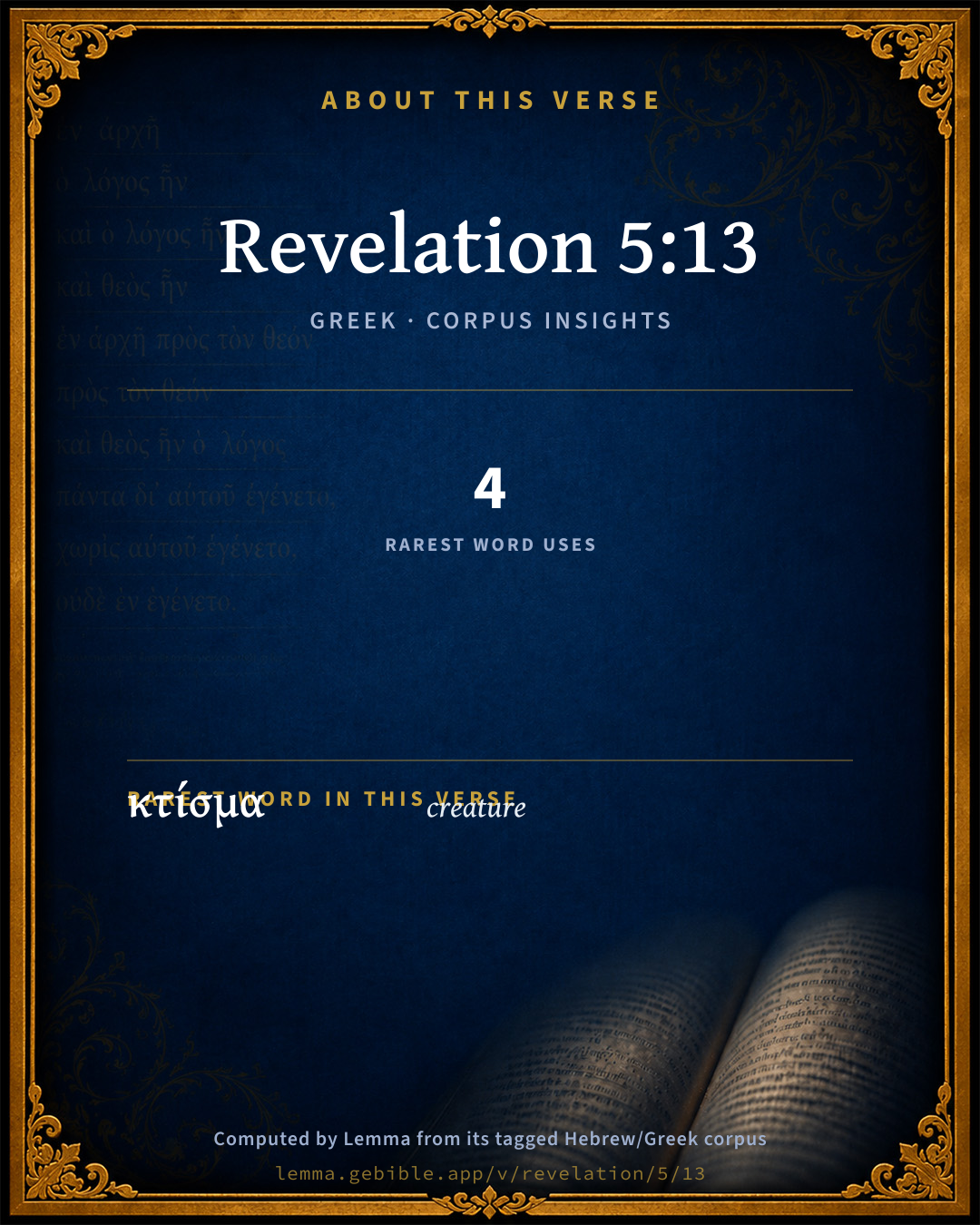
The rarest word here is κτίσμα creature G2938 — appearing just 4 times in the whole Greek New Testament.

Shared distinctive vocabulary

κτίσμα creature G2938 occurs in 4 verses of the Greek New Testament. Also found in:

Repetition

Words recur within this verse:

Cross-references

26

Topical passages linked to Revelation 5:13 in the Treasury of Scripture Knowledge — connected by theme and wording, ordered by reader-vote popularity; previews shown in the World English Bible.

  • Philippians 2:10 that at the name of Jesus every knee should bow, of those in heaven, those on earth, and those under the earth,
  • 1 Chronicles 29:11 Yours, Yahweh, is the greatness, the power, the glory, the victory, and the majesty: for all that is in the heavens and in the earth is yours. Yours is the kingdom, Yahweh, and you are exalted as head above all.
  • Psalms 148:2–13 Praise him, all his angels! Praise him, all his host!
  • Revelation 5:12 saying with a loud voice, "Worthy is the Lamb who has been killed to receive the power, wealth, wisdom, strength, honor, glory, and blessing!"
  • Psalms 96:11–13 Let the heavens be glad, and let the earth rejoice. Let the sea roar, and it's fullness!
  • Isaiah 42:10 Sing to Yahweh a new song, and his praise from the end of the earth; you who go down to the sea, and all that is therein, the isles, and the inhabitants of it.
  • Romans 11:36 For of him, and through him, and to him, are all things. To him be the glory for ever! Amen.
  • 1 Peter 5:11 To him be the glory and the power forever and ever. Amen.
  • Revelation 5:3 No one in heaven above, or on the earth, or under the earth, was able to open the book, or to look in it.
  • Luke 2:14 "Glory to God in the highest, On earth peace, good will toward men."
  • Revelation 6:16 They told the mountains and the rocks, "Fall on us, and hide us from the face of him who sits on the throne, and from the wrath of the Lamb,
  • Isaiah 24:14 These shall lift up their voice, they shall shout; for the majesty of Yahweh they cry aloud from the sea.
  • Romans 9:5 of whom are the fathers, and from whom is Christ as concerning the flesh, who is over all, God, blessed forever. Amen.
  • Romans 16:27
  • Jude 1:25 to God our Savior, who alone is wise, be glory and majesty, dominion and power, both now and forever. Amen.
  • Revelation 5:6 I saw in the midst of the throne and of the four living creatures, and in the midst of the elders, a Lamb standing, as though it had been slain, having seven horns, and seven eyes, which are the seven Spirits of God, sent out into all the earth.
  • Revelation 7:9–10 After these things I looked, and behold, a great multitude, which no man could number, out of every nation and of all tribes, peoples, and languages, standing before the throne and before the Lamb, dressed in white robes, with palm branches in their hands.
  • Ephesians 3:21 to him be the glory in the assembly and in Christ Jesus to all generations forever and ever. Amen.
  • 1 Peter 4:11 If any man speaks, let it be as it were oracles of God. If any man serves, let it be as of the strength which God supplies, that in all things God may be glorified through Jesus Christ, to whom belong the glory and the dominion forever and ever. Amen.
  • Revelation 1:6 and he made us to be a Kingdom, priests to his God and Father; to him be the glory and the dominion forever and ever. Amen.
  • Revelation 4:2–3 Immediately I was in the Spirit. Behold, there was a throne set in heaven, and one sitting on the throne
  • Psalms 72:18–19 Praise be to Yahweh God, the God of Israel, Who alone does marvelous deeds.
  • Matthew 6:13 Bring us not into temptation, but deliver us from the evil one. For yours is the Kingdom, the power, and the glory forever. Amen.'
  • Colossians 1:23 if it is so that you continue in the faith, grounded and steadfast, and not moved away from the hope of the Gospel which you heard, which is being proclaimed in all creation under heaven; of which I, Paul, was made a servant.
  • Revelation 5:9 They sang a new song, saying, "You are worthy to take the book, And to open its seals: For you were killed, And bought us for God with your blood, Out of every tribe, language, people, and nation,
  • 1 Timothy 4:16 Pay attention to yourself, and to your teaching. Continue in these things, for in doing this you will save both yourself and those who hear you.

Cross-references courtesy of OpenBible.info (CC BY 4.0).

Where the printed editions differ

1 variant

Places in this verse where the major printed Greek editions disagree on the wording in a way that affects the translation — a comparison of editions, not a manuscript-by-manuscript collation. The editions are the modern critical texts (Nestlé-Aland 28/27, SBL, Westcott-Hort, Tregelles, Tyndale House) and the traditional texts behind the KJV (the Textus Receptus and the Byzantine/Majority text). It is not a claim about which reading is original.

  1. Extra text
    ἀμήν.

    “Amen.”

    In Byz Not in NA28NA27TynSBLWHTregTR

    ἀμήν. (amēn) 'Amen.' is only in a few manuscripts (Byz)

Textual data: Translators Amalgamated Greek New Testament (STEPBible TAGNT) · CC BY 4.0.

Commentary

Notes on Revelation 5:13 from classic Christian and Jewish commentators (each source and its license shown beneath its notes). The classic Christian expositions comment on the surrounding passage and are grouped to its opening verse, so a note may address several verses; the Jewish commentaries on the Tanakh (Rashi and others) are per-verse, so they appear only where the commentator wrote on this verse.

Lemma curates 59 commentaries, every one of them public domain or Creative Commons licensed, each selected and text-cleaned for this edition rather than reprinted as found. About our sources →

Tyndale Open Study Notes

Tyndale Open Resources

5:13 The second antiphonal response resounds from every creature, even those under the earth (the place of the dead) and in the sea (usually associated with evil), possibly implying a mandatory response even by those in rebellion against God (Isa 45:23-25; Rom 14:11; Phil 2:10-11).

Tyndale Open Study Notes — © Tyndale Open Resources, licensed CC BY-SA 4.0. Text via the HelloAO Bible API.

Bengel's Gnomon

Johann Albrecht Bengel

Rev 5:13. Πᾶν κτίσμα—ἐν αὐτοῖς, every creature—in them) All the works of the Lord in all places of His dominion: Psa 103:22.—καὶ τὰ ἐν αὐτοῖς, πάντας ἤκουσα λέγοντας) This reading is supported by the greater number of copies.[71] A few have changed πάντας, or even λέγοντας, into the neuter. Τὰ ἐν αὐτοῖς is put absolutely, as ch. Rev 10:6. And this, πάντας ἤκουσα λέγοντας, admirably comprises the harmonious song of all the inhabitants whom the four quarters in the universe contain.

[71] So Vulg. and B. But A, πάντα—λέγοντα: so Rec. Text.—E.

Bengel's Gnomon of the New Testament — English translation (T&T Clark, Edinburgh, 1860) — public domain. Text from a community e-Sword module.

Meyer's Critical & Exegetical Commentary

Heinrich August Wilhelm Meyer

Rev_5:13. As John wishes to state how finally every creature (πᾶν κτίσμα) unites in the hymns of praise which have thus far been heard,and that, too, so that now praise and honor are proclaimed alike to the enthroned God and the Lamb, and consequently, the hymns of praise from the two chs. 4 and 5 are united in an overpowering harmony,[1968]he expressly mentions the four great regions of the creation,[1969] the whole of which he wishes to represent, just as in Psa_146:6, Php_2:11, the entire creation is described in its three chief departments. Grot., etc., incorrectly: ἘΠῚ Τ. ΘΑΛΆΣΣΗς is synonymous with ὙΠΟΚΆΤΩ Τῆς Γῆς. Entirely distorted is also the forced interpretation of Alcasar, according to which ἘΝ Τ. ΟὐΡ. is to be regarded as referring to Christians, ἘΠῚ Τ. Γῆς to Jews, ἘΠῚ Τ. ΘΑΛ. to heathen, and ὙΠΟΚ. Τ. Γ. the damned and devils. Similar interpretations are to be found on Php_2:10.[1970] Yet the question as to what is meant by the πᾶν κτίσμα ὃ ἐν τῷ οὐρανῷ dare not be repulsed by the remark, which in itself is correct, that only one exhaustive enumeration is intended.[1971] In heaven, we cannot seek sun, moon, and stars,[1972] but only the living heavenly beings to whom the godly glorified ones belong. On the earth is first collective humanity, yet all other creatures are connected therewith in thought. Under the earth are not demons, who unwillingly obey Christ,[1973] the devils, who by their very existence, and the gifts wherewith they are furnished, are a striking proof of the greatness and love of the Lamb also, because all things have been created by the Son,[1974]this is a reference alien to the connection in general, and entirely so to the designation ΤῸ ἈΡΝΊΟΝ,but those contained in Hades,[1975] yet not in purgatory.[1976] By ἘΠῚ Τῆς ΘΑΛΆΣΣΗς, i.e., on the seanot in the sea,[1977] for the change of prepositions is to be accurately noticedrefers not to ships, but to such creatures as belong to the sea itself, here represented as situated not in the same,[1978] but on the surface.[1979]

καὶ τὰ ἐν αὐτοῖς. On the καὶ, introducing an idea whereby several preceding special points are definitively comprised, cf. Mat_26:59; Mar_15:1.[1980]

ἐν αὐτοῖς, viz., in the spheres mentioned. Incorrectly, Grot.: The things which are most deeply seated in animals and things, and escape the eyes of men.

πάντας-g0- ἤκουσα-g0- λέγοντας-g0-. If this reading is more correct than the, of course easier, καὶ τὰ ἐν αὐτοῖς πάντα ἤκ. λέγοντα,[1981] the masc. form is explained not by the arbitrary conception[1982] that the ascription of praise proceeds not so much from creatures in the different regions of the creation (πᾶν κτίσμα, κ.τ.λ.) as rather from angels who, as chiefs, represent these regions; but the express form[1983] corresponds to the prosopopoeia,[1984] which here is still bolder than, e.g., Psa_103:22; Psa_148:1 sqq., Rev_19:1 sqq., because here John in his vision actually hears the song of praise raised by all the works of God.

The four points of the ascription of praise correspond with the simple classification of the entire creation;[1985] but it is arbitrary to limit the εὐλογία to the κτίσμα ὅ ἐν τ. ουρανῷ, etc.[1986]

[1968] Cf. Boss., Hengstenb., Ebrard, etc.

[1969] Beng.

[1970] See Meyer in loc.

[1971] Ebrard.

[1972] C. a Lap.

[1973] Vitr.

[1974] Joh_1:3; Joh_1:10; Hengstenb.

[1975] Cf. Php_2:10.

[1976] C. a Lap.

[1977] Luther, etc.

[1978] Cf. the τὰ ἐν αὐτ.

[1979] Cf. De Wette.

[1980] Winer, p. 407.

[1981] See Critical Notes.

[1982] Ewald.

[1983] Cf. Rev_4:8.

[1984] Cf. De Wette.

[1985] Beng.

[1986] Against Beng.

Meyer — Critical and Exegetical Commentary on the New Testament — English translation by Peter Christie, edited by Frederick Crombie (T&T Clark, 1880) — public domain. Text from a community e-Sword module.

Expositor's Greek Testament

ed. W. Robertson Nicoll

Rev 5:13 . From the whole creation a third doxology rises, catching up the last word ( εὐλογίᾳ ) of the preceding, and addressed as in the primitive and distinctive confessions of early Christianity ( e.g. , Joh 17:3 , 1Ti 2:5 ) to God and Jesus alike (Rev 7:10 ). In this chorus of praise (Rev 1:6 ), by a sweep of the poet’s imagination, even departed spirits and sea-monsters ( ἐπὶ τ . θαλ ., rather than seafaring men) join “even all that is in” earth and sea and heaven ( cf. the title of the sun in the Rosetta inscription of 196 B.C.’ μέγας βασιλεὺς τῶν τε ἄνω κ . τ . κάτω χωρῶν ). Sacrifice is on the throne of the universe; by dying for men, Jesus has won the heart and confidence of the world. Thus the praise of God the creator (ch. 4) and the praise of Jesus the redeemer (ch. 5) blend in one final song, whose closing words indicate that the latter’s prestige was not confined to a passing phase of history. The crime for which the messiah dethrones the rulers (in Enoch xlvi.) is just “because they do not praise and extol him, nor thankfully acknowledge whence the kingdom was bestowed upon them, … because they do not extol the name of the Lord of Spirits”. In the papyrus of Ani ( E. B. D. 3) Râ is worshipped by the gods “who dwell in the heights and who dwell in the depths”; whilst Isis and Osiris, as possessing supreme power, received honour “in the regions under the earth and in those above ground” (Plut. de Iside , 27). Compare the fine rabbinic saying of Rabbi Pinchas and R. Jochanan on Psa 100:2 : “though all offerings cease in the future, the offering of praise alone shall not cease; though all prayers cease, thanksgiving alone shall not cease”.

The Expositor's Greek Testament, edited by W. Robertson Nicoll (1897–1910) — public domain. Text from a community e-Sword module.

Geneva Bible (1599)

Geneva Bible translators

The consent of all the common multitude of the creatures.

Geneva Bible (1599) marginal notes — public domain. Text via Bolls.life.

Jamieson, Fausset & Brown

Robert Jamieson, A. R. Fausset & David Brown

The universal chorus of creation, including the outermost circles as well as the inner (of saints and angels), winds up the doxology. The full accomplishment of this is to be when Christ takes His great power and reigns visibly.

every creature--"all His works in all places of His dominion" (Psa 103:22).

under the earth--the departed spirits in Hades.

such as are--So B and Vulgate. But A omits this.

in the sea--Greek, "upon the sea": the sea animals which are regarded as being on the surface [ALFORD].

all that are in them--So Vulgate reads. A omits "all (things)" here (Greek, "panta"), and reads, "I heard all (Greek, "pantas") saying": implying the harmonious concert of all in the four quarters of the universe.

Blessing, &c.--Greek, "the blessing, the honor, and the glory, and the might to the ages of the ages." The fourfold ascription indicates world-wide universality.

Jamieson, Fausset & Brown — Commentary Critical and Explanatory on the Whole Bible (1871) — public domain (CC PDM 1.0). Text via the HelloAO Bible API.

Adam Clarke's Commentary

Verse 13. Every creature] All parts of the creation, animate and inanimate, are represented here, by that figure of speech called prosopopaeia or personification, as giving praise to the Lord Jesus, because by him all things were created. We find the whole creation gives precisely the same praise, and in the same terms, to Jesus Christ, who is undoubtedly meant here by the Lamb just slain as they give to GOD who sits upon the throne. Now if Jesus Christ were not properly GOD this would be idolatry, as it would be giving to the creature what belongs to the Creator.

Adam Clarke's Commentary on the Bible (1810–1826) — public domain. Text from a community e-Sword/MySword module.

Ellicott's Commentary for English Readers

(13) And every creature . . .—The third chorus: the chorus of the universe. The song of the redeemed, echoed by the hosts of angels, is now merged in the utterance of all. “Every creature which is in the heaven, and upon the earth, and beneath the earth, and upon the sea, and all the things that are in them, heard I saying—

“To Him that sitteth upon the throne,

And to the Lamb,

(Be) the blessing, and the honour,

And the glory, and the might,

To the ages of the ages.”

The song of praise rises from all quarters, and from all forms of creation. The whole universe, animate and inanimate, joins in this glad acclaim. To limit it to either rational or animate creation is to enfeeble the climax which this third chorus forms to the two preceding ones, and is to denude the passage of its fulness and of its poetry. The Hebrew mind delighted in representing every bird and every grass-blade as joining in God’s praise. “Mountains and all hills, fruitful trees and all cedars, beasts and all cattle, creeping things and flying fowl,” as well as kings of the earth and all people, were called on to bless the name of the Lord. Christian poets have told us that “Earth with her thousand voices praises God.”

“Nature, attend! join every living soul,

Beneath the spacious temple of the sky,

In adoration join’d; and, ardent, raise

One general song! To Him, ye vocal gales,

Breathe soft, whose Spirit in your freshness breathes.

* * * And thou, majestic main,

A secret world of wonders in thyself,

Sound His stupendous praise, whose greater voice

Or bids you roar, or bids your roaring fall.

Soft roll your incense, herbs, and fruits, and flowers,

In mingled clouds to Him whose sun exalts,

Whose breath perfumes you, and whose pencil paints.”

—Thomson, Hymn to Seasons.

The Apostle who pictured all creation as waiting in eager expectation for the full redemption—the redemption of “the body” (Rom_8:23), looked forward to the time when “the whole universe, whether animate or inanimate, would bend the knee in homage and raise its voice in praise” (Php_2:10). The doxology which thus rises from the universe is appropriately four-fold: the definite article (omitted in the English version) must be supplied before each word (“The blessing,” &c.). The two preceding songs were in honour of the Lamb; in this last the praise is addressed to the Throned One and to the Lamb. This linking of the Lamb with God as the Throned One is common throughout the book. Here they are linked in praise; in Rev_6:16 they are linked in wrath; in Rev_7:17 they are linked in ministering consolation; in Rev_19:6-7, they are linked in triumph. In the final vision of the book the Lord God and the Lamb are the temple (Rev_21:22) and the light (Rev_21:23), the refreshment (Rev_22:1) and sovereignty (Rev_22:3), of the celestial city.

A Bible Commentary for English Readers, edited by Charles John Ellicott (1878–1897) — public domain. Text from a community e-Sword module.

The Cambridge Bible for Schools and Colleges

gen. ed. J. J. S. Perowne

13. every creature] Cf. Php_2:10.

under the earth] See on Rev_5:3. It seems harsh to understand the words of an unwilling cooperation of the devils in glorifying God and His Son, besides that Judges 6 seems hardly to prove that all fallen spirits are yet confined “under the earth:” Mat_8:29 compared with Luk_8:31 suggests the contrary. It is more possible to suppose the dead, even the holy dead, to be described as “under the earth.” In Enoch lxii. we have a hymn, somewhat resembling those of this Book, actually sung by the souls of the lost—apparently in the intervals of their suffering. The souls of the Martyrs appear from this Book to be in Heaven, Rev_6:9 sqq.: but we cannot be sure that this is true of all the faithful, and it is not certain that a disembodied soul can be said, except figuratively, to be in any place at all: so that the place where their bodies lie is perhaps the only place where the dead can properly be said to be.

such as are in the sea] Read simply on the sea: including those in ships, and marine animals: see Psa_104:26.

Blessing, and honour] Lit. the blessing, and the honour, &c.—the art. being repeated with each noun, not, as in the preceding verse, standing once for all. The repetition of the article has perhaps none but a rhetorical or euphonic purpose. Whatever “power and riches …,” whatever “blessing and honour …” the world contains, all belongs of right to Him. Watts’ “Blessings more than we can give” is a perfectly legitimate developement of the sense.

The Cambridge Bible for Schools and Colleges (gen. ed. J. J. S. Perowne; Cambridge University Press, 1878–1918) — public domain. Text from a community e-Sword module.

John Gill's Exposition

And every creature which is in heaven,.... Animate or inanimate, angels, and the spirits of just men made perfect, sun, moon, and stars, and the fowls of the air:

and on the earth; men and beasts, and every creeping thing, mountains, hills, fruitful trees, and all cedars: and under the earth: in the bowels of it, metals, minerals, and everything of that kind:

and such as are in the sea; that sail in ships upon the mighty waters, and fishes great and small that are therein:

and all that are in them; in heaven, earth, and sea:

heard I saying, blessing, and honour, and glory, and power, be unto him that sitteth upon the throne, and unto the Lamb for ever and ever; all creatures in their way praise God, and are subservient to the glory and interest of Christ, and are the occasion of glorifying of both; and even the enemies of Christ, wicked men and devils, will be obliged to own Christ to be Lord, to the glory of God the Father, as well as angels and saints; and the same glory and honour which are given to the one are ascribed to the other, which shows the proper deity of Christ, and his equality with the Father. The Syriac version reads, "and I heard him who sitteth upon the throne, saying, to the Lamb be given blessing and honour", &c. with which compare Joh 5:22.

John Gill's Exposition of the Whole Bible (1746–1763) — public domain (CC PDM 1.0). Text via the HelloAO Bible API.

Trapp's Complete Commentary

John Trapp

13 And every creature which is in heaven, and on the earth, and under the earth, and such as are in the sea, and all that are in them, heard I saying, Blessing, and honour, and glory, and power, be unto him that sitteth upon the throne, and unto the Lamb for ever and ever.

Ver. 13. And every creature] The whole creation groaneth under vanity, and rejoiceth as it were in the forethought of that liberty of the sons of God at the last day, whereof it shall partake, Rom 8:21. {See Trapp on "Rom 8:21"}

John Trapp, A Commentary or Exposition upon All the Books of the Old and New Testament (1647–1656) — public domain. Text from a community e-Sword module.

Albert Barnes' Notes on the Bible

And every creature which is in heaven - The meaning of this verse is, that all created things seemed to unite in rendering honor to Him who sat on the throne, and to the Lamb. in the previous verse a certain number - a vast host - of angels are designated as rendering praise as they stood round the area occupied by the throne, the elders, and the living creatures; here it is added that all who were in heaven united in this ascription of praise.

And on the earth - All the universe was heard by John ascribing praise to God. A voice was heard from the heavens, from all parts of the earth, from under the earth, and from the depths of the sea, as if the entire universe joined in the adoration. It is not necessary to press the language literally, and still less, is it necessary to understand by it, as Prof. Stuart does, that the angels who presided over the earth, over the under-world, and over the sea, are intended. It is evidently popular language; and the sense is, that John heard a universal ascription of praise. All worlds seemed to join in it; all the dwellers on the earth, and under the earth, and in the sea, partook of the spirit of heaven in rendering honor to the Redeemer.

Under the earth - Supposed to be inhabited by the shades of the dead. See the Job 10:21-22 notes; Isa 14:9 note.

And such as are in the sea - All that dwell in the ocean. In Psa 148:7-10, “dragons, and all deeps; beasts, and all cattle; creeping things, and flying fowl,” are called on to praise the Lord; and there is no more incongruity or impropriety in one description than in the other. In the Psalm, the universe is called on to render praise; in the passage before us it is described as actually doing it. The hills, the streams, the floods; the fowls of the air, the dwellers in the deep, and the beasts that roam over the earth; the songsters in the grove, and the insects that play in the sunbeam, in fact, declare the glory of their Creator; and it requires no very strong effort of the fancy to imagine the universe as sending up a constant voice of thanksgiving.

Blessing, and honour, ... - There is a slight change here from Rev 5:12, but it is the same thing substantially. It is an ascription of all glory to God and to the Lamb.

Albert Barnes' Notes on the Bible (1834–1885) — public domain. Text from a community e-Sword/MySword module.

Matthew Poole's English Annotations

The meaning of the several phrases here used, is not to be strictly and particularly examined; the sense of them all in general is, to show the consent of all the angels and glorified saints, and of the whole church, in giving praise unto God, and particularly to the Lord Jesus Christ, (the Lamb), for the work of man’s redemption; and their particular consent, that Christ is to be worshipped as the Father; and the consent and acquiescence of the whole creation in the counsel and purpose of God, and in the work of his providence, constituting Christ as the King, Priest, and Prophet of his church. And though inanimate creatures, or sensitive creatures, cannot speak, yet they are also said to join in these praises, as the glory of God shineth in them, and they, by him, shall be freed from that vanity under which they groan, Rom 8:19-21, and enjoy something of the liberty of the sons of God; and shall all be subject and obedient unto Christ in their respective stations and orders, Phi 2:9,10, and fulfil his will in the execution of his counsels and purposes in the government of the world, in order to the preservation of his church.

Matthew Poole's English Annotations on the Holy Bible (1683–1685) — public domain. Text from a community e-Sword/MySword module.

Whedon's Commentary on the Bible

Daniel D. Whedon

13. Every creature—”By the very terms,” Alford well says, “animated creature; for heaven, earth, and sea themselves are mentioned as the abodes of these creatures.” And the threefoldness of these abodes is clear, notwithstanding the distinctions of on and under the surface of earth and sea.

In the sea—Rather on, referring to surface marine animals, and distinction from in in the following clause. All that are in (as well as on and under) them, that is, in the earth and sea. This wide creational song ascribes to God the creational four things.

Daniel D. Whedon (gen. ed.), Commentary on the Old and New Testaments (1874–1909) — public domain. Text from a community e-Sword module.

The Pulpit Commentary

And every creature which is in heaven, and on the earth, and under the earth, and such as are in the sea, and all that are in them; and every created thing which is in the heaven, and on the earth and under the earth, and on the sea, and all things that are in them (Revised Version). All animated creation now joins in the ascription of praise. Those under the earth are probably the "spirits in prison" of 1Pe_3:19, though Vitringa understands the expression to be used of the devils "who unwillingly obey Christ," and even declare his glory, as in Mar_1:24, "I know thee who thou art, the Holy One of God." The sea is meant literally; the apostle"s object being to include all animated beings wheresoever existing. It has been remarked that St. John"s exile at Patmos would render him familiar with the appearance of the sea, and account for its frequent use in the Apocalypse, both literally and symbolically. The things on the sea would signify, not merely ships with their inhabitants, but also those animals in the sea which are known to men by dwelling near the surface. "All things that are in them" serves to render emphatic the universality of the description, as in Exo_20:11 and Psa_146:6, The Lord made heaven and earth, the sea, and all that in them is.

Heard I saying. "Saying" is masculine, legontav in 10, 13, P, Vulgate, Andr. a, c, Arethas, Primasius. But the neuter, legonta , is read in A, 1, 12, Andr. p, bay. Blessing, and honour, and glory, and power; the blessing, and the honour, and the glory, and the dominion (Revised Version). The Revisers have wisely rendered kratov , "the dominion," by a different word from dunamiv , "power," of ver. 12, both of which in the Authorized Version are rendered "power." The article, too, serves to give greater emphasis, making the expression tantamount to "all blessing," etc.. (see on Rev_4:11) Nothing is signified by the omission of three attributes. The number four is symbolical of the complete creation, and may be used on that account; but probably the omission is to avoid repetition, the four attributes given being typical of the seven just previously uttered. Be unto him that sitteth upon the throne, and unto the Lamb forever and ever. That is, unto the Triune God. (see on Rev_4:2) Christ, as having part with the Father and the Holy Ghost in the Godhead, sits upon the throne, and is worthy with them to receive adoration. But in his special character as the Redeemer, he is also singled out to receive the praises of the redeemed.

The Pulpit Commentary (1880–1919), ed. H.D.M. Spence-Jones & Joseph S. Exell — public domain. Text from a community e-Sword module.

John Wesley's Explanatory Notes

And every creature - In the whole universe, good or bad. In the heaven, on the earth, under the earth, on the sea - With these four regions of the world, agrees the fourfold word of praise. What is in heaven, says blessing; what is on earth, honour; what is under the earth, glory: what is on the sea, strength; is unto him. This praise from all creatures begins before the opening of the first seal; but it continues from that time to eternity, according to the capacity of each. His enemies must acknowledge his glory; but those in heaven say, Blessed be God and the Lamb. This royal manifesto is, as it were, a proclamation, showing how Christ fulfils all things, and "every knee bows to him," not only on earth, but also in heaven, and under the earth. This book exhausts all things, 1 Cor. xv, 27, 28, and is suitable to an heart enlarged as the sand of the sea. It inspires the attentive and intelligent reader with such a magnanimity, that he accounts nothing in this world great; no, not the whole frame of visible nature, compared to the immense greatness of what he is here called to behold, yea, and in part, to inherit. St. John has in view, through the whole following vision, what he has been now describing, namely, the four living creatures, the elders, the angels, and all creatures, looking together at the opening of the seven seals.

John Wesley, Explanatory Notes Upon the Whole Bible (1754–1765) — public domain. Text via the GEBible commentary corpus.

The People's New Testament

B. W. Johnson

13. And every creature. All animated creation gives glory to the Lamb.

B. W. Johnson's The People's New Testament with Notes (1889–1891) — public domain. Electronic text from the Christian Classics Ethereal Library (CCEL) ThML edition.

unfoldingWord translationNotes

Door43 World Missions Community

in heaven and on the earth and under the earth

This means everywhere: the place where God and the angels live, the place where people and animals live, and the place where those who have died are. See how you translated this in Revelation 5:3. (See: Merism)

To the one who sits on the throne and to the Lamb be

"May he who sits on the throne and the Lamb have"

translationWords

create

heaven

lamb

eternity

amen

worship

unfoldingWord translationNotes — © Distant Shores Media and the Door43 World Missions Community, licensed CC BY-SA 4.0. Source: git.door43.org/Door43/en_tn.

Cambridge Greek Testament for Schools and Colleges

13. καὶ ὑποκάτω τῆς γῆς. א cop[215] arm[216] omit these words.

[215] Coptic.

[216] Armenian.

τῆς θαλάσσης. Lachmann adds ἐστιν with A; Text. Rec[217] adds ἄ ἐστιν with B2.

[217] Rec. Textus Receptus as printed by Scrivener.

πάντα. Tisch[218] adds καὶ with א and B2, which reads πάντα καὶ πάντας.

[218] Tischendorf: eighth edition; where the text aud notes differ the latter are cited.

13. πᾶν κτίσμα. Cf. Php 2:10-11.

ὑποκάτω τῆς γῆς. See on Rev 5:3. It seems harsh to understand the words of an unwilling cooperation of the devils in glorifying God and His Son, besides that Jud 1:6 seems hardly to prove that all fallen spirits are yet confined “under the earth”: Mat 8:29 compared with Luk 8:31, not to mention the “Wars in Heaven” Rev 12:7; Rev 12:9, suggests the contrary. It is more possible to suppose the dead, even the holy dead, to be described as “under the earth,” Psa 22:29. In Enoch lxii. we have a hymn, somewhat resembling those of this Book, actually sung by the souls of the lost—apparently in the intervals of their suffering. The souls of the Martyrs appear from this Book to be in Heaven, Rev 6:9 sqq.: but we cannot be sure that this is true of all the faithful, and it is not certain that a disembodied soul can be said, except figuratively, to be in any place at all: so that the place where their bodies lie is perhaps the only place where the dead can properly be said to be.

ἐπὶ τῆς θαλάσσης. This, like ἐπὶ τῆς γῆς, includes both human and animal life: the former is the explanation of λέγοντας in the masculine just below.

ἡ εὐλογία κ.τ.λ. The article is repeated with each noun intentionally. Whatever power and riches …, whatever blessing and honour … the world contains, all belong of right to Him. Watts’ “Blessings more than we can give” is a perfectly legitimate development of the sense.

Cambridge Greek Testament for Schools and Colleges (Cambridge University Press, 1896; 21 vols, various authors incl. Carr, Maclear, Plummer, Farrar, Lumby, Moule, M. R. James, Simcox) — public domain. Text from a community e-Sword module.

Vincent's Word Studies in the New Testament

Marvin R. Vincent

Creature [κτισμα] . See 1Ti 4:4; Jas 1:18. From ktizw to found. A thing founded or created Rev., created thing. See on Joh 1:3. In the sea [επι της θαλασσης] . More accurately, "on the sea," as Rev. Not ships, but creatures of the sea which have come up from its depths to the surface.

Blessing [η ευλογια] . Rev. rightly "the blessing." All the particulars of the following ascription have the article.

Honor [τιμη] . Originally a valuing by which the price is fixed, hence the price itself, the thing priced, and so, generally, honor. See on Act 28:10. Power [το κρατος] . Rev., the dominion. For the different words for power, see on 2Pe 2:11.

Marvin R. Vincent, Word Studies in the New Testament (1887–1900) — public domain. Text from a community e-Sword/MySword module.

Lesson kit

Teaching starters — assembled from the data on this page, not authored interpretation. Every prompt links to the verse data it draws on. Edit before teaching.

Revelation, in the Revelation, opens this verse with 51 words (23 distinct Greek lemmas). Its most distinctive word is ktísma (“creature”). A historical commentator’s framing appears above. Read the whole chapter for the surrounding context.

Discussion questions

  1. What does “creature” (ktísma) contribute to the verse as a whole?
  2. 1 Timothy 4:4 shares the word «creature» with this verse. How do the two illuminate each other?
  3. “upon” occurs 3× in this one verse. What is the effect of the repetition?
  4. These translations render this verse differently. What is at stake in choosing one wording over another?
  5. Reading how Tyndale Open Study Notes and Bengel's Gnomon read this verse, where do the two commentators agree and where do they part?

Things to notice

Reading settings

Reading text

Shown beneath each verse's original-language words.

Old Testament
Old Testament edition

Read the OT as the Masoretic Hebrew (MT) or the Greek Septuagint (LXX).

English shown for the Greek Septuagint (in the Hebrew ↔ Greek comparison).

Comparing translations? Open the Compare panel on any verse page to stack up to four side by side.