Colossians 1:4

Greek (Tischendorf 8th ed.) Colossians 1:4 appears in the Greek New Testament. The text above is from the Tischendorf 8th edition. Each word links to its Strong’s number and a concise gloss. Click any word for its full Thayer’s Greek Lexicon entry.
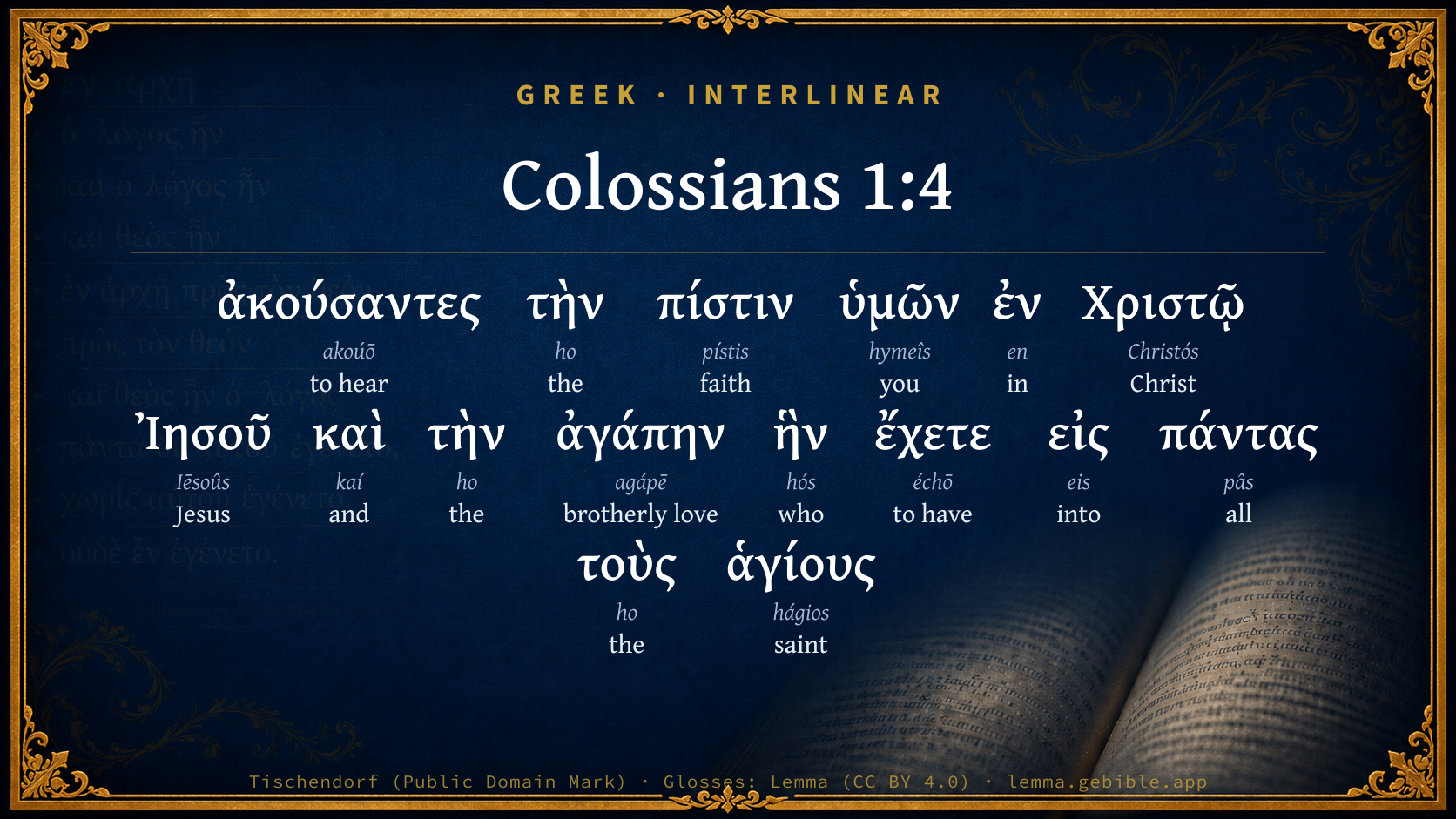
Download image
Cite this verse

Colossians 1:4 (World English Bible). Public Domain. Lemma interlinear Bible study tool, https://lemma.gebible.app/v/colossians/1/4.

Show BibTeX & RIS
BibTeX
RIS
English Translation
having heard of your faith in Christ Jesus, and of the love which you have toward all the saints,
World English Bible · Public Domain
Download a study sheet

One document with this verse’s original text, its word-by-word gloss line, the meaning frame, cross-references with their text, attributed commentary, and full source and license credits — printable, and it pastes into notes with its structure intact.

This verse Autodidact and up

Study sheet (.html) Plain text (.txt)

A passage Seminary Student

Up to 50 verses in one chapter. A passage sheet keeps up to 6 commentary sources and 12 cross-references per verse, in the order this page ranks them, and says so on the sheet whenever that leaves anything out. Ask for a single verse and you get the Autodidact verse sheet above.

Everything on this page stays free to read, with no account — the sheet is a download of what is already on screen, not access to it.

Want to remove ads? Support Godless Engineer
Compare translations 3

The same verse in 3 English versions, stacked beneath the original-language interlinear above. Click any original word for its lexicon entry.

Each is an independent rendering of the whole verse — the interlinear is not word-aligned to these translations.

Highlighted words mark where these versions differ — a whole-verse word diff, not a word-by-word alignment.

  • World English Bible Public Domain
    having heard of your faith in Christ Jesus, and of the love which you have toward all the saints,
  • King James Version Public Domain
    Since we heard of your faith in Christ Jesus, and of the love which ye have to all the saints,
  • unfoldingWord Literal Text CC BY-SA 4.0
    having heard of your faith in Christ Jesus and the love that you have for all the saints,

unfoldingWord Literal Text — © unfoldingWord, licensed CC BY-SA 4.0. Word-aligned USFM3 via Door43 (git.door43.org/unfoldingWord/en_ult).

Versions to compare (up to 4)

3 of 4 selected

Show all 19 translations

Every available English version of this verse, each an independent rendering of the whole verse.

  • World English Bible Public Domain
    having heard of your faith in Christ Jesus, and of the love which you have toward all the saints,
  • Berean Standard Bible Public Domain
    because we have heard about your faith in Christ Jesus and your love for all the saints—
  • Majority Standard Bible Public Domain
    because we have heard about your faith in Christ Jesus and your love for all the saints—
  • King James Version Public Domain
    Since we heard of your faith in Christ Jesus, and of the love which ye have to all the saints,
  • American Standard Version (1901) Public Domain
    having heard of your faith in Christ Jesus, and of the love which ye have toward all the saints,
  • Revised Version (1885) Public Domain
    having heard of your faith in Christ Jesus, and of the love which ye have toward all the saints,
  • Geneva Bible (1599) Public Domain
    Since wee heard of your faith in Christ Iesus, and of your loue toward all Saintes,
  • Douay-Rheims (1899) Public Domain
    Hearing your faith in Christ Jesus, and the love which you have towards all the saints.
  • Young's Literal Translation Public Domain
    having heard of your faith in Christ Jesus, and of the love that `is' to all the saints,
  • Literal Standard Version CC BY-SA 4.0
    having heard of your faith in Christ Jesus, and of the love that [is] to all the holy ones,
  • Unlocked Literal Bible CC BY-SA 4.0
    We have heard of your faith in Christ Jesus and of the love that you have for all those set apart for God.
  • unfoldingWord Literal Text CC BY-SA 4.0
    having heard of your faith in Christ Jesus and the love that you have for all the saints,
  • Darby Bible Public Domain
    having heard of your faith in Christ Jesus, and the love which ye have towards all the saints,
  • World Messianic Bible Public Domain
    having heard of your faith in Messiah Yeshua and of the love which you have toward all the holy ones,
  • Webster's Bible Public Domain
    Since we heard of your faith in Christ Jesus, and of the love which ye have to all the saints,
  • Free Bible Version CC BY-SA 4.0
    We've heard about your trust in Christ Jesus and your love for all the believers
  • Bible in Basic English Public Domain
    After hearing of your faith in Christ Jesus, and of the love which you have for all the saints,
  • Text-Critical English NT CC BY 4.0
    because we have heard of your faith in Christ Jesus and your love for all the saints,
  • Tyndale New Testament (1534) Public Domain
    sence we hearde of youre faith which ye have in Christ Iesu and of the love which ye beare to all sayntes

Literal Standard Version (2020), Covenant Press — licensed CC BY-SA 4.0. Text via the HelloAO Bible API (eBible.org). Unlocked Literal Bible (unfoldingWord) — licensed CC BY-SA 4.0. Text via the HelloAO Bible API (eBible.org). unfoldingWord Literal Text — © unfoldingWord, licensed CC BY-SA 4.0. Word-aligned USFM3 via Door43 (git.door43.org/unfoldingWord/en_ult). Free Bible Version, Dr. Jonathan Gallagher — licensed CC BY-SA 4.0. Text via the HelloAO Bible API (eBible.org).

Word by word

More ways to search: Search by grammar → Find every occurrence → Compare this word →

Practice this passage: Drill this verse → Learn its vocabulary →

ἀγάπην
agápē
G26
“brotherly love”
Noun, Accusative, Singular, Feminine
Part of Speech
Noun
Case
Accusative
Number
Singular
Gender
Feminine
Full Thayer's Definition

Origin: from G25

TDNT: 01:21,5

1. brotherly love, affection, good will, love, benevolence 2. love feasts
  1. ἀκούσαντες akoúō G191 “to hear” Verb, Aorist, Active, Participle, Nominative, Plural, Masculine
  2. τὴν ho G3588 “the” Article, Accusative, Singular, Feminine
  3. πίστιν pístis G4102 “faith” Noun, Accusative, Singular, Feminine
  4. ὑμῶν hymeîs G5210 “you” Personal pronoun, 2nd person, Genitive, Plural
  5. ἐν en G1722 “in” Preposition
  6. Χριστῷ Christós G5547 “Christ” Noun, Dative, Singular, Masculine
  7. Ἰησοῦ Iēsoûs G2424 “Jesus” Noun, Dative, Singular, Masculine
  8. καὶ kaí G2532 “and” Conjunction
  9. τὴν ho G3588 “the” Article, Accusative, Singular, Feminine
  10. ἣν hós G3739 “who” Relative pronoun, Accusative, Singular, Feminine
  11. ἔχετε échō G2192 “to have” Verb, Present, Active, Indicative, 2nd person, Plural
  12. εἰς eis G1519 “into” Preposition
  13. πάντας pâs G3956 “all” Adjective, Accusative, Plural, Masculine
  14. τοὺς ho G3588 “the” Article, Accusative, Plural, Masculine
  15. ἁγίους hágios G40 “saint” Adjective, Accusative, Plural, Masculine

About this verse

These counts appear in no published source. They are computed here, from the morphology-tagged text and Lemma’s own curated glosses. What Lemma adds →

16
words
14
distinct lemmas
Pauline Epistles
section

Repetition

A word recurs within this verse:

Cross-references

15

Topical passages linked to Colossians 1:4 in the Treasury of Scripture Knowledge — connected by theme and wording, ordered by reader-vote popularity; previews shown in the World English Bible.

  • Ephesians 1:15 For this cause I also, having heard of the faith in the Lord Jesus which is among you, and the love which you have toward all the saints,
  • 2 Thessalonians 1:3 We are bound to always give thanks to God for you, brothers, even as it is appropriate, because your faith grows exceedingly, and the love of each and every one of you towards one another abounds;
  • 1 Thessalonians 1:3 remembering without ceasing your work of faith and labor of love and patience of hope in our Lord Jesus Christ, before our God and Father.
  • Philemon 1:5 hearing of your love, and of the faith which you have toward the Lord Jesus, and toward all the saints;
  • Hebrews 6:10 For God is not unrighteous, so as to forget your work and the labor of love which you showed toward his name, in that you served the saints, and still do serve them.
  • Galatians 5:6 For in Christ Jesus neither circumcision amounts to anything, nor uncircumcision, but faith working through love.
  • 1 John 4:16 We know and have believed the love which God has for us. God is love, and he who remains in love remains in God, and God remains in him.
  • 3 John 1:3–4 For I rejoiced greatly, when brothers came and testified about your truth, even as you walk in truth.
  • 1 Thessalonians 3:6 But when Timothy came just now to us from you, and brought us glad news of your faith and love, and that you have good memories of us always, longing to see us, even as we also long to see you;
  • 1 John 3:14 We know that we have passed out of death into life, because we love the brothers. He who doesn't love his brother remains in death.
  • 2 Corinthians 7:7 and not by his coming only, but also by the comfort with which he was comforted in you, while he told us of your longing, your mourning, and your zeal for me; so that I rejoiced still more.
  • Colossians 1:9 For this cause, we also, since the day we heard this, don't cease praying and making requests for you, that you may be filled with the knowledge of his will in all spiritual wisdom and understanding,
  • 1 Thessalonians 4:9–10 But concerning brotherly love, you have no need that one write to you. For you yourselves are taught by God to love one another,
  • 1 Peter 1:21–23 who through him are believers in God, who raised him from the dead, and gave him glory; so that your faith and hope might be in God.
  • 1 John 3:23 This is his commandment, that we should believe in the name of his Son, Jesus Christ, and love one another, even as he commanded.

Cross-references courtesy of OpenBible.info (CC BY 4.0).

Commentary

Notes on Colossians 1:4 from classic Christian and Jewish commentators (each source and its license shown beneath its notes). The classic Christian expositions comment on the surrounding passage and are grouped to its opening verse, so a note may address several verses; the Jewish commentaries on the Tanakh (Rashi and others) are per-verse, so they appear only where the commentator wrote on this verse.

Lemma curates 59 commentaries, every one of them public domain or Creative Commons licensed, each selected and text-cleaned for this edition rather than reprinted as found. About our sources →

The Pulpit Commentary

Having heard of your faith in Christ Jesus, and of the love which ye have (hn ecete, Revised Text) toward all the saints (Eph_1:15, B.V; Phm_1:5, R.V; 1Th_4:9, 1Th_4:10; 1Jn_3:23 2Jn_1:4 3Jn_1:3, 4) "Having heard "more immediately from Epaphras (vers. 8, 9). Note the characteristic recurrence of this word: he had heard of their faith and love, as they had heard before the word of truth (ver. 5); from the day they had heard they had borne fruit (ver. 6), and he, in return, from the day he heard of it, had not ceased to pray for them (ver. 9); see note on ver. 8; and comp. 1Th_1:5 and 2:2 with 3:6 (Greek). "In Christ Jesus" is attached to "faith (as to "brethren" in ver. 2) so closely as to form with it a single idea; to be "in Christ Jesus" is of the very essence of this faith and brotherhood. "Faith in Christ," "believe in Christ," in our English Bible, commonly represent a different Greek preposition, eijv (literally, into or unto Christ); only in the pastoral Epistles and in Eph_1:15 not (Gal_3:26 see Lightfoot) or (Rom_3:25 see Meyer or Beet) do we find, as here, pistiv ejn Cristw. In Christ faith rests, finding its abiding ground and element of life. In the Epistles of this period the Christian state appears chiefly as "life in Christ;" rather than, as in the earlier letters, as "salvation through Christ". (comp. e.g. Ro 5 and Col_2:9-15) The "love" of the Colossians evokes thanksgiving, as that which they have "toward all the saints;" for as the Church extended Christian love needed to be more catholic (ver. 6; Col_3:11) and Colossian error in particular tended to exclusiveness and caste feeling (see note on ver. 28). The iteration of "all" in this Epistle is remarkable.

The Pulpit Commentary (1880–1919), ed. H.D.M. Spence-Jones & Joseph S. Exell — public domain. Text from a community e-Sword module.

Tyndale Open Study Notes

Tyndale Open Resources

1:4 God’s people (literally holy ones, or saints): In the New Testament, all Christians are saints, people who have been specially set apart by God as his own holy people (3:12).

Tyndale Open Study Notes — © Tyndale Open Resources, licensed CC BY-SA 4.0. Text via the HelloAO Bible API.

Bengel's Gnomon

Johann Albrecht Bengel

Col 1:4. Πάντας, all) present and absent.

Bengel's Gnomon of the New Testament — English translation (T&T Clark, Edinburgh, 1860) — public domain. Text from a community e-Sword module.

Expositor's Greek Testament

ed. W. Robertson Nicoll

Col 1:4 . Paul now introduces the grounds of his thankfulness, the good report he has heard as to the faith and love of the Colossians. He refers to it again (Col 1:9 ). πίστιν ἐν Χ . ἐν may be equivalent to εἰς , but probably indicates “the sphere in which their faith moves rather than the object to which it is directed” (Lightf.). This faith rests upon Christ. πίστ . is wrongly taken by Ewald to mean “fidelity”. πάντας , i.e. , all Christians throughout the world, whose unity in the universal Church was a thought much in Paul’s mind at this time.

The Expositor's Greek Testament, edited by W. Robertson Nicoll (1897–1910) — public domain. Text from a community e-Sword module.

Jamieson, Fausset & Brown

Robert Jamieson, A. R. Fausset & David Brown

Since we heard--literally, "Having heard." The language implies that he had only heard of, and not seen, them (Col 2:1). Compare Rom 1:8, where like language is used of a Church which he had not at the time visited.

love . . . to all--the absent, as well as those present [BENGEL].

Jamieson, Fausset & Brown — Commentary Critical and Explanatory on the Whole Bible (1871) — public domain (CC PDM 1.0). Text via the HelloAO Bible API.

Adam Clarke's Commentary

Verse 4. Since we heard of your faith] This is very similar to Eph 1:15. And it is certain that the apostle seems to have considered the Church at Ephesus, and that at Colassa to have been nearly in the same state, as the two epistles are very similar in their doctrine and phraseology.

Adam Clarke's Commentary on the Bible (1810–1826) — public domain. Text from a community e-Sword/MySword module.

John Calvin's Commentaries

4. Having heard of your faith. This was a means of stirring up his love towards them, and his concern for their welfare, when he heard it that they were distinguished by faith and love. And, unquestionably, gifts of God that are so excellent ought to have such an effect upon us as to stir us up to love them wherever they appear. He uses the expression, faith in Christ, that we may always bear in mind that Christ is the proper object of faith.

He employs the expression, love towards the saints, not with the view of excluding others, but because, in proportion as any one is joined to us in God, we ought to embrace him the more closely with special affection. True love, therefore, will extend to mankind universally, because they all are our flesh, and created in the image of God, (Genesis 9:6;) but in respect of degrees, it will begin with those who are of the household of faith. (Galatians 6:10.)

John Calvin's Commentaries (1540-1563) — public domain. Text from the Calvin Translation Society English edition (1840s-50s) via the Christian Classics Ethereal Library (ccel.org). Calvin's coverage is partial (roughly two-thirds of the Bible); uncommented books and verses are honest gaps, never fabricated. The 19th-century editor's footnotes and remarks are omitted so the notes are faithfully Calvin's own voice.

The Cambridge Bible for Schools and Colleges

gen. ed. J. J. S. Perowne

4. since we heard] More simply, having heard. He refers to the information given by Epaphras (Col_1:7), probably quite recently. On the question whether he had ever visited Colosssæ, see on Col_2:1 below, Introd., pp. 20, 21, and Appendix A. This verse gives no decisive evidence in the matter.

faith in Christ Jesus] Cp. Eph_1:15 for a closely parallel passage. “The preposition [‘in’] here … denotes the sphere in which their faith moves, rather than the object to which it is directed” (Lightfoot). But it is not easy to draw a clear distinction between “sphere” and “object” in this case. And surely Mar_1:15 (Greek) (cp. Rom_3:25; Joh_3:15; and, in the LXX., Psalms 77 :(Heb. and Eng. 78.) 22) proves the possibility of reference here to the Object of faith, on and in whom it reposes, as an anchor in the ground. On the other hand 2Ti_1:13 (quoted by Lightfoot) shews the possibility of explaining, “faith maintained by union with Christ.” But this more recondite meaning scarcely fits this context, where the parallelism of clauses seems to suggest the saints’ regard towards Christ first and then one another.

and of the love … saints] “This is His commandment, that we should believe on the name of His Son Jesus Christ, and love one another” (1Jn_3:23). Divine faith, in true and full exercise, issues by its nature in a life and work of love towards men, regarded as either actual (as here) or potential brethren of Him who is faith’s goal and rest.

all the saints] Doubtless not at Colossæ only, but everywhere. It was one of the earliest glories of the Gospel, illustrated everywhere in the N.T., to bind together in love a world-wide family. Cp. Col_3:11 below.—The words which ye have are probably in the true text.

The Cambridge Bible for Schools and Colleges (gen. ed. J. J. S. Perowne; Cambridge University Press, 1878–1918) — public domain. Text from a community e-Sword module.

John Gill's Exposition

Since we heard of your faith in Christ Jesus,.... This expresses the matter of their thankfulness, or what it was they gave thanks to God for, their faith in Christ; by which is not only meant their hearty assent to the whole doctrine of faith, concerning the person, offices, and grace of Christ, their soundness and steadfastness in it, and their sincere and constant profession of it; but the grace of faith in them, the operation of the Spirit of God in their souls, which had not Moses, nor any mere man, but Christ for its object; by which they looked unto him as a Saviour, went unto him as such, ventured on him, committed themselves unto him, leaned and relied upon him; that grace which comes from him, has him for its author and finisher, and returns unto him, and lives on him. This Paul and Timothy had heard of by their minister Epaphras; and it shows that they made no secret of it, did not keep it to themselves, but declared, confessed, and published it to others, as is the duty of all believers to do; and thanks being given for it to God, makes it a clear point that it was not of themselves, but was the gift of God, otherwise there would have been no need of thankfulness for it; as also, that it is a very eminent grace, and of great use and service to such who are possessed of it,

And of love which ye have to all the saints; this is another thing for which thanks are given to God. The object of this grace are "saints"; all men indeed are to be loved, and even our very enemies; and good is to be done to all, but especially to holy and good men, to the household of faith; and these are "all" to be loved and respected; nor is any respect or difference of persons to be made on account of country, or natural relation, as Jews or Gentiles, or of outward state and condition, as rich or poor, bond or free, or of greater or lesser gifts and grace, weak or strong believers, or of different sentiments in the lesser matters of religion. It denotes both the grace of love itself, which is a fruit of the Spirit implanted in regeneration, and is an evidence of the new birth, and always is where true faith in Christ is, for faith works by it; and also the effects of it, which lies not in bare words, in expressions of spiritual affection and friendship, but in deeds, by serving one another in love, by relieving in necessity, sympathizing in distress, praying with and for one another, and the like; all which these saints were famous for.

John Gill's Exposition of the Whole Bible (1746–1763) — public domain (CC PDM 1.0). Text via the HelloAO Bible API.

Trapp's Complete Commentary

John Trapp

4 Since we heard of your faith in Christ Jesus, and of the love which ye have to all the saints,

Ver. 4. And of the love, &c.] Faith in Christ Jesus maketh love to all the saints. Therefore they go commonly coupled in Paul’s Epistles. And therefore when the disciples heard how often they must forgive an offending brother, "Lord, increase our faith," say they, Luk 17:5. {See Trapp on "Luk 17:5"}

John Trapp, A Commentary or Exposition upon All the Books of the Old and New Testament (1647–1656) — public domain. Text from a community e-Sword module.

Albert Barnes' Notes on the Bible

Since we heard of your faith in Christ Jesus - To wit, by Epaphras, who had informed Paul of the steadfastness of their faith and love; Col 1:7-8. This does not prove that Paul had never been at Colossae, or that he did not establish the church there, for he uses a similar expression respecting the church at Ephesus Eph 1:15, of which he was undoubtedly the founder. The meaning is, that he had heard of their faith at that time, or of their perseverance in faith and love.

Which ye have to all the saints - In what way they had manifested this is not known. It would seem that Paul had been informed that this was a character of their piety, that they had remarkable love for all who bore the Christian name. Nothing could be more acceptable information respecting them to one who himself so ardently loved the church; and nothing could have furnished better evidence that they were influenced by the true spirit of religion; compare 1Jo 3:14.

Albert Barnes' Notes on the Bible (1834–1885) — public domain. Text from a community e-Sword/MySword module.

Matthew Poole's English Annotations

He instanceth in principal graces, as the matter of his thanksgiving, beginning with faith, described and differenced from the special object of it, Christ Jesus, implying not a bare knowledge or assent, but a trust in him alone for salvation; so Rom 1:8. Understanding this saving grace with the consequent was wrought in them, as he heard it was in the Ephesians, and Philemon, it, was a cogent motive to engage them in solemn thankfulness to God: see on Eph 1:15, compared with Phm 1:5. He joins love, or charity, to all the saints, with faith to our Saviour, because they are in effect inseparable, there being no real embracing of Christ without loving of him, and all his members for his sake, Gal 5:6; 2Ti 1:13; not as if believers were not to show love or charity to others, who are of the same nature, and so bear the image of God, for this Christ requires of them, Mat 5:44,45; but by how much the nearer any are brought to God by sanctification, by so much the more a special love is to be showed to them, as fellow citizens, of the household of God, and the hosehold of faith, Rom 15:26, with Gal 6:10; Eph 2:19.

Matthew Poole's English Annotations on the Holy Bible (1683–1685) — public domain. Text from a community e-Sword/MySword module.

Whedon's Commentary on the Bible

Daniel D. Whedon

4. Since we heard—Faith, love, and hope are three graces inseparably connected. Faith instrumentally saves the soul, makes it the home of love, and prepares it for the final glorification in heaven. This becomes at once an object of hope to the believer, in accordance with the prayer of our Lord: “Father, I will that they also, whom thou hast given me, be with me where I am.” Joh_17:24. Children of the same Father, believers in the same Saviour, and travellers together to the same heaven, cannot well fail of a deep, broad Christian love. This heavenly home is prepared, set apart, laid up, and so made secure for all believers, to be given them in its fulness of bliss at our Lord’s appearing.

Daniel D. Whedon (gen. ed.), Commentary on the Old and New Testaments (1874–1909) — public domain. Text from a community e-Sword module.

Godbey's Commentary on the New Testament

William B. Godbey

ARGUMENT 1

FAITH AND LOVE

4. “Hearing of your faith in Christ Jesus, and the Divine love which you have toward all the saints.” Here, again, we see the magnificent globe of human salvation, exhibiting the two distinct hemispheres; i.e., the human and the Divine. We do the believing, and God does the saving. Salvation must be subjective before it can be objective. We must first receive heaven in us, before we are in a fix to go to heaven. This Divine love, the heavenly agapee, constitutes the very atmosphere of heaven. We can not possibly love in the Bible sense, till we have it in our hearts. It is exotic in humanity, and indigenous in God alone. When the sinner meets the condition by an utter and eternal abandonment of sin, and casts himself, in a moment of desperation, on the mercy of God in Christ by simple faith alone, he freely forgives him for Christ’s sake, imputing to him the righteousness of Christ. At that moment the Holy Ghost, the commissioned executive of the new creation, pours out (Rom 5:5) into his heart this Divine love, which is the nature of God (1Jn 4:18), thus imparting the Christ-life and nature to the dead soul, resurrecting it into the new life of God and heaven. The popular Churches on this problem are wrapped in an awful delusion, preaching human love as a substitute for the Divine, there being no salvation in it, as illustrated in case of the rich man in hell, who there had it in behalf of his brethren in the superlative degree. Faith is your own act, co-operated by the Holy Ghost, who is always on hand and ready to give you all the help you need to believe God’s Word, and as a sinner to trust him implicitly for a free pardon, and as a Christian to trust him triumphantly for entire sanctification, and as a wholly sanctified servant of the Lord to trust him incessantly to keep you by his power, fill you with his Spirit, and give you momentary and perpetual victory over every foe. All the other graces are resolvable into these two; i.e., faith and love, which focalize at the constituents of the two spiritual hemispheres, and represent the entire plan of salvation. Hence, your faith is positively the measuring line of your experience. When the sinner believes God’s convicting truth, he always gets convicted. When he believes converting truth, he always gets converted. When the Christian believes God’s copious illuminating truth, everywhere revealing inbred sin surviving in the heart of the regenerate, he invariably gets convicted of it. When he walks in the light of that conviction, and believes God’s wonderful truth, revealing entire sanctification in the cleansing blood, he sweeps into Beulah land with a shout.

5-7. “From the day in which you heard, and have truly and perfectly known the grace of God.” We know the grace of God in regeneration, but truly, perfectly know that grace in sanctification. We reach experimental certainty.

8. “Who also revealed to us your Divine love in the Spirit.” The Holy Spirit is the only Dispenser of the Divine love, native only in the heart of God, and poured out into our hearts by the Holy Ghost. (Rom 5:5.) Hence, Holy Ghost religion only is characterized by love. All others are carnal and selfish.

William B. Godbey, Commentary on the New Testament (1896–1900) — public domain. Text from a community e-Sword module.

The People's New Testament

B. W. Johnson

4. Since we heard of your faith … and love. He probably heard through Epaphras, a member at Colosse (verse 7 and 4:12), who was at that time with him in Rome.

B. W. Johnson's The People's New Testament with Notes (1889–1891) — public domain. Electronic text from the Christian Classics Ethereal Library (CCEL) ThML edition.

unfoldingWord translationNotes

Door43 World Missions Community

We have heard

Paul is excluding his audience. (See: Exclusive and Inclusive "We")

your faith in Christ Jesus

"your belief in Christ Jesus"

because of the certain hope reserved for you in heaven

Here "certain hope" stands for what the believer can confidently expect, that is, the things that God has promised to do for all believers. These things are spoken of as if they were physical objects that God was keeping in heaven for the believers to possess later. AT: "because you are certain that God, who is in heaven, will do the many good things that he has promised you" (See: Metonymy)

the word of truth, the gospel

Possible meanings are 1) "the message about the truth, the gospel" or 2) "the true message, the gospel."

This gospel is bearing fruit and is growing

"Fruit" here is a metaphor for "result" or "outcome." AT: "This gospel is having good results, more and more" or "This gospel is having increasing results" (See: Metaphor)

in all the world

This is a generalization referring to the part of the world that they knew about. AT: "throughout the world" (See: Hyperbole and Generalization)

the grace of God in truth

"the true grace of God"

translationWords

faith

Jesus

love

God

heaven

word

true

good news

fruit

grace

unfoldingWord translationNotes — © Distant Shores Media and the Door43 World Missions Community, licensed CC BY-SA 4.0. Source: git.door43.org/Door43/en_tn.

Cambridge Greek Testament for Schools and Colleges

4. τὴν ἀγάπην [ἣν ἔχετε] εἰς πάντας κ.τ.λ. ἣν ἔχετε אACD*G, the versions except Pesh.; τὴν DcKL, Pesh. Chrys., as in || Eph 1:15. B omits altogether.

It is hard to decide whether to retain ἣν ἔχετε or to simply read τὴν ἁγάπην εἰς πάντας κ.τ.λ., and the question is complicated by Phm 1:5 τὴν ἀγάπην καὶ τὴν πίστιν ἦν ἔχεις εἰς τὸν κύριον Ἰησοῦν καὶ εἰς πάντας τοὺς ἁγίους. Perhaps on the whole B is preferable, each of the other readings being an attempt to improve the harsh grammar.

4. ἀκούσαντες, ‘for we heard.’ Prob. not temporal, but causal. Cf. Eph 1:15; contrast Phm 1:5.

τὴν πίστιν ὑμῶν ἐν Χριστῷ Ἰησοῦ. The article is often omitted before ἐν Χρ. Ἰησ.; cf. also Col 1:8. In the spoken language the absence of the article would be easily supplemented by the tone.

ἐν—here marking not the sphere, but the object of faith—centred on Christ and resting in Him, cf. Gal 3:26. It is thus rather fuller in thought than εἰς, Col 2:5. Hence perhaps the curious change from ἐν to εἰς in Eph 1:15 if ἀγάπην is not genuine there.

καὶ τὴν ἀγάπην. In Eph 1:15 (W.H.) love is not expressly mentioned, but is regarded as part of faith.

ἀγάπην. Not found before the LXX., yet in view of the fact that it occurs with comparative frequency there (perhaps twenty times in all, of which eleven are in Cant.) it is curious that no certain occurrence of it seems to be yet found in the papyri, and but once in Philo (see Deissmann, Bible Studies, p. 199). Yet the number of words supposed to have been coined by the LXX. translators is diminishing so rapidly that it is very improbable that this will remain to them.

[ἣν ἔχετε] See notes on Textual Criticism. Apparently unique, but Phm 1:5 is very similar.

εἰς πάντας τοὺς ἁγίους, “toward all the saints,” R.V.; cf. Php 4:22 and 2Th 1:3.

Cambridge Greek Testament for Schools and Colleges (Cambridge University Press, 1896; 21 vols, various authors incl. Carr, Maclear, Plummer, Farrar, Lumby, Moule, M. R. James, Simcox) — public domain. Text from a community e-Sword module.

International Critical Commentary

4. ἀκούσαντες τὴν πίστιν ὑμῶν ἐν χριστῷ Ἰησοῦ. Assigns the ground of his thanksgiving. He had heard from Epaphras, ver. 8. The addition of ἐν Χρ. Ἰης. as a more precise definition of πίστις, which of itself expresses only a psychological conception, is quite natural here, where St. Paul is addressing for the first time those who were unknown to him. So in Eph 1:15. In Rom 1:8 the specification of πίστις had preceded vv. 2, 3. The article is unnecessary, as πίστις ἐν Χρ. is one notion. See Eph. l.c.

καὶ τὴν ἀγάπην ἣν ἔχετε εἰς πάντας τοὺς ἁγίους.

ἣν ἔχετε is read in א A C D* G P 17 37 47, al. Old Latin, Vulg., Boh., Syr-Harcl., Arm. But Dc K L and most MSS. Chrys., Theod., Syr-Pesh have τὴν ἀγάπην τὴν εἰς, while B has τὴν ἀγάπην εἰς. The reading with ἣν ἔχετε might be a conformation to Phm 1:5, while τὴν ἀγάπην τήν might be a conformation to Eph 1:15.

International Critical Commentary — older volumes (1896–1929), various authors — public domain. Text from a community e-Sword module.

Lightfoot's Colossians and Philemon

J. B. Lightfoot

πάντοτε κ.τ.λ.] We here meet the same difficulty about the connexion of the clauses, which confronts us in several of St Paul’s opening thanksgivings. The words πάντοτε and περὶ ὑμῶν must clearly be taken together, because the emphasis of περὶ ὑμῶν would be inexplicable, if it stood at the beginning of a clause. But are they to be attached to the preceding or to the following sentence? The connexion with the previous words is favoured by St Paul’s usual conjunction of εὐχαριστεῖν πάντοτε (see the note on Phil. i. 3), and by the parallel passage οὐ παύομαι εὐχαριστῶν ὑπὲρ ὑμῶν in Ephes. i. 16. Thus the words will mean ‘We give thanks for you always in our prayers.’ For this absolute use of προσευχόμενοι see Matt. vi. 7, Acts xvi. 25.

4. ἀκούσαντες] ‘having heard’ from Epaphras (ver. 8); for the Apostle had no direct personal knowledge of the Colossian Church: see the introduction, p. 27 sq.

ἐν Χριστῷ Ἰησοῦ] to be connected with τὴν πίστιν ὑμῶν. The strict classical language would require τὴν ἐν Χ. Ἰ., but the omission of the article is common to the New Testament (e.g. ver. 8); see the note on 1 Thess. i. 1, and Winer § xx. p. 169 (ed. Moulton). The preposition ἐν here and in the parallel passage, Ephes. i. 15, denotes the sphere in which their faith moves, rather than the object to which it is directed (comp. 1 Cor. iii. 5); for, if the object had been meant, the natural preposition would have been ἐπὶ or εἰς (e.g. ii. 5). This is probably the case also in the passages where at first sight it might seem otherwise, e.g. 1 Tim. iii. 13, 2 Tim. iii. 15; for compare 2 Tim. i. 13 ἐν πίστει καὶ ἀγάπῃ τῇ ἐν Χριστῷ Ἰησοῦ, where the meaning is unambiguous. There is however authority in the LXX for the use of ἐν with πίστις, πιστεύειν, to denote the object, in Jer. xii. 6, Ps. lxxviii. 22, and perhaps in Mark i. 15, Rom. iii. 25, and (more doubtfully still) in Joh. iii. 15.

ἣν ἔχετε] See the detached note on the various readings.

J. B. Lightfoot, St Paul's Epistles to the Colossians and Philemon: a revised text with introductions, notes and dissertations (London: Macmillan, 1875) — public domain. Electronic text from Project Gutenberg (ebook #50857). Covers Colossians and Philemon only (the verse-by-verse notes; introductions and dissertations are omitted); Lightfoot's companion Galatians and Philippians volumes are not included, as the available public-domain scans carry garbled Greek that cannot be faithfully reproduced.

Lesson kit

Teaching starters — assembled from the data on this page, not authored interpretation. Every prompt links to the verse data it draws on. Edit before teaching.

Colossians, in the Pauline Epistles, opens this verse with 16 words (14 distinct Greek lemmas). Its most distinctive word is agápē (“brotherly love”). A historical commentator’s framing appears above. Read the whole chapter for the surrounding context.

Discussion questions

  1. What does “brotherly love” (agápē) contribute to the verse as a whole?
  2. How does Ephesians 1:15, which shares this passage’s theme, read alongside this verse?
  3. What does the repetition of “the” (3× in this one verse) do in this verse?
  4. These translations render this verse differently; the difference is in the English rendering, not the original. What questions does that raise?
  5. Compare how The Pulpit Commentary and Tyndale Open Study Notes read this verse. Where do they agree or differ?

Things to notice

Reading settings

Reading text

Shown beneath each verse's original-language words.

Old Testament
Old Testament edition

Read the OT as the Masoretic Hebrew (MT) or the Greek Septuagint (LXX).

English shown for the Greek Septuagint (in the Hebrew ↔ Greek comparison).

Comparing translations? Open the Compare panel on any verse page to stack up to four side by side.