

Acts 7:2
Greek (Tischendorf 8th ed.) Acts 7:2 appears in the Greek New Testament. The text above is from the Tischendorf 8th edition. Each word links to its Strong’s number and a concise gloss. Click any word for its full Thayer’s Greek Lexicon entry.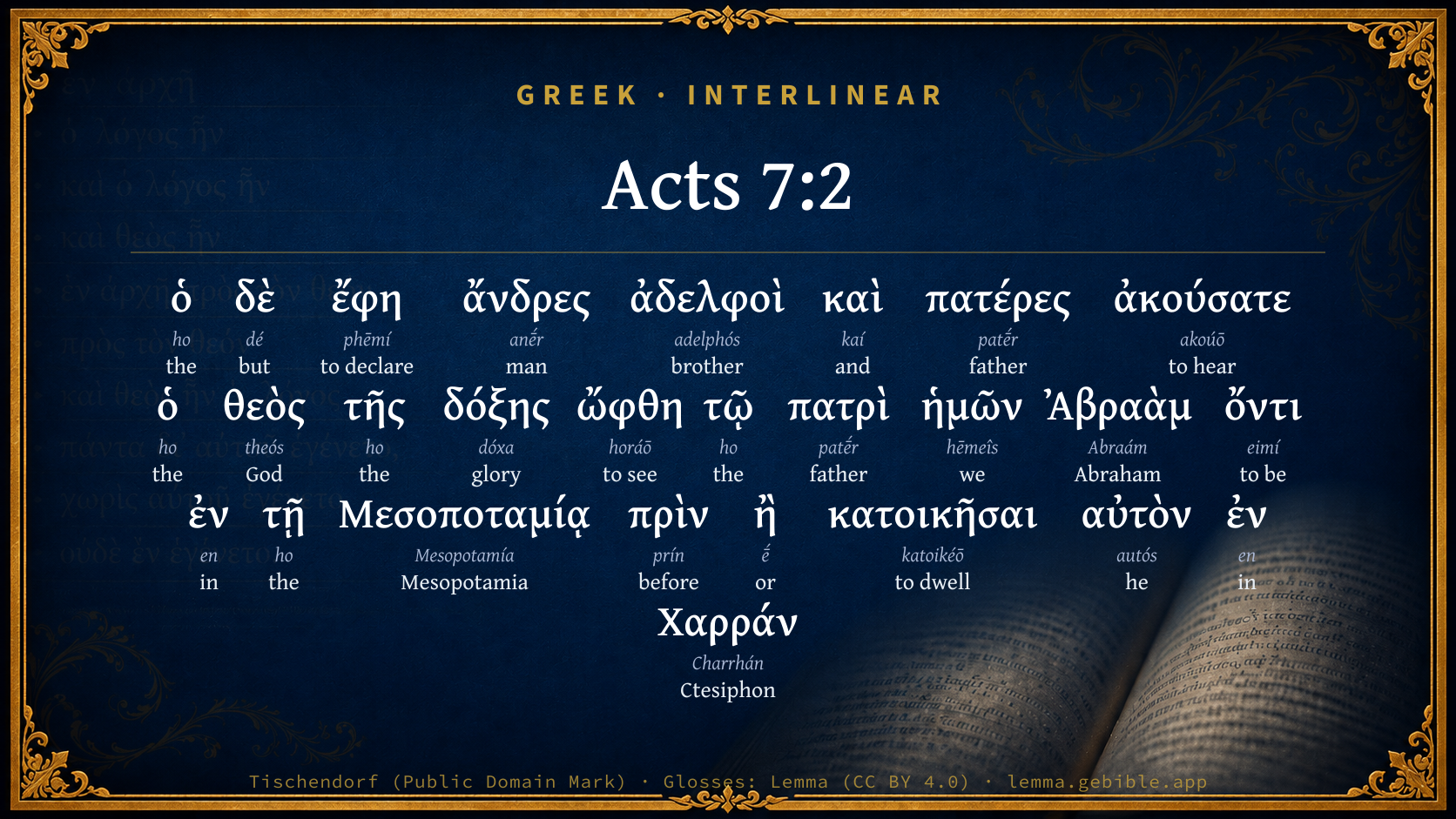
He said, "Brothers and fathers, listen. The God of glory appeared to our father Abraham, when he was in Mesopotamia, before he lived in Haran,
Download a study sheet
One document with this verse’s original text, its word-by-word gloss line, the meaning frame, cross-references with their text, attributed commentary, and full source and license credits — printable, and it pastes into notes with its structure intact.
This verse Autodidact and up
A passage Seminary Student
Up to 50 verses in one chapter. A passage sheet keeps up to 6 commentary sources and 12 cross-references per verse, in the order this page ranks them, and says so on the sheet whenever that leaves anything out. Ask for a single verse and you get the Autodidact verse sheet above.
Everything on this page stays free to read, with no account — the sheet is a download of what is already on screen, not access to it.
Compare translations 3
The same verse in 3 English versions, stacked beneath the original-language interlinear above. Click any original word for its lexicon entry.
Each is an independent rendering of the whole verse — the interlinear is not word-aligned to these translations.
Highlighted words mark where these versions differ — a whole-verse word diff, not a word-by-word alignment.
-
World English Bible Public Domain
He said, "Brothers and fathers, listen. The God of glory appeared to our father Abraham, when he was in Mesopotamia, before he lived in Haran,
-
King James Version Public Domain
And he said, Men, brethren, and fathers, hearken; The God of glory appeared unto our father Abraham, when he was in Mesopotamia, before he dwelt in Charran,
-
unfoldingWord Literal Text CC BY-SA 4.0
Then he said, “Men, brothers and fathers, listen to me: The God of glory appeared to our father Abraham when he was in Mesopotamia, even before he lived in Haran;
unfoldingWord Literal Text — © unfoldingWord, licensed CC BY-SA 4.0. Word-aligned USFM3 via Door43 (git.door43.org/unfoldingWord/en_ult).
Show all 19 translations
Every available English version of this verse, each an independent rendering of the whole verse.
-
World English Bible Public Domain
He said, "Brothers and fathers, listen. The God of glory appeared to our father Abraham, when he was in Mesopotamia, before he lived in Haran,
-
Berean Standard Bible Public Domain
And Stephen declared: “Brothers and fathers, listen to me! The God of glory appeared to our father Abraham while he was still in Mesopotamia, before he lived in Haran,
-
Majority Standard Bible Public Domain
And Stephen declared: “Brothers and fathers, listen to me! The God of glory appeared to our father Abraham while he was still in Mesopotamia, before he lived in Haran,
-
King James Version Public Domain
And he said, Men, brethren, and fathers, hearken; The God of glory appeared unto our father Abraham, when he was in Mesopotamia, before he dwelt in Charran,
-
American Standard Version (1901) Public Domain
And he said, Brethren and fathers, hearken: The God of glory appeared unto our father Abraham, when he was in Mesopotamia, before he dwelt in Haran,
-
Revised Version (1885) Public Domain
And he said, Brethren and fathers, hearken. The God of glory appeared unto our father Abraham, when he was in Mesopotamia, before he dwelt in Haran,
-
Geneva Bible (1599) Public Domain
And he sayd, Ye men, brethren and Fathers, hearken. That God of glory appeared vnto our father Abraham, while he was in Mesopotamia, before he dwelt in Charran,
-
Douay-Rheims (1899) Public Domain
Who said: Ye men, brethren, and fathers, hear. The God of glory appeared to our father Abraham, when he was in Mesopotamia, before he dwelt in Charan.
-
Young's Literal Translation Public Domain
and he said, `Men, brethren, and fathers, hearken: The God of the glory did appear to our father Abraham, being in Mesopotamia, before his dwelling in Haran,
-
Literal Standard Version CC BY-SA 4.0
And he said, “Men, brothers, and fathers, listen! The God of glory appeared to our father Abraham, being in Mesopotamia, before his dwelling in Haran,
-
Unlocked Literal Bible CC BY-SA 4.0
Stephen said, “Brothers and fathers, listen to me: The God of glory appeared to our father Abraham when he was in Mesopotamia, before he lived in Haran;
-
unfoldingWord Literal Text CC BY-SA 4.0
Then he said, “Men, brothers and fathers, listen to me: The God of glory appeared to our father Abraham when he was in Mesopotamia, even before he lived in Haran;
-
Darby Bible Public Domain
And he said, Brethren and fathers, hearken. The God of glory appeared to our father Abraham when he was in Mesopotamia, before he dwelt in Charran,
-
World Messianic Bible Public Domain
He said, “Brothers and fathers, listen. The God of glory appeared to our father Abraham when he was in Mesopotamia, before he lived in Haran,
-
Webster's Bible Public Domain
And he said, Men, brethren, and fathers, hearken; The God of glory appeared to our father Abraham when he was in Mesopotamia, before he dwelt in Charran,
-
Free Bible Version CC BY-SA 4.0
“Brothers and fathers, listen to me!” Stephen replied. “God in his glory appeared to our father Abraham when he was living in Mesopotamia, before he moved to Haran.
-
Bible in Basic English Public Domain
And he said, My brothers and fathers, give hearing. The God of glory came to our father Abraham, when he was in Mesopotamia, before he was living in Haran,
-
Text-Critical English NT CC BY 4.0
Stephen said, “Brothers and fathers, listen. The God of glory appeared to our father Abraham when he was in Mesopotamia, before he dwelt in Haran,
-
Tyndale New Testament (1534) Public Domain
And he sayde: ye men brethren and fathers harken to. The God of glory appered vnto oure father Abraham whyll he was yet in Mesopotamia before he dwelt in Charran
Literal Standard Version (2020), Covenant Press — licensed CC BY-SA 4.0. Text via the HelloAO Bible API (eBible.org). Unlocked Literal Bible (unfoldingWord) — licensed CC BY-SA 4.0. Text via the HelloAO Bible API (eBible.org). unfoldingWord Literal Text — © unfoldingWord, licensed CC BY-SA 4.0. Word-aligned USFM3 via Door43 (git.door43.org/unfoldingWord/en_ult). Free Bible Version, Dr. Jonathan Gallagher — licensed CC BY-SA 4.0. Text via the HelloAO Bible API (eBible.org).
Word by word
More ways to search: Search by grammar → Find every occurrence → Compare this word →
Practice this passage: Drill this verse → Learn its vocabulary →
- Appears 2× in the Greek New Testament
- First appears at Acts 2:9
- Part of Speech
- Noun
- Case
- Dative
- Number
- Singular
- Gender
- Feminine
Full Thayer's Definition
- ὁ ho G3588 “the” Article, Nominative, Singular, Masculine
- δὲ dé G1161 “but” Conjunction
- ἔφη phēmí G5346 “to declare” Verb, Imperfect, Active, Indicative, 3rd person, Singular
- ἄνδρες anḗr G435 “man” Noun, Vocative, Plural, Masculine
- ἀδελφοὶ adelphós G80 “brother” Noun, Vocative, Plural, Masculine
- καὶ kaí G2532 “and” Conjunction
- πατέρες patḗr G3962 “father” Noun, Vocative, Plural, Masculine
- ἀκούσατε akoúō G191 “to hear” Verb, Aorist, Active, Imperative, 2nd person, Plural
- ὁ ho G3588 “the” Article, Nominative, Singular, Masculine
- θεὸς theós G2316 “God” Noun, Nominative, Singular, Masculine
- τῆς ho G3588 “the” Article, Genitive, Singular, Feminine
- δόξης dóxa G1391 “glory” Noun, Genitive, Singular, Feminine
- ὤφθη horáō G3708 “to see” Verb, Aorist, Passive, Indicative, 3rd person, Singular
- τῷ ho G3588 “the” Article, Dative, Singular, Masculine
- πατρὶ patḗr G3962 “father” Noun, Dative, Singular, Masculine
- ἡμῶν hēmeîs G2249 “we” Personal pronoun, 1st person, Genitive, Plural
- Ἀβραὰμ Abraám G11 “Abraham” Noun, Proper, indeclinable
- ὄντι eimí G1510 “to be” Verb, Present, Active, Participle, Dative, Singular, Masculine
- ἐν en G1722 “in” Preposition
- τῇ ho G3588 “the” Article, Dative, Singular, Feminine
- Μεσοποταμίᾳ Mesopotamía G3318 “Mesopotamia” Noun, Dative, Singular, Feminine
- πρὶν prín G4250 “before” Adverb
- ἢ ḗ G2228 “or” Particle
- κατοικῆσαι katoikéō G2730 “to dwell” Verb, Aorist, Active, Infinitive
- αὐτὸν autós G846 “he” Personal pronoun, Accusative, Singular, Masculine
- ἐν en G1722 “in” Preposition
- Χαρράν Charrhán G5488 “Ctesiphon” Noun, Proper, indeclinable
About this verse
These counts appear in no published source. They are computed here, from the morphology-tagged text and Lemma’s own curated glosses. What Lemma adds →
- 27
- words
- 21
- distinct lemmas
- Acts
- section
Notable vocabulary
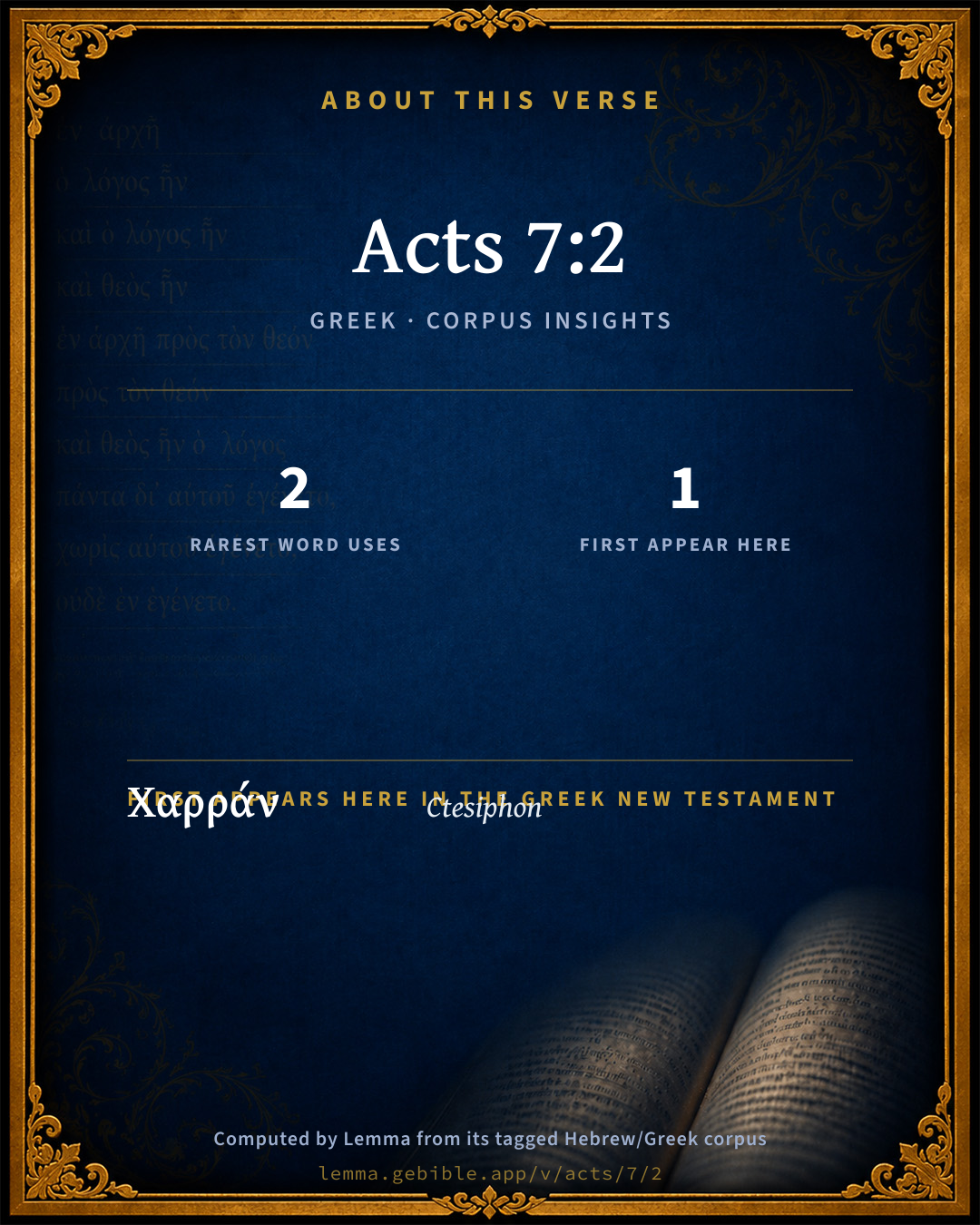
The rarest word here is Μεσοποταμίᾳ Mesopotamia G3318 — appearing just 2 times in the whole Greek New Testament.
First appearance in Scripture
This word makes its first canonical appearance in the Greek New Testament here:
- Χαρράν Ctesiphon G5488
Shared distinctive vocabulary
Μεσοποταμίᾳ Mesopotamia G3318 occurs in 2 verses of the Greek New Testament. Also found in:
Cross-references
24Topical passages linked to Acts 7:2 in the Treasury of Scripture Knowledge — connected by theme and wording, ordered by reader-vote popularity; previews shown in the World English Bible.
- Genesis 11:31 Terah took Abram his son, Lot the son of Haran, his son's son, and Sarai his daughter-in-law, his son Abram's wife. They went forth from Ur of the Chaldees, to go into the land of Canaan. They came to Haran, and lived there.
- Acts 22:1 "Brothers and fathers, listen to the defense which I now make to you."
- Psalms 29:3 Yahweh's voice is on the waters. The God of glory thunders, even Yahweh on many waters.
- Nehemiah 9:7 You are Yahweh the God, who did choose Abram, and brought him forth out of Ur of the Chaldees, and gave him the name of Abraham,
- John 1:14 The Word became flesh, and lived among us. We saw his glory, such glory as of the one and only Son of the Father, full of grace and truth.
- Hebrews 1:3 His Son is the radiance of his glory, the very image of his substance, and upholding all things by the word of his power, when he had by himself made purification for our sins, sat down on the right hand of the Majesty on high;
- Genesis 15:7 He said to him, "I am Yahweh who brought you out of Ur of the Chaldees, to give you this land to inherit it."
- Genesis 12:1 Now Yahweh said to Abram, "Get out of your country, and from your relatives, and from your father's house, to the land that I will show you.
- Genesis 12:5 Abram took Sarai his wife, Lot his brother's son, all their substance that they had gathered, and the souls who they had gotten in Haran; and they went forth to go into the land of Canaan. Into the land of Canaan they came.
- Genesis 29:4 Jacob said to them, "My relatives, where are you from?" They said, "We are from Haran."
- Joshua 24:2 Joshua said to all the people, Thus says Yahweh, the God of Israel, Your fathers lived of old time beyond the River, even Terah, the father of Abraham, and the father of Nahor: and they served other gods.
- Psalms 24:7 Lift up your heads, you gates; Be lifted up, you everlasting doors: The King of glory will come in.
- Psalms 24:10 Who is this King of glory? Yahweh of Hosts, He is the King of glory. Selah.
- Isaiah 6:3 One called to another, and said, "Holy, holy, holy, is Yahweh of Hosts! The whole earth is full of his glory!"
- Isaiah 51:2 Look to Abraham your father, and to Sarah who bore you; for when he was but one I called him, and I blessed him, and made him many.
- Matthew 6:13 Bring us not into temptation, but deliver us from the evil one. For yours is the Kingdom, the power, and the glory forever. Amen.'
- John 12:41 Isaiah said these things when he saw his glory, and spoke of him.
- Acts 23:7 When he had said this, an argument arose between the Pharisees and Sadducees, and the assembly was divided.
- 1 Corinthians 2:8 which none of the rulers of this world has known. For had they known it, they wouldn't have crucified the Lord of glory.
- Titus 2:13 looking for the blessed hope and appearing of the glory of our great God and Savior, Jesus Christ;
- Revelation 4:11 "Worthy are you, our Lord and God, the Holy One, to receive the glory, the honor, and the power, for you created all things, and because of your desire they existed, and were created!"
- Luke 2:14 "Glory to God in the highest, On earth peace, good will toward men."
- 2 Corinthians 4:4–6 in whom the god of this world has blinded the minds of the unbelieving, that the light of the Gospel of the glory of Christ, who is the image of God, should not dawn on them.
- Revelation 5:12–13 saying with a loud voice, "Worthy is the Lamb who has been killed to receive the power, wealth, wisdom, strength, honor, glory, and blessing!"
Cross-references courtesy of OpenBible.info (CC BY 4.0).
Lesson kit
Teaching starters — assembled from the data on this page, not authored interpretation. Every prompt links to the verse data it draws on. Edit before teaching.
Acts, in the Acts, opens this verse with 27 words (21 distinct Greek lemmas). Its most distinctive word is Mesopotamía (“Mesopotamia”). A historical commentator’s framing appears above. Read the whole chapter for the surrounding context.
Discussion questions
- The word Mesopotamía carries the sense “Mesopotamia.” How does it shape the verse?
- The word “Ctesiphon” first appears here in Scripture. What is being introduced at this debut?
- Acts 2:9 shares the word «Mesopotamia» with this verse. How do the two illuminate each other?
- “father” occurs 2× in this one verse. What is the effect of the repetition?
- These translations render this verse differently. What is at stake in choosing one wording over another?
- Reading how Whedon's Commentary on the Bible and The Preacher's Complete Homiletical Commentary read this verse, where do the two commentators agree and where do they part?
Things to notice
- 1 word makes its first canonical appearance in Scripture here.
- These translations choose different wording for 11 words in this verse.
- “father” occurs 2× in this single verse.
- 21 distinct Greek lemmas span 27 words in this verse.
Commentary
Notes on Acts 7:2 from classic Christian and Jewish commentators (each source and its license shown beneath its notes). The classic Christian expositions comment on the surrounding passage and are grouped to its opening verse, so a note may address several verses; the Jewish commentaries on the Tanakh (Rashi and others) are per-verse, so they appear only where the commentator wrote on this verse.
Lemma curates 59 commentaries, every one of them public domain or Creative Commons licensed, each selected and text-cleaned for this edition rather than reprinted as found. About our sources →
Whedon's Commentary on the Bible
Daniel D. Whedon
Daniel D. Whedon (gen. ed.), Commentary on the Old and New Testaments (1874–1909) — public domain. Text from a community e-Sword module.
The Preacher's Complete Homiletical Commentary
Joseph S. Exell (gen. ed.)
The Preacher's Complete Homiletical Commentary (gen. ed. Joseph S. Exell; Funk & Wagnalls, c. 1892) — public domain (pre-1929). A full-Bible homiletical/sermon-outline anthology covering 65 of 66 books (2 John is absent from the source module). Text from a community e-Sword module.
Bengel's Gnomon
Johann Albrecht Bengel
Bengel's Gnomon of the New Testament — English translation (T&T Clark, Edinburgh, 1860) — public domain. Text from a community e-Sword module.
Meyer's Critical & Exegetical Commentary
Heinrich August Wilhelm Meyer
Meyer — Critical and Exegetical Commentary on the New Testament — English translation by Peter Christie, edited by Frederick Crombie (T&T Clark, 1880) — public domain. Text from a community e-Sword module.
Expositor's Greek Testament
ed. W. Robertson Nicoll
The Expositor's Greek Testament, edited by W. Robertson Nicoll (1897–1910) — public domain. Text from a community e-Sword module.
Geneva Bible (1599)
Geneva Bible translators
Geneva Bible (1599) marginal notes — public domain. Text via Bolls.life.
Adam Clarke's Commentary
Adam Clarke's Commentary on the Bible (1810–1826) — public domain. Text from a community e-Sword/MySword module.
John Calvin's Commentaries
John Calvin's Commentaries (1540-1563) — public domain. Text from the Calvin Translation Society English edition (1840s-50s) via the Christian Classics Ethereal Library (ccel.org). Calvin's coverage is partial (roughly two-thirds of the Bible); uncommented books and verses are honest gaps, never fabricated. The 19th-century editor's footnotes and remarks are omitted so the notes are faithfully Calvin's own voice.
Ellicott's Commentary for English Readers
A Bible Commentary for English Readers, edited by Charles John Ellicott (1878–1897) — public domain. Text from a community e-Sword module.
The Cambridge Bible for Schools and Colleges
gen. ed. J. J. S. Perowne
The Cambridge Bible for Schools and Colleges (gen. ed. J. J. S. Perowne; Cambridge University Press, 1878–1918) — public domain. Text from a community e-Sword module.
John Gill's Exposition
John Gill's Exposition of the Whole Bible (1746–1763) — public domain (CC PDM 1.0). Text via the HelloAO Bible API.
Trapp's Complete Commentary
John Trapp
John Trapp, A Commentary or Exposition upon All the Books of the Old and New Testament (1647–1656) — public domain. Text from a community e-Sword module.
Albert Barnes' Notes on the Bible
Albert Barnes' Notes on the Bible (1834–1885) — public domain. Text from a community e-Sword/MySword module.
Matthew Poole's English Annotations
Matthew Poole's English Annotations on the Holy Bible (1683–1685) — public domain. Text from a community e-Sword/MySword module.
The Pulpit Commentary
The Pulpit Commentary (1880–1919), ed. H.D.M. Spence-Jones & Joseph S. Exell — public domain. Text from a community e-Sword module.
John Wesley's Explanatory Notes
John Wesley, Explanatory Notes Upon the Whole Bible (1754–1765) — public domain. Text via the GEBible commentary corpus.
McGarvey & Pendleton's Commentaries
J. W. McGarvey
J. W. McGarvey (with Philip Y. Pendleton), Commentaries on the New Testament (The Fourfold Gospel, 1914; Acts; and the epistles) — public domain. Text from a community e-Sword/MySword module.
The People's New Testament
B. W. Johnson
B. W. Johnson's The People's New Testament with Notes (1889–1891) — public domain. Electronic text from the Christian Classics Ethereal Library (CCEL) ThML edition.
Cambridge Greek Testament for Schools and Colleges
Cambridge Greek Testament for Schools and Colleges (Cambridge University Press, 1896; 21 vols, various authors incl. Carr, Maclear, Plummer, Farrar, Lumby, Moule, M. R. James, Simcox) — public domain. Text from a community e-Sword module.
Alford’s Greek Testament
Henry Alford
Henry Alford, The Greek Testament (1849–1861) — public domain. Text from a community e-Sword module.
Vincent's Word Studies in the New Testament
Marvin R. Vincent
Marvin R. Vincent, Word Studies in the New Testament (1887–1900) — public domain. Text from a community e-Sword/MySword module.