Acts 15:12

Greek (Tischendorf 8th ed.) Acts 15:12 appears in the Greek New Testament. The text above is from the Tischendorf 8th edition. Each word links to its Strong’s number and a concise gloss. Click any word for its full Thayer’s Greek Lexicon entry.
Download image
Cite this verse

Acts 15:12 (World English Bible). Public Domain. Lemma interlinear Bible study tool, https://lemma.gebible.app/v/acts/15/12.

Show BibTeX & RIS
BibTeX
RIS
English Translation
All the multitude kept silence, and they listened to Barnabas and Paul reporting what signs and wonders God had done among the Gentiles through them.
World English Bible · Public Domain
Download a study sheet

One document with this verse’s original text, its word-by-word gloss line, the meaning frame, cross-references with their text, attributed commentary, and full source and license credits — printable, and it pastes into notes with its structure intact.

This verse Autodidact and up

Study sheet (.html) Plain text (.txt)

A passage Seminary Student

Up to 50 verses in one chapter. A passage sheet keeps up to 6 commentary sources and 12 cross-references per verse, in the order this page ranks them, and says so on the sheet whenever that leaves anything out. Ask for a single verse and you get the Autodidact verse sheet above.

Everything on this page stays free to read, with no account — the sheet is a download of what is already on screen, not access to it.

Want to remove ads? Support Godless Engineer
Compare translations 3

The same verse in 3 English versions, stacked beneath the original-language interlinear above. Click any original word for its lexicon entry.

Each is an independent rendering of the whole verse — the interlinear is not word-aligned to these translations.

Highlighted words mark where these versions differ — a whole-verse word diff, not a word-by-word alignment.

  • World English Bible Public Domain
    All the multitude kept silence, and they listened to Barnabas and Paul reporting what signs and wonders God had done among the Gentiles through them.
  • King James Version Public Domain
    Then all the multitude kept silence, and gave audience to Barnabas and Paul, declaring what miracles and wonders God had wrought among the Gentiles by them.
  • unfoldingWord Literal Text CC BY-SA 4.0
    And the whole crowd kept silent and was listening to Barnabas and Paul describing how many signs and wonders God had worked among the Gentiles through them.

unfoldingWord Literal Text — © unfoldingWord, licensed CC BY-SA 4.0. Word-aligned USFM3 via Door43 (git.door43.org/unfoldingWord/en_ult).

Versions to compare (up to 4)

3 of 4 selected

Show all 19 translations

Every available English version of this verse, each an independent rendering of the whole verse.

  • World English Bible Public Domain
    All the multitude kept silence, and they listened to Barnabas and Paul reporting what signs and wonders God had done among the Gentiles through them.
  • Berean Standard Bible Public Domain
    The whole assembly fell silent as they listened to Barnabas and Paul describing the signs and wonders God had done among the Gentiles through them.
  • Majority Standard Bible Public Domain
    The whole assembly fell silent as they listened to Barnabas and Paul describing the signs and wonders God had done among the Gentiles through them.
  • King James Version Public Domain
    Then all the multitude kept silence, and gave audience to Barnabas and Paul, declaring what miracles and wonders God had wrought among the Gentiles by them.
  • American Standard Version (1901) Public Domain
    And all the multitude kept silence; and they hearkened unto Barnabas and Paul rehearsing what signs and wonders God had wrought among the Gentiles through them.
  • Revised Version (1885) Public Domain
    And all the multitude kept silence; and they hearkened unto Barnabas and Paul rehearsing what signs and wonders God had wrought among the Gentiles by them.
  • Geneva Bible (1599) Public Domain
    Then all the multitude kept silence, and heard Barnabas and Paul, which told what signes and wonders God had done among the Gentiles by them.
  • Douay-Rheims (1899) Public Domain
    And all the multitude held their peace; and they heard Barnabas and Paul telling what great signs and wonders God had wrought among the Gentiles by them.
  • Young's Literal Translation Public Domain
    And all the multitude did keep silence, and were hearkening to Barnabas and Paul, declaring as many signs and wonders as God did among the nations through them;
  • Literal Standard Version CC BY-SA 4.0
    And all the multitude kept silence and were listening to Barnabas and Paul expounding as many signs and wonders as God did among the nations through them;
  • Unlocked Literal Bible CC BY-SA 4.0
    All the multitude kept silent while they listened to Barnabas and Paul report the signs and wonders God had worked among the Gentiles through them.
  • unfoldingWord Literal Text CC BY-SA 4.0
    And the whole crowd kept silent and was listening to Barnabas and Paul describing how many signs and wonders God had worked among the Gentiles through them.
  • Darby Bible Public Domain
    And all the multitude kept silence and listened to Barnabas and Paul relating all the signs and wonders which God had wrought among the nations by them.
  • World Messianic Bible Public Domain
    All the multitude kept silence, and they listened to Barnabas and Paul reporting what signs and wonders God had done among the nations through them.
  • Webster's Bible Public Domain
    Then all the multitude kept silence, and gave audience to Barnabas and Paul, declaring what miracles and wonders God had wrought by them among the Gentiles.
  • Free Bible Version CC BY-SA 4.0
    Everyone listened attentively to Barnabas and Paul as they explained the miraculous signs that God had performed through them among the foreigners.
  • Bible in Basic English Public Domain
    And all the people were quiet while Barnabas and Paul gave an account of the signs and wonders which God had done among the Gentiles by them.
  • Text-Critical English NT CC BY 4.0
    Then the entire assembly fell silent as they listened to Barnabas and Paul tell of all the signs and wonders God had performed through them among the Gentiles.
  • Tyndale New Testament (1534) Public Domain
    Then all the multitude was peased and gave audience to Barnabas and Paul which tolde what signes and wondres God had shewed amonge the gentyls by them.

Literal Standard Version (2020), Covenant Press — licensed CC BY-SA 4.0. Text via the HelloAO Bible API (eBible.org). Unlocked Literal Bible (unfoldingWord) — licensed CC BY-SA 4.0. Text via the HelloAO Bible API (eBible.org). unfoldingWord Literal Text — © unfoldingWord, licensed CC BY-SA 4.0. Word-aligned USFM3 via Door43 (git.door43.org/unfoldingWord/en_ult). Free Bible Version, Dr. Jonathan Gallagher — licensed CC BY-SA 4.0. Text via the HelloAO Bible API (eBible.org).

Word by word

More ways to search: Search by grammar → Find every occurrence → Compare this word →

Practice this passage: Drill this verse → Learn its vocabulary →

ἐξηγουμένων
exēgéomai
G1834
“to lead out”
Verb, Present, Middle or Passive deponent, Participle, Genitive, Plural, Masculine
Part of Speech
Verb
Tense
Present
Voice
Middle or Passive deponent
Mood
Participle
Case
Genitive
Number
Plural
Gender
Masculine
Full Thayer's Definition

Origin: from G1537 and G2233

TDNT: 17:08,3

1. to lead out, be leader, go before 2. metaph., to draw out in narrative, unfold a teaching a. to recount, rehearse b. to unfold, declare 1. the things relating to God 2. used in Greek writing of the interpretation of things sacred and divine, oracles, dreams, etc.
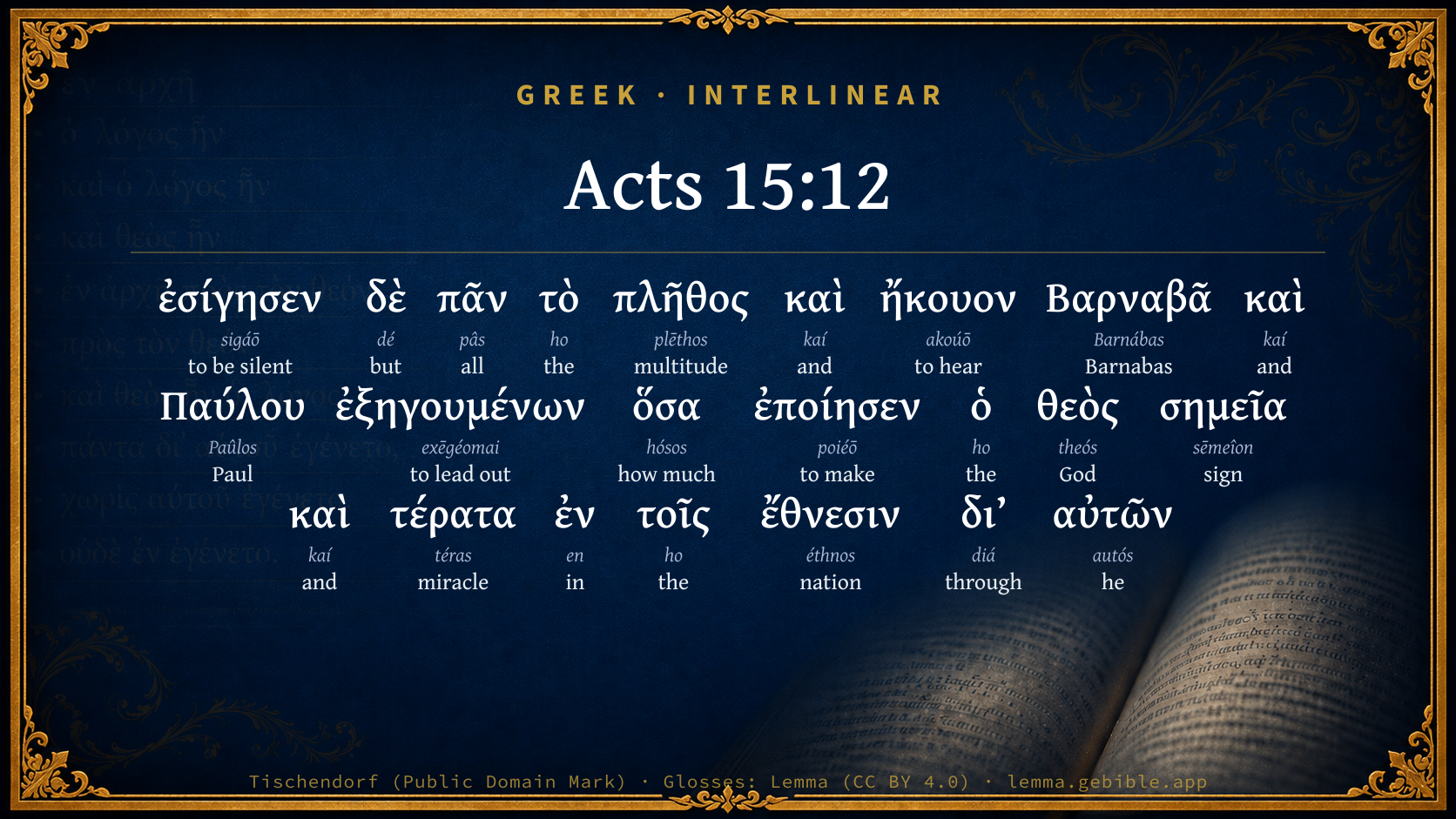
  1. ἐσίγησεν sigáō G4601 “to be silent” Verb, Aorist, Active, Indicative, 3rd person, Singular
  2. δὲ dé G1161 “but” Conjunction
  3. πᾶν pâs G3956 “all” Adjective, Nominative, Singular, Neuter
  4. τὸ ho G3588 “the” Article, Nominative, Singular, Neuter
  5. πλῆθος plēthos G4128 “multitude” Noun, Nominative, Singular, Neuter
  6. καὶ kaí G2532 “and” Conjunction
  7. ἤκουον akoúō G191 “to hear” Verb, Imperfect, Active, Indicative, 3rd person, Plural
  8. Βαρναβᾶ Barnábas G921 “Barnabas” Noun, Genitive, Singular, Masculine
  9. καὶ kaí G2532 “and” Conjunction
  10. Παύλου Paûlos G3972 “Paul” Noun, Genitive, Singular, Masculine
  11. ὅσα hósos G3745 “how much” Correlative pronoun, Accusative, Plural, Neuter
  12. ἐποίησεν poiéō G4160 “to make” Verb, Aorist, Active, Indicative, 3rd person, Singular
  13. ὁ ho G3588 “the” Article, Nominative, Singular, Masculine
  14. θεὸς theós G2316 “God” Noun, Nominative, Singular, Masculine
  15. σημεῖα sēmeîon G4592 “sign” Noun, Accusative, Plural, Neuter
  16. καὶ kaí G2532 “and” Conjunction
  17. τέρατα téras G5059 “miracle” Noun, Accusative, Plural, Neuter
  18. ἐν en G1722 “in” Preposition
  19. τοῖς ho G3588 “the” Article, Dative, Plural, Neuter
  20. ἔθνεσιν éthnos G1484 “nation” Noun, Dative, Plural, Neuter
  21. δι’ diá G1223 “through” Preposition
  22. αὐτῶν autós G846 “he” Personal pronoun, Genitive, Plural, Masculine

About this verse

These counts appear in no published source. They are computed here, from the morphology-tagged text and Lemma’s own curated glosses. What Lemma adds →

23
words
19
distinct lemmas
Acts
section

Notable vocabulary

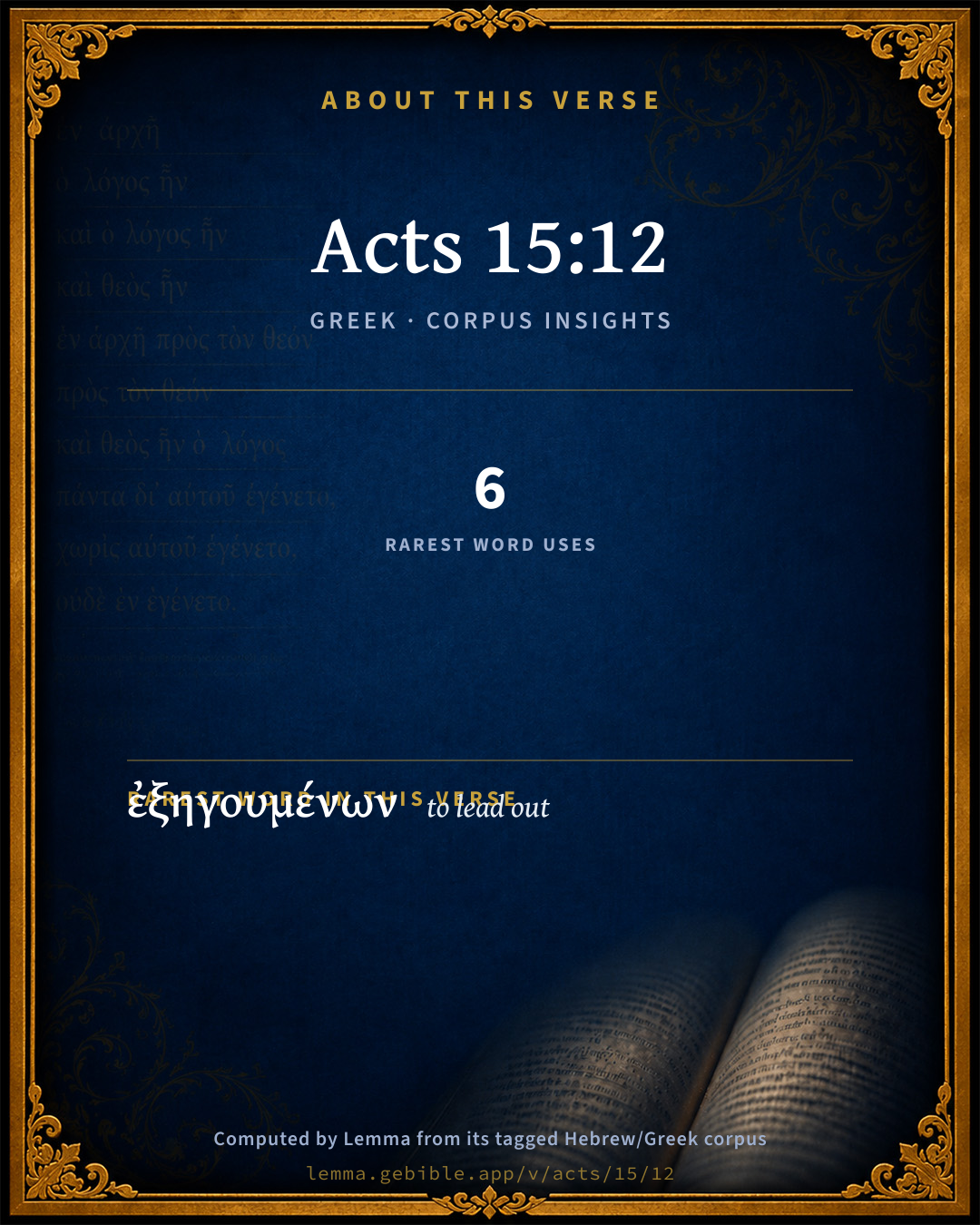
The rarest word here is ἐξηγουμένων to lead out G1834 — appearing just 6 times in the whole Greek New Testament.

Shared distinctive vocabulary

ἐξηγουμένων to lead out G1834 occurs in 6 verses of the Greek New Testament. Also found in:

Repetition

Words recur within this verse:

Cross-references

4

Topical passages linked to Acts 15:12 in the Treasury of Scripture Knowledge — connected by theme and wording, ordered by reader-vote popularity; previews shown in the World English Bible.

  • Acts 14:27 When they had arrived, and had gathered the assembly together, they reported all the things that God had done with them, and that he had opened a door of faith to the Gentiles.
  • Acts 15:4 When they had come to Jerusalem, they were received by the assembly and the apostles and the elders, and they reported all things that God had done with them.
  • John 4:48 Jesus therefore said to him, "Unless you see signs and wonders, you will in no way believe."
  • Acts 21:19 When he had greeted them, he reported one by one the things which God had worked among the Gentiles through his ministry.

Cross-references courtesy of OpenBible.info (CC BY 4.0).

Commentary

Notes on Acts 15:12 from classic Christian and Jewish commentators (each source and its license shown beneath its notes). The classic Christian expositions comment on the surrounding passage and are grouped to its opening verse, so a note may address several verses; the Jewish commentaries on the Tanakh (Rashi and others) are per-verse, so they appear only where the commentator wrote on this verse.

Lemma curates 59 commentaries, every one of them public domain or Creative Commons licensed, each selected and text-cleaned for this edition rather than reprinted as found. About our sources →

The Biblical Illustrator

Joseph S. Exell

Act_15:12

Then all the multitude kept silence and gave audience to Barnabas and Paul.

Apostolic testimony

1. When Paul speaks we want to know what Paul says. But some men must be their own reporters. So we turn from the Acts to the opening verses of Galatians. Where Luke contents himself with a summary, Paul passes into detail. Some reports are too condensed, and therefore unjust. The minister called and prayed. We do not say that he walked miles, and that when he prayed his heart wept.

2. Paul says he went up to Jerusalem by revelation. If he had gone up to Jerusalem awed by its position and fame, he would have picked out dainty inoffensive words that would win the ear of many. In reality, Paul went from heaven to Jerusalem, and withered its contemptibleness under the majesty of the visions from which he had just turned his eyes. We have dropped the word revelation except on the Sabbath, when we venture to say it sometimes. We have meaner words--such as impression, feeling, etc. These are inoffensive terms; an atheist might use such mock jewellery. The apostle said, I went up by revelation. I knew that the truth was with me, and I was anxious only that Christs Cross should be lifted up and seen everywhere as the one way of salvation.

3. Was Paul then afraid of Jerusalem, and pillars, and men of reputation? Paul was anxious to let the leaders of the Church know exactly what he had been preaching, so he had a private interview with those who were of reputation. Could we have heard him then! Speaking to a sympathetic audience, to men who had seen the Lord! Paul had no fear about his gospel. He said, I have been preaching salvation by Christ; now, brethren, what say you?

4. Paul was not ashamed of his Gentile converts. He took Titus with him, and said, This is a Gentile convert. He has begun in the Spirit; is he to be made perfect in the flesh? Always vindicate your arguments by your converts.

5. Paul illustrates by anticipation the right of private judgment. To those who were of reputation, who seemed to be pillars, he gave place by subjection, no, not for an hour. And speaking of those who seemed to be somewhat, he said, They added nothing to me. Where, then, was submission to papal authority? Here is one man who stands up in the Church, and says, This is the gospel which I have received, which I will preach, for which I mill live, for which, and in which, I will die. I am crucified with Christ, etc. That was the true assertion of private judgment: not the expression of an individual will, but the expression of a personal loyalty to a living Christ.

6. Paul showed the true nature of real and enduring unity. In effect, he said: We may be one without seeming to be united. There are men to whom circumcision is a hereditary rite. There are others to whom it would be an intolerable yoke. Now, let us go, the one to the circumcision, and the other to the uncircumcision; for I know that as this gospel spreads it will be seen at the last that neither circumcision availeth anything nor uncircumcision.

7. But the council could not break up so. One thing, said the council, shall unite us--that we remember the poor. The poor have ye always with you. So they all--the circumcision and the uncircumcision--in philanthropy showed their union in the Lord, who lived to redeem the human race! Speculative theology divides men; practical philanthropy unites them. Let us unite where we can. Never inquire into the creed of a needy man. The man is hungry; the creed must be bread. When he has eaten his bread you may ask him questions. Begin where you can; wherever the heart door is ajar, go in; wherever opportunity is offered, speak the living word or do the helpful deed. Always seek for the centre of union, and always avoid the cause of division or distrust. (J. Parker, D. D.)

The Biblical Illustrator, edited by Joseph S. Exell (c. 1880s–1900s) — public domain. Text from a community e-Sword module.

Joseph Benson's Commentary

Act 15:12-18. Then all the multitude kept silence — Having nothing further to object to what had been advanced; and gave audience to Barnabas and Paul — Who confirmed Peter’s reasoning, by declaring what miracles God had wrought among the Gentiles — By their ministry; of which, the chief miracle was, that he had amply conferred the gifts of the Holy Spirit on the believing Gentiles, although they were uncircumcised. After they had done speaking, James, the son of Alpheus, one of the apostles, answered those who were for subjecting the Gentiles to the law, by adding, in supplement to Peter’s reasoning, that the prophets had foretold the conversion of the Gentiles; so that it was always God’s purpose to make them his people. The passage he appeals to, quoting it according to the reading of the Seventy, is Amo 9:11-12; where see the notes. It may be thus paraphrased: After this — After the Jewish dispensation expires; I will return — To my people in mercy; and will build again the tabernacle — That is, the house, or family, of David; which is fallen down — Is in a low, degraded state: I will do this by raising from his seed the Christ, who shall erect, on the ruins of his fallen tabernacle, a spiritual and eternal kingdom; that the residue of men — And not the Jews alone; might seek after the Lord — After an acquaintance with him, and the blessings consequent thereon; and all the Gentiles upon whom my name is called — Or who shall be called by my name; who shall be my people. James adds, Known unto God are all his works — This the apostle infers from the prophecy itself, and the accomplishment of it. And this conversion of the Gentiles, being known to him from eternity, we ought not to think a new or strange thing. It is observable, he does not speak of God’s works in the natural world, (which would have been nothing to his present purposes) but of his dispensations toward the children of men. Now he could not know these, without knowing the characters and actions of particular persons, on a correspondence with which the wisdom and goodness of those dispensations are founded. For instance, he could not know how he would deal with heathen idolaters, (whom he was now calling into his church,) without knowing there would be heathen idolaters; and yet this was a thing purely contingent, a thing as dependant on the freedom of the human mind as any we can imagine. This text, therefore, among a thousand more, is an unanswerable proof that God foreknows future contingencies, though there are difficulties relating thereto which man cannot solve.

Joseph Benson's Commentary on the Old and New Testaments (1811–1818) — public domain. Text from a community e-Sword module.

MacLaren's Expositions of Holy Scripture

Alexander MacLaren

Acts

THE CHARTER OF GENTILE LIBERTY

Act 15:12 - Act 15:29.

Much was at stake in the decision of this gathering of the Church. If the Jewish party triumphed, Christianity sank to the level of a Jewish sect. The question brought up for decision was difficult, and there was much to be said for the view that the Mosaic law was binding on Gentile converts. It must have been an uprooting of deepest beliefs for a Jewish Christian to contemplate the abrogation of that law, venerable by its divine origin, by its hoary antiquity, by its national associations. We must not be hard upon men who clung to it; but we should learn from their final complete drifting away from Christianity how perilous is the position which insists on the necessity to true discipleship of any outward observance.

Our passage begins in the middle of the conference. Peter has, with characteristic vehemence, dwelt upon the divine attestation of the genuine equality of the uncircumcised converts with the Jewish, given by their possession of the same divine Spirit, and has flung fiery questions at the Judaisers, which silenced them. Then, after the impressive hush following his eager words, Barnabas and Paul tell their story once more, and clinch the nail driven by Peter by asserting that God had already by ‘signs and wonders’ given His sanction to the admission of Gentiles without circumcision. Characteristically, in Jerusalem Barnabas is restored to his place above Paul, and is named first as speaking first, and regarded by the Jerusalem Church as the superior of the missionary pair.

The next speaker is James, not an Apostle, but the bishop of the Church in Jerusalem, of whom tradition tells that he was a zealous adherent to the Mosaic law in his own person, and that his knees were as hard as a camel’s through continual prayer. It is singular that this meeting should be so often called ‘the Apostolic council,’ when, as a fact, only one Apostle said a word, and he not as an Apostle, but as the chosen instrument to preach to the Gentiles. ‘The elders,’ of whose existence we now hear for the first time in this wholly incidental manner, were associated with the Apostles {Act 15:6}, and the ‘multitude’ {Act 15:12} is most naturally taken to be ‘the whole Church’ {Act 15:22}. James represents the eldership, and as bishop in Jerusalem and an eager observer of legal prescriptions, fittingly speaks. His words practically determined the question. Like a wise man, he begins with facts. His use of the intensely Jewish form of the name Simeon is an interesting reminiscence of old days. So he had been accustomed to call Peter when they were all young together, and so he calls him still, though everybody else named him by his new name. What God had done by him seems to James to settle the whole question; for it was nothing else than to put the Gentile converts without circumcision on an equality with the Jewish part of the Church.

Note the significant juxtaposition of the words ‘Gentiles’ and ‘people’-the former the name for heathen, the latter the sacred designation of the chosen nation. The great paradox which, through Peter’s preaching at Caesarea, had become a fact was that the ‘people of God’ were made up of Gentiles as well as Jews-that His name was equally imparted to both. If God had made Gentiles His people, had He not thereby shown that the special observances of Israel were put aside, and that, in particular, circumcision was no longer the condition of entrance? The end of national distinction and the opening of a new way of incorporation among the people of God were clearly contained in the facts. How much Christian narrowness would be blown to atoms if its advocates would do as James did, and let God’s facts teach them the width of God’s purposes and the comprehensiveness of Christ’s Church! We do wisely when we square our theories with facts; but many of us go to work in the opposite way, and snip down facts to the dimension of our theories.

James’s next step is marked equally by calm wisdom and open-mindedness. He looks to God’s word, as interpreted by God’s deeds, to throw light in turn on the deeds and to confirm the interpretation of these. Two things are to be noted in considering his quotation from Amos-its bearing on the question in hand, and its divergence from the existing Hebrew text. As to the former, there seems at first sight nothing relevant to James’s purpose in the quotation, which simply declares that the Gentiles will seek the Lord when the fallen tabernacle of David is rebuilt. That period of time has at least begun, thinks James, in the work of Jesus, in whom the decayed dominion of David is again in higher form established. The return of the Gentiles does not merely synchronise with, but is the intended issue of, Christ’s reign. Lifted from the earth, He will draw all men unto Him, and they shall ‘seek the Lord,’ and on them His name will be called.

Now the force of this quotation lies, as it seems, first in the fact that Peter’s experience at Caesarea is to be taken as an indication of how God means the prophecy to be fulfilled, namely, without circumcision; and secondly, in the argumentum a silentio, since the prophet says nothing about ritual or the like, but declares that moral and spiritual qualifications-on the one hand a true desire after God, and on the other receiving the proclamation of His name and calling themselves by it-are all that are needed to make Gentiles God’s people. Just because there is nothing in the prophecy about observing Jewish ceremonies, and something about longing and faith, James thinks that these are the essentials, and that the others may be dropped by the Church, as God had dropped them in the case of Cornelius, and as Amos had dropped them in his vision of the future kingdom. God knew what He meant to do when He spoke through the prophet, and what He has done has explained the words, as James says in Act 15:18.

The variation from the Hebrew text requires a word of comment. The quotation is substantially from the Septuagint, with a slight alteration. Probably James quoted the version familiar to many of his hearers. It seems to have been made from a somewhat different Hebrew text in Act 15:17, but the difference is very much slighter than an English reader would suppose. Our text has ‘Edom’ where the Septuagint has ‘men’; but the Hebrew words without vowels are identical but for the addition of one letter in the former. Our text has ‘inherit’ where the Septuagint has ‘seek after’; but there again the difference in the two Hebrew words would be one letter only, so that there may well have been a various reading as preserved in the Septuagint and Acts. James adds to the Septuagint ‘seek’ the evidently correct completion ‘the Lord.’

Now it is obvious that, even if we suppose his rendering of the whole verse to be a paraphrase of the same Hebrew text as we have, it is a correct representation of the meaning; for the ‘inheriting of Edom’ is no mere external victory, and Edom is always in the Old Testament the type of the godless man. The conquest of the Gentiles by the restorer of David’s tabernacle is really the seeking after the Lord, and the calling of His name upon the Gentiles.

The conclusion drawn by James is full of practical wisdom, and would have saved the Church from many a sad page in its history, if its spirit had been prevalent in later ‘councils.’ Note how the very designation given to the Gentile converts in Act 15:19 carries argumentative force. ‘They turn to God from among the Gentiles’-if they have done that, surely their new separation and new attachment are enough, and make insistence on circumcision infinitely ridiculous. They have the thing signified; what does it matter about the sign, which is good for us Jews, but needless for them? If Church rulers had always been as open-eyed as this bishop in Jerusalem, and had been content if people were joined to God and parted from the world, what torrents of blood, what frowning walls of division, what scandals and partings of brethren would have been spared!

The observances suggested are a portion of the precepts enjoined by Judaism on proselytes. The two former were necessary to the Christian life; the two latter were not, but were concessions to the Jewish feelings of the stricter party. The conclusion may be called a compromise, but it was one dictated by the desire for unity, and had nothing unworthy in it. There should be giving and taking on both sides. If the Jewish Christians made the, to them, immense concession of waiving the necessity of circumcision, the Gentile section might surely make the small one of abstinence from things strangled and from blood. Similarities in diet would daily assimilate the lives of the two parties, and would be a more visible and continuous token of their oneness than the single act of circumcision.

But what does the reason in Act 15:21 mean? Why should the reading of Moses every Sabbath be a reason for these concessions? Various answers are given: but the most natural is that the constant promulgation of the law made respect for the feelings {even if mistaken} of Jewish Christians advisable, and the course suggested the most likely to win Jews who were not yet Christians. Both classes would be flung farther apart if there were not some yielding. The general principle involved is that one cannot be too tender with old and deeply rooted convictions even if they be prejudices, and that Christian charity, which is truest wisdom, will consent to limitations of Christian liberty, if thereby any little one who believes in Him shall be saved from being offended, or any unbeliever from being repelled.

The letter embodying James’s wise suggestion needs little further notice. We may observe that there was no imposing and authoritative decision of the Ecclesia, but that the whole thing was threshed out in free talk, and then the unanimous judgment of the community, ‘Apostles, elders and the whole Church,’ was embodied in the epistle. Observe the accurate rendering of Act 15:25, ‘having come to one accord,’ which gives a lively picture of the process. Note too that James’s proposal of a letter was mended by the addition of a deputation, consisting of an unknown ‘Judas called Barsabas’ {perhaps a relative of ‘Joseph called Barsabas,’ the unsuccessful nominee for Apostleship in Act 1:23}, and the well-known Silas or Silvanus, of whom we hear so much in Paul’s letters. That journey was the turning-point in his life, and he henceforward, attracted by the mass and magnetism of Paul’s great personality, revolved round him, and forsook Jerusalem.

Probably James drew up the document, which has the same somewhat unusual ‘greeting’ as his Epistle. The sharp reference to the Judaising teachers would be difficult for their sympathisers to swallow, but charity is not broken by plain repudiation of error and its teachers. ‘Subverting your souls’ is a heavy charge. The word is only here found in the New Testament, and means to unsettle, the image in it being that of packing up baggage for removal. The disavowal of these men is more complete if we follow the Revised Version in reading {Act 15:24} ‘no commandment’ instead of ‘no such commandment.’

These unauthorised teachers ‘went’; but, in strong contrast with them, Judas and Silas are chosen out and sent. Another thrust at the Judaising teachers is in the affectionate eulogy of Paul and Barnabas as ‘beloved,’ whatever disparaging things had been said about them, and as having ‘hazarded their lives,’ while these others had taken very good care of themselves, and had only gone to disturb converts whom Paul and Barnabas had won at the peril of their lives.

The calm matter-of-course assertion that the decision which commended itself to ‘us’ is the decision of ‘the Holy Ghost’ was warranted by Christ’s promises, and came from the consciousness that they had observed the conditions which He had laid down. They had brought their minds to bear upon the question, with the light of facts and of Scripture, and had come to a unanimous conclusion. If they believed their Lord’s parting words, they could not doubt that His Spirit had guided them. If we lived more fully in that Spirit, we should know more of the same peaceful assurance, which is far removed from the delusion of our own infallibility, and is the simple expression of trust in the veracious promises of our Lord.

The closing words of the letter are beautifully brotherly, sinking authority, and putting in the foreground the advantage to the Gentile converts of compliance with the injunctions. ‘Ye shall do well,’ rightly and conformably with the requirements of brotherly love to weaker brethren. And thus doing well, they will ‘fare well,’ and be strong. That is not the way in which ‘lords over God’s heritage’ are accustomed to end their decrees. Brotherly affection, rather than authority imposing its will, breathes here. Would that all succeeding ‘Councils’ had imitated this as well as ‘it seemed good to the Holy Ghost, and to us’!

Alexander MacLaren, Expositions of Holy Scripture (1904–1910) — public domain. Text from a community e-Sword module.

Bengel's Gnomon

Johann Albrecht Bengel

Act 15:12. Ἐξηγουμένων, narrating) By which very narration the sentiment of Peter was confirmed.

Bengel's Gnomon of the New Testament — English translation (T&T Clark, Edinburgh, 1860) — public domain. Text from a community e-Sword module.

Meyer's Critical & Exegetical Commentary

Heinrich August Wilhelm Meyer

Act_15:12. The result of this speech was that the whole assembled multitude (πᾶν τὸ πλῆθος) was silent, so that thus a new συζήτησις did not begin, and the agitation of the opponents was set at rest. A happy beginning for the happy issue. Now Barnabas and Paul could without contradiction confirm the view of Peter by the communication of their own apostolic experiences among the Gentiles,

Barnabas first, on account of his older and closer relation to the church. Comp. on Act_15:25.

σημεῖα κ. τέρατα] Comp. generally also Rom_15:19; 2Co_12:12, hence so much the less improbable (Zeller).

Meyer — Critical and Exegetical Commentary on the New Testament — English translation by Peter Christie, edited by Frederick Crombie (T&T Clark, 1880) — public domain. Text from a community e-Sword module.

Expositor's Greek Testament

ed. W. Robertson Nicoll

Act 15:12 . ἐσίγησε : may mean “became silent,” “itaque antea non tacuerant” (Blass), cf. Burton, N. T. Moods and Tenses , 21, A. and R.V., “kept silence”. πᾶν τὸ πλῆθος : implying a general assembly of the Church; on the word see Act 2:6 , Act 4:32 , etc. ἤκουον : imperfect, marking a continuous hearing; the silence and the audience both testified to the effect produced by St. Peter’s words. Βαρ . καὶ Π ., on the order here and in Act 15:25 cf. Ramsay, St. Paul , p. 84. ἐξηγουμένων : setting forth in detail; see above on Act 15:3 , and Act 10:8 . ὅσα ἐποί ., cf. Act 14:27 and Act 15:4 . In each case the appeal is made to what God had done, and to the further answer to the prayer of Act 4:30 by the miracles wrought among the Gentiles: it was an answer which a Jewish audience would understand, Joh 3:2 . The historical truthfulness of Paul and Barnabas thus recounting the facts, and leaving the actual proof of the rightfulness of their method of working to Peter and James, is to Zeller inconceivable an objection sufficiently answered by the consideration that Luke wished to represent not so much the attitude of Paul and Barnabas, but that of the original Apostles to the Gentile-question; and in Jerusalem it was only natural that Peter and James should be the spokesmen.

The Expositor's Greek Testament, edited by W. Robertson Nicoll (1897–1910) — public domain. Text from a community e-Sword module.

Geneva Bible (1599)

Geneva Bible translators

A true pattern of a lawful Council, where God’s truth only reigneth.

Geneva Bible (1599) marginal notes — public domain. Text via Bolls.life.

Jamieson, Fausset & Brown

Robert Jamieson, A. R. Fausset & David Brown

Then all . . . gave audience to Barnabas and Paul--On this order of the names here, see on Act 15:25.

declaring what miracles and signs God wrought among the Gentiles by them--This detail of facts, immediately following up those which Peter had recalled to mind, would lead all who waited only for divine teaching to see that God had Himself pronounced the Gentile converts to be disciples in as full standing as the Jews, without circumcision; and the attesting miracles to which Paul here refers would tend, in such an assembly to silence opposition.

Jamieson, Fausset & Brown — Commentary Critical and Explanatory on the Whole Bible (1871) — public domain (CC PDM 1.0). Text via the HelloAO Bible API.

Adam Clarke's Commentary

Verse 12. All the multitude kept silence] The strong facts stated by St. Peter could not be controverted. His speech may be thus analyzed:

1. Circumcision is a sign of the purification of the heart.

2. That purification can only be effected by the Holy Ghost.

3. This Holy Spirit was hitherto supposed to be the portion of those only who had received circumcision.

4. But the Gentiles, who were never circumcised, nor kept any part of the law of Moses, have had their hearts purified by faith in Christ Jesus.

5. As God, therefore, has given them the thing signified, he evidently does not intend that the sign should be administered.

6. Should we impose this burthensome rite, we should most evidently be provoking God, who plainly shows us that he intends no more to save in this way.

7. Therefore it is evident that both Jews and Gentiles are to be saved through the grace of the Lord Jesus Christ.

Gave audience to Barnabas and Paul] These apostles came forward next, to corroborate what Peter had said, by showing the miracles and wonders which God had by them wrought among the Gentiles. Peter stated facts: Paul and Barnabas confirmed the statement.

Adam Clarke's Commentary on the Bible (1810–1826) — public domain. Text from a community e-Sword/MySword module.

John Calvin's Commentaries

12. All the multitude held their peace. By these words, Luke giveth us to understand that the Spirit of God did so reign in that assembly, that they yielded forthwith to reason. The disputation was hot before; but now, after that Peter hath laid open the counsel of God, and hath handled the question according to the doctrine of the Scripture, by and by all noise being stayed, they are quiet and whist who did of late unadvisedly defend the error. This is a lively image of a lawful Council, when the truth of God alone, so soon as it is once come to light, maketh an end of all controversies; and assuredly it is effectual enough to appease all discord when the Spirit beareth the chief sway; because he is again a fit governor, as well to moderate their tongues who must speak before others as to keep the rest under obedience, that they be not too much addicted to themselves and wedded to their own wills, but that, laying away stubbornness, they may show themselves obedient to God. Neither is it to be doubted but that there was some few which would not yield, as it falleth out in a great assembly; yet the truth of God had the upper hand, so that the silence whereof Luke speaketh was a manifest testimony of common obedience. And this was no small moderation in Peter, in that having suffered every one to say for himself what he could, he deferred his judgment (lest it should be prejudicial to others) so long, until the question had been thoroughly discussed to and fro.

They heard Barnabas and Paul. We may gather by these words that they were not heard with silence before.: For seeing that the more part was persuaded that they did wickedly admit the profane Gentiles into the Church, there should nothing which they should have said have been patiently received until this false opinion were corrected and reformed; but all should have been taken at the worst. We see what a poison displeasure conceived for no cause is, which doth so possess men’s minds, that it stoppeth the way, so that the truth can never have en, trance. Hereby we learn how true that saying is, All things are sound to the sound, (Titus 1:15,) for there is nothing so wholesome but corrupt affection do turn the same into that which is hurtful. And to this end tendeth the narration made by Paul and Barnabas, that they may show and prove that God doth allow their apostleship among the Gentiles; forasmuch as it was ratified and confirmed by miracles, which are, as it were, certain seals thereof.

John Calvin's Commentaries (1540-1563) — public domain. Text from the Calvin Translation Society English edition (1840s-50s) via the Christian Classics Ethereal Library (ccel.org). Calvin's coverage is partial (roughly two-thirds of the Bible); uncommented books and verses are honest gaps, never fabricated. The 19th-century editor's footnotes and remarks are omitted so the notes are faithfully Calvin's own voice.

Ellicott's Commentary for English Readers

(12) And gave audience to Barnabas and Paul.—The leaders of the Church had clearly reserved their part in the debate to the last, and the two Apostles of the Gentiles were now called on to repeat more publicly what they had already narrated to the Apostles and elders (Act_15:4). It was, perhaps, with a special view to the character of their hearers that they laid stress on the “signs and wonders” which had attested God’s acceptance of their work (Mat_12:38; Mat_16:1; 1Co_1:22). Miracles had been wrought among the Gentiles as freely as among the Jews, and those who wrought them, unless they were casting out devils by Beelzebub (and the Judaisers appear to have shrunk from that charge), must have been sent by God (Joh_3:2; Joh_9:31-33).

A Bible Commentary for English Readers, edited by Charles John Ellicott (1878–1897) — public domain. Text from a community e-Sword module.

The Cambridge Bible for Schools and Colleges

gen. ed. J. J. S. Perowne

12. Then all the multitude] Though the apostles and elders are alone mentioned (Act_15:6) as coming together, it now appears that the assembly was a large one.

kept silence] The authority with which he could speak through whom God had first opened the door of faith to the Gentiles must have silenced opposition. For he like themselves had had prejudices to overcome before his mission to Cornelius.

and gave audience] Here the imperfect tense implies the steady continuous attention to the whole narrative of that first missionary journey of St Paul.

what miracles] The word is that usually rendered signs; and the two nouns are the same which occur in the prayer of the disciples (Act_4:30) ‘that signs and wonders may be done through the name of thy holy servant Jesus.’ The prayer was now being answered abundantly. It is well that the English rendering should accord in these places.

by them] See note on Act_15:4 above.

The Cambridge Bible for Schools and Colleges (gen. ed. J. J. S. Perowne; Cambridge University Press, 1878–1918) — public domain. Text from a community e-Sword module.

John Gill's Exposition

Then all the multitude kept silence,.... Upon this oration of Peter's, there was a profound silence in the whole assembly, among all the brethren of the church, who were come together on this occasion; they were all satisfied with, and by their silence acquiesced in, what Peter said; and waited to hear what might be further said about this matter, by other persons in the assembly; and even those who were on the other side of the question, were confounded and nonplussed, and knew not what to say, and the more so, when they perceived that the rest of the apostles and elders were of the same mind; for Beza's most ancient copy introduces this clause thus; "then the elders agreeing to the things that were said by Peter, the whole multitude was silent": and this gave Paul and Barnabas an opportunity of being heard; who, perhaps, could not so well be heard before, for the clamour of the people against them, who might not have so good an opinion of them, and of their practices:

and gave audience to Barnabas and Paul; Barnabas is mentioned first, he being most known to the Jews, and of whom they might have the better opinion; and who probably gave the account of their proceedings and success among the Gentiles:

declaring what miracles and wonders God had wrought among the Gentiles by them; what wonders of grace were wrought in the conversion of multitudes of them, wherever they came; and what miracles in nature were wrought for the confirmation of the Gospel, such as the striking blind Elymas the sorcerer, at Paphos in Cyprus, and curing the cripple at Lystra; and which they ascribe not to themselves but to God, whose instruments they only were.

John Gill's Exposition of the Whole Bible (1746–1763) — public domain (CC PDM 1.0). Text via the HelloAO Bible API.

Trapp's Complete Commentary

John Trapp

12 Then all the multitude kept silence, and gave audience to Barnabas and Paul, declaring what miracles and wonders God had wrought among the Gentiles by them.

Ver. 12. Then all the multitude kept silence] See here the picture of a lawful council, guided by the word and Spirit of God. It was not a Cyclopical assembly, ubi ουδεις ουδεν ουδενος ακουει, nor as in Alcibiades’ army, where all would be leaders, no learners, &c. Or, as the Jews of this day in their Jeshiboth, or academies, meet to dispute, but talk all together confusedly: the rabbis with their scholars, &c.

John Trapp, A Commentary or Exposition upon All the Books of the Old and New Testament (1647–1656) — public domain. Text from a community e-Sword module.

Albert Barnes' Notes on the Bible

Then all the multitude - Evidently the multitude of private Christians who were assembled on this occasion. That it does not refer to a synod of ministers and elders merely is apparent:

(1) Because the church, the brethren, are represented as having been present, and as concurring in the final opinion Act 15:22-23; and,

(2) Because the word “multitude” τὸ πλῆθος to plēthos would not have been used in describing the collection of apostles and elders merely. Compare Luk 1:10-11, Luk 1:13; Luk 5:6; Luk 6:17; Luk 19:37; Joh 5:3; Joh 21:6; Act 4:32; Act 6:2; Mat 3:7.

Gave audience - Heard, listened attentively to.

Barnabas and Paul - They were deeply interested in it, and they were qualified to give a fair statement of the facts as they had occurred.

Declaring what miracles and wonders ... - The argument here evidently is, that God had approved their work by miracles; that he gave evidence that what they did had his approbation; and that as all this was done without imposing on them the rites of the Jews, so it would follow that those were not now to be commanded.

Albert Barnes' Notes on the Bible (1834–1885) — public domain. Text from a community e-Sword/MySword module.

Matthew Poole's English Annotations

All the multitude; the apostles and elders themselves gave attention to what Barnabas and Paul declared, and by their silence did tacitly approve of what they had said.

Miracles and wonders; the conversion of the Gentiles in itself, and not only the signs which did attend it, is truly wonderful: the saving of any one soul is a miraculous work.

Matthew Poole's English Annotations on the Holy Bible (1683–1685) — public domain. Text from a community e-Sword/MySword module.

Whedon's Commentary on the Bible

Daniel D. Whedon

12. Kept silence—Hushed, not from the tumult of debate, as some commentators think; nor by the power of Peter’s speech, as others; but hushed from eager expectation of what the Antiochian ambassadors will say, and held silent by the thrilling interest of their narrative. Barnabas here, by local propriety, takes precedence, as also in the letter of the Council, (Act_15:25,) just as James takes precedence of Peter in Gal_2:9. Yet it no doubt is true that Jerusalem never so expanded her soul as to take in the greatness of Paul’s apostolate.

Miracles and wonders—The tale of these two hardy itinerants could not but possess all the novelty and power of romance to their listening ears. For a brief hour, at least, they stood upon the high platform of Jesus Himself, and their horizon extended into the breadth of his commission, “Go into all the world.” For a moment they realized that Christianity was to become a universal religion by shedding Judaism from its back.

Daniel D. Whedon (gen. ed.), Commentary on the Old and New Testaments (1874–1909) — public domain. Text from a community e-Sword module.

The Pulpit Commentary

And for then, A.V.; they hearkened for gave audience, A.V.; rehearsing what signs for declaring what miracles, A.V. Kept silence; marking the contrast between the noisy questionings and disputings which had preceded Peter"s speech, and the quiet orderly attention with which they now listened to Paul and Barnabas, telling them of the conversion of the Gentiles. It recalls Virgil"s description of the effect of the presence of a man of grave piety upon an excited crowd

Tum, pielate gravem ac meritis si forte virum quem Aspexere, silent, arrectisque auribus adslant. ("AEneid," 1:152. )

Vers. 12-35. A grave crisis in the kingdom of God: more lessons.

After Peter"s speech (vers. 7-10) came the narration of facts by Barnabas and Paul, in which they laid stress on the Divine tokens of favor and support which they had received in the execution of their work (ver. 12); and then James summed up the matter, evidently giving voice to the decision of the Church. We learn

I THAT MEN OF DIVERGENT THOUGHT SHOULD STRIVE TO MEET ONE ANOTHER"S VIEWS IN CHRISTIAN COUNCIL. Probably it would be hard to find two good men of any age or country who have taken more divergent views of the gospel of Christ than did James and Paul. Their Epistles show us how they viewed the one truth from separate and even distant standpoints. Had they come to this Church meeting intent on magnifying their own distinctive points, there would have ensued bitter conflict and fatal rupture. But they strove to meet one another, and the end was peace and the furtherance of redeeming truth.

II THAT AN EQUITABLE COMPROMISE MAY BE THE MOST HONORABLE SETTLEMENT. (Vers. 19-21.) In concession to the Gentile party, it was not required that they should submit to the distinctive rite; in concession to the Jewish party, it was required that certain statutes should be observed by them. Occasions will very frequently occur when each side owes it to the other to make concession. The spirit that strives only for victory is not the spirit of Christ. We should, as his disciples, count it an honor and a joy to concede, when we conscientiously can do so, to Christian brethren who differ from us.

III THAT WE MAY LEAVE UNIMPORTANT MATTERS TO THE SETTLEMENT OF TIME. The particular precepts which James and those who thought with him desired to have enforced have long since disappeared. Their observance at the time was expedient, for Moses had in every city them that preached him, etc. (ver. 21). But when the special reasons for conformity were removed, then they fell through. Where the peace of a Church or a large Christian community is at stake, we do well to accept small matters which are unessential; time is on our side.

IV THAT CHRISTIANITY HAS PURIFIED AND PROPORTIONED PUBLIC MORALS. It surprises and shocks us to read of abstinence from meat which had been offered to idols, and from things strangled, being placed side by side with abstinence from the sin of fornication, as if, in morals, these things stood on the same level. We feel that the latter is a thing so utterly and inherently bad that the former is not at all comparable with it in heinousness of offence. The fact is that we think thus because our holy religion has purified our thoughts, and taught us to see ceremonial and moral offences in true perspective. But wherever Christianity has been corrupted, where the traditions of men have overlaid its simplicity with their ceremonialism, we find this defective view prevailing. It was necessary, at that time and in the then condition of the world, formally and expressly to disallow a custom which we now shudder at and shrink from as a shameful sin.

V THAT DECISIONS, WHEN ONCE ATTAINED, SHOULD BE COURTEOUSLY AND CAREFULLY CARRIED OUT. (Vers. 22-33.) The Church at Jerusalem, though on the main point it had yielded to the Church at Antioch, did not give way sulkily or grudgingly. It did not dismiss the deputation with a cold and formal resolution. It sent able and influential men, with letters, to accompany Paul and Barnabas, and these greeted the Syrian Church and laid the matter fully before them. So that, in the end, the two communities understood one another and rejoiced in one another the more. What is done in Christ"s name and cause should be done with utmost courtesy and with perfect thoroughness.

VI THAT WE MAY REST HAPPY IN THE ALL-SEEING WISDOM AND ALL-EMBRACING LOVE OF GOD. (Vers. 14-15.) James intimated that what was then happening was only the fulfillment of the Divine intention. God knew from the beginning what he should accomplish, and he purposed the recovery and redemption of the whole Gentile world,

1. When we are baffled by the perplexities of the way, let us remember that all things are in the hands of the omniscient One.

2. When we are distressed by the disappointments and difficulties of our work, let us be consoled by thinking that God means to restore mankind; his wisdom and his love will prevail, though we see not our way and though our fears abound. C.

The Pulpit Commentary (1880–1919), ed. H.D.M. Spence-Jones & Joseph S. Exell — public domain. Text from a community e-Sword module.

John Wesley's Explanatory Notes

Miracles and wonders - By which also what St. Peter had said was confirmed.

John Wesley, Explanatory Notes Upon the Whole Bible (1754–1765) — public domain. Text via the GEBible commentary corpus.

Burkitt's Expository Notes on the New Testament

William Burkitt

The second speech made in this council, was that of Barnabas and Paul, who declared what miracles God had enabled them to work among the Gentiles, which was an evidence of God’s approbation of the Gentiles, though uncircumcised, and that he was pleased with their adminstration among them.

Hence they conclude very well, that the miracles wrought among the Gentiles, and the Holy Ghost descending upon the Gentiles, was God’s approving testimony, in the case that the believing Gentiles, without circumcision, should find no less acceptance with God than the believing Jews, who were of the circumcision.

William Burkitt's Expository Notes on the New Testament (1700–1703) — public domain. Text from a community e-Sword module.

McGarvey & Pendleton's Commentaries

J. W. McGarvey

12. This brief statement of facts had so good an effect upon the multitude, that Barnabas and Paul determined to follow it by a rehearsal of similar facts in the history of their own labors among the Gentiles. (12) " Then all the multitude kept silence, and listened to Barnabas and Paul relating what signs and wonders God had wrought among the Gentiles through them. " Their remarks on this occasion were not a repetition of what they had said in the former meeting, when they had set forth "all that God had done with them," but were confined to the "signs and wonders" by which God had indicated his approbation of their ministry. The reversal of the order in which Luke now habitually names these two brethren indicates that Barnabas, whose name is first, was the first speaker. This gave Paul the closing argument on those events.

J. W. McGarvey (with Philip Y. Pendleton), Commentaries on the New Testament (The Fourfold Gospel, 1914; Acts; and the epistles) — public domain. Text from a community e-Sword/MySword module.

The People's New Testament

B. W. Johnson

12. All the multitude kept silence. After Peter's reminder of his work among the Gentiles, Paul and Barnabas were probably called on to show whether their work, like Peter's, showed that God was with them. They therefore gave some account of the miracles that God had wrought by their hands, thereby attesting the Divine favor.

B. W. Johnson's The People's New Testament with Notes (1889–1891) — public domain. Electronic text from the Christian Classics Ethereal Library (CCEL) ThML edition.

unfoldingWord translationNotes

Door43 World Missions Community

General Information:

Here the word "them" refers to Paul and Barnabas.

All the multitude

"Everyone" or "The whole group" (See: Acts 15:6)

God had worked

"God had done" or "God had caused"

translationWords

Barnabas

Paul

report

miracle

God

Gentile

unfoldingWord translationNotes — © Distant Shores Media and the Door43 World Missions Community, licensed CC BY-SA 4.0. Source: git.door43.org/Door43/en_tn.

Cambridge Greek Testament for Schools and Colleges

12. ἐσίγησεν δὲ πᾶν τὸ πλῆθος, then all the multitude kept silence. We see here, though the Apostles and Elders are alone mentioned (Act 15:6) as being gathered together, that the assembly was a very large one. The cause of their silence was the voice of authority with which he could speak through whom God had first opened the door of faith to the Gentiles. For while he told what God had done, he related how he, like themselves, had much prejudice to overcome before his mission to Cornelius.

καὶ ἤκουον, and gave audience. The verb is plural to correspond with the plural sense of πλῆθος, and the use of the imperfect tense is to indicate the continuous attention to the whole narrative of that, the first missionary journey for the spread of the faith.

ὅσα … σημεῖα καὶ τέρατα, what signs and wonders. The two nouns are the same which occur in the prayer of the disciples (Act 4:30) ‘that signs and wonders may be done through the name of Thy holy servant Jesus.’ The prayer had been abundantly answered in the experience of Paul and Barnabas.

δι’ αὐτῶν, by them, i.e. through them as instruments. See above on Act 15:4.

Cambridge Greek Testament for Schools and Colleges (Cambridge University Press, 1896; 21 vols, various authors incl. Carr, Maclear, Plummer, Farrar, Lumby, Moule, M. R. James, Simcox) — public domain. Text from a community e-Sword module.

Alford’s Greek Testament

Henry Alford

12.] The multitude (see above) then,—and not before, on account of their mutual disputes,—being tranquillized by Peter’s speech, quietly received from Paul and Barnabas an account of the seals of signs and wonders by which God had stamped the approval of their ministry among the Gentiles. The miracles at Paphos and Lystra would be among the principal of these.

Henry Alford, The Greek Testament (1849–1861) — public domain. Text from a community e-Sword module.

Vincent's Word Studies in the New Testament

Marvin R. Vincent

Hearkened. The imperfect [ηκουον] denotes attention to a continued narrative.

Declaring [εξηγουμενων] . Better, as Rev., rehearsing. See on Luk 24:35.

What miracles, etc. Lit., how many [οσα] .

Marvin R. Vincent, Word Studies in the New Testament (1887–1900) — public domain. Text from a community e-Sword/MySword module.

Lesson kit

Teaching starters — assembled from the data on this page, not authored interpretation. Every prompt links to the verse data it draws on. Edit before teaching.

Acts, in the Acts, opens this verse with 23 words (19 distinct Greek lemmas). Its most distinctive word is exēgéomai (“to lead out”). A historical commentator’s framing appears above. Read the whole chapter for the surrounding context.

Discussion questions

  1. What does “to lead out” (exēgéomai) contribute to the verse as a whole?
  2. Luke 24:35 shares the word «to lead out» with this verse. How do the two illuminate each other?
  3. “the” occurs 3× in this one verse. What is the effect of the repetition?
  4. These translations render this verse differently. What is at stake in choosing one wording over another?
  5. Reading how The Biblical Illustrator and Joseph Benson's Commentary read this verse, where do the two commentators agree and where do they part?

Things to notice

Reading settings

Reading text

Shown beneath each verse's original-language words.

Old Testament
Old Testament edition

Read the OT as the Masoretic Hebrew (MT) or the Greek Septuagint (LXX).

English shown for the Greek Septuagint (in the Hebrew ↔ Greek comparison).

Comparing translations? Open the Compare panel on any verse page to stack up to four side by side.