1 Corinthians 11:18

Greek (Tischendorf 8th ed.) 1 Corinthians 11:18 appears in the Greek New Testament. The text above is from the Tischendorf 8th edition. Each word links to its Strong’s number and a concise gloss. Click any word for its full Thayer’s Greek Lexicon entry.
Download image
Cite this verse

1 Corinthians 11:18 (World English Bible). Public Domain. Lemma interlinear Bible study tool, https://lemma.gebible.app/v/1-corinthians/11/18.

Show BibTeX & RIS
BibTeX
RIS
English Translation
For first of all, when you come together in the assembly, I hear that divisions exist among you, and I partly believe it.
World English Bible · Public Domain
Download a study sheet

One document with this verse’s original text, its word-by-word gloss line, the meaning frame, cross-references with their text, attributed commentary, and full source and license credits — printable, and it pastes into notes with its structure intact.

This verse Autodidact and up

Study sheet (.html) Plain text (.txt)

A passage Seminary Student

Up to 50 verses in one chapter. A passage sheet keeps up to 6 commentary sources and 12 cross-references per verse, in the order this page ranks them, and says so on the sheet whenever that leaves anything out. Ask for a single verse and you get the Autodidact verse sheet above.

Everything on this page stays free to read, with no account — the sheet is a download of what is already on screen, not access to it.

Want to remove ads? Support Godless Engineer
Compare translations 3

The same verse in 3 English versions, stacked beneath the original-language interlinear above. Click any original word for its lexicon entry.

Each is an independent rendering of the whole verse — the interlinear is not word-aligned to these translations.

Highlighted words mark where these versions differ — a whole-verse word diff, not a word-by-word alignment.

  • World English Bible Public Domain
    For first of all, when you come together in the assembly, I hear that divisions exist among you, and I partly believe it.
  • King James Version Public Domain
    For first of all, when ye come together in the church, I hear that there be divisions among you; and I partly believe it.
  • unfoldingWord Literal Text CC BY-SA 4.0
    For first, I hear your coming together in the church, there are divisions among you, and in part I believe it.

unfoldingWord Literal Text — © unfoldingWord, licensed CC BY-SA 4.0. Word-aligned USFM3 via Door43 (git.door43.org/unfoldingWord/en_ult).

Versions to compare (up to 4)

3 of 4 selected

Show all 19 translations

Every available English version of this verse, each an independent rendering of the whole verse.

  • World English Bible Public Domain
    For first of all, when you come together in the assembly, I hear that divisions exist among you, and I partly believe it.
  • Berean Standard Bible Public Domain
    First of all, I hear that when you come together as a church, there are divisions among you, and in part I believe it.
  • Majority Standard Bible Public Domain
    First of all, I hear that when you come together as a church, there are divisions among you, and in part I believe it.
  • King James Version Public Domain
    For first of all, when ye come together in the church, I hear that there be divisions among you; and I partly believe it.
  • American Standard Version (1901) Public Domain
    For first of all, when ye come together in the church, I hear that divisions exist among you; and I partly believe it.
  • Revised Version (1885) Public Domain
    For first of all, when ye come together in the church, I hear that divisions exist among you; and I partly believe it.
  • Geneva Bible (1599) Public Domain
    For first of all, when ye come together in the Church, I heare that there are dissentions among you: and I beleeue it to be true in some part.
  • Douay-Rheims (1899) Public Domain
    For first of all I hear that when you come together in the church, there are schisms among you; and in part I believe it.
  • Young's Literal Translation Public Domain
    for first, indeed, ye coming together in an assembly, I hear of divisions being among you, and partly I believe `it',
  • Literal Standard Version CC BY-SA 4.0
    for first, indeed, coming together in an assembly, I hear of divisions being among you, and I partly believe [it],
  • Unlocked Literal Bible CC BY-SA 4.0
    For in the first place, I hear that when you come together in the church, there are divisions among you, and in part I believe it.
  • unfoldingWord Literal Text CC BY-SA 4.0
    For first, I hear your coming together in the church, there are divisions among you, and in part I believe it.
  • Darby Bible Public Domain
    For first, when ye come together in assembly, I hear there exist divisions among you, and I partly give credit [to it].
  • World Messianic Bible Public Domain
    For first of all, when you come together in the assembly, I hear that divisions exist among you, and I partly believe it.
  • Webster's Bible Public Domain
    For first of all, when ye come together in the church, I hear that there are divisions among you; and I partly believe it.
  • Free Bible Version CC BY-SA 4.0
    First of all, I hear that when you have church meetings that you are split into different factions, and I believe there's some truth to this.
  • Bible in Basic English Public Domain
    For first of all, it has come to my ears that when you come together in the church, there are divisions among you, and I take the statement to be true in part.
  • Text-Critical English NT CC BY 4.0
    For in the first place, I hear that there are divisions among you when you come together as a church, and in some part I believe it.
  • Tyndale New Testament (1534) Public Domain
    Fyrst of all when ye come togedder in the congregacion I heare that ther is dissencion amonge you: and I partly beleve it.

Literal Standard Version (2020), Covenant Press — licensed CC BY-SA 4.0. Text via the HelloAO Bible API (eBible.org). Unlocked Literal Bible (unfoldingWord) — licensed CC BY-SA 4.0. Text via the HelloAO Bible API (eBible.org). unfoldingWord Literal Text — © unfoldingWord, licensed CC BY-SA 4.0. Word-aligned USFM3 via Door43 (git.door43.org/unfoldingWord/en_ult). Free Bible Version, Dr. Jonathan Gallagher — licensed CC BY-SA 4.0. Text via the HelloAO Bible API (eBible.org).

Word by word

More ways to search: Search by grammar → Find every occurrence → Compare this word →

Practice this passage: Drill this verse → Learn its vocabulary →

σχίσματα
schísma
G4978
“division”
Noun, Accusative, Plural, Neuter
Part of Speech
Noun
Case
Accusative
Number
Plural
Gender
Neuter
Full Thayer's Definition

Origin: from G4977

TDNT: 23:03,1

1. a rent 2. metaph. a division, dissension
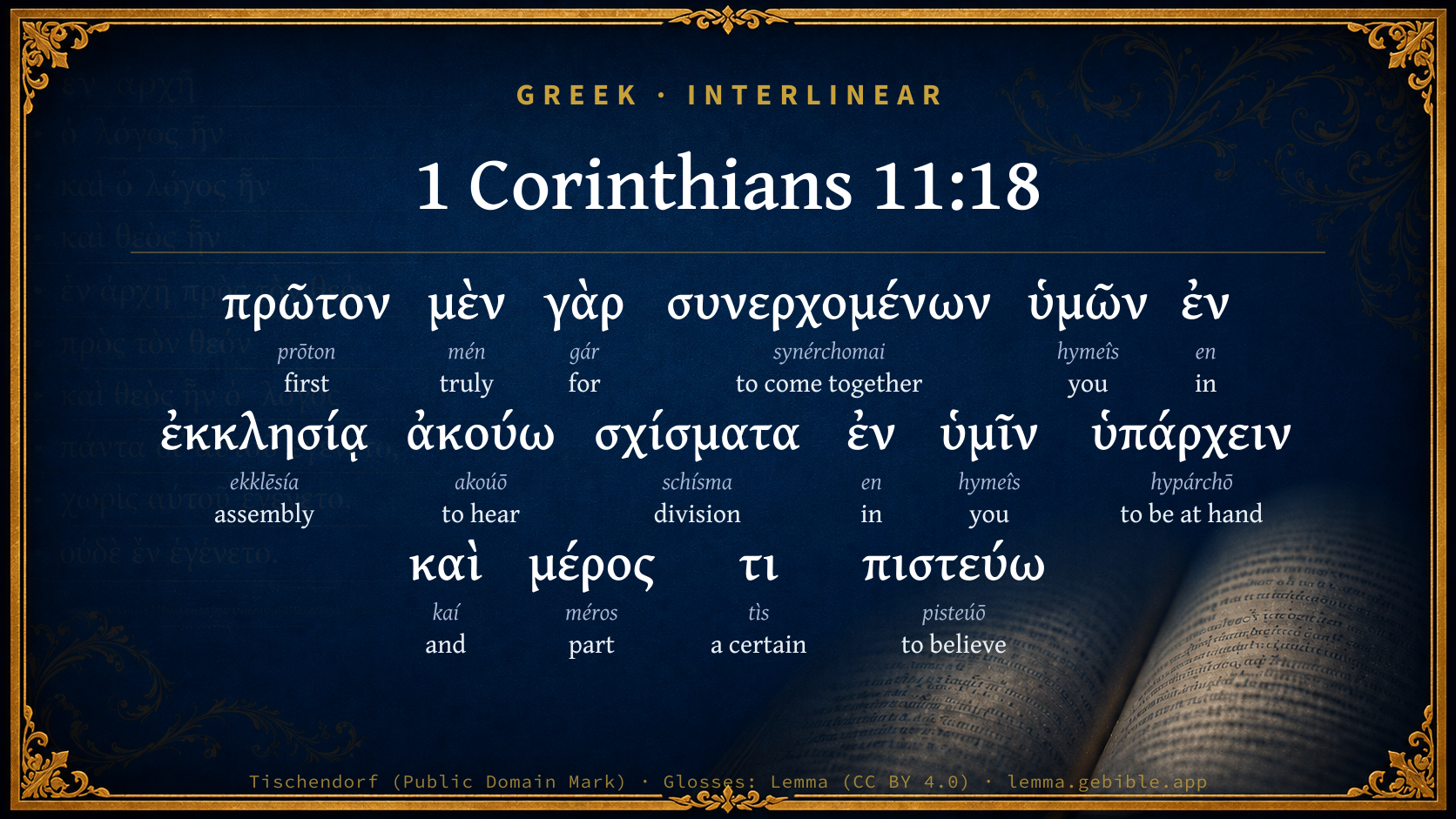
  1. πρῶτον prōton G4412 “first” Adverb, Superlative
  2. μὲν mén G3303 “truly” Particle
  3. γὰρ gár G1063 “for” Conjunction
  4. συνερχομένων synérchomai G4905 “to come together” Verb, Present, Middle or Passive deponent, Participle, Genitive, Plural, Masculine
  5. ὑμῶν hymeîs G5210 “you” Personal pronoun, 2nd person, Genitive, Plural
  6. ἐν en G1722 “in” Preposition
  7. ἐκκλησίᾳ ekklēsía G1577 “assembly” Noun, Dative, Singular, Feminine
  8. ἀκούω akoúō G191 “to hear” Verb, Present, Active, Indicative, 1st person, Singular
  9. ἐν en G1722 “in” Preposition
  10. ὑμῖν hymeîs G5210 “you” Personal pronoun, 2nd person, Dative, Plural
  11. ὑπάρχειν hypárchō G5225 “to be at hand” Verb, Present, Active, Infinitive
  12. καὶ kaí G2532 “and” Conjunction
  13. μέρος méros G3313 “part” Noun, Accusative, Singular, Neuter
  14. τι tìs G5100 “a certain” Indefinite pronoun, Accusative, Singular, Neuter
  15. πιστεύω pisteúō G4100 “to believe” Verb, Present, Active, Indicative, 1st person, Singular

About this verse

These counts appear in no published source. They are computed here, from the morphology-tagged text and Lemma’s own curated glosses. What Lemma adds →

16
words
14
distinct lemmas
Pauline Epistles
section

Notable vocabulary

The rarest word here is σχίσματα division G4978 — appearing just 8 times in the whole Greek New Testament.

Shared distinctive vocabulary

σχίσματα division G4978 occurs in 8 verses of the Greek New Testament. Also found in:

Repetition

Words recur within this verse:

Cross-references

4

Topical passages linked to 1 Corinthians 11:18 in the Treasury of Scripture Knowledge — connected by theme and wording, ordered by reader-vote popularity; previews shown in the World English Bible.

  • 1 Corinthians 3:3 for you are still fleshly. For insofar as there is jealousy, strife, and factions among you, aren't you fleshly, and don't you walk in the ways of men?
  • 1 Corinthians 1:10–12 Now I beg you, brothers, through the name of our Lord, Jesus Christ, that you all speak the same thing and that there be no divisions among you, but that you be perfected together in the same mind and in the same judgment.
  • 1 Corinthians 5:1 It is actually reported that there is sexual immorality among you, and such sexual immorality as is not even named among the Gentiles, that one has his father's wife.
  • 1 Corinthians 6:1 Dare any of you, having a matter against his neighbor, go to law before the unrighteous, and not before the saints?

Cross-references courtesy of OpenBible.info (CC BY 4.0).

Commentary

Notes on 1 Corinthians 11:18 from classic Christian and Jewish commentators (each source and its license shown beneath its notes). The classic Christian expositions comment on the surrounding passage and are grouped to its opening verse, so a note may address several verses; the Jewish commentaries on the Tanakh (Rashi and others) are per-verse, so they appear only where the commentator wrote on this verse.

Lemma curates 59 commentaries, every one of them public domain or Creative Commons licensed, each selected and text-cleaned for this edition rather than reprinted as found. About our sources →

Ellicott's Commentary for English Readers

(18) For first of all.—We in vain look for the “secondly,” which, in a perfectly systematic treatise, should follow this “first.” Some writers maintain that 1Co_11:18-19 form the first point, and 1Co_11:20-34 the second. There is, however, no indication of a new subject being introduced with 1Co_11:20, but the repetition of the words “come together” carries the mind back at once to the “come together” in 1Co_11:18, and indicates the continuation of the subject there commenced, and from which the Apostle had, at the mention of the word “divisions,” for a moment parenthetically digressed.

It is better to consider the “first point” to be the abuse regarding the Lord’s Supper, which is more immediately treated of; and the “second point,” the abuse of spiritual gifts, commencing with 1Co_12:1. They are two branches of the one general subject, viz., “Irregularities in religious assemblies,” and although the latter is not connected with the former by a definite “secondly,” there is a sufficient verbal indication that a second topic is entered upon. It is well to remember in this and similar cases that this is not a treatise, but a letter, and not only a letter, but an answer to a letter, and that if we had a copy of the epistle to which this is a reply, many points of sequence and arrangement, which at present present difficulties, would be as clear to us as they were to those who originally received this Epistle.

When ye come together in the church.—The reference here is not to a locality, but to the character of the assembly, as we should say “in church,” or, “in parliament.” The spirit of faction, which has already, in the earlier part of this Epistle, been dealt with, as pervading Christian society, had invaded the Christian assemblies.

I partly believe it.—These words are full of the courtesy and charity so characteristic of the Apostle; and they suggest to us all a lesson regarding our belief of evil reports, even when reaching us on “the very best authority.” The general practice is to believe a little more than we are told. St. Paul believed a part only of what he was told.

A Bible Commentary for English Readers, edited by Charles John Ellicott (1878–1897) — public domain. Text from a community e-Sword module.

Tyndale Open Study Notes

Tyndale Open Resources

11:18 The divisions may be those spoken of in 1:10-12 (cp. Titus 3:10), or (more likely) the result of social discrimination when they shared meals (see 1 Cor 11:21-22, 33; Acts 6:1).

Tyndale Open Study Notes — © Tyndale Open Resources, licensed CC BY-SA 4.0. Text via the HelloAO Bible API.

Bengel's Gnomon

Johann Albrecht Bengel

1Co 11:18. Πρῶτον, first) This word, when secondly does not follow, gives the discourse a degree of characteristic ἦθος or feeling.[97] Their assembly, even in the use of the gifts, might be held by the Corinthians for the better, 14.—ἐν τῇ ἐκκλησίᾳ, in the church) The church here approaches to the signification of the place of meeting. ἐπὶ τὸ αὐτὸ, into one place, [where it is right, that all things should be arranged with a view to harmony.—V. g.]—σχίσματα) divisions, not only in your mental opinions, ch. 1Co 1:10, but also as to your outward meetings, 1Co 11:21.—μέρος τι, partly) He excepts the innocent, and uses a mild term.—πιστεύω, I believe) while his love was unaffected by it, ch. 1Co 13:7.

[97] Appendix on moratus Sermo.

Bengel's Gnomon of the New Testament — English translation (T&T Clark, Edinburgh, 1860) — public domain. Text from a community e-Sword module.

Meyer's Critical & Exegetical Commentary

Heinrich August Wilhelm Meyer

1Co_11:18-19. Πρῶτον μὲν γάρ] The second point is found by most expositors in 1Co_11:20 (so Billroth, Rückert, Olshausen, de Wette, Ewald, Maier, Winer, p. 536 [E. T. 721]). In that case Paul first of all censures here generally the divisions which appeared in their assemblies, and then in 1Co_11:20 links on by οὖν the abuse of the Lords Supper as a consequence of those divisions. But this view has against it the fact that he follows up 1Co_11:18 neither by censure nor correction of what was amiss, which he would not have omitted to do, considering the importance of the matter in question, if he had regarded 1Co_11:18 as touching upon a distinct point from that in 1Co_11:20-21. Moreover, in 1Co_11:22, ἐπαινέσω ὑμᾶς; ἐν τούτῳ οὐκ ἐπαινῶ, which has reference to the οὐκ ἐπαινῶν of 1Co_11:17, proves that in his mind 1Co_11:18-22 formed not two rebukes, but one. This serves, too, by way of reply to Hofmann, who insists on taking πρῶτον, in spite of the μέν that follows it, not as firstly, but as before all things, above all. The true view, on the contrary, is (comp also Baur in the theol. Jahrbücher, 1852, p. 558; Räbiger, p. 135; Osiander), that οὖν in 1Co_11:20 does not introduce a second point of reprehension, but takes up again the first point, which had been begun in 1Co_11:18 and interrupted by ΚΑῚ ΜΈΡΟς ΤΙ Κ.Τ.Λ[1815] (see on 1Co_8:4),an interpretation which is strongly supported by the repetition of the same words συνερχομ. ὑμῶν. In using the term σχίσματα,[1816] Paul has already in his mind the separations at the love-feasts (not the party-divisions of 1Co_1:12, Theodoret, and many others), but is kept for a time from explaining himself more fully by the digression which follows, and does so only in 1Co_11:20. Still, however, the question remains: Where is the second point, which πρῶτον leads us to expect? It commences in 1Co_12:1. Paul censures two kinds of evils in connection with their assemblies(1) the degeneration of the Agapae (1Co_11:18-34), and (2) the misapplication of the gifts of the Spirit (1Co_12:1 ff.). The πρῶτον μέν is left out of account while he pursues the first point, and instead of following it up with an ἜΠΕΙΤΑ ΔΈ, after completing his discussion, he passes on in 1Co_12:1 with the continuative ΔΈ to the second subject, making no further reference to that ΠΡῶΤΟΝ ΜῈΝ ΓΆΡ in 1Co_11:18. How common it is in classic writers also to find the ΠΡῶΤΟΝ followed by no ἜΠΕΙΤΑ, or anything of the kind, but another turn given to the sentence, may be seen in Maetzner, a[1817] Antiph. p. 191; Bremi, a[1818] Lys. I. p. 31. Comp on Act_1:1, and on Rom_1:8; Rom_3:2.

ἘΝ ἘΚΚΛ.] in a church-meeting. This is conceived of as a local sphere (comp Bengel: vergit ad significationem loci), in which the συνέρχεσθαι takes place by the arrival of members; as we also say: in einer Gesellschaft zusammenkommen. Comp Winer, p. 386 [E. T. 515]. Although the apostle might have written ΕἸς ἘΚΚΛΗΣΊΑΝ (Lucian, Jov. Trag. 6), yet we must neither take ἐν in the sense of ΕἸς (Vulgate, Rückert, Schrader), nor impute to the word ἘΚΚΛ. the meaning: place of assembly (Grotius, Wolf, Heydenreich), nor understand it adverbially, as with abstract terms: congregationally (Hofmann).

There should be no comma after ἐκκλ.; for ΣΥΝΈΡΧ. Κ.Τ.Λ[1822] connects itself in meaning not with ἀκούω, but with σχίσματα κ.τ.λ[1823]

ἈΚΟΎΩ] in the sense of ἈΚΉΚΟΑ, denoting continuance. See Ast, a[1824] Plat. Leg. p. 9 f.; Bernhardy, p. 370; Kühner, a[1825] Xen. Mem. iii. 5. 26.

ΜΈΡΟς ΤΙ] for a part, partly, Thuc. i. 23. 3, ii. 64. 2, iv. 30.1; Isocr. p. 426 D. He cannot bring himself to believe all that he has heard of the divisions at their assemblies. A delicate way of showing the better opinion that he still has of his readers, not a reference to the uncertainty of the source whence the news reached him (Hofmann).

δεῖ] according to Gods decree. It is the necessitas consequentiae (Melanchthon); for the ἽΝΑ which follows indicates, according to the apostles teleological view (comp Mat_18:7), the end ordained by God, namely, that the tried, those, who have not suffered themselves to be carried away by party-agitation, should become manifest.

καὶ αἱρέσεις] It cannot be proved (although Rückert, Neander, Hofmann, and others hold) that ΑἹΡΈΣΕΙς is something worse[1827] than ΣΧΊΣΜΑΤΑ (and that ΚΑΊ must mean even), as Pelagius, Estius, and Calovius would take it; for καί may be simply also (among other evils also), and in Gal_5:20where, moreover, σχίσματα does not come in at all

Paul does not intend to construct an exact climax, but merely to heap together kindred things. Now, seeing that our Epistle says nothing of absolute party-separations, but always shows us merely party-divisions subsisting along with outward unity, one cannot well make out wherein the worseness of the αἱρέσεις consisted; for to hold, with Rückert, that ΕἾΝΑΙ means to ensue, and points to the future (as Hofmann too maintains), is a perfectly groundless assumption. The αἱρέσεις were there, were not merely coming; it will not do to confound εἶναι with ΓΊΝΕΣΘΑΙ or ἘΛΘΕῖΝ (Mat_18:7; Luk_17:1), a mistake into which J. Müller also falls, l.c[1828] We must therefore, with Chrysostom, Grotius, Olshausen, al[1829], regard ΑἹΡΈΣΕΙς as another form of designation for the same thing (the ΣΧΊΣΜΑΤΑ). It does not mean heresies in the sense of false doctrine (2Pe_2:1), as Calvin, Calovius, and others maintain; neither does it refer simply to the separations in keeping the Agapae (Chrysostom, Oecumenius, Theophylact); butas is clear from the nature of the sentence as assigning a more general reason for what had been saidto factious divisions in the church generally[1830] (according as there existed tendencies and views at variance with each other and destructive of harmony). Comp on Gal_5:20.

[1815] .τ.λ. καὶ τὰ λοιπά.

[1816] Chrysostom well remarks: οὐ λέγει· ἀκούω μὴ κοινῇ ὑμᾶς συνδειπνεῖν, ἀκούω γὰρ κατʼ ἰδίαν ὑμᾶς ἑστιᾶσθαι καὶ μὴ μετὰ τῶν πενήτων ἀλλʼ ὅ μάλιστα ἱκανὸν ἦν αὐτῶν διασεῖσαι τὴν διάνοιαν, τοῦτο τέθεικε τὸ τοῦ σχίσματος ὄνομα, ὅ καὶ τούτου ἦν αἴτιον.

[1817] d refers to the note of the commentator or editor named on the particular passage.

[1818] d refers to the note of the commentator or editor named on the particular passage.

[1822] .τ.λ. καὶ τὰ λοιπά.

[1823] .τ.λ. καὶ τὰ λοιπά.

[1824] d refers to the note of the commentator or editor named on the particular passage.

[1825] d refers to the note of the commentator or editor named on the particular passage.

[1827] So also J. Müller, v. d. Sünde, I. p. 538, ed. 5, holds that σχίσμ. denotes the inner disunion in the church, which shows itself in positive division and faction (αἱρέσεις). Wetstein, on the contrary, considered αἵρεσις a mollius vocabulum than σχίσμα.

[1828] .c. loco citato or laudato.

[1829] l. and others; and other passages; and other editions.

[1830] It is arbitrary to ascribe the disturbance about the Lords Supper to one special party at Corinth, such as the Christ-party (Olshausen), or that of Apollos (Räbiger).

Meyer — Critical and Exegetical Commentary on the New Testament — English translation by Peter Christie, edited by Frederick Crombie (T&T Clark, 1880) — public domain. Text from a community e-Sword module.

Expositor's Greek Testament

ed. W. Robertson Nicoll

1Co 11:18 . The severe reproach, εἰς τὸ ἧσσον συνέρχεσθε , is justified by 1Co 11:18-22 , which lead round to the intended παραγγελία . πρῶτον μὲν requires an ἔπειτα δέ , that is not forthcoming ( cf. Rom 1:8 ): the complement appears to lie in 12 14. viz., the abuse of spiritual gifts , a further and prominent ground of disapproval (Mr [1683] , Hn [1684] , El [1685] ). Bt [1686] and Ed [1687] find the antithesis in τὰ λοιπά , 1Co 11:34 b . Hf [1688] renders πρῶτον “chiefly,” dispensing with any complement, but μὲν supposes a mental δέ . 1Co 11:20 gives no contrasted ground of censure, it stands upon the same ground . συνερχομένων ὑμῶν ἐν ἐκκλησίᾳ (not τῇ ἐκκλ ., in the Church ): “as often as you come together in assembly” ptp [1689] pr [1690] of repeated occurrence; the σχίσματα in Church meetings were chronic. For ἀκούω σχίσματα , see 1Co 1:10 f.; the pr [1691] “I am hearing” suggests (in contrast with ἐδηλώθη above) continued information from various quarters ( cf. 1Co 5:1 , ἀκούεται ): hence the qualifying μέρος τι (acc [1692] of definition ) πιστεύω , wanting in ch. i.; P. does not “believe” everything reported to him, but so much as is stated he does credit. ὑπάρχειν (see parls.) implies not the bare fact, but a characteristic fact , a proprium of this Church “have their place (are there) amongst you”: cf. Act 28:18 .

[1683] Meyer’s Critical and Exegetical Commentary (Eng. Trans.).

[1684] C. F. G. Heinrici’s Erklärung der Korintherbriefe (1880), or 1 Korinther in Meyer’s krit.-exegetisches Kommentar (1896).

[1685] C. J. Ellicott’s St. Paul’s First Epistle to the Corinthians .

[1686] J. A. Beet’s St. Paul’s Epp. to the Corinthians (1882).

[1687] T. C. Edwards’ Commentary on the First Ep. to the Corinthians . 2

[1688] J. C. K. von Hofmann’s Die heilige Schrift N.T. untersucht , ii. 2 (2te Auflage, 1874).

[1689] participle

[1690] present tense.

[1691] present tense.

[1692] accusative case.

The Expositor's Greek Testament, edited by W. Robertson Nicoll (1897–1910) — public domain. Text from a community e-Sword module.

Godet's Commentaries

Frédéric Louis Godet

Vv. 18, 19. “For first of all, when ye come together in the Church, I hear that there be divisions among you; and I partly believe it. 19. For there must even be sects among you, that they which are approved may be made manifest among you.”

The apostle now gives the reason for the severe words: “I do not praise you.” The: for first of all, announces a first rebuke in regard to the divisions in their assemblies (1Co 11:18-19), and leads us to expect a second to be indicated by a: then again; but this formula, corresponding to the first of all, is found nowhere in the sequel. Where does this second rebuke begin? Meyer, Osiander, heinrici think that it points to the abuses in the exercise of spiritual gifts treated in chaps. 12-14; that if there is not found at the beginning of chap. 12 the ἔπειτα δέ, then again, which should correspond to our πρῶτον μέν of 1Co 11:18, this may arise from the fact that the long development of chap. 11 had made the apostle forget the form used at the beginning of the passage (1Co 11:18). Edwards prefers to place the expected secondly in 1Co 11:34, where, according to him, it is logically implied in the τὰ δὲ λοιπά, the rest. Hofmann thinks that there is no secondly to be sought in the sequel, since πρῶτον signifies here, as often, not firstly, but principally; comp. Rom 3:2. This last assertion might be established if πρῶτον stood alone; with the μέν it is less easily admissible. And how should the divisions be represented as the essential point in what follows? The meaning of Edwards can as little be admitted. The words: “The rest will I set in order when I come,” do not contain any threatening, any announcement of rebukes to be addressed to them. Meyer’s meaning falls to the ground for this reason: that the divisions, σχίσματα, mentioned 1Co 11:18-19, are not put by the apostle in any connection with the disorders in the Holy Supper, which are explained by a wholly different cause. Consequently the two subjects cannot have been combined in one by Paul, and both embraced in the πρῶτον μέν of 1Co 11:18. We have therefore simply, with Olshausen, de Wette, Rückert, to place the understood then again at 1Co 11:20, where the rebukes begin relating to the celebration of the Supper. And such is the meaning to which we are led by the close study of the relation between the three terms συνέρχεσθε, ye come together (1Co 11:17), συνερχομένων ὑμῶν, when ye come together (1Co 11:18), and συνερχομένων οὖν ὑμῶν, when therefore ye come together (1Co 11:20). Meyer thinks that the second συνερχομένων (1Co 11:20) is the repetition of the συνερχομένων (1Co 11:18). Hence it is he combines in one and the same rebuke the blame bearing on the divisions and that which applies to the profanation of the Supper. This is his error. The second συνερχομένων is not the repetition of the first, but of the συνέρχεσθε, ye come together, of 1Co 11:17: “You come together for the worse, and that chiefly because of your divisions (1Co 11:18-19), then again because of the way you celebrate the Supper.” Here is the second rebuke, developed from 1Co 11:20 to 1Co 11:34. Meyer asks why, if it is so, the first rebuke is found so briefly treated? Quite simply, because this matter of divisions had already formed the subject of the whole first part, chaps. 1-4, and Paul needs only here to refer to it, while applying to their meetings for worship what he had said of the malign influence exercised by such divisions over the life of the Church in general.

The two συνερχομένων are therefore parallel to one another, and both rest on the συνέρχεσθε of 1Co 11:17. Only the first of these participles points to their assemblies merely in a passing way, while the second, referring as it does to the subject about which the apostle is now most seriously concerned, the profanation of the holy table, is emphasized by the οὖν, therefore; this particle shows that he is returning to the thought which had mainly suggested to him the εἰς τὸ ἧττον συνέρχεσθε, ye come together for the worse (1Co 11:17).

The first thing which Paul has to blame in their assemblies for worship, is the divisions which break out among them.

The τῇ before ἐκκλησίᾳ in the T. R. should be rejected. The meaning is not: in the church, but: in church: “when you come together in a general assembly of the Church.” The point in question is the manner, not the place; comp. 1Co 14:23. The form of the phrase seems incorrect; for it is not at the time when their divisions break out that the apostle hears of them. This finds its explanation the instant we refer the present participle συνερχομένων, not to the time, but to the manner of meeting.

The news might have reached him either by the house of Chloe (1Co 1:11), or by the deputies of the Church (1Co 16:15).

The: and I partly believe it, is very delicate. Paul would admit that the state of things has been described to him in certain respects worse than it is. But when a Church is in the moral state in which that of Corinth is, it must inevitably become a theatre of discord. This necessity is of the same kind as that indicated by Jesus when He said: “It must needs be that offences come” (Mat 18:7), that is to say: given such a world as ours.

In the following verse the moral reason is explained which renders these discussions providentially necessary.

Frédéric Louis Godet — Commentaries on Luke, John, Romans, and 1 Corinthians — English translation (T&T Clark, Edinburgh, 1870s–1890s) — public domain. Text from a community e-Sword module.

Hodge's Commentary on Romans, Ephesians & First Corinthians

Charles Hodge

1Co_11:18

For first of all, when ye come together in the church, I hear that there be divisions among you; and I partly believe it.

For first of all, or, For in the first place. Paul often begins an enumeration which he does not follow out. There is nothing to answer to these words in what follows. According to one view the first censure is directed against the divisions, and the second against their mode of celebrating the Lords supper. But the only divisions which he here refers to are those connected with their public worship, and especially with the celebration of the sacrament. Besides, the subject of divisions was treated in the beginning of the epistle. He is here speaking of their assemblies. The second ground of censure is to be found in the following chapter. When ye come together in the church. The word (ἐκκλησία) church never means in the New Testament, a building. The meaning is, when ye come together in convocation, or assemble as a church. I hear that there be divisions among you. Literally, schisms. For the meaning of that word, see 1Co_1:10. The nature of these schisms is described in what follows. They were cliques, not sects, but parties, separated from each other by alienation of feeling. It is evident that the rich formed one of these parties, as distinguished from the poor. And probably there were many other grounds of division. The Jewish converts separated from the Gentiles; those having one gift exalted themselves over those having another. It is not outward separation, but inward alienation, which is here complained of. And I partly believe it. Paul intimates that he was loath to believe all he had heard to their disadvantage in this matter; but he was forced to believe enough to excite his serious disapprobation.

Charles Hodge — Commentary on Romans (1835), First Corinthians (1857), and Ephesians (1856) — public domain. Text from a community e-Sword module.

Geneva Bible (1599)

Geneva Bible translators

To celebrate the Lord’s Supper aright, it is required that there be not only consent of doctrine, but also of affections, that it be not profaned.

Geneva Bible (1599) marginal notes — public domain. Text via Bolls.life.

Jamieson, Fausset & Brown

Robert Jamieson, A. R. Fausset & David Brown

first of all--In the first place. The "divisions" (Greek, "schisms") meant, are not merely those of opinion (Co1 1:10), but in outward acts at the love-feasts (Agapæ), (Co1 11:21). He does not follow up the expression, "in the first place," by "in the second place." But though not expressed, a second abuse was in his mind when he said, "In the first place," namely, THE ABUSE OF SPIRITUAL GIFTS, which also created disorder in their assemblies [ALFORD], (Co1 12:1; Co1 14:23, Co1 14:26, Co1 14:33, Co1 14:40).

in the church--not the place of worship; for ISIDORE OF PELUSIUM denies that there were such places specially set apart for worship in the apostles' times [Epistle, 246.2]. But, "in the assembly" or "congregation"; in convocation for worship, where especially love, order, and harmony should prevail. The very ordinance instituted for uniting together believers in one body, was made an occasion of "divisions" (schisms).

partly--He hereby excepts the innocent. "I am unwilling to believe all I hear, but some I cannot help believing" [ALFORD]: while my love is unaffected by it [BENGEL].

Jamieson, Fausset & Brown — Commentary Critical and Explanatory on the Whole Bible (1871) — public domain (CC PDM 1.0). Text via the HelloAO Bible API.

Adam Clarke's Commentary

Verse 18. There be divisions among you] They had σχισματα, schisms, among them: the old parties were kept up, even in the place where they assembled to eat the Lord's Supper. The Paulians, the Kephites, and the Apollonians, continued to be distinct parties; and ate their meals separately, even in the same house.

Adam Clarke's Commentary on the Bible (1810–1826) — public domain. Text from a community e-Sword/MySword module.

John Calvin's Commentaries

18. When ye come together in the Church, I hear there are divisions Some take the words divisions and heresies, as referring to that disorder (ἀταξίαν) of which he speaks soon afterwards. I consider them as having a more extensive signification, and certainly it is not likely that he would employ terms so improper and unsuitable for the purpose of exposing that abuse. For as to their alleging that he has expressed himself in more severe terms, with the view of exposing more fully the heinousness of the offense, I would readily grant this, if the meaning corresponded. It is, then, a reproof of a general kind — that they were not of one accord as becomes Christians, but every one was so much taken up with his own interests, that he was not prepared to accommodate himself to others. Hence arose that abuse, as to which we shall see in a little — hence sprung ambition and pride, so that every one exalted himself and despised others — hence sprung carelessness as to edification — hence sprung profanation of the gifts of God.

He says that he partly believes it, that they might not think that he charged them all with this heinous crime, and might accordingly complain, that they were groundlessly accused. In the meantime, however, he intimates that this had been brought to him not by mere vague rumor, but by credible information, such as he could not altogether discredit.

John Calvin's Commentaries (1540-1563) — public domain. Text from the Calvin Translation Society English edition (1840s-50s) via the Christian Classics Ethereal Library (ccel.org). Calvin's coverage is partial (roughly two-thirds of the Bible); uncommented books and verses are honest gaps, never fabricated. The 19th-century editor's footnotes and remarks are omitted so the notes are faithfully Calvin's own voice.

The Cambridge Bible for Schools and Colleges

gen. ed. J. J. S. Perowne

18. For first of all] Either (1) we must take this to apply to this and the next verse, find the second cause of blame to commence with 1Co_11:20, or (2) we must regard it as applying to the whole of this chapter, and then the next cause of blame will be the abuse of spiritual gifts, which is treated of in chapters 12–14. The latter is the more probable, for many of the commentators seem to have been misled by the technical theological sense which was attached to the words schism and heresy in later ages, a sense which seems to have been unknown to the Apostle. The divisions of which the Apostle speaks seem to have been social and personal rather than theological or ecclesiastical. See note on 1Co_11:21.

in the church] Not the building, for there were no churches in the sense of buildings devoted to Christian worship then, but in the assembly.

divisions] Margin, schisms. Wiclif and Tyndale better, dissencion. Dissidia, Calvin. Vulgate, scissuras. See note on ch. 1Co_1:10.

The Cambridge Bible for Schools and Colleges (gen. ed. J. J. S. Perowne; Cambridge University Press, 1878–1918) — public domain. Text from a community e-Sword module.

John Gill's Exposition

For there must be also heresies among you.... This is a reason why he was ready to believe there might be something of truth in the report he had received of the divisions among them; for if there were heresies, false doctrines, and bad principles, among them, such as were subversive of the fundamentals of Christianity, as the denial of the resurrection of the dead, &c. it was no wonder that there were schisms and factions among them, since heresies generally issue in them. These, the apostle says, "must be"; because God has decreed they shall, whose counsel is immutable, and his purpose unalterable; and since this always was the case, that there were false prophets under the former dispensation, it must be expected that false teachers will arise in the churches now, bringing in damnable heresies; and since Satan is always busy to sow the tares of false doctrine; and human nature, being both weak and wicked, is so susceptible thereof, and so easily imposed upon and deceived, it cannot be thought that it should be otherwise; which, by the goodness and wisdom of God, are overruled to a very good purpose:

that they which are approved: who sincerely believe in Christ, are sound in the faith, and have a well grounded experience of it; who have themselves tried things that differ, and approve of them that are excellent, and have been tried by others, and found to be sincere, upright, and faithful, and are approved of God and good men:

may be made manifest among you; by their steadfastness in the faith, their zealous attachment to it, earnest contention for it, and warm and honest vindication of it; and by the departure of those from them who oppose it, and go on the side of error and heresy; by which means it is known who are the sincere followers of the Lamb, in doctrine, discipline, and conversation, and who not.

John Gill's Exposition of the Whole Bible (1746–1763) — public domain (CC PDM 1.0). Text via the HelloAO Bible API.

Trapp's Complete Commentary

John Trapp

18 For first of all, when ye come together in the church, I hear that there be divisions among you; and I partly believe it.

Ver. 18. There be divisions] Gr. σχισματα, schisms, rents, yea, and that about the sacrament of the Lord’s supper (that bond of love), through Satan’s malice. Now there can be no greater sin committed, saith Chrysostom, than to break the peace of the Church. Cyprian saith, It is an inexpiable blemish, such as cannot be washed off with the blood of martyrdom. {a} The error of it may be pardoned (saith Oecolampadius in his epistle to the Lutherans of Snevia) so there be faith in Christ Jesus; but the discord we cannot expiate though we should lay down our lives to do it.

{a} Hom. 11. ad Ephes.

John Trapp, A Commentary or Exposition upon All the Books of the Old and New Testament (1647–1656) — public domain. Text from a community e-Sword module.

Albert Barnes' Notes on the Bible

For first of all - That is, I mention as the first thing to be reproved.

When ye come together in the church - When you come together in a religious assembly; when you convene for public worship. The word “church” here does not mean, as it frequently does with us, a “building.” No instance of such a use of the word occurs in the New Testament; but it means when they came together as a Christian assembly; when they convened for the worship of God. These divisions took place then; and from some cause which it seems then operated to produce alienations and strifes.

I hear - I have learned through some members of the family of Chloe; 1Co 1:11.

That there be divisions among you - Greek, as in the margin, Schisms. The word properly means a rent, such as is made in cloth Mat 9:16; Mar 2:21, and then a division, a split, a faction among people; Joh 7:43; Joh 9:10; Joh 10:19. It does not mean here that they had proceeded so far as to form separate churches, but that there was discord and division in the church itself; see the notes on 1Co 1:10-11.

And I partly believe it - I credit a part of the reports; I have reason to think, that, though the evil may have been exaggerated, yet that it is true at least in part. I believe that there are dissensions in the church that should be reproved.

Albert Barnes' Notes on the Bible (1834–1885) — public domain. Text from a community e-Sword/MySword module.

Matthew Poole's English Annotations

In the church, here, must signify the religious assembly; for at this time there were no temples built for Christians, but they met in private houses, as the iniquity of those times would bear: yet others think the place is here meant where the church was wont to meet, and say, that the Christians had a certain stated place, though in a private house, where they used to meet. But it is not very probable that they should, in the midst of heathens, be so quiet and secure as to meet either constantly, or ordinarily, in any one certain and stated place, so denominated. What schisms, or divisions, the apostle meaneth, he expoundeth in the following verses; either they quarrelled about meats, or drinks, or their order in sitting down, or the time when they should begin, or did not stay till they were all met.

Matthew Poole's English Annotations on the Holy Bible (1683–1685) — public domain. Text from a community e-Sword/MySword module.

Whedon's Commentary on the Bible

Daniel D. Whedon

18. First—But what is the second to this first? Clearly, as Alford shows, the paragraph upon the Lord’s supper (17-34) is the first, and the entire subject of spiritual gifts, beginning at the next chapter, is the second to it. And Alford’s showing on this point shows, also, that declare takes in the commencing paragraph.

Divisions—Σχισματα, schisms. In modern ecclesiastical phraseology schisms are secessions from the Church; and heresies (next verse) are doctrines contrary to the belief of the Church. Such is not the apostle’s use of the words. By schisms here he means the separations in feeling produced by the sets and cliques at the Lord’s supper.

Partly—He believes some of the report, but cannot quite, in charity, believe the whole.

Daniel D. Whedon (gen. ed.), Commentary on the Old and New Testaments (1874–1909) — public domain. Text from a community e-Sword module.

The Pulpit Commentary

First of all. The "second" rebuke is not clearly stated, but is no doubt meant to refer to the abuses in "speaking with the tongue." In the Church; rather, in congregation, or assembly. The reference is not to a particular building. The Lord"s Supper was administered frequently (originally every day, (Act_2:46) and often in private houses. Divisions; schisms (ch. 1:10, 12). Here, however, he is referring to cliques and quarrels at the love feasts. Partly! cannot think, he says, in a tone of kindness, that these reports are wholly false. There must be some ground for them, even if the facts have been exaggerated.

Vers. 18, 19.

Words of evil omen.

In a good English dictionary, the term "schismatic" is thus explained: "One who separates from a Church from difference of opinion." The Bible makes no reference to an individual schismatic; nor does it apply the word "schism" to separation from the Church. "Heresy" is defined in the dictionary as "the taking and holding of an opinion contrary to the usual belief, especially in theology." Such, no doubt, is according to ecclesiastical usage; but the Scripture means by a "heresy" a sect or faction, not apart from but within the Church: "Heresies factions among you.

I A SCHISM IS A RENT IN THE MIDST OF THE CHURCH, marring the enjoyment and expression of its essential unity. If a piece of undressed cloth were put to an old garment, a schism would occur. Not that the garment would fall into two parts, but that it would show an unseemly rent. A division of opinion among the people who heard our Saviour is called a schism; and the same word is used to denote the discord in the crowd when St. Paul appeared before the council at Jerusalem. The only Church of all those to which St. Paul wrote, which had schisms within it of such seriousness as to give him anxiety and call for animadversion, was the Church at Corinth; but by these he did not mean the action of parties breaking off from the primitive Church in that city, and forming rival Churches or separate denominations. They were parties in the Church dissenting or differing from one another. This will appear the more clearly if we mark the remedies which the apostle prescribed, viz.:

1. To speak the same thing, and be perfectly joined together in the same mind and the same judgment. To speak the same thing was to exalt the one great Name of the Lord Jesus, and not to take party names, saying, "I am of Paul; I am of Apollos." And to be perfectly joined in the same mind the mind of Christ, and the same judgment the judgment of his Spirit, while it never precluded activity of investigation and discussion, certainly implied that the normal condition of the Church should be one of concord, and not one of countless variations and opposing views.

2. To keep the Lord"s Supper as the apostle instructed them. The Corinthians were charged not to partake of the sacred supper as of a common meal, lest they should "come together to judgment." They were to keep the feast with reverence, and with discernment of the Lord"s body. They were also to show brotherly kindness, not as partisans, but as brethren, coining together and waiting for one another at the festival of love.

3. To bear in mind the doctrine of the mystical body, and, as members therein, to have the same care one for another. To have schisms or alienations would be to separate limbs that had need of each other, and so to vex and impede the whole body of Christ. At the present day, wherever parties are formed in a particular Church with hostile feelings and a desire to weaken one another, there is schism, in the New Testament sense of the word. And wherever, within the Church general, or communion of saints, there is an elevation of party names, and a setting up of party or denominational communions, making the Lord"s Supper "their own supper," there is schism.

II A HERESY IS AN AGGRAVATED FORM OF A SCHISM, AND DENOTES A SEPARATIST PARTY OR A SECT. We read of "the heresy of the Sadducees", (Act_5:17) and "the heresy of the Pharisees". (Act_15:5) The Christians were charged with forming a new heresy or sect heresy of the Nazarenes." It was in this sense, and not at all in the sense of heterodoxy, that St. Paul admitted that he worshipped the God of his fathers, "after the manner which they called heresy." The Jews at Rome, agreeing to bear the apostle on the faith or" the Nazarenes, remarked, "As concerning this heresy, we know that it is everywhere spoken against." Thus the term undoubtedly denoted a faction, not a mode of thought or form of doctrine, true or false; but in the Church it to from the beginning an unfavourable meaning. A heresy was a faction which carried out a schism to actual separation, and was animated in doing so by a proud, unruly spirit. Accordingly, heresies are classed with variances, strifes, and seditions, among "the works of the flesh". (Gal_5:20) "A man that is a heretic," therefore, means, not an errorist, but a separatist. We do, indeed, read in 2Pe_2:1 of "heresies of doctrine;" but the reference is to the conduct of introducers of strange doctrine as forming a separate party. "Many shall follow their pernicious ways." We have seen that direction was given for the prevention of schism. It was also given for the correction and removal of heretics. Titus was instructed to admonish a heretic once and again. If admonition failed, Titus was to reject or shun him as a mischief maker among brethren. We live in a time of great confusion. Church unity is misunderstood; Church liberty is abused; and Church discipline is relaxed is, in some quarters, almost obsolete. Let every one look to his own spirit and conduct. As a Christian, you are a Churchman. Never join a sect or faction. Never lift the mere banner of a party. Belong to the Church of God, which was born of the Holy Ghost on the day of Pentecost. For actual instruction and united worship, you must be in some one particular part of that Church; abide in that which is in your judgment the best constituted and administered; but never take your chamber for the whole house, or any particular Church for the Church universal. Bear a brotherly heart and countenance towards all who love the Lord, that, so far as your influence extends, there may be no schism in the body, Deplore the existence of splits and divisions as an evil; yet remember that it evolves some good they who are approved may be made manifest among you." Oh to be approved of him who knows what spirit we are of, and to be manifested as no heretics, but faithful members of Christ and loving children of God! F.

The Pulpit Commentary (1880–1919), ed. H.D.M. Spence-Jones & Joseph S. Exell — public domain. Text from a community e-Sword module.

John Wesley's Explanatory Notes

In the church - In the public assembly. I hear there are schisms among you; and I partly believe it - That is, I believe it of some of you. It is plain that by schisms is not meant any separation from the church, but uncharitable divisions in it; for the Corinthians continued to be one church; and, notwithstanding all their strife and contention, there was no separation of any one party from the rest, with regard to external communion. And it is in the same sense that the word is used, chap. i, 10; chap. xii, 25; which are the only places in the New Testament, beside this, where church schisms are mentioned. Therefore, the indulging any temper contrary to this tender care of each other is the true scriptural schism. This is, therefore, a quite different thing from that orderly separation from corrupt churches which later ages have stigmatized as schisms; and have made a pretense for the vilest cruelties, oppressions, and murders, that have troubled the Christian world. Both heresies and schisms are here mentioned in very near the same sense; unless by schisms be meant, rather, those inward animosities which occasion heresies; that is, outward divisions or parties: so that whilst one said, "I am of Paul," another, "I am of Apollos," this implied both schism and heresy. So wonderfully have later ages distorted the words heresy and schism from their scriptural meaning. Heresy is not, in all the Bible, taken for "an error in fundamentals," or in anything else; nor schism, for any separation made from the outward communion of others. Therefore, both heresy and schism, in the modern sense of the words, are sins that the scripture knows nothing of; but were invented merely to deprive mankind of the benefit of private judgment, and liberty of conscience.

John Wesley, Explanatory Notes Upon the Whole Bible (1754–1765) — public domain. Text via the GEBible commentary corpus.

Godbey's Commentary on the New Testament

William B. Godbey

THE LOVE FEAST AND THE EUCHARIST

We must remember that the Lord’s Supper’ was instituted by our Savior immediately after the last meal He ate with His apostles. During the apostolic age they perpetuated that custom of having a social, religious meal, and eating together in commemoration of the last Supper of our Lord and His apostles and exhibitory of their love to one another. For this reason, John Wesley revived the love feast. In connection with this love feast, which preceded the Eucharist, they had run into some irregularities which the apostle here endeavors to correct, stating to them that their coming together is “not for the better, but for the worse.”

18-19. “For in the first place, indeed your coming together in the church, I hear there are schisms among you, and I partially believe it. For it behooveth that there be heresies among you in order that the approved among you may be made manifest.” Darkness prepares us to appreciate the light of day. Adversity qualifies us for prosperity, and the world is made up of antitheses. Everything has its antithetical counterpart. Hence “all things work together for good to them that love God” (Rom 8:38); i. e., everything in the universe, in the wonderful redemption of Christ, is made a blessing to His true people. Even the schisms and heresies with which He sees fit to inflict the church become a great source of blessing to the truly humble, meek and lowly by way of profitable illustration and admonition. The prevailing worldliness and wickedness in the churches today are ousting the true hearts from the incantations of Satan’s oblivious lullabies, and stirring them out to wake up and appreciate the glorious gospel of entire sanctification.

William B. Godbey, Commentary on the New Testament (1896–1900) — public domain. Text from a community e-Sword module.

McGarvey & Pendleton's Commentaries

J. W. McGarvey

For first of all [Paul was not careful as to his divisions, and so his "secondly" is not clearly stated. Olshausen, Ewald, Winer and others think it begins at 1Co_11:20 ; and thus the apostle first censures the factions, and next the evils which resulted from the factions. But as Paul includes both these in one rebuke, it is best with Meyer, Fausset and others to find the "secondly" beginning at 1Co_12:1 ; so that the first rebuke is directed at their misbehavior at the love-feast and the Lord's Supper, and the second at their misapplication of the gifts of the Spirit], when ye come together in the church [i. e., in the congregation, for as yet they doubtless had no building ( Act_18:7 ), and in this latter sense the word is nowhere used in the New Testament], I hear that divisions exist among you; and I partly believe it . [Evidently the divisions rebuked in chapter 1 manifested themselves in the meetings of the congregation, and the Pauline, Petrine and other parties gathered in separate groups. Paul was distressed to hear this, and Alford interprets him thus: "I am unwilling to believe all I hear, but some I can not help believing."]

J. W. McGarvey (with Philip Y. Pendleton), Commentaries on the New Testament (The Fourfold Gospel, 1914; Acts; and the epistles) — public domain. Text from a community e-Sword/MySword module.

The People's New Testament

B. W. Johnson

18. When ye come together in the church. In a meeting of the church. There be divisions. He had spoken in chapters 1–3 of the divisions in the congregation. He now tells them that he had heard that these divisions were manifest at their church meetings.

B. W. Johnson's The People's New Testament with Notes (1889–1891) — public domain. Electronic text from the Christian Classics Ethereal Library (CCEL) ThML edition.

Cambridge Greek Testament for Schools and Colleges

18. πρῶτον μὲν γάρ. Either (1) we must take this to apply to this and the next verse, and the second cause of blame to commence with 1Co 11:20, or (2) we must regard it as applying to the whole of this chapter, and then the next cause of blame will be the abuse of spiritual gifts, which is treated of in chapters 12–14. The latter is the more probable, for many of the commentators seem to have been misled by the technical theological sense which was attached to the words schism and heresy in later ages, a sense which is clearly unknown to the Apostle. The divisions of which the Apostle speaks seem to have been social and personal rather than theological or ecclesiastical. See note on 1Co 11:21.

ἐν ἐκκλησίᾳ. Not the building, for there were no churches in the sense of buildings devoted to Christian worship then, but in the assembly. For the omission of the article, see note on 1Co 14:4.

σχίσματα. See note on ch. 1Co 1:10. St John uses the word in the sense of a difference of opinion (Joh 7:43, Joh 9:16, Joh 10:19), and here it is obvious that no formal separation into different bodies took place (see ch. 1Co 12:25, as well as last note). The sense here is rather that of the ‘little rift within the lute’ which makes harmonious co-operation impossible.

Cambridge Greek Testament for Schools and Colleges (Cambridge University Press, 1896; 21 vols, various authors incl. Carr, Maclear, Plummer, Farrar, Lumby, Moule, M. R. James, Simcox) — public domain. Text from a community e-Sword module.

Alford’s Greek Testament

Henry Alford

18.] πρῶτον—where is the second particular founda, nswering to this πρῶτον? Ordinarily, it is assumed that the σχίσματα are the first abuse, the disorders in the Agapæ (beginning with ver. 20), the second. But I am convinced, with Meyer, that this view is wrong. For (1) neither special blame, nor correction of abuse, is conveyed in vv. 18, 19: nor is it so much as intimated, on the ordinary hypothesis, what the character of these σχίσματα was. And (2) the words of ver. 22, ἐπαινέσω ὑμᾶς ἐν τούτῳ; οὐκ ἐπαινῶ, plainly refer back to ver. 17, and shew that the whole is continuous. Again (3) the οὖν of ver. 20, as so frequently,—see ch. 8:4, and Hartung, Partikellehre, ii. 22,—resumes the subject broken off by καὶ μέρος … γέν. ἐν ὑμῖν. The σχίσματα before the Apostle’s mind are, specifically, those occurring at the Agapæ,—but on the mention of them, he breaks off to shew that such divisions were to be no matters of surprise, but were ordained to test them,—and in ver. 20 he returns with the very words, συνερχομένων ὑμῶν,—to the immediate matter in hand, and treats it at length. See more on vv. 21 ff.

But the question still remains, where is the second point, answering to this πρῶτον? Again with Meyer (and Macknight) I answer,—at ch. 12:1. The abuse of spiritual gifts, which also created disorder in their assemblies, ch. 14:23 al., and concerning which he concludes, 14:40, πάντα εὐσχημόνως κ. κατὰ τάξιν γινέσθω,—was the other point before his mind, when he wrote this πρῶτον. That he takes no notice in ch. 12:1, by any ἔπειτα δέ or the like, of what has gone before, will be no objection to the above view to any one but the merest tiro in our Apostle’s style.

There is a trajection of the ἀκούω, which, in the sense, precedes συνερχ., &c.

ἐν ἐκκλ.] in assembly; not local, as E. V., ‘in the church,’ but =ἐπὶ τὸ αὐτό, ver. 20. [In ver. 16, where the word is used of distinct bodies of Christians, it was not possible to keep the word assemblies, but it should be done whenever the sense admits it, and it suits the matter in hand].

σχίσματα] of what sort, is specified below; viz. that he does not here refer to the party dissensions of ch. 1:10, nor could he say of them μέρος τι πιστεύω, but strictly to σχίσματα which took place at their meetings together, viz. that each takes before other his own supper, &c. So Chrys.: οὐ λέγει, ἀκούω γὰρ μὴ κοινῇ ὑμᾶς συνδειπνεῖν· ἀκούω κατʼ ἰδίαν ὑμᾶς ἑστιᾶσθαι, καὶ μὴ μετὰ τῶν πενήτων· ἀλλʼ ὃ μάλιστα ἱκανὸν ἦν αὐτῶν διασεῖσαι τὴν διάνοιαν, τοῦτο τέθεικε, τὸ τοῦ σχίσματος ὄνομα, ὃ καὶ τούτου ἦν αἴτιον, Hom. xxvii. p. 241; and Theophyl., Œc., Est., Pise., Grot., which last remarks, ‘Accidebat jam illis temporibus, quod nostris multo magis evenit, ut res in stituta ad concorporandos fideles in vexillum schismatis verteretur.’

κ. μέρος τι πιστ.] Said in gentleness: q. d. “I am unwilling to believe all I hear concerning the point, but some (hardly ‘much,’ ‘in great part,’ as Stanley: nor do his testimonies from Thucyd. i. 23; vii. 30, bear out this meaning. It might, of course, lie beneath the surface, but is not given by μέρος τι) I cannot help believing.”

Henry Alford, The Greek Testament (1849–1861) — public domain. Text from a community e-Sword module.

International Critical Commentary

18. ‘For, to begin with.’ The Apostle hastens to justify his refusal to give praise. The πρῶτον μέν has no δεύτερον δέ or ἔπειτα δέ afterwards, and possibly there is no antithesis; but some find it in the section about spiritual gifts (12:1 f.): cf. Rom 1:8, Rom 1:3:2, Rom 1:10:1, Rom 1:11:13; 2Co 12:12: Blass, Gr. § 77. 12.

ἐν ἐκκλησίᾳ. ‘In assembly,’ i.e. in a gathering of the members of the Corinthian Church. “This use is at once classical and a return to the original force of qāhāl” (Hort, The Chr. Eccles. p. 118): 14:19, 28, 35; comp. 3Jn 1:6 and ἐν συναγωγῇ, Joh 6:59, Joh 18:20. ‘Church’ in the sense of a building for public worship cannot be meant; there were no such buildings.

ἀκούω σχίσματα ἐν ὑμῖν ὑπάρχειν ‘I continually hear (pres.) that dissensions among you prevail’ (not simply εἶναι): these splits are the rule. In the Love-feasts they seem to have been chiefly social, between rich and poor. Possibly what St James condemns (2:1-4) took place; the wealthy got the best places at the tables. Yet neither σχίσματα (see on 1:10) nor αἱρέσεις are separations from the Church, but dissensions within it. Wherever people deliberately choose (αἱρεῖν) their own line independently of authority, there is αἵρεσις: Gal 5:20.

μέρος τι πιστεύω. The Apostle has the love which ‘hopeth all things’ (13:7), and he will not believe that all that he hears to their discredit is true; miti sermone utitur (Beng.).

The reading ἐν τῇ ἐκκλ. (Tr., ‘in the Church’ AV.) is found only in a few cursives. There is no reason for suspecting that ἐν ἐκκλ. (all uncials) is an interpolation.

μέρος τι is the accusative of the extent to which the action applies: comp. πάντα πᾶσιν ἀρέσκω (10:33). We might have had ἐκ μέρους (13:9, 12).

International Critical Commentary — older volumes (1896–1929), various authors — public domain. Text from a community e-Sword module.

Vincent's Word Studies in the New Testament

Marvin R. Vincent

In the church [εν εκκλησια] . See on Mt 16:18. Not the church edifice, a meaning which the word never has in the New Testament, and which appears first in patristic writings. The marginal rendering of the Rev. is better : in congregation.

Marvin R. Vincent, Word Studies in the New Testament (1887–1900) — public domain. Text from a community e-Sword/MySword module.

Lesson kit

Teaching starters — assembled from the data on this page, not authored interpretation. Every prompt links to the verse data it draws on. Edit before teaching.

1 Corinthians, in the Pauline Epistles, opens this verse with 16 words (14 distinct Greek lemmas). Its most distinctive word is schísma (“division”). A historical commentator’s framing appears above. Read the whole chapter for the surrounding context.

Discussion questions

  1. What does “division” (schísma) contribute to the verse as a whole?
  2. Matthew 9:16 shares the word «division» with this verse. How do the two illuminate each other?
  3. “you” occurs 2× in this one verse. What is the effect of the repetition?
  4. These translations render this verse differently; the difference is in the English rendering, not the original. What questions does that raise?
  5. Reading how Ellicott's Commentary for English Readers and Tyndale Open Study Notes read this verse, where do the two commentators agree and where do they part?

Things to notice

Reading settings

Reading text

Shown beneath each verse's original-language words.

Old Testament
Old Testament edition

Read the OT as the Masoretic Hebrew (MT) or the Greek Septuagint (LXX).

English shown for the Greek Septuagint (in the Hebrew ↔ Greek comparison).

Comparing translations? Open the Compare panel on any verse page to stack up to four side by side.