Hebrews 12:19

Greek (Tischendorf 8th ed.) Hebrews 12:19 appears in the Greek New Testament. The text above is from the Tischendorf 8th edition. Each word links to its Strong’s number and a concise gloss. Click any word for its full Thayer’s Greek Lexicon entry.
Download image
Cite this verse

Hebrews 12:19 (World English Bible). Public Domain. Lemma interlinear Bible study tool, https://lemma.gebible.app/v/hebrews/12/19.

Show BibTeX & RIS
BibTeX
RIS
English Translation
the sound of a trumpet, and the voice of words; which those who heard it begged that not one more word should be spoken to them,
World English Bible · Public Domain
Download a study sheet

One document with this verse’s original text, its word-by-word gloss line, the meaning frame, cross-references with their text, attributed commentary, and full source and license credits — printable, and it pastes into notes with its structure intact.

This verse Autodidact and up

Study sheet (.html) Plain text (.txt)

A passage Seminary Student

Up to 50 verses in one chapter. A passage sheet keeps up to 6 commentary sources and 12 cross-references per verse, in the order this page ranks them, and says so on the sheet whenever that leaves anything out. Ask for a single verse and you get the Autodidact verse sheet above.

Everything on this page stays free to read, with no account — the sheet is a download of what is already on screen, not access to it.

Want to remove ads? Support Godless Engineer
Compare translations 3

The same verse in 3 English versions, stacked beneath the original-language interlinear above. Click any original word for its lexicon entry.

Each is an independent rendering of the whole verse — the interlinear is not word-aligned to these translations.

Highlighted words mark where these versions differ — a whole-verse word diff, not a word-by-word alignment.

  • World English Bible Public Domain
    the sound of a trumpet, and the voice of words; which those who heard it begged that not one more word should be spoken to them,
  • King James Version Public Domain
    And the sound of a trumpet, and the voice of words; which voice they that heard intreated that the word should not be spoken to them any more:
  • unfoldingWord Literal Text CC BY-SA 4.0
    and to a sound of a trumpet and to a voice of words of which the ones having heard begged for not a word to be added to them.

unfoldingWord Literal Text — © unfoldingWord, licensed CC BY-SA 4.0. Word-aligned USFM3 via Door43 (git.door43.org/unfoldingWord/en_ult).

Versions to compare (up to 4)

3 of 4 selected

Show all 19 translations

Every available English version of this verse, each an independent rendering of the whole verse.

  • World English Bible Public Domain
    the sound of a trumpet, and the voice of words; which those who heard it begged that not one more word should be spoken to them,
  • Berean Standard Bible Public Domain
    to a trumpet blast or to a voice that made its hearers beg that no further word be spoken.
  • Majority Standard Bible Public Domain
    to a trumpet blast or to a voice that made its hearers beg that no further word be spoken.
  • King James Version Public Domain
    And the sound of a trumpet, and the voice of words; which voice they that heard intreated that the word should not be spoken to them any more:
  • American Standard Version (1901) Public Domain
    and the sound of a trumpet, and the voice of words; which `voice' they that heard entreated that no word more should be spoken unto them;
  • Revised Version (1885) Public Domain
    and the sound of a trumpet, and the voice of words; which voice they that heard entreated that no word more should be spoken unto them:
  • Geneva Bible (1599) Public Domain
    Neither vnto the sounde of a trumpet, and the voyce of wordes, which they that heard it, excused themselues, that the word should not be spoken to them any more,
  • Douay-Rheims (1899) Public Domain
    And the sound of a trumpet, and the voice of words, which they that heard excused themselves, that the word might not be spoken to them:
  • Young's Literal Translation Public Domain
    and a sound of a trumpet, and a voice of sayings, which those having heard did entreat that a word might not be added to them,
  • Literal Standard Version CC BY-SA 4.0
    and a sound of a trumpet, and a voice of sayings, which those having heard begged that a word might not be added to them,
  • Unlocked Literal Bible CC BY-SA 4.0
    You have not come to a trumpet blast, nor to a voice that speaks words whose hearers begged that not another word be spoken to them.
  • unfoldingWord Literal Text CC BY-SA 4.0
    and to a sound of a trumpet and to a voice of words of which the ones having heard begged for not a word to be added to them.
  • Darby Bible Public Domain
    and trumpet's sound, and voice of words; which they that heard, excusing themselves, declined [the] word being addressed to them any more:
  • World Messianic Bible Public Domain
    the sound of a shofar, and the voice of words; which those who heard it begged that not one more word should be spoken to them,
  • Webster's Bible Public Domain
    And the sound of a trumpet, and the voice of words; which voice they that heard, entreated that the word should not be spoken to them any more:
  • Free Bible Version CC BY-SA 4.0
    where the sound of a trumpet and a voice speaking was heard—and those who heard the voice begged never to hear it speak to them again.
  • Bible in Basic English Public Domain
    And to the sound of a horn, and the voice of words, the hearers of which made request that not a word more might be said to them:
  • Text-Critical English NT CC BY 4.0
    You have not come to a trumpet blast and a voice whose words made the hearers beg that no further word be spoken to them.
  • Tyndale New Testament (1534) Public Domain
    nether vnto the sounde of a trope and the voyce of wordes: which voyce they that hearde it wisshed awaye that the communicacion shuld not be spoken to them.

Literal Standard Version (2020), Covenant Press — licensed CC BY-SA 4.0. Text via the HelloAO Bible API (eBible.org). Unlocked Literal Bible (unfoldingWord) — licensed CC BY-SA 4.0. Text via the HelloAO Bible API (eBible.org). unfoldingWord Literal Text — © unfoldingWord, licensed CC BY-SA 4.0. Word-aligned USFM3 via Door43 (git.door43.org/unfoldingWord/en_ult). Free Bible Version, Dr. Jonathan Gallagher — licensed CC BY-SA 4.0. Text via the HelloAO Bible API (eBible.org).

Word by word

More ways to search: Search by grammar → Find every occurrence → Compare this word →

Practice this passage: Drill this verse → Learn its vocabulary →

ἤχῳ
ēchos
G2279
“sound”
Noun, Dative, Singular, Masculine
Part of Speech
Noun
Case
Dative
Number
Singular
Gender
Masculine
Full Thayer's Definition

Origin: of uncertain affinity

TDNT: None

1. a sound, noise a. spoken of the roar of the sea waves 2. rumour, report
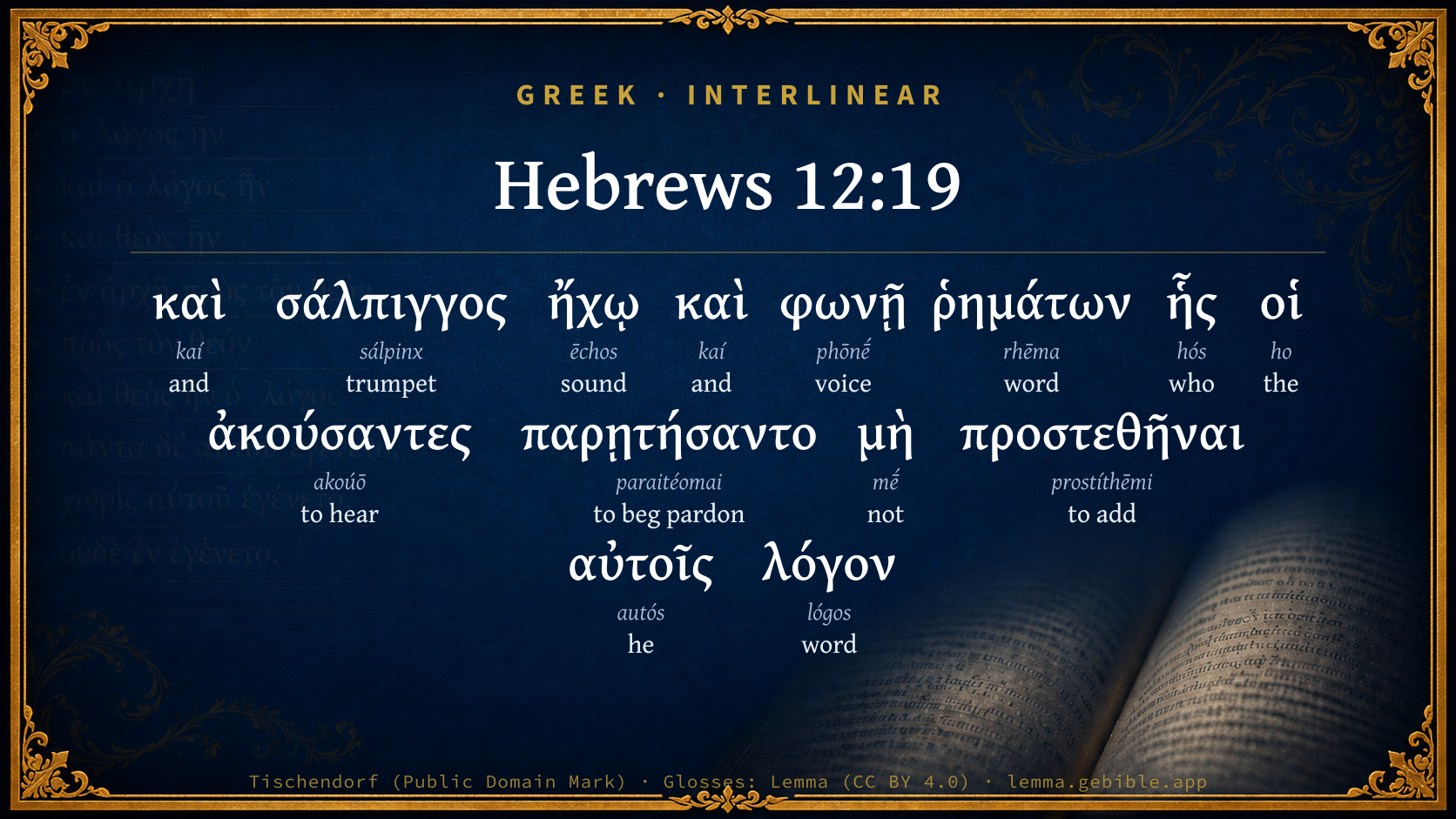
  1. καὶ kaí G2532 “and” Conjunction
  2. σάλπιγγος sálpinx G4536 “trumpet” Noun, Genitive, Singular, Feminine
  3. καὶ kaí G2532 “and” Conjunction
  4. φωνῇ phōnḗ G5456 “voice” Noun, Dative, Singular, Feminine
  5. ῥημάτων rhēma G4487 “word” Noun, Genitive, Plural, Neuter
  6. ἧς hós G3739 “who” Relative pronoun, Genitive, Singular, Feminine
  7. οἱ ho G3588 “the” Article, Nominative, Plural, Masculine
  8. ἀκούσαντες akoúō G191 “to hear” Verb, Aorist, Active, Participle, Nominative, Plural, Masculine
  9. παρῃτήσαντο paraitéomai G3868 “to beg pardon” Verb, Aorist, Middle deponent, Indicative, 3rd person, Plural
  10. μὴ mḗ G3361 “not” Particle, Negative
  11. προστεθῆναι prostíthēmi G4369 “to add” Verb, Aorist, Passive, Infinitive
  12. αὐτοῖς autós G846 “he” Personal pronoun, Dative, Plural, Masculine
  13. λόγον lógos G3056 “word” Noun, Accusative, Singular, Masculine

About this verse

These counts appear in no published source. They are computed here, from the morphology-tagged text and Lemma’s own curated glosses. What Lemma adds →

14
words
13
distinct lemmas
General Epistles
section

Notable vocabulary

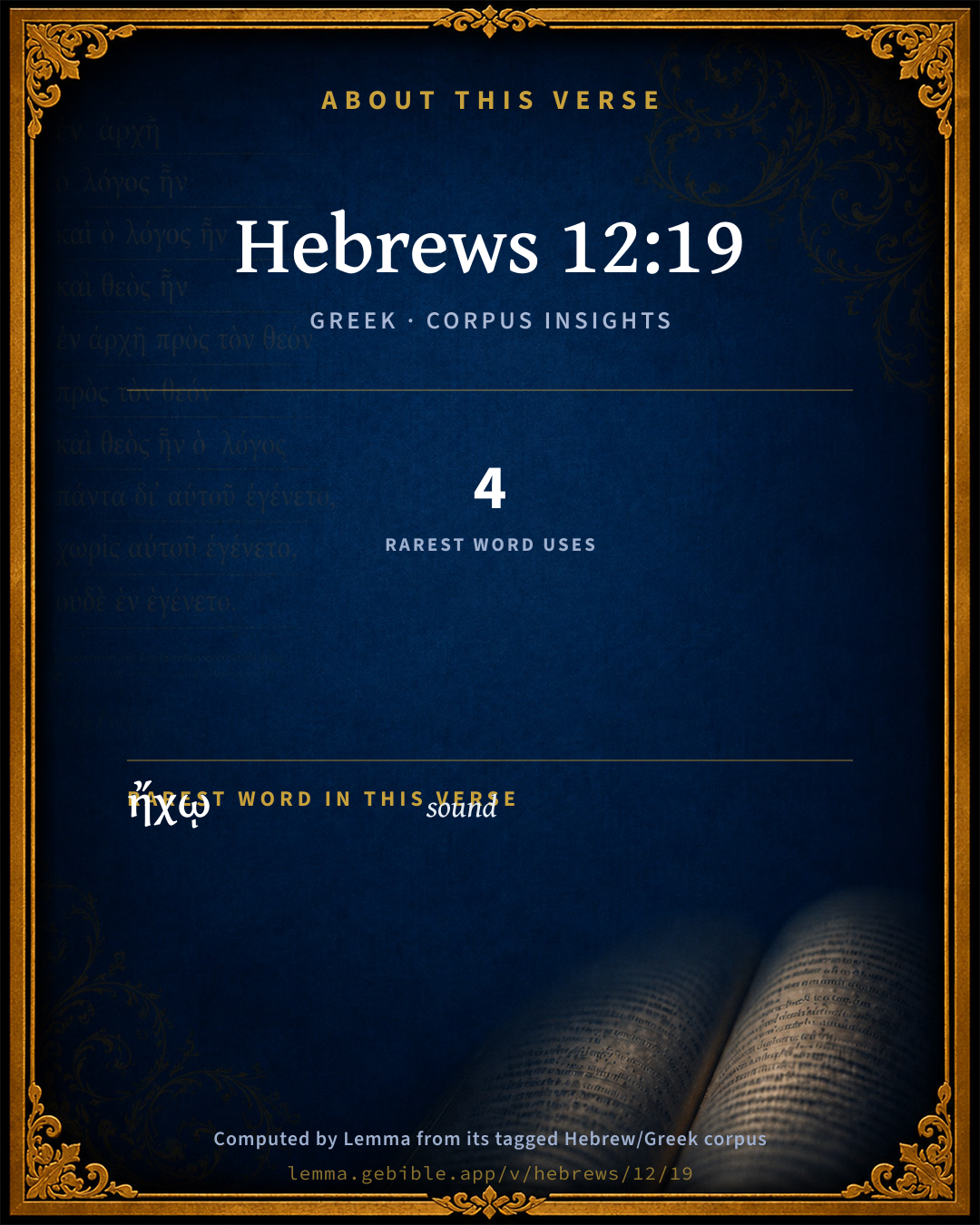
The rarest word here is ἤχῳ sound G2279 — appearing just 4 times in the whole Greek New Testament.

Shared distinctive vocabulary

ἤχῳ sound G2279 occurs in 4 verses of the Greek New Testament. Also found in:

Repetition

A word recurs within this verse:

Cross-references

10

Topical passages linked to Hebrews 12:19 in the Treasury of Scripture Knowledge — connected by theme and wording, ordered by reader-vote popularity; previews shown in the World English Bible.

  • Deuteronomy 18:16 according to all that you desired of Yahweh your God in Horeb in the day of the assembly, saying, Let me not hear again the voice of Yahweh my God, neither let me see this great fire any more, that I not die.
  • 1 Corinthians 15:52 in a moment, in the twinkling of an eye, at the last trumpet. For the trumpet will sound, and the dead will be raised incorruptible, and we will be changed.
  • Exodus 20:1–19 God spoke all these words, saying,
  • Deuteronomy 4:12 Yahweh spoke to you out of the midst of the fire: you heard the voice of words, but you saw no form; only [you heard] a voice.
  • Exodus 20:22 Yahweh said to Moses, "This is what you shall tell the children of Israel: 'You yourselves have seen that I have talked with you from heaven.
  • Deuteronomy 4:33 Did ever a people hear the voice of God speaking out of the midst of the fire, as you have heard, and live?
  • Deuteronomy 5:3–22 Yahweh didn't make this covenant with our fathers, but with us, even us, who are all of us here alive this day.
  • Exodus 19:16–19 It happened on the third day, when it was morning, that there were thunders and lightnings, and a thick cloud on the mountain, and the sound of an exceedingly loud trumpet; and all the people who were in the camp trembled.
  • Deuteronomy 5:24–27 and you said, Behold, Yahweh our God has shown us his glory and his greatness, and we have heard his voice out of the midst of the fire: we have seen this day that God does speak with man, and he lives.
  • 1 Thessalonians 4:16 For the Lord himself will descend from heaven with a shout, with the voice of the archangel, and with God's trumpet. The dead in Christ will rise first,

Cross-references courtesy of OpenBible.info (CC BY 4.0).

Commentary

Notes on Hebrews 12:19 from classic Christian and Jewish commentators (each source and its license shown beneath its notes). The classic Christian expositions comment on the surrounding passage and are grouped to its opening verse, so a note may address several verses; the Jewish commentaries on the Tanakh (Rashi and others) are per-verse, so they appear only where the commentator wrote on this verse.

Lemma curates 59 commentaries, every one of them public domain or Creative Commons licensed, each selected and text-cleaned for this edition rather than reprinted as found. About our sources →

Tyndale Open Study Notes

Tyndale Open Resources

12:19 The awesome trumpet blast and a voice terrified the people (see Exod 19:16, 19; 20:18; Deut 4:12) so that they begged God to stop speaking (Exod 20:19).

Tyndale Open Study Notes — © Tyndale Open Resources, licensed CC BY-SA 4.0. Text via the HelloAO Bible API.

Bengel's Gnomon

Johann Albrecht Bengel

Heb 12:19. Καὶ σάλπιγγος ἤχῳ, and the sound of the trumpet) Exo 19:16, LXX., φωνὴ τῆς σάλπιγγος ἤχει μέγα. The trumpet rouses hearers to listen to what is said.—κα φωνῆ ῥημάτων, and to the voice of words) So the LXX., Deu 4:12: moreover the ten commandments are intended. The Decalogue, ib. Deu 12:13, pronounced with a loud voice, ib. ch. Deu 5:19 (Deu 5:22).—ἧς) Construed with ἀκούσαντες.—παρῃτήσαντο) implored, that not a word more should be spoken, Exo 20:16 (Exo 20:19).—μὴ προστεθῆναι, that there should be no more added) Deu 5:19 (Deu 5:22), in LXX., These words the Lord spake—and He added (προσέθηκε) no more: for the rest were subsequently committed to Moses.

Bengel's Gnomon of the New Testament — English translation (T&T Clark, Edinburgh, 1860) — public domain. Text from a community e-Sword module.

Meyer's Critical & Exegetical Commentary

Heinrich August Wilhelm Meyer

Heb_12:19. Καὶ σάλπιγγος ἤχῳ] and to the sound of trumpet. Comp. Exo_19:16 : φωνὴ τῆς σάλπιγγος ἤχει μέγα. Ibid. Exo_12:19; Exo_20:18.

καὶ φωνῇ ῥημάτων] and clang (piercing note) of words, which, namely, were spoken by God at the publication of the law, Exodus 20, Deuteronomy 5. Comp. Deu_4:12 : καὶ ἐλάλησε κύριος πρὸς ὑμᾶς ἐκ μέσον τοῦ πυρὸς φωνὴν ῥημάτων, ἣν ὑμεῖς ἠκούσατε.

ἧς οἱ ἀκούσαντεχ κ.τ.λ.] they that heard which begged to be spared (Heb_12:25; Act_25:11), that it should be further spoken to them (sc. on account of the terribleness of that already heard). Calvin: Caeterum quod dicit populum excusasse, non ita debet accipi, quasi populus renuerit audire Dei verba, sed deprecatus est, ne Deum ipsum loquentem audire cogeretur. Persona enim Mosis interposita horrorem nonnihil mitigabat. Comp. Deu_5:25 : καὶ νῦν μὴ ἀποθάνωμεν … ἐὰν προσθώμεθα ἡμεῖς ἀκοῦσαι τὴν φωνὴν κυρίου τοῦ θεοῦ ἡμῶν ἔτι; Deu_18:16; Exo_20:18-19.

ἧς] goes back to φωνῇ, and is dependent not on λόγον (Storr), but upon ἀκούσαντες.

μή] after verbs of seeking to be excused, denying, warding off, etc., quite ordinarily. See Kühner, II. p. 410; Winer, Gramm., 7 Aufl. p. 561.

αὐτοῖς] looks back to the Israelites (οἱ ἀκούσαντες), not to ῥημάτων.

Meyer — Critical and Exegetical Commentary on the New Testament — English translation by Peter Christie, edited by Frederick Crombie (T&T Clark, 1880) — public domain. Text from a community e-Sword module.

Jamieson, Fausset & Brown

Robert Jamieson, A. R. Fausset & David Brown

trumpet--to rouse attention, and herald God's approach (Exo 19:16).

entreated that the word should not be spoken--literally, "that speech should not be added to them"; not that they refused to hear the word of God, but they wished that God should not Himself speak, but employ Moses as His mediating spokesman. "The voice of words" was the Decalogue, spoken by God Himself, a voice issuing forth, without any form being seen: after which "He added no more" (Deu 5:22).

Jamieson, Fausset & Brown — Commentary Critical and Explanatory on the Whole Bible (1871) — public domain (CC PDM 1.0). Text via the HelloAO Bible API.

John Calvin's Commentaries

19. They that heard entreated, etc. This is the second clause, in which he shows that the Law was very different from the Gospel; for when it was promulgated there was nothing but terrors on every side. For everything we read of in the nineteenth chapter of Exodus was of this kind, and intended to show to the people that God had ascended his tribunal and manifested himself as a strict judge. If by chance an innocent beast approached, he commanded it to be killed: how much heavier punishment awaited sinners who were conscious of their guilt, nay, who knew themselves to be condemned to eternal death by the Law? But the Gospel contains nothing but love, provided it be received by faith. What remains to be said you may read in the third chapter of the Second Epistle to the Corinthians.

But by the words the people entreated, etc., is not to be understood that they refused to hear God, but that they prayed not to be constrained to hear God himself speaking; for by the interposition of Moses their dread was somewhat mitigated. Yet interpreters are at a loss to know how it is that the Apostle ascribes these words to Moses, I exceedingly fear and quake; for we read nowhere that they were expressed by Moses. But the difficulty may be easily removed, if we consider that Moses spoke thus in the name of the people, whose requests as their delegate he brought to God. It was, then, the common complaint of the whole people; but Moses is included, who was, as it were, the speaker for them all.

John Calvin's Commentaries (1540-1563) — public domain. Text from the Calvin Translation Society English edition (1840s-50s) via the Christian Classics Ethereal Library (ccel.org). Calvin's coverage is partial (roughly two-thirds of the Bible); uncommented books and verses are honest gaps, never fabricated. The 19th-century editor's footnotes and remarks are omitted so the notes are faithfully Calvin's own voice.

Ellicott's Commentary for English Readers

(19) See Exo_19:19 (“the voice of the trumpet”), Deu_4:12 (“the voice of the words”).

Intreated.—“If we hear the voice of the Lord our God any more, then we shall die” (Deu_5:25; Exo_20:19). Though God drew near to Israel, to reveal Himself, so terrible was His voice to them, so awful the penalties which fenced round their approach to Him, that they shrank back from hearing His words.

A Bible Commentary for English Readers, edited by Charles John Ellicott (1878–1897) — public domain. Text from a community e-Sword module.

The Cambridge Bible for Schools and Colleges

gen. ed. J. J. S. Perowne

19. the sound of a trumpet] Exo_19:16; Exo_19:19; Exo_20:18.

the voice of words] Deu_4:12.

intreated] The verb means literally “to beg off.”

that the word should not be spoken to them any more] Lit. “that no word more should be added to them” (Deu_5:22-27; Deu_18:16; Exo_20:19).

The Cambridge Bible for Schools and Colleges (gen. ed. J. J. S. Perowne; Cambridge University Press, 1878–1918) — public domain. Text from a community e-Sword module.

John Gill's Exposition

For they could not endure that which was commanded,.... In the law; not that they disliked and despised the law, as unregenerate men do; but they could not endure it, or bear it, as a yoke, it being a yoke of bondage; nor as a covenant of works, it requiring perfect obedience, but giving no strength to perform; and as it showed them their sins, but did not direct them to a Saviour; as it was an accusing, cursing, and condemning law; and, as a fiery one, revealing wrath, and filling the conscience with it; unless this should have any respect to the following edict, more particularly:

and if so much as a beast touch the mountain, it shall be stoned or thrust through with a dart; and, if a beast, much more a man: and, how easily, through inadvertence, might this be done? and how terrible was the punishment? nothing less than death, by stoning, or being shot: and this they could not bear to hear, or think of: the last clause, "or thrust through with a dart", is wanting in the Alexandrian and Beza's Claromontane copies, in the Vulgate Latin, and all the Oriental versions; and yet is necessary to be retained, being in the original text, in Exo 19:12.

John Gill's Exposition of the Whole Bible (1746–1763) — public domain (CC PDM 1.0). Text via the HelloAO Bible API.

Trapp's Complete Commentary

John Trapp

19 And the sound of a trumpet, and the voice of words; which voice they that heard intreated that the word should not be spoken to them any more:

Ver. 19. And the sound of a trumpet] Showing the nature of God’s law, to manifest God’s will, men’s sins, and to warn them of the wrath deserved; likewise to summon them to appear before the Judge.

The voice of words] That is, the delivery of the decalogue, called the words of the covenant, Exo 31:18, the ten words.

John Trapp, A Commentary or Exposition upon All the Books of the Old and New Testament (1647–1656) — public domain. Text from a community e-Sword module.

Albert Barnes' Notes on the Bible

And the voice of a trumpet - Exo 19:19. The sound of the trumpet amidst the tempest was suited to increase the terror of the scene.

And the voice of words - Spoken by God; Exo 19:19. It is easy to conceive what must have been the awe produced by a voice uttered from the midst of the tempest so distinct as to be heard by the hundreds of thousands of Israel, when the speaker was invisible.

Which voice they that heard ... - Exo 20:18-19. It was so fearful and overpowering that the people earnestly prayed that if they must be addressed, it might he by the familiar voice of Moses and not by the awful voice of the Deity.

Albert Barnes' Notes on the Bible (1834–1885) — public domain. Text from a community e-Sword/MySword module.

Matthew Poole's English Annotations

And the sound of a trumpet; which was most shrill and dreadful, it sounded long, and waxed louder and louder, giving a fearful alarm unto Israel to draw near to the Lord to hear his law to them, and covenant with them, and to see a type of their doom, if they transgressed it, in an obscure representation of the general judgment, Exo 19:16,19; 20:18; compare 1Th 4:16; 2Th 1:7-9.

And the voice of words: after which alarm, the Angel of the covenant uttered his voice out of the fire most majestically, distinctly, and loudly, and spake to Israel in their own language the ten words, or commandments, that they might hear and understand them, so as they sensed them to be dreadful for their sound and matter, Exo 20:1-20; Deu 4:10,12,13; 5:1-27.

Which voice they that heard entreated that the word should not be spoken to them any more: the people, being overwhelmed with the majesty and dreadfulness of that voice, deprecated any more such for matter or manner of manifestation to them, Exo 20:19; Deu 5:23-26; 18:16. And therefore desired Moses to speak to them God’s law, and that God might speak no more.

Matthew Poole's English Annotations on the Holy Bible (1683–1685) — public domain. Text from a community e-Sword/MySword module.

Whedon's Commentary on the Bible

Daniel D. Whedon

19. Trumpet—Note on 1Th_4:16.

Voice of words—From the fire at the summit.

Daniel D. Whedon (gen. ed.), Commentary on the Old and New Testaments (1874–1909) — public domain. Text from a community e-Sword module.

The Pulpit Commentary

Vers. 19-21. And the sound of a trumpet, (Exo_19:16) and the voice of words; (Deu_4:12) which voice they that heard entreated that no word should be spoken to them more: (Psalm 24, which was sung on that occasion, expresses the idea of the King of glory being at length enthroned there, and his people of clean hands and pure hearts being admitted to stand in the holy place before him. (cf. "This is my rest forever: here will I dwell," Psa_132:14) In the Psalms generally the holy hill of Zion continues to be viewed as the LORD"S immovable abode, where he is surrounded by thousands of angels, and whence he succors his people. (cf. Ps 48 Ps 68 Ps 125 Ps 132; etc.) Then by the prophets it is further idealized as the scene and center of Messianic blessings. (cf. Isa 12 Isa_25:1-3 Isa 33 Isa 35 Isa_46:13 Mic 4; to which many other passages might be added) Compare also the visions, in the latter chapters of Ezekiel, of the ideal city and temple of the future age. Lastly, in the Apocalypse the seer has visions of "Mount Zion", (Re 14) and "the holy city, new Jerusalem", (Re 21) with the presence there of God and the Lamb, and with myriads of angels, and innumerable multitudes of saints redeemed. If, in the passage before us, a distinction is to be made between "Mount Zion" and "the heavenly Jerusalem," it may be that the former represents the Church below, the latter the heavenly regions, though both are blent together in one grand picture of the communion of saints. For so in Revelation 14 the hundred and forty-four thousand on Mount Zion seem distinct from the singers and harpers round the throne, whose song is heard from heaven and learnt by those below; while the picture of the holy city in Revelation 21 is one entirely heavenly, representing there the final consummation rather than any present state of things. And to an innumerable company of angels, to the general assembly and Church of the Firstborn (rather, and to myriads, the general assembly of angels, and the Church of the Firstborn), which are written in heaven, and to God the Judge of all, and to the spirits of just men made perfect, and to Jesus the Mediator of a new covenant, and to the blood of sprinkling, that speaketh better things than that of Abel (literally, than Abel). Of the several ways of translating the beginning of the above passage, the best seems to be to take muriasin by itself as including both the angels and the Church of the Firstborn, and to connect panhgurei with "angels" only. "Myriads" is a well-known expression for the LORD"S attendant hosts; (cf. Jud_1:14 Deu_30:2 Dan_7:10) further, kai , which throughout the passage connects the different objects approached, comes between panhgurei and ekklhsia , not between aggelwn and panhgurei , and the application of both panhgurei and ekklhsia to prwtotokwn would seem an unmeaning redundancy. The word panhguriv , which in classical Greek denotes properly the assembly of a whole nation for a festival, is peculiarly appropriate to the angels, whether regarded (as in the Old Testament) as ministering round the throne or as congregated to rejoice over man"s redemption. "The Church of the Firstborn" seems to denote the Church militant rather than the Church triumphant; for

(1) ekklhsia is elsewhere used for the Church on earth; (so also in the Old Testament; cf. Psa_79:6)

(2) the phrase, en ouranoiv apogegrammenwn , expresses the idea of being enrolled in the books of heaven rather than being already there; (cf. Luk_10:20 Php_4:3 Rev_20:12 Rev_21:27)

(3) the "spirits of the perfected" are mentioned afterwards as a class distinct. The word prwtotokwn may be suggested here by the firstborn of Israel, who were specially hallowed to the Lord, (Num_3:13) and numbered as such by Moses, (Num_3:43) or perhaps still more by the birthright (prwtotokia) spoken of above as forfeited by Esau. God"s elect may be called his firstborn as being hallowed to him and heirs of his promises. (cf. Exo_4:22, "Israel is my son, even my firstborn;" and Jer_31:9, "Ephraim is my firstborn They thus correspond to the hundred and forty-four thousand of Revelation 14, standing on Mount Zion, being "redeemed from the earth," and having "the Father"s Name written on their foreheads;" seen distinct from, and yet in communion with, the saints in bliss, whose voices are heard above. Between them and the spirits of the perfected is interposed, "God the Judge of all;" and this appropriately, since before him the saints on earth must appear ere they join the ranks of the perfected: the former look up to him from below; the latter have already passed before him to the rest assigned them. Teteleiwmenen ("perfected") expresses, as elsewhere in the Epistle, full accomplishment of an and or purpose with regard to things or persons; (of Heb_2:10 Heb_5:9 Heb_7:19, 28 9:9 10:1, 14 11:40) the word is used here of those whose warfare is accomplished, and who have attained the rest of God. Their "spirits" only are spoken of, because the "perfect consummation and bliss both in body and soul" is still to come. In the mean while, with respect to the issue of their earthly course, they have been already perfected. (cf. Rev_14:13, "They rest from their labors Corresponding to the Lamb in Revelation, there is seen next Jesus the Mediator, through whom is the approach of the whole company to the Judge of all, and the accomplishment to the perfected. The new covenant" is, of course, meant to be contrasted with the old one before Mount Sinai, under which there was no such approach or accomplishment. Then "the blood of sprinkling" has reference to that wherewith the old covenant was ratified. (Ex 24; cf. supra, Heb_9:18) The blood shed by Christ on earth for atonement is conceived as carried by him with himself into the holy place on high, (cf. Heb_9:12) to be forever the blood of sprinkling for effectual cleansing." And this blood "speaketh better things than Abel." His blood cried from the ground for vengeance, with the accusing voice of primeval sin; Christ"s speaks only of reconciliation anti peace. Some commentators (Bengel in the first place, whom Delitzsch follows) see in this contrast between Sinai and Zion a distinct parallelism between vers. 18, 19 and vers. 22-24; seven objects of approach in one case being supposed to be set against seven in the other, More obvious is the correspondence of the successive clauses of vers. 22-24 to the general ideas connected with the giving of the Law. The two pictures may be contrasted thus

The Old Covenant.

Sinai, a palpable earthly mountain, surrounded by gloom and storm. The angels through whom the Law was given, (of Heb_2:2 Gal_3:19 Act_7:53 Deu_23:2) unseen by men, but operating in the winds and in the fire. (cf. Heb_1:7) Israel congregated under the mountain, afraid, and forbidden to touch it. The LORD, unapproachable, shrouded in darkness or revealed in fire. Moses, himself afraid, and winning through his mediation no access for the people. The blood sprinkled on the people to ratify the old covenant, but which could not cleanse the conscience. The sound of a trumpet and the voice of words, inspiring fear.

The New Covenant.

Zion, radiant with light and crowned with the city of God. Festal choirs of assembled angels. The accepted Church of the Firstborn, with free approach to the holiest of all. The Judge of all, without his terrors, accessible, and awarding rest to the perfected. The Divine availing Mediator. The ever-cleansing blood of complete atonement. The voice of that cleansing blood, speaking of peace and pardon.

Such is the vision by the contemplation of which the inspired writer would arouse his readers, amid their trials and waverings, to realize the things that are eternal. He would have them pierce with the eye of faith beyond this visible scene into the world invisible, which is no less real. If they were perplexed and disheartened by what they found around them by the opposition of the world and the fewness of the faithful he bids them associate themselves in thought with those countless multitudes who were on their side. The picture is, indeed, in some respects, ideal; for the actual Church on earth does not come up to the idea of the "Church of the Firstborn;" but it is presented according to God"s purpose for his people, and it rests with us to make it a present reality to ourselves.

The Pulpit Commentary (1880–1919), ed. H.D.M. Spence-Jones & Joseph S. Exell — public domain. Text from a community e-Sword module.

John Wesley's Explanatory Notes

The sound of a trumpet - Formed, without doubt, by the ministry of angels, and preparatory to the words, that is, the Ten Commandments, which were uttered with a loud voice, Deut. v, 22.

John Wesley, Explanatory Notes Upon the Whole Bible (1754–1765) — public domain. Text via the GEBible commentary corpus.

The People's New Testament

B. W. Johnson

19. And the sound of a trumpet (Exod. 19:16). The trumpet blast preceded the giving of the law. The voice of words. The voice of God proclaiming the Ten Commandments. They … entreated. Filled with terror at the awful manifestation they entreated that God speak no more directly to them. (Exod. 20:19.)

B. W. Johnson's The People's New Testament with Notes (1889–1891) — public domain. Electronic text from the Christian Classics Ethereal Library (CCEL) ThML edition.

Cambridge Greek Testament for Schools and Colleges

19. σάλπιγγος. Exo 19:16; Exo 19:19; Exo 20:18.

φωνῇ ῥημάτων. Deu 4:12.

παρῃτήσαντο. The verb means literally “to beg off.”

μή. The common redundant negative (expressing the negative result) after verbs of denying. See Winer, p. 755.

μὴ προστεθῆναι κ.τ.λ. Lit., “that no word more should be added to them” (Deu 5:22-27; Deu 18:16; Exo 20:19).

Cambridge Greek Testament for Schools and Colleges (Cambridge University Press, 1896; 21 vols, various authors incl. Carr, Maclear, Plummer, Farrar, Lumby, Moule, M. R. James, Simcox) — public domain. Text from a community e-Sword module.

Alford’s Greek Testament

Henry Alford

19.] which they who heard (ἧς, referring to φωνῇ, is governed by ἀκούσαντες, not as Storr, by λόγον) entreated (παραιτεῖσθαί τι = αἰτεῖσθαί τι παρά τινος, in all senses, but more usually in the deprecatory sense. Hence simply to deprecate (Thuc. v. 63, ὁ δὲ παρῃτεῖτο, μηδὲν τούτων δρᾶν: hence further, to refuse or forbid, as in Act 25:11, and even more directly in ver. 25 below) that (more) discourse should not be added to them (αὐτοῖς might agree with τοῖς ῥήμασιν, but much more probably agrees with τοῖς ἀκούσασιν, from the form of construction in Deut. l. c., where they say that they should die, ἐὰν προσθώμεθα ἡμεῖς ἀκοῦσαι (A, προσθῶμεν ἀκοῦσαι ἡμεῖς) τὴν φωνὴν τοῦ θεοῦ ἡμῶν ἔτι. Calvin explains the sense, “Cæterum quod dicit populum excusasse, non ita debet accipi quasi populus renuerit audire Dei verba, sed deprecatus est, ne Deum ipsum loquentem audire cogeretur. Persona enim Mosis interposita horrorem nonnihil mitigabat”):

20,

Henry Alford, The Greek Testament (1849–1861) — public domain. Text from a community e-Sword module.

Vincent's Word Studies in the New Testament

Marvin R. Vincent

Sound of a trumpet [σαλπιγγος ηχω] . See Exo 19:16, 19; Exo 20:18. Hcov a noise, almost entirely in Luke and Acts. See Luk 4:37; Act 2:2; comp. LXX, 1Sa 14:19. Of the roar of the waves, Luk 21:25; comp. LXX, Psa 64:7; Psa 76:17. A rumor or report, see on Luk 4:37, and comp. LXX, 1Sa 4:16; Psa 9:6. It does not occur in the O. T. narrative of the giving of the law, where we have fwnh voice; see LXX, Exo 19:13, 16, 19; Exo 20:18. For fwnh salpiggov voice of a trumpet in N. T., see Rev 1:10; Rev 4:1; Rev 8:13. Salpigx is a war - trumpet.

Voice of words [φωνη ρηματων] . See Exo 19:19; Deu 4:12; Deu 5:22, 24, 26.

Entreated [παρητησαντο] . See on 1Ti 4:7.

Be spoken to them any more [προστεθηναι αυτοις] . Lit. be added. See on Luk 3:19; Luk 20:11; Act 12:3. To them refers to the hearers, not to the things heard. Rend. "that no word more should be spoken unto them." Comp. Exo 20:19; Deu 5:25; Deu 18:16.

Marvin R. Vincent, Word Studies in the New Testament (1887–1900) — public domain. Text from a community e-Sword/MySword module.

Westcott on Hebrews & the Epistles of John

Brooke Foss Westcott

19. καὶ oddrw. ἤχῳ...) Tho ‘sound of a trumpet’ is mentioned in Ex. xix. λέως παρόντοςτ᾽ τοῦτο γὰρ καὶ ἐν τῇ δευτέρᾳ παρουσίᾳ ἔσται ((ἔσυπι.. Comp. occurs again Lk. iv. 37; Acts ii. 2. Tho ‘voico of words’ is mentioned in Deut. iv. 12.

fs (sc. φωνῆς) of ἀκούσαντες Even that which was most intelligible, most human, the articulate voice, inspired the hoarers with overwhelming dread :

19 om. μή δ".

which voice they that heard intreated that no word more should be spoken to them, that is by God Himself, but only through Mosos (Ex. xx. 19).

xxv. 11:1 Tim. iv. 7; 2 Tim. ii. 23. The word admits the construction with and without a negative particle (παραιτεῖσθαι προστεθῆναι and wapatr. μὴ προστεθῆναι). For the former compare Lk. xxiii. 2; Rom. xv, 22; and By αὐτοῖς must be understood τοῖς ἀκούσασιν not τοῖς dxovebciow, tho hearers not tho words.

Brooke Foss Westcott (1825–1901), The Epistle to the Hebrews (1889) and The Epistles of St John (1883) — public domain (pre-1929). Text recovered from Internet Archive / Google Books OCR scans. Westcott’s Gospel of John commentary is not included (its OCR lost the chapter running-heads required for reliable verse-keying). Some Greek quoted in the Hebrews volume is imperfectly rendered by the OCR.

Lesson kit

Teaching starters — assembled from the data on this page, not authored interpretation. Every prompt links to the verse data it draws on. Edit before teaching.

Hebrews, in the General Epistles, opens this verse with 14 words (13 distinct Greek lemmas). Its most distinctive word is ēchos (“sound”). A historical commentator’s framing appears above. Read the whole chapter for the surrounding context.

Discussion questions

  1. How does “sound” (ēchos) shape what this verse is saying?
  2. How does Luke 4:37, which shares the word «sound», read alongside this verse?
  3. What does the repetition of “and” (2× in this one verse) do in this verse?
  4. The translations on this page render this verse differently — a whole-verse word diff, not a word-by-word alignment. What might account for the different wordings?
  5. Compare how Tyndale Open Study Notes and Bengel's Gnomon read this verse. Where do they agree or differ?

Things to notice

Reading settings

Reading text

Shown beneath each verse's original-language words.

Old Testament
Old Testament edition

Read the OT as the Masoretic Hebrew (MT) or the Greek Septuagint (LXX).

English shown for the Greek Septuagint (in the Hebrew ↔ Greek comparison).

Comparing translations? Open the Compare panel on any verse page to stack up to four side by side.