1 John 4:6

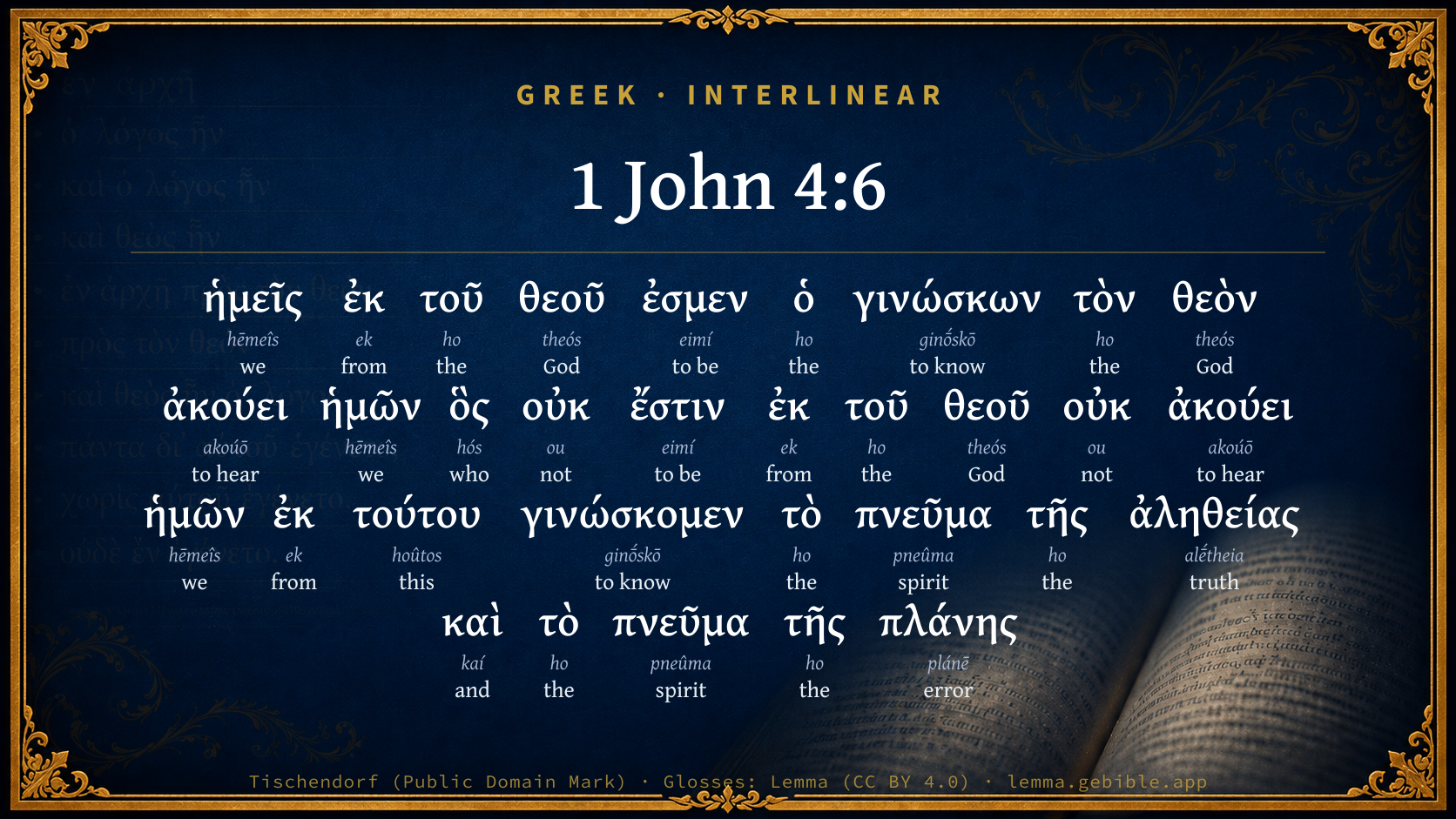
Greek (Tischendorf 8th ed.) 1 John 4:6 appears in the Greek New Testament. The text above is from the Tischendorf 8th edition. Each word links to its Strong’s number and a concise gloss. Click any word for its full Thayer’s Greek Lexicon entry.
Download image
Cite this verse

1 John 4:6 (World English Bible). Public Domain. Lemma interlinear Bible study tool, https://lemma.gebible.app/v/1-john/4/6.

Show BibTeX & RIS
BibTeX
RIS
English Translation
We are of God. He who knows God listens to us. He who is not of God doesn't listen to us. By this we know the spirit of truth, and the spirit of error.
World English Bible · Public Domain
Download a study sheet

One document with this verse’s original text, its word-by-word gloss line, the meaning frame, cross-references with their text, attributed commentary, and full source and license credits — printable, and it pastes into notes with its structure intact.

This verse Autodidact and up

Study sheet (.html) Plain text (.txt)

A passage Seminary Student

Up to 50 verses in one chapter. A passage sheet keeps up to 6 commentary sources and 12 cross-references per verse, in the order this page ranks them, and says so on the sheet whenever that leaves anything out. Ask for a single verse and you get the Autodidact verse sheet above.

Everything on this page stays free to read, with no account — the sheet is a download of what is already on screen, not access to it.

Want to remove ads? Support Godless Engineer
Compare translations 3

The same verse in 3 English versions, stacked beneath the original-language interlinear above. Click any original word for its lexicon entry.

Each is an independent rendering of the whole verse — the interlinear is not word-aligned to these translations.

Highlighted words mark where these versions differ — a whole-verse word diff, not a word-by-word alignment.

  • World English Bible Public Domain
    We are of God. He who knows God listens to us. He who is not of God doesn't listen to us. By this we know the spirit of truth, and the spirit of error.
  • King James Version Public Domain
    We are of God: he that knoweth God heareth us; he that is not of God heareth not us. Hereby know we the spirit of truth, and the spirit of error.
  • unfoldingWord Literal Text CC BY-SA 4.0
    We are from God. The one knowing God listens to us. Whoever is not from God does not listen to us. From this we know the spirit of truth and the spirit of error.

unfoldingWord Literal Text — © unfoldingWord, licensed CC BY-SA 4.0. Word-aligned USFM3 via Door43 (git.door43.org/unfoldingWord/en_ult).

Versions to compare (up to 4)

3 of 4 selected

Show all 19 translations

Every available English version of this verse, each an independent rendering of the whole verse.

  • World English Bible Public Domain
    We are of God. He who knows God listens to us. He who is not of God doesn't listen to us. By this we know the spirit of truth, and the spirit of error.
  • Berean Standard Bible Public Domain
    We are from God. Whoever knows God listens to us; whoever is not from God does not listen to us. That is how we know the Spirit of truth and the spirit of deception.
  • Majority Standard Bible Public Domain
    We are from God. Whoever knows God listens to us; whoever is not from God does not listen to us. That is how we know the Spirit of truth and the spirit of deception.
  • King James Version Public Domain
    We are of God: he that knoweth God heareth us; he that is not of God heareth not us. Hereby know we the spirit of truth, and the spirit of error.
  • American Standard Version (1901) Public Domain
    We are of God: he that knoweth God heareth us; he who is not of God heareth us not. By this we know the spirit of truth, and the spirit of error.
  • Revised Version (1885) Public Domain
    We are of God: he that knoweth God heareth us; he who is not of God heareth us not. By this we know the spirit of truth, and the spirit of error.
  • Geneva Bible (1599) Public Domain
    We are of God, he that knoweth God, heareth vs: he that is not of God, heareth vs not. Heereby knowe wee the spirit of trueth, and the spirit of errour.
  • Douay-Rheims (1899) Public Domain
    We are of God. He that knoweth God, heareth us. He that is not of God, heareth us not. By this we know the spirit of truth, and the spirit of error.
  • Young's Literal Translation Public Domain
    we -- of God we are; he who is knowing God doth hear us; he who is not of God, doth not hear us; from this we know the spirit of the truth, and the spirit of the error.
  • Literal Standard Version CC BY-SA 4.0
    we are of God; he who is knowing God hears us; he who is not of God, does not hear us; from this we know the Spirit of truth and the spirit of error.
  • Unlocked Literal Bible CC BY-SA 4.0
    We are from God. Anyone who knows God listens to us. He who is not from God does not listen to us. By this we know the spirit of truth and the spirit of error.
  • unfoldingWord Literal Text CC BY-SA 4.0
    We are from God. The one knowing God listens to us. Whoever is not from God does not listen to us. From this we know the spirit of truth and the spirit of error.
  • Darby Bible Public Domain
    *We* are of God; he that knows God hears us; he who is not of God does not hear us. From this we know the spirit of truth and the spirit of error.
  • World Messianic Bible Public Domain
    We are of God. He who knows God listens to us. He who is not of God doesn’t listen to us. By this we know the spirit of truth, and the spirit of error.
  • Webster's Bible Public Domain
    We are of God. He that knoweth God, heareth us; he that is not of God, heareth not us. By this we know the spirit of truth, and the spirit of error.
  • Free Bible Version CC BY-SA 4.0
    We belong to God and whoever knows God listens to us, while whoever doesn't belong to God doesn't listen to us. This is how we can distinguish the spirit of truth from the spirit of deception.
  • Bible in Basic English Public Domain
    We are of God: he who has the knowledge of God gives ear to us; he who is not of God does not give ear to us. By this we may see which is the true spirit, and which is the spirit of error.
  • Text-Critical English NT CC BY 4.0
    We are from God. Whoever knows God listens to us; whoever is not from God does not listen to us. By this we know the Spirit of truth and the spirit of error.
  • Tyndale New Testament (1534) Public Domain
    We are of God. He that knoweth God heareth vs: he that is not of God heareth vs not. Herby knowe we the sprete of veritie and the sprete of erroure.

Literal Standard Version (2020), Covenant Press — licensed CC BY-SA 4.0. Text via the HelloAO Bible API (eBible.org). Unlocked Literal Bible (unfoldingWord) — licensed CC BY-SA 4.0. Text via the HelloAO Bible API (eBible.org). unfoldingWord Literal Text — © unfoldingWord, licensed CC BY-SA 4.0. Word-aligned USFM3 via Door43 (git.door43.org/unfoldingWord/en_ult). Free Bible Version, Dr. Jonathan Gallagher — licensed CC BY-SA 4.0. Text via the HelloAO Bible API (eBible.org).

Word by word

More ways to search: Search by grammar → Find every occurrence → Compare this word →

Practice this passage: Drill this verse → Learn its vocabulary →

πλάνης
plánē
G4106
“error”
Noun, Genitive, Singular, Feminine
Part of Speech
Noun
Case
Genitive
Number
Singular
Gender
Feminine
Full Thayer's Definition

Origin: from G4108 (as abstractly)

TDNT: 09:48,9

1. a wandering, a straying about a. one led astray from the right way, roams hither and thither 2. metaph. a. mental straying 1. error, wrong opinion relative to morals or religion b. error which shows itself in action, a wrong mode of acting c. error, that which leads into error, deceit or fraud
  1. ἡμεῖς hēmeîs G2249 “we” Personal pronoun, 1st person, Nominative, Plural
  2. ἐκ ek G1537 “from” Preposition
  3. τοῦ ho G3588 “the” Article, Genitive, Singular, Masculine
  4. θεοῦ theós G2316 “God” Noun, Genitive, Singular, Masculine
  5. ἐσμεν eimí G1510 “to be” Verb, Present, Active, Indicative, 1st person, Plural
  6. ὁ ho G3588 “the” Article, Nominative, Singular, Masculine
  7. γινώσκων ginṓskō G1097 “to know” Verb, Present, Active, Participle, Nominative, Singular, Masculine
  8. τὸν ho G3588 “the” Article, Accusative, Singular, Masculine
  9. θεὸν theós G2316 “God” Noun, Accusative, Singular, Masculine
  10. ἀκούει akoúō G191 “to hear” Verb, Present, Active, Indicative, 3rd person, Singular
  11. ἡμῶν hēmeîs G2249 “we” Personal pronoun, 1st person, Genitive, Plural
  12. ὃς hós G3739 “who” Relative pronoun, Nominative, Singular, Masculine
  13. οὐκ ou G3756 “not” Particle, Negative
  14. ἔστιν eimí G1510 “to be” Verb, Present, Active, Indicative, 3rd person, Singular
  15. ἐκ ek G1537 “from” Preposition
  16. τοῦ ho G3588 “the” Article, Genitive, Singular, Masculine
  17. θεοῦ theós G2316 “God” Noun, Genitive, Singular, Masculine
  18. οὐκ ou G3756 “not” Particle, Negative
  19. ἀκούει akoúō G191 “to hear” Verb, Present, Active, Indicative, 3rd person, Singular
  20. ἡμῶν hēmeîs G2249 “we” Personal pronoun, 1st person, Genitive, Plural
  21. ἐκ ek G1537 “from” Preposition
  22. τούτου hoûtos G3778 “this” Demonstrative pronoun, Genitive, Singular, Neuter
  23. γινώσκομεν ginṓskō G1097 “to know” Verb, Present, Active, Indicative, 1st person, Plural
  24. τὸ ho G3588 “the” Article, Accusative, Singular, Neuter
  25. πνεῦμα pneûma G4151 “spirit” Noun, Accusative, Singular, Neuter
  26. τῆς ho G3588 “the” Article, Genitive, Singular, Feminine
  27. ἀληθείας alḗtheia G225 “truth” Noun, Genitive, Singular, Feminine
  28. καὶ kaí G2532 “and” Conjunction
  29. τὸ ho G3588 “the” Article, Accusative, Singular, Neuter
  30. πνεῦμα pneûma G4151 “spirit” Noun, Accusative, Singular, Neuter
  31. τῆς ho G3588 “the” Article, Genitive, Singular, Feminine

About this verse

These counts appear in no published source. They are computed here, from the morphology-tagged text and Lemma’s own curated glosses. What Lemma adds →

32
words
14
distinct lemmas
General Epistles
section

Notable vocabulary

The rarest word here is πλάνης error G4106 — appearing just 10 times in the whole Greek New Testament.

Shared distinctive vocabulary

πλάνης error G4106 occurs in 10 verses of the Greek New Testament. Also found in:

Repetition

Words recur within this verse:

  • θεοῦ God G2316 ×3
  • ἐσμεν to be G1510 ×2
  • γινώσκων to know G1097 ×2
  • ἀκούει to hear G191 ×2
  • πνεῦμα spirit G4151 ×2
  • τοῦ the G3588 ×8
  • ἡμεῖς we G2249 ×3
  • ἐκ from G1537 ×3
  • οὐκ not G3756 ×2

Cross-references

29

Topical passages linked to 1 John 4:6 in the Treasury of Scripture Knowledge — connected by theme and wording, ordered by reader-vote popularity; previews shown in the World English Bible.

  • John 14:17 the Spirit of truth, whom the world can't receive; for it doesn't see him, neither knows him. You know him, for he lives with you, and will be in you.
  • John 10:27 My sheep hear my voice, and I know them, and they follow me.
  • 1 Corinthians 2:12–14 But we received, not the spirit of the world, but the Spirit which is from God, that we might know the things that were freely given to us by God.
  • John 15:26 "When the Counselor has come, whom I will send to you from the Father, the Spirit of truth, who proceeds from the Father, he will testify about me.
  • John 8:45–50 But because I tell the truth, you don't believe me.
  • 1 John 4:1 Beloved, don't believe every spirit, but test the spirits, whether they are of God, because many false prophets have gone out into the world.
  • John 18:37 Pilate therefore said to him, "Are you a king then?" Jesus answered, "You say that I am a king. For this reason I have been born, and for this reason I have come into the world, that I should testify to the truth. Everyone who is of the truth listens to my voice."
  • 1 John 4:4 You are of God, little children, and have overcome them; because greater is he who is in you than he who is in the world.
  • 1 Corinthians 14:37 If any man thinks himself to be a prophet, or spiritual, let him recognize the things which I write to you, that they are the commandment of the Lord.
  • 2 Thessalonians 2:9–11 even he whose coming is according to the working of Satan with all power and signs and lying wonders,
  • Micah 3:8 But as for me, I am full of power by the Spirit of Yahweh, And of judgment, and of might, To declare to Jacob his disobedience, And to Israel his sin.
  • John 16:13 However when he, the Spirit of truth, has come, he will guide you into all truth, for he will not speak from himself; but whatever he hears, he will speak. He will declare to you things that are coming.
  • 2 Thessalonians 1:8 giving vengeance to those who don't know God, and to those who don't obey the Gospel of our Lord Jesus,
  • 1 John 4:8 He who doesn't love doesn't know God, for God is love.
  • Isaiah 8:20 To the law and to the testimony! if they don't speak according to this word, surely there is no morning for them.
  • Isaiah 29:10 For Yahweh has poured out on you the spirit of deep sleep, and has closed your eyes, the prophets; and your heads, the seers, has he covered.
  • Luke 10:22 Turning to the disciples, he said, "All things have been delivered to me by my Father. No one knows who the Son is, except the Father, and who the Father is, except the Son, and he to whomever the Son desires to reveal him."
  • John 8:19 They said therefore to him, "Where is your Father?" Jesus answered, "You know neither me, nor my Father. If you knew me, you would know my Father also."
  • John 13:20 Most assuredly I tell you, he who receives whomever I send, receives me; and he who receives me, receives him who sent me."
  • 1 Timothy 4:1 But the Spirit says expressly that in later times some will fall away from the faith, paying attention to seducing spirits and doctrines of demons,
  • Hosea 4:12 My people consult with their wooded idol, And answer to a stick of wood. Indeed the spirit of prostitution has led them astray, And they have been unfaithful to their God.
  • Micah 2:11 If a man walking in a spirit of falsehood lies: 'I will prophesy to you of wine and of strong drink;' He would be the prophet of this people.
  • John 10:16 I have other sheep, which are not of this fold. I must bring them also, and they will hear my voice. They will become one flock with one shepherd.
  • John 20:21 Jesus therefore said to them again, "Peace be to you. As the Father has sent me, even so I send you."
  • Romans 1:1 Paul, a servant of Jesus Christ, called to be an apostle, set apart for the Gospel of God,
  • Romans 11:8 According as it is written, "God gave them a spirit of stupor, eyes that they should not see, and ears that they should not hear, to this very day."
  • 2 Corinthians 10:7 Do you look at things only as they appear in front of your face? If anyone trusts in himself that he is Christ's, let him consider this again with himself, that, even as he is Christ's, so also we are Christ's.
  • 2 Peter 3:2 that you should remember the words which were spoken before by the holy prophets, and the commandments of us, the apostles of the Lord and Savior:
  • Jude 1:17 But you, beloved, remember the words which have been spoken before by the apostles of our Lord Jesus Christ.

Cross-references courtesy of OpenBible.info (CC BY 4.0).

Commentary

Notes on 1 John 4:6 from classic Christian and Jewish commentators (each source and its license shown beneath its notes). The classic Christian expositions comment on the surrounding passage and are grouped to its opening verse, so a note may address several verses; the Jewish commentaries on the Tanakh (Rashi and others) are per-verse, so they appear only where the commentator wrote on this verse.

Lemma curates 59 commentaries, every one of them public domain or Creative Commons licensed, each selected and text-cleaned for this edition rather than reprinted as found. About our sources →

The Cambridge Bible for Schools and Colleges

gen. ed. J. J. S. Perowne

6. We are of God] ‘We’ with great emphasis, like ‘ye’ in 1Jn_4:4, in contrast to the false prophets. ‘We’ is probably not equivalent to ‘ye’, viz. all true believers: ‘we’ means the Apostles. See on 1Jn_4:14 and on 1Jn_1:4. The opposition here is not between true and false Christians, but between true and false teachers. Comp. 1Co_14:37.

he that knoweth God heareth us] We might render, ‘He that increaseth in the knowledge of God’ (ὁ γινώσκεν τὸν Θεόν). Here once more we have that magisterial tone of Apostolic authority which is so conspicuous in the Prologue (1Jn_1:1-4). It underlies the whole Epistle, as it does the whole of the Fourth Gospel, but here and there comes to the surface. It is the quiet confidence of conscious strength. Comp. ‘He that is of God heareth the words of God; for this cause ye hear them not because ye are not of God’; and, ‘Every one that is of the Truth heareth My voice’ (Joh_8:47; Joh_18:37). For ordinary Christians to adopt this language is presumptuous sectarianism.

Note that, as usual, the antithesis is not exact: ‘he that knoweth God’ is balanced by ‘he that is not of God’; indicating that it is the child of God who comes by experience to know Him.

Hereby know we] Literally, From this. A fresh sentence should begin here. It is not certain whether ‘from this’ refers to the whole section (1–6), or to the latter half (4–6), or only to the first half of 1Jn_4:6. In any case the meaning is, not that those who hear the Apostle have the Spirit of truth, while those who refuse to hear have the spirit of error; but that the Apostles have the Spirit of truth because God’s children hear them, while the false prophets have the spirit of error because the world hears them.

the spirit of truth] The Holy Spirit; Joh_14:17; Joh_15:26; Joh_16:13 : comp. 1Co_2:12, where the whole passage is very similar to this. It is not easy to determine whether the genitive ‘of truth’ expresses the character of the Spirit, as in ‘the Holy Spirit of promise’ (Eph_1:13), ‘the Spirit of grace (Heb_10:29), or the source, as in ‘the Spirit of God’ and ‘the Spirit of Christ’ (Rom_8:9; Rom_8:11). The Spirit is the Truth (1Jn_5:7), proceeds from Him who is the Truth (Joh_14:6; Joh_14:26), communicates and interprets the Truth (Joh_16:13-14).

The Cambridge Bible for Schools and Colleges (gen. ed. J. J. S. Perowne; Cambridge University Press, 1878–1918) — public domain. Text from a community e-Sword module.

The Biblical Illustrator

Joseph S. Exell

1Jn_4:6

Hereby know we the spirit of truth, and the spirit of error

The time spirit and the Holy Spirit

I.

The time spirit. What the Germans call the Zeit Geist; the spirit of the world, and of the age in which we live. What is that spirit? It is the world about us, this age of ours, speaking inarticulately to the soul of man. The world lies all around, a varied, splendid scene; vast, rich, fair, full of wealth and beauty. Till it can express itself, it is like a very lovely body without a soul. But it makes to itself a voice in the time spirit, and so talks to our hearts. Its mediums are manifold and diverse; among them are art and literature; the voices vary greatly, according to race, age, and clime. This is an age of marvels. Here are scholars studying and speculating; inventors planning and contriving; politicians doing their best as architects of their own fortunes. Here be poets, and painters, mechanics and artisans; here are grand cities, growing grander year after year; here we have luxury, comfort, delights of all sorts, music, worlds shows, balls, dances, entertainments, with titles, dress, gala, and glory to the full. What is all this? A mere chaos of activities till the Zeit Geist speaks. To this it gives, what is needed, expression and interpretation; as the musician would say, it interprets the worlds psalm of the world life.

II. Is there then no other voice? Surely something is lacking here. There is such other voice: the voice of another spirit, greater than the time spirit. We name Him in the Creed when we say, and I believe in the Holy Ghost, the Lord and Giver of Life. This is the Spirit which speaks against the spirit of the age; which strengthens, purifies, and elevates, as the other weakens, corrupts, and depresses; whose utterances are wisdom and truth.

III. Such are the two spirits, which, on either side, perpetually address the soul of man. How shall we know them apart? Or rather what constitutes their difference? If is marked and strong. The time spirit preaches boastfully of man, of the world, of life; the Holy Spirit of sin, of righteousness, and of judgment. The spirit of the age applauds and flatters us; the Holy Spirit rebukes, reproves, convicts. The time spirit talks to us of the glory and greatness of man, of temporal things as all-sufficient, of the world as the measure of our destinies, of a free and reckless life without responsibility, faith, or fear. The Holy Spirit on the contrary, speaks of the sin of man, his weakness and corruption; of a righteousness which consists in faith, obedience, and self-denial, of a battle against the world, of a coming judgment on the earth and its guilty tenants. And this is the essential difference between the voices; the one bids to indulgence, the other to discipline; the one addresses the physical, the other the moral nature; the one displays the kingdoms of this world and all the glory of them, the other points to that straight and narrow gate through which we enter into the kingdom of heaven. There are strange fables and legends of the old time and of the new; stories of syrens, who, singing in their rock-bound coasts, drew hapless mariners to wreck and death before their cruel eyes; stories of melodies so sweet and strange, that men, if once they listened, straightway forgot home, and kindred, and all that ever they knew, and cared for nothing but to listen to that song forever. And we must choose what we will do; whether we will hearken to the syrens, and forget thenceforth all that ever we were taught of God and Christ, of sin and its dire penances temporal and eternal, of righteousness and its crown. Such is our choice; and it presses on us for a decision, since the time is short, and the fashion of this world passeth away. (M. Dix, D. D.)

The Biblical Illustrator, edited by Joseph S. Exell (c. 1880s–1900s) — public domain. Text from a community e-Sword module.

Tyndale Open Study Notes

Tyndale Open Resources

4:6 John tests the reality of a person’s Christianity by whether they listen to and agree with the teachings of the apostles. • The Spirit of truth is the Holy Spirit (John 14:17, 26; 15:26; 16:13-15), who teaches the truth about Christ (1 Jn 2:20, 27). • False prophets have the spirit of deception, the spirit of antichrist, which leads people away from Christ (see study note on 2:22). Therefore, union with the historic body of Christ and the consensus of teaching that began with the apostles is a sign of fidelity to Christ’s work in the world.

Tyndale Open Study Notes — © Tyndale Open Resources, licensed CC BY-SA 4.0. Text via the HelloAO Bible API.

Bengel's Gnomon

Johann Albrecht Bengel

1Jn 4:6. Ἐσμὲν, we are) Understand, on this account we speak from [of] God.—ἐκ τούτου, from this) which is stated in 1Jn 4:2-6.

Bengel's Gnomon of the New Testament — English translation (T&T Clark, Edinburgh, 1860) — public domain. Text from a community e-Sword module.

Meyer's Critical & Exegetical Commentary

Heinrich August Wilhelm Meyer

1Jn_4:6. ἠμεῖς] Antithesis of αὐτοί, 1Jn_4:5; either specially John and the other apostles (Storr, Düsterdieck, Brückner, Braune, etc.) as the true teachers, or believers generally (Calvin, Spener, Lücke, de Wette, etc.); in favour of the former interpretation is the fact that believers are addressed in this section in the second person, together with the following ἀκούει ἠμῶν, as also the antithesis to ψευδοπροφῆται indicates teachers.

With ἐκ τοῦ Θεοῦ ἐσμεν we are to supply, according to 1Jn_4:5, the thought διὰ τοῦτο ἐκ τοῦ Θεοῦ λαλοῦμεν; the following words: ὁ γινώσκων τὸν Θεὸν ἀκούει ἡμῶν, contain the proof of the thought just expressed.

ὁ γιν. τὸν Θεόν forms the antithesis of ὁ κόσμος, and is synonymous with ὅς ἐστιν ἐκ τ. Θεοῦ, for it is only he who is a child of God that possesses the true knowledge of God. According to Lücke and others, the apostle means by this those to whom belongs the general ἐκ τοῦ Θεοῦ εἶναι, i.e. the divine impress and instinct, which is the condition of childhood of God in Christ; but the expression itself is opposed to this, for the knowledge of God is necessarily conditioned by faith in Christ.

In the second clause: ὃς οὐκ ἔστιν … οὐκ ἀκ. ἡμῶν, ὃς … Θεοῦ forms the antithesis to ὁ γινώσκων τ. Θεόν. This is the antithesis between world and church of the children of God.

In the concluding clause: ἐκ τούτου … τῆς πλάνης, it is to the immediately preceding thought that ἐκ τούτου refers. According to the usual view, with which Düsterdieck agrees, the sense of this passage is: He who hears the apostles shows thereby that the πνεῦμα τῆς ἀληθείας is in him; he who, on the contrary, does not hear them, shows that the πν. τῆς πλάνης is in him; it is in his relation to the apostolic teaching that any one shows of what spirit he is the child.[259] But, according to the train of thought in this section, it is not the spirit of the hearers, but that of the teachers that is the subject (so also Myrberg and Braune); the sense therefore is: That the πνεῦμα τῆς πλάνης prevails in the false prophets, may be known by this, that the world hears them; that in us, on the contrary, the πνεῦμα τῆς ἀληθείας dwells, may be perceived by this, that those who know God, i.e. the children of God, hear us. The πν. τῆς ἀληθείας cannot be in him whom the world hears, nor can the πν. τῆς πλάνης be in him whom the children of God hear; Braune: the πν. τῆς πλάνης is certainly in him whom the world hears, and the πν. τῆς ἀληθείας in him whom the children of God hear.

τὸ πνεῦμα τῆς ἀληθείας; comp. Joh_14:17; Joh_15:26; Joh_16:13; a description of the Holy Ghost, inasmuch as He not only produces a knowledge of the truth, but makes the truth His very nature (Weiss).[260] τὸ πν. τῆς πλάνης, the spirit that emanates from the devil, which seduces men to falsehood and error; comp. chap. 1Jn_1:8; 1Th_2:3; 1Ti_4:1.

[259] Luther: If we hear Gods true messengers, that is a plain token of true religion; if, however, we despise and mock them, that is a plain token of error.

[260] The thought of this passage corresponds with that of Joh_10:3-5, where Christ appeals for a proof that He is the Good Shepherd to the fact that the sheep know and hear His voice, whilst they do not know the voice of the stranger, and flee from it.

Meyer — Critical and Exegetical Commentary on the New Testament — English translation by Peter Christie, edited by Frederick Crombie (T&T Clark, 1880) — public domain. Text from a community e-Sword module.

Expositor's Greek Testament

ed. W. Robertson Nicoll

1Jn 4:6 . Conversely, those who are getting to know God, understand the language of His messengers and listen to it. ἐκ τούτου , i.e , from their hearkening or not hearkening. Men’s attitude to the message of the Incarnate Saviour ranks them on this side or on that on God’s side or the world’s. Of course St. John does not ignore St. Paul’s ἀληθεύοντες ἐν ἀγάπῃ (Eph 4:15 ). The message may be the truth and be rejected, not because of the hearers’ worldliness, but because it is wrongly delivered not graciously and winsomely. Cf. Rowland Hill’s anecdote of the preaching barber who had made a wig for one of his hearers badly made and nearly double the usual price. When anything particularly profitable escaped the lips of the preacher, the hearer would observe to himself: “Excellent! This should touch my heart; but oh, the wig!” τῆς ἀληθείας see note on 1Jn 1:8 . τὸ πν . τῆς πλάνης , “the spirit that leadeth astray”.

The Expositor's Greek Testament, edited by W. Robertson Nicoll (1897–1910) — public domain. Text from a community e-Sword module.

Cambridge Greek Testament for Schools and Colleges

6. For ἐκ τούτου ([723][724][725][726], Peschito) [727], Vulgate, and Thebaic have ἐν τούτῳ.

[723] 4th century. Discovered by Tischendorf in 1859 at the monastery of S. Catherine on Mount Sinai, and now at Petersburg. All three Epistles.

[724] 4th century. Brought to Rome about 1460. It is entered in the earliest catalogue of the Vatican Library, 1475. All three Epistles.

[725] 9th century. All three Epistles.

[726] 9th century. All three Epistles.

[727] 5th century. Brought by Cyril Lucar, Patriarch of Constantinople, from Alexandria, and afterwards presented by him to Charles I. in 1628. In the British Museum. All three Epistles.

6. ἡμεῖς. Once more we have no barren seesaw, but an advance. Αὐτοί is opposed to ἱμεῖς, and ἡμεῖς is opposed to αὐτοί: but ἡμεῖς is not a return to ὑμεῖς. The contrast between ὑμεῖς and αὐτοί is that between true and false Christians. The contrast between αὐτοί and ἡμεῖς is that between false and true teachers. As in 1Jn 4:14 and 1Jn 1:4, ἡμεῖς probably means the Apostles. Comp. 1Co 14:37.

ὁ γινώσκων τὸν Θεόν. Both the verb itself and the present participle are very expressive; ‘He that is increasing in the knowledge of God’. It is with a view to this increase that Christ has given us διάνοια (1Jn 5:20); and he who has it ἀκούει ἡμῶν, listens to us. Here again we have that magisterial tone of Apostolic authority which is so conspicuous in the Prologue (1Jn 1:1-4). It underlies the whole Epistle, as it does the whole of the Fourth Gospel, but here and there comes to the surface. It is the quiet confidence of conscious strength. Comp. ‘He that is of God heareth the words of God; for this cause ye hear them not because ye are not of God’; and, ‘Every one that is of the Truth heareth My voice’ (Joh 8:47; Joh 18:37). For ordinary Christians to adopt this language is presumptuous sectarianism.

Note, that, as usual, the antithesis is not exact: ‘he that knoweth God’ is balanced by ‘he that is not of God’; indicating that it is the child of God who comes by experience to know Him.

ἐκ τούτου. A fresh sentence should begin here. It is not certain whether ‘from this’ refers to the whole section (1–6), or to the latter half (4–6), or only to the first half of 1Jn 4:6. In any case the meaning is, not that those who hear the Apostle have the Spirit of truth, while those who refuse to hear have the spirit of error; but that the Apostles have the Spirit of truth because God’s children listen to them, while the false prophets have the spirit of error because the world listens to them. On the other hand the world does not listen to the Apostles, because it has no sympathy or affinity with what they have to teach (1Co 2:14).

τὸ πνεῦμα τῆς ἀληθείας. The Holy Spirit; Joh 14:17; Joh 15:26; Joh 16:13: comp. 1Co 2:12. It is not easy to decide whether τῆς ἀληθείας expresses the character of the Spirit, as in τῷ πνεύματι τῆς ἐπαγγελίας τῷ ἁγίῳ (Eph 1:13), and τὸ πνεῦμα τῆς χάριτος (Heb 10:29), or the source, as τῷ πνεύματι τοῦ θεοῦ (1Co 6:11). The Spirit is the Truth (1Jn 4:6), proceeds from Him who is the Truth (Joh 14:6; Joh 14:26), communicates and interprets the Truth (Joh 16:13-14).

τὸ πνεῦμα τῆς πλάνης. The expression occurs nowhere else in N.T. Comp. τὸ πνεῦμα τοῦ κόσμου (1Co 2:12). It is the spirit which emanates from him who ‘is a liar and the father thereof’ (Joh 8:44).

Cambridge Greek Testament for Schools and Colleges (Cambridge University Press, 1896; 21 vols, various authors incl. Carr, Maclear, Plummer, Farrar, Lumby, Moule, M. R. James, Simcox) — public domain. Text from a community e-Sword module.

Geneva Bible (1599)

Geneva Bible translators

He testifieth unto them that his doctrine and the doctrine of his fellows, is the assured word of God, which of necessity we have boldly to set against all the mouths of the whole world, and thereby discern the truth from falsehood.

True Prophets against whom are set false Prophets, that is, such as err themselves, and lead others into error.

Geneva Bible (1599) marginal notes — public domain. Text via Bolls.life.

Jamieson, Fausset & Brown

Robert Jamieson, A. R. Fausset & David Brown

We--true teachers of Christ: in contrast to them.

are of God--and therefore speak of God: in contrast to "speak they of the world," Jo1 4:5.

knoweth God--as his Father, being a child "of God" (Jo1 2:13-14).

heareth us--Compare Joh 18:37, "Every one that is of the truth, heareth My voice."

Hereby-- (Jo1 4:2-6); by their confessing, or not confessing, Jesus; by the kind of reception given them respectively by those who know God, and by those who are of the world and not of God.

spirit of truth--the Spirit which comes from God and teaches truth.

spirit of error--the spirit which comes from Satan and seduces into error.

Jamieson, Fausset & Brown — Commentary Critical and Explanatory on the Whole Bible (1871) — public domain (CC PDM 1.0). Text via the HelloAO Bible API.

Adam Clarke's Commentary

Verse 6. We are of God] We, apostles, have the Spirit of God, and speak and teach by that Spirit. He that knoweth God-who has a truly spiritual discernment, heareth us-acknowledges that our doctrine is from God; that it is spiritual, and leads from earth to heaven.

Hereby know we the Spirit of truth] The doctrine and teacher most prized and followed by worldly men, and by the gay, giddy, and garish multitude, are not from God; they savour of the flesh, lay on no restraints, prescribe no cross-bearing, and leave every one in full possession of his heart's lusts and easily besetting sins. And by this, false doctrine and false teachers are easily discerned.

Adam Clarke's Commentary on the Bible (1810–1826) — public domain. Text from a community e-Sword/MySword module.

John Calvin's Commentaries

6 We are of God Though this really applies to all the godly, yet it refers properly to the faithful ministers of the Gospel; for the Apostle, through the confidence imparted by the Spirit, glories here that he and his fellow-ministers served God in sincerity, and derived from him whatever they taught. It happens that false prophets boast of the same thing, for it is their custom to deceive under the mask of God; but faithful ministers differ much from them, who declare nothing of themselves but what they really manifest in their conduct.

We ought, however, always to bear in mind the subject which he here handles; small was the number of the godly, and unbelief prevailed almost everywhere; few really adhered to the Gospel, the greater part were running headlong into errors. Hence was the occasion of stumbling. John, in order to obviate this, bids us to be content with the fewness of the faithful, because all God’s children honored him and submitted to his doctrine. For he immediately sets in opposition to this a contrary clause, that they who are not of God, do not hear the pure doctrine of the Gospel. By these words he intimates that the vast multitude to whom the Gospel is not acceptable, do not hear the faithful and true servants of God, because they are alienated from God himself. It is then no diminution to the authority of the Gospel that many reject it.

But to this doctrine is added a useful admonition, that by the obedience of faith we are to prove ourselves to be of God. Nothing is easier than to boast that we are of God; and hence nothing is more common among men, as the case is at this day with the Papists, who proudly vaunt that they are the worshippers of God, and yet they no less proudly reject the word of God. For though they pretend to believe God’s word, yet when they are brought to the test, they close their ears and will not hear, and yet to revere God’s word is the only true evidence that we fear him. Nor can the excuse, made by many, have any place here, that they shun the doctrine of the Gospel when proclaimed to them, because they are not fit to form a judgment; for it cannot be but that every one who really fears and obeys God, knows him in his word.

Were any one to object and say, that many of the elect do not immediately attain faith, nay, that at first they stubbornly resist; to this I answer, that at that time they are not to be regarded, as I think, as God’s children; for it is a sign of a reprobate man when the truth is perversely rejected by him.

And by the way, it must be observed, that the hearing mentioned by the Apostle, is to be understood of the inward and real hearing of the heart, which is done by faith.

Hereby know we The antecedent to hereby, or, by this, is included in the two preceding clauses, as though he had said, “Hence the truth is distinguished from falsehood, because some speak from God, others from the world.” But by the spirit of truth and the spirit of error, some think that hearers are meant, as though he had said, that those who give themselves up to be deceived by impostors, were born to error, and had in them the seed of falsehood; but that they who obey the word of God shew themselves by this very fact to be the children of the truth. This view I do not approve of. For as the Apostle takes spirits here metonymically for teachers or prophets, he means, I think, no other thing than that the trial of doctrine must be referred to these two things, whether it be from God or from the world.

However, by thus speaking he seems to say nothing; for all are ready to declare, that they do not speak except from God. So the Papists at this day boast with magisterial gravity, that all their inventions are the oracles of the Spirit. Nor does Mahomet assert that he has drawn his dotages except from heaven. The Egyptians also, in former times, pretended that all their mad absurdities, by which they infatuated themselves and others, had been revealed from above. But, to all this I reply, that we have the word of the Lord, which ought especially to be consulted. When, therefore, false spirits pretend the name of God, we must inquire from the Scriptures whether things are so. Provided a devout attention be exercised, accompanied with humility and meekness, the spirit of discernment will be given us, who, as a faithful interpreter, will open to us the meaning of what is said in Scripture.

John Calvin's Commentaries (1540-1563) — public domain. Text from the Calvin Translation Society English edition (1840s-50s) via the Christian Classics Ethereal Library (ccel.org). Calvin's coverage is partial (roughly two-thirds of the Bible); uncommented books and verses are honest gaps, never fabricated. The 19th-century editor's footnotes and remarks are omitted so the notes are faithfully Calvin's own voice.

John Gill's Exposition

We are of God,.... Not only as the chosen of God, the children of God, regenerated ones, and believers, but as ministers of the Gospel; they were chosen, and called, and sent of God to preach the Gospel, and were qualified for it, by gifts received from him, and had their doctrine from him, as well as their commission and mission: they were not of the world, and therefore did not speak of the world, nor things suited to worldly men; but being of God, they spoke the words of God, which were agreeable to him, which made for the glory of the three divine Persons, and were consistent with the divine perfections; which maintained the honour and dignity of the persons in the Godhead; which magnified the grace of God in salvation, and debased the creature:

he that knoweth God; not only as the God of nature and providence, but as in Christ, and that not only professionally, but practically; that has an experimental knowledge of him, that knows him as exercising lovingkindness, having tasted of his grace and goodness; that knows him so as to trust in him, and love him; for such a knowledge of God is meant, as has true real affection to him joined with it; so that it is he that loves his name, his glory, his truths, and his ordinances: he

heareth us: not only externally, constantly attending on the ministry of the word, as such do; but internally, understanding what is heard, receiving it in love, cordially embracing it, and firmly believing it, and acting according to it:

he that is not of God; who is not born of God, but is as he was when born into the world, and is of it: and who does not righteousness, nor loves his brother, nor confesses the divinity, humanity, and offices of Christ, and so is not on the side of truth, nor has the truth of grace in him; see Jo1 3:10; such a man

heareth not us; he is a mere natural man, a carnal and unregenerate man; and such an one cannot attend on a Gospel ministry, or receive Gospel doctrines, which are with him senseless, stupid, and foolish notions, yea, foolishness itself; nor can he know and understand them through ignorance, and want, of a spiritual discerning; they are hard sayings, and he cannot hear, nor bear them; and when this is the case, it is a plain token of unregeneracy, and that such persons are not of God; see Joh 8:47.

Hereby know we the spirit of truth, and the spirit of error; the difference between truth and error; can distinguish one from another, and discern who are the true ministers of Christ, and who are the false teachers; for not only the word of God, the Scriptures of truth, are the test and standard, the touchstone to bring them to, and try them by; and the doctrines they severally bring show who they are; but even their very hearers distinguish them. Spirits, or men pretending to the Spirit of God, may be known in a great measure by their followers; they who have the spirit of error, and are of the world, they are followed, and caressed, and applauded by the men of the world, by unregenerate persons; they who have the spirit of truth, and are of God, they are heard and approved of, and embraced by spiritual men, by such who know God in Christ, and have tasted that the Lord is gracious.

John Gill's Exposition of the Whole Bible (1746–1763) — public domain (CC PDM 1.0). Text via the HelloAO Bible API.

Trapp's Complete Commentary

John Trapp

6 We are of God: he that knoweth God heareth us; he that is not of God heareth not us. Hereby know we the spirit of truth, and the spirit of error.

Ver. 6. Heareth us] Christ’s sheep are rational; they can discern his voice from that of a stranger, and will hear it not with that gristle only that grows upon their heads, but with the ear of their soul, which trieth doctrines as the mouth doth meat, Job 34:3, and knoweth the spirit of truth and the spirit of error.

John Trapp, A Commentary or Exposition upon All the Books of the Old and New Testament (1647–1656) — public domain. Text from a community e-Sword module.

Albert Barnes' Notes on the Bible

We are of God - John here, doubtless, refers to himself, and to those who taught the same doctrines which he did. He takes it for granted that those to whom he wrote would admit this, and argues from it as an indisputable truth. He had given them such evidence of this, as to establish his character and claims beyond a doubt; and he often refers to the fact that he was what he claimed to be, as a point which was so well established that no one would call it in question. See Joh 19:35; Joh 21:24; 3Jo 1:12. Paul, also, not unfrequently refers to the same thing respecting himself; to the fact - a fact which no one would presume to call in question, and which might be regarded as the basis of an argument - that he and his fellow apostles were what they claimed to be. See 1Co 15:14-15; 1Th 2:1-11. Might not, and ought not, all Christians, and all Christian ministers, so to live that the same thing might be assumed in regard to them in their contact with their fellow-men; that their characters for integrity and purity might be so clear that no one would be disposed to call them in question? There are such men in the church and in the ministry now; why might not all be such?

He that knoweth God, heareth us - Every one that has a true acquaintance with the character of God will receive our doctrine. John might assume this, for it was not doubted, he presumed, that he was an apostle and a good man; and if this were admitted, it would follow that those who feared and loved God would receive what he taught.

Hereby - By this; to wit, by the manner in which they receive the doctrines which we have taught.

Know we the spirit of truth, and the spirit of error - We can distinguish those who embrace the truth from those who do not. Whatever pretensions they might set up for piety, it was clear that if they did not embrace the doctrines taught by the true apostles of God, they could not be regarded as his friends; that is, as true Christians. It may be added that the same test is applicable now. They who do not receive the plain doctrines laid down in the word of God, whatever pretensions they may make to piety, or whatever zeal they may evince in the cause which they have espoused, can have no well-founded claims to the name Christian. One of the clearest evidences of true piety is a readiness to receive all that God has taught. Compare Mat 18:1-3; Mar 10:15; Jam 1:19-21.

Albert Barnes' Notes on the Bible (1834–1885) — public domain. Text from a community e-Sword/MySword module.

Haydock's Catholic Bible Commentary

We (Christians) are of God, have received the Spirit; we, the apostles of Christ, were lawfully sent by him. --- He that knoweth God, heareth us, &c. That is, they who love and serve God, and comply with the doctrine of his Son, Jesus Christ, hear and follow the doctrine which we were commissioned by him to teach. --- He that is not of God, heareth us not. The are not of God, who refuse to hear and obey the voice of the Church and those whom Christ appointed to govern his Church, as hath been observed elsewhere. --- By this we know the Spirit of truth and the spirit of error. Here St. John gives them the second general mark and rule, to preserve them and all Christians from errors and heresies to the end of the world. He that knoweth God, heareth us Apostles, whom he sent, and heareth our successors, invested with the same mission and authority, whom Christ sent, as his heavenly Father sent him, whom he appointed to govern his Church, and with whom he promised to remain to the end of the world. (Witham)

George Leo Haydock (1774–1849), Haydock's Catholic Family Bible and Commentary, 1859 edition — public domain. Excludes Psalms (Douay-Rheims chapter numbering differs from Protestant) and Deuterocanonical books (Catholic canon only).

Whedon's Commentary on the Bible

Daniel D. Whedon

6. We—The utterers of the true apostolic traditions from Christ himself, as claimed with bold emphasis by our St. John in 1Jn_1:1-3. Hence here is the third test of the antichristic spirits—the not hearing the true gospel history and doctrine, as maintained and declared by St. John and his fellow-apostles. Compare similar claim of St. Paul, 1Ti_1:11-20, with our notes. As the apostles were the true chosen witnesses and pupils of Jesus, their narrative of facts and statements of principles are solely authoritative. The heretics were outsiders. They took their systems from the spirit of the age— the world—mixed them with Christian dogma, and undertook to palm an unhistorical, unauthentic, pseudo-Christianity upon the Church.

Daniel D. Whedon (gen. ed.), Commentary on the Old and New Testaments (1874–1909) — public domain. Text from a community e-Sword module.

The Pulpit Commentary

The opposite ease stated again, but not in the same form as in verse 4. The "we" here is not the same as the "ye" there, with the mere addition of the writer. "We" here seems to mean the apostles. If it is considered "broad enough to include all who have truly received Christ by faith," it leaves no one to be the hearers. "He that knoweth God heareth us" will mean that we hear ourselves, if "us" means all believers. But St. John"s meaning seems rather to be that he who acquires knowledge oJ ginwskwn of God is ready to listen to further apostolic instruction. From this ejk toutou need not be confined to verse 6; it may apply to the whole passage. For the Spirit of truth, comp. Joh_14:17 Joh_15:26 Joh_16:13.

The Pulpit Commentary (1880–1919), ed. H.D.M. Spence-Jones & Joseph S. Exell — public domain. Text from a community e-Sword module.

John Wesley's Explanatory Notes

We - Apostles. Are of God - Immediately taught, and sent by him. Hereby we know - From what is said, 1 John iv, 2-6.

John Wesley, Explanatory Notes Upon the Whole Bible (1754–1765) — public domain. Text via the GEBible commentary corpus.

The People's New Testament

B. W. Johnson

6. We are of God. Hence speaks God's message, and those that know God accept the message. Hereby know we, etc. By the principles given in verses 2–5 we distinguish between the spirit of truth (the Holy Spirit) and that of error.

B. W. Johnson's The People's New Testament with Notes (1889–1891) — public domain. Electronic text from the Christian Classics Ethereal Library (CCEL) ThML edition.

Alford’s Greek Testament

Henry Alford

6.] contrast. We (emphatic, as opposed to them: but who are meant? The Apostles and their companions in the ministry, or all believers? Or again, all teachers of God’s truth, the Apostles included? It is hardly likely that the wider meaning has place here, seeing that 1) he has before said ὑμεῖς ἐκ τοῦ θεοῦ ἐστέ, and 2) he is here opposing one set of teachers to another. On the other hand, it is not likely that he should confine what is said to the Apostles only: such as are mentioned with praise in 3Jn 1:5-8 would surely be included) are of God (see above): he that knoweth (pres.: apprehendeth: hath any faculty for the knowledge of. The Apostle sets ὁ γινώσκων τὸν θεόν in the place of ὁ ὢν ἐκ τοῦ θεοῦ, as belonging more immediately to the matter in hand, the hearing, and receiving more knowledge. This γινώσκειν τὸν θεόν, the apprehension and recognition of God, is the peculiar property of God’s children, not any natural faculty in which one unrenewed man differs from another. All rationalistic interpretations of these words, e. g., that of Socinus, Schlichting, al. “animi probitas et studium ea faciendi quæ Deo probantur,” are quite beside the purpose) God heareth us: he who is not of God doth not hear us (here we must remember carefully, what the context is, and what its purpose. The Apostle is giving a test to distinguish, not the children of God from those who are not children of God, but the spirit of truth from the spirit of error, as is clear from the words following. And this he does by saying that in the case of the teachers of the truth, they are heard and received by those who apprehend God, but refused by those who are not of God. It is evident then that these two terms here, ὁ γινώσκων τὸν θεόν, and ὃς οὐκ ἔστιν ἐκ τοῦ θεοῦ, represent two patent matters of fact,—two classes open and patent to all: one of them identical with the κόσμος above: the other consisting of those of whom it is said above, ἐγνώκατε τὸν πατέρα, … ἐγνώκατε τὸν ἀπʼ ἀρχῆς, ch. 2:13, 14. How these two classes are what they are, it is not the purpose of this passage to set forth, nor need we here enquire: we have elsewhere tests to distinguish them, ch. 3:9, 10, and have there gone into that other question. We have a striking parallel, in fact the key to these words, in the saying of our Lord to Pilate, Joh 18:37). From this (viz., not, as Düsterd., al., the whole foregoing train of circumstances; nor, those tests proposed in vv. 2, 3: but the facts set forth in vv. 5, 6: the reception of the false teachers by the world the reception of the true teachers by those that apprehend God, and their rejection by those who are not of God: as Schlichting, who however means the words in his rationalistic sense, “ex assensu et dissensu proborum et improborum.” The same point is touched by our Lord in Joh 10:8, ἀλλʼ οὐκ ἤκουσαν αὐτῶν τὰ πρόβατα) we know (in this unemphatic first person the Apostle includes his readers: we, all God’s children. γινώσκομεν, distinguish, recognize, as so often) the Spirit of truth (the Spirit that cometh of God and teacheth truth: see reff.) and the spirit of error (the spirit that cometh of the devil, teaching lies and seducing men into error: see ch. 1:8, 2:26).

Henry Alford, The Greek Testament (1849–1861) — public domain. Text from a community e-Sword module.

International Critical Commentary

6. ἡμεῖς] The contrast with ὑμεῖς (ver. 5) suggests that the teachers and not the whole body of Christians are meant. They know whence they draw the inspiration of their life and work. And they will be recognized by those who have begun to live the eternal life which consists in knowing God and His messenger (cf. Joh 17:3).

ὁ γινώσκων τὸν θεόν] The phrase is used as practically equivalent to εἶναι ἐκ τοῦ θεοῦ, but it emphasizes one particular point in the continual progress made by those who “are of God,” viz. the knowledge of Him which comes from experience of life in fellowship with Him.

ὃς οὐκ ἔστιν κ.τ.λ.] They cannot know or welcome the truth, because the principles which guide their thoughts are not derived from the truth.

ἐκ τούτου] Cf. Joh 6:66, Joh 19:12, in neither of which verses is the meaning exclusively temporal. The phrase is not used again in the Epistle, or in the Johannine writings, with γινώσκειν. As compared with ἐν τούτῳ it may perhaps suggest a criterion which is less obvious, and which lies further away from that which it may be used to test. The character of their confession offers an immediate test of the spirits. It requires a longer process of intelligent observation to determine the character of the reception with which the message meets. The “test” here is the fact that the one message is welcomed by those who are of God and know God, the other only by those who are of the world. Cf. Joh 15:19.

γινώσκομεν] The preceding ἡμεῖς and ἡμῶν make it natural to refer this to the teachers, and grammatically this is no doubt the more correct interpretation. But when the writer is meditating, rather than pursuing a course of logically developed thought, his meditation is apt to pass out into wider spheres, and it is more than probable that he now includes in the first person plural the whole body of those whom he is addressing, as well as the teachers, with whom he began by associating himself.

τὸ πνεῦμα τῆς ἀληθείας κ.τ.λ.] The Spirit of God, of which the essential characteristic is truth, and the spirit of the Devil, or of Antichrist, which is characterized by falsehood, the active falsehood which leads men astray (πλάνης).

ο] pr. καιIe258* (56).

ος… ημων2o א B K al. pler. vg. etc.] om. A L a 3. 142. 177*

ος] pr. καιIc364 (137).

εκ τουτου] εν τουτω A vg. sah. cop.

πν̄α (? 1o, 2o)] πρ̄αIa 205-261 (51).

C. 4:7-5:12Third presentation of the ethical and Christological theses. They are not only shown to be connected (as in B), but the proof of their inseparability is given. Love is the basis of our knowledge of fellowship with God, because God is love. And this love of God is manifested in the sending of His Son, as faith comprehends it. So the two main thoughts of the Epistle, Faith in Jesus Christ and Love of the Brethren, are intertwined in this passage, which may be divided into two sections.

I. 4:7-21. First meditation on the two thoughts now combined. Love based on faith in the revelation of Love which has been given, the test of our knowledge of God and of our birth from God

II. 5:1-12. Faith as the ground of love.

I. 1. 4:7-12. Love based on the Revelation of Love

(a) 7-10 The writer grounds an appeal to his “beloved” hearers for mutual love on the true nature of love as manifested in the Incarnation. True love is not merely a quality of nature, and on that analogy included in our conception of the Deity. It has its origin in God. Human love is a reflection of something in the Divine nature itself. Its presence in men shows that they have experienced the new birth from God and share in that higher life which consists in gradually becoming acquainted with God. Where love is absent there has not been even the beginning of the knowledge of God, for love is the very nature and being of God. And God’s love has been manifested in us. God sent His only-begotten Son, in whom His whole nature is reproduced, who alone can fully reveal it to men, into the world of men with a special purpose. That purpose was to enable men to share the higher spiritual life which He imparts (ἵνα ζήσωμεν διʼ αὐτοῦ). The nature of true love is manifested in those who have begun to share that life. True love is something which gives itself, neither in return for what has been given nor in order to get as much again: even as God gave His Son, not as a reward for the love which men had showed to Him, but as a boon to those who had only manifested their hostility to Him, in order to remove the obstacles which intervened between God and men.

International Critical Commentary — older volumes (1896–1929), various authors — public domain. Text from a community e-Sword module.

Vincent's Word Studies in the New Testament

Marvin R. Vincent

He that knoweth [ο γινωσκων] . Lit., the one knowing : he who is habitually and ever more clearly perceiving and recognizing God as his Christian life unfolds. The knowledge is regarded as progressive and not complete. Compare Phi 3:12, and He who is calling (oJ kalwn, 1Th 5:24) also oJ ajgapwn he that loves (ver. 7).

Hereby [εκ τουτου] . Not the same as the common ejn toutw (ver. 2). It occurs only here in the Epistle. En toutw is in this : ejk toutou from this. The former marks the residing or consisting of the essence or truth of a thing in something the apprehension of which conveys to us the essential nature of the thing itself. The latter marks the inference or deduction of the truth from something, as contrasted with its immediate perception in that something. Rev., by this.

The spirit of error [το πνευμα της πλανης] . The phrase occurs nowhere else in the New Testament. Compare pneumasi planoiv misleading spirits, 1Ti 4:1.

Marvin R. Vincent, Word Studies in the New Testament (1887–1900) — public domain. Text from a community e-Sword/MySword module.

Westcott on Hebrews & the Epistles of John

Brooke Foss Westcott

6. ἡμεῖς ἐκ τ. 6. ἐ] we are of God. The apostle has spoken of Christian speaks of Christian teachers. In each case living dependence upon God produces its full effect. The hearer discerns the true message. The teacher discovers the true disciple. And this concurrence of experience brings fresh assurance and deeper knowledge.

The opposition of ἡμεῖς to ὑμεῖς and the use of ἀκούει shew that St John is not speaking here of Christians generally but of those whose work it is to unfold the divine message,

The description of the true teachers is not exactly parallel with that of the false teachers. It is not directly said of these that ‘they speak of God’ because the conclusion does not admit of being put in the same form as in the former case (‘they speak of the world and the world heareth them’). The world listens to those who express its own thoughts; the Christian listens to those who teach him more

of God, new thoughts which he makes his own. Thus the argument which in the former clause lies in ‘speak of the world,’ in this clause lies in ‘he that knoweth God.’ The readiness to hear springs from a living, growing, knowledge, which welcomes and appropriates the truth.

Comp. John viii. 47.

ὁ γινώσκων τ. 6.) gus novit Deum V., he that knoweth God. The Latin and English renderings both fail to express the force of the original phrase which describes a knowledge apprehended as progressive and not complete, a knowledge which answers to the processes of life. Comp. τσ. 7, v. 20; John xvii. 3. Contrast ii. 3 f., 13 ἴ,, iii. 1.

So St Paul speaks of ‘the call’ of God as continuous; 1 Thess, vy. 24. Comp. Phil. iii. 12 f£

St John appears to choose this most expressive phrase in place of the more general one ‘he that is of God’ in order to illustrate the position of the true disciple as one who is ever advancing in the knowledge of God, and whose power of hearing and learning is given by this attitude of faithful expectancy. |

So it is that when he passes to the negative side it is sufficient to say ‘he that is not of God’ without bringing into prominence the special energy which flows from this divine dependence in regard to the fuller exposition of the Gospel.

The contrast which is marked here between him ‘that Anoweth God’ and the man ‘who 7s not qf God’ is given under a slightly different form in Ὁ. 7 where it is said ‘he that loveth hath been born of God and knoweth God,

C. Tae CuHristian LIFE: THE Viotory oF Farru. (iv. 7—V. 21.)

The consideration of Antichrists and of the spirit of Antichrist and error is now over, and St John lays open the fulness of the Christian life. In doing this he takes up in:a new connexion thoughts which he has before touched upon, and groups them in relation to the final revelation God is love (iv. 8, 16).

The whole division of the Epistle seems to fall most naturally into three sections:

I. Tue Sprrit oF THE CHRISTIAN Lire: Gop anp LOVE. (iv. 7—2I.)

III. Tse Activrry AND CoNFIDENCE OF THE CHRISTIAN Lire: EprLOGUE.

(v. 13—21.) I. Tas Sprei or THe CHRISTIAN

LiFe: Gop anD Lov: (iv. 7—21!).

This section deals in succession with

ignorat Ἐ.) when he made profession — of knowing Him. His acknowledgment of God (as at Baptism) was based on no true recognition of His nature.

The aor. (ἔγνων) always has its full

force. Compare iii. 1; John x. 38, XVi. 3. ὅτι... because. It is assumed that

knowledge. involves practical sympathy. Compare ii. 3 note.

Bede puts well one side of the truth; Quisquis [Deum] non amat, profecto ostendit quia quam sit amabilis non novit (ad c. ii. 5).

This conception of the nature of knowledge corresponds with the view of the Gospel as ‘the Truth.’

ὁ 0. ἀγάπη ἐστίν] Deus caritas est V. See Additional Note.

Brooke Foss Westcott (1825–1901), The Epistle to the Hebrews (1889) and The Epistles of St John (1883) — public domain (pre-1929). Text recovered from Internet Archive / Google Books OCR scans. Westcott’s Gospel of John commentary is not included (its OCR lost the chapter running-heads required for reliable verse-keying). Some Greek quoted in the Hebrews volume is imperfectly rendered by the OCR.

Lesson kit

Teaching starters — assembled from the data on this page, not authored interpretation. Every prompt links to the verse data it draws on. Edit before teaching.

1 John, in the General Epistles, opens this verse with 32 words (14 distinct Greek lemmas). Its most distinctive word is plánē (“error”). A historical commentator’s framing appears above. Read the whole chapter for the surrounding context.

Discussion questions

  1. How does “error” (plánē) shape what this verse is saying?
  2. Matthew 27:64 shares the word «error» with this verse. How do the two illuminate each other?
  3. “God” occurs 3× in this one verse. What is the effect of the repetition?
  4. The translations on this page render this verse differently — a whole-verse word diff, not a word-by-word alignment. What might account for the different wordings?
  5. Reading how The Cambridge Bible for Schools and Colleges and The Biblical Illustrator read this verse, where do the two commentators agree and where do they part?

Things to notice

Reading settings

Reading text

Shown beneath each verse's original-language words.

Old Testament
Old Testament edition

Read the OT as the Masoretic Hebrew (MT) or the Greek Septuagint (LXX).

English shown for the Greek Septuagint (in the Hebrew ↔ Greek comparison).

Comparing translations? Open the Compare panel on any verse page to stack up to four side by side.