
Revelation 9:16

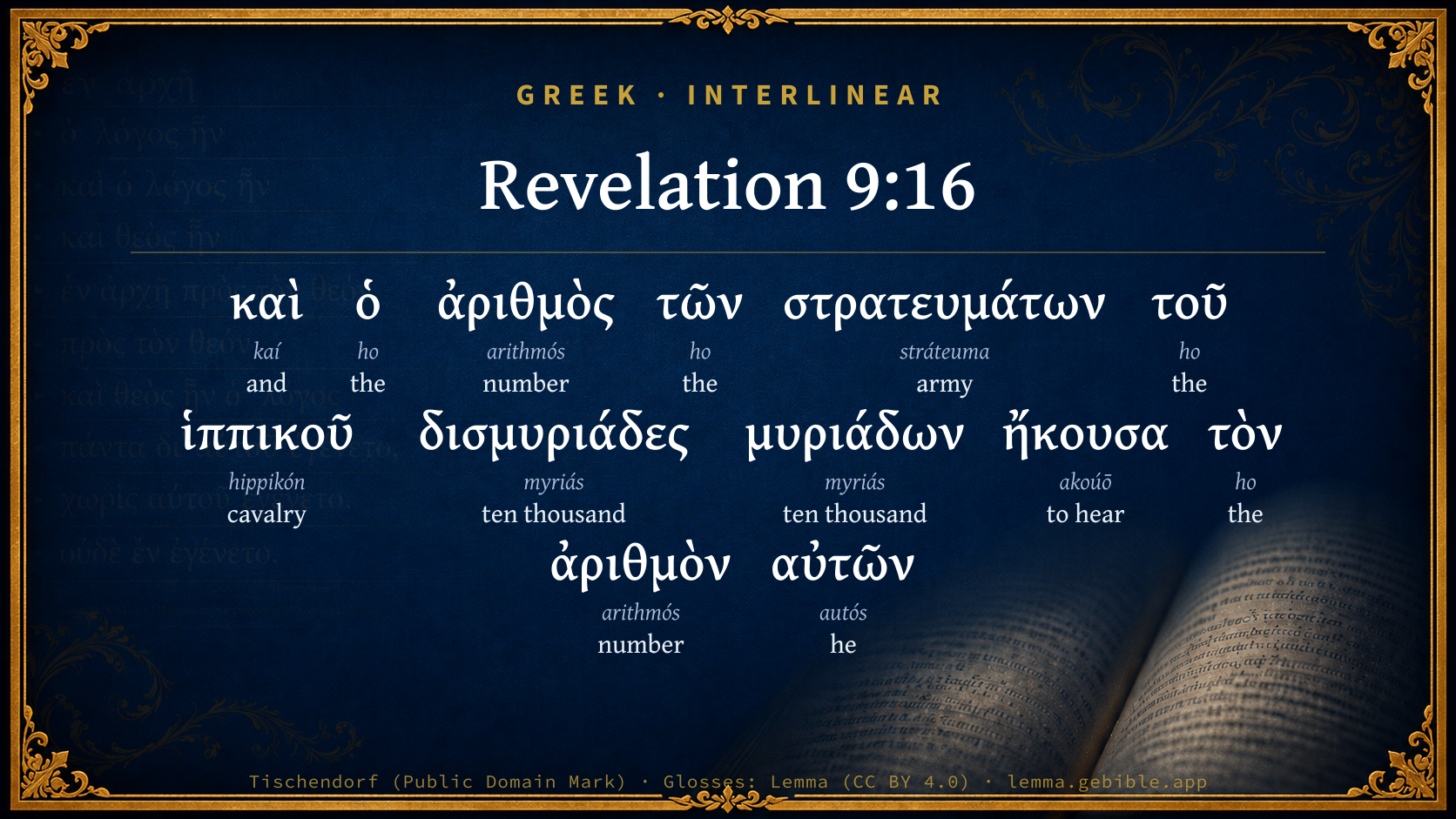
Greek (Tischendorf 8th ed.) Revelation 9:16 appears in the Greek New Testament. The text above is from the Tischendorf 8th edition. Each word links to its Strong’s number and a concise gloss. Click any word for its full Thayer’s Greek Lexicon entry.
Download image
Cite this verse

Revelation 9:16 (World English Bible). Public Domain. Lemma interlinear Bible study tool, https://lemma.gebible.app/v/revelation/9/16.

Show BibTeX & RIS
BibTeX
RIS
English Translation
The number of the armies of the horsemen was two hundred million. I heard the number of them.
World English Bible · Public Domain
Highlights
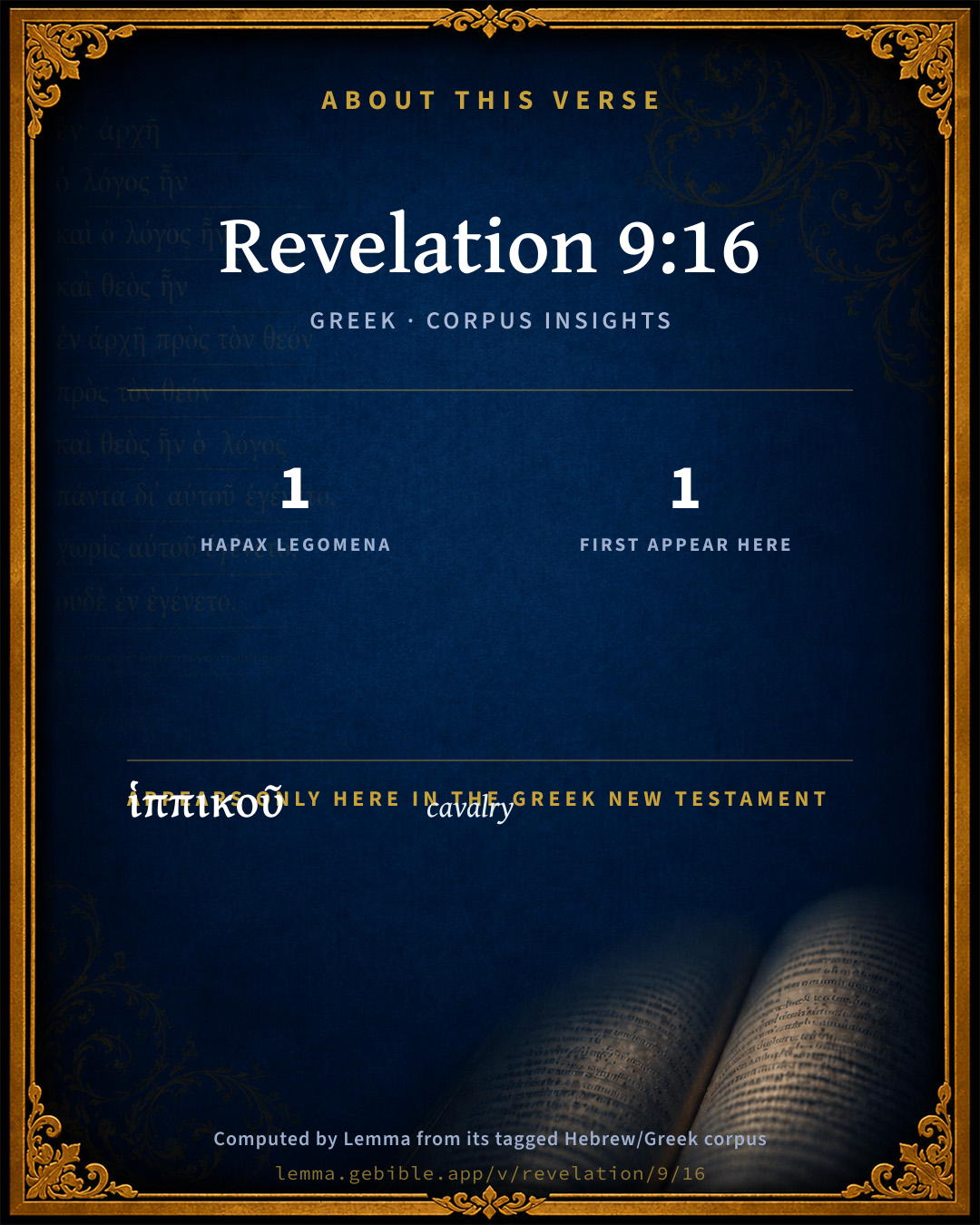
  • 1 hapax legomenon — only here in the Greek New Testament
  • 1 first appearance in the Greek New Testament
Full analysis ↓
Download a study sheet

One document with this verse’s original text, its word-by-word gloss line, the meaning frame, cross-references with their text, attributed commentary, and full source and license credits — printable, and it pastes into notes with its structure intact.

This verse Autodidact and up

Study sheet (.html) Plain text (.txt)

A passage Seminary Student

Up to 50 verses in one chapter. A passage sheet keeps up to 6 commentary sources and 12 cross-references per verse, in the order this page ranks them, and says so on the sheet whenever that leaves anything out. Ask for a single verse and you get the Autodidact verse sheet above.

Everything on this page stays free to read, with no account — the sheet is a download of what is already on screen, not access to it.

Want to remove ads? Support Godless Engineer
Compare translations 3

The same verse in 3 English versions, stacked beneath the original-language interlinear above. Click any original word for its lexicon entry.

Each is an independent rendering of the whole verse — the interlinear is not word-aligned to these translations.

Highlighted words mark where these versions differ — a whole-verse word diff, not a word-by-word alignment.

  • World English Bible Public Domain
    The number of the armies of the horsemen was two hundred million. I heard the number of them.
  • King James Version Public Domain
    And the number of the army of the horsemen were two hundred thousand thousand: and I heard the number of them.
  • unfoldingWord Literal Text CC BY-SA 4.0
    And the number of the horse soldiers two myriads of myriads; I heard their number.

unfoldingWord Literal Text — © unfoldingWord, licensed CC BY-SA 4.0. Word-aligned USFM3 via Door43 (git.door43.org/unfoldingWord/en_ult).

Versions to compare (up to 4)

3 of 4 selected

Show all 19 translations

Every available English version of this verse, each an independent rendering of the whole verse.

  • World English Bible Public Domain
    The number of the armies of the horsemen was two hundred million. I heard the number of them.
  • Berean Standard Bible Public Domain
    And the number of mounted troops was two hundred million; I heard their number.
  • Majority Standard Bible Public Domain
    And the number of mounted troops was a hundred million; I heard their number.
  • King James Version Public Domain
    And the number of the army of the horsemen were two hundred thousand thousand: and I heard the number of them.
  • American Standard Version (1901) Public Domain
    And the number of the armies of the horsemen was twice ten thousand times ten thousand: I heard the number of them.
  • Revised Version (1885) Public Domain
    And the number of the armies of the horsemen was twice ten thousand times ten thousand: I heard the number of them.
  • Geneva Bible (1599) Public Domain
    And the nomber of horsemen of warre were twentie thousand times ten thousand: for I heard the nomber of them.
  • Douay-Rheims (1899) Public Domain
    And the number of the army of horsemen was twenty thousand times ten thousand. And I heard the number of them.
  • Young's Literal Translation Public Domain
    and the number of the forces of the horsemen `is' two myriads of myriads, and I heard the number of them.
  • Literal Standard Version CC BY-SA 4.0
    and the number of the forces of the horsemen—twice ten thousand ten thousands, and I heard the number of them.
  • Unlocked Literal Bible CC BY-SA 4.0
    The number of the soldiers on horseback was 200,000,000. I heard their number.
  • unfoldingWord Literal Text CC BY-SA 4.0
    And the number of the horse soldiers two myriads of myriads; I heard their number.
  • Darby Bible Public Domain
    and the number of the hosts of horse [was] twice ten thousand times ten thousand. I heard their number.
  • World Messianic Bible Public Domain
    The number of the armies of the horsemen was two hundred million. I heard the number of them.
  • Webster's Bible Public Domain
    And the number of the army of the horsemen was two hundred thousand thousand: and I heard the number of them.
  • Free Bible Version CC BY-SA 4.0
    I was told the number of the army of soldiers on horseback: it was 200 million.
  • Bible in Basic English Public Domain
    And the number of the armies of the horsemen was twice ten thousand times ten thousand: the number of them came to my ears.
  • Text-Critical English NT CC BY 4.0
    The number of the troops on horse was ten thousand times ten thousand; I heard their number.
  • Tyndale New Testament (1534) Public Domain
    And the nombre of horsme of warre were twenty tymes xM. And I herde the nobre of them.

Literal Standard Version (2020), Covenant Press — licensed CC BY-SA 4.0. Text via the HelloAO Bible API (eBible.org). Unlocked Literal Bible (unfoldingWord) — licensed CC BY-SA 4.0. Text via the HelloAO Bible API (eBible.org). unfoldingWord Literal Text — © unfoldingWord, licensed CC BY-SA 4.0. Word-aligned USFM3 via Door43 (git.door43.org/unfoldingWord/en_ult). Free Bible Version, Dr. Jonathan Gallagher — licensed CC BY-SA 4.0. Text via the HelloAO Bible API (eBible.org).

Word by word

More ways to search: Search by grammar → Find every occurrence → Compare this word →

Practice this passage: Drill this verse → Learn its vocabulary →

About this verse

These counts appear in no published source. They are computed here, from the morphology-tagged text and Lemma’s own curated glosses. What Lemma adds →

13
words
8
distinct lemmas
Revelation
section

Notable vocabulary

1 hapax legomenon — a word that appears only here in the entire Greek New Testament:

  • ἱππικοῦ cavalry G2461

First appearance in Scripture

This word makes its first canonical appearance in the Greek New Testament here:

  • ἱππικοῦ cavalry G2461

Shared distinctive vocabulary

στρατευμάτων army G4753 occurs in 7 verses of the Greek New Testament. Also found in:
Repetition

Words recur within this verse:

  • ἀριθμὸς number G706 ×2
  • δισμυριάδες ten thousand G3461 ×2
  • ὁ the G3588 ×4

Cross-references

7

Topical passages linked to Revelation 9:16 in the Treasury of Scripture Knowledge — connected by theme and wording, ordered by reader-vote popularity; previews shown in the World English Bible.

  • Revelation 7:4 I heard the number of those who were sealed, one hundred forty-four thousand, sealed out of every tribe of the children of Israel:
  • Psalms 68:17 The chariots of God are tens of thousands and thousands of thousands. The Lord is among them, from Sinai, into the sanctuary.
  • Daniel 7:10 A fiery stream issued and came forth from before him: thousands of thousands ministered to him, and ten thousand times ten thousand stood before him: the judgment was set, and the books were opened.
  • Ezekiel 38:4 and I will turn you about, and put hooks into your jaws, and I will bring you forth, and all your army, horses and horsemen, all of them clothed in full armor, a great company with buckler and shield, all of them handling swords;
  • Daniel 11:40 At the time of the end shall the king of the south contend with him; and the king of the north shall come against him like a whirlwind, with chariots, and with horsemen, and with many ships; and he shall enter into the countries, and shall overflow and pass through.
  • Revelation 5:11 I saw, and I heard something like a voice of many angels around the throne, the living creatures, and the elders; and the number of them was ten thousands of ten thousands, and thousands of thousands;
  • Ezekiel 23:6 who were clothed with blue, governors and rulers, all of them desirable young men, horsemen riding on horses.

Cross-references courtesy of OpenBible.info (CC BY 4.0).

Commentary

Notes on Revelation 9:16 from classic Christian and Jewish commentators (each source and its license shown beneath its notes). The classic Christian expositions comment on the surrounding passage and are grouped to its opening verse, so a note may address several verses; the Jewish commentaries on the Tanakh (Rashi and others) are per-verse, so they appear only where the commentator wrote on this verse.

Lemma curates 59 commentaries, every one of them public domain or Creative Commons licensed, each selected and text-cleaned for this edition rather than reprinted as found. About our sources →

Joseph Benson's Commentary

Rev 9:16-19. The number of the army of horsemen were two hundred thousand — A description is here given of the forces, and of the means and instruments by which the Othmans should effect the ruin of the eastern empire. The armies are described as very numerous, myriads of myriads. When Mohammed the Second besieged Constantinople, he had about four hundred thousand men in his army, besides a powerful fleet of thirty larger and two hundred lesser ships. They are described, too, chiefly as horsemen; and so they are described both by Ezekiel and by Daniel; (see Bishop Newton’s last dissertation upon Daniel;) and it is well known that their armies consisted chiefly of cavalry, especially before the order of Janizaries was instituted by Amurath the First. The Timariots, or horsemen, holding lands by serving in the wars, are the strength of the government; and are in all accounted between seven and eight hundred thousand fighting men. Some say they are a million; and besides these, there are Spahis and other horsemen in the emperor’s pay.

In the vision — That is, in appearance, and not in reality, they had breast- plates of fire and of hyacinth and brimstone — The colour of fire is red, of hyacinth blue, and of brimstone yellow: and this “hath a literal accomplishment; for the Othmans, from the first time of their appearance, have affected to wear such warlike apparel of scarlet, blue, and yellow.” Of the Spahis particularly, some have red, and some have yellow standards, and others red or yellow, mixed with other colours. In appearance, too, the heads of the horses were as the heads of lions — To denote their strength, courage, and fierceness; and out of their mouths issued fire, and smoke, and brimstone — A manifest allusion to great guns and gunpowder, which were invented under this trumpet, and were of such signal service to the Othmans in their wars. For by these three was the third part of men killed — By these the Othmans made such havoc and destruction in the Greek or eastern empire. Amurath the Second broke into Peloponnesus, and took several strong places by means of his artillery. But his son Mohammed, at the siege of Constantinople, employed such great guns as were never made before. One is described to have been of such a monstrous size, that it was drawn by seventy yoke of oxen, and by two thousand men. Two more discharged a stone of the weight of two talents. Others emitted a stone of the weight of half a talent. But the greatest of all discharged a ball of the weight of three talents, or about three hundred pounds; and the report of this cannon is said to have been so great, that all the country round about was shaken to the distance of forty furlongs. For forty days the wall was battered by these guns, and so many breaches were made, that the city was taken by assault, and an end put to the Grecian empire.

Moreover they had power to do hurt by their tails as well as by their mouths, their tails being like unto serpents, and having heads — In this respect they very much resemble the locusts, only the different tails are accommodated to the different creatures, the tails of scorpions to locusts, the tails of serpents, with a head at each end, to horses. By this figure it is meant, that the Turks draw after them the same poisonous trains as the Saracens; they profess and propagate the same imposture, they do hurt not only by their conquests, but also by spreading their false doctrine; and wherever they establish their dominion, there too they establish their religion. Many indeed of the Greek Church remained, and are still remaining among them; but they are subjected to a capitation-tax, which is rigorously exacted from all above fourteen years of age; are burdened besides with the most heavy and arbitrary impositions; are compelled to the most servile drudgery; are abused in their persons, and robbed of their property: but notwithstanding these and greater persecutions, some remains of the Greek Church are still preserved among them, as we may reasonably conclude, to serve some great and mysterious ends of providence.

Joseph Benson's Commentary on the Old and New Testaments (1811–1818) — public domain. Text from a community e-Sword module.

Tyndale Open Study Notes

Tyndale Open Resources

9:16 The relationship of the four angels to their army is not clear. • 200 million: This figure represents an innumerable multitude. Even at its greatest strength, the ancient Roman army with twenty-one legions numbered only about 126,000 soldiers. It is unproductive to use this number in attempting to identify any specific country with such an overwhelming destructive force.

Tyndale Open Study Notes — © Tyndale Open Resources, licensed CC BY-SA 4.0. Text via the HelloAO Bible API.

Bengel's Gnomon

Johann Albrecht Bengel

Rev 9:16. Δισμυριάδες μυριάδων) A chiliad is 1000; but a myriad, 10,000. Myriads (the plural number being taken in its strictest sense, for a twofold number, as ch. Rev 12:14), 20,000. Therefore one chiliad of chiliads is 1,000,000; a chiliad of myriads is 10,000,000; a myriad of myriads, 100,000,000; myriads of myriads, 200,000,000. But what are δισμυριάδες μυριάδων, δὶς being added in the best copies[102] to the plural number of myriads? ΔΙΣΜΎΡΙΟΙ often occurs in the 2d Book of Maccabees. Thence ΔΙΣΜΥΡΙᾺς (like ΔΙΣΧΙΛΙᾺς, the former part of the compound being unchangeable, as is the case with numerals), that is, a myriad doubled [400 millionen, auf das wenigste.—Not. Crit.]: such as also are those expressions, Gen 32:2, two camps; Ecc 6:6, a thousand years twice (told); Psa 68:17, two myriads, thousands upon thousands: Geier especially being the interpreter. Whoever translated it in Primasius, as 80,000, was neither a Grecian nor an arithmetician: and yet he also appears to have read δισμυριάδες μυριάδων, as others did in Primasius; and, unless I am deceived, he at first thought that myriads of myriads, which appeared to denote something squared, were four myriads, or 40,000: then having doubled this very sum, on account of the particle δὶς, he took it as 80,000, when there were in reality 400,000,000 horsemen. The Apocalypse expresses in a twofold manner several periods of times, especially under the first and third woe: but it marks the duration of the second woe once only, by an hour, and a day, and a month, and a year; and in turn under that woe, instead of a second indication of time, it indicates the number of equestrian armies, that is, of the horsemen. The second woe is a period of about 207 years of men: therefore for every year (if there arose other or fresh horsemen every year) the immense body of 2,000,000, or at least, if that δὶς is not satisfactory to any one, 1,000,000 horsemen, are collected. When John adds, that their number was heard by him, he hints, that the certain number specified, if it is put for an uncertain one, yet has not a wide uncertainty; and that the greatness of the number, however incredible it may appear, is still to be credited. At the last even a greater multitude springs forth: ch. Rev 20:8.

[102] A and Cypr. have δισμυριάδες.: Vulg. “vicies millies dena millia:” Rec. Text, δύο μυρ.: B, μυριαδες.—E.

Bengel's Gnomon of the New Testament — English translation (T&T Clark, Edinburgh, 1860) — public domain. Text from a community e-Sword module.

Meyer's Critical & Exegetical Commentary

Heinrich August Wilhelm Meyer

Rev_9:16-19. Description of the army led by the four released angels; its immense size, Rev_9:16; its supernatural nature, and terrible effect (Rev_9:17-19.)

τοῦ ἵππου. The explanatory variations τοῦ ἱππικοῦ and τῶν ἵππων arose from the offence taken because John did not write, in accordance with classical usage, τῆς ἵππου.

δισμυριάδες μυριάδων; i.e., two hundred millions.

ἥκουσα, κ.τ.λ., is added by asyndeton, since an explanation is necessary as to whence it was that John knew of the immense number.[2652] Beda, who prefers to render the Greek expression by bis myriades myridaum, than with the Vulg., vicies millies dena millia, finds here a deceitful duplicity of the perverse army. Beng. thinks that the Turkish army could readily have reached that number; viz., in the course of the entire two hundred and seven years of their dominion (cf. Rev_9:15). Hengstenb. recognizes the unnaturalness of the number, and concludes thence that it is meant allegorically; it is to be ascribed to no particular war, but to the class personified, as in all the preceding trumpet-visions. But since the army itself, Rev_9:17 sqq., is not described allegorically, the number can be allegorical as little as the local designation, Rev_9:14 : but this number is likewise schematical;[2653] i.e., the army, which is on all occasions beheld as definite, individual, and supernatural in its entire character, appears also in a concrete but supernatural numerical quantity. An allusion to Psa_68:18 may be regarded as the substratum of the concrete number here presented to the prophet in his vision. [See Note LXI., p. 293.] That John, when he now wishes to describe the horses and riders seen by him (καὶ οὕτως εἰδον, κ.τ.λ.), adds explicitly ἐν τῇ ὁράσει to the εἰδον τ. ἵππ., can occasion surprise only as this formula, ordinarily employed by the ancient prophets,[2654] does not occur more frequently in the Apoc.; but from the fact that it is nowhere found except in this passage, although it could stand everywhere with the εἶδον indicating a prophetic ὅρασις, nothing less follows than that the present vision has an allegorical meaning, as Beng. and Hengstenb.[2655] affirm; the latter of whom, spiritualizing throughout, says, In the vision every thing is seen; that which is inner must imprint itself on what is outward, the spiritual must assume a body; and thus in the color of the breastplate, described immediately afterwards, he sees only a pictorial expression of the murderous spirit of the soldiers, who are to be understood literally. But even granting that the idea of vision here presupposed were correct, the εἰδον, in itself, would here, as everywhere, point to this allegorizing. For, why should we find just here the express addition ἐν τῇ ὁράσει? In it, no intention whatever is to be perceived, and least of all, that of giving an exegetical hint: it is possible, therefore, that John here added the ἐν τῇ ὅρασει to his εἱδον involuntarily, because, in the sixth trumpet-vision, what has thus far been advanced is what he has heard, while he now intends to describe the forms as they appeared to him in the vision.

The first part of the description, ἔχοντας θώρακας

θείωδεις, is referred by Beng., Ewald, De Wette, Hengstenb., Bleek, only to τοὺς καθημένους ἐπʼ αὐτ., as if the description of the horses were given uninterruptedly and completely, only after that of the riders had been given more incidentally. But Züll. and Ebrard have more correctly referred the ἔχοντας, κ.τ.λ., to the horses and the riders; for it is the more improbable that the first feature of the description, which is expressly stated to be a description of the horses, should not apply to them, as the color of the breastplates has a correspondence with the things proceeding from the mouths of the horses. In general, the treatment is not concerning the riders, but the horses; so that the words καὶ τ. καθημ. ἐπʼ αὐτ. contain only what is incidental, and in no way hinder the reference of ἔχ. θώρ., κ.τ.λ., to τ. ἳππουσ.

θώρακας πυρίνους, κ.τ.λ. The πυρνους and the θειώδεις designate, just as the ὑακίνθινους, only the color;[2656] and, besides, there are three colors to be regarded in their particularity, because they correspond to the three things coming from the mouths of the horses.[2657] The ὙΑΚΙΝΘΊΝΟΥς, which designates dark red,[2658] corresponds excellently with the succeeding ΚΑΠΝΌς.

ΚΑῚ ΑἹ ΚΕΦ., Κ.Τ.Λ. The heads of the horses were like the heads of lions, possibly similar to lion heads in the size of the mouths and the length of the manes;[2659] it is a definite, monstrous appearance, that is represented, and not in general that the heads of the horses are fierce and terrible,[2660] which, of course, is suited better to the allegorical explanation.

Κ. ἘΚ Τ. ΣΤΟΜΆΤΩΝ, Κ.Τ.Λ. How seriously the description is meant, may be inferred from the fact, that in Rev_9:18 the fire, the smoke, and the sulphur, proceeding from the mouths of the horses, are expressly designated as the three plagues whereby[2661] these armies are to slay men, just as the locusts tormented them with their scorpion stings. Fire, smoke, and sulphurof which the latter, according to the analogy of Rev_21:8, Rev_14:10, Rev_19:20, indicates the infernal nature of the plagues[2662]are as little intended to be allegorical as, e.g., the famine or the killing in the seal-visions.[2663] The allegorical interpretation, therefore, manifests also here the most singularly arbitrary expedients. They who understand the whole of heretics interpret the fire as the desire for injuring; the smoke, as the seeming zeal of faith, because smoke is blue like the heavens; the sulphur, as the deformity of vices.[2664] Similar is the interpretation in Aret., Luther, Calov., etc., who think, it is true, of the Turks, but have especially in view their erroneous doctrine. What proceeds from the mouths of the horses is, according to Calov., properly the Koran, which comprehends within itself sulphurous lust, the smoke of false doctrines, and the fires of wars. To expositors who understand the armies, Rev_9:16 sqq., of actual soldiers,even notwithstanding the fact that what is said in the text refers not to horsemen, the supposed cavalrymen, so much as to the horses,nothing is readier than to ascribe the fire, smoke, and sulphur, to fiery missiles. Much more correctly, therefore, from the standpoint of the allegory, did, e.g., Grotius understand the firebrands cast into Jerusalem,[2665] than Hengstenb., who understands the fierce animosity, the spirit of murder, and lust for destruction, described by personification as soldiers; after the example of Bengel, who only is unwilling to think of cannon and powder-smoke, because the followers of Mohammed did not, as yet, possess such implements of war.

ἡ γὰρ ἐξουσία, κ.τ.λ. Cf. Rev_9:3; Rev_9:10. With reference to Rev_9:18, it is especially emphasized, that the proper power of the horses lies in their mouths; besides this, a second point is added, καὶ ἐν ταῖς οὐραῖς αὐτων. But in how far there is also in the tails an ἐξουσία, is explained (γὰρ): αἱ γὰρ οὐραὶ αὐτῶν ὁμοιαι ὅφεσιν, κ.τ.λ. The tails of the horses are, therefore, serpent-like,[2666] especially because these tails have heads; so that they are such as to do injury (ἐν αὐταῖς, sc., οὐραις, ἀδικ.). It is entirely inapplicable to explain this feature in the description of the monstrous horses, from the analogy of the ancient fiction[2667] concerning the so-called ἀμφίσβαινα (i.e., the serpent moving forwards and backwards) with two heads;[2668] since here nothing whatever is said of two-headed serpents, but instead of the usual horse-tail, something in serpent form, viz., which has a serpents head, is presented.

Hengstenb.[2669] finds here the malignity of war symbolized. But why should Bengel be mistaken, who explains that the horsemen (the Turks), even when they turn their backs and seem to flee, do injury? Or is it not still more consistent when Grot. mentions, with reference to this, that with the ancients infantry frequently sat back of the cavalry? Volkm., without seeming to exercise the best judgment, is satisfied with referring this to the kicking-back of the horses.

[2652] Cf. Rev_7:4.

[2653] Cf. Rev_7:4.

[2654] Cf. Dan_8:2; Dan_9:21.

[2655] Klief. also, who explains (p. 152) the troops of riders identical with the worldly war-power described in Rev_9:1-12, which now proceeds to slay men.

[2656] Against Züll., who understands a breastplate of copper, blue steel, and brass. Cf. also Eichh., who thinks of an iron and bronze breastplate polished and shining in the sunlight. Still more inaptly, Heinr.: πυρ. is truly fiery; ὑακινθ. signifies polished steel; θειωδ., exhaling a sulphurous odor.

[2657] Against Ewald: Regard therefore the red, shining, and glowing colors brought together in order to denote the height of brilliancy.

[2658] See the lexicons.

[2659] Ewald.

[2660] Beng., Hengstenb.

[2661] ἀπὸ. Cf. Winer, p. 348.

[2662] Hengstenb.

[2663] The classical myth, in accordance with which Ovid (Met., vii. 104 sq.) writes:

[2664] N. de Lyra. Cf. also Ebrard.

[2665] They seemed to proceed from the mouth of the horses, because they flew from before their mouths.

[2666] See on Rev_9:10.

[2667] Wetst., Beng., Herd., Ew., etc.

[2668] Plin., H. N., viii. 35: The double head of the amphisbaenae, i.e., also at the tail.

[2669] Cf. also Stern, Ebrard.

Ecce, adamanteis vulcanum naribus efflant Acripedes tauri, tactaeque vaporibus herbae Ardent.

[So the brazen-footed oxen breathe fire from their adamantine nostrils, and the grass touched by the vapors glows], (cf. Virg., Georg. 2:140: Tauri spirantes naribus ignem, Oxen breathing fire from their nostrils), may be compared, as it expresses with all seriousness that those oxen were actually fire-breathing.

NOTES BY THE AMERICAN EDITOR

LXI. Rev_9:16. δισμυριάδες μυριάδων

Beck interprets the number literally, and explains it by colossal military expeditions and wars to occur throughout the whole world, as intimated by Rev_9:15; Rev_9:18, τὸ τρίτον τῶν ἀνθρώπων, and Rev_9:20, οἱ λοιποὶ τῶν ἀνθρώπων: a universal war involving all races of men, analogous to the migrations of nations, the first appearance of Mohammedanism, the Crusades, and illustrates its probability by referring to the now estimated one thousand millions of the earths inhabitants.

Meyer — Critical and Exegetical Commentary on the New Testament — English translation by Peter Christie, edited by Frederick Crombie (T&T Clark, 1880) — public domain. Text from a community e-Sword module.

Expositor's Greek Testament

ed. W. Robertson Nicoll

Rev 9:16 . The second woe is an irruption of fiendish cavalry.

The Expositor's Greek Testament, edited by W. Robertson Nicoll (1897–1910) — public domain. Text from a community e-Sword module.

Jamieson, Fausset & Brown

Robert Jamieson, A. R. Fausset & David Brown

Compare with these two hundred million, Psa 68:17; Dan 7:10. The hosts here are evidently, from their numbers and their appearance (Rev 9:17), not merely human hosts, but probably infernal, though constrained to work out God's will (compare Rev 9:1-2).

and I heard--A, B, Aleph, Vulgate, Syriac, Coptic, and CYPRIAN omit "and."

Jamieson, Fausset & Brown — Commentary Critical and Explanatory on the Whole Bible (1871) — public domain (CC PDM 1.0). Text via the HelloAO Bible API.

Adam Clarke's Commentary

Verse 16. Two hundred thousand thousand] Δυο μυριαδες μυριαδων· Two myriads of myriads; that is, two hundred millions; an army that was never yet got together from the foundation of the world, and could not find forage in any part of the earth. Perhaps it only means vast numbers, multitudes without number. Such a number might be literally true of the locusts. Those who will have their particular system supported by the images in this most obscure book, tell us that the number here means all the soldiers that were employed in this war, from its commencement to its end! Those who can receive this saying let them receive it.

Adam Clarke's Commentary on the Bible (1810–1826) — public domain. Text from a community e-Sword/MySword module.

Ellicott's Commentary for English Readers

(16) And the number . . .—Translate, And the number of the armies of the cavalry was two myriads of myriads. I heard the number of them. The writer heard, perhaps from some herald angel, the number of this vast army of horsemen; it was twice ten-thousand times ten thousand—i.e., two hundred millions. The number is like an echo from Psa_68:17—“The chariots of God are twenty thousand (two myriads), even thousands (or, thousands of thousands) of angels.” This utterly bewildering number might have been sufficient to keep interpreters from looking for some slavishly literal fulfilment: it simply stands for an immense host, and may serve to point out the prolific powers of retribution—the harvest of sin is misery, multiplied thirty, sixty, one hundred-fold.

A Bible Commentary for English Readers, edited by Charles John Ellicott (1878–1897) — public domain. Text from a community e-Sword module.

The Cambridge Bible for Schools and Colleges

gen. ed. J. J. S. Perowne

16. of the horsemen] It is implied that the way the four angels will slay the third part of men will be by means of a vast invading army. The word rendered “horsemen” is not here plural but collective, as we should say “the cavalry.” But it is not that he gives the number of one arm only of an army containing more: apparently this army consists of cavalry exclusively. This illustrates the use of the name Euphrates, just so far as to make it possible that the image was suggested to St John’s mind by the fact that the Parthian cavalry were the most formidable barbarian force of his own day. More than this we can hardly say, as to the meaning of the vision, and any partial fulfilment that it may have had or be about to have.

two hundred thousand thousand] The number is perhaps suggested by Psa_68:17 : still, it hardly seems as if these horsemen were celestial (like those of Rev_19:14), though they are not distinctly infernal, like the locusts of the previous visions.

and I heard] Omit “and.”

The Cambridge Bible for Schools and Colleges (gen. ed. J. J. S. Perowne; Cambridge University Press, 1878–1918) — public domain. Text from a community e-Sword module.

John Gill's Exposition

And the number of the army of the horsemen,.... This shows that the four angels before mentioned were men, and design generals of armies, or armies of men, even of horsemen; and manifestly point at the Turks, who were not only originally Persians, and had their name, as some say (e), from Turca in Persia, and from whence the Persians have their name, signifies an horseman; but the armies of the Turks chiefly consisted of horse, and what for show and for use, they had generally double the number of horses and mules as of men (f); and they are very good horsemen, and very dextrous at leaping on and off (g); and the horse's tail is still carried before the general, and principal officers, as an ensign expressive of their military exploits, and showing where their main strength lies. And the number of this mighty army, it is said,

were two hundred thousand thousand; or "two myriads of myriads"; two hundred millions, or twenty thousand brigades of ten thousand each; that is, a very large and prodigious number, almost infinite and incredible, like the army of Gog and Magog, as the sand of the sea, Rev 20:8. The Turks used to bring, and still do bring vast armies into the field: in the year 1396, Bajazet, with three hundred thousand men, fell upon sixty thousand Christians, killed twenty thousand of them, and lost sixty thousand of his own: against him afterward, in the year 1397, came Tamerlane the Tartar, with four hundred thousand horse, and six hundred thousand foot, and having killed two hundred thousand Turks, took Bajazet prisoner, and carried him about in a cage, in golden chains. In the year 1438, Amurath entered into Pannonia, with three hundred thousand horsemen: and in the year 1453, Mahomet took Constantinople with the like number (h); yea, it is said, that the army at the siege of that city consisted of forty myriads, or four hundred thousand men (i). It is reported, that the great Turk contemptuously sent to the emperor of the Romans a camel, or a dromedary, loaden with wheat, with this vow by a message, that he should bring against him as many fighting men as there were grains of wheat therein (k). And it is related (l), that when Ladislaus, king of Hungary, went out against Amurath with four and twenty thousand horse, Dracula, governor of Walachia, advised him not to attack the emperor of the Turks with so small an army, since he went out every day a hunting with more men than such a number:

and I heard the number of them; expressed by some angel, and therefore John was certain of it, otherwise he could not have told them.

(e) Laonic. Chalcocondylas de reb. Turc. l. 1. p. 6. (f) Ib. l. 7. p. 227, 255. (g) Laonic. Chalcocond. l. 2. p. 65. (h) Alsted. Chronol. p. 321. (i) Laonic. Chalcocond. l. 7. p. 255. (k) Napier in loc. (l) Bonfinius apud Pareum in loc.

John Gill's Exposition of the Whole Bible (1746–1763) — public domain (CC PDM 1.0). Text via the HelloAO Bible API.

Trapp's Complete Commentary

John Trapp

16 And the number of the army of the horsemen were two hundred thousand thousand: and I heard the number of them.

Ver. 16. Two hundred thousand thousand] Not so many at any one time, but in several ages and battles. Howbeit the Turk goes usually into the field 200,000 strong; many times he hath more, as in that famous battle fought by Bajazet against Tamerlane, where he had well-nigh a million. Of his common soldiers called Asapi (which for the most part are miserable Christians), he makes no great reckoning or other use than to blunt the swords of his enemies, or to abate their first fury, thereby to give the easier victory to his janizaries {a} and better soldiers, which are all cavalry for most part.

{a} One of a former body of Turkish infantry, constituting the Sultan’s guard and the main part of the standing army. The body was first organized in the 14th century, and was composed mainly of tributary children of Christians; after a large number of them had been massacred in 1826, the organization was finally abolished. ŒD

John Trapp, A Commentary or Exposition upon All the Books of the Old and New Testament (1647–1656) — public domain. Text from a community e-Sword module.

Albert Barnes' Notes on the Bible

And the number of the army of the horsemen - It is to be observed here that the strength of the army seemed to be cavalry. In the former plagues there is no distinct mention of horsemen; but here what struck the beholder was the immense and unparalleled number of horsemen.

Were two hundred thousand thousand - A thousand thousand is one million, and consequently the number here referred to would be 200 million. This would be a larger army than was ever assembled, and it cannot be supposed that it is to be taken literally. That it would be a very large host - so large that it would not be readily numbered - is clear. The expression in the original, while it naturally conveys the idea of an immense number, would seem also to refer to some uniqueness in the manner of reckoning them. The language is, “two myriads of myriads” - δύο μυριάδες μυριάδων duo muriades muriadōn. The myriad was ten thousand. The idea would seem to be this. John saw an immense host of cavalry. They appeared to be divided into large bodies that were in some degree separate, and that might be reckoned by ten thousands. Of these different squadrons there were many, and to express their great and unusual numbers he said that there seemed to be myriads of them - two myriads of myriads, or twice ten thousand myriads. The army thus would seem to be immense - an army, as we should say, to be reckoned by tens of thousands.

And I heard the number of them - They were so numerous that he did not pretend to be able to estimate the number himself, for it was beyond his power of computation; but he heard it stated in these round numbers, that there were “two myriads of myriads” of them.

Albert Barnes' Notes on the Bible (1834–1885) — public domain. Text from a community e-Sword/MySword module.

Haydock's Catholic Bible Commentary

Twenty thousand times ten thousand, or two hundred millions. Such an immense multitude cannot be accounted for, but by supposing a great part of it consist of the infernal beings in human form, as it is doubtful whether there be that number of men capable of bearing arms upon the whole globe of the earth.

George Leo Haydock (1774–1849), Haydock's Catholic Family Bible and Commentary, 1859 edition — public domain. Excludes Psalms (Douay-Rheims chapter numbering differs from Protestant) and Deuterocanonical books (Catholic canon only).

Matthew Poole's English Annotations

He saith nothing of the infantry, but leaves us to conjecture how great that must be, from the number of the horse; we must not think there was precisely this number, but the meaning is, that the armies should be vastly great, as we know all the Turkish armies are. Magog’s army is described from the cavalry, Eze 38:4,15.

Matthew Poole's English Annotations on the Holy Bible (1683–1685) — public domain. Text from a community e-Sword/MySword module.

Whedon's Commentary on the Bible

Daniel D. Whedon

16. Horsemen—Alford correctly says, that the four angels are apparently “resolved into the hosts of cavalry.” The cavalry alone, of this great army, is stupendous, letting alone the infantry. The number amounts to two hundred millions. It is the decimal of totality raised to the seventh power, and reduplicated, to indicate how vast the totality of the wars of the Christian ages would be!

Heard the number—For no human eye could see it.

Daniel D. Whedon (gen. ed.), Commentary on the Old and New Testaments (1874–1909) — public domain. Text from a community e-Sword module.

The Pulpit Commentary

And the number of the army of the horsemen; and the number of the armies of the cavalry. No horsemen have hitherto been Minded to; but they are apparently the destroying host under the direction of the four angels. The symbol is, no doubt, chosen to signify power, of which horsemen or cavalry are an emblem. Were two hundred thousand thousand; or, twice myriads of myriads. (cf. Jud_1:14-16, which is a quotation from Enoch; also Dan_7:10) The number is, of course, not to be taken literally, but as signifying an exceeding great multitude. And I heard the number of them. Omit "and." St. John "heard the number" possibly from one of the elders, who had before instructed him. (cf. Rev_7:13) He states this, since so vast a multitude would be innumerable.

The Pulpit Commentary (1880–1919), ed. H.D.M. Spence-Jones & Joseph S. Exell — public domain. Text from a community e-Sword module.

John Wesley's Explanatory Notes

And the number of the horsemen was two hundred millions - Not that so many were ever brought into the field at once, but (if we understand the expression literally) in the course of "the hour, and day, and month, and year." So neither were "the third part of men killed" at once, but during that course of years.

John Wesley, Explanatory Notes Upon the Whole Bible (1754–1765) — public domain. Text via the GEBible commentary corpus.

The People's New Testament

B. W. Johnson

16–19. The number of the army of the horsemen. Countless armies of horsemen are signified.

B. W. Johnson's The People's New Testament with Notes (1889–1891) — public domain. Electronic text from the Christian Classics Ethereal Library (CCEL) ThML edition.

unfoldingWord translationNotes

Door43 World Missions Community

General Information:

Suddenly, 200,000,000 soldiers on horseback appear in John's vision. John is no longer speaking about the four angels mentioned in the previous verse.

200,000,000

Some ways to express this are: "two hundred million" or "two hundred thousand thousand" or "twenty thousand times ten thousand." If your language does not have a specific number for this, you could also see how you translated a similar large number in Revelation 5:11. (See: Numbers)

fiery red

"red like fire" or "bright red." See how you translated this in Revelation 6:3.

sulfurous yellow

"yellow like sulfur" or "bright yellow like sulfur"

out of their mouths came fire, smoke, and sulfur

"fire, smoke, and sulfur came out of their mouths"

translationWords

horse

vision

breastplate

lions

fire

sulfur

unfoldingWord translationNotes — © Distant Shores Media and the Door43 World Missions Community, licensed CC BY-SA 4.0. Source: git.door43.org/Door43/en_tn.

Cambridge Greek Testament for Schools and Colleges

16. τῶν στρατευμάτων. Primas[332] reads militantium = στρατευομένων.

[332] Primasius, edited by Haussleiter.

δύο μυριάδες μυριάδων. With א. Lach[333] Tisch[334] W. H[335] and Weiss read δισμυριάδες μυριάδων with Revelation 1*. Epiph[336] quotes ἤκουσα τὸν ἀριθμὸν τοῦ στρατοῦ μυρίαι μυριάδες καὶ χίλιαι χιλιάδες; B2 reads μυριάδες μυριάδων; Primas[337] reads octoginta milia (which points to an older reading δισμύριοι, cf. Psa 68:17, where LXX. translate τὸ ἅρμα τοῦ θεοῦ μυριοπλάσιον, as if each angel was over 20,000), and quotes Tyconius as reading bis miriades miriadum which is certainly wrong, for in his commentary Tyc[338] says non dixit quot miriadum. The reading of most editors might have been reached by combining two readings, one of which has only indirect Latin evidence.

[333] Lachmann’s larger edition.

[334] Tischendorf: eighth edition; where the text aud notes differ the latter are cited.

[335] H. Westcott aud Hort.

[336] St Epiphanius.

[337] Primasius, edited by Haussleiter.

[338] Tyconius.

16. τοῦ ἱππικοῦ. Not plural but collective, as we should say “the cavalry.” Not that the Seer gives the number of one arm only of an army containing more: apparently this army consists of cavalry exclusively. The four angels seem to be its captains, and it is held in readiness with them to march when they are loosed to slay the third part of men. The Parthian cavalry was the most formidable barbarian force of St John’s day: did the Parthian kings boast of the myriads of horsemen whom they could call out at a day appointed? Any way, if the Parthian cavalry suggested the image to St John’s mind, we should have the explanation of the use of the name Euphrates. More than this we can hardly say as to the meaning of the Vision, and any partial fulfilment that it may have had or be about to have.

δύο μυριάδες μυριάδων. The number is perhaps suggested by Psa 68:17 (Primasius’ text implies that in some ancient MSS. it had been reproduced literally, each angel had 20,000 horsemen, 80,000 in all): still it hardly seems as if these horsemen were celestial (like those of Rev 19:14), though they are not distinctly infernal like the locusts of the previous Vision.

Cambridge Greek Testament for Schools and Colleges (Cambridge University Press, 1896; 21 vols, various authors incl. Carr, Maclear, Plummer, Farrar, Lumby, Moule, M. R. James, Simcox) — public domain. Text from a community e-Sword module.

Vincent's Word Studies in the New Testament

Marvin R. Vincent

Of the horsemen [του ιππικου] . Singular number, like the English the horse or the cavalry.

Two hundred thousand thousand [δυο μυριαδες μυριαδων] . Lit., two ten - thousands of ten - thousands. See on ch. Rev 5:11. Rev., twice ten - thousand times ten - thousand. Compare Psa 68:17; Dan 7:10; Heb 12:22; Jude 1:14.

Marvin R. Vincent, Word Studies in the New Testament (1887–1900) — public domain. Text from a community e-Sword/MySword module.

Lesson kit

Teaching starters — assembled from the data on this page, not authored interpretation. Every prompt links to the verse data it draws on. Edit before teaching.

Revelation, in the Revelation, opens this verse with 13 words (8 distinct Greek lemmas). Its most distinctive word is hippikón (“cavalry”). A historical commentator’s framing appears above. Read the whole chapter for the surrounding context.

Discussion questions

  1. The word hippikón carries the sense “cavalry.” How does it shape the verse?
  2. 1 word here appears nowhere else in the Greek New Testament. Why might the author reach for such rare wording?
  3. This is the first place “cavalry” appears in Scripture (first appears here). What does its debut here establish?
  4. How does Matthew 22:7, which shares the word «army», read alongside this verse?
  5. What does the repetition of “number” (2× in this one verse) do in this verse?
  6. These translations render this verse differently. What is at stake in choosing one wording over another?
  7. Compare how Joseph Benson's Commentary and Tyndale Open Study Notes read this verse. Where do they agree or differ?

Things to notice

  • 1 word in this verse appears nowhere else in the Greek New Testament.
  • 1 word makes its first canonical appearance in Scripture here.
  • These translations choose different wording for 9 words in this verse.
  • “number” occurs 2× in this single verse.
  • 8 distinct Greek lemmas span 13 words in this verse.

Reading settings

Reading text

Shown beneath each verse's original-language words.

Old Testament
Old Testament edition

Read the OT as the Masoretic Hebrew (MT) or the Greek Septuagint (LXX).

English shown for the Greek Septuagint (in the Hebrew ↔ Greek comparison).

Comparing translations? Open the Compare panel on any verse page to stack up to four side by side.