
Exodus 2:15

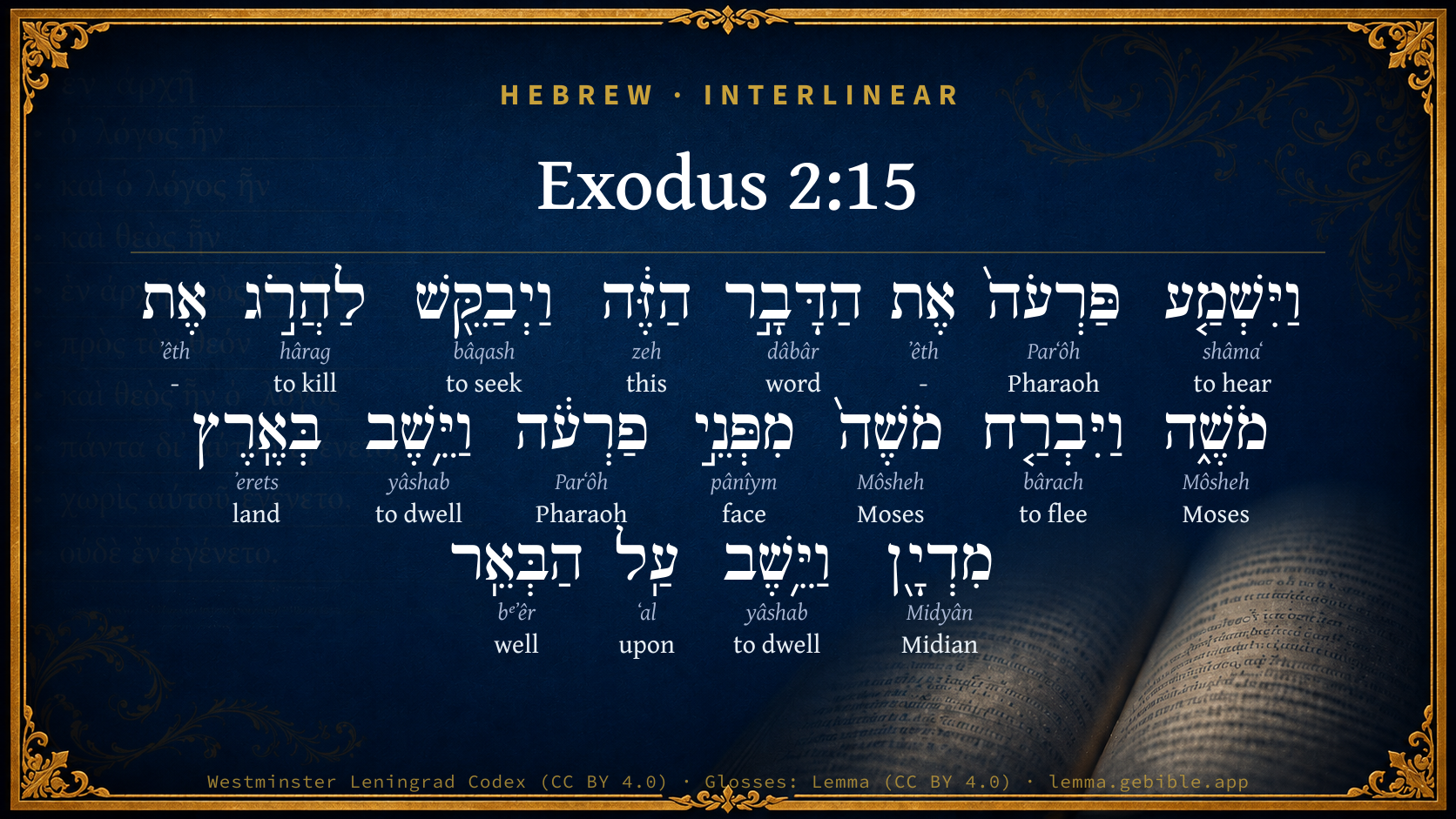
Hebrew (Westminster Leningrad Codex) Exodus 2:15 appears in the Hebrew Old Testament. The text above is from the Westminster Leningrad Codex. Each word links to its Strong’s number, a concise gloss, and parsing drawn from the Open Scriptures Hebrew Bible morphology. Click any word for its full Brown-Driver-Briggs (BDB) entry.
Download image
Cite this verse

Exodus 2:15 (World English Bible). Public Domain. Lemma interlinear Bible study tool, https://lemma.gebible.app/v/exodus/2/15.

Show BibTeX & RIS
BibTeX
RIS
English Translation
Now when Pharaoh heard this thing, he sought to kill Moses. But Moses fled from the face of Pharaoh, and lived in the land of Midian, and he sat down by a well.
World English Bible · Public Domain
Download a study sheet

One document with this verse’s original text, its word-by-word gloss line, the meaning frame, cross-references with their text, attributed commentary, and full source and license credits — printable, and it pastes into notes with its structure intact.

This verse Autodidact and up

Study sheet (.html) Plain text (.txt)

A passage Seminary Student

Up to 50 verses in one chapter. A passage sheet keeps up to 6 commentary sources and 12 cross-references per verse, in the order this page ranks them, and says so on the sheet whenever that leaves anything out. Ask for a single verse and you get the Autodidact verse sheet above.

Everything on this page stays free to read, with no account — the sheet is a download of what is already on screen, not access to it.

Want to remove ads? Support Godless Engineer
Compare translations 3

The same verse in 3 English versions, stacked beneath the original-language interlinear above. Click any original word for its lexicon entry.

Each is an independent rendering of the whole verse — the interlinear is not word-aligned to these translations.

Highlighted words mark where these versions differ — a whole-verse word diff, not a word-by-word alignment.

  • World English Bible Public Domain
    Now when Pharaoh heard this thing, he sought to kill Moses. But Moses fled from the face of Pharaoh, and lived in the land of Midian, and he sat down by a well.
  • King James Version Public Domain
    Now when Pharaoh heard this thing, he sought to slay Moses. But Moses fled from the face of Pharaoh, and dwelt in the land of Midian: and he sat down by a well.
  • unfoldingWord Literal Text CC BY-SA 4.0
    And Pharaoh heard this thing, and he sought to kill Moses. And Moses fled from the face of Pharaoh. And he dwelt in the land of Midian, and he sat down by a well.

unfoldingWord Literal Text — © unfoldingWord, licensed CC BY-SA 4.0. Word-aligned USFM3 via Door43 (git.door43.org/unfoldingWord/en_ult).

Versions to compare (up to 4)

3 of 4 selected

Show all 18 translations

Every available English version of this verse, each an independent rendering of the whole verse.

  • World English Bible Public Domain
    Now when Pharaoh heard this thing, he sought to kill Moses. But Moses fled from the face of Pharaoh, and lived in the land of Midian, and he sat down by a well.
  • Berean Standard Bible Public Domain
    When Pharaoh heard about this matter, he sought to kill Moses. But Moses fled from Pharaoh and settled in the land of Midian, where he sat down beside a well.
  • Majority Standard Bible Public Domain
    When Pharaoh heard about this matter, he sought to kill Moses. But Moses fled from Pharaoh and settled in the land of Midian, where he sat down beside a well.
  • King James Version Public Domain
    Now when Pharaoh heard this thing, he sought to slay Moses. But Moses fled from the face of Pharaoh, and dwelt in the land of Midian: and he sat down by a well.
  • American Standard Version (1901) Public Domain
    Now when Pharaoh heard this thing, he sought to slay Moses. But Moses fled from the face of Pharaoh, and dwelt in the land of Midian: and he sat down by a well.
  • Revised Version (1885) Public Domain
    Now when Pharaoh heard this thing, he sought to slay Moses. But Moses fled from the face of Pharaoh, and dwelt in the land of Midian: and he sat down by a well.
  • Geneva Bible (1599) Public Domain
    Now Pharaoh heard this matter, and sought to slay Moses: therefore Moses fled from Pharaoh, and dwelt in the lande of Midian, and hee sate downe by a well.
  • Douay-Rheims (1899) Public Domain
    And Pharao heard of this word and sought to kill Moses: but he fled from his sight, and abode in the land of Madian, and he sat down by a well.
  • Young's Literal Translation Public Domain
    And Pharaoh heareth of this thing, and seeketh to slay Moses, and Moses fleeth from the face of Pharaoh, and dwelleth in the land of Midian, and dwelleth by the well.
  • Literal Standard Version CC BY-SA 4.0
    And Pharaoh hears of this thing, and seeks to slay Moses, and Moses flees from the face of Pharaoh, and dwells in the land of Midian, and dwells by the well.
  • Unlocked Literal Bible CC BY-SA 4.0
    Now when Pharaoh heard about it, he tried to kill Moses. But Moses fled from Pharaoh and stayed in the land of Midian. There he sat down by a well.
  • unfoldingWord Literal Text CC BY-SA 4.0
    And Pharaoh heard this thing, and he sought to kill Moses. And Moses fled from the face of Pharaoh. And he dwelt in the land of Midian, and he sat down by a well.
  • Darby Bible Public Domain
    And Pharaoh heard of this matter, and sought to slay Moses. But Moses fled from before Pharaoh, and dwelt in the land of Midian. And he sat by the well.
  • World Messianic Bible Public Domain
    Now when Pharaoh heard this thing, he sought to kill Moses. But Moses fled from the face of Pharaoh, and lived in the land of Midian, and he sat down by a well.
  • Webster's Bible Public Domain
    Now when Pharaoh heard this thing, he sought to slay Moses. But Moses fled from the face of Pharaoh, and dwelt in the land of Midian: and he sat down by a well.
  • Free Bible Version CC BY-SA 4.0
    When Pharaoh found out, he tried to have Moses killed, but Moses ran away from Pharaoh and went to live in Midian. One day as he was sitting by a well,
  • Bible in Basic English Public Domain
    Now when Pharaoh had news of this, he would have put Moses to death. But Moses went in flight from Pharaoh into the land of Midian: and he took his seat by a water-spring.
  • JPS Tanakh (1917) Public Domain
    Now when Pharaoh heard this thing, he sought to slay Moses. But Moses fled from the face of Pharaoh, and dwelt in the land of Midian; and he sat down by a well.

Literal Standard Version (2020), Covenant Press — licensed CC BY-SA 4.0. Text via the HelloAO Bible API (eBible.org). Unlocked Literal Bible (unfoldingWord) — licensed CC BY-SA 4.0. Text via the HelloAO Bible API (eBible.org). unfoldingWord Literal Text — © unfoldingWord, licensed CC BY-SA 4.0. Word-aligned USFM3 via Door43 (git.door43.org/unfoldingWord/en_ult). Free Bible Version, Dr. Jonathan Gallagher — licensed CC BY-SA 4.0. Text via the HelloAO Bible API (eBible.org).

Word by word

More ways to search: Search by grammar → Find every occurrence → Compare this word →

Practice this passage: Drill this verse → Learn its vocabulary →

הַבְּאֵֽר
bᵉʼêr
H875
“the · well”
Particle, Definite Article + Noun, Common, Feminine, Singular, Absolute
Part of Speech
Particle + Noun
Type
Common
Gender
Feminine
Number
Singular
State
Absolute
Full BDB Definition

Origin: from H874

TWOT: 194a

well, pit, spring
  1. וַיִּשְׁמַ֤ע shâmaʻ H8085 “and · to hear” Conjunction + Verb, Qal, Sequential Imperfect, 3rd Person, Masculine, Singular
  2. פַּרְעֹה֙ Parʻôh H6547 “Pharaoh” Noun, Proper
  3. אֶת ʼêth H853 “-” Particle, Direct Object
  4. הַדָּבָ֣ר dâbâr H1697 “the · word” Particle, Definite Article + Noun, Common, Masculine, Singular, Absolute
  5. הַזֶּ֔ה zeh H2088 “the · this” Particle, Definite Article + Pronoun, Demonstrative, Masculine, Singular
  6. וַיְבַקֵּ֖שׁ bâqash H1245 “and · to seek” Conjunction + Verb, Piel, Sequential Imperfect, 3rd Person, Masculine, Singular
  7. לַהֲרֹ֣ג hârag H2026 “to kill” Preposition + Verb, Qal, Infinitive Construct
  8. אֶת ʼêth H853 “-” Particle, Direct Object
  9. מֹשֶׁ֑ה Môsheh H4872 “Moses” Noun, Proper
  10. וַיִּבְרַ֤ח bârach H1272 “and · to flee” Conjunction + Verb, Qal, Sequential Imperfect, 3rd Person, Masculine, Singular
  11. מֹשֶׁה֙ Môsheh H4872 “Moses” Noun, Proper
  12. מִפְּנֵ֣י pânîym H6440 “from · face(s) of” Preposition + Noun, Common, Both, Plural, Construct
  13. פַרְעֹ֔ה Parʻôh H6547 “Pharaoh” Noun, Proper
  14. וַיֵּ֥שֶׁב yâshab H3427 “and · to dwell” Conjunction + Verb, Qal, Sequential Imperfect, 3rd Person, Masculine, Singular
  15. בְּאֶֽרֶץ ʼerets H776 “in/at · land of” Preposition + Noun, Common, Both, Singular, Construct
  16. מִדְיָ֖ן Midyân H4080 “Midian” Noun, Proper
  17. וַיֵּ֥שֶׁב yâshab H3427 “and · to dwell” Conjunction + Verb, Qal, Sequential Imperfect, 3rd Person, Masculine, Singular
  18. עַֽל ʻal H5921 “upon” Preposition

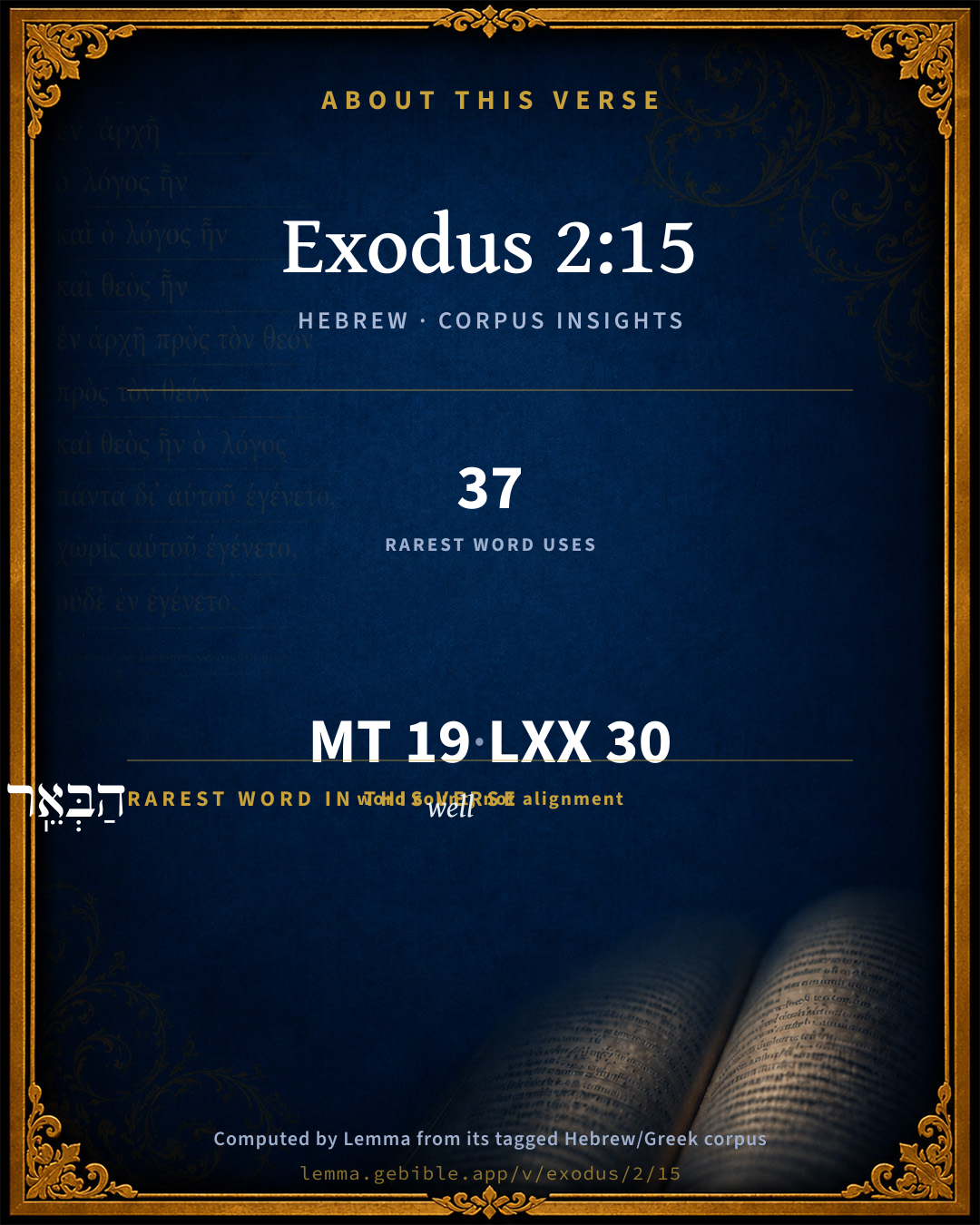
About this verse

These counts appear in no published source. They are computed here, from the morphology-tagged text and Lemma’s own curated glosses. What Lemma adds →

19
words
15
distinct lemmas
Pentateuch
section

Shared distinctive vocabulary

הַבְּאֵֽר well H875 occurs in 33 verses of the Hebrew Bible. Also found in:

Grammatical profile

  • 6 verbs
  • 9 nouns
  • 1 pronoun
  • 1 preposition
  • 2 particles

Verb forms

  • וַיִּשְׁמַ֤ע Qal · Sequential Imperfect
  • וַיְבַקֵּ֖שׁ Piel · Sequential Imperfect
  • לַהֲרֹ֣ג Qal · Infinitive Construct
  • וַיִּבְרַ֤ח Qal · Sequential Imperfect
  • וַיֵּ֥שֶׁב Qal · Sequential Imperfect
  • וַיֵּ֥שֶׁב Qal · Sequential Imperfect

Repetition

Words recur within this verse — often emphatic in Hebrew:

  • פַּרְעֹה֙ Pharaoh H6547 ×2
  • מֹשֶׁ֑ה Moses H4872 ×2
  • וַיֵּ֥שֶׁב to dwell H3427 ×2

Hebrew & Septuagint length

In English translation the verse runs 33 words from the Hebrew and 38 from the Septuagint (LXX English) — closely comparable.

A rough comparison of the two English renderings, which tokenize alike — not a word-level alignment.

Word counts can differ between the Hebrew and the Greek without any difference in meaning — e.g. the Hebrew direct-object marker אֵת has no separate Greek word, and Greek often adds the article ὁ.

In the original languages it is 19 Hebrew tokens and 30 Greek tokens — but the two are counted differently (Hebrew bundles its prefixes and suffixes into one token; the Greek is in lemma form), so that isn’t a like-for-like length.

Cross-references

13

Topical passages linked to Exodus 2:15 in the Treasury of Scripture Knowledge — connected by theme and wording, ordered by reader-vote popularity; previews shown in the World English Bible.

  • Acts 7:29 Moses fled at this saying, and became a stranger in the land of Midian, where he became the father of two sons.
  • Hebrews 11:27 By faith, he left Egypt, not fearing the wrath of the king; for he endured, as seeing him who is invisible.
  • Genesis 24:11 He made the camels kneel down outside the city by the well of water at the time of evening, the time that women go out to draw water.
  • Genesis 29:2 He looked, and behold, a well in the field, and, behold, three flocks of sheep lying there by it. For out of that well they watered the flocks. The stone on the well's mouth was great.
  • 1 Kings 19:1–3 Ahab told Jezebel all that Elijah had done, and withal how he had slain all the prophets with the sword.
  • 1 Kings 19:13–14 It was so, when Elijah heard it, that he wrapped his face in his mantle, and went out, and stood in the entrance of the cave. Behold, there came a voice to him, and said, What are you doing here, Elijah?
  • Proverbs 22:3 A prudent man sees danger, and hides himself; But the simple pass on, and suffer for it.
  • Matthew 10:23 But when they persecute you in this city, flee into the next, for most assuredly I tell you, you will not have gone through the cities of Israel, until the Son of Man has come.
  • John 4:6 Jacob's well was there. Jesus therefore, being tired from his journey, sat down by the well. It was about the sixth hour.
  • Exodus 4:19 Yahweh said to Moses in Midian, "Go, return into Egypt; for all the men who sought your life are dead."
  • Genesis 25:4 The sons of Midian: Ephah, Epher, Hanoch, Abida, and Eldaah. All these were the children of Keturah.
  • Genesis 25:2 She bore him Zimran, Jokshan, Medan, Midian, Ishbak, and Shuah.
  • Genesis 28:6–7 Now Esau saw that Isaac had blessed Jacob and sent him away to Paddan Aram, to take him a wife from there, and that as he blessed him he gave him a charge, saying, "You shall not take a wife of the daughters of Canaan,"

Cross-references courtesy of OpenBible.info (CC BY 4.0).

Hebrew and Greek witnesses Masoretic Hebrew ↔ Greek Septuagint

The same verse in the two great witnesses to the Old Testament, shown verse-for-verse.

These are two independent witnesses, not word-aligned to each other, and the Septuagint is shown in lemma (dictionary) form.

Hebrew Exodus 2:15 Masoretic · Westminster Leningrad Codex

וַיִּשְׁמַ֤ע פַּרְעֹה֙ אֶת הַדָּבָ֣ר הַזֶּ֔ה וַיְבַקֵּ֖שׁ לַהֲרֹ֣ג אֶת מֹשֶׁ֑ה וַיִּבְרַ֤ח מֹשֶׁה֙ מִפְּנֵ֣י פַרְעֹ֔ה וַיֵּ֥שֶׁב בְּאֶֽרֶץ מִדְיָ֖ן וַיֵּ֥שֶׁב עַֽל הַבְּאֵֽר

Now when Pharaoh heard this thing, he sought to kill Moses. But Moses fled from the face of Pharaoh, and lived in the land of Midian, and he sat down by a well.

World English Bible · Public Domain

Greek LXX Exodus 2:15 Septuagint · lemma form

ἀκούω δέ φαραώ ὁ ῥῆμα οὗτος καί ζητέω ἀνααἱρέω μωυσῆς ἀναχωρέω δέ μωυσῆς ἀπό πρόσωπον φαραώ καί οἰκέω ἐν γῆ μαδιαμ ἔρχομαι δέ εἰς γῆ μαδιαμ καταἵζω ἐπί ὁ φρέαρ

And Pharao heard this matter, and sought to kill Moses; and Moses departed from the presence of Pharao, and lived in the land of Madiam; and having come into the land of Madiam, he sat on the well.

LXX2012 (modern English Septuagint) · Public Domain

Hebrew: Westminster Leningrad Codex (CC BY 4.0). Greek: Septuagint (public domain); English from LXX2012 (modern English Septuagint) (Public Domain). How the Septuagint differs from the Hebrew →

Targum (Aramaic paraphrase)

2

The Targum is the ancient Jewish Aramaic paraphrase of the Hebrew Scriptures — an interpretive translation, not the Hebrew text itself. Onkelos (literal) and Pseudo-Jonathan (expansive) render the Torah, and Jonathan the Prophets. Coverage is partial: where no permissively-licensed English translation exists for a verse, only the Aramaic is shown. This is verse-level text, not a word-by-word alignment to the Hebrew.

  1. Targum Onkelos Torah (Genesis–Deuteronomy)
    וּשְׁמַע פַּרְעֹה יָת פִּתְגָמָא הָדֵין וּבְעָא לְמִקְטַל יָת משֶׁה וַעֲרַק משֶׁה מִן קֳדָם פַּרְעֹה וִיתֵיב בְּאַרְעָא דְמִדְיָן וִיתֵיב עַל בֵּירָא:

    (no public-domain English translation for this verse)

    Targum Onkelos — Aramaic: “Onkelos Genesis” (public domain); “Onkelos Exodus” (public domain); “Onkelos Leviticus” (public domain); “Onkelos Numbers” (public domain); “Onkelos Deuteronomy” (public domain). English: “Sefaria Community Translation” (CC0 1.0 (public-domain dedication)); “J.W. Etheridge. The Targums of Onkelos and Jonathan Ben Uzziel on the Pentateuch. London: Longmans, Green, 1862” (public domain). Text via Sefaria.

  2. Targum Pseudo-Jonathan Torah (Genesis–Deuteronomy)
    וּשְׁמַע פַּרְעה יַת פִּתְגָמָא הָדֵין וּבְעָא לְמִקְטוֹל יַת משֶׁה וְעָרַק משֶׁה מִן קֳדָם פַּרְעה וִיתֵיב בְּאַרְעָא דְמִדְיָן וִיתֵב עַל בֵּירָא

    And Pharoh heard this thing, and sought to kill Mosheh; and Mosheh escaped before Pharoh, to dwell in the land of Midian. And he sat by a well.

    Targum Pseudo-Jonathan — Aramaic: “Targum Jonathan on Genesis” (public domain); “Targum Jonathan on Exodus” (public domain); “Targum Jonathan on Leviticus” (public domain); “Targum Jonathan on Numbers” (public domain); “Targum Jonathan on Deuteronomy” (public domain). English: “The Targum of Jonathan ben Uzziel, trans. J. W. Etheridge, London, 1862” (public domain). Text via Sefaria.

Commentary

Notes on Exodus 2:15 from classic Christian and Jewish commentators (each source and its license shown beneath its notes). The classic Christian expositions comment on the surrounding passage and are grouped to its opening verse, so a note may address several verses; the Jewish commentaries on the Tanakh (Rashi and others) are per-verse, so they appear only where the commentator wrote on this verse.

Lemma curates 59 commentaries, every one of them public domain or Creative Commons licensed, each selected and text-cleaned for this edition rather than reprinted as found. About our sources →

Trapp's Complete Commentary

John Trapp

Exo 2:15 Now when Pharaoh heard this thing, he sought to slay Moses. But Moses fled from the face of Pharaoh, and dwelt in the land of Midian: and he sat down by a well.

Ver. 15. But Moses fled.] God, by forty years’ exile, fitted Moses for further light and advancement. Much he had learned in Egypt, {Act 7:22} but more in Midian. Mr Ascham was a good schoolmaster to Queen Elizabeth, but affliction was a better. Men commonly beat and bruise their links before they light them, to make them burn the brighter. Moses had neither been so illuminate a doctor, nor so excellent a ruler, if not first humbled, as here.

John Trapp, A Commentary or Exposition upon All the Books of the Old and New Testament (1647–1656) — public domain. Text from a community e-Sword module.

The Biblical Illustrator

Joseph S. Exell

Exo_2:15

He sat down by a well

The meditations of a perplexed soul

I.

They occurred at an important crisis in the life of Moses. But Moses fled from the face of Pharaoh.

1. Moses had vacated a good home.

2. Moses had incurred the anger of Pharaoh.

II. They afford an opportunity for determining on a new course of life,

III. They are soon interrupted by a call to new activities (Exo_2:17).

IV. They were indulged in a very favourable place. The well in olden time, a fine scene for rest and contemplation. Christ, when He was tired, sat on a well. His rest was broken by the advent of a woman, whom He ultimately led to Himself in contrition of heart. (J. S. Exell, M. A.)

Moses flight

1. Criminations of Gods servants are soon carried to the ears of persecutors.

2. Persecutors ears are open to receive all reports against Gods people.

3. Fame of any evil against Gods servants stirs up violent men to pursue them.

4. The death of Gods instruments for His Churchs good is the aim of bloody enemies.

5. God provides Midian to save what Egypt would destroy.

6. God is pleased to change court enjoyments for a poor well, to refresh His weary saints (Exo_2:15). (G. Hughes, B. D.)

The Biblical Illustrator, edited by Joseph S. Exell (c. 1880s–1900s) — public domain. Text from a community e-Sword module.

Joseph Benson's Commentary

Exo 2:15. Moses fled from Pharaoh — God ordered this for wise ends. Things were not yet ripe for Israel’s deliverance. The measure of Egypt’s iniquity was not yet full; the Hebrews were not sufficiently humbled, nor were they yet increased to such a multitude as God designed: Moses is to be further fitted for the service, and therefore is directed to withdraw for the present, “till the time to favour Israel, even the set time, come.” God guided Moses to Midian, because the Midianites were of the seed of Abraham, and retained the worship of the true God; so that he might have not only a safe, but a comfortable settlement among them; and through this country he was afterward to lead Israel, which that he might do the better, he now had opportunity of acquainting himself with it. Hither he came, and sat down by a well — Tired and thoughtful, waiting to see what way Providence would direct him. It was a great change with him, since he was but the other day at ease in Pharaoh’s court.

Joseph Benson's Commentary on the Old and New Testaments (1811–1818) — public domain. Text from a community e-Sword module.

The Preacher's Complete Homiletical Commentary

Joseph S. Exell (gen. ed.)

MAIN HOMILETICS OF THE PARAGRAPH.—Exo_2:15

THE MEDITATIONS OF A PERPLEXED SOUL

“And he sat down by a well.” This calls to our mind a New Testament scene. These meditations—

I. They occurred at an important crisis in the life of Moses. “But Moses fled from the face of Pharaoh.”

1. Moses had vacated a good home. He had left the wealth—luxury of an Egyptian palace—the kindness of a royal mother who was deeply interested in him. He knew not where he was going—what he was to do for a daily livelihood—how his future was to be spent. All before him was mystery—he might well be perplexed.

2. Moses had incurred the anger of Pharaoh. This might well fill him with terror—he knew the influence and cruelty of that monarch—his hatred was to be feared. Had Moses been permitted a faint insight into his future relations with the Egyptian court, probably his meditations, near this well, would have been more prolonged than they were. There are times when all young men have to spend an hour in contemplation, especially when they are going, alone and unbefriended, into an unknown future of grave importance, not merely to themselves, but also to others. The past sweeps before them like a dream. The future is all mist. They must think for themselves—they must obtain the Divine guidance. The temporary rest by the well marks a crisis in their history.

II. They afford an opportunity for determining on a new course of life. Moses is thinking about the future. He would naturally ask himself, “What am I to do?” Return to Egypt is impossible.—Heaven would, no doubt, influence his thought on this occasion. But a thoughtful spirit will not be long without employment—will not be long without a home. God will send the daughters of the priest of Midian to its aid. Providence has unnumbered agencies for the guidance and help of perplexed souls.

III. They are soon interrupted by a call to new activities. (Exo_2:17.) The daughters of the priest of Midian were attacked by hostile shepherds. Moses sees this. Will he interpose? Has he not had enough of meddling with the feuds of others? Is he not now a wanderer for so doing? But he cannot remain the quiet spectator of injury. The same spirit and impulse that made him kill the Egyptian shows itself again in his defence of these women. He could not but defend the weak. He is not to be daunted by failure. He is successful now. Good men may be dispirited sometimes. They may need times of thought. But it is not their destiny to rest long by the wells of life: theirs is the conflict with oppression and evil. There is work in Midian as well as in Egypt, for them.

IV. They were indulged in a very favourable place. The well in olden time, a fine scene for rest and contemplation. Christ, when he was tired, sat on a well. His rest was broken by the advent of a woman whom he ultimately led to himself in contrition of heart.

SUGGESTIVE COMMENTS ON THE VERSE

Exo_2:15. Criminations of God’s servants are soon carried to the ears of persecutors.… An evil report often awakens the anger of men.

It is well sometimes to exchange the excitement of a royal court for quiet thought by the well.

God is in the solicitude of those whom he intends for great service.

God provides a Midian to save what Egypt would destroy.

Never take the responsibility of communicating evil news to a tyrant.

ILLUSTRATIONS

Exo_2:15. Revenge commonly hurts both the offerer and the sufferer; as we see in a foolish bee, which in her anger envenometh the flesh and loseth her sting, and so lives a drone ever after [Bishop Hall].

Wax, when it is laid in cold places, becomes so hard and stiff that it will break rather than bow; but being laid in the sun, becomes soft and pliable, fit for any impression. So, when we neglect the duty of meditation on good things, our hearts, being changed from God, wax hard and obdurate; but when, by meditation, we draw nigh unto Him, the beams of His favour, shining upon our hearts do make them soft and flexible and fit for any holy impression that He may please to stamp upon them [Downham’s Guide to Godliness].

Moses gave up the palace to share the fortunes of Israel:—“Mrs. Hannah More,” says her biographer, “after pointing out to us some of the many beautiful objects to be seen from the room in which we were sitting, conducted us into an adjoining spartment, which was her sleeping room; and pointing to an arm-chair, ‘That chair,’ said she, ‘I call my home.’ ‘Here,’ looking out of window, ‘is what I call my moral prospect. You see yonder distant hill which limits the prospect in that direction. You see this tree before my window directly in range of the hill. The tree, you observe, from being near, appears higher than the hill which is distant, though the hill actually is much higher than the tree. Now this tree represents to my mind the objects of time; that hill, the objects of eternity. The former, like the tree, from being reviewed near at hand, appears great. The latter, like the distant hill, appears small’ ” [Trench].

The Preacher's Complete Homiletical Commentary (gen. ed. Joseph S. Exell; Funk & Wagnalls, c. 1892) — public domain (pre-1929). A full-Bible homiletical/sermon-outline anthology covering 65 of 66 books (2 John is absent from the source module). Text from a community e-Sword module.

Tyndale Open Study Notes

Tyndale Open Resources

2:15 Moses fled: By trying to rescue Israel himself rather than through God’s help, Moses made himself a fugitive rather than a leader in Egypt, forestalling God’s purposes for him. Moses’ life was drastically changed as a consequence of his actions (cp. Num 20:9-13; Deut 3:23-29). • Midian was located on both sides of the Gulf of Aqaba—in the southern Sinai Peninsula and on the western edge of the Arabian Peninsula. A major trade route from southern Arabia passed through this dry and barren area. Its people seem to have been nomadic shepherds and traders (see Gen 37:28). It was a good place for a fugitive to disappear.

Tyndale Open Study Notes — © Tyndale Open Resources, licensed CC BY-SA 4.0. Text via the HelloAO Bible API.

Jamieson, Fausset & Brown

Robert Jamieson, A. R. Fausset & David Brown

Moses fled from the face of Pharaoh--His flight took place in the second year of Thothmes I.

dwelt in the land of Midian--situated on the eastern shore of the gulf of the Red Sea and occupied by the posterity of Midian the son of Cush. The territory extended northward to the top of the gulf and westward far across the desert of Sinai. And from their position near the sea, they early combined trading with pastoral pursuits (Gen 37:28). The headquarters of Jethro are supposed to have been where Dahab-Madian now stands; and from Moses coming direct to that place, he may have travelled with a caravan of merchants. But another place is fixed by tradition in Wady Shuweib, or Jethro's valley, on the east of the mountain of Moses.

sat down by a well--(See on Gen 29:3).

Jamieson, Fausset & Brown — Commentary Critical and Explanatory on the Whole Bible (1871) — public domain (CC PDM 1.0). Text via the HelloAO Bible API.

Adam Clarke's Commentary

Verse 15. Pharaoh - sought to slay Moses. But Moses fled from the face of Pharaoh] How can this be reconciled with Heb 11:27: By faith he (Moses) forsook Egypt, not fearing the wrath of the king? Very easily. The apostle speaks not of this forsaking of Egypt, but of his and the Israelites' final departure from it, and of the bold and courageous manner in which Moses treated Pharaoh and the Egyptians, disregarding his threatenings and the multitudes of them that pursued after the people whom, in the name and strength of God, he led in the face of their enemies out of Egypt.

Dwelt in the land of Midian] A country generally supposed to have been in Arabia Petraea, on the eastern coast of the Red Sea, not far from Mount Sinai. This place is still called by the Arabs the land of Midian or the land of Jethro. Abul Farajius calls it the land of the Arabs. It is supposed that the Midianites derived their origin from Midian, the fourth son of Abraham by Keturah, thus: - Abraham, Zimran, Jokshan, Medan and Midian, Raguel, Jethro; see Ge 25:1. But Calmet contends that if Jethro had been of the family of Abraham, either by Jokshan, or Midian, Aaron and Miriam could not have reproached Moses with marrying a Cushite, Zipporah, the daughter of Reuel. He thinks therefore that the Midianites were of the progeny of Cush, the son of Ham; see Ge 10:6.

Adam Clarke's Commentary on the Bible (1810–1826) — public domain. Text from a community e-Sword/MySword module.

Ellicott's Commentary for English Readers

(15) When Pharaoh heard . . . he sought to slay Moses.—Naturally. The administration of justice was one of the chief duties of the royal office; and the crime committed by Moses was one to be punished by death. There was nothing to reduce it from murder to manslaughter. And the motives which extenuate it in the eyes of moderns—patriotic zeal and hatred of oppression—would not have commanded the sympathies of a Pharaoh.

Moses fled.—Or, had fled. Moses would fly as soon as he found his act was known. He fled “at the saying” of the Israelite (Act_7:29). When Pharaoh sought for him, he was gone.

Dwelt in the land of Midian—i.e., “Was led to make Midian his home,” under circumstances about to be related. The Midian of this book seems to be the south-eastern portion of the Sinaitic peninsula, not the opposite Arabian coast, where were the main settlements of the nation.

Sat down by a well.—Rather, the well. There must have been one principal well in these parts, copious, and so generally resorted to. Moses fixed his temporary-abode in its neighbourhood.

A Bible Commentary for English Readers, edited by Charles John Ellicott (1878–1897) — public domain. Text from a community e-Sword module.

The Cambridge Bible for Schools and Colleges

gen. ed. J. J. S. Perowne

15. Midian] The most important of a group of tribes (Gen_25:1-4), in N.W. Arabia, and E. of Canaan (ib. v. 6; cf. Num_22:4), which the Hebrews reckoned to their own race, through Abraham’s second wife Ḳeṭurah, and so a step further removed than the Ishmaelites. The proper home of the Midianites appears to have been on the E. side of the Gulf of ‘Akaba, where Ptolemy (vi. 7. 2) and the Arabic geographers (cf. EB. iii. 3081) mention a place Μοδίανα, Madyan, almost exactly opposite the S. extremity of the Sin. Peninsula; but nomad branches of the tribe wandered northward along the margin of the desert, whence they made forays into Edom, for instance (Gen_36:35), and even Canaan (Judges 6-8). From Exo_3:1 (cf. Exo_18:1; Exo_18:5; Exo_18:27) it appears that ‘the land of Midian’ was not far from Sinai: if, therefore, ‘Sinai’ has been rightly located by tradition (see p. 189 ff.), there must have been a Midianite settlement in some part of what is now called the ‘Sinaitic’ Peninsula, probably in its S.E. Others, however, regard ‘the land of Midian’ as denoting more naturally the proper home of the tribe, and consider the passage to support the view that ‘Sinai’ was on the E. of the Gulf of ‘Aḳaba (cf. p. 189 f.).

In the S. or SE. of the Peninsula, Moses would be beyond Egyptian jurisdiction. It is true, in Wâdy Maghârah, and Wâdy Sarbuṭ el-Khadim, there were mines for turquoise and copper, worked by the Egyptians, and protected by military guards, which are mentioned frequently, at intervals, from the 3rd to the 20th dynasty (see full descriptions, with numerous photographs, in Petrie’s Researches in Sinai, 1906): but (see the Map) these were in the NW. of the Peninsula, and not necessarily on the route to the S. or SE. Sayce’s statement (HCM. 265 f.) that in the days of the Exodus the Sin. Peninsula was ‘an Egyptian province’ seems to be an exaggeration of the facts; for even the mining districts were not occupied by them permanently (see Petrie, p. 206).

by the well] the well of the district to which he came.

15–22. Moses’ flight to Midian; and his marriage there to a daughter of the priest of Midian.

The Cambridge Bible for Schools and Colleges (gen. ed. J. J. S. Perowne; Cambridge University Press, 1878–1918) — public domain. Text from a community e-Sword module.

John Gill's Exposition

Now when Pharaoh heard this thing, he sought to slay Moses,.... Both for his killing the Egyptian, which by the laws of Egypt (i) was death, whether bond or free; and for his taking part with the Hebrews against the Egyptians, and knowing him to be a wise and valiant man, might fear he would put himself at the head of the Hebrews, and cause a revolt of them; and if there was anything in his dream, or if he had such an one, and had the interpretation of it given by his magicians, that an Hebrew child should be born, by whom Egypt would be destroyed; see Gill on Exo 1:15, he might call it to mind, and be affected with it, and fear the time was coming on, and Moses was the person by whom it should be done; and he might be stirred up by his courtiers to take this step, who doubtless envied the growing interest of Moses in his court:

but Moses fled from the face of Pharaoh; not through want of courage, but through prudence, to avoid danger, and preserve his life for future usefulness; and no doubt under a divine impulse, and by the direction of divine Providence, the time for him to be the deliverer of Israel not being yet come:

and dwelt in the land of Midian: a country so called from Midian, one of Abraham's sons by Keturah, Gen 25:2. Jerom (k) calls it a city, and says it was on the other side of Arabia, to the south, in the desert of the Saracens, to the east of the Red sea, from whence the country was called Midian; and Philo (l) says, that Moses went into neighbouring Arabia; and which is confirmed by Artapanus (m) the Heathen historian, who says, that from Memphis, crossing the river Nile, he went into Arabia; and this country was sometimes called Cush or Ethiopia; hence Moses's wife is called an Ethiopian woman, Num 12:1.

and he sat down by a well; weary, thoughtful, and pensive. It may be observed, that it was usual with persons in such like circumstances, being strangers and not knowing well to whom to apply for assistance or direction, to place themselves at a well of water, to which there was frequent resort, both for the use of families and of flocks; see Gen 24:11. This well is now called, as some say, Eyoun el Kaseb, fourteen hours and a half from Magare Chouaib, or "the grot of Jethro" (n); but if this was so far from Jethro's house, his daughters had a long way to go with their flock: but some other travellers (o) speak of a very neat and pleasant village, called Hattin, where they were shown the grave of Jethro, Moses's father-in-law; and in the neighbourhood of that place is a cistern, now called Omar, and is said to be the watering place where Moses met with the daughters of the priest of Midian. A late learned man (p) thinks, that Sharma, which is about a day and a half's journey southeast from Mount Sinai, is the place where Jethro lived. The Arabic geographer (q) says, at the shore of the Red sea lies the city Madian, greater than Tabuc, and in it is a well, out of which Moses watered the flocks of Scioaib, that is, Raguel.

(i) Diodor. Sicul. Bibliothec. l. 1. p. 70. (k) De locis Heb. fol. 93. A. B. (l) De Vita Mosis, l. 1. p. 609. (m) Apud Euseb. Praepar. Evangel. l. 9. c. 27. p. 433. (n) See a Journey from Grand Cairo to Mecca, in Ray's Travels, vol. 2. p. 468. (o) Egmont and Heyman's Travels, vol. 2. p. 29. (p) See the Origin of Hieroglyphics, at the end of a Journal from Cairo, to Mount Sinai, p. 55. Ed. 2. (q) Climat. 3. par. 5.

John Gill's Exposition of the Whole Bible (1746–1763) — public domain (CC PDM 1.0). Text via the HelloAO Bible API.

Albert Barnes' Notes on the Bible

No Egyptian king would have left; such an offence unpunished. But the position of Moses, as an adopted son of a princess, made it necessary even for a despotic sovereign to take unusual precautions.

The land of Midian - The Midianites occupied an extensive district from the eastern coast of the Red Sea to the borders of Moab.

Albert Barnes' Notes on the Bible (1834–1885) — public domain. Text from a community e-Sword/MySword module.

Haydock's Catholic Bible Commentary

Madian. A city and country of Arabia, which took its name from Madian the son of Abraham, by Cetura, and was peopled by his posterity. (Challoner) --- There were, perhaps, some of the descendants of Cham, by his son Chus, intermixed with them; (Haydock) and hence Aaron reproaches the wife of Moses for being a Chusite, Numbers xii. 1. Jethro was a Cinean, descended from the same stock.

George Leo Haydock (1774–1849), Haydock's Catholic Family Bible and Commentary, 1859 edition — public domain. Excludes Psalms (Douay-Rheims chapter numbering differs from Protestant) and Deuterocanonical books (Catholic canon only).

Matthew Poole's English Annotations

He sought to slay Moses; not out of zeal to punish a murderer, but to secure himself from so dangerous a person, probably supposing that this was the man foretold to be the scourge of Egypt, and the deliverer of Israel.

Matthew Poole's English Annotations on the Holy Bible (1683–1685) — public domain. Text from a community e-Sword/MySword module.

Whedon's Commentary on the Bible

Daniel D. Whedon

15. And he sat down by a well — The (well-known) well (of that place). Midian was the country of the wandering descendants of Abraham’s son Midian, in the peninsula of Sinai, and reaching around the Arabian Gulf into the desert beyond. Knobel locates “the well” at Sherm, on the Arabian Gulf, northeast of Ras Mohammed. Here was once a sanctuary, and an hereditary priest and priestess, possibly successors of Jethro, and here are now deep, copious, and very ancient wells.

The author of the Epistle to the Hebrews says (Heb_11:27) that Moses left Egypt “by faith,” and “not fearing the wrath of the king,” yet our narrative says that he feared and fled. How is this? Simply that he feared and evaded by flight the immediate and transitory consequences of his rash act, but feared not the grand result of the conflict on which he had staked all. He was ready to measure strength with Pharaoh when the time should come, “for he endured as seeing Him who is invisible.” The general who falls back in order to advance does not fear. (It is surprising that Alford should find difficulty here.)

Daniel D. Whedon (gen. ed.), Commentary on the Old and New Testaments (1874–1909) — public domain. Text from a community e-Sword module.

The Pulpit Commentary

Pharaoh heard. If we have been right in supposing the Pharaoh of the original oppression to have been Seti I, the present Pharaoh, from whom Moses flies when he is "full forty years old", (Act_7:23) and who does not die till Moses is near eighty, must be his son, the Great Rameses, Rameses II This prince was associated by his father at the age of ten or twelve (Brugsch, "History of Egypt," vol. 2. pp. 24-5), and reigned sixty-seven years, as appears from his monuments. He is the only king of the New Empire whose real reign exceeded forty years, and thus the only monarch who fulfils the conditions required by the narrative of Exodus supplemented by St. Stephen"s speech in the Acts. He sought to slay Moses. We need not understand from this expression that the Pharaoh"s will was thwarted or opposed by anything but the sudden disappearance of Moses. As St. Stephen says, (Act_7:29) "Then fled Moses at this saying," i.e. at the mere words of the aggressor, "Writ thou slay me as thou didst the Egyptian?" Moses fled, knowing what he had to expect, quitted Egypt, went to Midian; and the Egyptian monarch "sought to slay him" too late. The land of Midian is a somewhat vague expression, for the Midianites were nomads, and at different times occupied distinct and even remote localities. Their principal settlements appear to have been on the eastern side of the Elanitic Gulf (Gulf of Akabah); but at times they extended northwards to the confines of Moab (Gen_36:35; Num_22:4, Num_22:7, etc.) and westward into the Sinaitic peninsula, which appears to have been "the land of Midian whereto Moses fled. (see below, Exo_3:1) The Midianites are not expressly mentioned in the Egyptian inscriptions. They were probably included among the Mentu, with whom the Egyptians contended in the Sinaitic region, and from whom they took the copper district north-west of Sinai. And he sat down by a well. Rather "and he dwelt by the well." He took up his abode in the neighbourhood of the principal well belonging to the tract here called Midian. The tract was probably one of no great size, an offshoot of the greater Midian on the other side of the gulf. We cannot identify the well; but it was certainly not that near the town of Modiana, & Ntilde; spoken of by Edrisi and Abulfeda, which was in Arabia Proper, on the east of the gulf.

Moses as a fugitive.

Men"s sins are sure to "find them out." Moses had thought that he would not be detected. He had carefully "looked this way and that way" ere he struck the blow, and had seen "that there was no man." He had at once hidden the body of his victim underground. He had concluded that the Hebrew whom he had delivered from the oppressor would keep silence; if from no other reason, yet at any rate to save himself from being suspected. But the man, it appears, had chattered. Perhaps from no ill motive, but simply from inability to keep a secret. He had told his wife, or his daughter, or his neighbour; and at once "the thing was known." While Moses imagined his deed shrouded in deepest secrecy, it was the general talk. All the Hebrews knew of it; and soon the Egyptians knew also. Presently it came to the ears of the king, whose business it was to punish crime, and who, naturally and rightfully, "sought to slay Moses." But he had fled away; he had put seas and deserts between himself and the royal vengeance; he was a refugee in Midian. So, though he escaped the public execution which Egyptian law awarded to his crime, he had to expiate it by forty years of exile and of hard service, a hireling shepherd tending the flock of another man.

HOMILIES BY J. ORR

Vers. 15-23. The long exile.

Moses took with him into Midian all the best elements of his character; he left some of the faulty ones behind. He may be assumed to have left much of his self-confidence, and to have been cured in part of his natural rashness. His after growth in meekness would almost imply that he had come to see the need of curbing his hot passions, and had, like David, purposed in his heart that he would not transgress. (Psa_17:3 Psa_32:1) But he carried with him all his nobleness, all his magnanimity and courtesy. This comes beautifully out in his defence of the women at the well (vers. 16, 17).

I AN INSTANCE OF CHIVALRY. We have in the incident

1. The weak pushed aside by the strong. Rude, ill-mannered fellows thrustaside the daughters of the priest of Midian from the sheep-troughs, and shamelessly appropriate the water with which they had diligently filled them.

2. Brave championship of the weak. Moses takes their part, stands up tohelp them, and compels the shepherds to give way. Not content with this, he gives the maidens what assistance he is able. The two dispositions stand in fine contrast: the one all that is unmanly and contemptible, the other all that is chivalrous and noble. The instance teaches

1. That the chivalrous disposition is also helpful. The one grace sets off the other. But the bully is a churl, helping nobody, and filching from the weak.

2. That the bully is to boot a coward. He will insult a woman, but cringes in the presence of her vindicator. No true man need be afraid to beard him.

3. That acts of kindness to the defenceless are often repaid in unexpected ways. They are indeed their own reward. It revives one"s spirit to maintain the cause of the needy. Moses, like Jesus, sat by the well; but this little act of kindness, like the Saviour"s conversation with the woman of Samaria, did more to refresh his spirit than the sweetest draught he could have taken from it. It was good for him, defeated in resisting tyranny in Egypt, and discouraged by the reception he had met with from his brethren, to have this opportunity of reasserting his crushed manhood, and of feeling that he was still useful. It taught him, and it teaches us

(1) Not to despair of doing good. Tyranny has many phases, and when it cannot be resisted in one form, it may in another. And it taught him

(2) Not to despair of human nature. Gratitude had not vanished from the earth, because his brethren had proved ungrateful. Hearts were still to be found, sensitive to the magic touch of kindness; capable of responding to it; ready to repay it by love. For the little deed of chivalry led to unexpected and welcome results. It prepared the way for the hospitable reception of Moses by Reuel; found for him a home in Midian; gave him a wife; provided him with suitable occupation.

II THE RESIDENCE IN MIDIAN. Notice on this

1. The place of it. In or near the Peninsula of Sinai. Solitude and grandeur. Fit place for education of thought and heart. Much alone with God with Nature in her more awful aspects with his own thoughts.

2. The society of it. He had probably few companions beyond his immediate circle: his wife; her father, sheikh and priest, pious, hospitable, kindly-natured; the sisters. His life simple and unartificial, a wholesome corrective to the luxury of Egypt.

3. The occupation of it. He kept flocks. (Exo_3:1) The shepherd"s life, besides giving him a valuable knowledge of the topography of the desert, was very suitable for developing qualities important in a leader watchfulness, skill, caution, self-reliance, bravery, tenderness, etc. So David was taken "from the sheepcote, from following the sheep," to be ruler over God"s people, over Israel. (2Sa_7:8) It lets in light on Moses" character that he was willing to stoop to, and did not spurn, this lowly toil. He that could so humble himself was fit to be exalted. By faithfulnesss in that which was least, he served an apprenticeship for being faithful also in much. (Luk_16:10)

4. The duration of it. Forty years was a long time, but not too long for the training God was giving him. The richest characters are slowest in coming to maturity, and Moses was all this while developing in humility, and in knowledge of God, of man, and, of his own heart.

The whole subject teaches us valuable lessons. Learn

1. God"s dealings with his servants are often mysterious. Moses in Midian seems an instance of the highest gifts thrown uselessly away. Is this, we ask in surprise, the only use God can find for a man so richly gifted, so remarkably preserved, and on whom have been lavished all the treasures of Egypt"s wisdom? Any ordinary man might be a shepherd, but how few could do the work of a Moses? Moses himself, in the meditations of these forty years, must often have wondered at the strange irony of his life. Yet how clear it was all made to him at last! Trust God to know better what is good for you than you do yourself.

2. How little a man has, after all, to do with the shaping of his own history! In one sense he has much, yea everything, to do with it. Had Moses, e.g., not so rashly slain the Egyptian, his whole future would doubtless have borne a different complexion. Man is responsible for his acts, but once he has done them, they are taken in spite of himself out of his hands, and shaped in their consequences by overruling Providence. He who sent the princess to the river, sent also the priest"s daughters to the well.

3. It is man"s wisdom to study contentment with his lot. It may be humble, and not the lot we like, or had counted on. It may be a lot to which we never expected to be reduced. We may feel as if our gifts and powers were being wasted in it. Yet if it is our lot the one meanwhile providentialiy marked out for us our wisdom is cheerfully to accept of it, and make the best of the tasks which belong to it, J.O.

HOMILIES BY D. YOUNG Vers. 15-22. Moses in Midian.

Moses had to flee. The hard, unworthy reproach, humiliating as he must have felt it to be, nevertheless gave him a timely warning. His flight seems to have been instantaneous; perhaps not even the opportunity to bid farewell to his friends. An utter rupture, a complete separation was his only safety. Consider

I WHAT HE LEFT BEHIND HIM.

1. Possibly Pharaoh"s daughter was still alive. If so, we can imagine her sorrow and utter perplexity over the son of her adoption, and the reproaches she might have to bear from her own kindred. How often she may have heard that common expression which adds insult to bitter disappointment, "I told you so." We may be tolerably sure as to one result of the long sojourn of Moses in Midian, viz., that when he returned, she would be vanished from the scene, spared from beholding the son of her adoption the agent of such dreadful visitations to her own people. Yet even with this mitigation, the agony may have been more than she could boar. She had sheltered Moses, watched over him, and "nourished him for her own son," giving him the opportunity to become learned m all the wisdom of the Egyptians; only to find at last that a sword had pierced through her own soul. (Luk_2:35; Act_7:21, Act_7:22)

2. He left his brethren in servitude. Any expectation they may have had, from his present eminence and possibly greater eminence in the future, was now completely crushed. It is well to effect a timely crushing of false hopes, even if great severity has to be used.

3. He left behind all difficulties that came from his connexion with the court. Had he gone on staying in Egypt he would have had to make his election, sooner or later, between the Egyptians and his own people. But now he is spared having to decide for himself. We have to thank God that he sometimes takes painful and difficult decisions out of our hands, so that we have no longer to blame ourselves either for haste or procrastination; for rashness and imprudence, or cowardice and sloth. God in his providence does things for us, which we might find it very hard to do for ourselves.

II WHAT HE FOUND BEFORE HIM. He went out, hardly knowing whither he went. The safest place was the best for him, and that safest place might not immediately appear. Yet how plain it is that God was guiding him, as really as he guided Abraham, though Moses was not conscious of the guiding. He fled because he had slain a fellow-man, yet he was not going forth as a Cain. Under the wrath of Pharaoh, he was not under that wrath of God which rests upon murderers. He Was going to a new school, that was all having learned all that could be learned in the old one. He probably asked himself as he fled, "Where can I go? Who will receive me? What story can I tell?" He would feel, now the homicide was known, that it was impossible to say how far the news had reached. Onward he sped perhaps, like most fugitives of the sort, hiding by day and travelling by night until at last he reached the land of Midian. Here he concluded to dwells although it may have been in his mind only a temporary stage to a distant and safer abode. And now observe that with this fresh mention of what happened to him after his flight, there is an immediate and still further revelation of his character, all in the way of showing his natural fitness for the great work of his life. He has made an awful mistake in his manner of showing sympathy with Israel, and in consequence has exposed himself to a humiliating rebuff; but all this does not make him one whit less willing to champion the weak when the occasion comes. He was a man always ready for opportunities of service; and wherever he went there seemed to be something for him to do. He had fled from a land where the strong oppressed the weak, and come into another land where he found the same thing prevailing, and in one of its most offensive forms; for the tyranny was that of man over woman. The people of Midian had a priest who seems to have been himself a hospitable man and a judicious and prudent one (ch. 18.); but there was so little reality of religion among the people, so little respect for the priest"s office, that these shepherds drove his daughters away from the well whom rather they should have gladly helped. It was not an occasional misadventure to the daughters, but a regular experience (ver. 18). None of these shepherds perhaps had ever killed a man, but for all that they were a pack of savage boors. Moses, on the other hand, even though he has slain a man, is not a mere bravo, one who puts little value on human life. One might have said of him as Chaucer says of one of his pilgrims in the "Canterbury Tales,

He was a veray parfit gentil knight.

Then, when Moses had helped the women, his difficulties and doubts were soon brought to an end. He had helped them, though they were utter strangers, because he felt it his duty so to do. He was not looking to them for a release from his difficulties, for how could a few weak women help him, those who had just been the objects of his own pity? But as women had been the means of protecting him in infancy, so they were the means of providing for him now. He did not seek Reuel; Reuel sought him. He needed no certificate of character, these daughters themselves were an epistle of commendation to their father. He might safely tell all his story now, for even the darkest chapter of it would be viewed in the light of his recent generous action. Y.

Sitting by the well: a suggestive comparison.

The very expression, "He sat down by a well," inevitably suggests that conversation beside the well at Sychar, in which Jesus took so important a part. Note the following points of resemblance, and then say if they can be considered as purely accidental. Are they not rather involved in the profound designs of him who presided over the construction of the Scriptures?

1. As we see Moses fleeing from the face of Pharaoh, so we see Jesusmaking a prudent departure from Judaea into Galilee, on account of the Pharisees.

2. Both Moses and Jesus are found sitting by a well.

3. As Moses comes in contact with seven women of a different nation, so Jesus with the woman of Samaria. And just as the daughters of Reuel made the difference seem greater still by calling Moses an Egyptian, which though a name partly appropriate, was yet particularly inappropriate at a time when he was the object of Pharaoh"s bitterest hatred so the woman of Samaria laid emphasis on the fact that Jesus was a Jew, being altogether ignorant how small a part was that of the truth concerning him.

4. The very difference in number is significant. Moses could help a numberin the service that he rendered, because it was a mere external service. But Jesus needed to have the woman of Samaria alone, that he might deal effectually with her peculiar, individual need. There is a great difference in respect of the things to be said and done, according as we are dealing with one person or more than one.

5. The meeting of Moses with the daughters of Reuel led on to his becoming acquainted with Reuel himself; gaining his confidence and becoming his helper. So Jesus serving the woman of Samaria was led on to serve, not one only, but many of those connected with her.

6. Moses soon entered into a nearer relation still with Reuel, and Jesus in the course of his conversation with the woman asserted principles which were to break down the barriers between Sew and Samaritan, and every wall of partition separating those who should be united. Lastly, he who helped these women became a shepherd; and his dying thought was of a shepherd"s work, as he prayed God to give him a successor who should be a true shepherd to Israel. And as to Jesus, we all know how he delighted to set himself before his disciples as the Good Shepherd, deeply concerned for the nourishment and security of his flock, and concerned most of all to seek and to save that which was lost Y. (Mat_18:11-13; Luk_15:4 Luk_19:10)

The Pulpit Commentary (1880–1919), ed. H.D.M. Spence-Jones & Joseph S. Exell — public domain. Text from a community e-Sword module.

John Wesley's Explanatory Notes

Moses fled from Pharaoh - God ordered this for wise ends. Things were not yet ripe for Israel's deliverance. The measure of Egypt's iniquity was not yet full; the Hebrews were not sufficiently humbled, nor were they yet increased to such a multitude as God designed: Moses is to be farther fitted for the service, and therefore is directed to withdraw for the present, till the time to favour Israel, even the set time, come. God guided Moses to Midian, because the Midianites were of the seed of Abraham, and retained the worship of the true God; so that he might have not only a safe, but a comfortable settlement among them; and through this country he was afterwards to lead Israel, which, that he might do the better, he now had opportunity of acquainting himself with it. Hither he came, and sat down by a well; tired and thoughtful, waiting to see which way Providence would direct him. It was a great change with him, since he was but the other day at ease in Pharaoh's court.

John Wesley, Explanatory Notes Upon the Whole Bible (1754–1765) — public domain. Text via the GEBible commentary corpus.

unfoldingWord translationNotes

Door43 World Missions Community

Now when Pharaoh heard about it

The word "now" is used here to mark a break in the event. Here the author starts to tell a new part of the incident.

Now the priest of Midian had seven daughters

The word "now" is used here to mark a break in the event. Here the author tells about new people in the narrative.

drew water

This means that they brought up water from a well.

troughs

a long, narrow, open container for animals to eat or drink out of

drive them away

"chase them away"

helped them

"rescued them"

translationWords

Pharaoh

Moses

Midian

priest

flocks

shepherd

unfoldingWord translationNotes — © Distant Shores Media and the Door43 World Missions Community, licensed CC BY-SA 4.0. Source: git.door43.org/Door43/en_tn.

Rashi

Rabbi Shlomo Yitzchaki (Rashi)

וישמע פרעה AND PHARAOH HEARD IT — they (Dathan and Abiram) slandered (denounced) him (Exodus Rabbah 1:31).

ויבקש להרג את משה AND HE SOUGHT TO SLAY MOSES — He handed him over to the executioner to slay him, but the sword proved powerless against him. It is to this that Moses referred when he said, (18:4) “And He delivered me from Pharaoh’s sword” (see Mechilta יתרו and Exodus Rabbah 1:31).

[וישב בארץ מדין AND HE ABODE IN THE LAND OF MIDIAN — the word וישב means he stayed there, as (Genesis 37:1) “And Jacob abode (וישב)‎”.]

וישב על הבאר — Here the word וישב has the meaning of sitting down. He learnt to sit at the well from Jacob whose marriage had been brought about by means of a well (Exodus Rabbah 1:32).

Rashi on the Tanakh — English translations: “The Judaica Press complete Tanach with Rashi, translated by A. J. Rosenberg” (CC BY 4.0); “Pentateuch with Rashi's commentary by M. Rosenbaum and A.M. Silbermann, 1929-1934” (public domain); “The Metsudah Tanach series, Lakewood, N.J” (CC BY 4.0); and “The Book of Joshua, Metsudah Publications, 1997” (CC BY 4.0). Text via Sefaria.

Ibn Ezra

Rabbi Abraham ibn Ezra

And settled in the land of Midian. The Midianites were subservient to Pharaoh, so Moshe chose to be a shepherd in order to keep his distance from the civilized areas, where he might be recognized. When Hashem told him that Pharaoh and all the people that sought his life had died (4:19), and at the same time his youngest son was born, he expressed his appreciation by naming him Eliezer: “The God of my father came to my aid and He saved me from the sword of Pharaoh” (18:4).

Ibn Ezra on the Tanakh — English translations: “Sefaria Community Translation” (CC0 1.0 (public-domain dedication)); “Yalkut, Sifsei Chachomim Chumash, Metsudah Publications, 2009” (CC BY 4.0); and “Commentary of Ibn Ezra on Isaiah - trans. by M. Friedlander, 1873” (public domain). Text via Sefaria.

Lesson kit

Teaching starters — assembled from the data on this page, not authored interpretation. Every prompt links to the verse data it draws on. Edit before teaching.

Exodus, in the Pentateuch, opens this verse with 19 words (15 distinct Hebrew lemmas). Its most distinctive word is bᵉʼêr (“well”). A historical commentator’s framing appears above. Read the whole chapter for the surrounding context.

Discussion questions

  1. How does “well” (bᵉʼêr) shape what this verse is saying?
  2. Genesis 14:10 shares the word «well» with this verse. How do the two illuminate each other?
  3. “Pharaoh” occurs 2× in this one verse. What is the effect of the repetition?
  4. The translations on this page render this verse differently — a whole-verse word diff, not a word-by-word alignment. What might account for the different wordings?
  5. The verb «וַיִּשְׁמַ֤ע» is Qal Sequential Imperfect. How does its form color the action?
  6. Reading how Trapp's Complete Commentary and The Biblical Illustrator read this verse, where do the two commentators agree and where do they part?

Things to notice

Reading settings

Reading text

Shown beneath each verse's original-language words.

Old Testament
Old Testament edition

Read the OT as the Masoretic Hebrew (MT) or the Greek Septuagint (LXX).

English shown for the Greek Septuagint (in the Hebrew ↔ Greek comparison).

Comparing translations? Open the Compare panel on any verse page to stack up to four side by side.