Revelation 7:4

Greek (Tischendorf 8th ed.) Revelation 7:4 appears in the Greek New Testament. The text above is from the Tischendorf 8th edition. Each word links to its Strong’s number and a concise gloss. Click any word for its full Thayer’s Greek Lexicon entry.
Download image
Cite this verse

Revelation 7:4 (World English Bible). Public Domain. Lemma interlinear Bible study tool, https://lemma.gebible.app/v/revelation/7/4.

Show BibTeX & RIS
BibTeX
RIS
English Translation
I heard the number of those who were sealed, one hundred forty-four thousand, sealed out of every tribe of the children of Israel:
World English Bible · Public Domain
Download a study sheet

One document with this verse’s original text, its word-by-word gloss line, the meaning frame, cross-references with their text, attributed commentary, and full source and license credits — printable, and it pastes into notes with its structure intact.

This verse Autodidact and up

Study sheet (.html) Plain text (.txt)

A passage Seminary Student

Up to 50 verses in one chapter. A passage sheet keeps up to 6 commentary sources and 12 cross-references per verse, in the order this page ranks them, and says so on the sheet whenever that leaves anything out. Ask for a single verse and you get the Autodidact verse sheet above.

Everything on this page stays free to read, with no account — the sheet is a download of what is already on screen, not access to it.

Want to remove ads? Support Godless Engineer
Compare translations 3

The same verse in 3 English versions, stacked beneath the original-language interlinear above. Click any original word for its lexicon entry.

Each is an independent rendering of the whole verse — the interlinear is not word-aligned to these translations.

Highlighted words mark where these versions differ — a whole-verse word diff, not a word-by-word alignment.

  • World English Bible Public Domain
    I heard the number of those who were sealed, one hundred forty-four thousand, sealed out of every tribe of the children of Israel:
  • King James Version Public Domain
    And I heard the number of them which were sealed: and there were sealed an hundred and forty and four thousand of all the tribes of the children of Israel.
  • unfoldingWord Literal Text CC BY-SA 4.0
    And I heard the number of the ones having been sealed: 144 thousands, having been sealed from every tribe of the sons of Israel:

unfoldingWord Literal Text — © unfoldingWord, licensed CC BY-SA 4.0. Word-aligned USFM3 via Door43 (git.door43.org/unfoldingWord/en_ult).

Versions to compare (up to 4)

3 of 4 selected

Show all 19 translations

Every available English version of this verse, each an independent rendering of the whole verse.

  • World English Bible Public Domain
    I heard the number of those who were sealed, one hundred forty-four thousand, sealed out of every tribe of the children of Israel:
  • Berean Standard Bible Public Domain
    And I heard the number of those who were sealed, 144,000 from all the tribes of Israel:
  • Majority Standard Bible Public Domain
    And I heard the number of those who were sealed, 144,000 from all the tribes of Israel:
  • King James Version Public Domain
    And I heard the number of them which were sealed: and there were sealed an hundred and forty and four thousand of all the tribes of the children of Israel.
  • American Standard Version (1901) Public Domain
    And I heard the number of them that were sealed, a hundred and forty and four thousand, sealed out of every tribe of the children of Israel:
  • Revised Version (1885) Public Domain
    And I heard the number of them which were sealed, a hundred and forty and four thousand, sealed out of every tribe of the children of Israel.
  • Geneva Bible (1599) Public Domain
    And I heard the number of them, which were sealed, and there were sealed an hundreth and foure and fourtie thousand of all the tribes of the children of Israel.
  • Douay-Rheims (1899) Public Domain
    And I heard the number of them that were signed, an hundred forty-four thousand were signed, of every tribe of the children of Israel.
  • Young's Literal Translation Public Domain
    And I heard the number of those sealed, (144 thousands were sealed out of all the tribes of the sons of Israel):
  • Literal Standard Version CC BY-SA 4.0
    And I heard the number of those sealed—one hundred forty-four thousand, having been sealed out of every tribe of the sons of Israel:
  • Unlocked Literal Bible CC BY-SA 4.0
    I heard the number of those who were sealed: 144,000, who were sealed from every tribe of the people of Israel:
  • unfoldingWord Literal Text CC BY-SA 4.0
    And I heard the number of the ones having been sealed: 144 thousands, having been sealed from every tribe of the sons of Israel:
  • Darby Bible Public Domain
    And I heard the number of the sealed, a hundred [and] forty-four thousand, sealed out of every tribe of [the] sons of Israel:
  • World Messianic Bible Public Domain
    I heard the number of those who were sealed, one hundred forty-four thousand, sealed out of every tribe of the children of Israel:
  • Webster's Bible Public Domain
    And I heard the number of them who were sealed: and there were sealed a hundred and forty four thousand of all the tribes of the children of Israel.
  • Free Bible Version CC BY-SA 4.0
    I was told the number of those who were sealed: one hundred and forty-four thousand. Those who were sealed came from every tribe of the children of Israel:
  • Bible in Basic English Public Domain
    And there came to my ears the number of those who had the mark on their brows, a hundred and forty-four thousand, who were marked out of every tribe of the people of Israel.
  • Text-Critical English NT CC BY 4.0
    Then I heard the number of those who were sealed: one hundred and forty-four thousand, sealed from every tribe of the sons of Israel.
  • Tyndale New Testament (1534) Public Domain
    And I herde the nombre of them which were sealed and there were sealed an C. and xliiii. M.

Literal Standard Version (2020), Covenant Press — licensed CC BY-SA 4.0. Text via the HelloAO Bible API (eBible.org). Unlocked Literal Bible (unfoldingWord) — licensed CC BY-SA 4.0. Text via the HelloAO Bible API (eBible.org). unfoldingWord Literal Text — © unfoldingWord, licensed CC BY-SA 4.0. Word-aligned USFM3 via Door43 (git.door43.org/unfoldingWord/en_ult). Free Bible Version, Dr. Jonathan Gallagher — licensed CC BY-SA 4.0. Text via the HelloAO Bible API (eBible.org).

Word by word

More ways to search: Search by grammar → Find every occurrence → Compare this word →

Practice this passage: Drill this verse → Learn its vocabulary →

ἐσφραγισμένων
sphragízō
G4972
“to seal”
Verb, Perfect, Passive, Participle, Genitive, Plural, Masculine
Part of Speech
Verb
Tense
Perfect
Voice
Passive
Mood
Participle
Case
Genitive
Number
Plural
Gender
Masculine
Full Thayer's Definition

Origin: from G4973

TDNT: 22:39,1

1. to set a seal upon, mark with a seal, to seal a. for security: from Satan b. since things sealed up are concealed (as the contents of a letter), to hide, keep in silence, keep secret c. in order to mark a person or a thing 1. to set a mark upon by the impress of a seal or a stamp 2. angels are said to be sealed by God d. in order to prove, confirm, or attest a thing 1. to confirm authenticate, place beyond doubt 1d e. of a written document 1d f. to prove one's testimony to a person that he is what he professes to be
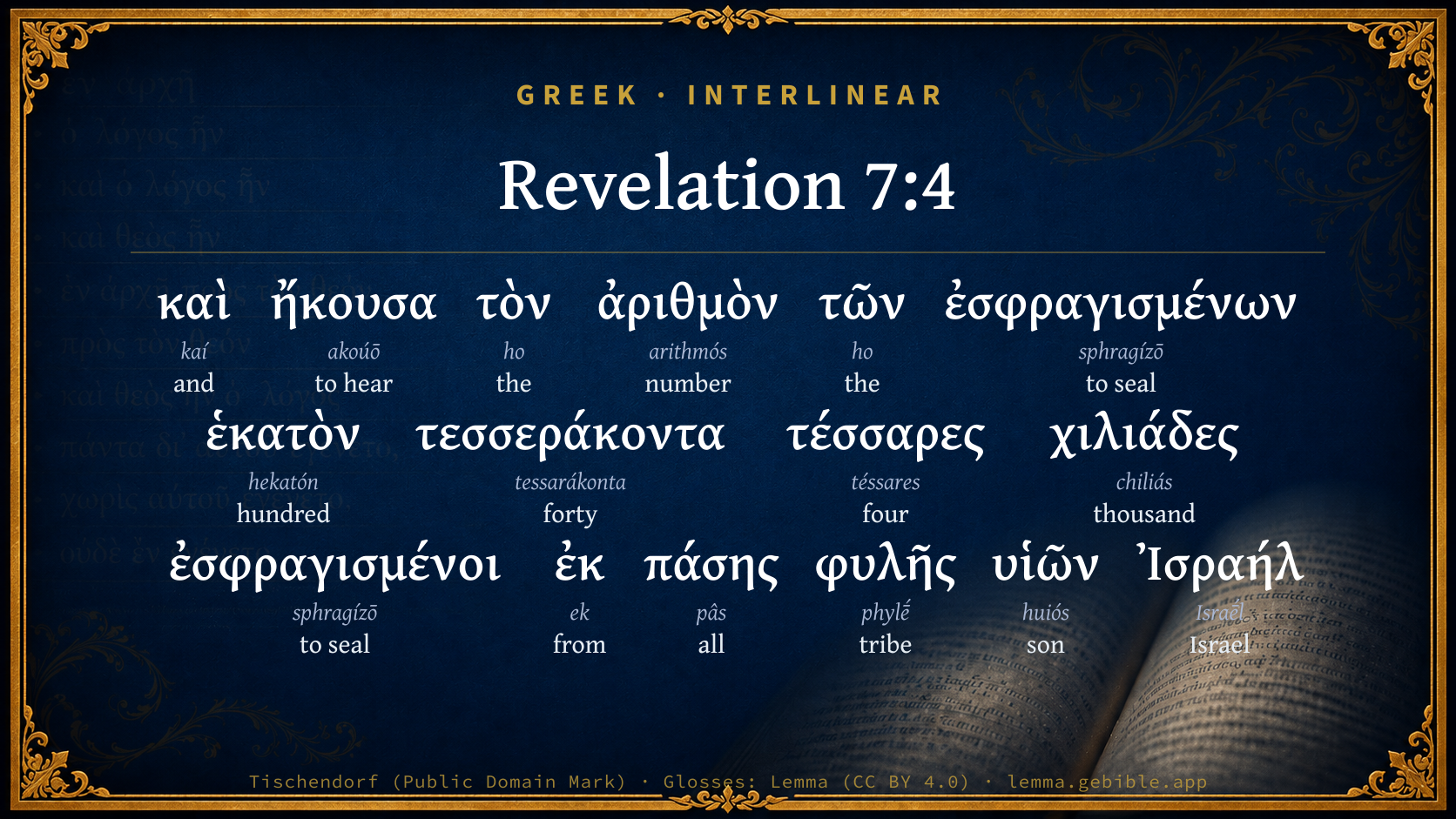
  1. καὶ kaí G2532 “and” Conjunction
  2. ἤκουσα akoúō G191 “to hear” Verb, Aorist, Active, Indicative, 1st person, Singular
  3. τὸν ho G3588 “the” Article, Accusative, Singular, Masculine
  4. ἀριθμὸν arithmós G706 “number” Noun, Accusative, Singular, Masculine
  5. τῶν ho G3588 “the” Article, Genitive, Plural, Masculine
  6. ἑκατὸν hekatón G1540 “hundred” Adjective, Numeral (indeclinable)
  7. τεσσεράκοντα tessarákonta G5062 “forty” Adjective, Numeral (indeclinable)
  8. τέσσαρες téssares G5064 “four” Adjective, Nominative, Plural, Feminine
  9. χιλιάδες chiliás G5505 “thousand” Noun, Nominative, Plural, Feminine
  10. ἐσφραγισμένοι sphragízō G4972 “to seal” Verb, Perfect, Passive, Participle, Nominative, Plural, Masculine
  11. ἐκ ek G1537 “from” Preposition
  12. πάσης pâs G3956 “all” Adjective, Genitive, Singular, Feminine
  13. φυλῆς phylḗ G5443 “tribe” Noun, Genitive, Singular, Feminine
  14. υἱῶν huiós G5207 “son” Noun, Genitive, Plural, Masculine
  15. Ἰσραήλ Israḗl G2474 “Israel” Noun, Proper, indeclinable

About this verse

These counts appear in no published source. They are computed here, from the morphology-tagged text and Lemma’s own curated glosses. What Lemma adds →

16
words
14
distinct lemmas
Revelation
section

Notable vocabulary

The rarest word here is ἐσφραγισμένων to seal G4972 — appearing just 15 times in the whole Greek New Testament.

Shared distinctive vocabulary

ἐσφραγισμένων to seal G4972 occurs in 14 verses of the Greek New Testament. Also found in:

Repetition

Words recur within this verse:

  • ἐσφραγισμένων to seal G4972 ×2
  • τὸν the G3588 ×2

Cross-references

14

Topical passages linked to Revelation 7:4 in the Treasury of Scripture Knowledge — connected by theme and wording, ordered by reader-vote popularity; previews shown in the World English Bible.

  • Revelation 14:1 I saw, and behold, the Lamb standing on Mount Zion, and with him a number, one hundred forty-four thousand, having his name, and the name of his Father, written on their foreheads.
  • Revelation 14:3 They sing a new song before the throne, and before the four living creatures and the elders. No one could learn the song except the one hundred forty-four thousand, those who had been redeemed out of the earth.
  • Luke 22:30 that you may eat and drink at my table in my Kingdom. You will sit on thrones, judging the twelve tribes of Israel."
  • Matthew 19:28 Jesus said to them, "Most assuredly I tell you that you who have followed me, in the regeneration when the Son of Man will sit on the throne of his glory, you also will sit on twelve thrones, judging the twelve tribes of Israel.
  • Acts 26:7 which our twelve tribes, earnestly serving night and day, hope to attain. Concerning this hope I am accused by the Jews, King Agrippa!
  • Ezekiel 48:31 and the gates of the city shall be after the names of the tribes of Israel, three gates northward: the gate of Reuben, one; the gate of Judah, one; the gate of Levi, one.
  • Romans 9:27 Isaiah cries concerning Israel, "If the number of the children of Israel are as the sand of the sea, It is the remnant who will be saved;
  • Romans 11:5–6 Even so then at this present time also there is a remnant according to the election of grace.
  • James 1:1 James, a servant of God and of the Lord Jesus Christ, to the twelve tribes which are in the Dispersion: Greetings.
  • Revelation 9:16 The number of the armies of the horsemen was two hundred million. I heard the number of them.
  • Ezekiel 47:13 Thus says the Lord Yahweh: This shall be the border, by which you shall divide the land for inheritance according to the twelve tribes of Israel: Joseph [shall have two] portions.
  • Ezekiel 48:19 Those who labor in the city, out of all the tribes of Israel, shall until it.
  • Zechariah 9:1 An oracle. The word of Yahweh is against the land of Hadrach, And will rest upon Damascus; For the eye of man And of all the tribes of Israel is toward Yahweh;
  • Genesis 15:5 Yahweh brought him outside, and said, "Look now toward the sky, and count the stars, if you are able to count them." He said to Abram, "So shall your seed be."

Cross-references courtesy of OpenBible.info (CC BY 4.0).

Where the printed editions differ

2 variants

Places in this verse where the major printed Greek editions disagree on the wording in a way that affects the translation — a comparison of editions, not a manuscript-by-manuscript collation. The editions are the modern critical texts (Nestlé-Aland 28/27, SBL, Westcott-Hort, Tregelles, Tyndale House) and the traditional texts behind the KJV (the Textus Receptus and the Byzantine/Majority text). It is not a claim about which reading is original.

  1. Editions differ
    ἑκατὸν

    “one hundred”

    In NA28NA27TynSBLWHTregByz Not in TR
  2. Editions differ
    τεσσεράκοντα

    “forty”

    In NA28NA27TynSBLWHTregTR»1Byz Not in TR

Textual data: Translators Amalgamated Greek New Testament (STEPBible TAGNT) · CC BY 4.0.

Commentary

Notes on Revelation 7:4 from classic Christian and Jewish commentators (each source and its license shown beneath its notes). The classic Christian expositions comment on the surrounding passage and are grouped to its opening verse, so a note may address several verses; the Jewish commentaries on the Tanakh (Rashi and others) are per-verse, so they appear only where the commentator wrote on this verse.

Lemma curates 59 commentaries, every one of them public domain or Creative Commons licensed, each selected and text-cleaned for this edition rather than reprinted as found. About our sources →

The Cambridge Bible for Schools and Colleges

gen. ed. J. J. S. Perowne

The Sealing of the 144,000, Rev_7:4-8

4. an hundred and forty and four thousand] As there are twelve tribes, so in each tribe there are to be twelve thousands: possibly with a reminiscence of the primitive political and military organisation, when a “thousand” was a recognised subdivision of a tribe. See Jdg_6:15; Mic_5:2. Any way, we are probably to understand that each portion of Israel is a miniature likeness of the whole.

of all the tribes of the children of Israel] It is one of the most controverted of the minor questions of interpretation of this Book, whether Israel is here to be understood in the literal or the spiritual sense. This vision of a certain number of Israelites, and the next of an innumerable multitude of all nations, are certainly correlative to each other: and the most obvious way of understanding them is, that among God’s elect there will be many faithful Israelites, and yet few comparatively to the number of faithful Gentiles. Others however understand these 144,000, and the innumerable multitude of Rev_7:9, to represent the same persons regarded in two different aspects. To God they are all His own people, all duly numbered and organised and marshalled as His army, and everyone known to Him by name: on the other hand, from a human point of view they belong to all nations, and. are too many to be counted. Lastly, in Rev_14:1 we hear of a company of 144,000 whom (not from their number only) it is natural to identify with these: and it appears that these represent, not the whole multitude of the elect, but a group specially faithful and specially favoured, even among them. It seems worth asking, whether the true solution be not a combination of the first and last, whether we are to understand that Christ’s nearest and dearest ones still come from God’s old people, who are still “beloved for the fathers’ sake,” though they attain such nearness to Him, not by virtue of their descent, but by graces of the same kind as sanctify Gentile saints also.

The Cambridge Bible for Schools and Colleges (gen. ed. J. J. S. Perowne; Cambridge University Press, 1878–1918) — public domain. Text from a community e-Sword module.

The Biblical Illustrator

Joseph S. Exell

Rev_7:4-8

The number of them which were sealed.

The sealing

I. Who, then, are these 144,000 sealed ones?

II. The nature of the sealing of which these 144,000 are the subjects.

1. It is manifest that the transaction takes place on earth, and in the case of people contemporaneously living in the flesh.

2. This sealing involved the impartation of a conspicuous and observable mark.

3. It is something Divine. The seal with which the sealing is done is a seal of the living God. It so pledges Him, and to Him, that it must be regarded as His own act.

4. The office of this sealing is in the hands of an angel, who comes forth from the sun-rising. He is a high officer from God. He carries a seal of the miracle-working God, and he gives commands to the angels of judgment. Many take him to be the Lord Jesus Himself. There is much to sustain this view.

5. This sealing was, moreover, amoral, and not a mere arbitrary or external thing. Those who receive it are described as the servants of our God, as contradistinguished from other classes of men. And from what is said of them in the fourteenth chapter they are very eminently Gods servants. It is the common law of the Divine proceedings that His special honours are never otherwise conferred than in connection with special dutifulness and fidelity under very special trials and difficulties.

6. And from this we are enabled to get a still deeper glance into the nature of this peculiar sealing. The seal of God is the Spirit of God, particularly in His more unusual gifts.

7. Very various and diverse: hence would also be the outward manifestations of this mark. It would show itself in the doctrines professed by the sealed ones, in the power with which they announce and defend them, in a particularly holy, prayerful, and self-denying life, in a bravery and fearlessness before gainsayers which no earthly powers can daunt, and in a wisdom and heavenliness of demeanour.

III. The intent and effect of this marvellous sealing. It is agreed on all hands that it is a merciful and gracious act. Its first effect is to stay the blasts of judgment, and to produce a lull in the work of vengeance. So it is ever. Gods people are the salt of the earth. But for them, and Gods gracious purposes toward them, judgment and ruin would instantly break over the globe. Governments stand, society exists, the waters flow, the trees live, the sea retains its salubrity, the grasses grow upon the earth, and the death-blasts of the destroying angels are restrained, only because the Lord is engaged taking out from among the nations a people for His name, the number of which must first be made up. But this sealing was more particularly for the comfort, assurance, and security of the sealed ones themselves. As the gift of the Holy Ghost certified and assured the apostles of the Divinity of the cause they had espoused, of their acceptance as Gods acknowledged ambassadors; so this sealing with the seal of the living God certified and assured these 144,000 of the unmistakable character of their faith, of their election as a firstfruits of incoming new administrations, and guaranteed unto them not only security amid She blasts of heightening judgment upon earth, but also a peculiar and blessed portion with Jesus in His glory. (J. A. Seiss, D. D.)

All saints

I. The number of the blessed. The hundred and forty and four thousand am the twelve thousand from each of the twelve tribes; and these mystic figures, though they may mean much else, seem at least to represent a certain perfect number contemplated by God. Let it be a mystery, this apparent limitation of the number of the elect! let Gods foreknowledge and mans freewill defy our explanation, and be confused in our attempt to see the relation of number to Him who is infinite!--yet the believer feels a sensation of repose in the thought that the work answers to the design, and that the number of the redeemed is perfect according to the will of God. In all our anticipations of the result of labour for God, this faith must rule our hearts, viz., that the Divine love will not be disappointed. Care must be had for the few, that they may lack nothing which the Church can give.

II. There is a great multitude. There are few minds that are not swayed by a comparison of numbers. The multitude who agree to forget God charm us with the thought of impunity, if we be no worse than they; the difficulty of holy living is increased by its singularity. Is not one blessing, which we derive from a contemplation of the angels, the thought of support which the obedience of their innumerable company lends to cheer the hearts of those who on earth are fighting against numbers?

III. Their happiness.

IV. There is a reason why even Christians hesitate to call a man happy till he is dead, not because he may fall into misfortune, but into sin. As long as life lasts, so long lasts temptation. Exhaustion of body, or extremity of pain, or influence of opiates, or dreadful memory of early sins, exercises at times a desperate tyranny over the quiet of the closing day. Therefore with such dangers even to the last, well may we hold our breath and cal no man happy till he be dead.

V. There is in the religious life scarcely a sorer trial than doubt. And not only in matters of speculation and doubt, but in every common incident of daily life, let us force ourselves to imagine what our departed friends now feel, not what they once felt.

VI. A contemplation of the dead will relieve us of the painful thought that death cuts short the work of life. The life beyond the grave has been beautifully compared to the heavens at night. Think how, at the creation of day and night, Adam must have marvelled to see the sun withdraw; how dread and awful must have been the first darkness veiling from his eyes a world of perfect beauty; what a blank it must have appeared in his sight! But greater far was his amazement when stars broke out, and one by one lit up the hollow vaults of heaven, and the whole spaces of the air were jewelled with bright orbs, and countless worlds like unto his own were presented to his eyes! If the sun by day can so blind us, and the darkness of nightfall can reveal so many worlds, why may not death not only compensate a man for the loss of life, but open to his clearer vision regions of untraversed light which it had not entered into his heart to conceive?

VII. Remember above all things that the happiness of those we speak of depends not on themselves. God Himself is their light and life and their exceeding great reward; their eyes rest on Him; salvation is His free gift. (Canon Furse.)

The Biblical Illustrator, edited by Joseph S. Exell (c. 1880s–1900s) — public domain. Text from a community e-Sword module.

Joseph Benson's Commentary

Rev 7:4-8. And I heard the number of them, a hundred and forty and four thousand — This single passage, says the bishop of Meaux, may show the mistake of those who always expect the numbers in the Revelation to be precise and exact; for is it to be supposed, that there should be in each tribe twelve thousand believers, neither more nor fewer, to make up the total sum of one hundred and forty-four thousand? It is not by such trifles and low sense the divine oracles are to be explained. We are to observe, in the numbers of the Revelation, a certain figurative proportion which the Holy Ghost designs to point out to observation. As there were twelve patriarchs and twelve apostles, twelve became a sacred number in the synagogue and in the Christian Church. This number of twelve, first multiplied into itself, and then by one thousand, makes one hundred and forty-four thousand. The bishop sees, in the solid proportion of this square number, the unchangeableness of the truth of God and his promises. Perhaps it may mean the beauty and stability of the Christian Church, keeping to the apostolical purity of faith and worship. Of the tribe of Juda, &c. — As the Church of Christ was first formed out of the Jewish Church and nation, so here the spiritual Israel is first mentioned. But the twelve tribes are not enumerated here in the same order as they are in other places of Holy Scripture. Judah hath the precedence, because from him descended the Messiah, and in this tribe the kingdom was established. Dan is entirely omitted, being the first tribe that fell into idolatry after the settlement of Israel in Canaan; and also being early reduced to a single family, which family itself seems to have been cut off in war before the time of Ezra. For in the Chronicles, where the posterity of the patriarchs is recited, Dan is wholly omitted. Ephraim also was a tribe that greatly promoted idolatry, and therefore is not mentioned by name, but the tribe is denominated that of Joseph. The Levitical ceremonies being abolished, Levi was again on a level with his brethren, and is here mentioned as a tribe instead of that of Dan. In this list the children of the bond-woman and of the free-woman are confounded together; for in Christ Jesus there is neither bond nor free.

Joseph Benson's Commentary on the Old and New Testaments (1811–1818) — public domain. Text from a community e-Sword module.

Tyndale Open Study Notes

Tyndale Open Resources

7:4-8 Who are the 144,000? This listing of the tribes of Israel does not exactly correlate with the twelve physical tribes. Instead, it communicates that God knows precisely which people on earth belong to him. By the AD 90s, Israel’s twelve tribes no longer existed; ten tribes were dispersed when Assyria conquered the northern kingdom of Israel (2 Kgs 17:1-41). The early Christian church regarded itself symbolically as the Israel of God (Matt 19:28; Rom 2:28-29; 9:6-8; Gal 3:29; 6:16; Phil 3:3). The 144,000 probably represent all faithful Christians (cp. Rev 14:1-5; 21:12-17). The list begins appropriately with Judah (the royal tribe of Jesus) but substitutes Manasseh (one of the two tribes of Joseph) for Dan. The tribe of Dan fell into idolatry (Judg 18:14-31; 1 Kgs 12:25-30), and early Christians regarded it as the epitome of evil.

Tyndale Open Study Notes — © Tyndale Open Resources, licensed CC BY-SA 4.0. Text via the HelloAO Bible API.

Bengel's Gnomon

Johann Albrecht Bengel

Rev 7:4. Ἰσραὴλ) Israel in the strict sense is denoted. For this book pronounces literally respecting Israel many things, which some take in a figurative sense. Israelism, as H. More terms it, Book i., Synops. proph., cap. 4, ought not to be too much extended. Lampe rightly says, that the Jews ought to be sought for in the Apocalypse, more than most interpreters have found them. Medit. anecd. in Apoc., p. 261.

Bengel's Gnomon of the New Testament — English translation (T&T Clark, Edinburgh, 1860) — public domain. Text from a community e-Sword module.

Meyer's Critical & Exegetical Commentary

Heinrich August Wilhelm Meyer

Rev_7:4-8. καὶ ἤκουσα τὸν ἀριθμὸν τῶν ἐσφραγισμένων. The act of sealing is, therefore, to be considered as occurring between Rev_7:3 and Rev_7:4. That John does not behold this act itself, but only hears the number of the sealed,probably from the other angel, Rev_7:2-3,[2295]corresponds with the holy moderation which is peculiar to true prophecy; for as in the innumerable company, Rev_7:9 sqq., the sealing, in general, is such as cannot be represented,[2296] so in reference to the one hundred and forty-four thousand out of Israel, it would be in a high degree unnatural if their sealing had occurred before the eyes of the prophet. In Ezekiel 9 it is, likewise, not described how the mark was made upon the foreheads of the godly; but after the command for this is communicated (Rev_7:4), in Rev_7:11 it is said that it is accomplished. Yet it is not a happy fiction of John,[2297] that he says that he has only heard the number of the sealed; but the apparently insignificant circumstance testifies to the truth of the vision, and the entirely ethical nature of divine revelation in general. Nor is it possible for that to be revealed by vision to the prophet which must conflict with his proper subjectivity.

The schematic number one hundred and forty-four thousand applies, as a product of the radical number twelve, especially to believers from the twelve tribes of Israel.

ἐκ πάσης φυλῆς υἱῶν Ἰσρ. Out of every tribe. Cf. Winer, p. 105. The pregnant mode of expression shows that one hundred and forty-four thousand in all were sealed, and that the sealed were from every tribe. What follows (Rev_7:5-8) makes the declaration more specific, upon which it is to be noted: 1. That the number of twelve thousand, fixed for each of the twelve tribes, from the very fact that it is every time the same shows that it is schematic by expressing the idea that in the divine gifts of grace all have like share, but no one from any one right. It is just as when in Eze_47:14, the Holy Land appears equally divided among all the tribes. 2. As to the representation of the tribes, neither the tribe of Levi dare be missing,[2298] nor is the fixed number, twelve, exceeded. Yet it was impracticable to include Manasseh and Ephraim under the name of Joseph, because each of those two branches of the original tribe of Joseph stands by the side of the other tribes with significative independence of age.[2299] If, also, John wanted, in general, to avoid the name of Ephraim, because of the untheocratic reminiscence connected therewith, he put instead thereof the accurately taken paternal name of Joseph, including also the fraternal tribe of Manasseh.[2300] Yet the appearance of not thirteen, but only twelve tribes, is accomplished by the omission of the tribe of Dan.[2301] Gomarus,[2302] Hartwig, and Züll. have indeed put ΔΆΝ instead of ΜΑΝΑΣΣῆ,an arbitrary decision, in no way justified by unimportant codd. (Rev_9:13), because they offer ΔΆΝ instead of ΓΆΔ,[2303] and this contradicts the express testimonies of Iren., Orig., Andr., etc. Of just as little force is the play upon the name Manasseh, according to which the root of the word (נָשָׂח, he forgot) is regarded as indicating that here another name, viz., Dan, is regarded as forgotten, or properly not forgotten, but embraced or incorporated in a secret way.[2304] The intentional omission of the tribe of Dan is explained, especially by the Church Fathers, by the fact that from this tribe the Antichrist was to come,[2305] which, however, John nowhere intimates. Others have recalled the idolatry of the Danites;[2306] but the old sin of the tribe can be no foundation for excluding all its members from eternal life. The avoidance of the name of Ephraim, that had become offensive,[2307] in no way favors this view, because the tribe named, of course, intentionally not as Ephraim, but Joseph, presents its twelve thousand like the rest. The simplest reason for not naming Dan lies rather in the fact that it had died out long already before the time of John;[2308] even though the more definite declaration of Jewish tradition that only the family of Husim survived from the tribe of Dan,[2309] may be nothing but a reminiscence of Gen_46:23. Already in 1 Chronicles 4 sqq., the tribe of Dan is omitted, although it is not passed over in 1Ch_2:1 sqq. Cf. also Deuteronomy 33, where the small tribes of Simeon and Issachar are lacking.

In the succession it is only by an artificial subtilty which often passes over into pure trifling, that a consequent intention and a mystical meaning can be found. Beda, e.g., explains, because of the secret meaning of the name: After Judah, therefore, Reuben; i.e., after the beginnings of divine confession and praise, the performance of an action follows.[2310] Besides, the opinion of Hengstenb.[2311] is possible, that the sons of the wives and those of the bondwomen are intentionally commingled in order to indicate that in Christ no earthly distinction is valid. But Grot. also can say, from his standpoint, No order is observed, because in Christ all are equal.[2312] It is natural for Judah to have the precedence, because from that tribe the Lord comes.[2313] Reuben follows afterwards, who as the firstborn could have stood before.[2314] The succeeding names are introduced without further intention; only at the close stands Benjamin as the youngest, and finally, from an allusion to the O. T.,[2315] in connection with Joseph.[2316]

[2295] De Wette, Ebrard.

[2296] See the general note on ch. 7.

[2297] Züll.

[2298] Beng., correctly: Since the Levitical ceremonies have been abandoned, Levi again is found on an equal footing with his brethren. All are priests; all have access, not one through the other, but one with the other.

[2299] Ewald, etc.

[2300] Cf. Num_13:11.

[2301] Cf. especially Heinrichs, Excursus iii.: Cur in recensu tribuum Israel, c. vii. 58, nulla tribus Daniticæ mentio fiat (ii. 228 sqq.).

[2302] In Wetst.

[2303] Cf. also Matth.

[2304] Beng., Eichh.

[2305] Cf. Gen_49:17. Beda, Andr., C. a Lap., Stern.

[2306] Judges 18. Wetst., Vitr., Hengstenb.

[2307] Hengstenb.

[2308] Grot., Ew., De Wette, Ebrard, etc.

[2309] Cf. Grot.

[2310] Reuben = videns filium; filii = opera.

[2311] Cf. Vitr., etc.

[2312] Cf. also C. a Lap., Calov., De Wette, etc.

[2313] Rev_5:5; Heb_7:14. Beda, Beng., Rinck, Ebrard, etc.

[2314] Cf. also 1Ch_5:1.

[2315] Gen_35:24; Gen_46:20-21; Deu_27:21; Num_1:10-11; 1Ch_2:2.

[2316] It is strange that in א, not only Gad and Simeon are forgotten, but also Joseph and Benjamin are transposed.

NOTES BY THE AMERICAN EDITOR

LIII. Rev_7:4. τοὺς δούλους τοῦ θεοῦ

Gebhardt emphatically dissents from the limitation of the one hundred and forty-four thousand to converted Israelites: Neither the Jews in contrast with the Gentiles, nor the Christian Jews in distinction from the Christian Gentiles, but Christians, the true Israelites, whether Jews or Gentiles. The twelve tribes of the children of Israel are therefore identical with the people of God; only the latter are described in O. T. style, or typically, and as a living great organism. Where the purpose is to confirm Christians in their confidence in God, or to impress on their mind their high dignity, they are represented as the true Israel, as the numbered or chosen one hundred and forty-four thousand. So Philippi (Kirch. Glaubenslehre, iv. iii. 251): The one hundred and forty-four thousand sealed out of all the tribes of the children of Israel are not only Christians among the Jews, upon which see Calov., Ewald, De Wette, Hengstenb., Klief., etc.; but rather the entire congregation of believers is meant, the true spiritual Israel, who have been preserved from all the plagues to be inflicted on the world. Beck also argues against the view advocated by our author, but regards those sealed as elect persons among believers: The υἱοι Ἰσραηλ here mentioned are ancient Israel as little as Jerusalem in the Apocalypse is ancient Jerusalem, or as little as, in general, the temple, altar, candlesticks, Balaam, Jezebel, Jews, etc., above, designate the ancient historical objects and persons; but the latter are only the types of that which corresponds in the Christian congregation. So the name Israelites here is likewise typical. The twelve tribes of the children of Israel, from whom the choice is made, have, in the Apocalypse, their metropolis in the New Jerusalem, which, according to Rev_21:12; Rev_21:14, has the names of the twelve tribes of Israel on its doors, and is built upon the foundation of the twelve apostles. The name of this new Jerusalem, as the N. T. city of God, is, according to Rev_3:12, stamped, together with the name of the N. T. God (my God, i.e., Jesus Christ), and, therefore, with the seal of God here mentioned with respect to the children of Israel, upon those who, by fidelity to the word of Jesus Christ, have proved conquerors in the time of trial. Thus it is also expressly said of the one hundred and forty-four thousand designated in Rev_14:3, that they were purchased from the earth, or (Rev_7:4) from among men, from humanity, and, therefore, not merely from the Jewish nation; cf. Rev_5:9. In the Apocalypse, the entire development of the kingdom is stated universally. It has thus, also, nothing whatever to do with a particularistic national sphere, or with the history of a particular people, but with the universal national sphere, with the universal judgment and universal salvation, and, therefore, with a universal and not a partial, holy nation; cf. Rev_10:11. But this conception is conformable also to the N. T. fundamental view. According to this, there is awarded to ancient Israel, indeed, the first participation in universal grace (Rom_1:16; Rom_11:25-32), but no such particular preference as the sealing before the plagues, so that, therefore, all Gentile Christians must be subject thereto. The national distinction between Jew and Gentile, the distinction of the flesh, is removed in the fellowship of the new covenant (Joh_10:16; Joh_11:52). What unites them as one new people of God is the unity of faith and life on the basis of the new, spiritual type of humanity formed in Jesus Christ. Cf. Act_15:7-9; Rom_2:28. Cf. Rom 7:29 with Rom 7:26; Eph_2:13-15; Eph_2:18; Eph_3:3-6; 1Co_12:13; Gal_3:26-28; Col_3:11. Since the Christian community, formed of both nationalities, is the true bearer of the Divine covenant, the name of Israel and its twelve tribes is, accordingly, transferred to the Christian Church. Only in its unity and organization of spirit, the typical Israel finds its full expression, its fulfilment, as it formerly presented only a union and organization of people of God which was of the flesh (Rom_9:6-8). Cf. Gal_4:28; Rom_9:24 sqq., Rev_10:11-11 : Gal_3:7; Gal_4:26; Gal_6:15 sq. Cf. Php_3:3; 1Pe_1:1, with Rev_2:9; Mat_19:28 with Mat_8:11 sq. and Mat_28:19; Rev_18:4; and, finally, Rev_21:12; Rev_21:14, the climax of the entire view.… The number of the sealed in the Apoc. comprises, therefore, neither merely converted Jews (whether of the first or the last times), nor all Christendom, or the entire number of believers, but (ἐκ πάσης φυλῆς) a selection from all tribes or sections of believers without distinction of Jewish or heathen origin. They are the approved spiritual Christians, the τέλειοι (Php_3:13 sqq.); and their sealing occurs by their receiving the new seal of the covenant, the Holy Spirit of the Father and the Son in special power and fulness, so that he appears in a visible mark, characterizing their entire conduct, and secures them against the trials pertaining to the empire of the world, especially on the part of a spurious Christianity (cf. Mat_24:21-25; 1Jn_2:18; 1Jn_2:20; 1Jn_2:27), and against the judgments of God proceeding through the world.

Meyer — Critical and Exegetical Commentary on the New Testament — English translation by Peter Christie, edited by Frederick Crombie (T&T Clark, 1880) — public domain. Text from a community e-Sword module.

Expositor's Greek Testament

ed. W. Robertson Nicoll

Rev 7:4 . After a pause, in which the sealing is supposed to have taken place, the writer hears that the number of the sealed is the stereotyped 144,000, twelve thousand from each of the twelve tribes of Israel (a “thousand” being the primitive subdivision of a clan or tribe, like the English shire into “hundreds”). The enumeration of these tribes (Rev 7:5-8 ) contains two peculiarities, ( a ) the substitution of Joseph for Ephraim, a variation to which we have no clue, and ( b ) the omission of Dan. The latter reflects the growing disrepute into which Dan fell; it either stands last ( e.g. in [912] .; Jos 19:40 f.; Jdg 1:34 ) or drops out entirely, while it is curiously connected in the Talmud as already in Test. XII. Patr. (Dan 5 )’ with Beliar, and in Irenæus (5:30, 32) as in Hippolytus ( de Antichr . 5, 6) with the origin of Antichrist. This sinister reputation ( cf. A.C. 171 174, Selwyn 200 204, Erbes 77 f.), current long before Irenæus’ day, rested on the haggadic interpretation of passages like Gen 49:17 ; Deu 33:22 ; and Jer 8:16 . Andreas, commenting on Rev 16:12 , thinks that Antichrist will probably come from Persia, ἔνθα ἡ φυλὴ τοῦ Δάν .

[912] Codex Porphyrianus (sæc. ix.), at St. Petersburg, collated by Tischendorf. Its text is deficient for chap. Rev 2:13-16 .

The Expositor's Greek Testament, edited by W. Robertson Nicoll (1897–1910) — public domain. Text from a community e-Sword module.

Geneva Bible (1599)

Geneva Bible translators

That is, of the Jews a number certain in itself before God, and such as may be numbered of us: for which cause also the same is here set down as certain. But of the elect which are of the Gentiles, the number indeed is in itself certain with God, but of us not possibly to be numbered, as God, Gen. 15:5, and often elsewhere, and Isaiah figured most excellently, Isa. 49 and 60. This therefore is spoken with respect, when a certain number is put for one uncertain. Confer this with verse 6.

Geneva Bible (1599) marginal notes — public domain. Text via Bolls.life.

Jamieson, Fausset & Brown

Robert Jamieson, A. R. Fausset & David Brown

Twelve is the number of the tribes, and appropriate to the Church: three by four: three, the divine number, multiplied by four, the number for world-wide extension. Twelve by twelve implies fixity and completeness, which is taken a thousandfold in 144,000. A thousand implies the world perfectly pervaded by the divine; for it is ten, the world number, raised to the power of three, the number of God.

of all the tribes--literally, "out of every tribe"; not 144,000 of each tribe, but the aggregate of the twelve thousand from every tribe.

children--Greek, "sons of Israel." Rev 3:12; Rev 21:12, are no objection, as ALFORD thinks, to the literal Israel being meant; for, in consummated glory, still the Church will be that "built on the foundation of the (Twelve) apostles (Israelites), Jesus Christ (an Israelite) being the chief corner-stone." Gentile believers shall have the name of Jerusalem written on them, in that they shall share the citizenship antitypical to that of the literal Jerusalem.

Jamieson, Fausset & Brown — Commentary Critical and Explanatory on the Whole Bible (1871) — public domain (CC PDM 1.0). Text via the HelloAO Bible API.

Adam Clarke's Commentary

Verse 4. I heard the number of them which were sealed] In the number of 144,000 are included all the Jews converted to Christianity; 12,000 out of each of the twelve tribes: but this must be only a certain for an uncertain number; for it is not to be supposed that just 12,000 were converted out of each of the twelve tribes.

Adam Clarke's Commentary on the Bible (1810–1826) — public domain. Text from a community e-Sword/MySword module.

Ellicott's Commentary for English Readers

(4) And I heard the number of them . . . Translate, And I heard the number of the sealed: there were a hundred and forty and four thousand sealed out of every tribe of the sons of Israel. There are two or three questions which these verses suggest. What are we to understand by the number twelve thousand from each tribe? Who are these who are drawn from the tribes of Israel? Why is there a change of the order and name of the tribes? It may help us to clearer thoughts to take the second of these questions first. (1) Who are these one hundred and forty-four thousand? An answer to this has been partly anticipated in our previous comments; but perhaps a fuller consideration is needed. Some have thought that the sealed ones must be Jewish Christians: i.e., they are disposed to take the twelve tribes literally. The scope of the previous verses seems decisive against this view. The time of judgment and trial is drawing near; we have seen the tokens of the coming storm in the opening of the sixth seal; our wish is to know the lot of the saints of God; this chapter answers this wish: they are safe, having the seal of God. Now, to limit the answer to the Israelitish Christians is to break in abruptly upon the general flow of thought with a bold literalism. The sealed ones are explained to be the servants of God; the description which follows proclaims them to be the “Israel of God.” It would be a strange leap away from the subject to introduce a sudden limitation of thought. Nor is there any necessity for doing so. Israelitish and Jewish names are freely adopted by the sacred writers, and used in a spiritual sense without any explanation of such usage; and the Apostle most emphatically laid down the principle that “he is not a Jew which is one outwardly, neither is that circumcision which is outward in the flesh, but he is a Jew which is one inwardly, and circumcision is that of the heart, in the spirit and not in the letter” (Rom_2:28-29); and the principle he applies by affirming that in Christ “there is neither Jew nor Greek” (Gal_3:28). The Christian Church absorbs the Jewish, inherits her privileges, and adopts, with wider and nobler meaning, her phraseology. She has her Jerusalem, but it is a heavenly Jerusalem (Heb_12:22): a Jerusalem from above (Gal_4:26): a new Jerusalem (Rev_21:2; see Rev_3:12); and to that Jerusalem of God the true Israel of God, the chosen generation and royal priesthood of every age, turn the eye of faith. It is needless to say that this view does not rob, as it has been said, the Jew of God’s promises; it only intensifies those promises by showing the growth of that Church in which the Jew may yet find the truest consummation of his holiest and highest hopes, and into which God is yet able to graft them in again (Rom_11:23; Rom_11:25-26), and in which he may yet play a part loftier than men dream of. (2) How are we to understand the numbers? As we cannot adopt the literal interpretation of the tribes of Israel, still less can we admit a literal interpretation of the numbers here mentioned; but they are not on this ground to be looked upon as meaningless numbers: there is an appropriate symbolism in the numbers of the Apocalypse. Twelve is used as the number of those who in every age have been called out to witness for some truth which the world needed. Thus the twelve tribes of Israel were the appointed witnesses of a pure theology and a pure morality in the days of idolatry and license; and later, the twelve Apostles became the inheritors of a similar, though higher, spiritual work in the world. The number twelve, then, stands for a world-witness of divine truth; and the fruits of this world-witness is a wide and sustained success: the twelve multiplied by the twelve a thousand-fold—“the native and not degenerate progeny of the Apostles apostolically multiplied” (Mede, quoted by Dr. Currey). The skeleton organisation is twelve, the college of the Apostles; the one hundred and forty-four thousand represent the growth into full numbers of the choice ones of God. (3) Does the change in the order and names of the tribes symbolise anything? The alterations are not without significance. They are briefly these: The tribe of Dan is omitted, and the name of Ephraim does not appear, but the number is made up to twelve by two representatives of Joseph: Manasseh, who stands sixth in order, and Joseph (superseding the name, but representing the tribe of Ephraim), who is placed eleventh on the list. The number twelve is maintained to show that in all changes God’s purposes stand. The omission of one tribe and the changed name of another are designed to show that in the Church, as in Israel, the most splendid opportunities may be lost. Dan, once a tribe, and not an insignificant tribe, which had reared its heroes, gradually lapsed into idolatry and immorality, dwindled in numbers and importance, and at length disappeared, and as a tribe became extinct. Its omission in this list is a silent but emphatic comment on the sacred warnings: “Let him that thinketh he standeth take heed lest he fall.” “Begin not to say we have Abraham to our father: God is able of these stones to raise up children unto Abraham.” Similarly, Ephraim, as has been suggested by a thoughtful writer, who exalted himself in Israel, is now lost in the greater name of Joseph. (Comp. Hos_13:1; Hos_10:11; Luk_18:14.) The order of the names is altered. Reuben no longer stands first: Judah has taken the firstborn’s place; and Levi, though named, does not occupy the third, the place of his birthright, but the eighth place. Here, again, the changes have their teachings. The unstable Reuben, with all his splendid advantages—the firstborn, the excellency of dignity and the excellency of power—failed to hold his own among his brethren; the fatal instability of his character accompanied his history, and weakened his otherwise pre-eminent powers; yet weak and erring, the type of the brilliant and vacillating, he is not an outcast altogether, but finds place, and high place, among the servants of God. Judah, lion-like, resolute, and strong, wins the foremost place; from him springs the true Ruler, the Lion of the tribe of Judah, to unfold the counsels of God, and to rule the world with a righteous sceptre. Levi’s subordinate position is thought to be due to the fact that the Mosaic ritual and Levitical priesthood are at an end. This may be so; the changes are the result of the actual history of the tribes, and illustrate how in the Christian Church, as in the Jewish, privileges may be lost, opportunities seized or cast away, offices and functions used for a time, and then laid aside when their work is accomplished; but in all and through all changes, God’s unchanging purpose runs onward to its certain close. The grouping of the tribes is, as has been pointed out, in the order of closest kinship: “We find not one violent separation of those who are naturally united, where both are truly members of the Israel of God” (Rev. C. H. Waller, Names on Gates of Pearl).

A Bible Commentary for English Readers, edited by Charles John Ellicott (1878–1897) — public domain. Text from a community e-Sword module.

John Gill's Exposition

And I heard the number of them which were sealed,.... And therefore could be sure of the exact number, which did not depend upon his sight, and telling them, in which some mistake might have been made, but he heard the number expressed:

and there were sealed an hundred and forty, and four thousand: which is a square number arising from twelve, the square root of it, being just twelve times twelve thousand; and may denote their being the true and genuine offspring of the twelve apostles of the Lamb, holding their doctrine, and being built on their foundation; see Rev 21:14; and these were

of all the tribes of the children of Israel; not that these were all Jews in a literal sense, for the time of their conversion in great numbers is not yet come. Dr. Goodwin thinks these sealed ones design the believers of the Greek and Armenian churches, and his reasons are not despicable; but this is to limit and restrain them to a particular part of the church of Christ; whereas they take in all the saints within this long tract of time, even all that are the true Israel of God, who are Jews inwardly, of what nation, kindred, tongue, and people soever; and is a certain and determinate number for an uncertain and indeterminate one; and only intends a large number of persons known to God and Christ; see the Apocrypha:

"Arise up and stand, behold the number of those that be sealed in the feast of the Lord;'' (2 Esdras 2:38)

John Gill's Exposition of the Whole Bible (1746–1763) — public domain (CC PDM 1.0). Text via the HelloAO Bible API.

Trapp's Complete Commentary

John Trapp

4 And I heard the number of them which were sealed: and there were sealed an hundred and forty and four thousand of all the tribes of the children of Israel.

Ver. 4. A hundred forty and four thousand] A competent company. Not so many as the locusts, Rev 9:3, and yet more than most thought they had been.

John Trapp, A Commentary or Exposition upon All the Books of the Old and New Testament (1647–1656) — public domain. Text from a community e-Sword module.

Albert Barnes' Notes on the Bible

And I heard the number of them which were sealed - He does not say where he heard that, or by whom it was communicated to him, or when it was done. The material point is, that he heard it; he did not see it done. Either by the angel, or by some direct communication from God, he was told of the number that would be sealed, and of the distribution of the whole number into twelve equal parts, represented by the tribes of the children of Israel.

And there were sealed an hundred and forty and four thousand of all the tribes of the children of Israel - In regard to this number, the first and the main question is, whether it is meant that this was to be the literal number, or whether it was symbolical; and, if the latter, of what it is a symbol:

I. As to the first of these inquiries, there does not appear to be any good reason for doubt. The fair interpretation seems to require that it should be understood as symbolical, or as designed not to be literally taken; for:

(a)The whole scene is symbolical - the winds, the angels, the sealing.

It cannot be supposed that this number will include all who will be sealed and saved. In whatever way this is interpreted, and whatever we may suppose it to refer to, we cannot but suppose that more than this number will be saved. The number is too exact and artificial to suppose that it is literal. It is inconceivable that exactly the same number - precisely twelve thousand - should be selected from each tribe of the children of Israel. If literal, it is necessary to suppose that this refers to the twelve tribes of the children of Israel. But on every supposition this is absurd. Ten of their tribes had been long before carried away, and the distinction of the tribes was lost, no more to be recovered, and the Hebrew people never have been, since the time of John, in circumstances to which the description here could be applicable. These considerations make it clear that the description here is symbolical. But,

II. Of what is it symbolical? Is it of a large number, or of a small number? Is it of those who would be saved from among the Jews, or of all who would be saved in the Christian church - represented as the “tribes of the children of Israel?” To these inquiries we may answer:

(1) That the representation seems to be rather that of a comparatively small number than a large one, for these reasons:

(a) The number of itself is not large.

(b) The number is not large as compared with those who must have constituted the tribes here referred to - the number twelve thousand, for example, as compared with the whole number of the tribe of Judah, of the tribe of Reuben, etc.

(c) It would seem from the language that there would be some selection from a much greater number. Thus, not all in the tribes were scaled, but those who were sealed were “of all the tribes” - ἐκ πάσης φυλῆς ek pasēs phulēs; that is, out of these tribes. So in the specification in each tribe - ἐκ φυλῆς Ἰούδα, Ρουβὴν ek phulēs Iouda, Roubēn, etc. Some out of the tribe, to wit, twelve thousand, were sealed, It is not said of the twelve thousand of the tribes of Judah, Reuben, etc., that they constituted the tribe, but that they were sealed out of the tribe, as a part of it preserved and saved. “When the preposition ἐκ ek, or “out of,” stands after any such verb as sealed, between a definite numeral and a noun of multitude in the genitive, sound criticism requires, doubtless, that the numeral should be thus construed as signifying, not the whole, but a part taken out” (Elliott, i. 237). Compare Exo 32:28; Num 1:21; 1Sa 4:10. The phrase, then, would properly denote those taken out of some other and greater number - as a portion of a tribe, and not the whole tribe. If the reference here is to the church, it would seem to denote that a portion only of that church would be sealed.

(d) For the same reason the idea would seem to be, that comparatively a small portion is referred to - as twelve thousand would be comparatively a small part of one of the tribes of Israel; and if this refers to the church, we should expect to find its fulfillment in a state of things in which the largest proportion would not be scaled; that is, in a corrupt state of the church in which there would be many professors of religion, but comparatively few who had real piety.

(2) To the other inquiry - whether this refers to those who would be sealed and saved among the Jews, or to those in the Christian church - we may answer:

(a) that there are strong reasons for supposing the latter to be the correct opinion. Long before the time of John all these distinctions of tribe were abolished. The ten tribes had been carried away and scattered in distant lands, never more to be restored; and it cannot be supposed that there was any such literal selection from the twelve tribes as is here spoken of, or any such designation of twelve thousand from each. There was no occasion - either when Jerusalem was destroyed, or at any ether time - on which there were such transactions as are here referred to occurring in reference to the children of Israel.

(b) The language is such as a Christian, who had been by birth and education a Hebrew, would naturally use if he wished to designate the church. Compare the notes on Jam 1:1. Accustomed to speak of the people of God as “the twelve tribes of Israel,” nothing was more natural than to transfer this language to the church of the Redeemer, and to speak of it in that figurative manner. Accordingly, from the necessity of the case, the language is universally understood to have reference to the Christian church. Even Prof. Stuart, who supposes that the reference is to the siege and destruction of Jerusalem by the Romans, interprets it of the preservation of Christians, and their flight to Pella, beyond Jordan. Thus interpreted, moreover, it accords with the entire symbolical character of the representation.

(c) The reference to the particular tribes may be a designed allusion to the Christian church as it would be divided into denominations, or known by different names; and the fact that a certain portion would be sealed from every tribe would not be an unfit representation of the fact that a portion of all the various churches or denominations would be sealed and saved. That is, salvation would be confined to no one church or denomination, but among them all there would be found true servants of God. It would be improper to suppose that the division into tribes among the children of Israel was designed to be a type of the sects and denominations in the Christian church, and yet the fact of such a division may not improperly be employed as an illustration of that; for the whole church is made up not of any one denomination alone, but of all who hold the truth combined, as the people of God in ancient times consisted not solely of any one tribe, however large and powerful, but of all combined. Thus understood, the symbol would point to a time when there would be various denominations in the church, and yet with the idea that true friends of God would be found among them all.

(d) Perhaps nothing can be argued from the fact that exactly twelve thousand were selected from each of the tribes. In language so figurative and symbolical as this, it could not be maintained that this proves that the santo definite number would be taken from each denomination of Christians. Perhaps all that can be fairly inferred is, that there would be no partiality or preference for one more than another; that there would be no favoritism on account of the tribe or denomination to which anyone belonged; but that the seal would be impressed on all, of any denomination, who had the true spirit of religion. No one would receive the token of the divine favor because he was of the tribe of Judah or Reuben; no one because he belonged to any particular denomination of Christians. Large numbers from every branch of the church would be sealed; none would be sealed because he belonged to one form of external organization rather than to another; none would be excluded because he belonged to any one tribe, if he had the spirit and held the sentiments which made it proper to recognize him as a servant of God. These views seem to me to express the true sense of this passage. No one can seriously maintain that the writer meant to refer literally to the Jewish people; and if he referred to the Christian church, it seems to be to some selection that would be made out of the whole church, in which there would be no favoritism or partiality, and to the fact that, in regard to them, there would be some something which, in the midst of abounding corruption or impending danger, would designate them as the chosen people of God, and would furnish evidence that they would be safe.

Albert Barnes' Notes on the Bible (1834–1885) — public domain. Text from a community e-Sword/MySword module.

Haydock's Catholic Bible Commentary

I heard the number of them that were sealed. By these determinate numbers need only be understood a great number of Jews converted and saved, though much greater was the number of the saved taken from among the Gentiles of all nations, of which it is said, I saw a great multitude, which no man could number, &c. (Witham) --- The number of one hundred and forty-four thousand is not to be taken in a literal and strict sense, but to express in general terms the great number of the elect; for it appears that the tribe of Dan, which certainly must have produced some elect, is not mentioned, and the tribe of Joseph is put in lieu of that of Ephraim: so that if it be supposed that these numbers must be taken literally, the tribe of Joseph would have produced a double number to that of any other tribe, since Manasses was his son, and the tribe of Dan would have produced none. (Ven. Bede)

George Leo Haydock (1774–1849), Haydock's Catholic Family Bible and Commentary, 1859 edition — public domain. Excludes Psalms (Douay-Rheims chapter numbering differs from Protestant) and Deuterocanonical books (Catholic canon only).

Matthew Poole's English Annotations

Ver. 4-8. For the understanding of these five verses several things are to be noted.

1. That the whole number is one hundred and forty-four thousand, which is the product of twelve, as the original number, (setting aside the ciphers), for twelve times twelve make one hundred and forty-four. The number of one hundred and forty-four, Rev 21:17, was the measure of the wall of the new Jerusalem. Twelve, which is the root of this number one hundred and forty-four, seemeth to be God’s number, and used in Scripture about one hundred and forty-four times, and almost generally in things belonging to the church; which had twelve patriarchs, twelve tribes under the Old Testament, twelves apostles (as its head) under the New Testament: and the new Jerusalem from heaven, Rev 21:12, is said to have twelve gates, and at the gates twelve angels; Rev 7:14, the wall had twelve foundations; the length of it, Rev 7:16, twelve thousand furlongs.

2. That we must not by one hundred and forty-four thousand understand a certain, but an uncertain number, which yet was very great.

3. That by the tribes of Israel mentioned here, are to be understood the several gospel churches of the Gentiles, who are now God’s Israel ingrafted into the true olive.

4. That the tribe of Dan is here left out, and Ephraim is not named, though included in Joseph. Of the tribe of Dan there were none sealed. Dan was a great ringleader to idolatry, so was Ephraim; see Jdg 17:1-18:31; and at Dan it was that Jeroboam set up his calves. Levi is put in instead of Dan, and Joseph instead of Ephraim, by which means here are yet twelve tribes; which teacheth us this: That Christians, if idolaters, must not look for any special protection or favour from God in a day of evil.

5. These tribes are not set in order, according to their birthright.

Juda was Leah’s fourth son, Gen 29:35, put first, because Christ descended from him.

Reuben, her eldest son, is put next, giving place only to the Messiah’s tribe.

Gad, Jacob’s son by Zilpah, Gen 30:11, is put next.

Aser, Jacob’s son by Zilpah, in the fourth place, Gen 30:13.

Nepthalim is put next, who was Jacob’s son by Bilhah, Rachel’s maid, Gen 30:8.

Manasses is put next, who was Joseph’s son.

Simeon, Jacob’s second son by Leah, Gen 29:33, is put in the seventh place.

Levi, Leah’s third son, Gen 29:34, in the eighth place.

Issachar, Leah’s fifth son, Gen 30:18, is put in the ninth place.

Zabulon, Leah’s sixth son, is put in the tenth place, Gen 30:20.

Joseph is put in the eleventh place, for Ephraim his son.

Benjamin, Rachel’s second son, is put in the last place.

If there be any mystery in this order, differing from all other scriptures where there is a mention made of the twelve patriarchs, it is probable that Mr. Mede hath hit upon it, in regard of the, good or ill deserts of these tribes, some of which are mentioned by him; all may be learned from the history of the Jews recorded in holy writ. Hence we may learn, that the summary sense of all these verses is this: That although within that period of time which is signified under the seventh seal, there should be great persecutions of the church, yet God would preserve unto himself a great number in all his churches, which should not apostatize, and who in the persecutions should not be hurt; so as his church should not fail, though the archers should shoot sore at it; for though men raged, yet it was by God’s permission; and his angels overruled it, who should take notice of those numbers that he had sealed, and marked in their foreheads.

Matthew Poole's English Annotations on the Holy Bible (1683–1685) — public domain. Text from a community e-Sword/MySword module.

Whedon's Commentary on the Bible

Daniel D. Whedon

4. And I heard the number—Omitting the element of time, the present verse assumes the sealing as all done and the number reported. The whole number, not including the great multitude of Rev_7:9; but the number of the sealed of all the tribes of… Israel is alone given.

A hundred and forty and four thousand—A decisive instance of an exact for an inexact number, and decisive proof that there are symbol-numbers as well as symbol-objects. The basis is the symbol tribal-number, twelve; it is squared and multiplied by the cube of the number of universality, ten. It is, therefore, the churchly number, raised by multiplication of itself to a seemly magnitude, with the decimal symbolizing the inclusion of an immense whole. See notes on Rev_9:16; Rev_11:13; Rev_20:4.

Daniel D. Whedon (gen. ed.), Commentary on the Old and New Testaments (1874–1909) — public domain. Text from a community e-Sword module.

The Pulpit Commentary

And I heard the number of them which were sealed. The description of the actual operation of sealing is omitted (cf. Ezekiel 9, where it is also omitted). And there were sealed a hundred and forty and four thousand. Omit "and there were." This number the square of 12 multiplied by 1000 is typical of a large and perfect number. No one has ever said that the number should be taken literally; and there are evident reasons why it could not be so intended. We have, therefore, to inquire what is its symbolical signification. The number 12 is always typical, in the Apocalypse and elsewhere, of a complete and perfect number. It is formed of 4 multiplied by 3. Four is generally representative of the created universe, and 3 of the Godhead. (see Rev_5:9) 4 plus 3, that is 7; and 4 multiplied by 3, that is 12, indicate a perfect number a number which includes and embraces everything. And thus 12 multiplied by 12 denotes the most exhaustive and perfect completion. The number 1000 is generally used to denote a large and complete, but somewhat uncertain, number. (cf. Rev_14:1 Rev_20:2 Rev_21:16, etc.) Thus the square of 12 multiplied by 1000 has the signification of a large number not definitely fixed, but nevertheless perfect; that is to say, not omitting a single one of those who should be included in the number. We are therefore taught that at the judgment day, before the destruction of the world is allowed to take place, a large number, consisting of those who have proved themselves to be God"s servants, will be preserved and set apart; and that, although the number may be large, yet it will be perfect, not one of those who are worthy to be selected being overlooked or forgotten. This number subsequently is increased, being included in the "great multitude which no man could number" of ver. 9, and which is formed by the whole company of the redeemed. Of all the tribes of the children of Israel. The Authorized Version here appears to give the correct sense of pav , "every." The number is made up not necessarily by an equal number from each tribe, but by a number from the twelve tribes viewed as a whole. As explained above, the number one thousand, though signifying "completeness," is not a definite number. Here, as elsewhere, it is the spiritual Israel which is signified. In support of this view, we may remark:

(1) The constant use in the Apocalypse of the terms" Israel," "Jew," "Jerusalem," etc., in the spiritual sense; and it seems scarcely credible that the writer of the book, who throughout insists on the fulfilment in the Christian religion of all things Jewish, should in this place, for no apparent reason, deliberately make a distinction between Jew and Gentile. The terms are constantly used to denote the spiritual Israel, the spiritual Jerusalem, etc., except where allusion is made to some historical fact, as in Rev_2:14 Rev_5:5 Rev_22:16 Rev_15:3. (cf. Jews, Rev_2:9 and Rev_3:9; Israel, Rev_21:12; Jerusalem, Rev_3:12 and Rev_21:2, Rev_21:10; Babylon, Rev_14:8 Rev_16:19 Rev_17:5 Rev_18:2, Rev_18:10, Rev_18:21; Sodom and Egypt, Rev_11:8; Euphrates, Rev_9:14 Rev_16:12; Sion, Rev_14:1; Jezebel, Rev_2:20; David,Rev_3:7; Gentiles, Rev_11:2)

(2) The improbability of the omission of the tribe of Dan, if the literal Israel were meant.

(3) The general testimony of ancient commentators, which is the view of those who appointed this passage for use in the Liturgy on All Saints" Day. Some, however, have considered that the hundred and forty-four thousand are distinct from, and not included in, the multitude of ver. 9. They believe the former indicates the converted from among the Jews, and the latter those saved from the Gentiles. Thus Bengel, Dusterdieck, Ebrard, Grotius, etc. But it may be remembered that in Rev_14:3, Rev_14:4, the hundred and forty-four thousand redeemed from the earth and from among men is not confined to Jews. By other commentators the number has been thought to denote converts in the age of Constantine, etc.

The Pulpit Commentary (1880–1919), ed. H.D.M. Spence-Jones & Joseph S. Exell — public domain. Text from a community e-Sword module.

John Wesley's Explanatory Notes

Of the children of Israel - To these will afterwards be joined a multitude out of all nations. But it may be observed, this is not the number of all the Israelites who are saved from Abraham or Moses to the end of all things; but only of those who were secured from the plagues which were then ready to fall on the earth. It seems as if this book had, in many places, a special view to the people of Israel.

John Wesley, Explanatory Notes Upon the Whole Bible (1754–1765) — public domain. Text via the GEBible commentary corpus.

Kretzmann's Popular Commentary

Paul E. Kretzmann

The total number of the sealed:

v. 4. And I heard the number of them which were sealed; and there were sealed an hundred and forty and four thousand of all the tribes of the children of Israel.

v. 5. Of the tribe of Juda were sealed twelve thousand. Of the tribe of Reuben were sealed twelve thousand. Of the tribe of Gad were sealed twelve thousand.

v. 6. Of the tribe of Aser were sealed twelve thousand. Of the tribe of Nephthalim were sealed twelve thousand. Of the tribe of Manasses were sealed twelve thousand.

v. 7. Of the tribe of Simeon were sealed twelve thousand. Of the tribe of Lev. were sealed twelve thousand. Of the tribe of Issachar were sealed twelve thousand.

v. 8. Of the tribe of Zebulon were sealed twelve thousand. Of the tribe of Joseph were sealed twelve thousand. Of the tribe of Benjamin were sealed twelve thousand.

Note that the tribe of Judah is mentioned first, since the fourth son of Jacob became the bearer of the Messianic promise and the forefather of the Messiah. After an interval, during which the sealing is supposed to have taken place, the total number of those that were sealed with the protective mark of God is announced. John did not do the counting himself, but only heard the number, for only the Lord knows them that are His. It is evidently a collective, stereotyped number, intended to include all those that belong to the true Israel, to the congregation of the believers, of all tongues and nations. The enumeration of the tribes is also made simply to get the number twelve, in accordance with the ancient way of figuring. It is for this reason that Joseph is substituted for Ephraim, and that Dan is omitted; Lev. is mentioned with the rest, because in the Church of Christ there is no distinctive priesthood, but all belong to the royal priesthood. The seal of the Lord was placed upon the definite number of those whom He had chosen unto eternal life.

Paul E. Kretzmann, Popular Commentary of the Bible (1921–1924) — public domain. Text from a community e-Sword module.

Burkitt's Expository Notes on the New Testament

William Burkitt

Observe here, 1. That the true church is represented in this book by the name of the Jews, and the false church by the Gentiles; so that the tribes of the children of Israel is to be understood the whole universal church of sincere and serious Christians, all that profess and practice the faith of Abraham, and so are his spiritual seed.

Note, 2. That these hundred forty and four thousand are particularly mentioned, Rev 14:1 as the pure virgin church, distinguished from the adulterers; this number then comprehends all such as during Antichrist’s tyranny should be kept from his delusions, of whatsoever nation they be; all that adhere to Christ against Antichrist are sealed, to preserve them from that defection wherein others would be involved.

Note, 3. The great care which Almighty God takes in a time of general apostasy, to preserve a number in all his churches from that fatal mischief, that the Catholic church may not fail: God has a number sealed: and such as are sealed shall by preserved.

Note, 4. That thought the number of God’s sealed ones be great in inself, one hundred and forty-four thousand, yet how small is it in comparison of the not sealed.

Note, 5. That as God had a number out of all nations, ranks, and conditions of men, in and throughout the whole world.

Note, 6. That the tribe of Dan is here left out; the reasons assigned for it are various; because, say some, Antichrist was to come of that tribe: but it doth not any where appear that ever Almighty God punished a people before they committed sin.

Others with more reason conceive it was the great idolatry which this tribe fell into, and continued in until the captivity, Jdg 18:30 Amo 8:14, yet we must not suppose that none of this tribe were saved, because here not mentioned; for we find Samson of this tribe, and reckoned among those worthies, whose names are recorded, By faith Samson, Heb 11:32-34.

Note, 7. That Levi, or the Levites, who had no inheritance in the earthly Canaan, but were dispersed and scattered throughout all the tribes, that they might teach the people the law of the Lord, and so could not be numbered there; yet, says the learned and pious Dr. Hammond, in Christ their portion was as good as the rest, and therefore were not omitted here. Behold here a consideration which administers much comfort to us the ministers of the gospel: though many of us have no earthly possessions, and some cut short of outward comforts, yet our title to the heavenly inheritance is good, and we shall not miss of it as the reward of our faithfulness.

Note lastly, That although Levi had the charge of all the tribes, and had the peculiar favour above all the rest to stand before God, and administer to him in holy things, yet no more are sealed of this than of the other tribes; all were teachers, but all were not sealed; all are not saved that are of the holy calling, and who may be instrumental to save others. It was a solemn speech of an ancient father, Non temere dico, sed ut affectus sum, ac ut animo sentio: Revere puto sacerdotes non multos esse qui salvi fient, et sacerdotes non multos esse qui salvi fient, et plures esse qui pereunt. With it agrees St. Paul, 1Co 9:27.

Fearing, lest having preached to others, he himself should become a cast-away.

William Burkitt's Expository Notes on the New Testament (1700–1703) — public domain. Text from a community e-Sword module.

Godbey's Commentary on the New Testament

William B. Godbey

THE JEWS — 4-8

Here we see twelve thousand of every tribe are sealed. These constitute the hundred and forty-four thousand repeatedly alluded to in these prophecies. They constitute the nucleus of the heavenly bridehood. The Jews are God’s earthly people, while the Christians are His heavenly people. Were not ten tribes lost after the deportation by Shalmanezer, as none but Judah and Benjamin returned in the Exodus of Nehemiah? There is a general misapprehension and delusion on that subject. As the ten tribes were carried into captivity a hundred and thirty-four years before Judah and Benjamin, they had been in the Chaldean Empire two hundred years at the time of the Exodus. As only fifty thousand returned to Jerusalem under Nehemiah, of course they were but a fraction of Judah and Benjamin; yet doubtless many of the ten tribes returned with them to Palestine. So the ten tribes were not lost, but they simply lost their tribehood, as they did not return in their organized tribes, but as individuals. Hence, all of this hue and cry about the lost tribes, ransacking all the world to find them, and writing vast volumes, is a piece of twaddle and nonsense. Thousands of people are now studying great books which claim to identify the lost tribes with the Anglo-Saxon race, denominating Great Britain Ephraim, and the United States Manasseh. It is all a stratagem and a hoax to flatter the English and Americans. It is an awful pity, as those nations have a great superfluity of egotism and pomposity, without these auxiliaries. Noah had three sons. Ham, in Hebrew, means black; Shem, red; and Japheth, white. The most ancient history says Noah divided his claim in the post-diluvian world among his sons, giving to Ham Africa, to Shem Asia, and Japheth Europe. The Greeks, in history, give Javan — i.e., Japheth — as their ancestor. Greece became the nucleus of European nations. Hence you see the Anglo-Saxons and all Europeans are Japhethites; whereas, the Jews are the descendants of Shem. Abraham is contemporary with Shem; therefore, the hypothesis which identifies the Israelites with the Anglo-Saxons is radically false.

Good Lord, deliver us from all subterranean devices, by which we would steal away the prophecies which legitimately belong to the Jews, and appropriate their promises to the Gentiles We have enough of our own. Great Mt. Olivet is literally covered from base to summit with Jewish tombs, though they have been driven from their country twelve hundred years. These bygone generations, sleeping in their graves, are the silent custodians of the Holy Land. When I walked up and down the rocky paths trodden by the Prince of Life, hither and thither over that mountain [from which we enjoy so conspicuous a view of the Holy City, I loved to stand on the spot whence He ascended up to heaven. In my visions of prophetic fulfillment, I saw Him descending in the clouds, and the sainted Jews all over Mt. Olivet and throughout Palestine leaping from their tombs with triumphant shouts to meet Him in the air. These constitute the nucleus of the glorified bridehood. Ten years ago there were only ten thousand Jews in Palestine; now there are one hundred thousand, and they are rapidly coming from all nations, through the influence of eleven distinct colonization societies, especially that of Baron Rothschild, who holds a mortgage on all Palestine, which the bankrupt Turkish Government will never be able to redeem. God expedite the day when he will close the mortgage, take possession of the country, proclaim himself king of the Jews, and call home the children of Abraham wandering in every land.

Since the conversion of Joseph Rabinowitz, a learned Jewish lawyer of Russia, and his organization of a Christian Church among the Jews, denominated “Israelites of the New Covenant,” they are rapidly being converted to Christianity. However, Ezekiel 37 teaches plainly, in the valley of dry bones, that they are to be gathered into Canaan in their unregenerated state. So we need not expect a general turning to God on the part of Abraham’s children till after they are gathered into Palestine. The Mohammedans conquered Palestine and captured Jerusalem A.D. 637, driving the Christians out. Daniel says they will hold it twelve hundred and sixty years. 1896 minus 637 leaves 1259. Hence you see, according to the prophecies, the Mohammedan power in Palestine will fall in 1897. A thousand auspicious omens this day prognosticate the speedy fall of Turkdom in the Holy Land. When I was there last summer, all nationalities were on the constant lookout for the fall of the Turkish power. Moslem prophecies constantly proclaimed the near approach of that notable event. Since the world has three distinct systems of chronology, it is fanatical sticklerism to be contentious about the exactitude of these dates. Still, however, they serve all practical purposes, and reveal proximately the eventful epochs of prophetical fulfillment. When the Mohammedan power falls in Palestine, there is no alternative but for the Holy Land to pass into Christendom. Who shall get it? The French are there in great power, rapidly building magnificent edifices, and exceedingly anxious for that country. The Russians are there in still greater power, pouring out millions of money to build religious and philanthropic institutions throughout the Holy Land. They are determined to have it. Peter the Great prophesied that they were to possess Jerusalem and the Holy Land. The English are there in rapidly increasing power, especially since they took Egypt from the Turkish Pasha. As England is Protestant, France Catholic, and Russia Greek, I am exceedingly hopeful the Holy Land will pass into the British Empire. This becomes more than probable since Baron Rothschild, a son of Abraham, an officer in the British Government, the richest man in the world, holds a mortgage on all that country. What has he to do but to close his mortgage and take possession of the Holy Land in the name of the British Government? I am expecting every day to hear that the Turks are driven out of Palestine. Though the ruling class, they are only one sixteenth of the present population. The moment Turkdom falls, Jerusalem and the Holy Land pass into Christendom. Then that country will be turned over to the Jews, its rightful owners, all other claimants being usurpers and robbers. This notable event will be a sunburst on the Christian world. Especially after the Jews return will evangelistic agencies be utilized to their utmost vigor for their conversion to Christ. That country is still, though terribly abused, pauperized and beggarized by Mohammedan misrule, intrinsically the garden-spot of the globe. It consists of inexhaustible beds of calcium and aluminum, the great fertilizers of the earth. It is paradoxically destitute of the sterilizing elements. Hence, it is a land of incalculable and inexhaustible fertility; besides, it is everywhere prolific of the most valuable, delicious tropical fruits. Under Jewish industry and enterprise, it will again speedily flow with milk and honey, and abound in corn and wine.

The Jewish people are a constant miracle in the eyes of all nations. While all their ancient contemporaries have long ago sunk into oblivion, and even their memories perished, the Jews, exiled to the ends of the earth, persecuted and slaughtered indiscriminately by all the prominent nations of the globe, driven from their own country, have found not an inch of territory on which to rest their weary feet. Yet they have outstripped all nations in the accumulation of wealth, and this day stand at the head of the financial world. When I traveled in Europe, Asia, and Africa, I received my money from Jewish bankers. They also stand at the front of the learned world, excelling in the time-honored universities of the globe. In many nations they excel in law and journalism. In every land the hand of God is on them, preparing them for the metropolitanship of the world. In the good time coming, when the nations shall beat their swords into plowshares and their spears into pruning-hooks, and learn war no more, how convenient it will be to carry all international controversies to Jerusalem and refer them to committees of sanctified Jews, who are perfectly posted in the languages, laws, and finances of the different nations! They will constitute the international court to which all important matters will be referred by the nations of the earth.

William B. Godbey, Commentary on the New Testament (1896–1900) — public domain. Text from a community e-Sword module.

The People's New Testament

B. W. Johnson

4–8. And I heard the number of them which were sealed. The number first named is one hundred and forty-four thousand, twelve thousand from each of the twelve tribes of Israel. These numbers are not to be taken literally, but only signify that a great number, not a countless number, but a part of each tribe of Israel, accepted the gospel. Of the tribes Ephraim appears under the name of Joseph, and Dan is entirely omitted, a fact possibly due to the early falling away of Dan into idolatry The number twelve is preserved by counting Levi. For another appearance of the one hundred and forty-four thousand, see 14:1.

B. W. Johnson's The People's New Testament with Notes (1889–1891) — public domain. Electronic text from the Christian Classics Ethereal Library (CCEL) ThML edition.

unfoldingWord translationNotes

Door43 World Missions Community

those who were sealed

This can be stated with an active verb. AT: "those whom God's angel marked" (See: Active or Passive)

144,000

"one hundred forty-four thousand people" (See: Numbers and Ellipsis)

twelve thousand from the tribe

"12,000 people from the tribe" (See: Numbers)

translationWords

tribe

Israel

Judah

Reuben

Gad

Asher

Naphtali

Manasseh

unfoldingWord translationNotes — © Distant Shores Media and the Door43 World Missions Community, licensed CC BY-SA 4.0. Source: git.door43.org/Door43/en_tn.

Cambridge Greek Testament for Schools and Colleges

4–8. THE SEALING OF THE 144,000

4. ἑκατὸν τεσσεράκοντα τέσσαρες χιλιάδες. As there are twelve tribes, so in each tribe there are to be twelve thousands: possibly with a reminiscence of the primitive political and military organisation, when a “thousand” was a recognised subdivision of a tribe. See Jdg 6:15; Mic 5:2. Any way, we are probably to understand that each portion of Israel is a miniature likeness of the whole.

ἐκ πάσης φυλῆς υἱῶν Ἰσραήλ. It is one of the most controverted of the minor questions of interpretation of this Book, whether Israel is here to be understood in the literal or the spiritual sense. This vision of a certain number of Israelites, and the next of an innumerable multitude of all nations, are certainly correlative to each other: and the most obvious way of understanding them is, that among God’s elect there will be many faithful Israelites, and yet few comparatively to the number of faithful Gentiles. It certainly seems as if the 144,000 are to be preserved from “the great tribulation” and the great multitude converted by enduring it. Others however understand these 144,000, and the innumerable multitude of Rev 7:9, to represent the same persons regarded in two different aspects. To God they are all His own people, all duly numbered and organised and marshalled as His army, and everyone known to Him by name: on the other hand, from a human point of view they belong to all nations, and are too many to be counted. Lastly, in Rev 14:1 we hear of a company of 144,000 whom (not from their number only) it is natural to identify with these: and it appears that those represent, not the whole multitude of the elect, but a group specially faithful and specially favoured, even among them. It seems worth asking, whether the true solution be not a combination of the first and last, whether we are to understand that Christ’s nearest and dearest ones still come from God’s old people, who are still “beloved for the fathers’ sake,” though they attain such nearness to Him, not by virtue of their descent, but by graces of the same kind as sanctify Gentile saints also.

Cambridge Greek Testament for Schools and Colleges (Cambridge University Press, 1896; 21 vols, various authors incl. Carr, Maclear, Plummer, Farrar, Lumby, Moule, M. R. James, Simcox) — public domain. Text from a community e-Sword module.

Alford’s Greek Testament

Henry Alford

4.] And I heard the number of the sealed, an hundred and forty-four thousand sealed (the number is symbolical of fixedness and full completion, 12 × 12, taken a thousand fold. No one that I am aware of has taken it literally, and supposed that just this particular number and no more is imported. The import for us is that the Lord knoweth and sealeth His own: that the fulness of their number shall be accomplished and not one shall fail: and, from what follows, that the least as well as the greatest of the portions of his Church, shall furnish its quota to this blessed company: see more below) from every tribe (i. e. from the sum of the tribes; from every tribe, all being taken together. This is evident from what follows. For this accumulative sense of πᾶς with an anarthrous substantive, see reff. and Winer, edn. 6, § 18. 4) of the sons of Israel (this has been variously understood. By many, and even by the most recent Commentator, Düsterdieck, these sealed ones are taken to represent Jewish believers: the chosen out of the actual children of Israel. I need hardly say that such an interpretation seems to me to be quite inconsistent with the usage of this book. Our rule in such cases must be, to interpret a term, where it may possibly be ambiguous, by the use of the same term, if we can discover any, in a place or places where it is clear and unmistakeable. Now in the description of the heavenly Jerusalem, ch. 21:9 ff., we have the names τῶν δώδεκα φυλῶν υἱῶν Ἰσραήλ inscribed on its 12 gates. Can there be any doubt as to the import of those names in that place? Is it not that the city thus inscribed is the dwelling-place of the Israel of God? Or are the upholders of the literal sense here prepared to carry it out there, and to regard these inscribed names as importing that none but the literal descendants of Israel dwelt within? (For observe that such an inference could not be escaped by the fact of the names of the 12 Apostles being inscribed on its foundations: those being individual names, the others collective.) It seems certain, by this expression being again used there “totidem verbis,” that the Apostle must here, as there, have intended Israel to be taken not as the Jewish nation, but as the Israel of God. Again, we have a striking indication furnished in ch. 3:12, who these children of Israel are, and to what city they belong:—ὁ νικῶν … γράψω ἐπʼ αὐτὸν τὸ ὄνομα τοῦ θεοῦ μου, καὶ τὸ ὄνομα τῆς πόλεως τοῦ θεοῦ μου τῆς καινῆς Ἱερουσαλὴμ ἡ καταβαίνουσα ἐκ τοῦ οὐρανοῦ ἀπὸ τοῦ θεοῦ μου, καὶ τὸ ὄνομά μου τὸ καινόν. These words serve to bind together the sealing here, and the vision of the new Jerusalem in ch. 21. Nor is it any valid objection to this view that the persons calling themselves Jews in ch. 2:9, 3:9, have been taken to be actual Jews. There is a wide difference in the circumstances there, as there is also in the appellation itself): out of the tribe of Judah, twelve thousand sealed, &c. &c. The points to be noticed in this enumeration are, 1) that with the exception of Judah being placed first, the order of the tribes does not seem to follow any assignable principle. It may indeed be not without reason, that Reuben, the eldest, next follows Judah, and Benjamin the youngest is placed last, with Joseph his own brother: but beyond this all is uncertainty: as any one will find, who attempts to apply to the order any imaginable rule of arrangement. So far has been generally confessed. “Nullus servatur ordo, quia omnes in Christo pares,” says Grotius. 2) That the tribe of Dan is omitted. This is accounted for by the fathers and ancient interpreters, from the idea (founded on Gen 49:17) that antichrist was to arise from this tribe. So in Catena,—ἡ τοῦ Δὰν φυλὴ τῆς σωτηρίας ἐκβέβληται, ἅτε μαιεύουσα τὸν Ἀντίχριστον, καὶ ὑπʼ αὐτοῦ συγκροτουμένη, καὶ τούτῳ προσανέχουσα, καὶ καύχημα τοῦτον προβαλλομένη καὶ κλέος ἀκλέες καὶ ὀλέθριον: by most Commentators, from the fact, that this tribe was the first to fall into idolatry, see Jdg_18: by others (Grot., Ewald, De W., Ebrard, Düsterd., al.), from the fact that this tribe had been long ago as good as extinct. Grot. quotes for this a Jewish tradition,—“jam olim ea tribus ad unam familiam Hussim reciderat, ut aiunt Hebræi, quæ ipsa familia bellis interiisse videtur ante Esdræ tempora.” Accordingly we find in 1 Chron. 4ff. where all Israel are reckoned by genealogies, that this tribe is omitted altogether. This latter seems the more probable account here, seeing that in order to the number 12 being kept, some one of the smaller tribes must be omitted. In Deu_33, Simeon is omitted. 3) That instead of Ephraim, Joseph is mentioned. We have a somewhat similar instance in Num 13:11, with this difference, that there it is “of the tribe of Joseph, namely of the tribe of Manasseh.” The substitution here has been accounted for by the “untheocratic” recollections connected with the name Ephraim (so e. g. Düsterd.). But this may well be questioned. In the prophecy of Hosea, where the name so frequently occurs, it designates Israel repentant, as well as Israel backsliding; cf. especially Hos 14:4-8, the recollection of which would admirably fit the spirit of this present passage. I should rather suppose that some practice had arisen which the Apostle adopts, of calling the tribe of Ephraim by this name. 4) That the tribe of Levi is included among the rest, hardly appears to depend on the reason assigned by Bengel, al., that the Levitical ceremonies being now at an end, all are alike priests and have access to God: for in some O. T. catalogues, even where territorial division is in question, Levi is not omitted: the cities of the priests being mentioned under the head of this tribe. Cf. 1Ch_6.

It yet remains to enquire, before passing on to the second vision in this episode, what is the import and intent of the sealing here mentioned. It has been the general view, that it was to exempt those sealed from the judgments which were to come on the unbelieving. And it can hardly be denied, that this view receives strong support from Scripture analogy, e. g. that of Exo_12 and Eze_9, especially the latter, where the exempted ones are marked, as here, on their foreheads. It is also borne out by our ch. 9:4, where these sealed ones are by implication exempted from the plague of the locusts from the pit. It is again hardly possible to weigh fairly the language used in this place itself, without coming to the same conclusion. The four angels are commanded not to begin their work of destruction, until the sealing has taken place. For what imaginable reason could such a prohibition be uttered, unless those who were to be sealed were to be marked out for some purpose connected with that work? And for what purpose could they be thus marked out, if not for exemption? The objection brought against this view by Düsterd., that so far from being exempt from trials, the saints in glory have come out of great tribulation, is grounded on the mistake of not distinguishing between the trials of the people of God and the judgments on the unbelieving world. In the latter, the saints have no part, as neither had the children of Israel in the plagues of Egypt. And indeed the very symbolism here used, in which the elect are pointed out under the names of the 12 tribes, serves to remind us of this ancient exemption. At the same time, exemption from the coming plagues is not the only object of the sealing. It serves a positive as well as a negative purpose. It appropriates to God those upon whom it has passed. For the seal contains His own Name, cf. ch. 3:12, 14:1. And thus they are not only gathered out of the world, but declared to be ready to be gathered into the city of God. And thus the way is prepared for the next vision in the episode.

Henry Alford, The Greek Testament (1849–1861) — public domain. Text from a community e-Sword module.

Vincent's Word Studies in the New Testament

Marvin R. Vincent

An hundred and forty and four thousand. Not literally, but the number symbolical of fixedness and full completion (12 x 12). The interpretations, as usual, vary greatly, dividing generally into two great classes : one holding that only Jews are meant, the other including the whole number of the elect both Jew and Gentile. Of the former class some regard the sealed as representing Jewish believers chosen out of the literal Israel. Others add to this the idea of these as forming the nucleus of glorified humanity to which the Gentiles are joined. Others again regard them as Jews reserved by God until Antichrist comes, to maintain in the bosom of their nation a true belief in Jehovah and His law, like the seven thousand in the days of Elijah.

The interpretation of the latter class seems entitled to the greater weight. According to the Apocalyptic usage, Jewish terms are "christianized and heightened in their meaning, and the word" Israel "is to be understood of all Christians, the blessed company of all faithful people, the true Israel of God." See Rom 2:28, 29; Rom 9:6, 7; Gal 6:16; Phi 3:3. The city of God, which includes all believers, is designated by the Jewish name, New Jerusalem. In verse 3, the sealed are designated generally as the servants of God. In chapter 14 the one hundred and forty - four thousand sealed are mentioned after the description of the enemies of Christ, who have reference to the whole Church of Christ; and the mention of the sealed is followed by the world - wide harvest and vintage of the earth. The one hundred and forty - four thousand in chapter 14., have the Father 's name written in their foreheads; and in chapter Rev 22:4, all the inhabitants of the New Jerusalem are so marked. In chapter Rev 21:12, the twelve tribes include all believers. The mark of Satan which is in the forehead, is set upon all his servants without distinction of race. See chapter Rev 13:16, 17; Rev 14:9; Rev 16:2; Rev 19:20; Rev 20:4. The plagues threaten both Jews and Gentiles, as the sealing protects all.

Marvin R. Vincent, Word Studies in the New Testament (1887–1900) — public domain. Text from a community e-Sword/MySword module.

Lesson kit

Teaching starters — assembled from the data on this page, not authored interpretation. Every prompt links to the verse data it draws on. Edit before teaching.

Revelation, in the Revelation, opens this verse with 16 words (14 distinct Greek lemmas). Its most distinctive word is sphragízō (“to seal”). A historical commentator’s framing appears above. Read the whole chapter for the surrounding context.

Discussion questions

  1. The word sphragízō carries the sense “to seal.” How does it shape the verse?
  2. Matthew 27:66 shares the word «to seal» with this verse. How do the two illuminate each other?
  3. “to seal” occurs 2× in this one verse. What is the effect of the repetition?
  4. These translations render this verse differently; the difference is in the English rendering, not the original. What questions does that raise?
  5. Reading how The Cambridge Bible for Schools and Colleges and The Biblical Illustrator read this verse, where do the two commentators agree and where do they part?

Things to notice

Reading settings

Reading text

Shown beneath each verse's original-language words.

Old Testament
Old Testament edition

Read the OT as the Masoretic Hebrew (MT) or the Greek Septuagint (LXX).

English shown for the Greek Septuagint (in the Hebrew ↔ Greek comparison).

Comparing translations? Open the Compare panel on any verse page to stack up to four side by side.