
Revelation 22:8

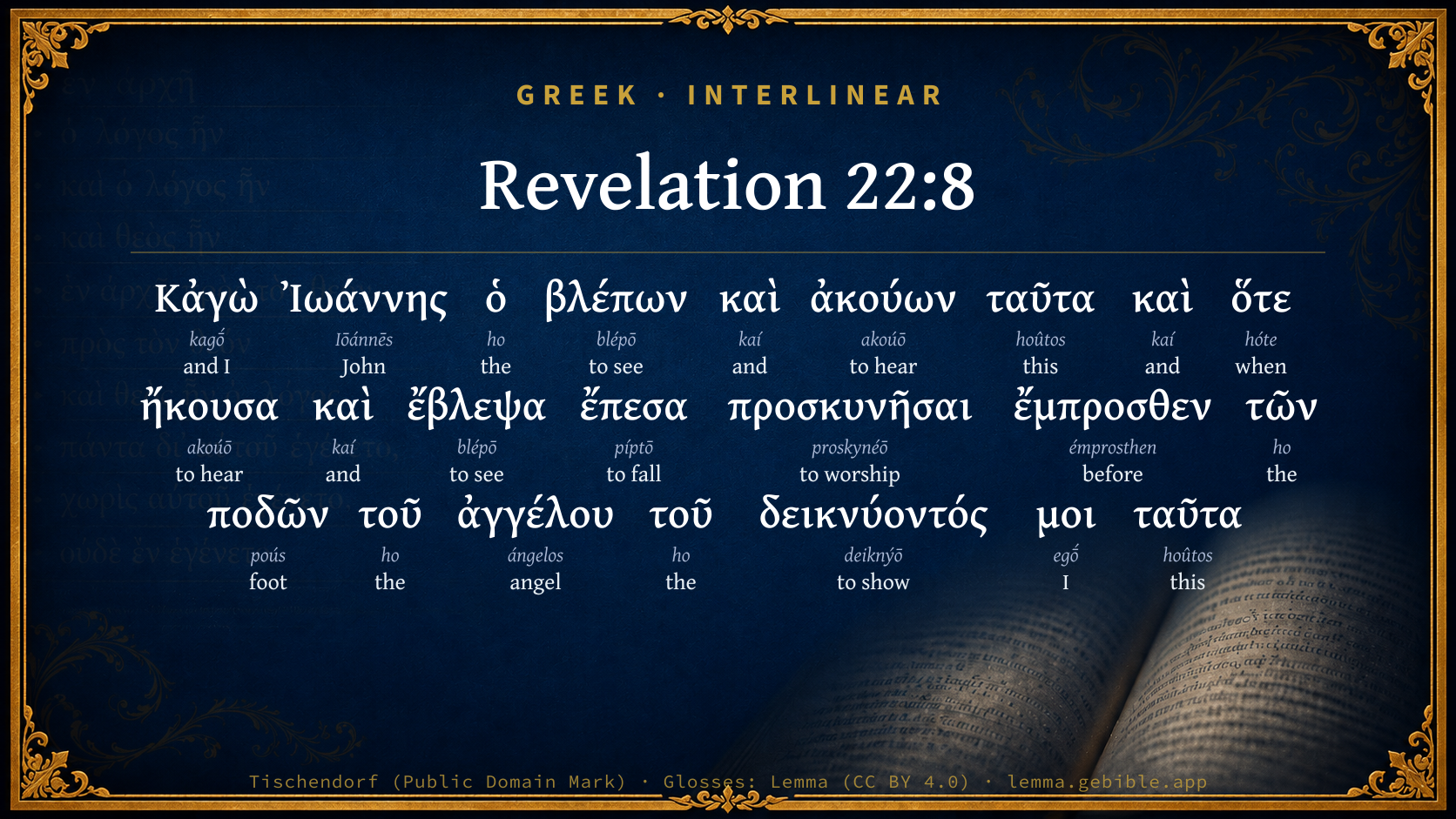
Greek (Tischendorf 8th ed.) Revelation 22:8 appears in the Greek New Testament. The text above is from the Tischendorf 8th edition. Each word links to its Strong’s number and a concise gloss. Click any word for its full Thayer’s Greek Lexicon entry.
Download image
Cite this verse

Revelation 22:8 (World English Bible). Public Domain. Lemma interlinear Bible study tool, https://lemma.gebible.app/v/revelation/22/8.

Show BibTeX & RIS
BibTeX
RIS
English Translation
Now I, John, am the one who heard and saw these things. When I heard and saw, I fell down to worship before the feet of the angel who had shown me these things.
World English Bible · Public Domain
Download a study sheet

One document with this verse’s original text, its word-by-word gloss line, the meaning frame, cross-references with their text, attributed commentary, and full source and license credits — printable, and it pastes into notes with its structure intact.

This verse Autodidact and up

Study sheet (.html) Plain text (.txt)

A passage Seminary Student

Up to 50 verses in one chapter. A passage sheet keeps up to 6 commentary sources and 12 cross-references per verse, in the order this page ranks them, and says so on the sheet whenever that leaves anything out. Ask for a single verse and you get the Autodidact verse sheet above.

Everything on this page stays free to read, with no account — the sheet is a download of what is already on screen, not access to it.

Want to remove ads? Support Godless Engineer
Compare translations 3

The same verse in 3 English versions, stacked beneath the original-language interlinear above. Click any original word for its lexicon entry.

Each is an independent rendering of the whole verse — the interlinear is not word-aligned to these translations.

Highlighted words mark where these versions differ — a whole-verse word diff, not a word-by-word alignment.

  • World English Bible Public Domain
    Now I, John, am the one who heard and saw these things. When I heard and saw, I fell down to worship before the feet of the angel who had shown me these things.
  • King James Version Public Domain
    And I John saw these things, and heard them. And when I had heard and seen, I fell down to worship before the feet of the angel which shewed me these things.
  • unfoldingWord Literal Text CC BY-SA 4.0
    And I, John, the one seeing and hearing these. And when I heard and saw them, I fell down to worship at the feet of the angel showing me these.

unfoldingWord Literal Text — © unfoldingWord, licensed CC BY-SA 4.0. Word-aligned USFM3 via Door43 (git.door43.org/unfoldingWord/en_ult).

Versions to compare (up to 4)

3 of 4 selected

Show all 19 translations

Every available English version of this verse, each an independent rendering of the whole verse.

  • World English Bible Public Domain
    Now I, John, am the one who heard and saw these things. When I heard and saw, I fell down to worship before the feet of the angel who had shown me these things.
  • Berean Standard Bible Public Domain
    And I am John, who heard and saw these things. And when I had heard and seen them, I fell down to worship at the feet of the angel who had shown me these things.
  • Majority Standard Bible Public Domain
    And I, John, am the one who heard and saw these things. And when I had heard and seen them, I fell down to worship at the feet of the angel who had shown me these things.
  • King James Version Public Domain
    And I John saw these things, and heard them. And when I had heard and seen, I fell down to worship before the feet of the angel which shewed me these things.
  • American Standard Version (1901) Public Domain
    And I John am he that heard and saw these things. And when I heard and saw, I fell down to worship before the feet of the angel that showed me these things.
  • Revised Version (1885) Public Domain
    And I John am he that heard and saw these things. And when I heard and saw, I fell down to worship before the feet of the angel which shewed me these things.
  • Geneva Bible (1599) Public Domain
    And I am Iohn, which sawe and heard these thinges: and when I had heard and seene, I fell downe to worship before the feete of the Angell which shewed me these things.
  • Douay-Rheims (1899) Public Domain
    And I, John, who have heard and seen these things. And after I had heard and seen, I fell down to adore before the feet of the angel, who shewed me these things.
  • Young's Literal Translation Public Domain
    And I, John, am he who is seeing these things and hearing, and when I heard and beheld, I fell down to bow before the feet of the messenger who is shewing me these things;
  • Literal Standard Version CC BY-SA 4.0
    And I, John, am he who is seeing these things and hearing, and when I heard and beheld, I fell down to worship before the feet of the messenger who is showing me these things;
  • Unlocked Literal Bible CC BY-SA 4.0
    I, John, am the one who heard and saw these things. When I heard and saw them, I fell down to worship at the feet of the angel who had been showing me these things.
  • unfoldingWord Literal Text CC BY-SA 4.0
    And I, John, the one seeing and hearing these. And when I heard and saw them, I fell down to worship at the feet of the angel showing me these.
  • Darby Bible Public Domain
    And I, John, [was] he who heard and saw these things. And when I heard and saw, I fell down to do homage before the feet of the angel who shewed me these things.
  • World Messianic Bible Public Domain
    Now I, Yochanan, am the one who heard and saw these things. When I heard and saw, I fell down to worship before the feet of the angel who had shown me these things.
  • Webster's Bible Public Domain
    And I John saw these things, and heard them. And when I had heard and seen, I fell down to worship before the feet of the angel who showed me these things.
  • Free Bible Version CC BY-SA 4.0
    I am John who heard and saw all this. When I heard and saw them, I fell down at the feet of the angel who had shown me these things to worship him.
  • Bible in Basic English Public Domain
    And I, John, am he who saw these things and to whose ears they came. And when I had seen and given ear, I went down on my face to give worship at the feet of the angel who made these things clear to me.
  • Text-Critical English NT CC BY 4.0
    I, John, am the one who heard and saw these things. And when I heard and saw them, I fell down to worship at the feet of the angel who showed them to me.
  • Tyndale New Testament (1534) Public Domain
    I am Ihon which sawe these thynges and herde them. And when I had herde and sene I fell doune to worshippe before the fete of the angell which shewed me these thynges.

Literal Standard Version (2020), Covenant Press — licensed CC BY-SA 4.0. Text via the HelloAO Bible API (eBible.org). Unlocked Literal Bible (unfoldingWord) — licensed CC BY-SA 4.0. Text via the HelloAO Bible API (eBible.org). unfoldingWord Literal Text — © unfoldingWord, licensed CC BY-SA 4.0. Word-aligned USFM3 via Door43 (git.door43.org/unfoldingWord/en_ult). Free Bible Version, Dr. Jonathan Gallagher — licensed CC BY-SA 4.0. Text via the HelloAO Bible API (eBible.org).

Word by word

More ways to search: Search by grammar → Find every occurrence → Compare this word →

Practice this passage: Drill this verse → Learn its vocabulary →

δεικνύοντός
deiknýō
G1166
“to show”
Verb, Present, Active, Participle, Genitive, Singular, Masculine
Part of Speech
Verb
Tense
Present
Voice
Active
Mood
Participle
Case
Genitive
Number
Singular
Gender
Masculine
Full Thayer's Definition

Origin: a prolonged form of an obsolete primary of the same meaning

TDNT: 2:25,*

1. to show, expose to the eyes 2. metaph. a. to give evidence or proof of a thing b. to show by words or teach
  1. Κἀγὼ kagṓ G2504 “and I” Personal pronoun, 1st person, Nominative, Singular, Aramaic form
  2. Ἰωάννης Iōánnēs G2491 “John” Noun, Nominative, Singular, Masculine
  3. ὁ ho G3588 “the” Article, Nominative, Singular, Masculine
  4. βλέπων blépō G991 “to see” Verb, Present, Active, Participle, Nominative, Singular, Masculine
  5. καὶ kaí G2532 “and” Conjunction
  6. ἀκούων akoúō G191 “to hear” Verb, Present, Active, Participle, Nominative, Singular, Masculine
  7. ταῦτα hoûtos G3778 “this” Demonstrative pronoun, Accusative, Plural, Neuter
  8. καὶ kaí G2532 “and” Conjunction
  9. ὅτε hóte G3753 “when” Adverb
  10. ἤκουσα akoúō G191 “to hear” Verb, Aorist, Active, Indicative, 1st person, Singular
  11. καὶ kaí G2532 “and” Conjunction
  12. ἔβλεψα blépō G991 “to see” Verb, Aorist, Active, Indicative, 1st person, Singular
  13. ἔπεσα píptō G4098 “to fall” Verb, Aorist, Active, Indicative, 1st person, Singular
  14. προσκυνῆσαι proskynéō G4352 “to worship” Verb, Aorist, Active, Infinitive
  15. ἔμπροσθεν émprosthen G1715 “before” Preposition
  16. τῶν ho G3588 “the” Article, Genitive, Plural, Masculine
  17. ποδῶν poús G4228 “foot” Noun, Genitive, Plural, Masculine
  18. τοῦ ho G3588 “the” Article, Genitive, Singular, Masculine
  19. ἀγγέλου ángelos G32 “angel” Noun, Genitive, Singular, Masculine
  20. τοῦ ho G3588 “the” Article, Genitive, Singular, Masculine
  21. μοι egṓ G1473 “I” Personal pronoun, 1st person, Dative, Singular
  22. ταῦτα hoûtos G3778 “this” Demonstrative pronoun, Accusative, Plural, Neuter

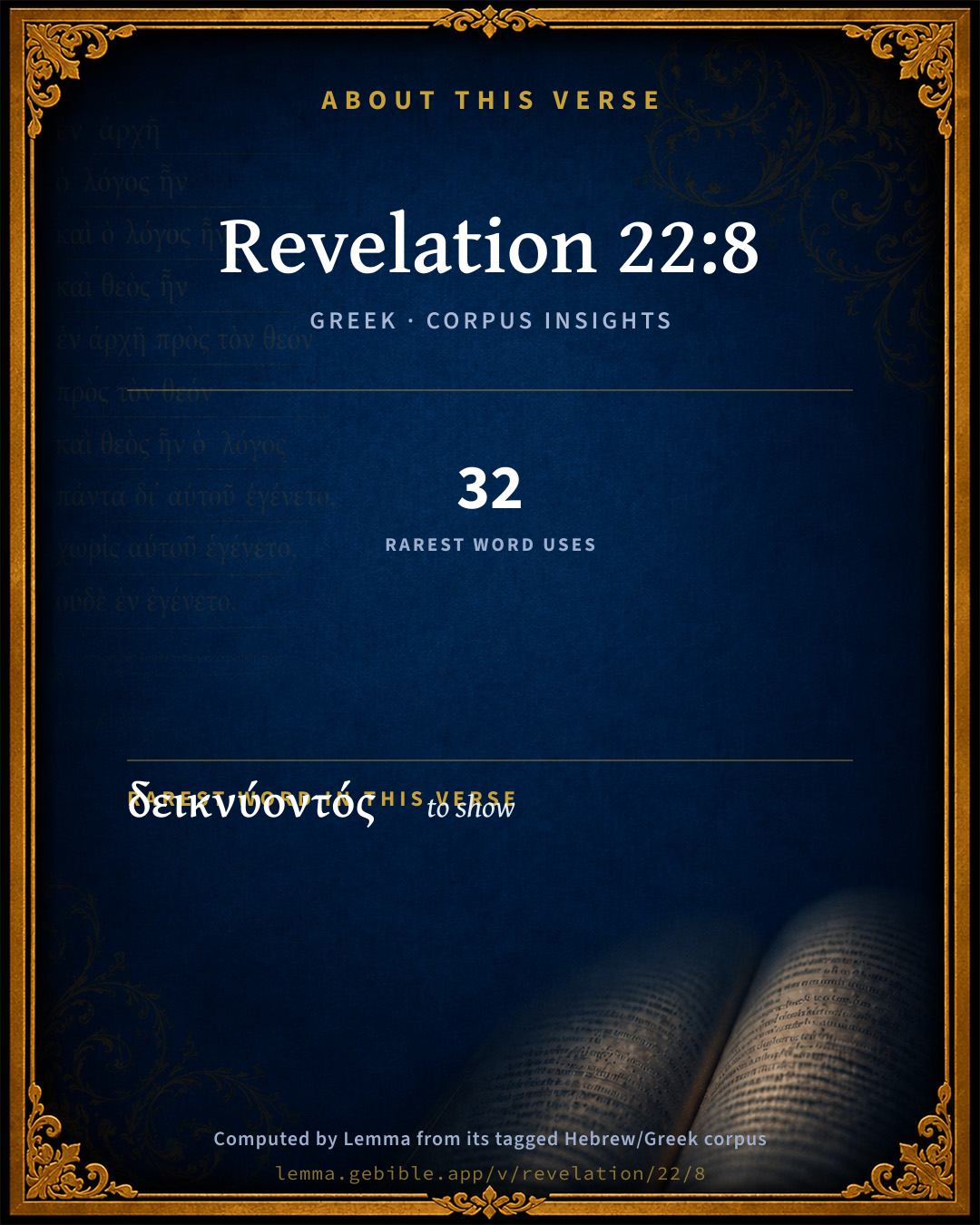
About this verse

These counts appear in no published source. They are computed here, from the morphology-tagged text and Lemma’s own curated glosses. What Lemma adds →

23
words
15
distinct lemmas
Revelation
section

Shared distinctive vocabulary

δεικνύοντός to show G1166 occurs in 30 verses of the Greek New Testament. Also found in:
Repetition

Words recur within this verse:

  • βλέπων to see G991 ×2
  • ἀκούων to hear G191 ×2
  • ὁ the G3588 ×4
  • καὶ and G2532 ×3
  • ταῦτα this G3778 ×2

Cross-references

2

Topical passages linked to Revelation 22:8 in the Treasury of Scripture Knowledge — connected by theme and wording, ordered by reader-vote popularity; previews shown in the World English Bible.

  • Revelation 19:10 I fell down before his feet to worship him. He said to me, "Look! Don't do it! I am a fellow bondservant with you and with your brothers who hold the testimony of Jesus. Worship God, for the testimony of Jesus is the Spirit of Prophecy."
  • Revelation 1:1 This is the Revelation of Jesus Christ, which God gave him to show to his servants the things which must happen soon, which he sent and made known by his angel to his servant, John,

Cross-references courtesy of OpenBible.info (CC BY 4.0).

Commentary

Notes on Revelation 22:8 from classic Christian and Jewish commentators (each source and its license shown beneath its notes). The classic Christian expositions comment on the surrounding passage and are grouped to its opening verse, so a note may address several verses; the Jewish commentaries on the Tanakh (Rashi and others) are per-verse, so they appear only where the commentator wrote on this verse.

Lemma curates 59 commentaries, every one of them public domain or Creative Commons licensed, each selected and text-cleaned for this edition rather than reprinted as found. About our sources →

Joseph Benson's Commentary

Rev 22:8-9. And 1 John saw these things — I, who have committed these revelations to writing for the constant use of the churches, do solemnly declare they are no invention of my own, but what I was an eye and ear witness to, having really seen and heard these things in the prophetic visions granted me, as I have faithfully related them. And when I had heard, I fell down, &c. — And now, my visions appearing to be at an end, I prostrated myself before the angel who had showed me these things — To express the great respect and gratitude I felt for a person who had laid me under such great obligations. See on Rev 19:10. Then saith he, See thou do it not — The expression, as before, in the original is short and elliptical, as is usual in showing vehement aversion: as if the apostle had said, The angel hindered me again, as he had done once before, informing me that I should not consider him as the author of these prophetic visions, but as a fellow-servant of the prophets; and, as such, employed in the service of God with them: all the praise of the church should be therefore given to God alone, who only is to be acknowledged the author of these Revelations, and who only gives the Spirit of prophecy for the encouragement and consolation of the faithful.

Joseph Benson's Commentary on the Old and New Testaments (1811–1818) — public domain. Text from a community e-Sword module.

Tyndale Open Study Notes

Tyndale Open Resources

22:8-9 The earlier warning against false worship (see 19:10) is reiterated when John again falls at the feet of the angel. Only God deserves our worship (cp. John the Baptist in relation to Jesus; John 1:6-8, 26-27; 3:27-35).

Tyndale Open Study Notes — © Tyndale Open Resources, licensed CC BY-SA 4.0. Text via the HelloAO Bible API.

Bengel's Gnomon

Johann Albrecht Bengel

Rev 22:8. [242] Καὶ ἐγὼ, and I) Dionysius of Alexandria construed this also with μακάριος, blessed, Rev 22:7: εἰμὶ, I am, is rather to be understood.

[242] ἀπέστειλε, sent) The conclusion exactly agrees with the introduction of the book.—V. g.

Bengel's Gnomon of the New Testament — English translation (T&T Clark, Edinburgh, 1860) — public domain. Text from a community e-Sword module.

Jamieson, Fausset & Brown

Robert Jamieson, A. R. Fausset & David Brown

Both here and in Rev 19:9-10, the apostle's falling at the feet of the angel is preceded by a glorious promise to the Church, accompanied with the assurance, that "These are the true sayings of God," and that those are "blessed" who keep them. Rapturous emotion, gratitude, and adoration, at the prospect of the Church's future glory transport him out of himself, so as all but to fall into an unjustifiable act; contrast his opposite feeling at the prospect of the Church's deep fall [AUBERLEN], see on Rev 17:6; Rev 19:9-10.

saw . . . and heard--A, B, Vulgate, and Syriac transpose these verbs. Translate literally, "I John (was he) who heard and saw these things." It is observable that in Rev 19:10, the language is, "I fell before his feet to worship him"; but here, "I fell down to worship (God?) before the feet of the angel." It seems unlikely that John, when once reproved, would fall into the very same error again. BENGEL'S view, therefore, is probable; John had first intended to worship the angel (Rev 19:10), but now only at his feet intends to worship (God). The angel does not even permit this.

Jamieson, Fausset & Brown — Commentary Critical and Explanatory on the Whole Bible (1871) — public domain (CC PDM 1.0). Text via the HelloAO Bible API.

Adam Clarke's Commentary

Verse 8. I fell down to worship] I prostrated myself before him as before a superior being, to express my gratitude, and give him thanks for the communications he had made. See on Re 19:10.

Adam Clarke's Commentary on the Bible (1810–1826) — public domain. Text from a community e-Sword/MySword module.

Ellicott's Commentary for English Readers

(8) And I John saw these things . . .—Or rather, And I John am he who hears and sees these things. The words of the angel are confirmed by the words of Christ. Now we have the confirmatory testimony of the seer to the truth of the vision. The declaration reminds us of the opening of the Epistle of St. John: “That which we have seen and heard declare we unto you” (1Jn_1:1-3). It is no mere dream or ingenious fancy of his own that he has recorded; it is a veritable revelation.

And when I had heard . . .—Or better, When I heard and saw, I fell down to worship before the feet of the angel who was showing me these things. Wonder and awe took possession of the seer, and for the second time he was about to offer unlawful homage to the angel-minister. (Comp. Rev_19:10.) This twice offered and twice refused worship is full of teaching. To render to all their due is wise and seemly and Christ-like; to offer exaggerated homage to any is to invert God’s order, and to degrade by pretending to exalt man, whose true glory is that he is God’s creation.

A Bible Commentary for English Readers, edited by Charles John Ellicott (1878–1897) — public domain. Text from a community e-Sword module.

The Cambridge Bible for Schools and Colleges

gen. ed. J. J. S. Perowne

8. And I John saw &c.] Lit. and I John [am] he that saw and heard (or “heard and saw”) these things. It is possible to connect these words with the immediately preceding sentence, regarding it, not as a continuation of the angel’s speech, but as the beginning of St John’s reflexion, “Blessed is he that keepeth the words, &c., and [blessed am] I John, who see and hear these things.” It was so understood by St Dionysius of Alexandria in the third century, and this construction is the easiest and smoothest grammatically. But few modern commentators accept this view: it seems inappropriate to the context.

I fell down to worship] As at Rev_19:10. Some suppose that St John is here repeating his statement of what he did then, but it is far more natural to understand that he did the same again. The words “I come quickly” would even more naturally lead him to think that this angel was “He that is to come,” than the words of that angel (who may or may not have been the same as this) led him to think that he was the God Whose “true sayings” he communicated.

The Cambridge Bible for Schools and Colleges (gen. ed. J. J. S. Perowne; Cambridge University Press, 1878–1918) — public domain. Text from a community e-Sword module.

John Gill's Exposition

And I John saw these things, and heard them,.... He was both an eye and an ear witness; some things he saw, and others he heard; and to render his testimony the more authentic, he puts his name to it; and he being an apostle of Christ, and a man of great sincerity and probity, is to be believed.

And when I had heard and seen; the things related in this book, being amazed at them, and filled with joy on account of many of them, and firmly believing the whole as coming from God:

I fell down to worship before the feet of the angel which showed me these things. This is the second time John did so, though warned of it, and rebuked for it, which shows the proneness even of good men to fall into sin again and again; and what a propensity there is in mankind to idolatry; and very likely this might be suffered, that a second reproof might be given, and repeated instructions be on record, to prevent the worshipping of angels, introduced in the first ages of Christianity.

John Gill's Exposition of the Whole Bible (1746–1763) — public domain (CC PDM 1.0). Text via the HelloAO Bible API.

Trapp's Complete Commentary

John Trapp

8 And I John saw these things, and heard them. And when I had heard and seen, I fell down to worship before the feet of the angel which shewed me these things.

Ver. 8. Saw these things and heard them] So that there is no colour of cause why any one should doubt or distrust such a witness.

I fell down to worship] This is the second time. It is hard to say how often a saint may fall into the same sin; howbeit they sin of incogitancy; put them in mind, and they mend all. They sin of passion, and passions last not long. There is no way of wickedness in them, they make not a trade of it, Psa 139:24.

John Trapp, A Commentary or Exposition upon All the Books of the Old and New Testament (1647–1656) — public domain. Text from a community e-Sword module.

Albert Barnes' Notes on the Bible

And I John saw these things, and heard them - That is, I saw the parts that were disclosed by pictures, visions, and symbols; I heard the parts that were communicated by direct revelation.

And when I had heard and seen, I fell down to worship before the feet of the angel, ... - As he had done on a former occasion. See the notes on Rev 19:10. John appears to have been entirely overcome by the extraordinary nature of the revelations made to him, and not improbably entertained some suspicion that it was the Redeemer himself who had manifested himself to him in this remarkable manner.

Albert Barnes' Notes on the Bible (1834–1885) — public domain. Text from a community e-Sword/MySword module.

Haydock's Catholic Bible Commentary

This is the second time the saint wishes to adore the Angel, but not with the supreme worship of latria, as he knew the object of his worship was only an Angel, and of course a mere creature; but the Angel, through respect for St. John, still refuses the proffered honour, (see Chap. xix. 10.) and to shew the holy society that was hereafter to exist between Angels and men, who were to compose but one and the same family. (Bible de Vence)

George Leo Haydock (1774–1849), Haydock's Catholic Family Bible and Commentary, 1859 edition — public domain. Excludes Psalms (Douay-Rheims chapter numbering differs from Protestant) and Deuterocanonical books (Catholic canon only).

Matthew Poole's English Annotations

I John saw these things; I saw the vision.

And heard them; I heard the words spoken to me relating to them.

Matthew Poole's English Annotations on the Holy Bible (1683–1685) — public domain. Text from a community e-Sword/MySword module.

Whedon's Commentary on the Bible

Daniel D. Whedon

8. Saw… and heard—What God sent his angel to show.

These things—The apocalyptic showings and sayings.

I fell down—Re-narrating here the fact of Rev_19:10, to show that so truly divine seemed this apocalypse that he came near to worshipping the mere messenger that brought it.

Daniel D. Whedon (gen. ed.), Commentary on the Old and New Testaments (1874–1909) — public domain. Text from a community e-Sword module.

The Pulpit Commentary

And I John saw these things, and heard them; literally, and I John am the one hearing and seeing these things. The absence of the verb (the present participle being used alone) indicates the person to whom the revelation is made, without assigning any specific period as the particular time when the revelation took place. The same statement is made in Rev_1:1 (which see). "These things" are all that have been related in the book. And when I had heard and seen, I fell down to worship before the feet of the angel which showed me these things; and when I heard and saw, etc. The tense here becomes aorist (vide supra). St. John has once before fallen into the same error, viz. that of paying undue homage to the angel. (see on Rev_19:10) The beatific vision overwhelms him with awe, and he is bowed down with his own humility.

Vers. 8-10. Glimpses through the barrier: revelation.

"And I John am he that heard and saw these things. And when I heard and saw, I fell down to worship," etc. These verses bring under our notice two or three very suggestive circumstances, which we shall merely state in the briefest; manner.

I ETERNAL REALITIES BROUGHT TO THE CONSCIENCE OF INDIVIDUAL MAN. "And I John am he that heard and saw these things," etc. "I John," the beloved disciple of Christ. "I myself heard and saw these things." How did he hear them? And how did he see them? Was it with the outward ear or with the outward eye? I trow not; for have we not read, the whole was a vision, a kind of dream a long, grotesque, terribly suggestive dream? In truth, all outward Vision and sight are but emblems of the mental faculties of sight and sound which are within us, and which are ever active, voluntarily and involuntarily. What are the creations of poetry, the inventions of romance, and the revellings and riotings of our visions in the night, but sights and sounds? In visions John saw this, as I have elsewhere indicated.

II THE INSTINCT OF WORSHIP WRONGLY DIRECTED. Psychology, as well as the history of our race, show that deep in the centre of our nature is the hunger for worship. Man must have a God, whatever else he may lack. He has been called a worshipping animal. The wonderful things which came within the mind of John seem to have aroused this religious instinct to a passion. "He fell down to worship before the feet of the messenger." Superstition has ever been, and still is, one of the regnant curses of the race.

III THE RECOIL OF GENUINE SAINTS FROM FLATTERY. "See thou do it not," etc. This angel, or messenger, a man, was superior to that vanity which will do everything, almost, to attract attention, to win a cheer or receive an empty compliment. What does he say? "See thou do it not: I am a fellow servant with thee and with thy brethren the prophets, and with them which keep the words of this book: worship God." This genuine saint, whilst he repudiated the idea of being a God, humbly identified himself with truly good men of every order, sphere, and time.

IV THE PRACTICAL ALLEGIANCE OF CHRISTLY MEN TO ONE GOD. "Worship God." What a name! The Cause, Means, and End of all things in the universe but sin. God! The Supreme, not only in might and wisdom, but in all goodness and truth; the one Being in the universe around whom all thoughts and sympathies should revolve in all reverence and devotion.

CONCLUSION. Here, then, are subjects for thought most quickening, elevating, and devout. D.T.

The Pulpit Commentary (1880–1919), ed. H.D.M. Spence-Jones & Joseph S. Exell — public domain. Text from a community e-Sword module.

John Wesley's Explanatory Notes

I fell down to worship at the feet of the angel - The very same words which occur, chap. xix, 10. The reproof of the angel, likewise, See thou do it not, for I am thy fellowservant, is expressed in the very same terms as before. May it not be the very same incident which is here related again? Is not this far more probable, than that the apostle would commit a fault again, of which he had been so solemnly warned before?

John Wesley, Explanatory Notes Upon the Whole Bible (1754–1765) — public domain. Text via the GEBible commentary corpus.

Scofield Reference Notes

C. I. Scofield

angel

(See Scofield "Heb 1:4").

The Scofield Reference Bible (1917 edition), notes by C. I. Scofield — public domain. Text from a community e-Sword module.

The People's New Testament

B. W. Johnson

8, 9. I fell down to worship before the feet of the angel. See on these two verses the notes on 19:10. There John attempts to worship the angel and is prevented. Among the idolatrous tendencies that early showed themselves in the church was angel worship. This not only rebukes it, but the worship of any being, earthly or heavenly, who is not divine.

B. W. Johnson's The People's New Testament with Notes (1889–1891) — public domain. Electronic text from the Christian Classics Ethereal Library (CCEL) ThML edition.

unfoldingWord translationNotes

Door43 World Missions Community

General Information:

John tells his readers about how he responded to the angel.

I fell down to worship at the feet

This means that John purposely lay on the ground and stretched himself out in reverence or submission. This action was an important part of worship, to show respect and willingness to serve. See how you translated similar words in Revelation 19:10.

translationWords

John (the apostle)

angel

worship

servant

brother

prophet

obey

word

unfoldingWord translationNotes — © Distant Shores Media and the Door43 World Missions Community, licensed CC BY-SA 4.0. Source: git.door43.org/Door43/en_tn.

Expositor's Greek Testament

ed. W. Robertson Nicoll

There is no trace of any reluctance on the prophet’s part to return to earth, as in Asc. Isa. (Gk.), 2:33 35.

The Expositor's Greek Testament, edited by W. Robertson Nicoll (1897–1910) — public domain. Text from a community e-Sword module.

Cambridge Greek Testament for Schools and Colleges

8. ἔμπροσθεν τῶν. A has πρό.

8. κἀγὼ Ἰωάννης ὁ ἀκούων καὶ βλέπων ταῦτα. Most modern commentators understand εἰμὶ after κἀγὼ or after Ἰωάννης: “I am that John who …,” or “I John am he who.…” It would be also possible to compare Dan 10:17, Theodotion, καὶ ἐγὼ ἀπὸ τοῦ νῦν οὐ στήσεται ἐν ἐμοὶ ἰσχύς, where A. V[897] translates it, “As for me,” &c.; though καὶ before ὅτε is against this. The context is against the sense which is grammatically easiest, “Blessed is he that keepeth … and[blessed am] I John …,” as though the first clause were not the continuation of the angel’s speech, but the beginning of St John’s reflection. This was the way in which St Dionysius of Alexandria in the third century understood the passage.

[897] Authorised Version.

ἔπεσα προσκυνῆσαι. As at Rev 19:10. Some suppose that St John is here repeating his statement of what he did then, but it is far more natural to understand that he did the same again. The words “I come quickly” would even more naturally lead him to think that this angel was “He that is to come,” than the words of that angel (who may or may not have been the same as this) led him to think that he was the God Whose “true sayings” he communicated.

Cambridge Greek Testament for Schools and Colleges (Cambridge University Press, 1896; 21 vols, various authors incl. Carr, Maclear, Plummer, Farrar, Lumby, Moule, M. R. James, Simcox) — public domain. Text from a community e-Sword module.

Vincent's Word Studies in the New Testament

Marvin R. Vincent

I John saw [εγω ιωαννης ο βλεπων] . The A. V. overlooks the article with the participle - the one seeing. Hence Rev., correctly, I John am he that heard and saw.

Had heard and seen [ηκουσα και εβλεψα] . Aorist tense. There is no need of rendering it as a pluperfect. Rev., rightly, I heard and saw. The appeal to hearing and seeing is common to all John's writings. See Joh 1:14; Joh 19:35; Joh 21:14; I Joh 1:1, 2; Joh 4:14.

Marvin R. Vincent, Word Studies in the New Testament (1887–1900) — public domain. Text from a community e-Sword/MySword module.

Lesson kit

Teaching starters — assembled from the data on this page, not authored interpretation. Every prompt links to the verse data it draws on. Edit before teaching.

Revelation, in the Revelation, opens this verse with 23 words (15 distinct Greek lemmas). Its most distinctive word is deiknýō (“to show”). A historical commentator’s framing appears above. Read the whole chapter for the surrounding context.

Discussion questions

  1. What does “to show” (deiknýō) contribute to the verse as a whole?
  2. How does Matthew 4:8, which shares the word «to show», read alongside this verse?
  3. What does the repetition of “to see” (2× in this one verse) do in this verse?
  4. These translations render this verse differently. What is at stake in choosing one wording over another?
  5. Compare how Joseph Benson's Commentary and Tyndale Open Study Notes read this verse. Where do they agree or differ?

Things to notice

Reading settings

Reading text

Shown beneath each verse's original-language words.

Old Testament
Old Testament edition

Read the OT as the Masoretic Hebrew (MT) or the Greek Septuagint (LXX).

English shown for the Greek Septuagint (in the Hebrew ↔ Greek comparison).

Comparing translations? Open the Compare panel on any verse page to stack up to four side by side.