
Revelation 18:22

Greek (Tischendorf 8th ed.) Revelation 18:22 appears in the Greek New Testament. The text above is from the Tischendorf 8th edition. Each word links to its Strong’s number and a concise gloss. Click any word for its full Thayer’s Greek Lexicon entry.
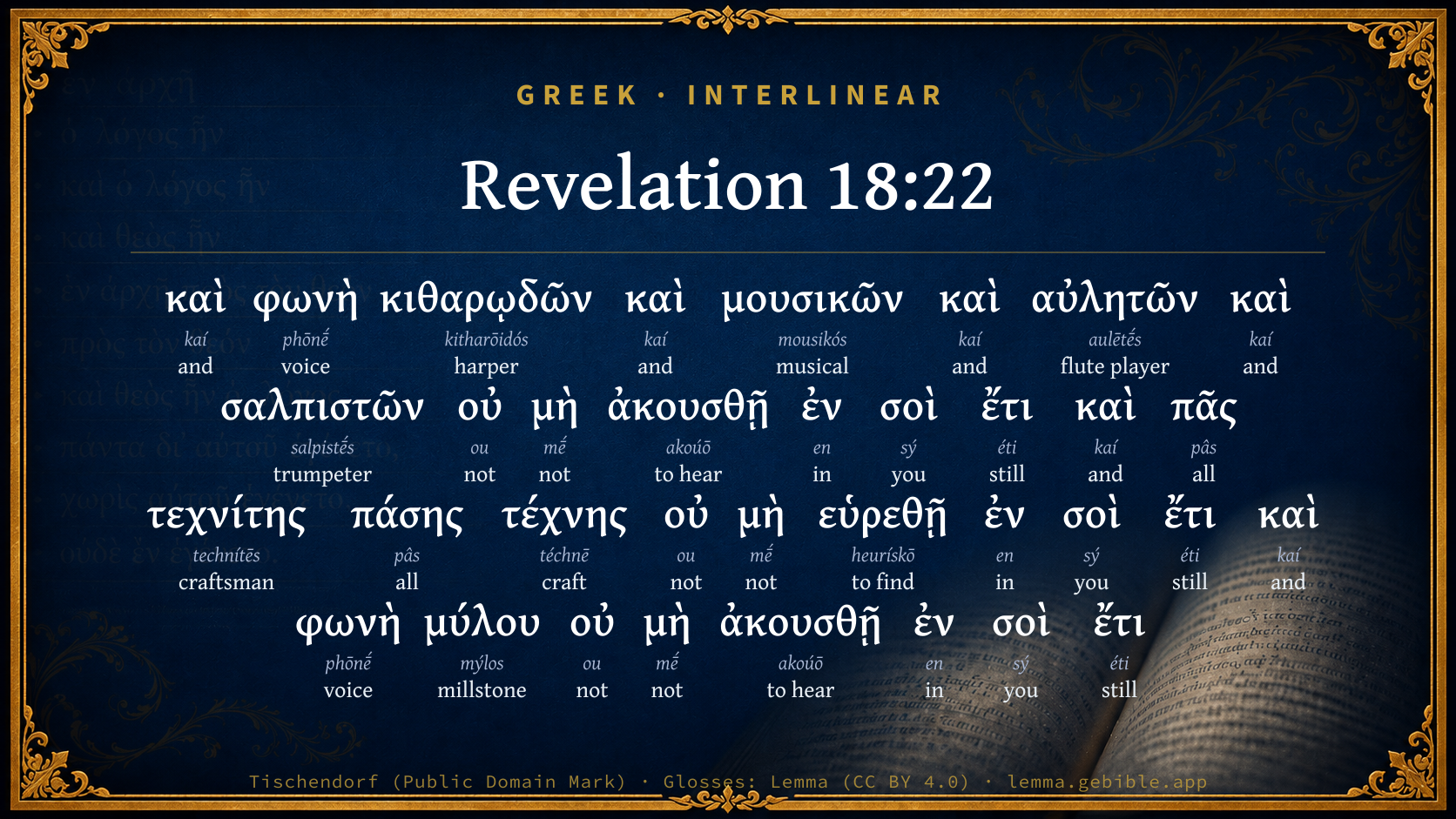
Download image
Cite this verse

Revelation 18:22 (World English Bible). Public Domain. Lemma interlinear Bible study tool, https://lemma.gebible.app/v/revelation/18/22.

Show BibTeX & RIS
BibTeX
RIS
English Translation
The voice of harpists, minstrels, flute players, and trumpeters will be heard no more at all in you. No craftsman, of whatever craft, will be found any more at all in you. The sound of a mill will be heard no more at all in you.
World English Bible · Public Domain
Highlights
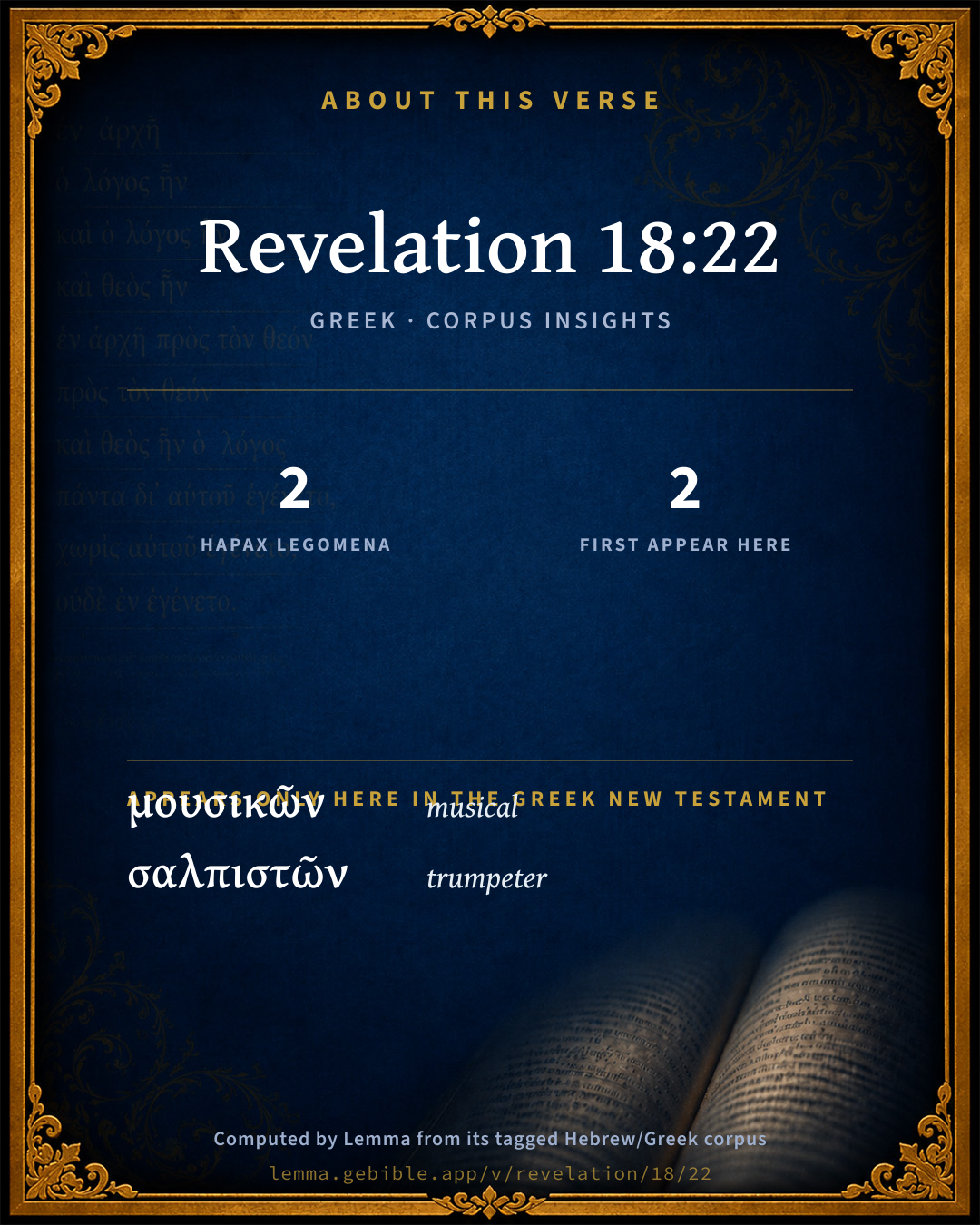
  • 2 hapax legomena — only here in the Greek New Testament
  • 2 first appearances in the Greek New Testament
Full analysis ↓
Download a study sheet

One document with this verse’s original text, its word-by-word gloss line, the meaning frame, cross-references with their text, attributed commentary, and full source and license credits — printable, and it pastes into notes with its structure intact.

This verse Autodidact and up

Study sheet (.html) Plain text (.txt)

A passage Seminary Student

Up to 50 verses in one chapter. A passage sheet keeps up to 6 commentary sources and 12 cross-references per verse, in the order this page ranks them, and says so on the sheet whenever that leaves anything out. Ask for a single verse and you get the Autodidact verse sheet above.

Everything on this page stays free to read, with no account — the sheet is a download of what is already on screen, not access to it.

Want to remove ads? Support Godless Engineer
Compare translations 3

The same verse in 3 English versions, stacked beneath the original-language interlinear above. Click any original word for its lexicon entry.

Each is an independent rendering of the whole verse — the interlinear is not word-aligned to these translations.

Highlighted words mark where these versions differ — a whole-verse word diff, not a word-by-word alignment.

  • World English Bible Public Domain
    The voice of harpists, minstrels, flute players, and trumpeters will be heard no more at all in you. No craftsman, of whatever craft, will be found any more at all in you. The sound of a mill will be heard no more at all in you.
  • King James Version Public Domain
    And the voice of harpers, and musicians, and of pipers, and trumpeters, shall be heard no more at all in thee; and no craftsman, of whatsoever craft he be, shall be found any more in thee; and the sound of a millstone shall be heard no more at all in thee;
  • unfoldingWord Literal Text CC BY-SA 4.0
    and the sound of harpists and musicians and flutists and trumpeters will certainly not be heard in you anymore, and every craftsman will certainly not be found in you anymore, and the sound of a mill will certainly not be heard in you anymore.

unfoldingWord Literal Text — © unfoldingWord, licensed CC BY-SA 4.0. Word-aligned USFM3 via Door43 (git.door43.org/unfoldingWord/en_ult).

Versions to compare (up to 4)

3 of 4 selected

Show all 19 translations

Every available English version of this verse, each an independent rendering of the whole verse.

  • World English Bible Public Domain
    The voice of harpists, minstrels, flute players, and trumpeters will be heard no more at all in you. No craftsman, of whatever craft, will be found any more at all in you. The sound of a mill will be heard no more at all in you.
  • Berean Standard Bible Public Domain
    And the sound of harpists and musicians, of flute players and trumpeters, will never ring out in you again. Nor will any craftsmen of any trade be found in you again, nor the sound of a millstone be heard in you again.
  • Majority Standard Bible Public Domain
    And the sound of harpists and musicians, of flute players and trumpeters, will never ring out in you again. Nor will any craftsmen of any trade be found in you again, nor the sound of a millstone be heard in you again.
  • King James Version Public Domain
    And the voice of harpers, and musicians, and of pipers, and trumpeters, shall be heard no more at all in thee; and no craftsman, of whatsoever craft he be, shall be found any more in thee; and the sound of a millstone shall be heard no more at all in thee;
  • American Standard Version (1901) Public Domain
    And the voice of harpers and minstrels and flute-players and trumpeters shall be heard no more at all in thee; and no craftsman, of whatsoever craft, shall be found any more at all in thee; and the voice of a mill shall be heard no more at all in thee;
  • Revised Version (1885) Public Domain
    And the voice of harpers and minstrels and flute-players and trumpeters shall be heard no more at all in thee; and no craftsman, of whatsoever craft, shall be found any more at all in thee; and the voice of a millstone shall be heard no more at all in thee;
  • Geneva Bible (1599) Public Domain
    And the voyce of harpers, and musicians, and of pipers, and trumpetters shalbe heard no more in thee, and no craftesman, of whatsoeuer craft he be, shall be found any more in thee: and the sound of a milstone shalbe heard no more in thee.
  • Douay-Rheims (1899) Public Domain
    And the voice of harpers, and of musicians, and of them that play on the pipe, and on the trumpet, shall no more be heard at all in thee; and no craftsman of any art whatsoever shall be found any more at all in thee; and the sound of the mill shall be heard no more at all in thee;
  • Young's Literal Translation Public Domain
    and voice of harpers, and musicians, and pipers, and trumpeters, may not be heard at all in thee any more; and any artizan of any art may not be found at all in thee any more; and noise of a millstone may not be heard at all in thee any more;
  • Literal Standard Version CC BY-SA 4.0
    and voice of harpists, and musicians, and pipers, and trumpeters, may not be heard at all in you anymore; and any craftsman of any craft may not be found at all in you anymore; and noise of a millstone may not be heard at all in you anymore;
  • Unlocked Literal Bible CC BY-SA 4.0
    The sound made by harpists, musicians, flute players, and trumpeters will not be heard anymore in you. No craftsman of any kind will be found in you. No sound of a mill will be heard anymore in you.
  • unfoldingWord Literal Text CC BY-SA 4.0
    and the sound of harpists and musicians and flutists and trumpeters will certainly not be heard in you anymore, and every craftsman will certainly not be found in you anymore, and the sound of a mill will certainly not be heard in you anymore.
  • Darby Bible Public Domain
    and voice of harp-singers and musicians and flute-players and trumpeters shall not be heard any more at all in thee, and no artificer of any art shall be found any more at all in thee, and voice of millstone shall be heard no more at all in thee,
  • World Messianic Bible Public Domain
    The voice of harpists, minstrels, flute players, and trumpeters will be heard no more at all in you. No craftsman of whatever craft will be found any more at all in you. The sound of a mill will be heard no more at all in you.
  • Webster's Bible Public Domain
    And the voice of harpers, and musicians, and of pipers, and trumpeters, shall be no more heard in thee; and no artificer, of whatever craft he be, shall be found any more in thee; and the sound of a millstone shall be no more heard in thee;
  • Free Bible Version CC BY-SA 4.0
    “Never again will anyone hear music in you: the sound of harps, singers, flutes, and trumpets. Never again will craftsmen of any trade work in you. Never again will the sound of a mill be heard in you.
  • Bible in Basic English Public Domain
    And the voice of players and makers of music will never again be sounding in you: and no worker, expert in art, will ever again be living in you; and there will be no sound of the crushing of grain any more at all in you;
  • Text-Critical English NT CC BY 4.0
    The sound of harpists, musicians, flutists, and trumpeters will never be heard in yoʋ again. No craftsman of any trade will ever be found in yoʋ again. The sound of a mill will never be heard in yoʋ again.
  • Tyndale New Testament (1534) Public Domain
    And the voyce of harpers and musicions and of pypers and trompetters shalbe herde no more in the: and no craftes man of whatsoever craft he be shalbe founde eny more in the. and the soude of a myll shalbe herde no more in the

Literal Standard Version (2020), Covenant Press — licensed CC BY-SA 4.0. Text via the HelloAO Bible API (eBible.org). Unlocked Literal Bible (unfoldingWord) — licensed CC BY-SA 4.0. Text via the HelloAO Bible API (eBible.org). unfoldingWord Literal Text — © unfoldingWord, licensed CC BY-SA 4.0. Word-aligned USFM3 via Door43 (git.door43.org/unfoldingWord/en_ult). Free Bible Version, Dr. Jonathan Gallagher — licensed CC BY-SA 4.0. Text via the HelloAO Bible API (eBible.org).

Word by word

More ways to search: Search by grammar → Find every occurrence → Compare this word →

Practice this passage: Drill this verse → Learn its vocabulary →

μουσικῶν
mousikós
G3451
“musical”
Adjective, Genitive, Plural, Masculine
Part of Speech
Adjective
Case
Genitive
Number
Plural
Gender
Masculine
Full Thayer's Definition

Origin: from Mousa (a Muse)

TDNT: None

1. devoted to and skilled in the arts sacred to the muses 2. accomplished in the liberal arts 3. specifically, skilled in music 4. playing on musical instruments
  1. καὶ kaí G2532 “and” Conjunction
  2. φωνὴ phōnḗ G5456 “voice” Noun, Nominative, Singular, Feminine
  3. κιθαρῳδῶν kitharōidós G2790 “harper” Noun, Genitive, Plural, Masculine
  4. καὶ kaí G2532 “and” Conjunction
  5. καὶ kaí G2532 “and” Conjunction
  6. αὐλητῶν aulētḗs G834 “flute player” Noun, Genitive, Plural, Masculine
  7. καὶ kaí G2532 “and” Conjunction
  8. σαλπιστῶν salpistḗs G4538 “trumpeter” Noun, Genitive, Plural, Masculine
  9. οὐ ou G3756 “not” Particle, Negative
  10. μὴ mḗ G3361 “not” Particle, Negative
  11. ἀκουσθῇ akoúō G191 “to hear” Verb, Aorist, Passive, Subjunctive, 3rd person, Singular
  12. ἐν en G1722 “in” Preposition
  13. σοὶ sý G4771 “you” Personal pronoun, 2nd person, Dative, Singular
  14. ἔτι éti G2089 “still” Adverb
  15. καὶ kaí G2532 “and” Conjunction
  16. πᾶς pâs G3956 “all” Adjective, Nominative, Singular, Masculine
  17. τεχνίτης technítēs G5079 “craftsman” Noun, Nominative, Singular, Masculine
  18. πάσης pâs G3956 “all” Adjective, Genitive, Singular, Feminine
  19. τέχνης téchnē G5078 “craft” Noun, Genitive, Singular, Feminine
  20. οὐ ou G3756 “not” Particle, Negative
  21. μὴ mḗ G3361 “not” Particle, Negative
  22. εὑρεθῇ heurískō G2147 “to find” Verb, Aorist, Passive, Subjunctive, 3rd person, Singular
  23. ἐν en G1722 “in” Preposition
  24. σοὶ sý G4771 “you” Personal pronoun, 2nd person, Dative, Singular
  25. ἔτι éti G2089 “still” Adverb
  26. καὶ kaí G2532 “and” Conjunction
  27. φωνὴ phōnḗ G5456 “voice” Noun, Nominative, Singular, Feminine
  28. μύλου mýlos G3458 “millstone” Noun, Genitive, Singular, Masculine
  29. οὐ ou G3756 “not” Particle, Negative
  30. μὴ mḗ G3361 “not” Particle, Negative
  31. ἀκουσθῇ akoúō G191 “to hear” Verb, Aorist, Passive, Subjunctive, 3rd person, Singular
  32. ἐν en G1722 “in” Preposition
  33. σοὶ sý G4771 “you” Personal pronoun, 2nd person, Dative, Singular
  34. ἔτι éti G2089 “still” Adverb

About this verse

These counts appear in no published source. They are computed here, from the morphology-tagged text and Lemma’s own curated glosses. What Lemma adds →

35
words
17
distinct lemmas
Revelation
section

Notable vocabulary

2 hapax legomena — words that appear only here in the entire Greek New Testament:

  • μουσικῶν musical G3451
  • σαλπιστῶν trumpeter G4538

First appearance in Scripture

These words make their first canonical appearance in the Greek New Testament here:

  • μουσικῶν musical G3451
  • σαλπιστῶν trumpeter G4538

Shared distinctive vocabulary

κιθαρῳδῶν harper G2790 occurs in 2 verses of the Greek New Testament. Also found in:
Repetition

Words recur within this verse:

Cross-references

7

Topical passages linked to Revelation 18:22 in the Treasury of Scripture Knowledge — connected by theme and wording, ordered by reader-vote popularity; previews shown in the World English Bible.

  • Ezekiel 26:13 I will cause the noise of your songs to cease; and the sound of your harps shall be no more heard.
  • Jeremiah 25:10 Moreover I will take from them the voice of mirth and the voice of gladness, the voice of the bridegroom and the voice of the bride, the sound of the millstones, and the light of the lamp.
  • Jeremiah 7:34 Then will I cause to cease from the cities of Judah, and from the streets of Jerusalem, the voice of mirth and the voice of gladness, the voice of the bridegroom and the voice of the bride; for the land shall become a waste.
  • Jeremiah 16:9 For thus says Yahweh of Hosts, the God of Israel: Behold, I will cause to cease out of this place, before your eyes and in your days, the voice of mirth and the voice of gladness, the voice of the bridegroom and the voice of the bride.
  • Isaiah 24:8–9 The mirth of tambourines ceases, the noise of those who rejoice ends, the joy of the harp ceases.
  • Ecclesiastes 12:4 And the doors shall be shut in the street; When the sound of the grinding is low, And one shall rise up at the voice of a bird, And all the daughters of music shall be brought low;
  • Jeremiah 33:11 the voice of joy and the voice of gladness, the voice of the bridegroom and the voice of the bride, the voice of those who say, Give thanks to Yahweh of Hosts, for Yahweh is good, for his loving kindness endures forever; [and of them] who bring [sacrifices of] thanksgiving into the house of Yahweh. For I will cause the captivity of the land to return as at the first, says Yahweh.

Cross-references courtesy of OpenBible.info (CC BY 4.0).

Commentary

Notes on Revelation 18:22 from classic Christian and Jewish commentators (each source and its license shown beneath its notes). The classic Christian expositions comment on the surrounding passage and are grouped to its opening verse, so a note may address several verses; the Jewish commentaries on the Tanakh (Rashi and others) are per-verse, so they appear only where the commentator wrote on this verse.

Lemma curates 59 commentaries, every one of them public domain or Creative Commons licensed, each selected and text-cleaned for this edition rather than reprinted as found. About our sources →

Joseph Benson's Commentary

Rev 18:22-24. The voice of harpers — Players on stringed instruments; and musicians — Skilful singers in particular; and pipers — Who played on flutes, chiefly on mournful, whereas trumpeters played on joyful occasions; shall be heard no more at all in thee; and no craftsman — Greek, τεχνιτης ωασης τεχνης, no artificer, of whatever art. Arts of every kind, particularly music, sculpture, painting, and statuary, were there carried to their greatest height. No, nor even the sound of a mill-stone shall be heard any more in thee — Not only the arts that adorn life, but even those employments without which it cannot subsist, will cease from thee for ever: all which expressions denote absolute and eternal desolation. There shall be no more musicians for the entertainment of the rich and great; no more tradesmen or artificers to employ those of the middle ranks, and to furnish the conveniences of life; no more servants or slaves to grind at the mill, prepare bread, and supply the necessaries of life. Nay, there shall be no more lights, no more bridal songs: that is, no more marriages, in which lamps and songs were known ceremonies; and therefore the city shall never be peopled again, but shall remain depopulated and desolate for ever. The desolation of Rome is therefore described in such a manner as to show that neither rich nor poor, neither persons of middle rank nor those of the lowest condition, should be able to live there any more. For thy merchants were the great men of the earth — A circumstance which was in itself indifferent, and yet led them into pride, luxury and numberless other sins. For by thy sorceries were all nations deceived — That is, poisoned by thy pernicious practices. So that the reasons assigned for her utter desolation are her pride and luxury, her superstition and idolatry, with various other vices; and especially her cruel persecutions of God’s saints and servants: for it is added, In her was found the blood of prophets, &c. — These seem to be the words of St. John: and of all that were slain upon the earth — As if he had said, Her punishment shall be as severe and exemplary as if she had been guilty of all the persecutions that ever were upon account of religion; for by her conduct she hath approved, and imitated, and surpassed them all. Certainly there is no city under the sun which has so clear a title to general blood-guiltiness as Rome. The guilt of the blood shed under the heathen emperors was not removed under the popes, but hugely multiplied. Nor is Rome accountable only for what hath been shed in the city, but for that shed in all the earth. For at Rome, under the popes, as well as under the heathen emperors, were the bloody orders and edicts given: and wherever the blood of holy men was shed, there were the grand rejoicings for it. And what immense quantities of blood have been shed by her agents! Charles IX. of France, in his letter to Gregory XIII., boasts that in, and not long after, the massacre of Paris, he had destroyed seventy thousand Huguenots. Some have computed that, from the year 1518 to 1548, fifteen millions of Protestants perished by war and the inquisition. This may be overcharged; but certainly the number of them in those thirty years, as well as since, is almost incredible. To these we may add innumerable martyrs in ancient, middle, and late ages, — in Bohemia, Germany, Holland, France, England, Ireland, and many other parts of Europe, Africa, and Asia.

Now this tyrannical cruelty exercised against God’s saints, apostles, and prophets being considered, we cannot wonder that the sentence of so terrible a desolation and destruction should be passed on this persecuting city. But the reader must observe, Rome hath never yet been depopulated and desolated in this manner. She hath been taken indeed and plundered by Alaric, king of the Visigoths, in the year 410; by Genseric, king of the Vandals, in the year 455; by Totilas, king of the Ostrogoths, in the year 546; and by others since that time: but yet she is still standing and flourishing, and is honoured by many nations as the metropolis of the Christian world; she still resounds with singers and musicians; she still excels in arts, which serve to pomp and luxury; she still abounds with candles, and lamps, and torches, burning even by day as well as by night: and consequently this prophecy hath not yet been, but remaineth still to be, fulfilled.

Joseph Benson's Commentary on the Old and New Testaments (1811–1818) — public domain. Text from a community e-Sword module.

Bengel's Gnomon

Johann Albrecht Bengel

Rev 18:22. [206] Μουσικῶν) of musicians, that is, singers: for these are the chief [part of musicians]. שרים, LXX. μουσικοὶ, Gen 31:27; Eze 26:13.—τεχνίτης, craftsman) Nowhere do the arts of painting, sculpture, etc., together with music, flourish more than at Rome: as the Topographies and Itineraries show; for instance, Keyssler’s, Part i. Ep. 49, etc.

[206] Ver. 21. οὕτως, thus) This word is a proof that this prophecy is not yet fulfilled.—V. g.

Bengel's Gnomon of the New Testament — English translation (T&T Clark, Edinburgh, 1860) — public domain. Text from a community e-Sword module.

Expositor's Greek Testament

ed. W. Robertson Nicoll

Rev 18:22 . μουσικῶν “minstrels or musicians” ( 1Ma 9:41 ); the occurrence of the generic term among the specific is certainly awkward and would favour the rendering “singers” (Bengel, Holtzm.) in almost any other book than this. On these musical epithets see Friedländer, iii. 238 f.; the impulses to instrumental music at Rome during this period came mainly from Alexandria. For coins stamped with Nero as harpist see Suet. Nero , xxv. φωνὴ μύλου , the daily accompaniment of Oriental life. The sound of the mill meant habitation, but in the desolation of Rome no more pleasant stir of mirth or business would be heard (Isa 47:5 ). The fanatic Jesus, son of Ananus, who howled during the siege of Jerusalem and for four years previously (Jos. Bell . vi. 5, 3) “woe to Jerusalem,” denounced upon her “a voice from the east, a voice from the west, a voice from the four winds, a voice against Jerusalem and the temple a voice against bridegrooms and brides, and a voice against the whole people”.

The Expositor's Greek Testament, edited by W. Robertson Nicoll (1897–1910) — public domain. Text from a community e-Sword module.

Geneva Bible (1599)

Geneva Bible translators

The events are two, the one of them opposite unto the other for amplification sake. There shall be, saith he, in Babylon no mirth nor joy at all, in this and the next verse, but all heavy and lamentable things from the bloody slaughters of the righteous and the vengeance of God coming upon it for the same.

Geneva Bible (1599) marginal notes — public domain. Text via Bolls.life.

Jamieson, Fausset & Brown

Robert Jamieson, A. R. Fausset & David Brown

pipers--flute players. "Musicians," painters and sculptors, have desecrated their art to lend fascination to the sensuous worship of corrupt Christendom.

craftsman--artisan.

Jamieson, Fausset & Brown — Commentary Critical and Explanatory on the Whole Bible (1871) — public domain (CC PDM 1.0). Text via the HelloAO Bible API.

Adam Clarke's Commentary

Verse 22. The voice of harpers, &c.] This seems to indicate not only a total destruction of influence, &c., but also of being. It seems as if this city was to be swallowed up by an earthquake, or burnt up by fire from heaven.

Adam Clarke's Commentary on the Bible (1810–1826) — public domain. Text from a community e-Sword/MySword module.

Ellicott's Commentary for English Readers

(22, 23) And the voice of harpers . . .—Better, the sound, . . The sounds of mirth and triumph, &c., cease: the sound of harpers, and musicians, and flute-players, and trumpeters, shall not be heard in thee ANY MORE: the power of wealth has gone; her own right hand has forgotten her cunning: every craftsman of every craft shall not be found in thee ANY MORE: the sound of grinding the corn is at an end: the sound of millstone shall not be heard in thee ANY MORE: the cheerful lamps of home and feast are extinguished: light of lamp shall not shine in thee ANY MORE: the sounds of domestic joy are silenced: voice of bridegroom and of bride shall not be heard in thee ANY MORE. The words are an echo of earlier prophecy: “I destroy from them the voice of mirth, and the voice of gladness, the voice of the bridegroom and the voice of the bride, the sound of the millstones, and the light of the candle.” It was thus Jeremiah warned Jerusalem of her coming doom (Jer_25:10). Now the same judgments are pronounced against the foe of the true Jerusalem.

A Bible Commentary for English Readers, edited by Charles John Ellicott (1878–1897) — public domain. Text from a community e-Sword module.

The Cambridge Bible for Schools and Colleges

gen. ed. J. J. S. Perowne

22. the voice of harpers &c.] Isa_14:11, of Babylon, Eze_26:13, of Tyre, are certainly parallels: compare also Isa_24:8, which is as similar as the passages of Jeremiah referred to on the following passage, and apparently, like them, spoken of the unfaithful Jerusalem.

the sound of a millstone &c.] Jer_25:10.

The Cambridge Bible for Schools and Colleges (gen. ed. J. J. S. Perowne; Cambridge University Press, 1878–1918) — public domain. Text from a community e-Sword module.

John Gill's Exposition

And the light of a candle shall shine no more at all in thee,.... Either for common use, or at feasts, or at marriages, which being kept at night, required candies, lamps, or torches; this shows that Babylon, or Rome, shall be deprived of everything, even of the least thing that is comfortable in life; see Jer 25:10 this will be a just punishment upon her for her abuse of this blessing of life; so where wax candles in great numbers have been burning in the daytime, there will not be so much as a single candle to give light in the night; and where candles have been lighted up for the dead, there will not be one for the use of the living:

and the voice of the bridegroom and of the bride shall be heard no more at all in thee: there will be no marrying, nor giving in marriage; no procreation of children, or propagation of posterity, in this place; which denotes the utter extirpation of the inhabitants of it; the phrases are taken from Jer 7:34 Jer 25:10 and this will be in righteous retaliation for the prohibition of marriage; which God has instituted, and is honourable, Ti1 4:2 the reasons of Babylon's destruction follow:

for thy merchants were the great men of the earth: in allusion to the merchants of Tyre, said to be princes, Isa 23:8 for by trading and dealing in the wares and merchandise of Rome, persons of mean extract, and of very low circumstances of life, have grown exceeding rich, and have equalled the princes of the earth; as for instance, Cardinal Wolsey here in England, a butcher's son at Ipswich; and on the other hand, the princes and great men of the earth have become Rome's merchants, and have thought it an high honour to get a cardinal's hat, as the Cardinals Albertus duke of Austria, Bourbon, Pool, and others, mentioned by Brightman:

for by thy sorceries were all nations deceived; meaning her false doctrines, traditions, idolatry, superstition, and will worship, with which, as another Jezebel, she has bewitched, allured, and deceived the nations of the empire, and the kings thereof, Rev 18:3.

John Gill's Exposition of the Whole Bible (1746–1763) — public domain (CC PDM 1.0). Text via the HelloAO Bible API.

Trapp's Complete Commentary

John Trapp

22 And the voice of harpers, and musicians, and of pipers, and trumpeters, shall be heard no more at all in thee; and no craftsman, of whatsoever craft he be, shall be found any more in thee; and the sound of a millstone shall be heard no more at all in thee;

Ver. 22. And the voice of harpers, &c.] Thine organs and sackbuts, thy chanting and churchmusic, shall cease.

And the sound of a millstone] Anciently they used handmills, which did make a great noise in the cities, as Diodate here noteth.

John Trapp, A Commentary or Exposition upon All the Books of the Old and New Testament (1647–1656) — public domain. Text from a community e-Sword module.

Albert Barnes' Notes on the Bible

And the voice of harpers - Those who play on the harp. This was usually accompanied with singing. The idea, in this verse and the following, is substantially the same as in the previous parts of the chapter, that the mystical Babylon - papal Rome - would be brought to utter desolation. This thought is here exhibited under another form - that all which constituted festivity, joy, and amusement, and all that indicated thrift and prosperity, would disappear. Of course, in a great and “fun” city, there would be all kinds of music; and when it is said that this would be heard there no more it is a most striking image of utter desolation.

And musicians - Musicians in general; but perhaps here singers, as distinguished from those who played on instruments.

And of pipers - Those who played on pipes or flutes. See the 1Co 14:7 note; Mat 11:17 note.

And trumpeters - Trumpets were common instruments of music, employed on festival occasions, in war, and in worship. Only the principal instruments of music are mentioned here, as representatives of the rest. The general idea is, that the sound of music, as an indication of festivity and joy, would cease.

Shall be heard no more at all in thee - It would become utterly and permanently desolate.

And no craftsman, of whatsoever craft - That is, artificers of all kinds would cease to ply their trades there. The word used here - τεχνίτης technitēs - would include all artisans or mechanics, all who were engaged in any kind of trade or craft. The meaning here is, that all these would disappear, an image, of course, of utter decay.

And the sound of a millstone shall be heard no more - Taylor (Frag. to Calmet, Dictionary vol. iv. p. 346) supposes that this may refer not so much to the rattle of the mill as to the voice of singing, which usually accompanied grinding. The sound of a mill is cheerful, and indicates prosperity; its ceasing is an image of decline.

Albert Barnes' Notes on the Bible (1834–1885) — public domain. Text from a community e-Sword/MySword module.

Matthew Poole's English Annotations

And the voice of harpers, &c., shall be heard no more at all in thee; all these seem to me but the expression of an utter ruin and desolation, by various phrases and expressions; they should have no more occasion of mirth, nor any more business done in their city. If any will understand these expressions, of their organs, and other musical instruments used in worship, and of spiritual craftsmen, I shall not contradict it; but I think it more proper to understand the words more largely.

For thy merchants were the great men of the earth; for by thy sorceries were all nations deceived: though thou hast had a trade with great men, and by thy enchanted cups of the wine of thy fornication hast intoxicated many in all nations, yet thou shalt use that trade no more; the nations shall be deceived no more by thee; here shall be an end of thee. And one thing that brings thee to thy ruin, shall be thy seducing others to idolatry, so as they have seemed to reasonable men to be bewitched by thee.

Matthew Poole's English Annotations on the Holy Bible (1683–1685) — public domain. Text from a community e-Sword/MySword module.

Whedon's Commentary on the Bible

Daniel D. Whedon

22. The three silences—of music, of manufacture, and of sustenance. Harpers, on the chords; musicians, vocalists; pipers, flute-players; trumpeters, with rousing martial music.

Craftsman… craft he be— Literally, the artisan of every art.

Sound—Greek, voice of the personified millstone.

Daniel D. Whedon (gen. ed.), Commentary on the Old and New Testaments (1874–1909) — public domain. Text from a community e-Sword module.

The Pulpit Commentary

And the voice of harpers, and musicians, and of pipers, and trumpeters, shall be heard no more at all in thee; harpers and minstrels and flute players, etc. (Revised Version). Cf. the description of the desolation of Tyre in Eze_26:13 and Isa_24:8. And no craftsman, of whatsoever craft he be, shall be found any more in thee. "Every craft" is omitted in a, A. (On the last phrase, see on ver. 21) And the sound of a millstone shall be heard no more at all in thee. This passage, together with the following verse, is founded on Jer_25:10.

The Pulpit Commentary (1880–1919), ed. H.D.M. Spence-Jones & Joseph S. Exell — public domain. Text from a community e-Sword module.

John Wesley's Explanatory Notes

And the voice of harpers - Players on stringed instruments. And musicians - Skilful singers in particular. And pipers - Who played on flutes, chiefly on mournful, whereas trumpeters played on joyful, occasions. Shall be heard no more in thee; and no artificer - Arts of every kind, particularly music, sculpture, painting, and statuary, were there carried to their greatest height. No, nor even the sound of a mill-stone shall be heard any more in thee - Not only the arts that adorn life, but even those employments without which it cannot subsist, will cease from thee forever. All these expressions denote absolute and eternal desolation. The voice of harpers - Music was the entertainment of the rich and great; trade, the business of men of middle rank; preparing bread and the necessaries of life, the employment of the lowest people: marriages, in which lamps and songs were known ceremonies, are the means of peopling cities, as new births supply the place of those that die. The desolation of Rome is therefore described in such a manner, as to show that neither rich nor poor, neither persons of middle rank, nor those of the lowest condition, should be able to live there any more. Neither shall it be repeopled by new marriages, but remain desolate and uninhabited forever.

John Wesley, Explanatory Notes Upon the Whole Bible (1754–1765) — public domain. Text via the GEBible commentary corpus.

Scofield Reference Notes

C. I. Scofield

voice

Cf. Isa 24:8 contra, Rev 14:1-3.

The Scofield Reference Bible (1917 edition), notes by C. I. Scofield — public domain. Text from a community e-Sword module.

The People's New Testament

B. W. Johnson

22. And the voice of harpers. It is this third angel who declares the silence and desolation of the city now. And the sound of the millstone. In the mills grinding food for the people. The mills were hand-mills, usually worked by women as a domestic duty.

B. W. Johnson's The People's New Testament with Notes (1889–1891) — public domain. Electronic text from the Christian Classics Ethereal Library (CCEL) ThML edition.

Cambridge Greek Testament for Schools and Colleges

22. πάσης τέχνης. אA cop[681] omit.

[681] Coptic.

μύλον. C has μύθον.

22. φωνὴ κιθαρῳδῶν. Isa 14:11, of Babylon, Eze 26:13, of Tyre, are certainly parallels: compare also Isa 24:8, which is as similar as the passages of Jeremiah referred to on the following verse, and apparently, like them, spoken of the unfaithful Jerusalem.

φωνὴ μύλου οὐ. Jer 25:10.

Cambridge Greek Testament for Schools and Colleges (Cambridge University Press, 1896; 21 vols, various authors incl. Carr, Maclear, Plummer, Farrar, Lumby, Moule, M. R. James, Simcox) — public domain. Text from a community e-Sword module.

Vincent's Word Studies in the New Testament

Marvin R. Vincent

Harpers. See on ch. Rev 14:2.

Musicians [μουσικων] Only here in the New Testament. There seems to be no special reason for changing the rendering to minstrels, as Rev. The term music had a much wider signification among the Greeks than that which we attach to it. "The primitive education at Athens consisted of two branches : gymnastics for the body, music for the mind. Music comprehended from the beginning everything appertaining to the province of the nine Muses; not merely learning the use of the lyre or how to bear part in a chorus, but also the hearing, learning, and repeating of poetical compositions, as wel as the practice of exact and elegant pronunciation - which latter accomplishment, in a language like the Greek, with long words, measured syllables, and great diversity of accentuation between one word and another, must have been far more difficult to acquire than it is in any modern European language. As the range of ideas enlarged, so the words music and musical teachers acquired an expanded meanings so as to comprehend matter of instruction at once ampler and more diversified. During the middle of the fifth century B. C. at Athens, there came thus to be found among the musical teachers men of the most distinguished abilities and eminence, masters of all the learning and accomplishments of the age, teaching what was known of Astronomy, Geography, and Physics, and capable of holding dialectical discussions with their pupils upon all the various problems then afloat among intellectual men" (Grote, "History of Greece," 6, ch. 67).

Pipers [αυλητων] . Rev., flute - players. Only here and Mt 9:23. The female flute - players, usually dissolute characters, were indispensable attendants at the Greek banquets. Plato makes Eryximachus in "the Symposium," say : "I move that the flute - girl who has just made her appearance, be told to go away and play to herself, or, if she likes, to the women who are within. Today let us have conversation instead" (" Symposium, "176). Again, Socrates says :" The talk about the poets seems to me like a commonplace entertainment to which a vulgar company have recourse; who, because they are not able to converse and amuse one another, while they are drinking, with the sound of their own voices and conversation, by reason of their stupidity, raise the price of flute - girls in the market, hiring for a great sum the voice of a flute instead of their own breath, to be the medium of intercourse among them "(Protagoras," 347). Compare Isa 24:8; Eze 26:13.

Millstone. Compare Jer 25:10; Mt 24:41.

Marvin R. Vincent, Word Studies in the New Testament (1887–1900) — public domain. Text from a community e-Sword/MySword module.

Lesson kit

Teaching starters — assembled from the data on this page, not authored interpretation. Every prompt links to the verse data it draws on. Edit before teaching.

Revelation, in the Revelation, opens this verse with 35 words (17 distinct Greek lemmas). Its most distinctive word is mousikós (“musical”). A historical commentator’s framing appears above. Read the whole chapter for the surrounding context.

Discussion questions

  1. How does “musical” (mousikós) shape what this verse is saying?
  2. This verse holds 2 words here found nowhere else in the Greek New Testament. What might the rare words draw attention to?
  3. 2 words here appear for the first time in Scripture. What is being introduced at this debut?
  4. Revelation 14:2 shares the word «harper» with this verse. How do the two illuminate each other?
  5. “still” occurs 3× in this one verse. What is the effect of the repetition?
  6. The translations on this page render this verse differently — a whole-verse word diff, not a word-by-word alignment. What might account for the different wordings?
  7. Reading how Joseph Benson's Commentary and Bengel's Gnomon read this verse, where do the two commentators agree and where do they part?

Things to notice

  • 2 words in this verse appear nowhere else in the Greek New Testament.
  • 2 words make their first canonical appearance in Scripture here.
  • These translations choose different wording for 23 words in this verse.
  • “still” occurs 3× in this single verse.
  • 17 distinct Greek lemmas span 35 words in this verse.

Reading settings

Reading text

Shown beneath each verse's original-language words.

Old Testament
Old Testament edition

Read the OT as the Masoretic Hebrew (MT) or the Greek Septuagint (LXX).

English shown for the Greek Septuagint (in the Hebrew ↔ Greek comparison).

Comparing translations? Open the Compare panel on any verse page to stack up to four side by side.