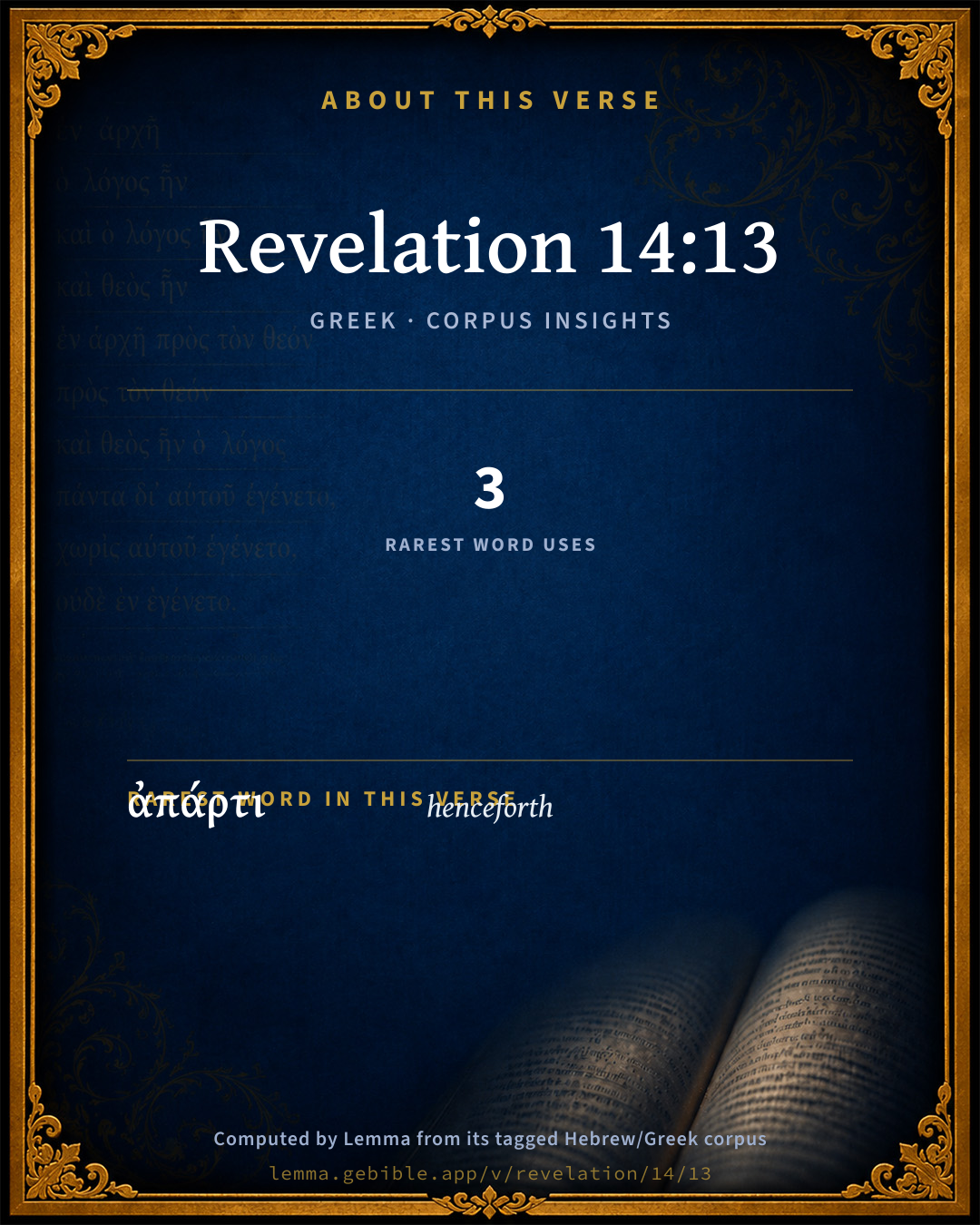
Revelation 14:13

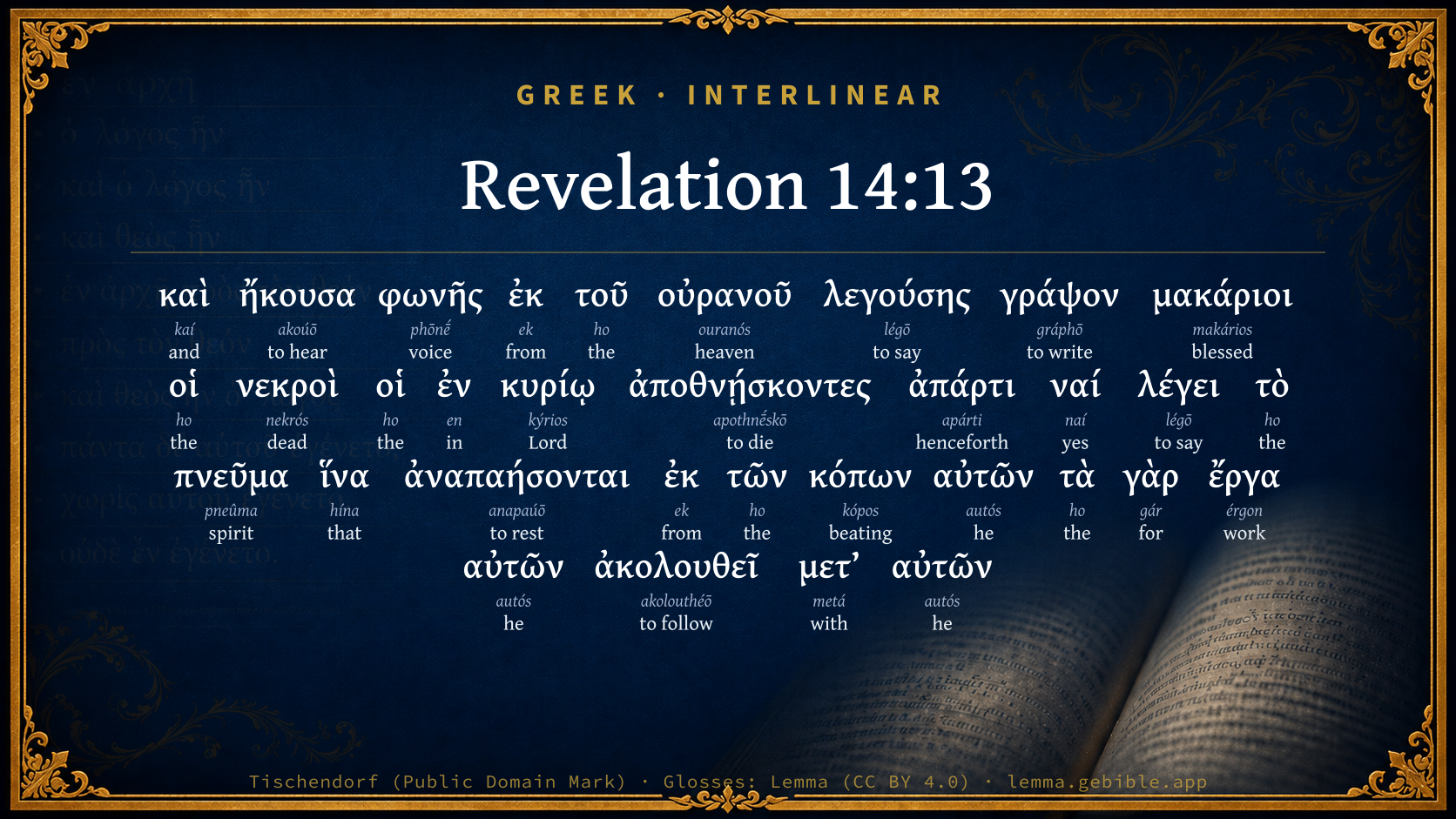
Greek (Tischendorf 8th ed.) Revelation 14:13 appears in the Greek New Testament. The text above is from the Tischendorf 8th edition. Each word links to its Strong’s number and a concise gloss. Click any word for its full Thayer’s Greek Lexicon entry.
Download image
Cite this verse

Revelation 14:13 (World English Bible). Public Domain. Lemma interlinear Bible study tool, https://lemma.gebible.app/v/revelation/14/13.

Show BibTeX & RIS
BibTeX
RIS
English Translation
I heard the voice from heaven saying, "Write, 'Blessed are the dead who die in the Lord from now on.'" "Yes," says the Spirit, "that they may rest from their labors; for their works follow with them."
World English Bible · Public Domain
Download a study sheet

One document with this verse’s original text, its word-by-word gloss line, the meaning frame, cross-references with their text, attributed commentary, and full source and license credits — printable, and it pastes into notes with its structure intact.

This verse Autodidact and up

Study sheet (.html) Plain text (.txt)

A passage Seminary Student

Up to 50 verses in one chapter. A passage sheet keeps up to 6 commentary sources and 12 cross-references per verse, in the order this page ranks them, and says so on the sheet whenever that leaves anything out. Ask for a single verse and you get the Autodidact verse sheet above.

Everything on this page stays free to read, with no account — the sheet is a download of what is already on screen, not access to it.

Want to remove ads? Support Godless Engineer
Compare translations 3

The same verse in 3 English versions, stacked beneath the original-language interlinear above. Click any original word for its lexicon entry.

Each is an independent rendering of the whole verse — the interlinear is not word-aligned to these translations.

Highlighted words mark where these versions differ — a whole-verse word diff, not a word-by-word alignment.

  • World English Bible Public Domain
    I heard the voice from heaven saying, "Write, 'Blessed are the dead who die in the Lord from now on.'" "Yes," says the Spirit, "that they may rest from their labors; for their works follow with them."
  • King James Version Public Domain
    And I heard a voice from heaven saying unto me, Write, Blessed are the dead which die in the Lord from henceforth: Yea, saith the Spirit, that they may rest from their labours; and their works do follow them.
  • unfoldingWord Literal Text CC BY-SA 4.0
    And I heard a voice from heaven saying, “Write, ‘Blessed the dead dying in the Lord from now on.’” “Yes,” says the Spirit, “so they will rest from their labors, for their deeds follow with them.”

unfoldingWord Literal Text — © unfoldingWord, licensed CC BY-SA 4.0. Word-aligned USFM3 via Door43 (git.door43.org/unfoldingWord/en_ult).

Versions to compare (up to 4)

3 of 4 selected

Show all 19 translations

Every available English version of this verse, each an independent rendering of the whole verse.

  • World English Bible Public Domain
    I heard the voice from heaven saying, "Write, 'Blessed are the dead who die in the Lord from now on.'" "Yes," says the Spirit, "that they may rest from their labors; for their works follow with them."
  • Berean Standard Bible Public Domain
    And I heard a voice from heaven telling me to write, “Blessed are the dead—those who die in the Lord from this moment on.” “Yes,” says the Spirit, “they will rest from their labors, for their deeds will follow them.”
  • Majority Standard Bible Public Domain
    And I heard a voice from heaven telling me to write, “Blessed are the dead—those who die in the Lord from this moment on.” “Yes,” says the Spirit, “they will rest from their labors, and their deeds will follow them.”
  • King James Version Public Domain
    And I heard a voice from heaven saying unto me, Write, Blessed are the dead which die in the Lord from henceforth: Yea, saith the Spirit, that they may rest from their labours; and their works do follow them.
  • American Standard Version (1901) Public Domain
    And I heard the voice from heaven saying, Write, Blessed are the dead who die in the Lord from henceforth: yea, saith the Spirit, that they may rest from their labors; for their works follow with them.
  • Revised Version (1885) Public Domain
    And I heard a voice from heaven saying, Write, Blessed are the dead which die in the Lord from henceforth: yea, saith the Spirit, that they may rest from their labours; for their works follow with them.
  • Geneva Bible (1599) Public Domain
    Then I heard a voyce from heauen, saying vnto me, Write, The dead which die in the Lord, are fully blessed. Euen so sayth the Spirit: for they rest from their labours, and their workes follow them.
  • Douay-Rheims (1899) Public Domain
    And I heard a voice from heaven, saying to me: Write: Blessed are the dead, who die in the Lord. From henceforth now, saith the Spirit, that they may rest from their labours; for their works follow them.
  • Young's Literal Translation Public Domain
    And I heard a voice out of the heaven saying to me, `Write: Happy are the dead who in the Lord are dying from this time!' `Yes, (saith the Spirit,) That they may rest from their labours -- and their works do follow them!'
  • Literal Standard Version CC BY-SA 4.0
    And I heard a voice out of Heaven saying to me, “Write: Blessed are the dead who are dying in the LORD from this time!” “Yes,” says the Spirit, “That they may rest from their labors—and their works follow them!”
  • Unlocked Literal Bible CC BY-SA 4.0
    I heard a voice from heaven say, “Write this: Blessed are the dead who die in the Lord.” “Yes,” says the Spirit, “so that they may rest from their labors, for their deeds will follow them.”
  • unfoldingWord Literal Text CC BY-SA 4.0
    And I heard a voice from heaven saying, “Write, ‘Blessed the dead dying in the Lord from now on.’” “Yes,” says the Spirit, “so they will rest from their labors, for their deeds follow with them.”
  • Darby Bible Public Domain
    And I heard a voice out of the heaven saying, Write, Blessed the dead who die in [the] Lord from henceforth. Yea, saith the Spirit, that they may rest from their labours; for their works follow with them.
  • World Messianic Bible Public Domain
    I heard a voice from heaven saying, “Write, ‘Blessed are the dead who die in the Lord from now on.’” “Yes,” says the Spirit, “that they may rest from their labors, for their works follow with them.”
  • Webster's Bible Public Domain
    And I heard a voice from heaven, saying to me, Write, Blessed are the dead who die in the Lord from henceforth: Verily, saith the Spirit, that they may rest from their labors; and their works follow them.
  • Free Bible Version CC BY-SA 4.0
    Then I heard a voice from heaven that told me, “Write this down! Blessed are the dead who die in the Lord from now on. Yes, says the Spirit, because they can rest from their troubles. What they have accomplished will speak for them.”
  • Bible in Basic English Public Domain
    And a voice from heaven came to my ears, saying, Put in writing, There is a blessing on the dead who from now on come to their end in the Lord: yes, says the Spirit, that they may have rest from their troubles; for their works go with them.
  • Text-Critical English NT CC BY 4.0
    Then I heard a voice from heaven saying, “Write: ‘Blessed are the dead who die in the Lord from now on.’ ” “Yes,” says the Spirit, “that they may rest from their labors, and their works will follow them.”
  • Tyndale New Testament (1534) Public Domain
    And I herde a voyce from heven sayinge vnto me: wryte. Blessed are the deed which here after dye in the lorde even soo sayth the sprete: that they maye rest from their laboures but their workes shall folowe them.

Literal Standard Version (2020), Covenant Press — licensed CC BY-SA 4.0. Text via the HelloAO Bible API (eBible.org). Unlocked Literal Bible (unfoldingWord) — licensed CC BY-SA 4.0. Text via the HelloAO Bible API (eBible.org). unfoldingWord Literal Text — © unfoldingWord, licensed CC BY-SA 4.0. Word-aligned USFM3 via Door43 (git.door43.org/unfoldingWord/en_ult). Free Bible Version, Dr. Jonathan Gallagher — licensed CC BY-SA 4.0. Text via the HelloAO Bible API (eBible.org).

Word by word

More ways to search: Search by grammar → Find every occurrence → Compare this word →

Practice this passage: Drill this verse → Learn its vocabulary →

ἀπάρτι
apárti
G534
“henceforth”
Adverb
Part of Speech
Adverb
Full Thayer's Definition

Origin: from G575 and G737

TDNT: None

1. from now, henceforth
  1. καὶ kaí G2532 “and” Conjunction
  2. ἤκουσα akoúō G191 “to hear” Verb, Aorist, Active, Indicative, 1st person, Singular
  3. φωνῆς phōnḗ G5456 “voice” Noun, Genitive, Singular, Feminine
  4. ἐκ ek G1537 “from” Preposition
  5. τοῦ ho G3588 “the” Article, Genitive, Singular, Masculine
  6. οὐρανοῦ ouranós G3772 “heaven” Noun, Genitive, Singular, Masculine
  7. λεγούσης légō G3004 “to say” Verb, Present, Active, Participle, Genitive, Singular, Feminine
  8. γράψον gráphō G1125 “to write” Verb, Aorist, Active, Imperative, 2nd person, Singular
  9. μακάριοι makários G3107 “blessed” Adjective, Nominative, Plural, Masculine
  10. οἱ ho G3588 “the” Article, Nominative, Plural, Masculine
  11. νεκροὶ nekrós G3498 “dead” Adjective, Nominative, Plural, Masculine
  12. οἱ ho G3588 “the” Article, Nominative, Plural, Masculine
  13. ἐν en G1722 “in” Preposition
  14. κυρίῳ kýrios G2962 “Lord” Noun, Dative, Singular, Masculine
  15. ἀποθνῄσκοντες apothnḗskō G599 “to die” Verb, Present, Active, Participle, Nominative, Plural, Masculine
  16. ναί naí G3483 “yes” Particle
  17. λέγει légō G3004 “to say” Verb, Present, Active, Indicative, 3rd person, Singular
  18. τὸ ho G3588 “the” Article, Nominative, Singular, Neuter
  19. πνεῦμα pneûma G4151 “spirit” Noun, Nominative, Singular, Neuter
  20. ἵνα hína G2443 “that” Conjunction
  21. ἀναπαήσονται anapaúō G373 “to rest” Verb, Future, Passive, Indicative, 3rd person, Plural
  22. ἐκ ek G1537 “from” Preposition
  23. τῶν ho G3588 “the” Article, Genitive, Plural, Masculine
  24. κόπων kópos G2873 “beating” Noun, Genitive, Plural, Masculine
  25. αὐτῶν autós G846 “he” Personal pronoun, Genitive, Plural, Masculine
  26. τὰ ho G3588 “the” Article, Nominative, Plural, Neuter
  27. γὰρ gár G1063 “for” Conjunction
  28. ἔργα érgon G2041 “work” Noun, Nominative, Plural, Neuter
  29. αὐτῶν autós G846 “he” Personal pronoun, Genitive, Plural, Masculine
  30. ἀκολουθεῖ akolouthéō G190 “to follow” Verb, Present, Active, Indicative, 3rd person, Singular
  31. μετ’ metá G3326 “with” Preposition
  32. αὐτῶν autós G846 “he” Personal pronoun, Genitive, Plural, Masculine

About this verse

These counts appear in no published source. They are computed here, from the morphology-tagged text and Lemma’s own curated glosses. What Lemma adds →

33
words
24
distinct lemmas
Revelation
section

Notable vocabulary

The rarest word here is ἀπάρτι henceforth G534 — appearing just 3 times in the whole Greek New Testament.

Shared distinctive vocabulary

ἀπάρτι henceforth G534 occurs in 3 verses of the Greek New Testament. Also found in:

Repetition

Words recur within this verse:

  • λεγούσης to say G3004 ×2
  • τοῦ the G3588 ×6
  • αὐτῶν he G846 ×3
  • ἐκ from G1537 ×2

Cross-references

35

Topical passages linked to Revelation 14:13 in the Treasury of Scripture Knowledge — connected by theme and wording, ordered by reader-vote popularity; previews shown in the World English Bible.

  • Revelation 20:6 Blessed and holy is he who has part in the first resurrection. Over these, the second death has no power, but they will be priests of God and of Christ, and will reign with him one thousand years.
  • 1 Thessalonians 5:10 who died for us, that, whether we wake or sleep, we should live together with him.
  • 2 Timothy 4:7–8 I have fought the good fight. I have finished the course. I have kept the faith.
  • Hebrews 4:9–11 There remains therefore a Sabbath rest for the people of God.
  • 1 Corinthians 15:58 Therefore, my beloved brothers, be steadfast, immovable, always abounding in the Lord's work, because you know that your labor is not in vain in the Lord.
  • Hebrews 6:10–11 For God is not unrighteous, so as to forget your work and the labor of love which you showed toward his name, in that you served the saints, and still do serve them.
  • Revelation 19:9 He said to me, "Write, 'Blessed are those who are invited to the marriage supper of the Lamb.'" He said to me, "These are true words of God."
  • 1 Thessalonians 4:16 For the Lord himself will descend from heaven with a shout, with the voice of the archangel, and with God's trumpet. The dead in Christ will rise first,
  • Isaiah 57:1–2 The righteous perishes, and no man lays it to heart; and merciful men are taken away, none considering that the righteous is taken away from the evil [to come].
  • Job 3:17–19 There the wicked cease from troubling; There the weary are at rest.
  • 2 Corinthians 5:8 We are of good courage, I say, and are willing rather to be absent from the body, and to be at home with the Lord.
  • Revelation 6:11 A long white robe was given to each of them. They were told that they should rest yet for a while, until their fellow servants and their brothers, who would also be killed even as they were, should complete their course.
  • Romans 14:8 For if we live, we live to the Lord. Or if we die, we die to the Lord. If therefore we live or die, we are the Lord's.
  • 1 Thessalonians 4:14 For if we believe that Jesus died and rose again, even so those who have fallen asleep in Jesus will God bring with him.
  • Revelation 21:5 He who sits on the throne said, "Behold, I am making all things new." He said, "Write, for these words of God are faithful and true."
  • Psalms 19:11 Moreover by them is your servant warned. In keeping them there is great reward.
  • Philippians 1:21–23 For to me to live is Christ, and to die is gain.
  • Ecclesiastes 4:1–2 Then I returned and saw all the oppressions that are done under the sun: and, behold, the tears of those who were oppressed, and they had no comforter; and on the side of their oppressors there was power; but they had no comforter.
  • Isaiah 35:10 and the ransomed of Yahweh shall return, and come with singing to Zion; and everlasting joy shall be on their heads: they shall obtain gladness and joy, and sorrow and sighing shall flee away.
  • Revelation 16:17 The seventh poured out his bowl into the air. A loud voice came forth out of the temple of heaven, from the throne, saying, "It is done!"
  • Psalms 85:13 Righteousness goes before him, And prepares the way for his steps.
  • Matthew 3:17 Behold, a voice out of the heavens said, "This is my beloved Son, with whom I am well pleased."
  • Luke 16:25 "But Abraham said, 'Son, remember that you, in your lifetime, received your good things, and Lazarus, in like manner, bad things. But now here he is comforted and you are in anguish.
  • 1 Corinthians 15:18 Then they also who are fallen asleep in Christ have perished.
  • Galatians 6:7–8 Don't be deceived. God is not mocked, for whatever a man sows, that will he also reap.
  • 2 Thessalonians 1:6–7 Since it is a righteous thing with God to repay affliction to those who afflict you,
  • Revelation 7:14–17 I told him, "My lord, you know." He said to me, "These are those who came out of the great tribulation. They washed their robes, and made them white in the Lamb's blood.
  • Matthew 25:35–40 for I was hungry, and you gave me food to eat; I was thirsty, and you gave me drink; I was a stranger, and you took me in;
  • Luke 16:9 I tell you, make for yourselves friends by means of unrighteous mammon, so that when you fail, they may receive you into the eternal tents.
  • Philippians 2:17 Yes, and if I am poured out on the sacrifice and service of your faith, I rejoice, and rejoice with you all.
  • Revelation 2:1 To the angel of the assembly in Ephesus write: "He who holds the seven stars in his right hand, he who walks among the seven golden lampstands says these things:
  • Revelation 10:4 When the seven thunders sounded, I was about to write; but I heard a voice from the sky saying, "Seal up the things which the seven thunders said, and don't write them."
  • Revelation 11:15 The seventh angel sounded, and great voices in heaven followed, saying, "The kingdom of the world has become the Kingdom of our Lord, and of his Christ. He will reign forever and ever!"
  • Revelation 11:19 God's temple that is in heaven was opened, and the ark of the Lord's covenant was seen in his temple. Lightnings, sounds, thunders, an earthquake, and great hail followed.
  • Revelation 1:11 saying, "What you see, write in a book and send to the seven assemblies: to Ephesus, Smyrna, Pergamum, Thyatira, Sardis, Philadelphia, and to Laodicea."

Cross-references courtesy of OpenBible.info (CC BY 4.0).

Where the printed editions differ

1 variant

Places in this verse where the major printed Greek editions disagree on the wording in a way that affects the translation — a comparison of editions, not a manuscript-by-manuscript collation. The editions are the modern critical texts (Nestlé-Aland 28/27, SBL, Westcott-Hort, Tregelles, Tyndale House) and the traditional texts behind the KJV (the Textus Receptus and the Byzantine/Majority text). It is not a claim about which reading is original.

  1. Extra text
    μοι·

    “to me:”

    In TR Not in NA28NA27TynSBLWHTregByz

    μοι· (moi) 'to me:' is only in traditional manuscripts (TR)

Textual data: Translators Amalgamated Greek New Testament (STEPBible TAGNT) · CC BY 4.0.

Commentary

Notes on Revelation 14:13 from classic Christian and Jewish commentators (each source and its license shown beneath its notes). The classic Christian expositions comment on the surrounding passage and are grouped to its opening verse, so a note may address several verses; the Jewish commentaries on the Tanakh (Rashi and others) are per-verse, so they appear only where the commentator wrote on this verse.

Lemma curates 59 commentaries, every one of them public domain or Creative Commons licensed, each selected and text-cleaned for this edition rather than reprinted as found. About our sources →

Matthew Henry's Commentary

Here we have the vision of the harvest and vintage, introduced with a solemn preface. Observe,

I. The preface, Rev 14:13. Here note, 1. Whence this prophecy about the harvest came: it came down from heaven, and not from men, and therefore it is of certain truth and great authority. 2. How it was to be preserved and published - by writing; it was to be a matter of record, that the people of God might have recourse to it for their support and comfort upon all occasions. 3. What it principally intended, and that is, to show the blessedness of all the faithful saints and servants of God, both in death and after death: Blessed are the dead that die in the Lord from henceforth, etc. Here observe, (1.) The description of those that are and shall be blessed - such as die in the Lord, either die in the cause of Christ, or rather die in a state of vital union with Christ, such as are found in Christ when death comes. (2.) The demonstration of this blessedness: They rest from their labours, and their works do follow them. [1.] They are blessed in their rest; they rest from all sin, temptation, sorrow, and persecution. There the wicked cease from troubling, there the weary are at rest. [2.] They are blessed in their recompence: Their works follow them; they do not go before them as their title, or price of purchase, but follow them as their evidence of having lived and died in the Lord; and the memory of them will be pleasant, and the reward glorious, far above the merit of all their services and sufferings. [3.] They are happy in the time of their dying, when they have lived to see the cause of God reviving, the peace of the church returning, and the wrath of God falling upon their idolatrous cruel enemies. Such times are good times to die in; they have Simeon's desire: Now, Lord, let thou thy servant depart in peace, for mine eyes have seen thy salvation. And all this is ratified and confirmed by the testimony of the Spirit witnessing with their spirits and with the written word.

II. We have the vision itself, represented by a harvest and a vintage.

1. By a harvest (Rev 14:14, Rev 14:15), an emblem that sometimes signifies the cutting down of the wicked, when ripe for ruin, by the judgments of God, and sometimes the gathering in of the righteous, when ripe for heaven, by the mercy of God. This seems rather to represent God's judgments against the wicked: and here observe,

(1.) The Lord of the harvest - one so like unto the Son of man that he was the same, even the Lord Jesus, who is described, [1.] By the chariot in which he sat - a white cloud, a cloud that had a bright side turned to the church, how dark soever it might be to the wicked. [2.] By the ensign of his power: On his head was a golden crown, authority to do all that he did and whatsoever he would do. [3.] By the instrument of his providences: In his hand a sharp sickle. [4.] By the solicitations he had from the temple to perform this great work. What he did, he was desired to do by his people; and, though he was resolved to do it, he would for this thing be sought unto by them, and so it should be in return to their prayers.

(2.) The harvest-work, which is, to thrust the sickle into the corn, and reap the field. The sickle is the sword of God's justice; the field is the world; reaping is cutting the inhabitants of the earth down and carrying them off.

(3.) The harvest-time; and this is when the corn is ripe, when the measure of the sin of men is filled up, and they are ripe for destruction. The most inveterate enemies of Christ and his church are not destroyed till by their sin they are ripe for ruin, and then he will spare them no longer; he will thrust in his sickle, and the earth shall be reaped.

2. By a vintage, Rev 14:17. Some think that these two are only different emblems of the same judgment; others that they refer to distinct events of providence before the end of all things. Observe, (1.) To whom this vintage-work was committed - to an angel, another angel that came out from the altar, that is, from the holiest of all in heaven. (2.) At whose request this vintage-work was undertaken: it was, as before, at the cry of an angel out of the temple, the ministers and churches of God on earth. (3.) The work of the vintage, which consists of two parts: - [1.] The cutting off, and gathering, the clusters of the vine, which were now ripe and ready, fully ripe, Rev 14:18. [2.] Casting these grapes into the wine-press (Rev 14:19); here we are told, First, What was the wine-press: it was the wrath of God, the fire of his indignation, some terrible calamity, very probably the sword, shedding the blood of the wicked. Secondly, Where was the place of the wine-press - without the city, where the army lay that came against Babylon. Thirdly, The quantity of the wine, that is, of the blood that was drawn forth by this judgment: it was, for depth, up to the horses' bridles, and, for breadth and length, a thousand and six hundred furlongs (Rev 14:20); that is, say some, 200 Italian miles, which is thought to be the measure of the holy land, and may be meant of the patrimony of the holy see, encompassing the city of Rome. But here we are left of doubtful conjectures. Perhaps this great event has not yet had its accomplishment, but the vision is for an appointed time; and therefore, though it may seem to tarry, we are to wait for it. But who shall live when the Lord does this?

Matthew Henry's Commentary on the Whole Bible (1708–1710) — public domain (CC PDM 1.0). Text via the HelloAO Bible API.

The Cambridge Bible for Schools and Colleges

gen. ed. J. J. S. Perowne

Blessing on the Faithful Dead, and the Harvest and the Vintage of the Earth, Rev_14:13-20

13. Write] See on Rev_10:4.

Blessed are the dead &c.] Two questions arise as to this verse, though its touching associations make us unwilling to raise questions about it. What is its relevance here? and why are the holy dead blessed “from henceforth”?—i.e. probably, from the time foreshadowed by the last part of the vision. The answer to both probably is, that in those days a holy death will be the only escape from persecution and temptation, which “if it were possible should seduce even the Elect.” Not only “for the Elect’s sake the days shall be shortened,” but even before they end, one and another of the Elect will be delivered from them. Even now it is a matter of thanksgiving when a Christian is delivered by death “from the miseries of this wretched world, from the body of death, and from all temptation,” and much more then, when temptation is so much sorer that no Saint can dare wish to abide in the flesh.—This seems better than supposing that the special blessedness of the dead of those days consists only in the interval being shorter before their “perfect consummation and bliss.”

that they may rest] The construction probably is, “who die that they may rest”—the sense is, “Yea, they are indeed blessed, for the result, and the providential end, of their dying is, to bring them to rest.”

and their works] Read, for their works.

do follow them] More accurately, follow with them: there is therefore hardly any resemblance to 1Ti_5:24-25. The meaning of the passage is much the same as 1Th_4:15—we are not to think of the holy dead as if they missed (and as if the dead of the last days only just missed) the glories of the Lord’s coming: for they and their good works are kept by Him safe against that day, ready to share in its glories.

The Cambridge Bible for Schools and Colleges (gen. ed. J. J. S. Perowne; Cambridge University Press, 1878–1918) — public domain. Text from a community e-Sword module.

Joseph Benson's Commentary

Rev 14:13. And I heard a voice from heaven — This is most seasonably heard when the beast is in his highest power and fury; saying unto me, Write — He was at first commanded to write the whole book. Whenever this is repeated, it denotes something peculiarly observable. Blessed — Μακαριοι, happy, are the dead which die in the Lord — In the faith of the Lord Jesus Christ; and, in consequence of that faith, in a state of vital union with him, he being thereby made of God unto them wisdom, righteousness, sanctification, and redemption, and thereby imparting unto them, 1st, A satisfactory knowledge of the nature and greatness of their future felicity, in their illumination; 2d, A title to it, in their justification; 3d, A meetness for it, in their sanctification; and, 4th, Bringing them to the enjoyment of it, in their complete redemption from all the consequences of the fall; from henceforth — Particularly, 1st, Because they escape the approaching calamities, or are taken away from the evil to come, as the expression is, Isa 57:1-2, to which passage there seems to be an allusion here; 2d, Because they already enjoy so near an approach to, and indeed an anticipation of, glory — the glory to be conferred at the second coming of Christ, and the resurrection of the dead; for they rest — No pain, no purgatory follows; but pure and unmixed happiness; from their labours — And the more laborious their life was, the sweeter is their rest. How different is this state from that of those (Rev 14:11) who have no rest day nor night! Reader, which wilt thou choose? And their works — Each one’s peculiar works, done from a principle of faith and love, with a single eye to the glory of God, and in a spirit of humility before God, resignation to his will, and patience under all trials and sufferings; and in meekness, gentleness, and long-suffering toward those who oppose them in their Christian course of cheerfully doing good, and patiently suffering ill; follow them — And will be produced as evidences of their faith and love; or of the genuineness of their religion at the day of judgment. But the words, τα εργα αυτων ακολουθει μετ’ αυτων, properly signify, their works follow with them, or follow them immediately; that is, the fruit of their works; they reap this, in some measure, immediately on their admission into paradise. Observe, reader, their works do not go before, to procure for them admittance into the mansions of joy and glory, but they follow or attend them when admitted. Bishop Newton accounts for the expression, From henceforth, blessed are the dead, &c., by observing, that though from the time of the Reformation, “the blessedness of the dead who die in the Lord hath not been enlarged, yet it hath been much better understood, more clearly written and promulgated than it was before, and the contrary doctrine of purgatory hath been exploded and banished from the belief of all reasonable men. This truth,” adds he, “was moreover one of the leading principles of the Reformation. What first provoked Luther’s spirit was the scandalous sale of indulgences; and the doctrine of indulgences having a close connection with the doctrine of purgatory, the refutation of the one naturally leads to the refutation of the other; and his first work of reformation was his ninety-five theses, or positions, against indulgences, purgatory, and the dependent doctrines. So that he may be said literally to have fulfilled the command from heaven, of writing, Blessed are the dead, &c., and from that time to this, this truth hath been so clearly asserted, and so solemnly established, that it is likely to prevail for ever.” But though what the bishop here states might be one reason of the expression, from henceforth blessed, &c., yet the principal reason of its being used seems evidently to have been that above suggested, namely, to intimate that the sufferings which the people of God would be exposed to at this period, from the persecutions of the antichristian power, would be so great that those individuals who escaped them by being taken out of the world by death before they came, would have reason to think themselves happy.

Joseph Benson's Commentary on the Old and New Testaments (1811–1818) — public domain. Text from a community e-Sword module.

The Preacher's Complete Homiletical Commentary

Joseph S. Exell (gen. ed.)

CRITICAL AND EXEGETICAL NOTES

Rev_14:13. Blessed are the dead.—This relieves anxiety concerning all who are taken out of the warfare before the victory is fully won. They will share all the rewards, and their life-witness and service will be in no wise forgotten. Recall the fear with which St. Paul deals in the epistle to the Thessalonians, that those who died before Christ came would be placed under some special disadvantages.

Rev_14:14. Son of man.—So figured as presiding over the final judgment of humanity. The visions of a harvest and a vintage (Rev_14:15-20), typify the time, now nigh at hand, in which God will gather in His own, and will trample His enemies in the winepress of His wrath.

MAIN HOMILETICS OF THE PARAGRAPH.—Rev_14:13-16

Rev_14:13. The Harvest of the Earth for Keeping.—This is the link between the earlier and later visions of this chapter. Many of the Lord’s redeemed ones had already been gathered in, out of their earth-persecutions. Many were still left under the fiery trial. But they were keeping steadfast and faithful, while the gospel was being proclaimed unto “every nation and tribe and tongue and people.” They are to be cheered and encouraged by the vision of the hour when the angel may declare that the earth-story is complete, and the judgment of God has come. In that day evil, however mighty it may seem to have grown, will fall, suddenly, irretrievably, even as Babylon fell in the day of its pride. In that day the patience of the saints will gain its full recognition. The Divine acceptance comes to the “sheep of the right hand,” “they that keep the commandments of God, and the faith of Jesus.” But this final day of God’s judgment is no present thing; it is a vision of the far-away. It may even be turned wrongly, and made a discouragement to Christian souls, for it may seem as if all the blessedness of that day were reserved for those saints who were alive when the great judgment-trumpet should be sounded. The writer checks himself to say a gracious and comforting word to those who might be troubled with such thoughts and fears. The harvest of the earth is a long-continued process. The angel of the harvest is the death-angel, as well as the angel of ingathering for those who are “alive and remain at the coming.” Therefore this comforting word may be spoken—nay, write it down, for it is certain; write it down, for the saints of all the ages will want the gracious assurance. Not only blessed are the dead which have died in the Lord, whom you have seen in vision harping in the glory, and singing their new song, but blessed are the dead which die in the Lord from henceforth, from this very hour right away to the judgment day. “Yea, saith the Spirit, for they rest from their labours, and their works do follow them.” They are all stored safe in the garner of God, until the harvest of the earth is complete. Then, having given this comforting assurance, the writer can return upon his visions of the end of all earthly things—his visions of the harvest-day of God. It must prove to be a double harvest. Christ Himself will see to the ingathering of the saints. His angels will execute His will upon those who have refused His gospel, kept their sin, and worked against all the gracious purposes of His love.

I. The first-fruits of God’s harvest of the earth.—“The dead which die in the Lord.” We may think of heaven as the great storehouse, granary, of God. His harvest is the harvesting of years. His grain ripens in all the ages. The reaper we call death cuts down the golden grain; but no stalk is lost—every one is borne into the garner, and safely treasured there until the harvest work is complete. It is but a resting time for the saints; they never pass out of God’s memory and regard. “Their works do follow them,” and all will be taken into due account in the great day of Divine appraisement. It is a most helpful way in which to think of our dead, and of our own dying. They are but first-fruits of harvest, carried in early to God’s barn. They are only waiting awhile, until the day when the earth-fields can be swept once for all, and God’s harvest of the earth be complete.

II. The remainder of God’s harvest of the earth.—A day must come when the arresting hand must be placed on the earth’s story, the stalks may no longer stand in the earth-fields. All must be gathered in. That is presented in symbol in the visions of the angel offering the sickle to the Son of man, reminding Him that the harvest is almost over-ripe, and must at once be reaped. Of this we are assured: the succession of the dying will not be continuous. The number of Christ’s redeemed ones will one day be completed. And what He will do for them in the great forever they shall know when the last stalk has fallen before the reaper.

SUGGESTIVE NOTES AND SERMON SKETCHES

Rev_14:13. The Blessedness of the Dead.—What this text means in its fulness of application no one now knows. But its suggestions are manifest and manifold.

I. God’s saints, at death, enter into rest.—Rest—not, indeed, from service, but from labour—which implies the disagreeable, exhausting, discouraging side of toil. In the higher sense of service they rest not day nor night, serving God in His temple. But the hindrances without and within all cease, and the service is unmixed delight.

II. Their works do follow them.—This, in a threefold sense, is true:

1. Follow them in witnessing to their fidelity.

2. Follow them in contributing to their reward.

3. Follow them in perpetuating their influence for good.—Anon.

Dying in the Lord.

I. What is it to die in the Lord?—One has said that it “implies a previous living with Him.” Living with Him involves the exercise of certain elements. These are found in Rev_14:12.

1. Faith: “The faith of Jesus.” No man can live with or die in the Lord without faith in Him. With it he can live and die triumphantly.

2. Obedience: “They that keep the commandments of God.” Living with God is obeying God. The obedience of faith—the obedience that is vitally connected with faith—enters into the preparation for a happy death, or death in the Lord.

II. Why are those who die in the Lord blessed or happy?—

1. The happiness of contemplation. The Christian has a bright prospect. He can look forward, not to a dark uncertainty, but to the pleasures of home. When dying, one said, “I wish I had the power of writing or speaking, for then I would describe to you how pleasant a thing it is to die.” Another, “I have experienced more happiness in dying two hours this day than in my whole life.”

2. The happiness of release from toil, sorrow, pain. Rest—“That they may rest from their labours.” Christians are not free from trials; it is not according to the Divine plan that they should be. But those trials cannot pass beyond the gate of death; and when the Christian passes into the beyond he leaves his trials.

3. The happiness of being with Christ after death. The psalmist said, “In Thy presence is fulness of joy; at Thy right hand there are pleasures for evermore.” Again, “I shall be satisfied when I awake with Thy likeness.” Paul said, “I am in a strait betwixt two, having a desire to depart and be with Christ, which is far better.” Great joy here, but fulness of joy with Christ.—Anon.

“The Blessed Dead.”—No book is fuller than this Apocalypse of the struggles and victories of the Church on earth; but it also opens a door into heaven. It shows that heaven is not all future, but, as it were, contemporary with present history, and bound to it by the closest ties. Messengers pass and repass; tidings come and go; and the Lamb who is in the midst of the throne presides alike over time and eternity.

I. The answer which the text gives to the question, How is the heavenly blessedness attested?—We all profess to believe in the reality of heaven; but why?

1. There is the evidence from, miracle, or the presence of the supernatural in the form of power. This great apostle heard a voice from heaven. But before this, John had looked on One whose life was crowded with miracle. He had witnessed His risen glory as He came back from heaven, and His ascension glory as He returned to heaven. If miracle could vouch for heaven, its existence was confirmed.

2. The testimony is, in itself, Divinely credible. Its internal character vouches for its authority.

3. There is a living and. experimental evidence of the reality of heaven. It is written in living epistles, written, not with ink, but with the Spirit of the Living God.

II. How is the heavenly blessedness secured?—

1. The doctrine here is that the title to heaven depends on faith “in the Lord.”

2. But there is also a preparation for the heavenly state by holy obedience. “They rest from their labours,” implying that they prove their faith by works.

III. How is the heavenly blessedness enjoyed?—

1. Heaven is the rest of the worker. It is not sloth, torpor, or inactivity; but while there is no apathy there is rest to the body and the spirit. No more out in the billows, toiling in rowing, when the wind is contrary, but in smooth water, and with the ripple breaking on the shore.

2. Heaven is the continued influence of the work. “Their works do follow them.” Every moral act, truly good, will last for ever. The simplest act of self-denial for Christ’s sake, the mother’s faintest prayer, record themselves in the soundingboard of eternity, and never die away.—John Cairns, D.D.

Rev_14:15. The Harvest of the Earth.—The expression is a singular and, indeed, a striking one. As his fields are to the farmer, so, we are permitted to think, the whole earth is to God. The farmer works for a harvest of his fields and trees, and God may be thought of as working for the harvest of the whole earth. God’s work in the world is like ploughing, sowing, weeding the fields. God’s work has its reward when He carries home the last loaded wain, and His garner is filled with the good corn of the earth of humanity. Can we follow out the figure, and find in it the suggestion of helpful truths?

I. God prepared the earth for His seeding.—Scientific men may wrangle over the ages and order of creation. It is enough for us to know that, at a given time, God had prepared the earth to be the scene of a moral trial for a new race of beings. It is full of interest to inquire into all the mystery of nature. Of its study man never tires. But it is of far greater interest to observe in how marvellous a way the earth was adjusted and adapted to the beings who were to be placed upon it. The relativity of creation to a being with five senses, and these particular five senses, has never yet been shown with the precision and fulness that it demands. The farmer cleans, and ploughs, and manures, and harrows, and ridges, his fields, in precise adaptation to the crop that he intends to grow upon it; and earth is the prepared field of God, made ready for His sowing.

II. God seeds His prepared earth with men.—Scattering the seed all over the earth, that man’s probation may be carried on under every varying condition of soil, and landscape, and climate, and relationship. God keeps on seeding the earth with men; every seed with a great possibility in it; every seed set where its possibility may freely unfold, and where the God provided influences all tend to the nourishment of all its best possibilities. Men, men everywhere, are the seed of God. They are quick with Divine life, and sown in the earth to grow into a harvest for God.

III. The harvest God seeks from His seeding is character.—God sows His earth with moral beings, in the hope of reaping moral character. But what is moral character? It is the proper fruitage of the earth-experience of moral beings. But can we understand it a little more fully than that? A moral being is one that can recognise a distinction between good and evil, and, when the distinction is seen, can choose for itself which it will have, the good or the evil. But a moral being must be put into such circumstances as will offer it the choice between good and evil. And substantially the test amounts to this: good is doing what is known to be the will of the Creator; evil is doing the will of the moral being himself, when that is known to be not the will of the Creator. The picture-scene in the Garden of Eden is the typical trial of moral beings. But what we need, for our present purpose, to see with clearness, is that when, under enticement of the senses, the moral being has chosen the evil, he is said to have fallen, but he has really started the possibility of moral character, which is the issue of the conflict in which the will, biassed by the indulgence of the senses, is brought back to the choice and obedience of God’s will, and recovered from all the sad experiences and conditions resulting from the choice of evil. The story of a life is the story of that conflict. It is the growth, through the long months, of God’s seed into the “full corn in the ear” of established moral character. It is the unfolding of what God would gather in from His seeding of men, the righteousness of the accepted will of God. One thing only does man take through the great gates—the character that he has gained. It is the full ear that heads the stalk, and ripens for the reaper.

IV. God has anxious times while His seed of men is growing into His harvest of character.—Every blade that breaks the earth in the farmer’s field has to fight for its life with varied foes: insects, worms, mildew, rust, living creatures, varying temperatures, crowding weeds; the growth of every blade to stalk and ear is a hard-won victory. The stalk can do its best, and be its best, only at the cost of unceasing struggle and watchfulness. And the field of earth is but a type of the world of men. Every character is the product of a stern experience, the issue of a hundred fights; a triumph from an unceasing struggle. Think of each man’s life-story, and this is true. Think of the histories of nations, and this is true. Think of the story of humanity as if it were the story of one man, and it is God’s Adam, planted in God’s earth, and growing amid the thousandfold influences for good and evil, through all the long ages, and showing at last the golden grain of moral character, rich and ripe, that can be gathered into God’s garner, as the glorious reward of His toil; For over every phase and feature of the struggle in every man out of which character is born, God presides. The problem of each man’s dealings with his surroundings—helpful be they, or injurious—God is intensely interested in. He is anxious as the farmer is anxious over his growing blades. He is anxious as the parent is anxious over the unfolding of character in his child. He may let the struggle alone. He may interfere. But we may be sure that He is deeply concerned. We speak of the “making of a man,” or the “making of a nation.” The one thing of profoundest interest to God is the making of characters in His great earth-fields. Be it so; then a fact of infinite sadness has to be faced. The issue is disappointing, for God’s harvest-hope of reaping character from His sowing of men is only partially fulfilled.

The Preacher's Complete Homiletical Commentary (gen. ed. Joseph S. Exell; Funk & Wagnalls, c. 1892) — public domain (pre-1929). A full-Bible homiletical/sermon-outline anthology covering 65 of 66 books (2 John is absent from the source module). Text from a community e-Sword module.

MacLaren's Expositions of Holy Scripture

Alexander MacLaren

Ecclesiastes

NAKED OR CLOTHED?

Ecc 5:15. - Rev 14:13.

It is to be observed that these two sharply contrasted texts do not refer to the same persons. The former is spoken of a rich worldling, the latter of ‘the dead who die in the Lord.’ The unrelieved gloom of the one is as a dark background against which the triumphant assurance of the other shines out the more brightly, and deepens the gloom which heightens it. The end of the man who has to go away from earth naked and empty-handed acquires new tragic force when set against the lot of those ‘whose works do follow them.’ Well-worn and commonplace as both sets of thought may be, they may perhaps be flashed up into new vividness by juxtaposition; and if in this sermon we have nothing new to say, old truth is not out of place till it has been wrought into and influenced our daily practice. We shall best gather the lessons of our text if we consider what we must leave, what we must take, and what we may take.

I. What we must leave.

The Preacher in the context presses home a formidable array of the limitations and insufficiencies of wealth. Possessed, it cannot satisfy, for the appetite grows with indulgence. Its increase barely keeps pace with the increase of its consumers. It contributes nothing to the advantage of its so-called owner except ‘the beholding of it with his eyes,’ and the need of watching it keeps them open when he would fain sleep. It is often kept to the owner’s hurt, it often disappears in unfortunate speculation, and the possessor’s heirs are paupers. But, even if all these possibilities are safely weathered, the man has to die and leave it all behind. ‘He shall take nothing of his labour which he can carry away in his hand’; that is to say, death separates from all with whom the life of the body brings us into connection. The things which are no parts of our true selves are ours in a very modified sense even whilst we seem to possess them, and the term of possession has a definite close. ‘Shrouds have no pockets,’ as the stern old proverb says. How many men have lived in the houses which we call ours, sat on our seats, walked over our lands, carried in their purses the money that is in ours! Is ‘the game worth the candle’ when we give our labour for so imperfect and brief a possession as at the fullest and the longest we enjoy of all earthly good? Surely a wise man will set little store by possessions of all which a cold, irresistible hand will come to strip him. Surely the life is wasted which spends its energy in robing itself in garments which will all be stripped from it when the naked self ‘returns to go as he came.’

But there are other things than these earthly possessions from which death separates us. It carries us far away from the sound of human voices and isolates us from living men. Honour and reputation cease to be audible. When a prominent man dies, what a clatter of conflicting judgments contends over his grave! and how utterly he is beyond them all! Praise or blame, blessing or banning are equally powerless to reach the unhearing ear or to agitate the unbeating heart. And when one of our small selves passes out of life, we hear no more the voice of censure or of praise, of love or of hate. Is it worth while to toil for the ‘hollow wraith of dying fame,’ or even for the clasp of loving hands which have to be loosened so surely and so soon?

Then again, there are other things which must be left behind as belonging only to the present order, and connected with bodily life. There will be no scope for material work, and much of all our knowledge will be antiquated when the light beyond shines in. As we shall have occasion to see presently, there is a permanent element in the most material work, and if in handling the transient we have been living for the eternal, such work will abide; but if we think of the spirit in which a sad majority do their daily tasks, whether of a more material or of a more intellectual sort, we must recognise that a very large proportion of all the business of life must come to an end here. There is nothing in it that will stand the voyage across the great deep, or that can survive in the order of things to which we go. What is a man to do in another world, supposing there is another world, where ledgers and mills are out of date? Or what has a scholar or scientist to do in a state of things where there is no place for dictionaries and grammars, for acute criticism, or for a careful scientific research?

Physical science, linguistic knowledge, political wisdom, will be antiquated. The poetry which glorifies afresh and interprets the present will have lost its meaning. Half the problems that torture us here will cease to have existence, and most of the other half will have been solved by simple change of position. ‘Whether there be tongues, they shall cease; whether there be knowledge, it shall vanish away’; and it becomes us all to bethink ourselves whether there is anything in our lives that we can carry away when all that is ‘of the earth earthy’ has sunk into nothingness.

II. What we must take.

We must take ourselves. It is the same ‘he’ who goes ‘naked as he came’; it is the same ‘he’ who ‘came from his mother’s womb,’ and is ‘born again’ as it were into a new life, only ‘he’ has by his earthly life been developed and revealed. The plant has flowered and fruited. What was mere potentiality has become fact. There is now fixed character. The transient possessions, relationships, and occupations of the earthly life are gone, but the man that they have made is there. And in the character there are predominant habits which insist upon having their sway, and a memory of which, as we may believe, there is written indelibly all the past. Whatever death may strip from us, there is no reason to suppose that it touches the consciousness and personal identity, or the prevailing set and inclination of our characters. And if we do indeed pass into another life ‘not in entire forgetfulness, and not in utter nakedness,’ but carrying a perfected memory and clothed in a garment woven of all our past actions, there needs no more to bring about a solemn and continuous act of judgment.

III. What we may take.

‘Their works do follow them.’ These are the words of the Spirit concerning ‘the dead who die in the Lord.’ We need not fear marring the great truth that ‘not by works of righteousness but by His mercy He saved us,’ if we firmly grasp the large assurance which this text blessedly contains. A Christian man’s works are perpetual in the measure in which they harmonise with the divine will, in the measure they have eternal consequences in himself whatever they may have on others. If we live opening our minds and hearts to the influx of the divine power ‘that worketh in us both to will and to do of His good pleasure,’ then we may be humbly sure that these ‘works’ are eternal; and though they will never constitute the ground of our acceptance, they will never fail to secure ‘a great recompence of reward.’ To many a humble saint there will be a moment of wondering thankfulness when he sees these his ‘children whom God hath given him’ clustered round him, and has to say, ‘Lord, when saw I Thee naked, or in prison, and visited Thee?’ There will be many an apocalypse of grateful surprise in the revelations of the heavens. We remember Milton’s noble explanation of these great words which may well silence our feeble attempts to enforce them-

‘Thy works and alms and all thy good endeavour

Stood not behind, nor in the grave were trod,

But as faith pointed with her golden rod,

Followed them up to joy and bliss for ever.’

So then, life here and yonder will for the Christian soul be one continuous whole, only that there, while ‘their works do follow them,’ ‘they rest from their labours.’

Alexander MacLaren, Expositions of Holy Scripture (1904–1910) — public domain. Text from a community e-Sword module.

Tyndale Open Study Notes

Tyndale Open Resources

14:13 A dramatic voice from heaven once again instructs John to write (see 1:11, 19; 21:5; cp. 10:4). • Blessed are those who die in the Lord: God desires that those who endure persecution be with him and enjoy his blessings and rest. • The mention of hard work and good deeds in connection with eternal reward foreshadows the assigning of rewards based on works (20:12).

Tyndale Open Study Notes — © Tyndale Open Resources, licensed CC BY-SA 4.0. Text via the HelloAO Bible API.

Bengel's Gnomon

Johann Albrecht Bengel

Rev 14:13.[163] Ἀπάρτι, λέγει τὸ Πνεῦμα) That voice which said, Write, Blessed are the dead, who die in the Lord, that they may rest, etc., was uttered by one of the inhabitants of heaven, with whose person and condition it particularly agrees to call Jesus Lord. The Spirit Himself, as it were by a parenthesis, interrupts that voice, and at once approves and amplifies it, by the word ἀπάρτι, from now; just as after the words, Write, Blessed, there follows, in ch. Rev 19:9, an asseveration. From now, that is, they are blessed, saith the Spirit. From now, from this very point of time, when this voice speaks in the series of prophecy. A saying of the Spirit occurs also, ch. Rev 22:17, Rev 2:7, etc. Moreover the Spirit speaks in the saints, especially those who are afflicted, 1Pe 4:14; and seeking their home, 2Co 5:5. Ἵνα depends upon the word ΜΑΚΆΡΙΟΙ, as ch. Rev 16:15, Rev 22:14. ΝΑῚ[164] appears first to have occurred in the margin, as in ch. Rev 22:20, the second ΝΑΊ: whence some have made it ΝΑῚ ΛΈΓΕΙ, others, ΛΈΓΕΙ ΝΑΊ. The sense is plain without this word.[165] The Latin did not contain this reading, but expressed it in a twofold way, ἀπʼ ἄρτι, a modo jam, as in Gal 1:6, sic tam. [Comp. App. Crit. Ed. II. P. IV. N. IX. § cxvi. cxviii.] —ἵνα ἀναπαύσωνται) A future, as ἽΝΑ ἜΣΤΑΙ, ch. Rev 22:14.

[163] ἀποθνήσκοντες, dying) either by a violent or a natural death.—V. g.

[164] B has ἀπʼ ἄρτι λέγει ναί; Vulg. “A modo jam.” The other oldest authorities have ἄπʼ ἄρτι. ναὶ, λέγει.—E.

[165] But still the margin of Ed. 2 fixes a higher value upon it than the larger Edition.—E. B.

Bengel's Gnomon of the New Testament — English translation (T&T Clark, Edinburgh, 1860) — public domain. Text from a community e-Sword module.

Meyer's Critical & Exegetical Commentary

Heinrich August Wilhelm Meyer

Rev_14:13. A heavenly voice,[3511] concerning which it is in no way said to what person it belongs,[3512] commands John to write down what was itself just proclaimed as a word of revelation of his spirit (viz., Μακάρ.

μετʼ αὐτῶν), because[3513] this word of revelation contains the most effectual consolation for believers who are oppressed by the secular power, and even threatened with death.[3514] Züll. is wrong in considering that there are two voices, for the voice of the Spirit (ναὶ, λεγ. τ. πν., ἳνα, κ.τ.λ.) is distinguished here as little from the voice from heaven, as in the epistles, chs. 2 and 3, what the Spirit says is to be distinguished from what the Lord commands to be written. The voice from heaven belongs to a heavenly person, who, as interpreter of the Spirit, communicates his revelation to the prophet in intelligible words. The first sentence, which concludes with ἀπʼ ἄρτι, contains what is properly the main point of the consolatory declaration, and, as it were, the theme, whose meaning (μακάριοι) is more fully explained in the following sentence. Not only by the formal plan, but also in a still more inward way, is this latter part of the heavenly discourse to be distinguished from the former; the ναὶ already shows us the beginning of a new declaration, and a new declaration is also actually presented, sinceas the parenthetical words λέγει τὸ πνεῦμα affirmthis confirmation and exposition (ναὶ

ἴνα ἀναπαήσονται, κ.τ.λ.), added to the first words Μακάριοι

ἀπʼ ἄρτι, appear in a definite way as a revelation of the Spirit. It is, therefore, incorrect to refer the ἀπʼ ἄρτι to the latter sentence, whether in the sense of Vitr., who combines the ἀπʼ ἄρτι with ἀναπαήσ., or in that of Lamb., Bos., who[3515] writes ἀπαρτί (i.e., ἀπηρτισμένως), and tries to explain the wonderfully composed formula of assurance ἀπαρτὶ ναὶ by the absolute plane profecto.[3516] The reference of the ἀπʼ ἄρτι[3517] to the emphatically prefixed conception of μακάριοι is shown by the relation of the thought.[3518] By a combination with ἀποθνήσκ., Züll. reaches the incorrect interpretation: Better on this account than those who experience the impending time of distress, are the martyrs dying just at the beginning of this time;[3519] but the conception μακάριοι means much more and differently from what Züll. expresses, and to refer it alone to martyrs is as certainly incorrect as ἀποθνήσκειν ἐν κυρίῳ is not to die for the sake of the Lord.[3520]

The dead who die[3521] in the Lord, i.e., bound with him by faith, and kept in fellowship with him[3522] by fidelity to the faith even unto death,[3523] are blessed from henceforth, because, viz., now the glorious end, which will bring condemnation to enemies[3524] and complete blessedness to all believers,[3525] immediately impends. This is the eschatological reference of the ἀπʼ ἄρτι[3526] presented in the connection, in its combination with the idea μακάριοι, which in itself points already to the goal of the Christian hope.

Incorrect is the explanation of Stern, who, in uncertainty, refers the απʼ ἄρτι to the entire sentence μακάρ.

ἀποθν., and incorrectly tries to apply what is said only of the end of time in such sense that then they who die in Christ immediately enter paradisewith intermission of purgatory, which is, therefore, indirectly fixed for the dying prior to that final time; while just as incorrectly, in order to escape the doctrine of purgatory, Calov., etc., explain the ἀπʼ ἄρτι by from the death of every one. [See Note LXXVII., p. 405.] ἵνα ἀναπαήσονται ἐκ τῶν κόπων αὐτῶν. The future is formed from ἀναπαύω, just as κατακαήσομαι from κατακαίω.[3527] The ἵνα here can depend as little upon the parenthetical λέγει τ. πν.[3528] as the ἵνα in 2Co_8:7 upon the succeeding λέγω. But this passage is not, with Ewald and De Wette, to be explained from 2 Cor. (above cited) and Eph_5:33, as an idea lying at the foundation of a purposive command; but the close analogy of Rev_22:14 shows that the clause ἵνα, κ.τ.λ., is to be elucidated after the manner of the restrictive idea of μακα̇ριοι,[3529] that it is expressed at the same time how the goal of blessedness (μακάρ.), held forth by the promise, includes that heavenly ἁνάπαυσις, and is to be afforded those dying in the Lord.[3530] The solemn expression[3531] which designates the blessed rest from all troubles of the earthly life of conflict[3532] is the more significant, because it sets forth a peculiar opposition to the lot of the damned, Rev_14:11.

τὰ δὲ ἔργα αὐτῶν ἀκολουθεῖ μετʼ αὐτῶν. The δὲ marks excellently the contrast between the just-mentioned ἀνάπαυσις ἐκ τῶν κόπων and the ἔργα, to which the κόποι themselves belong.[3533] This significant contrast becomes uncertain if the idea of the works[3534] be resolved into that of the reward itself.[3535] The thought, which occurs in like manner both in the classics and in the rabbins,[3536] is the profound view that the works wrought by believers in the Lord (1Co_15:58) are themselves an eternal good.

[3511] Rev_10:4.

[3512] Against Hengstenb., who wants to refer it to a departed saint, or one of the elders.

[3513] Cf. Rev_19:9, Rev_21:5.

[3514] Cf. Rev_13:7, Rev_10:1-6.

[3515] Exercit. phil. Francq., 1713, p. 299 sq.

[3516] i.e., with unconditional certainty.

[3517] Mat_26:64; Joh_11:52.

[3518] Beda, C. a Lap., Calov., Wolf, Ew., De Wette, Hengstenb., Ebrard.

[3519] Isa_57:1. Cf. Coccejus: The time is impending, in which it will be better to die than to live. Hammond.

[3520] Also against Grot., Laun., Vitr., etc.

[3521] The part. pres. marks the words οἱ ἐν κυρ. ἀποθν. in relation to the idea οἱ νεκροί (Züll., incorrectly: Those exposed to death), as a designation given more accurately than in a mode having no regard to time.

[3522] 1Co_15:18; 1Th_4:16.

[3523] Rev_2:10.

[3524] Rev_6:10, Rev_8:3 sqq.

[3525] Rev_7:9 sqq., Rev_11:16 sqq., Rev_14:1 sqq., Rev_21:1. sqq.

[3526] Cf. Mat_26:64.

[3527] Winer, p. 83.

[3528] Ebrard.

[3529] (Hengstenb.) Not αποθν., as Winer, p. 297, attempts, who by the partic. understands the temp. fin. ἀποθνήσκουσι.

[3530] Cf. Rev_9:20.

[3531] Cf. Heb_4:9 : κατάπαυσις.

[3532] κοπ., Rev_2:3. Cf. Rev_21:4.

[3533] Rev_2:2.

[3534] Cf. Rev_2:5; Rev_2:19, Rev_3:8.

[3535] De Wette; cf. Grot.: The memory of deeds.

[3536] Sophael., Philact., 1420: ἀθάνατον ἀρετήν [immortal virtue]; v. 1443: οὐ γάρ ἡ εὐσέβεια συνθνήσκει βροτοῖς [Piety does not die with mortals]. Aboth., Rev_6:9 : At the hour of mans departure, gold and silver do not accompany him, but the law and good works.

The entire section, Rev_14:6-13, Hammond refers to the times from Domitian to Constantine.

The old Lutheran exposition[3537] understood by the angel with the eternal gospel, Luther. Such an interpretation was made already by Michael Stifel, in the year 1522. Bugenhagen took Rev_14:6 sqq. as the text for his funeral sermon on Luther.[3538] A Catholic compositor, who was engaged in setting up the Lutheran Bible, Wittenberg, 1623, committed great offence by substituting neu (new) for ewig (everlasting).[3539] Calov. understood by the angel (Rev_14:8), the second Martin, viz., Chemnitz with his Examen Trid. Conc. (ἔπεσεν Βαβ.); by the angel (Rev_14:9), the antagonists of the Calixtines, among whom he reckons also himself.

Bengel preferred to refer the angel (Rev_14:6) to John Arnd; the μεσουράνημα is

Germany. The angel (Rev_14:8) is probably Spener.

[3537] Almost all of our writers (Wolf). Cf. also Vitr.

[3538] Cf. Bengel, Erkl. Off., p. 758.

[3539] Cf. Wolf on Rev_14:6.

NOTES BY THE AMERICAN EDITOR

LXXVII. Rev_14:13. ἀπʼ ἄρτι

The interpretation referred to is not peculiar to Calov. and the school of exegetes which he represents; e.g., Ebrard: ἀπʼ ἀρτι μακάριοι εἰσι says rather simply this (De Wette, etc.), that they who die in Christ need not wait for blessedness and compensation until, by the return of Christ to earth, an end is made to the power of the beast hostile to Christ, but, that, immediately after their deaths, they shall find the most glorious compensation by resting from their labors, and not losing the fruit of their works accompanying them. Nothing whatever is said concerning any merit of their works before God as Judge; for they are the regenerate who die in the Lord, because they have lived in Him, and He in them. Hengstenberg: The dead who die in the Lord are blessed from now on. This is not contrasted with any former time in which the dead who died in the Lord were not blessed. The blessedness is as old as the dying in the Lord, and this dates from the time of Christs death, who also already, for the intermediate state, has brought life to light (2Ti_1:10), but with a remote future with respect to the completion of the kingdom of God; not first in the new Jerusalem that is hereafter to be established on the renewed earth, but already from the moment of their departure into heaven. This is explained by the conversation between Christ and the penitent thief. The latter prayed the Lord to remember him when he came into his kingdom at the establishment of the kingdom of glory on earth. But the Lord assured him of more than that for which he prayed (Luk_23:43). By saying, Lord, remember me, the thief shows that he is one who is dying in the Lord. For to die in the Lord, is when one, in the face of death, with complete confidence confesses Him to be Lord. Luthardt: It was expressly revealed to John, in order that Christians of all times may know that from now on, i.e., now already, blessed are they who die in the Lord, i.e., in fellowship with him, for with their death they enter into a blessed state; in order, also, that they may be consoled in that they die before the second coming of Christ.… This toilsome life is now at an end, and a blessed peaceful rest in the bosom of Christ follows, while the unblessed have no rest day or night (Rev_14:11).

Observe the force of the ἐκ τῶν κοπῶν, as in note on ch. Rev_2:2. The promise ἀναπαήσονται belongs here only where there have been previously κόποι, viz., toilsome exhaustive labors, not for self, but for the Lord.

Meyer — Critical and Exegetical Commentary on the New Testament — English translation by Peter Christie, edited by Frederick Crombie (T&T Clark, 1880) — public domain. Text from a community e-Sword module.

Expositor's Greek Testament

ed. W. Robertson Nicoll

Rev 14:13 . The approaching climax of retribution upon pagan Rome affects the dead as well as the living. The latter are encouraged to hold on in hope; the former are brought nearer their reward ( cf. Rev 6:11 , Rev 11:18 ). Ἀπάρτι goes with μακάριοι (note here and in Clem. Rom. 47. the first application of μ . to the dead saints) rather than with ἀποθνήσκοντες , and οἱ ἐν κ . ἀποθ . (which is timeless, like προσκ . τ . θ . in Rev 14:11 ) denotes all who die in the faith, loyal to their Lord, i.e. , primarily martyrs and confessors ( cf. Rev 13:8 ; Rev 13:15 ). They die “in His fellowship, as it were in His arms” (Beyschlag). Like Paul (in 1Th 4:15 ), though on different grounds, the writer is controverting a fear ( cf. 4 Esd. 13:24) that at the advent of messiah those who survived on earth would have some advantage over those who had already died. “Yea, saith the Spirit” ratifying what has been said “happy to rest from their labours” ( i.e. , their Christian activities, not the special form of their death for the faith). So far as the sense is concerned, it matters little whether ἵνα κ . τ . λ . depends on μακάριοι or ἀποθνήσκοντες . Both constructions are grammatically legitimate, though the former is perhaps closer. The point of the passage (note πνεῦμα and γράψον , as in 1 3., Rev 22:6 f.) is that the bliss of death for a Christian consists not in mere rest from labour but in a rest which brings the reward of labour. While death brings the rest, the reward cannot be given till the final judgment. Consequently the near prospect of the latter is welcome, among other reasons, because it means the long-deferred recompense (Rev 11:18 ) for the faithful dead. So far from being forgotten (Rev 2:2 f., Rev 2:19 , Rev 2:23 , etc.), their ἔργα accompany them to judgment and it is implied receive their proper reward there ( cf. Milton’s fourteenth sonnet). The bliss of the departed therefore depends upon two grounds: their ἔργα are not to be overlooked, and the interval of waiting is now ( ἀπάρτι ) brief. The fourth degree of bliss in 4 Ezra 7 :[95] is that the departed spirits of the just understand “the rest which, gathered in their chambers [ cf. Rev 6:9-11 ] they can enjoy now with deep quietness, guarded by angels, as well as the glory which still awaits them in the latter days”. John does not share the current pessimistic belief ( cf. Apoc. Bar. xi. xii. 4, Verg. Aen. i. 94, with Isa 57:1 f.) that death was preferable to life, in view of the overwhelming miseries of the age. His thought is not that death is happier than life under the circumstances, but that if death came in the line of religious duty it involved no deprivation. The language reflects Gen 2:2 (with κόπων put for ἔργων ), but while it is true enough, it is hardly apposite, to think of the dead as resting from works (Heb 4:9 ), no more being needed. The root of the passage lies not in the Iranian belief (Brandt, 423 f., Böklen, 41) that the soul was escorted by its good deeds to bliss in another world ( cf. Maas, Orpheus , 217 f.), but in the closer soil of Jewish hope ( cf. Bacher’s Agada d. Tannaiten , 2 i. 399 f.; Volz 103) as in En. ciii. 2, 3, Apoc. Bar. xiv. 12, 13, and Pirke Aboth vi. 9 (hora discessus hominis non comitantur eum argentum aut aurum aut lapides pretiosi aut margaritae, sed lex et opera bona). In 4 Esd. 7:35 (where, at the resurrection of the dead, “the work shall follow and the reward be disclosed”) opus may be a Hebraism for “recompense” (Psa 109:20 ἔργον , cf. 1Ti 5:25 ). Contemporary Jewish eschatology also took a despairing view of the world ( cf. 4 Esd. 4:26 33). But while the dead are pronounced “blessed,” e.g. , in Apoc. Bar. xi. 7, it is because they have not lived to see the ruins of Jerusalem and the downfall of Israel. Better death than that experience! Death is a blessing compared with the life which falls upon times so out of joint (Rev 10:6 f.). The living may well envy the dead. In John’s Apocalypse, on the other hand, the dead are felicitated because they miss nothing by their martyrdom. Yet life is a boon. No plaintive, weary cry of Weltschmerz rises from the pages of this Apocalypse. ἀναπαύω in the papyri means relief from public duties or the “resting” of land in agriculture ( cf. U. Wilcken’s Archiv f. Papyrusforschung , i. pp. 157 f.).

The Expositor's Greek Testament, edited by W. Robertson Nicoll (1897–1910) — public domain. Text from a community e-Sword module.

Geneva Bible (1599)

Geneva Bible translators

By works, is meant the reward which followeth good works.

That is for the Lord.

Geneva Bible (1599) marginal notes — public domain. Text via Bolls.life.

Jamieson, Fausset & Brown

Robert Jamieson, A. R. Fausset & David Brown

Encouragement to cheer those persecuted under the beast.

Write--to put it on record for ever.

Blessed--in resting from their toils, and, in the case of the saints just before alluded to as persecuted by the beast, in resting from persecutions. Their full blessedness is now "from henceforth," that is, FROM THIS TIME, when the judgment on the beast and the harvest gatherings of the elect are imminent. The time so earnestly longed for by former martyrs is now all but come; the full number of their fellow servants is on the verge of completion; they have no longer to "rest (the same Greek as here, anapausis) yet for a little season," their eternal rest, or cessation from toils (Th2 1:7; Greek, "anesis," relaxation after hardships. Heb 4:9-10, sabbatism of rest; and Greek, "catapausis," akin to the Greek here) is close at hand now. They are blessed in being about to sit down to the marriage supper of the Lamb (Rev 19:9), and in having part in the first resurrection (Rev 20:6), and in having right to the tree of life (Rev 22:14). In Rev 14:14-16 follows the explanation of why they are pronounced "blessed" now in particular, namely, the Son of man on the cloud is just coming to gather them in as the harvest ripe for garner.

Yea, saith the Spirit--The words of God the Father (the "voice from heaven") are echoed back and confirmed by the Spirit (speaking in the Word, Rev 2:7; Rev 22:17; and in the saints, Co2 5:5; Pe1 4:14). All "God's promises in Christ are yea" (Co2 1:20).

unto me--omitted in A, B, C, Vulgate, Syriac, and Coptic.

that they may--The Greek includes also the idea, They are blessed, in that they SHALL rest from their toils (so the Greek).

and--So B and ANDREAS read. But A, C, Vulgate, and Syriac read "for." They rest from their toils because their time for toil is past; they enter on the blessed rest because of their faith evinced by their works which, therefore, "follow WITH (so the Greek) them." Their works are specified because respect is had to the coming judgment, wherein every man shall be "judged according to his works." His works do not go before the believer, nor even go by his side, but follow him at the same time that they go with him as a proof that he is Christ's.

Jamieson, Fausset & Brown — Commentary Critical and Explanatory on the Whole Bible (1871) — public domain (CC PDM 1.0). Text via the HelloAO Bible API.

Adam Clarke's Commentary

Verse 13. I heard a voice from heaven] As the information now to be given was of the utmost importance, it is solemnly communicated by a voice from heaven; and the apostle is commanded to write or record what is said.

Blessed are the dead] Happy are they. They are happy in two respects: 1. They do not see the evil that shall come upon the world, and are exempted from any farther sufferings. 2. They actually and conscientiously enjoy happiness in a state of blessedness.

In the first sense, Happy are the dead! is a proverb frequently to be met in the Greek and Roman poets. Ex. gr.

Τρις μακαρες Δαναοι και τετρακις, οἱ τοτ' ολοντο

Τροιῃ εν ευρειη, χαριν Ατρειδῃσι φεροντες.

Ὡς δη εγωγ' οφελον θανεειν και ποτμον επισπειν

Ηματι τῳ, ὁτε μοι πλειστοι χαλκηρεα δουρα

Τρωες επερῥιψαν περι Πηλειωνι θανοντι.

ODYSS., lib. v. ver. 306.

Happy, thrice happy; who, in battle slain,

Press'd, in Atrides' cause, the Trojan plain:

O, had I died before that well fought wall;

Had some distinguished day renown'd my fall,

Such as was that when showers of javelins fled,

From conquering Troy, around Achilles dead.

POPE.

Thus imitated by the prince of the Roman poets:-

Extemplo AEneae solvuntur frigore membra.

Ingemit, et, duplices tendens ad sidera palmas,

Talia voce refert: O terque quaterque beati,

Queis ante ora patrum Trojae sub moenibus altis

Contigit oppetere! O Danaum fortissime gentis

Tydide, mene Iliacis occumbere campis

Non potuisse? tuaque animam hanc effundere dextra?

Saevus ubi AEacidae telo jacet Hector, ubi ingens

Sarpedon: ubi tot Simois correpta sub undis

Scuta virum, galeasque, et fortis corpora volvit.

VIRG., AEN. i., ver. 93.

"In horror fix'd the Trojan hero stands,

He groans, and spreads to heaven his lifted hands.

Thrice happy those whose fate it was to fall,

Exclaims the chief, before the Trojan wall!

O, 'twas a glorious fate to die in fight!

To die so bravely in their parents' sight!

O, had I there, beneath Tydides' hand,

That bravest hero of the Grecian band,

Pour'd out this soul, with martial glory fired,

And in the plain triumphantly expired,

Where Hector fell, by fierce Achilles' spear,

And great Sarpedon, the renown'd in war;

Where Simois' stream, encumber'd with the slain,

Rolls shields and helms and heroes to the main."

PITT.

Which die in the Lord] These are the only glorious dead. They die, not in the field of battle, in either what are called lawful or unlawful wars against their fellow men; but they die in the cause of God, they die under the smile and approbation of God, and they die to live and reign with God for ever and ever.

From henceforth] απαρτι From this time; now; immediately. This word is joined to the following by many MSS. and some versions. It was a maxim among the Jews, that as soon as the souls of the just departed from this life they ascended immediately to heaven.

Yea, saith the Spirit] The Holy Spirit confirms the declaration from heaven, and assigns the reasons of it.

That they may rest from their labours] Have no more tribulation and distress.

And their works do follow there.] εργααυτωνακολουθειμετ αυτων And their works follow WITH them. They are in company. Here is an elegant prosopopoeia or personification; their good works, sufferings, c., are represented as so many companions escorting them on their way to the kingdom of God.

There are some good and pertinent things in the Jewish writers on this subject. "Rabbi Jonathan taught, If a man perform one righteous action in this life, it goes before him into the world to come. But if a man commit one crime, it cleaves to him, and drags him to the day of judgment." Sota, fol. 3, 2. Avoda Sara, fol. 5, 1.

"Come and see, If any man observe a precept, that work ascends to God, and says, Such a one performed me. But if a man transgress the law, that sin ascends to the holy blessed God, and says, I came from such a one, who has performed me." Sohar Levit., fol. 34, col. 136. Here the same personification is observed as that in the text.

"In that hour in which a man passes from this life into eternity, all his works precede him and there they say unto him, 'This and that thou hast done in such a place on such a day.' This he shall acknowledge. They shall require that he shall subscribe this with his own hand, as it is written, Job 37:7; each man shall subscribe with his own hand; and not only this, but he shall acknowledge that the sentence brought against him is most just." Taanith, fol. 11, 1.

The following elegant similitude Schoettgen gives from Sepher Hachayim, Part II., fol. 47, 1, 2. "A certain man had three friends, two of whom he loved; but the third he did not highly esteem. On a time the king commanded him to be called before him; and being alarmed, he sought to find an advocate. He went to that friend whom he loved most, but he utterly refused to go with him. The second offered to go with him as far as the door of the king's palace, but refused to speak a word in his behalf. The third, whom he loved least, not only went with him, but pleaded his cause so well before the king that he was cleared from all blame. In like manner, every man has three friends, when he is cited by death to appear before God. The first friend, whom he loved most, viz., his money, cannot accompany him at all. His second, viz., his relations and neighbours, accompanied him only to the grave, and then returned; but could not deliver him from the Judge. The third friend, whom he held but in little esteem, viz., the law and his good works, went with him to the king, and delivered him from judgment." The meaning of this most plainly is, that nothing except the deeds of good and evil men shall accompany them to the judgment-seat of God, and that a man's lot will be in the other world as his conduct has been in this; Their works follow with them.

Adam Clarke's Commentary on the Bible (1810–1826) — public domain. Text from a community e-Sword/MySword module.

Ellicott's Commentary for English Readers

(13)And I heard a voice . . .—Translate, And I heard a voice out of the heaven, saying, Write, Blessed are the dead who die in the Lord from henceforth; Yea, saith the Spirit, in that they shall rest from their labours; for their works follow with them. We are not told whose voice speaks, but it proclaims a blessing on (not only martyrs, but) those who die in the Lord, in happy union and fellowship with Him (Joh_15:2-5; 1Jn_1:3); such are happy, for they rest from toil, and their works of faith and labours of love (even if only the giving a cup of cold water in the name of Christ) follow with them into the presence of their Lord (Mat_10:41-42; Heb_6:10). The words “from henceforth” form a difficulty; the reason for their introduction is to be found in the state of trouble which the last verses describe: the righteous are happy in being taken away from the evil to come. Or may it be that the words are designed to console the mourners in an age when dark unbelief robs away the sweet resurrection trust, and writes over its graves, “Farewell for ever”? If the climax of world-power should be bitter scorn of the idea of a life to come, and complacent satisfaction with a portion in this world, then words of faith, proclaiming that the dead are happy and restful, and that their work is not in vain in the Lord, may find new force to sustain a fainting courage or a wavering trust.

A Bible Commentary for English Readers, edited by Charles John Ellicott (1878–1897) — public domain. Text from a community e-Sword module.

John Gill's Exposition

And I heard a voice from heaven,.... Like that which was heard at Christ's baptism and transfiguration, certifying the truth of what follows, so that that may be depended upon as an undoubted verity:

saying unto me, write; which is a further confirmation of the following sayings being true and faithful; see Rev 1:9

blessed are the dead which die in the Lord from henceforth; merely to die is not an happiness, for death is common to all, good and bad; it is a disunion of soul and body, and cannot be in itself desirable; it is the fruit of sin, and has something in it awful and terrible; and though it is the privilege of believers, as its sting is removed by Christ, yet not as simply and absolutely considered; but to die in the Lord is a blessedness: some render the words, "which die for the Lord"; so the Arabic version, "which die for the faith of the Lord"; and the Ethiopic version, "which die for God"; and so restrain them to the martyrs of Jesus: to suffer death for the sake of Christ and his Gospel is a gift and an honour, and what glorifies Christ; and there is a glory consequent upon it, which such shall enjoy; but then in the spiritual reign of Christ, to which this passage refers, and after the destruction of antichrist, there will be no more suffering for Christ, no more martyrdoms; wherefore this cannot be the sense of the words: nor do they mean dying in the lively exercise of faith and hope in the Lord; for though it is a happiness so to die, both to persons themselves, and to their friends and relations, yet these are not the only persons that are blessed; there are some who all their lifetime are subject to bondage, and go off in the dark, and yet are happy; but to die in the Lord is to die interested in him, in union to him; which union is not dissolved by death, and which preserves from all condemnation, at death or at judgment, and secures the soul's immediate entrance into happiness, and the resurrection of the body at the last day, and therefore such must be blessed: the phrase, "from henceforth", is differently placed; the Ethiopic version connects it with the word "write", rendering it, "write now"; and the Vulgate Latin version reads it with the next clause, "hereafter, yea, saith the Spirit"; and so the Latin interpreter of the Syriac version, though that itself seems rather to place it as ours does, and which is most correct; and is to be understood not of the time of John's writing, thenceforward to the resurrection; for those that died before his time were as happy as those who died after; nor of the time of death, though it is a truth, that from the time of the saints' death, and from the very moment of their separation, they are blessed, and are in a state of happiness until the resurrection; but of that period of time which the declarations made by the three preceding angels refer to, from thenceforward, and after the destruction of antichrist, and during the spiritual reign of Christ: and the sense is, that happy will those persons be that die in Christ within that time, and before the Laodicean church state takes place; when coldness, lukewarmness, and carnal security will seize upon men, and Christ will come upon them at an unawares; and those sharp and severe times will commence, signified by the harvest and vintage of the earth in the following verses, and which seem to be no other than the end of the world, and the destruction of it; wherefore happy will they be that are going to heaven before that time comes; see Ecc 4:1

yea, saith the Spirit; the third witness in heaven, who sets his seal to the truth of what the voice declares, and shows wherein this blessedness will consist:

that they may rest from their labours; both of body and soul; from all toil of body, and laborious work, from all diseases and distempers of body, and all outward sorrows and calamities men labour under, and are fatigued with in this life; and from all inward troubles, from a body of sin, from the temptations of Satan, and from all doubts and fears, from their present warfare state, and all conflicts with their spiritual enemies:

and their works do follow them; they do not go before them, to prepare heaven and happiness for them; nor do they take them along with them, and use them as pleas for their admission into the heavenly glory; but they will follow them, and will be found to praise, and honour, and glory, and will be taken notice of by Christ, and graciously rewarded by him, at his appearing and kingdom. This is directly opposite to the notions of the Jews, who say, that when a man departs this life, his works "go before him", and say unto him, thou hast done so and so, in such a place, and on such a day (w); and that whoever does a good work in this world, it shall "go before him" in the world to come (x); and so they (y) represent good works as saying to a man when he is about to die,

"go in peace; before thou gettest thither, , we will go before thee, as it is said, Isa 48:8 "thy righteousness shall go before thee".''

Sometimes they say (z), they go along with him at the time of a man's departure: neither gold, nor silver, nor precious stones and pearls accompany him, but the law and good works, as it is said, Pro 6:22 "when thou goest it shall lead thee", &c.

(w) T. Bab. Taanith, fol. 11. 1. (x) T. Bab. Sota, fol. 3. 2. & Avoda Zara, fol. 5. 1. & Nishmat Chayim, fol. 21. 1. (y) Pirke Eliezer, c. 34. & Yalkut Simeoni, par. 2. fol. 55. 4. (z) Pirke Abot, c. 6. sect. 9.

John Gill's Exposition of the Whole Bible (1746–1763) — public domain (CC PDM 1.0). Text via the HelloAO Bible API.

Trapp's Complete Commentary

John Trapp

13 And I heard a voice from heaven saying unto me, Write, Blessed are the dead which die in the Lord from henceforth: Yea, saith the Spirit, that they may rest from their labours; and their works do follow them.

Ver. 13. A voice from heaven] That voice of Christ, Joh 5:24; Joh 8:51.

Write, Blessed are the dead] Though by the pope accursed and pronounced damned heretics.

Which die in the Lord] Especially if for the Lord; which is (saith Father Latimer) the greatest promotion in the world, such as is not granted to any angel in heaven.

From henceforth] As well as heretofore in those primitive persecutions. Or, from henceforth, that is, presently from the very time of their death, απαρτι, e vestigio, a mode, ab ipso mortis tempere. This puts out the very fire of purgatory; for if all believers die in Christ, and are blessed, and that presently, then none are to be purged.

Rest from their labours] The sleep of these labourers, oh, how sweet is it! Quale sopor fessis in gramine -they get the goal, they enter the haven:

" Italiam socii laeto clamors salutant."

A Christian here is like quicksilver (which hath in itself a principle of motion, but not of rest), never quiet; but as the ball upon the racket, ship upon the waves, &c. Death brings him to his rest, Isa 57:2.

And their works follow them] They die not with them, as Hortensius’s Orations did. Mors privare potest opibus, non operibus, Death may deprive a man of his wealth, but not of his works.

John Trapp, A Commentary or Exposition upon All the Books of the Old and New Testament (1647–1656) — public domain. Text from a community e-Sword module.

Albert Barnes' Notes on the Bible

And I heard a voice from heaven - A voice that seemed to speak from heaven.

Saying unto me, Write - Make a record of this truth. We may suppose that John was engaged in making a record of what he saw in vision; he was now instructed to make a record of what he heard. This passage may be referred to as a proof that he wrote this book while in Patmos, or as the heavenly disclosures were made to him, and not afterward from memory.

Blessed are the dead - That is, the condition of those who die in the manner which is immediately specified, is to be regarded as a blessed or happy one. It is much to be able to say of the dead that they are “blessed.” There is much in death that is sad; we so much dread it by nature; it cuts us off from so much that is dear to us; it blasts so many hopes; and the grave is so cold and cheerless a resting place, that we owe much to a system of religion which will enable us to say and to feel, that it is a blessed thing to die. Assuredly we should be grateful for any system of religion which will enable us thus to speak of those who are dead; which will enable us, with corresponding feeling, to look forward to our own departure from this world.

Which die in the Lord - Not all the dead; for God never pronounces the condition of the wicked who die, blessed or happy. Religion guards this point, and confines the declaration to those who furnish evidence that they are prepared for heaven. The phrase “to die in the Lord” implies the following things:

That they who thus die are the friends of the Lord Jesus. The language “to be in the Lord” is often used to denote true attachment to him, or close union with him. Compare Joh 15:4-7; Rom 16:13, Rom 16:22; 1Co 4:17; 1Co 7:39; Phi 1:14; Col 4:7. The assurance, then, is limited to those who are sincere Christians; for this the language properly implies, and we are authorized to apply it only as there is evidence of true religion.

(2)To “die in the Lord” would seem also to imply that there should be, at the time, the evidence of his favor and friendship. This would apply:

(a) to those who die as martyrs, giving their lives as a testimony to the truth of religion, and as an evidence of their love for it; and,

(b) to those who have the comforting evidence of his presence and favor on the bed of death.

From henceforth - ἀπάρτι aparti. This word has given no little perplexity to expositors, and it has been variously rendered. Some have connected it with the word “blessed” - “Blessed henceforth are the dead who die in the Lord”; that is, they will be ever-onward blessed: some with the word “die,” referring to the time when the apostle was writing - “Blessed are they who, after this time, die in the Lord”; designing to comfort those who were exposed to death, and who would die as martyrs: some as referring to the times contemplated in these visions - “Blessed will they be who shall die in those future times.” Witsius understands this as meaning that, from the time of their death, they would be blessed, as if it had been said, immediately after their dissolution they would be blessed. Doddridge renders it, “Henceforth blessed are the dead.” The language is evidently not to be construed as implying that they who had died in the faith before were not happy, but that in the times of trial and persecution that were to come, they were to be regarded as especially blessed who should escape from these sorrows by a Christian death. Scenes of woe were indeed to occur, in which many believers would die. But their condition was not to be regarded as one of misfortune, but of blessedness and joy, for:

(a)They would die in an honorable cause;

(b)They would emerge from a world of sorrow; and,

(c)They would rise to eternal life and peace.

The design, therefore, of the verse is to impart consolation and support to those who would be exposed to a martyr’s death, and to those who, in times of persecution, would see their friends exposed to such a death. It may be added that the declaration here made is true still, and ever will be. It is a blessed thing to die in the Lord.

Yea, saith the Spirit - The Holy Spirit; “the Spirit by whose inspiration and command I record this” (Doddridge).

That they may rest from their labours - The word rendered here “labor” - κόπος kopos - means properly “wailing, grief,” from κόπτω KOPTOO, “to beat,” and hence, a beating of the breast as in grief. Then the word denotes “toil, labor, effort,” Joh 4:38; 1Co 3:8; 1Co 15:58; 2Co 6:5; 2Co 10:15; 2Co 11:23, 2Co 11:27. It is used here in the sense of wearisome toil in doing good, in promoting religion, in saving souls, in defending the truth. From such toils the redeemed in heaven will be released; for although there will be employment there, it will be without the sense of fatigue or weariness. And in view of such eternal rest from toil, we may well endure the labors and toils incident to the short period of the present life, for, however arduous or difficult, it will soon be ended.

And their works do follow them - That is, the rewards or the consequences of their works will follow them to the eternal world, the word works here being used for the rewards or results of their works. In regard to this, considered as an encouragement to labor, and as a support in the trials of life, it may be remarked:

(a)That all that the righteous do and suffer here will be appropriately recompensed there.

This is all that can follow a man to eternity. He can take with him none of his gold, his lands, his raiment; none of the honors of this life; none of the means of sensual gratification. All that will go with him will be his character, and the results of his conduct here, and, in this respect, eternity will be but a prolongation of the present life. It is one of the highest honors of our nature that we can make the present affect the future for good; that by our conduct on the earth we can lay the foundation for happiness million of ages hence.

In no other respect does man appear so dignified as in this; nowhere do we so clearly see the grandeur of the soul as in the fact, that what we do today may determine our happiness in that future period, when all the affairs of this world shall which cannot now be numbered shall have rolled by. It is then a glorious thing to live, and will be a glorious thing to die. Compare the notes on 1Co 15:58.

Albert Barnes' Notes on the Bible (1834–1885) — public domain. Text from a community e-Sword/MySword module.

Haydock's Catholic Bible Commentary

Blessed are the dead (all the dead) who die in the Lord, and not the martyrs only, for their works follow every one. (Witham) --- It is understood of the martyrs, who die for the Lord. (Challoner) --- For their works follow them. It is just that they rest at length from their labours, and enjoy for eternity the recompense of their fidelity. They land on the shores of their native country, enriched with the treasures of the good works they have done in this lower world. This is said in express contradiction to those who denied the necessity of good works, and maintained the indifference of actions. This seems to have been the doctrine of the Nicolaites and other heretics of those times. (Calmet) --- The Holy Ghost confirms the sentence of their happiness, not only because at the moment of their departure their hard labours and penitential works cease, but their souls are admitted to a glorious immorality, the recompense of their good works. (Pastorini)

George Leo Haydock (1774–1849), Haydock's Catholic Family Bible and Commentary, 1859 edition — public domain. Excludes Psalms (Douay-Rheims chapter numbering differs from Protestant) and Deuterocanonical books (Catholic canon only).

Matthew Poole's English Annotations

And I heard a voice from heaven saying unto me, Write: these words denote the excellency of the following saying; it is a voice from heaven, therefore worthy of our attention. John is commanded to write it, to be kept in memory for the comfort and encouragement of God’s people, who might be discouraged at the hearing of those calamitous times which they were like to meet with during the reign of antichrist, in which many of them were like to be put to death.

Blessed are the dead which die in the Lord: this phrase of dying in the Lord, is applicable to any persons that die united to Christ by a true and lively faith; all such die in the Lord. But if we consider the Scriptural usage of it, it seems rather to signify martyrs, such as die for the Lord; for εν often in Scripture signifieth for, Rom 16:2,8,12; 1Pe 4:14, &c. If any shall be put to death for adherence to Christ, they shall be no losers; for they shall be blessed, and that not only upon the account of that glory into which they shall pass, but upon the account of that

rest which their death will give them from the troubles of the calamitous times before or hereafter mentioned.

From henceforth: there is some little difference amongst interpreters about the sense of this particle: certain it is, it is not to be understood of the time following this revelation exclusively, as to those who before died to Christ; for they also were blessed, they also rested from their labours, &c.; yet the particle seems to refer to the time to come. The emphasis of the particle seems to be, to obviate the doubts of those who should happen to die under antichrist’s rage, because they died not by the hands of pagans and avowed enemies of the gospel, but of such as should call themselves Christians; such, saith God, die for the Lord, and are blessed, and shall be blessed.

Yea, saith the Spirit; the Spirit of truth affirms it.

That they may rest from their labours; they shall be at rest from the troubles of this life.

And their works do follow them; and their good deeds and patient sufferings shall follow them, as witnesses for them before the Judge of the quick and the dead.

Here follow two visions, the one of a harvest, the other of a vintage; there is no great difficulty in determining, that they both signify some judicial dispensations of God, that he would bring upon the world, or some part of it, the latter of which should be greater than the former: yet Dr. More and Mr. Mede have another notion of them. But there is some doubt amongst interpreters, whether they signify God’s general judgment in the last day, or some particular judgments before that day, mentioned Rev 15:1-8 and Rev 16:1-21, and belong to the vials which we there read of. Those who think that the last judgment is here showed to John, are led to it from the representation of the day of judgment, under the notion of a harvest, Mat 3:12; 13:39. But I rather agree with them who think that the harvest here mentioned, is a representation of some judicial dispensations of God before that time, particularly God’s vengeance upon the beast, more fully expressed, Rev 16:1-21. For:

1. The last judgment is fully described afterward, Rev 19:1-20:15.

2. To express that, there needed not two types, the one of a harvest, the other of a vintage.

3. Here is no mention of the resurrection, which must go before the last judgment.

Mr. Mede hath noted, that there are three things belonging to a harvest;

(1.) Cutting down of corn.

(2.) Gathering it into the barn.

(3.) Threshing it.

Whence, in Scripture, it signifieth either cutting and destroying, or safety and preserving, which is the end of gathering corn into the barn. We have examples of the former, Isa 17:3,5; Jer 51:33; but of the latter we have only examples in the New Testament, Luk 10:2. It is his opinion, that the conversion of the Jews, going before the great slaughter mentioned Rev 19:1-21, is that which is here meant; but I rather agree with those who think, that by this parable is signified God’s judgments upon antichrist, and that the general scope of both the parables is to declare, that God would grievously punish antichrist, first by lesser, then by greater judgments, as is more particularly expressed in the two next chapters, to which this, to me, seemeth prefatory. Let us now come to the text itself... See Poole on "Rev 14:14".

Matthew Poole's English Annotations on the Holy Bible (1683–1685) — public domain. Text from a community e-Sword/MySword module.

Whedon's Commentary on the Bible

Daniel D. Whedon

13. Heard a voice from heaven—The above three menacing angel-voices were from the mid-heaven; but now peals down a voice from the highest heaven in beautiful contrast with the menacing voices. Amid the menaces upon the persecutors it interpolates a benediction upon the faithful dying sufferers.

Write—Let this blessed assurance be well recorded.

Blessed are the dead—They are under no malediction, in no torment, in no unconsciousness, for they are blessed, that is, happy and more than happy.

Die in the Lord—Said on occasion of their martyr-death, yet in such comprehensive terms as to include all the dying faithful in all ages.

From henceforth—This from henceforth, starts from the death of each individual dying saint. The meaning then is, those dying in the Lord are thenceforth and forever blessed. The end of a holy life is the commencement of an eternal bliss. This assures the unshrinking faithful who refuse the beast, his mark, and his number, and thereby meet death, that their destiny is not torment, but blessedness.

Yea, saith the Spirit— This appears to be a responding voice ratifying the affirmation of blessedness. John hears this response from the same highest heaven, and knows and tells us that so saith the Spirit. By inspired intuition he knows the voice of the Spirit, and allows us now to infer that the first voice was from the First Person of the Trinity, and the response from the Third.

That—In order that. Depends upon die. Those dying in the Lord do truly die, in order that they may rest from their labours.

And—Better reading, For, assigning a reason for their blessed rest, namely, that their works of keeping the commandments of God, and the faith of Jesus, (Rev_14:12,) do follow them, namely, from this world to the next, as witnesses for their justification with God.

Daniel D. Whedon (gen. ed.), Commentary on the Old and New Testaments (1874–1909) — public domain. Text from a community e-Sword module.

The Pulpit Commentary

And I heard a voice from heaven saying unto me. It seems most natural to suppose that the voice is that of the angel who directs the visions of St. John, (cf. Rev_1:1 Rev_4:1 Rev_19:9, Rev_19:10) but there is no certainty in the matter. Omit "unto me." with a, A, B, C, P, and others.

Write, Blessed are the dead which die in the Lord from henceforth. "Henceforth" should probably stand thus, and not in connection with the following sentence. We have just had mentioned the necessity for patience on the part of the saints; here we have an encouragement and incentive to that patience, inasmuch as they who die in the Lord are henceforward blessed. In what their blessedness consists, the next sentence slates. The full consummation of their bliss may not occur until after the judgment, but the faithful have not to wait until then for peace; their conflict is, after all, only for this life, and thus they may well be content to suffer for so short a period. (comp. Rev_6:11) Yea, saith the Spirit, that they may rest from their labours; and their works do follow them; that they shall rest... for their works, etc. The first part explains the "blessedness" of the previous passage; in this rest consists their blessedness. The last clause, "for their works," etc., explains why the blessedness consists in rest; they have henceforth no need of labours, for the effects of their former works accompany them and permit them now complete rest. Contrast the opposite fate of the wicked, described in ver. 11. St. Paul urges upon Christians the same duty, and proffers the same encouragement: "Therefore, my beloved brethren, be ye steadfast, unmovable, always abounding in the work of the Lord, forasmuch as ye know that your labour is not in vain in the Lord". (1Co_15:58)

A voice from heaven: the blessed dead.

However deep the gloom in which the description of the future struggles of the Church may plunge us, the Holy Ghost never suffers it to be indefinitely prolonged. We have stood with wondering awe amid the deep recesses of a glacier, and, as if lest the chill should be too severe and the gloom too intense, many a chink overhead let in a light and a glow that revealed wondrous glory above. Even so, as we stand in the midst of the threatening conflicts of the Church, we see light let in from above a glory shining in the gloom. Thus it is here. We have witnessed the rise and power of the dragon, of the first beast, and of the second beast. We have looked upward and caught a glimpse of the heavenly state. We have heard the voices of the three angels, proclaiming

(1) the everlasting gospel,

(2) the fall of Babylon the great,

(3) the punishment of the ungodly; and again there is a gleam of heavenly brightness shining in upon us.

A voice is heard whose, we are not told but it is a commanding voice, under the direction of the Holy Ghost, and that is enough for us. Moreover, it is from heaven, from the realm of light, from the region whence the shadows have fled away. From that higher region the changing scenes of life and death, of struggle and of victory, are beheld; and from the clearer light in which these earthly incidents are viewed, there is an emphatic testimony given to us which is of priceless value. As so much of the book deals with the struggles of earth, it is restful indeed to be permitted to hear something as to how they fare who have passed beyond them.

I IN THIS DYING WOULD THERE IS A FEATURE WHICH DISTINCTIVELY MARKS SOME DEATHS. "The dead which die in the Lord." The, dead which are dying. The believers in Christ under the present dispensation, who are, one by one, passing away, are evidently intended. "Dying in the Lord" is no vague expression. It defines. It includes. It limits. Otherwise were there no meaning in the phrase. It indicates, indeed, nothing special as to the physical mode of decease; nor as to age; nor as to the accidents of death. The expression, "from henceforth," is ambiguous. (For various interpretations, see expositors.) We incline to the opinion that the "henceforth" here referred to is the time of weariness, in which the faith and patience of the saints wilt be severely tried by the raging of the powers of evil; that it will be blessed to die in Jesus, and pass away to the realm where the weariness (cf. ek twn kopwn autwn) will be known no more. The significance of the expression, "die in the Lord," should be carefully studied. Deaths are not alike any more than lives are. The deaths of Lazarus and Dives were as widely different as their lives. To die in the Lord" is the natural sequence of living to the Lord. No change of state can affect the relation of believers to their Saviour. (1Th_5:10 Rev_1:18) Such a dying as is here referred to must include

(1) trust,

(2) union,

(3) communion,

(4) surrender,

(5) rest

in Christ all going on in the act of dying, as really as in the act of living. Whether we live or die, we continue to be the Lord"s. Once his, we are ever his.

II THERE ARE MANIFOLD GROUNDS ON WHICH WE KNOW THOSE TO BE BLESSED WHO THUS DIE IN THE LORD. Each phrase in the text is full of meaning.

1. Their blessedness is declared by the Holy Ghost. "Yea, saith the Spirit.

2. It is proclaimed to the apostle by a voice from heaven.

3. There is a command to place it on record for all time.

Each of these three lines of thought is indicated by the words of the verse. Much more is indicated, however, by the doctrine underlying the expression, "in the Lord." This phrase is used to express the unique relation between Christ and the believer. It is constantly recurring. "In Christ." From this the blessedness of those dying in him may be confidently affirmed; e.g.:

1. Our Lord, in his work for men, contemplated the whole duration of their existence.

2. He is the Saviour of man"s whole nature body, soul, and spirit.

3. Our Saviour"s work for believers touched every point of their need.

4. He is himself the Lord of life.

5. Being in him is enough for time and eternity. We know whom we have believed.

6. He is guardian of believers as much after death as before it. Hence it must be the case, "Blessed," etc.

III WE ARE DISTINCTLY TOLD IN WHAT THE BLESSEDNESS CONSISTS. There is no ground in Scripture for asserting the sleep of the soul between death and the resurrection. It is, indeed, only "the body" which "is dead because of sin; the spirit is life because of righteousness." And Jesus expressly declared that whoso keepeth his sayings should never taste of death. "Absent from the body," they are "at home with the Lord." Not, indeed, that the fully glorified state is theirs as yet, nor will be till the resurrection. Not till Christ, our Life, is manifested, shall we be manifested with him in glory. The heavenly life has three stages. The first beginning at regeneration, and closing with the dissolution of the body. The second beginning at death, and ending at the resurrection. The third beginning with the resurrection, and never ending. It is this intermediate stage which is pronounced "blessed." They are blessed in death, and blessed after it. "The having died is gain" (to apoyanein). How?

1. Negatively. "They rest from their labours.

a. From struggles with sin.

b. From wearying conflict.

c. From every fault and flaw.

d. From all the frailties incident to a disordered frame.

2. Positively. Their works follow with them. They not only leave behind them blessed impulses which will follow after their earthly works have ceased, but they take with them their works into another life; i.e. the works of faith and patience and holy activity which were the outwork of their devotion and zeal were a part of themselves; they not only expressed what they were, but they played their part in the growth and perfecting of their characters. And not only so, but the Lord, into whose presence they are ushered at death, sees both them and their works too, as one. As Ewald, "Their works are so far from being lost through their death, that they follow them into eternity" (quoted in "Speaker"s Commentary," in loc. ). The same law works in the case of the righteous as in the case of the wicked. "Some men"s sins are open beforehand, going before them to judgment; i.e. a man goes into eternity, plus his works, whether they be good or bad. Blessed, indeed, is it when the works have been those of faith and love, which, though in many cases forgotten by the worker, shall be remembered by the great Saviour Judge.

IV A COMMAND IS GIVEN TO PUT THIS ON RECORD. The truth contained in this verse is too precious a one to be left to the uncertainty of a merely verbal tradition. We know not to what shreds and patches our glorious gospel might by this time have been reduced, had it been thus left at the mercy of floating reports handed down by word of mouth. It was "safe" to write this. The value of this truth is simply unspeakable.

1. It shows us that death is not a terminus of life, but an incident in living. It is a change of states under the guardian care of a Divine Redeemer, who loves his own too much to let them perish.

2. In the light of such a truth, we should dread death less. Nay, more; we ought not to dread it at all. Our Saviour has passed through the gates of the grave himself, that he might deliver them who through fear of death have been all their lifetime subject to bondage.

3. A right use of this truth will prepare us for enduring with more calmness and bravery the trials and hardships of this life. Persecution. Insult. Martyrdom. What fretfulness under sorrow is often shown by those who abandon the evangelical faith! Life of Carlyle; a man who, though a prodigy of intellectual acquirement, lived a life which was one continuous whine.

4. Let us not grieve unduly over those who are gone. If they have died in the Lord, and if we are living in the Lord, we shall go to them, but they shall not return to us. We can rejoice in the thought of the increasing wealth of our treasure in the heavenly state, as saint after saint is caught upward into light.

5. Let us look forward hopefully and cheerfully to our own future. What work the Master may have appointed for us we cannot foresee, nor do we at all know when we shall be called up to join the "men who are made perfect." But we need not wish to know. It is enough for us that they and we are one. "The saints on earth and all the dead But one communion make; All join in Christ, their living Head, And of his grace partake.

6. Knowing how well we are cared for in life and in death by our blessed Lord, let us concentrate all our energies on glorifying our Lord. This is the conclusion to which the Apostle Paul himself arrived. Knowing that when we are absent from the body we shall be at home with the Lord, we should make it the object of our supreme ambition to be well pleasing to him. This, indeed, is our one concern. To work, and love, and obey, and wait. And in time our Master will come and fetch us home, and we shall be forever with him.

The blessed dead.

"And I heard a voice from heaven saying unto me, Write, Blessed are the dead which die in the Lord from henceforth." By such word as this it is that Christ "hath abolished death." True, it is at the side of the open grave and over our dead that we read them, so that the stern, hard fact of death is still with us, and often well nigh crushing our hearts with its load of sorrow. Death yet reigns. But his sovereignty is shorn of its worst power, since words like these felt upon the ears and hearts of men. The Vale, vale, in aeternum vale! of broken hearted paganism is gone, never to return. The broken pillar and the extinguished torch are no longer fit emblems to place over the grave of our loved ones. The pillar rears its fair shaft and lacks not its beautiful coronal, and on the eternal shore the torch burns more brightly than ever, and is by no means gone out, though our dim eyes for a while see it not. And this unspeakably precious gospel, which brings us such glad tidings of great joy, it is which some men want to silence as effete and incredible, that they may substitute for it their own dismal speculations, the only outcome and clear utterance of which is that, in regard to religious faith, there is nothing solid under our feet, nor clear over our heads; all is one great "perhaps;" nothing certain nothing; neither soul, nor God, nor eternal life. To all such we say, "If we be dreaming, as you affirm, then for God"s sake let us dream on, unless you have some better, surer belief to which we may awake." But let us now think awhile of the unspeakably precious truth our text contains. And we note

I WHOM IT CONCERNS.

1. Those "in the Lord. "It is obviously of the utmost moment that we rightly understand who are spoken of. Alas! the context has warned as that the blessing here pronounced is not for all. The blessed dead are placed in marked contrast with those who in this life have borne the mark of the beast, which is the world, in their forehead and upon their hand. How glad are we, for ourselves and for those dear to us, when it comes to the last solemn moment, to forget that there is any distinction between the death of the righteous and of the wicked; between the death of one who has loved and served Christ, and of one who has lived "without him in the world"? It seems so hard to preserve that distinction" (Vaughan, in loc. ). But there it is, and may not be overlooked, though, to the unspeakable hurt of men"s souls, it too often is. Now, "to die in the Lord," we must first have been "in the Lord." And can any be said to be "in the Lord" if they never think of him, never call upon him, never look to him, and never seek to live to him? "In the Lord" is the constant phrase which tells of a living trust and hope and love towards the Lord; and how can the description be applied where none of these things are? God help us all to remember this!

2. And these when they are dead. Just then, when we want to know something of them; when with streaming tears we yearn "For the touch of a vanished hand, And the sound of a voice that is still.

II WHAT IT SAYS OF THEM.

1. That they are "blessed. What unspeakable comfort there is in this assurance for those who are left behind! Not unconscious, for such high epithet as "blessed" belongs not to mere unconsciousness. Not in purgatorial pains, for neither could that be called blessed. Doubtless Christ"s transforming, assimilating power, through the energy of the Spirit of God, goes on in the departed believer, as it is necessary that it should. For St. Paul teaches us that "he who began a good work in us will perfect it until the day of Jesus Christ". (Php_1:6) Therefore that good work is going on still; death does not hinder, but accelerate it. But the process is not by those hideous means which mediaeval monks imagined, and which the very word "purgatory" suggests. But they are blessed; that is enough to know, enough to uplift the mourner"s heart.

2. And immediately that they quit this life. Such is the meaning of the word "henceforth." "It means substantially even now; not merely in the new Jerusalem which is one day to be set up on the renovated earth, but from the very moment of their departure to heaven" (Hengstenberg, in loc. ).

3. They die to rest. "Yea, saith the Spirit, in order that (ina) they may rest or, "that they shall rest from their labours." Death, therefore, is for them but the Divine signal that the day"s work is done, that the evening hour has come, and that they are now to go home and rest. The wearisome work and toilsome trying task, which has often well nigh worn them out such is the significance of the word "labours all that is over, and death is the Lord"s call to them to now lie down and rest.

4. Their works follow with them. Not their labours, the element of distress and pain in their work, but their works. How do they follow? Perhaps:

(1) In that they are carried on still. They were works for the honour of their Lord, for the good of their fellow men prayers and endeavours to draw others to Christ, intercessions for the Church of God, all manner of beneficent deeds. Are all these to cease? Is there no room for them where the blessed dead now are? Shall the sainted mother who here besought the Lord for her children that they too may be saved shall she cease that "work"? The Lord forbid that she should; and our text seems to tell us that she, and all they like her, will not, for their works follow them.

(2) For reward. There is the scene, there the day, of recompense. Not here or now. "Let thine eyes look right on, and thine eyelids straight before thee." "Oh how great is thy goodness which thou hast laid up for them that fear thee!

(3) In their effects upon their character. We cannot see the soul, we saw only the man, and faulty enough he was, we well knew; but all the while, as the days of his life went on, and this or that work was put upon him to discharge, the soul was, by means thereof, as the marble by the sculptor"s chisel, being wrought into a condition of beauty and faultlessness such as from the first had been in the Creator"s mind.

(4) As ministers to their joy. The joy of gratitude that they were enabled to undertake and accomplish them. The joy of knowing that as seed they will yield blessed harvest, and, perhaps, of witnessing that harvest. St. Paul spoke always of his converts as his "joy and crown of rejoicing in the day of the Lord Jesus." Such "works" will be a joy to remember, to look upon in their results and to continue in. They cannot but be, every way, ministers to our joy.

III THE EMPHASIS THAT IS LAID UPON IT.

1. It is declared by "a voice from heaven. This voice "may well be conceived to be that of one of "the just made perfect," testifying from his own experience what the true members of the militant Church on earth have to expect in heaven" (Hengstenberg, in loc.). When we remember that the attestations to our Lord"s Divine Sonship were made in similar manner by a voice from heaven, this declaration is thereby lifted up to a like high level of authority and importance.

2. It was commanded to be written. "This command to "write" is repeated twelve times in the Revelation, to indicate that all the things it refers to are matters of importance, which must not be forgotten by the Church of Christ.

3. It is confirmed solemnly by the Holy Spirit. "Yea, saith the Spirit." With such solemn sanctions are these words so inestimably precious to the Church, introduced to our notice and commended to our reverent heed.

IV THE PURPOSE OF ITS PROCLAMATION.

1. It was a truth most necessary for the time when it was given. See the circumstances of the faithful Church, how fearful their trial, how dire their need of all and everything that would fortify their minds amid such awful temptations to be unfaithful to their Lord. And what truth could be more helpful than such as this?

2. And it is needed still.

(1) To comfort us concerning our departed brethren in Christ.

(2) To strengthen us in view of our own departure.

(3) To cheer us amid work that often seems thankless and unfruitful, although it be the "work of the Lord.

With our hope we ought never to be weary in such work. Noble work has often been done by men who had no such hope. Think of the three hundred at Thermopylae. Think of the holy men of old to whom the grave seemed to end all, to be the place where they should be "no more," and yet who became heroes of the faith (cf. Hebrews 11).

(4) To every way ennoble and elevate our lives.

(5) To draw forth our love and devotion to him "who having overcome the sharpness of death, hath opened the kingdom of heaven to all believers." Are these purposes fulfilled in us? S.C.

The blessedness of the departed faithful.

If the threatenings of judgment upon the worshippers of the false are motives to patience and fidelity, how much more is the promise of a blessed reward! Between these two the tried and persecuted Christian disciple is hedged in. This blessedness is

(1) assured by the heavenly proclamation: "a voice from heaven." It is

(2) confirmed by the Spirit"s testimony: Yea, saith the Spirit." It is

(3) promised to them who are spiritual: "in the Lord." It is

(4) the reward of fidelity maintained to the end of life: they "die in the Lord.

The reward is

(1) a state of felicity: "blessed" are they.

(2) It consists in a state of repose after toil, danger, and exposure: "They rest from their labours.

(3) It is exhibited as the consequence of and acknowledgment of their diligent, obedient labour: "Their works follow with them.

Here is the encouragement to

(1) self denial;

(2) patient labour;

(3) undying devotion. R.G.

Heaven"s description of the satiated dead.

"And I heard a voice from heaven saying unto me, Write, Blessed are the dead which die in the Lord from henceforth: Yea, saith the Spirit, that they may rest from their labours; and their works do follow them." Here is a voice from heaven. Voices from earth are plentiful they load our air and din our ears. We have voices from the markets and voices from the Parliament, voices from the Church and voices from the college, voices on every subject and in every key. They are contradictory and unsatisfactory; they solve not the deepest problems of the soul. Thank God, there is a voice from heaven let us listen to it. It comes from infallibility itself; and teaches the most momentous questions of interest and destiny. Notice

I HEAVEN"S DESCRIPTION OF THE CHARACTER OF THE SAINTED DEAD. "Blessed are the dead which die in the Lord." Their character was that of vital union with Christ. The Scriptures represent this union by a great variety of figure. It is compared to the union of a building with its foundation stone its existence depends upon it; to that of the branch and the vine its strength, foliage, fruit, life, of the one depend upon the sap it derives from the other; to that of the spirit and the body the former being the source of animation, the impulse of activity, and the guide of the movements of the latter. These figures confessedly indicate a union the most close and the most vital. This union may include two things.

1. Their existence in his affections. We live in the hearts of those who love us. Children do thoroughly live in the affections of their loving parents, that they control their plans and inspire their efforts. Because the child lives in the heart of the affectionate parent, the parent lives and labours for his child. In this sense Christ"s disciples live in him; they are in his heart; he thinks upon them, he plans for them, he works for them, he causes "all things to work together for good.

2. Their existence in his character. Without figure, we live in the character of those we admire and love. Arnold"s most loyal pupils live in his character now. They see their old master in their books, and hear him in their sermons. Christ is the grand Object of their love, and the chief subject of their thought, and to please him is the grand purpose of their life. As loving children identify themselves with all that pertains to their parents, so they feel a vital interest in all that relates to the cause of Christ. This Paul felt. "I live; yet not I, but Christ liveth in me." This character implies two things.

(1) A moral change. Men are not born in this state. "If any man be in Christ, he is a new creature." The change is so great that the man must be conscious of it.

(2) A judicial change. "There is therefore now no condemnation to them which are in Christ Jesus." Their sins are pardoned, their iniquities are forgiven; they "have peace with God through our Lord Jesus Christ." Such is the character of the sainted dead as here described. "They die in the Lord.

II HEAVEN"S DESCRIPTION OF THE CONDITION OF THE SAINTED DEAD. "Blessed are the dead.

1. Their blessedness is in rest from all trying labour. Not rest from work, for work is the condition of blessedness; but from all trying labour, all anxious toil, all wearying, annoying, irritating, fruitless toil.

(1) Rest from all trying labour pertaining to our physical subsistence. By the sweat of our brow here we have to eat bread. Not so yonder.

(2) Rest from all trying labour pertaining to intellectual culture. How much trying labour is there here to train our faculties and to get knowledge! "Much study is a weariness of the flesh." Not so yonder.

(3) Rest from all trying labour pertaining to our spiritual cultivation. Here we have to wrestle hard against our spiritual foes, and often have to cry out in the struggle, "O wretched man that I am! who shall deliver me from the body of this death?" Not so yonder.

(4) Rest from all trying labour to benefit our fellow men. To do good here is a trying work. The ignorance, the callousness, the ingratitude of men whom we seek to help, often distract and pain the heart. Not so yonder. Rest! What a cheering word! It is the couch of the weary traveller; it is the haven for the storm tossed mariner; it is home for the veteran who, after many a battle, has won the victory.

2. Their blessedness is in the influence of their works. "Their works do follow them." No one act, truly done for Christ and in his spirit will be lost. All good works springing from faith in Christ shall follow the worker into the eternal world follow him in their blessed influence upon himself, in the happy results they have produced in others, and in the gracious acknowledgment of God. The moment we appear on the other side, we shall hear the voice addressing us, "Call the labourers, and give them their hire." We shall then find that the smallest effort is not lost.

3. Their blessedness began immediately after death. "From henceforth, saith the Spirit." From the moment of death the blessedness begins. This stands opposed to two errors.

(1) That there is an obliviousness of soul until the resurrection; and

(2) that there are purgatorial fires which must follow death. "From henceforth." "Not from the waking of the soul into consciousness after the sleep of centuries; not from the extinction of purgatorial fires; but from death. "Today shalt thou be with me;" "Absent from the body, present with the Lord.

4. Their blessedness is vouched by the Spirit of God. "From henceforth, saith the Spirit." Who declares this blessedness? An erring Church? Not even the highest angel. It is the Spirit. He who knows the present and the future; he who hears the last sigh of every saint on earth, and his first note of triumph. The Spirit saith it. Let us believe it with an unquestioning faith. The Spirit saith it. Let us adore him for his revelation.

This subject speaks:

1. Comfort to the bereaved. Weep not inordinately for the good that are gone. "Sorrow not as those who are without hope." Your loved ones still live: they "rest from their labours; and their works do follow them.

2. Courage to the faint. You disciples of the Lord, who feel the journey of life to be trying, the battle to be severe, and feel at all times depressed take heart; yet a little while all your trials will be over. You shall "rest from your labours; and your works shall follow you." "Go thou thy way until the end be: for thou shalt rest, and stand in thy lot at the end of the days." "I would die my death in Christo; Breathing in his love, I"m blest; When this frame to dust returneth, I shall enter into rest. In that rest I shall adore him, In the strains of sacred love, With the ransomed of all races Gathered in the heavens above. Aid me, Lord, to die in Christo. Oh, in Christo let me die! (See the "Biblical Liturgy.") D.T.

The Pulpit Commentary (1880–1919), ed. H.D.M. Spence-Jones & Joseph S. Exell — public domain. Text from a community e-Sword module.

John Wesley's Explanatory Notes

And I heard a voice - This is most seasonably heard when the beast is in his highest power and fury. Out of heaven - Probably from a departed saint. Write - He was at first commanded to write the whole book. Whenever this is repeated it denotes something peculiarly observable. Happy are the dead - From henceforth particularly:

1. Because they escape the approaching calamities:

2. Because they already enjoy so near an approach to glory. Who die in the Lord - In the faith of the Lord Jesus. For they rest - No pain, no purgatory follows; but pure, unmixed happiness. From their labours - And the more labourious their life was, the sweeter is their rest. How different this state from that of those, verse 11, chap. xiv, 11 who "have no rest day or night!" Reader, which wilt thou choose? Their works - Each one's peculiar works. Follow - or accompany them; that is, the fruit of their works. Their works do not go before to procure them admittance into the mansions of joy; but they follow them when admitted.

John Wesley, Explanatory Notes Upon the Whole Bible (1754–1765) — public domain. Text via the GEBible commentary corpus.

Kretzmann's Popular Commentary

Paul E. Kretzmann

The bliss of the saints and the reaping of the earth:

v. 13. And I heard a voice from heaven saying unto me, Write: Blessed are the dead which die in the Lord from henceforth; yea, saith the Spirit, that they may rest from their labors; and their works do follow them.

v. 14. And I looked, and, behold, a white cloud, and upon the cloud One sat like unto the Son of Man, having on His head a golden crown and in His hand a sharp sickle.

v. 15. And another angel came out of the temple, crying with a loud voice to Him that sat on the cloud, Thrust in Thy sickle and reap; for the time is come for Thee to reap; for the harvest of the earth is ripe.

v. 16. And He that sat on the cloud thrust His sickle on the earth; and the earth was reaped.

The fate of Anti-Christ’s servants, of all those that reject the salvation of Christ, has just been pictured. The prospect of the loyal Christians is all the more glorious by contrast: And I heard a voice out of heaven saying, Write: Blessed are the dead that die in the Lord from henceforth; yes, says the Spirit, that they rest from their labors; for their works follow after them. Here the curtain of heaven and of eternity is lifted for a moment to show the faithful believers, all who die in the faith, what a wonderful reward of mercy awaits them above. Those that die in the Lord are those that remain steadfast in His Word and faith unto the end, whether this end be that of a quiet death or that of martyrdom. With their death they enter immediately into the bliss which is prepared for them; there is no purgatory, no soul-sleep, in the sense of the term as used by modern false teachers: the soul is in the happiness of heaven, and the body will there be reunited with it on the last day. And so great is the Lord’s mercy that He calls this rest in heaven a reward of labor, making the good works of the believers the proof of their faith and graciously calling eternity’s unspeakable joy a recompense, although it is a matter of grace alone. This verse is like a peaceful interlude in the rushing of a mighty storm.

The next picture brings out the other side of the Judgment again: And I saw, and, behold, a white cloud, and on the cloud One sitting like a Son of Man, having on His head a golden crown and in His hand a sharp sickle; and another angel came out of the temple, crying with a loud voice to Him that sat on the cloud, Send forth Thy sickle and reap, because there has come the hour to reap; for the harvest of the earth has matured. And He that sat upon the cloud threw His sickle on the earth, and the earth was harvested. The Son of Man, Jesus Christ, will return from heaven on the last day, riding on the clouds of heaven, with great power and glory. The white cloud is like a garment of light, and He bears on His head the crown of glory. He is the Lord of the harvest, and at His command the souls of all men are harvested. The fields are white for harvest, the total number of elect has been reached. There must be no delay, the sheaves must be garnered in.

Paul E. Kretzmann, Popular Commentary of the Bible (1921–1924) — public domain. Text from a community e-Sword module.

Burkitt's Expository Notes on the New Testament

William Burkitt

These words in their original and primary intention were delivered by the Spirit, and commanded to be written by St. John, for the support and comfort of the church under that severe persecution which should befall it; and to declare the happy condition of martyrs particularly, and such as die for the Lord; but they may be considered in a greater latitude, and be of general use to the church of God in all ages, and under all circumstances, and administer comfort to all believers who die in the Lord, that is, in the faith of the Lord, in the fear of the Lord, and in the favour of the Lord, to all that die sincere Christians, both in faith and practice.

Here note, 1. A solemn declaration of the blessed state of good men after this life; their death is blessed, and a blessing to them.

Note, 2. The time from whence their blessedness commences, from henceforth, that is, from the time of their death, then doth their blessedness begin.

Thence learn, That all good Christians immediately upon their dissolution and departure out of this life are in a blessed and happy condition.

Note, 3. Wherein the blessedness of the righteous after their departure doth consist:

1. In resting from their labours, that is, from all the troubles, sorrows, and sufferings, from all the calamities, infirmities, and miseries of this frail, mortal state; no sin shall affect them, no sorrow afflict them, no danger affright them.

2. In reaping the comfort of all the good works they have done in the world, their works follow them: that is,

1. A delightful remembrance of their good works is found with them, which if it refreshes their souls with transporting pleasure now, how will it swallow them up with the highest transports of complacency and delight then!

2. The blessed fruits and happy effects of their good works, and the special reward belonging to them, shall accompany good men into another world, which will render them completely blessed, by procuring for them, through the merits of our Lord Jesus Christ, an admission into heaven, where they shall drink of those pleasures which are at God’s right hand for evermore.

Note lastly, How this truth concerning the future blessedness of the righteous deserves our most serious and attentive regard and meditation, because delivered by an audible voice from heaven, expressly commanded to be written, and confirmed by the solemn asseveration of the Spirit, I heard a voice from heaven, saying unto me, Write, Blessed are the dead which die in the Lord.

William Burkitt's Expository Notes on the New Testament (1700–1703) — public domain. Text from a community e-Sword module.

The People's New Testament

B. W. Johnson

13. I heard a voice from heaven saying unto me, Write. We are not told whose voice, but it is a voice of authority. The words to be written are next stated. Blessed are the dead which die in the Lord. Not all the dead, but those dead who die in the Lord. Only those die in the Lord who are in the Lord when they die. The Christian life, begun by faith and baptism into Christ (Rom. 6:3), is a life in Christ. To be assured of this blessed death one must live a Christian life. From henceforth. Probably from the time of this utterance to John, though some have supposed that the time meant is that of the Lord's coming, which is declared in verse 14. Yea, saith the Spirit. The Spirit confirms the blessing pronounced and states the reason. They may rest from their labors. Yet though they rest their labors are not lost; they follow them to eternity to speak for them.

B. W. Johnson's The People's New Testament with Notes (1889–1891) — public domain. Electronic text from the Christian Classics Ethereal Library (CCEL) ThML edition.

unfoldingWord translationNotes

Door43 World Missions Community

the dead who die

"those who die"

who die in the Lord

"who are united to the Lord and die." This may refer to people who are killed by their enemies. AT: "who die because they are united to the Lord"

labors

difficulties and sufferings

their deeds will follow them

These deeds are spoken of as if they were alive and able to follow those who did them. Possible meanings are 1) "others will know the good deeds these people have done" or 2) "God will reward them for their deeds" (See: Personification)

translationWords

voice

heaven

bless

die

in Christ

Holy Spirit

rest

labor

works

unfoldingWord translationNotes — © Distant Shores Media and the Door43 World Missions Community, licensed CC BY-SA 4.0. Source: git.door43.org/Door43/en_tn.

Cambridge Greek Testament for Schools and Colleges

13–20. BLESSING ON THE FAITHFUL DEAD, AND THE HARVEST AND THE VINTAGE OF THE EARTH

13. γράψον. See on Rev 10:4.

μακάριοι οἱ νεκποί. Two questions arise as to this verse, though its touching associations make us unwilling to raise questions about it. What is its relevance here? and why are the holy dead blessed “from henceforth”?—i.e. probably, from the time foreshadowed by the last part of the Vision. One answer to both probably is suggested by the reference to Isa 57:1-2, that in those days a holy death will be the only escape from persecution and temptation, which “if it were possible should seduce even the Elect.” Not only “for the Elect’s sake the days shall be shortened,” but even before they end, one and another of the Elect will be delivered from them. Even now it is a matter of thanksgiving when a Christian is delivered by death “from the miseries of this wretched world, from the body of death, and from all temptation,” and much more then, when temptation is so much sorer that no Saint can dare wish to abide in the flesh. This seems better than supposing that the special blessedness of the dead of those days consists only in the interval being shorter before their “perfect consummation and bliss.” At the same time it is probably intended that the faithful dead are “henceforth” more perfectly blessed than those who fell asleep before the Advocate had been taken up and the Accuser cast down.

ναί· λέγει τὸ πνεῦμα. The Spirit in the Church and in the Seer bears witness to the Voice from Heaven.

ἵνα ἀναπαήσονται. They die in order to their rest. For the ellipse, cf. St Joh 1:8; Joh 13:18; 1Jn 2:19. The future expresses that their rest is the sure result as well as the providential end of their dying.

ἐκ τῶν κόπων αὐτῶν. They rest from their labours, not from their works; for these are their treasure in heaven. The distinction between κόποι and ἔργα is almost in the manner of the Fourth Gospel, cf. Intr. p. xxxviii. On the whole verse cf. Mat 11:28, Δεῦτε πρός με πάντες οἱ κοπιῶντες … κἀγὼ ἀναπαύσω ὑμᾶς.

τὰ γὰρ ἔργα αὐτῶν ἀκολουθεῖ μετʼ αὐτῶν. For their works follow with them: there is therefore hardly any resemblance to 1Ti 5:24-25. The meaning of the passage is much the same as 1Th 4:15—we are not to think of the holy dead as if they missed (and as if the dead of the last days only just missed) the glories of the Lord’s coming: for they and their good works are kept by Him safe against that day, ready to share in its glories.

Cambridge Greek Testament for Schools and Colleges (Cambridge University Press, 1896; 21 vols, various authors incl. Carr, Maclear, Plummer, Farrar, Lumby, Moule, M. R. James, Simcox) — public domain. Text from a community e-Sword module.

Lesson kit

Teaching starters — assembled from the data on this page, not authored interpretation. Every prompt links to the verse data it draws on. Edit before teaching.

Revelation, in the Revelation, opens this verse with 33 words (24 distinct Greek lemmas). Its most distinctive word is apárti (“henceforth”). A historical commentator’s framing appears above. Read the whole chapter for the surrounding context.

Discussion questions

  1. The word apárti carries the sense “henceforth.” How does it shape the verse?
  2. John 13:19 shares the word «henceforth» with this verse. How do the two illuminate each other?
  3. “to say” occurs 2× in this one verse. What is the effect of the repetition?
  4. The translations on this page render this verse differently — a whole-verse word diff, not a word-by-word alignment. What might account for the different wordings?
  5. Reading how Matthew Henry's Commentary and The Cambridge Bible for Schools and Colleges read this verse, where do the two commentators agree and where do they part?

Things to notice

Reading settings

Reading text

Shown beneath each verse's original-language words.

Old Testament
Old Testament edition

Read the OT as the Masoretic Hebrew (MT) or the Greek Septuagint (LXX).

English shown for the Greek Septuagint (in the Hebrew ↔ Greek comparison).

Comparing translations? Open the Compare panel on any verse page to stack up to four side by side.