

Acts 2:11
Greek (Tischendorf 8th ed.) Acts 2:11 appears in the Greek New Testament. The text above is from the Tischendorf 8th edition. Each word links to its Strong’s number and a concise gloss. Click any word for its full Thayer’s Greek Lexicon entry.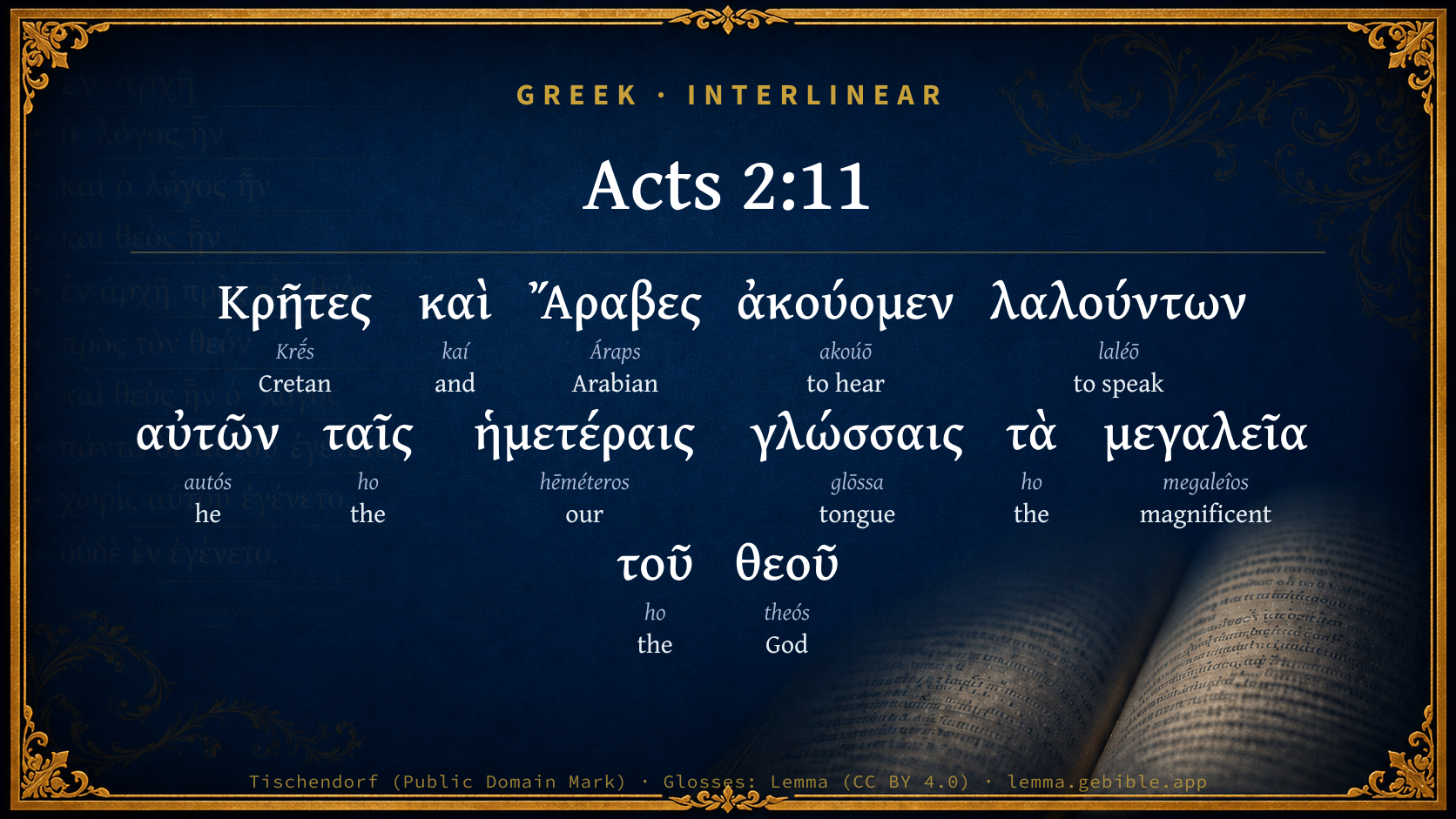
Cretans and Arabians: we hear them speaking in our languages the mighty works of God!"
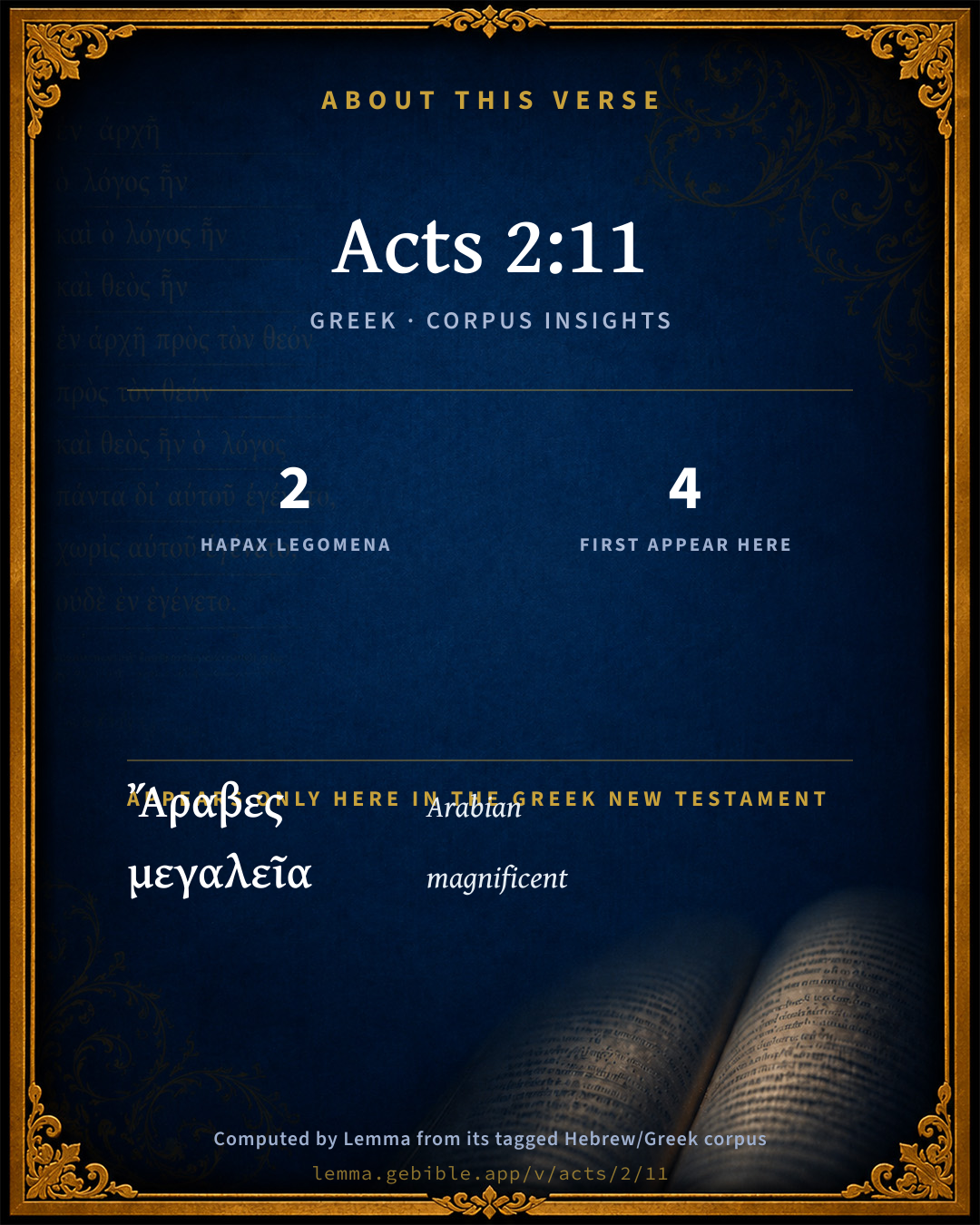
- 2 hapax legomena — only here in the Greek New Testament
- 4 first appearances in the Greek New Testament
Download a study sheet
One document with this verse’s original text, its word-by-word gloss line, the meaning frame, cross-references with their text, attributed commentary, and full source and license credits — printable, and it pastes into notes with its structure intact.
This verse Autodidact and up
A passage Seminary Student
Up to 50 verses in one chapter. A passage sheet keeps up to 6 commentary sources and 12 cross-references per verse, in the order this page ranks them, and says so on the sheet whenever that leaves anything out. Ask for a single verse and you get the Autodidact verse sheet above.
Everything on this page stays free to read, with no account — the sheet is a download of what is already on screen, not access to it.
Compare translations 3
The same verse in 3 English versions, stacked beneath the original-language interlinear above. Click any original word for its lexicon entry.
Each is an independent rendering of the whole verse — the interlinear is not word-aligned to these translations.
Highlighted words mark where these versions differ — a whole-verse word diff, not a word-by-word alignment.
-
World English Bible Public Domain
Cretans and Arabians: we hear them speaking in our languages the mighty works of God!"
-
King James Version Public Domain
Cretes and Arabians, we do hear them speak in our tongues the wonderful works of God.
-
unfoldingWord Literal Text CC BY-SA 4.0
both Jews and proselytes, Cretans and Arabians, we are hearing them speaking in our languages the great things of God.”
unfoldingWord Literal Text — © unfoldingWord, licensed CC BY-SA 4.0. Word-aligned USFM3 via Door43 (git.door43.org/unfoldingWord/en_ult).
Show all 19 translations
Every available English version of this verse, each an independent rendering of the whole verse.
-
World English Bible Public Domain
Cretans and Arabians: we hear them speaking in our languages the mighty works of God!"
-
Berean Standard Bible Public Domain
both Jews and converts to Judaism; Cretans and Arabs—we hear them declaring the wonders of God in our own tongues!”
-
Majority Standard Bible Public Domain
both Jews and converts to Judaism; Cretans and Arabs—we hear them declaring the wonders of God in our own tongues!”
-
King James Version Public Domain
Cretes and Arabians, we do hear them speak in our tongues the wonderful works of God.
-
American Standard Version (1901) Public Domain
Cretans and Arabians, we hear them speaking in our tongues the mighty works of God.
-
Revised Version (1885) Public Domain
Cretans and Arabians, we do hear them speaking in our tongues the mighty works of God.
-
Geneva Bible (1599) Public Domain
Creetes, and Arabians: wee hearde them speake in our owne tongues the wonderful works of God.
-
Douay-Rheims (1899) Public Domain
Jews also, and proselytes, Cretes, and Arabians: we have heard them speak in our own tongues the wonderful works of God.
-
Young's Literal Translation Public Domain
Cretes and Arabians, we did hear them speaking in our tongues the great things of God.'
-
Literal Standard Version CC BY-SA 4.0
Cretes and Arabians, we heard them speaking the great things of God in our tongues.”
-
Unlocked Literal Bible CC BY-SA 4.0
Jews and proselytes, Cretans and Arabians, we hear them telling in our languages about the mighty works of God.”
-
unfoldingWord Literal Text CC BY-SA 4.0
both Jews and proselytes, Cretans and Arabians, we are hearing them speaking in our languages the great things of God.”
-
Darby Bible Public Domain
Cretans and Arabians, we hear them speaking in our own tongues the great things of God?
-
World Messianic Bible Public Domain
Cretans and Arabians—we hear them speaking in our languages the mighty works of God!”
-
Webster's Bible Public Domain
Cretes and Arabians we hear them speak in our languages the wonderful works of God.
-
Free Bible Version CC BY-SA 4.0
Cretans and Arabians—we hear them speaking in our own languages about all the great things God has done.”
-
Bible in Basic English Public Domain
Men of Crete and Arabia, to all of us they are talking in our different languages, of the great works of God.
-
Text-Critical English NT CC BY 4.0
Cretans and Arabs—we hear them speaking about the mighty acts of God in our own tongues.”
-
Tyndale New Testament (1534) Public Domain
Grekes and Arabians: we have herde them speake with oure awne tonges the greate workes of God.
Literal Standard Version (2020), Covenant Press — licensed CC BY-SA 4.0. Text via the HelloAO Bible API (eBible.org). Unlocked Literal Bible (unfoldingWord) — licensed CC BY-SA 4.0. Text via the HelloAO Bible API (eBible.org). unfoldingWord Literal Text — © unfoldingWord, licensed CC BY-SA 4.0. Word-aligned USFM3 via Door43 (git.door43.org/unfoldingWord/en_ult). Free Bible Version, Dr. Jonathan Gallagher — licensed CC BY-SA 4.0. Text via the HelloAO Bible API (eBible.org).
Word by word
More ways to search: Search by grammar → Find every occurrence → Compare this word →
Practice this passage: Drill this verse → Learn its vocabulary →
- Appears 1× in the Greek New Testament
- First appears here
- Part of Speech
- Noun
- Case
- Nominative
- Number
- Plural
- Gender
- Masculine
Full Thayer's Definition
- Κρῆτες Krḗs G2912 “Cretan” Noun, Nominative, Plural, Masculine
- καὶ kaí G2532 “and” Conjunction
- Ἄραβες Áraps G690 “Arabian” Noun, Nominative, Plural, Masculine
- ἀκούομεν akoúō G191 “to hear” Verb, Present, Active, Indicative, 1st person, Plural
- λαλούντων laléō G2980 “to speak” Verb, Present, Active, Participle, Genitive, Plural, Masculine
- αὐτῶν autós G846 “he” Personal pronoun, Genitive, Plural, Masculine
- ταῖς ho G3588 “the” Article, Dative, Plural, Feminine
- ἡμετέραις hēméteros G2251 “our” Possessive pronoun, 1st person, Dative, Plural, Feminine
- γλώσσαις glōssa G1100 “tongue” Noun, Dative, Plural, Feminine
- τὰ ho G3588 “the” Article, Accusative, Plural, Neuter
- μεγαλεῖα megaleîos G3167 “magnificent” Adjective, Accusative, Plural, Neuter
- τοῦ ho G3588 “the” Article, Genitive, Singular, Masculine
- θεοῦ theós G2316 “God” Noun, Genitive, Singular, Masculine
About this verse
These counts appear in no published source. They are computed here, from the morphology-tagged text and Lemma’s own curated glosses. What Lemma adds →
- 13
- words
- 11
- distinct lemmas
- Acts
- section
Notable vocabulary
2 hapax legomena — words that appear only here in the entire Greek New Testament:
First appearance in Scripture
These words make their first canonical appearance in the Greek New Testament here:
Shared distinctive vocabulary
Κρῆτες Cretan G2912 occurs in 2 verses of the Greek New Testament. Also found in:
Repetition
A word recurs within this verse:
- ταῖς the G3588 ×3
Cross-references
33Topical passages linked to Acts 2:11 in the Treasury of Scripture Knowledge — connected by theme and wording, ordered by reader-vote popularity; previews shown in the World English Bible.
- Exodus 15:11 Who is like you, Yahweh, among the gods? Who is like you, glorious in holiness, Fearful in praises, doing wonders?
- 1 Corinthians 12:10 and to another workings of miracles; and to another prophecy; and to another discerning of spirits; to another different kinds of languages; and to another the interpretation of languages.
- Job 9:10 Who does great things past finding out, Yes, marvelous things without number.
- Psalms 26:7 That I may make the voice of thanksgiving to be heard, And tell of all your wondrous works.
- Psalms 78:4 We will not hide them from their children, Telling to the generation to come the praises of Yahweh, His strength, and his wondrous works that he has done.
- Jeremiah 25:24 and all the kings of Arabia, and all the kings of the mixed people who dwell in the wilderness;
- Titus 1:12 One of them, a prophet of their own, said, "Cretans are always liars, evil beasts, and idle gluttons."
- Hebrews 2:4 God also bearing witness with them, both by signs and wonders, and by various works of power, and by gifts of the Holy Spirit, according to his own will?
- 1 Kings 10:15 besides [that which] the traders [brought], and the traffic of the merchants, and of all the kings of the mixed people, and of the governors of the country.
- 2 Chronicles 17:11 Some of the Philistines brought Jehoshaphat presents, and silver for tribute; the Arabians also brought him flocks, seven thousand and seven hundred rams, and seven thousand and seven hundred male goats.
- 2 Chronicles 26:7 God helped him against the Philistines, and against the Arabians who lived in Gur Baal, and the Meunim.
- Psalms 40:5 Many, Yahweh, my God, are the wonderful works which you have done, And your thoughts which are toward us. They can't be set in order to you; If I would declare and speak of them, they are more than can be numbered.
- Psalms 71:17 God, you have taught me from my youth. Until now, I have declared your wondrous works.
- Psalms 77:11 I will remember Yah's deeds; For I will remember your wonders of old.
- Psalms 89:5 The heavens will praise your wonders, Yahweh; Your faithfulness also in the assembly of the holy ones.
- Psalms 96:3 Declare his glory among the nations, His marvelous works among all the peoples.
- Psalms 107:8 Let them praise Yahweh for his loving kindness, For his wonderful works to the children of men!
- Psalms 107:15 Let them praise Yahweh for his loving kindness, For his wonderful works to the children of men!
- Psalms 107:21 Let them praise Yahweh for his loving kindness, For his wonderful works to the children of men!
- Psalms 111:4 He has caused his wonderful works to be remembered. Yahweh is gracious and merciful.
- Psalms 136:4 To him who alone does great wonders; For his loving kindness endures forever:
- Isaiah 13:20 It shall never be inhabited, neither shall it be lived in from generation to generation: neither shall the Arabian pitch tent there; neither shall shepherds make their flocks to lie down there.
- Isaiah 25:1 Yahweh, you are my God; I will exalt you, I will praise your name; for you have done wonderful things, [even] counsels of old, in faithfulness [and] truth.
- Isaiah 28:29 This also comes forth from Yahweh of Hosts, who is wonderful in counsel, and excellent in wisdom.
- Jeremiah 3:2 Lift up your eyes to the bare heights, and see; where have you not been lain with? By the ways have you sat for them, as an Arabian in the wilderness; and you have polluted the land with your prostitution and with your wickedness.
- Daniel 4:2–3 It has seemed good to me to show the signs and wonders that the Most High God has worked toward me.
- Acts 27:7 When we had sailed slowly many days, and had come with difficulty opposite Cnidus, the wind not allowing us further, we sailed under the lee of Crete, opposite Salmone.
- Acts 27:12 Because the haven was not suitable to winter in, the majority advised going to sea from there, if by any means they could reach Phoenix, and winter there, which is a port of Crete, looking northeast and southeast.
- Titus 1:5 I left you in Crete for this reason, that you would set in order the things that were lacking, and appoint elders in every city, as I directed you;
- Isaiah 21:13 The burden on Arabia. In the forest in Arabia shall you lodge, you caravans of Dedanites.
- Galatians 1:17 nor did I go up to Jerusalem to those who were apostles before me, but I went away into Arabia. Then I returned to Damascus.
- Galatians 4:25 For this Hagar is Mount Sinai in Arabia, and answers to the Jerusalem that exists now, for she is in bondage with her children.
- 1 Corinthians 12:28 God has set some in the assembly: first apostles, second prophets, third teachers, then miracle workers, then gifts of healings, helps, governments, and various kinds of languages.
Cross-references courtesy of OpenBible.info (CC BY 4.0).
Lesson kit
Teaching starters — assembled from the data on this page, not authored interpretation. Every prompt links to the verse data it draws on. Edit before teaching.
Acts, in the Acts, opens this verse with 13 words (11 distinct Greek lemmas). Its most distinctive word is Áraps (“Arabian”). A historical commentator’s framing appears above. Read the whole chapter for the surrounding context.
Discussion questions
- The word Áraps carries the sense “Arabian.” How does it shape the verse?
- 2 words here appear nowhere else in the Greek New Testament. Why might the author reach for such rare wording?
- 4 words make their first appearance in Scripture here. What does this debut establish?
- How does Titus 1:12, which shares the word «Cretan», read alongside this verse?
- What does the repetition of “the” (3× in this one verse) do in this verse?
- The translations on this page render this verse differently — a whole-verse word diff, not a word-by-word alignment. What might account for the different wordings?
- Compare how Bengel's Gnomon and Expositor's Greek Testament read this verse. Where do they agree or differ?
Things to notice
- 2 words in this verse appear nowhere else in the Greek New Testament.
- 4 words make their first canonical appearance in Scripture here.
- These translations choose different wording for 17 words in this verse.
- “the” occurs 3× in this single verse.
- 11 distinct Greek lemmas span 13 words in this verse.
Commentary
Notes on Acts 2:11 from classic Christian and Jewish commentators (each source and its license shown beneath its notes). The classic Christian expositions comment on the surrounding passage and are grouped to its opening verse, so a note may address several verses; the Jewish commentaries on the Tanakh (Rashi and others) are per-verse, so they appear only where the commentator wrote on this verse.
Lemma curates 59 commentaries, every one of them public domain or Creative Commons licensed, each selected and text-cleaned for this edition rather than reprinted as found. About our sources →
Bengel's Gnomon
Johann Albrecht Bengel
Bengel's Gnomon of the New Testament — English translation (T&T Clark, Edinburgh, 1860) — public domain. Text from a community e-Sword module.
Expositor's Greek Testament
ed. W. Robertson Nicoll
The Expositor's Greek Testament, edited by W. Robertson Nicoll (1897–1910) — public domain. Text from a community e-Sword module.
Adam Clarke's Commentary
Adam Clarke's Commentary on the Bible (1810–1826) — public domain. Text from a community e-Sword/MySword module.
John Calvin's Commentaries
John Calvin's Commentaries (1540-1563) — public domain. Text from the Calvin Translation Society English edition (1840s-50s) via the Christian Classics Ethereal Library (ccel.org). Calvin's coverage is partial (roughly two-thirds of the Bible); uncommented books and verses are honest gaps, never fabricated. The 19th-century editor's footnotes and remarks are omitted so the notes are faithfully Calvin's own voice.
Ellicott's Commentary for English Readers
A Bible Commentary for English Readers, edited by Charles John Ellicott (1878–1897) — public domain. Text from a community e-Sword module.
The Cambridge Bible for Schools and Colleges
gen. ed. J. J. S. Perowne
The Cambridge Bible for Schools and Colleges (gen. ed. J. J. S. Perowne; Cambridge University Press, 1878–1918) — public domain. Text from a community e-Sword module.
John Gill's Exposition
John Gill's Exposition of the Whole Bible (1746–1763) — public domain (CC PDM 1.0). Text via the HelloAO Bible API.
Albert Barnes' Notes on the Bible
Albert Barnes' Notes on the Bible (1834–1885) — public domain. Text from a community e-Sword/MySword module.
Matthew Poole's English Annotations
Matthew Poole's English Annotations on the Holy Bible (1683–1685) — public domain. Text from a community e-Sword/MySword module.
Whedon's Commentary on the Bible
Daniel D. Whedon
Daniel D. Whedon (gen. ed.), Commentary on the Old and New Testaments (1874–1909) — public domain. Text from a community e-Sword module.
The Pulpit Commentary
The Pulpit Commentary (1880–1919), ed. H.D.M. Spence-Jones & Joseph S. Exell — public domain. Text from a community e-Sword module.
John Wesley's Explanatory Notes
John Wesley, Explanatory Notes Upon the Whole Bible (1754–1765) — public domain. Text via the GEBible commentary corpus.
Scofield Reference Notes
C. I. Scofield
The Scofield Reference Bible (1917 edition), notes by C. I. Scofield — public domain. Text from a community e-Sword module.
McGarvey & Pendleton's Commentaries
J. W. McGarvey
J. W. McGarvey (with Philip Y. Pendleton), Commentaries on the New Testament (The Fourfold Gospel, 1914; Acts; and the epistles) — public domain. Text from a community e-Sword/MySword module.
The People's New Testament
B. W. Johnson
B. W. Johnson's The People's New Testament with Notes (1889–1891) — public domain. Electronic text from the Christian Classics Ethereal Library (CCEL) ThML edition.
Cambridge Greek Testament for Schools and Colleges
Cambridge Greek Testament for Schools and Colleges (Cambridge University Press, 1896; 21 vols, various authors incl. Carr, Maclear, Plummer, Farrar, Lumby, Moule, M. R. James, Simcox) — public domain. Text from a community e-Sword module.
Alford’s Greek Testament
Henry Alford
Henry Alford, The Greek Testament (1849–1861) — public domain. Text from a community e-Sword module.
Vincent's Word Studies in the New Testament
Marvin R. Vincent
Marvin R. Vincent, Word Studies in the New Testament (1887–1900) — public domain. Text from a community e-Sword/MySword module.