
Genesis 23:16

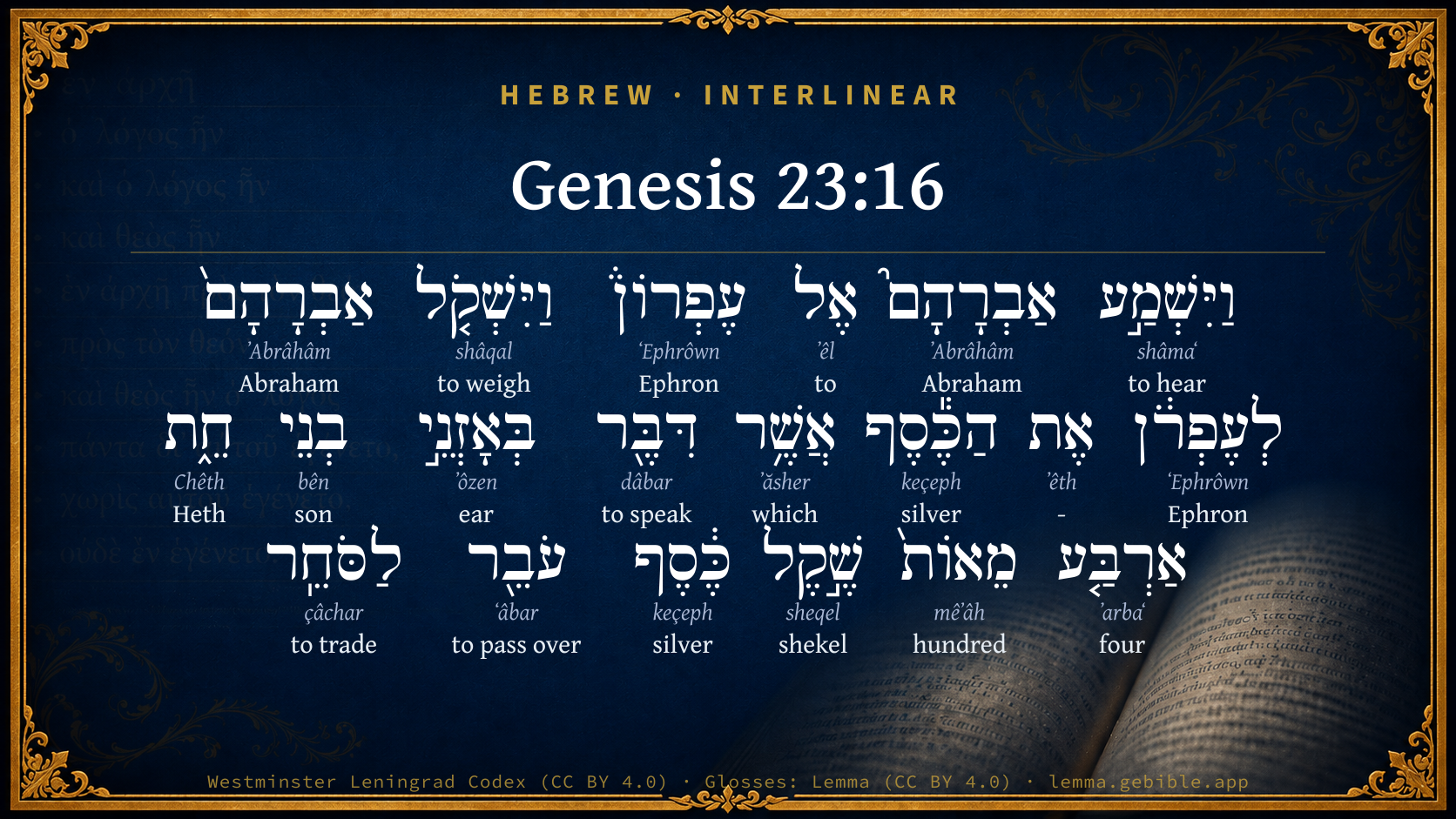
Hebrew (Westminster Leningrad Codex) Genesis 23:16 appears in the Hebrew Old Testament. The text above is from the Westminster Leningrad Codex. Each word links to its Strong’s number, a concise gloss, and parsing drawn from the Open Scriptures Hebrew Bible morphology. Click any word for its full Brown-Driver-Briggs (BDB) entry.
Download image
Cite this verse

Genesis 23:16 (World English Bible). Public Domain. Lemma interlinear Bible study tool, https://lemma.gebible.app/v/genesis/23/16.

Show BibTeX & RIS
BibTeX
RIS
English Translation
Abraham listened to Ephron. Abraham weighed to Ephron the silver which he had named in the audience of the children of Heth, four hundred shekels of silver, according to the current merchants' standard.
World English Bible · Public Domain
Highlights
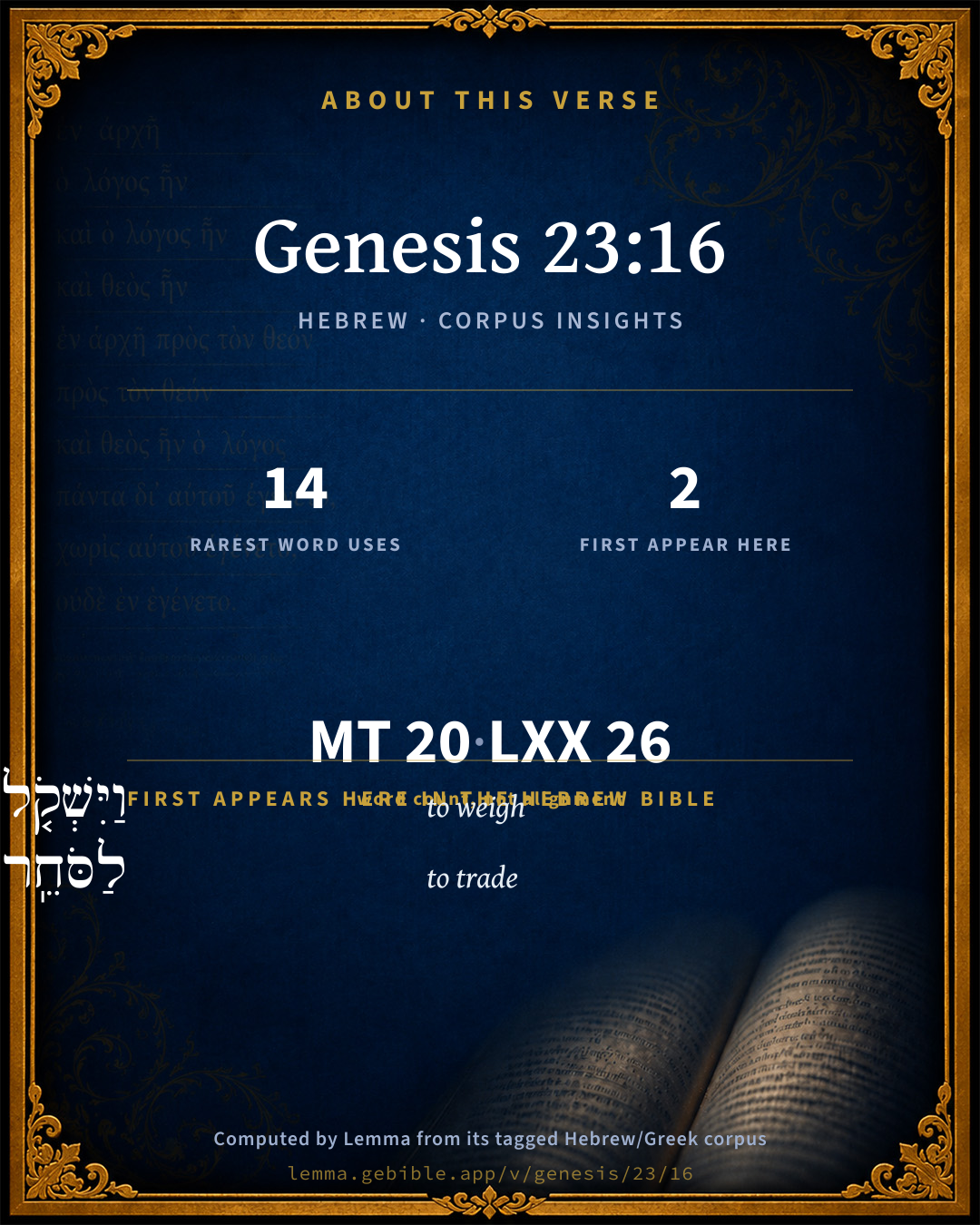
  • 2 first appearances in the Hebrew Bible
Full analysis ↓
Download a study sheet

One document with this verse’s original text, its word-by-word gloss line, the meaning frame, cross-references with their text, attributed commentary, and full source and license credits — printable, and it pastes into notes with its structure intact.

This verse Autodidact and up

Study sheet (.html) Plain text (.txt)

A passage Seminary Student

Up to 50 verses in one chapter. A passage sheet keeps up to 6 commentary sources and 12 cross-references per verse, in the order this page ranks them, and says so on the sheet whenever that leaves anything out. Ask for a single verse and you get the Autodidact verse sheet above.

Everything on this page stays free to read, with no account — the sheet is a download of what is already on screen, not access to it.

Want to remove ads? Support Godless Engineer
Compare translations 3

The same verse in 3 English versions, stacked beneath the original-language interlinear above. Click any original word for its lexicon entry.

Each is an independent rendering of the whole verse — the interlinear is not word-aligned to these translations.

Highlighted words mark where these versions differ — a whole-verse word diff, not a word-by-word alignment.

  • World English Bible Public Domain
    Abraham listened to Ephron. Abraham weighed to Ephron the silver which he had named in the audience of the children of Heth, four hundred shekels of silver, according to the current merchants' standard.
  • King James Version Public Domain
    And Abraham hearkened unto Ephron; and Abraham weighed to Ephron the silver, which he had named in the audience of the sons of Heth, four hundred shekels of silver, current money with the merchant.
  • unfoldingWord Literal Text CC BY-SA 4.0
    So Abraham listened to Ephron, and Abraham weighed out to Ephron the price that he had mentioned in the ears of the sons of Heth, 400 shekels of silver, the currency among the merchants.

unfoldingWord Literal Text — © unfoldingWord, licensed CC BY-SA 4.0. Word-aligned USFM3 via Door43 (git.door43.org/unfoldingWord/en_ult).

Versions to compare (up to 4)

3 of 4 selected

Show all 18 translations

Every available English version of this verse, each an independent rendering of the whole verse.

  • World English Bible Public Domain
    Abraham listened to Ephron. Abraham weighed to Ephron the silver which he had named in the audience of the children of Heth, four hundred shekels of silver, according to the current merchants' standard.
  • Berean Standard Bible Public Domain
    Abraham agreed to Ephron’s terms and weighed out for him the price he had named in the hearing of the Hittites: four hundred shekels of silver, according to the standard of the merchants.
  • Majority Standard Bible Public Domain
    Abraham agreed to Ephron’s terms and weighed out for him the price he had named in the hearing of the Hittites: four hundred shekels of silver, according to the standard of the merchants.
  • King James Version Public Domain
    And Abraham hearkened unto Ephron; and Abraham weighed to Ephron the silver, which he had named in the audience of the sons of Heth, four hundred shekels of silver, current money with the merchant.
  • American Standard Version (1901) Public Domain
    And Abraham hearkened unto Ephron. And Abraham weighed to Ephron the silver which he had named in the audience of the children of Heth, four hundred shekels of silver, current `money' with the merchant.
  • Revised Version (1885) Public Domain
    And Abraham hearkened unto Ephron; and Abraham weighed to Ephron the silver, which he had named in the audience of the children of Heth, four hundred shekels of silver, current money with the merchant.
  • Geneva Bible (1599) Public Domain
    So Abraham hearkened vnto Ephron, and Abraham weyed to Ephron the siluer, which he had named, in the audience of the Hittites, euen foure hundreth siluer shekels of currant money among marchants.
  • Douay-Rheims (1899) Public Domain
    And when Abraham had heard this, he weighed out the money that Ephron had asked, in the hearing of the children of Heth, four hundred sicles of silver of common current money.
  • Young's Literal Translation Public Domain
    And Abraham hearkeneth unto Ephron, and Abraham weigheth to Ephron the silver which he hath spoken of in the ears of the sons of Heth, four hundred silver shekels, passing with the merchant.
  • Literal Standard Version CC BY-SA 4.0
    And Abraham listens to Ephron, and Abraham weighs to Ephron the silver which he has spoken of in the ears of the sons of Heth, four hundred silver shekels, passing with the merchant.
  • Unlocked Literal Bible CC BY-SA 4.0
    Abraham listened to Ephron and Abraham weighed out to Ephron the amount of silver that he had spoken in the hearing of the sons of Heth, four hundred shekels of silver, according to the standard measurement of the merchants.
  • unfoldingWord Literal Text CC BY-SA 4.0
    So Abraham listened to Ephron, and Abraham weighed out to Ephron the price that he had mentioned in the ears of the sons of Heth, 400 shekels of silver, the currency among the merchants.
  • Darby Bible Public Domain
    And Abraham hearkened to Ephron; and Abraham weighed to Ephron the money that he had named in the ears of the sons of Heth -- four hundred shekels of silver, current with the merchant.
  • World Messianic Bible Public Domain
    Abraham listened to Ephron. Abraham weighed to Ephron the silver which he had named in the hearing of the children of Heth, four hundred shekels of silver, according to the current merchants’ standard.
  • Webster's Bible Public Domain
    And Abraham hearkened to Ephron; and Abraham weighed to Ephron the silver which he had named in the audience of the sons of Heth, four hundred shekels of silver, current money with the merchant.
  • Free Bible Version CC BY-SA 4.0
    Abraham accepted Ephron's offer. Abraham weighed out and gave to Ephron the four hundred pieces of silver he'd mentioned, using the standard weights used by merchants, and with the Hittites acting as witnesses.
  • Bible in Basic English Public Domain
    And Abraham took note of the price fixed by Ephron in the hearing of the children of Heth, and gave him four hundred shekels in current money.
  • JPS Tanakh (1917) Public Domain
    And Abraham hearkened unto Ephron; and Abraham weighed to Ephron the silver, which he had named in the hearing of the children of Heth, four hundred shekels of silver, current money with the merchant.

Literal Standard Version (2020), Covenant Press — licensed CC BY-SA 4.0. Text via the HelloAO Bible API (eBible.org). Unlocked Literal Bible (unfoldingWord) — licensed CC BY-SA 4.0. Text via the HelloAO Bible API (eBible.org). unfoldingWord Literal Text — © unfoldingWord, licensed CC BY-SA 4.0. Word-aligned USFM3 via Door43 (git.door43.org/unfoldingWord/en_ult). Free Bible Version, Dr. Jonathan Gallagher — licensed CC BY-SA 4.0. Text via the HelloAO Bible API (eBible.org).

Word by word

More ways to search: Search by grammar → Find every occurrence → Compare this word →

Practice this passage: Drill this verse → Learn its vocabulary →

חֵ֑ת
Chêth
H2845
“Heth”
Noun, Proper
Part of Speech
Noun
Type
Proper
Full BDB Definition

Origin: from H2865

TWOT: 776

Heth = "terror" - a son of Canaan and the progenitor of the Hittites
  1. וַיִּשְׁמַ֣ע shâmaʻ H8085 “and · to hear” Conjunction + Verb, Qal, Sequential Imperfect, 3rd Person, Masculine, Singular
  2. אַבְרָהָם֮ ʼAbrâhâm H85 “Abraham” Noun, Proper
  3. אֶל ʼêl H413 “to” Preposition
  4. עֶפְרוֹן֒ ʻEphrôwn H6085 “Ephron” Noun, Proper
  5. וַיִּשְׁקֹ֤ל shâqal H8254 “and · to weigh” Conjunction + Verb, Qal, Sequential Imperfect, 3rd Person, Masculine, Singular
  6. אַבְרָהָם֙ ʼAbrâhâm H85 “Abraham” Noun, Proper
  7. לְעֶפְרֹ֔ן ʻEphrôwn H6085 “to/for · Ephron” Preposition + Noun, Proper
  8. אֶת ʼêth H853 “-” Particle, Direct Object
  9. הַכֶּ֕סֶף keçeph H3701 “the · silver” Particle, Definite Article + Noun, Common, Masculine, Singular, Absolute
  10. אֲשֶׁ֥ר ʼăsher H834 “which” Particle, Relative
  11. דִּבֶּ֖ר dâbar H1696 “to speak” Verb, Piel, Perfect, 3rd Person, Masculine, Singular
  12. בְּאָזְנֵ֣י ʼôzen H241 “in/at · ears of” Preposition + Noun, Common, Feminine, Dual, Construct
  13. בְנֵי bên H1121 “sons of” Noun, Common, Masculine, Plural, Construct
  14. אַרְבַּ֤ע ʼarbaʻ H702 “four” Adjective, Cardinal number, Feminine, Singular, Absolute
  15. מֵאוֹת֙ mêʼâh H3967 “hundred” Adjective, Cardinal number, Both, Plural, Absolute
  16. שֶׁ֣קֶל sheqel H8255 “shekel of” Noun, Common, Masculine, Singular, Construct
  17. כֶּ֔סֶף keçeph H3701 “silver” Noun, Common, Masculine, Singular, Absolute
  18. עֹבֵ֖ר ʻâbar H5674 “passing over” Verb, Qal, Participle Active, Masculine, Singular, Absolute
  19. לַסֹּחֵֽר çâchar H5503 “to/for the · trading” Preposition, Determined + Verb, Qal, Participle Active, Masculine, Singular, Absolute

About this verse

These counts appear in no published source. They are computed here, from the morphology-tagged text and Lemma’s own curated glosses. What Lemma adds →

20
words
17
distinct lemmas
Pentateuch
section

Notable vocabulary

The rarest word here is חֵ֑ת Heth H2845 — appearing just 14 times in the whole Hebrew Bible.

First appearance in Scripture

These words make their first canonical appearance in the Hebrew Bible here:

  • וַיִּשְׁקֹ֤ל to weigh H8254
  • לַסֹּחֵֽר to trade H5503

Shared distinctive vocabulary

חֵ֑ת Heth H2845 occurs in 12 verses of the Hebrew Bible. Also found in:

Grammatical profile

  • 5 verbs
  • 10 nouns
  • 2 adjectives
  • 1 preposition
  • 2 particles

Verb forms

  • וַיִּשְׁמַ֣ע Qal · Sequential Imperfect
  • וַיִּשְׁקֹ֤ל Qal · Sequential Imperfect
  • דִּבֶּ֖ר Piel · Perfect
  • עֹבֵ֖ר Qal · Participle Active
  • לַסֹּחֵֽר Qal · Participle Active

Repetition

Words recur within this verse — often emphatic in Hebrew:

  • אַבְרָהָם֮ Abraham H85 ×2
  • עֶפְרוֹן֒ Ephron H6085 ×2
  • הַכֶּ֕סֶף silver H3701 ×2

Hebrew & Septuagint length

In English translation the verse runs 33 words from the Hebrew and 31 from the Septuagint (LXX English) — closely comparable.

A rough comparison of the two English renderings, which tokenize alike — not a word-level alignment.

Word counts can differ between the Hebrew and the Greek without any difference in meaning — e.g. the Hebrew direct-object marker אֵת has no separate Greek word, and Greek often adds the article ὁ.

In the original languages it is 20 Hebrew tokens and 26 Greek tokens — but the two are counted differently (Hebrew bundles its prefixes and suffixes into one token; the Greek is in lemma form), so that isn’t a like-for-like length.

Cross-references

12

Topical passages linked to Genesis 23:16 in the Treasury of Scripture Knowledge — connected by theme and wording, ordered by reader-vote popularity; previews shown in the World English Bible.

  • Jeremiah 32:9 I bought the field that was in Anathoth of Hanamel my uncle's son, and weighed him the money, even seventeen shekels of silver.
  • Zechariah 11:12 I said to them, "If you think it best, give me my wages; and if not, keep them." So they weighed for my wages thirty pieces of silver.
  • Genesis 23:15 "My lord, listen to me. What is a piece of land worth four hundred shekels of silver between me and you? Therefore bury your dead."
  • Genesis 43:21 and it happened, when we came to the lodging-place, that we opened our sacks, and, behold, every man's money was in the mouth of his sack, our money in full weight. We have brought it again in our hand.
  • Exodus 30:13 They shall give this, everyone who passes over to those who are numbered, half a shekel after the shekel of the sanctuary; (the shekel is twenty gerahs;) half a shekel for an offering to Yahweh.
  • Ezra 8:25–30 and weighed to them the silver, and the gold, and the vessels, even the offering for the house of our God, which the king, and his counselors, and his princes, and all Israel there present, had offered:
  • Job 28:15 It can't be gotten for gold, Neither shall silver be weighed for its price.
  • Ezekiel 45:12 The shekel shall be twenty gerahs. Twenty shekels plus twenty-five shekels plus fifteen shekels shall be your mina.
  • Matthew 7:12 Therefore whatever you desire for men to do to you, you shall also do to them; for this is the law and the prophets.
  • Romans 13:8 Owe no one anything, except to love one another; for he who loves his neighbor has fulfilled the law.
  • Philippians 4:8 Finally, brothers, whatever things are true, whatever things are honorable, whatever things are just, whatever things are pure, whatever things are lovely, whatever things are of good report; if there is any virtue, and if there is any praise, think about these things.
  • 1 Thessalonians 4:6 that no one should take advantage of and wrong a brother or sister in this matter; because the Lord is an avenger in all these things, as also we forewarned you and testified.

Cross-references courtesy of OpenBible.info (CC BY 4.0).

Hebrew and Greek witnesses Masoretic Hebrew ↔ Greek Septuagint

The same verse in the two great witnesses to the Old Testament, shown verse-for-verse.

These are two independent witnesses, not word-aligned to each other, and the Septuagint is shown in lemma (dictionary) form.

Hebrew Genesis 23:16 Masoretic · Westminster Leningrad Codex

וַיִּשְׁמַ֣ע אַבְרָהָם֮ אֶל עֶפְרוֹן֒ וַיִּשְׁקֹ֤ל אַבְרָהָם֙ לְעֶפְרֹ֔ן אֶת הַכֶּ֕סֶף אֲשֶׁ֥ר דִּבֶּ֖ר בְּאָזְנֵ֣י בְנֵי חֵ֑ת אַרְבַּ֤ע מֵאוֹת֙ שֶׁ֣קֶל כֶּ֔סֶף עֹבֵ֖ר לַסֹּחֵֽר

Abraham listened to Ephron. Abraham weighed to Ephron the silver which he had named in the audience of the children of Heth, four hundred shekels of silver, according to the current merchants' standard.

World English Bible · Public Domain

Greek LXX Genesis 23:16 Septuagint · lemma form

καί ἀκούω αβρααμ ὁ εφρων καί ἀπο καταἵστημι αβρααμ ὁ εφρων ὁ ἀργύριον ὅς λαλέω εἰς ὁ οὖς ὁ υἱός χετ τετρακόσιοι δίδραγμον ἀργύριον δόκιμος ἔμπορος

And Abraam listened to Ephron, and Abraam rendered to Ephron the money, which he mentioned in the ears of the sons of Chet, four hundred didrachmas of silver approved with merchants.

LXX2012 (modern English Septuagint) · Public Domain

On this verse, The Cambridge Bible for Schools and Colleges discusses the Septuagint’s reading. Read the note in Commentary ↓

Hebrew: Westminster Leningrad Codex (CC BY 4.0). Greek: Septuagint (public domain); English from LXX2012 (modern English Septuagint) (Public Domain). How the Septuagint differs from the Hebrew →

Targum (Aramaic paraphrase)

2

The Targum is the ancient Jewish Aramaic paraphrase of the Hebrew Scriptures — an interpretive translation, not the Hebrew text itself. Onkelos (literal) and Pseudo-Jonathan (expansive) render the Torah, and Jonathan the Prophets. Coverage is partial: where no permissively-licensed English translation exists for a verse, only the Aramaic is shown. This is verse-level text, not a word-by-word alignment to the Hebrew.

  1. Targum Onkelos Torah (Genesis–Deuteronomy)
    וְקַבֵּל אַבְרָהָם מִן עֶפְרוֹן וּתְקַל אַבְרָהָם לְעֶפְרוֹן יָת כַּסְפָּא דְּמַלֵּיל קֳדָם בְּנֵי חִתָּאָה אַרְבַּע מְאָה סִלְעִין דִּכְסַף מִתְקַבֵּל סְחוֹרָא (נ''י דְּמִתְקַבֵּל סְחוֹרָתָא) בְּכָל מְדִינְתָּא

    (no public-domain English translation for this verse)

    Targum Onkelos — Aramaic: “Onkelos Genesis” (public domain); “Onkelos Exodus” (public domain); “Onkelos Leviticus” (public domain); “Onkelos Numbers” (public domain); “Onkelos Deuteronomy” (public domain). English: “Sefaria Community Translation” (CC0 1.0 (public-domain dedication)); “J.W. Etheridge. The Targums of Onkelos and Jonathan Ben Uzziel on the Pentateuch. London: Longmans, Green, 1862” (public domain). Text via Sefaria.

  2. Targum Pseudo-Jonathan Torah (Genesis–Deuteronomy)
    וְקַבֵּל אַבְרָהָם מִן עֶפְרוֹן וּתְקַל אַבְרָהָם לְעֶפְרוֹן יַת כַּסְפָּא דְמַלֵיל בְּאַנְפֵּיהּ בְּנֵי חִתָּאָה אַרְבַּע מְאָה סִלְעִין דִכְסַף טַב עָבְרִין בְּכָל פְּתוֹר וּמִתְקַבְּלִין בְּכָל פְּרַקְמַטְיָא

    And Abraham hearkened unto Ephron, and Abraham weighed to Ephron the silver which he had named before the sons of Hittah, four hundred sileen of silver, good, passing at every table, and receivable in all transactions.

    Targum Pseudo-Jonathan — Aramaic: “Targum Jonathan on Genesis” (public domain); “Targum Jonathan on Exodus” (public domain); “Targum Jonathan on Leviticus” (public domain); “Targum Jonathan on Numbers” (public domain); “Targum Jonathan on Deuteronomy” (public domain). English: “The Targum of Jonathan ben Uzziel, trans. J. W. Etheridge, London, 1862” (public domain). Text via Sefaria.

Commentary

Notes on Genesis 23:16 from classic Christian and Jewish commentators (each source and its license shown beneath its notes). The classic Christian expositions comment on the surrounding passage and are grouped to its opening verse, so a note may address several verses; the Jewish commentaries on the Tanakh (Rashi and others) are per-verse, so they appear only where the commentator wrote on this verse.

Lemma curates 59 commentaries, every one of them public domain or Creative Commons licensed, each selected and text-cleaned for this edition rather than reprinted as found. About our sources →

Matthew Henry's Commentary

We have here the conclusion of the treaty between Abraham and Ephron about the burying-place. The bargain was publicly made before all the neighbours, in the presence and audience of the sons of Heth, Gen 23:16, Gen 23:17. Note, Prudence, as well as justice, directs us to be fair, and open, and above-board, in our dealings. Fraudulent contracts hate the light, and choose to be clandestine; but those that design honestly in their bargains care not who are witnesses to them. Our law countenances sales made in market - overt, and by deed enrolled. Observe, 1. Abraham, without fraud, covin, or further delay, pays the money, Gen 23:16. He pays it readily, without hesitation, - pays it in full, without diminution, - and pays it by weight, current money with the merchant, without deceit. See how anciently money was used for the help of commerce; and see how honestly money should be paid where it is due. Observe, Though all the land of Canaan was Abraham's by promise, yet, the time of his possessing not having come, what he had now occasion for he bought and paid for. Note, Dominion is not founded in grace. The saints' title to an eternal inheritance does not entitle them to the possessions of this world, nor justify them in doing wrong. 2. Ephron honestly and fairly makes him a good title to the land, Gen 23:17, Gen 23:18, Gen 23:20. The field, with all its appurtenances, is conveyed to Abraham and his heirs for ever, in open court, not by writing (it does not appear that writing was then used), but by such a public solemn declaration before witnesses as was sufficient to pass it. Note, As that which is bought must be honestly paid for, so that which is sold must be honestly paid for, so that which is sold must be honestly delivered and secured. 3. Abraham, thereupon, takes possession, and buries Sarah in the cave or vault (whether framed by nature or art is not certain) which was in the purchased field. It is probable that Abraham had buried servants out of his family since he came to Canaan, but the graves of the common people (Kg2 23:6) might suffice for them; now that Sarah was dead a peculiar place must be found for her remains. It is worth noting, (1.) That a burying-place was the first spot of ground Abraham possessed in Canaan. Note, When we are entering into the world it is good to think of our going out of it; for, as soon as we are born, we begin to die. (2.) That it was the only piece of land he ever possessed, though the country was all his own in reversion. Those that have least of this earth find a grave in it. Abraham provided, not cities, as Cain and Nimrod, but a sepulchre, [1.] To be a constant memorandum of death to himself and his posterity, that he and they might learn to die daily. This sepulchre is said to be at the end of the field (Gen 23:9); for, whatever our possessions are, there is a sepulchre at the end of them. [2.] To be a token of his belief and expectation of the resurrection; for why should such care be taken of the body if it be thrown away for ever, and must not rise again? Abraham, in this, said plainly that he sought a better country, that is, a heavenly. Abraham is content to be still flitting, while he lives, but secures a place where, when he dies his flesh may rest in hope.

Matthew Henry's Commentary on the Whole Bible (1708–1710) — public domain (CC PDM 1.0). Text via the HelloAO Bible API.

Trapp's Complete Commentary

John Trapp

Gen 23:16 And Abraham hearkened unto Ephron; and Abraham weighed to Ephron the silver, which he had named in the audience of the sons of Heth, four hundred shekels of silver, current [money] with the merchant.

Ver. 16. In the audience of the sons of Heth.] Whom he takes to witness, and so provideth for his security and quietness afterwards; as did also Jeremiah in the purchase of his uncle’s field. Wisdom and circumspection are to be used in contracts and covenants.

Current with the merchant.] It may well be said of money hoarders, they have no quicksilver, no current money.

John Trapp, A Commentary or Exposition upon All the Books of the Old and New Testament (1647–1656) — public domain. Text from a community e-Sword module.

Tyndale Open Study Notes

Tyndale Open Resources

23:16-20 Abraham paid the amount and finalized the transaction, avoiding indebtedness by accepting no gifts from the people (cp. 14:21-24). The Hittite elders witnessed the transaction, ensuring that no one could challenge Abraham’s full ownership of the land. The transaction took place at the city gate, where public legal and business dealings were conducted (cp. 19:1). The land became Abraham’s permanent possession, a down payment on God’s promise to give him the land. Abraham knew that God’s promise was not fulfilled (12:7) by this acquisition, so he planned for the future. By buying land for his dead, he declared that God’s promises do not end with this life. This is the hope of all who die in faith.

Tyndale Open Study Notes — © Tyndale Open Resources, licensed CC BY-SA 4.0. Text via the HelloAO Bible API.

Jamieson, Fausset & Brown

Robert Jamieson, A. R. Fausset & David Brown

Abraham weighed . . . the silver--The money, amounting to £50 was paid in presence of the assembled witnesses; and it was weighed. The practice of weighing money, which is often in lumps or rings, each stamped with their weight, is still common in many parts of the East; and every merchant at the gates or the bazaar has his scales at his girdle.

Jamieson, Fausset & Brown — Commentary Critical and Explanatory on the Whole Bible (1871) — public domain (CC PDM 1.0). Text via the HelloAO Bible API.

Adam Clarke's Commentary

Verse 16. Current with the merchant] עבר לסחר ober lassocher, passing to or with the traveller - such as was commonly used by those who travelled about with merchandise of any sort. The word signifies the same as hawker or pedlar among us.

Adam Clarke's Commentary on the Bible (1810–1826) — public domain. Text from a community e-Sword/MySword module.

John Calvin's Commentaries

16. And Abraham weighed to Ephron the silver. I know not what had come into Jerome’s mind, when he says, that one letter was abstracted from Ephron’s name, after he had been persuaded, by Abraham’s entreaties, to receive money for the field; because, by the sale of the sepulcher, his virtue was maimed or diminished: for, in fact, the name of Ephron is found written in the very same manner, after that event, as before. Nor ought it to be imputed to Ephron as a fault, that, being pressed, he took the lawful price for his estate; when he had been prepared liberally to give it. If there was any sin in the case, Abraham must bear the whole blame. But who shall dare to condemn a just sale, in which, on both sides, religion, good faith, and equity, are maintained? Abraham, it is argued, bought the field for the sake of having a sepulcher. But ought Ephron on that account to give it freely, and under the pretext of a sepulcher, to be defrauded of his right? We see here, then, nothing but mere trifling. The Canonists, however, — preposterous and infatuated as they are, — rashly laying hold of the expressions of Jerome, have determined that it is a prodigious sacrilege to sell sepulchres. Yet, in the meantime, all the Papal sacrificers securely exercise this traffic: and while they acknowledge the cemetery to be a common sepulcher, they suffer no grave to be dug, unless the price be paid.

Current money with the merchant. Moses speaks thus, because money is a medium of mutual communication between men. It is principally employed in buying and selling merchandise. Whereas Moses says, in the close of the chapter, that the field was confirmed by the Hittites to Abraham for a possession; the sense is, that the purchase was publicly attested; for although a private person sold it, yet the people were present, and ratified the contract between the two parties.

John Calvin's Commentaries (1540-1563) — public domain. Text from the Calvin Translation Society English edition (1840s-50s) via the Christian Classics Ethereal Library (ccel.org). Calvin's coverage is partial (roughly two-thirds of the Bible); uncommented books and verses are honest gaps, never fabricated. The 19th-century editor's footnotes and remarks are omitted so the notes are faithfully Calvin's own voice.

Ellicott's Commentary for English Readers

(16) Abraham weighed . . . current money with the merchant.—Shekel literally means weight, and money was not coined until long afterwards. In the last clause, by inserting money our version antedates facts. According to the Hebrew, it was the silver that was current with the merchants. The metal was probably made into small bars, marked by the refiner to indicate their quality: and Abraham weighed out to Ephron about 200 ounces of silver in bars of the quality usual in trade.

A Bible Commentary for English Readers, edited by Charles John Ellicott (1878–1897) — public domain. Text from a community e-Sword module.

The Cambridge Bible for Schools and Colleges

gen. ed. J. J. S. Perowne

16. weighed] The scales were ready. “Weighed” is the appropriate word for the payment of money in days when money was not coined. Coined money seems not to have been in use among the Israelites before the Exile. The price of an article was reckoned by the weight of metal—silver or bronze—given in exchange for it. The metal might consist of bars or rings. Possibly in Jos_7:21, “a wedge of gold” was a bar, or ingot. For other instances in which the word for “to pay” is in the Hebrew “to weigh,” cf. 1Ki_20:39; Isa_55:2 (“spend”); Jer_32:9-10; Zec_11:12. Sayce (quoted by Skinner, p. 338, n.) mentions evidence for “shekels stamped with a seal” in the period of Hammurabi (Cont. Rev. Aug. 1907).

silver, current money with the merchant] Lit. “silver passing over to the merchant,” i.e. pieces of good metal used in commercial exchange. LXX τετρακόσια δίδραχμα ἀργυρίου δοκίμου ἐμπόροις, Lat. quadringentos siclos argenti probatae monetae publicae.

The Cambridge Bible for Schools and Colleges (gen. ed. J. J. S. Perowne; Cambridge University Press, 1878–1918) — public domain. Text from a community e-Sword module.

John Gill's Exposition

Unto Abraham for a possession,.... To be enjoyed by him and his for ever, as his own property, being purchased by his money:

in the presence of the children of Heth; they being witnesses of the bargain, and of the payment of the money by Abraham, and of the surrender of the field unto him, for his own use:

before all that went in at the gates of his city; not of Abraham's city, for he had none, but of Ephron's city, which was Hebron, see Gen 23:10; these are either the same with the children of Heth, and so the clause is added by way of explanation, and including all the inhabitants of the place; or else different from them, they intending the princes of the people that composed the assembly Abraham addressed, and these the common people, the inhabitants of the place. Aben Ezra takes them to be the travellers that passed and repassed through the gates of the city: however, the design of the expression is to show in what a public manner this affair was transacted, and that the field was made as firm and as sure to Abraham as it could well be, no writings on such occasion being used so early.

John Gill's Exposition of the Whole Bible (1746–1763) — public domain (CC PDM 1.0). Text via the HelloAO Bible API.

Haydock's Catholic Bible Commentary

Sicles. About £50. (Haydock) --- It was no simony to buy land for a sepulchre, as it was not blessed. (Menochius) --- Current money, was such as passed among merchants, though probably not yet coined in any part of the world; and therefore we find, that Abraham and others weigh the pieces of silver or gold. In this manner were bargains concluded before witnesses, who in those days supplied the want of writings and lawyers. (Calmet)

George Leo Haydock (1774–1849), Haydock's Catholic Family Bible and Commentary, 1859 edition — public domain. Excludes Psalms (Douay-Rheims chapter numbering differs from Protestant) and Deuterocanonical books (Catholic canon only).

Matthew Poole's English Annotations

In those times silver was paid by weight, Gen 43:21; Jer 32:10.

Current money with the merchant, i.e. right for quality as well as weight in the judgment of merchants, whose frequent dealing in it makes them more able to judge of it.

Matthew Poole's English Annotations on the Holy Bible (1683–1685) — public domain. Text from a community e-Sword/MySword module.

Whedon's Commentary on the Bible

Daniel D. Whedon

16. Abraham weighed… the silver — “Ancient money, being uncoined, was weighed instead of being counted. Even to this day the Oriental merchants weigh the silver and the gold which are the medium of traffic; not only the bullion, but the coined pieces also, lest some dishonest trader might pass upon them a coin of light weight. The ancient Egyptians, and some other nations, used rings of gold and silver for the same purposes that coins are now used.” — FREEMAN’S Handbook of Bible Manners and Customs.

Current money — Hebrews, silver passing to the merchant. That is, such as passed among the merchants of that time.

Daniel D. Whedon (gen. ed.), Commentary on the Old and New Testaments (1874–1909) — public domain. Text from a community e-Sword module.

The Pulpit Commentary

And Abraham hearkened unto Ephron (either as knowing that the price he asked was reasonable, or as being in no humor to bargain with him on the subject); and Abraham weighed to Ephron the silver, this is still common; for although coins have now a definite name,size, and value, yet every merchant carries a small apparatus by which he weighs each coin to see that it has not been tampered with by Jewish Clippers" ("Land and Book," p. 578)which he had named in the audience of the sons of Heth (the stipulation and the payment of the money were both made in the presence of witnesses), four hundred shekels of silver, current money with the merchant literally, silver passing with the merchant, or goer about, i.e. with merchandise; from sachar, to go about (cf.. emporov, ejmporeuomai). The Canaanites, of whom the Hittites were a branch, were among the earliest traders of antiquity (cf. Job 40; Pro_31:24) and the silver bars employed as the medium of exchange in their mercantile transactions were probably stamped in some rude fashion to indicate their weight.

The Pulpit Commentary (1880–1919), ed. H.D.M. Spence-Jones & Joseph S. Exell — public domain. Text from a community e-Sword module.

Scofield Reference Notes

C. I. Scofield

And Abraham

(See Scofield "Gen 23:4").

The Scofield Reference Bible (1917 edition), notes by C. I. Scofield — public domain. Text from a community e-Sword module.

Rashi

Rabbi Shlomo Yitzchaki (Rashi)

וישקל אברהם לעפרן AND ABRAHAM WEIGHED TO EPHRON [THE SILVER] — The name Ephron is written defectively (without the ו) to indicate that there was something missing in Ephron viz, sincerity — because he promised much but did not do even the very least (Bava Metzia 87a): He took from him big Shekels, viz., centenaria (worth a full 100 smaller units) as it is said, “money current with the merchant” which means, such coins as were everywhere accepted as worth a full Shekel — for there are places where their Shekels are of large size, centenaria; old French Centenars (cf. Ruth R. 7).

Rashi on the Tanakh — English translations: “The Judaica Press complete Tanach with Rashi, translated by A. J. Rosenberg” (CC BY 4.0); “Pentateuch with Rashi's commentary by M. Rosenbaum and A.M. Silbermann, 1929-1934” (public domain); “The Metsudah Tanach series, Lakewood, N.J” (CC BY 4.0); and “The Book of Joshua, Metsudah Publications, 1997” (CC BY 4.0). Text via Sefaria.

Radak

Rabbi David Kimhi (Radak)

וישמע...עובר לסוחר. Silver coins acceptable by the most discriminating merchants who weighed each coin to assure themselves that they were not being short-changed.

Radak on the Tanakh — English translations: “Sefaria Community Translation” (CC0 1.0 (public-domain dedication)); “Eliyahu Munk, HaChut Hameshulash” (CC BY 4.0); “Rabbi Mike Feuer, Jerusalem Anthology” (CC BY 4.0); and “R. David Kimhi on the first book of Psalms, Translated by R.G. Finch, London, 1919” (public domain). Text via Sefaria.

Lesson kit

Teaching starters — assembled from the data on this page, not authored interpretation. Every prompt links to the verse data it draws on. Edit before teaching.

Genesis, in the Pentateuch, opens this verse with 20 words (17 distinct Hebrew lemmas). Its most distinctive word is Chêth (“Heth”). A historical commentator’s framing appears above. Read the whole chapter for the surrounding context.

Discussion questions

  1. The word Chêth carries the sense “Heth.” How does it shape the verse?
  2. 2 words here appear for the first time in Scripture. What is being introduced at this debut?
  3. Genesis 10:15 shares the word «Heth» with this verse. How do the two illuminate each other?
  4. “Abraham” occurs 2× in this one verse. What is the effect of the repetition?
  5. These translations render this verse differently; the difference is in the English rendering, not the original. What questions does that raise?
  6. The verb «וַיִּשְׁמַ֣ע» is Qal Sequential Imperfect. How does its form color the action?
  7. Reading how Matthew Henry's Commentary and Trapp's Complete Commentary read this verse, where do the two commentators agree and where do they part?

Things to notice

Reading settings

Reading text

Shown beneath each verse's original-language words.

Old Testament
Old Testament edition

Read the OT as the Masoretic Hebrew (MT) or the Greek Septuagint (LXX).

English shown for the Greek Septuagint (in the Hebrew ↔ Greek comparison).

Comparing translations? Open the Compare panel on any verse page to stack up to four side by side.