
Acts 19:28

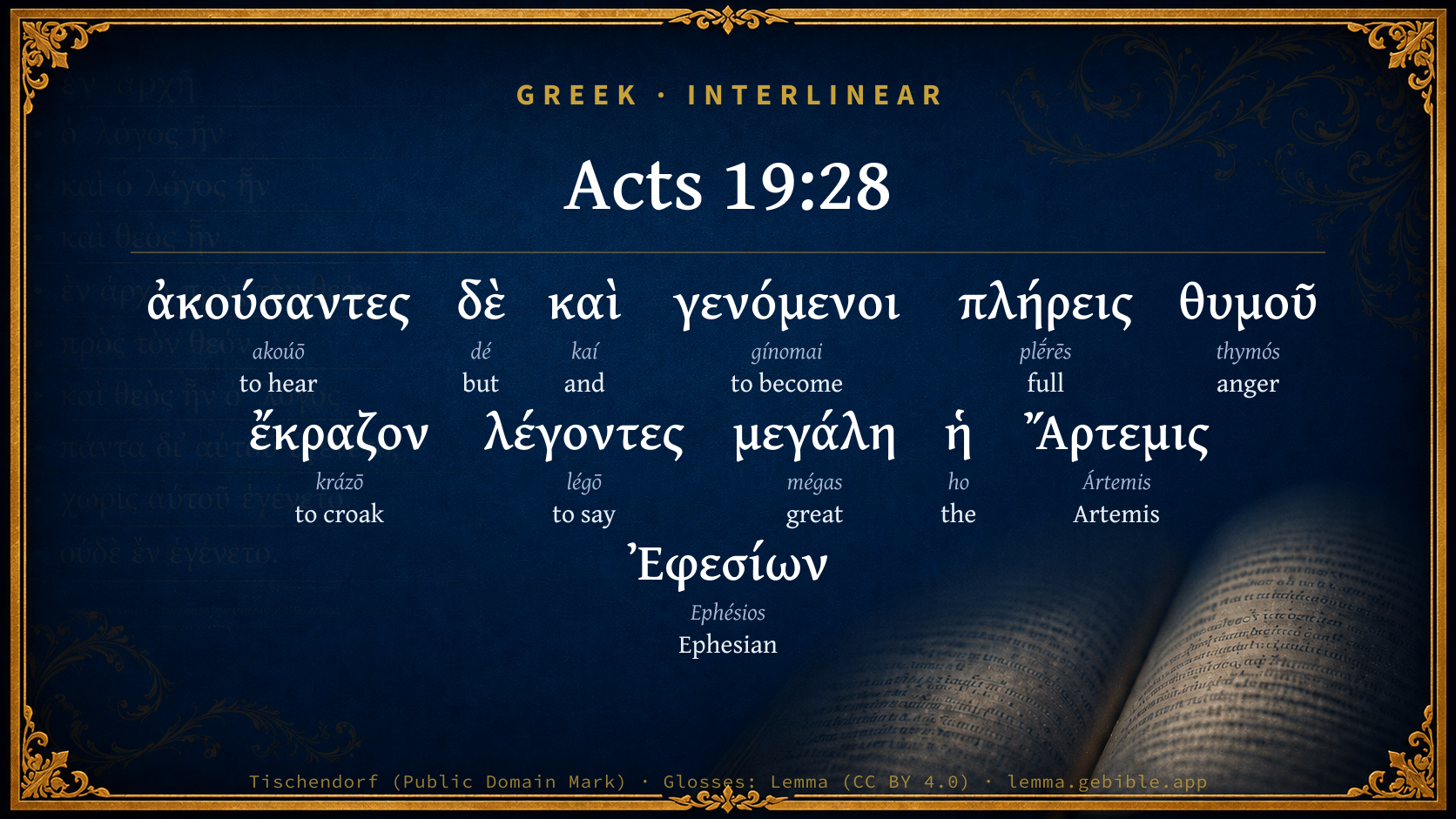
Greek (Tischendorf 8th ed.) Acts 19:28 appears in the Greek New Testament. The text above is from the Tischendorf 8th edition. Each word links to its Strong’s number and a concise gloss. Click any word for its full Thayer’s Greek Lexicon entry.
Download image
Cite this verse

Acts 19:28 (World English Bible). Public Domain. Lemma interlinear Bible study tool, https://lemma.gebible.app/v/acts/19/28.

Show BibTeX & RIS
BibTeX
RIS
English Translation
When they heard this they were filled with anger, and cried out, saying, "Great is Artemis of the Ephesians!"
World English Bible · Public Domain
Highlights
  • 1 first appearance in the Greek New Testament
Full analysis ↓
Download a study sheet

One document with this verse’s original text, its word-by-word gloss line, the meaning frame, cross-references with their text, attributed commentary, and full source and license credits — printable, and it pastes into notes with its structure intact.

This verse Autodidact and up

Study sheet (.html) Plain text (.txt)

A passage Seminary Student

Up to 50 verses in one chapter. A passage sheet keeps up to 6 commentary sources and 12 cross-references per verse, in the order this page ranks them, and says so on the sheet whenever that leaves anything out. Ask for a single verse and you get the Autodidact verse sheet above.

Everything on this page stays free to read, with no account — the sheet is a download of what is already on screen, not access to it.

Want to remove ads? Support Godless Engineer
Compare translations 3

The same verse in 3 English versions, stacked beneath the original-language interlinear above. Click any original word for its lexicon entry.

Each is an independent rendering of the whole verse — the interlinear is not word-aligned to these translations.

Highlighted words mark where these versions differ — a whole-verse word diff, not a word-by-word alignment.

  • World English Bible Public Domain
    When they heard this they were filled with anger, and cried out, saying, "Great is Artemis of the Ephesians!"
  • King James Version Public Domain
    And when they heard these sayings, they were full of wrath, and cried out, saying, Great is Diana of the Ephesians.
  • unfoldingWord Literal Text CC BY-SA 4.0
    And hearing this and becoming full of anger, they were shouting, saying, “Great Artemis of the Ephesians.”

unfoldingWord Literal Text — © unfoldingWord, licensed CC BY-SA 4.0. Word-aligned USFM3 via Door43 (git.door43.org/unfoldingWord/en_ult).

Versions to compare (up to 4)

3 of 4 selected

Show all 19 translations

Every available English version of this verse, each an independent rendering of the whole verse.

  • World English Bible Public Domain
    When they heard this they were filled with anger, and cried out, saying, "Great is Artemis of the Ephesians!"
  • Berean Standard Bible Public Domain
    When the men heard this, they were enraged and began shouting, “Great is Artemis of the Ephesians!”
  • Majority Standard Bible Public Domain
    When the men heard this, they were enraged and began shouting, “Great is Artemis of the Ephesians!”
  • King James Version Public Domain
    And when they heard these sayings, they were full of wrath, and cried out, saying, Great is Diana of the Ephesians.
  • American Standard Version (1901) Public Domain
    And when they heard this they were filled with wrath, and cried out, saying, Great is Diana of the Ephesus.
  • Revised Version (1885) Public Domain
    And when they heard this, they were filled with wrath, and cried out, saying, Great is Diana of the Ephesians.
  • Geneva Bible (1599) Public Domain
    Now when they heard it, they were full of wrath, and cried out, saying, Great is Diana of the Ephesians.
  • Douay-Rheims (1899) Public Domain
    Having heard these things, they were full of anger, and cried out, saying: Great is Diana of the Ephesians.
  • Young's Literal Translation Public Domain
    And they having heard, and having become full of wrath, were crying out, saying, `Great `is' the Artemis of the Ephesians!'
  • Literal Standard Version CC BY-SA 4.0
    And having heard, and having become full of wrath, they were crying out, saying, “Great [is] the Artemis of the Ephesians!”
  • Unlocked Literal Bible CC BY-SA 4.0
    When they heard this, they were filled with anger and cried out, saying, “Great is Artemis of the Ephesians.”
  • unfoldingWord Literal Text CC BY-SA 4.0
    And hearing this and becoming full of anger, they were shouting, saying, “Great Artemis of the Ephesians.”
  • Darby Bible Public Domain
    And having heard [this], and being filled with rage, they cried out, saying, Great [is] Artemis of the Ephesians.
  • World Messianic Bible Public Domain
    When they heard this they were filled with anger, and cried out, saying, “Great is Artemis of the Ephesians!”
  • Webster's Bible Public Domain
    And when they heard these sayings, they were full of wrath, and cried out, saying, Great is Diana of the Ephesians.
  • Free Bible Version CC BY-SA 4.0
    When they heard this they became furious, and shouted out, “Great is Artemis of the Ephesians!”
  • Bible in Basic English Public Domain
    And hearing this, they were very angry, crying out and saying, Great is Diana of Ephesus.
  • Text-Critical English NT CC BY 4.0
    When they heard this, they were filled with rage and began crying out, “Great is Artemis of the Ephesians!”
  • Tyndale New Testament (1534) Public Domain
    When they hearde these sayinges they were full of wrathe and cryed out saying: Greate is Diana of the Ephesians.

Literal Standard Version (2020), Covenant Press — licensed CC BY-SA 4.0. Text via the HelloAO Bible API (eBible.org). Unlocked Literal Bible (unfoldingWord) — licensed CC BY-SA 4.0. Text via the HelloAO Bible API (eBible.org). unfoldingWord Literal Text — © unfoldingWord, licensed CC BY-SA 4.0. Word-aligned USFM3 via Door43 (git.door43.org/unfoldingWord/en_ult). Free Bible Version, Dr. Jonathan Gallagher — licensed CC BY-SA 4.0. Text via the HelloAO Bible API (eBible.org).

Word by word

More ways to search: Search by grammar → Find every occurrence → Compare this word →

Practice this passage: Drill this verse → Learn its vocabulary →

About this verse

These counts appear in no published source. They are computed here, from the morphology-tagged text and Lemma’s own curated glosses. What Lemma adds →

12
words
12
distinct lemmas
Acts
section

Notable vocabulary

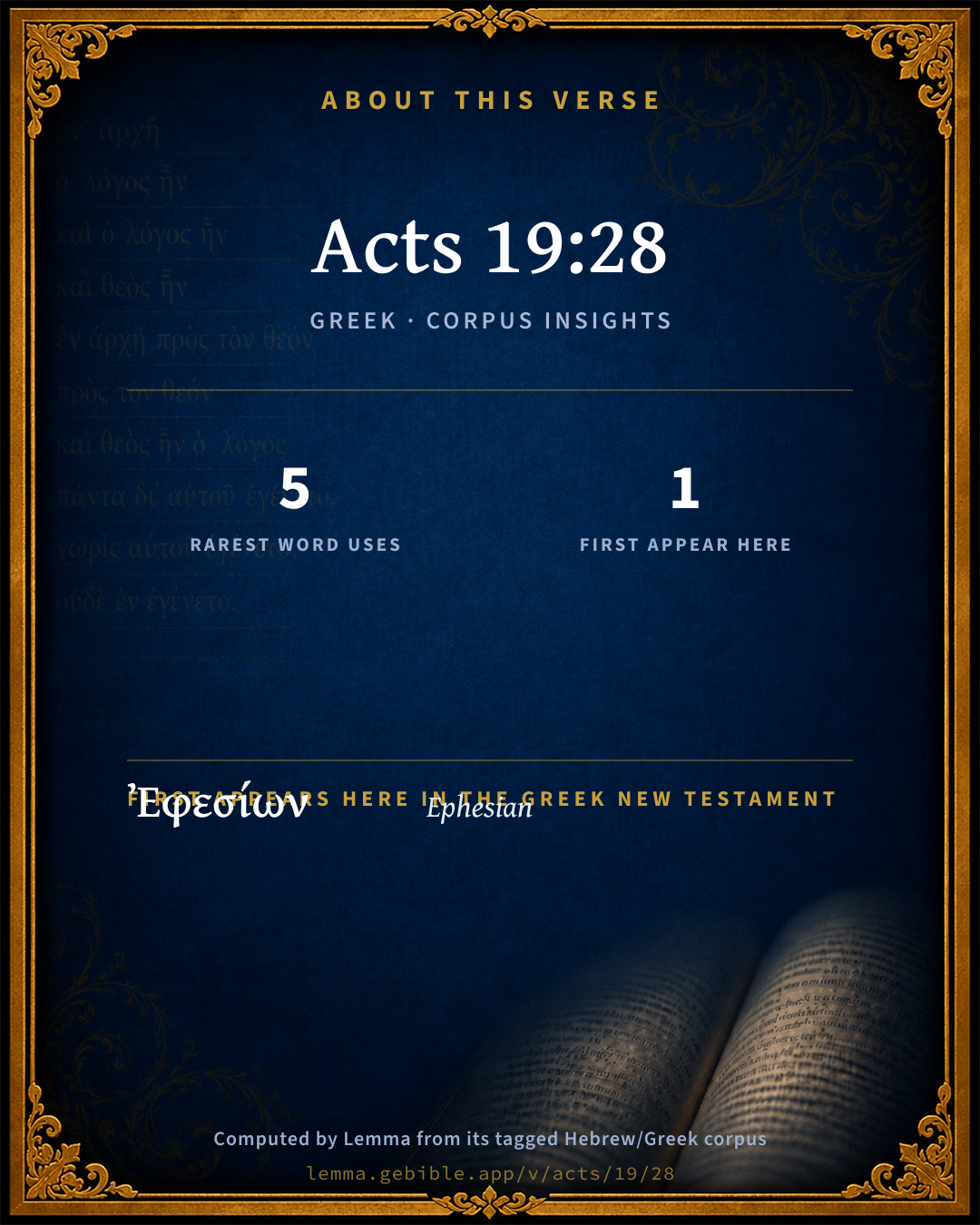
The rarest word here is Ἄρτεμις Artemis G735 — appearing just 5 times in the whole Greek New Testament.

First appearance in Scripture

This word makes its first canonical appearance in the Greek New Testament here:

  • Ἐφεσίων Ephesian G2180

Shared distinctive vocabulary

Ἄρτεμις Artemis G735 occurs in 5 verses of the Greek New Testament. Also found in:
Cross-references

13

Topical passages linked to Acts 19:28 in the Treasury of Scripture Knowledge — connected by theme and wording, ordered by reader-vote popularity; previews shown in the World English Bible.

  • Revelation 13:4 They worshiped the dragon, because he gave his authority to the beast, and they worshiped the beast, saying, "Who is like the beast? Who is able to make war with him?"
  • Revelation 17:13 These have one mind, and they give their power and authority to the beast.
  • 1 Samuel 5:3–5 When they of Ashdod arose early on the next day, behold, Dagon was fallen on his face to the ground before the ark of Yahweh. They took Dagon, and set him in his place again.
  • 1 Kings 18:26–29 They took the bull which was given them, and they dressed it, and called on the name of Baal from morning even until noon, saying, Baal, hear us. But there was no voice, nor any who answered. They leaped about the altar which was made.
  • Psalms 2:2 The kings of the earth take a stand, And the rulers take counsel together, Against Yahweh, and against his anointed, saying,
  • Isaiah 41:5–7 The isles have seen, and fear; the ends of the earth tremble; they draw near, and come.
  • Jeremiah 50:38 A drought is on her waters, and they shall be dried up; for it is a land of engraved images, and they are mad over idols.
  • Acts 7:54 Now when they heard these things, they were cut to the heart, and they gnashed at him with their teeth.
  • Acts 16:19–24 But when her masters saw that the hope of their gain was gone, they seized Paul and Silas, and dragged them into the marketplace before the rulers.
  • Acts 18:19 He came to Ephesus, and he left them there; but he himself entered into the synagogue, and reasoned with the Jews.
  • Acts 19:34–35 But when they perceived that he was a Jew, all with one voice for a time of about two hours cried out, "Great is Artemis of the Ephesians!"
  • Acts 21:28–31 crying out, "Men of Israel, help! This is the man who teaches all men everywhere against the people, and the law, and this place. Moreover, he also brought Greeks into the temple, and has defiled this holy place!"
  • Revelation 12:12 Therefore rejoice, heavens, and you who dwell in them. Woe to the earth and to the sea, because the devil has gone down to you, having great wrath, knowing that he has but a short time."

Cross-references courtesy of OpenBible.info (CC BY 4.0).

Commentary

Notes on Acts 19:28 from classic Christian and Jewish commentators (each source and its license shown beneath its notes). The classic Christian expositions comment on the surrounding passage and are grouped to its opening verse, so a note may address several verses; the Jewish commentaries on the Tanakh (Rashi and others) are per-verse, so they appear only where the commentator wrote on this verse.

Lemma curates 59 commentaries, every one of them public domain or Creative Commons licensed, each selected and text-cleaned for this edition rather than reprinted as found. About our sources →

Joseph Benson's Commentary

Act 19:28-29. And when they heard, &c., they were full of wrath — The inflammatory speech of Demetrius, addressed to the superstition and avarice of the multitude, immediately produced the desired effect; the craftsmen, and all who were employed about the temple, were exasperated to the highest degree: and, enraged to think that both their trade and their religion were in danger, they ran about the city; and cried out, with great violence, Great is Diana of the Ephesians — Elsner has shown how frequently this epithet of great was given by the heathen to Jupiter, Diana, and others of their superior deities. And the whole city was filled with confusion — The common and natural effect of an intemperate zeal for a false religion; they rushed with one accord — Demetrius and his company, with the multitude that was gathered about them; into the theatre —

Where criminals were wont to be thrown to the wild beasts; dragging with them Gaius and Aristarchus — When they could not find Paul. Probably, they hoped to oblige them to fight with the wild beasts, as some think Paul had done before.

Joseph Benson's Commentary on the Old and New Testaments (1811–1818) — public domain. Text from a community e-Sword module.

Bengel's Gnomon

Johann Albrecht Bengel

Act 19:28. Ἀκούσαντες, having heard this) viz. the artificers and workmen.

Bengel's Gnomon of the New Testament — English translation (T&T Clark, Edinburgh, 1860) — public domain. Text from a community e-Sword module.

Meyer's Critical & Exegetical Commentary

Heinrich August Wilhelm Meyer

Act_19:28-29. Μεγάλη ἡ Ἄρτ. Ἐφ.] An enthusiastic outcry for the preservation of the endangered (and yet so lucrative!) majesty of the goddess.

ὥρμησαν namely, those who ran together along with Demetrius and his companions.

ὁμοθυμαδόν] here also: with one mind (in opposition to Deyling, Krebs, Loesner, and others, who think that, on account of Act_19:32, it must be rendered simul); for they were at one on the point, that in the theatre something in general must be determined on against Paul and his companions for the defence of the honour of the goddess (Act_19:34), although specially the most might not know τίνος ἕνεκεν συνεληλύθεισαν (Act_19:32).

It is well known that the theatre was used for the despatch of public transactions and for popular assemblies (even for such as were tumultuary). See Wetstein in loc.; Hermann, Staatsalterth. § 128. 9. Consequently the more easy it is to understand, why the vehement crowd poured itself into the great theatre.[101]

συναρπάσ.] First, they drew along with them the two fellow-travellers (συνεκδ.) of the apostle, and then rushed into the theatre. But it may also be conceived as simultaneous; while they carried along with them, they rushed, etc. Whether they fetched these two men from their lodgings, or encountered them in the streets, cannot be determined.

Caius is otherwise unknown, and is not identical with the Caius mentioned in Act_20:4 (see in loc.), or with the one mentioned in Rom_16:23; 1Co_1:15.

Ἀρίσταρχ.] See Act_20:4, Act_27:2; Col_4:10; Phm_1:24.

[101] It was one of the largest, as its ruins show. See Ottfr. Müller, Archäol. d. Kunst, p. 391.

Meyer — Critical and Exegetical Commentary on the New Testament — English translation by Peter Christie, edited by Frederick Crombie (T&T Clark, 1880) — public domain. Text from a community e-Sword module.

Expositor's Greek Testament

ed. W. Robertson Nicoll

Act 19:28 . ἔκραζον : “they cried continuously,” imperfect, see addition in . Μεγάλη ἡ Ἄ .: omitting ἡ we have apparently the popular cry, or rather invocation: Great Artemis! as it was actually used in the cultus the cry was not an argument against Paul’s doctrine, but rather a prayer to the goddess and queen of Ephesus, and so regarded it gives a vividness and naturalness to the scene, Ramsay, Church in the Roman Empire , p. 135 ff., and “Diana,” u. s. , p. 105; see , critical note.

The Expositor's Greek Testament, edited by W. Robertson Nicoll (1897–1910) — public domain. Text from a community e-Sword module.

Jamieson, Fausset & Brown

Robert Jamieson, A. R. Fausset & David Brown

Great is Diana of the Ephesians--the civic cry of a populace so proud of their temple that they refused to inscribe on it the name of Alexander the Great, though he offered them the whole spoil of his Eastern campaign if they would do it [STRABO in HOWSON].

Jamieson, Fausset & Brown — Commentary Critical and Explanatory on the Whole Bible (1871) — public domain (CC PDM 1.0). Text via the HelloAO Bible API.

Ellicott's Commentary for English Readers

(28) They were full of wrath, and cried out.—Better, they went on crying out, the tense implying continued action.

Great is Diana of the Ephesians.—The cry was probably the usual chorus of the festivals of Artemis. Stress was now laid on the distinctive adjective, “Great she was, whoever might attack her greatness.”

A Bible Commentary for English Readers, edited by Charles John Ellicott (1878–1897) — public domain. Text from a community e-Sword module.

The Cambridge Bible for Schools and Colleges

gen. ed. J. J. S. Perowne

28. And when they heard these sayings] The A.V. indicates that there is no Greek for the two last words. It is enough, with the Rev. Ver., to say “this.”

they were full of wrath] The verb in the original expresses that the anger grew as they listened. So better, filled with, as Rev. Ver. Demetrius had appealed to them in such wise as to excite them more by each fresh argument. Their self-interest first, and their pride and superstition afterwards.

and … Diana of the Ephesians] Here as before (Act_19:24) the Greek name is Artemis.

The Cambridge Bible for Schools and Colleges (gen. ed. J. J. S. Perowne; Cambridge University Press, 1878–1918) — public domain. Text from a community e-Sword module.

John Gill's Exposition

Some therefore cried one thing, and some another,.... Not in the church at Ephesus among the disciples, and friends of the apostle, as if they were divided in their sentiments about his going into the theatre, some being for it, and others against it; but the people that were gathered together in the theatre, these were not agreed about the reason of this tumult, some said it was on account of one thing, and some another:

for the assembly was confused; the multitude of people that were gathered together were made up of different persons, of different employments and sentiments, and were in no manner of form or order:

and the more part knew not wherefore they were come together; there was a noise and a hubbub in the city; but what was the reason and meaning of it, they were ignorant of; they were got together into the theatre in great numbers, but what was to be done there they knew not. And this is too often the case in religious assemblies, that the majority, at least many, can give no account of the reason, end, and design of their assembling together.

John Gill's Exposition of the Whole Bible (1746–1763) — public domain (CC PDM 1.0). Text via the HelloAO Bible API.

Trapp's Complete Commentary

John Trapp

28 And when they heard these sayings, they were full of wrath, and cried out, saying, Great is Diana of the Ephesians.

Ver. 28. They were full of wrath] The Greek word θυμος signifieth the heating or heaving of the blood by the apprehension of the injury offered; hot and fiery anger, such as was that of Nebuchadnezzar, seven fold hotter than his fiery furnace, Dan 3:19.

Great is Diana] Papists boast and write much of the Romish greatness, as Lipsius and others. We grant them to be that great whore in the Revelation, Rev 17:18.

John Trapp, A Commentary or Exposition upon All the Books of the Old and New Testament (1647–1656) — public domain. Text from a community e-Sword module.

Albert Barnes' Notes on the Bible

Were full of wrath - Were greatly enraged - probably at the prospect of losing their gains.

Great is Diana ... - The term “great” was often applied by the Greeks to Diana. Thus, in Xenophon (Ephes. i.), he says, “I adjure you by your own goddess, the great (τὴν μεγάλην tēn megalēn) Diana of the Ephesians.” The design of this clamor was doubtless to produce a persecution against Paul, and thus to secure a continuance of their employment. Often, when people have no arguments, they raise a clamor; when their employments are in danger of being ruined, they are filled with rage. We may learn, also, that when people’s pecuniary interests are affected, they often show great zeal for religion, and expect by clamor in behalf of some doctrine to maintain their own interest, and to secure their own gains.

Albert Barnes' Notes on the Bible (1834–1885) — public domain. Text from a community e-Sword/MySword module.

Haydock's Catholic Bible Commentary

Great is Diana of the Ephesians. This they shouted out without intermission for about two hours, though the greatest part knew not why they had met together. A true representation of an unthinking rash mob. (Witham)

George Leo Haydock (1774–1849), Haydock's Catholic Family Bible and Commentary, 1859 edition — public domain. Excludes Psalms (Douay-Rheims chapter numbering differs from Protestant) and Deuterocanonical books (Catholic canon only).

Matthew Poole's English Annotations

The argument from their profit wrought very much upon them, especially meeting with their prejudicate opinions, having pretended antiquity and universality to confirm them.

Saying, Great is Diana of the Ephesians; to show their abhorrence of what Paul had taught; and desiring her glory might be perpetual, whom Paul thought not worthy to be honoured at all.

Matthew Poole's English Annotations on the Holy Bible (1683–1685) — public domain. Text from a community e-Sword/MySword module.

Whedon's Commentary on the Bible

Daniel D. Whedon

28. Great—There were in mythology the twelve Dii Majores, Greater Gods, and Artemis was not generally reckoned one of them. Nevertheless Great was the special title applied by her worshippers throughout “the world.” Here, as in many other cases, vociferation supplies the place of argument. Loud and well repeated utterance is sometimes the only effective support of a false cause.

They heard… full of wrath—The oratory of Demetrius takes full effect. Having a common interest, these pagan brethren have a common piety and a common wrath, and their wrath has a common object. Woe to our apostle if he is found in Ephesus!

Daniel D. Whedon (gen. ed.), Commentary on the Old and New Testaments (1874–1909) — public domain. Text from a community e-Sword module.

The Pulpit Commentary

This for these sayings, A.V.; filled with wrath for full of wrath, A.V. Great is Diana, etc. A notable instance of assertion and clamor crying down reason and truth. If therefore for wherefore if, A.V.; that for which, A.V.; the courts are for the law is, A.V.; proconsuls for deputies, A.V.; accuse for implead, A.V. Against any man. Mark the skill with which the town-clerk passes from the concrete to the abstract, and avoids the mention of Paul"s name. The courts are open; ajgoraioi (or ajgoraioi) agontai. Some supply the word sunodoi, and make the sense "judicial assemblies," "sessions," coming round at proper fixed intervals. But the verb agontai, more naturally suggests hJmerai, as Bengel says (agein genesia tarav thv skhnophgiav: jOlumpia: geneqlion, etc.), and then the meaning is, The regular court-days are kept, when the proconsul attends to try causes;" there is no need to have an irregular trial. So Suidas explains it, JHmera ejnh hJ ajgora. There are proconsuls. Bengel, with whom Meyer agrees, thinks the plural denotes the unbroken succession of proconsuls. But Lewin thinks it may mark the exact time of these transactions as being immediately after the poisoning of the Proconsul Junius Silanus by order of Agrippina, when the two procurators, Celer and Aelius, exercised the proconsular power till the appointment of another proconsul, according to a law of Claudius to that effect. Others have other explanations.

The Pulpit Commentary (1880–1919), ed. H.D.M. Spence-Jones & Joseph S. Exell — public domain. Text from a community e-Sword module.

Scofield Reference Notes

C. I. Scofield

Diana

Gr. Artemis. Not anciently of the Greek pantheon, but an Eastern goddess. Cf. Jdg 2:13. (See Scofield "Jdg 2:13").

But "Diana of the Ephesians" was rather a particular image of Artemis, reputed to have fallen from heaven; Act 19:35.

The Scofield Reference Bible (1917 edition), notes by C. I. Scofield — public domain. Text from a community e-Sword module.

Kretzmann's Popular Commentary

Paul E. Kretzmann

The effect of the speech:

v. 28. And when they heard these sayings, they were full of wrath and cried out, saying, Great is Diana of the Ephesians!

v. 29. the whole city was filled with confusion; and having caught Gaius and Aristarchus, men of Macedonia, Paul’s companions in travel, they rushed with one accord into the theater.

v. 30. And when Paul would have entered in unto the people, the disciples suffered him not.

v. 31. And certain of the chiefs of Asia, which were his friends, sent unto him, desiring him that he would not adventure himself into the theater.

v. 32. Some therefore cried one thing, and some another; for the assembly was confused, and the more part knew not wherefore they were come together.

v. 33. And they drew Alexander out of the multitude, the Jews putting him forward. And Alexander beckoned with the hand, and would have made his defense unto the people.

v. 34. But when they knew that he was a Jew, all with one voice, about the space of two hours, cried out, Great is Diana of the Ephesians!

If Demetrius intended to kindle a fire, he certainly was successful beyond his design. No sooner had he closed his speech than some member of the guild or some other person in the audience coined a catchy phrase which struck the popular fancy: Great is Artemis of the Ephesians! And, full of anger as they were, the others took up the cry and carried it out to the street. In less time than it takes to tell about it, the disturbance had spread to all quarters; it filled the city, and surged back and forth like various liquids that have been poured together and cannot become settled. The streets being far too narrow for a proper show of mob violence, agitators and rabble alike were struck by the idea at the same time and rushed into the large theater, probably the largest in the world, its diameter being 495 feet and its capacity 24,500 people. But on their way, in their mad rush, they managed to seize and to carry along with them two fellow-lodgers of Paul, the Macedonians Gaius and Aristarchus. The latter is mentioned also in other passages as a native of Macedonia, of the city of Thessalonica, chap. 20:4; 27:2. It is probable that these two men, here mentioned as attendants of Paul, were delegates of the Thessalonian congregation who were with Paul carrying the contribution to the congregation at Jerusalem. These faithful men being in danger of their lives, Paul firmly intended to go out and face the angry mob, in order to shield them with his own life; but this the members of the congregation would not permit. To the infuriated mob his appearance at that time would have been like a red rag, and, according to all possibility, could have accomplished nothing. And the disciples were seconded in their endeavors by some of the leading men of the city, the Asiarchs, the chief priests of the Roman Empire in the provinces, whose duties included also the providing of games for the people. Some of these influential men were decidedly friendly to Paul, as this act of kindness shows, since they took the trouble of sending to him and earnestly begging him not to venture forth into the theater. In the meantime, the members of the mob were working themselves into a fine frenzy, for they continued to shout, someone thing and some another. There was no unity of thought and of leadership: it was an unlawful, tumultuous assembly, poured together like liquids that will not mix properly. And, as usual, when a rabble, a mob, springs from the ground upon such occasions, the majority of the people had no idea why they had really come together. At this point the Jews of the city, fearing that the fury of the mob might turn against them also, since Paul was a Jew, and since they themselves were opposed to idolatry, made the attempt to have one of their own number, a man by the name of Alexander, explain the situation to the surging multitude. The man tried to follow the instructions which he had received as the Jews pushed him to the front. But no sooner did he raise his hand, indicating to the people that he wanted to speak, and, in this case, to hold a speech of defense, than the intelligence went the rounds that he was a Jew. Whether they could all see plainly enough to distinguish his dress and features, or whether those nearest to the arena or stage passed the word along, the entire multitude, the infuriated mob, with one voice from them all, like the bellowing of some enraged monster, took up the phrase which had caught their fancy as one of the silversmiths had shouted it: Great is Artemis of the Ephesians! It was a wild demonstration of a lawless mob, but a comparatively harmless enjoyment, at that: it satisfied their idea of worship without hurting anyone. The city authorities therefore did not interfere at this point, since any opposition would have inflamed the mob to acts of violence. They were evidently well versed in the psychology of the mob and bided their time.

Paul E. Kretzmann, Popular Commentary of the Bible (1921–1924) — public domain. Text from a community e-Sword module.

McGarvey & Pendleton's Commentaries

J. W. McGarvey

28, 29. The prospect of pecuniary ruin enraged the artisans, while their veneration for the goddess suggested the best theme on which to give vent to their wrath before the people. (28) " And when they heard this they were full of wrath, and cried out, saying, Great is Diana of the Ephesians. (29) And the whole city was filled with confusion; and having caught Gaius and Aristarchus, Macedonians, Paul's companions in travel, they rushed with one accord into the theater. " The outcry, "Great is Diana of the Ephesians," awakened the old enthusiasm of all the idolaters who heard it, and the tone of rage with which it was uttered, suggesting some assault upon the honor of the goddess, threw the gathering mob into a frenzy. It was a kind of providence in reference to Paul, that he happened to be out of their reach. Not finding him, they seize his companions, and rushing into the theater, where criminals were sometimes exposed to wild beasts, they are about to take the part of the wild beasts themselves. What was the fate of Gaius and Aristarchus is not here stated, though both names occur afterward in the history, and probably designate the same individuals.

J. W. McGarvey (with Philip Y. Pendleton), Commentaries on the New Testament (The Fourfold Gospel, 1914; Acts; and the epistles) — public domain. Text from a community e-Sword/MySword module.

unfoldingWord translationNotes

Door43 World Missions Community

General Information:

Here the first word "they" refers to the craftsmen who made the idols (Acts 19:24-25). The second word "They" refers to the people who had gathered to hear the craftsmen who shouted.

General Information:

Gaius and Aristarchus came from Macedonia but were working with Paul in Ephesus at this time.

they were filled with anger

This speaks of the craftsmen as though they were containers. Here "anger" is spoken of as if it were the contents that fill a container. AT: "they became very angry" (See: Metaphor)

cried out

"shouted aloud" or "shouted loudly"

The whole city was filled with confusion

Here "city" refers to the people. The city is spoken of as if it were a container. And, "confusion" is spoken of as if it were the contents that filled the container. AT: "Then people all over the city became upset and started shouting" (See: Metonymy and Metaphor)

the people rushed together

This was a mob or near riot situation.

into the theater

The Ephesus theater was used for public meetings and for entertainment such as plays and music. It was an outdoor semi-circular area with bench seats that could hold thousands of people.

Paul's travel companions

The men who had been with Paul.

Gaius and Aristarchus

These are names of men. (See: How to Translate Names)

translationWords

anger

Ephesus

seize

Paul

Macedonia

unfoldingWord translationNotes — © Distant Shores Media and the Door43 World Missions Community, licensed CC BY-SA 4.0. Source: git.door43.org/Door43/en_tn.

Cambridge Greek Testament for Schools and Colleges

28. ἀκούσαντες δὲ κ.τ.λ., and when they heard this they became filled with wrath, &c. Demetrius had appealed to them in such wise as to excite them more by each fresh argument. Their self-interest first, and their pride and superstition afterwards.

Cambridge Greek Testament for Schools and Colleges (Cambridge University Press, 1896; 21 vols, various authors incl. Carr, Maclear, Plummer, Farrar, Lumby, Moule, M. R. James, Simcox) — public domain. Text from a community e-Sword module.

Vincent's Word Studies in the New Testament

Marvin R. Vincent

Cried out [εκραζον] . The imperfect is graphic; they continued crying. This reiteration was a characteristic of the oriental orgiastic rites.

Marvin R. Vincent, Word Studies in the New Testament (1887–1900) — public domain. Text from a community e-Sword/MySword module.

Lesson kit

Teaching starters — assembled from the data on this page, not authored interpretation. Every prompt links to the verse data it draws on. Edit before teaching.

Acts, in the Acts, opens this verse with 12 words (12 distinct Greek lemmas). Its most distinctive word is Ártemis (“Artemis”). A historical commentator’s framing appears above. Read the whole chapter for the surrounding context.

Discussion questions

  1. The word Ártemis carries the sense “Artemis.” How does it shape the verse?
  2. This is the first place “Ephesian” appears in Scripture (first appears here). What does its debut here establish?
  3. How does Acts 19:24, which shares the word «Artemis», read alongside this verse?
  4. These translations render this verse differently; the difference is in the English rendering, not the original. What questions does that raise?
  5. Compare how Joseph Benson's Commentary and Bengel's Gnomon read this verse. Where do they agree or differ?

Things to notice

  • 1 word makes its first canonical appearance in Scripture here.
  • These translations choose different wording for 14 words in this verse.
  • 12 distinct Greek lemmas span 12 words in this verse.

Reading settings

Reading text

Shown beneath each verse's original-language words.

Old Testament
Old Testament edition

Read the OT as the Masoretic Hebrew (MT) or the Greek Septuagint (LXX).

English shown for the Greek Septuagint (in the Hebrew ↔ Greek comparison).

Comparing translations? Open the Compare panel on any verse page to stack up to four side by side.