Matthew 11:5

Greek (Tischendorf 8th ed.) Matthew 11:5 appears in the Greek New Testament. The text above is from the Tischendorf 8th edition. Each word links to its Strong’s number and a concise gloss. Click any word for its full Thayer’s Greek Lexicon entry.
Download image
Cite this verse

Matthew 11:5 (World English Bible). Public Domain. Lemma interlinear Bible study tool, https://lemma.gebible.app/v/matthew/11/5.

Show BibTeX & RIS
BibTeX
RIS
English Translation
the blind receive their sight, the lame walk, the lepers are cleansed, the deaf hear, the dead are raised up, and the poor have good news preached to them.
World English Bible · Public Domain
Highlights
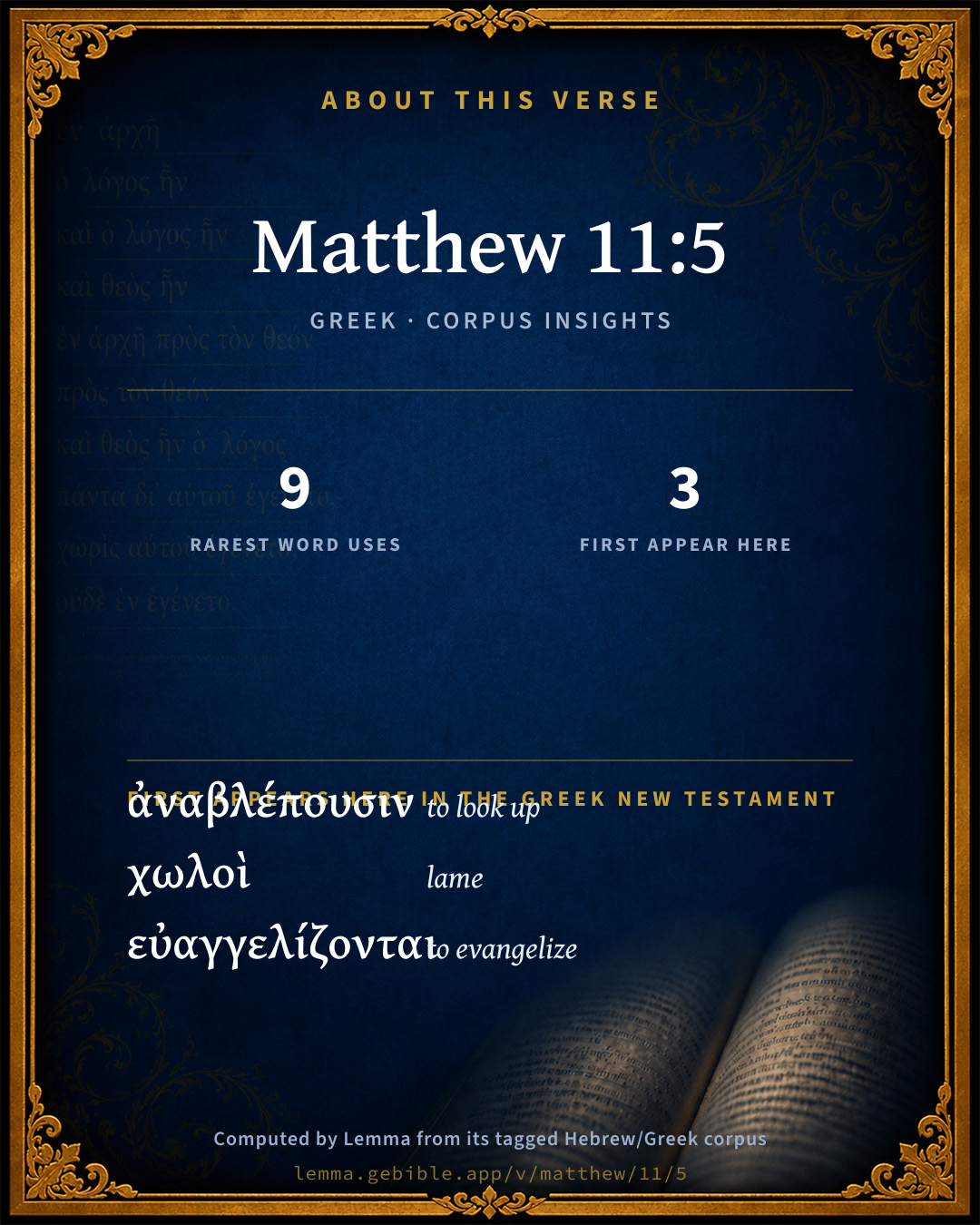
  • 3 first appearances in the Greek New Testament
Full analysis ↓
Download a study sheet

One document with this verse’s original text, its word-by-word gloss line, the meaning frame, cross-references with their text, attributed commentary, and full source and license credits — printable, and it pastes into notes with its structure intact.

This verse Autodidact and up

Study sheet (.html) Plain text (.txt)

A passage Seminary Student

Up to 50 verses in one chapter. A passage sheet keeps up to 6 commentary sources and 12 cross-references per verse, in the order this page ranks them, and says so on the sheet whenever that leaves anything out. Ask for a single verse and you get the Autodidact verse sheet above.

Everything on this page stays free to read, with no account — the sheet is a download of what is already on screen, not access to it.

Want to remove ads? Support Godless Engineer
Compare translations 3

The same verse in 3 English versions, stacked beneath the original-language interlinear above. Click any original word for its lexicon entry.

Each is an independent rendering of the whole verse — the interlinear is not word-aligned to these translations.

Highlighted words mark where these versions differ — a whole-verse word diff, not a word-by-word alignment.

  • World English Bible Public Domain
    the blind receive their sight, the lame walk, the lepers are cleansed, the deaf hear, the dead are raised up, and the poor have good news preached to them.
  • King James Version Public Domain
    The blind receive their sight, and the lame walk, the lepers are cleansed, and the deaf hear, the dead are raised up, and the poor have the gospel preached to them.
  • unfoldingWord Literal Text CC BY-SA 4.0
    The blind see again, and the lame walk, lepers are cleansed, and the deaf hear, and the dead are raised, and the poor are being told the gospel.

unfoldingWord Literal Text — © unfoldingWord, licensed CC BY-SA 4.0. Word-aligned USFM3 via Door43 (git.door43.org/unfoldingWord/en_ult).

Versions to compare (up to 4)

3 of 4 selected

Show all 19 translations

Every available English version of this verse, each an independent rendering of the whole verse.

  • World English Bible Public Domain
    the blind receive their sight, the lame walk, the lepers are cleansed, the deaf hear, the dead are raised up, and the poor have good news preached to them.
  • Berean Standard Bible Public Domain
    The blind receive sight, the lame walk, the lepers are cleansed, the deaf hear, the dead are raised, and the good news is preached to the poor.
  • Majority Standard Bible Public Domain
    The blind receive sight, the lame walk, the lepers are cleansed, the deaf hear, the dead are raised, and the good news is preached to the poor.
  • King James Version Public Domain
    The blind receive their sight, and the lame walk, the lepers are cleansed, and the deaf hear, the dead are raised up, and the poor have the gospel preached to them.
  • American Standard Version (1901) Public Domain
    the blind receive their sight, and the lame walk, the lepers are cleansed, and the deaf hear, and the dead are raised up, and the poor have good tidings preached to them.
  • Revised Version (1885) Public Domain
    the blind receive their sight, and the lame walk, the lepers are cleansed, and the deaf hear, and the dead are raised up, and the poor have good tidings preached to them.
  • Geneva Bible (1599) Public Domain
    The blinde receiue sight, and the halt doe walke: the lepers are clensed, and the deafe heare, the dead are raised vp, and the poore receiue the Gospel.
  • Douay-Rheims (1899) Public Domain
    The blind see, the lame walk, the lepers are cleansed, the deaf hear, the dead rise again, the poor have the gospel preached to them.
  • Young's Literal Translation Public Domain
    blind receive sight, and lame walk, lepers are cleansed, and deaf hear, dead are raised, and poor have good news proclaimed,
  • Literal Standard Version CC BY-SA 4.0
    blind receive sight, and lame walk, lepers are cleansed, and deaf hear, dead are raised, and poor have good news proclaimed,
  • Unlocked Literal Bible CC BY-SA 4.0
    Blind people are receiving sight, lame people are walking, lepers are being cleansed, deaf people are hearing again, people who have died are being raised back to life, and needy people are being told the good news.
  • unfoldingWord Literal Text CC BY-SA 4.0
    The blind see again, and the lame walk, lepers are cleansed, and the deaf hear, and the dead are raised, and the poor are being told the gospel.
  • Darby Bible Public Domain
    Blind [men] see and lame walk; lepers are cleansed, and deaf hear; and dead are raised, and poor have glad tidings preached to them:
  • World Messianic Bible Public Domain
    the blind receive their sight, the lame walk, the lepers are cleansed, the deaf hear, the dead are raised up, and the poor have good news preached to them.
  • Webster's Bible Public Domain
    The blind receive their sight, and the lame walk, the lepers are cleansed, and the deaf hear, the dead are raised, and the poor have the gospel preached to them.
  • Free Bible Version CC BY-SA 4.0
    The blind can see, the crippled can walk, the lepers are healed, the deaf can hear, the dead are resurrected, and the poor hear the good news.
  • Bible in Basic English Public Domain
    The blind see; those who were not able to, are walking; lepers are made clean; those who were without hearing, now have their ears open; the dead come to life again, and the poor have the good news given to them.
  • Text-Critical English NT CC BY 4.0
    The blind receive their sight and the lame walk, lepers are made clean and the deaf hear, the dead are raised and the poor have good news preached to them.
  • Tyndale New Testament (1534) Public Domain
    The blynd se the halt goo the lepers are clensed: the deef heare the ded ryse ageyne and the glad tidinges is preached to the povre.

Literal Standard Version (2020), Covenant Press — licensed CC BY-SA 4.0. Text via the HelloAO Bible API (eBible.org). Unlocked Literal Bible (unfoldingWord) — licensed CC BY-SA 4.0. Text via the HelloAO Bible API (eBible.org). unfoldingWord Literal Text — © unfoldingWord, licensed CC BY-SA 4.0. Word-aligned USFM3 via Door43 (git.door43.org/unfoldingWord/en_ult). Free Bible Version, Dr. Jonathan Gallagher — licensed CC BY-SA 4.0. Text via the HelloAO Bible API (eBible.org).

Word by word

More ways to search: Search by grammar → Find every occurrence → Compare this word →

Practice this passage: Drill this verse → Learn its vocabulary →

λεπροὶ
leprós
G3015
“leprous”
Adjective, Nominative, Plural, Masculine
Part of Speech
Adjective
Case
Nominative
Number
Plural
Gender
Masculine
Full Thayer's Definition

Origin: from the same as G3014

TDNT: 07:53,5

1. scaly, rough 2. leprous, affected with leprosy
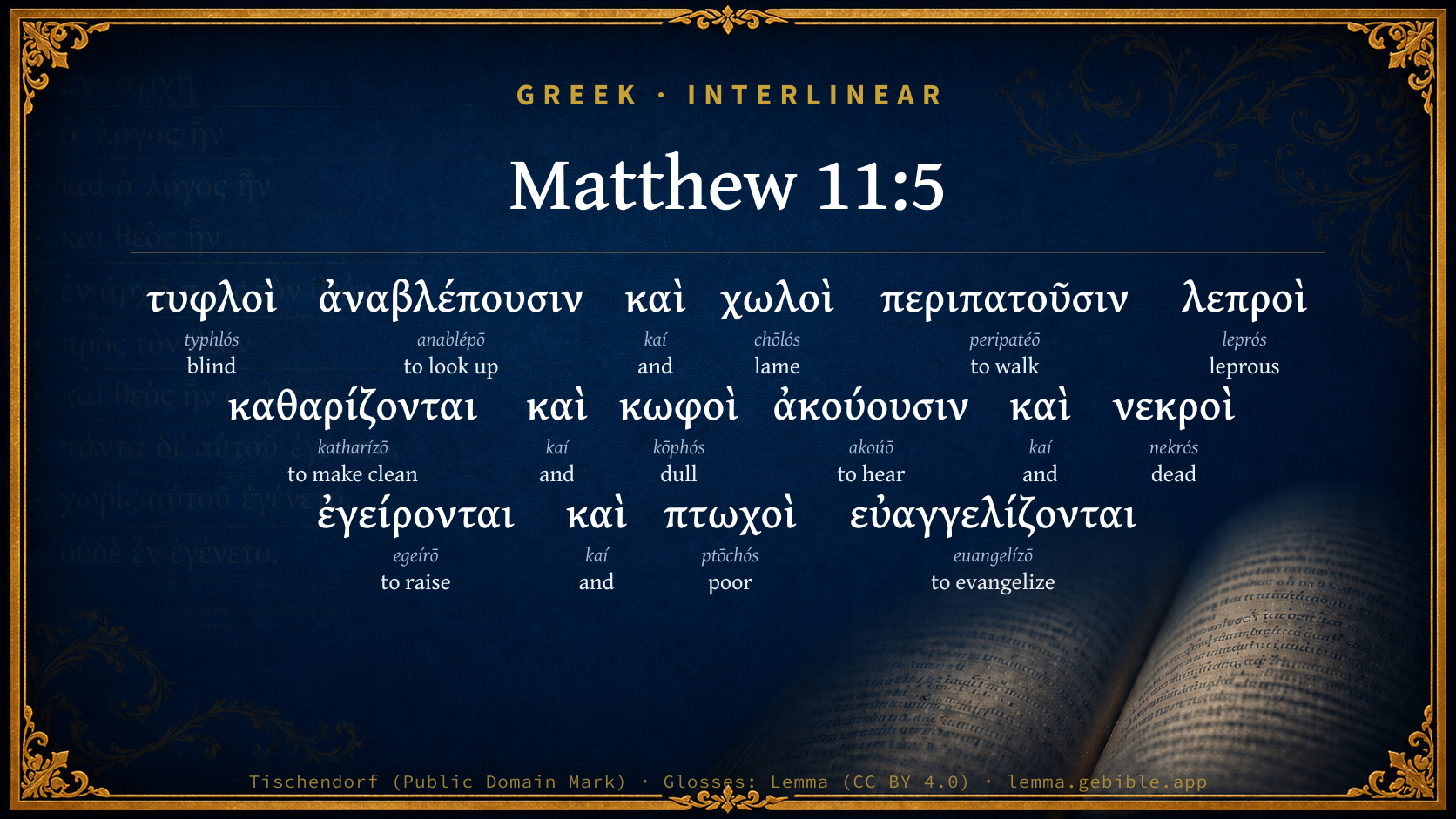
  1. τυφλοὶ typhlós G5185 “blind” Adjective, Nominative, Plural, Masculine
  2. ἀναβλέπουσιν anablépō G308 “to look up” Verb, Present, Active, Indicative, 3rd person, Plural
  3. καὶ kaí G2532 “and” Conjunction
  4. χωλοὶ chōlós G5560 “lame” Adjective, Nominative, Plural, Masculine
  5. περιπατοῦσιν peripatéō G4043 “to walk” Verb, Present, Active, Indicative, 3rd person, Plural
  6. καθαρίζονται katharízō G2511 “to make clean” Verb, Present, Passive, Indicative, 3rd person, Plural
  7. καὶ kaí G2532 “and” Conjunction
  8. κωφοὶ kōphós G2974 “dull” Adjective, Nominative, Plural, Masculine
  9. ἀκούουσιν akoúō G191 “to hear” Verb, Present, Active, Indicative, 3rd person, Plural
  10. καὶ kaí G2532 “and” Conjunction
  11. νεκροὶ nekrós G3498 “dead” Adjective, Nominative, Plural, Masculine
  12. ἐγείρονται egeírō G1453 “to raise” Verb, Present, Passive, Indicative, 3rd person, Plural
  13. καὶ kaí G2532 “and” Conjunction
  14. πτωχοὶ ptōchós G4434 “poor” Adjective, Nominative, Plural, Masculine
  15. εὐαγγελίζονται euangelízō G2097 “to evangelize” Verb, Present, Passive, Indicative, 3rd person, Plural

About this verse

These counts appear in no published source. They are computed here, from the morphology-tagged text and Lemma’s own curated glosses. What Lemma adds →

16
words
13
distinct lemmas
Gospels
section

Notable vocabulary

The rarest word here is λεπροὶ leprous G3015 — appearing just 9 times in the whole Greek New Testament.

First appearance in Scripture

These words make their first canonical appearance in the Greek New Testament here:

  • ἀναβλέπουσιν to look up G308
  • χωλοὶ lame G5560
  • εὐαγγελίζονται to evangelize G2097

Shared distinctive vocabulary

λεπροὶ leprous G3015 occurs in 9 verses of the Greek New Testament. Also found in:

Repetition

A word recurs within this verse:

Cross-references

35

Topical passages linked to Matthew 11:5 in the Treasury of Scripture Knowledge — connected by theme and wording, ordered by reader-vote popularity; previews shown in the World English Bible.

  • Isaiah 35:4–6 Tell those who are of a fearful heart, Be strong, don't be afraid: behold, your God will come [with] vengeance, [with] the recompense of God; he will come and save you.
  • Isaiah 61:1–3 The Spirit of the Lord Yahweh is on me; because Yahweh has anointed me to preach good news to the humble; he has sent me to bind up the broken-hearted, to proclaim liberty to the captives, and the opening [of the prison] to those who are bound;
  • Isaiah 42:6–7 I, Yahweh, have called you in righteousness, and will hold your hand, and will keep you, and give you for a covenant of the people, for a light of the Gentiles;
  • Luke 4:18 "The Spirit of the Lord is on me, Because he has anointed me to preach good news to the poor. He has sent me to heal the brokenhearted, To proclaim release to the captives, Recovering of sight to the blind, To deliver those who are crushed,
  • Isaiah 29:18 In that day shall the deaf hear the words of the book, and the eyes of the blind shall see out of obscurity and out of darkness.
  • Luke 7:21–22 In that hour he cured many of diseases and plagues and evil spirits; and to many who were blind he gave sight.
  • John 14:11–12 Believe me that I am in the Father, and the Father in me; or else believe me for the very works' sake.
  • James 2:5 Listen, my beloved brothers. Didn't God choose those who are poor in this world to be rich in faith, and heirs of the Kingdom which he promised to those who love him?
  • Matthew 15:30–31 Great multitudes came to him, having with them the lame, blind, mute, maimed, and many others, and they put them down at his feet. He healed them,
  • Matthew 21:14 The blind and the lame came to him in the temple, and he healed them.
  • John 11:43–44 When he had said this, he cried with a loud voice, "Lazarus, come out!"
  • Acts 3:2–8 A certain man who was lame from his mother's womb was being carried, whom they laid daily at the door of the temple which is called Beautiful, to ask gifts for the needy of those who entered into the temple.
  • Acts 14:8–10 At Lystra a certain man sat, impotent in his feet, a cripple from his mother's womb, who never had walked.
  • Psalms 146:8 Yahweh opens the eyes of the blind. Yahweh raises up those who are bowed down. Yahweh loves the righteous.
  • Isaiah 43:8 Bring forth the blind people who have eyes, and the deaf who have ears.
  • John 5:36 But the testimony which I have is greater than that of John, for the works which the Father gave me to accomplish, the very works that I do, testify about me, that the Father has sent me.
  • John 10:25 Jesus answered them, "I told you, and you don't believe. The works that I do in my Father's name, these testify about me.
  • John 10:38 But if I do them, though you don't believe me, believe the works; that you may know and believe that the Father is in me, and I in the Father."
  • Acts 4:9–10 if we are examined today concerning a good deed done to a crippled man, by what means this man has been healed,
  • 2 Kings 5:7 It happened, when the king of Israel had read the letter, that he tore his clothes, and said, Am I God, to kill and to make alive, that this man does send to me to recover a man of his leprosy? but consider, I pray you, and see how he seeks a quarrel against me.
  • 2 Kings 5:14 Then went he down, and dipped [himself] seven times in the Jordan, according to the saying of the man of God; and his flesh came again like the flesh of a little child, and he was clean.
  • Psalms 22:26 The humble shall eat and be satisfied. They shall praise Yahweh who seek after him. Let your hearts live forever.
  • Psalms 72:12–13 For he will deliver the needy when he cries; The poor, who has no helper.
  • Isaiah 66:2 For all these things has my hand made, and [so] all these things came to be, says Yahweh: but to this man will I look, even to him who is poor and of a contrite spirit, and who trembles at my word.
  • Matthew 8:1–4 When he came down from the mountain, great multitudes followed him.
  • Matthew 9:24–25 he said to them, "Make room, because the girl isn't dead, but sleeping." They were ridiculing him.
  • Matthew 9:30 Their eyes were opened. Jesus strictly charged them, saying, "See that no one knows about this."
  • Matthew 10:8 Heal the sick, cleanse the lepers, and cast out demons. Freely you received, so freely give.
  • Mark 7:37 They were astonished beyond measure, saying, "He has done all things well. He makes even the deaf hear, and the mute speak!"
  • Mark 9:25 When Jesus saw that a multitude came running together, he rebuked the unclean spirit, saying to him, "You mute and deaf spirit, I command you, come out of him, and never enter him again!"
  • Luke 7:14–16 He came near and touched the coffin, and the bearers stood still. He said, "Young man, I tell you, arise!"
  • John 2:23 Now when he was in Jerusalem at the Passover, during the feast, many believed in his name, observing his signs which he did.
  • John 3:2 The same came to him by night, and said to him, "Rabbi, we know that you are a teacher come from God, for no one can do these signs that you do, unless God is with him."
  • Zechariah 11:7 So I fed the flock of slaughter, especially the oppressed of the flock. I took for myself two staffs. The one I called "Favor," and the other I called "Union," and I fed the flock.
  • Matthew 5:3 "Blessed are the poor in spirit, For theirs is the Kingdom of Heaven.

Cross-references courtesy of OpenBible.info (CC BY 4.0).

Commentary

Notes on Matthew 11:5 from classic Christian and Jewish commentators (each source and its license shown beneath its notes). The classic Christian expositions comment on the surrounding passage and are grouped to its opening verse, so a note may address several verses; the Jewish commentaries on the Tanakh (Rashi and others) are per-verse, so they appear only where the commentator wrote on this verse.

Lemma curates 59 commentaries, every one of them public domain or Creative Commons licensed, each selected and text-cleaned for this edition rather than reprinted as found. About our sources →

The Biblical Illustrator

Joseph S. Exell

Mat_11:5

And the poor have the gospel preached to them.

The right of the poor

I. Let us state the sentiment of the text. We understand it to intend the poor in condition, and not the poor in spirit.

1. The gospel is not preached to the poor in order to mix itself with the questions of civil distinctions.

2. It is not that the gospel regards social distinctions as chiefly important.

3. It is not that the gospel takes the same view of these respective classifications which we are accustomed to entertain.

4. It is not that the gospel is merely adapted to the humble spheres and employments of life.

5. It is not that the gospel is unworthy the attention of the most educated minds.

6. This announcement is not only declarative but predictive.

II. Why is the gospel especially preached to the poor?

1. To demonstrate the Divine independence,

2. To explain the apparent inequalities of Providence. If the poor are denied worldly wealth; they can have durable riches.

3. To establish the necessity of a Divine revelation. The poor show the perplexity of other systems; Christianity commenced where they failed.

4. To exhibit the true importance of man.

6. To relieve the heaviest severity of present trouble. The gospel is the tender mercy of our God.

6. To unfold the true genius of the Christian faith.

7. To intimate the spirituality of Christian blessings and rewards.

8. To place before us the value of predispositions in the reception of Christianity.

9. To bind the institutions of the gospel with the perpetuity of an inevitable human condition-The poor ye have always with you.

III. The demonstration of the truth of christianity, arising out of this fact, remains to be established.

1. It was the accomplishment of prophecy.

2. It distinguished it from all other systems of philosophy and religion.

3. It took a survey of human nature profound as it was new.

4. It reflects most amiably on the character of the Christian Founder.

5. Its Divine efficacy is proved to be complete.

6. The truth of Christianity borrows new evidence from its operations on the poor, when we remember the nature of the principles which it has inculcated.

7. In this progress of the gospel we must seek an adequate cause. (R. W. Hamilton, D. D.)

The gospel of the poor

We shall more clearly see how it is that Christs gospel is for the poor, if we contrast it with some of the many human schemes which we are assured are an excellent substitute for the gospel of Christ.

1. There is that parody of the gospel of Christ which I will call the gospel of philanthropy. This gospel says educate the poor, refine their tastes, open your museums on the Sunday. These things have softening and humanising influence, so long as they are not made substitutes for religion. But there is a refined sensuousness as well as a brutal. These things will not save man.

2. There is the gospel of science. This gospel says to the poor man, Your condition is the result of inevitable laws. It is the rule of nature that in the struggle for existence the weakest shall go to the wall. If therefore you are weak you must submit to the common lot. This gospel gives no comfort.

3. There is the gospel of socialism. This says All men have equal rights. The rich are your oppressors your poverty is the result of cruel laws made by the rich for their benefit. Wreck these and you will soon correct the inequality. This is a gospel of hate. But the gospel of Jesus Christ is the gospel of power, for it is the gospel of good tidings; of Him who was poor. And what makes this gospel so strong and attractive is that it is a gospel of sympathy. It is also a gospel of hope, because it is the gospel of the resurrection. It is a gospel of brotherhood. (Dean Perowne, D. D.)

Poverty and the gospel

Christs gospel was one of mercy to the poor. His conduct fortified His words. His earliest life was of poverty. His miracles were not philosophical enigmas; but of mercy to helpless sufferers. Thus Christ represented the best spirit of the Old Testament. The genius of the Jewish Scriptures is that of mercy to the poor; the prophets denounced avarice. This view of the gospel also fits in with the order of the unfolding of human life and human society. It takes sides with the poor, and so the universal tendency of Providence and of history, slowly unfolded, is, nevertheless, on the whole, going from low to high, from worse to better, and from good toward the perfect. When we consider, we tee that man begins as a helpless thing, a baby zero without a figure before it; and every step in life adds a figure to it and gives it more and more worth. On the whole, the law of unfolding throughout the world is from lower to higher, and though, when applied to the population of the globe, it is almost inconceivable; still, with many back-sets and reactions, the tendency of the universe is thus from lower to higher. Why? Let any man consider whether there is not of necessity a benevolent intelligence somewhere, that is drawing up from the crude toward the ripe, from the rough toward the smooth, from bad to good, and from good through better toward best; and the tendency upward runs like a golden thread through the history of the whole world, both in the unfolding of human life and in the unfolding of the race itself. Thus the tendency of nature is in accordance with the tendency of the gospel as declared by Jesus Christ-namely, that it is a ministry of mercy to the needy. The causes of poverty are worthy consideration.

1. Climate and soil have much to do with it. Men whose winters last nine months, as in extreme north, cannot be rich. Some live on borders of deserts.

2. Bad government is a public source of poverty. Property is insecure.

3. Ignorance or undevelopedness of mind is a great cause of poverty. All property is matter that has been shaped to uses by intelligent skill. It is the husbandman who thinks, foresees, and calls on natural laws to serve Him whose farm brings forth one hundred fold.

4. The appetites and passions of men are the causes of poverty. The men of animalism are always at the bottom of society. All these causes indicate that the poor need moral and intellectual culture. To preach the gospel to the poor is to awaken the mind of the poor. It is a gospel of prosperity. Its primary result is to develop the man himself; to give him such qualities that he will not need relief. The gospel changed from a spirit of humanity into a philosophical system of doctrine, is perverted. Churches organized upon elective affinities are contrary to the spirit of the gospel. Art and intellectual communion right; but must not abandon humanity. The church needs poor men; it needs familiarity with universal human nature. (H. W. Beecher.)

Tendency of the gospel to level up

So, make the common people grow, and there is nobody tall enough to be much higher. When you cross the continent on the Union Pacific Railway and reach the Rocky Mountains, you do not know it. You have been running up at a rate that seemed as if you were in a valley almost. It simply was because the grade was so easy on this side that when you got up to the top of the mountains they do not seem any higher than the plains below, and it is rising so gradually that first made them seem so low. But when you begin to go on the other side, and plunge down the gorges and canons, the mountains seem very high from those low points. The general tendency of Christian democratic institutions is to raise the average of mankind, and as the average goes up it becomes harder and harder for single men to stand as much above the level of their fellow-men as they did formerly. (H. W. Beecher.)

Preaching for the Poor

1. That the gospel must be preached where the poor can come and hear it.

2. It must be preached attractively before the poor will come to hear it.

3. It must be preached simply. (C. H. Spurgeon.)

The climax of wonders

1. That the tendency of the gospel is to raise society.

2. That the gospel dignifies man independently of his outward circumstances.

3. The great simplicity of the gospel.

4. The freeness of the gospel.

5. The inherent power of the gospel.

(1) The gospel is the only system adapted to man.

(2) It is the most favourable system to the working class.

(3) That it is by the influence of the gospel alone that the world can be reformed.

(4) That those only who believe the gospel can enjoy its blessings. (H. E. Thomas.)

The gospel preached to the poor

The law.

I. Its excellency. This provision of the gospel for the poor was a new thing; it was a charity unknown before. The excellency of its effects. What exaltation of hope and character it substitutes for cheerless poverty. It cultivates the moral wilderness.

II. The obligation it lays upon us. Iii. The means of fulfilling it. (N. Paterson.)

The gospel preached to the poor

I. The salvation of God as brought before us in the text-the gospel.

II. The mode of its announcement-preached.

1. Clearly.

2. Fully.

3. Affectionately.

4. Faithfully.

5. As the Word of God.

III. The objects which are especially brought before us in the text-the poor. The gospel knows no partiality. The poor in spirit also have the gospel preached to them. (H. Allen, M. A )

The gospel especially addressed to the poor

1. Because it is peculiarly adapted to their capacities.

2. Also to their means. It is not a costly purchase.

3. It is suited to their opportunities, It is not limited to time or place, but is a thing of the heart, and can be professed consistently with daily toil.

The gospel is glad tidings to the poor.

1. It elevates in rank.

2. It promotes the terrestrial happiness.

3. It lights up the hope of immortality. (H. Stowell, M. A.)

The gospel kindles noble principles within the heart of the poor

Let me here state a simple fact relative to Sunday School instruction by way of illustration. The earliest Sunday School which was instituted, as far as I have been able to collect, was in a valley in Gloucestershire, by a manufacturer, who, though not a man of piety himself, was moved by the state of ignorance of the little ones released on the day of rest from their labours in the factory, and from all restraint; he built a school, and employed a holy old man to bring them into this fold, where they were fostered in simplicity and security. Years rolled on, and that rich manufacturer was reduced by vicissitudes in trade to great distress; and as he was walking in the streets in the midst of his poverty, he was accosted by a man in the garb of soldier, who said, How glad am I to see you. The manufacturer replied, I know you not. The man rejoined, Ah! but I know you, sir; it was in your school that I was taught to read the Word of God, which has been my comfort in all my wanderings. It cheers me, said the man of sorrows, changed as you see me; I was then rich, but am now poor. Say you so? exclaimed the soldier, I have just received a pension; you cannot work for your broad, but I can work for mine, and that pension shall be yours. He pressed upon him his little all, for which he had toiled and bled in his countrys defence. Never, said the afflicted man, when relating this incident, did I before comprehend the meaning of that promise, Cast thy bread upon the waters, and it shall be found after many days. Oh, what a sublime description-or rather, what a sublime action! It is worth ten thousand sentiments. There was the magnificent character and majesty of soul, which nothing but Christian principle can give, and compared with which, all the deeds of ordinary philanthropy are but the glow-worms light to the splendour of the mid-day. That poor man had no learning but what he derived from the gospel; but see how it elevated his soul. (H. Stowell, M. A.)

The gospel for the poor

It is the high-born chiefly that approach the person of the sovereign, enjoy the honours of the palace, and fill the chief offices of the state. Royal favours seldom descend so low as humble life. The grace of our King, however, is like those blessed dews that, while the mountain tops remain dry, lie thick in the valleys; and, leaving the proud and stately trees to stand without a gem, hang the lowly bush with diamonds, and sow the sward broadcast with orient pearl. This is the kingdom for the mean, and the meek, and the poor, and the humble! (Dr. Guthrie.)

The Biblical Illustrator, edited by Joseph S. Exell (c. 1880s–1900s) — public domain. Text from a community e-Sword module.

Tyndale Open Study Notes

Tyndale Open Resources

11:5 Jesus’ miracles of compassion inaugurated the Kingdom of God (12:28; see Isa 29:18-19; 35:5-6; 61:1). Jesus expected John to understand that he was fulfilling Old Testament expectations.

Tyndale Open Study Notes — © Tyndale Open Resources, licensed CC BY-SA 4.0. Text via the HelloAO Bible API.

Bengel's Gnomon

Johann Albrecht Bengel

Mat 11:5.[512] Εὐαγγελίζονται, are evangelized) The word is passive; cf. Luk 16:16. For the works of our Lord Himself, which the disciples of John then saw and heard, are meant; cf. Luk 4:18, concerning the prediction of this work.[513] Nor did all poor men as yet preach the Gospel, but only the apostles. See Mat 10:7.

[512] Τυφλοὶ ἀναβλέπουσι) At that very moment (period of time) such miracles were being performed (Luk 7:21), which were the very miracles reserved for the Christ. In ancient times, sinners used to be punished with blindness, leprosy, and death.—νεκροὶ ἐγείρονται) A miracle which had been very recently performed in the case of the young man of Nain, Luk 7:14.—V. g.

[513] Which was peculiarly a work of the Christ, who was anointed for that very purpose, Isa 61:1.—V. g. Comp. Luk 4:1.—ED.

Bengel's Gnomon of the New Testament — English translation (T&T Clark, Edinburgh, 1860) — public domain. Text from a community e-Sword module.

Meyer's Critical & Exegetical Commentary

Heinrich August Wilhelm Meyer

Mat_11:5-6. In words that seem an echo of Isa_35:5 f., 8, Isa_61:1 ff., though, in accordance with existing circumstances, embracing some additional matters, Jesus draws His answer clearly and decidedly from the well-known facts of His ministry, which prove Him to be the ἐρχόμενος foretold in prophecy. Comp. Luk_4:18. The words of the answer form a resumé of cases such as those in Mat_8:2, Mat_9:1; Mat_9:23; Mat_9:27; Mat_9:32; therefore they cannot have been intended to be taken in the sense of spiritual redemption, which Jesus might lay claim to as regards His works (in answer to de Wette, Keim, Wittichen); comp. Schweizer in the Stud. u. Krit. 1836, p. 106 ff.; Weiss, bibl. Theol., ed. 2, p. 48; Hofmann, Schriftbew. II. 1, p. 181.

πτωχοὶ εὐαγγελ.] well-known passive construction, as in Heb_4:2; Heb_4:6; Gal_2:7; Rom_3:2; Heb_11:2; Bernhardy, p. 341 f.

πτωχοί] are the poor, the miserable, the friendless, the oppressed and helpless multitude (comp. on Mat_5:3), elsewhere compared to sheep without a shepherd (Mat_9:36), and likened a little further on to a bruised reed and smoking flax (Mat_12:20). Such people crowded about our Lord, who proclaimed to them the Messianic deliverance. And this deliverance they actually obtained when, as πτωχοὶ τῷ πνεύματι, Mat_5:3, they surrendered themselves to His word under a deep heartfelt consciousness of their need of help.

σκανδαλ. ἐν ἐμοί] will have been offended in me, so as to have come to entertain false views concerning me, so as to have ceased to believe in me, to have come to distrust me; Mat_13:57, Mat_26:31; Mat_26:33; comp. on Mat_5:29.

REMARK.

Judging from Johns question, Mat_11:2, and Jesus reply, Mat_11:6, it is neither unwarrantable nor, as far as can be seen, incompatible with the evangelic narrative, to assume that nothing else is meant than that John was really in doubt as to the personal Messiahship of Jesus and the nature of that Messiahship altogether,a doubt, however, which, after the honourable testimony of Jesus, Mat_11:7 ff., cannot be regarded as showing a want of spirituality, nor as inconsistent with the standpoint and character of one whom God had sent as the forerunner, and who had been favoured with a divine revelation, but only as a temporary eclipse of his settled conviction, which, owing to human infirmity, had yielded to the influence of despondency. This condition is so explicable psychologically from the popular nature of the form which he expected the Messianic kingdom to assume on the one hand, as well as from his imprisonment on the other, coupled with the absence of any interposition in his favour on the part of Him who, as Messiah in the Baptists sense, should have given things a totally different turn by manifesting Himself in some sudden, overwhelming, and glorious crisis, and so analogous to undoubted examples of the same thing in other holy men (Moses, Elias), that there is no foundation for the view that, because of this question of the Baptist (which Strauss even regards as an expression of the first beginnings of his faith), the evangelic accounts of his earlier relation to Jesus are to be regarded as overdrawn (on the other hand, Wieseler, l.c. p. 203 ff.),a view which seems to be shared by Weizsäcker, p. 320, and Schenkel. Actual doubt was the cause of the question, and furnished the occasion for informing him about the works of Jesus, which, as characteristic marks of the Messiah, formed again a counterpoise to his doubts, and so awoke an internal conflict in which the desire to call upon Jesus finally to declare Himself was extremely natural; and, accordingly, there is no reason for Strauss wonder that, ere this, οὐκ ἀκούσας has not been substituted in Mat_11:2 as a likely reading instead of ἀκούσας. From all this, and without importing any subjective element into the accounts, it is to be considered as settled that the Baptists question proceeded from real doubt as to whether Jesus was the ἐρχόμενος, yea or nay; nor is it for a moment to be limited (Paulus, Olshausen, Neander, Fleck, Kuhn, Ebrard, de Wette, Wieseler, Döllinger, and several others; comp. also Hofmann, Weissag. u. Erf. II. p. 75; Lichtenstein, L. J. p. 256; Hausrath, Zeitgesch. I. p. 338; Gess, Chr. Pers. u. Werk, I. p. 352) to doubts regarding the true nature of the Messiahs manifestation and works; but still less is the whole narrative to be explained by supposing, in accordance with the time-honoured exegetical tradition, that John sent the message for the benefit of his own disciples, to confirm in them a belief in Jesus as the Messiah (Origen in Cramers Catena, Chrysostom, Augustine, Jerome, Hilary, Theophylact, Euth. Zigabenus, Münster, Luther, Calvin, Beza, Melanchthon, Clarius, Zeger, Jansen, Maldonatus, Grotius, Calovius, Bengel), or by seeing in it an expression of impatience, and an indirect challenge to the Messiah to establish His kingdom without delay (Lightfoot, Michaelis, Schuster in Eichhorns Bibl. XI. p. 1001 ff.; Leopold, Joh. d. Täuf. 1825, p. 96; Kuinoel, Fritzsche, Hase). The correct view was substantially given by so early a writer as Tertullian, and subsequently by Wetstein, Thies, J. E. Ch. Schmidt, Ammon, Löffler, kl. Schriften, II. p. 150 ff.; Neander, Krabbe, Bleek, Riggenbach, and several others; comp. also Ewald, Gesch. Chr. p. 420, who, however, supposes at the same time that the disciples of John may have been urging him to tell them plainly whether they ought to transfer their allegiance to Jesus or not; similarly Keim, who thinks that John, though hesitating between the alternative: He is the Messiah and He is not so, was nevertheless more disposed in favour of the affirmative view; so also Schmidt in the Jahrb. f. D. Th. 1869, p. 638 ff., who notices the way in which, as he supposes, the Baptist belies his former testimony regarding Christ.

Meyer — Critical and Exegetical Commentary on the New Testament — English translation by Peter Christie, edited by Frederick Crombie (T&T Clark, 1880) — public domain. Text from a community e-Sword module.

Expositor's Greek Testament

ed. W. Robertson Nicoll

Mat 11:5 . ἀναβλέπουσιν : used also in classics to express recovery of sight. κωφοὶ , here taken to mean deaf , though in Mat 9:32-33 , it means dumb , showing that the prophecy, Isa 35:5 , is in the speaker’s thoughts. πτωχοὶ : vague word, might mean literal poor (De W.) or spiritual poor, or the whole people in its national misery (Weiss, Matt. Evan.), best defined by such a text as Mat 9:36 , and such facts as that reported in Mat 9:10-13 . εὐαγγελίζονται : might be middle = the poor preach, and so taken by Euthy. Zig. (also as an alternative by Theophy.), for “what can be poorer than fishing ( ἁλιευτικῆς )?” The poor in that case = the Twelve sent out to preach the kingdom. That, too, was character istic of the movement, though not the characteristic intended, which is that the poor, the socially insignificant and neglected, are evangelised (passive, as in Heb 4:2 ).

The Expositor's Greek Testament, edited by W. Robertson Nicoll (1897–1910) — public domain. Text from a community e-Sword module.

Adam Clarke's Commentary

Verse 5. The blind receive their sight, c.] αναβλεπωσι, look upwards, contemplating the heavens which their Lord hath made.

The lame walk] περιπατωσι, they walk about to give the fullest proof to the multitude that their cure was real. These miracles were not only the most convincing proofs of the supreme power of Christ, but were also emblematic of that work of salvation which he effects in the souls of men.

1. Sinners are blind; their understanding is so darkened by sin that they see not the way of truth and salvation.

2. They are lame - not able to walk in the path of righteousness.

3. They are leprous, their souls are defiled with sin, the most loathsome and inveterate disease; deepening in themselves, and infecting others.

4. They are deaf to the voice of God, his word, and their own conscience.

5. They are dead in trespasses and sins; God, who is the life of the soul, being separated from it by iniquity.

Nothing less than the power of Christ can redeem from all this; and, from all this, that power of Christ actually does redeem every penitent believing soul. Giving sight to the blind, and raising the dead, are allowed by the ancient rabbins to be works which the Messiah should perform, when he should manifest himself in Israel.

The poor have the Gospel preached to them.] And what was this Gospel? Why, the glad tidings that Jesus Christ came into the world to save sinners: that he opens the eyes of the blind; enables the lame to walk with an even, steady, and constant pace in the way of holiness; cleanses the lepers from all the defilement of their sins; opens the ears of the deaf to hear his pardoning words; and raises those who were dead in trespasses and sins to live in union with himself to all eternity.

Adam Clarke's Commentary on the Bible (1810–1826) — public domain. Text from a community e-Sword/MySword module.

Ellicott's Commentary for English Readers

(5) The blind receive their sight.—Apparently no facts were stated which might not have already come to the ears of the Baptist. At least one instance of each class of miracle has already been recorded by St. Matthew, the blind (Mat_9:27), the lame (Mat_9:6), the leper (Mat_8:2), the dead (Mat_9:25). The raising of the widow’s son at Nain, which in St. Luke follows closely upon the healing of the centurion’s servant, must also have preceded what is here narrated. What the Baptist needed was, not the knowledge of fresh facts, but a different way of looking at those he already knew. Where these works were done, there were tokens that the coming One had indeed come. But above all signs and wonders, there was another spiritual note of the kingdom, which our Lord reserves as the last and greatest: Poor men have the good news proclaimed to them. They are invited to the kingdom, and told of peace and pardon. It is as though our Lord knew that the Baptist, whose heart was with the poor, would feel that One who thus united power and tenderness could be none other than the expected King.

A Bible Commentary for English Readers, edited by Charles John Ellicott (1878–1897) — public domain. Text from a community e-Sword module.

The Cambridge Bible for Schools and Colleges

gen. ed. J. J. S. Perowne

5. Comp. Isa_35:5; Isa_61:1. The first passage describes the work of God, who “will come and save you.”

the poor have the gospel preached to them] In earthly kingdoms envoys are sent to the rich and great. Compare the thought implied in the disciple’s words, “Who then can be saved?” If it is difficult for the rich to enter the kingdom, how much more for the poor?

The Cambridge Bible for Schools and Colleges (gen. ed. J. J. S. Perowne; Cambridge University Press, 1878–1918) — public domain. Text from a community e-Sword module.

John Gill's Exposition

The blind receive their sight,.... Our Lord here, has reference to several prophecies concerning the Messiah, in Isa 35:6 and which having their accomplishment in him, John and his disciples might easily and strongly conclude, that he was he that was to come, and that they should not look for another. The several things here mentioned, were not all done at this time, but were what these disciples had sufficient and authentic evidence of; sight was restored to the blind before them then; and no doubt they were informed of the two blind men, that had their eyes opened, Mat 9:30

and the lame walk; as did the man sick of the palsy, who was brought to him on a bed, carried by four men, but went away himself, with his bed upon his shoulders, Mat 9:2

the lepers are cleansed: as the poor man was, that was full of leprosy, and who was cured by Christ, by touching him, Mat 8:3

and the deaf hear; as did the man, into whose ears Christ put his fingers and said, Ephphatha, be opened, Mar 7:33

and the dead are raised: as were Jairus's daughter, Mat 9:18 and the widow's son of Nain, Luk 7:15

and the poor have the Gospel preached them; by "the poor" are meant, either the preachers of the Gospel; for so the words may be rendered, "the poor preach the Gospel": and such were the apostles of Christ; they were poor with respect to the things of this world; they were chiefly fishermen; and, with respect to human literature, they were unlearned men, had no stock or furniture of acquired learning, and were mean, abject, and contemptible, in the sight and opinion of men; and yet Christ called, qualified, and sent them forth to preach the Gospel. Or else, the hearers of it are designed; who were also the poor of this world, made a very low figure in life, and had but a small share of knowledge and understanding, and so were despised, and reckoned as cursed by the Scribes and Pharisees: or they were such, who were poor in spirit, or spiritually poor; who saw their spiritual poverty, bewailed and acknowledged it, and sought after the true riches of grace, and glory in Christ. Now these, as they had the Gospel preached to them more fully and clearly, with more power and authority, and so as it never was before or since, so they "received" it, as Tremellius from the Syriac reads the text, readily and willingly, joyfully and gladly, with faith and love; and were, as it may be also rendered, "evangelized" by it, or thrown into a gospel mould and frame: which may be said to be done, when a man has a spirit of liberty, in opposition to a spirit of bondage; when he lives by faith on Christ alone; when his comforts do not spring from his works, but from Christ; when the love and grace of God influence his repentance and obedience; when a man has a spirit of meekness and of love to the saints, is of a forbearing and forgiving spirit: when he is desirous of performing all duties both to God and man, and yet depends upon none of them, but upon Christ alone, for salvation.

John Gill's Exposition of the Whole Bible (1746–1763) — public domain (CC PDM 1.0). Text via the HelloAO Bible API.

Trapp's Complete Commentary

John Trapp

5 The blind receive their sight, and the lame walk, the lepers are cleansed, and the deaf hear, the dead are raised up, and the poor have the gospel preached to them.

Ver. 5. The blind receive their sight] Our Saviour seems to say the same to John, that she did to Judah, Gen 38:25. Discern, I pray thee, whose works are these. The end of his miracles was the proof of his majesty.

The poor have the gospel, &c.] Gr. are gospelized (ευαγγελιζονται): they not only receive it, but are changed by it, transformed into it.

John Trapp, A Commentary or Exposition upon All the Books of the Old and New Testament (1647–1656) — public domain. Text from a community e-Sword module.

Haydock's Catholic Bible Commentary

The blind see, &c.[2] Christ shews them who he was by the miracles, which were foretold concerning the Messias. --- The poor have the gospel preached to them. This is the sense held forth by the prophet Isaias. (Chap. lxi. ver. 1) (Witham) --- That is, they are declared to have the kingdom of heaven, and are styled blessed. Here also he fulfils the prophecy of Isaias, (Chap. lxi) which in the Septuagint version is rendered, He sent me to preach the gospel to the poor. (Nicholas de Lyra.)

===============================

[BIBLIOGRAPHY]

Pauperes Evangelizantur, Greek: ptochoi euaggelizontai. In the prophet Isaias, Greek: euaggelizesthai ptochois epestalke me.

====================

George Leo Haydock (1774–1849), Haydock's Catholic Family Bible and Commentary, 1859 edition — public domain. Excludes Psalms (Douay-Rheims chapter numbering differs from Protestant) and Deuterocanonical books (Catholic canon only).

Whedon's Commentary on the Bible

Daniel D. Whedon

5. The blind receive their sight — Our Lord here refers to Isa_29:18, and other passages where these works are made the proofs of the Messiah.

Daniel D. Whedon (gen. ed.), Commentary on the Old and New Testaments (1874–1909) — public domain. Text from a community e-Sword module.

The Pulpit Commentary

The blind receive their sight, and the lame walk, the lepers are cleansed, and the deaf hear (and, Revised Version), the dead are raised up, and the poor have the gospel preached to them. The first and the last of the examples selected by our Lord are fulfilments or" prophecy. (Isa_61:1) Observe that

(1) the words are taken from the LXX (euaggelisasyai ptwcoiv ... tufloiv anableqin), which, perhaps, represents a different reading from the Massoretic text (cf. Cheyne, in loc., "Critical Note").

(2) Our Lord reverses the order of the expressions, taking the restoration of sight to the blind as the commencement of a series of physical miracles, and thus making spiritual work the climax.

(3) He does not quote Isaiah"s phrase, "liberty to the captives," although the quotation of its context could not but suggest it to John, the reason being, it would seem, that he desired to call John"s attention away from the more political part of Messiah"s work to that which alone forms the basis of permanent political improvement the restoration of the individual.

(4) In accordance with this is the fact that when he was laying stress on the character of his adherents as the one qualification for sharing in his kingdom, he alluded to the same passage of Isaiah. (vide Mat_5:3-5) John was not wholly emancipated from the Jewish tendency to regard the external results of the kingdom; our Lord"s mind dwelt rather on the internal results. Although John"s difficulty had been felt when he heard of the works (ver. 2, note), our Lord only said in reply, "Tell him of my works." It was an old message, and yet a new one. In the nature of those works, when fully understood, lay the true solution of his difficulty. Observe that here also Christ adds a Beatitude (ver. 6). The blind, (Mat_9:27, note) (and the lame. The "and" is doubtless genuine here, its omission in some manuscripts being due to the parallel passage in Luke. Observe the rhythm, "blind and lame," "lepers and deaf," "and dead and poor." Perhaps this is the result of oral transmission. The lame walk. (Isa_35:6) The dead are raised up. "Quod novissime factum erat juveni Nainitico" (Bengel; and so Ellicott, "Hist. Lects.," pp. 181, 183, edit. 1861). The gospel; good tidings. (Revised Version text not margin, probably to suggest to English readers the reference to Isa_61:1)

The classes Christ helped.

The point of the answer sent by our Lord to John is usually thought to be the proof he was giving of his Divine power; he was opening the eyes of the blind; he was making the lame walk; he was cleansing the lepers; he was unstopping the ears of the deaf; he was raising the dead. Must he not, then, be the Messiah? Nicodemus properly argued, "Rabbi, we know that thou art a Teacher come from God, for no man can do these miracles that thou doest, except God be with him." And yet it may be that this was not our Lord"s precise point. Indeed, John knew all about these miracles, and it was because he could not make up his mind about them that he sent the inquiry. It may be that our Lord fixed the attention of the messengers on the kinds of persons for whom he was working, and the character of the work he was doing for them. And we can see that just this would be the most suggestive and helpful answer for John. It would show him that Jesus was Messiah in a spiritual sense. "It might seem, at first sight, as if the thing that would make fitting impression on John was the display of Divine power in these miracles of healing and restoration. It would seem as if John would be bound to argue that he must be Divine who could do such mighty works. But that is only the surface-teaching of the miracles. The prominent thing in our Lord"s response is his pointing out who it is gets the benefit of his work; it is as if he had said, "See all you can, but be sure to notice and to tell John this it is the blind who are being blessed; it is the lame, it is the lepers, it is the deaf, who are being blessed; it is the poor who are being savingly blessed." It is as if the Lord had said, "Be sure and point out to John the character of my work; that will be an all-sufficient answer to his question." Jesus worked for those who were sufferers because of sin. He came to be "God saving men from their sins." Jesus did not touch national disabilities, social struggles, class weaknesses, or political contentions; these things formed no sphere for him. Where sin had been, there he went. Where sin was, there he came. What sin had done, that he strove to remedy. So the suffering made for him a sphere. The ignorant, the poor, the perishing, were ready for his gospel. R.T.

The Pulpit Commentary (1880–1919), ed. H.D.M. Spence-Jones & Joseph S. Exell — public domain. Text from a community e-Sword module.

John Wesley's Explanatory Notes

The poor have the Gospel preached to them - The greatest mercy of all. Isaiah xxix, 18; xxxv, 5.

John Wesley, Explanatory Notes Upon the Whole Bible (1754–1765) — public domain. Text via the GEBible commentary corpus.

The People's New Testament

B. W. Johnson

5. Dead are raised. In Luke, the raising of the widow's son at Nain immediately precedes this message; and in this Gospel we have seen the ruler's daughter raised. The poor have the gospel preached to them. It adds to the force of this testimony that the poor had always been overlooked by Pharisees and the Jewish doctors. The ancient philosophers and theologians had no gospel for those who could not pay for it. The climax is preaching the gospel to the poor. Jesus answers John by pointing to his works. They were a more convincing answer than words. What he has done for mankind is still a most convincing demonstration.

B. W. Johnson's The People's New Testament with Notes (1889–1891) — public domain. Electronic text from the Christian Classics Ethereal Library (CCEL) ThML edition.

Cambridge Greek Testament for Schools and Colleges

5. Comp. Isa 35:5; Isa 61:1. The first passage describes the work of God, who ‘will come and save you.’

πτωχοὶ εὐαγγελίζονται. In earthly kingdoms envoys are sent to the rich and great. Compare the thought implied in the disciple’s words, ‘Who then can be saved?’ If it is difficult for the rich to enter the kingdom, how much more for the poor?

For the construction see Winer 287. 5, and 326.1, a. It falls under one or other of the following rules: (1) a verb governing dative of person and accusative of thing in active voice retains the accusative of the thing in the passive. Cp. πεπίστευμαι τὸ εὐαγγέλιον from πιστεύω τινί τι. (2) A verb governing a genitive or dative in the active has for subject in the passive the object of the active verb.

Cambridge Greek Testament for Schools and Colleges (Cambridge University Press, 1896; 21 vols, various authors incl. Carr, Maclear, Plummer, Farrar, Lumby, Moule, M. R. James, Simcox) — public domain. Text from a community e-Sword module.

Alford’s Greek Testament

Henry Alford

5.] The words νεκροὶ ἐγ. have raised some difficulty; but surely without reason. In Luke, the raising of the widow’s son at Nain immediately precedes this message; and in this Gospel we have had the ruler’s daughter raised. These miracles might be referred to by our Lord under the words νεκ. ἐγ.; for it is to be observed that He bade them tell John not only what things they saw, but what things they had heard, as in Luke.

It must not be forgotten that the words here used by our Lord have an inner and spiritual sense, as betokening the blessings and miracles of divine grace on the souls of men, of which His outward and visible miracles were symbolical. The words are mostly cited from Isa 35:5, where the same spiritual meaning is conveyed by them. They are quoted here, as the words of Isa_53 are by the Evangelist in ch. 8:17, as applicable to their partial external fulfilment, which however, like themselves, pointed onward to their greater spiritual completion.

εὐαγγελίζονται is passive,—see reff. and 2Ki 18:31 in the LXX. In ref. Luke it is also passive, but with the thing preached as its subject. Stier remarks the coupling of these miracles together, and observes that with νεκ. ἐγ. is united πτωχοὶ εὐαγγελίζονται, as being a thing hitherto unheard of and strange, and an especial fulfilment of Isa 61:1.

Henry Alford, The Greek Testament (1849–1861) — public domain. Text from a community e-Sword module.

International Critical Commentary

5. καὶ πτωχοὶ εὐαγγελίζονται] Omit S1 k. εὐαγγελίζεσθαι occurs only here in Mt. It is common in Lk. For other Lucan words occurring once in texts of Mt., cf. συνέχεσθαι, 4:24; νομικός, 22:35.

International Critical Commentary — older volumes (1896–1929), various authors — public domain. Text from a community e-Sword module.

Vincent's Word Studies in the New Testament

Marvin R. Vincent

The lame walk. Tynd., The halt go.

Marvin R. Vincent, Word Studies in the New Testament (1887–1900) — public domain. Text from a community e-Sword/MySword module.

Lesson kit

Teaching starters — assembled from the data on this page, not authored interpretation. Every prompt links to the verse data it draws on. Edit before teaching.

Matthew, in the Gospels, opens this verse with 16 words (13 distinct Greek lemmas). Its most distinctive word is leprós (“leprous”). A historical commentator’s framing appears above. Read the whole chapter for the surrounding context.

Discussion questions

  1. What does “leprous” (leprós) contribute to the verse as a whole?
  2. 3 words make their first appearance in Scripture here. What does this debut establish?
  3. How does Matthew 8:2, which shares the word «leprous», read alongside this verse?
  4. What does the repetition of “and” (4× in this one verse) do in this verse?
  5. These translations render this verse differently. What is at stake in choosing one wording over another?
  6. Compare how The Biblical Illustrator and Tyndale Open Study Notes read this verse. Where do they agree or differ?

Things to notice

  • 3 words make their first canonical appearance in Scripture here.
  • These translations choose different wording for 12 words in this verse.
  • “and” occurs 4× in this single verse.
  • 13 distinct Greek lemmas span 16 words in this verse.

Reading settings

Reading text

Shown beneath each verse's original-language words.

Old Testament
Old Testament edition

Read the OT as the Masoretic Hebrew (MT) or the Greek Septuagint (LXX).

English shown for the Greek Septuagint (in the Hebrew ↔ Greek comparison).

Comparing translations? Open the Compare panel on any verse page to stack up to four side by side.