
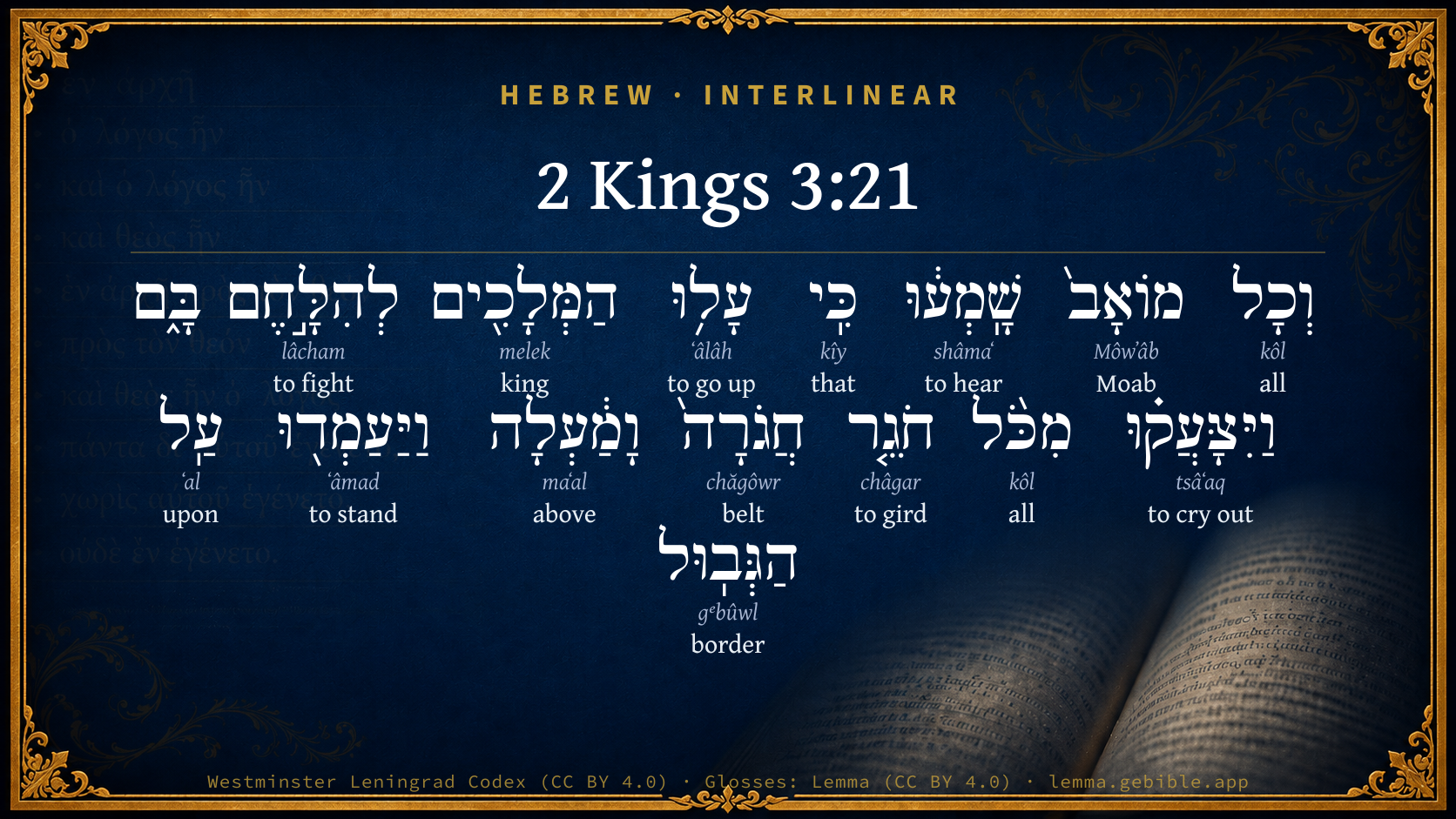
2 Kings 3:21

Hebrew (Westminster Leningrad Codex) 2 Kings 3:21 appears in the Hebrew Old Testament. The text above is from the Westminster Leningrad Codex. Each word links to its Strong’s number, a concise gloss, and parsing drawn from the Open Scriptures Hebrew Bible morphology. Click any word for its full Brown-Driver-Briggs (BDB) entry.
Download image
Cite this verse

2 Kings 3:21 (World English Bible). Public Domain. Lemma interlinear Bible study tool, https://lemma.gebible.app/v/2-kings/3/21.

Show BibTeX & RIS
BibTeX
RIS
English Translation
Now when all the Moabites heard that the kings had come up to fight against them, they gathered themselves together, all who were able to put on armor, and upward, and stood on the border.
World English Bible · Public Domain
Download a study sheet

One document with this verse’s original text, its word-by-word gloss line, the meaning frame, cross-references with their text, attributed commentary, and full source and license credits — printable, and it pastes into notes with its structure intact.

This verse Autodidact and up

Study sheet (.html) Plain text (.txt)

A passage Seminary Student

Up to 50 verses in one chapter. A passage sheet keeps up to 6 commentary sources and 12 cross-references per verse, in the order this page ranks them, and says so on the sheet whenever that leaves anything out. Ask for a single verse and you get the Autodidact verse sheet above.

Everything on this page stays free to read, with no account — the sheet is a download of what is already on screen, not access to it.

Want to remove ads? Support Godless Engineer
Compare translations 3

The same verse in 3 English versions, stacked beneath the original-language interlinear above. Click any original word for its lexicon entry.

Each is an independent rendering of the whole verse — the interlinear is not word-aligned to these translations.

Highlighted words mark where these versions differ — a whole-verse word diff, not a word-by-word alignment.

  • World English Bible Public Domain
    Now when all the Moabites heard that the kings had come up to fight against them, they gathered themselves together, all who were able to put on armor, and upward, and stood on the border.
  • King James Version Public Domain
    And when all the Moabites heard that the kings were come up to fight against them, they gathered all that were able to put on armor, and upward, and stood in the border.
  • unfoldingWord Literal Text CC BY-SA 4.0
    And all of Moab heard that the kings had come up to fight with them. And they were summoned, from every one tying a belt and upwards, and they stood at the border.

unfoldingWord Literal Text — © unfoldingWord, licensed CC BY-SA 4.0. Word-aligned USFM3 via Door43 (git.door43.org/unfoldingWord/en_ult).

Versions to compare (up to 4)

3 of 4 selected

Show all 18 translations

Every available English version of this verse, each an independent rendering of the whole verse.

  • World English Bible Public Domain
    Now when all the Moabites heard that the kings had come up to fight against them, they gathered themselves together, all who were able to put on armor, and upward, and stood on the border.
  • Berean Standard Bible Public Domain
    Now all the Moabites had heard that the kings had come up to fight against them. So all who could bear arms, young and old, were summoned and stationed at the border.
  • Majority Standard Bible Public Domain
    Now all the Moabites had heard that the kings had come up to fight against them. So all who could bear arms, young and old, were summoned and stationed at the border.
  • King James Version Public Domain
    And when all the Moabites heard that the kings were come up to fight against them, they gathered all that were able to put on armor, and upward, and stood in the border.
  • American Standard Version (1901) Public Domain
    Now when all the Moabites heard that the kings were come up to fight against them, they gathered themselves together, all that were able to put on armor, and upward, and stood on the border.
  • Revised Version (1885) Public Domain
    Now when all the Moabites heard that the kings were come up to fight against them, they gathered themselves together, all that were able to put on armour, and upward, and stood on the border.
  • Geneva Bible (1599) Public Domain
    And when al the Moabites heard that the Kings were come vp to fight against them, they gathered all that was able to put on harnesse, and vpwarde, and stood in their border.
  • Douay-Rheims (1899) Public Domain
    And all the Moabites hearing that the kings were come up to fight against them, gathered together all that were girded with a belt upon them, and stood in the borders.
  • Young's Literal Translation Public Domain
    and all Moab have heard that the kings have come up to fight against them, and they are called together, from every one girding on a girdle and upward, and they stand by the border.
  • Literal Standard Version CC BY-SA 4.0
    and all of Moab has heard that the kings have come up to fight against them, and they are called together, from everyone girding on a girdle and upward, and they stand by the border.
  • Unlocked Literal Bible CC BY-SA 4.0
    Now when all the Moabites heard that the kings had come to fight against them, they gathered themselves together, all who were able to put on armor, and they stood at the border.
  • unfoldingWord Literal Text CC BY-SA 4.0
    And all of Moab heard that the kings had come up to fight with them. And they were summoned, from every one tying a belt and upwards, and they stood at the border.
  • Darby Bible Public Domain
    And all the Moabites heard that the kings were come up to fight against them, and they were called together, all that were able to put on armour, and upward, and stood by the border.
  • World Messianic Bible Public Domain
    Now when all the Moabites heard that the kings had come up to fight against them, they gathered themselves together, all who were able to put on armor, young and old, and stood on the border.
  • Webster's Bible Public Domain
    And when all the Moabites heard that the kings were come up to fight against them, they gathered all that were able to put on armor, and upward, and stood in the border.
  • Free Bible Version CC BY-SA 4.0
    All the Moabites had heard that the kings had come to attack them. So everyone who could wear a sword, young and old, was called up and went to guard the border.
  • Bible in Basic English Public Domain
    Now all Moab, hearing that the kings had come to make war against them, got together all who were able to take up arms and went forward to the edge of the country.
  • JPS Tanakh (1917) Public Domain
    Now when all the Moabites heard that the kings were come up to fight against them, they gathered themselves together, all that were able to put on armour, and upward, and stood on the border.

Literal Standard Version (2020), Covenant Press — licensed CC BY-SA 4.0. Text via the HelloAO Bible API (eBible.org). Unlocked Literal Bible (unfoldingWord) — licensed CC BY-SA 4.0. Text via the HelloAO Bible API (eBible.org). unfoldingWord Literal Text — © unfoldingWord, licensed CC BY-SA 4.0. Word-aligned USFM3 via Door43 (git.door43.org/unfoldingWord/en_ult). Free Bible Version, Dr. Jonathan Gallagher — licensed CC BY-SA 4.0. Text via the HelloAO Bible API (eBible.org).

Word by word

More ways to search: Search by grammar → Find every occurrence → Compare this word →

Practice this passage: Drill this verse → Learn its vocabulary →

חֲגֹרָה֙
chăgôwr
H2290
“belt”
Noun, Common, Feminine, Singular, Absolute
Part of Speech
Noun
Type
Common
Gender
Feminine
Number
Singular
State
Absolute
Full BDB Definition

Origin: from H2296

TWOT: 604a , 604c

girdle, belt - girdle, loin-covering, belt, loin-cloth, armour
  1. וְכָל kôl H3605 “and · all of” Conjunction + Noun, Common, Masculine, Singular, Construct
  2. מוֹאָב֙ Môwʼâb H4124 “Moab” Noun, Proper
  3. שָֽׁמְע֔וּ shâmaʻ H8085 “to hear” Verb, Qal, Perfect, 3rd Person, Common, Plural
  4. כִּֽי kîy H3588 “that” Conjunction
  5. עָל֥וּ ʻâlâh H5927 “to go up” Verb, Qal, Perfect, 3rd Person, Common, Plural
  6. הַמְּלָכִ֖ים melek H4428 “the · kings” Particle, Definite Article + Noun, Common, Masculine, Plural, Absolute
  7. לְהִלָּ֣חֶם lâcham H3898 “to fight” Preposition + Verb, Niphal, Infinitive Construct
  8. וַיִּצָּעֲק֗וּ tsâʻaq H6817 “and · to cry out” Conjunction + Verb, Niphal, Sequential Imperfect, 3rd Person, Masculine, Plural
  9. מִכֹּ֨ל kôl H3605 “from · all of” Preposition + Noun, Common, Masculine, Singular, Construct
  10. חֹגֵ֤ר châgar H2296 “girding” Verb, Qal, Participle Active, Masculine, Singular, Construct
  11. וָמַ֔עְלָה maʻal H4605 “and · above · toward” Conjunction + Adverb + Suffix, Demonstrative
  12. וַיַּעַמְד֖וּ ʻâmad H5975 “and · to stand” Conjunction + Verb, Qal, Sequential Imperfect, 3rd Person, Masculine, Plural
  13. עַֽל ʻal H5921 “upon” Preposition
  14. הַגְּבֽוּל gᵉbûwl H1366 “the · border” Particle, Definite Article + Noun, Common, Masculine, Singular, Absolute

About this verse

These counts appear in no published source. They are computed here, from the morphology-tagged text and Lemma’s own curated glosses. What Lemma adds →

16
words
14
distinct lemmas
Historical
section

Notable vocabulary

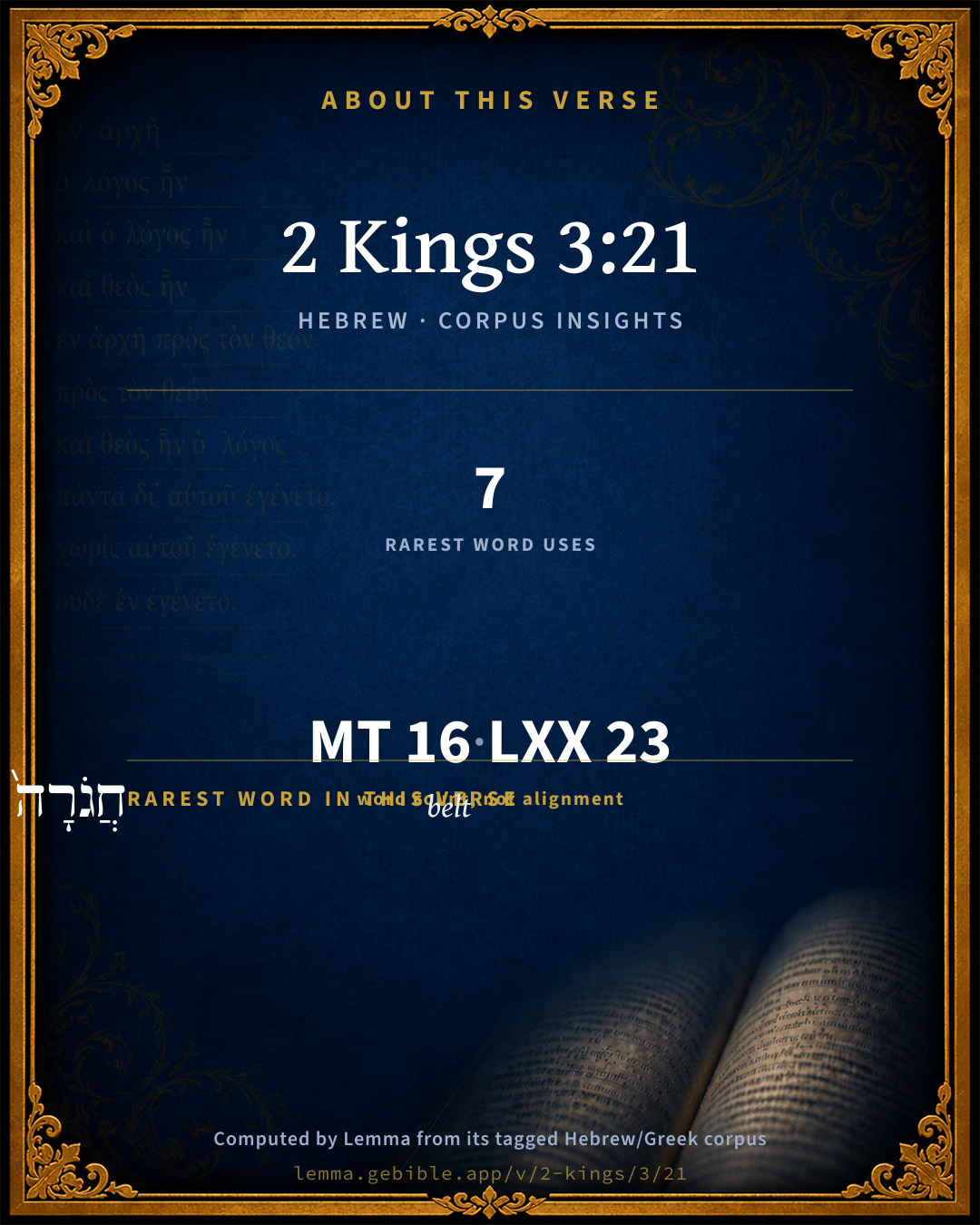
The rarest word here is חֲגֹרָה֙ belt H2290 — appearing just 7 times in the whole Hebrew Bible.

Shared distinctive vocabulary

חֲגֹרָה֙ belt H2290 occurs in 7 verses of the Hebrew Bible. Also found in:

Grammatical profile

  • 6 verbs
  • 6 nouns
  • 2 prepositions
  • 1 conjunction
  • 1 adverb

Verb forms

  • שָֽׁמְע֔וּ Qal · Perfect
  • עָל֥וּ Qal · Perfect
  • לְהִלָּ֣חֶם Niphal · Infinitive Construct
  • וַיִּצָּעֲק֗וּ Niphal · Sequential Imperfect
  • חֹגֵ֤ר Qal · Participle Active
  • וַיַּעַמְד֖וּ Qal · Sequential Imperfect

Repetition

A word recurs within this verse — often emphatic in Hebrew:

  • וְכָל all H3605 ×2

Hebrew & Septuagint length

In English translation the verse runs 35 words from the Hebrew and 39 from the Septuagint (LXX English) — closely comparable.

A rough comparison of the two English renderings, which tokenize alike — not a word-level alignment.

Word counts can differ between the Hebrew and the Greek without any difference in meaning — e.g. the Hebrew direct-object marker אֵת has no separate Greek word, and Greek often adds the article ὁ.

In the original languages it is 16 Hebrew tokens and 23 Greek tokens — but the two are counted differently (Hebrew bundles its prefixes and suffixes into one token; the Greek is in lemma form), so that isn’t a like-for-like length.

Cross-references

2

Topical passages linked to 2 Kings 3:21 in the Treasury of Scripture Knowledge — connected by theme and wording, ordered by reader-vote popularity; previews shown in the World English Bible.

  • 1 Kings 20:11 The king of Israel answered, Tell him, Don't let him who girds on [his armor] boast himself as he who puts it off.
  • Ephesians 6:14 Stand therefore, having the utility belt of truth buckled around your waist, and having put on the breastplate of righteousness,

Cross-references courtesy of OpenBible.info (CC BY 4.0).

Hebrew and Greek witnesses Masoretic Hebrew ↔ Greek Septuagint

The same verse in the two great witnesses to the Old Testament, shown verse-for-verse.

These are two independent witnesses, not word-aligned to each other, and the Septuagint is shown in lemma (dictionary) form.

Hebrew 2 Kings 3:21 Masoretic · Westminster Leningrad Codex

וְכָל מוֹאָב֙ שָֽׁמְע֔וּ כִּֽי עָל֥וּ הַמְּלָכִ֖ים לְהִלָּ֣חֶם בָּ֑ם וַיִּצָּעֲק֗וּ מִכֹּ֨ל חֹגֵ֤ר חֲגֹרָה֙ וָמַ֔עְלָה וַיַּעַמְד֖וּ עַֽל הַגְּבֽוּל

Now when all the Moabites heard that the kings had come up to fight against them, they gathered themselves together, all who were able to put on armor, and upward, and stood on the border.

World English Bible · Public Domain

Greek LXX 2 Kings 3:21 Septuagint · lemma form

καί πᾶς μωαβ ἀκούω ὅτι ἀναβαίνω ὁ βασιλεύς πολεμέω αὐτός καί ἀναβοάω ἐκ πᾶς περιζώνυμμι ζωνή καί ἐπάνω καί ἵστημι ἐπί ὁ ὅριον

And all Moab heard that the three kings were come up to fight against them; and they cried out on every side, even all that were girded with a girdle, and they said, Ho! and stood upon the border.

LXX2012 (modern English Septuagint) · Public Domain

Hebrew: Westminster Leningrad Codex (CC BY 4.0). Greek: Septuagint (public domain); English from LXX2012 (modern English Septuagint) (Public Domain). How the Septuagint differs from the Hebrew →

Targum (Aramaic paraphrase)

1

The Targum is the ancient Jewish Aramaic paraphrase of the Hebrew Scriptures — an interpretive translation, not the Hebrew text itself. Onkelos (literal) and Pseudo-Jonathan (expansive) render the Torah, and Jonathan the Prophets. Coverage is partial: where no permissively-licensed English translation exists for a verse, only the Aramaic is shown. This is verse-level text, not a word-by-word alignment to the Hebrew.

  1. Targum Jonathan Prophets (Joshua–Malachi)
    וְכָל מוֹאֲבָאֵי שְׁמָעוּ אֲרֵי סְלִיקוּ מַלְכַיָא לְאַגָחָא קְרָבָא בְּהוֹן וְאִתְכְּנִישׁוּ מִכֹּל אֲסִירֵי סַיְפָא וּלְעֵילָא וְקָמוּ עַל תְּחוּמָא:

    (no public-domain English translation for this verse)

    Targum Jonathan — Aramaic: “Mikraot Gedolot” (public domain). English: “Sefaria Community Translation” (CC0 1.0 (public-domain dedication)); “London "Chaldee Paraphrase," 1871” (public domain). Text via Sefaria.

Commentary

Notes on 2 Kings 3:21 from classic Christian and Jewish commentators (each source and its license shown beneath its notes). The classic Christian expositions comment on the surrounding passage and are grouped to its opening verse, so a note may address several verses; the Jewish commentaries on the Tanakh (Rashi and others) are per-verse, so they appear only where the commentator wrote on this verse.

Lemma curates 59 commentaries, every one of them public domain or Creative Commons licensed, each selected and text-cleaned for this edition rather than reprinted as found. About our sources →

Trapp's Complete Commentary

John Trapp

2Ki 3:21 And when all the Moabites heard that the kings were come up to fight against them, they gathered all that were able to put on armour, and upward, and stood in the border.

Ver. 21. They gathered all that were able to put on armour.] In Scotland, they have an ancient custom, in cases of importance, to command the fire cross to be carried; that is, two firebrands set in fashion of a cross, and pitched upon the point of a spear, and proclamation is thereupon made that all men over sixteen years of age, and under sixty, shall come into the field against the common enemy. {a}

{a} Life of King Edward VI, by Sir J. Heywood,

John Trapp, A Commentary or Exposition upon All the Books of the Old and New Testament (1647–1656) — public domain. Text from a community e-Sword module.

Joseph Benson's Commentary

2Ki 3:21. All that were able to put on armour and upward — That is, from youths, that were but just able to put on armour, to those that were far advanced in life; so that none were exempted. And stood in the border —

Of their country, intending to defend themselves, but not to march out of their country to give the enemy battle.

Joseph Benson's Commentary on the Old and New Testaments (1811–1818) — public domain. Text from a community e-Sword module.

The Preacher's Complete Homiletical Commentary

Joseph S. Exell (gen. ed.)

CRITICAL AND EXPLANATORY NOTES.—

2Ki_3:23. This is blood—For the rancour between the kings of Israel and Judah was well known; hence the Moabites supposed they had slaughtered each other in some quarrel on their march. Thus deluded by the sight of the water—reddened by the sun’s rays, or with the colour of the earth into which they had dug (2Ki_3:16), the Moabites hastened. unprepared, into the hands of their foes.

2Ki_3:25. קּיר הֲרָשֶׂת—Called Kir Moab (Isa_15:1). It was the capital city, and fortified—now called Kerak.

2Ki_3:27. Eldest son, and offered him for a burnt offering upon the wall—In the sight of the assailing armies; and this spectacle of horror roused in the allies of Israel such revulsion, because that their support of Israel had driven the king of Moab to this dreadful act, that they fell back from the siege, and left Israel to its own fortunes.—W. H. J.

HOMILETICS OF 2Ki_3:21-27

THE DANGER OF TRUSTING TO APPEARANCES

I. Appearances may deceive those who fancy themselves well prepared for all contingencies (2Ki_3:21). Moab was aware of the approach of the invading army, and made the most careful and elaborate preparation to withstand it. All who were capable of bearing arms were marched to the frontier, and the brave little nation, keenly watching every movement of the enemy, seemed determined to make a stout and desperate defence. It is important to prepare for the conflict of life; to be armed with the whole armour of God, and ever on our guard against the attack of our spiritual foes. But when we are best prepared we are liable to be misled by false appearances. “Let him that thinketh he standeth take heed lest he fall.”

II. Appearances may surprise the most cautious into committing a fatal blunder (2Ki_3:22-24). The shining of the early morning sun upon the water that filled the red earth-pits newly dug in the valley was mistaken for blood, and the Moabite leader, without taking any pains to verify his impression, jumped to the conclusion that the invading army had qurelled, and what he saw shining in the sunlight was the blood of the slain. The word of command was given to advance, with the expectation that there was now nothing to do but to gather the spoil; but, too late to remedy it, the mistake of the Moabites was seen, and the compact little army that was strong and formidable when entrenched in its defences was speedily smitten and put to flight when it came into unexpected contact with the refreshed and well-armed Israelites. A false glitter did all the mischief. Alas! how many have been thus lured on to their destruction—the lover of strong drink, who has “looked upon the wine when it is red,” until he has been fascinated with its mocking sheen and whelmed in its intoxicating vortex; the insatiate seeker of pleasure, who has been captivated by beauteous forms and pleasant sounds, and lost in giddy mazes; the grasping money-getter, for whom the glare of wealth has had an irresistible charm that has robbed him of the love of home, of kindred, and of honour. Enchanted with the glamour of false appearances, the generous have become penurious—the modest, bold—the careful, recklessly extravagant—the virtuous, base.

III. Trusting to appearances is often followed by the most ruinous consequences (2Ki_3:25-27). In this case we see an army utterly routed—a fruitful country made barren and desolate—and the only heir-apparent to a throne cruelly immolated by a distracted father. Many a promising nation has been brought to naught by yielding to the unholy lust of power, following the ignis fatuus of military glory, or craving for the crimsoned reputation of a tyrannical ascendency. The Sclavonians have a legend that a certain river was infested with a water-demon who had the power of assuming the shape of a cluster of red flowers waving and spreading themselves out in graceful and attractive forms on the surface of the water; but if the passer-by was tempted to put forth his hand to pluck one of the fragile blossoms, he was at once seized by invisible hands, dragged beneath the surface, and suffocated in the treacherous stream. It is perilous to trust to false appearances: it may lead to irreparable disaster. Many who have plucked the flower of pleasure have found it to contain a fatal sting.

LESSONS:—

1. Appearances have a great influence over us.

2. Are often false and fictitious.

3. Entice many into hopeless ruin.

GERM NOTES ON THE VERSES

2Ki_3:22-25. They rise soon enough to beguile themselves. The beams of the rising sun, glistening upon those vaporous and unexpected waters, carried in the eyes of some Moabites a semblance of blood. A few eyes were enough to fill all ears with a false noise: the deceived sense miscarries the imagination. Civil broils give just advantage to a common enemy; therefore must the camps be spoiled, because the kings have smitten each other. Those who shall be deceived are given over to credulity: the Moabites do not examine either the conceit or the report, but fly in confusedly upon the camp of Israel, whom they find, too late, to have no enemies but themselves. As if death would not have hastened enough to them, they come to fetch it, they come to challenge it: it seizeth upon them unavoidably. They are smitten, their cities razed, their lands marred, their wells stopped, their trees felled, as if God meant to waste them but once.—Bp. Hall.

2Ki_3:22-23. Optical illusions. I. May deceive the most wary. II. May lead to very serious mistakes. III. Should be carefully tested.

—The Divine aid by which the army of Israel was not only saved from destruction, but even obtained a complete victory over their enemies, consisted here not in a miracle of God surpassing the known laws of nature, but only in this, that God the Lord, as he had announced before by His prophet, introduced the laws of nature working to the determinate end in the predetermined way. As the suddenly appearing mass of waters was affected in a natural way by a violent rain in the distance, so also the illusion that was so fatal to the Moabites is explained in a natural way, indicated even in the text. From the red earth of the pits the water collected in them had assumed a red colour, which was considerably increased by the rays of the rising sun falling upon it, so that, seen from a distance, it must have appeared like blood. But the Moabites might be the less disposed to think of an optical illusion, as by their familiar acquaintance with the region they knew that the Wady had at that time no water, and they had seen or learned nothing of the rain which had fallen far from them in the Edomite mountains.—Keil.

2Ki_3:23. The self-destruction of the allied armies of Moab, Ammon, and Edom (2Ch_20:22-25) was still fresh in the minds of the Moabites; and knowing the enmity and jealousy existing between Judah and Israel, and confident that the Edomites were no fast friends of either party, they very naturally imagined, from the sight of what appeared so much blood, that the different kings had fallen out among themselves, and destroyed each other. They supposed it only remained for them to go, as did Jehoshaphat on that former occasion, and gather up the precious jewels and other spoil from among the dead bodies.

2Ki_3:25. The terrible havoc of war. I. Sacrifices precious lives. II. Ruthlessly destroys the work of years. III. Exhausts the resources of a nation. IV. Checks national growth.

2Ki_3:26-27. No onsets are so furious as the last assaults of the desperate. The king of Moab, now hopeless of recovery, would be glad to shut up with a pleasing revenge. With seven hundred resolute followers, he rushes into the battle towards the king of Edom, as if he would bid death welcome might he but carry with him that despited neighbour, and now, mad with repulse, he returns; and, whether as angry with his destiny, or as barbarously affecting to win his cruel gods with so dear a sacrifice, he offers them, with his own hands, the blood of his eldest son in the sight of Israel, and sends him up in the smoke to those hellish deities. Oh, prodigious act, whether of rage or of devotion! What a hand had Satan over his miserable vassals! What marvel is it to see men sacrifice their souls in an unfelt oblation to these plausible tempters, when their own flesh and blood have not been spared! There is no tyrant like to the prince of darkness.—Bp. Hall.

2Ki_3:26. Bravery. I. Called forth by the stress of circumstances. II. Challenges admiration irrespective of the cause it champions. III. Often unavailing.

2Ki_3:27. The offering was doubtless made to the Moabitish god Chemosh, not to the God of Israel. Mesha supposed that his misfortunes were owing to the vengeance of his gods, whom he had in some way offended, and by this costly sacrifice he sought to propitiate them. Human sacrifices were common among many of the ancient heathen nations. The story of Iphigenia sufficiently shows the existence of the practice among the Greeks. It prevailed, also, among the Carthaginians and Phœnicians, and most of the nations in and around Palestine. Causing children to pass through the fire to Molech (chap. 2Ki_13:10; Deu_18:10) is an allusion to this abominable custom. Diodorus Siculus relates that when Agathocles was going to besiege Carthage, the people, seeing the extremities to which they were reduced, ascribed their misfortune to the anger of their god, in that they had latterly spared to offer him children nobly born, and had fraudulently put him off with the children of slaves and foreigners. To make an atonement for this crime, two hundred children of the best families in Carthage were at once offered in sacrifice, and no less than three hundred of the citizens voluntarily sacrificed themselves. Philo, in a fragment preserved by Eusebius, says: “It was a custom among the ancients, on occasions of great distress, for the rulers of a city or nation, instead of leaving the entire population to destruction, to sacrifice the beloved of their children as a ransom to the vengeful deities.—Whedon.

—Various accounts of the origin of human sacrifice have been given, but all are necessarily conjectural. It seems to us that the practice grew out of the notion that whatever was most costly and precious must needs be most acceptable as an offering to the gods; and it being established that the life of an animal was an acceptable offering, perverse ingenuity reasoned that the life of the human creature—the noblest of creatures—and his life-blood the most precious on earth, must be still more acceptable to heaven, still more valuable in the sight of the gods. This being the case, it further followed that the more illustrious, the more pure or exalted the person whose life was offered, the more proper still was the offering, and the more cogent its force in gratifying, soothing, or rendering propitious the stern powers that ruled the destinies of man. As to the precise object, it appears to us that in all, or nearly all, the cases fully known, these offerings were propitiatory at least, if not expiatory.—Kitto.

—The inhuman cruelty of heathenism. I. Immolates the choicest human victims. II. Is prompted by despair. III. Rouses the indignation of the righteous. IV. Is specially offensive to God.

—The departure of the Israelitish army in consequence of the human sacrifice of the king of Moab is a very remarkable sign of the difference between the fundamental opinions of the Israelites and of the heathen. Whereas, amongst almost all heathen peoples, sacrifice culminates in human sacrifice, and this is considered the most holy and most effective, in the Mosaic system, on the other hand, it is regarded as the greatest and most detestable abomination in the sight of God. It is forbidden, not merely from considerations of humanity, but also because, as the law declares with special emphasis, the sanctuary of the Lord is thereby defiled and His Holy Name profaned (Lev_20:1-5; Lev_18:21). Human sacrifice stands in the most glaring contradiction to the revelation of God as the Holy One, in which character He was known in Israel alone; hence it was to be punished, without respite, by death. From the preceding narrative we see how deep roots the detestation of human sacrifice had struck in the conscience of the people. Neither the cultus founded by Jeroboam, nor that of Baal which Ahab had imported, with all its barbarism, had been able even to weaken this detestation. It was still so strong that a victorious army allowed itself to be led thereby to withdraw again from a land it had already subdued.—Lange.

The Preacher's Complete Homiletical Commentary (gen. ed. Joseph S. Exell; Funk & Wagnalls, c. 1892) — public domain (pre-1929). A full-Bible homiletical/sermon-outline anthology covering 65 of 66 books (2 John is absent from the source module). Text from a community e-Sword module.

Geneva Bible (1599)

Geneva Bible translators

Hebrew, to gird himself with a girdle.

Geneva Bible (1599) marginal notes — public domain. Text via Bolls.life.

Ellicott's Commentary for English Readers

(21) And when . . . heard . . . they gathered.—Now all the Moabites had heard . . . and had gathered themselves: literally, had been summoned, called together (Jdg_7:23).

All that were able to put on armour.—From every one girding on a girdle, and upwards—i.e., all of adult age, all who could bear arms. It was a levy en masse of the male population for the defence of the country.

Stood in.—Had taken their stand on the frontier.

A Bible Commentary for English Readers, edited by Charles John Ellicott (1878–1897) — public domain. Text from a community e-Sword module.

The Cambridge Bible for Schools and Colleges

gen. ed. J. J. S. Perowne

21. And [R.V. Now] when all the Moabites heard] By the circuitous journey which the armies had made their march would be less observed, and it would only be at the time of their appearance on the frontier that the object of their expedition would become known. But the casting off the yoke of Israel, and the freeing of their land from such a burdensome tribute made the war popular in Moab, and all were prepared to do their duty against the invaders.

come up] See above on verse 7.

they gathered all that were able to put on armour] R.V. they gathered themselves together, all &c. The verb is literally, ‘they called themselves together’. The expression indicates the enthusiasm with which each man appealed to his neighbour. ‘To put on armour’ is literally ‘to gird themselves with a girdle’, for to the girdle the weapon was attached.

and stood in the border] This would naturally be a height dividing their country from the land of Edom.

21–27. The Moabites attack the allied armies, but are defeated. The king of Moab sacrifices his eldest son (Not in Chronicles)

The Cambridge Bible for Schools and Colleges (gen. ed. J. J. S. Perowne; Cambridge University Press, 1878–1918) — public domain. Text from a community e-Sword module.

John Gill's Exposition

And when they came to the camp of Israel,.... Not in an orderly regular manner, in rank and file, as an army should march, but in a confused manner, everyone striving who should get thither first, and have the largest share of the booty:

the Israelites rose up and smote the Moabites, so that they fled before them; being prepared for them, they fell upon them sword in hand, and soon obliged them to flee:

but they went forward smiting the Moabites, even in their country; they pursued them closely, and slew them as they fled, and followed them not only to their borders, but into their own country: though Schultens (m), from the use of the word in the Arabic language, renders the passage, "and they blunted their swords in it (in that slaughter), even by smiting the Moabites".

(m) De Defect. Hod. Ling. Heb. sect. 26.

John Gill's Exposition of the Whole Bible (1746–1763) — public domain (CC PDM 1.0). Text via the HelloAO Bible API.

Albert Barnes' Notes on the Bible

And stood in the border - On the north side of the wady, ready to defend their territory.

Albert Barnes' Notes on the Bible (1834–1885) — public domain. Text from a community e-Sword/MySword module.

Haydock's Catholic Bible Commentary

Upon them. Hebrew, "and upward," both soldiers and those who were usually exempt from service.

George Leo Haydock (1774–1849), Haydock's Catholic Family Bible and Commentary, 1859 edition — public domain. Excludes Psalms (Douay-Rheims chapter numbering differs from Protestant) and Deuterocanonical books (Catholic canon only).

Matthew Poole's English Annotations

To put on armour, Heb. to gird on a girdle, i.e. a military girdle, to which the sword was fastened, 2Sa 20:8; 1Ki 2:5.

In the border, or, in that border, to wit, of their country, which was towards Edom, which way they understood the kings came. Here they stood probably to defend the passages into their country.

Matthew Poole's English Annotations on the Holy Bible (1683–1685) — public domain. Text from a community e-Sword/MySword module.

The Pulpit Commentary

And when all the Moabites heard that the kings were come up to fight against them. The Hebrew has no pluperfect tense; but the verbs have here a pluperfect force. Translate, When all the Moabites had heard that the kings were come up to fight against them, they had gathered all that were able, etc. The muster of the troops had long preceded the storm. They gathered all that were able to put on amour; literally, there had been gathered together all that girded themselves with girdles; i.e. all the male population of full age. And upwardi.e. , and all above the age when the girdle was first assumed and stood in the border; took up a position near the extreme border of their territory, on the northern bank of the Wady-el-Ahsy.

Vers. 21-25.

God"s enemies rewarded after their deserving.

Whether or no the Moabites were, humanly speaking, justified in their attempt to shake off the Israelitish yoke, and re-establish their independence, at any rate they were, as a nation, distinctly hostile to Jehovah and his laws, and must be counted as among God"s enemies. Their Chemosh cannot be reckoned as an adumbration of the true God; he is rather an adumbration of the evil and malignant spirit. A people that delights in human sacrifice, and offers to its deities tender and innocent children, drowning their cries with the loud din of drums and tom-toms, must have depraved its conscience by long persistence in evil, and departed very far indeed from original righteousness. Moab, moreover, had, from the time of Balak, determinately set itself at once to oppose the Israelites, whenever opportunity offered, by armed force, and also to corrupt and deprave them morally and religiously. The Moabites had recently made what seems to have been an entirely unprovoked attack upon Jehoshaphat, and had stirred up the Ammonites and Edomites to do the same. (2Ch_20:1-15) They had already suffered one chastisement for this wrong-doing, at the hand of God; (2Ch_20:22-24) but God"s anger against them was not yet fully appeased. The rebellion on which Mesha had adventured led now to a further chastisement Moab was ravaged from one end of the country to the other, the towns were taken and demolished, the fruit trees cut down, the good land "marred," only Kir-haraseth was left unharmed; and even there the inhabitants suffered greatly. Moab was severely punished; but, as usually, God"s justice was tempered with mercy. She was not crushed; she was not destroyed. If we may believe Mesha, she gradually recovered and rebuilt her towns. After fifty years of depression she was able to resume her raids into the land of Israel, (2Ki_13:20) and it was not till the establishment of the Roman supremacy over the East that, having filled up the measure of her iniquities, she ceased to exist as a nation.

The Pulpit Commentary (1880–1919), ed. H.D.M. Spence-Jones & Joseph S. Exell — public domain. Text from a community e-Sword module.

John Wesley's Explanatory Notes

The border - Of their country, to defend the passage.

John Wesley, Explanatory Notes Upon the Whole Bible (1754–1765) — public domain. Text via the GEBible commentary corpus.

Kretzmann's Popular Commentary

Paul E. Kretzmann

The Defeat of Moab

v. 21. And when all the Moabites heard that the kings were come up to fight against them, this had taken place in the course of the seven days while the attacking army was approaching, they gathered all that were able to put on armor, summoning all those that were able to gird themselves, that is, to bear arms, and upward, not only the very young, but also all the older men, and stood in the border, drawn up in battle-line along the boundary of their country.

v. 22. And they rose up early in the morning, on the day when the Lord sent down the water from the mountains of Edom, and the sun shone upon the water, and the Moabites saw the water on the other side as red as blood, from the reflection of the sun’s red light;

v. 23. and they said, This is blood, a conclusion by no means far-fetched, for they knew that there was no water in the desert; the kings are surely slain, and they have smitten one another, their well-known jealousy having reached such a height of disagreement that a bloody carnage had resulted. Now, therefore, Moab, to the spoil! They broke ranks and rushed forward as a disorganized mob.

v. 24. And when they came to the camp of Israel, the Israelites rose up and smote the Moabites, who were utterly taken by surprise when the enemy met them with arms ready for the attack, so that they fled before them. But they went forward smiting the Moabites, even in their country; for the Israelites and their allies pursued the fleeing Moabites across the boundary.

v. 25. And they beat down the cities, and on every good piece of land cast every man his stone and filled it, rendering it unfit for bearing grain; and they stopped all the wells of water, and felled all the good trees; only in Kir-haraseth left they the stones thereof, the capital city, the most important fortification of the country, they besieged last; howbeit, the slingers went about it and smote it, picking off the men of the garrison as they showed themselves upon the walls.

v. 26. And when the king of Moab saw that the battle was too sore for him, he took with him seven hundred men that drew swords, expert swordsmen, to break through even unto the king of Edom, believing that this part of the attacking army was the weakest; but they could not.

v. 27. Then he, the king of Moab, took his eldest son that should have reigned in his stead, the heir apparent to the throne,and offered him for a burnt offering upon the wall, sacrificing him to the Moabite war-god Chemosh in full sight of the besieging army. And there was great indignation against Israel, their army was filled with disgust and indignation at this deed; and they departed from him, not wishing to remain any longer in that country, horrified at seeing this human sacrifice, and returned to their own land. Thus all believers should abhor the abominations of the idolatrous world and flee from their temptations.

Paul E. Kretzmann, Popular Commentary of the Bible (1921–1924) — public domain. Text from a community e-Sword module.

unfoldingWord translationNotes

Door43 World Missions Community

Now

This word is used here to mark a break in the main story line. Here the author tells background information about the Moabite army preparing to meet the three kings and their armies in battle. (See: Background Information)

all who were able to put on armor

Here "armor" represents ability to fight. AT: "all the men who could fight" (See: Metonymy)

the kings had come

Here the word "kings" refers to both the kings and their armies. AT: "the kings had come with their armies" or "the kings and their armies had come" (See: Synecdoche)

it looked as red as blood

This compares the red appearance of the water to the color of blood. AT: "it was red like blood" (See: Simile)

So now, Moab

The soldiers are referring to themselves here as "Moab." AT: "soldiers of Moab" (See: Synecdoche)

plunder them

"steal their belongings." After an army defeated their enemies, they would often plunder their towns by stealing whatever was left of value.

translationWords

king

armor

blood

unfoldingWord translationNotes — © Distant Shores Media and the Door43 World Missions Community, licensed CC BY-SA 4.0. Source: git.door43.org/Door43/en_tn.

Rashi

Rabbi Shlomo Yitzchaki (Rashi)

At the border. At the border, that is called marche, in O.F.

Rashi on the Tanakh — English translations: “The Judaica Press complete Tanach with Rashi, translated by A. J. Rosenberg” (CC BY 4.0); “Pentateuch with Rashi's commentary by M. Rosenbaum and A.M. Silbermann, 1929-1934” (public domain); “The Metsudah Tanach series, Lakewood, N.J” (CC BY 4.0); and “The Book of Joshua, Metsudah Publications, 1997” (CC BY 4.0). Text via Sefaria.

Lesson kit

Teaching starters — assembled from the data on this page, not authored interpretation. Every prompt links to the verse data it draws on. Edit before teaching.

2 Kings, in the Historical, opens this verse with 16 words (14 distinct Hebrew lemmas). Its most distinctive word is chăgôwr (“belt”). A historical commentator’s framing appears above. Read the whole chapter for the surrounding context.

Discussion questions

  1. The word chăgôwr carries the sense “belt.” How does it shape the verse?
  2. Genesis 3:7 shares the word «belt» with this verse. How do the two illuminate each other?
  3. “all” occurs 2× in this one verse. What is the effect of the repetition?
  4. The translations on this page render this verse differently — a whole-verse word diff, not a word-by-word alignment. What might account for the different wordings?
  5. The verb «שָֽׁמְע֔וּ» is Qal Perfect. How does its form color the action?
  6. Reading how Trapp's Complete Commentary and Joseph Benson's Commentary read this verse, where do the two commentators agree and where do they part?

Things to notice

Reading settings

Reading text

Shown beneath each verse's original-language words.

Old Testament
Old Testament edition

Read the OT as the Masoretic Hebrew (MT) or the Greek Septuagint (LXX).

English shown for the Greek Septuagint (in the Hebrew ↔ Greek comparison).

Comparing translations? Open the Compare panel on any verse page to stack up to four side by side.