Hebrews 4:7

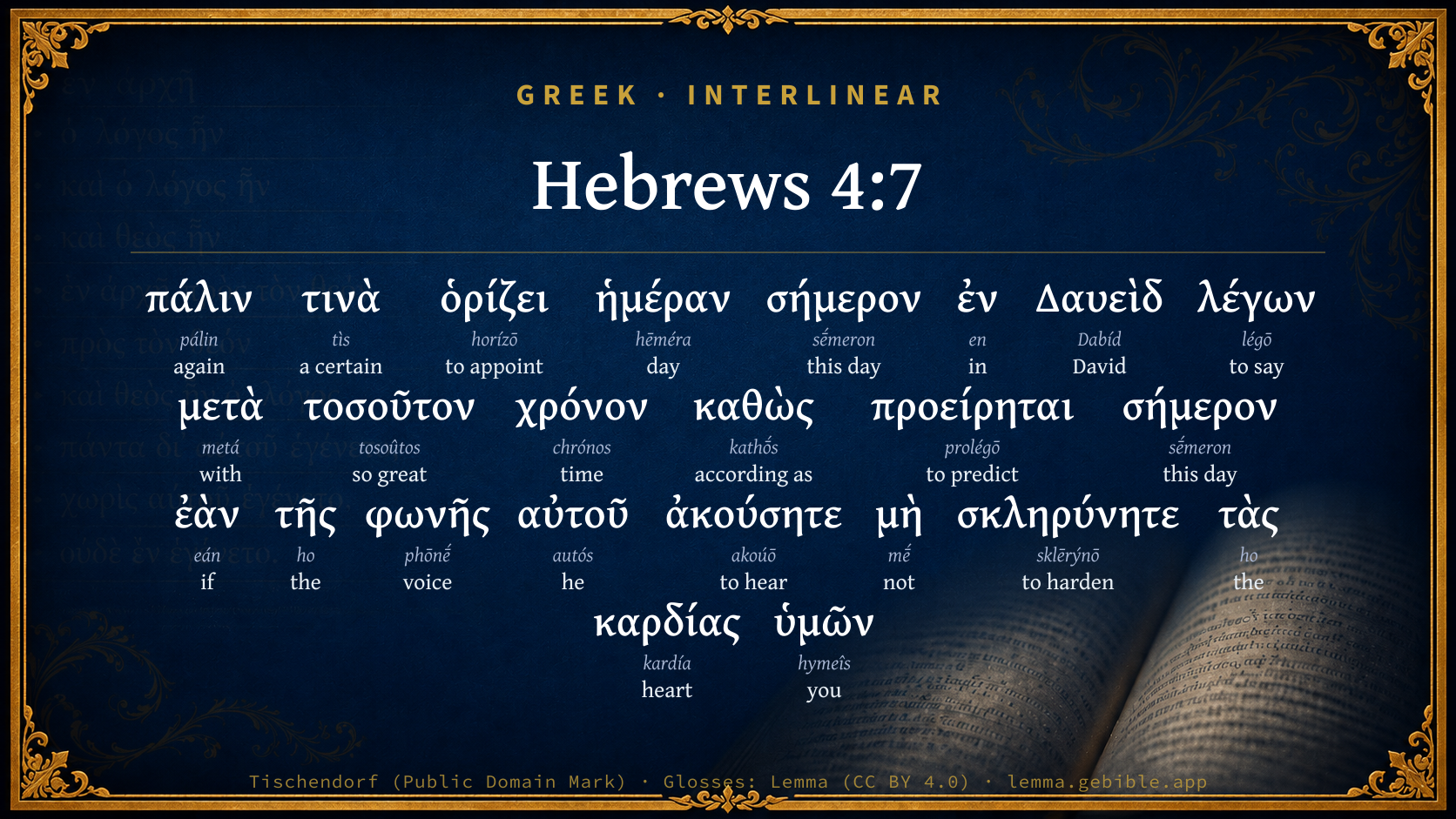
Greek (Tischendorf 8th ed.) Hebrews 4:7 appears in the Greek New Testament. The text above is from the Tischendorf 8th edition. Each word links to its Strong’s number and a concise gloss. Click any word for its full Thayer’s Greek Lexicon entry.
Download image
Cite this verse

Hebrews 4:7 (World English Bible). Public Domain. Lemma interlinear Bible study tool, https://lemma.gebible.app/v/hebrews/4/7.

Show BibTeX & RIS
BibTeX
RIS
English Translation
he again defines a certain day, today, saying through David so long a time afterward (just as has been said), "Today if you will hear his voice, Don't harden your hearts."
World English Bible · Public Domain
Download a study sheet

One document with this verse’s original text, its word-by-word gloss line, the meaning frame, cross-references with their text, attributed commentary, and full source and license credits — printable, and it pastes into notes with its structure intact.

This verse Autodidact and up

Study sheet (.html) Plain text (.txt)

A passage Seminary Student

Up to 50 verses in one chapter. A passage sheet keeps up to 6 commentary sources and 12 cross-references per verse, in the order this page ranks them, and says so on the sheet whenever that leaves anything out. Ask for a single verse and you get the Autodidact verse sheet above.

Everything on this page stays free to read, with no account — the sheet is a download of what is already on screen, not access to it.

Want to remove ads? Support Godless Engineer
Compare translations 3

The same verse in 3 English versions, stacked beneath the original-language interlinear above. Click any original word for its lexicon entry.

Each is an independent rendering of the whole verse — the interlinear is not word-aligned to these translations.

Highlighted words mark where these versions differ — a whole-verse word diff, not a word-by-word alignment.

  • World English Bible Public Domain
    he again defines a certain day, today, saying through David so long a time afterward (just as has been said), "Today if you will hear his voice, Don't harden your hearts."
  • King James Version Public Domain
    Again, he limiteth a certain day, saying in David, To day, after so long a time; as it is said, To day if ye will hear his voice, harden not your hearts.
  • unfoldingWord Literal Text CC BY-SA 4.0
    he again sets a certain day, calling it “Today,” speaking through David after so much time, just as it has already been said, “Today, if you hear his voice, do not harden your hearts.”

unfoldingWord Literal Text — © unfoldingWord, licensed CC BY-SA 4.0. Word-aligned USFM3 via Door43 (git.door43.org/unfoldingWord/en_ult).

Versions to compare (up to 4)

3 of 4 selected

Show all 19 translations

Every available English version of this verse, each an independent rendering of the whole verse.

  • World English Bible Public Domain
    he again defines a certain day, today, saying through David so long a time afterward (just as has been said), "Today if you will hear his voice, Don't harden your hearts."
  • Berean Standard Bible Public Domain
    God again designated a certain day as “Today,” when a long time later He spoke through David as was just stated: “Today, if you hear His voice, do not harden your hearts.”
  • Majority Standard Bible Public Domain
    God again designated a certain day as “Today,” when a long time later He spoke through David as was just stated: “Today, if you hear His voice, do not harden your hearts.”
  • King James Version Public Domain
    Again, he limiteth a certain day, saying in David, To day, after so long a time; as it is said, To day if ye will hear his voice, harden not your hearts.
  • American Standard Version (1901) Public Domain
    he again defineth a certain day, To-day, saying in David so long a time afterward (even as hath been said before), To-day if ye shall hear his voice, Harden not your hearts.
  • Revised Version (1885) Public Domain
    he again defineth a certain day, saying in David, after so long a time, Today, as it hath been before said, Today if ye shall hear his voice, Harden not your hearts.
  • Geneva Bible (1599) Public Domain
    Againe he appointed in Dauid a certaine day, by To day, after so long a time, saying, as it is sayd, This day, if ye heare his voyce, harden not your hearts.
  • Douay-Rheims (1899) Public Domain
    Again he limiteth a certain day, saying in David, To day, after so long a time, as it is above said: To day if you shall hear his voice, harden not your hearts.
  • Young's Literal Translation Public Domain
    again He doth limit a certain day, `To-day,' (in David saying, after so long a time,) as it hath been said, `To-day, if His voice ye may hear, ye may not harden your hearts,'
  • Literal Standard Version CC BY-SA 4.0
    again He limits a certain day, “Today,” in David saying, after so long a time, as it has been said, “Today, if you may hear His voice, you may not harden your hearts,”
  • Unlocked Literal Bible CC BY-SA 4.0
    God has again set a certain day calling it “Today.” After many days, he spoke through David, as it was earlier said, “Today if you hear his voice, do not harden your hearts.”
  • unfoldingWord Literal Text CC BY-SA 4.0
    he again sets a certain day, calling it “Today,” speaking through David after so much time, just as it has already been said, “Today, if you hear his voice, do not harden your hearts.”
  • Darby Bible Public Domain
    again he determines a certain day, saying, in David, 'To-day,' after so long a time; (according as it has been said before), To-day, if ye will hear his voice, harden not your hearts.
  • World Messianic Bible Public Domain
    he again defines a certain day, “today”, saying through David so long a time afterward (just as has been said), “Today if you will hear his voice, don’t harden your hearts.”
  • Webster's Bible Public Domain
    (Again, he limiteth a certain day, saying in David, To-day, after so long a time; as it is said, To-day, if ye will hear his voice, harden not your hearts.
  • Free Bible Version CC BY-SA 4.0
    So God again sets a day—today—saying a long time later through David as he did before, “If you hear what God is saying to you today, don't have a hard-hearted attitude.”
  • Bible in Basic English Public Domain
    After a long time, again naming a certain day, he says in David, Today (as he had said before), Today if you will let his voice come to your ears, be not hard of heart,
  • Text-Critical English NT CC BY 4.0
    he again designates a certain day, calling it “Today,” as he says through David much later, in the passage already quoted, “Today, if you hear his voice, do not harden your hearts.”
  • Tyndale New Testament (1534) Public Domain
    Agayne he apoynteth in David a certayne present daye after so longe a tyme sayinge as it is rehearsed: this daye if ye heare his voyce be not harde herted.

Literal Standard Version (2020), Covenant Press — licensed CC BY-SA 4.0. Text via the HelloAO Bible API (eBible.org). Unlocked Literal Bible (unfoldingWord) — licensed CC BY-SA 4.0. Text via the HelloAO Bible API (eBible.org). unfoldingWord Literal Text — © unfoldingWord, licensed CC BY-SA 4.0. Word-aligned USFM3 via Door43 (git.door43.org/unfoldingWord/en_ult). Free Bible Version, Dr. Jonathan Gallagher — licensed CC BY-SA 4.0. Text via the HelloAO Bible API (eBible.org).

Word by word

More ways to search: Search by grammar → Find every occurrence → Compare this word →

Practice this passage: Drill this verse → Learn its vocabulary →

σκληρύνητε
sklērýnō
G4645
“to harden”
Verb, Present, Active, Subjunctive, 2nd person, Plural
Part of Speech
Verb
Tense
Present
Voice
Active
Mood
Subjunctive
Person
2nd person
Number
Plural
Full Thayer's Definition

Origin: from G4642

TDNT: 22:10,8

1. to make hard, harden 2. metaph. a. to render obstinate, stubborn b. to be hardened c. to become obstinate or stubborn
  1. πάλιν pálin G3825 “again” Adverb
  2. τινὰ tìs G5100 “a certain” Indefinite pronoun, Accusative, Singular, Feminine
  3. ὁρίζει horízō G3724 “to appoint” Verb, Present, Active, Indicative, 3rd person, Singular
  4. ἡμέραν hēméra G2250 “day” Noun, Accusative, Singular, Feminine
  5. σήμερον sḗmeron G4594 “this day” Adverb
  6. ἐν en G1722 “in” Preposition
  7. Δαυεὶδ Dabíd G1138 “David” Noun, Proper, indeclinable
  8. λέγων légō G3004 “to say” Verb, Present, Active, Participle, Nominative, Singular, Masculine
  9. μετὰ metá G3326 “with” Preposition
  10. τοσοῦτον tosoûtos G5118 “so great” Demonstrative pronoun, Accusative, Singular, Masculine
  11. χρόνον chrónos G5550 “time” Noun, Accusative, Singular, Masculine
  12. καθὼς kathṓs G2531 “according as” Adverb
  13. προείρηται prolégō G4302 “to predict” Verb, Perfect, Passive, Indicative, 3rd person, Singular
  14. σήμερον sḗmeron G4594 “this day” Adverb
  15. ἐὰν eán G1437 “if” Conditional
  16. τῆς ho G3588 “the” Article, Genitive, Singular, Feminine
  17. φωνῆς phōnḗ G5456 “voice” Noun, Genitive, Singular, Feminine
  18. αὐτοῦ autós G846 “he” Personal pronoun, Genitive, Singular, Masculine
  19. ἀκούσητε akoúō G191 “to hear” Verb, Aorist, Active, Subjunctive, 2nd person, Plural
  20. μὴ mḗ G3361 “not” Particle, Negative
  21. τὰς ho G3588 “the” Article, Accusative, Plural, Feminine
  22. καρδίας kardía G2588 “heart” Noun, Accusative, Plural, Feminine
  23. ὑμῶν hymeîs G5210 “you” Personal pronoun, 2nd person, Genitive, Plural

About this verse

These counts appear in no published source. They are computed here, from the morphology-tagged text and Lemma’s own curated glosses. What Lemma adds →

24
words
22
distinct lemmas
General Epistles
section

Notable vocabulary

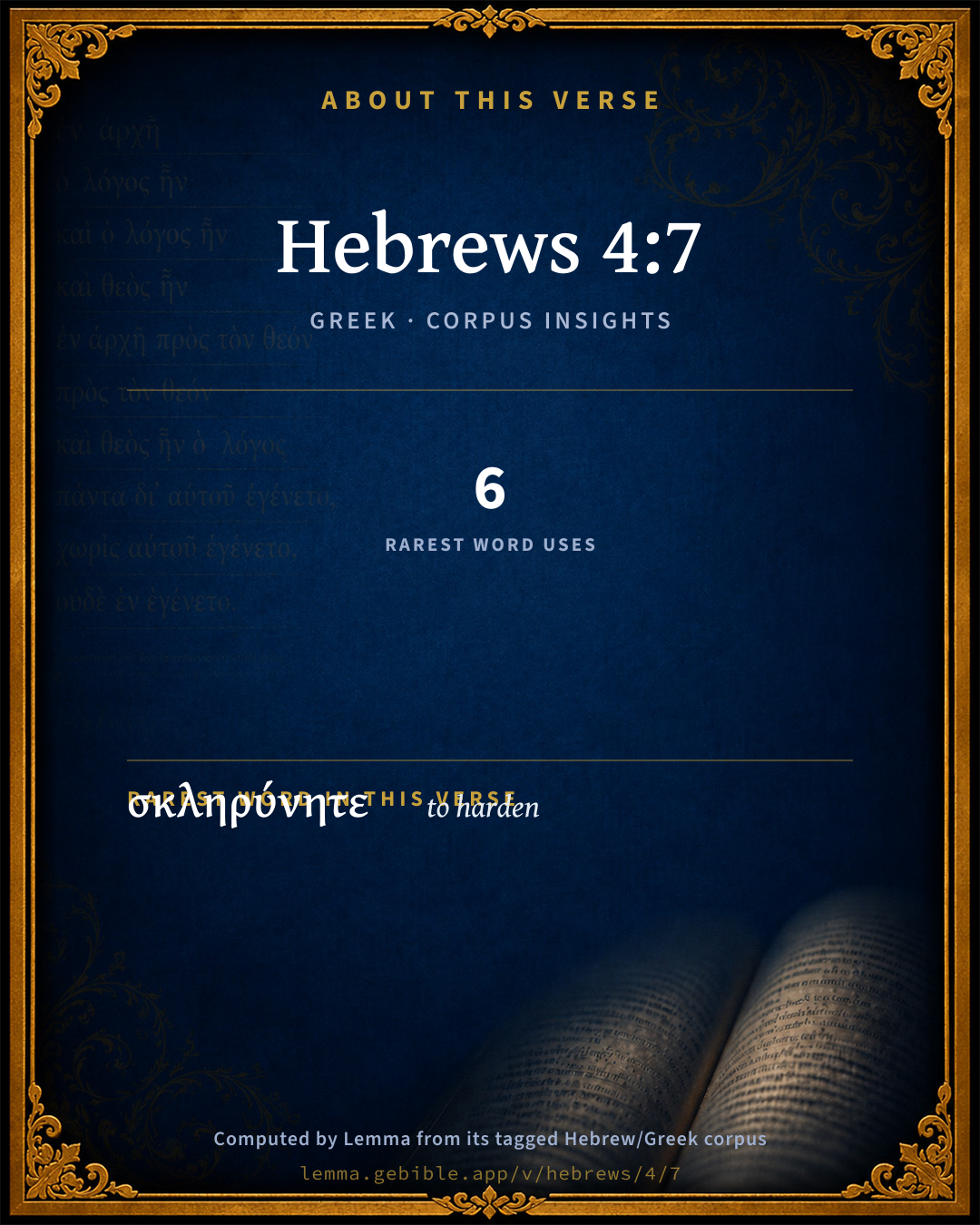
The rarest word here is σκληρύνητε to harden G4645 — appearing just 6 times in the whole Greek New Testament.

Shared distinctive vocabulary

σκληρύνητε to harden G4645 occurs in 6 verses of the Greek New Testament. Also found in:

Repetition

Words recur within this verse:

  • σήμερον this day G4594 ×2
  • τῆς the G3588 ×2

Cross-references

5

Topical passages linked to Hebrews 4:7 in the Treasury of Scripture Knowledge — connected by theme and wording, ordered by reader-vote popularity; previews shown in the World English Bible.

  • Psalms 95:7 For he is our God. We are the people of his pasture, And the sheep in his care. Today, oh that you would hear his voice!
  • Hebrews 3:7–8 Therefore, even as the Holy Spirit says, "Today if you will hear his voice,
  • Hebrews 3:15 while it is said, "Today if you will hear his voice, Don't harden your hearts, as in the rebellion."
  • 2 Samuel 23:1–2 Now these are the last words of David. David the son of Jesse says, The man who was raised on high says, The anointed of the God of Jacob, The sweet psalmist of Israel:
  • Matthew 22:43 He said to them, "How then does David in the Spirit call him Lord, saying,

Cross-references courtesy of OpenBible.info (CC BY 4.0).

Where the printed editions differ

1 variant

Places in this verse where the major printed Greek editions disagree on the wording in a way that affects the translation — a comparison of editions, not a manuscript-by-manuscript collation. The editions are the modern critical texts (Nestlé-Aland 28/27, SBL, Westcott-Hort, Tregelles, Tyndale House) and the traditional texts behind the KJV (the Textus Receptus and the Byzantine/Majority text). It is not a claim about which reading is original.

  1. Different wording
    προείρηται,

    “it has been predicted,”

    In NA28NA27TynSBLWHTreg Not in TRByz

    εἴρηται (eirētai) 'it has been said' occurs in traditional manuscripts (TR+Byz) instead of προείρηται, (proeirētai) 'it has been predicted,' in older manuscripts (NA28+NA27+Tyn+SBL+WH+Treg)

Textual data: Translators Amalgamated Greek New Testament (STEPBible TAGNT) · CC BY 4.0.

Commentary

Notes on Hebrews 4:7 from classic Christian and Jewish commentators (each source and its license shown beneath its notes). The classic Christian expositions comment on the surrounding passage and are grouped to its opening verse, so a note may address several verses; the Jewish commentaries on the Tanakh (Rashi and others) are per-verse, so they appear only where the commentator wrote on this verse.

Lemma curates 59 commentaries, every one of them public domain or Creative Commons licensed, each selected and text-cleaned for this edition rather than reprinted as found. About our sources →

The Biblical Illustrator

Joseph S. Exell

Heb_4:7

To-day

The present

Let us take that short division of time--to-day--the now--and consider what is the duty, the preciousness of each passing hour and day.

1. Let us notice that each day has its own gifts. A writer speaks of the hours passing by him like solemn virgins in long and silent procession. He sits in his garden and sees them pass. Their faces are veiled in their hands, they bear caskets full of various gifts, some trivial, some of inestimable value. Among these gifts are stores of brilliant diadems and fruits and faded flowers. He forgets his morning wishes, he lets the day pass by idly and neglectfully. At last, just as the evening is about to fall, he hastily snatches some of their slightest gifts, some harsh apple or withering rose, and as they turn and pass away in silence into the evening shadows, the veils slip from their faces, and he sees the look of scorn which their faces wear. Yes, every day has its gifts, but all good gifts are exactly what we make of them. Let us pray that God will teach us rightly to use His gifts of every day.

2. Each day has not only its own immediate gifts, but also its immediate opportunities. When the Roman emperor sadly lamented to his friends, I have lost a day, he meant that on that day be had not conferred a kindness upon any one. How often by selfishness and temper, by egotism, by vanity and want of thought, we miss those opportunities of helping others in little ways which the angels in heaven might envy us. We may see men and women on every side of us, not by any means only among the poor, but among our social equals, staggering along under heavy burdens, which it does not even occur to us to put out even so much as our fingers to help. A word spoken in due season, how good It is! When good John Newton saw a little child crying over the loss of a halfpenny, and by giving it another dried its tears, he felt that he had not spent a day in vain. But it is not only by our daily neglect of a thousand little kindness and courtesies of daily life that we so lightly regard as mere grains of coarse sand in the hour-glass--moments as precious as if they were grains of gold. We lose them in a thousand other ways--not only lose, but squander and fling them away, and, worse than all, pervert them into opportunities of unkindness. In the words of the man of business, Time for us is money. But that is the least thing it is--for time is eternity.

3. Again, every day has its own stores of pure and innocent happiness. To those who walk through the world with open eyes every day reveals something beautiful. We are self-tormentors only because we are selfish and egotistical and vain. Our taste is corrupted; there are few of us to whom God wholly denies the grassy field of contentment, the simple wild flowers of innocent gladness, the limpid spring of the river of the water of life. That was a true saying of the ancients, Carpe diem--pluck the blossom of to-day. Our best hopes, our richest treasures, our destiny on earth, yes, even our heaven itself, lie not in the visionary future, but in the here and in the now.

4. And again, every day has its duties. What a special gift of God is this! Riches may fly away, fame may vanish, friends may die, but duty never ceases. This saves our poor little lives from most of their perplexities. Are we happy? Let not our felicity make us falter in the performance of a single duty, for on these duties that happiness itself depends. Are we unhappy? Strenuously try not to grieve over the bitterness, for action is the surest of solaces. In every case we cannot do better than obey the brave old rule, Do the next thing. While we are doing our duty, it is always ours to say that we are doing the very thing for which God made us. One of the most charming of the Greek idylls tells us how two poor fishermen, weary and cold, before the earliest dawn, while the moon still rides high in the heavens, rise from their beds of dried seaweed in their miserable hut, and while the waves dash fiercely on the shore hard by, repair their nets by the dim and uncertain twilight; and while they repair them, one of the men tells the other the story of how on the evening before he had fallen asleep very hungry and weary, and had dreamed that he stood on the reck where he was used to fish, and had thrown his line and caught a huge fish. When, with straining rod and line, he drew it to land, he found the fish to be made of pure and solid gold. And in his dream he thereupon took a solemn oath that he would sell his prize, and get wealth, and never dip line in the waves again. And now his poor ignorant thoughts were troubled with his oath, and he doubted whether he should renew his fishing. Cheer up, says his old comrade, you may fish. You did not take the oath, for you see you have not caught the fish of gold. What are dreams? But if not in a dream, in broad waking if you toil and watch, some good may perhaps come to your vision. Look out for the real vision, lest you die of hunger with your golden dreams. Is not the moral of this Greek idyll to be found even in Scripture? When the apostles waiting through those great forty days after the resurrection, when the appearance of the risen Lord seemed for a time to be hopeless, conscious of the pressure of their want and waiting, when it lay heavily upon them, what was to be done? Thank God, there is always something to be done. Each day has its duty, and He who gave the day and the duty gives also the desire to fulfil it. But not only has each day its duty, but each day has its one supreme duty before which all others sink into insignificance--the duty of repentance if we are living lives of sin; the duty of getting nearer to God and seeing His face if by our Saviours mercy we have tasted that the Lord is gracious. Oh, if this duty be left neglected, no other duty can be a substitute for it. Everyday is but a single spoke in the swift wheel of the revolving week, and the weeks flash into the months, and the months into the years, and the years roll on into the world beyond the grave. How many days are there even in a long life? How very few may be left to us! If, then, as we have seen first, every day has its gifts which we often despise; and secondly, every day has opportunities which we often waste; and thirdly, every day has its sources of happiness which we often forget; and fourthly, every day has its duties which the best so imperfectly accomplish; and fifthly, every day has its one thing needful Which if left unaccomplished is utter ruin--ought we not to thank God that every day has also its gracious help. There is One of infinite help always at hand--God is our help and strength. He loves us, He will not forsake us. He who gave His own Son for our sins, shall He not with Him also freely give us all things? And is it not the Son who shall be our Judge? Is He not standing in heaven to make intercession for us at Gods right hand? Is not conscience His voice within us? Has He not given us His Holy Spirit? Is not duty which He makes so clear to us His eternal law? and though He is infinitely far above us, He has given us a ladder between heaven and earth, so that we may ascend heavenward in our supplications, and His answer will fall back in blessings. (Archdeacon Farrar.)

The immediate claims of religion

I. THE PROPOSAL. If ye will hear His voice.

1. By acknowledging His authority.

2. By considering His words.

3. By accepting the benefits which He offers.

4. By obeying His commands.

II. THE MEANS OF ACCEPTING IT. Harden not your heart. Beware of cruelty to your own souls. Beware of impenitence amidst the means and calls of religion.

III. THE PERIOD TO WHICH IT REFERS. To-day.

1. To-morrow you may be indisposed to listen to the voice of God.

2. To-morrow you may be incapable of hearing His voice.

IV. THE END TO BE SECURED BY ACCEPTING IT. This the connection leads us to consider as Rest. The heavenly rest.

1. Rest from sin.

2. Rest from sorrow. (Essex Congregational Remembrancer.)

Today

We have two brief clauses to dwell upon: If ye will hear His voice; Harden not your hearts.

1. The word will is not in the original. The apostle is not speaking at present of a willingness on the part of man, but of a grace on the part of God. The exercise of the human will does not come into view till the next clause. This says merely, If ye hear, or shall hear, Gods voice speaking. It is the recognition of the Divine freedom to speak or not to speak. If ye should hear God speaking, listen. It is conceivable that God may not speak. We may have wearied Him out by our inattention. He may say, My Spirit shall no longer strive. If ye should hear His voice. This awakens thought, quickens interest, arouses anxiety. What if I should have silenced that voice? Often have I heard without hearing. Often has the voice pleaded, entreated, besought, and there was nothing in me that regarded. Neither hope nor fear, neither love nor dread, neither interest, nor apprehension, no, nor curiosity. If ye hear says, which haply ye may not.

2. Harden not your hearts. The figure is taken from that process of drying and stiffening which is fatal to the free play of a limb or the further growth of a vegetable. The heart, in Scripture phrase, is that life-centre, that innermost being, out of which are the issues of thought and action, and upon the condition of which depend alike the decisions of the will and the habits of the living and moving man. When the heart is hardened, there is an end of all those influences of grace which till then can touch and stir, control and guide, inspire the quickening motive and apply the heavenward impulse. Sometimes this hardening is ascribed in Scripture to the operation of God. That is when the voice ceases to speak, and the will to disobey has become at last an incapacity to obey. But this we say, Never does the hardening b-gin on Gods side; and never does the Divine hardening preclude the human softening. Whosoever will--that is the condition: and without the willing salvation cannot be even if it would. These are deep as well as sorrowful mysteries. The text of this day lets them alone. It addresses itself to the will, which is the man, and says, Harden not your heart. If you will not harden it, certainly God will not. Why will ye die, when He hath no pleasure in it? If you hear, any one of you, the voice speaking--hear it say, This is not your rest; hear it say, I am Thy salvation--come unto Me--abide in Me--I will refresh--in Me ye shall have peace--harden not your heart. If the deceitfulness of sin should say within any of you, The voice can wait--let it plead outside you till you have taken your fill of that which it cannot tolerate and cannot dwell with--then, when age comes, or sickness, or sorrow, or some shadow cast before of death or eternity, then hearken, then obey--harden not your heart.

3. To-day, if ye shall hear His voice. The Epistle returns again and again to that word. What is To-day. It is the opposite of two times and two eternities. It is the opposite of yesterday and to-morrow in time; it is the opposite of an immeasurable past, an inconceivable future, in the eternity which God inhabits. To-day is at once the dividing line and the meeting point of the two--the barrier between the two finites, and the link between the two infinites. To-day. What a word of reproof and of admonition--of thanksgiving and of hope--of opportunity and of blessing. Is not each To-day the very epitome and abstract of a life? It has its morning and its evening; it has its waking and its falling on sleep; it has its typical birth and death; it has its hours marked out and counted; it has its duties assigned and distributed; it has its alternations of light and shade; it has its worship and its service, its going forth to labour and its coming back to reckon. Within these twelve or these sixteen hours a life may be lived, a soul lost or won. (Dean Vaughan.)

Opportunity to be seized

Opportunity is the flower of time, and as the stalk may remain when the flower is cut off, so time may remain with us when opportunity is gone. (J. Bond.)

To-day

How much the Bible has to say about to-day--time present! This is really all we can call our own. It says very little about yesterday or tomorrow. Yesterday is like a closed book; its record is finished. As the mill cannot grind with the water that is past, so our work cannot be done with the strength and opportunities of yesterday. Of to-morrow we may repeat the old and significant saying, It may never come!

Opportunity

Opportunity has hair in front; behind she is bald. If you seize her by the forelock, you may hold her; but if suffered to escape, not Jupiter himself can catch her again.

Harden not your hearts

Hardening the heart

I. THE MEANING OF THE WORD HEART, AS HERE USED. Parents sometimes have the mortification of seeing their own children become stubborn against parental authority, and of seeing their requirements resisted and their counsels set at nought. Parents often see children, when they undertake to press them to do anything, instead of obeying, wax stubborn and rebellious. They stand and resist, and manifest a cool determination to persevere in their disobedience; and, so far as the philosophy of the act is concerned, resistance to God is just the same. The mind resisting truth is hardening the heart, in the sense of the text.

II. HOW IS IT THAT SINNERS DO HARDEN THEIR HEARTS?

1. This leads me to say that persons are very much in danger of hardening themselves, by holding fast to some erroneous opinion or improper practice to which they are committed. All their prejudices are in favour of it, and they are very jealous lest anything should disturb it. What danger such persons are in of assigning to themselves, as a reason for resisting the truth, that it clashes with some of their favourite notions! When they see its practical results contradict some pet theory of theirs, they will strengthen themselves against it. I recollect an instance of this kind. One evening, in the city of New York, I found among the inquirers a very anxious lady, who was exceedingly convicted of her sins, and pressed her strongly to submit to God. Ah! she said, if I were sure I am in the right Church, I would. The right Church! said I; I care not what Church you are in, if you will only submit yourself to Christ. But, she replied, I am not in the Catholic Church, I am not in the right Church; if I were, I would yield. So that her anxiety about the right Church prevented her yielding at all, and she continued to harden her heart against Christ.

2. Others harden themselves by indulging in a spirit of procrastination. I will follow Thee, is their language, but not now.

3. I remark, again, that many persons strengthen themselves and harden their hearts by refusing, wherever they can refuse, to be convicted of their sins. They have a multitude of ways of avoiding the point, and force away the truth, and hardening themselves against it. Take care, for instance, of the practice of excusing sin.

4. But, again: Another way in which men harden themselves is that they are unwilling to come and do what is implied in becoming Christians. But a short time since, I was pressing an individual to yield up certain forms of sin of which I knew him to be guilty. Ah, said he, if I begin to yield this and that, where will it all end? I must be consistent, said he, and where shall I stop? Where should he stop? It was clear that the cost was too great, and that he was therefore disposed to harden himself and resist Gods claims, because he considered God required too much. This is a very common practice. If you ask persons in a general way, they are willing to be Christians; but what will be expected of them? Ah! that is quite a different thing! Now you have set them to count the cost, and they find it will involve too great a sacrifice. They are wholly unwilling to renounce themselves and their idols; and accordingly they betake themselves to hardening their hearts, and strengthening themselves in unbelief. I will cite the case just referred to for a moment. The conversation respected at that time a particular form of sin. Now, why did he not yield at once? He saw that the principle on which he yielded this point would compel him to give up others; and therefore he said, If I begin this, where shall I stop? He gathered up all the reasons he could, and strengthened himself in his position. Thus he was hardening his heart; this was just what the Jews did when Christ preached.

III. WHY MEN SHOULD NOT HARDEN THEIR HEARTS IN THIS WAY.

1. Perhaps the first thing that I shall notice will startle some of you. It is this: you should not harden your hearts, because, if you do not do so, you will be converted. God has so constituted the mind that, as everybody knows, truth is a most powerful stimulant, which invites and draws the mind in a given direction. Truth induces it to act in conformity with its dictates. Now, to do this, to obey the truth, that is conversion. If you do not obey it, it is because you harden yourself against it; for it is an utter impossibility to be indifferent to the presentation of truth, and especially is it utterly impossible to maintain a blank indifference to the presentation of the great practical truths of Christianity.

2. Another reason why you should not harden your hearts is that you will not be converted if you do. In other words, if you resist the Spirit, God never forces you against your will. If He cannot persuade you to embrace the truth, He cannot save you by a physical act of omnipotence, as, for instance, He could create a world. You are a free moral agent, and He can save you only in His own way. In other words, if He cannot gain your own consent to be saved in His own any, He cannot possibly save you at all.

3. Another reason why you should not harden your hearts is that you may be given up! God may give you up to the hardness of your hearts. The Bible shows that this is not uncommon. Whole generations of the Jews were thus given up. Some think there is not so much danger of this now; but the fact is there is more, because there is more light. He gives them up because they resist the light of the truth with regard to His claims.

IV. WHOSE VOICE IS HERE REFERRED TO? IS it the voice of a tyrant, who comes out with his omnipotent arm to crush you? If you will hear His voice, harden not your hearts. Whose voice is it? In the first place, it is the voice of God; but, more than this, it is the voice of your Father I But is it the voice of your Father, with the rod of correction, pursuing you, to subdue you by force? Oh, no! it is the voice of His mercy--of His deepest compassion. A few further remarks must close what I have to say; and the first remark is this: persons often mistake the true nature of hardness of heart. Supposing it to be involuntary, they lament it as a misfortune, rather than regret it as a crime. They suppose that the state of apathy which results from the resistance of their will is hardness of heart. It is true that the mind apologises to itself for resistance to the claims of God, and, as a natural consequence, there is very little feeling in the mind, because it is under the necessity of making such a use of its powers as to cause great destitution of feeling. This is hardening the heart--that act of the mind in resisting the claims of God. For persons to excuse themselves by complaining that their hearts are hard is only to add insult to injury. I remark, once more, it is worthy of notice that the claims, commands, promises, and invitations of God are all in the present tense. Turn to the Bible, and from end to end you will find it is, To-day if ye will hear His voice. Now is the accepted time. God says nothing of tomorrow; lie does not even guarantee that we shall live till then. Again: the plea of inability is one of the most paltry, abusive, and blasphemous of all. What! Are men not able to refrain from hardening themselves? I have already said, and you all know, that it is the nature of truth to influence the mind when it receives it; and, when the Spirit does convert a man, it is by so presenting the truth as to gain his consent. Now, if there was not something in the truth itself adapted to influence the mind, He might continue to present the truth for ever, without your ever being converted. It is because there is an adaptedness in truth--something in the very nature of it which tends to influence the mind of man. Now, when persons complain of their inability to embrace the truth, what an infinite mistake! God approaches with offers of mercy, and with the cup of salvation in His hand, saying, Sinner! I am coming! Beware not to harden yourself. Do not cavil. Do not hide behind professors of religion. Do not procrastinate! for I am coming to win you. Now, what does the sinner do? Why, he falls to hardening his heart, procrastinating, making all manner of excuses, and pleading his inability. Inability! What! Is not a man able to refrain from surrounding himself with considerations which make him stubborn? Once more: I said this is a most abusive way of treating God. Why, just think. Here is God endeavouring to gain the sinners consent--to what? Not to be sent to hell. Oh, no! lie is not trying to persuade you to do anything, or to consent to anything, that will injure you. Oh, no! He is not trying to persuade you to give up anything that is really good rather relinquishment of which will make you wretched or unhappy--to give up all joy and everything that is pleasant--to give up things that tend to peace--He is not endeavouring to persuade you to do any such thing as this. With regard to all such things, He is not only willing that you should have them, but would bring you into a state in which you could really enjoy them. (C. G. Finney.)

The Biblical Illustrator, edited by Joseph S. Exell (c. 1880s–1900s) — public domain. Text from a community e-Sword module.

Tyndale Open Study Notes

Tyndale Open Resources

4:7 So God set another time . . . and that time is today: The logic here is that David wrote Ps 95 much later than the wilderness debacle, so God’s rest cannot be limited to that earlier generation. The words already quoted are from Ps 95:7-8; these words encourage us not to harden our hearts when hearing God’s voice so that we might enter the rest that the people in the wilderness were denied. This opportunity is available today (see Heb 3:13).

Tyndale Open Study Notes — © Tyndale Open Resources, licensed CC BY-SA 4.0. Text via the HelloAO Bible API.

Bengel's Gnomon

Johann Albrecht Bengel

Heb 4:7. Πάλιν, again) Who would have thought that there is a sermon so important and so solemn in the 95th Psalm? Let us highly value the words of GOD; comp. ch. Heb 10:8, note.—ὁρίζει, He limits) viz. GOD.—ἡμέραν, a day) This is deduced from the quotation, σήμερον, to-day, which is presently brought forward. See how beautifully he lays stress on the word, יום, a day, and single words in the same manner often, ch. Heb 2:8; Heb 2:11-12, Heb 7:11; Heb 7:21, Heb 8:13, Heb 10:9, Heb 12:5; Heb 12:27: the day, viz. that of striving for the heavenly rest: Heb 4:8.—ἐν, in) So ch. Heb 1:1.—τοσοῦτον χρόνον) so long a time, more than four hundred years from Moses and Joshua to David, who sung this psalm.—καθὼς προείρηται, as it was before said) The apostle refers his hearers to the whole text, as repeated above from the psalm.

Bengel's Gnomon of the New Testament — English translation (T&T Clark, Edinburgh, 1860) — public domain. Text from a community e-Sword module.

Meyer's Critical & Exegetical Commentary

Heinrich August Wilhelm Meyer

Heb_4:7. The apodosis. We have not to construe in such wise that the first σήμερον shall be taken as apposition to ἡμέραν: He marks out, therefore, again a definite day (fixes anew a term), namely, a to-day, in thatas was before observed

He says in David, so long time after, To-day, etc. (Calvin, Beza, Grotius, Jac. Cappellus, Carpzov, Schulz, Klee, Bleek, de Wette, Bisping, Maier, MCaul, Moll). Nor yet so that the first σήμερον is connected with λέγων: He fixes, therefore, again a day, in that, after so long a time, He says in David to-day; even as it says: To-day, if ye, etc (Zeger, Schlichting, Heinrichs, Stengel). On the contrary, the first σήμερον already begins the citation; is then, however,on account of the words parenthetically introduced by the author: ἐν Δαυῒδ … προείρηται,resumed in the second σήμερον.

ἐν Δαυΐδ] not: apud Davidem, i.e. in the Book of Psalms (Dindorf, Schulz, Böhme, Bleek, Ebrard, Alford, Woerner, al.; with comparison of Rom_11:2; Rom_9:25), but: in the person of David, as the instrument of which God made use for speaking. The ninety-fifth psalm, although not Davidic, was ascribed to David in the superscription of the LXX., whom our author follows.

μετὰ τοσοῦτον χρόνον] from the time of Joshua (Heb_4:8).

καθὼς προείρηται] Reference to Heb_3:7 f., 15.

Meyer — Critical and Exegetical Commentary on the New Testament — English translation by Peter Christie, edited by Frederick Crombie (T&T Clark, 1880) — public domain. Text from a community e-Sword module.

Jamieson, Fausset & Brown

Robert Jamieson, A. R. Fausset & David Brown

Again--Anew the promise recurs. Translate as the Greek order is, "He limited a certain day, 'To-day.'" Here Paul interrupts the quotation by, "In (the Psalm of) David saying after so long a time (after five hundred years' possession of Canaan)," and resumes it by, "as it has been said before (so the Greek oldest manuscript, before, namely, Heb 3:7, Heb 3:15), To-day if ye hear His voice," &c. [ALFORD].

Jamieson, Fausset & Brown — Commentary Critical and Explanatory on the Whole Bible (1871) — public domain (CC PDM 1.0). Text via the HelloAO Bible API.

Adam Clarke's Commentary

Verse 7. He limiteth a certain day] The term day signifies not only time in general, but also present time, and a particular space. Day here seems to have the same meaning as rest in some other parts of this verse. The day or time of rest relative to the ancient Jews being over and past, and a long time having elapsed between God's displeasure shown to the disobedient Jews in the wilderness and the days of David, and the true rest not having been enjoyed, God in his mercy has instituted another day-has given another dispensation of mercy and goodness by Christ Jesus; and now it may be said, as formerly, To-day, if ye will hear his voice, harden not your hearts. God speaks now as he spoke before; his voice is in the Gospel as it was in the law. Believe, love, obey, and ye shall enter into this rest.

Adam Clarke's Commentary on the Bible (1810–1826) — public domain. Text from a community e-Sword/MySword module.

John Calvin's Commentaries

7. But there is some more difficulty in what he immediately subjoins, that there is another today appointed for us in the Psalm, because the former people had been excluded; but the words of David (as it may be said) seem to express no such thing, and mean only this, that God punished the unbelief of the people by refusing to them the possession of the land. To this I answer, that the inference is correct, that to us is offered what was denied to them; for the Holy Spirit reminds and warns us, that we may not do the same thing so as to incur the same punishment. For how does the matter stand? Were nothing at this day promised, how could this warning be suitable, “Take heed lest the same thing happen to you as to the fathers.” Rightly then does the Apostle say, that as the fathers’ unbelief deprived them of the promised possession, the promise is renewed to their children, so that they may possess what had been neglected by their fathers.

John Calvin's Commentaries (1540-1563) — public domain. Text from the Calvin Translation Society English edition (1840s-50s) via the Christian Classics Ethereal Library (ccel.org). Calvin's coverage is partial (roughly two-thirds of the Bible); uncommented books and verses are honest gaps, never fabricated. The 19th-century editor's footnotes and remarks are omitted so the notes are faithfully Calvin's own voice.

Ellicott's Commentary for English Readers

(7) Again, he limiteth.—Better, He again marketh out (or, defineth). The next step taken (see the last Note) is to point out that, long after the occupation of Canaan, the Psalmist—God speaking in the Psalm—says “To-day,” in pleading with Israel. The implied meaning is as if He said, “Harden not your hearts today, lest I swear unto you also, Ye shall not enter into My rest.”

In David.—Probably this is equivalent to saying, In the Book of Psalms. In the LXX., however, Psalms 95 is ascribed to David.

After so long a time.—The period intervening between the divine sentence on the rebels in the wilderness (Numbers 14) and the time of the Psalmist.

As it is said.—The best MSS. read, as it hath been before said.

A Bible Commentary for English Readers, edited by Charles John Ellicott (1878–1897) — public domain. Text from a community e-Sword module.

The Cambridge Bible for Schools and Colleges

gen. ed. J. J. S. Perowne

7. again he limiteth a certain day …] There is no reason whatever for the parenthesis in the A. V., of which the reading, rendering, and punctuation are here alike infelicitous to an extent which destroys for ordinary readers the meaning of the passage. It should be rendered (putting only a comma at the end of Heb_4:6), “Again, he fixes a day, To-day, saying in David, so long afterwards, even as has been said before, To-day if ye will hear,” &c. In the stress laid upon the word “to-day” we find a resemblance to Philo, who defines “to-day” as “the infinite and interminable aeon,” and says “Till to-day, that is for ever” (Leg. Allegg. iii. 8; De Profug. 11). The argument is that “David” (a general name for the “Psalmist”) had, nearly five centuries after the time of Moses, and three millenniums after the Creation, still spoken of God’s rest as an offer open to mankind. If we regard this as a mere verbal argument, turning on the attribution of deep mystic senses to the words “rest” and “to-day,” and on the trains of inference which are made to depend on these words, we must remember that such a method of dealing with Scripture phraseology was at this period universally current among the Jews. But if we stop at this point all sorts of difficulties arise; for if the “rest” referred to in Psalms 95 was primarily the land of Canaan (as in Deu_1:34-36; Deu_12:9, &c.), the oath of God, “they shall not enter into my rest” only applied to the generation of the wandering, and He had said “Your little ones … them will I bring in, and they shall know the land which ye have despised,” Num_14:31. If, on the other hand, “the rest” meant heaven, it would be against all Scripture analogy to assume that all the Israelites who died in the wilderness were excluded from future happiness. And there are many other difficulties which will at once suggest themselves. The better and simpler way of looking at this, and similar trains of reasoning, is to regard them as particular modes of expressing blessed and eternal truths, and to look on the Scripture language applied to them in the light rather of illustration than of Scriptural proof. Quite apart from this Alexandrian method of finding recondite and mystic senses in the history and language of the Bible, we see the deep and glorious truths that God’s offer of “Rest” in the highest sense—of participation in His own rest—is left open to His people in the eternal today of merciful opportunity. The Scripture illustration must be regarded as quite subordinate to the essential truth, and not the essential truth made to depend on the Scripture phraseology. When God says “They shall not enter my rest,” the writer—reading as it were between the lines with the eyes of Christian enlightenment—reads the promise “but others shall enter into my rest,” which was most true.

saying in David] A common abbreviated form of quotation like “saying in Elijah” for “in the part of Scripture about Elijah” (Rom_9:2). The quotation may mean no more than “in the Book of Psalms.” The 95th Psalm is indeed attributed to David in the LXX; but the superscriptions of the LXX, like those of our A. V., are wholly without authority, and are in some instances entirely erroneous. The date of the Psalm is more probably the close of the Exile. We may here notice the fondness of the writer for the Psalms, of which he quotes no less than eleven in this Epistle (Psalms 2, 8, 22, 40, 45, 95, 102, 104, 105, 118, 135).

The Cambridge Bible for Schools and Colleges (gen. ed. J. J. S. Perowne; Cambridge University Press, 1878–1918) — public domain. Text from a community e-Sword module.

John Gill's Exposition

Again he limiteth a certain day,.... Since the seventh day of the creation was a day of rest which God entered into, and not man; and since the land of Canaan was a typical rest, which the unbelieving Israelites did not enter into, because of unbelief; and yet there must be persons, and there must be a time for them to enter into the true rest which God has left a promise of; therefore he has limited, fixed, and appointed a certain day, the Gospel dispensation, for believers to enter into it:

saying in David; or by David, who was the penman of the 95th psalm, as may be learned from hence; and this is agreeably to, and confirms a rule which the Jews give, that those psalms which are without a title were written by David (g); the Spirit of God spake in him and by him, and plainly pointed out another day of rest from the above mentioned:

today, after so long a time; as two thousand five hundred years from the first seventh day to the time of Moses, and five hundred years from the times of Moses and Joshua, to his:

as it is said; the Alexandrian copy reads, "as it is before said", or, "above said", as the Vulgate Latin, and Syriac versions; that is, in Psa 95:7 before cited, Heb 3:7

today if you will hear his voice, harden not your hearts; See Gill on Heb 3:7, Heb 3:8.

(g) Aben Ezra & Kimchi Praefat. in Tillim.

John Gill's Exposition of the Whole Bible (1746–1763) — public domain (CC PDM 1.0). Text via the HelloAO Bible API.

Trapp's Complete Commentary

John Trapp

7 Again, he limiteth a certain day, saying in David, To day, after so long a time; as it is said, To day if ye will hear his voice, harden not your hearts.

Ver. 7. After so long a time] Four hundred years almost passed between Joshua’s and David’s days. David’s today was not Joshua’s today.

Today if ye will hear] That day of salvation, wherein the Lord doth offer us mercy in the ministry of his word, showing us our misery, and exciting us to use the remedy.

John Trapp, A Commentary or Exposition upon All the Books of the Old and New Testament (1647–1656) — public domain. Text from a community e-Sword module.

Albert Barnes' Notes on the Bible

Again, he limiteth - He designates, or definitely mentions. The word rendered “limiteth” - ὁρίζει horizei - means to “bound,” to set a boundary - as of a field or farm; and then to determine or fix definitely, to designate, appoint. Here it means, that he specifies particularly, or mentions expressly.

A certain day - A particular time; he mentions today particularly. That is, in the time of David, he uses the word “today,” as if time was “then” an offer of rest, and as if it were then possible to enter into it. The object of the additional thought was to show that the offer of rest was not confined to the Israelites to whom it was first made; that David regarded it as existing in his day; and that man might even then be invited to come and partake of the rest that was promised. “Nearly five hundred years after the time when the Israelites were going to the promised land, and when the offer of rest was made to them, we hear David speaking of “rest” still; rest which Was offered in his time, and which might then be lost by hardening the heart. It could not be, therefore, that the offer of rest pertained merely to the promised land. It must be something in advance of that. It must be something existing in the time of David. It must be an offer of heaven.” A Jew might feel the force of this argument more than we do; still it is conclusive to prove the point under consideration, that there was a rest spoken of long after the offer of the promised land, and that all the promises could not have pertained to that.

Saying in David - In a Psalm composed by David, or rather perhaps, saying “by” David; that is, God spake by him.

Today - Now - that is, even in the time of David.

After so long a time - That is, so long after the first promise was made; to wit, about 500 years. These are the words of Paul calling attention to the fact that so long a time after the entrance into the promised land there was still a speaking of “today,” as if even then they were called to partake of the rest.

As it is said - To quote it exactly; or to bring the express authority of the Scriptures. It is expressly said even after that long time, “today - or now, if you will hear his voice.” All this is to prove that even in that time there was an offer of rest.

Albert Barnes' Notes on the Bible (1834–1885) — public domain. Text from a community e-Sword/MySword module.

Matthew Poole's English Annotations

Again, he limiteth a certain day, saying in David: this is a further proof, that David did not mean or intend the rest of the Jews in Canaan, in the Psa 95:1-11, from the determined time of it; as if the Spirit had said: Besides what I have proved, take another argument; Again I argue. God by the prophet setteth out, and severeth from all other time, a certain stated day, from which the rest spoken of is cleared, and of it testifieth by him, Psa 95:7,8.

To-day, after so long a time; after four hundred years past of Israel’s rest in Canaan, which was a long time, doth David say of to-day, a time present, then and further to be extended, even the gospel day, in David’s time, and after it; not in Joshua’s, for that was past long before.

As it is said, To-day if ye will hear his voice, harden not your hearts; ye ought to-day to hear, receive, and believe the gospel of God’s rest, and not by unbelief to turn your hearts from the voice of God in the gospel.

Matthew Poole's English Annotations on the Holy Bible (1683–1685) — public domain. Text from a community e-Sword/MySword module.

Whedon's Commentary on the Bible

Daniel D. Whedon

7. He—God by the psalmist.

Limiteth—Defines, specifies, a certain day.

In David—Delitzsch explains this as by David. For David does not here stand for the book of Psalms, but as name of the author of this ninety-fifth Psalm.

To day—In our, David’s, day. After so long a time as has elapsed since Israel’s second generation entered Canaan, namely, a time of five hundred years. And even at this day there still remains a rest to those who hear his voice, but forfeited by those who harden their hearts.

Daniel D. Whedon (gen. ed.), Commentary on the Old and New Testaments (1874–1909) — public domain. Text from a community e-Sword module.

John Wesley's Explanatory Notes

After so long a time - It was above four hundred years from the time of Moses and Joshua to David. As it was said before - St. Paul here refers to the text he had just cited.

John Wesley, Explanatory Notes Upon the Whole Bible (1754–1765) — public domain. Text via the GEBible commentary corpus.

The People's New Testament

B. W. Johnson

7. Again he limiteth a certain day. The thought is that there is a day of opportunity. If that day is passed by, the opportunity is gone. The word of the Lord is, To-day if, etc.

B. W. Johnson's The People's New Testament with Notes (1889–1891) — public domain. Electronic text from the Christian Classics Ethereal Library (CCEL) ThML edition.

Cambridge Greek Testament for Schools and Colleges

7. πάλιν τινὰ ὁρίζει ἡμέραν. There is no reason whatever for the parenthesis in the A. V., of which the reading, rendering, and punctuation are here alike infelicitous to an extent which destroys for ordinary readers the meaning of the passage. It should be rendered (putting only a comma at the end of Heb 4:6), “Again, he fixes a day, To-day, saying in David, so long afterwards, even as has been said before, To-day if ye will hear,” &c. In the stress laid upon the word “to-day” we find a resemblance to Philo, who defines “to-day” as “the infinite and interminable aeon,” and says “Till to-day, that is for ever” (Leg. Allegg. III. 8; De Profug. 11). The argument is that “David” (a general name for “the Psalmist”) had, nearly five centuries after the time of Moses, and three millenniums after the Creation, still spoken of God’s rest as an offer open to mankind. If we regard this as a mere verbal argument, turning on the attribution of deep mystic senses to the words “rest” and “to-day,” and on the trains of inference which are made to depend on these words, we must remember that such a method of dealing with Scripture phraseology was at this period universally current among the Jews. But if we stop at this point all sorts of difficulties arise; for if the “rest” referred to in Psalms 95 was primarily the land of Canaan (as in Deu 1:34-36; Deu 12:9, &c.), the oath of God, “they shall not enter into my rest,” only applied to the generation of the wanderings, and He had said “Your little ones … them will I bring in, and they shall know the land which ye have despised,” Num 14:31. If, on the other hand, the “rest” meant heaven, it would be against all Scripture analogy to assume that all the Israelites who died in the wilderness were excluded from future happiness. And there are many other difficulties which will at once suggest themselves. The better and simpler way of looking at this, and similar trains of reasoning, is to regard them as particular modes of expressing blessed and eternal truths, and to look on the Scripture language applied to them in the light rather of illustration than of Scriptural proof. Quite apart from this Alexandrian method of finding recondite and mystic senses in the history and language of the Bible, we see the deep and glorious truth that God’s offer of “Rest” in the highest sense—of participation in His own rest—is left open to His people in the eternal to-day of merciful opportunity. The Scripture illustration must be regarded as quite subordinate to the essential truth, and not the essential truth made to depend on the Scripture phraseology. When God says “They shall not enter my rest,” the writer—reading as it were between the lines with the eyes of Christian enlightenment—reads the promise “but others shall enter into my rest,” which was most true.

ἐν Δαυεὶδ λέγων. A common abbreviated form of quotation like “saying in Elijah” for “in the part of Scripture about Elijah” (Rom 11:2). The quotation may mean no more than “in the Book of Psalms.” The 95th Psalm is indeed attributed to David in the LXX.; but the superscriptions of the LXX., as well as those of the Hebrew text, are wholly without authority, and are in some instances entirely erroneous. The date of the Psalm is more probably the close of the Exile. We may here notice the fondness of the writer for the Psalms, of which he quotes no less than eleven in this Epistle (Psalms 2, 8, 22, 40, 45, 95, 102, 104, 110, 118, 135.).

Cambridge Greek Testament for Schools and Colleges (Cambridge University Press, 1896; 21 vols, various authors incl. Carr, Maclear, Plummer, Farrar, Lumby, Moule, M. R. James, Simcox) — public domain. Text from a community e-Sword module.

Vincent's Word Studies in the New Testament

Marvin R. Vincent

Again he limiteth a certain day (palin tina oJrizei hJmeran). For limiteth rend. defineth. For the verb see on declared, Rom 1:4. The meaning is, he gives another opportunity of securing the rest, and calls the period in which the opportunity is offered today.

In David. The date of the composition of Psalm 95 is uncertain. In LXX (94) it is called a Psalm of David. In the words in David the writer may adopt the LXX title, or may mean simply in the Psalms. In the Hebrew the Psalm has no inscription.

After so long a time [μετα τοσουτον χρονον] . The time between Joshua and David. After this long interval he renews the promise in the Psalm.

As it is said [καθως προειρηται] . Rend. as it hath been befor e said; referring to the citations, ch. 3 7, 8, 15.

Marvin R. Vincent, Word Studies in the New Testament (1887–1900) — public domain. Text from a community e-Sword/MySword module.

Westcott on Hebrews & the Epistles of John

Brooke Foss Westcott

7. ὁρίζει) Ο. L. prafinivit... Vulg. terminat... The Holy Spirit through tho writer of the Psalm (c. iii. 7) deJineth a certain day, ‘Today, saying... It seems more natural to take ‘Today’ as the explanation of ‘a certain day,’ than to connect it with ‘saying’ as part of tho quotation.

ἐν Δ. λέγων] saying in the person of David, who was regarded as the author of the whole Psalter; and not ‘in the book of David’ (the phrases ἐν Ἠλίᾳ Rom. xi. 2, ἐν τῷ ‘Qaond Rom. ix. 25, are not exactly parallel). The expression, which follows the comnion mode of speaking, is not to be regarded by itself as decisive of the authorship of the Psalm.

προείρηται] c. iii. 7, 15.

8—1o. The words of the Psalmist convey also another lesson. In one sense it might be said that in the second generation those who were rescued from Egypt did enter into the rest which was refused to their fathers. But Canaan was not the rest of God. The rest of God is a Sabbath rest which man also is destined to sharo, a rest after finished labour. Thorofore tho Psalmist, in tho troubled rest of Canaan, still points his hearers to an end unattained.

* For Uf Joshua had given them rest, He would not have spoken after this of another day. » There remainoth then a sabbath rest for the people of God. * For he that te entered into His rest hath himself also rested Srom his works as God did from His oten.

Brooke Foss Westcott (1825–1901), The Epistle to the Hebrews (1889) and The Epistles of St John (1883) — public domain (pre-1929). Text recovered from Internet Archive / Google Books OCR scans. Westcott’s Gospel of John commentary is not included (its OCR lost the chapter running-heads required for reliable verse-keying). Some Greek quoted in the Hebrews volume is imperfectly rendered by the OCR.

Lesson kit

Teaching starters — assembled from the data on this page, not authored interpretation. Every prompt links to the verse data it draws on. Edit before teaching.

Hebrews, in the General Epistles, opens this verse with 24 words (22 distinct Greek lemmas). Its most distinctive word is sklērýnō (“to harden”). A historical commentator’s framing appears above. Read the whole chapter for the surrounding context.

Discussion questions

  1. The word sklērýnō carries the sense “to harden.” How does it shape the verse?
  2. How does Acts 19:9, which shares the word «to harden», read alongside this verse?
  3. What does the repetition of “this day” (2× in this one verse) do in this verse?
  4. These translations render this verse differently; the difference is in the English rendering, not the original. What questions does that raise?
  5. Compare how The Biblical Illustrator and Tyndale Open Study Notes read this verse. Where do they agree or differ?

Things to notice

  • These translations choose different wording for 20 words in this verse.
  • “this day” occurs 2× in this single verse.
  • 22 distinct Greek lemmas span 24 words in this verse.

Reading settings

Reading text

Shown beneath each verse's original-language words.

Old Testament
Old Testament edition

Read the OT as the Masoretic Hebrew (MT) or the Greek Septuagint (LXX).

English shown for the Greek Septuagint (in the Hebrew ↔ Greek comparison).

Comparing translations? Open the Compare panel on any verse page to stack up to four side by side.