

Acts 26:3
Greek (Tischendorf 8th ed.) Acts 26:3 appears in the Greek New Testament. The text above is from the Tischendorf 8th edition. Each word links to its Strong’s number and a concise gloss. Click any word for its full Thayer’s Greek Lexicon entry.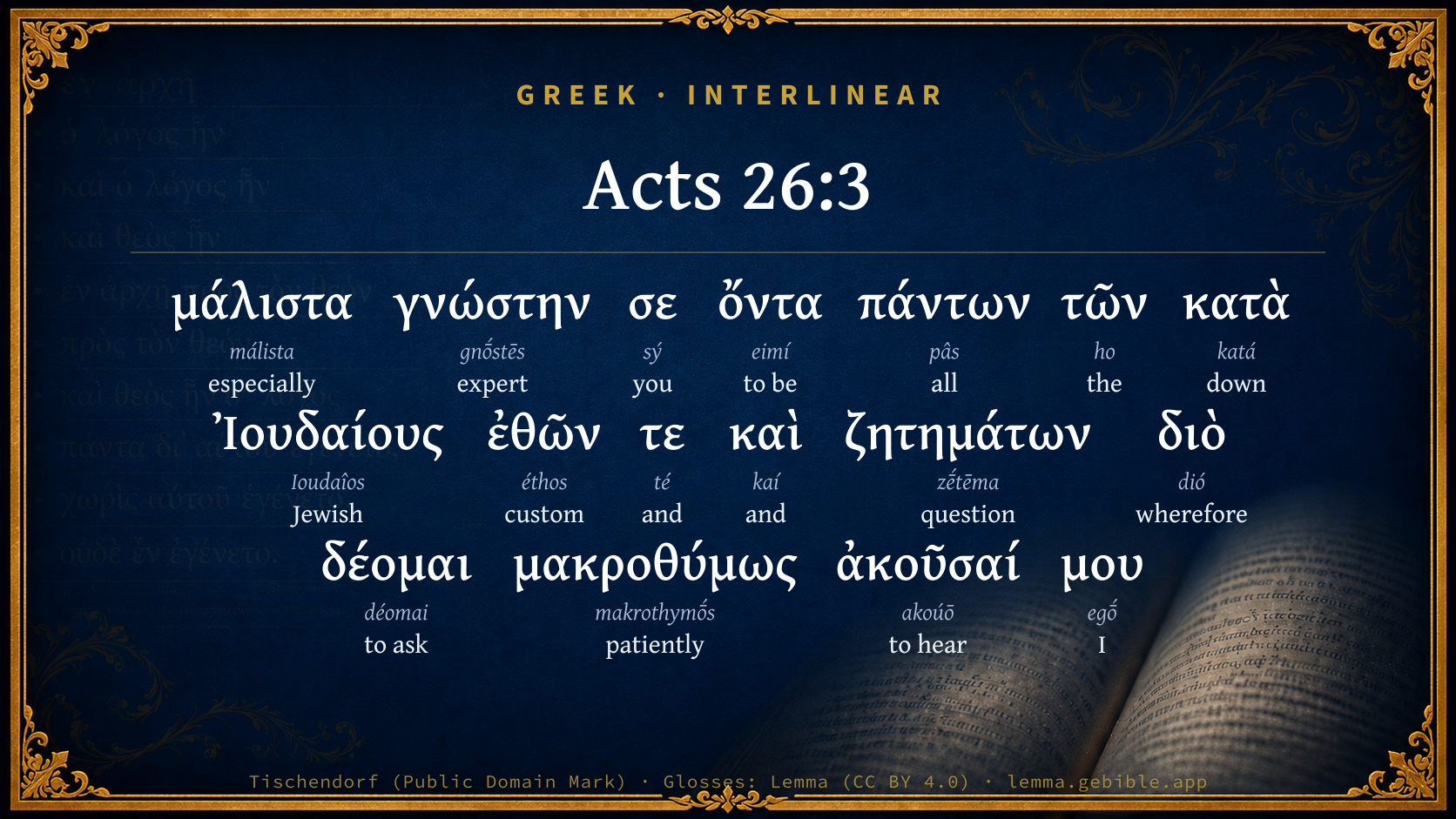
especially because you are expert in all customs and questions which are among the Jews. Therefore I beg you to hear me patiently.
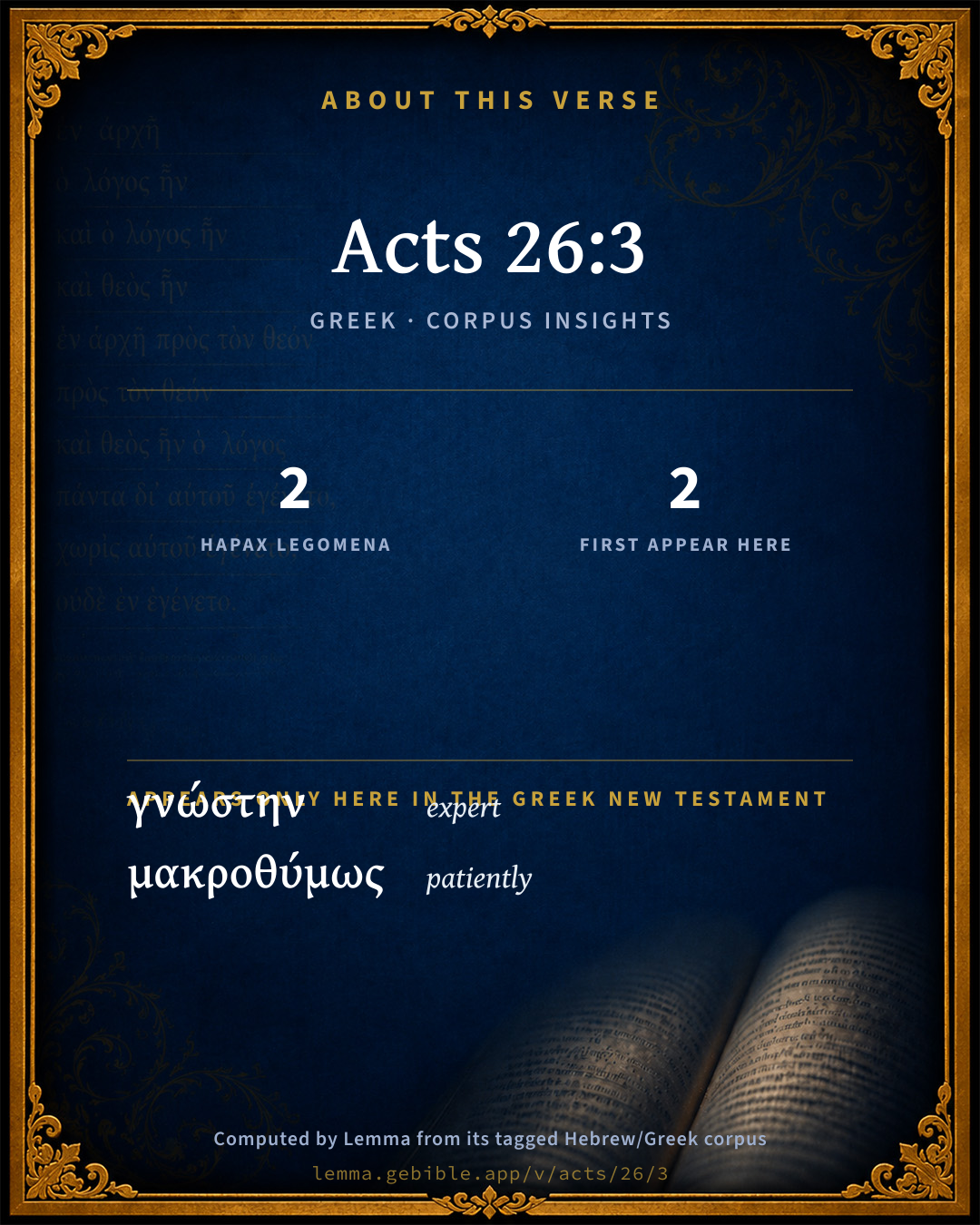
- 2 hapax legomena — only here in the Greek New Testament
- 2 first appearances in the Greek New Testament
Download a study sheet
One document with this verse’s original text, its word-by-word gloss line, the meaning frame, cross-references with their text, attributed commentary, and full source and license credits — printable, and it pastes into notes with its structure intact.
This verse Autodidact and up
A passage Seminary Student
Up to 50 verses in one chapter. A passage sheet keeps up to 6 commentary sources and 12 cross-references per verse, in the order this page ranks them, and says so on the sheet whenever that leaves anything out. Ask for a single verse and you get the Autodidact verse sheet above.
Everything on this page stays free to read, with no account — the sheet is a download of what is already on screen, not access to it.
Compare translations 3
The same verse in 3 English versions, stacked beneath the original-language interlinear above. Click any original word for its lexicon entry.
Each is an independent rendering of the whole verse — the interlinear is not word-aligned to these translations.
Highlighted words mark where these versions differ — a whole-verse word diff, not a word-by-word alignment.
-
World English Bible Public Domain
especially because you are expert in all customs and questions which are among the Jews. Therefore I beg you to hear me patiently.
-
King James Version Public Domain
Especially because I know thee to be expert in all customs and questions which are among the Jews: wherefore I beseech thee to hear me patiently.
-
unfoldingWord Literal Text CC BY-SA 4.0
especially you being an expert in all the customs and controversies among the Jews. So I ask you to hear me patiently.
unfoldingWord Literal Text — © unfoldingWord, licensed CC BY-SA 4.0. Word-aligned USFM3 via Door43 (git.door43.org/unfoldingWord/en_ult).
Show all 19 translations
Every available English version of this verse, each an independent rendering of the whole verse.
-
World English Bible Public Domain
especially because you are expert in all customs and questions which are among the Jews. Therefore I beg you to hear me patiently.
-
Berean Standard Bible Public Domain
especially since you are acquainted with all the Jewish customs and controversies. I beg you, therefore, to listen to me patiently.
-
Majority Standard Bible Public Domain
especially since you are acquainted with all the Jewish customs and controversies. I beg you, therefore, to listen to me patiently.
-
King James Version Public Domain
Especially because I know thee to be expert in all customs and questions which are among the Jews: wherefore I beseech thee to hear me patiently.
-
American Standard Version (1901) Public Domain
especially because thou art expert in all customs and questions which are among the Jews: wherefore I beseech thee to hear me patiently.
-
Revised Version (1885) Public Domain
especially because thou art expert in all customs and questions which are among the Jews: wherefore I beseech thee to hear me patiently.
-
Geneva Bible (1599) Public Domain
Chiefly, because thou hast knowledge of all customes, and questions which are among the Iewes: wherefore I beseech thee, to heare me patiently.
-
Douay-Rheims (1899) Public Domain
Especially as thou knowest all, both customs and questions that are among the Jews: Wherefore I beseech thee to hear me patiently.
-
Young's Literal Translation Public Domain
especially knowing thee to be acquainted with all things -- both customs and questions -- among Jews; wherefore, I beseech thee, patiently to hear me.
-
Literal Standard Version CC BY-SA 4.0
especially knowing you to be acquainted with all things—both customs and questions—among Jews; for this reason, I implore you to hear me patiently.
-
Unlocked Literal Bible CC BY-SA 4.0
especially, because you are an expert in all the Jewish customs and questions. So I ask you to hear me patiently.
-
unfoldingWord Literal Text CC BY-SA 4.0
especially you being an expert in all the customs and controversies among the Jews. So I ask you to hear me patiently.
-
Darby Bible Public Domain
especially because thou art acquainted with all the customs and questions which are among the Jews; wherefore I beseech thee to hear me patiently.
-
World Messianic Bible Public Domain
especially because you are expert in all customs and questions which are among Jews. Therefore I beg you to hear me patiently.
-
Webster's Bible Public Domain
Especially, because I know thee to be expert in all customs and questions which are among the Jews: wherefore I beseech thee to hear me patiently.
-
Free Bible Version CC BY-SA 4.0
particularly because you are an expert in all Jewish issues and customs. I beg your patient indulgence as you listen to what I have to say.
-
Bible in Basic English Public Domain
The more so, because you are expert in all questions to do with the Jews and their ways: so I make my request to you to give me a hearing to the end.
-
Text-Critical English NT CC BY 4.0
especially since yoʋ are acquainted with all the customs and controversies of the Jews. Therefore I beg yoʋ to listen to me patiently.
-
Tyndale New Testament (1534) Public Domain
namely because thou arte experte in all customes and questions which are amonge the Iewes. Wherfore I beseche the to heare me paciently.
Literal Standard Version (2020), Covenant Press — licensed CC BY-SA 4.0. Text via the HelloAO Bible API (eBible.org). Unlocked Literal Bible (unfoldingWord) — licensed CC BY-SA 4.0. Text via the HelloAO Bible API (eBible.org). unfoldingWord Literal Text — © unfoldingWord, licensed CC BY-SA 4.0. Word-aligned USFM3 via Door43 (git.door43.org/unfoldingWord/en_ult). Free Bible Version, Dr. Jonathan Gallagher — licensed CC BY-SA 4.0. Text via the HelloAO Bible API (eBible.org).
Word by word
More ways to search: Search by grammar → Find every occurrence → Compare this word →
Practice this passage: Drill this verse → Learn its vocabulary →
- Appears 1× in the Greek New Testament
- First appears here
- Part of Speech
- Noun
- Case
- Accusative
- Number
- Singular
- Gender
- Masculine
Full Thayer's Definition
- μάλιστα málista G3122 “especially” Adverb, Superlative
- γνώστην gnṓstēs G1109 “expert” Noun, Accusative, Singular, Masculine
- σε sý G4771 “you” Personal pronoun, 2nd person, Accusative, Singular
- ὄντα eimí G1510 “to be” Verb, Present, Active, Participle, Accusative, Singular, Masculine
- πάντων pâs G3956 “all” Adjective, Genitive, Plural, Neuter
- τῶν ho G3588 “the” Article, Genitive, Plural, Neuter
- κατὰ katá G2596 “down” Preposition
- Ἰουδαίους Ioudaîos G2453 “Jewish” Adjective, Accusative, Plural, Masculine
- ἐθῶν éthos G1485 “custom” Noun, Genitive, Plural, Neuter
- τε té G5037 “and” Particle
- καὶ kaí G2532 “and” Conjunction
- ζητημάτων zḗtēma G2213 “question” Noun, Genitive, Plural, Neuter
- διὸ dió G1352 “wherefore” Conjunction
- δέομαι déomai G1189 “to ask” Verb, Present, Middle or Passive deponent, Indicative, 1st person, Singular
- μακροθύμως makrothymṓs G3116 “patiently” Adverb
- ἀκοῦσαί akoúō G191 “to hear” Verb, Aorist, Active, Infinitive
- μου egṓ G1473 “I” Personal pronoun, 1st person, Genitive, Singular
About this verse
These counts appear in no published source. They are computed here, from the morphology-tagged text and Lemma’s own curated glosses. What Lemma adds →
- 17
- words
- 17
- distinct lemmas
- Acts
- section
Notable vocabulary
2 hapax legomena — words that appear only here in the entire Greek New Testament:
First appearance in Scripture
These words make their first canonical appearance in the Greek New Testament here:
Shared distinctive vocabulary
ζητημάτων question G2213 occurs in 5 verses of the Greek New Testament. Also found in:
Cross-references
11Topical passages linked to Acts 26:3 in the Treasury of Scripture Knowledge — connected by theme and wording, ordered by reader-vote popularity; previews shown in the World English Bible.
- Acts 6:14 For we have heard him say that this Jesus of Nazareth will destroy this place, and will change the customs which Moses delivered to us."
- Acts 26:26 For the king knows of these things, to whom also I speak freely. For I am persuaded that none of these things is hidden from him, for this has not been done in a corner.
- Deuteronomy 17:18 It shall be, when he sits on the throne of his kingdom, that he shall write him a copy of this law in a book, out of [that which is] before the priests the Levites:
- Acts 21:21 They have been informed about you, that you teach all the Jews who are among the Gentiles to forsake Moses, telling them not to circumcise their children neither to walk after the customs.
- Acts 24:4 But, that I don't delay you, I entreat you to bear with us and hear a few words.
- Acts 24:10 When the governor had beckoned to him to speak, Paul answered, "Because I know that you have been a judge of this nation for many years, I cheerfully make my defense,
- Acts 25:19–20 but had certain questions against him about their own religion, and about one Jesus, who was dead, whom Paul affirmed to be alive.
- Acts 25:26 Of whom I have no certain thing to write to my lord. Therefore I have brought him forth before you, and especially before you, King Agrippa, that, after examination, I may have something to write.
- Acts 26:7 which our twelve tribes, earnestly serving night and day, hope to attain. Concerning this hope I am accused by the Jews, King Agrippa!
- Acts 28:17 It happened that after three days Paul called together those who were the leaders of the Jews. When they had come together, he said to them, "I, brothers, though I had done nothing against the people, or the customs of our fathers, still was delivered prisoner from Jerusalem into the hands of the Romans,
- 1 Corinthians 13:2 If I have the gift of prophecy, and know all mysteries and all knowledge; and if I have all faith, so as to remove mountains, but don't have love, I am nothing.
Cross-references courtesy of OpenBible.info (CC BY 4.0).
Lesson kit
Teaching starters — assembled from the data on this page, not authored interpretation. Every prompt links to the verse data it draws on. Edit before teaching.
Acts, in the Acts, opens this verse with 17 words (17 distinct Greek lemmas). Its most distinctive word is gnṓstēs (“expert”). A historical commentator’s framing appears above. Read the whole chapter for the surrounding context.
Discussion questions
- The word gnṓstēs carries the sense “expert.” How does it shape the verse?
- This verse holds 2 words here found nowhere else in the Greek New Testament. What might the rare words draw attention to?
- 2 words here appear for the first time in Scripture. What is being introduced at this debut?
- Acts 15:2 shares the word «question» with this verse. How do the two illuminate each other?
- These translations render this verse differently; the difference is in the English rendering, not the original. What questions does that raise?
- Reading how Bengel's Gnomon and Expositor's Greek Testament read this verse, where do the two commentators agree and where do they part?
Things to notice
- 2 words in this verse appear nowhere else in the Greek New Testament.
- 2 words make their first canonical appearance in Scripture here.
- These translations choose different wording for 12 words in this verse.
- 17 distinct Greek lemmas span 17 words in this verse.
Commentary
Notes on Acts 26:3 from classic Christian and Jewish commentators (each source and its license shown beneath its notes). The classic Christian expositions comment on the surrounding passage and are grouped to its opening verse, so a note may address several verses; the Jewish commentaries on the Tanakh (Rashi and others) are per-verse, so they appear only where the commentator wrote on this verse.
Lemma curates 59 commentaries, every one of them public domain or Creative Commons licensed, each selected and text-cleaned for this edition rather than reprinted as found. About our sources →
Bengel's Gnomon
Johann Albrecht Bengel
Bengel's Gnomon of the New Testament — English translation (T&T Clark, Edinburgh, 1860) — public domain. Text from a community e-Sword module.
Expositor's Greek Testament
ed. W. Robertson Nicoll
The Expositor's Greek Testament, edited by W. Robertson Nicoll (1897–1910) — public domain. Text from a community e-Sword module.
Jamieson, Fausset & Brown
Robert Jamieson, A. R. Fausset & David Brown
Jamieson, Fausset & Brown — Commentary Critical and Explanatory on the Whole Bible (1871) — public domain (CC PDM 1.0). Text via the HelloAO Bible API.
Ellicott's Commentary for English Readers
A Bible Commentary for English Readers, edited by Charles John Ellicott (1878–1897) — public domain. Text from a community e-Sword module.
The Cambridge Bible for Schools and Colleges
gen. ed. J. J. S. Perowne
The Cambridge Bible for Schools and Colleges (gen. ed. J. J. S. Perowne; Cambridge University Press, 1878–1918) — public domain. Text from a community e-Sword module.
John Gill's Exposition
John Gill's Exposition of the Whole Bible (1746–1763) — public domain (CC PDM 1.0). Text via the HelloAO Bible API.
Trapp's Complete Commentary
John Trapp
John Trapp, A Commentary or Exposition upon All the Books of the Old and New Testament (1647–1656) — public domain. Text from a community e-Sword module.
Albert Barnes' Notes on the Bible
Albert Barnes' Notes on the Bible (1834–1885) — public domain. Text from a community e-Sword/MySword module.
Matthew Poole's English Annotations
Matthew Poole's English Annotations on the Holy Bible (1683–1685) — public domain. Text from a community e-Sword/MySword module.
The Pulpit Commentary
The Pulpit Commentary (1880–1919), ed. H.D.M. Spence-Jones & Joseph S. Exell — public domain. Text from a community e-Sword module.
John Wesley's Explanatory Notes
John Wesley, Explanatory Notes Upon the Whole Bible (1754–1765) — public domain. Text via the GEBible commentary corpus.
McGarvey & Pendleton's Commentaries
J. W. McGarvey
J. W. McGarvey (with Philip Y. Pendleton), Commentaries on the New Testament (The Fourfold Gospel, 1914; Acts; and the epistles) — public domain. Text from a community e-Sword/MySword module.
Cambridge Greek Testament for Schools and Colleges
Cambridge Greek Testament for Schools and Colleges (Cambridge University Press, 1896; 21 vols, various authors incl. Carr, Maclear, Plummer, Farrar, Lumby, Moule, M. R. James, Simcox) — public domain. Text from a community e-Sword module.
Alford’s Greek Testament
Henry Alford
Henry Alford, The Greek Testament (1849–1861) — public domain. Text from a community e-Sword module.
Vincent's Word Studies in the New Testament
Marvin R. Vincent
Marvin R. Vincent, Word Studies in the New Testament (1887–1900) — public domain. Text from a community e-Sword/MySword module.