
Philippians 1:27

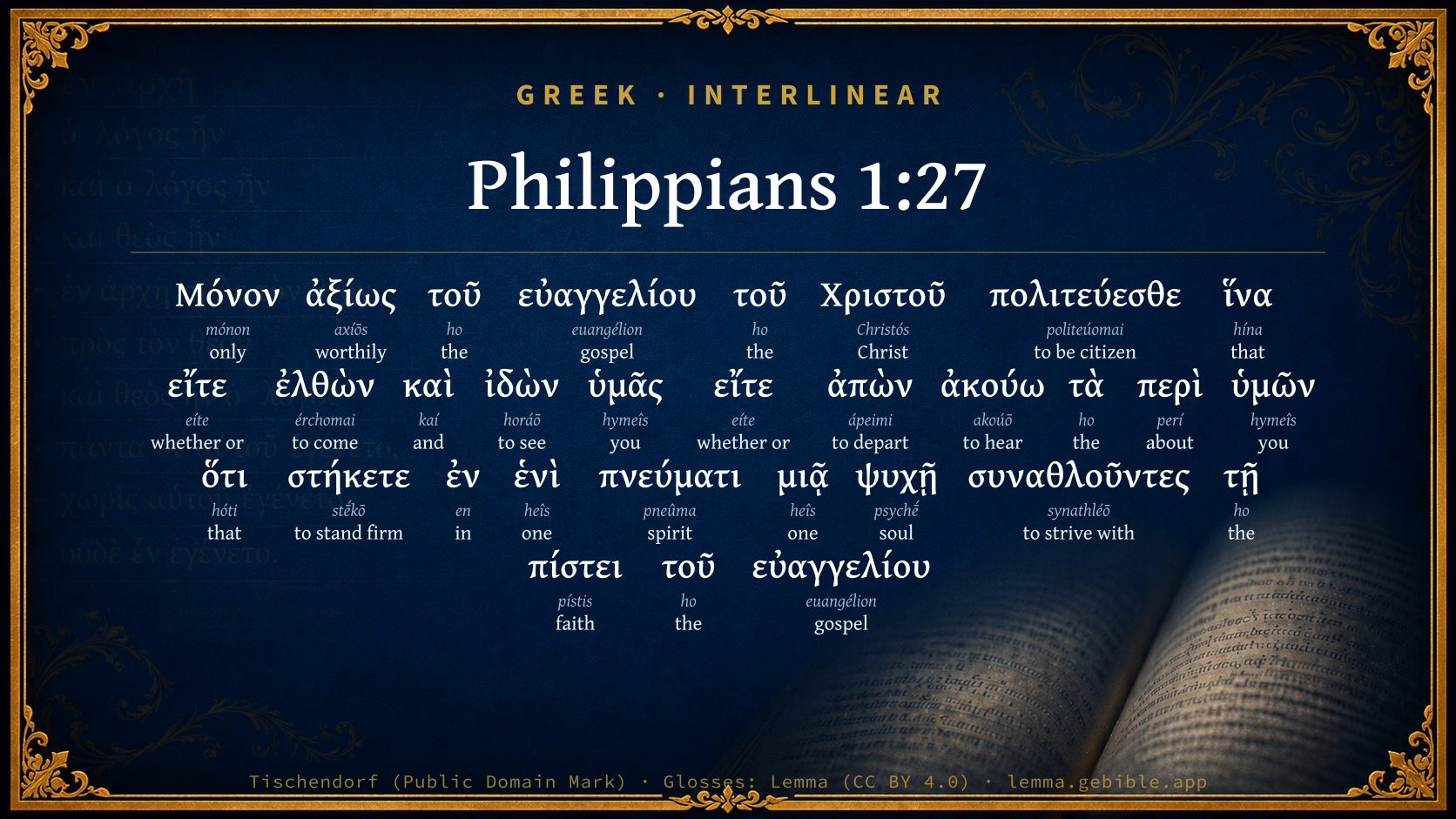
Greek (Tischendorf 8th ed.) Philippians 1:27 appears in the Greek New Testament. The text above is from the Tischendorf 8th edition. Each word links to its Strong’s number and a concise gloss. Click any word for its full Thayer’s Greek Lexicon entry.
Download image
Cite this verse

Philippians 1:27 (World English Bible). Public Domain. Lemma interlinear Bible study tool, https://lemma.gebible.app/v/philippians/1/27.

Show BibTeX & RIS
BibTeX
RIS
English Translation
Only let your manner of life be worthy of the Gospel of Christ, that, whether I come and see you or am absent, I may hear of your state, that you stand firm in one spirit, with one soul striving for the faith of the Gospel;
World English Bible · Public Domain
Highlights
  • 1 first appearance in the Greek New Testament
Full analysis ↓
Download a study sheet

One document with this verse’s original text, its word-by-word gloss line, the meaning frame, cross-references with their text, attributed commentary, and full source and license credits — printable, and it pastes into notes with its structure intact.

This verse Autodidact and up

Study sheet (.html) Plain text (.txt)

A passage Seminary Student

Up to 50 verses in one chapter. A passage sheet keeps up to 6 commentary sources and 12 cross-references per verse, in the order this page ranks them, and says so on the sheet whenever that leaves anything out. Ask for a single verse and you get the Autodidact verse sheet above.

Everything on this page stays free to read, with no account — the sheet is a download of what is already on screen, not access to it.

Want to remove ads? Support Godless Engineer
Compare translations 3

The same verse in 3 English versions, stacked beneath the original-language interlinear above. Click any original word for its lexicon entry.

Each is an independent rendering of the whole verse — the interlinear is not word-aligned to these translations.

Highlighted words mark where these versions differ — a whole-verse word diff, not a word-by-word alignment.

  • World English Bible Public Domain
    Only let your manner of life be worthy of the Gospel of Christ, that, whether I come and see you or am absent, I may hear of your state, that you stand firm in one spirit, with one soul striving for the faith of the Gospel;
  • King James Version Public Domain
    Only let your conversation be as it becometh the gospel of Christ: that whether I come and see you, or else be absent, I may hear of your affairs, that ye stand fast in one spirit, with one mind striving together for the faith of the gospel;
  • unfoldingWord Literal Text CC BY-SA 4.0
    Only conduct yourselves in a manner worthy of the gospel of Christ so that whether having come and having seen you or whether being absent, I might hear about you, that you stand firm in one spirit, with one soul striving together for the faith of the gospel.

unfoldingWord Literal Text — © unfoldingWord, licensed CC BY-SA 4.0. Word-aligned USFM3 via Door43 (git.door43.org/unfoldingWord/en_ult).

Versions to compare (up to 4)

3 of 4 selected

Show all 19 translations

Every available English version of this verse, each an independent rendering of the whole verse.

  • World English Bible Public Domain
    Only let your manner of life be worthy of the Gospel of Christ, that, whether I come and see you or am absent, I may hear of your state, that you stand firm in one spirit, with one soul striving for the faith of the Gospel;
  • Berean Standard Bible Public Domain
    Nevertheless, conduct yourselves in a manner worthy of the gospel of Christ. Then, whether I come and see you or only hear about you in my absence, I will know that you stand firm in one spirit, contending side by side for the faith of the gospel,
  • Majority Standard Bible Public Domain
    Nevertheless, conduct yourselves in a manner worthy of the gospel of Christ. Then, whether I come and see you or only hear about you in my absence, I will know that you stand firm in one spirit, contending side by side for the faith of the gospel,
  • King James Version Public Domain
    Only let your conversation be as it becometh the gospel of Christ: that whether I come and see you, or else be absent, I may hear of your affairs, that ye stand fast in one spirit, with one mind striving together for the faith of the gospel;
  • American Standard Version (1901) Public Domain
    Only let your manner of life be worthy of the gospel of Christ: that, whether I come and see you and be absent, I may hear of your state, that ye stand fast in one spirit, with one soul striving for the faith of the gospel;
  • Revised Version (1885) Public Domain
    Only let your manner of life be worthy of the gospel of Christ: that, whether I come and see you or be absent, I may hear of your state, that ye stand fast in one spirit, with one soul striving for the faith of the gospel;
  • Geneva Bible (1599) Public Domain
    Onely let your conuersation be, as it becommeth the Gospel of Christ, that whether I come and see you, or els be absent, I may heare of your matters that ye continue in one Spirit, and in one mind, fighting together through the faith of the Gospel.
  • Douay-Rheims (1899) Public Domain
    Only let your conversation be worthy of the gospel of Christ: that, whether I come and see you, or, being absent, may hear of you, that you stand fast in one spirit, with one mind labouring together for the faith of the gospel.
  • Young's Literal Translation Public Domain
    Only worthily of the good news of the Christ conduct ye yourselves, that, whether having come and seen you, whether being absent I may hear of the things concerning you, that ye stand fast in one spirit, with one soul, striving together for the faith of the good news,
  • Literal Standard Version CC BY-SA 4.0
    Only conduct yourselves worthily of the good news of the Christ, that, whether having come and seen you, whether being absent I may hear of the things concerning you, that you stand fast in one spirit, with one soul, striving together for the faith of the good news,
  • Unlocked Literal Bible CC BY-SA 4.0
    Only conduct yourselves in a manner worthy of the gospel of Christ, so that whether I come to see you or am absent, I may hear about you, that you are standing firm in one spirit, with one mind striving together for the faith of the gospel.
  • unfoldingWord Literal Text CC BY-SA 4.0
    Only conduct yourselves in a manner worthy of the gospel of Christ so that whether having come and having seen you or whether being absent, I might hear about you, that you stand firm in one spirit, with one soul striving together for the faith of the gospel.
  • Darby Bible Public Domain
    Only conduct yourselves worthily of the glad tidings of the Christ, in order that whether coming and seeing you, or absent, I may hear of what concerns you, that ye stand firm in one spirit, with one soul, labouring together in the same conflict with the faith of the glad tidings;
  • World Messianic Bible Public Domain
    Only let your way of life be worthy of the Good News of Messiah, that whether I come and see you or am absent, I may hear of your state, that you stand firm in one spirit, with one soul striving for the faith of the Good News;
  • Webster's Bible Public Domain
    Only let your manner of life be as it becometh the gospel of Christ: that whether I come and see you, or else be absent, I may hear of your affairs, that ye stand fast in one spirit, with one mind striving together for the faith of the gospel;
  • Free Bible Version CC BY-SA 4.0
    Just be sure that the way you live your lives corresponds to the good news of Christ, so that whether I come and see you or not I can get to hear how you're doing—that you stand firm in full agreement with one another, spiritually united as you work together for the trusting faith of the good news.
  • Bible in Basic English Public Domain
    Only let your behaviour do credit to the good news of Christ, so that if I come and see you or if I am away from you, I may have news of you that you are strong in one spirit, working together with one soul for the faith of the good news;
  • Text-Critical English NT CC BY 4.0
    Only live as citizens in a manner worthy of the gospel of Christ, so that whether I come and see you or am absent, I may hear that you are standing firm in one spirit, striving together with one mind for the faith of the gospel,
  • Tyndale New Testament (1534) Public Domain
    Only let yovre conversacion be as it be cometh the gospell of Christ: that whether I come and se you or els be absent I maye yet heare of you that ye contynue in one sprete and in one soule labouringe as we do to mayntayne the fayth of the gospell

Literal Standard Version (2020), Covenant Press — licensed CC BY-SA 4.0. Text via the HelloAO Bible API (eBible.org). Unlocked Literal Bible (unfoldingWord) — licensed CC BY-SA 4.0. Text via the HelloAO Bible API (eBible.org). unfoldingWord Literal Text — © unfoldingWord, licensed CC BY-SA 4.0. Word-aligned USFM3 via Door43 (git.door43.org/unfoldingWord/en_ult). Free Bible Version, Dr. Jonathan Gallagher — licensed CC BY-SA 4.0. Text via the HelloAO Bible API (eBible.org).

Word by word

More ways to search: Search by grammar → Find every occurrence → Compare this word →

Practice this passage: Drill this verse → Learn its vocabulary →

πολιτεύεσθε
politeúomai
G4176
“to be citizen”
Verb, Present, Middle or Passive deponent, Imperative, 2nd person, Plural
Part of Speech
Verb
Tense
Present
Voice
Middle or Passive deponent
Mood
Imperative
Person
2nd person
Number
Plural
Full Thayer's Definition

Origin: middle voice of a derivative of G4177

TDNT: 14:36,9

1. to be a citizen 2. to administer civil affairs, manage the state 3. to make or create a citizen a. to be a citizen b. to behave as a citizen 1. to avail one's self of or recognise the laws 2. to conduct one's self as pledged to some law of life
  1. Μόνον mónon G3440 “only” Adverb
  2. ἀξίως axíōs G516 “worthily” Adverb
  3. τοῦ ho G3588 “the” Article, Genitive, Singular, Neuter
  4. εὐαγγελίου euangélion G2098 “gospel” Noun, Genitive, Singular, Neuter
  5. τοῦ ho G3588 “the” Article, Genitive, Singular, Masculine
  6. Χριστοῦ Christós G5547 “Christ” Noun, Genitive, Singular, Masculine
  7. ἵνα hína G2443 “that” Conjunction
  8. εἴτε eíte G1535 “whether or” Conjunction
  9. ἐλθὼν érchomai G2064 “to come” Verb, Aorist, Active, Participle, Nominative, Singular, Masculine
  10. καὶ kaí G2532 “and” Conjunction
  11. ἰδὼν horáō G3708 “to see” Verb, Aorist, Active, Participle, Nominative, Singular, Masculine
  12. ὑμᾶς hymeîs G5210 “you” Personal pronoun, 2nd person, Accusative, Plural
  13. εἴτε eíte G1535 “whether or” Conjunction
  14. ἀπὼν ápeimi G548 “to depart” Verb, Present, Active, Participle, Nominative, Singular, Masculine
  15. ἀκούω akoúō G191 “to hear” Verb, Present, Active, Subjunctive, 1st person, Singular
  16. τὰ ho G3588 “the” Article, Accusative, Plural, Neuter
  17. περὶ perí G4012 “about” Preposition
  18. ὑμῶν hymeîs G5210 “you” Personal pronoun, 2nd person, Genitive, Plural
  19. ὅτι hóti G3754 “that” Conjunction
  20. στήκετε stḗkō G4739 “to stand firm” Verb, Present, Active, Indicative, 2nd person, Plural
  21. ἐν en G1722 “in” Preposition
  22. ἑνὶ heîs G1520 “one” Adjective, Dative, Singular, Neuter
  23. πνεύματι pneûma G4151 “spirit” Noun, Dative, Singular, Neuter
  24. μιᾷ heîs G1520 “one” Adjective, Dative, Singular, Feminine
  25. ψυχῇ psychḗ G5590 “soul” Noun, Dative, Singular, Feminine
  26. συναθλοῦντες synathléō G4866 “to strive with” Verb, Present, Active, Participle, Nominative, Plural, Masculine
  27. τῇ ho G3588 “the” Article, Dative, Singular, Feminine
  28. πίστει pístis G4102 “faith” Noun, Dative, Singular, Feminine
  29. τοῦ ho G3588 “the” Article, Genitive, Singular, Neuter
  30. εὐαγγελίου euangélion G2098 “gospel” Noun, Genitive, Singular, Neuter

About this verse

These counts appear in no published source. They are computed here, from the morphology-tagged text and Lemma’s own curated glosses. What Lemma adds →

31
words
23
distinct lemmas
Pauline Epistles
section

Notable vocabulary

The rarest word here is πολιτεύεσθε to be citizen G4176 — appearing just 2 times in the whole Greek New Testament.

First appearance in Scripture

This word makes its first canonical appearance in the Greek New Testament here:

  • συναθλοῦντες to strive with G4866

Shared distinctive vocabulary

πολιτεύεσθε to be citizen G4176 occurs in 2 verses of the Greek New Testament. Also found in:
Repetition

Words recur within this verse:

  • εὐαγγελίου gospel G2098 ×2
  • εἴτε whether or G1535 ×2
  • ἑνὶ one G1520 ×2
  • τοῦ the G3588 ×5
  • ὑμᾶς you G5210 ×2

Cross-references

48

Topical passages linked to Philippians 1:27 in the Treasury of Scripture Knowledge — connected by theme and wording, ordered by reader-vote popularity; previews shown in the World English Bible.

  • Ephesians 4:1 I therefore, the prisoner in the Lord, beg you to walk worthily of the calling with which you were called,
  • 1 Corinthians 16:13–14 Watch! Stand firm in the faith! Be courageous! Be strong!
  • 1 Corinthians 1:10 Now I beg you, brothers, through the name of our Lord, Jesus Christ, that you all speak the same thing and that there be no divisions among you, but that you be perfected together in the same mind and in the same judgment.
  • 2 Peter 3:14 Therefore, beloved, seeing that you look for these things, be diligent to be found in peace, without blemish and blameless in his sight.
  • Philippians 2:1–2 If there is therefore any exhortation in Christ, if any consolation of love, if any fellowship of the Spirit, if any tender mercies and compassion,
  • Colossians 1:10 that you may walk worthily of the Lord, to please him in all respects, bearing fruit in every good work, and increasing in the knowledge of God;
  • Jude 1:3 Beloved, while I was very eager to write to you about our common salvation, I was constrained to write to you exhorting you to contend earnestly for the faith which was once for all delivered to the saints.
  • 1 Thessalonians 4:1 Finally then, brothers, we beg and exhort you in the Lord Jesus, that as you received from us how you ought to walk and to please God, that you abound more and more.
  • Ephesians 4:3–6 being eager to keep the unity of the Spirit in the bond of peace.
  • Romans 12:4–5 For even as we have many members in one body, and all the members don't have the same function,
  • 1 Corinthians 12:12–31 For as the body is one, and has many members, and all the members of the body, being many, are one body; so also is Christ.
  • Philippians 2:12 So then, my beloved, even as you have always obeyed, not only in my presence, but now much more in my absence, work out your own salvation with fear and trembling.
  • 2 Corinthians 13:11 Finally, brothers, rejoice. Be perfected, be comforted, be of the same mind, live in peace, and the God of love and peace will be with you.
  • Psalms 133:1 See how good and how pleasant it is For brothers to live together in unity!
  • Jeremiah 32:39 and I will give them one heart and one way, that they may fear me forever, for the good of them, and of their children after them:
  • Acts 4:32 The multitude of those who believed were of one heart and soul. Not one of them claimed that anything of the things which he possessed was his own, but they had all things in common.
  • Philippians 3:18–4:1 For many walk, of whom I told you often, and now tell you even weeping, as the enemies of the cross of Christ,
  • 1 Corinthians 15:58 Therefore, my beloved brothers, be steadfast, immovable, always abounding in the Lord's work, because you know that your labor is not in vain in the Lord.
  • Romans 1:16 For I am not ashamed of the Gospel of Christ, for it is the power of God for salvation for everyone who believes; for the Jew first, and also for the Greek.
  • 2 Timothy 4:7 I have fought the good fight. I have finished the course. I have kept the faith.
  • James 3:18 Now the fruit of righteousness is sown in peace by those who make peace.
  • 2 Peter 3:11 Therefore since all these things are thus to be destroyed, what manner of persons ought you to be in holy living and godliness,
  • Proverbs 22:23 For Yahweh will plead their case, And plunder the life of those who plunder them.
  • Matthew 12:25 Knowing their thoughts, Jesus said to them, "Every kingdom divided against itself is brought to desolation, and every city or house divided against itself will not stand.
  • John 17:20–21 Not for these only do I pray, but for those also who believe in me through their word,
  • Acts 2:46 Day by day, continuing steadfastly with one accord in the temple, and breaking bread at home, they took their food with gladness and singleness of heart,
  • Acts 24:24 But after some days, Felix came with Drusilla, his wife, who was a Jewess, and sent for Paul, and heard him concerning the faith in Christ Jesus.
  • 2 Corinthians 4:4 in whom the god of this world has blinded the minds of the unbelieving, that the light of the Gospel of the glory of Christ, who is the image of God, should not dawn on them.
  • Ephesians 1:13 in whom you also, having heard the word of the truth, the Gospel of your salvation,--in whom, having also believed, you were sealed with the Holy Spirit of promise,
  • 1 Timothy 1:11 according to the Gospel of the glory of the blessed God, which was committed to my trust.
  • 1 Timothy 1:19 holding faith and a good conscience; which some having thrust away made a shipwreck concerning the faith;
  • Titus 2:10 not stealing, but showing all good fidelity; that they may adorn the doctrine of God, our Savior, in all things.
  • Philemon 1:5 hearing of your love, and of the faith which you have toward the Lord Jesus, and toward all the saints;
  • 3 John 1:3–4 For I rejoiced greatly, when brothers came and testified about your truth, even as you walk in truth.
  • Psalms 122:3 Jerusalem, that is built as a city that is compact together;
  • Romans 1:5 through whom we received grace and apostleship, for obedience of faith among all the nations, for his name's sake;
  • Romans 1:9 For God is my witness, whom I serve in my spirit in the Gospel of his Son, how unceasingly I make mention of you always in my prayers,
  • Romans 10:8 But what does it say? "The word is near you, in your mouth, and in your heart;" that is, the word of faith, which we preach:
  • Romans 15:16 that I should be a servant of Christ Jesus to the Gentiles, ministering as a priest the Gospel of God, that the offering up of the Gentiles might be made acceptable, sanctified by the Holy Spirit.
  • Romans 15:29 I know that, when I come to you, I will come in the fullness of the blessing of the Gospel of Christ.
  • 2 Corinthians 9:13 seeing that through the proof given by this service, they glorify God for the obedience of your confession to the Gospel of Christ, and for the liberality of your contribution to them and to all;
  • Galatians 1:7 and there isn't another gospel. Only there are some who trouble you, and want to pervert the Gospel of Christ.
  • Ephesians 1:15 For this cause I also, having heard of the faith in the Lord Jesus which is among you, and the love which you have toward all the saints,
  • Philippians 2:24 But I trust in the Lord that I myself also will come shortly.
  • Colossians 1:4 having heard of your faith in Christ Jesus, and of the love which you have toward all the saints,
  • 1 Thessalonians 2:11–12 As you know how we exhorted, comforted, and implored every one of you, as a father does his own children,
  • 1 Thessalonians 3:6 But when Timothy came just now to us from you, and brought us glad news of your faith and love, and that you have good memories of us always, longing to see us, even as we also long to see you;
  • 2 Peter 1:4–9 by which he has granted to us his precious and exceedingly great promises; that through these you may become partakers of the divine nature, having escaped from the corruption that is in the world by lust.

Cross-references courtesy of OpenBible.info (CC BY 4.0).

Commentary

Notes on Philippians 1:27 from classic Christian and Jewish commentators (each source and its license shown beneath its notes). The classic Christian expositions comment on the surrounding passage and are grouped to its opening verse, so a note may address several verses; the Jewish commentaries on the Tanakh (Rashi and others) are per-verse, so they appear only where the commentator wrote on this verse.

Lemma curates 59 commentaries, every one of them public domain or Creative Commons licensed, each selected and text-cleaned for this edition rather than reprinted as found. About our sources →

Matthew Henry's Commentary

The apostle concludes the chapter with two exhortations: -

I. He exhorts them to strictness of conversation (Phi 1:27): Only let your conversation be as becometh the gospel of Christ. Observe, Those who profess the gospel of Christ should have their conversation as becomes the gospel, or in a suitableness and agreeableness to it. Let it be as becomes those who believe gospel truths, submit to gospel laws, and depend upon gospel promises; and with an answerable faith, holiness, and comfort. Let it be in all respects as those who belong to the kingdom of God among men, and are members and subjects of it. It is an ornament to our profession when our conversation is of a piece with it. - That whether I come and see you, or else be absent, I may hear of your affairs. He had spoken in Phi 1:26 of his coming to them again, and had spoken it with some assurance, though he was now a prisoner; but he would not have them build upon that. Our religion must not be bound up in the hands of our ministers: "Whether I come or no, let me hear well of you, and do you stand fast." Whether ministers come or no, Christ is always at hand. He is nigh to us, never far from us; and hastens his second coming. The coming of the Lord draws nigh, Jam 5:8. Let me hear of you that you stand fast in one spirit, with one mind striving together for the faith of the gospel. Three things he desired to hear of them; and they are all such as become the gospel: - 1. It becomes those who profess the gospel to strive for it, to use a holy violence in taking the kingdom of heaven. The faith of the gospel is the doctrine of faith, or the religion of the gospel. There is that in the faith of the gospel which is worth striving for. If religion is worth any thing, it is worth every thing. There is much opposition, and there is need of striving. A man may sleep and go to hell; but he who will go to heaven must look about him and be diligent. 2. The unity and unanimity of Christians become the gospel: Strive together, not strive one with another; all of you must strive against the common adversary. One spirit and one mind become the gospel; for there is one Lord, one faith, one baptism. There may be a oneness of heart and affection among Christians, where there is diversity of judgment and apprehensions about many things. 3. Stedfastness becomes the gospel: Stand fast in one spirit, with one mind. Be stedfast and immovable by any opposition. It is a shame to religion when the professors of it are off and on, unfixed in their minds, and unstable as water; for they will never excel. Those who would strive for the faith of the gospel must stand firm to it.

II. He exhorts them to courage and constancy in suffering: And in nothing terrified by your adversaries, Phi 1:28. The professors of the gospel have all along met with adversaries, especially at the first planting of Christianity. Our great care must be to keep close to our profession, and be constant to it: whatever oppositions we meet with, we must not be frightened at them, considering that the condition of the persecuted is much better and more desirable than the condition of the persecutors; for persecuting is an evident token of perdition. Those who oppose the gospel of Christ, and injure the professors of it, are marked out for ruin. But being persecuted is a token of salvation. Not that it is a certain mark; many hypocrites have suffered for their religion; but it is a good sign that we are in good earnest in religion, and designed for salvation, when we are enabled in a right manner to suffer for the cause of Christ. - For to you it is given on the behalf of Christ not only to believe, but also to suffer for his name, Phi 1:29. Here are two precious gifts given, and both on the behalf of Christ: - 1. To believe in him. Faith is God's gift on the behalf of Christ, who purchased for us not only the blessedness which is the object of faith, but the grace of faith itself: the ability or disposition to believe is from God. 2. To suffer for the sake of Christ is a valuable gift too: it is a great honour and a great advantage; for we may be very serviceable to the glory of God, which is the end of our creation, and encourage and confirm the faith of others. And there is a great reward attending it too: Blessed are you when men shall persecute you, for great is your reward in heaven, Mat 5:11, Mat 5:12. And, if we suffer with him, we shall also reign with him, Ti2 2:12. If we suffer reproach and loss for Christ, we are to reckon it a great gift, and prize it accordingly, always provided we behave under our sufferings with the genuine temper of martyrs and confessors (Phi 1:30): "Having the same conflict which you saw in me, and now hear to be in me; that is, suffering in the same manner as you saw and now hear of me that I suffer." It is not simply the suffering, but the cause, and not only the cause, but the spirit, which makes the martyr. A man may suffer in a bad cause, and then he suffers justly; or in a good cause, but with a wrong mind, and then his sufferings lose their value.

Matthew Henry's Commentary on the Whole Bible (1708–1710) — public domain (CC PDM 1.0). Text via the HelloAO Bible API.

Ellicott's Commentary for English Readers

(27) Let your conversation . . .—The original is here (as in the famous passage, Php_3:20), Use your citizenship (that is, of the kingdom of heaven) worthily of the gospel of Christ. The same word is employed by St. Paul in Act_23:1 (“I have walked in all good conscience before God”), with an obvious reference to his citizenship in the chosen nation of Israel. Its use in this Epistle is suggestive—both as natural to one contemplating the great imperial city, and writing to the people of a Roman colony proud of their full citizenship, and also as leading on to that great conception of the unity of the Church in earth and in heaven, which is the main subject of the Ephesian, and in some degree of the Colossian, Epistle.

In one spirit, with one mind.—Rather, in one spirit, one soul. The phrase “in one spirit” may refer to the spirit of man, or to the Spirit of God. If it be intended to be strictly parallel to the “one soul” (which has no separate preposition in the Greek), the former sense is manifestly suggested. If, however, the words “with one soul” be connected, as is not unnatural, with “striving together,” this suggestion falls to the ground; and the usage of this Epistle (see especially Php_2:1-7), and the other Epistles of the same period (Eph_2:18-22; Eph_3:5; Eph_5:18; Eph_6:18; Col_1:8), certainly favours the latter interpretation. In either case “the soul” (as in the famous three-fold division of men’s nature in 1Th_5:23) is that element of humanity which is the seat of emotion and passion. (Comp. the “one heart and one soul” of Act_4:32.) This element the Christianity of the New Testament, unlike Stoicism or asceticism, will not crush, but enlist, as it enlists the body also, in the free service of God.

Striving together for the faith.—Properly, with the faith. The faith of the gospel—the power of Christianity—is personified. The Philippians are to be combatants on the same side against the same foes (compare the use of the same word in Php_4:3). The metaphor seems drawn from the games, as is seen by the use of the simple verb in 2Ti_2:8, “If a man strive . . . he is not crowned, except he strive lawfully.” In the exhortation to stand fast (comp. Eph_6:13-14) we have the element of passive endurance, here of active and aggressive energy.

(27-30) In these verses St. Paul exhorts the Philippians to unanimous boldness and steadfastness, under some conflict of antagonism or persecution which threatened them at this time. Of the history of the Church at Philippi we have no historical record after the notice of St. Paul’s first visit, and of the violence which he then had to endure (Act_16:12-40). But in 2Co_7:5, written certainly from Macedonia, probably from Philippi, towards the close of the third missionary journey, we find St. Paul saying, “When we were come to Macedonia our flesh had no rest. Without were fightings, within were fears.” (Comp. also 2Co_8:2 of the same Epistle.) It would seem, therefore, that the subsequent history of the Philippian Church corresponded only too well to the circumstances under which its Christianity first began.

[3. Exhortation (Php_1:27 to Php_2:4).

(1) To STEADFASTNESS AND CONFIDENCE UNDER PERSECUTION (Php_1:27-30).

(2) To UNITY OF SPIRIT, based on humility and self-forgetfulness (Php_2:1-4).]

A Bible Commentary for English Readers, edited by Charles John Ellicott (1878–1897) — public domain. Text from a community e-Sword module.

The Biblical Illustrator

Joseph S. Exell

Php_1:27-30

Only let your conversation be as it becometh the gospel of Christ

A call to a four-fold manifestation of spiritual life

I.

To holiness (Php_1:27). As if he had said, I have one dominating wish in reference to you.

1. It is well to know what Gods princes wish for us. The noblest desire one man can cherish for another is that he may be like Jesus.

2. There is but one ideal life in the Church. But here is a difficulty: how can the lowest copy the highest? Would it not have been wiser to have set forth a man who excelled in one moral feature, and to have said, Transcribe that, and so on until all the graces had been gradually acquired? Is not the setting forth of absolute perfection exorbitant and demanding too much from the helpless sinner? Let us see. What does moral perfection begin in? It begins in the disposition, the will, the heart. If you are urged to escape from polar winter to tropical summer, it is not meant that the journey is to be accomplished at a stride, but step by step. When a child is required to be perfect as a musician it is not intended that in one day his uncrafty fingers should liberate the angel strains. So with the growth of the acorn into the oak. And so when our Saviour tells us to be perfect as our Father in heaven is perfect He means that we are to grow in grace. In all our growing and striving Christ Himself is with us, and His grace is all-sufficient.

II. To unanimity (Php_1:27). This is not monotony. The root of true unity is oneness in the love and service of Christ. Christendom is in reality one, though apparently many. The coat is of many colours, the heart is one. This is particularly seen in the time of threatened danger. The armies of defence have never come from any particular section of the Church. How illogical the decision to have nothing to do with religion because the Church is divided. There are so many styles of building, and so many modifications of those styles, some Doric, others classic--are people so perplexed with these varieties as to renounce architecture altogether and resolved to reside in the open air? Try the same with clothing, patriotism, business. Do men give up commerce because some tradesmen are insolvent? Do you give up housekeeping because some chimneys smoke?

III. To courage (Php_1:28). Timidity is a symptom of moral feebleness, an impediment in the path of moral progress. Timidity on the part of one may dishearten the courage of a multitude. It arises from distrust in God. How many a man of noble powers and enlarged culture, for want of strength in a crisis, the courage to utter the decisive word, fails and trembles, and becomes the prey of the mean.

IV. Fearlessness in the strife is to be associated with magnanimity in endurance (Php_1:29-30). The strong in heart are called to suffer. Suffering is an education, a means of grace. Think of the hidden and silent heroism that is going on day by day. How many a man otherwise mighty fails in suffering! (J. Parker, D. D.)

Christian citizenship

There was one drawback to the apostles delight in thinking of the Philippians. It was not doctrinal unsoundness, or denial of his authority, but the spirit of social rivalry and partizanship. This he hints at by the recurrence of the word all in the former part of this chapter, and he now deals with it in a most delicate but effective way. He shows, in a manner which they as Roman citizens were quick to understand, the leading duties of gospel citizenship and their enforcing motives.

I. The duties of this Christian citizenship.

1. Stand firmly by the charter of your citizenship--the gospel--all of you, all together. Be a compact body. The apostle puts stress upon the Christian spirit as the outcome of the Christian faith, and does not dream, like some recent men, that the one can exist apart from the other.

2. Be unitedly zealous for the common faith. Zeal for the truth is not only to impel them to stand by the truth, but to make it known. There is a zeal which begins and ends with self, or which will show itself in its own way only, and a zeal which spends itself not so much against the common foe as against those of their own party who differ in minor things. What the apostle commends is a right kind of zeal rightly directed.

3. Be bold in facing your foe. The opposition was formidable--Jews and Gentiles singly and combined; the attack was likely to be sudden.

II. The motives by which they are enforced.

1. An attention to these duties attests their true apprehension and enjoyment of Christianity itself (Php_2:1).

2. The power of Divine love.

3. Obedience to those duties will bear witness to the reality of their communion with God.

4. It is also thus a true testimony to the compassion and tenderness which Christ alone puts into mens hearts.

5. Doing thus you will make my cup of gladness run over. (J. J. Goadby.)

Citizens of heaven

The meaning is, Play the citizen in a manner worthy of the gospel. Paul does not mean, of course, Discharge your civic duties as Christian men, though some Christian Englishmen need that reminder; but their city was the heavenly Jerusalem.

I. Keep fresh the sense of belonging to the mother city. Paul was writing from Rome, where he might see how the consciousness of being a Roman gave dignity to a man. He would kindle a similar feeling in Christians.

1. We belong to another polity than that with which we are connected by the bonds of sense.

2. Therefore it is a great part of Christian discipline to keep a vivid consciousness that there is an unseen order of things. The future life is present to an innumerable company.

3. There is a present connection between all Christians and the heavenly city. The life of Christian men on earth and in heaven is fundamentally the same; in principle, motive, taste, aim, etc. As Philippi was to Rome, so is earth to heaven, a colony on the outskirts of the empire, ringed round by barbarians, and separated by seas, but keeping open its communications, and one in citizenship.

4. Our true habitat is elsewhere; so let us set our affections on things above. The descendants of the original settlers in our colonies talk still of coming to England as going home, though they were born in Australia and have lived there all their lives.

5. How need that feeling of detachment from the present sadden our spirits or weaken our interest in things around us? To recognize our separation from the order of things in which we move because we have our being in that majestic unseen order makes life great, not small.

II. Live by the laws of the city.

1. The Philippian colonists were governed by the code of Rome. They owed no obedience to the law of the province of Macedonia. So Christian men are not to be governed by maxims and rules of conduct which prevail in the province, but from the capital.

2. The gospel is not merely to be believed, but to be obeyed. Like some of the ancient municipal charters, the grant of privileges and proclamation of freedom is also the sovereign code which imposes duties and shapes life. A gospel of laziness and mere exemption from hell is not Pauls gospel.

3. That law is all-sufficient. In Christ we have the realized ideal, the flawless example, and instead of a thousand precepts, all duty is resolved into one--be like Christ.

4. Live worthy of the gospel, then. How grand the unity and simplicity thus breathed into our duties.

5. Such an all-comprehensive precept is not a mere toothless generality. Let a man try honestly to shape his life by it, and he will find soon enough how close it grips him. The tiny round of the dewdrop is shaped by the same laws which mould the giant planet.

6. It is an exclusive commandment, shutting out obedience to other codes, however common or fashionable. We are governed from home, and give no submission to provincial authorities. Never mind what people say about you, or what may be their maxims or ways. The censures or praises of men need not move us. We report to headquarters, and subordinate estimates need be nothing to us. We appeal unto Caesar.

III. Fight for the advance of the dominions of the city.

1. Like the armed colonies which Rome had on her frontier, who received their bits of land on condition of holding the border against the enemy, and pushing it forward a league or two, so Christian soldiers are set down to be wardens of the marches, and to

(1) stand fast--maintaining our ground and repelling all assaults.

(2) This successful resistance is to be in one spirit, inasmuch as all resistance depends on our spirits being rooted in Gods Spirit, in vital union with whom we may be knit together in a unity which shall oppose a granite breakwater to the inrushing tide of opposition.

(3) We are to carry the war onwards, striving together for the faith of the gospel.

(4) There is to be discipline and compact organization like that of the Praetorian guards.

(5) The cause for which we are to fight is the faith of the gospel--either its sum and substance or the subjective act of trust in it--to unitedly contend for its growing power in our own heart and the hearts of others.

2. Such work is ever needed, and never more than now, when a wave of unbelief seems passing over us, and when material comfort is so attractive. Close your ranks for the fight.

IV. Be sure of victory.

1. Terrified refers to a horse shying or plunging at some object. It is generally things half-seen, and mistaken for something dreadful, that makes horses shy; it is usually a half-look at adversaries and a mistaken estimate of their strength that makes Christians afraid. Go up to your fears and speak to them, and, as ghosts are said to do, they will generally fade away.

2. Such courage is based on a sure hope. Our citizenship is in heaven. The outlying colony knows that the Emperor is marching to its relief. (A. Maclaren, D. D.)

Ministerial solicitude

I. The appropriate metaphor. The Church is a city, set on a hill. The Divine mind has expended infinite treasures on it. It is a masterpiece of perfection. Its foundation is Christ.

1. We expect to see order in a city: so there must be laws and government in the Church.

2. There is to be beauty in a city: so all excellence should be in the Church.

3. In a city we expect commerce; so the Church is to send her merchandise to all parts.

4. In an imperial city we look for the residence of the sovereign, and this is the comfort of the Church--The Lord of hosts is with us.

5. As it is a city, it is a place of chartered privileges--the free gifts of the reigning monarch.

II. The general direction. What does this venerable citizen say to his fellow citizens? It is not the profession of citizenship that will avail.

1. With regard to your principles: God gave His Son to die for you rebels; therefore you owe your lives to Him.

2. Let your conversation be as becometh the privileges of the gospel--how varied and rich they are.

3. Let it be as becometh the holy practice required by the gospel. Let your light so shine, etc.

III. The particular enumeration.

1. Steadfastness. I never knew a man who was always changing whose piety was deep and sincere. Be steadfast in your attachment to

(1) your own Church;

(2) its doctrines;

(3) its discipline.

2. Unity

(1) of judgment;

(2) of affection.

3. Energy and activity. (T. Mortimer, M. A.)

A ministers desire on behalf of his people

I. We have a duty. We are citizens of no mean city (Php_3:20; Heb_12:23). What an unspeakable privilege; our duty is to act up to it (Eph_4:1; 1Th_2:12).

(1) Let it be seen in your life that you are men of other principles than those of the world.

(2) By acting on other principles than those of ambition, ease, selfishness.

(3) By being men of other habits (Php_3:18-19)--unworldly, spiritual: in the home, in business, etc.

2. Remember that the glory of the gospel is connected with the conversation of its professors. A treasure is entrusted to you; do not tarnish it, lose it, barter it.

II. Some particulars of our duty specified. That ye stand fast. It is easy for a man to be obstinate and head strong in maintaining his own opinions; but the difficulty is for a man to stand fast in the gospel, viz.

1. In one spirit--a steady union of affection (Act_1:14; Act_2:46), without jarring or discord.

2. In one spirit for the common faith. When a mans opinion about the things of the world is attacked, how ready he is to defend it, but what a cold indifference there is about Christian principles.

III. The desire expressed for this gospel conversation. Only. Paul seems to have lost sight of other themes--only let me see this, and I shall be happy. This was comprehensive of everything else. (T. Woodroffe.)

Citizenship

(Text in conjunction with Php_3:20.) Paul was a Roman citizen. By virtue of this, be possessed rights, privileges, and immunities denied to strangers. He now turns it to spiritual account.

I. True believers are citizens of heaven. Here they are strangers and pilgrims. Their thoughts and affections point to the heavenly Jerusalem. But they cannot say with Paul, I was free born. Like the captain, With a great sum they obtained this freedom (1Pe_1:18-19). It is the believers interest in Christ, the purchaser of his freedom, which constitutes him a citizen of heaven.

II. Citizens of heaven should reflect in their lives the dignity and holiness of their city. As royal children they must behave royally. We do not expect princely bearing in the pauper, and we look only for earthly mindedness in the citizens of earth. When Alexander was asked to run in the Olympic games, he replied, I will if kings are to be my antagonists.

III. Heavens laws for the life of its citizens upon earth are contained in the gospel of their king. The one great law of which all the rest are only particular applications is Christ our life. He left us an example.

IV. Lives which harmonize and illustrate these laws are worthy of the heaven to which they belong. Lessons:

1. Prize the privilege.

2. Study the laws.

3. Live the life. (J. B. Norton.)

Conversation becoming the gospel

Consider--

I. The gospel in--

1. The dignity which it confers.

(1) What we are by nature--children of wrath, aliens, slaves of sin.

(2) What we are by grace--children of God, citizens of heaven, kings and priests unto God.

2. The knowledge it communicates.

(1) The mystery of godliness--God manifest in the flesh.

(2) The mystery of the gospel--the union between Christ and His people.

(3) The mystery connected with the resurrection.

(4) The mystery of iniquity.

(5) The mystery of providence--All things work together for good, etc.

(6) The mysteries of the kingdom.

3. The spirit it enjoins. Peace with God, joy, Gods love, the manifestation of the mercy we enjoy, walking in love, blamelessly.

II. The attendant advantages.

1. Stedfastness. Changing circumstances, heresies, worldliness, try this stability.

2. Unity.

(1) Every individual soldier must remember that he belongs to the army.

(2) In order to this unity there must be personal consistency and individual value of the truth. One mind, viz., that which was in Christ Jesus.

(3) Mutual effort.

3. Zeal for the success of the truth.

(1) Defending its purity.

(2) Extending its blessings. (W. Cadman, M. A.)

Conversation becoming the gospel

I. What in the gospel must our conversation become?

1. The doctrine of the gospel. Living as those who believe--

(1) That Christ is the Son of God and man (Joh_1:14).

(2) That He died for sin, even for ours; that He rose again, ascended, and will come again to judge the world.

2. The discipline of the gospel. That all things be done--

(1) Decently and in order (1Co_14:40).

(2) In faith (Rom_14:23).

(3) In love (Eph_5:2).

(4) In humility (Php_4:1-2; Luk_17:10).

(5) To the glory of God (1Co_10:31; Mat_5:16).

3. Our expectations from the gospel. Live as those who expect (1Jn_3:4)--

(1) Pardon (Eph_1:7).

(2) Acceptance (Gal_2:16).

(3) Peace with God (Rom_5:1).

(4) Joy in the Holy Ghost (Rom_14:16-17; 1Pe_1:8).

(5) All the graces of the Spirit (1Pe_2:9).

(6) A joyful resurrection (1Co_15:52-53).

(7) Eternal happiness.

4. Our profession of the gospel, for which we have these rules.

(1) In departing from iniquity (2Ti_2:19).

(2) In being new creatures (2Co_5:17).

(3) In loving Christ above all things (Luk_14:26).

(4) In denying our selves, taking up our cross and following Christ (Mat_14:24).

(5) In bearing much fruit (Joh_15:8).

(6) In being holy in all manner of conversation (1Pe_1:15); in thought (Pro_12:5; Php_4:8); in affections (Col_3:2); in words (Jam_1:26; Eph_4:29); in actions (Tit_2:11-12).

(7) In loving one another (Joh_42:35).

(8) In continuing to the end (Joh_8:31).

II. Why walk as becometh the gospel?

1. Otherwise we are a shame to the gospel (Heb_6:6).

2. Enemies to Christ (Php_3:18-19).

3. You will receive no benefit from the gospel (Heb_4:1-2).

4. The gospel will rise in judgment against you (Joh_3:19).

5. But if you walk as becometh the gospel, all its promises shall be made good unto you (Joh_1:29; Joh_14:2; Mat_25:34).

III. What conversation is that which becometh the gospel?

1. Towards God.

(1) A humble conversation (Eph_4:1-2; Mat_11:29).

(2) Trustful.

(3) Cheerful (Php_4:4).

(4) Obedient.

(5) Heavenly (Php_3:20).

2. Towards man.

(1) Meek and lowly (Mat_11:29).

(2) Loving (Joh_13:34-35).

(3) Just (Mat_7:12).

(4) Charitable (1Ti_6:17-18).

IV. Use. Walk thus according to the gospel.

1. Motives.

(1) This is most safe (Pro_10:9).

(2) Most profitable (1Ti_6:18; Jam_2:5).

(3) Most honourable (1Sa_2:30).

(4) Most pleasant (Pro_3:17).

(5) Most necessary (Luk_10:42) to happiness (Heb_12:14).

2. Means.

(1) Search the Scriptures.

(2) Frequent ordinances (Rom_10:17).

(3) Be much in prayer (Jam_1:5).

(4) Meditate often (chap. 4:8).

(5) Live above your bodies (1Co_9:27). (Bishop Beveridge.)

Conversation becoming the gospel

I. A conversation becoming the gospel must be wise, for the gospel is a system of knowledge. Hence it is called light. There are three states with regard to gospel knowledge.

1. The heathen are children of night.

2. The Jews had some light.

3. Christians are children of the light and of the day. Christians ought to excel in this light.

II. A conversation becoming the gospel should be cheerful, for the gospel is a system of joy.

1. As such it was predicted.

2. Joyful results universally followed its establishment.

3. It has lost none of its power to bless.

(1) In duty.

(2) In trials.

(3) Death.

III. A conversation becoming the gospel must be holy, for the gospel is a system of sanctity.

1. There is no holiness in theory or practice outside. But--

2. The gospel

(1) teaches it;

(2) requires it;

(3) produces it.

IV. A conversation worthy the gospel should be charitable, for the gospel is a system of benevolence. Nothing is more unbecoming to it than a selfish, grasping temper. (W. Jay.)

Christian consistency

I. Paul pleaded for a consistent Christian Church. The Christians life is to harmonize with his creed. His life must be characterized by--

1. Truthfulness. God is the author of truth; the Holy Spirit the spirit of truth; the gospel the word of truth; and the Christian must be a man of truth.

2. Love. This is the first and great commandment in the evidence of discipleship, the inspiration of duty, and is due to foes as well as friends.

3. Holiness in thought, desire, and action.

II. For a united Church. The early Christians were frequently exhorted to be one in faith, feeling, spirit, and action; the bond was to be love, and the end the establishment of the gospel. This union was necessary--

1. To resist their common adversaries, who were and are combined, persistent, powerful.

2. To develop their Christian graces. Our minds and hearts are enlarged by the intercourse of good men. The bold encourage the timid, the wise instruct the ignorant, the strong shelter the weak. The manifold diversities of our nature and condition constitute the perfection of the Church, as the members of the body.

3. To establish the true faith. The success of the whole depends on the agreement of the parts.

III. For a zealous Church. Christians are to stand by, struggle for, suffer, and even die with one another.

1. This zeal is demanded for a noble object.

(1) We are to strive, not for place, power, or popularity, but--

(2) For the faith: to maintain its purity in our own hearts, and to diffuse its gracious influence through the world.

(3) The tradesman is zealous in business, the statesman in politics, the Christian for the faith.

(4) This was never needed more than now.

2. The object inspires the zeal. It calls into exercise our highest faculties; it informs the judgment, subdues the will, sanctifies the affections, and ennobles the soul. It has done more for the race than all the moralists or philanthropists who have ever lived.

3. This zeal is to be exercised in a commendable spirit, together. Christians are not to strive against one another. The earnest Christian has no time for useless debate. Cultivate the spirit of brotherly sympathy. (G. J. Procter.)

Christian consistency

I. What is that deportment which becometh a professor of the gospel of Christ?

1. With respect to the world.

(1) He must not worship its god--mammon (Mat_6:24; 1Jn_2:15; 1Ti_6:9-11).

(2) He must shun its company (Psa_1:1; 2Co_6:14-18).

(3) He must avoid its pleasures and fashions (Rom_12:2). True, Christ attended the wedding at Cana, etc., but good people were there, and it was to manifest His glory; but whoever heard of Gods glory being promoted at card parties, etc.

2. With respect to his prevailing sentiments.

(1) Peace.

(2) Faith.

(3) Joyful hope.

(4) Patience and cheerful acquiescence.

(5) Courage.

3. With respect to sin.

(1) He must not commit it.

(2) He must hate it.

(3) He must struggle against it in every form and everywhere.

4. With respect to the aim and business of his life. To promote the glory of God (Mat_5:14-16; 1Co_10:31-32).

II. Why such a deportment should be maintained.

1. Because it would bring joy to those who watch for your souls (Php_2:1; Php_4:1).

2. Because of the advantage--the witness in yourself of your conversion.

3. Because it prepares the mind for the season of affliction and the solemnities of death.

4. Because it is the will and commandment of Christ.

Conclusion:

1. The world vigilantly watches and judges the character and conduct of professors. The want of consistency in Christians has done more harm to Christianity than all the ravings of infidels.

2. Gods eye is constantly upon us.

3. The plea of not being a professor will be no plea in the hour of death for a sinful life. (I. Spencer, D. D.)

Christian consistency

I. The general character of Christian consistency.

II. Its special requirements.

III. Paramount importance.

IV. Gratifying results. (J. Lyth, D. D.)

I. What the conduct is which becomes the gospel.

1. It must be the genuine result of gospel dispositions. Conduct is the birth of principle; what is seen in the life is the development of what exists in the heart. The tree must be good before the fruit can be good. But we must not judge altogether by outward appearance. All is not gold that glitters. A fair show in the flesh is naught unless the heart be right with God. The gospel makes the heart right.

2. Must be maintained under the influence of gospel principles and in the use of gospel ordinances. Everything is liable to deterioration; institutions, buildings, metals of the finest polish, Christians of the most exalted piety. We must live by faith, by the love of God in the keeping of His commandments, by an attention to the means of grace.

3. Must resemble gospel patterns. The gospel is not a collection of maxims and doctrines so much as an exhibition of examples. Follow me as I follow Christ.

4. Must be conformable to gospel precepts. The gospel is not merely an offer of mercy and a promise of blessing. The law is not made void through faith. Where much is given, much is required. The epitome of these precepts is live soberly, righteously, and godly in the present world.

II. What obligations are we under to maintain this conduct?

1. God requires it. For this end He has given His revelation. Not every one that saith, Lord, Lord, etc. The will of God is righteous, and no creature can resist it with impunity.

2. Consistency requires it. Profession without practice is hypocrisy. Actions speak louder than words. Let every one that nameth the name of Christ depart from iniquity.

3. Our personal comfort requires it. Our rejoicing is the testimony of our conscience. Without this peace is a delusion.

4. Our connection with society requires it. We owe to society what we cannot adequately repay but by the blessings of the life of the gospel.

5. Our final salvation requires it. We shall be judged according to our works.

Conclusion:

1. How excellent is the Christian religion.

2. How illiberal and unreasonable to censure it on account of its inconsistent professors. (R. Treffry.)

The gospel

s power in a Christians life:--

I. What the gospel is.

1. It is the gospel of Christ because--

(1) He is the author of it.

(2) The pith and marrow of it.

(3) The finisher of it. It is His property, it glorifies His person, it is sweet with the savour of His name.

2. It is the gospel of Christ. Good news.

(1) It removes the worst ills--sin, death, hell.

(2) It brings the best blessings--reconciliation with God, goodwill on earth, eternal happiness in heaven.

II. Our conversation must be such as becometh the gospel. The gospel is--

1. Simple. So should we be in our dress, our speech, our behaviour. Wherever you find the Christian you ought not to want a key to him. He should be a transparent man like Nathaniel and as little children.

2. True. Gold without dross. So should the Christian be in his talk. There should be no scandal, oath taking, equivocation, still less lying.

3. Fearless. It calls things by their right names, and is the very reverse of what is now called charity. Be honest and brave in your profession and action,

4. Gentle. Bad temper is quite contrary to the gospel. Have a lions heart, but a ladys hand.

5. Loving. Without love the Christian is as sounding brass.

6. Merciful. Harsh or miserly people do not become the gospel.

7. Holy. The Christian must be holy as Christ is holy.

III. The stern necessity of a conversation that becometh the gospel.

1. If you do not live like this you will make your innocent fellow members suffer. You tempt others, and bring discredit on the whole Church.

2. You make your Lord suffer. The world lays your sin at the door of your religion.

3. You will pull down all the witness you have ever borne for Christ. How can your children, neighbours, etc., believe you if you act inconsistently. (C. H. Spurgeon.)

Christian conduct is made up of little things

See to it that each hours feelings, and thoughts, and actions are pure and true; then will your life be such. The mightiest maze of magnificent harmonies that ever a Beethoven gave to the world, is but single notes, and all its complicated and interlacing strains are resolvable into individualities. The wide pasture is but separate spears of grass; the sheeted bloom of the prairies but isolated flowers.

Striving together for the faith of the gospel--

1. The phrase, faith of the gospel, has a distinct significance in the New Testament. It refers to the Divine revelation of mercy and love in the Son of God, and its acceptance by earnest and penitent trust. It is connected with long lives of antecedent prophecy, symbolical services, the constant yearning of the world for a Redeemer, and the Messianic hope of the Jews.

2. This message of redemption meets with endless forms of acceptance and rejection.

(1) At first its promulgation came in contact with heathenism as a religion, and naturally accused the opposition of the proud systems of error.

(2) Next it came in contact with Heathenism as a philosophy, and the proud reason of the classic world sought to analyze its mysteries.

(3) To every form of religious thought and every phase of intellectual life it has come for eighteen centuries to be rejected by the proud, but to be accepted by the meek.

3. It is one of the vital questions of the day how to meet and overcome this opposition.

I. The pulpit is naturally called into requisition.

1. But is it to be the teacher of philosophy? Then its function is to wrestle with the doubts, to antagonize the unbelief of the day. But this attitude is only a negative one, and to take up in detail the varied assaults would only be to advertize and disseminate them.

2. The real business of the pulpit, as de fined by Scripture, is to preach Christ and Him crucified, and by the proclamation of positive truth there the unbelief of the day will best be met.

II. The press competes with the pulpit in the education of the multitude. Here unbelief finds full and systematized expression, but so may and so does Christianity. The bane and the antidote exist side by side, and sceptical assaults along the whole line of the faith have been repelled in current literature. Here scientific objections can be and are met by scientific men.

III. But the individual Christian life is the best defender of the faith. The union of Christians in the conversation which becometh the gospel will render the faith invincible. (W. A. Snively, D. D.)

Means in aid of the propagation of the gospel

I. The faith of the gospel. The faith which was once delivered to the saints, the truth as it is in Jesus: viz.--

1. The truth about God. His unity and three-fold Personality.

2. About man--his fall and ruin.

3. About redemption--the Incarnation and Atonement of Christ; the acceptance of salvation by faith; regeneration and sanctification by the Holy Ghost.

4. About immortality.

II. The import of the apostles language concerning it. The Philippians are to strive together for it. The gospel was a precious deposit; they were to hold it fast in opposition to all who would rob them of it; they were to preserve it in its original purity, in opposition to those who sought to adulterate it. But it was not to be a concealed treasure, or appropriated exclusively by themselves, but was to be communicated to their fellow men.

1. All Christians may and must aid in disseminating the faith of the gospel. Some think this the business of ministers. Paul told the saints as well as the bishops and deacons to do it. Christians may do this.

(1) By cultivating purity of heart and life and maintaining an exemplary deportment. This method is sanctioned by Christ Himself--Let your light so shine. Its efficacy may be illustrated by numerous facts. This was the main method of gospel propagation in Apostolic and early Christian times. Gibbon puts the virtues of Christians among his secondary causes. So today. The greatest enemies of the Cross are inconsistent Christians.

(2) By pecuniary contributions. Many overvalue money; some undervalue it: the truth is, it is a talent to be employed for God. God has given you the power and opportunity to get it. Consecrate it therefore to Him. The proportion must be left to conscience. The poorest should not be discouraged, for God values the widows mite, when the offering of a willing mind. Let modern Churches take example by the Church at Philippi.

(3) By union and cooperation. The advantages of this are obvious. We see this in business and politics, and in philanthropic and religious societies. Why then should minor differences separate Christians? Divisions are a source of weakness; union is strength.

(4) By humble, importunate, and believing prayer. Old Testament and New alike enjoin this as a means of advancing the faith. Let this be remembered in public, private, and family prayer. It is a means which God delights to honour.

2. In this good work Christians should be zealous. Striving as the competitors in the games. Nothing is more offensive to Christ than lukewarmness.

(1) The work needs the most strenuous effort. It has to struggle with the most inveterate and formidable opposition, from the evil heart and from evil systems.

(2) It is worthy of them. It brings glory to God, the highest good to man, and honour to the Redeemer. (J. Thomson, D. D.)

Unity and action

I. The object for whose perpetuity you are to cooperate. The whole gospel, not its promises, or precepts, or doctrines alone, still less any particular views relating to them, such as Calvinism or Arminianism. We have to contend for the faith, not a fragment of it. Why are Christians to strive together for this?

1. Because they alone understand and prize it. By the grace of the Spirit they see its value. To them Christ is all. His gospel is the book of their hearts. They cannot but love what is precious. To others it may be dull.

2. Because to them its honourable privileges are granted. Their religious privileges become duties in consequence of their obligations to Him who had saved them. Their duties become privileges in consequence of their low: to Him who first loved them.

3. Because the enemies of the Master are watchful and active.

II. The position you are to maintain. It was net required of them to assume the position of an united phalanx. God had assigned that as He has to us. We are simply to stand fast in one spirit in it. You have the gospel verities--unitedly maintain them. Divide and conquer is the policy of the adversary; close your ranks and win is ours. Every kingdom divided against itself shall not stand.

III. The unity of purpose you are to cherish.

1. Be of one mind on the subject of unity itself.

2. On the subject of social prayer: If two of you shall agree, etc.

3. With respect to the mutual ministry: Support your pastors and love them.

4. In doing good to all men. (W. Leask, D. D.)

Stand fast

The word στήκετε in the original signifies to hold on, and to remain firm at ones post, and is derived from the combats, in which each endeavour to keep his place, and to maintain himself in his seat, without going back, or being shaken by all the attacks of the enemy. The apostle, employing this image to represent to us the life of the faithful, means, that in this spiritual warfare we should never allow ourselves to be drawn from that position in which God has placed us, and that all together, like his faithful and valiant soldiers, courageously repulsing the enemy, we should always stand firm, without quitting either the faith or the profession which by His grace we have made. (J. Daille.)

Striving together

As a wrestler grapples his antagonist, and strains himself for the mastery, so the Christian must struggle against every enemy of the truth. (G. J. Procter.)

Concord in the Church

As there is no body or society more noble than the Church, so there is none in which union and concord are more necessary. You are begotten of the same seed, i.e., of the gospel, brought up in the same family, nourished with the same food, animated by the same spirit, destined to the same inheritance. If so many close ties cannot unite you, at any rate let this common warfare in which you are engaged, this common danger that you run, and these common enemies with whom you contend, extinguish your differences, and make you rally together for your common preservation and defence. Often among the kingdoms of the earth, the fear of an enemy without stays the misunderstandings and quarrels within. Let us imitate in this respect the prudence of the children of this world. Whatever you may have of wisdom or courage, turn it against the enemy. May he alone feel the vigour of your arm, and the point of your weapons. It is not against your brother that they should be employed. They are made, and they have been given you, to defend, and not to wound him; to preserve, and not to shed his blood. I say it with regret, it is nothing but our division, my brethren, which has prevented the defeat of the enemy, and the triumph of the Church. If we had all fought together, we should long ago have been conquerors. (J. Daille.)

The Biblical Illustrator, edited by Joseph S. Exell (c. 1880s–1900s) — public domain. Text from a community e-Sword module.

Joseph Benson's Commentary

Php 1:27-28. Only — Whatever becomes of me, be you sure to mind this; that your conversation be as it becometh the gospel of Christ — That is, suitable to the light and grace of it; to its doctrines, precepts, promises, ordinances, and all its privileges; answerable to the discoveries which it makes to you of your original and fallen state, of your redemption and salvation in and through Christ Jesus, and of the wonderful love of God manifested thereby; of the holy and happy state into which you are in a measure already brought, and of the unspeakably greater felicity and glory reserved for you hereafter; and withal, of the danger you are in from the assaults of the many subtle and powerful enemies that are combined against you. In other words, See that you be humble and thankful, loving and obedient, watchful and circumspect; and always giving diligence to be found of Christ in peace, without spot and blameless. That whether I come and see you — As I purpose doing; or else, being absent, may hear of your affairs — May receive a consolatory account of you: that ye stand fast — In the faith and hope of the gospel; in one spirit — Under the guidance and government of the Holy Spirit, and in the most perfect unanimity; with one mind — Μια ψυχη, with one soul, being all equally zealous; striving together — Συναθλουντες, jointly wrestling; the term being borrowed from the Athletæ, the wrestlers, and other contenders in the Olympic games; for the faith of the gospel — For all the truths revealed, the duties enjoined, and the blessings promised therein, against the Jews, who would seduce you to the Mosiac law, and bring you into bondage to its burdensome ceremonies; against the heathen, who, by persecution, endeavour to make you relapse into idolatry; against all the temptations of the devil, the world, and the flesh, the deceitfulness of sin, and the snares and devices of sinners. In nothing terrified — Or terrified in no shape or degree; by your adversaries — Whether Jews or Gentiles, however numerous and powerful; which — Namely, their being adversaries to the gospel, and you who believe and obey it; is to them an evident token of perdition — Surely and swiftly coming upon them, since nothing can be a more certain sign that they are exposed to it, and even ripe for it, than the prevalency of such a persecuting spirit in them; but to you — Who are persecuted; of salvation — That is, the persecutions to which you are exposed for righteousness’ sake, and which you patiently endure, are an evident token of complete salvation, soon to be revealed and bestowed on you; and that of God — Himself, who will assuredly reward your pious fortitude with blessings proportionably great. It evidently appears from hence, and from several other passages in this epistle, that the Philippian believers were now in a suffering state; a circumstance which, if kept in mind, as we proceed, will greatly illustrate several passages in the epistle, which would otherwise appear obscure.

Joseph Benson's Commentary on the Old and New Testaments (1811–1818) — public domain. Text from a community e-Sword module.

Whedon's Commentary on the Bible

Daniel D. Whedon

III. EXHORTATIONS, Php_1:27 to Php_2:18.

1. To a befitting Church life, Php_1:27-30.

27. Only—There is one indispensable condition on the part of the Philippian Church, in order to this joy.

Your conversation—The Greek term embraces the whole moral life. They are citizens of a spiritual country, and as such they are to live as good citizens ought. The reference here is to their Church life, which they are to live worthily of the gospel which began it in them. The manner of it appears in four particulars, which the apostle desired to find true in their case, whether he should come and see them, or, remaining absent, should hear. (1) Firm unity in a common spirit, thought, and purpose; (2) with one mind, soul, feeling, and interest; (3) striving together, and mutually, as spiritual athletes, for the vital faith which the gospel gives; (4) in nothing terrified, like frightened horses, but standing with steadfast courage against all opposition. Such a Church is strong anywhere and in any age, and only such a style of conduct is worthy of the gospel of Christ.

Daniel D. Whedon (gen. ed.), Commentary on the Old and New Testaments (1874–1909) — public domain. Text from a community e-Sword module.

The Preacher's Complete Homiletical Commentary

Joseph S. Exell (gen. ed.)

CRITICAL AND EXPLANATORY NOTES

Php_1:27. Your conversation.—R.V. “manner of life.” Margin, “behave as citizens.” Perform your duties as citizens. St. Paul in Philippi, by the assertion of his Roman citizenship, had brought the prætors to their knees (Act_16:37-38), and is addressing men who could fully appreciate the honour of the jus Italicum conferred by Cæsar Augustus on their city. He would have them be mindful of their place in the kingdom which “cometh not with observation.” Whether I come and see you, or else be absent, I may hear.—The question arises whether St. Paul meant to say if he visited them, they themselves would inform him of the condition of the Church; or whether he meant he would see for himself if he went, and if not at least he would hear. As he is actually distant, the idea of hearing is uppermost, and so we have “I may hear” where we might have expected “I shall learn.”

Php_1:28. In nothing terrified.—The phrase is a continuation of the idea of the amphitheatre in Php_1:27 (“striving together”). We must, it seems, recognise a double metaphor—behaving in the arena, before antagonists and spectators, like a horse that takes fright and bolts. The warning against such unworthy conduct might be rendered—

“In the world’s broad field of battle,

In the bivouac of life,

Be not like dumb driven cattle.

Be a hero in the strife.”

Which is to them an evident token of perdition.—When once they have discovered that all their artifices have not the least power to alarm you, will not this be a clear indication that they fight on behalf of a failing cause? But to you of salvation, and that of God.—The Christian gladiator does not anxiously await the signal of life or death from the fickle crowd. The great President of the contest Himself has given him a sure token of deliverance (Lightfoot).

Php_1:29. It is given in the behalf of Christ.—God has granted you the high privilege of suffering for Christ; this is the surest sign that He looks upon you with favour (Ibid.). The veterans in Philippi would understand well enough that a position involving personal danger might be a mark of favour from the prefect to the private soldier.

MAIN HOMILETICS OF THE PARAGRAPH.—Php_1:27-30

Exhortation to Christian Bravery.

I. To act as becometh Christian citizens.—“Only let your conversation be as becometh the gospel of Christ” (Php_1:27). Whether the apostle is able to visit them again or not, he exhorts the Philippians to attend diligently to present duties, and act in all things with the dignity and fidelity becoming members of the heavenly commonwealth. The Christian finding himself living for a time in this world as in a dark place, where other gods are worshipped, where men sell themselves for gain, where he is tempted to do as others do, and is asked to coquette with the world, to mind earthly things, should at once take his stand and say: “I cannot; I am a citizen of heaven, my affections are set on things above; I cannot come down to your level, I have come out from the world and may not touch the unclean thing; I have formed other tastes, have other pleasures; other rules regulate my conduct; I cannot live as you live, nor do as you do.”

1. Be united in spiritual steadfastness.—“That ye stand fast in one spirit” (Php_1:27). The Spirit inspires the highest courage, and helps all who partake of His influence to stand fast in their integrity. “For God hath given us not the spirit of fear, but of power and of love and of a sound mind.”

2. Earnestly and unitedly maintain the faith.—“With one mind striving together for the faith of the gospel” (Php_1:27). With one soul, penetrated by the same Spirit, unitedly strive to maintain the gospel in its purity, as it was committed unto them. Every true believer should be a valiant champion for the truth. Men who have no settled faith are like those birds that frequent the Golden Horn, and are to be seen from Constantinople, of which it is said they are always on the wing and never rest. No one ever saw them alight on the water or on the land; they are for ever poised in mid-air. The natives call them lost souls, seeking rest and finding none. To lose our hold of the gospel is to be doomed to unrest and misery. To attempt to stand alone is to court defeat. Union is strength.

3. Remember the interest of your religious teachers in your endeavours.—“That whether I come and see you, or else be absent, I may hear of your affairs” (Php_1:27). The anxious minister is ever deeply concerned in the welfare of his people. He rejoices in their faithfulness and progress; he mourns over their laxity and defeat; he encourages them in their labours and struggles in the spread of the truth. Our defection from the gospel is not only a loss to ourselves, but a disappointment and sorrow to others.

II. To act with fearlessness in the midst of opposition.—“And in nothing terrified by your adversaries” (Php_1:28). Opposition should nerve to more resolute resistance. The enemies of the good are the enemies of God, and the good man, with God on his side, need not fear either their numbers or their ferocity. One of their ancient kings said, “The Lacedæmonians seldom inquire the number of their enemies, but the place where they could be found.” When a certain captain rushed in haste to his general and said, “The enemy is coming in such vast numbers, it will be useless to resist,” the general replied, “Our duty is not to count our enemies, but to conquer them.” And conquer them they did.

1. This fearlessness a proof of the inevitable punishment of their opponents.—“Which is to them an evident token of perdition” (Php_1:28). In contending hopelessly against you they are only rushing on to their own destruction. Your bravery in the contest, and their own consciousness of the weakness of their own cause, will strike terror into their hearts, so that they will be easily routed.

2. This fearlessness a proof of the salvation of the steadfast.—“But to you of salvation, and that of God” (Php_1:28). God who gives courage to the steadfast and helps them in the conflict, ensures to them the victory. We are not saved because we are brave for God and truth, but the courageous soul will not fail of salvation.

III. To accept suffering for the truth as a privilege and a discipline.—

1. It is suffering for Christ. “For unto you it is given in the behalf of Christ, not only to believe on Him, but also to suffer for His sake” (Php_1:29). Suffering is no evidence of the divine displeasure, but is often a signal proof of the divine regard. There is no virtue in the mere endurance of suffering, but in the Christ-like spirit with which it is borne. There lived in a village near Burnley a girl who was persecuted in her own home because she was a Christian. She struggled on bravely, seeking strength from God, and rejoicing that she was a partaker of Christ’s sufferings. The struggle was too much for her; but He willed it so, and at length her sufferings were ended. When they came to take off the clothes from her poor dead body, they found a piece of paper sewn inside her dress, and on it was written, “He opened not His mouth.”

2. It is suffering which the best of men have endured.—“Having the same conflict which ye saw in me, and now hear to be in me” (Php_1:30). Suffering for the truth links us with Paul and his contemporaries, and with the noble army of martyrs in all ages. Christ has taught us how to suffer, and for His sake we can bear pain and calumny without complaining and without retaliation. Mrs. Sherwood relates that, pained at seeing Henry Martyn completely prostrate by his tormentor, Sabat, the apostate, she exclaimed, “Why subject yourself to all this? Rid yourself of this Sabat at once.” He replied, “Not if his spirit was ten times more acrimonious and exasperating.” Then smiling in his gentle, winning manner, he pointed upwards and whispered in low and earnest tones, “For Him!”

Lessons.—

1. The Christian spirit inspires the loftiest heroism.

2. To strive to be good excites the opposition of the wicked.

3. One true Christian hero is an encouragement to many.

GERM NOTES ON THE VERSES

Php_1:27. Christian Consistency.

I. The apostle pleaded for a consistent Christian Church.—

1. The Christian life must be characterised by truthfulness.

2. By love.

3. By purity.

II. The apostle pleaded for a united Christian Church.—

1. This union was necessary to resist their common adversaries.

2. To develop their Christian graces.

3. To establish the true faith.

III. The apostle pleaded for a zealous Christian Church.—

1. This zeal demanded for a noble object. “The faith of the gospel.”

2. To be exercised in a commendable manner. “Striving together.”—J. T. Woodhouse.

Evangelical Consistency.

I. What that conduct is which becomes the gospel.—

1. It must be the genuine result of gospel dispositions.

2. It must be maintained under the influence of gospel principles and in the use of gospel ordinances.

3. It must resemble gospel patterns.

4. It must be conformable to gospel precepts.

II. What obligations are we under to maintain this conduct.—

1. God requires us to conduct ourselves according to the gospel.

2. Consistency requires it.

3. Our personal comfort requires it.

4. Our connection with society requires it.

5. Our final salvation requires it.

Lessons.—

1. How excellent is the Christian religion.

2. How illiberal and unreasonable is the conduct of those who censure Christianity on account of the unworthy actions of its inconsistent professors.—R. Treffry.

The Effects of the Gospel upon those who receive it.

I. Illustrate the exhortation of the apostle.—

1. The gospel of Christ is a system which assumes and proceeds upon the incalculable value of the soul.

2. Which assumes and depicts the danger and guilt of the soul, and provides a plan for its immediate restoration to the divine favour.

3. Is a system of peculiar and authoritative truth.

4. Is a system of godliness.

5. Of morals.

6. Of universal charity.

II. The sources of the apostle’s anxiety.—

1. He desired the Philippians thus to act from a regard to the honour of the gospel and its author.

2. Out of a regard for the Philippians themselves.

3. From a regard to the Gentiles.

4. From a regard to himself, his own peace, and his own joy.—T. Binney.

Php_1:28-29. Conflict and Suffering.—

1. Faith in Christ must go before suffering for Christ, so that to suffer for Him is of greater importance, and in some respects more honourable, than simply to believe in Him.

2. Then are sufferings truly Christian and an evidence of salvation, when as the sufferer is first a believer, so his sufferings are for Christ’s sake—for His truth.

3. Christian courage under suffering will not be kept up without conflict.

4. In suffering for truth nothing befalls us but what is common to men.—Fergusson.

The Preacher's Complete Homiletical Commentary (gen. ed. Joseph S. Exell; Funk & Wagnalls, c. 1892) — public domain (pre-1929). A full-Bible homiletical/sermon-outline anthology covering 65 of 66 books (2 John is absent from the source module). Text from a community e-Sword module.

Lange's Commentary on the Holy Scriptures

SECTION III

The Lord’s Example and Pattern for the Observance of the Church

Php_1:27 to Php_2:18

(1) A true Christian deportment the condition of the Apostle’s joy in the Church (Php_1:27-30)

Characteristics of a Christian walk (Php_1:27-28 a); and the incentives to such a walk (Php_1:28 b, 30)

27Only let your conversation [deportment] be as it becometh the gospel of Christ: that whether I come and see you or (else) be absent, I may hear of your affairs, that ye stand fast in one spirit, with one mind striving together for the faith of the gospel; 28and in nothing terrified by your adversaries, which Isaiah 25 to them an evident token of perdition, but to you of salvation, and that of God. 29For unto you it is [was] given in the behalf of Christ, not only to believe on him, but also to suffer for his sake [in his behalf]; 30having the same conflict which ye saw26 in me and now hear to be in me.

EXEGETICAL AND CRITICAL

Php_1:27. Only let your deportment be as it becometh the gospel of Christ. Μόνον in this emphatic position marks the true Christian walk as the sole, indispensable condition of Paul’s joy, when he should come to them, as the connection with Php_1:24-26 shows. (Gal_2:10; Gal_5:13). Bengel: hoc unum curate, nil aliud. But this one requisition contains within itself manifold other requisitions. The verb here (πολιτεύεσθε) is taken from political life. The church at Philippi forms a part of the kingdom of God, of which they should prove themselves citizens. Paul uses the word elsewhere only in Act_23:1 (πεπολίτευμαι), in his speech before the Jewish Council, where in the presence of the civil rulers he feels himself to be but a member of the common body politic. Περιπατεῖν refers more to individual life; this verb to church-life, corresponding to πάντες (Php_1:4; Php_1:7-8). The fundamental law of this kingdom is denoted by τοῦ εὐαγγελίου τοῦ Χριστοῦ, and the corresponding deportment by ἀξίως. (Col_1:10 : ἀξίως τοῦ κυρίου; Eph_4:1 : ἀξίως περιπατῆσαι τῆς κλήσεως).—That (ἵνα) states the aim or object of his exhortation, agreeably to the context (Php_1:26).—Whether I come and see you or be absent (εἵτε ἐλθὼν καὶ ἰδὼν ὑμᾶς, εἴτε ἀπών). He thus leaves it uncertain how it may be, but in accordance with his hopeful desire, puts the supposition of his coming first. In both cases he presupposes his release, which might indeed lead him not to Philippi, but elsewhere.—I may hear (ἀκούσω), includes both cases, i.e., either from their own mouth, or from others (Meyer). Bengel: audiam et cognoscam. The object is: your affairs (τὰ περὶ ὑμῶν), and this as more fully explained: that ye stand fast in one spirit (ὅτι στήκετε ἐν ἐνὶ πνεύματι), which is the subject of Paul’s great anxiety. Comp. οἶδά σε τίς εἶ, Luk_4:34; Luk_19:3; Mar_1:24. See Winer’s Gramm. p. 626. Hölemann incorrectly joins ἵνα with στήκετε, as if it were ἀκούσας, and ὅτι simply repeated ἵνα. The construction would be confused, harsh (hiulca, Calvin terms it), and the participles would be nominative absolute. The verb (Php_4:1; 1Co_16:13; Gal_5:1; 1Th_3:8; 2Th_2:15) means to keep one’s ground in battle. What is meant evidently is that the Philippians should cherish a spirit of unity among themselves, as in 1Co_4:21; 1Co_12:13; 1Pe_3:4. It is presupposed that this harmony, which is to be an object of such earnest endeavor, is a gift of the Holy Spirit (Eph_4:3-4), but the Holy Spirit is not directly intended (Van Hengel).—With one mind striving together for the faith of the gospel (μιᾶ ψυχῇ συναθλοῦντες τῇ πίστει τοῦ εὐαγγελίου. This explains more fully στήκετε ἐν ἑνὶ πνεύματι. Here we evidently have to do with a struggle in which the main object is unity, and hence μιᾷ ψυχῇ stands with emphasis at the beginning. The πνεῦμα which is in the ψυχή, is that part of our nature which is the sphere ἐν) of the unity. The dative ψυχῄ is the instrumental dative. The substantive ψυχή denotes that part of our being which is connected above with πνεῦμα and below with σάρξ, and constitutes the centre of man’s peculiar personality,—individuality. Hence, μιᾷ ψυχῇ presents their outward manifestation.—Comp. Php_2:2; Act_4:32, (Delitzsch, Psychologie, p. 199. ff.). Repellent peculiarities may exist even where there is an agreement in principle. Bengel: est interdum inter sanctos naturalis aliqua antipathia. The dative τῇ πίστει, for the faith, presents the object of the struggle, which the genitive τοῦ εὐαγγελίου renders more precise, and so guards it from any arbitrary misconception of friends or foes. The preposition in συναθλοῦντες refers to this co-operation of the Philippians with Paul (Col_2:1; 1Ti_6:12; 2Ti_4:7). Comp. Php_1:7; Php_1:30; Php_4:3, where μοί indicates what is here sufficiently plain from the connection. It is incorrect to limit σύν only to the unity of the Philippians among themselves (Wiesinger), which μιᾷ ψυχῇ after ἐν ἑνὶ πνειύματι has already pointed out, or to exclude this reference (Meyer), or to make σύν govern πίστει (Grotius). Τῇ πίστει is not an instrumental dative (Calvin, et al.), nor should μιᾷ ψυχῇ be connected with στήκετε (Chrysostom, Luther).

Php_1:28. And in nothing terrified (μὴ πτυρόμενοι ἐν μηδενί). Καί adds another concomitant of στήκετε. The verb (properly used of horses in the race) means to turn about, to start, spring aside. Comp. Php_1:20; 2Co_6:3.—By your adversaries (ὑπὸ τῶν ἀντικειμένων) gives the cause of this agitation or panic. We are to understand this of their personal enemies (comp. Php_1:30), unchristian opposers of the gospel, especially among the Jews, but also among the heathen (Php_1:30, etc.; Act_16:11 sq.; Act_17:5 sq).—The Apostle proceeds to enforce his exhortation by appropriate motives, Act_28:6-30.—Which to them is an evident token of perdition (ἥτις ἐστὶν αὐτοῖς ἔνδειξις ἀπωλείας). The argumentative ἥτις = since it is (Eph_3:13), in sense points back to the thought that the church does not allow itself to be terrified, but grammatically connects itself by a familiar attraction with ἔνδειξις (1Ti_3:15). See Winer’s Gramm., p. 627. The emphatic position of ἐστίν shows that even if they (οἱ ἀντικείμενοι) do not perceive it, or in their excitement do not acknowledge it, yet the fact that the church is unterrified is an evidence (comp. Rom_3:25; 2Co_8:24) of their destruction, of their exclusion from the blessed kingdom of God (1Co_1:18). Comp. 2Th_1:5-10.—But to you of salvation (ύμῖν δὲ σωτηρίας). Comp. Rom_8:17; 2Ti_2:12. For the reading see on the text. That which should awaken the fears of others with regard to their final destiny, even if it does not, is to believers a pledge of salvation.—And that of God. Καὶ τοῦτο refers equally to both clauses; for the disquietude of the adversaries before the bar of conscience, and the calmness of believers, alike come from God (ἀπὸ θεοῦ). Punishment and consolation are both from Him! To limit τοῦτο in the second member (Calvin, et al.), to understand it of humility (Hölemann), or to connect it with what follows (Rilliet), is incorrect.

Php_1:29. For unto you it was given (ὅτι ὑμῖν ἐχαρίσθη) confirms the statement in Php_1:28, the last words of which (ἀπὸ θεοῦ) led the Apostle to adopt the passive form here. It is just you who are struggling and suffering together, to whom this grace [or undeserved favor] has been granted by God. Hence ὑμὶν has the emphatic position. Bengel emphasizes the verb (gratiæ munus signum salutis), but without reason, while Meyer limits the confirmation to τοῦτο ἀπὸ θεοῦ.—In the behalf of Christ, not only to believe on him, but also to suffer in his behalf (τὸ ὑπὲρ Χριστοῦ, οὐ μόνον τὸ εἰς αὐτὸν πιστεύειν, ἀλλὰ καὶ τὸ ὑπὲρ αὐτοῦ πάσχειν). This clause forms the subject of ἐχαρίσθη. At first τὸ ὑπὲρ Χριστοῦ πάσχειν was the thought in Paul’s mind (which expresses positively what is stated negatively in μὴ πτυρόμενοι); but the condition under which the suffering leads to salvation (σωτηρία) occurs to the writer’s mind, and he interpolates the clause οὐ μόνον …. πιστεύειν in the middle of the sentence, but afterwards resumes his first thought in τὸ ὑπὲρ αὐτοῦ. The faith which works such steadfast endurance of suffering clearly proves that both are from God. To Τὸ ὑπὲρ Χριστοῦ is not = what concerns Christ (Beza, et al.).

Php_1:30. Having the same conflict (τὸν αὐτὸν ἀγῶνα ἔχοντες) presents the characteristic of this suffering, the participle agreeing with the subject understood with πάσχειν, as in Eph_4:2; Eph_3:17-18; and Col_3:10. See Winer’s Gramm., p. 572. It should not be connected with στήκετε (Bengel), or be referred back to ὑμῖν for its subject (Meyer).—Τὸν αὐτόν is explained by what follows: Which ye saw in me and now hear to be in me (οἷον εἴδετε ἐν ἐμοὶ καὶ νῦν ἀκούετε ἐν ἐμοί). He refers in the first verb to his sojourn at Philippi (Act_16:12-16 sq.), and in νῦν άκούετε to the information contained in the present letter (which would be read before them) and to that furnished by the report of Epaphroditus (Php_2:28). Ἐν ἐμοι, in me, in both instances refers to a conflict which Paul suffers, to persecutions directed against himself. The Philippians also endured the same; and it is the kind of conflict which is the same in each case. The likeness does not consist merely in the similar ground of the conflict, that is in the faith for which they suffer (Meyer). The second ἐν ἐμοί is not =de me (Vulg., Erasmus, et al.), nor is allusion made here to false teachers (Heinrichs).

DOCTRINAL AND ETHICAL

1. A right deportment of the Christian is the one thing which the Apostle demands of each member of the church. It is only this one thing, because this embraces all that belongs to the special circumstances, positions, and relations of life; just this alone, because it is the deportment of a citizen of the kingdom of God, including the relations of each one with every other, and finds its rule in the fundamental law of the people of God, the Gospel of Christ, to which it must correspond (Php_1:27).

2. Four points here deserve especial attention, (a) The calling of the Christian is that of a warrior who retreats not; (b) It requires him to hold together and to agree together with the church; (c) It requires him to keep ever in view the object of the contest, his faith; and (d) It secures to him, in all outward afflictions, true soul-peace. In the first respect, it is not something to be won, but is a prize which having been won, the Christian is to defend; not salvation to be gained, but a possession to be kept. In the second respect, it is unity with the Apostle and with each member of the church, in the direction and impulse of the Spirit, in opposition to unchristian opponents. But the individual peculiarities of temperament, education, etc., are not to be made an occasion for separation. In the third respect, it is the holding fast of the faith which is according to the gospel; and in the fourth respect, it is the keeping watch over the soul in order that by looking to the example of the Apostle and of the Lord Himself, we may be kept from fear and despair by reason of the adversaries.

3. The intrepidity of the Christian amid the enmities of unchristian opponents, is as certainly an evidence to him of fellowship with God, as it is for them a proof that they should and may learn therein their exposure to final destruction (Php_1:28).

4. He who believes in Christ must regard it as a grace of God that he is permitted to suffer for Him (Php_1:29).

HOMILETIC AND PRACTICAL

Compare the Doctrinal and Ethical remarks.

Starke:—Brief epitome of the whole of Christianity: faith, love, patience.

Rieger:—Although we must suffer and struggle together for the gospel, yet we often become thereby more completely linked, together. Since the disposition to yield to fear is planted so deeply in our nature, it becomes a part of the renewal of our souls into the image of God, to obtain again a steadfast courage to adhere to the right.

Schleiermacher:—Fearlessness with respect to all adversaries of the kingdom of God and all their efforts against it, must be peculiar to the Christian; for it has no other basis or other measure in him than his faith in the Redeemer and his love for Him and for His holy cause.

Heubner:—To believe in Christ is to make common cause with Him, hence also to suffer with Him.

Passavant:—Whenever Christians fall out with one another, it happens for the most part because they are unwilling to surrender their own self-will to the control of the one Spirit of the Lord, or to merge their individuality in His sovereignty.

[Robert Hall:—“Nothing terrified by your adversaries” (Php_1:28). Having Jesus Christ present with the Father, as an advocate, what was there to terrify them? They knew that He was at the head of all—principalities and powers, thrones and dominions, being made subject to Him. That Christian, my brethren, who views Jesus Christ as the Lord of men, of angels, and of glory, how firm and undaunted may he look around him, and consider kings and princes but as common dust; for they must submit themselves to His authority or perish. See Psa_2:10-12.—H.]

Footnotes:

[25]Php_1:28.—[The received text has μέν before ἐστιν, interpolated to respond to δέ in the next clause; and probably for a similar reason ὑμῶν was changed to ἡμῖν (Meyer, Alford, Lightfoot). Ellicott would retain ἡμῖν.—H.]

[26]Php_1:30.—[The T. R. has ἴδετε after a few copies, but the correct word is undoubtedly εἴδετε. The itacism, or similar pronunciation, of the first syllable (an error of the ear in dictation) led to the interchange.—H.]

Lange's Commentary on the Holy Scriptures (Critical, Doctrinal, and Homiletical), ed. John Peter Lange, English translation edited by Philip Schaff (1864–1880) — public domain. Text from a community e-Sword module.

MacLaren's Expositions of Holy Scripture

Alexander MacLaren

Philippians

CITIZENS OF HEAVEN

Php 1:27-28

We read in the Acts of the Apostles that Philippi was the chief city of that part of Macedonia, and a ‘colony.’ Now, the connection between a Roman colony and Rome was a great deal closer than that between an English colony and England. It was, in fact, a bit of Rome on foreign soil.

The colonists and their children were Roman citizens. Their names were enrolled on the lists of Roman tribes. They were governed not by the provincial authorities, but by their own magistrates, and the law to which they owed obedience was not that of the locality, but the law of Rome.

No doubt some of the Philippian Christians possessed these privileges. They knew what it was to live in a community to which they were less closely bound than to the great city beyond the sea. They were members of a mighty polity, though they had never seen its temples nor trod its streets. They lived in Philippi, but they belonged to Rome. Hence there is a peculiar significance in the first words of our text. The rendering, ‘conversation,’ was inadequate even when it was made. It has become more so now. The word then meant ‘conduct.’ It now means little more than words. But though the phrase may express loosely the Apostle’s general idea, it loses entirely the striking metaphor under which it is couched. The Revised Version gives the literal rendering in its margin--’Behave as citizens’--though it adopts in its text a rendering which disregards the figure in the word, and contents itself with the less picturesque and vivid phrase--’let your manner of life be worthy.’ But there seems no reason for leaving out the metaphor; it entirely fits in with the purpose of the Apostle and with the context.

The meaning is, Play the citizen in a manner worthy of the Gospel. Paul does not, of course, mean, Discharge your civic duties as Christian men, though some Christian Englishmen need that reminder; but the city of which these Philippians were citizens was the heavenly Jerusalem, the metropolis, the mother city of us all. He would kindle in them the consciousness of belonging to another order of things than that around them. He would stimulate their loyalty to obedience to the city’s laws. As the outlying colonies of Rome had sometimes entrusted to them the task of keeping the frontiers and extending the power of the imperial city, so he stirs them up to aggressive warfare; and as in all their conflicts the little colony felt that the Empire was at its back, and therefore looked undaunted on shoals of barbarian foes, so he would have his friends at Philippi animated by lofty courage, and ever confident of final victory.

Such seems to be a general outline of these eager exhortations to the citizens of heaven in this outlying colony of earth. Let us think of them briefly in order now.

I. Keep fresh the sense of belonging to the mother city.

Paul was not only writing to Philippi, but from Rome, where he might see how, even in degenerate days, the consciousness of being a Roman gave dignity to a man, and how the idea became almost a religion. He would kindle a similar feeling in Christians.

We do belong to another polity or order of things than that with which we are connected by the bonds of flesh and sense. Our true affinities are with the mother city. True, we are here on earth, but far beyond the blue waters is another community, of which we are really members, and sometimes in calm weather we can see, if we climb to a height above the smoke of the valley where we dwell, the faint outline of the mountains of that other land, lying bathed in sunlight and dreamlike on the opal waves.

Therefore it is a great part of Christian discipline to keep a vivid consciousness that there is such an unseen order of things at present in existence. We speak popularly of ‘the future life,’ and are apt to forget that it is also the present life to an innumerable company. In fact, this film of an earthly life floats in that greater sphere which is all around it, above, beneath, touching it at every point.

It is, as Peter says, ‘ready to be unveiled.’ Yes, behind the thin curtain, through which stray beams of the brightness sometimes shoot, that other order stands, close to us, parted from us by a most slender division, only a woven veil, no great gulf or iron barrier. And before long His hand will draw it back, rattling with its rings as it is put aside, and there will blaze out what has always been, though we saw it not. It is so close, so real, so bright, so solemn, that it is worth while to try to feel its nearness; and we are so purblind, and such foolish slaves of mere sense, shaping our lives on the legal maxim that things which are non-apparent must be treated as non-existent, that it needs a constant effort not to lose the feeling altogether.

There is a present connection between all Christian men and that heavenly City. It not merely exists, but we belong to it in the measure in which we are Christians. All these figurative expressions about our citizenship being in heaven and the like, rest on the simple fact that the life of Christian men on earth and in heaven is fundamentally the same. The principles which guide, the motives which sway, the tastes and desires, affections and impulses, the objects and aims, are substantially one. A Christian man’s true affinities are with the things not seen, and with the persons there, however his surface relationship knit him to the earth. In the degree in which he is a Christian, he is a stranger here and a native of the heavens. That great City is, like some of the capitals of Europe, built on a broad river, with the mass of the metropolis on the one bank, but a wide-spreading suburb on the other. As the Trastevere is to Rome, as Southwark to London, so is earth to heaven, the bit of the city on the other side the bridge. As Philippi was to Rome, so is earth to heaven, the colony on the outskirts of the empire, ringed round by barbarians, and separated by sounding seas, but keeping open its communications, and one in citizenship.

Be it our care, then, to keep the sense of that city beyond the river vivid and constant. Amid the shows and shams of earth look ever onward to the realities ‘the things which are ,’ while all else only seems to be. The things which are seen are but smoke wreaths, floating for a moment across space, and melting into nothingness while we look. We do not belong to them or to the order of things to which they belong. There is no kindred between us and them. Our true relationships are elsewhere. In this present visible world all other creatures find their sufficient and homelike abode. ‘Foxes have holes, and birds their roosting-places’; but man alone has not where to lay his head, nor can he find in all the width of the created universe a place in which and with which he can be satisfied. Our true habitat is elsewhere. So let us set our thoughts and affections on things above. The descendants of the original settlers in our colonies talk still of coming to England as going ‘home,’ though they were born in Australia, and have lived there all their lives. In like manner we Christian people should keep vigorous in our minds the thought that our true home is there where we have never been, and that here we are foreigners and wanderers.

Nor need that feeling of detachment from the present sadden our spirits, or weaken our interest in the things around us. To recognise our separation from the order of things in which we ‘move,’ because we belong to that majestic unseen order in which we really ‘have our being,’ makes life great and not small. It clothes the present with dignity beyond what is possible to it if it be not looked at in the light of its connection with ‘the regions beyond.’ From that connection life derives all its meaning. Surely nothing can be conceived more unmeaning, more wearisome in its monotony, more tragic in its joy, more purposeless in its efforts, than man’s life, if the life of sense and time be all. Truly it is ‘like a tale told by an idiot, full of sound and fury, signifying nothing.’ ‘The white radiance of eternity,’ streaming through it from above, gives all its beauty to the ‘dome of many-coloured glass’ which men call life. They who feel most their connection with the city which hath foundations should be best able to wring the last drop of pure sweetness out of all earthly joys, to understand the meaning of all events, and to be interested most keenly, because most intelligently and most nobly, in the homeliest and smallest of the tasks and concerns of the present.

So, in all things, act as citizens of the great Mother of heroes and saints beyond the sea. Ever feel that you belong to another order, and let the thought, ‘Here we have no continuing city,’ be to you not merely the bitter lesson taught by the transiency of earthly joys and treasures and loves, but the happy result of ‘seeking for the city which hath the foundations.’

II. Another exhortation which our text gives is, Live by the laws of the city.

The Philippian colonists were governed by the code of Rome. Whatever might be the law of the province of Macedonia, they owed no obedience to it. So Christian men are not to be governed by the maxims and rules of conduct which prevail in the province, but to be governed from the capital. We ought to get from on-lookers the same character that was given to the Jews, that we are ‘a people whose laws are different from all people that be on earth,’ and we ought to reckon such a character our highest praise. Paul would have these Philippian Christians act ‘worthy of the gospel .’ That is our law.

The great good news of God manifest in the flesh, and of our salvation through Christ Jesus, is not merely to be believed, but to be obeyed. The gospel is not merely a message of deliverance, it is also a rule of conduct. It is not merely theology, it is also ethics. Like some of the ancient municipal charters, the grant of privileges and proclamation of freedom is also the sovereign code which imposes duties and shapes life. A gospel of laziness and mere exemption from hell was not Paul’s gospel. A gospel of doctrines, to be investigated, spun into a system of theology, and accepted by the understanding, and there an end, was not Paul’s gospel. He believed that the great facts which he proclaimed concerning the self-revelation of God in Christ would unfold into a sovereign law of life for every true believer, and so his one all-sufficient precept and standard of conduct are in these simple words, ‘worthy of the gospel.’

That law is all-sufficient. In the truths which constituted Paul’s gospel, that is to say, in the truths of the life, death, and resurrection of Jesus Christ, lies all that men need for conduct and character. In Him we have the ‘realised ideal,’ the flawless example, and instead of a thousand precepts, for us all duty is resolved into one--be like Christ. In Him we have the mighty motive, powerful enough to overcome all forces that would draw us away, and like some strong spring to keep us in closest contact with right and goodness. Instead of a confusing variety of appeals to manifold motives of interest and conscience, and one knows not what beside, we have the one all-powerful appeal, ‘If ye love Me, keep My commandments,’ and that draws all the agitations and fluctuations of the soul after it, as the rounded fulness of the moon does the heaped waters in the tidal wave that girdles the world. In Him we have all the helps that weakness needs, for He Himself will come and dwell with us and in us, and be our righteousness and our strength.

Live ‘worthy of the gospel,’ then. How grand the unity and simplicity thus breathed into our duties and through our lives! All duties are capable of reduction to this one, and though we shall still need detailed instruction and specific precepts, we shall be set free from the pedantry of a small scrupulous casuistry, which fetters men’s limbs with microscopic bands, and shall joyfully learn how much mightier and happier is the life which is shaped by one fruitful principle, than that which is hampered by a thousand regulations.

Nor is such an all-comprehensive precept a mere toothless generality. Let a man try honestly to shape his life by it; and he will find soon enough how close it grips him, and how wide it stretches, and how deep it goes. The greatest principles of the gospel are to be fitted to the smallest duties. Indeed that combination--great principles and small duties--is the secret of all noble and calm life, and nowhere should it be so beautifully exemplified as in the life of a Christian man. The tiny round of the dew-drop is shaped by the same laws that mould the giant sphere of the largest planet. You cannot make a map of the poorest grass-field without celestial observations. The star is not too high nor too brilliant to move before us and guide simple men’s feet along their pilgrimage. ‘Worthy of the gospel’ is a most practical and stringent law.

And it is an exclusive commandment too, shutting out obedience to other codes, however common and fashionable they may be. We are governed from home, and we give no submission to provincial authorities. Never mind what people say about you, nor what may be the maxims and ways of men around you. These are no guides for you. Public opinion {which only means for most of us the hasty judgments of the half-dozen people who happen to be nearest us}, use and wont, the customs of our set, the notions of the world about duty, with all these we have nothing to do. The censures or the praise of men need not move us. We report to headquarters, and subordinates’ estimate need be nothing to us. Let us then say, ‘With me it is a very small matter that I should be judged of men’s judgment. He that judgeth me is the Lord.’ When we may be misunderstood or harshly dealt with, let us lift our eyes to the lofty seat where the Emperor sits, and remove ourselves from men’s sentences by our ‘appeal unto Cæsar’; and, in all varieties of circumstances and duty, let us take the Gospel which is the record of Christ’s life, death, and character, for our only law, and labour that, whatever others may think of us, we ‘may be well pleasing to Him.’

III. Further, our text bids the colonists fight for the advance of the dominions of the City.

Like the armed colonists whom Russia and other empires had on their frontier, who received their bits of land on condition of holding the border against the enemy, and pushing it forward a league or two when possible, Christian men are set down in their places to be ‘wardens of the marches,’ citizen soldiers who hold their homesteads on a military tenure, and are to ‘strive together for the faith of the gospel.’

There is no space here and now to go into details of the exposition of this part of our text. Enough to say in brief that we are here exhorted to ‘stand fast’; that is, as it were, the defensive side of our warfare, maintaining our ground and repelling all assaults; that this successful resistance is to be ‘in one spirit,’ inasmuch as all resistance depends on our poor feeble spirits being ingrafted and rooted in God’s Spirit, in vital union with whom we may be knit together into a unity which shall oppose a granite breakwater to the onrushing tide of opposition; that in addition to the unmoved resistance which will not yield an inch of the sacred soil to the enemy, we are to carry the war onwards, and, not content with holding our own, are with one mind to strive together for the faith of the gospel. There is to be discipline, then, and compact organisation, like that of the legions whom Paul, from his prison among the Prætorian guards, had often seen shining in steel, moving like a machine, grim, irresistible. The cause for which we are to fight is the faith of the gospel, an expression which almost seems to justify the opinion that ‘the faith’ here means, as it does in later usage, the sum and substance of that which is believed. But even here the word may have its usual meaning of the subjective act of trust in the gospel, and the thought may be that we are unitedly to fight for its growing power in our own hearts and in the hearts of others. In any case, the idea is plainly here that Christian men are set down in the world, like the frontier guard, to push the conquests of the empire, and to win more ground for their King.

Such work is ever needed, never more needed than now. In this day when a wave of unbelief seems passing over society, when material comfort and worldly prosperity are so dazzlingly attractive to so many, the solemn duty is laid upon us with even more than usual emphasis, and we are called upon to feel more than ever the oneness of all true Christians, and to close up our ranks for the fight. All this can only be done after we have obeyed the other injunctions of this text. The degree in which we feel that we belong to another order of things than this around us, and the degree in which we live by the Imperial laws, will determine the degree in which we can fight with vigour for the growth of the dominion of the City. Be it ours to cherish the vivid consciousness that we are here dwelling not in the cities of the Canaanites, but, like the father of the faithful, in tents pitched at their gates, nomads in the midst of a civic life to which we do not belong, in order that we may breathe a hallowing influence through it, and win hearts to the love of Him whom to imitate is perfection, whom to serve is freedom.

IV. The last exhortation to the colonists is, Be sure of victory.

‘In nothing terrified by your adversaries,’ says Paul. He uses a very vivid, and some people might think, a very vulgar metaphor here. The word rendered terrified properly refers to a horse shying or plunging at some object. It is generally things half seen and mistaken for something more dreadful than themselves that make horses shy; and it is usually a half-look at adversaries, and a mistaken estimate of their strength, that make Christians afraid. Go up to your fears and speak to them, and as ghosts are said to do, they will generally fade away. So we may go into the battle, as the rash French minister said he did into the Franco-German war, ‘with a light heart,’ and that for good reasons. We have no reason to fear for ourselves. We have no reason to fear for the ark of God. We have no reason to fear for the growth of Christianity in the world. Many good men in this time seem to be getting half-ashamed of the gospel, and some preachers are preaching it in words which sound like an apology rather than a creed. Do not let us allow the enemy to overpower our imaginations in that fashion. Do not let us fight as if we expected to be beaten, always casting our eyes over our shoulders, even while we are advancing, to make sure of our retreat, but let us trust our gospel, and trust our King, and let us take to heart the old admonition, ‘Lift up thy voice with strength; lift it up, be not afraid.’

Such courage is a prophecy of victory. Such courage is based upon a sure hope. ‘Our citizenship is in heaven, from whence also we look for the Lord Jesus as Saviour.’ The little outlying colony in this far-off edge of the empire is ringed about by wide-stretching hosts of dusky barbarians. Far as the eye can reach their myriads cover the land, and the watchers from the ramparts might well be dismayed if they had only their own resources to depend on. But they know that the Emperor in his progress will come to this sorely beset outpost, and their eyes are fixed on the pass in the hills where they expect to see the waving banners and the gleaming spears. Soon, like our countrymen in Lucknow, they will hear the music and the shouts that tell that He is at hand. Then when He comes, He will raise the siege and scatter all the enemies as the chaff of the threshing-floor, and the colonists who held the post will go with Him to the land which they have never seen, but which is their home, and will, with the Victor, sweep in triumph ‘through the gates into the city.’

Alexander MacLaren, Expositions of Holy Scripture (1904–1910) — public domain. Text from a community e-Sword module.

Kretzmann's Popular Commentary

Paul E. Kretzmann

An Admonition to Constancy and True Unity. Php 1:27-30

v. 27. Only let your conversation be as it becometh the Gospel of Christ, that, whether I come and see you, or else be absent, I may hear of your affairs that ye stand fast in one spirit, with one mind striving together for the faith of the Gospel,

v. 28. and in nothing terrified by your adversaries; which is to them an evident token of perdition, but to you of salvation, and that of God.

v. 29. For unto you it is given in the behalf of Christ, not only to believe on Him, but also to suffer for His sake,

v. 30. having the same conflict which ye saw in me and now hear to be in me.

The apostle here adds a warning limitation to his exultant promise: Only comport yourselves in a manner worthy of the Gospel of Christ, in order that, whether I come to see you or am absent, I hear in regard to you that you stand firmly in one spirit, with one soul battling together through the faith of the Gospel. The Philippian Christians should meanwhile, until his release and his arrival in their midst, lead such a life as would be worthy of the Gospel of Christ, as would in no way bring shame and disgrace upon the message of salvation. In the apostle’s absence as well as in his presence he expects the Christians of Philippi to show the behavior that conforms with their Christian duty. They are citizens of a kingdom whose palace and throne are above, and this citizenship imposes certain obligations. When he comes, he wants to find them, above all, standing together firmly in one spirit. And if his absence from them should continue for a longer space of time than he now anticipates, he expects the same care from them. They should perform the duties of their spiritual citizenship. They should show firmness, constancy, in the midst of the temptations and hatred of the heathen. By virtue of their having embraced Christianity, they were looked upon by their neighbors as aliens, as followers after strange gods, and they were hated accordingly. But they should and could be constant in the Spirit that gives them strength at all times. With one soul they should thus battle in the faith of the Gospel, their most sacred and precious possession. That is the spirit which is needed in our days also, the feeling of solidarity, the consciousness of being one with all believers in Christ, especially with those of the pure Word and Sacraments, the spirit which makes for true unity and union and stands firmly against all attacks for the faith once delivered to the saints.

If the Christians do this, then the opposite possibility is excluded from the start: And not terrified in anything by the adversaries, which is to them a showing of perdition, but to you of salvation, and this from God. Not in a single point of their faith, not in a single principle upheld by the Bible, should the Christians be overcome by terror and thus give way. Though the adversaries are strong and full of guile, they cannot and should not be able to strike terror into the hearts of the Christians. And the fact that the believers battle so valiantly and are not terrified is to their adversaries a token, an indication, of perdition, indicating that the victory must finally be on the side of the Christians. The latter, a poor small crew, standing up valiantly against a world of unbelievers without the sign of a tremor, is a token of their eventual victory over their many enemies. They will receive salvation in the fullest and deepest sense, the last great healing, the final glory. And all this from God. He alone is the Author and Finisher of our salvation. The token which the Christians have on their side in the battle is one which was placed and ordered by God Himself as a surety for their victory.

The manner in which confidence, undaunted courage, is to the Christians an evidence of the appointed victory, is shown in the last words: For to you is given for Christ’s sake not only to believe in Him, but also to suffer for Him, having the same battle of the kind you see in me and now hear in me. It is a privilege, a grace, a gift which is given to the Christians, to stand up for Jesus, to stand on His side, to fight His battles, to endure His suffering. So one takes this gift of himself, of his own reason and strength. Such an open avowal of Christ is an expression of faith. In this faith Christians become confessors, receive strength to suffer all manner of persecution and enmity on the part of the world. They all go through the same experiences as the apostle himself. Through these apparently unpleasant and evil things God intends to strengthen the faith of His children. And if faith and the ability to endure suffering is granted by God, He will grant also the last great boon, eternal salvation. The apostle, therefore, reminds the Philippians that they are not alone in their difficulties, in their battles. He had stood up against the enemies of his faith, he had endured sufferings for the sake of the Gospel. The greater the hero of Christ, the more severe the battle. Let all Christians stand up firmly and cheerfully unite to bear the brunt and burden of all the attacks of their enemies for the sake of Christ, and this fact will redound to their final glorification, to the attaining of the salvation which God has reserved for them.

Summary

After the opening address and salutation, the apostle describes his personal attitude toward his readers, includes a prayer for their further growth in knowledge, shows that his present circumstances have tended to the furtherance rather than to the hindrance of the Gospel, adding an urgent admonition to constancy and true unity.

Paul E. Kretzmann, Popular Commentary of the Bible (1921–1924) — public domain. Text from a community e-Sword module.

The Expositor's Bible

Chapter 5

UNDAUNTED AND UNITED STEADFASTNESS.

Php_1:27-30 (R.V.)

AT Php_1:27 the letter begins to be hortative. Up to this point the Apostle has been taking the Philippians into his confidence, in order that they may share his point of view and see things as he sees them. Now he begins more directly to call them to the attitude and work which become them as Christians; but up to Php_1:30 the sense of the dear tie between him and them is still very present, colouring and controlling his exhortations.

"Be assured," he has been saying, "that by the grace of God, abounding amid trials, it is well with me; and I have very good hope of yet again enjoying this honour, that through my means it may be well with you; -only fix you on this, let this be your concern, to walk as it becomes the gospel: this is the ground on which you must win your victory; this is the line on which alone you can make any effectual contribution to our common welfare, and that of all the Churches." So the Apostle urges. For, let us be assured of it, while we debate with ourselves by what efforts and in what lines we can do some stroke of service to the good cause, or to some special representative of it, after all the greatest and weightiest thing by far that we can do is to be thoroughly consistent and devoted in our own Christian walk, living lives answerable to the gospel.

The original suggests that the Apostle thinks of the Philippians as citizens of a state, who are to carry on their life according to the constitution and laws of the state to which they belong. That citizenship of theirs, as we shall afterwards see, is in heaven, {Php_3:20} where Christ their head is gone. The privilege of belonging to it had reached them through the call of God. And it was their business on the earth to act out the citizenship, to prove the reality of it in their conduct, and to manifest to the world what sort of citizenship it is. Now the standard according to which this is to be done is the gospel of Christ-the gospel, not only as it contains a code of rules for practice, but as it reveals the Saviour to whom we are to be conformed, and discloses a Divine order of holiness and grace to the influence of which our souls are to bow. And, indeed, if our thinking, and speaking, and acting held some proportion to the gospel we profess to believe; if they corresponded to the purity, the tenderness, the Divine worth of the gospel; if from step to step of life we were indeed building ourselves on our most holy faith, what manner of persons should we be? This opens more fully in the next chapter.

But we are tried by circumstances; and the same Christianity will take different manifestations according to the circumstances in which it is unfolded. For every Christian and for every Christian community much depends on the shaping influence of the providences of life. The Apostle, therefore, must have regard to the circumstances of the Philippians. We are all ready, commonly, to exert ourselves, as we say, to "improve our circumstances"; and, in one view, it is natural and fitting enough. Yet it is of more importance-much more-that in the circumstances as they stand we should bear ourselves in a manner worthy of the gospel. Some of us are ready to stir heaven and earth in order that certain unwelcome conditions of our lot may be altered or abolished. It would be more to the point to walk with God under them as long as they last. When they have passed away, the opportunity for faith, love, and service which they have furnished will have passed away for ever.

The Apostle, therefore, specifies what he wished to see or hear of in the Philippian Church, as proper to the circumstances in which they stood. He calls for steadfastness as against influences that might shake and overthrow, put in motion against them by the enemies of the gospel.

The words suggest the strain of the situation as it was felt in those small early Churches. It is difficult for us adequately to conceive it. There was the unfriendly aspect both of Roman law and of public opinion to unauthorised religious fraternities; there was the hostility of ardent Jews, skilful to stir into activity enmities which otherwise might have slumbered; there was the jealousy of religious adventurers of all kinds with whom that age was becoming rife. But besides, there was the immense pressure of general unbelief. Christianity had to be embraced and maintained against the judgment and under the cool contempt of the immense majority, including the wealth, the influence, the wisdom, the culture-all that was brilliant, imposing, and exclusive. This temper was disdainful for the most part; it became bitter and spiteful if in any instance Christianity came near enough to threaten its repose. It found, no doubt, active interpreters and representatives in every class, in every family circle. Christianity was carried forward in those days by a great spiritual power working with the message. It needed nothing less than this to sustain the Christian against the deadweight of the worlds adverse verdict, echoing back from every tribunal by which the world gives forth its judgments. Then every feeling of doubt, or tendency to vacillate, created by these influences, was reinforced by the consciousness of faults and failings among the Christians themselves.

Against all this faith held its ground, faith clinging to the unseen Lord. In that faith the Philippians were to stand fast. Not only so; looking on "the faith" as if it were a spiritual personality, striving and striven with, they were to throw their own being and energy into the struggle, that the cause of faith might make head and win fresh victories. The faith is knocking at many doors, is soliciting many minds. But much depends on ardent and energetic Christians, who will throw their personal testimony into the conflict, and who will exert on behalf of the good cause the magic of Christian sympathy and Christian love. So they should be fellow-athletes contending on the side of faith, and in the cause of faith.

In our own day a livelier sense has awakened of the obligation lying upon Christians to spend and be spent in their Masters cause, and to be fellow-helpers to the truth. Many voices are raised to enforce the duty. Still, it cannot be doubted that in most cases this aspect of the Christian calling is too languidly conceived and too intermittently put in practice. And many in all the Churches are so little qualified to labour for the faith, or even stand fast in it, that their Christianity is only held up externally by the consent and custom of those about them.

At this point and in this connection the Apostle begins to bring forward the exhortation to peace and unity which goes forward into the following chapter. Apparently no steadfastness will, in his view, be "worthy of the gospel," unless this loving unity is added. If there was a common instinct of worldliness and unbelief, giving unity to the influences against which the Philippians had to contend, the operation of a mighty uniting influence was to be expected on the other side, an influence Divine in its origin and energy. The subject is brought forward, one can see, in view of tendencies to disagreement which had appeared at Philippi. But it was a topic on which the Apostle had intensely strong convictions, and he was ever ready to expatiate upon it.

We need not be surprised at the earnestness about peace and unity evinced in the Epistles, nor think it strange that such exhortations were required. Consider the case of these early converts. What varieties of training had formed their characters; what prejudices of diverse races and religions continued to be active in their minds. Consider also what a world of new truths had burst upon them. It was impossible they could at once take in all these in their just proportions. Various aspects of things would strike different minds, and difficulty must needs be felt about the reconciliation of them. In addition to theory, practice opened a field of easy divergence. Church life had to be developed, and Church work had to be done. Rules and precedents were lacking. Everything had to be planned and built from the foundation. The very energy of the Christian faith tended to produce energetic individualities. If all these things are weighed, instead of being surprised at the rise of difficulties we may rather wonder how interminable disagreement was averted. The temper of "standing fast" might seem perhaps likely rather to aggravate than to alleviate some of these sources of discord.

On the other hand, to the Apostles mind a glorious unity was one especial mark of the triumph of the Kingdom of God. That expressed the victory in all the members of the new society of one influence proceeding from one Lord; it expressed the prevalence of that new life the chief element of which is the uniting grace, the grace of love. It should not be difficult to understand the value which the Apostle set on this feature in the life of Churches, how he longed to see it, how he pressed it so ardently on his disciples. Sin, dividing men from God, had divided them also from one another. It introduced selfishness, self-seeking, self-worship, self-assertion, everything that tends to divide. It rent men into separate interests, societies, classes, worships; and these stood over against one another isolated, jealous, conflicting. Men had long ago ceased to think it possible to have things otherwise ordered. They had almost ceased to desire it. How eminently then did the glory of the redemption in Christ appear in the fact that by it the dispersed out of all kinds of dispersion were gathered into one. They were bound to one another as well as to Christ; they became more conscious of oneness than ever they had been of separation. It testified to the presence and working of Him who made all, and from whom all, by different paths, had gone astray.

The means by which this unity was to be maintained was chiefly the prevalence of the Christian affections in the hearts of believers-the presence and power of that mind of Christ, of which more must be said in connection with the following chapter. Certainly the Apostle regards this as, at any rate, the radical security for unity in life and work, and without it he does not suppose the unity for which he cares can exist at all. In this connection it is worth observing that the unity he is thinking of is chiefly that which should bind together the members of those little communities which were rising up in various places under his ministry. It is the harmony of those whose lot is cast in the same place, who can influence one another, whose plain business it was to confess Christ together. Wider unity was supposed indeed, and was rejoiced in; but the maintenance of it had not yet become so much a practical question. This continued to be the case for some time after the Apostolic period. Men were anxious to hold each local congregation together, and to avert local splits and quarrels. If that were done, it seemed as though nothing further were urgently needed.

Yet the same principles establish the unity of the visible Church throughout the world, and indicate the discharge of the duties which are necessary in order to the expression of it. Christians differ indeed among themselves upon the question how far the Church has received organic institutions fitted to give expression or embodiment to her unity; and diversity of judgment on that point is not likely soon to be removed. For the rest the main thing to observe is that Christs Church is one, in root and principle. This applies not only to the Church invisible, but to the Church visible too. Only the latter, as she falls short in all service and attainment, falls short also in expressing her own unity and in performing the duties connected with it. On the one hand they err who think that because the state of the visible Church is marred by divisions, therefore unity in her ease is a dream, and that the unity of the Church invisible is alone to be asserted. On the other hand they err who, on much the same grounds, conclude that only one of the organised communions can possess the nature and attributes of the visible Church of Christ. The visible Churches are imperfect in their unity as they are in their holiness. In both respects their state is neither to be absolutely condemned nor to be absolutely approved. And no one of them is entitled to throw upon the rest all the blame of the measure of disunion. Any one that does so becomes a principal fomenter of disunion.

This is too wide a subject to follow further. Meanwhile it may be gathered from what has been said that the most direct application of the Apostles language must be, not to the mutual relations of great communions, but to the mutual relations of Christians in the same local society. There is great room for such an application of it. Exaggerated statements may sometimes be made as to the indifference of Christians in modern congregations to one anothers weal or woe; but certainly very often self-will and bitter feeling are allowed to prevail, as if the tender ties and solemn obligations of Christian fellowship had been forgotten. And very often mutual ignorance, indifference, or silent aversion marks the relations of those who have worshipped God together for long years. Certainly there is either some element lacking in the Christianity which is supposed to sustain Church life of this kind, or else the temperature of it must be low. Hence it comes, too that the edification of Christians has so largely dissociated itself from the fellowship of the Churches to which they still resort, and seeks support on other lines. It was not so in those earliest Churches. The life and growth of the Christians were nursed in the Church meetings. There they gathered to read and sing and pray and break bread; to strengthen one another against Pagan violence and seduction; to love one another, as bound together by ties which Pagans never knew; to endure together the scorn and wrong which Christs name might bring upon them; and not impossibly, after they had thus fought side by side, to die together one triumphant martyr death. Similar conditions have more or less returned again whenever the Churches have been tolerably pure and united, and have at the same time been subjected to some sharp pressure of persecution.

They were to stand fast-then in one spirit, cherishing that "spirit of the mind" which is the immediate fruit of the working of the One Spirit of God, the common gift of the Father. It is supposed that Christians know what this is and can recognise it. But they might not be solicitous enough to maintain it, and they might be betrayed into preferring a spirit of their own. The Holy Spirits influence, creating in each of them the new spirit of the mind, would be the key to right conduct in their common life. It would inspire a purer wisdom and a higher motive than the flesh supplies. Recognising it in one another, they would find themselves confirmed and cheered, established against external opposition and internal strife. Too easily we content ourselves with thoughts, words, and deeds which come only from our own private "spirit" and which are governed by that. We are too careless of living in a higher region. For the want of this some persons among us are infidels. They think they can account for all they see in Christians from the mens own spirit. Their cavil is by no means always true or fair; yet it finds too much plausible support.

The same unity in the one spirit, with its accompanying vitality, gladness, and courage, was to characterise their active labours in the gospel. Let it be remembered that men do not make this attainment in a moment by stepping across some definite line. They grow into it by sincerity of aim, and by steadfast endeavour in the strength of Christ. In this way the "fellowship unto the gospel" (Php_1:5), already so happily characteristic of the Philippians, was to grow yet more in cordiality, devotedness, and power.

Meanwhile, what were they to make of the attacks directed against them by those who hated the gospel? This was no doubt a very practical question. Although persecution of the Christians had not yet revealed the energy it was afterwards to assume, their lot was often hard enough. The first burst of trial of this kind exerts a very depressing influence on some minds; with others the prolonged endurance of it, wearing out the spirit, is the more dangerous experience. Either way the dark cloud is felt, suddenly or gradually, shutting out the sky. This feeling of depression and dismay is to be steadfastly resisted. Enmity, unpleasant and ominous as it may be, is not to perturb or move you. It is not to be regarded as a reason for depression or an augury of defeat. Far otherwise: here should be discerned and grasped a token of salvation given by God Himself.

It has been said that earthly prosperity was the promise of the Old Covenant, but adversity that of the New. This is, at least, so far true that the necessity and benefit of chastening are very plainly set before us. Such discipline is part of the salvation secured for us; it is necessary to lead us aright to final well-being; and it will be administered to Gods children as He sees fit. When it comes, it does not necessarily indicate special Divine displeasure, still less Divine ill will. It does indicate that we have lessons to learn, attainments to make, and faults to be purged out; it indicates also that God is taking loving pains with us for these ends. All these things ought to be very certain to Christians. Yet some Christians, when their own turn comes, find it very hard to believe so much. Pains, losses, and disappointments, coming in the very forms they most deprecate, wear such an unfriendly aspect that they can only feel scorched and affronted; and the hurt spirit breaks out in a querulous "Why?" To be so thrown off our balance is a failure of faith.

But Paul is occupied here with the spirit in which one special form of trial is to be dealt with. Antipathy, contempt, and persecution are bitter, very bitter to some sensitive souls; but when they come upon us as followers of Christ, and for His sake, they have a consolation proper to themselves. They are to be borne gladly, not only because all chastening is guided by fatherly love and wisdom, but because this kind of suffering is our glory. It comes to believers as part of their fellowship with Christ; and it is such a part of that fellowship as carries with it a peculiar power of assurance and confirmation. Christians share with Christ the enmity of the worlds unbelief, because they share with Him the knowledge and love of the Father. If, indeed, by indulging self-will and passion (though perhaps under religious forms) we bring enemity on ourselves, then we suffer as evildoers. But if we suffer for righteousness, the Spirit of glory and of God rests upon us. Some share of suffering for Christ comes, therefore, as Gods gift to His children, and ought to be valued accordingly.

As to the exact point of the Apostles remark on the "token" of perdition and of salvation, two views may be taken. In the line of what has just been said, he may be understood to mean simply that when God allows believers to suffer, persecution for Christs sake, it is a sign of their salvation; just as, on the contrary, to be found opposing and persecuting Gods children is a sign and omen of destruction. As if he said: "It is not you but they who have cause to be terrified; for lo! thine enemies, O Lord, for lo! thine enemies shall perish."

This is a scriptural view. Yet both here and in 2Th_1:6 it is perhaps more precise to say that for the Apostle the special sign of salvation on the one side, and destruction on the other, is the patience and calmness with which Christians are enabled to endure their trials. This patience, while it is a desirable attainment on their part, is also something secured for them and given to them by their Lord. It is very precious and should be earnestly embraced. In this view the Apostle says: "In no wise be terrified by your adversaries; and this tranquillity of yours shall be a sign, on the one part, of your salvation, and also, on the other part, if they repent not, of their destruction." For this tranquillity is a victory given to you by God, which endures when their malice is exhausted. Does it not tell of a power working for you which mocks their malice, a power which is well able to perfect your salvation as well as to overthrow the enemies of God? So you find coming into experience that which beforehand was given you by promise. It was given you to believe in Christ, and also to suffer for Him. Now that you find yourselves enabled to suffer for Him so calmly, will not that become a sign to confirm all you have believed? For the tranquillity of spirit into which faith rises under persecution is an evidence of the source from which it comes. Much may be borne by resolute men for any cause in which they have embarked. But very different from this striving of the human heart hardening itself to bear, in order that an enemys malice may not spy out its weakness, are the calmness and patience given to Gods children in the hour of trial. That bespeaks an inward support more mighty than all sorrow. The Divineness of it becomes still more conspicuous when it approves itself as the One Spirit, triumphing in persons of diverse tempers and characters. This has been a sign to many an unbeliever, filling him with rage and fear. And to the children of God it has been the Spirit witnessing with their spirit that they are His children.

The Apostle will not allow it to be overlooked that in this point as in others his Philippian friends and he are tied together in closest fellowship. This conflict of theirs is the same which they had heard of and seen as proceeding in his case too. Perhaps we may say of this that it admonishes us not to think too meanly of our own Christian experience, and of the questions and decisions which it involves. The Apostle knew that his Philippian friends regarded his conflict as something conspicuous and great. He was a standard-bearer, on whom much depended; and then, all the movements of his soul were magnanimous and grand. But their own experience might seem petty-almost mean; their trials not very serious, and their way of dealing with them at times so halting and half-hearted that it seemed an offence against humility to make much account of them. If this was the true view, then also it must be Christs view; and so a very depressed way of looking at their calling and their encouragements might set in. The Apostle will not allow this. He thinks, and they are to think, that it is the same question that is being fought out in their case as in his-the same forces are arrayed against one another in both cases-and the victory in both cases will be equally momentous. So he would quicken their sense of the situation by the energy and vivacity of his own convictions. It is unquestionable that Christians suffer much loss by indulging a certain bastard humility, which leads them to underrate the solemnity of the interest attaching to their own history. This renders them inattentive to the serious eyes with which Christ their Master is looking down upon it.

William Robertson Nicoll, ed., The Expositor's Bible (London: Hodder & Stoughton, 1887–1910) — public domain. 65 of 66 books (1 Corinthians is not separately keyed, as that volume carries no machine-parseable verse references); section-level commentary keyed to the opening verse. Introductory and overview sections not keyed to a specific passage are excluded.

Tyndale Open Study Notes

Tyndale Open Resources

1:27-30 Paul encourages the Philippian Christians to live in a way that is worthy of the Good News (cp. Eph 4:1; Col 1:10; 1 Thes 2:12), particularly by standing strong despite persecution.

1:27 As foreigners in this world, the Philippian believers are to live as citizens of heaven (cp. 3:20; 1 Pet 2:9-11).

Tyndale Open Study Notes — © Tyndale Open Resources, licensed CC BY-SA 4.0. Text via the HelloAO Bible API.

Bengel's Gnomon

Johann Albrecht Bengel

Php 1:27. Μόνον, only) Make this one thing your care; nothing else. [—— whatever happens as to my arrival. By supposing this or that event, not a few persuade themselves, that they will be at last such as it is proper for them to be; but it is better always to perform present duty, without evasions.—V. g.]—τοῦ εὐαγγελίου, the Gospel) For the sake of propagating which I delight [feel it desirable] to remain. [There is plainly taught in this very passage all that is worthy of a Christian man, who desires to be called evangelical. Faith is mentioned, Php 1:27, hope, Php 1:28, love, ch. Php 2:2.—V. g.]—ἰδὼν—ἀκούσω, seeing—I may hear) Comp. Php 1:30.—ἀκούσω) I may hear and know; for ἀκούσω is to be referred also to coming and seeing you.—ἐν ἑνὶ πνεύματι, in one spirit) one among you.—μιᾷ ψυχῇ, with one soul [mind]) There is sometimes a certain natural antipathy among saints, but this feeling is overcome, when there is not only unity of spirit but also of soul.—συναθλοῦντες) striving along with me. Paul was struggling in a conflict, Php 1:30.

Bengel's Gnomon of the New Testament — English translation (T&T Clark, Edinburgh, 1860) — public domain. Text from a community e-Sword module.

Meyer's Critical & Exegetical Commentary

Heinrich August Wilhelm Meyer

Php_1:27. To these accounts regarding his own present position Paul now subjoins certain exhortations to right conduct for his readers.

μόνον] without connecting particle, as in Gal_2:10; Gal_5:13. With the above assurance, namely, that he shall continue alive, etc., he, in order that the object of this preserving of his life (Php_1:25) may be accomplished in them, needs only to summon them to be in a way worthy of the gospel members of the Christian community (πολιτεύεσθε); nothing further is needed. Hofmann, in consequence of his finding previously a promise, finds here, equally erroneously, the only counter-demand made for it.

τοῦ Χριστοῦ] of Christ. See on Mar_1:1.

πολιτεύεσθε] comp. on Act_23:1. See also 2Ma_6:1; 2Ma_11:25; 3Ma_3:4; Joseph. Antt. iii. 5. 8, Vit. 2; Wetstein ad loc., and Suicer, Thes. II. p. 709 ff. The word, which is not used elsewhere by Paul in the epistles to express the conduct of life, is here purposely chosen, because he has in view the moral life, internal and external, of the Christian commonwealth, corresponding to the purport of the gospel (πολιτεύεσθαι, to be citizen of a state, to live as citizen). See the sequel. It is also selected in Act_23:1, where the idea of the official relation of service is involved (πολιτεύεσθαι, to administer an office in the state). Comp. 2Ma_6:1; 2Ma_11:25; 3Ma_3:4. In the absence of such references as these, Paul says περιπατεῖν (Eph_4:1; Col_1:10, with ἀξίως). Comp. however, Clement, Cor. i. 3 : πολιτεύεσθαι κατὰ τὸ καθήκον τῷ Χριστῷ, and ch. 54: πολιτευόμενος τὴν ἀμεταμέλητον πολιτείαν τοῦ Θεοῦ, ch. 21: ἀξίως αὐτοῦ πολιτευόμενοι.

εἴτε ἐλθὼν κ.τ.λ.] a parenthetic definition as far as ἀπών, so that ἀκούσω then depends on ἵνα: in order that Iwhether it be when I have come and seen you, or during my absence from youmay hear, etc. The two cases εἴτε … εἴτε do not refer to the liberation and non-liberation of the apostle; but they assume the certainty of the liberation (Php_1:25 f.), after which Paul desired to continue his apostolic journeys and to come again to the Philippians; and indeed trusted that he should come (Php_2:24), but yet, according to the circumstances, might be led elsewhere and be far away from them (εἴτε ἀπών). In either event it is his earnest desire and wish that he may come to learn the affairs of the church in their excellence as described by ὅτι στήκετε κ.τ.λ. It cannot surprise us to find the notion of learning expressed by the common form of the zeugma,[81] corresponding to the εἴτε ἀπών; and from the ἈΚΟΎΣΩ accordingly employed there naturally suggests itself a word of kindred import to correspond with ΕἼΤΕ ἘΛΘῶΝ Κ.Τ.Λ., such as ΓΝῶ. The rash opinion, repeated even by Hofmann, that ἈΚΟΎΣΩ only refers to the second case, does the apostle the injustice of making his discourse hiulca (Calvin), and even grammatically faulty (Hofmann), it being supposed that he intended to write either: ut sive veniens videam vos, sive absens audiam, or: sive quum venero et videro vos, sive absens audiam de statu vestro, intelligam utroque modo, etc. Calvin allows a choice between these two interpretations; the latter is approved of by de Wette and Weiss (comp. Rilliet and J. B. Lightfoot). Hofmann also accuses the apostle of the confusion of having written εἴτε ἈΠῺΝ ἈΚΟΎΣΩ ΤᾺ ΠΕΡῚ ὙΜῶΝ (which words are to be taken together), as if he had previously put ΕἼΤΕ ἘΛΘῺΝ ὌΨΟΜΑΙ ὙΜᾶς; but of having left it to the reader mentally to supply the verbs that should have depended on ἵνα, and of which two[82] would have been needed! The passage employed for comparison, Rom_4:16, with its close, concise, and clear dialectic, is utterly a stranger to such awkwardness. Hoelemann finally interprets the passage in a perfectly arbitrary way, as if Paul had written: ἵνα, εἴτε ἐλθὼν κ. ἰδὼν ὑμᾶς, εἴτε ἀπὼν καὶ ἀκούσας τὰ περὶ ὑμῶν, στήκητε κ.τ.λ., thus making the participles absolute nominatives.

τὰ περὶ ὑμῶν] the object of ἀκούσω, so that ὅτι στήκετε κ.τ.λ., that, namely, ye stand, etc., is a more precise definition arising out of the loving confidence of the apostle, analogous to the familiar attraction οἶδά σε τίς εἶ, and the like; Winer, p. 581 [E. T. 781]. It has been awkwardly explained as absolute: quod attinet ad res vestras (Heinrichs, Rheinwald, Matthies, and others), while van Hengel not more skilfully, taking εἴτε ἀπὼν ἀκούσω τ. π. ὑμ. together, afterwards supplies ἀκούσω again. Grotius, Estius, and am Ende take τά even for ταῦτα, and Hoelemann makes Paul express himself here also by an anakoluthon (comp. above on εἴτε ἐλθὼν κ.τ.λ.), so that either ὅτι should have been omitted and στήκητε written, or τά should not have been inserted.

ἐν ἑνὶ πνεύματι] is to be joined with στήκετε, alongside of which it stands, although Hofmann, without any reason, takes it absolutely (2Th_2:15). It is the common element, in which they are to stand, i.e. to remain stedfast (Rom_5:2; 1Co_15:1; 1Co_16:13); πνεύματι, however, refers not to the Holy Spirit (Erasmus, Beza, and others, also Heinrichs, Rheinwald, Matthies, van Hengel, Weiss), but, as the context shows by μιᾷ ψυχῇ, to the human spirit; comp. 1Th_5:23. The perfect accord of their minds in conviction, volition, and feeling, presents the appearance of one spirit which the various persons have in common. De Wette well says: the practical community of spirit. Comp. Act_4:32. It is, as a matter of course, plain to the Christian consciousness that this unity of the human spirit is brought about by the Holy Spirit (see on Eph_4:3 f., 23), but ἑνὶ πνεύμ. does not say so. Moreover the emphasis is on this ἐν ἑνὶ πν., and therefore μιᾷ ψ. is subsequently placed first.

The special mode, which this standing fast in one spirit desired by the apostle is to assume, is contained in the sequel down to ἀντικειμ.

μιᾷ ψυχῇ συναθλ. κ.τ.λ.] The ψυχή, as distinguished from the πνεῦμα, is the principle of the individual personal life, which receives its impressions on the one hand from the πνεῦμα as the principle of the higher divine ζωή, and on the other hand from the outer world, and is the seat of the activity of feeling and emotion, the sympathetic unity of which in the church is here described (comp. on Luk_1:46 f.). Comp. ἰσόψυχος, Php_2:20; σύμψυχοι, Php_2:2; Herodian. vi. 5. 15: μιᾷ τε γνώμῃ καὶ ψυχῇ, Rom_15:6, ὀμοθυμαδόν, 4Ma_14:20, ὁμόψυχος, 1Pe_3:8, ὁμόφρων. But μιᾷ ψ. does not also belong to στήκετε (Chrysostom, Theophylact, Luther, Er. Schmid, and others), for συναθλ. requires a modal definition in harmony with the context.

συναθλοῦντες] in keeping with στήκετε, according to the conception of a contest (comp. Php_1:30), under which the activity of Christian faithfulness is presented in relation to all hostile powers. Comp. Col_2:1; 1Th_2:2; 1Ti_6:12; 2Ti_4:7, et al.; also Soph. O. C. 564; Eur. Suppl. 317; Aesch. Prom. 95. The compound, striving together (comp. Php_4:3, and συναγωνίζεσθαι, Rom_15:30), is not to be overlooked, as if συναθλ., with the dative of the thing expressed merely the entering or stepping into the lists for it (Hofmann). It does not refer, however, to the fellowship of the Philippians themselves (quasi facto agmine contra hostes evang., Grotius; comp. Hoelemann, Rilliet, de Wette, Wiesinger, Weiss, and others, following Chrysostom, Theodoret, Theophylact, Oecumenius). Paul looks upon himself as a combatant (Php_1:30, comp. Php_1:7), and the Philippians as striving with him, and affording him assistance (Diod. iii. 4) as his σύναθλοι in defending the faith (objectively viewed), protecting it and rendering it victorious. That they were to do this with one accord, is stated emphatically by μιᾷ ψυχῇ, but is not conveyed by συναθλ. in itself. If, however, Paul is the combatant, the passage cannot be understood in the sense: adjuvantes decertantem adversus impios evangelii fidem, Erasmus, Paraphr.; comp. Castalio, Michaelis, Mynster, Flatt, Lightfoot,even apart from the fact that such a personification of πίστις is unprecedented, and must have been suggested by the text, as in the case of τῇ ἀληθείᾳ, 1Co_13:6.

τῇ πίστει is the dative commodi (comp. Jud_1:3), not instrumenti (Beza, Calvin, Grotius, Calovius, Loesner, Rheinwald, and others), which μιᾷ ψυχῇ was. As to the genitive of the object with πίστις, see on Rom_3:22.

[81] It is a mistake (notwithstanding Winer, p. 578 [E. T. 777]) to suppose that in a zeugma the directly appropriate verb must be joined to the first member. It can also be joined with the second, as here. Comp. Xen. Anab. vii. 8. 12, and Kühner in loc;. Plat. Rep. p. 589 C, and Stallbaum in loc;. Hom. Il. iii. 327, and Faesi in loc.; generally Nägelsbach, z. Ilias, p. 179, ed. 3; Bremi, ad Lys. p. 43 ff.; Kühner, II. 2, p. 1075 f.

[82] But why two? He would only have needed to insert μαθῶ or γνῶ before ὅτι. This would have suited both halves of the alternative discourse, in the confused form in which Hofmann makes it run; and there would be no necessity whatever for two verbs.

Meyer — Critical and Exegetical Commentary on the New Testament — English translation by Peter Christie, edited by Frederick Crombie (T&T Clark, 1880) — public domain. Text from a community e-Sword module.

Expositor's Greek Testament

ed. W. Robertson Nicoll

Phi 1:27-30 . ENTREATY TO LIVE WORTHILY OF THE GOSPEL IN THE FACE OF CONFLICTS.

Phi 1:27 . μόνον “gives the aim for which he wishes to remain alive” (Hfm [62] ). ἀξίως … πολιτ . For the whole phrase cf. Inscrr [63] of Pergamon (after 133 B.C.), Bd. ii., 496 5, [ ἀ ] ναστρεφομένην καλῶς καὶ εὐσεβῶς καὶ ἀξίως τῆς πόλεως (Dsm [64] , NBS [65] , p. 22). For ἀξίως τ . εὐαγγ . Cf. Inscrr [66] Perg. , 521, of a priestess, ἱερασαμένην ἀξίως τῆς Θεοῦ καὶ τῆς πατρίδος ( op. cit. , p. 75). πολιτεύεσθε . In addition to reff. in marg., cf. Joseph., Vit. , 2; Paris Papyr. , 63, coll. 8, 9 (164 B.C.), in which a letter-writer claims for himself that he has ὁσίως καὶ … δικαίως [ πολι ] τευσάμενος before the gods (Dsm [67] , BS [68] , p. 211); 1 Clem. ad Cor. , vi., 1. The word seems gradually to have lost its original sense of life in a community, and came to mean simply “live” or “behave”. But probably a shade of its original significance often survives as here, to live as directed by certain regulations, certain laws. [Hort, Christian Eccl. , p. 137, would retain the strict sense, “live a community-life … one directed not by submission to statutes but by the inward power of the Spirit of fellowship”.] ἀκούσω . We should, of course, expect ἀπὼν καὶ ἀκούσας with some finite verb of knowing, but the Apostle, as so frequently, changes the expression of his thought in the process of its formation. στήκ . ἐν ἑ . πν . Curiously enough, the second reference to citizenship (Phi 3:20 ) is followed by the same two verbs στήκειν and συναθλεῖν (so Gw [69] ). This is the first direct exhortation to unity in the Epistle. Apparently there was a danger of friction. We have no reason to suppose that there had been serious divisions in the Philippian Church, but the case of Euodia and Syntyche (Phi 4:2 ) discloses perilous tendencies. This was not unnatural, for “the very energy of the Christian faith tended to produce energetic personalities” (Rainy, Exp. B. , p. 82). And so, apart from doctrinal differences altogether, divergences might arise on questions of method, organisation, etc., with serious consequences. The following words, ἑνὶ πνεύματι , viewed in the light of 1Co 12:9 ; 1Co 12:11 ; 1Co 12:13 , suggest that the differences may have been due to a supposed superiority in spiritual endowments. ἑ . πνεύμ . It is difficult to define precisely the Pauline idea of πνεῦμα . At times ( e.g. , Rom 8:16 ) Paul speaks as if the Divine πν . and the human were two forces existing side by side, the Divine working upon the human. At others, the πν . in man seems to refer to the direct indwelling of the Spirit- of God as the principle of new life imparted to man, e.g. , Rom 8:10 . On the whole, we believe it is true to affirm that πν . in Paul is not a psychological but a religious term (so also Hpt [70] Kl [71] holds that Paul recognised a distinct πν . τοῦ ἀνθρώπου . Hltzm [72] would identify this with the νοῦς . Cf. Cone., Paul , pp. 326 327). Here we are safe in holding that ἑνὶ πν . refers to the common, spiritual life implanted in them by the direct working of the Holy Spirit. Certainly this is its most usual significance in Paul. See an instructive discussion in Holsten, Paulin. Theol. , p. 11, who shows that when Paul uses πν . to denote the human spirit, apart from Divine working, it is when he is obliged to emphasise it as the inner power which moves in the hidden life, or when he draws a sharp contrast between the inner and outer side of human nature, laying stress upon the former as the essential, in opposition to the senses which cannot truly know. μιᾷ ψυχῇ . Apparently Chr [73] and Th. Mps [74] , with the best ancient versions, join μ . ψ . with στήκ . The words denote the common feeling, the agreement of heart and mind which was the result of possession of the same Spirit. Cf. Act 4:32 . Kl [75] well compares the sense of camaraderie which binds the soldiers of a country together. For an exhaustive discussion of ψυχή see Hatch, Essays in Bibl. Greek , pp. 101 109. συναθ λ . τ . π . A comparison with Phi 4:3 would suggest “striving along with the faith” (so Lft [76] , Vau.). This is certainly harsh. The parallel in Jud 1:3 , ἐπαγωνίζεσθαι τῇ πίστει , favours the sense, “striving together ( συν ) for the faith”. Conjungat vos evangelii fides, praesertim cum illa vobis sit communis armatura adversus eundem hostem (Calvin). τῇ πίστ . Christianity regarded in its most characteristic aspect as the acceptance of God’s revelation of mercy in Christ, and the resting upon that for salvation. ἡ πίστις gradually becomes a technical term. See Hatch, Hibbert Lectures , p. 314; Harnack, Dogmengesch. , i., p. 129 ff.

[62] Hofmann.

[63] nscrr. Inscriptions.

[64] Deissmann ( BS. = Bibelstudien, NBS. = Neue Bibelstudien ).

[65] Neue Bibelstudien

[66] nscrr. Inscriptions.

[67] Deissmann ( BS. = Bibelstudien, NBS. = Neue Bibelstudien ).

[68] Bibelstudien

[69] Gwynn.

[70] Haupt.

[71] Klöpper.

[72]ltzm. Holtzmann.

[73] Chrysostom.

[74] Mps. Theodore of Mopsuestia.

[75] Klöpper.

[76] Lightfoot.

The Expositor's Greek Testament, edited by W. Robertson Nicoll (1897–1910) — public domain. Text from a community e-Sword module.

Geneva Bible (1599)

Geneva Bible translators

The word signifieth, to stand fast, and it is proper to wrestlers, that stand fast, and shrink not a foot.

Having set down those things before, in manner of a Preface, he descendeth now to exhortations, warning them first of all, to consent both in doctrine and mind, and afterward, that being thus knit together with those common bands, they continue through the strength of faith to bear all adversity in such sort, that they admit nothing unworthy the profession of the Gospel.

Geneva Bible (1599) marginal notes — public domain. Text via Bolls.life.

Jamieson, Fausset & Brown

Robert Jamieson, A. R. Fausset & David Brown

Only--Whatever happens as to my coming to you, or not, make this your one only care. By supposing this or that future contingency, many persuade themselves they will be such as they ought to be, but it is better always without evasion to perform present duties under present circumstances [BENGEL].

let your conversation be--(Compare Phi 3:20). The Greek implies, "Let your walk as citizens (namely, of the heavenly state; 'the city of the living God,' Heb 12:22, 'the heavenly Jerusalem,' 'fellow citizens of the saints,' Eph 2:19) be," &c.

I . . . see . . . hear--so Phi 1:30. "Hear," in order to include both alternatives, must include the meaning know.

your affairs--your state.

in one spirit--the fruit of partaking of the Holy Spirit (Eph 4:3-4).

with one mind--rather as Greek, "soul," the sphere of the affections; subordinate to the "Spirit," man's higher and heavenly nature. "There is sometimes natural antipathies among believers; but these are overcome, when there is not only unity of spirit, but also of soul" [BENGEL].

striving together--with united effort.

Jamieson, Fausset & Brown — Commentary Critical and Explanatory on the Whole Bible (1871) — public domain (CC PDM 1.0). Text via the HelloAO Bible API.

Adam Clarke's Commentary

Verse 27. Let your conversation be as it becometh the Gospel] The apostle considers the Church at Philippi as a free or imperial city, which possesses great honours, dignities, and privileges; and he exhorts them to act, αξιως, worthy of or suitably to those honours and privileges. This is the idea that is expressed by the word πολιτευεσθε, act according to the nature of your political situation, the citizenship and privileges which you possess in consequence of your being free inhabitants of Christ's imperial city, the Church. The apostle resumes the same metaphor, Php 3:20: ἡμων - το πολιτευμα εν ουρανοις ὑπαρχει· For our citizenship is in heaven; but in this last verse he puts heaven in the place of the Church, and this is all right; for he, who is not a member of the Church of Christ on earth, can have no right to the kingdom of heaven, and he who does not walk worthy of the Gospel of Christ cannot be counted worthy to enter through the gates into the city of the eternal King.

Whether I come and see you] Leaving the matter still in doubt as to them, whether he should again visit them.

In one spirit] Being all of one mind under the influence of the Holy Ghost.

Striving together] συναθλουντες. Wrestling together, not in contention with each other, but in union against the enemies of the Gospel faith-the doctrine of Christ crucified, and freedom from all Mosaic rites and ceremonies, as well as from sin and perdition, through his passion and sacrifice.

Adam Clarke's Commentary on the Bible (1810–1826) — public domain. Text from a community e-Sword/MySword module.

John Calvin's Commentaries

27 Only in a manner worthy of the gospel. We make use of this form of expression, when we are inclined to pass on to a new subject. Thus it is as though he had said, “But as for me, the Lord will provide, but as for you, etc., whatever may take place as to me, let it be your care, nevertheless, to go forward in the right course.” When he speaks of a pure and honorable conversation as being worthy of the gospel, he intimates, on the other hand, that those who live otherwise do injustice to the gospel.

That whether I come As the Greek phrase made use of by Paul is elliptical, I have made use of videam, (I see,) instead of videns (seeing.) If this does not appear satisfactory, you may supply the principal verb Intelligam, (I may learn,) in this sense: “Whether, when I shall come and see you, or whether I shall, when absent, hear respecting your condition, I may learn in both ways, both by being present and by receiving intelligence, that ye stand in one spirit.” We need not, however, feel anxiety as to particular terms, when the meaning is evident.

Stand in one spirit This, certainly, is one of the main excellences of the Church, and hence this is one means of preserving it in a sound state, inasmuch as it is torn to pieces by dissensions. But although Paul was desirous by means of this antidote to provide against novel and strange doctrines, yet he requires a twofold unity — of spirit and soul. The first is, that we have like views; the second, that we be united in heart. For when these two terms are connected together, spiritus (spirit) denotes the understanding, while anima (soul) denotes the will. Farther, agreement of views comes first in order; and then from it springs union of inclination.

Striving together for the faith This is the strongest bond of concord, when we have to fight together under the same banner, for this has often been the occasion of reconciling even the greatest enemies. Hence, in order that he may confirm the more the unity that existed among the Philippians, he calls them to notice that they are fellow-soldiers, who, having a common enemy and a common warfare, ought to have their minds united together in a holy agreement. The expression which Paul has made use of in the Greek (συναθλοῦντες τὣ πίστει) is ambiguous. The old interpreter renders it Collaborantes fidei, (laboring together with the faith.) Erasmus renders it Adiuvantes fidem, (Helping the faith,) as if meaning, that they gave help to the faith to the utmost of their power. As, however, the dative in Greek is made use of instead of the ablative of instrumentality, (that language having no ablative,) I have no doubt that the Apostle’s meaning is this: “Let the faith of the gospel unite you together, more especially as that is a common armory against one and the same enemy.” In this way the particle σύν, which others refer to faith, I take as referring to the Philippians, and with greater propriety, if I am not mistaken. In the first place, every one is aware how effectual an inducement it is to concord, when we have to maintain a conflict together; and farther, we know that in the spiritual warfare we are armed with the shield of faith, (Ephesians 6:16,) for repelling the enemy; nay, more, faith is both our panoply and our victory. Hence he added this clause, that he might shew what is the end of a pious connection. The wicked, too, conspire together for evil, but their agreement is accursed: let us, therefore, contend with one mind under the banner of faith.

John Calvin's Commentaries (1540-1563) — public domain. Text from the Calvin Translation Society English edition (1840s-50s) via the Christian Classics Ethereal Library (ccel.org). Calvin's coverage is partial (roughly two-thirds of the Bible); uncommented books and verses are honest gaps, never fabricated. The 19th-century editor's footnotes and remarks are omitted so the notes are faithfully Calvin's own voice.

The Cambridge Bible for Schools and Colleges

gen. ed. J. J. S. Perowne

27–30. Entreaties to cherish Consistency, and especially Unity, more than ever now in the Apostle’s absence

27. Only, &c.] The mention of his anticipated coming and its joyful effects leads him to speak by way of caution and entreaty of the unvarying law of Christian duty, the same always whether he visited them or not. We trace in this Epistle, along with the Apostle’s desire that they should in a general sense live consistently, a special anxiety that the consistency of holy and unselfish mutual love should be more prevalent among them.

let your conversation be &c.) Lit., “live your citizen-life in a way worthy of &c.” The verb represented by “live your citizen-life” occurs, in N.T., here and Act_23:1; where A.V. simply, “I have lived.” A cognate noun occurs below, Php_3:20, an important illustrative passage; see note there. The verb is used in 2 Maccabees (2Ma_6:1, 2Ma_11:25) in the same sense of living a life, living according to certain laws or principles, without emphasis on the “citizen” element of the word. R.V., like A.V., here drops that element out of its rendering; let your manner of life be worthy &c. It is interesting to find the same verb in Polycarp’s Epistle to the Philippians, ch. 5 (Introduction, p. 27).—“Conversation” in A.V. is used in its old and exact sense, still apparent in our word “conversant.” It is the whole active intercourse and business of life, not merely the exchange of words. See note in this Series on Eph_2:3. The Gospel is meant, by its essential principle, to rule and leaven the whole of human life.

or else be absent] Words which are perfectly consistent with the two previous verses. He bids them live the life of holy consistency at once and always, not waiting for his presence in order to begin. See further, in the same strain, Php_2:12.

I may hear] Strictly, of course, this refers only to the alternative of his prolonged absence. If he “came and saw them” hearing would be superseded. But this is obviously implied in the whole sentence.

your affairs] Better, with R.V., your state. The literal rendering is “the things concerning you.” The phrase occurs also, in St Paul, Eph_6:22, and below Php_2:19-20.

stand fast] The Greek is one word, a verb not found earlier than the N.T., where it occurs eight times; here, and Mar_11:25; Rom_14:4; 1Co_16:13; Gal_5:1; below, Php_4:1; 1Th_3:8; 2Th_2:15. In Mark it appears to mean simply “to stand”; but in all the other places the idea of good foothold is conspicuous.

in one spirit] For the precise phrase see (in the Greek) 1Co_12:13; Eph_2:18. In both these passages the reference is clearly to the Holy Spirit, “in” whom the saints have been baptized with new life, and “in” whom they approach the Father through the Son. We therefore explain this place also of Him, as the surrounding, penetrating, Giver of life and power to each saint and to the community. On the word “Spirit” see notes in this Series on Rom_8:4; Eph_1:17.

Manifestly, in the two places quoted above, the point of the word “one” is that the Unity of the Divine Agent must have its holy counterpart in the unity of the saints’ action “in Him.”

with one mind] Lit. and better, with one soul. So Tyndale and Cranmer. Latin Versions, unanimes.—Cp. in this Epistle the adjectives “one-souled” (Php_2:2, where A.V. and R.V. “of one accord”), “equal-souled” (Php_2:20), and notes. The phrase “one soul” occurs also Act_4:32; a close parallel to this passage, in which as in many others (see e.g. Mat_12:18; Mat_26:38; Luk_2:35; Joh_12:27; Act_14:22; Eph_6:6; Heb_6:19; Heb_12:3), the word soul (psychê) is associated with ideas of sensibility, as manifested either in suffering or action. It is possible that the word “Spirit” suggested, humanly speaking, the word “soul” to the Apostle, by the law of association. See Isa_57:16; 1Th_5:23; Heb_4:12. If so, it may be further possible that he uses the two words in a significant connexion. “Soul” in Scripture appears often to connote life embodied, organized. Now here in the first place is the Divine Life-giver, the One Spirit; then we have the result and manifestation of His presence, the organization of it, as it were, in the “one soul” of the believing company.

striving together] The same word occurs below, Php_4:3, and only there in N.T. By derivation it refers to the athletic, or prize-seeking, contests of the games; the races, wrestlings, and boxings of the Greeks; favourite similes and metaphors with St Paul. See e.g. 1Co_9:24; 1Co_9:27; 2Ti_2:5; 2Ti_4:7, and cp. Conybeare and Howson, Life &c. of St Paul, ch. xx. at the beginning. But the reference is quite subordinate to the general one of close and vigorous encounter with complex obstacles.

for the faith] It is possible to render “with the faith”, and Lightfoot adopts this version. But not only does it involve a personification of “the faith” bolder than any parallel personification in St Paul (Lightfoot adduces for parallels 1Co_13:6; 2Ti_1:8, itself a doubtful case; 3Jn_1:8), but the whole stress of the passage lies on the cooperation of the Christians not with anything else but with one another. This is lost in the rendering in question.

“The faith of the Gospel”:—i.e. the faith which embraces the Gospel. Cp. “faith of (the) truth,” 2Th_2:13. They were to strive, side by side, for the object of bringing men to believe the Gospel of their Lord.—The objective meaning of the word “faith,” the body of truth, the Christian’s creed, is a meaning very rare, to say the least, in St Paul (see note on Eph_4:5 in this Series); and this other suits both context and construction better.

The Cambridge Bible for Schools and Colleges (gen. ed. J. J. S. Perowne; Cambridge University Press, 1878–1918) — public domain. Text from a community e-Sword module.

John Gill's Exposition

Only let your conversation be as it becometh the Gospel of Christ,.... Or "behave as citizens worthy of the Gospel"; for not so much their outward conversation in the world is here intended, which ought to be in wisdom towards them that are without; so as to give no offence to any, and to put to, silence, the ignorance of foolish men, and them to confusion and: shame, who falsely accuse their good conversation in Christ; though this is what is highly becoming professors of the Gospel; and a moral conversation proceeding from principles of grace, under the influence of the Spirit of God, is very ornamental to the Gospel, being what that requires and powerfully teaches; but the conversation of the saints one with another, in their church state, is here meant. The allusion is to cities which have their peculiar laws and rules, to which the citizens are to conform; and such as behave according to them act up to the character of good citizens, and becoming, and worthy of the charter by which they hold their privileges and immunities. A church of Christ is as a city, and is often so called; the members of it are citizens, fellow citizens, one with another, and of the household of God, and have laws and rules according to which they are to conduct themselves; as such do who walk worthy of their calling, and becoming the charter of the Gospel by which they have and hold their freedom and privileges, as citizens of the new Jerusalem: and such a Gospel walk and conversation lies in such things as these; constant attendance on the preaching of the Gospel, and on the administration of Gospel ordinances; a strict observation of the rules of behaviour towards persons that have given offence, either in public or private; a just regard to the discipline of Christ's house, in admonitions; reproofs, censures and excommunications, as cases require; cultivating love, unity, and peace; keeping the ordinances as they were delivered; retaining and striving for the doctrines of the Gospel; holding the mysteries of it in a pure conscience, and adorning: it by a becoming life and conversation. This the apostle recommends as the "only", the main and principal thing these saints should attend to; and as what would give him the greatest joy and pleasure to hear of, whether he should ever come and see them again or not:

that whether I come and see you, or else be absent, I may hear of your affairs. The Vulgate Latin version reads "hear of you"; and so do the Syriac and Ethiopic versions:

that ye stand fast in one spirit; meaning either the Gospel, which is the Spirit that giveth life; so called because it is from the, Spirit of God, and that by which he is conveyed into the souls of men, and contains spiritual things: this is one, uniform, consistent scheme of truths; find in this believers ought to stand fast, and should abide by it, and never give up, or part with anyone branch of it; and so to do is one part of their Gospel conversation; for the apostle in this and the following things points out the several parts of that conversation he exhorts to: or else the holy Spirit of God is intended, who as he is the beginner of the good work of grace on the soul, is he also who carries it on and will perfect it; and therefore to him should the people of God look for grace and strength, to enable them to stand fast in the profession of their faith, to hold fast without wavering, and to persevere to the end; who is that one Spirit by which they are baptized into one body, and become fellow citizens with the saints: or the spirit of love, unity, and peace is here meant: true Christian love makes the saints to be of one heart and soul; and in this single affection to one another should they stand fast; brotherly love should continue, and all endeavours be used to keep the unity of the spirit in the bond of peace; which is another branch of becoming Gospel conversation: the apostle adds,

with one mind, or "soul"; either signifying the same as before, or else that they should be of one judgment in the doctrines and ordinances of the Gospel, and abide therein; which is necessary to their harmonious walk and conversation together, as citizens of Zion:

striving together for the faith of the Gospel: by the "faith of the Gospel", may be designed the grace of faith, which comes by the Gospel; as the means of it, and by which the Gospel becomes useful and beneficial to the souls of men, and which has the Gospel for its object; for faith comes by hearing the word, and that is only profitable when it is mixed with it, and is that grace which gives credit to every truth of it, upon the testimony of divine revelation: now as the doctrine of faith is that which the saints are to strive for, the grace of faith is that by which they strive for it; by which they resist Satan, oppose false teachers, and overcome the world; and agreeably to this sense the Arabic version reads, "by the faith of the Gospel": though rather the doctrine of faith is intended, that word of faith, or faith, which is the Gospel itself, and which is often so called; and for this, in all its parts and branches, believers should strive; as for all those doctrines of faith, which concern the unity of God, the trinity of persons in the Godhead, the divine sonship of Christ, the proper deity and distinct personality of him and the blessed Spirit; and for all such doctrines as regard the state and condition of men by the fall of Adam, as that the guilt of his sin is imputed to all his posterity, the pollution of nature by it derived and communicated to them, that the bias of man's mind is naturally to that which is evil, and is averse to that which is good, and that he is impotent to everything that is spiritually good; and for all those doctrines which regard the free and distinguishing grace of God; of election, as eternal, personal, and irrespective of faith, holiness, and good works, as motives and conditions of it; of the covenant of grace, as from everlasting, absolute and unconditional, sure and firm; of redemption, as particular, and as proceeding upon a full satisfaction for sin to law and justice; of justification by the righteousness of Christ; of peace and pardon by his blood; of regeneration, conversion, and sanctification, as entirely owing to powerful and efficacious grace, and not to man's free will; of the saints' final perseverance, the resurrection of the dead, a future judgment, and eternal life, as the free gift of God: striving for these, as wrestlers do with one another, to which the allusion is, supposes persons to strive and wrestle against; and they are such as oppose truth and themselves unto it; as all such that deny divine revelation, or the authority of the Scriptures; that say that Jesus is not the Messiah; or that Christ is not the natural and eternal Son of God; or that deny his proper deity, his satisfaction and righteousness; that reject the efficacious grace of God, and the operations of the Spirit as unnecessary, to regeneration and conversion; that advance and plead for the purity of human nature, the power of man's free will, and ascribe justification and salvation to the works of men: all such are to be contended with and strove against, and that not with carnal weapons, but with spiritual ones, with the Scriptures of truth; by which a good warfare with them may be warred, and the good fight of faith fought with much success; and the whole requires great care and solicitude, earnestness, zeal, constancy, and courage: striving together for these, intends either striving with the apostle, and as they had him both as a fellow soldier, and for an example; or rather striving one with another, their ministers with their members, and their members with their ministers; the one by preaching, writing, and disputing more especially, the other by bearing a constant testimony to truth, and praying for the success of it; and both by dying for it when required; and so to do is to have the conversation as becomes the Gospel of Christ.

John Gill's Exposition of the Whole Bible (1746–1763) — public domain (CC PDM 1.0). Text via the HelloAO Bible API.

Trapp's Complete Commentary

John Trapp

27 Only let your conversation be as it becometh the gospel of Christ: that whether I come and see you, or else be absent, I may hear of your affairs, that ye stand fast in one spirit, with one mind striving together for the faith of the gospel;

Ver. 27. Only let your conversation] q.d. If you would that God should hear you, and deliver me, be ready prepared for the receipt of such a mercy. The fountain of divine grace will not be laden at with foul hands, Psa 66:17. The leper’s lips should be covered, according to the law.

Let your conversation] πολιτευεσθε, your civil conversation, your common commerce, and interdealings with men also. Hippocrates took an oath from his followers to keep their profession unstained, and their lives unblameable. {a} When our life is contrary to our profession, it is a slander to the gospel; and it may be said of us, as a low countryman said to a gentleman that commended the Spaniards for their devotion and their often blessing and crossing themselves: No doubt, quoth he, they are, holy men; crosses without, and the devil within.

Striving together for the faith] As the barons of Polonia professed to do, by their starting up at the reading of the Gospel, and drawing out their swords half way, in testimony that they would stick and stand to the defence of that truth to the very death. (A. D. 965, Jo. Funccius.) Help the truth in necessity, strive with it, and for it. Say of it, as she did of the shield she gave her son going to the battle, η ταν η επι ταν (Plutarch), Either bring this back, or be brought back upon it. Or, as the Black Prince’s resolution in battle was, either to vanquish or perish. The serpent, they say, if he be so environed that he must of necessity pass through one of them, will sooner adventure upon the fire or flame than upon the shadow of the poplar tree. The mouse of Armenia will rather die than be defiled with any filth; insomuch, as if her hole be besmeared with dirt, she will rather choose to be taken than to be polluted. Let us resolve either to live with the faith of the gospel, or to die for it. The Athenians bound their citizens by oath, to fight for defence of their religion both alone and with ethers, αμυνω δε και υπερ ιερων και υπερ οσιων και μονος και μετα πολλων.

{a} αγεως και οσιως τον βιον και την τιχνης εμην

John Trapp, A Commentary or Exposition upon All the Books of the Old and New Testament (1647–1656) — public domain. Text from a community e-Sword module.

Albert Barnes' Notes on the Bible

Only let your conversation - The word “conversation” we now apply almost exclusively to oral discourse, or to talking. But it was not formerly confined to that and is never so used in the Scriptures. It means conduct in general - including, of course, our manner of speaking, but not limited to that - and should be so understood in every place where it occurs in the Bible. The original word used here - πολιτεύω politeuō - means properly “to administer the state; to live as a citizen; to conduct oneself according to the laws and customs of a state;” see Act 23:1; compare examples in Wetstein. It would not be improperly rendered: “let your conduct as a citizen be as becomes the gospel;” and might without impropriety, though not exclusively, be referred to our deportment as members of a community, or citizens of a state. It undoubtedly implies that, as citizens, we should act, in all the duties which that relation involves - in maintaining the laws, in submission to authority, in the choice of rulers, etc., as well as in other relations - on the principles of the gospel; for the believer is bound to perform every duty on Christian principles. But the direction here should not be confined to that. It doubtless includes our conduct in all relations in life, and refers to our deportment in general; not merely as citizens of the state, but as members of the church, and in all other relations. In our manner of speech, our plans of living, our dealings with others, our conduct and walk in the church and out of it - all should be done as becomes the gospel. The direction, therefore, in this place, is to be understood of everything pertaining to conduct.

As it becometh the gospel of Christ -

(1) The rules of the gospel are to be applied to all our conduct - to our conversation, business transactions, modes of dress, style of living, entertainments, etc. There is nothing which we do, or say, or purpose, that is to be excepted from those rules.

(2) There is a way of living which is appropriate to the gospel, or which is such as the gospel requires. There is something which the gospel would secure as its proper fruits in all our conduct, and by which our lives should be regulated. It would distinguish us from the frivolous, and from those who seek honor and wealth as their supreme object. If all Christians were under the influence of the gospel, there would be something in their dress, temper, conversation, and aims, which would distinguish them from others; The gospel is not a thing of nothing; nor is it intended that it should exert no influence on its friends.

(3) It is very important that Christians should frame their lives by the rules of the gospel, and, to this end, should study them and know what they are. This is important:

(a)Because they are the best and wisest of all rules;

(b)Because it is only in this way that Christians can do good;

(c)Because they have solemnly covenanted with the Lord to take his laws as their guide;

(d)Because it is only in this way that they can enjoy religion; and,

(e)Because it is only by this that they can have peace on a dying bed.

If people live as “becometh the gospel,” they live well. Their lives are honest and honorable; they are people of truth and uprightness; they will have no sources of regret when they die, and they will not give occasion to their friends to hang their heads with shame in the remembrance of them. No man on a dying bed ever yet regretted that he had framed his life by the rules of the gospel, or felt that his conduct had been conformed too much to it.

That whether I come and see you - Alluding to the possibility that he might be released, and be permitted to visit them again.

Or else be absent - Either at Rome, still confined, or released, and permitted to go abroad.

I may hear of your affairs ... - I may hear always respecting you that you are united, and that you are vigorously striving to promote the interests of the gospel.

Albert Barnes' Notes on the Bible (1834–1885) — public domain. Text from a community e-Sword/MySword module.

Haydock's Catholic Bible Commentary

Whether when I come, and see you, &c. This implies a doubt of his seeing them again. At least endeavour you to lead a life worthy of the gospel, according to the principles of your faith; and be not terrified by your adversaries and persecutors: God permits this for your salvation, though an occasion of perdition to your persecutors: you having the like to combat as you have seen in me, when whipped at Philippi. See Acts xvi. (Witham)

George Leo Haydock (1774–1849), Haydock's Catholic Family Bible and Commentary, 1859 edition — public domain. Excludes Psalms (Douay-Rheims chapter numbering differs from Protestant) and Deuterocanonical books (Catholic canon only).

Matthew Poole's English Annotations

Only let your conversation be as it becometh the gospel of Christ: q.d. In the mean time, whatever becomes of me, that which is for your part solely incumbent on you, who are brought into the fellowship of the gospel, is to demean yourselves truly agreeable to that state. The original phrase, as afterwards in this Epistle, Phi 3:20; 4:8, and elsewhere, Act 23:1, imports, that their deportment should be answerable to their citizenship, that they should behave themselves as might be most to the public good of the society to which they do relate, not being of the world here, any more than their Head, Joh 15:19; 17:16. Their course of life should be every way answerable to their high calling, Eph 4:1; Col 1:10; 1Th 2:12; bringing forth fruit meet for repentance.

That whether I come and see you, or else be absent, I may hear of your affairs; intimating, that it did behove them constantly to adorn the gospel, in the exercise of Christian courage, unanimity, and patience, as well when he was distaut from them, as when among them to oversee them: not as if he doubted of returning to them for their greater edification, but further to satisfy them as to his entire submission unto God’s pleasure on his journey, or at home, 2Co 5:6,8; and to excite them to shake off sloth, and to discharge their duty with all diligence, which would greatly cheer his heart.

That ye stand fast in one spirit, with one mind striving together for the faith of the gospel:

1. By their stedfast endeavour after a sweet, close, holy, lasting union amongst themselves. For one spirit, one soul or mind, here seem to imply one understanding enlightened by the sanctifying Spirit, and one heart, as an inward, uniting principle, which must upon no temptation be changed: compare Phi 2:2; 3:16; 4:2; with Rom 12:16; 1Co 1:10; 2Co 13:11; Eph 4:2,3; 1Pe 3:8; according to our Savior’s prayer. Joh 17:11,20-23, which was heard, Act 1:14; 2:16; 4:32; 5:12. Nor only by their union in heart and mind, but:

2. Their mutual helpfulness in action, as spiritual champions joining their forces together, for the defence of their royal charter, the maintenance of the main principles of Christianity, against all troublers of the church, and subverters of the evangelical faith, 1Co 9:24,25; Ga 5:13; Eph 6:14, with 2Ti 4:7.

3. A courageous spirit under sufferings from their most malignant gainsayers and persecutors, who do wittingly and willingly oppose the truth, and them professing of it, as Simon Magus and others did, Act 8:18-21; 1Ti 1:20; 2Ti 1:15.

Matthew Poole's English Annotations on the Holy Bible (1683–1685) — public domain. Text from a community e-Sword/MySword module.

The Pulpit Commentary

Only let your conversation be. St. Paul exhorts the Philippians to steadfastness. Only, whatever happens, whether I come or no, politeuesye , behave as citizens. (comp. Php_3:20, Hmwn to politeuma and Eph_2:19, Sumpolitai twn agiwn) The verb also occurs in Act_23:1, "I have lived (pepoliteumai) in all good conscience towards God." St. Paul was himself a Roman citizen; he was writing from Rome; his presence the re was caused by his having exercised the rights of citizenship in appealing to Caesar. He was writing to a place largely inhabited by Roman citizens (for Philippi was a Roman colony), a place in which he had declared himself to be a Roman. (Act_16:37) The metaphor was natural. Some of you are citizens of Rome, the imperial city; live, all of you, as citizens of the heavenly country, the city of the living God. As it becometh the gospel of Christ; rather, as R.V margin, behave as citizens worthily of. There is a striking parallel in Polycarp"s letter to these same Philippians (sect. 5). Eameya axiwv autou kai sumbasileusomen autw literally, "If we live as citizens worthily of him, we shall also reign with him." That whether I come and see you, or else be absent, I may hear of your affairs, that ye stand fast in one spirit. The metaphor is military, and follows naturally from the thought of citizenship. Philippi was a military colony, its chief magistrates were praetors, strathgoi , (Act_16:20) literally, "generals". (comp. Eph_6:13 and Gal_5:1) Spirit is the highest part of our immaterial nature, which, when enlightened by the Holy Spirit of God, can rise into communion with God, and discern the truths of the world unseen. In one spirit; because the spirits of believers are knit together into one fellowship by the one Holy Spirit of God abiding in them all. This distinction between spirit and soul occurs again in 1Th_5:23. The soul is the lower part of our inner being, the seat of the appetites, passions, affections, connected above with the pneuma , below with the sarx With one mind striving together for the faith of the gospel; with one soul (not mind); i.e. with all the desires and emotions concentrated on one object, all acting together in the one great work; Act_4:32, "Striving together with one another for the faith," rather than "striving together with the faith." The personification of faith, though approved by high authority, seems forced and improbable. Faith is here used objectively; the faith of the gospel is the doctrine of the gospel, Gal_1:23, "The faith which once he destroyed.

Vers. 27-30. Practical exhortation.

I CHRISTIAN CONVERSATION THE CONDITION OF CHRISTIAN JOY. Only (the word is emphatic) only, St. Paul says, whether he lives or dies, whether he comes again or sees them in the flesh no more, whatever happens to him or to them let them mind this one thing, holy living. This must be, he says, your one desire, your one aim, to live as Christian men should live.

II ST. PAUL ADDRESSES THE PHILIPPIANS AS MEMBERS OF A CHURCH; not isolated individuals, but members of a community, knit together into one body.

1. We are citizens of the heavenly commonwealth, under the one heavenly King. We must fight under his banner against the common enemy. There is need of united action: union is strength; we must stand fast, keeping our ground as in battle, striving together. Disunion breaks the power of the great army; it dissipates Christian energy, and impedes grievously the progress of the gospel.

2. Christian union is the unity of the Spirit. The Holy Spirit of God, abiding in the whole Church and in each individual Christian, is the bond of union. The spirit of the believer is the sphere of his influence. "The Spirit itself beareth witness with our spirit;" "The fruit of the Spirit is love, joy, peace." The more fully he abideth in us, the more shall we be disposed to love one another, to hate party spirit, to remember that we are one body in Christ.

3. If we preserve the unity of the Spirit, we shall strive together with one soul. The indwelling of the Holy Spirit will direct all our affections, emotions, and desires to bear on the one great object, the progress of the faith.

4. This Christian energy, this holy courage, is the gift of God. It shows that his presence goeth with the Christian host. It is the pledge of victory to his servants, of ruin to their adversaries.

5. And it implies willingness to suffer. Patience, as well as courage, is the gift of God. It is as high a privilege to be called to suffer with Christ and for Christ, as it is to work for him.

Lessons.

1. The gospel is the good tidings of God"s unspeakable gift: think of your Christian privileges, your Christian responsibilities, and walk worthily of the gospel.

2. Pray for the grace of perseverance, pray for it daily, earnestly.

3. Endeavour to keep the unity of the Spirit.

4. Remember that suffering comes from our Father in heaven; he chasteneth us for our profit. Suffering meekly borne, borne in the faith of Christ and out of love for Christ, becomes a blessing.

Vers. 27, 28. Practical counsel for holy and consistent living.

"Only let your manner of life be as it becometh the gospel of Christ.

I THE GOSPEL OF CHRIST IS THE TRUE STANDARD OF CHRISTIAN PIETY AS WELL AS "THE POWER OF GOD TO SALVATION." It is so:

1. By virtue of the doctrines it reveals for our comfort.

2. By virtue of the precepts it inculcates for our guidance; for it embodies in itself that which is at once "the law of Christ," "the law of love," "the law of liberty.

3. By virtue of the privileges it confers to secure holy living.

4. By virtue of the prospects it holds out as "a recompense of reward.

II CHRISTIAN LIFE MUST BE ORDERED ACCORDING TO THIS STANDARD, The original term suggests membership in a society, according to the idea of privilege which makes believers fellow-citizens of the saints." Our practice must accord with our profession. Like the gospel of Christ, we must be true and faithful, peaceful and loving, gracious and humble. Our walk must be consistently the same, whether our religious guides are present or absent.

III THE CHRISTIAN WALK IS TO MANIFEST ITSELF IN A FIRM AND SOLID UNITY. "That ye stand fast in one spirit." There were divergences of action, if not of thought, manifest among the pious Philippians, which made it necessary to counsel them to a steadfast unity of position and effort. We cannot grow in grace unless we live in peace, and we cannot hold our ground against the rushing tides of worldliness and sin which threaten to overwhelm us unless we are strongly rooted in Christ and his gracious gospel. This stability of position will have a twofold effect.

1. It will enable us to fight in concert for the faith of the gospel. "With one soul striving in concert with the faith of the gospel." If there was to be striving at all, it must not be in a way of contention, but of united endeavor to promote and defend the cause of Christ. Unity immensely enhances the power of the truth. This language implies

(1) that there is "one faith;

(2) that it is worth striving for, as it contains the message of mercy to man;

(3) that it is injurious to piety to undervalue truth;

(4) that the stability of Churches as well as individuals depends much upon unity of faith;

(5) that there may be a oneness of heart under intellectual differences.

2. It will make you superior to the fears of adversaries. "And in nothing terrified by your adversaries." There will be no wavering on your part, through the assaults of unbelieving Jews or Gentiles. There is a double argument or encouragement here presented: "seeing it your fearlessness is to them an evident token of destruction, but to you of salvation, and that of God.

(1) Their fearless maintenance of the truth, implying as it did the power of the gospel in their hearts, would be a proof to the adversaries that they merit destruction by rejecting it and by continuing steadfast in their wickedness. The sentiment is parallel with that in the Thessalonian Epistle, in which the suffering endured through the envy of the Jews was "a token or proof that God will inflict heavy punishment on the adversaries of the Christian faith". (2Th_1:5)

(2) It was also a proof that the God who now sustained them would finally reward them. This implies

(a) that suffering Christians will certainly be saved,

(b) and that their salvation will be great as well as certain. T.C.

Vers. 27-30. The gifts of faith and of suffering.

Paul"s release is still problematical; it is needful, therefore, that he should make provision in case he should still be absent from them. He calls them consequently to citizenship (poiteuesye) worthy of the gospel, and to the acceptance of those gifts which that citizenship implies.

I THE PHILIPPIANS ARE TO BE FAITHFUL CITIZENS OF GOD"S KINGDOM. (Ver. 27) Now, what is it which is prized in God"s kingdom as of prime importance? It is "the faith of the gospel;" that is, the body of truth of which the gospel is the expression. It is not for territory nor for treasure God"s faithful citizens fight, but for truth. Hence the spirit which befits the kingdom is unity in struggling for the truth as it is in Jesus. When the Philippians were able to keep this before them as the first anxiety and concern, then would they be acting in some measure worthy of their high calling. And after all, there is nothing worth fighting for but truth. Wars of aggrandizement are now discredited throughout the civilized world; and some pretext related to truth must now be set forth as the ground of war. If the citizens of this world and its kingdoms are brought to this, the citizens of the nobler kingdom should contend earnestly and only for the faith once delivered to the saints.

II THEY ARE TO BE FEARLESS CITIZENS AS WELL. (Ver. 28) In contending for truth we must expect opposition; but before our adversaries we are bound to be fearless. Courage is a grace peculiarly fitted for God"s witnesses. His people can say surely "Greater is he that is for us than all they that be against us." And in this matter of Christian courage Paul and Silas had given the Philippians excellent example. Imprisoned on the occasion of their first visit, they had aroused the attention of the entire prison by singing praises at midnight as their feet were fast in the stocks. And in this more serious imprisonment of Paul out of which this Epistle came, he was illustrating that heroism which he looked for in the Philippians. It was the fearless and dauntless citizen of God"s kingdom who was calling for fearlessness from his fellows.

III THEIR FEARLESSNESS WOULD BE A TOKEN AT ONCE OF THEIR OWN SALVATION AND OF THEIR OPPONENTS" DOOM. (Ver. 28) The courage and heroism of God"s witnesses was a sign of coming victory and salvation. It was also a sign of defeat and doom to their adversaries. A triumphant spirit often carries the day against fearful odds. God seems to give his people assurance of victory, and then to make that assurance a most powerful element in the issue. The dauntless are carried through discouragement to triumph.

IV BELIEVING AND SUFFERING ARE TWIN GIFTS OF GOD. (Ver. 29) This arrangement brings the whole course of God"s administration before us. He gives his people on Christ"s behalf, not only to believe on him, but also to suffer for him. It is sweet to think of faith being thus the gift of God. The suspicion which we cherish by nature gives place to the trust which comes through grace. And with trust there comes suffering. It is a most precious gift. In Miss Procter"s "Legends and Lyrics" we have an exquisite piece entitled "Treasures," where the following verse will help to elucidate this passage:"Suffering that I dreaded, Ignorant of her charms, Laid the fair child, Pity, Smiling in my arms.

V THE SIMILARITY OF EXPERIENCE BETWEEN PAUL AND THE PHILIPPIANS. (Ver. 30) For Paul"s experience had embraced the twin gifts too. He had learned to believe on Christ and to suffer for him. There had nothing happened unto him, therefore, but that which is common to men; and he wishes the Philippians to appreciate this. Our temptation is to represent our trials as unparalleled. The truth is that they can be paralleled and exceeded by the experience in the next house or next street. Paul at Philippi and Paul at Rome presents the common inheritance of faith and trial which the people of God everywhere experience. Let us consequently take kindly to what God gives he sends us trial and he sends us faith in such blessed proportions as to ensure a character in some way worthy of his kingdom. R.M.E.

Vers. 27-30. A life of consistency, unity, and courage.

"Only let your conversation be as it becometh the gospel of Christ," etc. The apostle here means that, whether he should come to them or not for he was not certain on the point they should be careful to pursue a certain course of conduct. "By supposing," says Bengel, "this or that future contingency men may persuade themselves that they will be such and such as they ought to be. But it is better always without evasion to perform present duties under present circumstances." Their obligation to live a Christly life was independent of the contingency of the circumstances of his life. He might visit them or he might not; he might remain in the flesh or he might depart. In any case he urges on them consistency of conduct, unity of life, and fearlessness of soul. He urges on them

I CONSISTENCY OF CONDUCT. "Let your conversation (politeuesthe) be as it becometh the gospel of Christ." I take this to mean, fulfill your duties as citizens, worthy of the gospel of Christ. This is a most comprehensive view of the duty of those who profess to believe in the gospel; it means, act worthy of your profession, be consistent. You profess to believe in a God: act worthy of that profession, be reverent, be devout, be thankful. You profess to believe in Christ: walk worthy of a true disciple, be docile, be studious, be loyal. You profess to believe in future retribution: regulate your present conduct in accordance with that faith, subordinate the world to the soul, he and consecrate the soul to almighty love. In Php_3:20 Paul says, "Our conversation is in heaven;" that is, our citizenship is in heaven. The genuine disciple of Christ is now a citizen of heaven, he is ruled by the laws of heaven, he enjoys the rights of heaven. This being so, how super-worldly and morally stately should be our deportment here! The discrepancy between the creed of Christian men and their daily conduct is a terrible sin and a tremendous curse.

II UNITY OF LIFE. "That whether I come and see you, or else be absent, I may hear of your affairs, that ye stand fast in one spirit, with one mind striving together for the faith of the gospel." Here is:

1. Unity of heart. "In one spirit, with one mind soul." Unity of heart consisteth not in uniformity of opinions or beliefs, but in identity of supreme purpose and love. There is only one meeting and mingling place of souls, and that is in the object of paramount affection.

2. Unity of labor. what is the labor? "Striving together for the faith of the gospel," or more properly, "with the faith of the gospel.

(1) The united labor must be steadfast. "Stand fast." One fixed, irrevocable purpose; no vacillation, no distraction. Let the union of heart be so complete, and the souls so welded together, that the united purpose shall be immovably fixed.

(2) The united labor must be earliest. "Striving together." The metaphor is drawn from the games, and whether the games were those of wrestling or racing, they involved almost an agony of earnestness. In Christian work all labor without earnestness is morally worthless in its character, and useless if not pernicious in its results.

(3) The united labor must be with one instrument. "Striving together for with the faith of the gospel." There is no destroying evil, "putting away sin," and promoting true virtue and holiness only with the gospel, Philosophy, legislation, and literature have tried and failed. The gospel is the "power of God." Here is true unity unity of heart, unity of labor, unity of instrument in the work.

III FEARLESSNESS OF SOUL. "In nothing terrified by your adversaries." "Terrified." "The original word is strong starting or flinching, like a scared animal. This fearlessness in the absence of all earthly means of protection or victory is a sign of a Divine strength made perfect in weakness (2Co_13:9) not a complete and infallible sign (for it has often accompanied mere fanatic delusion), but a sign real as far as it goes, having its right force in harmony with others. The effect which it had on the heathen themselves is shown even by the affected contempt with which the Stoics spoke of it as a kind of "madness," a morbid habit, a sheer obstinacy" (Dr. Barry). Two remarks are suggested concerning this Christian fearlessness.

1. It bodes good to its possessor, but evil to its adversaries. It is "an evident token of perdition" to the opponents of the gospel, but "salvation" to its genuine disciple. A man who has well-founded moral fearlessness of soul is safe amidst hostile hosts, and his very fearlessness will make hostile hosts fear and tremble.

2. It is well four, tied and often nobly developed. It is the gift of God, it is not an inherent Stoical self-sufficiency. It is given as a provision for the suffering condition to which Christians are subject. It is given to Christians, not only "to believe on Christ, but also to suffer for his sake." "In the world ye shall have tribulation," etc. How splendidly developed was this fearlessness of soul in Pant! "Having the same conflict which ye saw in me, and now hear to be in me." They saw his sufferings. (Act_16:24) "None of these things move me.

Conclusion. Such was the course of life which this apostle in the prospect of death urged on the Philippians consistency of conduct, unity of life, and fearlessness of soul; and all these are as binding on us and as necessary for our good as they were in the case of the Philippian Church. D.T.

Vers. 27-30. Exhortation to unity: motives for it.

I Love for those who HAVE LABOURED FOR US IN THE GOSPEL. Many can feel this love who are not yet capable of rising to a sense of love towards God. This lower affection may lead to the higher love of which it is a reflection.

II THE DISCOMFITURE OF THOSE WHO ARE HOSTILE TO THE GOSPEL. This need not be opposed to love. The gospel is set for the fail of many as well as for their rising again. It is good for the wicked to be brought low, for only in thus failing is there any hope of their being finally saved.

III A PEELING OF PRIDE THAT WE ARE CONNECTED WITH THE GREAT ONES OF THE CHURCH. The communion of suffering is ever part of the communion of saints. St. Paul is not here appealing to the highest motives, but to motives which are common to our human nature, and which may properly be used on the side of faith. Everything which is truly human is from God and is to be enlisted in his service. VW.H.

The Pulpit Commentary (1880–1919), ed. H.D.M. Spence-Jones & Joseph S. Exell — public domain. Text from a community e-Sword module.

John Wesley's Explanatory Notes

Only - Be careful for this, and nothing else. Stand fast in one spirit - With the most perfect unanimity. Striving together - With united strength and endeavours. For the faith of the gospel - For all the blessings revealed and promised therein.

John Wesley, Explanatory Notes Upon the Whole Bible (1754–1765) — public domain. Text via the GEBible commentary corpus.

Burkitt's Expository Notes on the New Testament

William Burkitt

Observe here, 1. The general charge given by the apostle to his beloved Philippians, their lives should answer their light, and their practices correspond with their profession: Let your conversation be such as it becometh the gospel. A gospel profession requires and calls for a gospel conversation: as the gospel is a gospel of truth and faithfulness, of sincerity and plainness, so our conversation should be sincere and upright, without deceit or fraud; as the gospel is a gospel of peace, so a Christian conversation is a quiet, calm, and peaceable conversation; Christians should be men of peace, peace-makers, peace preservers, lovers of peace, and livers in peace.

The gospel is a gospel of love and mercy, of grace and goodness; the badge and cognizance of Christ’s disciples, the mark and brand of Christ’s sheep, is love unfeigned: thus a gospel conversation is an amicable, loving, and charitable conversation.

Again, the gospel of Christ is a gospel of meekness and humility, and its chief lesson is humility: Learn of me, for I am meek and lowly in heart, Mat 11:29 and, Be ye clothed with humility, 1Pe 5:5.

In a word, the gospel of Christ is a gospel of holiness and purity; a Christian conversation must be a pure, and holy, and spotless conversation. Saints by profession should be saints indeed; and there is a comeliness in a gospel-conversation, both as to the inward and outward man.

Walk as becometh the gospel of Christ; that is answerable to the precepts and commands of the gospel, and answerable to the promises and encouragements of the gospel, answerable to the helps and supplies of grace which the gospel affords, answerable to that grand pattern of holiness which the gospel sets before us, and answerable to that high and glorious hope which the gospel raises us up to the joyful expectation of; this is to walk as becometh the gospel of Christ.

Observe, 2. The apostle having given a general injunction to walk as becometh the gospel of Christ, next gives a particular injunction for concord and unity amongst themselves: That ye stand fast in one Spirit, with one mind.

Learn hence, that all those who would walk worthy of the gospel, should endeavour after a close, holy, and lasting, union amongst themselves. We can never expect to thrive in grace, if we do not live in peace; let us prize unity and peace as the beauty and strength of the body, and let us pursue peace and union with the utmost strength of our soul.

Observe, 3. Another duty exhorted to, and that is, an united contention: Striving together for the faith of the gospel. Before he exhorted them to an holy union; now, to an united contention: unite, but strive; yet let your striving be in communion, not in contention; strive together in all holy and united endeavours to comfort and confirm one another in the faith of the gospel.

Observe, 4. He exhorts them as to an holy union, and an united contention, so to an humble boldness: In nothing terrified by your adversaries; in nothing, that is, terrified in no degree at any thing they shall do. Be not afraid to be holy; for your adversaries can never hurt you, if they do not hinder you in your duty; the less they fear God, the less you need to fear them.

Observe, 5. A double argument to persuade them to the foregoing duty: In nothing terrified by their adversaries.

1. This will be to them an evident token of perdition: that is, an united, humble, peaceable boldness, in your holy course, whereby you walk in the spirit and power of the gospel, without fright or fear, will be to your persecutors an evident token of perdition. Persecution is a black mark of a son of perdition, and a very evident token to a man’s own conscience that he is in the way of destruction.

2. But to you of salvation: that is, such as suffer patiently, yet resolutely, for the gospel are in the way of salvation; and their sufferings shall promote their eternal salvation: it is added,--

Salvation, and that of God: now this implies two things;

1. That the salvation of suffering Christians shall be sure, they shall certainly be saved, for God has undertaken for it. Now, if it be God that saves, Who shall destroy? Satan will say, "Serve me, and I will save you;" but he is feeble and cannot; false, and will not save. The world will say, "Cast in your lot among us, and we will save you harmless;" but there is no more trust to be given to the children than to the father of lies. But if the God of truth and power says, "I will save;" who will say nay?

2. That their salvation shall be great, as well as sure: he will save them with a mighty salvation, from their mighty sufferings and mighty fears. Suffer for Christ, and then fear none of those things which you shall suffer.

2. But to you of salvation: that is, such as suffer patiently, yet resolutely, for the gospel are in the way of salvation; and their sufferings shall promote their eternal salvation: it is added,-- Salvation, and that of God: now this implies two things; 1. That the salvation of suffering Christians shall be sure, they shall certainly be saved, for God has undertaken for it. Now, if it be God that saves, Who shall destroy? Satan will say, "Serve me, and I will save you;" but he is feeble and cannot; false, and will not save. The world will say, "Cast in your lot among us, and we will save you harmless;" but there is no more trust to be given to the children than to the father of lies. But if the God of truth and power says, "I will save;" who will say nay? 2. That their salvation shall be great, as well as sure: he will save them with a mighty salvation, from their mighty sufferings and mighty fears. Suffer for Christ, and then fear none of those things which you shall suffer.

William Burkitt's Expository Notes on the New Testament (1700–1703) — public domain. Text from a community e-Sword module.

Godbey's Commentary on the New Testament

William B. Godbey

ARGUMENT 4

UNITY OF CHRIST AND SPIRIT

27. The Lord’s salvation, when received in its fullness and power, unifies people in spirit and purpose.

28. “And not being intimidated in anything by the adversaries, which to them is a manifestation of destruction, but of your salvation.” Persecution has a deep and wonderful signification, a clear evidence of your salvation, and an equally decisive testimony of the persecutor’s destruction.

29,30. Here Paul assures us that to believe on Christ and to suffer in his behalf are equally fraught with blessings from God.

1,2. His exhortation here is intensified with burning irony, enforcing the spiritual unity of the saints, either with other, and with Christ.

3,4. “—In humility esteeming one another better than ourselves.”—Lord, help us all in the fear of God to obey this commandment! How amiable is that perfect humility which causes me to take the lowest seat, feeling that all others are better than myself!

5. “Let the same mind which is also in Christ Jesus.” The sinner has none but the carnal mind. The sanctified has only the mind of Christ; while the unsanctified Christian is double-minded Jas 1:8; Jas 4:8), having the mind of Christ dominant, and the carnal mind subjugated; but an exterminating war between them, till the latter is utterly consumed by the sanctifying fire of the Holy Ghost, or the former exterminated in fatal apostasy.

6-8. “—But made himself of no reputation, taking the form of a slave: being in the likeness of men, and found in fashion as a man, he humbled himself, being subject unto death, even the death of the cross.” When it was my privilege to hold the first holiness meeting in a prominent Southern city, I visited Dr. A—, pastor of the First Methodist Church, showed myself fraternal, and invited him to attend the meetings in the court-house. Two days have elapsed, audience is large, and interest cheering; meanwhile I look in vain for my brother. Again I visit him at the parsonage, and inquire into the cause of his absence. “Brother Godbey, I am glad you have come, as I was wanting to see you. I find your congregation consists of the poor and uninfluential people of this city. They have rallied to you from the slums and the jungles. Many of them are actually the refuse and the offscouring of the earth. When I ascertained the character of your crowd, I felt that I could not attend your meeting with safety to my reputation. I have written to a prominent preacher in the Kentucky Conference, who assures me of your good standing in that body. I feel it my duty to inform you that if you do not withdraw from that meeting, you will seriously damage your reputation.” Then I respond: “Dear Brother A—, I read Php 2:7, that my blessed Savior ‘made himself of no reputation,’ that he might come down to this dark world of sin and sorrow, bleed and die to save my soul from death and hell. Therefore, since, in my humble way, I am trying to be his disciple, I am not willing, but anxious, to damage and destroy my reputation, world without end, and even render myself scandalous for his sake.” Brother A—, with flowing tears, responds: “Brother Godbey, I would give all the world to be where you are.” I respond: “That is just what it cost me, and you can have it.” We mutually fall on our knees, and pray. Again he promises to come to my meeting. I have never seen him since.

William B. Godbey, Commentary on the New Testament (1896–1900) — public domain. Text from a community e-Sword module.

The People's New Testament

B. W. Johnson

27–30. Only let your conversation. Your manner of life. Whether absent, or present, he wishes to know that they are perfectly united.

B. W. Johnson's The People's New Testament with Notes (1889–1891) — public domain. Electronic text from the Christian Classics Ethereal Library (CCEL) ThML edition.

Cambridge Greek Testament for Schools and Colleges

27–30. ENTREATIES TO CHERISH CONSISTENCY, AND ESPECIALLY UNITY, MORE THAN EVER NOW IN HIS ABSENCE

27. Μόνον. “Only”; a word of corrective caution, as if to say, “Whether I come to you or not, remember the call to a holy and united life; let not that vary for you with my nearness or distance.” Μόνον is similarly used Gal 5:13, ἐπʼ ἐλευθερίᾳ ἐκλήθητε … μόνον μὴ τὴν ἐλευθερίαν εἰς ἀφορμὴν τῇ σαρκί: and see 2Th 2:7.

πολιτεύεσθε. Properly, “live your citizen-life.” By usage the verb sometimes means little more than ἀναστρέφεσθαι, with no articulate reference to πόλις: e.g. in the “long recension” (dated by Lightfoot cent. iv.) of the Ignatian Epistles, ad Trall. IX., we have the words ὁ Λόγος σὰρξ ἐγένετο καὶ ἐπολιτεύσατο ἄνευ ἁμαρτίας. (And see other instances in Suicer.) But in the only two places where it occurs in Biblical Greek before N. T. (2Ma 6:1; 2Ma 11:25) it seems to carry the notion of a common or corporate course of life; and so perhaps Act 23:1, the only other N. T. instance of its use: St Paul there is speaking, probably, of his “life” not from the individual point only but as a member of the Church of Israel. Lightfoot here says, “though πολιτεύεσθαι is used very loosely at a later date, at this time it seems always to refer to public duties devolving on a man as a member of a body.” Here such a reference is entirely in point; he is about to speak emphatically of the duty of common principles and action at Philippi. See below the kindred noun πολίτευμα, Php 3:20, and note. The verb occurs in Polycarp’s Ep. to the Philippians, ch. v., ἐὰν πολιτευσώμεθα ἀξίως [τοῦ κυρίου].

The “conversation” of the A.V. here represents the Vulg. conversamini, and means not mutual speech only, but the whole course and intercourse of life; a meaning surviving still in “conversant.”

ἵνα εἴτε ἐλθὼν καὶ ἰδὼν ὑμᾶς εἴτε ἀπὼν ἀκούω κτλ. More regularly he might have written ἵνα εἴτε ἐλθὼν καὶ ἰδὼν ὑμᾶς, εἴτε ἀπὼν καὶ ἀκούων τὰ περὶ ὑμῶν, γνῶ ὅτι κτλ. The irregularity of compression still leaves the thought perfectly clear.—Here, as below (Php 2:12) he is anxious to disengage them from an undue dependence on his personal and present influence; the last thing he wishes is to be necessary to them, as only Jesus Christ should and could be.

στήκετε. Στήκω is “a late present, formed from ἕστηκα, perf. of ἵστημι” (Lidd. and Scott, s.v.). It does not appear before N. T., and Suicer gives no patristic example. It is used by the Byzantine writers. In N. T. it occurs eight times; here, and Php 4:1 below; Mar 11:25; Rom 14:4; 1Co 16:13; Gal 5:1; 1Th 3:8; 2Th 2:15. In Mar. (ὅταν στήκητε προσευχόμενοι) it means “to stand” simply; in all the other cases the meaning “to stand fast” is in point.

ἐν ἑνὶ πνεύματι. For the precise phrase see 1Co 12:13, ἐν ἑνὶ πνεύματι … ἐβαπτίσθημεν: Eph 2:18, ἔχομεν τὴν προσαγωγὴν οἱ ἀμφότεροι ἐν ἑνὶ πνεύματι. In both these places the reference appears to be to the Holy Spirit, the Paraclete, “in” whom the saints have been imbued with new life, “in” whom they approach the Father, as living members of the Son. We may therefore explain this place also of Him, as the Divine atmosphere, as it were, of life and power. In all three places manifestly the point of ἑνὶ is that the One Agent must have His counterpart in the oneness of those who are filled with Him.

μιᾷ ψυχῇ. “With one soul”; so Tindale and ‘Cranmer’; Vulg. unanimes. With the expression cp. Php 2:2, σύμψυχοι, τὸ ἒν φρονοῦντες, and Php 2:20, ἰσόψυχον. Cp. Act 4:32, τοῦ πλήθους … ἦν … ἡ ψυχὴ μία. It is possible that the word πνεῦμα here suggested the word ψυχή to the Apostle, by the law of association (see Isa 57:16; 1Th 5:23; Heb 4:12). And if so he probably used the two words in a significant connexion. Ψυχή in Scripture appears often to indicate life embodied. We have then here first the Life-Giver, the One Πνεῦμα, and then the result and manifestation of His living presence, the organization and embodiment of it, as it were, in the one ψυχή of the believing company.

συναθλοῦντες. So below, Php 4:3, and nowhere else in N. T. Ἆθλος (contracted from the Epic ἄεθλος) is a contest, in sport or battle, and ἆθλον (ἄεθλον) the victor’s prize. The Greek “athletic” games suggested many metaphors to St Paul; e.g. 1Co 9:24; 1Co 9:27; 2Ti 2:5; 2Ti 4:7. See Appendix L. And cp. Conybeare and Howson, Life &c. of St Paul, ch. xx., at the beginning. But here this reference, if present at all, is quite subordinate to the general one of a close wrestling with complex obstacles.

τῇ πίστει. Lightfoot renders “in concert with the faith,” and compares συγχαίρει τῇ ἀληθείᾳ (1Co 13:6); συγκακοπάθησον τῷ εὐαγγελίῳ (2Ti 1:8). But such a personification of “the faith” is so bold as to demand special support from the context. And here the whole emphasis lies on the Christians’ co-operation with one another.

τῇ πίστει τοῦ εὐαγγελίου. “For the faith in the Gospel”; the faith which embraces it. (Cp. πίστις ἀληθείας, 2Th 2:13.) They were to “strive together” to promote belief in the message of their Lord. Τῇ πίστει may otherwise be taken as the instrumental dative; “with the faith,” as your weapon with which to confront the foe; cp. 1Pe 5:9, ᾧ ἀντίστητε στερεοὶ τῇ πίστει. For the reasons against explaining τῇ πίστει of the Christian’s creed, see above on Php 1:25.

Cambridge Greek Testament for Schools and Colleges (Cambridge University Press, 1896; 21 vols, various authors incl. Carr, Maclear, Plummer, Farrar, Lumby, Moule, M. R. James, Simcox) — public domain. Text from a community e-Sword module.

Alford’s Greek Testament

Henry Alford

27-2:18.] Exhortations to united firmness, to mutual concord, to humility; and in general to earnestness in religion.

27.] μόνον,—i.e. I have but this to ask of you, in the prospect of my return:—see reff.

πολιτεύεσθε] The πολίτενμα being the heavenly state, of which you are citizens, ch. 3:20. The expression is found in Jos. (Antt. iii. 5. 8) and in Philo, and is very common in the fathers: e.g. Ps-Ignat. Trall. 9, p. 789, ὁ λόγος σὰρξ ἐγένετο, κ. ἐπολιτεύσατο ἄνευ ἁμαρτίας,—Cyr. Jer. Catech. Illum. iv. 1, p. 51, ἰσάγγελον βίον πολιτεύεσθαι. See Suicer in voc. The emphasis is on ἀξίως τ. εὐ. τοῦ χρ.

ἵνα εἴτε κ.τ.λ.] This clause is loosely constructed,—the verb ἀκούσω belonging properly only to the second alternative, εἴτε ἀπών, but here following on both. Meyer tries to meet this by understanding ἀκούσω in the former case, ‘hear from your own mouth:’ but obviously, ἰδών is the real correlative to ἀκούσω, only constructed in a loose manner: the full construction would be something of this kind, ἵνα, εἴτε ἐλθὼν κ. ἰδὼν ὑμᾶς εἴτε ἀπὼν κ. ἀκούσας τὰ περὶ ὑμῶν, γνῶ ὅτι στήκετε. Then τὰ περὶ ὑμῶν, ὅτι στήκετε is another irregular construction—the article generalizing that which the ὅτι particularizes, as in οἶδά σε, τίς εἶ, and the like.

ἐν ἑνὶ πνεύματι] refers to the unity of spirit in which the various members of the church would be fused and blended in the case of perfect unity: but when Meyer and De W. deny that the Holy Spirit is meant, they forget that this one spirit of Christians united for their common faith would of necessity be the Spirit of God which penetrates and inspires them: cf. Eph 4:3, Eph 4:4. Then, as this Spirit is the highest principle in us,—he includes also the lower portion, the animal soul;

μιᾷ ψυχῇ συναθλοῦντες] These words must be taken together, not ψυχῇ taken with στήκετε as in apposition with πνεύματι (Chr., Thl., all.), which would leave συναθλ. without any modal qualification. The ψυχή, receiving on the one hand influence from the spirit, on the other impressions from the outer world, is the sphere of the affections and moral energies, and thus is that in and by which the exertion here spoken of would take place. συναθλοῦντες either with one another (so Chr., Thdrt., Thl., Œc., all., De W., al.), or with me (so Erasm., Luth., Beza, Bengel, al., Meyer). The former is I think preferable, both on account of the ἑνὶ πν. and μιᾷ ψυχῇ, which naturally prepare the mind for an united effort, and because his own share in the contest which comes in as a new element in ver. 30, and which Meyer adduces as a reason for his view, seems to me, on that view, superfluous; ἐμοί after συναθλοῦτες (cf. ch. 4:3) would have expressed the whole. I would render then as E. V., striving together. τῇ πίστει is a ‘dativus commodi’—for the faith, cf. Jud 1:3—not, as Erasm. Paraphr., ‘with the faith,’ ‘adjuvantes decertantem adversus impios evangelii fidem:’ for such a personification of πίστις would be without example: nor is it a dative of the instrument (Beza, Calv., Grot., al.), which we have already had in ψυχῇ, and which could hardly be with τοῦ εὐαγ. added.

Henry Alford, The Greek Testament (1849–1861) — public domain. Text from a community e-Sword module.

International Critical Commentary

27-30. Only, under any circumstances,—whether I shall come to you, as I hope to do, or remain absent, as I may be compelled to do,—I exhort you to bear yourselves as becomes members of a Christian community, in your steadfastness, unity, and active exertion on behalf of the gospel, and in your courage in the face of your adversaries; which will demonstrate the hopelessness of their efforts and their doom to destruction, and will be God’s own evidence to you of your own salvation. For the privilege conferred upon you of suffering for Christ will show that you are one with him, and partakers of that same grace which has enabled me to contend for his cause, and of that same conflict which you saw me undergo, and which you now hear of my still waging in my Roman prison.

27. μόνον ἀξίως τοῦ εὐαγγελίου τοῦ Χριστοῦ πολιτεύεσθε: ‘only let your manner of life be worthy of the gospel of Christ.’ For a similar usage of μόνον see 1Co 7:39; Gal 2:10; 2Th 2:7. Not as though he would say: ‘Look to your own conduct and God will take care of me’; nor as though he intended to state the only condition on which he would come to them; but, ‘whether I come or not, I have only to say,’ etc. Only on this condition can he successfully minister to their furtherance and joy of faith if he shall come to them, and only thus can these be maintained if he shall not come.

πολιτεύεσθε: Lit. ‘be citizens’; ‘exercise your citizenship.’ The verb occurs in N.T. only here and Act 23:1. In LXX, see 2 Macc. 6:1, 11:25. For the kindred noun πολίτευμα see ch. 3:20. Paul’s usual word for Christian conduct is περιπατεῖν, ‘to walk’ (Rom 6:4, Rom 6:8:4; 1Co 3:3), with ἀξίως, Eph 4:1; Col 1:10. The primary reference is to their membership in the church at Philippi; and the word is selected as pointing to their mutual duties as members of a local Christian commonwealth; probably not without an underlying thought of the universal Christian commonwealth embracing all the saints in earth and heaven. (Comp. 3:20, and Clem. Rom. ad Cor. iii., xxi., liv.) Clement develops the idea of individual obligation to a spiritual polity by comparison with the obligations due to secular states, in lv. See also Polyc. ad Phil. v. The word would naturally suggest itself to Paul, contemplating from the metropolitan centre the grandeur of the Roman state, and would appeal to the Philippians as citizens of a Roman ‘colonia’ which aimed to reproduce, on a smaller scale, the features of the parent commonwealth. (See Introd. II.) Here, as elsewhere in Paul’s letters, may be detected the influence of Stoicism upon his mode of thought. Stoic philosophy had leavened the moral vocabulary of the civilised world. Its language was fruitful in moral terms and images and furnished appropriate forms of expression for certain great Christian ideas. A favorite Stoic conception was that of a world-wide state. (See Lightf.’s essay on “St. Paul and Seneca,” Comm. p. 270 ff.)

ἀξίως τοῦ εὐαγγελίου τοῦ Χριστοῦ: ‘in a manner worthy of the gospel of Christ.’ Τοῦ Χτοῦ is the objective genitive,—the gospel which proclaims Christ. This is Paul’s more usual formula. (See 1Co 9:12; 2Co 2:12; Gal 1:7; 1Th 3:2.) We find also εὐαγγ. τοῦ υἱοῦ αὐτοῦ (Rom 1:9); τοῦ κυρίου ἡμῶν Ἰησοῦ (2Th 1:8); τῆς δόξης τοῦ Χριστοῦ (2Co 4:4).

ἵνα εἴτε ἐλθὼν καὶ ἰδὼν ὑμᾶς εἴτε ἀπὼν ἀκούω τὰ περὶ ὑμῶν.

אa ACDFGKL read ακουσω.

The construction is rhetorically inexact. Ἵνα goes with ἀκούω, and εἴτε ἐλθ. κ. ἰδ. ὑμ. and εἴτε ἀπ. are appositional with the personal subject of ἀκούω. Ἀκούω, which in regular construction would be ἀκούων followed by γνῶ or some similar verb, takes the finite form from the suggestion of the personal subject in ἀπὼν. The construction is moulded by the thought of absence, which is last and most prominent in the writer’s mind. The verb which would have been used on the supposition of his seeing them is dropped, and that which implies his absence is alone expressed. Τὰ περὶ ὑμῶν, as 2:19, 20; Col 4:8; comp. τὰ κατʼ ἐμὲ (ch. 1:12): ‘the things concerning you’; ‘your state’ (R.V.). Render the whole: ‘That whether I come and see you or remain absent, I may hear of your state.’

ὅτι στήκετε, etc.: Explaining the details of their ‘state.’ Στήκειν mostly in Paul, and always signifying firm standing, acquiring that meaning, however, from the context. In Mar 3:31, Mar 11:25, it means simply ‘to stand.’

ἐν ἑνὶ πνεύματι: ‘in one spirit.’ (Comp. Eph 4:4, and see Clem. ad Cor. xlvi.) Πνεῦμα here is not the Holy Spirit (as Weiss), but that disposition which is communicated in Christ to believers, filling their souls, and generating their holy qualities and works. In the possession of this they are πνευματικοί, —they are joined to the Lord and are one spirit with him (1Co 6:17. See 2Co 12:18; Luk 1:17; Joh 6:63; Act 6:10). The character, manifestations, or results of this disposition are often defined by qualifying genitives; as, the spirit of meekness, faith, power, wisdom. (See Rom 8:2, Rom 8:15; 1Co 4:21; 2Co 4:13; Gal 6:1; Eph 1:17; 2Ti 1:7.) At the same time it is to be carefully observed that these combinations are not mere periphrases for a faculty or disposition of man. The energy of the Holy Spirit is always assumed as behind and animating the disposition in its various manifestations. (See W. St. on Rom 8:4.)

μιᾷ ψυχῇ: ‘with one mind.’ (Comp. ch. 2:2, 20.) Ψυχὴ is the mind as the seat of sensation and desire. It is that part of the individual, personal life which receives its impressions on the one hand from the πνεῦμα, the higher divine life-principle, and on the other hand from the outer world. There are cases where the meanings of ψυχὴ and πνεῦμα approach very nearly, if indeed they are not practically synonymous. (See Luk 1:46, Luk 1:47; Joh 11:33, comp. 12:27; Mat 11:29; 1Co 16:18.) But there must, nevertheless, be recognised a general distinction between two sides of the one immaterial nature which stands in contrast with the body. Πνεῦμα expresses the conception of that nature more generally, being used both of the earthly and of the non-earthly spirit; while ψυχὴ designates it on the side of the creature. Πνεῦμα, and not ψυχὴ, is the point of contact with the regenerating forces of the Holy Spirit,—the point from which the whole personality is moved Godward. Ψυχὴ must not be restricted to the principle of animal life; nor must it be distinguished from πνεῦμα as being alone subject to the dominion of sin, since πνεῦμα also is described as being subject to such dominion. See 2Co 7:1; Eph 4:23; 1Co 7:34; 1Th 5:23, which imply that the πνεῦμα needs sanctification. Ψυχὴ is never, like πνεῦμα, used of God. (See W. St. on Rom 11:3.) Here μιᾷ ψυχῇ is not to be construed with στήκετε, but only with συναθλοῦντες.

συναθλοῦντες τῇ πίστει τοῦ εὐαγγελίου: ‘striving together for the faith of the gospel.’ Συναθ. only here and 4:3. The simple verb ἀθλεῖν occurs in 2Ti 2:5, where it signifies ‘to contend in the games’; but in class. it is used also of contending in battle (Hdt. vii. 212; Hom. Il. vii. 453, xv. 30); of conflicts of cities (Plat. Tim. xix. c). The compounded σὺν does not mean with Paul (so Mey.), but in fellowship with each other. Mey. appeals to vs. 30, but there the apostle’s conflict is introduced as a new point. Others refer to 4:3, but there μοί is written. Lightf., after Erasm., renders ‘in concert with the faith,’ faith being personified. He cites 1Co 13:6; 2Ti 1:8; 3Jn 1:8. The first is fairly in point, but the two others are too much in dispute to be decisive.

τῇ πίστει: Dat. of interest. The trustful and assured acceptance of Jesus Christ as the Saviour from sin and the bestower of eternal life, is the clear sense of πίστις in the majority of N.T. passages. At the same time, there is an evident tendency of the subjective conception to become objective. The subjective principle of the new life is sometimes regarded objectively as a power. It is the sender or proclaimer of a message (Gal 3:2; Rom 10:16. See Sieffert on Gal 3:2, and Bornemann on 1Th 2:13). It is something to be contended for (Jud 1:3). It is a precious gift to be obtained (2Pe 1:1). It is something to be held fast (1Ti 1:19). Hence, though not equivalent to doctrina fidei (so Lightf. here and on Gal 3:23, and Sanday on Rom 1:5), its meaning may go beyond that of the subjective energy to that of the faith as a rule of life (so Gal 3:23; 1Ti 1:19, 1Ti 1:4:1; and here). Thus Kl. explains πίστις here as “the new regimen of those who are Christ’s; the objectively new, obligatory way of life.” The phrase πίστις τοῦ εὐαγγελίου occurs nowhere else in N.T. According to the common analogy of genitives with πίστις, εὐαγγελίου would be the objective genitive, ‘faith in the gospel’; but according to the meaning of πίστις given above, it will be rather ‘the faith which belongs to the gospel,’ the rule of life which distinctively characterises it.

International Critical Commentary — older volumes (1896–1929), various authors — public domain. Text from a community e-Sword module.

Vincent's Word Studies in the New Testament

Marvin R. Vincent

Only. This one thing I urge as the only thing needful Let your conversation be [πολιτευεσθε] . Only here in Paul 's writings, and elsewhere only Act 23:1. The verb means to be a citizen. Lit., Be citizens worthily of the Gospel. Rev., Let your manner of life be. Margin, Behave as citizens. Compare Eph 3:19, and see on ch. Phi 3:20. The exhortation contemplates the Philippians as members of the christian commonwealth. The figure would be naturally suggested to Paul by his residence in Rome, and would appeal to the Philippians as a Roman colony, which was a reproduction of the parent commonwealth on a smaller scale.

Ye stand fast [στηκετε] . Compare Eph 6:13; 2Th 2:15. For the verb, see on Joh 1:26; Joh 8:44.

Spirit - mind [πνευματι - ψυχη] . See on Rom 8:4; Rom 11:3.

Striving together for the faith [συναθλουντες τη πιστει] . The verb occurs only here and ch. 4 3. The figure is that of an athletic contest, and is in keeping with standfast. Not to be rendered striving in concert with the faith, thus personifying faith, and making the faith signify the gospel teaching. 177 For the faith as christian doctrine, see on Act 6:7. Faith is to be taken in its usual subjective sense of trust in Christ or in the Gospel. Together refers to the mutual striving of the Philippians; not to their striving in concert with Paul.

Marvin R. Vincent, Word Studies in the New Testament (1887–1900) — public domain. Text from a community e-Sword/MySword module.

Lesson kit

Teaching starters — assembled from the data on this page, not authored interpretation. Every prompt links to the verse data it draws on. Edit before teaching.

Philippians, in the Pauline Epistles, opens this verse with 31 words (23 distinct Greek lemmas). Its most distinctive word is politeúomai (“to be citizen”). A historical commentator’s framing appears above. Read the whole chapter for the surrounding context.

Discussion questions

  1. The word politeúomai carries the sense “to be citizen.” How does it shape the verse?
  2. This is the first place “to strive with” appears in Scripture (first appears here). What does its debut here establish?
  3. How does Acts 23:1, which shares the word «to be citizen», read alongside this verse?
  4. What does the repetition of “gospel” (2× in this one verse) do in this verse?
  5. The translations on this page render this verse differently — a whole-verse word diff, not a word-by-word alignment. What might account for the different wordings?
  6. Compare how Matthew Henry's Commentary and Ellicott's Commentary for English Readers read this verse. Where do they agree or differ?

Things to notice

  • 1 word makes its first canonical appearance in Scripture here.
  • These translations choose different wording for 24 words in this verse.
  • “gospel” occurs 2× in this single verse.
  • 23 distinct Greek lemmas span 31 words in this verse.

Reading settings

Reading text

Shown beneath each verse's original-language words.

Old Testament
Old Testament edition

Read the OT as the Masoretic Hebrew (MT) or the Greek Septuagint (LXX).

English shown for the Greek Septuagint (in the Hebrew ↔ Greek comparison).

Comparing translations? Open the Compare panel on any verse page to stack up to four side by side.