Revelation 6:7

Greek (Tischendorf 8th ed.) Revelation 6:7 appears in the Greek New Testament. The text above is from the Tischendorf 8th edition. Each word links to its Strong’s number and a concise gloss. Click any word for its full Thayer’s Greek Lexicon entry.
Download image
Cite this verse

Revelation 6:7 (World English Bible). Public Domain. Lemma interlinear Bible study tool, https://lemma.gebible.app/v/revelation/6/7.

Show BibTeX & RIS
BibTeX
RIS
English Translation
When he opened the fourth seal, I heard the fourth living creature saying, "Come and see!"
World English Bible · Public Domain
Download a study sheet

One document with this verse’s original text, its word-by-word gloss line, the meaning frame, cross-references with their text, attributed commentary, and full source and license credits — printable, and it pastes into notes with its structure intact.

This verse Autodidact and up

Study sheet (.html) Plain text (.txt)

A passage Seminary Student

Up to 50 verses in one chapter. A passage sheet keeps up to 6 commentary sources and 12 cross-references per verse, in the order this page ranks them, and says so on the sheet whenever that leaves anything out. Ask for a single verse and you get the Autodidact verse sheet above.

Everything on this page stays free to read, with no account — the sheet is a download of what is already on screen, not access to it.

Want to remove ads? Support Godless Engineer
Compare translations 3

The same verse in 3 English versions, stacked beneath the original-language interlinear above. Click any original word for its lexicon entry.

Each is an independent rendering of the whole verse — the interlinear is not word-aligned to these translations.

Highlighted words mark where these versions differ — a whole-verse word diff, not a word-by-word alignment.

  • World English Bible Public Domain
    When he opened the fourth seal, I heard the fourth living creature saying, "Come and see!"
  • King James Version Public Domain
    And when he had opened the fourth seal, I heard the voice of the fourth beast say, Come and see.
  • unfoldingWord Literal Text CC BY-SA 4.0
    And when he opened the fourth seal, I heard the voice of the fourth living creature saying, “Come!”

unfoldingWord Literal Text — © unfoldingWord, licensed CC BY-SA 4.0. Word-aligned USFM3 via Door43 (git.door43.org/unfoldingWord/en_ult).

Versions to compare (up to 4)

3 of 4 selected

Show all 19 translations

Every available English version of this verse, each an independent rendering of the whole verse.

  • World English Bible Public Domain
    When he opened the fourth seal, I heard the fourth living creature saying, "Come and see!"
  • Berean Standard Bible Public Domain
    And when the Lamb opened the fourth seal, I heard the voice of the fourth living creature say, “Come!”
  • Majority Standard Bible Public Domain
    And when the Lamb opened the fourth seal, I heard the fourth living creature say, “Come and see!”
  • King James Version Public Domain
    And when he had opened the fourth seal, I heard the voice of the fourth beast say, Come and see.
  • American Standard Version (1901) Public Domain
    And when he opened the fourth seal, I heard the voice of the fourth living creature saying, Come.
  • Revised Version (1885) Public Domain
    And when he opened the fourth seal, I heard the voice of the fourth living creature saying, Come.
  • Geneva Bible (1599) Public Domain
    And when he had opened the fourth seale, I heard the voice of the fourth beast say, Come and see.
  • Douay-Rheims (1899) Public Domain
    And when he had opened the fourth seal, I heard the voice of the fourth living creature, saying: Come, and see.
  • Young's Literal Translation Public Domain
    And when he opened the fourth seal, I heard the voice of the fourth living creature saying, `Come and behold!'
  • Literal Standard Version CC BY-SA 4.0
    And when He opened the fourth seal, I heard the voice of the fourth living creature saying, “Come and behold!”
  • Unlocked Literal Bible CC BY-SA 4.0
    When the Lamb opened the fourth seal, I heard the voice of the fourth living creature say, “Come!”
  • unfoldingWord Literal Text CC BY-SA 4.0
    And when he opened the fourth seal, I heard the voice of the fourth living creature saying, “Come!”
  • Darby Bible Public Domain
    And when it opened the fourth seal, I heard [the voice of] the fourth living creature saying, Come [and see].
  • World Messianic Bible Public Domain
    When he opened the fourth seal, I heard the fourth living creature saying, “Come and see!”
  • Webster's Bible Public Domain
    And when he had opened the fourth seal, I heard the voice of the fourth living being say, Come and see.
  • Free Bible Version CC BY-SA 4.0
    When he opened the fourth seal, I heard the fourth living creature say, “Come!”
  • Bible in Basic English Public Domain
    And when the fourth stamp was undone, the voice of the fourth beast came to my ears, saying, Come and see.
  • Text-Critical English NT CC BY 4.0
    When the Lamb opened the fourth seal, I heard the fourth living creature say, “ Come and see.”
  • Tyndale New Testament (1534) Public Domain
    And when he opened the fourthe seale I herde the voyce of the fourthe beste saye: come and se.

Literal Standard Version (2020), Covenant Press — licensed CC BY-SA 4.0. Text via the HelloAO Bible API (eBible.org). Unlocked Literal Bible (unfoldingWord) — licensed CC BY-SA 4.0. Text via the HelloAO Bible API (eBible.org). unfoldingWord Literal Text — © unfoldingWord, licensed CC BY-SA 4.0. Word-aligned USFM3 via Door43 (git.door43.org/unfoldingWord/en_ult). Free Bible Version, Dr. Jonathan Gallagher — licensed CC BY-SA 4.0. Text via the HelloAO Bible API (eBible.org).

Word by word

More ways to search: Search by grammar → Find every occurrence → Compare this word →

Practice this passage: Drill this verse → Learn its vocabulary →

τετάρτην
tétartos
G5067
“fourth”
Adjective, Accusative, Singular, Feminine
Part of Speech
Adjective
Case
Accusative
Number
Singular
Gender
Feminine
Full Thayer's Definition

Origin: ordinal from G5064

TDNT: 10:07,1

1. the fourth
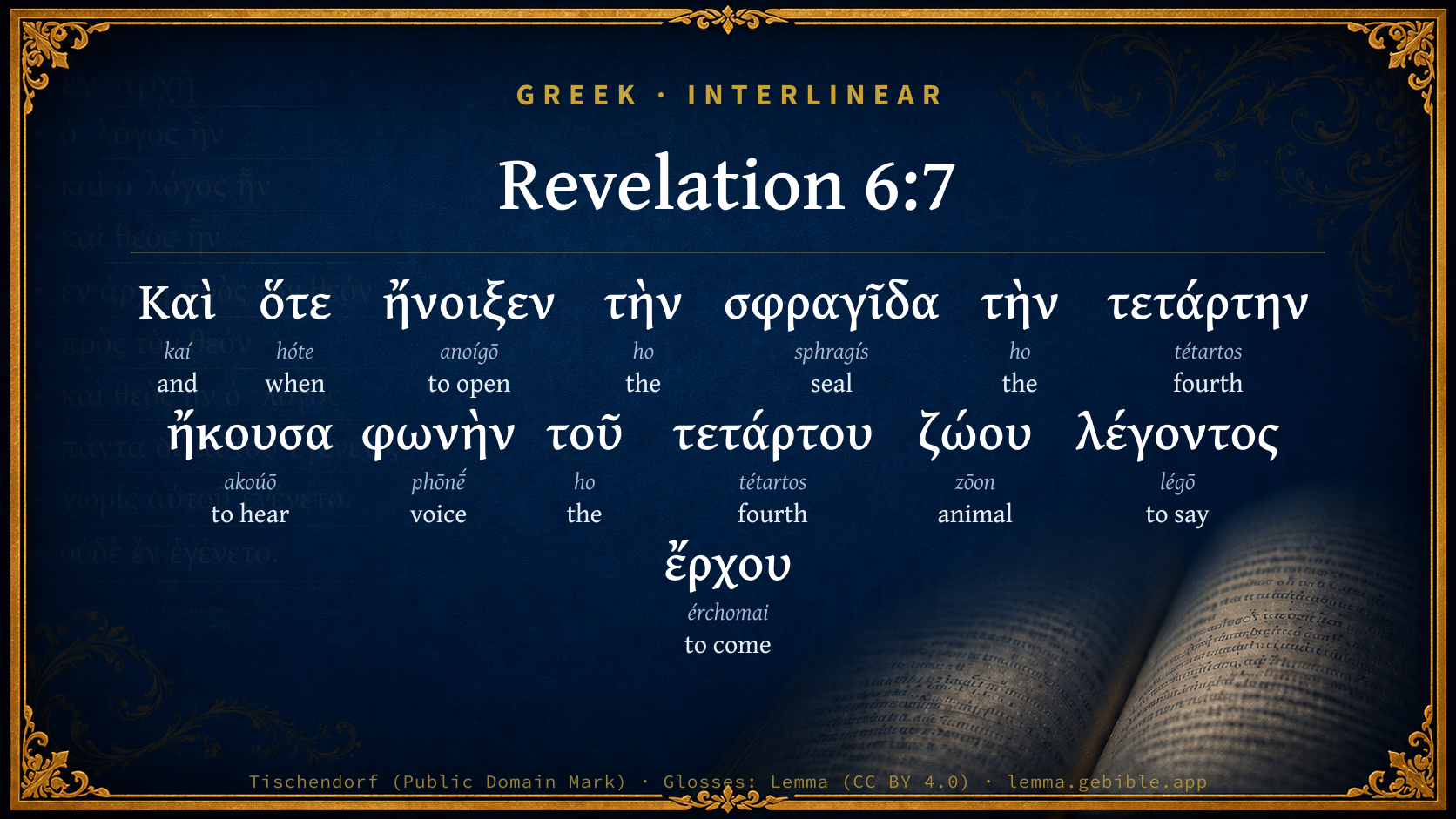
  1. Καὶ kaí G2532 “and” Conjunction
  2. ὅτε hóte G3753 “when” Adverb
  3. ἤνοιξεν anoígō G455 “to open” Verb, Aorist, Active, Indicative, 3rd person, Singular
  4. τὴν ho G3588 “the” Article, Accusative, Singular, Feminine
  5. σφραγῖδα sphragís G4973 “seal” Noun, Accusative, Singular, Feminine
  6. τὴν ho G3588 “the” Article, Accusative, Singular, Feminine
  7. ἤκουσα akoúō G191 “to hear” Verb, Aorist, Active, Indicative, 1st person, Singular
  8. φωνὴν phōnḗ G5456 “voice” Noun, Accusative, Singular, Feminine
  9. τοῦ ho G3588 “the” Article, Genitive, Singular, Neuter
  10. τετάρτου tétartos G5067 “fourth” Adjective, Genitive, Singular, Neuter
  11. ζώου zōon G2226 “animal” Noun, Genitive, Singular, Neuter
  12. λέγοντος légō G3004 “to say” Verb, Present, Active, Participle, Genitive, Singular, Neuter
  13. ἔρχου érchomai G2064 “to come” Verb, Present, Middle or Passive deponent, Imperative, 2nd person, Singular

About this verse

These counts appear in no published source. They are computed here, from the morphology-tagged text and Lemma’s own curated glosses. What Lemma adds →

14
words
11
distinct lemmas
Revelation
section

Notable vocabulary

The rarest word here is τετάρτην fourth G5067 — appearing just 10 times in the whole Greek New Testament.

Shared distinctive vocabulary

τετάρτην fourth G5067 occurs in 9 verses of the Greek New Testament. Also found in:

Repetition

Words recur within this verse:

  • τετάρτην fourth G5067 ×2
  • τὴν the G3588 ×3

Cross-references

4

Topical passages linked to Revelation 6:7 in the Treasury of Scripture Knowledge — connected by theme and wording, ordered by reader-vote popularity; previews shown in the World English Bible.

  • Revelation 4:7 The first creature was like a lion, and the second creature like a calf, and the third creature had a face like a man, and the fourth was like a flying eagle.
  • Revelation 6:3 When he opened the second seal, I heard the second living creature saying, "Come!"
  • Revelation 6:1 I saw that the Lamb opened one of the seven seals, and I heard one of the four living creatures saying, as with a voice of thunder, "Come and see!"
  • Revelation 6:5 When he opened the third seal, I heard the third living creature saying, "Come and see!" And behold, a black horse, and he who sat on it had a balance in his hand.

Cross-references courtesy of OpenBible.info (CC BY 4.0).

Where the printed editions differ

1 variant

Places in this verse where the major printed Greek editions disagree on the wording in a way that affects the translation — a comparison of editions, not a manuscript-by-manuscript collation. The editions are the modern critical texts (Nestlé-Aland 28/27, SBL, Westcott-Hort, Tregelles, Tyndale House) and the traditional texts behind the KJV (the Textus Receptus and the Byzantine/Majority text). It is not a claim about which reading is original.

  1. Extra text
    καὶ

    “and”

    In TRByz Not in NA28NA27TynSBLWHTreg

Textual data: Translators Amalgamated Greek New Testament (STEPBible TAGNT) · CC BY 4.0.

Commentary

Notes on Revelation 6:7 from classic Christian and Jewish commentators (each source and its license shown beneath its notes). The classic Christian expositions comment on the surrounding passage and are grouped to its opening verse, so a note may address several verses; the Jewish commentaries on the Tanakh (Rashi and others) are per-verse, so they appear only where the commentator wrote on this verse.

Lemma curates 59 commentaries, every one of them public domain or Creative Commons licensed, each selected and text-cleaned for this edition rather than reprinted as found. About our sources →

The Cambridge Bible for Schools and Colleges

gen. ed. J. J. S. Perowne

The Fourth Seal, Rev_6:7-8

7. I heard the voice of] The slight variation of phrase serves to mark the fourth rider off, as partly distinct in character from the rest. They have brought an increasing series of scourges to the earth: his work is utter and unmitigated woe, combining the worst features of theirs.

The Cambridge Bible for Schools and Colleges (gen. ed. J. J. S. Perowne; Cambridge University Press, 1878–1918) — public domain. Text from a community e-Sword module.

The Biblical Illustrator

Joseph S. Exell

Rev_6:7-8

A pale horse:…Death, and hell

Death on the pale horse

I.

This horse and his rider set out after us as soon as we were born; they are perpetually gaining ground on us, and therefore sooner or later they must overtake us.

II. It is awfully uncertain when he will overtake us.

III. It is equally certain, that when he does overtake us he will strike his blow, and nothing can prevent it. There is a great deal said at this day about the march of intellect. Yes; but intellect with all its march, never out-marches Death. He marches faster than intellect, and he will soon overtake. Nor can the greatest peace, holiness, and usefulness prevent it.

IV. Who then are the characters that, when death strikes the blow, will drop into hell, in the literal sense of the word?

1. Those who have never broken off their sins by true repentance.

2. Those who have not a personal interest in Jesus Christ by faith.

3. Those who have not experienced the regenerating influence of God; die as you are, without being born again, and you will be lost.

4. Those who did once run well, but who have now ceased to run well. (W. Dawson.)

The life of faith in death

But what now are we come out to see?

I. Behold the seal opened. Seals we use commonly to confirm and conceal, to make things sure, and to keep things secret. And thus death, as all Gods judgments, is said to be sealed (Job_3:3), and that with a firmer seal than of the Medes and Persians. In a word, men die not by chance, course of nature, influence of stars, but then and therefore, because it is appointed. That Christian who believes this, though he may desire Davids arithmetic to number his days aright, yet will he never study the black and senseless art of calculating his birth and death. None but fools are curious and inquisitive to know that which is under Gods privy signet. We are all as soldiers sent to sea with commission under seal, not to be opened till we come to such and such a point. Some deaths, indeed (as some clocks), give warning before they strike, with symptoms and signs infallible; but generally God hath seen this the best for us, that it should be for the general most certain, for the particular most uncertain, to him sealed, to us concealed; of which he would have us make these uses.

1. First, for our bodily health, not to be too careful, nor too careless.

2. Secondly, for our souls provision, not to do as most that have set days of truce and peace, and in which they hang up their armour a-rusting, and their beacons unwatched; but as people that live in perpetual hazard of war have all things in a daily readiness for service upon the least alarm.

3. Whenever this horse conies to fetch away us, or any of ours, children, or friends, a believer stamps not, and rages not, murmurs not, repines not, as the wild Irishmen without hope; expostulates not with destiny, but with Aaron, lays his hand on his heart and mouth for his sons sudden death, knowing what God hath sealed shall be and must be.

II. The seal being thus opened, come and see the creature that issues forth. Behold an horse, a fierce, a strong, a warlike, a speedy creature, so described by God Himself (Job_39:1-30.). Look, as the sturdy steed dashes out the little whappets brains, so easily doth Death with the least kick and spurn of his heel the stoutest constitution, triumphing like an emperor over all sorts of people, treading on the necks of kings and princes, as Joshua over them in the cave. What, then, is the course the Christian takes? He neither foolishly thinks to resist or escape, nor yet cravenly yields; but addresseth himself for the encounter.

III. Behold also the colour of this horse, the colour of the withering leaf, pale and wan, symbolising and noting the effect he hath first upon the living, whom he appals. See we not often prisoners at the bar wane away, and dye as white as a cloth at the sentence of death pronounced on them. A second effect of this pale horse is after death, bereaving the bodies of all blood and colour, making them lifeless, till the fashion of them he utterly altered, the beauty consumed, and shape turned into rottenness. Oh, how grievous is this to such Absaloms, Jezebels, and Rosamonds, who have set much by their painted sheaths and pampered carcases. Dust they were, and to dust they must return. Favour is deceitful, and beauty is vanity.

IV. Well, then, behold also, even hell, the page and follower of death, attending him wherever he goes among the wicked sort. Whence it is that they are so often coupled in this book, death and hell. Look as the foxes wait upon lions, carrion crows upon armies, gaolers upon sergeants for a prey, so diligently does the devil on Death for a booty. No fowler does more cunningly stalk behind the horse, or creep behind hedges, to get his aim at the shy fowls. No sergeant hides his mace, no angler his hook more warily, knowing that else hell should never swallow so many. In this consists the devils chiefest policy and our grossest simplicity, and even this is the cause of our sottish and foolish living and dying. (T. Adams.)

Views of death

I. The description given us of death.

1. Death is under a seal. It has a commission to execute, and cannot go beyond it: limits are fixed to it by the purpose and power of God, and it cannot break through them. Death is inevitable, because the Divine decree is unalterable. We fear death, and we fear hell; but he is more to be feared who has the keys of both. We are immortal till our time is come, and our work is done. The king of terrors, before he can level his dart so as to do any execution, must have a warrant from the King of heaven.

2. It is represented as riding: not creeping, walking, or running, but riding; which intimates that he moves swiftly, and often comes unexpectedly. It may also denote something of state and majesty: for it may be said of him, as of the other horseman, that he goeth forth conquering and to conquer. No wisdom can deliver, no strength can rescue, no wealth can ransom from this victorious enemy.

3. Death rides on a pale horse, and this colour may denote the general appearance of mortality.

4. It is represented in our text as having hell following after it. The page is more dreadful than the master; death would not be so terrible, were it not for that which follows it. Death to a wicked man is but the beginning of sorrows: to make use of it, then, as a remedy for other griefs, is but like leaping out of the smoke into the flame. We may make a mock of sin; but can we make a mock of hell?

II. Our duty with respect to death.

1. That we render the thoughts of death familiar to ourselves.

2. That we exercise faith in the providence and grace of God, both with respect to death and its consequences.

3. That we patiently wait and cheerfully submit to it. (B. Beddome, M. A.)

The

pale horse:--

I. The figurative description here given of death.

II. Our duty respecting it.

1. Come and see the antiquity of death.

2. Come and see the extent of its devastations.

3. Come and see this spoiler conquered.

4. Come and see how death may safely be encountered. (J. Burns, D. D.)

The Biblical Illustrator, edited by Joseph S. Exell (c. 1880s–1900s) — public domain. Text from a community e-Sword module.

Joseph Benson's Commentary

Rev 6:7-8. And when he had opened the fourth seal, I heard the voice of the fourth living creature — Like an eagle, toward the north; say, Come and see — Receive a further discovery of the divine will. And I looked, and behold a pale horse — Suitable to pale death, his rider. By death, in the Hebrew, we are frequently to understand the pestilence. See Jer 9:21; Jer 18:21; and Sir 39:29. And many other instances might be produced. And hell — Or hades, rather, representing the state of separate souls, followed with him. And power was given unto them — Namely, to death and hades. Or if we read, with Bengelius, αυτω, the expression is, Power was given to him, namely, to death; over the fourth part of the earth — That is, a very considerable part of the heathen Roman empire: to kill — By the several judgments of God here mentioned; with sword — That is, with war; with hunger — Or famine; with death — Or the pestilence; and with the beasts of the earth — These are called the four sore judgments of God, in the style of ancient prophecy. See Eze 14:21; Eze 33:27. The meaning is, That the sword and famine, which were judgments of the foregoing seals, are continued in this, and the pestilence is added to them. Accordingly, says Lowman, we find all these judgments in a very remarkable manner in this part of history, that is, in the reigns of Maximin, Decius, Gallus, Volusian, and Valerian, beginning after Severus, about the year 211, to A.D. 270. Thus also Bishop Newton; who observes, This period commences with Maximin, who was an emperor from the north, being born of barbarous parents in a village of Thrace. He was indeed a barbarian in all respects; an historian affirming that there was not a more cruel animal upon the earth. The history of his, and several succeeding reigns, is full of wars and murders, mutinies of soldiers, invasions of foreign armies, rebellions of subjects, and deaths of princes. There were more than twenty emperors in the space of fifty years, and all, or most of them, died in war, or were murdered by their own soldiers and subjects. Besides lawful emperors, there were, in the reign of Gallienus, thirty usurpers, who set up in different parts of the empire, and came all to violent and miserable ends. Here was sufficient employment for the sword; and such wars and devastations must necessarily produce a famine, and the famine is another distinguishing calamity of this period. In the reign of Gallus, the Scythians made such incursions, that not one nation, subject to the Romans, was left unwasted by them; and every unwalled town, and most of the walled cities, were taken by them. In the reign of Probus also there was a great famine throughout the world; and for want of victuals, the army mutinied and slew him. A usual consequence of famine is the pestilence, which is the third distinguishing calamity of this period. According to Zonaras, it arose from Ethiopia, while Gallus and Volusian were emperors, pervaded all the Roman provinces, and for fifteen years together incredibly exhausted them; and the learned Lipsius declares, that he never read of any greater plague, for the space of time that it lasted, or of land that it overspread. Zozimus also, speaking of the devastations of the Scythians before mentioned, further adds, that the pestilence, not less pernicious than war, destroyed whatever was left of human kind, and made such havoc as it had never done in former times. Many other historians, and other authors quoted by Bishop Newton, bear the same testimony; among whom Eutropius affirms, that the reign of Gallus and Volusian was remarkable only for the pestilence and diseases. And Trebellius Pollio attests, that in the reign of Gallienus the pestilence was so great, that five thousand men died in one day. Now when countries thus lie uncultivated, uninhabited, and unfrequented, the wild beasts usually multiply, and come into the towns to devour men, which is the fourth distinguishing calamity of this period. This would appear a probable consequence of the former calamities, if history had recorded nothing. But Julius Capitolinus, in his account of the younger Maximin, p. 150, informs us that five hundred wolves together entered into a city, which was deserted by its inhabitants, where this Maximin chanced to be. The colour of the pale horse, therefore, is very suitable to the mortality of this period; and the proclamation for death and destruction is fitly made by a creature like an eagle, that watches for carcasses. This period the bishop considers as continuing from Maximin to Dioclesian, about fifty years.

Joseph Benson's Commentary on the Old and New Testaments (1811–1818) — public domain. Text from a community e-Sword module.

Tyndale Open Study Notes

Tyndale Open Resources

6:7-8 With the fourth seal comes a ghastly looking horse. In the ancient world, pale green was the color for depicting a corpse. • the Grave: Greek Hades. In Greek thought, Hades was the underworld abode of bodiless beings. The Hebrew idea of Sheol, the place of the dead (1 Sam 28:15), was similar. • The killing of one-fourth of those on earth indicates that the final judgment has not yet arrived (contrast Rev 6:16-17). • This fourfold set of woes (sword and famine and disease and wild animals; cp. Ezek 14:21) summarizes the tragedies of earthly existence. The world cannot offer hope to humanity.

Tyndale Open Study Notes — © Tyndale Open Resources, licensed CC BY-SA 4.0. Text via the HelloAO Bible API.

Meyer's Critical & Exegetical Commentary

Heinrich August Wilhelm Meyer

Rev_6:7-8. The fourth form of horseman is recognizable not only by the entire description, but also his name is expressly mentioned: ὄνομα αὐτῷ ὁ Θάνατος. The text is thus as contradictory as is possible to all allegorizing interpretations of mortal heresy,[2071] of the complete falling away from Christ as spiritual death,[2072] of the Saracens and Turks,[2073] of the Roman people with the Emperor Domitian, whom Hell follows, because immediately after his death he entered it.[2074] Incorrect, also, as in Rev_6:5-6, is the limited reference of the whole to any special case, as possibly to the diseases and rapine which occurred at the time of the Jewish war in consequence of the famine (Rev_6:5-6),[2075] or to the devastations made by the flavi Germani, and other nations of the migration.[2076] As already by the ancient prophets, in addition to the sword[2077] and hunger,[2078] pestilence[2079] and also wild beasts[2080] were called grievous divine judgments, so the Lord also enumerates pestilences (ΛΟΙΜΟΊ) among the signs of his coming. Yet it does not follow thence that the horseman, who has the name Ὁ ΘΆΝΑΤΟς, is the plague;[2081] but it corresponds with those types, that death personified, just as the shedding of blood personified, and famine personified, should enter because of the Lords going forth to his victorious goal, and that the means mentioned (Rev_6:8) should ascribe to him deadly efficacy. This horse has the color which agrees with his work. χλωρός designates not only the fresh green of the grass,[2082] but also the greenish pallor of fear[2083] and of death.[2084]

ὁ καθήμενος. The loose but forcible construction in which the preceding nom. is absorbed by the following dat. (ὌΝ. ΑὐΤῷ Ὁ ΘΑΝ.), as in Rev_3:12; Rev_3:21.

ΚΑῚ Ὁ ἍΙΔΗς ἨΚΟΛΟΎΘΕΙ ΜΕΤʼ ΑὐΤΟῦ. The ΜΕΤΆ with ἈΚΟΛ. as Luk_9:48. To understand Hades by metonymy for the inhabitants of Hades, the host of those swept away by death,[2085] is an assumption which not only gives a monstrous idea, but also especially avoids the correct reading ἘΔΌΘΗ ΑὐΤΟῖς. The incorrect explanation, as well as the incorrect reading ΑὐΤῷ, depends upon the failure to recognize the fact that Hades, i.e., the place belonging to death,[2086] because filled by the agency of death, is represented here like death itself, as a person following death. The idea of locality, which especially belongs to Hades, is also in Rev_1:18 decisive as to the idea of death; conversely here and in Rev_20:13 sqq., Hades is personally considered, which suits better the idea of death. But to regard Hades only as the place of torment for the damned,[2087] is only possible if the plagues indicated in Rev_6:8 are misunderstood as though pertaining to unbelievers alone. The contrary is decided partly by the entire tendency of all four seal-visions, and partly, especially in this place, by the express extension of the dominant power granted death and hell following it, to the fourth part of the earth, and therefore of all inhabitants of the earth, believerswho have patiently endured and hoped for the coming of the Lordas well as unbelievers.[2088]

ΤῸ ΤΈΤΑΡΤΟΝ. The schematic number gives the idea of a considerably great portion of the whole; a still greater part is designated by the schematic three.[2089]

ἘΝ, as a designation of the instrument or means,[2090] stands properly with ῬΟΜΦΑΊᾼ, ΛΙΜῷ, and ΘΑΝΑΤῷ; while to ΘΗΡΊΩΝ, as the beasts themselves are active, ὙΠΌ is attached,[2091] which in other cases also is combined in classical Greek with the active.[2092] The ῥομφαία, Rev_6:8, has as little to do with the ΜΆΧΑΙΡΑ, Rev_6:4, as the ΛΙΜΌς concurs with the famine, Rev_6:5-6; on the contrary, such means to kill are to be ascribed to Death personally portrayed with Hell, as already in the O. T. are threatened as destructive means of punishment prior to Gods judgment. Because of the juxtaposition of ἘΝ ΘΑΝΆΤῼ with ἘΝ ῬΟΜΦΑΊᾼ and ἘΝ ΛΙΜῷ, the ΘΑΝΆΤῼ is readily taken specially as a designation of the plague, especially as the LXX., in similar connections, use ΘΆΝΑΤΟς where the Heb. text has דֶבֶר;[2093] but if John had wished to designate this precise idea, the expression ΛΟΙΜΌς[2094] would scarcely have escaped him. As in Rev_2:23, the general conception must be maintained also in this passage,[2095] which also appears the more suitable as the ἘΝ ΘΑΝΆΤῼ occurs in a certain exclusive way to the two preceding conceptions which are likewise furnished with the prep. ἘΝ, while the attached ὙΠῸ Τ. ΘΗΡΊΩΝ Τ. Γ., as also the change of prep. shows, connects it again with a certain independence to the three preceding conceptions. [See Note XLIX., p. 235.]

[2071] Beda, who mentions especially Arius; Zeger, etc.

[2072] Stern.

[2073] Vitr., C. a Lap.

[2074] N. de Lyra.

[2075] Wetst., Grot., Herd., Böhmer.

[2076] Huschke.

[2077] Cf. Rev_5:3 sqq.

[2078] Cf. Rev_6:5 sqq.

[2079] דֶבֶר. LXX.: θάνατος, Jer_21:7; Jer_14:12.

[2080] Lev_16:22; Eze_14:21.

[2081] Pestis nomine mortis (Eichh.).

[2082] Rev_8:7, Rev_9:4; Mar_6:39.

[2083] Il. vii. 479.

[2084] Pallida mors.

[2085] Eichh., Ebrard.

[2086] Cf. Rev_1:18, Rev_20:13 sqq.

[2087] Hengstenb.

[2088] Beng., Ew.

[2089] Rev_8:7.

[2090] Cf. Rev_2:16.

[2091] Cf. Ew., De Wette.

[2092] Matth., Ausführ. Griech. Gramm., § 592.

[2093] Vitr., Beng., De Wette, etc.

[2094] Mat_24:7.

[2095] Hengstenb., Ebrard.

NOTES BY THE AMERICAN EDITOR

XLIX. Rev_6:2-8

Alford regards the four seals, in their fulness, as contemporaneous, the ἵνα νικήσῃ not being accomplished until the entire earth is subjugated, although they may receive continually recurring, or even ultimate, fulfilments, as the ages of the world go on, in distinct periods of time, and by distinctly assignable events. So far, we may derive benefit from the commentaries of those who imagine that they have discovered their fulfilment in successive periods of history, that, from the very variety and discrepancy of the periods assigned by them, we may verify the facts of the prevalence of these announced judgments hitherto, throughout the whole lifetime of the Church.

Meyer — Critical and Exegetical Commentary on the New Testament — English translation by Peter Christie, edited by Frederick Crombie (T&T Clark, 1880) — public domain. Text from a community e-Sword module.

Expositor's Greek Testament

ed. W. Robertson Nicoll

Rev 6:7-8 . The fourth seal opened pestilence and mortality .

The Expositor's Greek Testament, edited by W. Robertson Nicoll (1897–1910) — public domain. Text from a community e-Sword module.

Geneva Bible (1599)

Geneva Bible translators

The fourth sign joined with words of declaration, is, that God will addict the fourth part of the world indifferently, unto death and hell, or the grave by all those means at once, by which before severally and in order he had recalled their minds unto amendment. Unto these are also added the wild and cruel beasts of the earth, out of Lev. 26:22. Thus doth God according to his wisdom dispense the treasures of his power, justly towards all, mercifully towards the good, and with patience or longsufferance towards his enemies.

Geneva Bible (1599) marginal notes — public domain. Text via Bolls.life.

Jamieson, Fausset & Brown

Robert Jamieson, A. R. Fausset & David Brown

and see--supported by B; omitted by A, C, and Vulgate. The fourth living creature, who was "like a flying eagle," introduces this seal; implying high-soaring intelligence, and judgment descending from on high fatally on the ungodly, as the king of birds on his prey.

Jamieson, Fausset & Brown — Commentary Critical and Explanatory on the Whole Bible (1871) — public domain (CC PDM 1.0). Text via the HelloAO Bible API.

Adam Clarke's Commentary

Verse 7. The fourth beast] That which had the face of an eagle.

Adam Clarke's Commentary on the Bible (1810–1826) — public domain. Text from a community e-Sword/MySword module.

Ellicott's Commentary for English Readers

(7, 8) The fourth seal.—And when He opened the fourth seal, I heard the voice of the fourth living being, saying, Come. And I saw, and behold, a horse, pallid (or, livid), and he that sat upon him his name was Death, and Hades was following with him; and there was given to them power over the fourth part of the earth to kill with sword, and with famine, and with death, and by the wild beasts of the earth. The colour pallid, or livid, is that deadly greenish hue, which is the unmistakable token of the approach of death. The rider is Death—not a particular form of death, but Death himself. Attending him, ready to gather up the slain, is Hades. The fourth seal is the darkest and most terrible. Single forms of death (war and famine) were revealed in the earlier seals; now the great King of Terrors himself appears, and in his hand are gathered all forms of death—war, famine, pestilence (for the second time the word “death” is used: it must be taken in a subordinate sense, as a particular form of death, such as plague, or pestilence; we may compare the use of the word “death” thus applied to some special disease, in the case of The Death, or Black Death), and wild beasts. These forms of death correspond with God’s four sore judgments—the sword, and famine, and pestilence, and the noisome beasts of Eze_14:21. The seal, therefore, gathers up into one all the awfulness of the past seals. It is the central seal, and it is the darkest. It is the midnight of sorrows, where all seems given up to the sovereignty of death. The middle things of life are often dark. Midway between the wicket-gate and golden city Bunyan placed his valley of the shadow of death, following the hint of the Psalmist, who placed it midway between the pasture and the house of the Lord (Psalms 23). Dante, perhaps working from the same hint, found his obscure wood and wanderings midway along the road of life:—

“In the midway of this our mortal life

I found me in a gloomy wood, astray.”

The darkest periods of the Church’s history were those we call the Middle Ages. By this, however, it is not meant that there is any chronological signification in the seal. The vision deepens in its central scene, like the horror of darkness in the dream of Abraham. The history of the Church has not unfrequently presented a sort of parallel. The age which follows the ages of barren dogmatism and of spiritual starvation is often an age of sham spiritual life. The pale horse of death is the parody of the white horse of victory: the form of godliness remains, the power is gone.

A Bible Commentary for English Readers, edited by Charles John Ellicott (1878–1897) — public domain. Text from a community e-Sword module.

John Gill's Exposition

And when he had opened the fourth seal,.... Of the seven seals of the sealed book; that is, when the Lamb had opened it, or took it off, as in Rev 6:1;

I heard the voice of the fourth beast say, come and see; this living creature was that which was like an eagle, and was on the north side of the throne, answerable to the standard of Dan, which was on the north of the camp of Israel, and had the figure of an eagle upon it; and the opening of this seal begins with Maximinus the Roman emperor, who came from Thrace, far north. This living creature was not James, the brother of our Lord, who had been dead long ago, as Grotius imagines; nor Cyprian, as Brightman thinks, though he lived under this seal; but the ministers of the Gospel in general in the times referred to are intended: and it may denote some decline in the Gospel ministry, that they had not the courage and strength of the lion, as the first Gospel preachers; nor the patience and laboriousness of the ox, the next set of ministers; nor the solidity and prudence of the man, the ministers that followed them; and yet they retained some degree of light and knowledge, sagacity and penetration, and contempt of the world, signified by the eagle; these invite John in a visionary way to come and see the following hieroglyphic.

John Gill's Exposition of the Whole Bible (1746–1763) — public domain (CC PDM 1.0). Text via the HelloAO Bible API.

Trapp's Complete Commentary

John Trapp

7 And when he had opened the fourth seal, I heard the voice of the fourth beast say, Come and see.

Ver. 7. {See Trapp on "Rev 6:3"}

John Trapp, A Commentary or Exposition upon All the Books of the Old and New Testament (1647–1656) — public domain. Text from a community e-Sword module.

Albert Barnes' Notes on the Bible

And when he had opened the fourth seal - See the notes at Rev 5:1.

I heard the voice of the fourth beast say - The flying eagle. See the notes at Rev 15:7. As in the other cases, there does not appear to have been any particular reason why the fourth of the living creatures should have made this proclamation rather than either of the others. It was poetic and appropriate to represent each one in his turn as making proclamation.

Come and see - See the notes at Rev 6:1.

Albert Barnes' Notes on the Bible (1834–1885) — public domain. Text from a community e-Sword/MySword module.

Haydock's Catholic Bible Commentary

The fourth seal....a pale horse, the rider’s name death. It is also expounded of trials, afflictions, persecutions, and especially of plagues, over four parts of the earth, by which may be denoted the great power and extent of the Roman empire. In the Greek we read, over the fourth part of the earth; which some reconcile, by observing that the Roman empire had dominions under it in all the four parts of the world, east, west, north, and south; and that its dominions might be said to comprehend the fourth part of the world. (Witham) --- By the pale horse, and the rider, death, who sat upon it, followed by hell, are meant that dreadful mortality which ever attends famines, &c. He had power to kill with sword, with famine, &c. All these evils came upon the Roman people, and history has preserved the memory of them, to shew the truth of the prophecy here delivered by St. John. (Grotius; Calmet)

George Leo Haydock (1774–1849), Haydock's Catholic Family Bible and Commentary, 1859 edition — public domain. Excludes Psalms (Douay-Rheims chapter numbering differs from Protestant) and Deuterocanonical books (Catholic canon only).

Matthew Poole's English Annotations

The beast mentioned Rev 4:7, that had the face of a flying eagle, inviteth John to attend to the opening of

the fourth seal, that is, the revelation of the counsels of God, as to what should happen to the church (within the Roman empire) in the fourth period, which is conceived to have begun with Maximinus, about the year 237, and to have ended with the reign of Dioclesian, 294.

Matthew Poole's English Annotations on the Holy Bible (1683–1685) — public domain. Text from a community e-Sword/MySword module.

The Pulpit Commentary

And when he had opened the fourth seal, I heard the voice of the fourth beast say; when he opened, as in vers. l, 3, and 5. The events narrated accompany the action of opening the seal. Of the fourth living being . (see on Rev_4:6) The individual is not specified (see on ver. 1); but Wordsworth specifies the living being like a flying eagle, by which he understands the Gospel of St. John (but see on Rev_4:6). Saying. Though legousan , the feminine accusative, to agree with fwnhn , "voice," is adopted in the Textus Receptus, and supported by the sole authority of 1, yet a, A, B, C, P, and others read legontov , the masculine genitive, agreeing with zwou , "living being." Come and see. The Revised Version omits "and see" (see on ver. 1). "Come" is probably addressed to St. John (see on ver. 1).

The Pulpit Commentary (1880–1919), ed. H.D.M. Spence-Jones & Joseph S. Exell — public domain. Text from a community e-Sword module.

John Wesley's Explanatory Notes

I heard the voice of the fourth living creature - Toward the north.

John Wesley, Explanatory Notes Upon the Whole Bible (1754–1765) — public domain. Text via the GEBible commentary corpus.

Scofield Reference Notes

C. I. Scofield

beast living creatures. (See Scofield "Eze 1:5").

Come and see Come! Omit "and see." So Rev 6:1; Rev 6:3; Rev 6:5

The Scofield Reference Bible (1917 edition), notes by C. I. Scofield — public domain. Text from a community e-Sword module.

Kretzmann's Popular Commentary

Paul E. Kretzmann

The opening of the fourth and fifth seals:

v. 7. And when He had opened the fourth seal, I Heard the voice of the fourth beast say, Come and see.

v. 8. And I looked, and, behold, a pale horse; and his name that sat on him was Death, and hell followed with him. And power was given unto them over the fourth part of the earth to kill with sword, and with hunger, and with death, and with the beasts of the earth.

v. 9. And when he had opened the fifth seal, I saw under the altar the souls of them that were slain for the Word of God and for the testimony which they held;

v. 10. and they cried with a loud voice, saying, How long, O Lord, holy and true, dost Thou not judge and avenge our blood on them that dwell on the earth?

v. 11. And white robes were given unto every one of them; and it was said unto them that they should rest yet for a little season until their fellow-servants also and their brethren that should be killed as they were should be fulfilled.

The prophetical types of the coming tribulations became more and more of a nature to strike terror into the heart of man: And when He opened the fourth seal, I heard the voice of the fourth living being saying, Come and see. In this case the eagle-faced cherub called to John to be a careful witness of the action of the Lamb and of its results. The prophet gives this description: And I saw, and, behold, a livid horse; and he that sat upon him, his name was Death, and Hell followed after him, and to them was given power over the fourth part of the earth, to kill with sword and with hunger and with death, and by the wild beasts of the earth. Here is a gruesome picture, the horse of a pale green, livid color, and his rider Death, with Hell at his heels, with pestilence and mortality, death in all its various forms, as their instruments of punishment. Everything that will bring death upon mankind in extraordinary and unusual forms is here mentioned. Truly, these words and their type have been fulfilled in the many devastating wars and famines and pestilences of which history tells, of which the majority of people living today have been witnesses. But hell, although it accompanies death and threatens to devour all men that die, has no power over those that are in God’s hands It is true, on the one hand, that in the midst of life we are in death; but it is also true, on the other, that in the midst of death we are in life, for we are in the hands of our Redeemer.

The opening of the fifth seal: And when He opened the fifth seal. I beheld beneath the altar the souls of those that were slain on account, of the Word of God and on account of the testimony which they bore The scene is here transferred from earth to heaven, the latter being conceived of as a splendid temple with its altar of burnt offering When the Lamb opened the fifth seal of the scroll, there were disclosed before the eyes of John all the souls of those that had been martyred on account of their confession of the Word of God, of the Gospel of their salvation, on account of the testimony which they bore to their Redeemer. Since the time of Stephen, who was murdered for his confession of Christ, the number of martyrs for the cause of Christ has steadily increased, until their number is beyond calculation. But their souls are in a safe place, in the care of God, where no plague or anguish can touch them.

The martyred souls are represented as being conscious: And they cried with a loud voice, saying, How long, O Sovereign holy and true, wilt Thou delay in charging and avenging our blood upon those that dwell upon the earth? The martyred souls are here shown in the act of crying to God for vengeance, for a vindication of His holiness and truth. The enemies of Christ and the Gospel, who have shed the blood of the Christians as water, not only in the great persecutions of the early Church, but also in the Inquisition of the Middle Ages and since, will be found by the righteousness and the avenging justice of God, for the blood of their victims cries to the Lord from the earth. God’s patience seems to delay unduly in punishing the crimes against His children, but in due time He will vindicate His holiness and truth.

This is indicated even in the manner in which the martyred souls were treated: And there was given to them, to every one, a white robe, and it was told them that they should remain quiet yet a little while, until there were added to them also their fellow-servants and their brethren that were sure to be killed as they were. White garments, the symbol of sanctity, purity, righteousness, and innocence, were given to the perfected saints in token of the righteousness of Christ which had been imputed to them by faith, by virtue of which all their sin was covered. The number of martyrs was not yet complete; as the enmity of the heathen increased, others would surely be added, just as history has shown and is showing this to us. But only a little while it would last, as God’s time is reckoned, and then God’s day of wrath would surprise the enemies of His Word, then God’s holiness and justice would be vindicated in all eternity. Patience, therefore, is one of the greatest Christian virtues, patience and a certain trust in the government of God.

Paul E. Kretzmann, Popular Commentary of the Bible (1921–1924) — public domain. Text from a community e-Sword module.

Burkitt's Expository Notes on the New Testament

William Burkitt

The fourth seal opened represents a pale horse, (pestilence,) with death riding upon it; and hell, that is, the grave, followed it: denoting, say some, all the calamities of sword, pestilence, and famine, which Christ Mark 13 foretold should come upon the Jews, and cause an universal devastation of their city and nation, and as universal a destruction of their persons.

Note here, 1. How death is represented as sitting upon a pale horse; by a horse, for his strength, there is no resisting of him; for his swiftness, it is always posting towards us; for his office and use, which is to cut off, and carry away; and by a pale horse, for its ghastliness. Death has a grim and ghastly countenance, that strikes terror into all hearts, and paleness into all faces.

Note, 2. As terrible as death was, it must and did receive power before it could destroy and kill: I beheld a pale horse, and he that sat on him was death, and hell followed with him: and power was given to them.

Learn thence, That all the executioners of God’s wrath and vengeance, sword, pestilence, and famine, death of all kinds, do act by commission, yea, they all come forth with limited commission; power was given to them.

Others conceive, that by this pale horse the persecution of the primitive church was represented under the Pagan emperors, who made her face look pale like death, by the loss of a vast quantity of blood and spirits, when the church was mowed down like a meadow, and sprang as fast.

William Burkitt's Expository Notes on the New Testament (1700–1703) — public domain. Text from a community e-Sword module.

The People's New Testament

B. W. Johnson

7, 8. Behold a pale horse, and his name that sat on him was death. Again, for the fourth time John beholds a horse. It is still a time of war. The horse is now pale, the bloodless color of the dead. Upon him sits an undescribed figure, called by the apostle Death. Behind the dread destroyer follows Hades, the unseen world, swallowing up the dying mortals and hiding them from human vision. The means employed to destroy men are described. Death and Hades employ (1) the sword or war; (2) hunger, or famine; (3) death, or pestilence, for so is the word here used often to translated, and such is its meaning in this place; and finally (4) the destruction caused by the wild beasts of forests and field. The evident meaning of this symbolism is so plain that all can understand its application, and we need only ask if the facts correspond. Do we find the scarcity, want, hunger, and pestilence, indicated by the prophecy, during the latter portion of this period of civil commotion? Do we have an awful reign of Death in the forms signified by the seal?

The Fulfillment. —Let the reader turn to the tenth chapter of the first volume of Gibbon's Rome. It details a condition of things which existed in the reign of Gallienus, when the ninety-two years of civil war were drawing towards a close about a.d. 268. During that reign nineteen pretenders to the throne aroused rebellions which were quenched in blood. The chapter closes with a passage which I ask the reader to compare carefully not only with verses 7 and 8, but also with verses 6 and 7. “But a long and general famine was a calamity of a more serious kind. It was the inevitable consequence of rapine and oppression, which extirpated the produce of the present and the future harvests. Famine is almost always followed by epidemical diseases, the effect of scanty and unwholesome food. Other causes must, however, have contributed to the furious plague, which, from the years two hundred and fifty to the year two hundred and fifty-six, raged without interruption in every province, every city, and almost every family of the Roman Empire. During some time five thousand persons died daily in Rome; and many towns that had escaped the hands of the Barbarians, were entirely depopulated. Applying this authentic fact to the most correct tables or mortality, it evidently proves, that above half the people of Alexandria had perished; and could we venture to extend the analogy of the other provinces, we might suspect that war, pestilence, and famine had consumed, in a few years, the moiety of the human species.”

Note the correspondence, John in round numbers states that one-fourth of the people of the Roman Empire would perish; Gibbon furnishes data for suggesting that one-half perished. John assigns four causes for this awful mortality: the sword, hunger, pestilence and wild beasts. Of these four Gibbon names in the last sentence of the above quotation three, and writers of the period itself speak of the fourth, the scourge of ravenous wild beasts which had multiplied owing to the depopulation of great provinces.

The first four seals, the Seals of the Horses, are associated. These have now been considered. The first, described in verses 1 and 2, I have pronounced the seal of the Triumphant prosperity, the age of Trajan and the Antonines. The red horse of the fourth verse is the seal of civil war, fulfilled in the awful convulsions that began around a.d. 186, and agitated the whole civilized world. The third seal, the black horse and balance of the fifth verse, is the seal of want, while the next, the pale horse of the eighth verse, is the seal of death.

THE FIFTH SEAL.

It is evident from the entire change of imagery, that, after the fourth seal, the subject of prophetic vision is entirely changed. The horse now disappears, and is seen no more in connection with the opening of the seals. Along with the horse the armed warriors sweep out of sight. The next vision is that of suffering saints.

B. W. Johnson's The People's New Testament with Notes (1889–1891) — public domain. Electronic text from the Christian Classics Ethereal Library (CCEL) ThML edition.

unfoldingWord translationNotes

Door43 World Missions Community

the fourth seal

"the next seal" or "seal number four" (See: Ordinal Numbers)

the fourth living creature

"the next living creature" or "living creature number four" (See: Ordinal Numbers)

pale horse

"grey horse." This is the color of a dead body, so its color is a symbol of death.

one-fourth of the earth

Here "the earth" represents the people of the earth. AT: "one-fourth of the people on the earth" (See: Metonymy and Fractions)

the sword

A sword is a weapon, and here it represents war. (See: Metonymy)

with the wild animals of the earth

This means that Death and Hades would cause the wild animals to attack and kill people.

translationWords

name

die

Hades

famine

unfoldingWord translationNotes — © Distant Shores Media and the Door43 World Missions Community, licensed CC BY-SA 4.0. Source: git.door43.org/Door43/en_tn.

Cambridge Greek Testament for Schools and Colleges

7, 8. THE FOURTH SEAL

7. ἔρχου with ACP; Text. Rec[238] adds καὶ βλέπε with אB2 (καὶ ἴδε) and Latt.; B2 and several MSS. of Vg[239] omit καὶ εἶδον, and Primas[240] καὶ ἰδοὺ, in Rev 6:8.

[238] Rec. Textus Receptus as printed by Scrivener.

[239] Vulgate.

[240] Primasius, edited by Haussleiter.

7. ἤκουσα φωνήν. The slight variation of phrase serves to mark the fourth rider off, as partly distinct in character from the rest. They have brought an increasing series of scourges to the earth: his work is utter and unmitigated woe, combining the worst features of theirs.

Cambridge Greek Testament for Schools and Colleges (Cambridge University Press, 1896; 21 vols, various authors incl. Carr, Maclear, Plummer, Farrar, Lumby, Moule, M. R. James, Simcox) — public domain. Text from a community e-Sword module.

Lesson kit

Teaching starters — assembled from the data on this page, not authored interpretation. Every prompt links to the verse data it draws on. Edit before teaching.

Revelation, in the Revelation, opens this verse with 14 words (11 distinct Greek lemmas). Its most distinctive word is tétartos (“fourth”). A historical commentator’s framing appears above. Read the whole chapter for the surrounding context.

Discussion questions

  1. What does “fourth” (tétartos) contribute to the verse as a whole?
  2. Matthew 14:25 shares the word «fourth» with this verse. How do the two illuminate each other?
  3. “fourth” occurs 2× in this one verse. What is the effect of the repetition?
  4. These translations render this verse differently. What is at stake in choosing one wording over another?
  5. Reading how The Cambridge Bible for Schools and Colleges and The Biblical Illustrator read this verse, where do the two commentators agree and where do they part?

Things to notice

  • These translations choose different wording for 8 words in this verse.
  • “fourth” occurs 2× in this single verse.
  • 11 distinct Greek lemmas span 14 words in this verse.

Reading settings

Reading text

Shown beneath each verse's original-language words.

Old Testament
Old Testament edition

Read the OT as the Masoretic Hebrew (MT) or the Greek Septuagint (LXX).

English shown for the Greek Septuagint (in the Hebrew ↔ Greek comparison).

Comparing translations? Open the Compare panel on any verse page to stack up to four side by side.