

Acts 10:22
Greek (Tischendorf 8th ed.) Acts 10:22 appears in the Greek New Testament. The text above is from the Tischendorf 8th edition. Each word links to its Strong’s number and a concise gloss. Click any word for its full Thayer’s Greek Lexicon entry.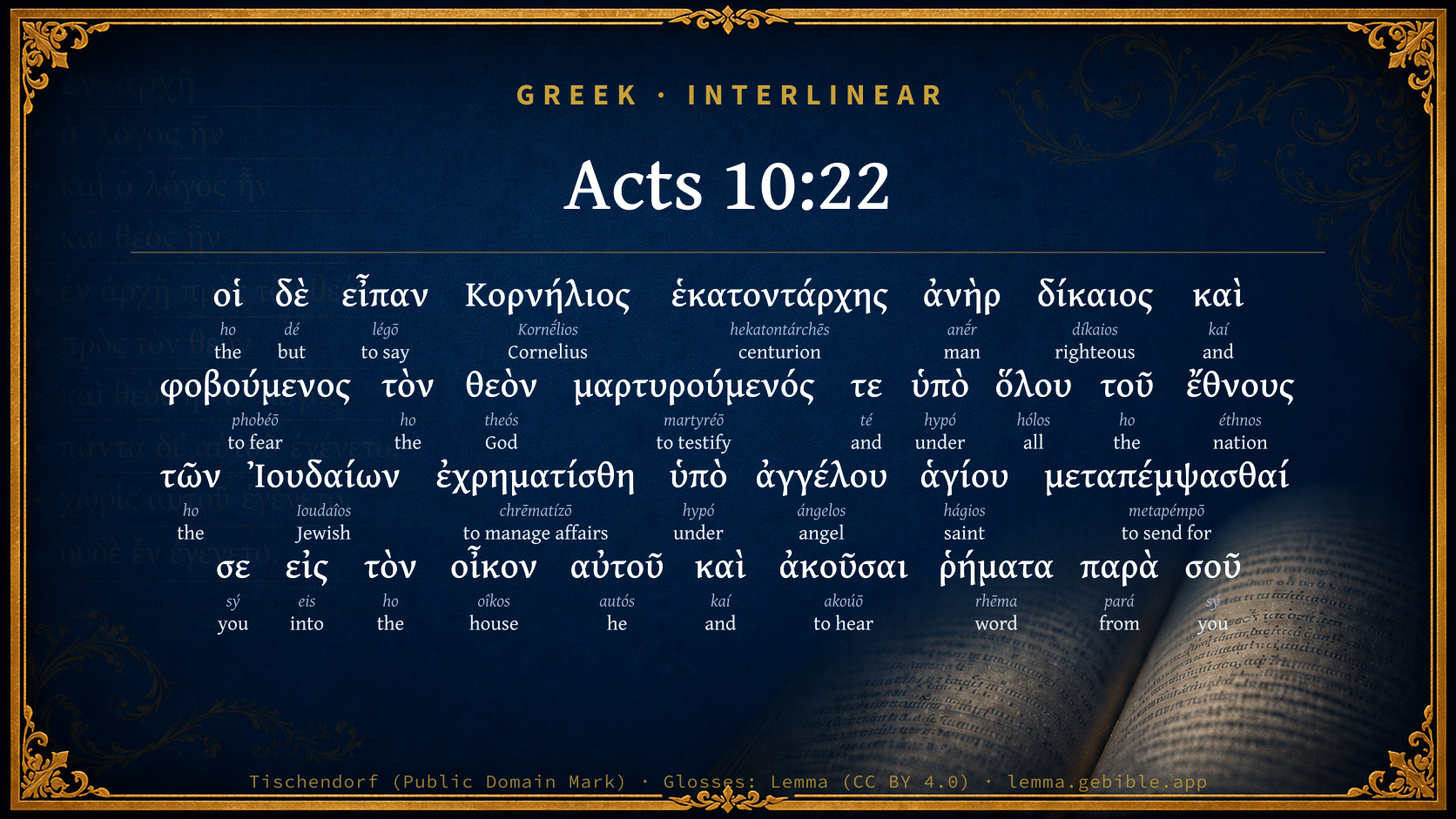
They said, "Cornelius, a centurion, a righteous man and one who fears God, and well spoken of by all the nation of the Jews, was directed by a holy angel to invite you to his house, and to listen to what you say."
Download a study sheet
One document with this verse’s original text, its word-by-word gloss line, the meaning frame, cross-references with their text, attributed commentary, and full source and license credits — printable, and it pastes into notes with its structure intact.
This verse Autodidact and up
A passage Seminary Student
Up to 50 verses in one chapter. A passage sheet keeps up to 6 commentary sources and 12 cross-references per verse, in the order this page ranks them, and says so on the sheet whenever that leaves anything out. Ask for a single verse and you get the Autodidact verse sheet above.
Everything on this page stays free to read, with no account — the sheet is a download of what is already on screen, not access to it.
Compare translations 3
The same verse in 3 English versions, stacked beneath the original-language interlinear above. Click any original word for its lexicon entry.
Each is an independent rendering of the whole verse — the interlinear is not word-aligned to these translations.
Highlighted words mark where these versions differ — a whole-verse word diff, not a word-by-word alignment.
-
World English Bible Public Domain
They said, "Cornelius, a centurion, a righteous man and one who fears God, and well spoken of by all the nation of the Jews, was directed by a holy angel to invite you to his house, and to listen to what you say."
-
King James Version Public Domain
And they said, Cornelius the centurion, a just man, and one that feareth God, and of good report among all the nation of the Jews, was warned from God by an holy angel to send for thee into his house, and to hear words of thee.
-
unfoldingWord Literal Text CC BY-SA 4.0
And they said, “Cornelius, a centurion, a man righteous and fearing God and attested by the whole nation of the Jews, was directed by a holy angel to summon you to his house and to hear words from you.”
unfoldingWord Literal Text — © unfoldingWord, licensed CC BY-SA 4.0. Word-aligned USFM3 via Door43 (git.door43.org/unfoldingWord/en_ult).
Show all 19 translations
Every available English version of this verse, each an independent rendering of the whole verse.
-
World English Bible Public Domain
They said, "Cornelius, a centurion, a righteous man and one who fears God, and well spoken of by all the nation of the Jews, was directed by a holy angel to invite you to his house, and to listen to what you say."
-
Berean Standard Bible Public Domain
“Cornelius the centurion has sent us,” they said. “He is a righteous and God-fearing man with a good reputation among the whole Jewish nation. A holy angel instructed him to request your presence in his home so he could hear a message from you.”
-
Majority Standard Bible Public Domain
“Cornelius the centurion has sent us,” they said. “He is a righteous and God-fearing man with a good reputation among the whole Jewish nation. A holy angel instructed him to request your presence in his home so he could hear a message from you.”
-
King James Version Public Domain
And they said, Cornelius the centurion, a just man, and one that feareth God, and of good report among all the nation of the Jews, was warned from God by an holy angel to send for thee into his house, and to hear words of thee.
-
American Standard Version (1901) Public Domain
And they said, Cornelius a centurion, a righteous man and one that feareth God, and well reported of by all the nation of the Jews, was warned `of God' by a holy angel to send for thee into his house, and to hear words from thee.
-
Revised Version (1885) Public Domain
And they said, Cornelius a centurion, a righteous man and one that feareth God, and well reported of by all the nation of the Jews, was warned of God by a holy angel to send for thee into his house, and to hear words from thee.
-
Geneva Bible (1599) Public Domain
And they sayd, Cornelius the captaine, a iust man, and one that feareth God, and of good report among all the nation of the Iewes, was warned from heauen by an holy Angel, to send for thee into his house, and to heare thy wordes.
-
Douay-Rheims (1899) Public Domain
Who said: Cornelius, a centurion, a just man, and one that feareth God, and having good testimony from all the nation of the Jews, received an answer of an holy angel, to send for thee into his house, and to hear words of thee.
-
Young's Literal Translation Public Domain
And they said, `Cornelius, a centurion, a man righteous and fearing God, well testified to, also, by all the nation of the Jews, was divinely warned by a holy messenger to send for thee, to his house, and to hear sayings from thee.'
-
Literal Standard Version CC BY-SA 4.0
And they said, “Cornelius, a centurion, a man righteous and fearing God, well testified to, also, by all the nation of the Jews, was divinely warned by a holy messenger to send for you, to his house, and to hear sayings from you.”
-
Unlocked Literal Bible CC BY-SA 4.0
They said, “A centurion named Cornelius, a righteous man and one who worships God, and is well spoken of by all the nation of the Jews, was told by a holy angel of God to send for you to come to his house, so he could listen to a message from you.”
-
unfoldingWord Literal Text CC BY-SA 4.0
And they said, “Cornelius, a centurion, a man righteous and fearing God and attested by the whole nation of the Jews, was directed by a holy angel to summon you to his house and to hear words from you.”
-
Darby Bible Public Domain
And they said, Cornelius, a centurion, a righteous man, and fearing God, and borne witness to by the whole nation of the Jews, has been divinely instructed by a holy angel to send for thee to his house, and hear words from thee.
-
World Messianic Bible Public Domain
They said, “Cornelius, a centurion, a righteous man and one who fears God, and well spoken of by all the Jewish nation, was directed by a holy angel to invite you to his house, and to listen to what you say.”
-
Webster's Bible Public Domain
And they said, Cornelius the centurion, a just man, and one that feareth God, and of good report among all the nation of the Jews, was warned from God by a holy angel to send for thee into his house, and to hear words from thee.
-
Free Bible Version CC BY-SA 4.0
“We come from Cornelius, a good, religious man who has reverence for God and is widely respected among the Jewish people,” they replied. “A holy angel instructed him to send for you to come to his house so he can hear what you have to tell him.”
-
Bible in Basic English Public Domain
And they said, Cornelius, a captain, an upright and God-fearing man, respected by all the nation of the Jews, had word from God by an angel to send for you to his house, and to give hearing to your words.
-
Text-Critical English NT CC BY 4.0
They said, “Cornelius, a centurion, a righteous and God-fearing man, who is well spoken of by the entire Jewish nation, was directed by a holy angel to send for yoʋ to come to his house and to hear a message from yoʋ.”
-
Tyndale New Testament (1534) Public Domain
And they sayde vnto him: Cornelius the captayne a iust man and won that feareth God and of good reporte amonge all the people of the Iewes was warned by an holy angell to sende for the into his housse and to heare wordes of the.
Literal Standard Version (2020), Covenant Press — licensed CC BY-SA 4.0. Text via the HelloAO Bible API (eBible.org). Unlocked Literal Bible (unfoldingWord) — licensed CC BY-SA 4.0. Text via the HelloAO Bible API (eBible.org). unfoldingWord Literal Text — © unfoldingWord, licensed CC BY-SA 4.0. Word-aligned USFM3 via Door43 (git.door43.org/unfoldingWord/en_ult). Free Bible Version, Dr. Jonathan Gallagher — licensed CC BY-SA 4.0. Text via the HelloAO Bible API (eBible.org).
Word by word
More ways to search: Search by grammar → Find every occurrence → Compare this word →
Practice this passage: Drill this verse → Learn its vocabulary →
- Appears 8× in the Greek New Testament
- First appears at Acts 10:1
- Part of Speech
- Noun
- Case
- Nominative
- Number
- Singular
- Gender
- Masculine
Full Thayer's Definition
- οἱ ho G3588 “the” Article, Nominative, Plural, Masculine
- δὲ dé G1161 “but” Conjunction
- εἶπαν légō G3004 “to say” Verb, Aorist, Active, Indicative, 3rd person, Plural
- Κορνήλιος Kornḗlios G2883 “Cornelius” Noun, Nominative, Singular, Masculine
- ἑκατοντάρχης hekatontárchēs G1543 “centurion” Noun, Nominative, Singular, Masculine
- ἀνὴρ anḗr G435 “man” Noun, Nominative, Singular, Masculine
- δίκαιος díkaios G1342 “righteous” Adjective, Nominative, Singular, Masculine
- καὶ kaí G2532 “and” Conjunction
- φοβούμενος phobéō G5399 “to fear” Verb, Present, Middle or Passive deponent, Participle, Nominative, Singular, Masculine
- τὸν ho G3588 “the” Article, Accusative, Singular, Masculine
- θεὸν theós G2316 “God” Noun, Accusative, Singular, Masculine
- μαρτυρούμενός martyréō G3140 “to testify” Verb, Present, Passive, Participle, Nominative, Singular, Masculine
- τε té G5037 “and” Particle
- ὑπὸ hypó G5259 “under” Preposition
- ὅλου hólos G3650 “all” Adjective, Genitive, Singular, Neuter
- τοῦ ho G3588 “the” Article, Genitive, Singular, Neuter
- ἔθνους éthnos G1484 “nation” Noun, Genitive, Singular, Neuter
- τῶν ho G3588 “the” Article, Genitive, Plural, Masculine
- Ἰουδαίων Ioudaîos G2453 “Jewish” Adjective, Genitive, Plural, Masculine
- ἐχρηματίσθη chrēmatízō G5537 “to manage affairs” Verb, Aorist, Passive, Indicative, 3rd person, Singular
- ὑπὸ hypó G5259 “under” Preposition
- ἀγγέλου ángelos G32 “angel” Noun, Genitive, Singular, Masculine
- ἁγίου hágios G40 “saint” Adjective, Genitive, Singular, Masculine
- μεταπέμψασθαί metapémpō G3343 “to send for” Verb, Aorist, Middle deponent, Infinitive
- σε sý G4771 “you” Personal pronoun, 2nd person, Accusative, Singular
- εἰς eis G1519 “into” Preposition
- τὸν ho G3588 “the” Article, Accusative, Singular, Masculine
- οἶκον oîkos G3624 “house” Noun, Accusative, Singular, Masculine
- αὐτοῦ autós G846 “he” Personal pronoun, Genitive, Singular, Masculine
- καὶ kaí G2532 “and” Conjunction
- ἀκοῦσαι akoúō G191 “to hear” Verb, Aorist, Active, Infinitive
- ῥήματα rhēma G4487 “word” Noun, Accusative, Plural, Neuter
- παρὰ pará G3844 “from” Preposition
- σοῦ sý G4771 “you” Personal pronoun, 2nd person, Genitive, Singular
About this verse
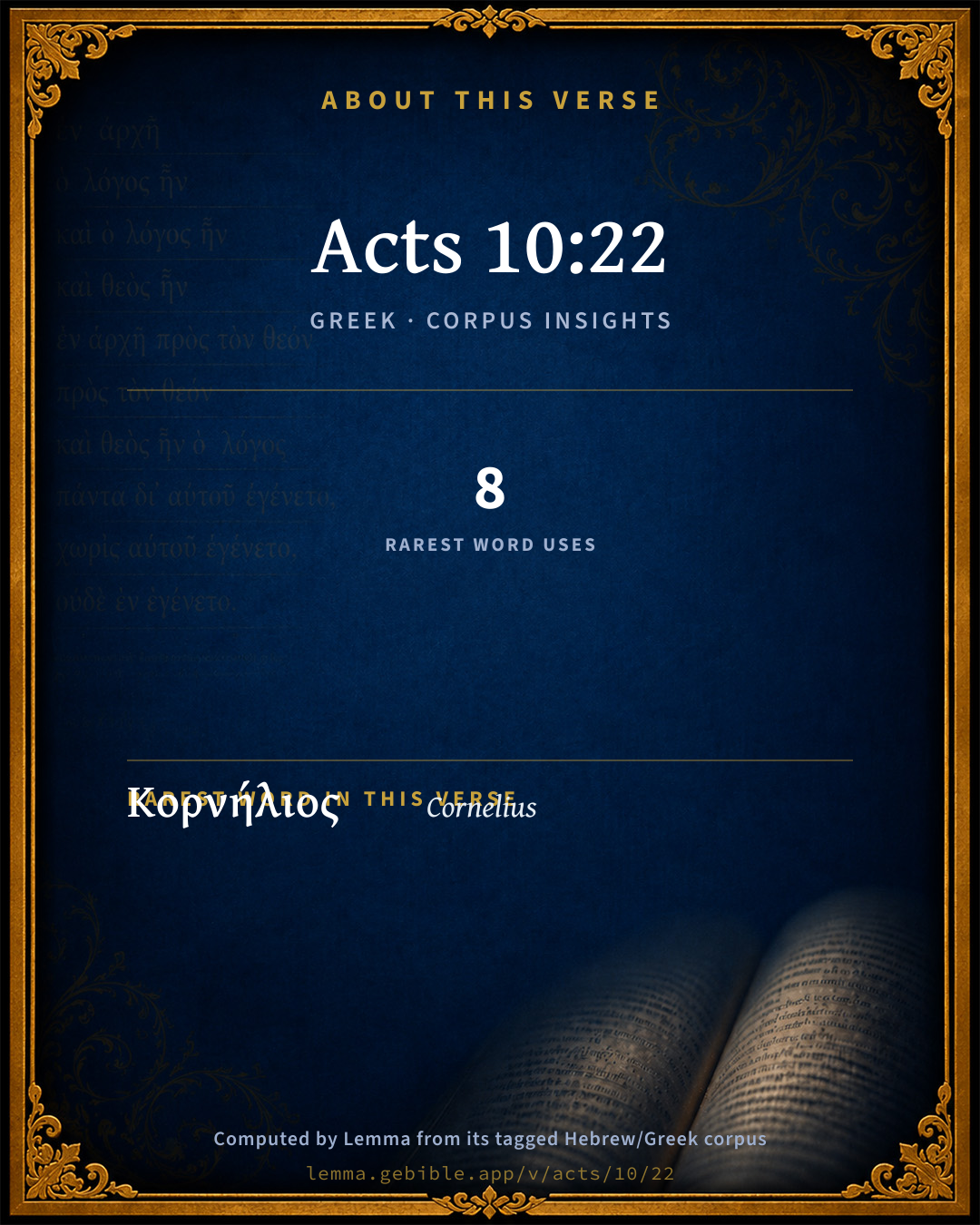
These counts appear in no published source. They are computed here, from the morphology-tagged text and Lemma’s own curated glosses. What Lemma adds →
- 34
- words
- 27
- distinct lemmas
- Acts
- section
Cross-references
30Topical passages linked to Acts 10:22 in the Treasury of Scripture Knowledge — connected by theme and wording, ordered by reader-vote popularity; previews shown in the World English Bible.
- Acts 11:14 who will speak to you words by which you will be saved, you and all your house.'
- Acts 10:2 a devout man, and one who feared God with all his house, who gave gifts for the needy generously to the people, and always prayed to God.
- Acts 22:12 One Ananias, a devout man according to the law, well reported of by all the Jews who lived in Damascus,
- 3 John 1:12 Demetrius has the testimony of all, and of the truth itself; yes, we also testify, and you know that our testimony is true.
- Hosea 14:9 Who is wise, that he may understand these things? Who is prudent, that he may know them? For the ways of Yahweh are right, And the righteous walk in them; But the rebellious stumble in them.
- Habakkuk 2:4 Behold, his soul is puffed up. It is not upright in him, but the righteous will live by his faith.
- Matthew 1:19 Joseph, her husband, being a righteous man, and not willing to make her a public example, intended to put her away secretly.
- Mark 6:20 for Herod feared John, knowing that he was a righteous and holy man, and kept him safe. When he heard him, he did many things, and he heard him gladly.
- Mark 8:38 For whoever will be ashamed of me and of my words in this adulterous and sinful generation, the Son of Man also will be ashamed of him, when he comes in the glory of his Father with the holy angels."
- Luke 2:25 Behold, there was a man in Jerusalem whose name was Simeon. This man was righteous and devout, looking for the consolation of Israel, and the Holy Spirit was on him.
- Luke 7:4–5 When they came to Jesus, they begged him earnestly, saying, "He is worthy for you to do this for him,
- Luke 23:50 Behold, a man named Joseph, who was a member of the council, a good and righteous man
- John 5:24 "Most assuredly I tell you, he who hears my word, and believes him who sent me, has eternal life, and doesn't come into judgment, but has passed out of death into life.
- John 6:63 It is the spirit who gives life. The flesh profits nothing. The words that I speak to you are spirit, and are life.
- John 6:68 Simon Peter answered him, "Lord, to whom would we go? You have the words of eternal life.
- John 13:20 Most assuredly I tell you, he who receives whomever I send, receives me; and he who receives me, receives him who sent me."
- John 17:8 for the words which you have given me I have given to them, and they received them, and knew for sure that I came forth from you, and they have believed that you sent me.
- John 17:20 Not for these only do I pray, but for those also who believe in me through their word,
- Acts 6:3 Therefore select from among you, brothers, seven men of good report, full of the Holy Spirit and of wisdom, whom we may appoint over this business.
- Acts 10:6 He lodges with one Simon, a tanner, whose house is by the seaside."
- Acts 10:33 Therefore I sent to you at once, and it was good of you to come. Now therefore we are all here present in the sight of God to hear all things that have been commanded you by God."
- Acts 24:15 having hope toward God, which these also themselves look for, that there will be a resurrection of the dead, both of the just and unjust.
- Romans 1:17 For in it is revealed God's righteousness from faith to faith. As it is written, "But the righteous shall live by faith."
- Romans 10:17–18 So faith comes by hearing, and hearing by the word of God.
- 2 Corinthians 5:18 But all things are of God, who reconciled us to himself through Jesus Christ, and gave to us the ministry of reconciliation;
- 1 Timothy 3:7 Moreover he must have good testimony from those who are outside, to avoid falling into reproach and the snare of the devil.
- Hebrews 10:38 But the righteous will live by faith. If he shrinks back, my soul has no pleasure in him."
- Hebrews 11:2 For by this, the elders obtained testimony.
- Hebrews 12:23 to the general assembly and assembly of the firstborn who are enrolled in heaven, to God the Judge of all, to the spirits of just men made perfect,
- 2 Peter 3:2 that you should remember the words which were spoken before by the holy prophets, and the commandments of us, the apostles of the Lord and Savior:
Cross-references courtesy of OpenBible.info (CC BY 4.0).
Lesson kit
Teaching starters — assembled from the data on this page, not authored interpretation. Every prompt links to the verse data it draws on. Edit before teaching.
Acts, in the Acts, opens this verse with 34 words (27 distinct Greek lemmas). Its most distinctive word is Kornḗlios (“Cornelius”). A historical commentator’s framing appears above. Read the whole chapter for the surrounding context.
Discussion questions
- How does “Cornelius” (Kornḗlios) shape what this verse is saying?
- Acts 10:1 shares the word «Cornelius» with this verse. How do the two illuminate each other?
- “under” occurs 2× in this one verse. What is the effect of the repetition?
- The translations on this page render this verse differently — a whole-verse word diff, not a word-by-word alignment. What might account for the different wordings?
- Reading how Bengel's Gnomon and Meyer's Critical & Exegetical Commentary read this verse, where do the two commentators agree and where do they part?
Things to notice
- These translations choose different wording for 27 words in this verse.
- “under” occurs 2× in this single verse.
- 27 distinct Greek lemmas span 34 words in this verse.
Commentary
Notes on Acts 10:22 from classic Christian and Jewish commentators (each source and its license shown beneath its notes). The classic Christian expositions comment on the surrounding passage and are grouped to its opening verse, so a note may address several verses; the Jewish commentaries on the Tanakh (Rashi and others) are per-verse, so they appear only where the commentator wrote on this verse.
Lemma curates 59 commentaries, every one of them public domain or Creative Commons licensed, each selected and text-cleaned for this edition rather than reprinted as found. About our sources →
Bengel's Gnomon
Johann Albrecht Bengel
Bengel's Gnomon of the New Testament — English translation (T&T Clark, Edinburgh, 1860) — public domain. Text from a community e-Sword module.
Meyer's Critical & Exegetical Commentary
Heinrich August Wilhelm Meyer
Meyer — Critical and Exegetical Commentary on the New Testament — English translation by Peter Christie, edited by Frederick Crombie (T&T Clark, 1880) — public domain. Text from a community e-Sword module.
Expositor's Greek Testament
ed. W. Robertson Nicoll
The Expositor's Greek Testament, edited by W. Robertson Nicoll (1897–1910) — public domain. Text from a community e-Sword module.
Jamieson, Fausset & Brown
Robert Jamieson, A. R. Fausset & David Brown
Jamieson, Fausset & Brown — Commentary Critical and Explanatory on the Whole Bible (1871) — public domain (CC PDM 1.0). Text via the HelloAO Bible API.
Adam Clarke's Commentary
Adam Clarke's Commentary on the Bible (1810–1826) — public domain. Text from a community e-Sword/MySword module.
John Calvin's Commentaries
John Calvin's Commentaries (1540-1563) — public domain. Text from the Calvin Translation Society English edition (1840s-50s) via the Christian Classics Ethereal Library (ccel.org). Calvin's coverage is partial (roughly two-thirds of the Bible); uncommented books and verses are honest gaps, never fabricated. The 19th-century editor's footnotes and remarks are omitted so the notes are faithfully Calvin's own voice.
Ellicott's Commentary for English Readers
A Bible Commentary for English Readers, edited by Charles John Ellicott (1878–1897) — public domain. Text from a community e-Sword module.
The Cambridge Bible for Schools and Colleges
gen. ed. J. J. S. Perowne
The Cambridge Bible for Schools and Colleges (gen. ed. J. J. S. Perowne; Cambridge University Press, 1878–1918) — public domain. Text from a community e-Sword module.
John Gill's Exposition
John Gill's Exposition of the Whole Bible (1746–1763) — public domain (CC PDM 1.0). Text via the HelloAO Bible API.
Trapp's Complete Commentary
John Trapp
John Trapp, A Commentary or Exposition upon All the Books of the Old and New Testament (1647–1656) — public domain. Text from a community e-Sword module.
Albert Barnes' Notes on the Bible
Albert Barnes' Notes on the Bible (1834–1885) — public domain. Text from a community e-Sword/MySword module.
Matthew Poole's English Annotations
Matthew Poole's English Annotations on the Holy Bible (1683–1685) — public domain. Text from a community e-Sword/MySword module.
Whedon's Commentary on the Bible
Daniel D. Whedon
Daniel D. Whedon (gen. ed.), Commentary on the Old and New Testaments (1874–1909) — public domain. Text from a community e-Sword module.
The Pulpit Commentary
The Pulpit Commentary (1880–1919), ed. H.D.M. Spence-Jones & Joseph S. Exell — public domain. Text from a community e-Sword module.
McGarvey & Pendleton's Commentaries
J. W. McGarvey
J. W. McGarvey (with Philip Y. Pendleton), Commentaries on the New Testament (The Fourfold Gospel, 1914; Acts; and the epistles) — public domain. Text from a community e-Sword/MySword module.
unfoldingWord translationNotes
Door43 World Missions Community
unfoldingWord translationNotes — © Distant Shores Media and the Door43 World Missions Community, licensed CC BY-SA 4.0. Source: git.door43.org/Door43/en_tn.
Cambridge Greek Testament for Schools and Colleges
Cambridge Greek Testament for Schools and Colleges (Cambridge University Press, 1896; 21 vols, various authors incl. Carr, Maclear, Plummer, Farrar, Lumby, Moule, M. R. James, Simcox) — public domain. Text from a community e-Sword module.
Vincent's Word Studies in the New Testament
Marvin R. Vincent
Marvin R. Vincent, Word Studies in the New Testament (1887–1900) — public domain. Text from a community e-Sword/MySword module.