Revelation 9:13

Greek (Tischendorf 8th ed.) Revelation 9:13 appears in the Greek New Testament. The text above is from the Tischendorf 8th edition. Each word links to its Strong’s number and a concise gloss. Click any word for its full Thayer’s Greek Lexicon entry.
Download image
Cite this verse

Revelation 9:13 (World English Bible). Public Domain. Lemma interlinear Bible study tool, https://lemma.gebible.app/v/revelation/9/13.

Show BibTeX & RIS
BibTeX
RIS
English Translation
The sixth angel sounded. I heard a voice from the horns of the golden altar which is before God,
World English Bible · Public Domain
Download a study sheet

One document with this verse’s original text, its word-by-word gloss line, the meaning frame, cross-references with their text, attributed commentary, and full source and license credits — printable, and it pastes into notes with its structure intact.

This verse Autodidact and up

Study sheet (.html) Plain text (.txt)

A passage Seminary Student

Up to 50 verses in one chapter. A passage sheet keeps up to 6 commentary sources and 12 cross-references per verse, in the order this page ranks them, and says so on the sheet whenever that leaves anything out. Ask for a single verse and you get the Autodidact verse sheet above.

Everything on this page stays free to read, with no account — the sheet is a download of what is already on screen, not access to it.

Want to remove ads? Support Godless Engineer
Compare translations 3

The same verse in 3 English versions, stacked beneath the original-language interlinear above. Click any original word for its lexicon entry.

Each is an independent rendering of the whole verse — the interlinear is not word-aligned to these translations.

Highlighted words mark where these versions differ — a whole-verse word diff, not a word-by-word alignment.

  • World English Bible Public Domain
    The sixth angel sounded. I heard a voice from the horns of the golden altar which is before God,
  • King James Version Public Domain
    And the sixth angel sounded, and I heard a voice from the four horns of the golden altar which is before God,
  • unfoldingWord Literal Text CC BY-SA 4.0
    And the sixth angel trumpeted, and I heard a voice from the horns of the golden altar before God,

unfoldingWord Literal Text — © unfoldingWord, licensed CC BY-SA 4.0. Word-aligned USFM3 via Door43 (git.door43.org/unfoldingWord/en_ult).

Versions to compare (up to 4)

3 of 4 selected

Show all 19 translations

Every available English version of this verse, each an independent rendering of the whole verse.

  • World English Bible Public Domain
    The sixth angel sounded. I heard a voice from the horns of the golden altar which is before God,
  • Berean Standard Bible Public Domain
    Then the sixth angel sounded his trumpet, and I heard a voice from the four horns of the golden altar before God
  • Majority Standard Bible Public Domain
    Then the sixth angel sounded his trumpet, and I heard a voice from the four horns of the golden altar before God
  • King James Version Public Domain
    And the sixth angel sounded, and I heard a voice from the four horns of the golden altar which is before God,
  • American Standard Version (1901) Public Domain
    And the sixth angel sounded, and I heard a voice from the horns of the golden altar which is before God,
  • Revised Version (1885) Public Domain
    And the sixth angel sounded, and I heard a voice from the horns of the golden altar which is before God,
  • Geneva Bible (1599) Public Domain
    Then the sixt Angel blew the trumpet, and I heard a voyce from the foure hornes of the golden altar, which is before God,
  • Douay-Rheims (1899) Public Domain
    And the sixth angel sounded the trumpet: and I heard a voice from the four horns of the great altar, which is before the eyes of God,
  • Young's Literal Translation Public Domain
    And the sixth messenger did sound, and I heard a voice out of the four horns of the altar of gold that is before God,
  • Literal Standard Version CC BY-SA 4.0
    And the sixth messenger sounded the trumpet, and I heard a voice out of the four horns of the altar of gold that is before God,
  • Unlocked Literal Bible CC BY-SA 4.0
    The sixth angel sounded his trumpet, and I heard a voice coming from the horns of the golden altar that is present before God.
  • unfoldingWord Literal Text CC BY-SA 4.0
    And the sixth angel trumpeted, and I heard a voice from the horns of the golden altar before God,
  • Darby Bible Public Domain
    And the sixth angel sounded [his] trumpet: and I heard a voice from the four horns of the golden altar which [is] before God,
  • World Messianic Bible Public Domain
    The sixth angel sounded. I heard a voice from the horns of the golden altar which is before God,
  • Webster's Bible Public Domain
    And the sixth angel sounded, and I heard a voice from the four horns of the golden altar which is before God,
  • Free Bible Version CC BY-SA 4.0
    The sixth angel blew his trumpet. I heard a voice come from the horns of the golden altar that stands in front of God
  • Bible in Basic English Public Domain
    And at the sounding of the sixth angel a voice came to my ears from the horns of the gold altar which is before God,
  • Text-Critical English NT CC BY 4.0
    Then the sixth angel sounded his trumpet, and I heard a single voice from the four horns of the golden altar before God
  • Tyndale New Testament (1534) Public Domain
    And the sixte. angell blewe and I herd a voyce from the iiii. corners of the golden aultre which is before god

Literal Standard Version (2020), Covenant Press — licensed CC BY-SA 4.0. Text via the HelloAO Bible API (eBible.org). Unlocked Literal Bible (unfoldingWord) — licensed CC BY-SA 4.0. Text via the HelloAO Bible API (eBible.org). unfoldingWord Literal Text — © unfoldingWord, licensed CC BY-SA 4.0. Word-aligned USFM3 via Door43 (git.door43.org/unfoldingWord/en_ult). Free Bible Version, Dr. Jonathan Gallagher — licensed CC BY-SA 4.0. Text via the HelloAO Bible API (eBible.org).

Word by word

More ways to search: Search by grammar → Find every occurrence → Compare this word →

Practice this passage: Drill this verse → Learn its vocabulary →

κεράτων
kéras
G2768
“horn”
Noun, Genitive, Plural, Neuter
Part of Speech
Noun
Case
Genitive
Number
Plural
Gender
Neuter
Full Thayer's Definition

Origin: from a primary kar (the hair of the head)

TDNT: 14:09,4

1. a horn a. of animals b. since animals (esp. bulls) defend themselves with their horns, the horn with the Hebrews (and other nations) is a symbol of strength and courage, and used as such in a variety of phrases 1. a mighty and valiant helper, the author of deliverance, of the Messiah c. a projecting extremity in a shape like a horn, a point, apex: as of an altar
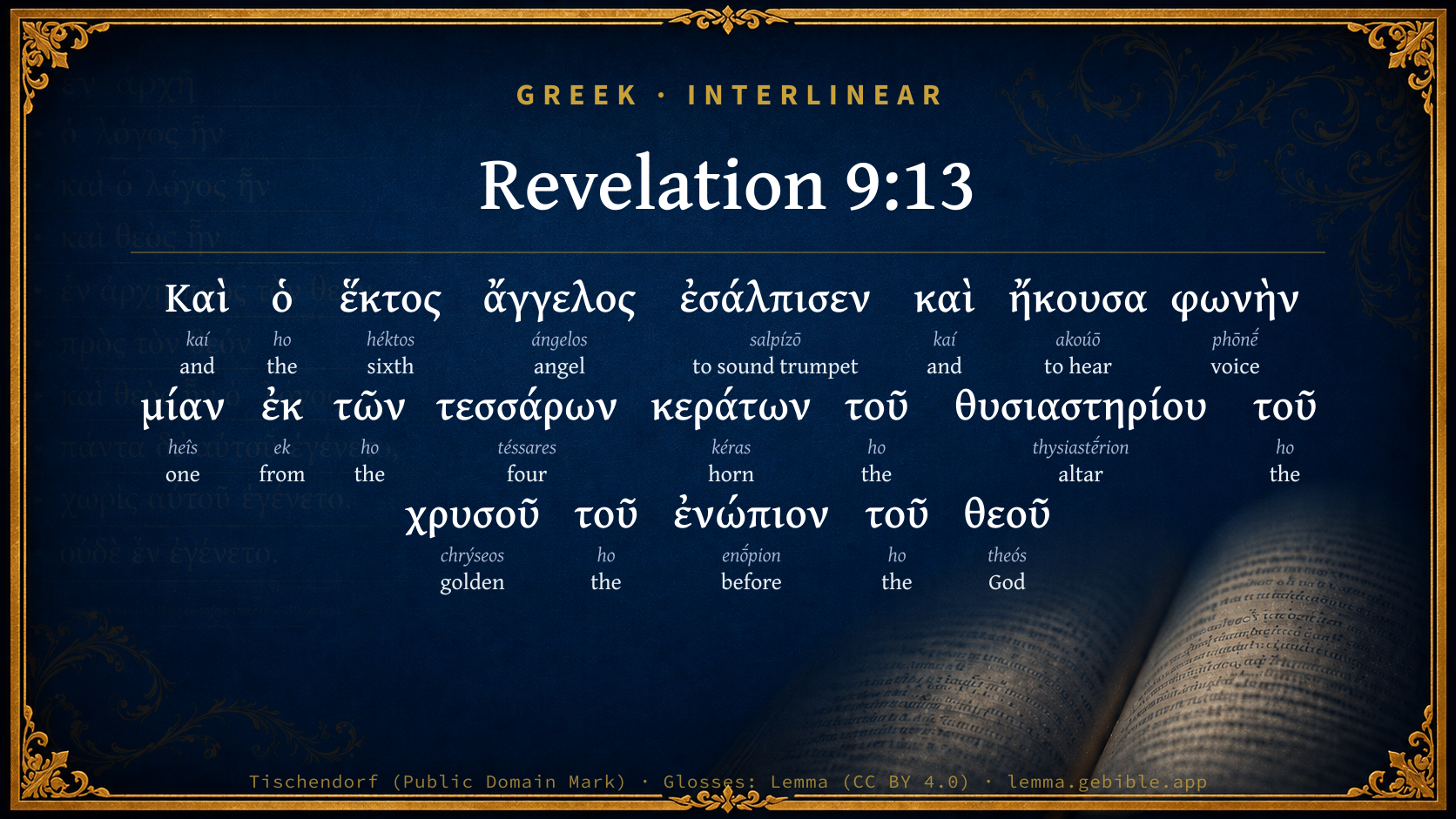
  1. Καὶ kaí G2532 “and” Conjunction
  2. ὁ ho G3588 “the” Article, Nominative, Singular, Masculine
  3. ἕκτος héktos G1623 “sixth” Adjective, Nominative, Singular, Masculine
  4. ἄγγελος ángelos G32 “angel” Noun, Nominative, Singular, Masculine
  5. ἐσάλπισεν salpízō G4537 “to sound trumpet” Verb, Aorist, Active, Indicative, 3rd person, Singular
  6. καὶ kaí G2532 “and” Conjunction
  7. ἤκουσα akoúō G191 “to hear” Verb, Aorist, Active, Indicative, 1st person, Singular
  8. φωνὴν phōnḗ G5456 “voice” Noun, Accusative, Singular, Feminine
  9. μίαν heîs G1520 “one” Adjective, Accusative, Singular, Feminine
  10. ἐκ ek G1537 “from” Preposition
  11. τῶν ho G3588 “the” Article, Genitive, Plural, Neuter
  12. τεσσάρων téssares G5064 “four” Adjective, Genitive, Plural, Neuter
  13. τοῦ ho G3588 “the” Article, Genitive, Singular, Neuter
  14. θυσιαστηρίου thysiastḗrion G2379 “altar” Noun, Genitive, Singular, Neuter
  15. τοῦ ho G3588 “the” Article, Genitive, Singular, Neuter
  16. χρυσοῦ chrýseos G5552 “golden” Adjective, Genitive, Singular, Neuter
  17. τοῦ ho G3588 “the” Article, Genitive, Singular, Neuter
  18. ἐνώπιον enṓpion G1799 “before” Adverb
  19. τοῦ ho G3588 “the” Article, Genitive, Singular, Masculine
  20. θεοῦ theós G2316 “God” Noun, Genitive, Singular, Masculine

About this verse

These counts appear in no published source. They are computed here, from the morphology-tagged text and Lemma’s own curated glosses. What Lemma adds →

21
words
15
distinct lemmas
Revelation
section

Notable vocabulary

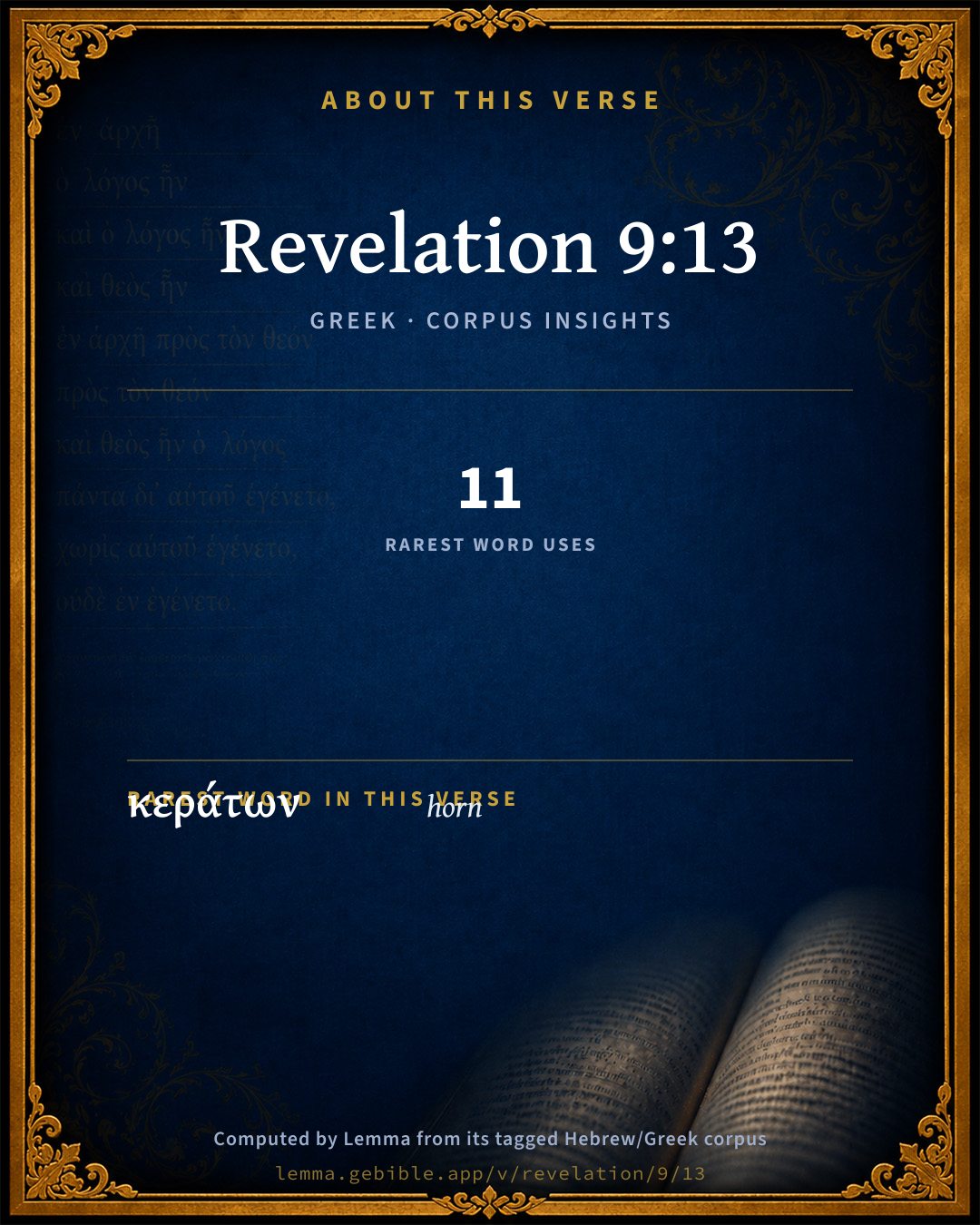
The rarest word here is κεράτων horn G2768 — appearing just 11 times in the whole Greek New Testament.

Shared distinctive vocabulary

κεράτων horn G2768 occurs in 10 verses of the Greek New Testament. Also found in:

Repetition

Words recur within this verse:

Cross-references

5

Topical passages linked to Revelation 9:13 in the Treasury of Scripture Knowledge — connected by theme and wording, ordered by reader-vote popularity; previews shown in the World English Bible.

  • Revelation 8:3–5 Another angel came and stood over the altar, having a golden censer. Much incense was given to him, that he should add it to the prayers of all the saints on the golden altar which was before the throne.
  • Exodus 30:2–3 Its length shall be a cubit, and its breadth a cubit. It shall be square, and its height shall be two cubits. Its horns shall be of one piece with it.
  • Hebrews 9:24 For Christ hasn't entered into holy places made with hands, which are representations of the true, but into heaven itself, now to appear in the presence of God for us;
  • Hebrews 10:21 and having a great priest over the house of God,
  • Revelation 9:1 The fifth angel sounded, and I saw a star from the sky which had fallen to the earth. The key to the pit of the abyss was given to him.

Cross-references courtesy of OpenBible.info (CC BY 4.0).

Commentary

Notes on Revelation 9:13 from classic Christian and Jewish commentators (each source and its license shown beneath its notes). The classic Christian expositions comment on the surrounding passage and are grouped to its opening verse, so a note may address several verses; the Jewish commentaries on the Tanakh (Rashi and others) are per-verse, so they appear only where the commentator wrote on this verse.

Lemma curates 59 commentaries, every one of them public domain or Creative Commons licensed, each selected and text-cleaned for this edition rather than reprinted as found. About our sources →

Matthew Henry's Commentary

Here let us consider the preface to this vision, and then the vision itself.

I. The preface to this vision: A voice was heard from the horns of the golden altar, Rev 9:13, Rev 9:14. Here observe, 1. The power of the church's enemies is restrained till God gives the word to have them turned loose. 2. When nations are ripe for punishment, those instruments of God's anger that were before restrained are let loose upon them, Rev 9:14. 3. The instruments that God makes use of to punish a people may sometimes lie at a great distance from them, so that no danger may be apprehended from them. These four messengers of divine judgment lay bound in the river Euphrates, a great way from the European nations. Here the Turkish power had its rise, which seems to be the story of this vision.

II. The vision itself: And the four angels that had been bound in the great river Euphrates were now loosed, Rev 9:15, Rev 9:16. And here observe, 1. The time of their military operations and executions is limited to an hour, and a day, and a month, and a year. Prophetic characters of time are hardly to be understood by us; but in general the time is fixed to an hour, when it shall begin and when it shall end; and how far the execution shall prevail, even to a third part of the inhabitants of the earth. God will make the wrath of man praise him, and the remainder of wrath he will restrain. 2. The army that was to execute this great commission is mustered, and the number found to be of horsemen two hundred thousand thousand; but we are left to guess what the infantry must be. In general, it tells us, the armies of the Mahomedan empire should be vastly great; and so it is certain they were. 3. Their formidable equipage and appearance, Rev 9:17. As the horses were fierce, like lions, and eager to rush into the battle, so those who sat upon them were clad in bright and costly armour, with all the ensigns of martial courage, zeal, and resolution. 4. The vast havoc and desolation that they made in the Roman empire, which had now become antichristian: A third part of them were killed; they went as far as their commission suffered them, and they could go no further. 5. Their artillery, by which they made such slaughter, described by fire, smoke, and brimstone, issuing out of the mouths of their horses, and the stings that were in their tails. It is Mr. Mede's opinion that this is a prediction of great guns, those instruments of cruelty which make such destruction: he observes, These were first used by the Turks at the siege of Constantinople, and, being new and strange, were very terrible, and did great execution. However, here seems to be an allusion to what is mentioned in the former vision, that, as antichrist had his forces of a spiritual nature, like scorpions poisoning the minds of men with error and idolatry, so the Turks, who were raised up to punish the antichristian apostasy, had their scorpions and their stings too, to hurt and kill the bodies of those who had been the murderers of so many souls. 6. Observe the impenitency of the antichristian generation under these dreadful judgments (Rev 9:20); the rest of the men who were not killed repented not, they still persisted in those sins for which God was so severely punishing them, which were, (1.) Their idolatry; they would not cast away their images, though they could do them no good, could not see, nor hear, nor walk. (2.) Their murders (Rev 9:21), which they had committed upon the saints and servants of Christ. Popery is a bloody religion, and seems resolved to continue such. (3.) Their sorceries; they have their charms, and magic arts, and rites in exorcism and other things. (4.) Their fornication; they allow both spiritual and carnal impurity, and promote it in themselves and others. (5.) Their thefts; they have by unjust means heaped together a vast deal of wealth, to the injury and impoverishing of families, cities, princes, and nations. These are the flagrant crimes of antichrist and his agents; and, though God has revealed his wrath from heaven against them, they are obstinate, hardened, and impenitent, and judicially so, for they must be destroyed.

III. From this sixth trumpet we learn, 1. God can make one enemy of the church to be a scourge and plague to another. 2. He who is the Lord of hosts has vast armies at his command, to serve his own purposes. 3. The most formidable powers have limits set them, which they cannot transgress. 4. When God's judgments are in the earth, he expects the inhabitants thereof should repent of sin, and learn righteousness. 5. Impenitency under divine judgments is an iniquity that will be the ruin of sinners; for where God judges he will overcome.

Matthew Henry's Commentary on the Whole Bible (1708–1710) — public domain (CC PDM 1.0). Text via the HelloAO Bible API.

The Cambridge Bible for Schools and Colleges

gen. ed. J. J. S. Perowne

The Sixth Trumpet. Second Woe, Rev_9:13-21

13. a voice] Lit. one voice: see on Rev_8:13. The word “four” just afterwards should probably be omitted: else “one voice from the four horns” would give the numeral a special meaning.

The Cambridge Bible for Schools and Colleges (gen. ed. J. J. S. Perowne; Cambridge University Press, 1878–1918) — public domain. Text from a community e-Sword module.

The Biblical Illustrator

Joseph S. Exell

Rev_9:13-21

Loose the four angels which are bound.

The sixth trumpet

I. The state of society at the time.

II. The nature of this visitation.

1. It is evoked by a cry out of the four horns of the altar. It comes from the immediate presence of God, and therefore with the sanction of God. The call itself is the common voice of all four of the horns of the altar, indicating the energy and the universality of the demand for vengeance, and of that vengeance itself. The implication is that Gods appointed way of forgiveness has been set aside; that the Divine system of gracious atonement and salvation has been rejected, and that the wickedness of earth has risen so high, especially in point of antagonism to the Cross, that even the altar itself, which otherwise cries only for mercy, is forced into a cry for vengeance.

2. The command issues to the angel who sounds this trumpet. The command itself is the command of the contemned Saviour. But it is addressed to the angel. He obeys it as his Divine commission, and thus presides over the administration ushered in by his trumpet. He looses the imprisoned forces, and sets them free for action.

3. Other angels are the more direct executors of the woe. Some have taken these to be good angels. I do not so regard them. Good angels are free, not bound. Good angels would not destroy men, except by special command of God; but these had only to be loosed, and they at once rushed forth for slaughter, impelled to the dreadful business by their own malicious nature. They were bound in mercy to our race, and here they are let loose in judgment. Their number also indicates the universality of their operations.

4. The moment the four bound angels are released from their constraint, hosts of death-dealing cavalry overrun the earth. As there are infernal locusts, so there are infernal horses; and as the former were let forth to overrun the world with their torments under the fifth trumpet, so the latter are let forth to overrun the world with still more terrible inflictions under the sixth.

5. Fearful havoc of human life is made by these infernal horses. To say nothing of the dread and horror which their presence inspires, and the confusion which their advent strikes into every department of society, it is here written, that, by these horses, one out of every three of the whole human family is killed, destroyed from the face of the earth.

6. The continuance of this plague is equally extraordinary.

7. The object of this woe is partly retributive and partly reformatory. It belongs to the judicial administrations of the great day. It is Gods terrific judgment upon the world, which has disowned allegiance to Him, and rejected the mediation of His Son. It is the righteous indignation of outraged justice which can no longer endure the superlative wickednesses of men. And yet, in wrath God remembers mercy. He suffers on]y one-third of the race to fall a prey to this tremendous woe. He delighteth not in the death of the wicked, but would rather that they should turn from their evil ways and live. (J. A. Seiss, D. D.)

The rest … repented not.--

Impenitence

So it was in the beginning, so it will be to the end. All outward plagues, all outbursts of moral evils, all apostasies in Divine societies, were and are trumpets of God; those who acknowledge His goodness and truth will tremble and rejoice that He is speaking to them; that He is calling them to repent; that He is preparing the way for a manifestation of Himself. But these trumpets, let them sound as loud and long as they may, seldom stir s man who disbelieves in a living and good God to confess Him. The terror which is in them stupefies rather than quickens. The slumberer is half roused out of his dream; is bewildered; takes a fresh opiate; flies to the gods that neither see, nor hear, nor walk; flies from Him whom he has only recognised in thunderings and lightnings. The sentence is everlastingly true that not the fire, nor the earthquake, nor the blast rending the mountains, but only the still small voice reaches the heart, and compels it to bow. (F. D. Maurice, M. A.)

Mans stubborn will

I. All men need repentance.

II. God pleads with men to bring them to repentance. These judgments of which we read are not Gods primary dealings with men. He does not begin in this manner. God has pleaded with men by His Spirit in their consciences. By His goodness, giving them all manner of providential mercies. Then, more especially by His Word.

III. But these milder methods often fail.

IV. Sterner methods are then tried.

V. But even these, at times, and for long time, fail. This is the declaration of our text (also Jer_5:3; Jer_8:6; Rom_2:4-5). So was it with Pharaoh, when the plagues one after another, which in many respects resembled these trumpet-plagues, came upon him.

VI. What is the reason of this? The answer is manifold, as, for example:

1. Those that are spared argue from that fact that they need not repent.

2. Sin deadens belief in God. It makes men practical atheists.

3. Gods judgments are put down to secondary causes.

4. Perfect love casteth out fear. This is true in a sense the apostle never meant. Let the heart love sin, as it is so prone to do, and that love will utterly cast out the fear of God.

5. The law of habit. You may bend the sapling, but not the tree.

VII. How intensely serious are the teachings of this fact! Is it true that, though God sends judgment after judgment upon men, they will yet not repent? Then:

1. More judgments and worse will come.

2. How we need to watch and pray lest we be hardened through the deceitfulness of sin!

3. What imperative need there is of the power of the Holy Spirit! (S. Conway, B. A.)

The Biblical Illustrator, edited by Joseph S. Exell (c. 1880s–1900s) — public domain. Text from a community e-Sword module.

Joseph Benson's Commentary

Rev 9:13-15. The sixth angel sounded, &c. — At the sounding of the sixth trumpet, a voice proceeded from the four horns of the golden altar, (for the scene was still in the temple,) ordering the angel of the sixth trumpet to loose the four angels which were bound in the great river Euphrates; and they were loosed accordingly. Such a voice, proceeding from the four horns of the golden altar, is a strong indication of the divine displeasure; and plainly intimates, that the sins of men must have been very great, when the altar, which was their sanctuary and protection, called aloud for vengeance. The four angels are the four sultanies, or four leaders of the Turks and Othmans. For there were four principal sultanies, or kingdoms of the Turks, bordering upon the river Euphrates: one at Bagdad, founded by Togrul Beg, or Tangrolipix, as he is more usually called, in the year 1055; another at Damascus, founded by Tagjuddaulas, or Ducas, in the year 1079; a third at Aleppo, founded by Sjarsuddaulas, or Melech, in the same year, 1079; and the fourth at Iconium, in Asia Minor, founded by Sedyduddaulus, or Cutlu Muses, or his son, in the year 1080. These four sultanies subsisted several years afterward; and the sultans were bound and restrained from extending their conquests farther than the territories and countries adjoining to the river Euphrates, primarily by the good providence of God, and secondarily by the croisades, or expeditions of the European Christians into the holy land, in the latter part of the eleventh, and in the twelfth and thirteenth centuries. Nay, the European Christians took several cities and countries from them, and confined them within narrower bounds. But when an end was put to the croisades, and the Christians totally abandoned their conquests in Syria and Palestine, as they did in the latter part of the thirteenth century, then the four angels on the river Euphrates were loosed. Soliman Shah, the first chief and founder of the Othman race, retreating with his three sons from Jingiz Chan and the Tartars, would have passed the river Euphrates, but was unfortunately drowned, the time of loosing the four angels being not yet come. Discouraged at this sad accident, two of his sons returned to their former habitations; but Ortogrul, the third, with his three sons, Conduz, Sarubani, and Othman, remained some time in those parts; and having obtained leave of Aladin, the sultan of Iconium, he came with four hundred of his Turks, and settled in the mountains of Armenia. From thence they began their excursions; and the other Turks associating with them, and following their standard, they gained several victories over the Tartars on one side, and over the Christians on the other. Ortogrul dying in the year 1288, Othman his son succeeded him in power and authority; and in the year 1299, as some say, with the consent of Aladin himself, he was proclaimed sultan, and founded a new empire; and the people afterward, as well as the new empire, were called by his name. For though they disclaim the name of Turks, and assume that of Othmans, yet nothing is more certain than that they are a mixed multitude, the remains of the four sultanies above mentioned, as well as the descendants particularly of the house of Othman.

In this manner, and at this time, the four angels were loosed, which were prepared for an hour, and a day, and a month, and a year, for to slay the third part of men — That is, as before, the men of the Roman empire, and especially in Europe, the third part of the world. The Latin or western empire was broken to pieces under the four first trumpets; the Greek or eastern empire was cruelly hurt and tormented under the fifth trumpet; and here, under the sixth trumpet, it is to be slain and utterly destroyed. Accordingly, all Asia Minor, Syria, Palestine, Egypt, Thrace, Macedon, Greece, and all the countries which formerly belonged to the Greek or eastern Cesars, the Othmans have conquered, and subjugated to their dominion. They first passed over into Europe in the reign of Orchan, their second emperor, and in the year 1357; they took Constantinople in the reign of Mohammed, their seventh emperor, and in the year 1453; and in time, all the remaining parts of the Greek empire shared the fate of the capital city. The last of their conquests were Candia, or the ancient Crete, in 1669, and Cameniec, in 1672. For the execution of this great work, it is said that they were prepared for an hour, and a day, and a month, and a year; which will admit either of a literal or a mystical interpretation; and the former will hold good if the latter should fail. If it be taken literally, it is only expressing the same thing by different words; as peoples, and multitudes, and nations, and tongues, are jointly used in other places; and then the meaning is, that they were prepared and ready to execute the divine commission at any time, or for any time, — any hour, or day, or month, or year, that God should appoint. If it be taken mystically, and the hour, and day, and month, and year be a prophetic hour, and day, and month, and year, then a year, (according to St. John’s, who follows herein Daniel’s computations) consisting of three hundred and sixty days, is three hundred and sixty years; and a month, consisting of thirty days, is thirty years; and a day is a year; and an hour is, in the same proportion, fifteen days: so that the whole period of the Othmans slaying the third part of men, or subduing the Christian states in the Greek or Roman empire, amounts to three hundred and ninety-one years and fifteen days. Now it is wonderfully remarkable, that the first conquest mentioned in history of the Othmans over the Christians, was in the year of the Hegira 680, and the year of Christ 1281. For Ortogrul “in that year (according to the accurate historian Saadi) crowned his victories with the conquest of the famous city of Kutahi upon the Greeks.” Compute three hundred and ninety-one years from that time, and they will terminate in the year 1672: and in that year, as it was hinted before, Mohammed the Fourth took Cameniec from the Poles, “and forty-eight towns and villages in the territory of Camenice were delivered up” to the sultan upon the treaty of peace. Whereupon Prince Cantemir hath made this memorable reflection: “This was the last victory by which any advantage accrued to the Othman state, or any city or province was annexed to the ancient bounds of the empire.” Agreeably to which observation, he hath entitled the former part of his history, Of the growth of the Othman empire, and the following part, Of the decay of the Othman empire. Other wars and slaughters, as he says, have ensued. The Turks even besieged Vienna in 1683; but this exceeding the bounds of their commission, they were defeated. Belgrade and other places may have been taken from them, and surrendered to them again; but still they have subdued no new state or potentate of Christendom now for the space of a hundred and fifty years; and in all probability they never may again, their empire appearing rather to decrease than increase. Here then the prophecy and the event agree exactly in the period of three hundred and ninety-one years; and if more accurate and authentic histories of the Othmans were brought to light, and we knew the very day wherein Kutahi was taken as certainly as we know that wherein Cameniec was taken, the like exactness might also be found in the fifteen days. But though the time be limited for the Othmans’ slaying the third part of men, yet no time is fixed for the duration of their empire; only this second wo will end when the third wo, (xi. 14,) or the destruction of the beast, shall be at hand.

Joseph Benson's Commentary on the Old and New Testaments (1811–1818) — public domain. Text from a community e-Sword module.

The Preacher's Complete Homiletical Commentary

Joseph S. Exell (gen. ed.)

CRITICAL AND EXEGETICAL NOTES

Rev_9:13. Sixth angel sounded.—This woe is an invasion of foreign nations coming out of the East, and causing everywhere ruin and disaster.

Rev_9:14. Loose the four angels.—These are the angels of invasion. No actual reference to the Euphrates must be sought for, but what the Euphrates symbolises. Rivers do not actually hind angels. The Eaphrates was the great military barrier between the great northern and southern kingdoms. It may symbolise the providence which kept Eastern delusions and fanaticisms from passing over to the West. When the barrier was broken a flood of evils poured into Europe. But it cannot be said that this reference to Euphrates is satisfactorily explained.

MAIN HOMILETICS OF THE PARAGRAPH.—Rev_9:13-21

The Second Woe-Trumpet.—The aim of the plague is to exhibit the death-working power of false thoughts, false customs, false beliefs, and to rouse men to forsake the false worships, worldliness, and self-indulgence, into which they had fallen (Rev_9:20-21). The enemy against whom these foes are gathered is the great world, lost in false thoughts, luxurious ways, dishonest customs—that world which, in the very essential genius of its nature, is hostile to goodness and the God of goodness. But the hosts which come against this sin-drowned world are not merely plagues, as famine and pestilence; they are plagues which are the result of the world-spirit, and are, to a great extent, therefore, the creation of those who suffer. For there are evils which are loosed upon the world by the natural action of sin and sinful customs. We should notice that the historical basis of the Apocalypse is the past history of God’s chosen people. The Apocalypse shows us the same principles working in higher levels and in wider arena. The Israel of God, the Church of Christ, with its grand opportunities, takes the place of the national Israel. (But its experiences are similar, and each set of experiences helps us in the understanding of the other.) The people who are victorious by faith at Jericho lay themselves open, by their timid worldliness, to the dangers of a Babylonish foe. The plague which falls on the spirit of worldliness does not spare the worldliness in the Church. The overthrow of corrupted systems bearing the Christian name is not a victory of the world over the Church, but of the Church over the world. The history of Israel is in much the key to the history of the world.—Bishop Boyd Carpenter.

The Preacher's Complete Homiletical Commentary (gen. ed. Joseph S. Exell; Funk & Wagnalls, c. 1892) — public domain (pre-1929). A full-Bible homiletical/sermon-outline anthology covering 65 of 66 books (2 John is absent from the source module). Text from a community e-Sword module.

Tyndale Open Study Notes

Tyndale Open Resources

9:13-14 The four horns of the gold altar (see 8:3) are introduced with the sixth trumpet blast. Many excavations have uncovered altars with pointed horns at their four corners (see study note on Exod 27:2). • The voice carries the authority of God in the command to release the four angels. • These angels have been bound, suggesting their evil nature (cp. Rev 20:2; 1 Enoch 10; contrast Rev 7:1). Their location at the great Euphrates River probably refers to Assyria and Babylon, empires that had devastated the kingdoms of Israel and Judah and thus were symbols of destruction (see 2 Kgs 17:22-24; 25:1-11).

Tyndale Open Study Notes — © Tyndale Open Resources, licensed CC BY-SA 4.0. Text via the HelloAO Bible API.

Bengel's Gnomon

Johann Albrecht Bengel

Rev 9:13. Καὶ, and) The second woe relates to the Saracens.—ἐκ τῶν τεσσάρων κεράτων) The ancients omit τεσσάρων:[96] the altar of incense had horns; in the writings of Moses it is not read of as having four horns.

[96] A Vulg. (Amiat. MS.) Memph. Syr. omit τεσσάρων. Bh Cypr. support it.—E.

Rev 9:13-14. Φωνὴν μίαν—λέγοντα) I regard this reading of the Alexandrian Manuscript as genuine. See App. Crit. Ed. ii. In the Cod. of Berlin, the masculine gender is transferred from the participle to the adjective, a stop being inserted between, vocem, unum,[97] etc.—ἘΝΏΠΙΟΝ—, before—) where the heavenly liturgy is performed.

[97] A reads μίαν—λέγοντα. But h Vulg. Cypr. 322, “vocem, unum—dicentem.” Rec. Text, λέγουσαν, with inferior authorities.—E.

Bengel's Gnomon of the New Testament — English translation (T&T Clark, Edinburgh, 1860) — public domain. Text from a community e-Sword module.

Meyer's Critical & Exegetical Commentary

Heinrich August Wilhelm Meyer

Rev_9:13-15. At a divine command the trumpet-angel looses the four angels bound thus far at the Euphrates, under whose direction the immense army of horsemen is to bring its plagues.

καὶ ἤκουσα, κ.τ.λ. What John hears[2608] in the vision, he represents just as what he beheld (Rev_9:17), in consequence of the trumpet-vision.

φωνὴν μίαν ἐκ τῶν (τεσσάρων) κεράτων τοῦ θυσιαστηρίου, κ.τ.λ. In a linguistic respect it is possible that the precise number is intended indefinitely,[2609] so that it is left entirely undecided as to whom the voice belongs, as Rev_6:6,[2610] although it is impossible to take ἐκ in the general sense of ἀπό,[2611] and to explain that the voice came from God enthroned back of the altar.[2612] Cf., on the other hand, also, Rev_16:7. Yet a more definite reference of the μίαν would result in connection with the fact that the voice proceeds from the four horns of the altar. The altar from whose horns the voice proceeds is expressly designated as that mentioned Rev_8:3 sqq.[2613] The circumstance, accordingly, that from its horns the voice proceeds which loosens the plagues described immediately afterwards, must have a similar meaning as the circumstance in Rev_8:5, that the fire cast upon the earth was taken from the same altar, i.e., the command of the angels to loose appears as a consequence of the prayers presented at the altar;[2614] but after that, it is proper to understand the one (Divine) voice making manifest this special hearing of prayer, in contrast with the many voices of those who pray, heard and referred to also in Rev_8:3 (τ. προσευχ. τῶν ἁγ.).

It is a perversion, however, to consider the one voice in any special relation to the four horns of the altar; for, even apart from the critical uncertainty of the reading τεσσάρων, the sense forced from it[2615] is extremely feeble, while the allegorical[2616] explanation[2617] is without any support. Also the relation, which is in itself arbitrary, between the four horns and the four sins, Rev_9:21, and likewise the four angels,[2618] falls with the spurious τεσσάρων.

τῷ ἕκτῳ ἀγγ. From the fact that here the trumpet-angel not only sounds the trumpet, but is himself engaged in the act which follows, the inference dare in no wise be drawn that the same relation occurs also in other passages where it is not explicitly stated.[2619] But if the question be asked why there is ascribed here[2620] to the proclaimer of the plagues a co-operation with them, any reference to economy of means[2621] affords no satisfactory answer; for why this economy just here, which nevertheless does not universally prevail? As a reason lying in the subject itself is not perceptible, it appears to be adopted only to avoid a barren uniformity, which would occur if the same angel who (Rev_8:5) cast the fire from the altar to the earth, or even if a new angel, who yet would have substantially the same position with that of the trumpet-angels, received now the command to loose the four angels at the Euphrates.

Αῦσον

Ἐυφράτῃ. The article τοὺς τέσσ. ἀγγ. has its definite reference, as Rev_8:2, to the following τοὺς δεδ., κ.τ.λ.,[2622] but throughout does not indicate the identity, adopted by Beda, etc., of the angel here named with that mentioned in Rev_7:1 sqq. That the four angels are wicked angels,[2623] not good,[2624] also not corruptible,as De Wette and Ebrard say, when they uncertainly remark that we must not think directly of wicked angels,is to be derived from their being bound,[2625] from their position on the Euphrates, and from the fact that they lead an army of an infernal kind, in which respect they are to be compared with the star which fell from heaven, Rev_9:1, as well as with the angel of the abyss, the king of the locusts, Rev_9:11.

The number four of the angels does not correspond to the four parts of the army led by them,[2626] for of this the text says nothing,[2627] but indicates[2628] that the army is to be led on all four sides of the earth, in order to slay[2629] the third of all men.[2630] Ebrard, in the interests of his allegorical explanation, emphasizes the number four of the angels leading the army, Rev_9:16 sqq., in contrast with the one king of the locusts, Rev_9:11. Thus in the one case there is a monarchical and in the other a democratical constitution; with which it also harmonizes, that in Rev_9:17 nothing is said of crowns as in Rev_9:7. Nevertheless, Ebrard does not expect the elucidation of the sixth as well as of the fifth trumpet-vision until its future fulfilment: the spiritual mercenary hosts of superstition are only foretokens of the still impending plagues. [See Note LIX., p. 293.] ἐπὶ τῷ ποταμῷ τῷ μεγάλῳ Ἐυφράτῃ. This local designation has been received literally;[2631] and the application has been made, that the Parthian armies, so perilous to the Romans, mentioned in Rev_9:16 sqq., came from the neighborhood of the Euphrates,[2632] or it is said that the Roman legions indicated in Rev_9:16 sqq. moved from the Euphrates against Jerusalem.[2633] The latter is without any truth;[2634] Grot. already was therefore compelled to explain: The armies of the Roman commanders, i.e., the four angels, extended to the Euphrates![2635] But it is a valid objection to the view of Ewald, as well as that of Herder,[2636] that the armies portrayed in Rev_9:16 sqq. are by no means human armies, but just as certainly of a supernatural kind, as the locusts of Rev_9:1 sqq., in their way. If the language of Rev_9:16 sqq., concerning actual martial bands, were to be interpreted therefore allegorically, Vitr., Beng., and many older expositors would be justified, who understood the army (16 sqq.) of the Tartars and Turks, and likewise, in connection with this, took the mention of the Euphrates in its proper geographical sense. But, unless we charge John with great confusion, we dare not say that the bound angels are allegorical,

Parthian,[2637] Roman commanders,[2638] or Turkish caliphs,[2639]the Euphrates on which they are bound literal, and the troops led by them again allegorical. Such confused inconsistency the purely allegorical explanation indeed avoids; but it also appears here so untenable and visionary, that, as it itself rests on no foundation, it offers no point whatever where it can be met by a definite counter argument. Wetst. says that the Euphrates is the Tiber, just as Babylon, ch. 14 sqq., is Rome;[2640] but in that passage it is explained, in the text itself, as to how Babylon is meant, while here nothing whatever concerning Babylon is said. With entire indefiniteness, Beda: The power of the worldly kingdom, and the waves of persecutors.

The context itself offers the correct conception, by recalling in the formal expression τ. ποταμῷ τῷ μεγἀλῷ Εὐφρ.[2641] the O. T.;[2642] combining with this local designation, to be comprehended from the O. T. history, the description of an army whose dreadfulness far surpasses every thing of a human character, and actual historical experience, but, besides, has an allegorical meaning as little as the locusts, Rev_9:1 sqq. The mention of the Euphrates is schematical; i.e., John designates with concrete definiteness the district whence the supernatural army-plague is to traverse the world, by naming the precise region whence, in O. T. times, the divinely sent plagues of Assyrian armies came upon Israel.[2643] An entirely similar schematical sense would have occurred if John had called the place whence the locusts went forth, Egypt. That the Euphrates is the boundary of the land of Abraham[2644] and David,[2645] is to be urged here as little as that it was the boundary of the Roman Empire;[2646] the only matter of consequence is, that from the Euphrates formerly the scourges of God proceeded.[2647] It is also irrelevant to this schematical idea, that the subject of consideration is now a plague for all men, while previously the scourges of God were sent against Israel: the mode of view of the writer of the Apocalypse is only indicated as rooted in the O. T., in the fact that this concrete local designation appears before his gazing eyes. [See Note LX., p. 293.] ἡτοισαμένοι. Cf. Rev_8:6, where also ἵνα follows. They were already prepared; only, up to the present, the bands held them In Rev_9:16, therefore, the description of the army breaking forth under their command directly follows; the released angels immediately put themselves in motion with their armies.

εἰς τὴν ὥραν

καὶ ἐνιαυτόν. Although the gender of the nouns is different,[2648] the art. is placed only before the first, not only because it combines in general the common conception of time, but also the close inner relation and determination of the individual conceptions to one another and through one another affords the idea of essential unity. For the expression, ascending from the hour to the year,[2649] shows that the fixed hour occurs in the fixed day, the day in the fixed month, etc.[2650] Incorrectly, Luther: for an hour, etc. Just as incorrectly, Bengel: Since the art. occurs only once, a continuous period of time is indicated,which, as a prophetic hour contains about eight ordinary days, and a prophetic day an ordinary half-year, he reckons as about two hundred and seven years, and understands it of the times of the Turk (634840 A.D.).

τὸ τρίτον τῶν ἀνθρ. Men, in reference to whose torment (Rev_9:1 sqq.) nothing was said of a third (cf. Rev_9:4), are now slain by the sixth trumpet-plague in the same proportion as previously trees, ships, etc., were destroyed.[2651]

[2608] Cf. Rev_6:3; Rev_6:5; Rev_6:7; Rev_6:10.

[2609] A voice. Ewald. Cf. Rev_8:13. Winer, p. 111.

[2610] De Wette.

[2611] Forth from, like the Heb. מִן, which includes the meaning of both prepositions.

[2612] Ew. i., Stern.

[2613] And Rev_6:9 sqq.

[2614] Cf. Hofm., De Wette, Bleek, Hengstenb., Ebrard, Klief.

[2615] That these four horns gave forth simultaneously, not a diverse, but one and the same voice (Vitr., Hengstenb.).

[2616] If it be considered that Beda, who does not have the four in his text, yet explains the horns, the Gospels projecting from the Church, the conjecture is readily made that the number ten. was inserted in the interests of this allegorizing interpretation.

[2617] It indicates the harmonious preaching of the one Church, or the one faith, from the Four Gospels (Zeger. Cf. also Calov, etc.). Or, according to Grot., who understands by the voices, the prayers of exiles beseeching that they may return at some time to their ancestral abodes, all places to which the Jews sent into exile the worshippers of Christ.

[2618] Hengstenb. Cf. also Beng., Züll., Hofm.

[2619] Against Beng.

[2620] Cf. Rev_17:1.

[2621] De Wette.

[2622] Ebrard.

[2623] Beda, Bengel, Ebrard, etc.

[2624] Boss., Hengstenb.

[2625] For the explanation of Bossuet, What binds the angels is the supreme command of God, which Hengstenb. adopts, is a spiritualistic subtilization that, besides, has no sense at all if Hengstenb. explains away the concrete idea of angel itself by the interpretation that in the angels the truth is embodied, that the bands of warriors led by them only act when they are sent.

[2626] Ewald.

[2627] Ew. ii. refers entirely to various nations which must have rendered military service in the Parthian army. Cf. Dan_7:4; Epiphan. (Haer. li. 34), who mentions Assyrians, Babylonians, Medes, and Persians.

[2628] Cf. Rev_7:1.

[2629] Cf. De Wette, Hengstenb.

[2630] Rev_9:15; Rev_9:18.

[2631] Cf. Rev_16:12.

[2632] Ewald. Cf. also De Wette, Rinck, Volkm.

[2633] Herder. Cf. Grot., Eichh., etc.

[2634] Cf. Tacit., Hist., v. 1.

[2635] Ingentes exercitus ad E. usque pertingebant.

[2636] Cf. also Bleek.

[2637] Ew. i.

[2638] Herd.

[2639] Beng.

[2640] Cf. N. de Lyra: The Euphrates is the Roman Empire.

[2641] Cf. Gen_15:18; Deu_1:7; Jam_1:4.

[2642] De Wette, Züll., Hofm., Hengstenb.

[2643] Isa_7:20. Cf. Isa_8:7; Jer_46:10. Hengstenb. Cf. Primas, Züll.

[2644] Hofm.

[2645] Züll.

[2646] De Wette.

[2647] Hengstenb.

[2648] Cf. Winer, p. 120.

[2649] Cf. Num_1:4; Zec_1:7; Hag_1:15. Hengstenb.

[2650] De Wette, Hengstenb., Ebrard.

[2651] Cf. Rev_8:7; Rev_8:9; Rev_8:11-12.

NOTES BY THE AMERICAN EDITOR

LIX. Rev_9:14. τοὺς τέσσαρας ἀγγέλους

Hengstenberg accounts for the number four as indicating the all-sidedness, the œcumenical character, of the Divine judgment. Alford: The question need not perplex us here, whether these are good or bad angels; for it does not enter in any way into consideration. They simply appear, as in other parts of this book, as ministers of the Divine purposes, and pass out of view as soon as mentioned.

NOTES BY THE AMERICAN EDITOR

LX. Rev_9:14. τῷ ποταμῷ τῷ μεγάλῳ Εὐφράτῃ

Alford remarks, on Düst.s opinion that if we take the Euphrates literally, and the rest mystically, endless confusion would be introduced: This is quite a mistake, as the slightest consideration will show. It is a common feature of Scripture allegory to intermingle with its mystic language literal designations of time and place. Take, for instance, the allegory in Psa_80:8; Psa_80:11 : Thou hast brought a vine out of Egypt.… She sent out her boughs unto the sea, and her branches unto the river; where, though the vine and her boughs and branches are mystical, Egypt, the sea, and the river are all literal. Nevertheless, the position of Hengstenb., concurring with that of Düsterdieck, seems correct: The local designation is only a seeming one. The Euphrates belongs no less to the vision, which loves to take, as the substratum of its views, events in the past agreeing in character (cf. Isa_11:15-16; Zec_10:11), e.g., the four angels there bound. Every historical interpretation, as, e.g., the reference to the Euphrates as the boundary of the Roman Empire, and to the dangers which threatened the Romans from the Parthians, apart from the mistake, in general, as to the meaning of the trumpets, is excluded by the immense number in Rev_9:16. What is said in Rev_9:20-21, is not concerning the Romans, but concerning men.

Rev_9:13-21. The sixth trumpet-vision; a wonderful army of horsemen slew the third of men without causing repentance in those who were left. This visitation belongs to the second woe.[2607]

[2607] Cf. Rev_11:14.

Meyer — Critical and Exegetical Commentary on the New Testament — English translation by Peter Christie, edited by Frederick Crombie (T&T Clark, 1880) — public domain. Text from a community e-Sword module.

Expositor's Greek Testament

ed. W. Robertson Nicoll

Rev 9:13-21 . The sixth trumpet blast .

Rev 9:13 . The golden altar of incense stands before God, as in the original tabernacle and temple; the specially solemn invocation of the angel shows that the Parthian-like invasion constitutes the climax of this series of disasters. φωνήν as Rev 1:10 , Rev 10:4 , etc., the “bath qol” (Gfrörer, i. 253 f., Dalman, viii. 1).

The Expositor's Greek Testament, edited by W. Robertson Nicoll (1897–1910) — public domain. Text from a community e-Sword module.

Geneva Bible (1599)

Geneva Bible translators

The sixth execution done upon the world by the tyrannical powers thereof working in the four parts of the earth, that is in most cruel manner executing their tyrannous dominion through the whole world, and killing the miserable people without punishment, which before was not lawful for them to do in that sort, as I showed upon the fourth verse. This narration has two parts: a commandment from God, in verse 14, and execution of the commandment, in the verse following.

The commandment given by Christ himself, who is governor over all.

He alludeth to the altar of incense, which stood in the Court which the Priests were in, over against the Ark of the Covenant, having a veil betwixt them.

Geneva Bible (1599) marginal notes — public domain. Text via Bolls.life.

Jamieson, Fausset & Brown

Robert Jamieson, A. R. Fausset & David Brown

a voice--literally, "one voice."

from--Greek, "out of."

the four horns--A, Vulgate (Amiatinus manuscript), Coptic, and Syriac omit "four." B and CYPRIAN support it. The four horns together gave forth their voice, not diverse, but one. God's revelation (for example, the Gospel), though in its aspects fourfold (four expressing world-wide extension: whence four is the number of the Evangelists), still has but one and the same voice. However, from the parallelism of this sixth trumpet to the fifth seal (Rev 6:9-10), the martyrs' cry for the avenging of their blood from the altar reaching its consummation under the sixth seal and sixth trumpet, I prefer understanding this cry from the four corners of the altar to refer to the saints' prayerful cry from the four quarters of the world, incensed by the angel, and ascending to God from the golden altar of incense, and bringing down in consequence fiery judgments. Aleph omits the whole clause, "one from the four horns."

Jamieson, Fausset & Brown — Commentary Critical and Explanatory on the Whole Bible (1871) — public domain (CC PDM 1.0). Text via the HelloAO Bible API.

Adam Clarke's Commentary

Verse 13. The four horns of the golden altar] This is another not very obscure indication that the Jewish temple was yet standing.

Adam Clarke's Commentary on the Bible (1810–1826) — public domain. Text from a community e-Sword/MySword module.

John Gill's Exposition

And the sixth angel sounded,.... His trumpet:

and I heard a voice from the four horns of the golden altar, which is before God; the allusion is not to the altar of burnt offering, which was covered with brass, but to the altar of incense covered with gold; and hence here, and elsewhere, it is called "the golden altar", and was a figure of the intercession of Christ; for on this altar incense was offered, which was typical of the prayers of the saints offered by Christ, through his mediation: the matter of this altar was shittim wood, a wood that is incorruptible, and of long duration, denoting the perpetuity of Christ's intercession; and its being covered with gold expresses the glory and excellency of it; its form was foursquare, as is the city of the new Jerusalem, and shows that Christ's intercession avails for all his people in the four parts of the world: and on it were "four horns", which some think represent the four evangelists, or the Gospel sent into the four parts of the world, and which is the power of God unto salvation; and for the contempt of which, in the eastern empire, the judgments signified under this trumpet came upon it; though rather these may point at the large extent and fulness of Christ's intercession, for all his people, in the four corners of the earth, as well as his power to protect and defend them, and to scatter and destroy his and their enemies. This altar is said to be "before God", in a visionary way, as the altar of incense was before the vail, and the mercy seat, and by the ark of the testimony, Exo 30:1; suggesting that Christ continually appears in the presence of God for all the saints. Now from hence was a "voice heard" by John, and which seems to be the voice of Christ, the advocate and intercessor. In the Greek text it is, "one voice"; not the voice of many angels round about the throne, nor of the souls under the altar, but of the one and only Mediator between God and man, the Lord Jesus Christ; and this was a voice, not supplicating, but commanding, being addressed to one of his ministering spirits.

John Gill's Exposition of the Whole Bible (1746–1763) — public domain (CC PDM 1.0). Text via the HelloAO Bible API.

Trapp's Complete Commentary

John Trapp

13 And the sixth angel sounded, and I heard a voice from the four horns of the golden altar which is before God,

Ver. 13. From the four horns] To show, saith one, Christ’s sufficiency of power to raise up instruments of his justice, according as by the sins of men he is provoked. To show, saith another, that the prayers of the saints from the four corners of the earth sound, and do great things in the world, make it ring.

John Trapp, A Commentary or Exposition upon All the Books of the Old and New Testament (1647–1656) — public domain. Text from a community e-Sword module.

Albert Barnes' Notes on the Bible

And the sixth angel sounded - See the notes on Rev 8:2, Rev 8:7.

And I heard a voice from the four horns of the golden altar which is before God - In the language used here there is an allusion to the temple, but the scene is evidently laid in heaven. The temple in its arrangements was designed, undoubtedly, to be in important respects a symbol of heaven, and this idea constantly occurs in the Scriptures. Compare the Epistle to the Hebrews passim. The golden altar stood in the holy place, between the table of show-bread and the golden candlestick. See the notes on Heb 9:1-2. This altar, made of shittim or acacia wood, was ornamented at the four corners, and overlaid throughout with laminae of gold. Hence, it was called “the golden altar,” in contradistinction from the altar for sacrifice, which was made of stone. Compare the notes on Mat 21:12, following on its four corners it had projections which are called horns Exo 30:2-3, which seem to have been intended mainly for ornaments. See Jahn, Arch. 332; Joseph. Ant. iii. 6, 8. When it is said that this was “before God,” the meaning is, that it was directly before or in front of the symbol of the divine presence in the most holy place. This image, in the vision of John, is transformed to heaven. The voice seemed to come from the very presence of the Deity; from the place where offerings are made to God.

Albert Barnes' Notes on the Bible (1834–1885) — public domain. Text from a community e-Sword/MySword module.

Haydock's Catholic Bible Commentary

At the sounding of the sixth trumpet, are said to be loosed the four angels bound in the river Euphrates. By these four angels, and the two hundred millions of horsemen, many understand the devils and their instruments, men incited by them in antichrist’s time, to make war and persecute the Church of Christ, who shall destroy a third part, that is, a great part of men then in the world. Divers others apply this to the Persians, the successors of the Parthians, who about the middle of the third age [century], in the time of Valerian, a great persecutor of the Christians, passed the Euphrates, which used to be the bounds of the Roman empire to the east, defeated, took, and kept Valerian prisoner, which by its consequences gave a great stroke to the Roman empire. See the bishop of Meaux, Pere Alleman, &c. (Witham)

George Leo Haydock (1774–1849), Haydock's Catholic Family Bible and Commentary, 1859 edition — public domain. Excludes Psalms (Douay-Rheims chapter numbering differs from Protestant) and Deuterocanonical books (Catholic canon only).

Matthew Poole's English Annotations

That is, from God, I heard him give a command, which

voice is said to have proceeded from the golden altar, ( in allusion to Exo 30:3), because there God received the prayers of his people; and this voice proceeding from that place, might signify the following judgment to come, in answer to the prayer’s of his servants’ souls from thence crying to him for vengeance. See Rev 6:9,10.

Matthew Poole's English Annotations on the Holy Bible (1683–1685) — public domain. Text from a community e-Sword/MySword module.

Whedon's Commentary on the Bible

Daniel D. Whedon

SIXTH (the second Woe) TRUMPET—The war-demons of Christendom, Rev_9:12-21.

13. A voice—Greek, one voice; perhaps emphatic one. The striking thought then would be, that the one voice came from the four horns. There was a unanimity in the four.

From—Literal Greek, out from. The altar was impregnate with the spirit of divine retribution, and called through all its horns for its speedy execution.

Altar—Notes on Rev_6:3; Rev_8:5.

Daniel D. Whedon (gen. ed.), Commentary on the Old and New Testaments (1874–1909) — public domain. Text from a community e-Sword module.

The Pulpit Commentary

And the sixth angel sounded, and I heard a voice; I heard one voice, perhaps in contradistinction to the four horns next mentioned. From the four horns of the golden altar which is before God; the golden altar before God. The balance of authority seems in favour of retaining tessarwn , "four," although the Revisers omit it. It is inserted in B, P, Andreas, Arethas, Primasius, etc., but emitted in a A, Syriac, Coptic, Bede, etc. Many commentators (eg. Vitringa, Hengstenberg) lay special stress upon it; and some represent the horns as the four Gospels, which speak with one voice. The voice issues from the altar, as in Rev_6:10 Rev_16:7. The voice, issuing from the resting place of the souls of the martyrs, denounces the impending woe. The altar is the golden altar of incense (Rev_8:3) which is before (the throne of) God, and which, in the earthly temple, stood before the veil. (Exo_40:26) This altar had four "horns" projecting at the corners. (Exo_30:2; see also Smith"s "Dictionary of the Bible," art. "Altar

The Pulpit Commentary (1880–1919), ed. H.D.M. Spence-Jones & Joseph S. Exell — public domain. Text from a community e-Sword module.

John Wesley's Explanatory Notes

And the sixth angel sounded - Under this angel goes forth the second woe. And I heard a voice from the four corners of the golden altar - This golden altar is the heavenly pattern of the Levitical altar of incense. This voice signified that the execution of the wrath of God, mentioned verses 20, 21, ver. 20, 21 should, at no intercession, be delayed any longer.

John Wesley, Explanatory Notes Upon the Whole Bible (1754–1765) — public domain. Text via the GEBible commentary corpus.

Scofield Reference Notes

C. I. Scofield

angel

(See Scofield "Heb 1:4").

The Scofield Reference Bible (1917 edition), notes by C. I. Scofield — public domain. Text from a community e-Sword module.

The People's New Testament

B. W. Johnson

13–15. The sixth angel sounded. A voice is then heard coming from the golden altar of incense (see 8:3). He does not say who spoke, but declares the command uttered.

B. W. Johnson's The People's New Testament with Notes (1889–1891) — public domain. Electronic text from the Christian Classics Ethereal Library (CCEL) ThML edition.

unfoldingWord translationNotes

Door43 World Missions Community

Connecting Statement:

The sixth of the seven angels begins to sound his trumpet.

I heard a voice coming

The voice refers to the one who was speaking. John does not say who the speaker was, but it may have been God. AT: "I heard someone speaking" (See: Synecdoche)

horns of the golden altar

These are horn-shaped extensions at each of the four corners of the top of the altar.

The voice said

The voice refers to the speaker. AT: "The speaker said" (See: Synecdoche)

The four angels who had been prepared for ... that year, were released

This can be stated with an active form. AT: "The angel released the four angels who had been prepared for ... that year" (See: Active or Passive)

The four angels who had been prepared

This can be stated with an active form. AT: "The four angels whom God had prepared" (See: Active or Passive)

for that hour, that day, that month, and that year

These words are used to show that there is a specific, chosen time and not just any time. AT: "for that exact time" (See: Parallelism)

translationWords

angel

trumpet

voice

gold

altar

God

bind

Euphrates River

unfoldingWord translationNotes — © Distant Shores Media and the Door43 World Missions Community, licensed CC BY-SA 4.0. Source: git.door43.org/Door43/en_tn.

Cambridge Greek Testament for Schools and Colleges

13–21. THE SIXTH TRUMPET. THE SECOND WOE

13. μίαν ἐκ τῶν τεσσάρων κεράτων. With B2P; א* omits these words. Primas[329] reads unum ex quattuor cornibus arae dei aureae, [Cyp.[330] (cf. Intr. p. lxxvii.) unum ex quattuor angelis (vel angulis) areae aureae.

[329] Primasius, edited by Haussleiter.

[330]] Enlarged edition of Testimonia Haussleiter.

13. φωνὴν μίαν. See critical note. Lit. “one voice”; see on Rev 8:13. The word τεσσάρων just afterwards should probably be omitted: else “one voice from the four horns” would give the numeral a special meaning.

Cambridge Greek Testament for Schools and Colleges (Cambridge University Press, 1896; 21 vols, various authors incl. Carr, Maclear, Plummer, Farrar, Lumby, Moule, M. R. James, Simcox) — public domain. Text from a community e-Sword module.

Alford’s Greek Testament

Henry Alford

13-21.] The sixth Trumpet. And the sixth angel blew his trumpet, and I heard a (it is doubtful, in the uncertain authenticity of τεσσάρων, whether any stress is to be laid on this μίαν or not. Vitringa gives it the emphasis,—“quatuor hæc cornua simul edidisse vocem, non diversam, sed unam eandemque:” and so Hengstb. The allegorical interpreters give it various imports—the agreement of the four Gospels (Zeger, Calov., al.),—that of the prayers of exiled Jews (Grot.), &c.) voice out of the [four] horns of the golden altar which was before God (the same altar as that previously mentioned in ch. 8:3 and 6:9, where see notes. From ch. 16:7 it would appear that the voice probably proceeded from the altar itself, represented as uttering the cry of vengeance for the blood shed on it; cf. ch. 6:9, with which cry of the martyred saints the whole series of retributive judgments is connected. The reading in the Codex Sinaiticus (see digest) is very remarkable, and may represent the original text. To suppose, as Elliott, that the cry from the altar is indicative of an altar having been the scene of some special sin on the part of the men of Roman Christendom, and so to apply it to the perversions of Christian rites in the Romish Church, is surely to confuse the whole imagery of the vision. For it is not of any altar in the abstract that we are reading, but of the golden altar which was before God, where the prayers of the saints had been offered by the angel, ch. 8:3, 5: and the voice is the result of those prayers, in accordance with which those judgments are inflicted.

The horns again, representing the enceinte of the altar, not any special rites with which the horns of an altar were concerned, cannot be pressed into the service of the above-noticed interpretation, but simply belong to the propriety of that heard and seen. The voice proceeded from the surface of the altar, on which the prayers had been offered: and that surface was bounded by the κέρατα) saying (the noun to which the participle, in this broken construction, is to be referred, may be either φωνήν, which is most probable, or κεράτων, in which latter case an emphasis would naturally fall on the foregoing μίαν, or, if λέγοντος be read, θυσιαστηρίου) to the sixth angel, who had (construction, see reff. It is far better to take ὁ ἔχων as the appositional nom., so common in this book, than, as Tregelles, to understand it as vocative. It is natural that the word ἕκτῳ should be further specified by adding the class to which the angel belonged, ὁ ἔχων τὴν σάλπιγγα: but hardly, that he should be singled out by the address, “Thou that hast the trumpet,” from the whole seven who had trumpets) the trumpet (τήν, as being that one now before us,—belonging to the present vision), Loose (it is too much to say that the angel himself is made the active minister of this loosing: we do not read καὶ πορευθεὶς ἔλυσεν following, but simply καὶ ἐλύθησαν. We must therefore believe that the command is given to him only in so far as he is the representative and herald of all that takes place under his trumpet-blowing) the four angels which are bound (so E. V. rightly: “are bound” is the true perfect passive, not “have been bound”) on (not “in,” as E. V.: ἐπί with the dat. denotes close adherence or juxtaposition: so our Lord sat ἐπὶ τῇ πηγῇ Joh 4:6) the great river Euphrates (the whole imagery here has been a crux interpretum: as to who these angels are, and what is indicated by the locality here described. I will only venture to point out, amidst the surging tumult of controversy, one or two points of apparent refuge to which we must not betake ourselves. First, we must not yield to the temptation, so attractive at first sight, of identifying these four angels with the four angels standing on the four corners of the earth and holding in the four winds, in ch. 7:1 ff. For the mission of these angels is totally distinct from theirs, as the locality is also. There is not a syllable of winds here, nor any hurting of earth, sea, or trees. Secondly, the question need not perplex us here, whether these are good or bad angels: for it does not enter in any way into consideration. They simply appear, as in other parts of this book, as ministers of the divine purposes, and pass out of view as soon as mentioned. Here, it would almost seem as if the angelic persons were little more than personifications; for they are immediately resolved into the host of cavalry. Thirdly, that there is nothing in the text to prevent “the great river Euphrates” from being meant literally. Düsterd. maintains, that because the rest of the vision has a mystical meaning, therefore this local designation must have one also: and that if we are to take the Euphrates literally and the rest mystically, endless confusion would be introduced. But this is quite a mistake, as the slightest consideration will shew. It is a common feature of Scripture allegory to intermingle with its mystic language literal designations of time and place. Take for instance the allegory in Psa 80:8, Psa 80:11, “Thou hast brought a vine out of Egypt.… she sent out her boughs unto the sea, and her branches unto the river:” where, though the vine and her boughs and branches are mystical, Egypt, the sea, and the river, are all literal. See some good remarks on this in Mr. Elliott’s 1st vol., p. 331 ff., where the above example is cited among others). And the four angels were loosed, which had been prepared (the perf. part. in conjunction with an aor. verb is necessarily pluperf. in sense) for (in the ordinary sense of εἰς after ἑτοιμάζω and its kindred words—viz. “in reference to,” “in reservation for,” “with a view to:” see ver. 7; 2Ti 2:21; and πρός, 1Pe 3:15) the hour and day and month and year (viz. which had been appointed by God: the appointed hour occurring in the appointed day, and that in the appointed month, and that in the appointed year. The art., prefixed, and not repeated, seems to make this meaning imperative. Had the art. been repeated before each, the ideas of the appointed hour, day, month, and year would have been separated, not, as now, united: had there been no art., we might have understood that the four were to be added together to make up the time, though even thus the εἰς occurring once only would have made some difficulty. The natural way of expressing this latter meaning would be, εἰς ὥραν κ. εἰς ἡμέραν κ. εἰς μῆνα κ. εἰς ἐνιαυτόν. The only way in which it can be extracted from the words as they now stand, is by understanding the τήν to designate some previously well-known period, “for the (well-known) hour and day and month and year.” But as no such notoriety of the period named can be recognized, we must I conceive adhere to the sense above given), that (ἵνα belongs to ἡτοιμασμένοι more naturally than to ἐλύθησαν) they should kill the third part of men (on τὸ τρίτον, see above, ch. 8:7. It seems necessary, that in τῶν ἀνθρώπων we are to include only the κατοικοῦντες ἐπὶ τῆς γῆς of ch. 8:13, not any of the servants of God): and the number of the armies of the cavalry was twice myriads of myriads (i. e. 20,000 × 10,000: = 200,000,000, two hundred millions. The number seems to be founded on those in the reff.);—I heard the number of them. And after this manner (i. e. according to the following description) saw I the horses in my vision (Düsterd. suggests, and it seems likely enough, that this express reference to sight is inserted on account of the ἤκουσα which preceded) and those who sat upon them, having (ἔχοντας most naturally refers to both horses and riders, not to riders only. The armour of both was uniform) breastplates fiery-red (the three epithets express the colours of the breastplates, and are to be separated, as belonging each to one portion of the host, and corresponding to the fire, smoke, and brimstone which proceeded out of the horses’ months below) and fuliginous (answering to καπνός below. ὑακίνθινος is used for any dark dull colour; Homer calls dark hair ὑακινθίνῳ ἄνθει ὁμοίας, Od. ζ. 231, ψ. 158. The hyacinth of the Greeks is supposed to have been our dark blue iris: see Palm and Rost, sub voce) and sulphureous (light yellow: such a colour as would be produced by the settling fumes of brimstone): and the heads of the horses (τῶν ἵππων takes up the horses again, both horses and riders having been treated of in the preceding sentence) (were) as heads of lions, and out of their months goeth forth fire and smoke and brimstone (i. e. separately, one of these out of the mouths of each division of the host. It is remarkable, that these divisions are three, though the angels were four). From (ἀπό indicates not directly the instrumentality, but the direction from which the result comes) these three plagues were killed the third part of men, by (ἐκ, the source out of which the result springs) the fire and the smoke and the brimstone which went forth (the participle agrees with the last noun only, but applies to all) out of their mouths. For the power of the horses is in their mouths (principally; seeing that by what proceeded from their mouths their mission, to slay the third part of men, was accomplished) and in their tails: for their tails were like serpents, having heads, and with (ἐν is the prep. of investiture, used of that in which clad or armed a man does any thing) them they hurt (i. e. inflict pain: viz. with the bites of the serpent heads in which they terminate.

I cannot but mention, in no unfriendly spirit, but because, both being friends, Truth is the dearer, that which may be designated the culminating instance of incongruous interpretation in Mr. Elliott’s historical exposition of these prophecies. These tails are, according to him, the horsetails, borne as symbols of authority by the Turkish Pachas. Well may Mr. Barker say (Friendly Strictures, p. 32), “an interpretation so wild, if it refutes not itself, seems scarcely capable of refutation.” Happily, it does refute itself. For it is convicted, by altogether leaving out of view the power in the mouths, which is the principal feature in the original vision: by making no reference to the serpent-like character of these tails, but being wholly inconsistent with it: by distorting the canon of symmetrical interpretation in making the heads attached to the tails to mean that the tails are symbols of authority: and by being compelled to render ἀδικοῦσι “they commit injustice,” a meaning which, in this reference, it surely will not bear. When it is said of fire- and smoke- and brimstone-breathing horses which kill the third part of men, that besides having power in their mouths they have it in their tails, which are like serpents, ending in heads, it would be a strange anti-climax to end, “and with these they do injustice.” I will venture to say, that a more self-condemnatory interpretation was never broached than this of the horsetails of the Pachas). And the rest of men (this specification which follows clearly shews what sort of men are meant; viz. the ungodly alone) who were not killed in (the course of: the ἐν again of that in which, as its vehicle or investiture, their death would come, if it had come) these plagues, did not even (the force of οὐδέ, which on the whole seems likely to have been the original reading) repent of (ἐκ, so as to come out from: see reff.) the works of their hands (i. e. as the context here necessitates, not, the whole course of their lives, but the idols which their hands had made. This will at once appear on comparing our passage with Deu 4:28, λατρεύσετε ἐκεῖ θεοῖς ἑτέροις, ἔργοις χειρῶν ἀνθρώπων, ξύλοις καὶ λίθοις, οἳ οὐκ ὄψονται, κ.τ.λ., and Ps. 134:15, τὰ εἴδωλα τῶν ἐθνῶν ἀργύριον κ. χρυσίον, ἔργα χειρῶν ἀνθρώπων· στόμα ἔχουσι καὶ οὐ λαλήλουσιν, κ.τ.λ. See also Act 7:41) that they should not (in order not to: the final purpose, explaining the οὐ μετεν. ἐκ preceding: cf. Winer, edn. 6, § 53. 6) worship (for ἵνα with indic. fut. see above, ch. 3:9 reff.) devils (see reff, 1 Cor.; 1 Tim., and notes there. The objects of worship of the heathen, and of semi-heathen Christians, are in fact devils, by whatever name they may be called), and images of gold (lit. the images which are, &c. But this we idiomatically express as above) and of silver and of brass and of stone and of wood, which can neither see nor hear nor walk: and they did not repent of their murders nor of their witchcrafts (lit. their drugs: concrete in sense of abstract, as in all the places in the canonical LXX in reff. On the sense, see note on Gal 5:20) nor of their fornication (Bengel remarks on πορνείας being in the sing., whereas the rest are plural, “Alia scelera ab hominibus per intervalla patrantur: una perpetua πορνεία est apud eos qui munditie cordis carent.” But perhaps this is too refined) nor of their thefts. The character of these sins points out very plainly who are the sufferers by this sixth, or second woe trumpet, and the survivors who do not repent. We are taught by St. Paul that the heathen are without excuse for degrading the majesty of God into an image made like unto corruptible things, and for degenerating into gross immoralities in spite of God’s testimony given through the natural conscience. And even thus will the heathen world continue in the main until the second advent of our Lord, of which these judgments are to be the immediate precursors. Nor will these terrible inflictions themselves bring those to repentance, who shall ultimately reject the Gospel which shall be preached among all nations. Whether, or how far, those Christians who have fallen back into these sins of the heathen, are here included, is a question not easy to decide. That they are not formally in the Apostle’s view, seems clear. We are not yet dealing with the apostasy and fornication within the church herself. But that they, having become as the κατοικοῦντες ἐπὶ τῆς γῆς, even so far as to inherit their character of persecutors of the saints, may by the very nature of the case, be individually included in the suffering of these plagues,—just as we believe and trust that many individually belonging to Babylon may be found among God’s elect,—it is of course impossible to deny.

Henry Alford, The Greek Testament (1849–1861) — public domain. Text from a community e-Sword module.

Vincent's Word Studies in the New Testament

Marvin R. Vincent

A voice [φωνην μιαν] . Lit., one voice.

Altar. See on ch. Rev 8:3.

Marvin R. Vincent, Word Studies in the New Testament (1887–1900) — public domain. Text from a community e-Sword/MySword module.

Lesson kit

Teaching starters — assembled from the data on this page, not authored interpretation. Every prompt links to the verse data it draws on. Edit before teaching.

Revelation, in the Revelation, opens this verse with 21 words (15 distinct Greek lemmas). Its most distinctive word is kéras (“horn”). A historical commentator’s framing appears above. Read the whole chapter for the surrounding context.

Discussion questions

  1. What does “horn” (kéras) contribute to the verse as a whole?
  2. Luke 1:69 shares the word «horn» with this verse. How do the two illuminate each other?
  3. “the” occurs 6× in this one verse. What is the effect of the repetition?
  4. The translations on this page render this verse differently — a whole-verse word diff, not a word-by-word alignment. What might account for the different wordings?
  5. Reading how Matthew Henry's Commentary and The Cambridge Bible for Schools and Colleges read this verse, where do the two commentators agree and where do they part?

Things to notice

Reading settings

Reading text

Shown beneath each verse's original-language words.

Old Testament
Old Testament edition

Read the OT as the Masoretic Hebrew (MT) or the Greek Septuagint (LXX).

English shown for the Greek Septuagint (in the Hebrew ↔ Greek comparison).

Comparing translations? Open the Compare panel on any verse page to stack up to four side by side.