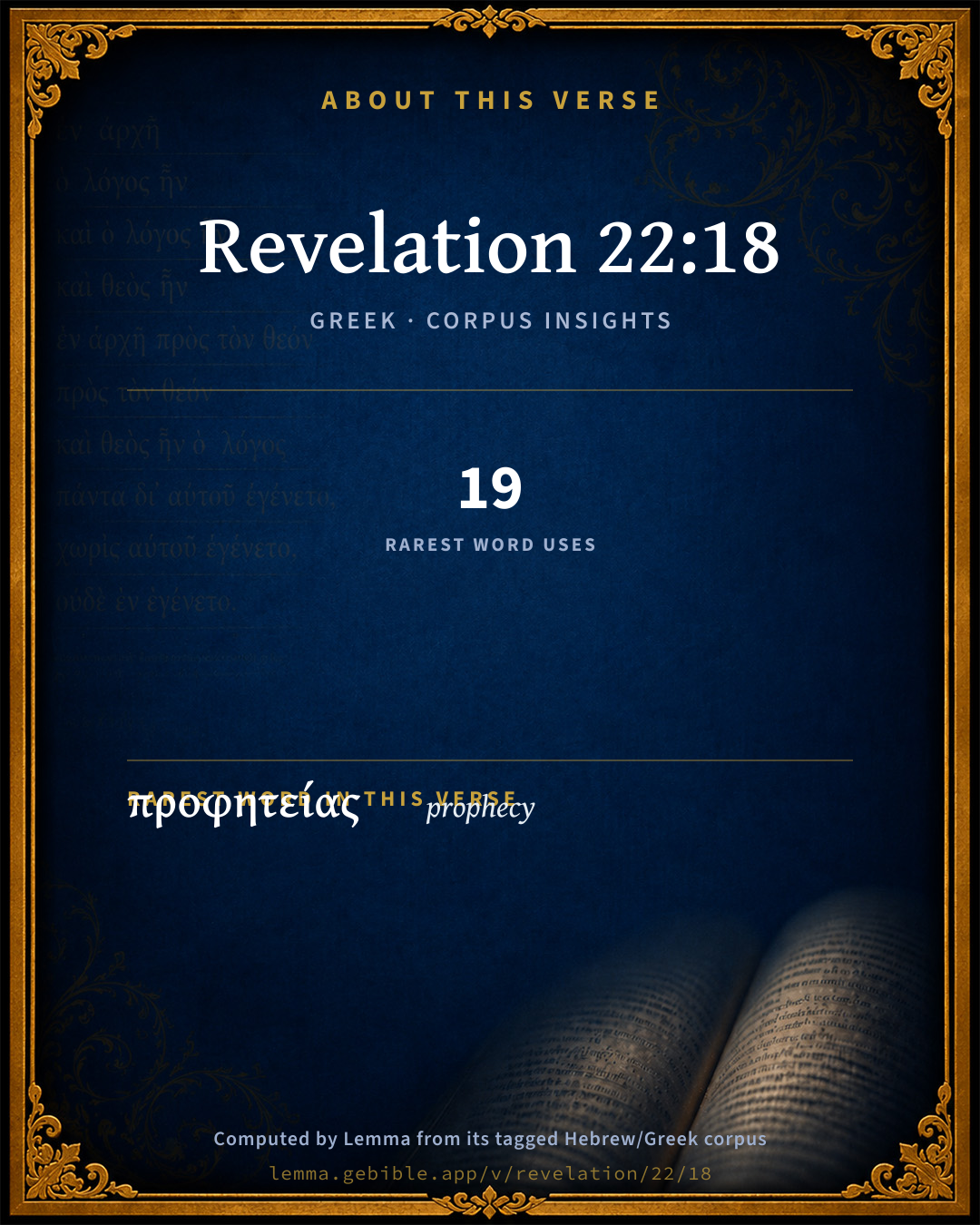
Revelation 22:18

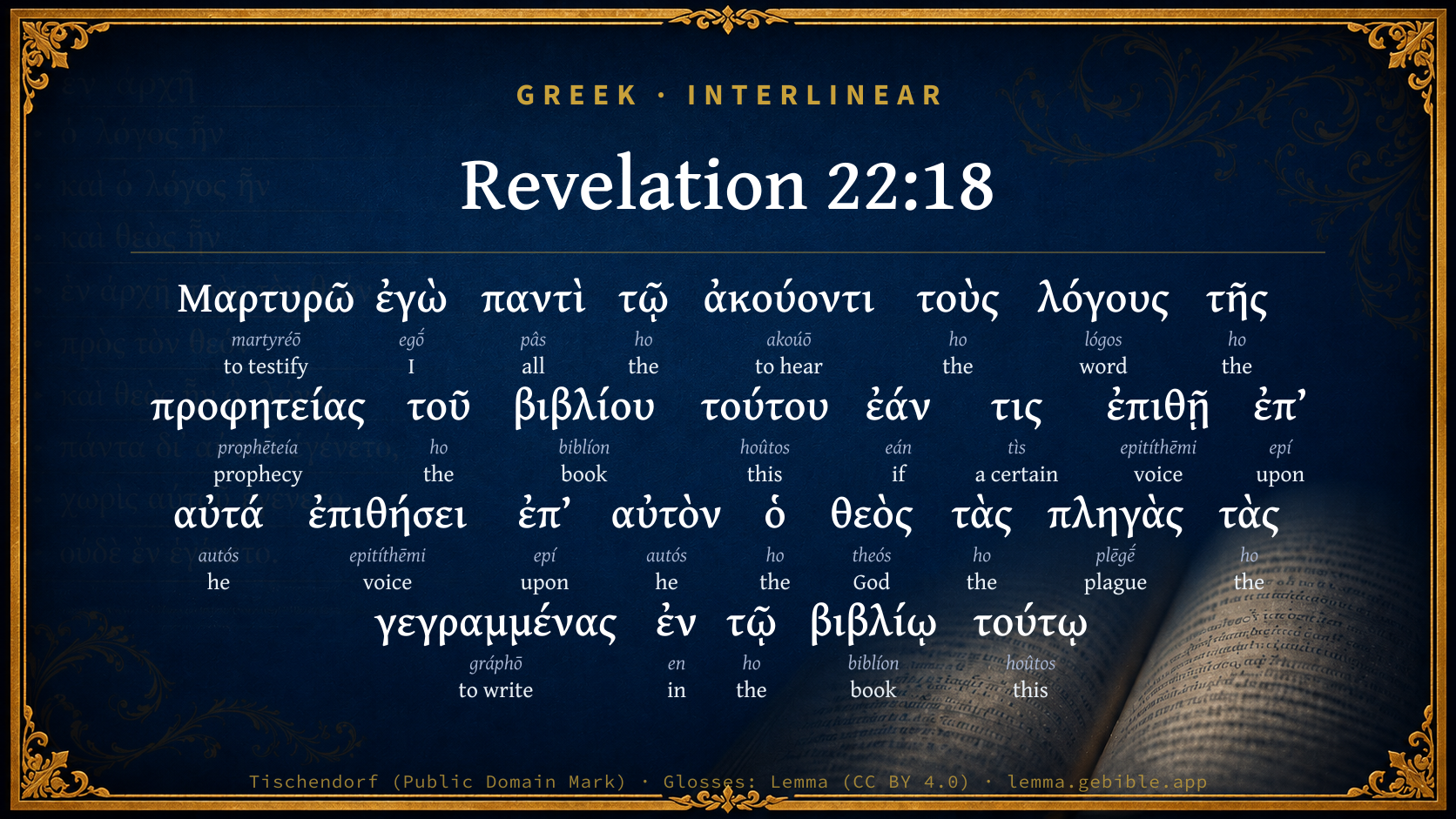
Greek (Tischendorf 8th ed.) Revelation 22:18 appears in the Greek New Testament. The text above is from the Tischendorf 8th edition. Each word links to its Strong’s number and a concise gloss. Click any word for its full Thayer’s Greek Lexicon entry.
Download image
Cite this verse

Revelation 22:18 (World English Bible). Public Domain. Lemma interlinear Bible study tool, https://lemma.gebible.app/v/revelation/22/18.

Show BibTeX & RIS
BibTeX
RIS
English Translation
I testify to everyone who hears the words of the prophecy of this book, if anyone adds to them, may God add to him the plagues which are written in this book.
World English Bible · Public Domain
Download a study sheet

One document with this verse’s original text, its word-by-word gloss line, the meaning frame, cross-references with their text, attributed commentary, and full source and license credits — printable, and it pastes into notes with its structure intact.

This verse Autodidact and up

Study sheet (.html) Plain text (.txt)

A passage Seminary Student

Up to 50 verses in one chapter. A passage sheet keeps up to 6 commentary sources and 12 cross-references per verse, in the order this page ranks them, and says so on the sheet whenever that leaves anything out. Ask for a single verse and you get the Autodidact verse sheet above.

Everything on this page stays free to read, with no account — the sheet is a download of what is already on screen, not access to it.

Want to remove ads? Support Godless Engineer
Compare translations 3

The same verse in 3 English versions, stacked beneath the original-language interlinear above. Click any original word for its lexicon entry.

Each is an independent rendering of the whole verse — the interlinear is not word-aligned to these translations.

Highlighted words mark where these versions differ — a whole-verse word diff, not a word-by-word alignment.

  • World English Bible Public Domain
    I testify to everyone who hears the words of the prophecy of this book, if anyone adds to them, may God add to him the plagues which are written in this book.
  • King James Version Public Domain
    For I testify unto every man that heareth the words of the prophecy of this book, If any man shall add unto these things, God shall add unto him the plagues that are written in this book:
  • unfoldingWord Literal Text CC BY-SA 4.0
    I testify to everyone hearing the words of the prophecy of this book: If anyone might add to them, God will add to him the plagues written in this book.

unfoldingWord Literal Text — © unfoldingWord, licensed CC BY-SA 4.0. Word-aligned USFM3 via Door43 (git.door43.org/unfoldingWord/en_ult).

Versions to compare (up to 4)

3 of 4 selected

Show all 19 translations

Every available English version of this verse, each an independent rendering of the whole verse.

  • World English Bible Public Domain
    I testify to everyone who hears the words of the prophecy of this book, if anyone adds to them, may God add to him the plagues which are written in this book.
  • Berean Standard Bible Public Domain
    I testify to everyone who hears the words of prophecy in this book: If anyone adds to them, God will add to him the plagues described in this book.
  • Majority Standard Bible Public Domain
    I testify to everyone who hears the words of prophecy in this book: If anyone adds to them, God will add to him the plagues described in this book.
  • King James Version Public Domain
    For I testify unto every man that heareth the words of the prophecy of this book, If any man shall add unto these things, God shall add unto him the plagues that are written in this book:
  • American Standard Version (1901) Public Domain
    I testify unto every man that heareth the words of the prophecy of this book, if any man shall add unto them, God shall add unto him the plagues which are written in this book:
  • Revised Version (1885) Public Domain
    I testify unto every man that heareth the words of the prophecy of this book, If any man shall add unto them, God shall add unto him the plagues which are written in this book:
  • Geneva Bible (1599) Public Domain
    For I protest vnto euery man that heareth the words of the prophecie of this booke, If any man shall adde vnto these things, God shall adde vnto him the plagues, that are written in this booke:
  • Douay-Rheims (1899) Public Domain
    For I testify to every one that heareth the words of the prophecy of this book: If any man shall add to these things, God shall add unto him the plagues written in this book.
  • Young's Literal Translation Public Domain
    `For I testify to every one hearing the words of the prophecy of this scroll, if any one may add unto these, God shall add to him the plagues that have been written in this scroll,
  • Literal Standard Version CC BY-SA 4.0
    For I testify to everyone hearing the words of the prophecy of this scroll, if anyone may add to these, God will add to him the plagues that have been written in this scroll,
  • Unlocked Literal Bible CC BY-SA 4.0
    I testify to everyone who hears the words of the prophecy of this book: If anyone adds to them, God will add to him the plagues that are written about in this book.
  • unfoldingWord Literal Text CC BY-SA 4.0
    I testify to everyone hearing the words of the prophecy of this book: If anyone might add to them, God will add to him the plagues written in this book.
  • Darby Bible Public Domain
    *I* testify to every one who hears the words of the prophecy of this book, If any one shall add to these things, God shall add to him the plagues which are written in this book.
  • World Messianic Bible Public Domain
    I testify to everyone who hears the words of the prophecy of this book: if anyone adds to them, God will add to him the plagues which are written in this book.
  • Webster's Bible Public Domain
    For I testify to every man that heareth the words of the prophecy of this book, if any man shall add to these things, God will add to him the plagues that are written in this book:
  • Free Bible Version CC BY-SA 4.0
    I solemnly declare to everyone who hears the prophetic words of this book that if anyone adds to them then God will add to them the plagues described in this book.
  • Bible in Basic English Public Domain
    For I say to every man to whose ears have come the words of this prophet's book, If any man makes an addition to them, God will put on him the punishments which are in this book:
  • Text-Critical English NT CC BY 4.0
    I testify to everyone who hears the words of the prophecy of this book: If anyone adds to them, may God add to him the plagues that are written in this book.
  • Tyndale New Testament (1534) Public Domain
    I testifye vnto every man that heareth the wordes of prophesy of thys boke. yf eny man shall adde vnto these thynges god shall adde vnto him the plages that are wrytten in this boke.

Literal Standard Version (2020), Covenant Press — licensed CC BY-SA 4.0. Text via the HelloAO Bible API (eBible.org). Unlocked Literal Bible (unfoldingWord) — licensed CC BY-SA 4.0. Text via the HelloAO Bible API (eBible.org). unfoldingWord Literal Text — © unfoldingWord, licensed CC BY-SA 4.0. Word-aligned USFM3 via Door43 (git.door43.org/unfoldingWord/en_ult). Free Bible Version, Dr. Jonathan Gallagher — licensed CC BY-SA 4.0. Text via the HelloAO Bible API (eBible.org).

Word by word

More ways to search: Search by grammar → Find every occurrence → Compare this word →

Practice this passage: Drill this verse → Learn its vocabulary →

προφητείας
prophēteía
G4394
“prophecy”
Noun, Genitive, Singular, Feminine
Part of Speech
Noun
Case
Genitive
Number
Singular
Gender
Feminine
Full Thayer's Definition

Origin: "from G4396 ("prophecy")"

TDNT: 19:02,0

1. prophecy a. a discourse emanating from divine inspiration and declaring the purposes of God, whether by reproving and admonishing the wicked, or comforting the afflicted, or revealing things hidden; esp. by foretelling future events b. Used in the NT of the utterance of OT prophets 1. of the prediction of events relating to Christ's kingdom and its speedy triumph, together with the consolations and admonitions pertaining to it, the spirit of prophecy, the divine mind, to which the prophetic faculty is due 2. of the endowment and speech of the Christian teachers called prophets 3. the gifts and utterances of these prophets, esp. of the predictions of the works of which, set apart to teach the gospel, will accomplish for the kingdom of Christ
  1. Μαρτυρῶ martyréō G3140 “to testify” Verb, Present, Active, Indicative, 1st person, Singular
  2. ἐγὼ egṓ G1473 “I” Personal pronoun, 1st person, Nominative, Singular
  3. παντὶ pâs G3956 “all” Adjective, Dative, Singular, Masculine
  4. τῷ ho G3588 “the” Article, Dative, Singular, Masculine
  5. ἀκούοντι akoúō G191 “to hear” Verb, Present, Active, Participle, Dative, Singular, Masculine
  6. τοὺς ho G3588 “the” Article, Accusative, Plural, Masculine
  7. λόγους lógos G3056 “word” Noun, Accusative, Plural, Masculine
  8. τῆς ho G3588 “the” Article, Genitive, Singular, Feminine
  9. τοῦ ho G3588 “the” Article, Genitive, Singular, Neuter
  10. βιβλίου biblíon G975 “book” Noun, Genitive, Singular, Neuter
  11. τούτου hoûtos G3778 “this” Demonstrative pronoun, Genitive, Singular, Neuter
  12. ἐάν eán G1437 “if” Conditional
  13. τις tìs G5100 “a certain” Indefinite pronoun, Nominative, Singular, Masculine
  14. ἐπιθῇ epitíthēmi G2007 “voice” Verb, Aorist, Active, Subjunctive, 3rd person, Singular
  15. ἐπ’ epí G1909 “upon” Preposition
  16. αὐτά autós G846 “he” Personal pronoun, Accusative, Plural, Neuter
  17. ἐπιθήσει epitíthēmi G2007 “voice” Verb, Future, Active, Indicative, 3rd person, Singular
  18. ἐπ’ epí G1909 “upon” Preposition
  19. αὐτὸν autós G846 “he” Personal pronoun, Accusative, Singular, Masculine
  20. ὁ ho G3588 “the” Article, Nominative, Singular, Masculine
  21. θεὸς theós G2316 “God” Noun, Nominative, Singular, Masculine
  22. τὰς ho G3588 “the” Article, Accusative, Plural, Feminine
  23. πληγὰς plēgḗ G4127 “plague” Noun, Accusative, Plural, Feminine
  24. τὰς ho G3588 “the” Article, Accusative, Plural, Feminine
  25. γεγραμμένας gráphō G1125 “to write” Verb, Perfect, Passive, Participle, Accusative, Plural, Feminine
  26. ἐν en G1722 “in” Preposition
  27. τῷ ho G3588 “the” Article, Dative, Singular, Neuter
  28. βιβλίῳ biblíon G975 “book” Noun, Dative, Singular, Neuter
  29. τούτῳ hoûtos G3778 “this” Demonstrative pronoun, Dative, Singular, Neuter

About this verse

These counts appear in no published source. They are computed here, from the morphology-tagged text and Lemma’s own curated glosses. What Lemma adds →

30
words
18
distinct lemmas
Revelation
section

Notable vocabulary

The rarest word here is προφητείας prophecy G4394 — appearing just 19 times in the whole Greek New Testament.

Shared distinctive vocabulary

προφητείας prophecy G4394 occurs in 19 verses of the Greek New Testament. Also found in:

Repetition

Words recur within this verse:

  • βιβλίου book G975 ×2
  • ἐπιθῇ voice G2007 ×2
  • ἐπ’ upon G1909 ×2
  • τῷ the G3588 ×8
  • τούτου this G3778 ×2
  • αὐτά he G846 ×2

Cross-references

21

Topical passages linked to Revelation 22:18 in the Treasury of Scripture Knowledge — connected by theme and wording, ordered by reader-vote popularity; previews shown in the World English Bible.

  • Deuteronomy 12:32 Whatever thing I command you, that shall you observe to do: you shall not add thereto, nor diminish from it.
  • Deuteronomy 4:2 You shall not add to the word which I command you, neither shall you diminish from it, that you may keep the commandments of Yahweh your God which I command you.
  • Proverbs 30:6 Don't you add to his words, Lest he reprove you, and you be found a liar.
  • Revelation 1:3 Blessed is he who reads and those who hear the words of the prophecy, and keep the things that are written in it, for the time is at hand.
  • Matthew 15:6–9 he shall not honor his father or mother.' You have made the commandment of God void because of your tradition.
  • Revelation 22:7 "Behold, I come quickly. Blessed is he who keeps the words of the prophecy of this book."
  • Leviticus 26:18 "'If you in spite of these things will not listen to me, then I will chastise you seven times more for your sins.
  • Leviticus 26:24–25 then I will also walk contrary to you; and I will strike you, even I, seven times for your sins.
  • Leviticus 26:28 then I will walk contrary to you in wrath; and I also will chastise you seven times for your sins.
  • Matthew 15:13 But he answered, "Every plant which my heavenly Father didn't plant will be uprooted.
  • 1 Thessalonians 4:6 that no one should take advantage of and wrong a brother or sister in this matter; because the Lord is an avenger in all these things, as also we forewarned you and testified.
  • Revelation 15:1 I saw another great and marvelous sign in the sky: seven angels having the seven last plagues, for in them God's wrath is finished.
  • Leviticus 26:37 They will stumble over one another, as it were before the sword, when no one pursues: and you will have no power to stand before your enemies.
  • Ephesians 4:17 This I say therefore, and testify in the Lord, that you no longer walk as the rest of the Gentiles also walk, in the futility of their mind,
  • Revelation 3:14 "To the angel of the assembly in Laodicea write: "The Amen, the Faithful and True Witness, the Head of God's creation, says these things:
  • Revelation 15:6–16:21 The seven angels who had the seven plagues came out, clothed with pure, bright linen, and wearing golden sashes around their breasts.
  • Revelation 19:20 The beast was taken, and with him the false prophet who worked the signs in his sight, with which he deceived those who had received the mark of the beast and those who worshiped his image. These two were thrown alive into the lake of fire that burns with sulfur.
  • Revelation 22:16 I, Jesus, have sent my angel to testify these things to you for the assemblies. I am the root and the offspring of David; the Bright and Morning Star."
  • Revelation 14:10–11 he also will drink of the wine of the wrath of God, which is prepared unmixed in the cup of his anger. He will be tormented with fire and sulfur in the presence of the holy angels, and in the presence of the Lamb.
  • Revelation 20:10 The devil who deceived them was thrown into the lake of fire and sulfur, where the beast and the false prophet are also. They will be tormented day and night forever and ever.
  • Revelation 20:15 If anyone was not found written in the book of life, he was cast into the lake of fire.

Cross-references courtesy of OpenBible.info (CC BY 4.0).

Where the printed editions differ

1 variant

Places in this verse where the major printed Greek editions disagree on the wording in a way that affects the translation — a comparison of editions, not a manuscript-by-manuscript collation. The editions are the modern critical texts (Nestlé-Aland 28/27, SBL, Westcott-Hort, Tregelles, Tyndale House) and the traditional texts behind the KJV (the Textus Receptus and the Byzantine/Majority text). It is not a claim about which reading is original.

  1. Different wording
    ἐγὼ

    “I myself”

    In NA28NA27TynSBLWHTregByz Not in TR

    γὰρ (gar) 'for' occurs in traditional manuscripts (TR) instead of ἐγὼ (egō) 'I myself' in older manuscripts (NA28+NA27+Tyn+SBL+WH+Treg+Byz)

Textual data: Translators Amalgamated Greek New Testament (STEPBible TAGNT) · CC BY 4.0.

Commentary

Notes on Revelation 22:18 from classic Christian and Jewish commentators (each source and its license shown beneath its notes). The classic Christian expositions comment on the surrounding passage and are grouped to its opening verse, so a note may address several verses; the Jewish commentaries on the Tanakh (Rashi and others) are per-verse, so they appear only where the commentator wrote on this verse.

Lemma curates 59 commentaries, every one of them public domain or Creative Commons licensed, each selected and text-cleaned for this edition rather than reprinted as found. About our sources →

The Cambridge Bible for Schools and Colleges

gen. ed. J. J. S. Perowne

The final Testimony of the Seer and his Benediction, Rev_22:18-21

18. For I testify] Omit “for.”

If any man shall add &c.] Deu_4:2; Deu_12:32. The parallel of those passages proves, that the curse denounced is on those who interpolate unauthorised doctrines in the prophecy, or who neglect essential ones; not on transcribers who might unadvisedly interpolate or omit something in the true text. The curse, if understood in the latter sense, has been remarkably ineffective, for the common text of this book is more corrupt, and the true text oftener doubtful, than in any other part of the N. T. But it may be feared that additions and omissions in the more serious sense have also been frequently made by rash interpreters. It is certain that the curse is designed to guard the integrity of this Book of the Revelation, not to close the N. T. canon. It is not even certain that this was the last written of the canonical books.

unto these things] Better simply unto them: an unemphatic pronoun being used. Though it cannot grammatically refer to “the words of the prophecy,” i.e. it no doubt does so refer ungrammatically.

The Cambridge Bible for Schools and Colleges (gen. ed. J. J. S. Perowne; Cambridge University Press, 1878–1918) — public domain. Text from a community e-Sword module.

The Biblical Illustrator

Joseph S. Exell

Rev_22:18-19

If any man shall add unto these things.

The Divine Word, and the doom of its defacers

I. The perfection of Gods Word. Man may not intermeddle with it, either to add or to take away. Can man improve the works of God?--the mountains, rivers, flowers?--the blue sky, the stars, the sun? Even so is the Word of God too perfect for him to touch.

II. The honour God puts on it. He has magnified it, even above His works; so that he who disparages the Word of God is more guilty than he who disparages the works of God. It is the fullest expression of His mind, the completest revelation of His character.

III. Our responsibilities in regard to it. It is not given us for mere speculation or gratification; but for something far higher. We are responsible for the way we treat it, study it, profit by it. Its perfection makes our responsibility very great, and appeals to our consciences most powerfully.

IV. The sin of tampering with it. Every low thought about the Bible is sin. Every attempt to touch it, either in the way of addition or subtraction, is sin.

V. The danger of meddling with it. The danger is exceeding great; and the punishment awarded to the intermeddlers is the declaration of the danger. God will not be mocked in this thing. (H. Bonar, D. D.)

The Biblical Illustrator, edited by Joseph S. Exell (c. 1880s–1900s) — public domain. Text from a community e-Sword module.

Joseph Benson's Commentary

Rev 22:18-19. For I testify — Here the Lord Jesus adds a solemn admonition, not only to the churches of Asia, but to all who should ever hear or read this book. To him that adds to the things contained in it, shall all the plagues mentioned in it be added; and from him that takes away from the words of this prophecy shall the blessings spoken of in it be taken. And doubtless this guilt is incurred by all those who lay hinderances in the way of the faithful, in order to prevent them from hearing their Lord’s words, I come, and answering, Come, Lord Jesus. This may likewise be considered as an awful sanction given to the whole New Testament; in like manner, as Moses guarded the law, (Deu 4:2; Deu 12:32,) and as God himself did, (Mal 4:4,) in closing the canon of the Old Testament. It is true, however, that this solemn caution particularly refers to this book of the Revelation. But, as Doddridge observes, “God forbid we should imagine every honestly mistaken criticism, where there is a question respecting receiving or excluding any particular verse, should affect a man’s salvation, in consequence of what is here said. Such a passage, however, should make men very cautious, that they may not rashly incur any censure on this account; though, undoubtedly, the terror of the threatening is planted against any designed erasement or addition.” It may be observed further on this verse, that since God threatens the plagues written in this book, and the loss of a part in the holy city, as what might be the portion of those who should presume to corrupt it, and such corruption might happen in any age of the church, — it is very evident that the holy city spoken of in the preceding chapter is a representation of the heavenly state to be enjoyed by all good men; how applicable soever it may seem to any glorious scene preceding the final judgment: and that Rev 20:11-12, refers to the universal judgment.

Joseph Benson's Commentary on the Old and New Testaments (1811–1818) — public domain. Text from a community e-Sword module.

Tyndale Open Study Notes

Tyndale Open Resources

22:18-19 I solemnly declare: John issues an oath to protect the integrity of the book of Revelation. He declares a curse upon anyone who alters the contents of the book or its message (cp. Deut 4:2; 12:32). The curse contrasts with the statement of blessing on all who read aloud, listen to, and obey the prophecy (Rev 1:3). At the time Revelation was written, scribes would sometimes alter books to suit their own views. Early Christians quickly developed means of authenticating both messages and messengers (see John 21:24; 1 Cor 16:21; Gal 6:11; Col 4:18; 2 Thes 3:17; 1 Jn 4:1-3). • Since the time of the early church, the scope and content of the New Testament has been established as the measure of the Christian proclamation. Yet the church continues to be plagued by those who would attempt to reconstruct the borders of Scripture by adding other works that they believe are of equal status with the Bible or by arguing that certain segments of the Bible are unreliable creations of human effort and perception. The genuine church has rejected and will continue to reject efforts to redefine the boundaries of the canon as human and even demonic attempts to alter the basis of the Christian faith.

Tyndale Open Study Notes — © Tyndale Open Resources, licensed CC BY-SA 4.0. Text via the HelloAO Bible API.

Bengel's Gnomon

Johann Albrecht Bengel

Rev 22:18. [249]ΜΑΡΤΥΡῶ ἘΓῺ) See Appar. on this passage.[250] In Rev 22:18-19, there is a most severe testimony, a most weighty admonition to all hearers of the Apocalypse. If any man shall add, there shall be added upon him plagues: if any man shall take away, from him shall be taken away blessings. Repayment in kind [talio]. It is more grievous, as it appears from the annexed threatenings, to add, than to take away: though many critics actually show that they entertain a contrary opinion, being more timid in the erasure than in the admission of glosses. To change, is at once both to add and to take away. First, any hearer may offend in this matter, when he endeavours to pass off as Apocalyptic writings which are not such, or suppresses those which are truly Apocalyptic. An unskilful expounder, who is blind and rash, offends, and especially if he deems himself to be endowed with a singular prophetical gift and faculty. An unfaithful translator and copyist, who writes out the text incorrectly, exceedingly offends: for while the text is uncorrupted, especially at the foundation, the offence of the expounder and of the hearer may be corrected; but when the text is corrupted, the injury is much greater. Yet in all these modes the offence may be committed in a greater or less degree, the faithful being hindered, so that they cannot learn to hear the Lord’s I come, and to answer Come, and thus to enjoy the truth and fruit of the whole book or of the separate parts and portions, and to recognise the glory of Jesus Christ: Rev 22:17; Rev 22:20. Nor is theirs a slight fault, who perversely, unfairly, and unseasonably bring forward mysteries, and produce in the world and its princes envy and suspicion towards the kingdom of God. It is not the modest endeavour, joined with the desire of progress, and not blocking up the way to the truth arising from other sources, which is here condemned; it is profane boldness, arising from carnal sense, which is condemned. And John especially forewarned Cerinthus, who afterwards incurred this censure. This clause applies to the case of all the books of Holy Scripture: comp. Deu 4:2; Pro 30:6; but it especially applies to the Apocalypse, the crowning point of prophecy, which was exposed to peculiar danger, and the minute and admirable connection of which might be disturbed or obscured by the change of even a single word. The separate parts of this book, guarded as it is by so severe an interdict, are of great moment. The extraordinary multitude of various readings in the Apocalypse cries aloud, that all have not at all times acted with religious caution in this matter. [In this very interdict, about the not adding or taking away, I have noticed twenty-four varieties of reading introduced by copyists.—Not. Crit.] Thanks be unto God, who has preserved to us marks and traces of the genuine reading through the dangers of so many ages!—ἐάν τις ἐπιθῇ, κ.τ.λ., if any man add) To add, according to the interpretation of Lange, is to put off to the future those things which are already accomplished: to take away, is to regard future things as already accomplished. Comm. Apoc. f. 250. Let another see, that he does not add; I am on my guard, that I do not take away.

[249] Ἔρχου, Come) The whole matter hinges on this, that you may confidently and with joy be able to hear the announcement I come, and to reply, Come. But if you have not yet attained to this, take care that you do attain to it.—V. g.

[250] So ABh; but Rec. Text, συμμαρτυροῦμαι γάρ: and Vulg. “contestor ego.”—E.

—ὁ ἀκούων, he that heareth) The Spirit and the bride saying, Come.—V. g.

Bengel's Gnomon of the New Testament — English translation (T&T Clark, Edinburgh, 1860) — public domain. Text from a community e-Sword module.

Meyer's Critical & Exegetical Commentary

Heinrich August Wilhelm Meyer

Rev_22:18-21. The close of the book in which the prophet has communicated to the churches the revelation given to him. Instead of the commendation, accompanied by rich promises, of the prophetical book, which stood in the beginning,[4438] there appears here likewise a threatening corresponding to its Divine authority against all who corrupt it (Rev_22:18 sq.). The prophet then once more declares, as a word of the Lord himself, the chief sum of the entire revelation, by, on his part, meeting this promise of the Lord with the believing prayer for its fulfilment (Rev_22:20), and then concludes with the Christian farewell greeting, corresponding to the address to the churches (Rev_1:4).

The threatening (Rev_22:18 sq.) has developed from the allusion in Deu_4:2,[4439] but has been shaped (ἘΠΙΘΉΣΕΙ Ὁ Θ. ἘΠʼ ΑὐΤ. ΤᾺς ΠΛΗΓᾺς, Κ. Τ. Λ., Rev_22:18; ἈΦΕΛΕῖ Ὁ Θ. ΤῸ ΜΈΡΟς ΑὐΤ. ἈΠῸ Τ. ΞΎΛΟΥ, Κ.Τ.Λ., Rev_22:19), according to the standard of the preceding descriptions,the threatened plagues being not only those described in ch. 16, which indeed in Rev_15:1; Rev_15:8, are co-ordinated as the last described in the former visions,[4440]and is marked in its righteousness by the paronomastic mode of expression (ἐάν τις ἐπιθῇ

ἐπιθήσει ὁ θεός ἀφέλῃ

ἀφελεῖ).[4441] The threatening is presented in the most formal way, παντὶ τῲ ἀκούοντι τοὺς λόγους, κ.τ.λ., i.e., to every one who, through the reading in the church, hears the prophetic discourses written in the present book.[4442] From this personal designation it results, at all events, that the threatening with the curse is not directed against inconsiderate transcribers;[4443] but on the other hand, Ew. i. and De Wette improperly press the expression τ. ἀκούοντι, when they refer the threat to the danger that what is received only with the ear in oral communication is easily falsified, and thus a distraction of Christian hope could be produced. Then the threatening must by its injustice create offence.[4444] But the ἀκούοντες come into consideration, not as mediators of the literary tradition, but as those who are to appropriate the contents of the prophetical book, revealed to them by God,notice that ἐάν τις ἐπιθῇ ἐπʼ αὐτά, is first said,for their own wrarning and encouragement, and are to maintain it in its purity, and to act accordingly. These fall under the curse when they arbitrarily falsify the revelation of God that has been given, because they will not approve the righteous ways of God, which are here described,[4445] and consequently call down upon themselves the wrathful judgments of God, which impend over unbelievers.

ὁ μαρτυρῶν ταῦτα, Christ. Cf. Rev_1:2, Rev_19:10. With a word of the coming Lord himself, which contains the very marrow of the entire revealed testimony given to the prophet,[4446] he concludes his book, not, however, without sealing with his Ἀμήν his believing acceptance of the Lords promise,[4447] and expressing his own longing for the Lords coming, in the sense of Rev_22:17.

[4438] Rev_1:3.

[4439] LXX.: οὑ προσθήσετε

καὶ οὐκ ἀφελεῖτε, κ.τ.λ.

[4440] On τ. μέρος αὐτ., κ.τ.λ., cf. Rev_21:8. Ewald: Shall withdraw fellowship.

[4441] Cf. Rev_11:18.

[4442] Cf. Rev_1:3. Ew., Dc Wette.

[4443] Vitr., Züll., Bleek, etc.

[4444] De Wette. Cf. also Luther, Introduction of 1522: Besides, I think that it is entirely too much that he severely commends and threatens with respect to such a book of his own, more than other holy books, as though it were of much more Importance.

[4445] Cf. Rev_15:3 sq., Rev_11:17 sqq.

[4446] Cf. Introduction, p. 28.

[4447] Cf. Rev_5:14, Rev_19:4.

The epistolary closing wish (Rev_22:21) corresponds to the dedication (Rev_1:4 sqq.) whence also the πάντων obtains its limitation. This is expressed incorrectly in the addition τῶν ἁλίων, but correctly in the ὑγῶν. Rec., Luth.

Meyer — Critical and Exegetical Commentary on the New Testament — English translation by Peter Christie, edited by Frederick Crombie (T&T Clark, 1880) — public domain. Text from a community e-Sword module.

Geneva Bible (1599)

Geneva Bible translators

The obtestation of Saint John (which is the third place of the confirmation, as was noted, verse 6) joined with a curse of execration, to preserve the truth of this book entire and uncorrupted, in two verses.

Geneva Bible (1599) marginal notes — public domain. Text via Bolls.life.

Jamieson, Fausset & Brown

Robert Jamieson, A. R. Fausset & David Brown

For I testify--None of our manuscripts have this. A, B, Vulgate, and ANDREAS read, "I" emphatic in the Greek. "I testify."

unto these things--A, B, and ANDREAS read, "unto them."

add . . . add--just retribution in kind.

Jamieson, Fausset & Brown — Commentary Critical and Explanatory on the Whole Bible (1871) — public domain (CC PDM 1.0). Text via the HelloAO Bible API.

Adam Clarke's Commentary

Verse 18. If any man shall add] Shall give any other meaning to these prophecies, or any other application of them than God intends, he, though not originally intended, shall have the plagues threatened in this book for his portion.

Adam Clarke's Commentary on the Bible (1810–1826) — public domain. Text from a community e-Sword/MySword module.

Ellicott's Commentary for English Readers

(18-19) I testify unto every man that heareth.—Omit “For,” and read, I testify to every one that hears . . . The “I” is emphatic; it introduces the final warning; the revelation must not be tampered with. If any one shall have added to them, God shall add to him the plagues which are written in this book; and if any one shall have taken away from the words of the book of this prophecy, God shall take away his portion from the tree of life, and out of the holy city which are written (or printed) in this book. We may compare Deu_4:2; Deu_12:32. The words are a solemn protest against the spirit which handles rashly or deceitfully the word of God; which adds its own thoughts, or makes its wishes the parent of its interpretations; which dilutes the force of its warnings, or impoverishes the fulness of its promises. The right of continual access to the tree of life was the promise of Rev_22:14; this right or freedom is forfeited by those who deal falsely or faithlessly by the words of Christ here. In a minor degree, it is true that those who leave this book unstudied and unprayed over, lose much spiritual sustenance and comfort. How much more do they lose who trifle with it, ignore its spiritual teachings, and sin against the laws of that kingdom whose progress it so vividly portrays.

A Bible Commentary for English Readers, edited by Charles John Ellicott (1878–1897) — public domain. Text from a community e-Sword module.

John Gill's Exposition

For I testify to every man,.... These are not the words of a scribe, who having wrote out a copy of this book, added the following adjuration to it, to deter persons from adding to it, or diminishing it; for the book is not yet finished, and both Christ and John speak after this; and to insert such a passage into the text would be a bold and daring action; nor are they even the words of John, the inspired writer of it, but of the Lord Jesus Christ, the faithful witness, as appears from Rev 22:16 who in a most solemn manner declares to every man, high or low, rich or poor, of whatsoever character, or however dignified, either in a civil or ecclesiastic way,

that heareth the words of the prophecy of this book read or explained,

if any man shall add unto these things. To "add" to the things contained in this book, is not to deliver, or write an exposition of it, in a modest manner, with a sincere view to give light into it, agreeably to the analogy of faith; for to expound Scripture, or to preach from it, consistent with it, is not to add unto it, but to give the sense of it; but then may it be said to be added unto, and so this book, when it is wrested and perverted, and a false gloss is put upon it, as the Pharisees did upon the law; and when unwritten traditions are made to be equal to it, or above it, as the same persons made the traditions of the elders, whereby they transgressed the law, and made the word of God of none effect, and so broke through the precept given, Deu 4:2 as do the Papists in like manner; and when men pretend to visions and revelations, and make them the rule of faith and practice, and to confirm things that are neither in this book, nor in any other part of the word of God; and when men interpolate it, and set up human fictitious writings upon equal authority with it; which shows the authenticity of this book, and of all the whole Scripture, and the perfection of it, whose canon is closed with it: the punishment of such a crime follows,

God shall add unto him the plagues that are written in this book; the things threatened to the antichristian party, Rev 2:22 the seven last plagues in which the wrath of God is filled up, which will be inflicted on the same, Rev 16:1, the lake of fire and brimstone, into which the beast, the false prophet, the devil, and all wicked men will be cast, Rev 19:20 see Pro 30:5.

John Gill's Exposition of the Whole Bible (1746–1763) — public domain (CC PDM 1.0). Text via the HelloAO Bible API.

Trapp's Complete Commentary

John Trapp

18 For I testify unto every man that heareth the words of the prophecy of this book, If any man shall add unto these things, God shall add unto him the plagues that are written in this book:

Ver. 18. If any man shall add unto these things] Either to this or to any of the foregoing books of Scripture, Deu 4:2; Pro 30:6; Gal 3:15; 2Ti 3:16-17. All which notwithstanding, the Jews have added their Deuteroseis, the Turks their Alfurta, the Papists their unwritten verities, which they equalize (at least) to the Scriptures.

John Trapp, A Commentary or Exposition upon All the Books of the Old and New Testament (1647–1656) — public domain. Text from a community e-Sword module.

Albert Barnes' Notes on the Bible

For I testify - The writer does not specify who is meant by the word “I” in this place. The most natural construction is to refer it to the writer himself, and not to the angel, or the Saviour. The meaning is, “I bear this solemn witness, or make this solemn affirmation, in conclusion.” The object is to guard his book against being corrupted by any interpolation or change. It would seem not improbable, from this, that as early as the time of John, books were liable to be corrupted by additions or omissions, or that at least there was felt to be great danger that mistakes might be made by the carelessness of transcribers. Against this danger, John would guard this book in the most solemn manner. Perhaps he felt, too, that as this book would be necessarily regarded as obscure from the fact that symbols were so much used, there was great danger that changes would be made by well-meaning persons with a view to make it appear more plain.

Unto every man that heareth the words of the prophecy of this book - The word “heareth” seems here to be used in a very general sense. Perhaps in most cases persons would be made acquainted with the contents of the book by hearing it read in the churches; but still the spirit of the declaration must include all methods of becoming acquainted with it.

If any man shall add unto these things - With a view to furnish a more full and complete revelation; or with a profession that new truth had been communicated by inspiration. The reference here is to the book of Revelation only - for at that time the books that now constitute what we call the Bible were not collected into a single volume. This passage, therefore, should not be adduced as referring to the whole of the sacred Scriptures. Still, the principle is one that is thus applicable; for it is obvious that no one has a right to change any part of a revelation which God makes to man; to presume to add to it, or to take from it, or in any way to modify it. Compare the notes at 2Ti 3:16.

God shall add unto him the plagues that are written in this book - These “plagues” refer to the numerous methods described in this book as those in which God would bring severe judgment upon the persecutors of the church and the corrupters of religion. The meaning is, that such a person would be regarded as an enemy of his religion, and would share the fearful doom of all such enemies.

Albert Barnes' Notes on the Bible (1834–1885) — public domain. Text from a community e-Sword/MySword module.

Haydock's Catholic Bible Commentary

I, John, testify and bear witness of all the truths contained in this revelation: If any man shall add to these things, he becomes guilty of sin, and makes himself liable to the punishments and plagues that are written in this book. (Witham)

George Leo Haydock (1774–1849), Haydock's Catholic Family Bible and Commentary, 1859 edition — public domain. Excludes Psalms (Douay-Rheims chapter numbering differs from Protestant) and Deuterocanonical books (Catholic canon only).

Whedon's Commentary on the Bible

Daniel D. Whedon

18. For—This word is pronounced spurious by the best authorities.

I testify—Who, here, testifies? The testifieth of Rev_22:20 shows that it is Jesus.

Add unto these things—With purpose to corrupt the apostolic truth. The words refer not so much to additions to the text of the manuscript, as to the adding unholy falsehood to holy truth.

God shall add unto him—Remaining unrepentant.

Daniel D. Whedon (gen. ed.), Commentary on the Old and New Testaments (1874–1909) — public domain. Text from a community e-Sword module.

The Pulpit Commentary

For I testify unto every man that heareth the words of the prophecy of this book. Omit "for." The pronoun "I" is emphatic. Here is the solemn appendix or seal of the veracity of the book, somewhat similar to the prefatory words in Rev_1:1-3. This is the fulfilment of the duty laid upon St. John in Rev_1:1, not an announcement of our Lord himself. (cf. the wording of Rev_1:3) If any man shall add unto these things, God shall add unto him the plagues that are written in this book; cf. the command in Deu_4:2, "Ye shall not add unto the word which I command you, neither shall ye diminish from it" (Revised Version). "The plagues that are written in this book" are those of the seals, the trumpets, the vials, the doom of Babylon, etc.; cf. the command of St. Paul to Timothy, (2Ti_1:13) and cf. also what is said in 2Ti_2:16-18 concerning the heretical teaching of Hymenaeus and Philetus.

Vers. 18, 19. Closing words of warning.

It would be deemed an unpardonable offence for an ambassador to add words to, or to subtract them from, any royal mandate which he was commissioned to deliver. And if any one in dispensing a physician"s prescription, when the life or death of a patient trembled in the balance, were wantonly to tamper with it, what condemnation could be too severe? Yet we fear that the tendency of many in our day is to treat a message in this book far more lightly than they would any important official human document; and instead of sympathizing with the words before us, and adding their reverent "Amen," they would in all probability either condemn the severity of these words, or else pass them by as out of date and altogether effete. On this account we deem it needful, in approaching the close of our expositions, to look into these verses with special care. We will first inquire what additions to the book or subtractions from it we may suppose men to make, from what we know of human treatment of the Word of God. We propose then to see what is the threatening here denounced against such. Having done this, we will endeavour to ascertain reasons for a sentence so severe. Then we shall be prepared to see how this passage may help us in the formation of religious thought, and how it may bear practically on the life.

I JUDGING FROM WHAT WE KNOW OF THE FACTS OF HISTORY, IN WHAT WAY MAY MEN BE SUPPOSED TO ADD TO OR TO SUBTRACT FROM THIS BOOK? The words of the text evidently embrace any kind of treatment of this Book of the Apocalypse which seemed to assume that a man was at liberty to take the book into his own hands, and to deal with it as he thought fit. Men do this:

1. If they put any merely human production alongside of it as if it were on a level therewith.

2. If they distort the book at pleasure to make it fit in with a preconceived theory about it; e.g. a preconceived and extreme theory of evolution is even now (1889) leading some to treat the old book most unfairly.

3. If they summarily reject the account which the book gives of itself, out of dislike to the supernatural, or from hostility to the principle of authority in religion.

4. If they make a human interpretation of the book of equal dignity or authority with the book itself.

5. If they deny and disown any of those great doctrines which are in wrought into the very texture of the book; e.g. the glory of Christ"s Person; the meaning of his work; the reality of his administration; the freeness of his grace; the certainty of his victory. These and cognate doctrines pervade the entire Apocalypse, and to omit, ignore, deny, or condemn them, from wilful refusal to submit to Divine authority, would be to commit the sin which is here exposed to view. The words of the Apocalypse as a whole, and of these two verses in particular, are not human; they are Divine. We should hear a voice saying, "Take thy shoes from off thy feet; for the place whereon thou standest is holy ground.

II WHAT IS THE THREATENING HERE UTTERED AGAINST THOSE WHO TAMPER WITH THE ROOK? The threatening assumes a positive or negative form according to the positive or negative form of the sin. In the one case it affirms that any actual and wilful ill treatment of, or adding to this book, will bring down the curse of God upon the guilty one"s head. In the other case, it declares that any rebellious rejection of the divinely revealed doctrines of this book will incur rejection from God.

III CAN WE DISCOVER REASONS FOR A SENTENCE SO SEVERE? Certainly we can: seven.

1. The book is Divine in its origin; it is, therefore, too sacred for human hands to mar. (For treatment of the question of the origin of this book, see our first homily in this section) In ver. 16 we have the explicit statement, "I Jesus have set mine angel," etc. In ver. 18 we have the emphatic Marturw egw beginning the verse. It is not absolutely clear whether the speaker in the second ease is Jesus himself or his angel. If the latter, the angel testifies for Jesus. If the former, Jesus speaks for himself. Either way the testimony is divinely authorized, and therefore must ever be too sacred for the trifier"s touch.

2. The book is a Divine manifesto to the Churches; therefore no others can have any right to touch it. It was given at first to those who loved our Lord, that they might keep and shield it. And any one professing to be an ambassador for God, who wilfully tampers with it, is false to his commission from the throne. What nation would bear with its sovereign"s legate, if he were known to add, alter, or delete a word issued from the throne? He would be visited, and rightly, with penalties of terrible severity. Is God"s sanction to be less stern?

3. The book is a disclosure of the future; and no one can possibly be competent to alter a single word of his who sees the end from the beginning. To disclose in a succession of parabolic or symbolic settings the future scenes which are to appear, and that in their order, is a task to which none but God himself can possibly be equal. Therefore the visions must remain untouched.

4. The book is a declaration of doctrine of doctrines on which souls live and grow and thrive; and therefore it is a very serious thing to meddle therewith. By contrary teaching, men may be led astray and ruined for time and for eternity. If there be a reservoir which supplies a town with water, or a well springing up in a barren land, the only one from which a traveller could drink, what curses would be yea, ought to be pronounced against him who should poison either the one or the other? Is it a less serious thing to poison the wells from whence the living water is drawn?

5. The book abounds in words of consolation; of the supports of which men may not be deprived. Few books in the Word of God are richer in consolation than this closing one; and who can estimate the guilt of depriving millions of souls of the words of solace uttered from the eternal throne? To strike a thousand men at once with paralysis would be nothing to such a crime as this!

6. The attempt to substitute human words for the Divine is unspeakably rash. For our part, we have ever felt that it would be a sheer impertinence if we were to take it upon ourselves to guide men through this life to the life to come, if we had not a "Thus saith the Lord" for every direction we gave. But if, when the Lord has spoken, any man deliberately substitutes words of his own, this is an action which no words of ours can adequately characterize.

7. There is desperate wickedness in that disloyalty and rebellion which would play fast and loose with the words of this book. We may not lose sight of the fact that this censure is here pronounced, not merely because of an evil act, but on account of the wickedness of heart which can consent to an act so evil. Any one who can deliberately handle the Word of God deceitfully commits a crime in sacred things, which society would absolutely refuse to tolerate in the common affairs of life. What place could such a one possibly find in the holy city? So far, then, from thinking the sentence even seemingly severe, we deem it one of the clearest proofs of Divine kindness and care that he has thrown the guard of so solemn a sanction around words which are meant for our guidance through this life to that which is to come. For the fact is that God"s severity to the trifler is the outcome of his care for us all.

IV LET US SEE WHAT BEARING THIS PASSAGE HAS ON THE FORMATION OF THOUGHT AND ON THE DIRECTION OF LIFE.

1. It should lead us to admire the wonderful concern of God for our guidance and safety in thus guarding for us his own message of love. We ought not for a moment to forget that for our sakes these words were written; for our sakes they have been preserved till now through fire and flood, and all the vicissitudes of earth. We can quite imagine a man under the influence of unbelief or hostility, taking fire at such a passage as this, deeming it a flash of fiery wrath directed against himself. But in so doing he would totally misapprehend the words. They are fraught with terror only to those who wilfully pervert them. And we have no hesitation in saying that menace to such is mercy to the rest. Is it no safeguard to the people to be told that the enemy shall not be permitted with impunity to poison the wells of living water? Whoever robs a people of their dearest treasure will have to smart for it. God"s goodness to us ensures that.

2. The words should lead us to admire and adore the far seeingness of the great Inspirer in inditing such words as these. For who does not know that one "Church," at any rate, has heaped words on words, and added them to the faith, to be accepted under pain and penalty of anathema sit"? And not content with this, but as if in order to prevent the discovery of her own fraud, she debars the people at large from free access to the book which would expose it, which is at once the charter of the people"s freedom from man, and defines the extent and the limits of the "true sayings of God.

3. The words which are so stern a guard around the Book of the Apocalypse do also apply with equal force to whatsoever writings stand on an equal footing of Divine authority. (cf. Deu_4:1-24 Jer_18:16, ad fin.; Gal_1:6-9 Mat_15:9) Hence we should learn

(1) to deal with most conscientious care with whatever comes to us with the weight and sanction of Divine authority;

(2) to remember that there is not anything outside the pages of the Word of God that does or can present such binding authority;

(3) to deal with all that is so outside the book as the word of man, and not as the Word of God. (see Act_17:11 2Co_1:21 1Co_2:5) Our faith must not stand "in the wisdom of men, but in the power of God.

4. The words before us show how an expositor of the holy book is to treat it in his teachings to the people. His task is at once grand in its simplicity, yet awful in its responsibility. He has, by every possible means,

(1) to find out exactly what the Spirit of God says; and

(2) to impress that, and that only, on the heart and conscience of the people.

5. We here see also how the people are to regard an expositor of God"s Word, viz. as one whose work is to teach them, not his own thoughts, but the thoughts of God; and they are ever at liberty to appeal from the human speaker to the book. They must not be pulpit Christians, but Bible Christians.

6. Finally, we learn with what state of mind we ought to study the book in which is contained what the Lord hath spoken. There should be humility, readiness of mind to hear what God the Lord will speak, and also unswerving loyalty to the God of truth in every point in which we see the truth of God. (1Pe_2:1, 1Pe_2:2) And in practical obedience to what the Lord teaches us in his Word, we shall come to know its glory as our truest guide, and our glory in having such a guide.

Vers. 18, 19. The possibility and penalty of a great crime.

"I testify unto every man that heareth the words of the prophecy of this book, If any man," etc. In these very remarkable words we have two things the possibility and the penalty of a great crime. The great crime is adding to and taking from the Word.

I THE POSSIBILITY OF A GREAT CRIME. What is the possible crime so solemnly addressed to all who peruse this Apocalypse this Apocalypse of unseen and eternal truths?

There is a sense in which things can be added to this book. By giving interpretation which misrepresent it. There is a sense in which things cannot be added to or taken from this book. What are those things? The absolute truth, the immutable love, the eternal rectitude, and the moral excellence of God. You cannot add to these. They are the spirit, the essence of all the all pervading and indestructible element of the whole book. Who can destroy or add to the rudimental elements of the material universe the elements that build up and remove mountains, that create rivers and oceans, that spread out the landscapes, plant the forest, and cause the atmosphere, the waters, and the earth itself to teem with untold millions of living things, the forms of all we see in the heavens above, and around, and beneath us? Were they all to vanish away, the rudimental element that produced all will remain indestructible remain to produce all these objects, and ten thousand more. So in the moral domain of truth, rectitude, and love. You cannot add anything to them, nor can you take anything from them one jot or tittle.

II THE PENALTY OF A GREAT CRIME. "If any man shall add unto them, God shall add unto him the plagues that are written in this book," etc. What does he put upon this book? Vain and fanciful glosses; makes it speak of things trifling, or, still worse, makes it speak things untrue to fact; or yet worse still, makes it curse those whom God has not cursed, those whom prejudice and party spirit alone have wilfully and uncharitably set up as foes. Does he not add to the words of the prophecy? And what, again, does he who closes his Bible at the Epistle of St. Jude, and never studies or ponders the solemn or momentous pages which follow? Does he not practically take away from the words of the prophecy, and forget, at least, the blessing of those who keep and love it? From these, and all such errors, on the right hand and on the left, may God of his great mercy preserve us all! (Dr. Vaughan). D.T.

The Pulpit Commentary (1880–1919), ed. H.D.M. Spence-Jones & Joseph S. Exell — public domain. Text from a community e-Sword module.

John Wesley's Explanatory Notes

I testify to every one, &c. - From the fulness of his heart, the apostle utters this testimony, this weighty admonition, not only to the churches of Asia, but to all who should ever hear this book. He that adds, all the plagues shall be added to him; he that takes from it, all the blessings shall be taken from him; and, doubtless, this guilt is incurred by all those who lay hindrances in the way of the faithful, which prevent them from hearing their Lord's "I come," and answering, "Come, Lord Jesus." This may likewise be considered as an awful sanction, given to the whole New Testament; in like manner as Moses guarded the law, Deut. iv, 2, and Deut. xii, 32; and as God himself did, Mal. iv, 4, in closing the canon of the Old Testament.

John Wesley, Explanatory Notes Upon the Whole Bible (1754–1765) — public domain. Text via the GEBible commentary corpus.

Burkitt's Expository Notes on the New Testament

William Burkitt

Here we have a dreadful commination and severe threatening denounced by Christ against all such as shall add any thing to the scriptures in general, and to this prophecy in particular; not by way of true interpretation, but either formally, by joining any thing to be received as scripture which God never revealed to be such; or virtually, by putting such a sense and meaning upon scripture as God never intended, and the words cannot rationally bear.

Almighty God here declares, that he will add to such his plagues, and shut them out of the holy city, the New Jerusalem, the kingdom of heaven: and if so, learn we what great guilt the church of Rome contracts, and what a dreadful curse she lies under, by making oral tradition of equal authority with the scriptures, and by adding new articles of faith, new points of doctrine: which is, in effect, to accuse God of ignorance or inadvertency.

True, the doctrine of christianity is a tradition; it was delivered by Christ to the apostles, and by the apostles to their successors; but now they being long since dead, we cannot receive from them the doctrine of life by word of mouth, but must stick to the scriptures or written word, for these things were written for our sake. But if any man shall add unto these things, God shall add unto him the plagues that are written in this book.

We reject not all traditions, because scripture itself is a tradition; but we blame the church of Rome, and deservedly sure, for making her private unwritten traditions of equal authority with the scriptures, and for urging that they ought to be received apri pietatis affectu, with the same pious affection with which we receive the holy scriptures.

And thus they set their post by God’s post, and equal their traditions with the doctrines of faith: thier opinion is bad, but their practice is worse; for they value their own traditions above the scriptures, and prefer them before the scriptures; they never called their own traditions " a nose of wax, and dead letter, a dumb rule, an obscure doctrine;" but in this manner have they stigmatized the holy scriptures; and how they will escape Christ’s severe commination here before us, for adding to, and taking from, the word of God, concerns them to look to it; for they must certainly answer for it at the bar of God.

William Burkitt's Expository Notes on the New Testament (1700–1703) — public domain. Text from a community e-Sword module.

The People's New Testament

B. W. Johnson

18. If any man add to these things. See Deut. 4:2, and 12:32. The whole spirit of the Scripture is against adding to or taking from the Lord's words. This is a warning against spurious revelations.

B. W. Johnson's The People's New Testament with Notes (1889–1891) — public domain. Electronic text from the Christian Classics Ethereal Library (CCEL) ThML edition.

unfoldingWord translationNotes

Door43 World Missions Community

General Information:

John gives his final remarks about the book of Revelation.

I testify

Here "I" refers to John.

the words of the prophecy of this book

Here "words" refers to the message that they formed. See how you translated this in Revelation 22:7. AT: "This prophetic message of this book" (See: Metonymy)

If anyone adds to them ... If anyone takes away

This is a strong warning to not change anything about this prophecy.

that are written about in this book

This can be stated in active form. AT: "which I have written about in this book" (See: Active or Passive)

translationWords

testimony

word

prophet

God

plague

holy city

unfoldingWord translationNotes — © Distant Shores Media and the Door43 World Missions Community, licensed CC BY-SA 4.0. Source: git.door43.org/Door43/en_tn.

Expositor's Greek Testament

ed. W. Robertson Nicoll

Luther strongly objected to the extravagant threat of this editorial note. The curse is certainly not only an anti-climax like the editorial postscript in Joh 21:24-25 (both indicating that either when published or when admitted to the canon, these two scriptures needed special authentication) but “an unfortunate ending to a book whose value consists in the spirit that breathes in it, the bold faith and confident hope which it inspires, rather than in the literalness and finality of its disclosures” (Porter). But the words are really a stereotyped and vehement form of claiming a canonicity equal to that of the O.T. ( cf. Jos. Ant. xx. 11. 2, τοσούτου γὰρ αἰῶνος ἤδη παρῳχηκότος οὔτε προσθεῖναί τις οὔτε ἀφελεῖν ἀπʼ αὐτῶν οὔτε μεταθεῖναι τετόλμηκεν ). They are adapted from Enoch cvi. 10 f. where the author expects his book to be a comfort and joy to the righteous, but exposed to perversion and alteration: “Many sinners will pervert and alter the words of uprightness” instead of refusing to “change or minish aught from my words”. Similar threats to careless or wilful copyists especially in frenaeus (Eus. H. E. Rev 22:20 ), and Rufin. pref. to Origen’s περὶ ἀρχῶν ( cf. Nestle’s Einführung , 161 f.). This nervous eagerness to safeguard Christian teaching was part and parcel of the contemporary tendency to regard apostolic tradition ( cf. Rev 18:20 , Rev 21:14 , etc.) as a body of authoritative doctrine, which must not be tampered with. An almost equally severe threat occurs in Slav. En. xlviii. 7 9, 56. (also Rev 3:3 ), so that the writer, in this jealousy for the letter rather than for the spirit, was following a recognised precedent ( R. J. 125 f.), which was bound up with a conservative view of tradition and a juristic conception of scripture (Titius, pp. 206 f., Deissm, 113 f.). Rabbinic librarii got a similar warning in that age ( cf. Bacher’s Agada d. Tann , i. 254), and Christian copyists, if not editors, required it in the case of the Apocalypse, although apparently they paid little heed to it, for as early as the time of Irenæus there were serious discrepancies in the copies circulated throughout the churches. John had himself omitted a contemporary piece of prophecy ( cf. on Rev 10:4 ). But he explains that he was inspired to do so; this verse refuses to let others deal similarly with his book.

The prayer of Rev 22:17 is answered in Rev 22:20 , which repeats the assurance of the messiah’s speedy advent. This μαρτυρία Ἰησοῦ , in the prophetic consciousness (Rev 19:10 ), is specifically eschatological. The close and sudden aspect of the end loomed out before Judaism ( cf. 4 Esd. 4:26, 44 50, Apoc. Bar. xxiii. 7, lxxxiii. 1) as before the Christian church at this period, bat it was held together with calculations which anticipated a certain process and progress of history. The juxtaposition of this ardent hope and an apocalyptic programme, here as in Mar 13:5-37 ; Mar 13:4 Esd. 14:11, 12, is one of the antinomies of the religious consciousness, which is illogical only on paper. In Sanhed. 97 a , a rabbinic cycle of seven years culminating in messiah’s advent is laid down; whereupon “Rab. Yoseph saith, There have been many septennial cycles of this kind, and he has not come … Rabbi Zera saith, Three things come unexpectedly: the messiah, the finding of treasure-trove, and a scorpion” ( cf. Drummond’s Jewish Messiah , 220). Κύριε . The Lordship of Jesus is defined as his right to come and to judge (Rev 22:12 ), which is also the point of Rom 14:9-12 ( cf. Kattenbusch, ii. 609, 658 f.). Ἔρχου , κύριε is the Greek rendering of the Aramaic watchword of the primitive church ( cf. on Rev 22:17 ), which possibly echoed a phrase in the Jewish liturgy ( cf. on 1Co 16:22 , and E. Bi. 2935, 2936).

The Expositor's Greek Testament, edited by W. Robertson Nicoll (1897–1910) — public domain. Text from a community e-Sword module.

Cambridge Greek Testament for Schools and Colleges

18–21. THE FINAL TESTIMONY OF THE SEER AND HIS BENEDICTION

18. ἐάν τις. Deu 4:2; Deu 12:32. The parallel of those passages proves, that the curse denounced is on those who interpolate unauthorised doctrines in the prophecy, or who neglect essential ones; not on transcribers who might unadvisedly interpolate or omit something in the true text. The curse, if understood in the latter sense, has been remarkably ineffective, for the common text of this book is more corrupt, and the truer text oftener doubtful, than in any other part of the N.T. It is probable however that many more difficult expressions would have been softened away if scribes had not taken the warning to themselves: it was certainly applied in this sense by Andreas. But it may be feared that additions and omissions in the more serious sense have also been frequently made by rash interpreters. It is certain that the curse is designed to guard the integrity of this Book of the Revelation, not to close the N.T. canon. It is not even very probable that this was the last written of the canonical books.

ἐπʼ αὐτά. The unemphatic pronoun is best rendered “thereto.” Though it cannot refer grammatically to τοὺς λόγους κ.τ.λ., no doubt it does so ungrammatically.

Cambridge Greek Testament for Schools and Colleges (Cambridge University Press, 1896; 21 vols, various authors incl. Carr, Maclear, Plummer, Farrar, Lumby, Moule, M. R. James, Simcox) — public domain. Text from a community e-Sword module.

Alford’s Greek Testament

Henry Alford

18-20.] Final solemn warning of the Apostle. I (emphatic) testify to every one (or, “of every one,” by a very common N. T. construction: see reff. for both usages) who heareth the sayings of the prophecy of this book, If any one add (aor. = futurus exactus, shall have added) to them, God shall add to him (lay upon him, as he has laid his own additions upon them: the verb being from ref. Deut., where the plagues of Egypt are threatened to the Israelites in case of their disobedience) the plagues which are written in this book: and if any one shall take away from the sayings of the book of this prophecy, God shall take away his portion from the tree of life (strike out his portion from the aggregate of those of which the whole participation of that tree is made up), and [out of] the holy city, which are written in this book (see Deu 4:2; Deu 12:32. The adding and taking away are in the application and reception in the heart: and so it is not a mere formal threat to the copier of the book, as that cited from Irenæus in H. E. v. 20, ὁρκίζω σε τὸν μεταγραψάμενον τὸ βιβλίον τοῦτο.… ἵνα ἀντιβάλῃς ὃ μετεγράψω, καὶ κατορθώσῃς.… All must be received and realized. This is at least an awful warning both to those who despise and neglect this book, and to those who add to it by irrelevant and trifling interpretations).

20,

Henry Alford, The Greek Testament (1849–1861) — public domain. Text from a community e-Sword module.

Lesson kit

Teaching starters — assembled from the data on this page, not authored interpretation. Every prompt links to the verse data it draws on. Edit before teaching.

Revelation, in the Revelation, opens this verse with 30 words (18 distinct Greek lemmas). Its most distinctive word is prophēteía (“prophecy”). A historical commentator’s framing appears above. Read the whole chapter for the surrounding context.

Discussion questions

  1. What does “prophecy” (prophēteía) contribute to the verse as a whole?
  2. Matthew 13:14 shares the word «prophecy» with this verse. How do the two illuminate each other?
  3. “book” occurs 2× in this one verse. What is the effect of the repetition?
  4. These translations render this verse differently. What is at stake in choosing one wording over another?
  5. Reading how The Cambridge Bible for Schools and Colleges and The Biblical Illustrator read this verse, where do the two commentators agree and where do they part?

Things to notice

Reading settings

Reading text

Shown beneath each verse's original-language words.

Old Testament
Old Testament edition

Read the OT as the Masoretic Hebrew (MT) or the Greek Septuagint (LXX).

English shown for the Greek Septuagint (in the Hebrew ↔ Greek comparison).

Comparing translations? Open the Compare panel on any verse page to stack up to four side by side.