Philippians 4:9

Greek (Tischendorf 8th ed.) Philippians 4:9 appears in the Greek New Testament. The text above is from the Tischendorf 8th edition. Each word links to its Strong’s number and a concise gloss. Click any word for its full Thayer’s Greek Lexicon entry.
Download image
Cite this verse

Philippians 4:9 (World English Bible). Public Domain. Lemma interlinear Bible study tool, https://lemma.gebible.app/v/philippians/4/9.

Show BibTeX & RIS
BibTeX
RIS
English Translation
The things which you learned, received, heard, and saw in me: do these things, and the God of peace will be with you.
World English Bible · Public Domain
Download a study sheet

One document with this verse’s original text, its word-by-word gloss line, the meaning frame, cross-references with their text, attributed commentary, and full source and license credits — printable, and it pastes into notes with its structure intact.

This verse Autodidact and up

Study sheet (.html) Plain text (.txt)

A passage Seminary Student

Up to 50 verses in one chapter. A passage sheet keeps up to 6 commentary sources and 12 cross-references per verse, in the order this page ranks them, and says so on the sheet whenever that leaves anything out. Ask for a single verse and you get the Autodidact verse sheet above.

Everything on this page stays free to read, with no account — the sheet is a download of what is already on screen, not access to it.

Want to remove ads? Support Godless Engineer
Compare translations 3

The same verse in 3 English versions, stacked beneath the original-language interlinear above. Click any original word for its lexicon entry.

Each is an independent rendering of the whole verse — the interlinear is not word-aligned to these translations.

Highlighted words mark where these versions differ — a whole-verse word diff, not a word-by-word alignment.

  • World English Bible Public Domain
    The things which you learned, received, heard, and saw in me: do these things, and the God of peace will be with you.
  • King James Version Public Domain
    Those things, which ye have both learned, and received, and heard, and seen in me, do: and the God of peace shall be with you.
  • unfoldingWord Literal Text CC BY-SA 4.0
    And what you learned and received and heard and saw in me, do these things, and the God of peace will be with you.

unfoldingWord Literal Text — © unfoldingWord, licensed CC BY-SA 4.0. Word-aligned USFM3 via Door43 (git.door43.org/unfoldingWord/en_ult).

Versions to compare (up to 4)

3 of 4 selected

Show all 19 translations

Every available English version of this verse, each an independent rendering of the whole verse.

  • World English Bible Public Domain
    The things which you learned, received, heard, and saw in me: do these things, and the God of peace will be with you.
  • Berean Standard Bible Public Domain
    Whatever you have learned or received or heard from me, or seen in me, put it into practice. And the God of peace will be with you.
  • Majority Standard Bible Public Domain
    Whatever you have learned or received or heard from me, or seen in me, put it into practice. And the God of peace will be with you.
  • King James Version Public Domain
    Those things, which ye have both learned, and received, and heard, and seen in me, do: and the God of peace shall be with you.
  • American Standard Version (1901) Public Domain
    The things which ye both learned and received and heard and saw in me, these things do: and the God of peace shall be with you.
  • Revised Version (1885) Public Domain
    The things which ye both learned and received and heard and saw in me, these things do: and the God of peace shall be with you.
  • Geneva Bible (1599) Public Domain
    Which yee haue both learned and receiued, and heard, and seene in mee: those things doe, and the God of peace shalbe with you.
  • Douay-Rheims (1899) Public Domain
    The things which you have both learned, and received, and heard, and seen in me, these do ye, and the God of peace shall be with you.
  • Young's Literal Translation Public Domain
    the things that also ye did learn, and receive, and hear, and saw in me, those do, and the God of the peace shall be with you.
  • Literal Standard Version CC BY-SA 4.0
    the things that you also learned, and receive, and hear, and saw in me, do those, and the God of peace will be with you.
  • Unlocked Literal Bible CC BY-SA 4.0
    The things that you have learned and received and heard and seen in me, do these things, and the God of peace will be with you.
  • unfoldingWord Literal Text CC BY-SA 4.0
    And what you learned and received and heard and saw in me, do these things, and the God of peace will be with you.
  • Darby Bible Public Domain
    What ye have both learned, and received, and heard, and seen in me, these things do; and the God of peace shall be with you.
  • World Messianic Bible Public Domain
    Do the things which you learned, received, heard, and saw in me, and the God of peace will be with you.
  • Webster's Bible Public Domain
    Those things, which ye have both learned, and received, and heard, and seen in me, do: and the God of peace will be with you.
  • Free Bible Version CC BY-SA 4.0
    Put into practice what you learned and received from me, what you saw me doing and heard me say. Then the God of peace will be with you.
  • Bible in Basic English Public Domain
    The things which came to you by my teaching and preaching, and which you saw in me, these things do, and the God of peace will be with you.
  • Text-Critical English NT CC BY 4.0
    Practice what you have learned and received from me, and what you have heard and seen in me. And the God of peace will be with you.
  • Tyndale New Testament (1534) Public Domain
    which ye have both learned and receaved herde and also sene in me: those thynges do and the god of peace shalbe with you.

Literal Standard Version (2020), Covenant Press — licensed CC BY-SA 4.0. Text via the HelloAO Bible API (eBible.org). Unlocked Literal Bible (unfoldingWord) — licensed CC BY-SA 4.0. Text via the HelloAO Bible API (eBible.org). unfoldingWord Literal Text — © unfoldingWord, licensed CC BY-SA 4.0. Word-aligned USFM3 via Door43 (git.door43.org/unfoldingWord/en_ult). Free Bible Version, Dr. Jonathan Gallagher — licensed CC BY-SA 4.0. Text via the HelloAO Bible API (eBible.org).

Word by word

More ways to search: Search by grammar → Find every occurrence → Compare this word →

Practice this passage: Drill this verse → Learn its vocabulary →

ἐμάθετε
manthánō
G3129
“to learn”
Verb, Aorist, Active, Indicative, 2nd person, Plural
Part of Speech
Verb
Tense
Aorist
Voice
Active
Mood
Indicative
Person
2nd person
Number
Plural
Full Thayer's Definition

Origin: prolongation from a primary verb, another form of which, matheo, is used as an alternate in certain tenses

TDNT: 10:30,6

1. to learn, be appraised a. to increase one's knowledge, to be increased in knowledge b. to hear, be informed c. to learn by use and practice 1. to be in the habit of, accustomed to
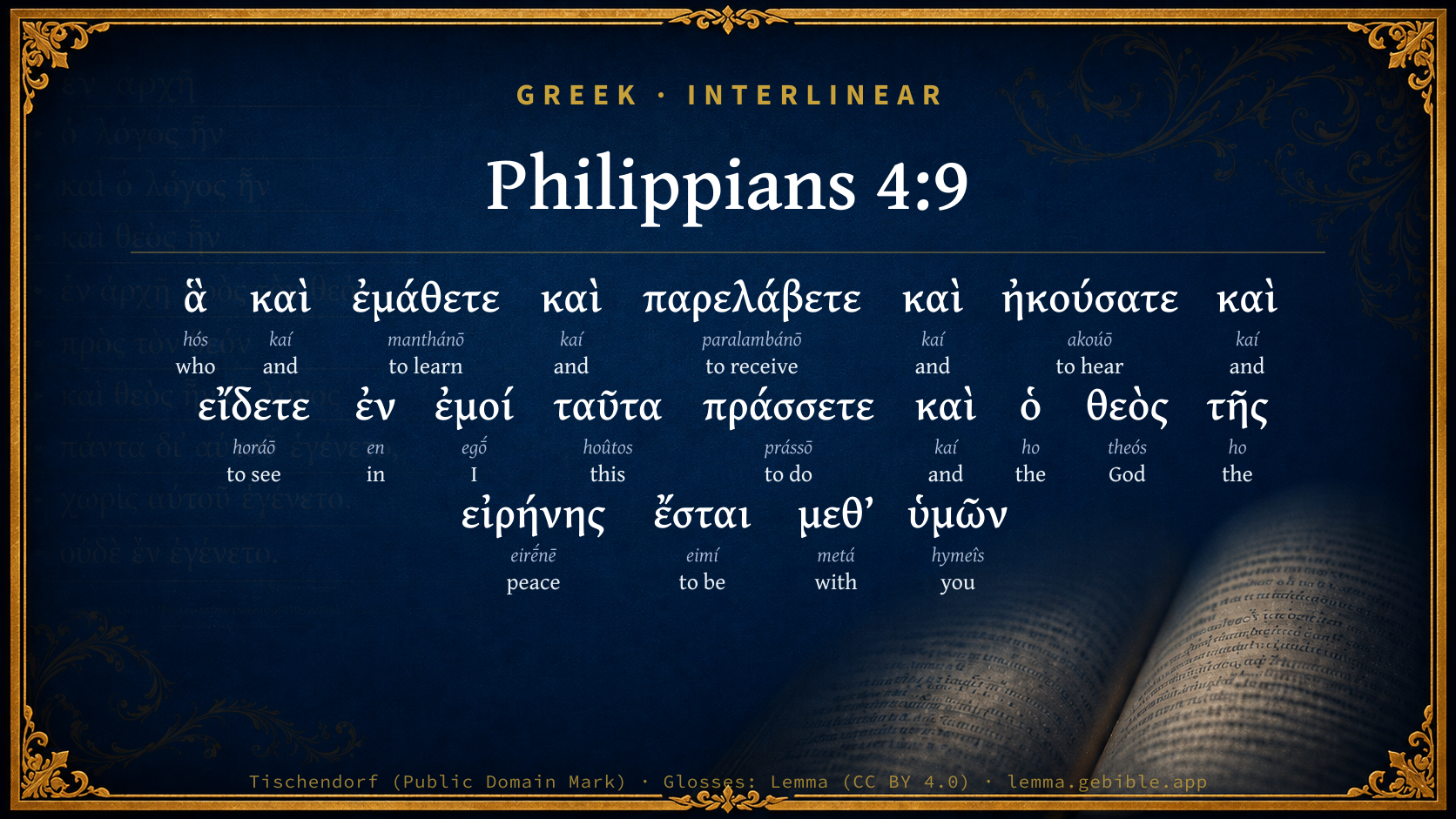
  1. ἃ hós G3739 “who” Relative pronoun, Accusative, Plural, Neuter
  2. καὶ kaí G2532 “and” Conjunction
  3. καὶ kaí G2532 “and” Conjunction
  4. παρελάβετε paralambánō G3880 “to receive” Verb, Aorist, Active, Indicative, 2nd person, Plural
  5. καὶ kaí G2532 “and” Conjunction
  6. ἠκούσατε akoúō G191 “to hear” Verb, Aorist, Active, Indicative, 2nd person, Plural
  7. καὶ kaí G2532 “and” Conjunction
  8. εἴδετε horáō G3708 “to see” Verb, Aorist, Active, Indicative, 2nd person, Plural
  9. ἐν en G1722 “in” Preposition
  10. ἐμοί egṓ G1473 “I” Personal pronoun, 1st person, Dative, Singular
  11. ταῦτα hoûtos G3778 “this” Demonstrative pronoun, Accusative, Plural, Neuter
  12. πράσσετε prássō G4238 “to do” Verb, Present, Active, Imperative, 2nd person, Plural
  13. καὶ kaí G2532 “and” Conjunction
  14. ὁ ho G3588 “the” Article, Nominative, Singular, Masculine
  15. θεὸς theós G2316 “God” Noun, Nominative, Singular, Masculine
  16. τῆς ho G3588 “the” Article, Genitive, Singular, Feminine
  17. εἰρήνης eirḗnē G1515 “peace” Noun, Genitive, Singular, Feminine
  18. ἔσται eimí G1510 “to be” Verb, Future, Middle deponent, Indicative, 3rd person, Singular
  19. μεθ’ metá G3326 “with” Preposition
  20. ὑμῶν hymeîs G5210 “you” Personal pronoun, 2nd person, Genitive, Plural

About this verse

These counts appear in no published source. They are computed here, from the morphology-tagged text and Lemma’s own curated glosses. What Lemma adds →

21
words
16
distinct lemmas
Pauline Epistles
section

Notable vocabulary

The rarest word here is ἐμάθετε to learn G3129 — appearing just 25 times in the whole Greek New Testament.

Shared distinctive vocabulary

ἐμάθετε to learn G3129 occurs in 24 verses of the Greek New Testament. Also found in:

Repetition

Words recur within this verse:

Cross-references

34

Topical passages linked to Philippians 4:9 in the Treasury of Scripture Knowledge — connected by theme and wording, ordered by reader-vote popularity; previews shown in the World English Bible.

  • James 1:22 But be doers of the word, and not only hearers, deluding your own selves.
  • Philippians 3:17 Brothers, be imitators together of me, and note those who walk this way, even as you have us for an example.
  • 1 Thessalonians 4:1–8 Finally then, brothers, we beg and exhort you in the Lord Jesus, that as you received from us how you ought to walk and to please God, that you abound more and more.
  • 2 Peter 1:10 Therefore, brothers, be more diligent to make your calling and election sure. For if you do these things, you will never stumble.
  • John 13:17 If you know these things, blessed are you if you do them.
  • Romans 16:20 And the God of peace will quickly crush Satan under your feet. The grace of our Lord Jesus Christ be with you.
  • Philippians 4:7 And the peace of God, which surpasses all understanding, will guard your hearts and your thoughts in Christ Jesus.
  • Matthew 28:20 teaching them to observe all things that I commanded you. Behold, I am with you always, even to the end of the age." Amen.
  • 2 Corinthians 13:11 Finally, brothers, rejoice. Be perfected, be comforted, be of the same mind, live in peace, and the God of love and peace will be with you.
  • Matthew 7:21 Not everyone who says to me, 'Lord, Lord,' will enter into the Kingdom of Heaven; but he who does the will of my Father who is in heaven.
  • 2 Thessalonians 3:4 We have confidence in the Lord concerning you, that you both do and will do the things we command.
  • Hebrews 13:20–21 Now may the God of peace, who brought again from the dead the great shepherd of the sheep with the blood of an eternal covenant, our Lord Jesus,
  • Luke 6:46 "Why do you call me, 'Lord, Lord,' and don't do the things which I say?
  • Luke 8:21 But he answered them, "My mother and my brothers are these who hear the word of God, and do it."
  • John 2:5 His mother said to the servants, "Whatever he says to you, do it."
  • Matthew 5:19–20 Whoever, therefore, shall break one of these least commandments, and teach others to do so, shall be called least in the Kingdom of Heaven; but whoever shall do and teach them shall be called great in the Kingdom of Heaven.
  • 2 Corinthians 5:19–20 namely, that God was in Christ reconciling the world to himself, not reckoning to them their trespasses, and having committed to us the word of reconciliation.
  • 1 Thessalonians 1:6 You became imitators of us, and of the Lord, having received the word in much affliction, with joy of the Holy Spirit,
  • Matthew 7:24–27 "Everyone therefore who hears these words of mine, and does them, I will liken him to a wise man, who built his house on a rock.
  • Romans 15:33 Now the God of peace be with you all. Amen.
  • 1 Corinthians 10:31–11:1 Whether therefore you eat, or drink, or whatever you do, do all to the glory of God.
  • 1 Thessalonians 2:14 For you, brothers, became imitators of the assemblies of God which are in Judea in Christ Jesus; for you also suffered the same things from your own countrymen, even as they did from the Jews;
  • 1 Thessalonians 5:23 May the God of peace himself sanctify you completely. May your whole spirit, soul, and body be preserved blameless at the coming of our Lord Jesus Christ.
  • 2 Thessalonians 3:6–10 Now we command you, brothers, in the name of our Lord Jesus Christ, that you withdraw yourselves from every brother who walks in rebellion, and not after the tradition which they received from us.
  • 1 Thessalonians 2:2–12 but having suffered before and been shamefully treated, as you know, at Philippi, we grew bold in our God to tell you the Gospel of God in much conflict.
  • Deuteronomy 5:1 Moses called to all Israel, and said to them, Hear, Israel, the statutes and the ordinances which I speak in your ears this day, that you may learn them, and observe to do them.
  • Acts 9:6 But rise up, and enter into the city, and you will be told what you must do."
  • Isaiah 41:10 Don't you be afraid, for I am with you; don't be dismayed, for I am your God; I will strengthen you; yes, I will help you; yes, I will uphold you with the right hand of my righteousness.
  • John 15:14 You are my friends, if you do whatever I command you.
  • 1 Corinthians 14:33 for God is not a God of confusion, but of peace. As in all the assemblies of the saints,
  • 2 Timothy 4:22 The Lord Jesus Christ be with your spirit. Grace be with you. Amen.
  • Matthew 1:23 "Behold, the virgin shall be with child, And shall bring forth a son. They shall call his name Immanuel;" Which is, being interpreted, "God with us."
  • 1 John 3:22 and whatever we ask, we receive from him, because we keep his commandments and do the things that are pleasing in his sight.
  • Isaiah 8:10 Take counsel together, and it shall be brought to nothing; speak the word, and it shall not stand: for God is with us.

Cross-references courtesy of OpenBible.info (CC BY 4.0).

Commentary

Notes on Philippians 4:9 from classic Christian and Jewish commentators (each source and its license shown beneath its notes). The classic Christian expositions comment on the surrounding passage and are grouped to its opening verse, so a note may address several verses; the Jewish commentaries on the Tanakh (Rashi and others) are per-verse, so they appear only where the commentator wrote on this verse.

Lemma curates 59 commentaries, every one of them public domain or Creative Commons licensed, each selected and text-cleaned for this edition rather than reprinted as found. About our sources →

The Biblical Illustrator

Joseph S. Exell

Php_4:9

Those things which ye have both learned and received--Observe

I.

The apostles example. He preached, practised, experienced the truth.

II. Its permanent force. Still heard and seen in the word of inspiration--accompanied with Divine power and blessing. (J. Lyth, D. D.)

Observe

I. The apostles conscious integrity.

II. His bright example of faith, zeal, self-consecration, purity.

III. Its authority as a rule.

IV. The advantage of copying it. Peace on earth--in heaven. (J. Lyth, D. D.)

The force of example

During the siege of Sebastopol, Gordon was one day going the round of the trenches, when he heard an angry altercation between a corporal and a sapper. On inquiring the cause, he learnt that the men were instructed to place some gablons on the battery, and that the corporal had ordered the sapper to stand on the parapet, where he would be exposed to the enemys fire, and to place the gabions, while he, perfectly sheltered, handed them up from below. Gordon at once jumped upon the parapet, ordering the corporal to join him, while the sapper handed them the gabions. When the work was done, and done under the fire of the watchful Russian gunners, Gordon turned to the corporal, and said, Never order a man to do anything that you are afraid to do yourself.

The Biblical Illustrator, edited by Joseph S. Exell (c. 1880s–1900s) — public domain. Text from a community e-Sword module.

Tyndale Open Study Notes

Tyndale Open Resources

4:9 all you learned and received from me: Everything Paul had taught them by word or example about the kind of life God desires (see 3:17; 1 Cor 4:6, 16-17; 2 Thes 3:7-9).

Tyndale Open Study Notes — © Tyndale Open Resources, licensed CC BY-SA 4.0. Text via the HelloAO Bible API.

Bengel's Gnomon

Johann Albrecht Bengel

Php 4:9. Ἃ καὶ) Those things which also [But Engl. Vers. “which ye have both learned and,” etc.] Καὶ, also, connects this verse with the following words, not with the preceding words. He makes a transition from what is general (ὅσα, whatsoever) to what regards Paul. There would have been place for the καὶ, and, before ἃ, which [i.e. but for the Asyndeton], the word καὶ, also, still remaining [i.e. in order to connect this ver. with what follows bearing on Paul in particular].—ἠκούσατε, ye have heard) although you have not yet sufficiently (παρελάβετε) received them.—εἴδετε, ye have seen) although ye have not as yet sufficiently learned them (ἐμάθετε).—[54] Ὁ ΘΕῸς Τῆς ΕἸΡΉΝΗς, the God of peace) not only the peace of God, Php 4:7, but God Himself.

[54] καὶ ὁ Θεὸς, and the God) This refers also to (think on) have respect or regard to (λογίζεσθε).

Bengel's Gnomon of the New Testament — English translation (T&T Clark, Edinburgh, 1860) — public domain. Text from a community e-Sword module.

Expositor's Greek Testament

ed. W. Robertson Nicoll

Phi 4:9 . It is hardly possible, with Ell [41] . , to refer ἃ καὶ κ . τ . λ . immediately to the preceding, without forcing the construction. ἐμάθ . κ . παρελ . plainly refer to the definite Christian teaching he had set himself to give them. παραλαμβάνω is used regularly of “receiving” truth from a teacher. ἠκ . κ . εἴδ . ἐν ἐ . This is the impression made upon them by his Christian character, apart from any conscious effort on his part. Cf. chap. Phi 3:17 . ὁ Θ . τ . εἰρ . See on Phi 4:8 ( ad init. ). It is quite possible that he has partly in view the disregard of these ethical qualities as threatening the harmony of the Church, and as, so far, to blame for the divisions already existing.

[41] Ellicott.

The Expositor's Greek Testament, edited by W. Robertson Nicoll (1897–1910) — public domain. Text from a community e-Sword module.

Jamieson, Fausset & Brown

Robert Jamieson, A. R. Fausset & David Brown

both--rather, "The things also which ye have learned . . . these practice"; the things which besides recommending them in words, have been also recommended by my example, carry into practice.

heard--though ye have not yet sufficiently "received" them.

seen--though ye have not as yet sufficiently "learned" them [BENGEL].

and--"and then," as the necessary result (Phi 4:7). Not only "the peace of God," but "the God of peace" Himself "shall be with you."

Jamieson, Fausset & Brown — Commentary Critical and Explanatory on the Whole Bible (1871) — public domain (CC PDM 1.0). Text via the HelloAO Bible API.

Adam Clarke's Commentary

Verse 9. Those things, which ye have - learned] From my preaching and writing;

And received] By faith, as a revelation from God;

And heard] From my preaching, and that of those who laboured with me; and heard from me, in my private communications with you; and heard of me from other Churches;

And seen in me] While living and labouring among you;

Do] Take them for the rule of your faith and practice.

And the God of peace] He who is the author of peace, the lover of peace, and the maintainer of peace; he who has made peace between heaven and earth, by the mission and sacrifice of his Son, shall be ever with you while you believe and act as here recommended.

Adam Clarke's Commentary on the Bible (1810–1826) — public domain. Text from a community e-Sword/MySword module.

John Calvin's Commentaries

9. What things ye have learned, and received, and heard By this accumulation of terms he intimates, that he was assiduous in inculcating these things. “This was my doctrine — my instruction — my discourse among you.” Hypocrites, on the other hand, insisted upon nothing but ceremonies. Now, it was a dishonorable thing to abandon the holy instruction, which they had wholly imbibed, and with which they had been thorouglly imbued.

You have seen in me Now, the main thing in a public speaker should be, that he may speak, not with his mouth merely, but by his life, and procure authority for his doctrine by rectitude of life. Paul, accordingly, procures authority for his exhortation on this ground, that he had, by his life no less than by his mouth, been a leader and master of virtues.

And the God of peace He had spoken of the peace of God; he now more particularly confirms what he had said, by promising that God himself, the Author of peace, will be with them. For the presence of God brings us every kind of blessing: as though he had said, that they would feel that God was present with them to make all things turn out well and prosperously, provided they apply themselves to pious and holy actions.

John Calvin's Commentaries (1540-1563) — public domain. Text from the Calvin Translation Society English edition (1840s-50s) via the Christian Classics Ethereal Library (ccel.org). Calvin's coverage is partial (roughly two-thirds of the Bible); uncommented books and verses are honest gaps, never fabricated. The 19th-century editor's footnotes and remarks are omitted so the notes are faithfully Calvin's own voice.

Ellicott's Commentary for English Readers

(9) Ye have both learned, and received.—The reference is here to St. Paul’s teaching, which he “delivered” to them (see 1Co_15:1-3; Gal_1:12) as a message, “received” by revelation of God, and which they “received” accordingly.

Heard, and seen in me.—Here the reference is to his example, as subsidiary to his teaching and confirmatory of its truth.

The God of peace.—The inversion (compared with Php_4:7) is striking. To have the “peace of God” with us is much; to have “the God of Peace” Himself with us is more. With this promise the Letter itself ends. What follows is but postscript.

A Bible Commentary for English Readers, edited by Charles John Ellicott (1878–1897) — public domain. Text from a community e-Sword module.

The Cambridge Bible for Schools and Colleges

gen. ed. J. J. S. Perowne

9. Those things &c.] On the apparent egotism of this appeal, see on Php_3:17. R.V. renders, somewhat better, The things &c.

have doth learned &c.] Better, both learned &c. The verbs are aorists, and the reference is to his long-past residence at Philippi.

received] Cp. 1Co_11:23; 1Co_15:1; 1Co_15:3; Gal_1:9; Col_2:6; 1Th_2:13; 1Th_4:1. In all these cases the verb is used of learning a truth passed on by another.

seen] Saw. See note 1 on this verse. in me] As specimen and model. See note on Php_1:26. Strictly speaking, the “in me” refers only to the “saw”.

do] Practise, as a holy habit.

and] See first note on Php_4:7.

the God of peace] Author and giver of the peace of God. Cp. for the phrase Rom_15:33; Rom_16:20; 2Co_13:11; 1Th_5:23; Heb_13:20. And see 2Th_3:16. In 1Co_14:33 we have, “God is not the author of confusion, but of peace”; and there the “peace” is evidently Christian social peace, rather than that which resides in the spirit of the saint, or has to do with his personal relations with God (and cp. 2Co_13:11). But the two are closely connected; the Divine peace in the individual tends always, in its right development and action, to the peace of the community, for it means the dethronement of the spirit of self. St Paul may thus have had in view here the need of more harmony among the Philippians, and of a nobler moral and spiritual tone (Php_4:8) as an aid towards it. But the whole context is so full of the highest aspects of Christian experience that we take the present phrase to refer primarily, at least, to God as at peace with His people, and making peace within their hearts; the “Lord of the sabbath” of the soul.

The Cambridge Bible for Schools and Colleges (gen. ed. J. J. S. Perowne; Cambridge University Press, 1878–1918) — public domain. Text from a community e-Sword module.

John Gill's Exposition

These things which ye have both learned,.... Meaning from himself, in a doctrinal way:

and received; not only into their heads but hearts, had embraced cordially, with great affection, in the love thereof, as well as given a full assent to:

and heard; either publicly or privately, from the pulpit, or in conversation; or had heard of him when absent, or from him when present:

and seen in me: in his life and conversation, which were well known, and were a pattern to them that believe; and therefore he adds,

do; practise the same things which they had learned from him as their duty, and had heard him urge as such, and had seen exemplified in himself:

and the God of peace shall be with you; to give that peace which is beyond the conception of a natural man, and the expression of a spiritual one, and is the great preservative through Christ; and to enable to do and to continue to do the above things, and to keep them from all harm, and every enemy of their souls; to favour them with his gracious presence here, and with endless peace hereafter.

John Gill's Exposition of the Whole Bible (1746–1763) — public domain (CC PDM 1.0). Text via the HelloAO Bible API.

Trapp's Complete Commentary

John Trapp

9 Those things, which ye have both learned, and received, and heard, and seen in me, do: and the God of peace shall be with you.

Ver. 9. And heard, and seen in me] Est aliquid quod ex magno viro vel tacente proficias. The very sight, nay, thought, of a good man often doth good. Whereas the tongue or heart of a wicked man "is little worth," Pro 10:20. If their thoughts and discourses were distilled, they are so frothy they would hardly yield one drop of true comfort.

And the God of peace] "Not only the peace of God," as Php 4:7. Austin somewhere fisheth a mystery out of the word pax, peace, which consisteth of three letters, saith he, to note the Trinity, from whom is all true peace. Others have observed that all the letters in Jehovah are quiescent, be at peace, letters to teach the same truth.

John Trapp, A Commentary or Exposition upon All the Books of the Old and New Testament (1647–1656) — public domain. Text from a community e-Sword module.

Albert Barnes' Notes on the Bible

Those things which ye have both learned, and received, and heard, and seen in me, do - That is, what you have witnessed in me, and what you have learned of me, and what you have heard about me, practice yourselves. Paul refers them to his uniform conduct - to all that they had seen, and known, and heard of him, as that which it was proper for them to imitate. The same thing, substantially, he urges in Phi 3:17; see the notes at that verse. It could have been only the consciousness of a pure and upright life which would make such counsel proper. How few are the people at this day who can urge others to imitate all that they have seen in them, and learned from them, and heard of them.

And the God of peace shall be with you - The God who gives peace; compare Heb 13:20; 1Th 5:23; see also the notes at Phi 4:7. The meaning here is, that Paul, by pursuing the course of life which he had led, and which he here counsels them to follow, had found that it had been attended with the blessing of the God of peace, and he felt the fullest assurance that the same blessing would rest on them if they imitated his example. The way to obtain the blessing of the God of peace, is to lead a holy life, and to perform with faithfulness all the duties which we owe to God and to our fellow-men.

Albert Barnes' Notes on the Bible (1834–1885) — public domain. Text from a community e-Sword/MySword module.

Matthew Poole's English Annotations

Those things, which ye have both learned; he recommends to their serious practice not new things, but those weighty matters which they had before learned of him when preaching amongst them.

And received, and heard; yea, and approved as worthy to be kept.

And seen in me; and that all things might be more lively and affecting, with an increase of words, he moves with this, that his doctrine was exemplified by his own practice when amongst them, (as he had hinted before, Phi 3:17), expressing the same thing by his life which he did by his word, 1Ti 4:12; 1Pe 5:3.

Do; whereupon he would have them to be doers also of the same things, 1Th 1:6; 2:13; Heb 13:7; Jam 1:22.

And the God of peace shall be with you; and in this practice you have comfort from the presence of the God of peace, (as above, Phi 4:7), who will embrace and prosper you, being reconciled to you in Christ, and at peace with you: so Rom 15:5,33; 16:20; 2Co 13:11; 1Th 5:23.

Matthew Poole's English Annotations on the Holy Bible (1683–1685) — public domain. Text from a community e-Sword/MySword module.

Whedon's Commentary on the Bible

Daniel D. Whedon

9. Those things—Rather, which things, namely, those just enumerated.

Learned—From his personal teaching.

Received—Accepting the instruction.

Heard—From others as to his character and life.

Seen—In his personal conduct. These they were to do. Such is the apostle’s own expansion of his counsel, in Php_3:17, to an imitation of himself.

The God of peace—The result of this course is the same as at Php_4:7. There it is the peace which God works; here, the God who in-works the peace. Not content with giving the grace, he comes himself.

Daniel D. Whedon (gen. ed.), Commentary on the Old and New Testaments (1874–1909) — public domain. Text from a community e-Sword module.

The Pulpit Commentary

Those things, which ye have both learned, and received, and heard, and seen in me, do. St. Paul turns from contemplation to practical life: they must translate into action the lessons which they received from him. The verbs are aorists and refer to the time when he was among them. He taught not by word only, but by living example; they saw in him when present, and heard of him when he was absent, a pattern of the Christian life. And the God of peace shall be with you. God dwells with those who think holy thoughts and live holy lives; and with him comes the peace which is his, which he giveth. (comp. Rom_15:33)

The apostle himself an example to believers.

"Those things, which ye both learned, and received, and heard, and saw in me, do: and the God of peace shall be with you.

I THE APOSTLE"S PRECEPTS. "Learned and received." The reference is to his oral teaching, which included all the principles out of which these graces or virtues take their origin and growth.

II THE APOSTLE"S EXAMPLE. As set before them in what they heard of him when absent, and in what they saw of him when he was present. They witnessed his laborious usefulness, his patient submission to persecution, his spirituality and care for his own spiritual life, and, above all, his splendid decision of character.

III THE EFFECT OF FOLLOWING THESE PRECEPTS AND THIS EXAMPLE. "The God of peace shall be with you." The way of peace lies along the pathway of obedience. The blessing of the Lord is upon them who love him and keep his commandments. T.C.

The transmission of the knowledge of Christ.

"Those things, which ye have both learned, and received, and heard, and seen in me, do: and the God of peace shall be with you." This verse is supposed by some to close the letter. The remaining verses are considered to be the postscript in which the apostle gracefully acknowledges the generous contributions he had received from them through the hands of Epaphroditus. The text directs attention to the transmission of the knowledge of Christ. Observe

I This knowledge of Christ is to be transmitted FROM MAN TO MAN. "Those things, which ye have both learned, and received," etc. It is suggested that the transmission of this knowledge includes two things.

1. Teaching on the part of the minister. Paul had received the gospel, (1Co_15:3 Gal_1:12) and received it as a message, received it to communicate. This he did did to the Philippians as well as to others. He did it in two ways.

(1) By words. "And heard." After his commission Paul used all his oratoric force for this purpose. He spoke to men rationally, devoutly, intelligently, earnestly, and with invincible persistence. The story of Christ is to be handed down from man to man by human lips. The pen can no more do the work of the tongue in this respect than the moon can do the work of the sun. Under the influence of the former the landscape will wither and the rivers will freeze.

(2) By example. "And seen in me. " Paul embodied the gospel. His life confirmed the doctrine that his lips declared. In him, as in his Master, the "word became flesh." Here, then, is the Divine way of transmitting from generation to generation the story of Christ. Men have tried other ways and have signally failed; hence the wretched moral condition of the world to-day. This way is, to a great extent, practically ignored.

2. Learning on the part of the hearer. "Ye have both learned, and received, and heard." A man may tell the story of Christ with the utmost accuracy and fullness. The spirit of the story he may breathe in his life and embody in his conduct, but it is only vitally transmitted so far as it is learnt by the auditors. We live in an age when people, through a vitiated moral taste, theological prejudices. and sectarian proclivities, turn away their ear from the true teachers of their time. They resort to places where they can be tickled, not taught, flattered, not corrected.

II This knowledge of Christ is to be transmitted IN ORDER TO BE PRACTISED. "Those things which ye have both learned, and received, and heard, and seen in me, do. " A gospel sermon should never be regarded as a lecture on philosophy, literature, or art a mere subject for speculative thought or a subject of discussion. The gospel is a law, it comes from the highest authority and with a binding force. What is said is to be done, not merely approved, criticised, thought on, or sighed about, but done. The ideas communicated are to be translated into actions, and such actions will ever be Christly in spirit and tendency. But into what actions are the conventional sermons of England translated? Turn to the columns of our daily journals and read of the mercantile swindlings, the courtly depravities, idlenesses, and sports, the political intrigues, senatorial slanderings and quarrellings, the barbaric executions, the bloody wars, and other nameless iniquities sanctioned and enacted by the hearers of what are called gospel sermons. Ah me! What boots preaching?

III The practice of this knowledge of Christ ENSURES THE SUBLIMEST GOOD. "The God of peace shall be with you." In ver. 7 we read of having the "peace of God," here of having the "God of peace." To have his peace is something glorious; but to have himself is something transcendently greater. "The God of peace." Elsewhere he is called the God of salvation," the "God of consolation," the "God of hope," etc.; but this title seems to transcend all others.

1. He is at peace with himself. A moral intelligence to possess peace must be absolutely free from the following things malice, remorse, forebodings. The mightiest revolutions through all the millenniums and the hostilities of all the hells of the universe awake no ripple upon the boundless sea of his ever-flowing love.

2. He is at peace with the universe. He has no unkind feeling to any sentient being; he contends with no one; he is at peace with all. He contend, forsooth! Does the immovable rock contend with the waves that break at its feet? Does the sun contend with the fleeting clouds? Now, they who translate the gospel into their life shall have the "God of peace" ever with them with them as the sunny heavens are with the earth. D.T.

The Pulpit Commentary (1880–1919), ed. H.D.M. Spence-Jones & Joseph S. Exell — public domain. Text from a community e-Sword module.

John Wesley's Explanatory Notes

The things which ye have learned - As catechumens. And received - By continual instructions. And heard and seen - In my life and conversation. These do, and the God of peace shall be with you - Not only the peace of God, but God himself, the fountain of peace.

John Wesley, Explanatory Notes Upon the Whole Bible (1754–1765) — public domain. Text via the GEBible commentary corpus.

Burkitt's Expository Notes on the New Testament

William Burkitt

Observe, 1. With what great confidence and good assurance St. Paul here recommended his own practice and example to his people’s imitation: all those things which he had by his doctrine and life commended to them, were to be carefully observed and imitated by them. It is a blessed thing, when a people’s eyes are taught by their minister’s holiness of life, and their ears by the soundness of his doctrine.

Our people have eyes to see how we walk, as well as ears to hear what we preach; therefore it is a minister’s great duty, by strictness and gravity of deportment, to maintain his esteem in the consciences of his people, yet always tempering gravity with a condescending affability. That minister only can go off the stage with honor and comfort, who has left behind him the good seed of sound doctrine, and the good savour of an holy example; that can say with our apostle, The things which you have both heard and seen in me, do.

Observe, 2. The promise annexed to the foregoing precept, These things do, and the God of peace shall be with you.

Where note, 1. Who will be with us: the God of peace: now he that is the God of peace, is the God of power; he that is the God of peace, is the God of patience, who, though he can punish, yet he will pardon the infirmities of his people.

Note, 2. How he will be with us: the heart of God will be with us, and the help and presence of God will be with us, to guide and direct us, to lead and conduct us, to cover and protect us; and, if God be with us, we shall shortly be with him.

Learn hence, That those which obey the gospel, whatsoever or whomsoever they want, shall ever abide in a peaceful and blessed condition: These things do, and the God of peace shall be with you.

William Burkitt's Expository Notes on the New Testament (1700–1703) — public domain. Text from a community e-Sword module.

The People's New Testament

B. W. Johnson

9. The things which, etc. He turns from precept to example, the best of all teachers, and enjoins that they observe not only what he had taught, but what they had seen in his life. The God of peace shall be with you. For he is with all who so live.

B. W. Johnson's The People's New Testament with Notes (1889–1891) — public domain. Electronic text from the Christian Classics Ethereal Library (CCEL) ThML edition.

Cambridge Greek Testament for Schools and Colleges

9. ἃ καὶ ἐμάθετε … ἐν ἐμοί. On the apparent egotism, see above on Php 3:17.—The aorists refer to the past days at Philippi.

παρελάβετε. In the sense of receiving a truth passed on by a teacher, who on his part παραδίδωσιν. See e.g. 1Co 11:23, ἐγὼ παρέλαβον ἀπὸ τοῦ κυρίου ὃ καὶ παρέδωκα ὑμῖν. Cp. Gal 1:9, εἴ τις ὑμᾶς εὐαγγελίζεται παρʼ ὃ παρέλαβετε, ἀνάθεμα ἔστω: and 1Th 4:1. Παραλαμβάνειν thus comes very nearly to mean “to learn” and παραδιδόναι (παράδοσις) “to teach.”

ἐν ἐμοί. Strictly, the words attach themselves to εἴδετε only. It is as if he had written ἅ ἐμάθετε κτλ. παρʼ ἐμοῦ καὶ εἴδ. ἐν ἐμοί.

πράσσετε. “Practise.” “Roughly speaking, ποιεῖν may be said to … designate performance, πράσσειν intentional … habitual performance; π. to point to an actual result, πρ. to the scope and character of the result” (Grimm, ed. Thayer, s.v. ποιεῖν).

καὶ. See above on the καὶ which introduces Php 4:7.

ὁ θεὸς τῆς εἰρήνης. Author and Giver of “The peace of God.” The phrase occurs Rom 15:33; Rom 16:20, ὁ θ. τῆς εἰρ. συντρίψει τὸν σατανᾶν: 2Co 13:11, ὁ θ. τῆς ἀγάπης καὶ τῆς εἰρ. ἔσται μεθʼ ὑμῶν: 1Th 5:23, αὐτὸς ὁ θ. τῆς εἰρ. ἁγιάσαι ὑμᾶς κτλ.: Heb 13:20, ὁ δὲ θ. τῆς εἰρ., ὁ ἀναγαγὼν κτλ. And cp. 2Th 3:16, ὁ κύριος τῆς εἰρ.: and 1Co 14:33, οὐ γὰρ ἀκαταστασίας ὁ θ. ἀλλὰ εἰρήνης. In the last case the peace is plainly social peace rather than internal, personal peace. But the two are closely connected; the peace of God in the individual tends always to the peace of the society, for it means the banishment of the self-spirit. Here very possibly St Paul has in side-view the Philippians’ need of peace in their community, and of a higher tone of Christian thought and feeling as an aid towards it. But the whole context is so full of the inward aspects of Christian experience that it seems best to take this phrase as referring primarily to the sabbath of the soul, the peace of God in the man.

Cambridge Greek Testament for Schools and Colleges (Cambridge University Press, 1896; 21 vols, various authors incl. Carr, Maclear, Plummer, Farrar, Lumby, Moule, M. R. James, Simcox) — public domain. Text from a community e-Sword module.

Alford’s Greek Testament

Henry Alford

9.] Summary exhortation to Christian virtues not yet specified.

9.] These general abstract things he now particularizes in the concrete us having been exemplified and taught by himself when among them. The first καί is not ‘both,’ as E. V., but also,—moreover: which, besides what I have said recommending them above, were also recommended to you by my own example.

ἐμάθετε] again, not as E. V. ‘have learned,’ &c.—but all aorists,—referring to the time when he was among them. Those things which (not ‘whatsoever things:’ we are on generals no longer: nor would he recommend to them all his own sayings and doings; but the καί expressly provides for their being of the kinds specified above) ye moreover learned, and received (reff.: here of receiving not by word of mouth, but by knowledge of his character: the whole is not doctrinal, but ethical) and heard (again not of preaching, but of his tried and acknowledged Christian character, which was in men’s mouths and thus heard) and saw (each for himself) in me (ἐν ἐμοί will not properly belong to the two first verbs, ἐμάθ. and παρελ., but must be associated by zeugma with them—he himself being clearly the example throughout), these things (ταῦτα … ἅ) practise (correlative with, not opposed to, λογίζεσθε above:—that λογισμός being eminently practical, and issuing, in the concrete, in the ταῦτα πράσσειν, after Paul’s example).

καί] and then: see ver. 7. On εἰρήνη, see there.

Henry Alford, The Greek Testament (1849–1861) — public domain. Text from a community e-Sword module.

International Critical Commentary

9. ἃ καὶ: ‘those things which also.’ Those things which are true, venerable, etc., which also ye learned of me.

Others coördinate the four καὶς: ‘those things which ye have as well learned as received; as well heard as seen’ (Vulg., Calv., Beza, Lightf.).

The four verbs form two pairs: ἐμάθετε and παρελάβετε referring to what they had learned by teaching; ἠκούσατε and εἴδετε, by example.

ἐμάθετε … παρελάβετε: ‘learned’ … ‘received.’ The meanings do not differ greatly, except that παρελ. adds, to the simple notion of learning, that of what was communicated or transmitted.

Kl. ἐμάθ. by personal instruction; παρελ. as oral or epistolary traditions obtained from him or transmitted by his delegates. Mey. renders παρελ. ‘accepted’; but that sense is rare in Paul. 1Co 15:1 is doubtful. 1Co 11:23, 1Co 11:15:3; Gal 1:12; 2Th 3:6, signify simple reception. (See Lightf. on Gal 1:12; Col 2:6; 1Th 2:13.)

ἠκούσατε καὶ εἴδετε: ‘heard and saw.’ In their personal intercourse with him. Not through preaching (Calv.), which has already been expressed. Lightf. and others explain ἠκ. of what they heard when he was absent. But all the other verbs refer to the time of his presence at Philippi.

Ἐν ἐμοι properly belongs to ἠκ. and εἴδ., but is loosely taken with all four verbs. Ἐμάθ. and παρελ., strictly, would require παρʼ ἐμοῦ.

πράσσετε: ‘do,’ or ‘practise.’ A distinction between πράσσειν and ποιεῖν is recognisable in some cases; πράσσειν, ‘practise,’ marking activity in its progress, and ποιεῖν in its accomplishment or product. The distinction, however, is not uniformly maintained, and must not be pressed. (See Schmidt, Synon. 23, and Trench, Syn. xcvi.)

καὶ: Consecutive, as vs. 7; ‘and so.’

ὁ θεὸς τῆς εἰρήνης: ‘the God of peace.’ Who is the source and giver of peace. The phrase only in Paul and Heb. (See Rom 15:33, Rom 15:16:20; 1Th 5:23; Heb 13:20.) Peace, in the N.T. sense, is not mere calm or tranquillity. All true calm and restfulness are conceived as based upon reconciliation with God. Christian peace implies the cessation of enmity between God and man (Rom 8:7); the complete harmony of the divine and the human wills; the rest of faith in divine love and wisdom (Isa 26:3). God is ‘the God of peace’ only to those who are at one with him. God’s peace is not sentimental, but moral. Hence the God of peace is the sanctifier of the entire personality (1Th 5:23). Accordingly ‘peace’ is habitually used in connection with the Messianic salvation, both in the Old and the New Testaments. The Messiah himself will be ‘peace’ (Mic 5:5). Peace is associated with righteousness as a Messianic blessing (Psa 72:7, Psa 85:10). Peace, founded in reconciliation with God, is the theme of the gospel (Act 10:36); the gospel is ‘the gospel of peace’ (Eph 2:17, Eph 2:6:15; Rom 10:15); Christ is ‘the Lord of peace’ (2Th 3:16), and bestows peace (Joh 14:27, Joh 16:33). “It is through God, as the author and giver of peace, that man is able to find the harmony which he seeks in the conflicting elements of his own nature, in his relations with the world, and in his relations to God himself” (Westcott, on Heb 13:20).

He now returns thanks for the gift which the Philippian church has sent him by Epaphroditus, and praises their past and present generosity.

International Critical Commentary — older volumes (1896–1929), various authors — public domain. Text from a community e-Sword module.

Lesson kit

Teaching starters — assembled from the data on this page, not authored interpretation. Every prompt links to the verse data it draws on. Edit before teaching.

Philippians, in the Pauline Epistles, opens this verse with 21 words (16 distinct Greek lemmas). Its most distinctive word is manthánō (“to learn”). A historical commentator’s framing appears above. Read the whole chapter for the surrounding context.

Discussion questions

  1. What does “to learn” (manthánō) contribute to the verse as a whole?
  2. Matthew 9:13 shares the word «to learn» with this verse. How do the two illuminate each other?
  3. “and” occurs 5× in this one verse. What is the effect of the repetition?
  4. These translations render this verse differently; the difference is in the English rendering, not the original. What questions does that raise?
  5. Reading how The Biblical Illustrator and Tyndale Open Study Notes read this verse, where do the two commentators agree and where do they part?

Things to notice

Reading settings

Reading text

Shown beneath each verse's original-language words.

Old Testament
Old Testament edition

Read the OT as the Masoretic Hebrew (MT) or the Greek Septuagint (LXX).

English shown for the Greek Septuagint (in the Hebrew ↔ Greek comparison).

Comparing translations? Open the Compare panel on any verse page to stack up to four side by side.