Acts 21:22

Greek (Tischendorf 8th ed.) Acts 21:22 appears in the Greek New Testament. The text above is from the Tischendorf 8th edition. Each word links to its Strong’s number and a concise gloss. Click any word for its full Thayer’s Greek Lexicon entry.
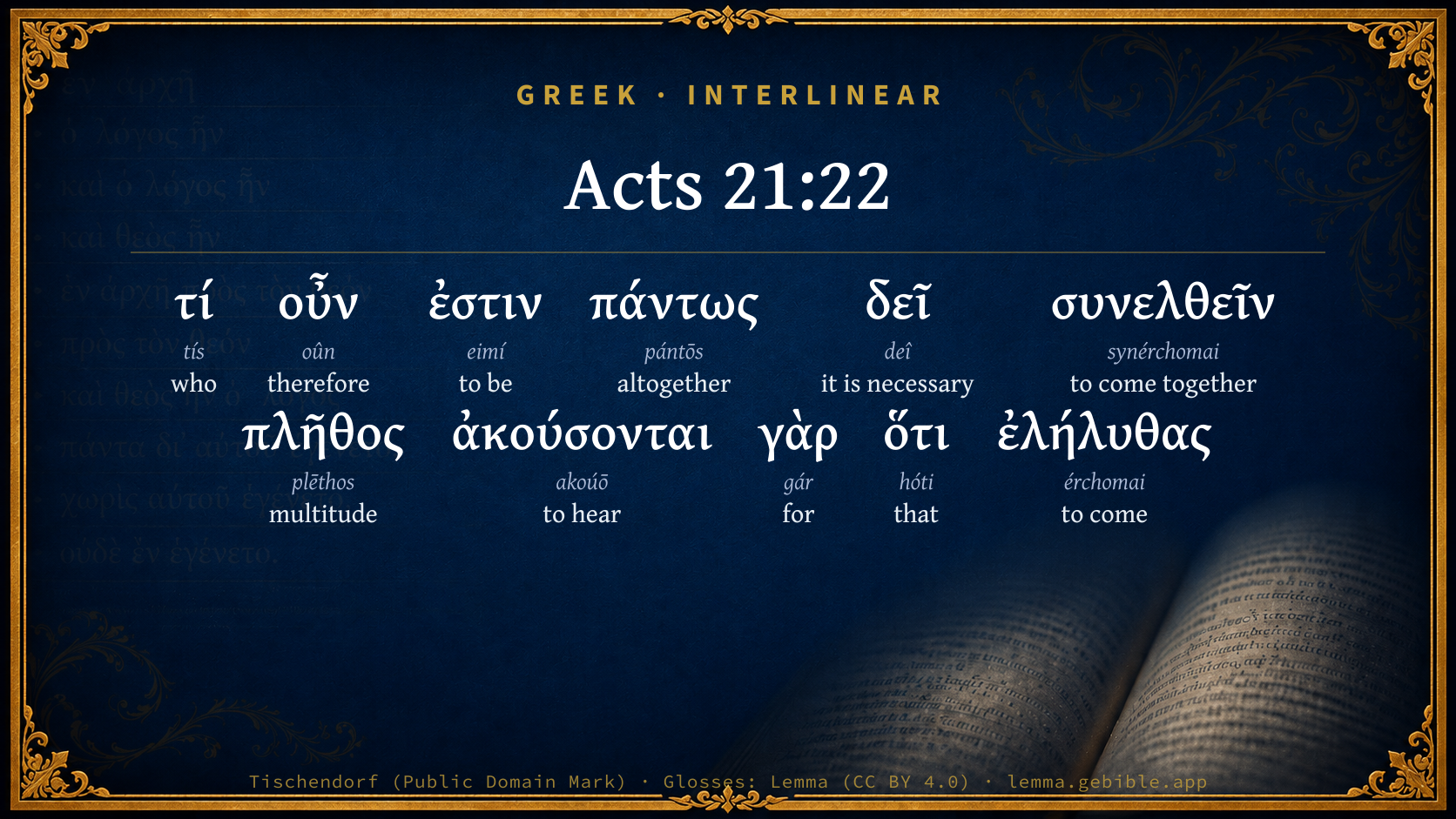
Download image
Cite this verse

Acts 21:22 (World English Bible). Public Domain. Lemma interlinear Bible study tool, https://lemma.gebible.app/v/acts/21/22.

Show BibTeX & RIS
BibTeX
RIS
English Translation
What then? The assembly must certainly meet, for they will hear that you have come.
World English Bible · Public Domain
Download a study sheet

One document with this verse’s original text, its word-by-word gloss line, the meaning frame, cross-references with their text, attributed commentary, and full source and license credits — printable, and it pastes into notes with its structure intact.

This verse Autodidact and up

Study sheet (.html) Plain text (.txt)

A passage Seminary Student

Up to 50 verses in one chapter. A passage sheet keeps up to 6 commentary sources and 12 cross-references per verse, in the order this page ranks them, and says so on the sheet whenever that leaves anything out. Ask for a single verse and you get the Autodidact verse sheet above.

Everything on this page stays free to read, with no account — the sheet is a download of what is already on screen, not access to it.

Want to remove ads? Support Godless Engineer
Compare translations 3

The same verse in 3 English versions, stacked beneath the original-language interlinear above. Click any original word for its lexicon entry.

Each is an independent rendering of the whole verse — the interlinear is not word-aligned to these translations.

Highlighted words mark where these versions differ — a whole-verse word diff, not a word-by-word alignment.

  • World English Bible Public Domain
    What then? The assembly must certainly meet, for they will hear that you have come.
  • King James Version Public Domain
    What is it therefore? the multitude must needs come together: for they will hear that thou art come.
  • unfoldingWord Literal Text CC BY-SA 4.0
    What therefore is it? They will certainly hear that you have come.

unfoldingWord Literal Text — © unfoldingWord, licensed CC BY-SA 4.0. Word-aligned USFM3 via Door43 (git.door43.org/unfoldingWord/en_ult).

Versions to compare (up to 4)

3 of 4 selected

Show all 19 translations

Every available English version of this verse, each an independent rendering of the whole verse.

  • World English Bible Public Domain
    What then? The assembly must certainly meet, for they will hear that you have come.
  • Berean Standard Bible Public Domain
    What then should we do? They will certainly hear that you have come.
  • Majority Standard Bible Public Domain
    What then should we do? Certainly a multitude will gather, for they will hear that you have come.
  • King James Version Public Domain
    What is it therefore? the multitude must needs come together: for they will hear that thou art come.
  • American Standard Version (1901) Public Domain
    What is it therefore? They will certainly hear that thou art come.
  • Revised Version (1885) Public Domain
    What is it therefore? they will certainly hear that thou art come.
  • Geneva Bible (1599) Public Domain
    What is then to be done? the multitude must needes come together: for they shall heare that thou art come.
  • Douay-Rheims (1899) Public Domain
    What is it therefore? the multitude must needs come together: for they will hear that thou art come.
  • Young's Literal Translation Public Domain
    what then is it? certainly the multitude it behoveth to come together, for they will hear that thou hast come.
  • Literal Standard Version CC BY-SA 4.0
    what then is it? Certainly the multitude must come together, for they will hear that you have come.
  • Unlocked Literal Bible CC BY-SA 4.0
    What should we do? They will certainly hear that you have come.
  • unfoldingWord Literal Text CC BY-SA 4.0
    What therefore is it? They will certainly hear that you have come.
  • Darby Bible Public Domain
    What is it then? a multitude must necessarily come together, for they will hear that thou art come.
  • World Messianic Bible Public Domain
    What then? The assembly must certainly meet, for they will hear that you have come.
  • Webster's Bible Public Domain
    What is it therefore? the multitude must needs come together: for they will hear that thou art come.
  • Free Bible Version CC BY-SA 4.0
    So what should we do about it? People will certainly get to hear that you've arrived here.
  • Bible in Basic English Public Domain
    What then is the position? They will certainly get news that you have come.
  • Text-Critical English NT CC BY 4.0
    What then is to be done? The assembly will surely meet, for they will hear that yoʋ have come.
  • Tyndale New Testament (1534) Public Domain
    What is it therfore? The multitude must nedes come togeder. For they shall heare that thou arte come.

Literal Standard Version (2020), Covenant Press — licensed CC BY-SA 4.0. Text via the HelloAO Bible API (eBible.org). Unlocked Literal Bible (unfoldingWord) — licensed CC BY-SA 4.0. Text via the HelloAO Bible API (eBible.org). unfoldingWord Literal Text — © unfoldingWord, licensed CC BY-SA 4.0. Word-aligned USFM3 via Door43 (git.door43.org/unfoldingWord/en_ult). Free Bible Version, Dr. Jonathan Gallagher — licensed CC BY-SA 4.0. Text via the HelloAO Bible API (eBible.org).

Word by word

More ways to search: Search by grammar → Find every occurrence → Compare this word →

Practice this passage: Drill this verse → Learn its vocabulary →

About this verse

These counts appear in no published source. They are computed here, from the morphology-tagged text and Lemma’s own curated glosses. What Lemma adds →

11
words
11
distinct lemmas
Acts
section

Notable vocabulary

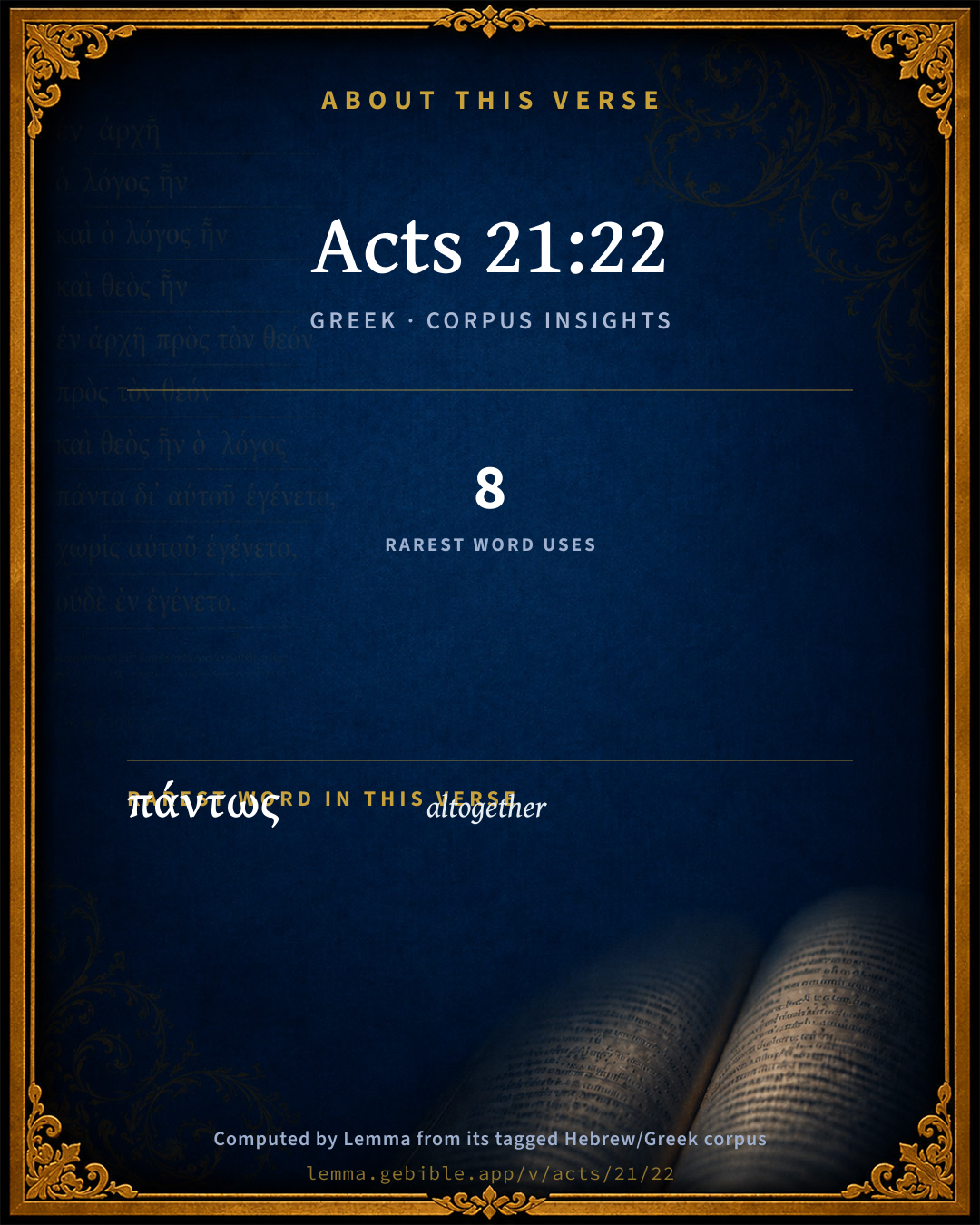
The rarest word here is πάντως altogether G3843 — appearing just 8 times in the whole Greek New Testament.

Shared distinctive vocabulary

πάντως altogether G3843 occurs in 8 verses of the Greek New Testament. Also found in:

Cross-references

3

Topical passages linked to Acts 21:22 in the Treasury of Scripture Knowledge — connected by theme and wording, ordered by reader-vote popularity; previews shown in the World English Bible.

  • Acts 15:12 All the multitude kept silence, and they listened to Barnabas and Paul reporting what signs and wonders God had done among the Gentiles through them.
  • Acts 15:22 Then it seemed good to the apostles and the elders, with the whole assembly, to choose men out of their company, and send them to Antioch with Paul and Barnabas: Judas called Barsabbas, and Silas, chief men among the brothers.
  • Acts 19:32 Some therefore cried one thing, and some another, for the assembly was in confusion. Most of them didn't know why they had come together.

Cross-references courtesy of OpenBible.info (CC BY 4.0).

Where the printed editions differ

1 variant

Places in this verse where the major printed Greek editions disagree on the wording in a way that affects the translation — a comparison of editions, not a manuscript-by-manuscript collation. The editions are the modern critical texts (Nestlé-Aland 28/27, SBL, Westcott-Hort, Tregelles, Tyndale House) and the traditional texts behind the KJV (the Textus Receptus and the Byzantine/Majority text). It is not a claim about which reading is original.

  1. Extra text
    δεῖ πλῆθος συνελθεῖν

    “should multitude to assemble”

    In TRByz Not in NA28NA27TynSBLWHTreg

    δεῖ πλῆθος συνελθεῖν (dei plēthos sunelthein) 'should multitude to assemble' is only in traditional manuscripts (TR+Byz)

Textual data: Translators Amalgamated Greek New Testament (STEPBible TAGNT) · CC BY 4.0.

Commentary

Notes on Acts 21:22 from classic Christian and Jewish commentators (each source and its license shown beneath its notes). The classic Christian expositions comment on the surrounding passage and are grouped to its opening verse, so a note may address several verses; the Jewish commentaries on the Tanakh (Rashi and others) are per-verse, so they appear only where the commentator wrote on this verse.

Lemma curates 59 commentaries, every one of them public domain or Creative Commons licensed, each selected and text-cleaned for this edition rather than reprinted as found. About our sources →

Joseph Benson's Commentary

Act 21:22-25. What is it therefore — Which may not be apprehended on such an occasion? Or, what is to be done? the multitude must needs come together — They will certainly be gathered together in a tumultuous manner, unless they be some way pacified. For they will hear that thou art come — And will immediately form their judgment of the truth or falsehood of the information they have received, by what they discover in thy present behaviour, of regard or disregard to the Mosaic ceremonies. Do therefore this, &c. — To show them, how far soever thou art from imposing the Mosaic ceremonies on any Jews or Gentiles, as necessary to salvation, or teaching men to seek justification by them, yet thou dost not think there is any intrinsic evil in them, nor teach it as a matter of duty, that believers in Christ, of Jewish extraction, should disuse and reject them; do this that we say to thee — As the best expedient we can think of, for immediately taking off any ill impressions which might otherwise be apprehended. We have four men — Converts to the gospel; which have a vow on them — Of Nazariteship; take them — As thy companions and partners; and purify thyself with them — According to the Jewish ritual; and be at the necessary charges with, (or, rather, for,) them, that they may shave their heads — And offer the sacrifices which the law has appointed in that case. These sacrifices are specified Num 6:13, &c., by which it appears, that the charges of these four would be the price of eight lambs and four rams, besides oil, flour, &c., and it was not uncommon among the Jews; for the rich to assist those Nazarites that were poor in bearing these charges: and all may know — Namely, all that come up to the temple, and see thee in these circumstances; that those things whereof they were informed are nothing — Have no reality or truth in them; but that — Instead of forbidding the observance of these ceremonies to others; thou thyself walkest orderly, and keepest the law — Avoiding all unnecessary occasion of offence. “It is evident from hence, that whatever might have passed between Paul and James on this head in private, (Gal 2:2,) James and the brethren thought it most regular and convenient, that the Jewish ritual should still be observed by those of the circumcision who believed in Christ; and considering what tribulation the church at Jerusalem must otherwise have been exposed to from the sanhedrim, who, no doubt, would have prosecuted them to the utmost as apostates, and also how soon Providence intended to render the practice of it impossible, and to break the whole power of the Jews, by the destruction of the temple, and city, and nation; it was certainly the most orderly and prudent conduct to conform to it, though it were looked upon by those that understood the matter fully, (which it was not necessary that all should,) as antiquated and ready to vanish away, Heb 8:13.” Locke and Doddridge.

Joseph Benson's Commentary on the Old and New Testaments (1811–1818) — public domain. Text from a community e-Sword module.

Bengel's Gnomon

Johann Albrecht Bengel

Act 21:22. Τί οὖν ἐστι; what is it therefore?) A frequent formula.—συνελθεῖν, come together) to hear what God hath done through thee, [and of what kind is thy doctrine.—V. g.]: Act 21:19; ch. Act 14:27.

Bengel's Gnomon of the New Testament — English translation (T&T Clark, Edinburgh, 1860) — public domain. Text from a community e-Sword module.

Meyer's Critical & Exegetical Commentary

Heinrich August Wilhelm Meyer

Act_21:22-23. Τί οὖν ἔστι;] What is accordingly the case? How lies then the matter? See on 1Co_14:15; Rom_3:9. The answer τοῦτο ποίησον has the reason for it in the first instance more precisely assigned by the preliminary remark, πάντως … ἐλήλυθας: a multitude (of such Jew-Christians) must (inevitably will) come together (assemble around thee, to hear thee and to observe thy demeanour), for, etc. That James meant a tumultuary concourse, is not stated by the text, and is, on the contrary, at variance with the sanguine δεῖ; but Calvin, Grotius, Calovius, and many others erroneously hold that πλῆθ. συνελθ. refers to the convoking of the church, or (so Lange) to the united body of the different household-congregations (in that case τὸ πλῆθ. must at least have been used).

εὐχὴν ἔχ. ἐφʼ ἑαυτ.] having a vow (Act_18:18) for themselves. This ἐφʼ ἑαυτῶν represents the having of the vow as founded on the mens own wish and self-interest, and accordingly exhibits it as a voluntary personal vow, in which they were not dependent on third persons. The use of ἐφʼ ἑαυτῶν in the sense of for oneself, at ones own hand, and the like,[124] is a classical one (Xen. Anab. ii. 4. 10; Thuc. v. 67. 1, viii. 8. 11), and very common; Hermann, ad Viger. p. 859; Kühner, II. p. 296. A yet more express mode of denoting it would be: ΑὐΤΟῚ ἘΦʼ ἙΑΥΤῶΝ. With this position of the vow there could be the less difficulty in Pauls taking it along with them; no interest of any other than the four men themselves was concerned in it. Moreover, on account of Act_21:26, and because the point here concerned a usage appointed in the law of Moses (otherwise than at Act_18:18), we are to understand a formal temporary Nazarite vow, undertaken on some unknown occasion (Numbers 6, and see on Act_18:18). See on such vows, Keil, Archäol. I. § 67; Oehler in Herzogs Encykl. X. p. 205 ff.

[124] א reads ἀφʼ ἑαυτῶν, a gloss substantially correct.

Meyer — Critical and Exegetical Commentary on the New Testament — English translation by Peter Christie, edited by Frederick Crombie (T&T Clark, 1880) — public domain. Text from a community e-Sword module.

Expositor's Greek Testament

ed. W. Robertson Nicoll

Act 21:22 . τί οὖν ἐστι ; cf. 1Co 14:15 ; 1Co 14:26 ; cf. 1Co 6:3 in [359] text. δεῖ πλῆθος συνελθεῖν , see critical note. ἀκούσονται , i.e. , the Judaising Christians referred to in κατηχήθησαν , Act 21:26 . The words refer, not to an assembly of the whole Church, or to a tumultuary assembly, Act 21:27 , but to an assembly of the Judaising Christians as above.

[359] R(omana), in Blass, a first rough copy of St. Luke.

The Expositor's Greek Testament, edited by W. Robertson Nicoll (1897–1910) — public domain. Text from a community e-Sword module.

Adam Clarke's Commentary

Verse 22. The multitude must needs come together] Whether this refers to a regular convocation of the Church, or to a tumult that would infallibly take place when it was heard that the apostle was come, we cannot pretend to say; but it is evident that James and the elders wished some prudent steps to be taken, in order to prevent an evil that they had too much reason to fear.

Adam Clarke's Commentary on the Bible (1810–1826) — public domain. Text from a community e-Sword/MySword module.

John Calvin's Commentaries

22. The multitude must needs come together. The verb is a verb neuter, as if they should say, the multitude must of necessity come together. For it had been an absurd thing that an apostle, of such rare report, should not come before the whole multitude of the faithful. For if he had eschewed the light and sight of people, the sinister suspicion might have been increased. Nevertheless, we see how modestly the elders behaved themselves in nourishing concord, when as they prevent the offense of the people in time, saving that they bear too much peradventure with their infirmity, in requiring a vow of Paul. But this moderation must be kept in the Church, that the pastors be in great authority, and yet that they rule not proudly as lords, neither despise the rest of the body. For the distinction of orders, which is the bond of peace, ought not to be any cause of dissension.

John Calvin's Commentaries (1540-1563) — public domain. Text from the Calvin Translation Society English edition (1840s-50s) via the Christian Classics Ethereal Library (ccel.org). Calvin's coverage is partial (roughly two-thirds of the Bible); uncommented books and verses are honest gaps, never fabricated. The 19th-century editor's footnotes and remarks are omitted so the notes are faithfully Calvin's own voice.

Ellicott's Commentary for English Readers

(22) The multitude must needs come together.—More accurately, at all events a crowd must needs come together. The report of St. Paul’s arrival was sure to spread, and those who heard of it would be eager to see how he acted. Would he ostentatiously reproduce in Jerusalem that living as a Greek with Greeks (1Co_9:22) of which they heard as his manner at Corinth and Ephesus? The advice which followed was intended to allay the suspicion of the timid, and to disappoint the expectations of more determined adversaries.

A Bible Commentary for English Readers, edited by Charles John Ellicott (1878–1897) — public domain. Text from a community e-Sword module.

The Cambridge Bible for Schools and Colleges

gen. ed. J. J. S. Perowne

22. What is it therefore?] i.e. How stands the matter? An expression used as introductory to the consideration of what is best to be done.

the multitude must needs come together] The oldest texts omit all but the word here rendered “needs,” giving only, “they will certainly hear that thou art come,” for the rest of the verse. Some keeping the Greek of the Textus Receptus, have translated “A multitude will certainly, &c.” But the reading of the oldest MSS. seems to give the most natural sense. The gathering before whom Paul had been speaking was composed of only the conspicuous members of the Christian body, to hear a report on the day after St Paul’s arrival. The rest of the speech addressed to the Apostle gives no hint of a crowd to be gathered, but recommends a policy by which the Judæo-Christians might learn gradually in their own visits to the temple that the Apostle against whom they had heard such reports was there himself taking part in the observance of the Mosaic customs.

The Cambridge Bible for Schools and Colleges (gen. ed. J. J. S. Perowne; Cambridge University Press, 1878–1918) — public domain. Text from a community e-Sword module.

John Gill's Exposition

What is it therefore?.... Is it true or not? or what must be done in this case? what method must be taken to remove these objections, and reconcile the minds of the people? the multitude must needs come together; either the whole church at Jerusalem, or the great confluence of people, even of believing Jews, that were come from all parts thither; there is no hindering of their coming together, to see the apostle, and to hear what he has to say to the objections against him, and complaints of him;

for they will hear that thou art come: this can never be kept a secret, and as soon as they hear it, they will flock in great numbers; they will come open mouthed, and be loud in their complaints, and it will be difficult to pacify them; there is danger in the case, the consequence may be bad; and therefore something must be done, to remove the opinion they had formed of the apostle, and the prejudice they had entertained against him; and therefore what follows is advised to.

John Gill's Exposition of the Whole Bible (1746–1763) — public domain (CC PDM 1.0). Text via the HelloAO Bible API.

Trapp's Complete Commentary

John Trapp

22 What is it therefore? the multitude must needs come together: for they will hear that thou art come.

Ver. 22. The multitude must needs come together] And be satisfied, for else that sinister opinion which they have conceived of thee will be increased, and they will take all for granted that is alleged against thee. Now a heathen sage could say (and there is much truth in it), Negligere quid de se quisque sentiat, non solum arrogantis est, sed ei dissoluti: It is a sign of a proud lewd person not to care what people think of him.

John Trapp, A Commentary or Exposition upon All the Books of the Old and New Testament (1647–1656) — public domain. Text from a community e-Sword module.

Albert Barnes' Notes on the Bible

What is it therefore? - What is to be done? What is it proper to do to avoid the effects of the evil report which has been circulated? What they deemed it proper to do is suggested in the following verses.

The multitude - The multitude of Jews.

Must needs come together - There will be inevitably a tumultuous assemblage. It will be impossible to prevent that. The reasons were, because the minds of the Jews were exceedingly agitated that one of their own countrymen had, as they understood, been advising apostasy from the religion of their fathers; because this had been extensively done in many parts of the world, and with great success; and because Paul, having, as they believed, himself apostatized from the national religion, had become very conspicuous, and his very presence in Jerusalem, as in other places, would be likely to excite a tumult. It was, therefore, the part of friendship to him and to the cause to devise some proper plan to prevent, if possible, the anticipated excitement.

Albert Barnes' Notes on the Bible (1834–1885) — public domain. Text from a community e-Sword/MySword module.

Matthew Poole's English Annotations

What is it therefore? It cannot be otherwise; or, what else remains to be done?

The multitude must needs come together; all the faithful must meet; for the magistrates then being pagan, and enemies both to the church and the gospel; in matters of great moment, especially when there was any fear of a schism, the whole multitude of believers were gathered together to consult about it.

Matthew Poole's English Annotations on the Holy Bible (1683–1685) — public domain. Text from a community e-Sword/MySword module.

Whedon's Commentary on the Bible

Daniel D. Whedon

22. What—What is, therefore, the true course before us?

The multitude… together—This clause is, without due reason, rejected by some critics from the text. The intelligence of Paul’s arrival, it means, will collect together a body of the believers inquisitive about Paul, and discussing adversely his views and character.

Daniel D. Whedon (gen. ed.), Commentary on the Old and New Testaments (1874–1909) — public domain. Text from a community e-Sword module.

The Pulpit Commentary

The R.T. omits the clause in the T.R. rendered the multitude must needs come together in the A.V.; they will certainly hear for they will hear, A.V. and T.R. The pantwv, which in the A.V. belongs to the omitted clause, is rendered "certainly" in the R.T.

The Pulpit Commentary (1880–1919), ed. H.D.M. Spence-Jones & Joseph S. Exell — public domain. Text from a community e-Sword module.

John Wesley's Explanatory Notes

What is it therefore - What is to be done? The multitude must needs come together - They will certainly gather together in a tumultuous manner, unless they be some way pacified.

John Wesley, Explanatory Notes Upon the Whole Bible (1754–1765) — public domain. Text via the GEBible commentary corpus.

McGarvey & Pendleton's Commentaries

J. W. McGarvey

See notes on verse 18

J. W. McGarvey (with Philip Y. Pendleton), Commentaries on the New Testament (The Fourfold Gospel, 1914; Acts; and the epistles) — public domain. Text from a community e-Sword/MySword module.

unfoldingWord translationNotes

Door43 World Missions Community

General Information:

Here the word "we" refers to James and the elders. (See: Acts 21:18 and Exclusive and Inclusive "We")

General Information:

The word "They" refers to the Jewish believers in Jerusalem who wanted to teach Jewish believers that they could still follow the laws of Moses. (See: Acts 21:20-21)

General Information:

The words "them," "their," and the first "they" refer to the four men who made a vow. The second words "they" and "They" refer to the Jewish believers in Jerusalem who wanted to teach Jewish believers that they could still follow the laws of Moses.

four men who made a vow

"four men who made a promise to God." This was the kind of vow where a person would not drink alcohol or cut his hair until the end of a set period of time.

Take these men and purify yourself with them

They had to make themselves ritually pure so they could worship in the temple. (See: Assumed Knowledge and Implicit Information)

pay their expenses for them

"pay for what they will need." The expenses would go toward buying a male and female lamb, a ram, and grain and drink offerings. (See: Assumed Knowledge and Implicit Information)

they may shave their heads

This was a sign that the person had completed what they promised God they would do. (See: Symbolic Action)

the things they have been told about you

This can be stated in active form. AT: "the things that people are saying about you" (See: Active or Passive)

follow the law

This speaks of obeying the law as if the law were a leader and the people follow behind it. AT: "obey the law" or "live a life that conforms to the law of Moses and other Jewish customs" (See: Metaphor)

translationWords

vow

pure

law

unfoldingWord translationNotes — © Distant Shores Media and the Door43 World Missions Community, licensed CC BY-SA 4.0. Source: git.door43.org/Door43/en_tn.

Cambridge Greek Testament for Schools and Colleges

22. τί οὖν ἐστιν; what is it therefore? i.e. How stands the matter? A question used as introductory to the consideration of what is best to be done.

πάντως δεῖ συνελθεῖν πλῆθος, a multitude must needs come together. These words are accepted by Lachmann and Tischendorf, but omitted by Tregelles, and also in the Rev. Vers. They appear to suit very badly with the sense. St Paul had just been addressing the conspicuous members of the Church at Jerusalem. They recommend to him a certain course by which certain Judæo-Christians might learn in their visits to the Temple that the Apostle against whom such evil reports had been circulated was taking part in the observance of the legal customs. In all this there was nothing done with special reference to a crowd, nor do we read of the gathering of any crowd till the seven days of the vow were nearly ended, and then it was the Jews of Asia who stirred up the multitude.

Cambridge Greek Testament for Schools and Colleges (Cambridge University Press, 1896; 21 vols, various authors incl. Carr, Maclear, Plummer, Farrar, Lumby, Moule, M. R. James, Simcox) — public domain. Text from a community e-Sword module.

Alford’s Greek Testament

Henry Alford

22. πάντως δ. συνελθ. πλ.] Not, as E. V., Calv., Grot., Calov., ‘the multitude must needs come together,’ i.e. there must be a meeting of the whole church (τὸ πλῆθος, ch. 2:6): but a multitude (of these Judaizers) will certainly come together: ‘they will meet and discuss your proceeding in a hostile manner.’

Henry Alford, The Greek Testament (1849–1861) — public domain. Text from a community e-Sword module.

Vincent's Word Studies in the New Testament

Marvin R. Vincent

What is it therefore? How does the matter lie ? What is to be done? The multitude must needs come together. Some texts omit. So Rev. If retained, we should read a multitude.

Marvin R. Vincent, Word Studies in the New Testament (1887–1900) — public domain. Text from a community e-Sword/MySword module.

Lesson kit

Teaching starters — assembled from the data on this page, not authored interpretation. Every prompt links to the verse data it draws on. Edit before teaching.

Acts, in the Acts, opens this verse with 11 words (11 distinct Greek lemmas). Its most distinctive word is pántōs (“altogether”). A historical commentator’s framing appears above. Read the whole chapter for the surrounding context.

Discussion questions

  1. The word pántōs carries the sense “altogether.” How does it shape the verse?
  2. Luke 4:23 shares the word «altogether» with this verse. How do the two illuminate each other?
  3. The translations on this page render this verse differently — a whole-verse word diff, not a word-by-word alignment. What might account for the different wordings?
  4. Reading how Joseph Benson's Commentary and Bengel's Gnomon read this verse, where do the two commentators agree and where do they part?

Things to notice

Reading settings

Reading text

Shown beneath each verse's original-language words.

Old Testament
Old Testament edition

Read the OT as the Masoretic Hebrew (MT) or the Greek Septuagint (LXX).

English shown for the Greek Septuagint (in the Hebrew ↔ Greek comparison).

Comparing translations? Open the Compare panel on any verse page to stack up to four side by side.