Revelation 6:5

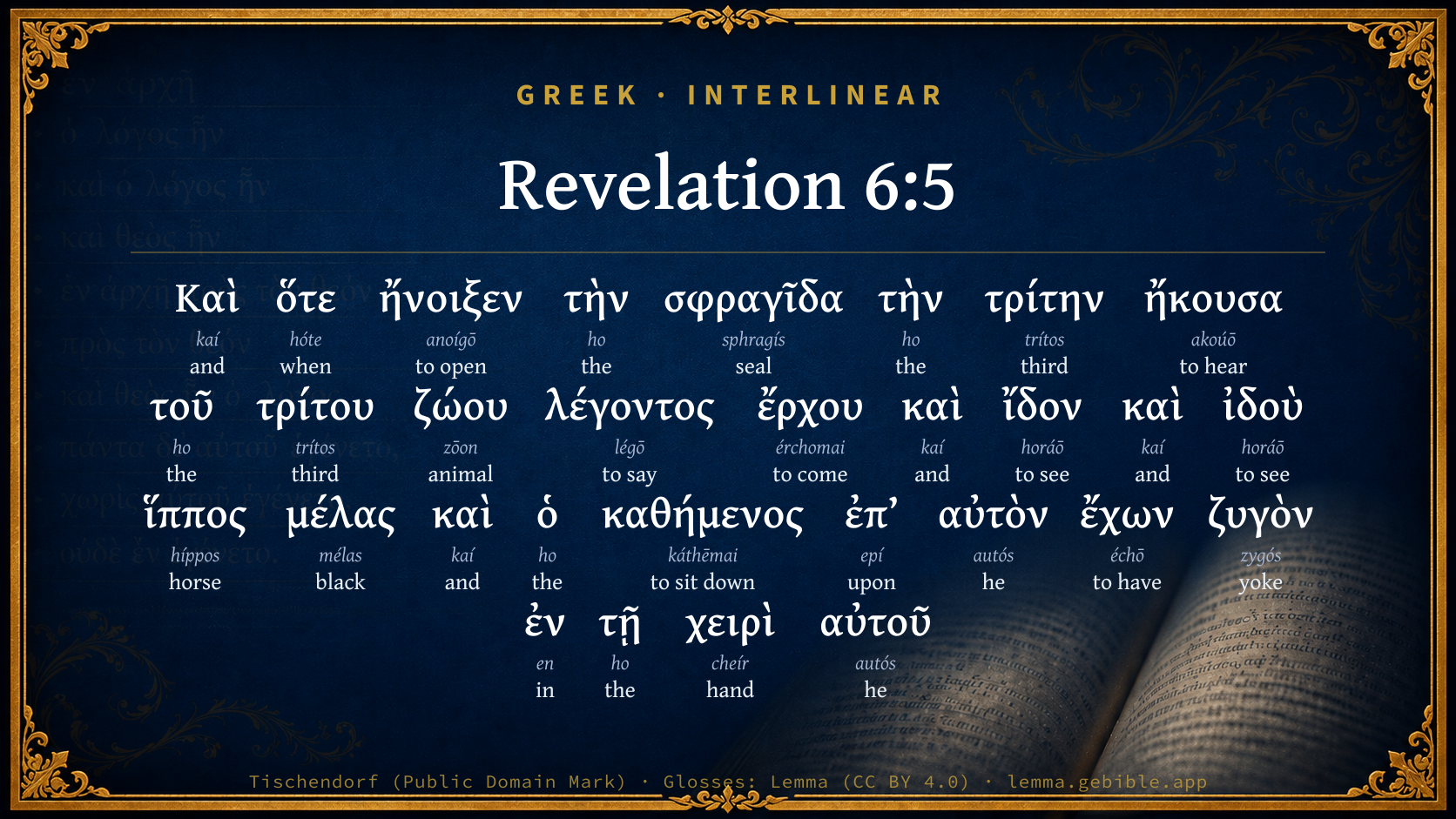
Greek (Tischendorf 8th ed.) Revelation 6:5 appears in the Greek New Testament. The text above is from the Tischendorf 8th edition. Each word links to its Strong’s number and a concise gloss. Click any word for its full Thayer’s Greek Lexicon entry.
Download image
Cite this verse

Revelation 6:5 (World English Bible). Public Domain. Lemma interlinear Bible study tool, https://lemma.gebible.app/v/revelation/6/5.

Show BibTeX & RIS
BibTeX
RIS
English Translation
When he opened the third seal, I heard the third living creature saying, "Come and see!" And behold, a black horse, and he who sat on it had a balance in his hand.
World English Bible · Public Domain
Download a study sheet

One document with this verse’s original text, its word-by-word gloss line, the meaning frame, cross-references with their text, attributed commentary, and full source and license credits — printable, and it pastes into notes with its structure intact.

This verse Autodidact and up

Study sheet (.html) Plain text (.txt)

A passage Seminary Student

Up to 50 verses in one chapter. A passage sheet keeps up to 6 commentary sources and 12 cross-references per verse, in the order this page ranks them, and says so on the sheet whenever that leaves anything out. Ask for a single verse and you get the Autodidact verse sheet above.

Everything on this page stays free to read, with no account — the sheet is a download of what is already on screen, not access to it.

Want to remove ads? Support Godless Engineer
Compare translations 3

The same verse in 3 English versions, stacked beneath the original-language interlinear above. Click any original word for its lexicon entry.

Each is an independent rendering of the whole verse — the interlinear is not word-aligned to these translations.

Highlighted words mark where these versions differ — a whole-verse word diff, not a word-by-word alignment.

  • World English Bible Public Domain
    When he opened the third seal, I heard the third living creature saying, "Come and see!" And behold, a black horse, and he who sat on it had a balance in his hand.
  • King James Version Public Domain
    And when he had opened the third seal, I heard the third beast say, Come and see. And I beheld, and lo a black horse; and he that sat on him had a pair of balances in his hand.
  • unfoldingWord Literal Text CC BY-SA 4.0
    And when he opened the third seal, I heard the third living creature saying, “Come!” And I looked and behold, a black horse, and the one sitting on it having a balance in his hand.

unfoldingWord Literal Text — © unfoldingWord, licensed CC BY-SA 4.0. Word-aligned USFM3 via Door43 (git.door43.org/unfoldingWord/en_ult).

Versions to compare (up to 4)

3 of 4 selected

Show all 19 translations

Every available English version of this verse, each an independent rendering of the whole verse.

  • World English Bible Public Domain
    When he opened the third seal, I heard the third living creature saying, "Come and see!" And behold, a black horse, and he who sat on it had a balance in his hand.
  • Berean Standard Bible Public Domain
    And when the Lamb opened the third seal, I heard the third living creature say, “Come!” Then I looked and saw a black horse, and its rider held in his hand a pair of scales.
  • Majority Standard Bible Public Domain
    And when the Lamb opened the third seal, I heard the third living creature say, “Come and see!” And I saw a black horse, and its rider held in his hand a pair of scales.
  • King James Version Public Domain
    And when he had opened the third seal, I heard the third beast say, Come and see. And I beheld, and lo a black horse; and he that sat on him had a pair of balances in his hand.
  • American Standard Version (1901) Public Domain
    And when he opened the first seal, I heard the third living creature saying, Come. And I saw, and behold, a black horse; and he that sat thereon had a balance in his hand.
  • Revised Version (1885) Public Domain
    And when he opened the third seal, I heard the third living creature saying, Come. And I saw, and behold, a black horse; and he that sat thereon had a balance in his hand.
  • Geneva Bible (1599) Public Domain
    And when hee had opened the thirde seale, I heard the thirde beast say, Come and see: Then I behelde, and loe, a blacke horse, and he that sate on him, had balances in his hand.
  • Douay-Rheims (1899) Public Domain
    And when he had opened the third seal, I heard the third living creature saying: Come, and see. And behold a black horse, and he that sat on him had a pair of scales in his hand.
  • Young's Literal Translation Public Domain
    And when he opened the third seal, I heard the third living creature saying, `Come and behold!' and I saw, and lo, a black horse, and he who is sitting upon it is having a balance in his hand,
  • Literal Standard Version CC BY-SA 4.0
    And when He opened the third seal, I heard the third living creature saying, “Come and behold!” And I saw, and behold, a black horse, and he who is sitting on it is having a balance in his hand,
  • Unlocked Literal Bible CC BY-SA 4.0
    When the Lamb opened the third seal, I heard the third living creature say, “Come!” I saw a black horse, and its rider held a pair of scales in his hand.
  • unfoldingWord Literal Text CC BY-SA 4.0
    And when he opened the third seal, I heard the third living creature saying, “Come!” And I looked and behold, a black horse, and the one sitting on it having a balance in his hand.
  • Darby Bible Public Domain
    And when it opened the third seal, I heard the third living creature saying, Come [and see]. And I saw: and behold, a black horse, and he that sat upon it having a balance in his hand.
  • World Messianic Bible Public Domain
    When he opened the third seal, I heard the third living creature saying, “Come and see!” And behold, a black horse, and he who sat on it had a balance in his hand.
  • Webster's Bible Public Domain
    And when he had opened the third seal, I heard the third living being say, Come and see. And I beheld, and lo, a black horse; and he that sat on him had a pair of balances in his hand.
  • Free Bible Version CC BY-SA 4.0
    When he opened the third seal, I heard the third living creature say, “Come!” I looked and saw a black horse. Its rider was holding a pair of scales in his hand.
  • Bible in Basic English Public Domain
    And when the third stamp was undone, the voice of the third beast came to my ears, saying, Come and see. And I saw a black horse; and he who was seated on it had scales in his hand.
  • Text-Critical English NT CC BY 4.0
    When the Lamb opened the third seal, I heard the third living creature say, “ Come and see.” And behold, there was a black horse! Its rider had a balance scale in his hand.
  • Tyndale New Testament (1534) Public Domain
    And when he opened the thyrde seale I herde the thyrde beste saye: come and se. And I behelde and loo a blacke hors: and he that sate on him had a payre of balances in his honde.

Literal Standard Version (2020), Covenant Press — licensed CC BY-SA 4.0. Text via the HelloAO Bible API (eBible.org). Unlocked Literal Bible (unfoldingWord) — licensed CC BY-SA 4.0. Text via the HelloAO Bible API (eBible.org). unfoldingWord Literal Text — © unfoldingWord, licensed CC BY-SA 4.0. Word-aligned USFM3 via Door43 (git.door43.org/unfoldingWord/en_ult). Free Bible Version, Dr. Jonathan Gallagher — licensed CC BY-SA 4.0. Text via the HelloAO Bible API (eBible.org).

Word by word

More ways to search: Search by grammar → Find every occurrence → Compare this word →

Practice this passage: Drill this verse → Learn its vocabulary →

μέλας
mélas
G3189
“black”
Adjective, Nominative, Singular, Masculine
Part of Speech
Adjective
Case
Nominative
Number
Singular
Gender
Masculine
Full Thayer's Definition

Origin: apparently a root word

TDNT: 13:09,6

1. black 2. black ink
  1. Καὶ kaí G2532 “and” Conjunction
  2. ὅτε hóte G3753 “when” Adverb
  3. ἤνοιξεν anoígō G455 “to open” Verb, Aorist, Active, Indicative, 3rd person, Singular
  4. τὴν ho G3588 “the” Article, Accusative, Singular, Feminine
  5. σφραγῖδα sphragís G4973 “seal” Noun, Accusative, Singular, Feminine
  6. τὴν ho G3588 “the” Article, Accusative, Singular, Feminine
  7. τρίτην trítos G5154 “third” Adjective, Accusative, Singular, Feminine
  8. ἤκουσα akoúō G191 “to hear” Verb, Aorist, Active, Indicative, 1st person, Singular
  9. τοῦ ho G3588 “the” Article, Genitive, Singular, Neuter
  10. τρίτου trítos G5154 “third” Adjective, Genitive, Singular, Neuter
  11. ζώου zōon G2226 “animal” Noun, Genitive, Singular, Neuter
  12. λέγοντος légō G3004 “to say” Verb, Present, Active, Participle, Genitive, Singular, Neuter
  13. ἔρχου érchomai G2064 “to come” Verb, Present, Middle or Passive deponent, Imperative, 2nd person, Singular
  14. καὶ kaí G2532 “and” Conjunction
  15. ἴδον horáō G3708 “to see” Verb, Aorist, Active, Indicative, 1st person, Singular
  16. καὶ kaí G2532 “and” Conjunction
  17. ἰδοὺ horáō G3708 “to see” Verb, Aorist, Middle, Imperative, 2nd person, Singular
  18. ἵππος híppos G2462 “horse” Noun, Nominative, Singular, Masculine
  19. καὶ kaí G2532 “and” Conjunction
  20. ὁ ho G3588 “the” Article, Nominative, Singular, Masculine
  21. καθήμενος káthēmai G2521 “to sit down” Verb, Present, Middle or Passive deponent, Participle, Nominative, Singular, Masculine
  22. ἐπ’ epí G1909 “upon” Preposition
  23. αὐτὸν autós G846 “he” Personal pronoun, Accusative, Singular, Masculine
  24. ἔχων échō G2192 “to have” Verb, Present, Active, Participle, Nominative, Singular, Masculine
  25. ζυγὸν zygós G2218 “yoke” Noun, Accusative, Singular, Masculine
  26. ἐν en G1722 “in” Preposition
  27. τῇ ho G3588 “the” Article, Dative, Singular, Feminine
  28. χειρὶ cheír G5495 “hand” Noun, Dative, Singular, Feminine
  29. αὐτοῦ autós G846 “he” Personal pronoun, Genitive, Singular, Masculine

About this verse

These counts appear in no published source. They are computed here, from the morphology-tagged text and Lemma’s own curated glosses. What Lemma adds →

30
words
20
distinct lemmas
Revelation
section

Notable vocabulary

The rarest word here is μέλας black G3189 — appearing just 3 times in the whole Greek New Testament.

Shared distinctive vocabulary

μέλας black G3189 occurs in 3 verses of the Greek New Testament. Also found in:

Repetition

Words recur within this verse:

  • τρίτην third G5154 ×2
  • ἴδον to see G3708 ×2
  • τὴν the G3588 ×5
  • Καὶ and G2532 ×4
  • αὐτὸν he G846 ×2

Cross-references

10

Topical passages linked to Revelation 6:5 in the Treasury of Scripture Knowledge — connected by theme and wording, ordered by reader-vote popularity; previews shown in the World English Bible.

  • Zechariah 6:2 In the first chariot were red horses; in the second chariot black horses;
  • Ezekiel 4:16 Moreover he said to me, Son of man, behold, I will break the staff of bread in Jerusalem: and they shall eat bread by weight, and with fearfulness; and they shall drink water by measure, and in dismay:
  • Zechariah 6:6 The one with the black horses goes out toward the north country; and the white went out after them; and the dappled went forth toward the south country."
  • Revelation 6:1 I saw that the Lamb opened one of the seven seals, and I heard one of the four living creatures saying, as with a voice of thunder, "Come and see!"
  • Leviticus 26:26 When I break your staff of bread, ten women shall bake your bread in one oven, and they shall deliver your bread again by weight: and you shall eat, and not be satisfied.
  • Revelation 4:6–7 Before the throne was something like a sea of glass, similar to crystal. In the midst of the throne, and around the throne were four living creatures full of eyes before and behind.
  • Revelation 5:5 One of the elders said to me, "Don't weep. Behold, the Lion who is of the tribe of Judah, the Root of David, has overcome; he who opens the book and its seven seals."
  • Revelation 5:9 They sang a new song, saying, "You are worthy to take the book, And to open its seals: For you were killed, And bought us for God with your blood, Out of every tribe, language, people, and nation,
  • Lamentations 5:10 Our skin is black like an oven, Because of the burning heat of famine.
  • Ezekiel 4:10 Your food which you shall eat shall be by weight, twenty shekels a day: from time to time shall you eat it.

Cross-references courtesy of OpenBible.info (CC BY 4.0).

Where the printed editions differ

2 variants

Places in this verse where the major printed Greek editions disagree on the wording in a way that affects the translation — a comparison of editions, not a manuscript-by-manuscript collation. The editions are the modern critical texts (Nestlé-Aland 28/27, SBL, Westcott-Hort, Tregelles, Tyndale House) and the traditional texts behind the KJV (the Textus Receptus and the Byzantine/Majority text). It is not a claim about which reading is original.

  1. Extra text
    καὶ βλέπε.

    “and do heed.”

    In TR Not in NA28NA27TynSBLWHTregByz

    καὶ βλέπε. (kai blepe) 'and do heed.' is only in traditional manuscripts (TR)

  2. Different wording
    εἶδον

    “I saw”

    In NA28NA27TynSBLWHTregTR Not in Byz

    ἴδε (ide) 'do see' occurs in a few manuscripts (Byz) instead of εἶδον (eidon) 'I saw' in older manuscripts (NA28+NA27+Tyn+SBL+WH+Treg+TR)

Textual data: Translators Amalgamated Greek New Testament (STEPBible TAGNT) · CC BY 4.0.

Commentary

Notes on Revelation 6:5 from classic Christian and Jewish commentators (each source and its license shown beneath its notes). The classic Christian expositions comment on the surrounding passage and are grouped to its opening verse, so a note may address several verses; the Jewish commentaries on the Tanakh (Rashi and others) are per-verse, so they appear only where the commentator wrote on this verse.

Lemma curates 59 commentaries, every one of them public domain or Creative Commons licensed, each selected and text-cleaned for this edition rather than reprinted as found. About our sources →

The Cambridge Bible for Schools and Colleges

gen. ed. J. J. S. Perowne

The Third Seal, Rev_6:5-6

5. a pair of balances] The primary meaning of the word is a yoke: but no doubt the A. V. is right, as what follows proves that scarcity rather than oppression is to be symbolised. The sense is, that mankind shall be placed on limited rations of bread, like the people of a besieged city; as in Lev_26:26; Eze_4:16.

The Cambridge Bible for Schools and Colleges (gen. ed. J. J. S. Perowne; Cambridge University Press, 1878–1918) — public domain. Text from a community e-Sword module.

The Biblical Illustrator

Joseph S. Exell

Rev_6:5-6

A black horse;… a pair of balances.

The cry of the world in want

It is a vision of scarcity, of insufficiency, not of absolute famine. The world does not seem to contain enough for all, and there happens a continual struggle for the bare necessaries of bodily life. Every year this is becoming more evident. Most present-day problems have their roots in it, and these problems press with such terrible force upon us that, I suppose, St. Johns vision can never have seemed more picturesquely true than it seems to-day. With our constantly growing popula-ion, the difficulty increases by leaps and bounds. The effect of it is an absorbing anxiety, a restless elaboration of contrivance--How can these present difficulties be overcome? and what new ones will start into sight when the old ones have disappeared?--till a large part of life seems taken up by the problem of how to live. Is any precept of Christ harder than this, Take no thought for your life, etc. Perhaps if we were alone, with nothing but our own personal salvation to think about, it would be easier. But you are not alone. Others depend on you. Husband, think of your wife; think of the children whose future depends so much on you. And if we go down in social life to the lowest depths of poverty, the struggle for existence becomes piteous. It is terrible to face it, but it is well to face it sometimes. In this abyss, insufficiency has become destitution; the struggle has lost all that it seemed to have of manliness and force; it has deformed life into a chaos of brute instincts; it has become parent of crime, disease, and death. Such is the vision of human want. And from the living creatures before Gods throne the appeal is made to Jesus Christ, Come! What is it, this appeal to the Lamb as it had been slain? It is for manifestation of the higher life, the true life, the eternal life which is the knowledge of the true God and Jesus Christ. Sometimes the least spiritually impressionable person is forced to see that there is indeed a higher life. The pressure of earthly things relaxes its hold upon you for a moment; above the ceaseless clamour of the worlds voices the voice of Jesus makes its way to your heart, never lessening its claim upon your life, never taking from the promise its consolation, Take My yoke upon you and learn of Me, for I am meek and lowly in heart; and ye shall find rest unto your souls. Yes, there is indeed a higher life. But it seems so hard of attainment in the life that I am living now. I am in the shadow of the black horseman; I am a sharer in the great struggle for existence. The thought of the higher life is wearisome; the life of prayer, of hourly communion with a Divine Friend, the life of the love of God, of joy in the knowledge of His presence and love, the life of glad obedience, of patient endurance. It all seems so hopeless. We cannot think of higher things. Is not this true of you? The struggle for existence makes us slaves in spirit. Surely the appeal from the living creatures to Christ is wanted for us to-day: Come, with Thy knowledge of the Fathers will. Come, with Thy strong rejoicing in the Fathers love. Come, with Thy unfaltering obedience. Come, with Thy victorious endurance. Let Thine be the Spirit which takes possession of a world in want, O Thou Lamb of God! (A. H. Simms, M. A.)

Scarcity in Gospel times

This vision has been explained in two ways, naturally and spiritually, and either yields a tolerably good signification. Both explanations are consonant with what we gather from the rest of the seals, which is, that much in the time of the Messiahs triumphal progress is not such as we should have expected.

1. We should have expected that the times of the Gospel would have been times of almost universal prosperity. So it had been prophesied (Eze_36:30; Hos_2:22; Joe_2:19). And we should the rather have expected this, because the preaching of the gospel does much to discourage many vices which occasion distress and ruin in this world, such as intemperance, drunkenness, wastefulness, gambling, immorality, etc. But it has not been so. From the first preaching of the gospel there has been just the same hard struggle for sustenance as there was before. Of course there have been countries in which the poor have not suffered from comparative scarcity, as in newly-planted colonies, but the tendency of things has been always to bring about, sooner or later, the universal struggle for a bare subsistence.

2. But the riding of this horse-rider has been interpreted spiritually to mean this, that in the day of Christs power there has not been, nor will be, that plentiful supply of the wholesome and nourishing Word of God which we should have expected. The more thoroughly we examine the history of religion, I do not mean of the Church, but of individual religion, the more we shall discover the truth of this. For well nigh 1,500 years the Word of God has been altogether out of the reach of the vast majority of Christians. Till the invention of printing each copy had to be written fully and fairly out. And look also at the comparative fewness of those who if by chance they possessed a copy could read it. But we must not for a moment limit this scarcity of the wholesome nourishing Word to the scarcity of Bibles. The nourishment of the vast body of the Church is through teaching and preaching, and there may be a vast circulation of Bibles, and yet these Bibles unread and their contents undigested. (M. F. Sadler, M. A.)

Price lists made in heaven

People do not generally suppose that God has much to do with price-lists. They go up and down, and millions higgle over them every day, but no one thinks of anything Divine connected with them. But whether men realise it or not, price-lists are made in heaven. John hears the rates of corn and bread announced by the same heavenly powers by which these mystic horses are called into action. Whatever the weather, the crops, the quantities of money in the country, the extent of speculation in the market, or other subordinate causes may have to do with it, the prime and all-controlling cause is the decree of the throne. It is God from whom we have our daily bread, and it is by His will that it is plentiful and cheap, or scarce and costly. (J. A. Seiss, D. D.)

The Biblical Illustrator, edited by Joseph S. Exell (c. 1880s–1900s) — public domain. Text from a community e-Sword module.

Joseph Benson's Commentary

Rev 6:5-6. And when he had opened the third seal I heard the third living creature — Which was like a man, and had his station in the south; say — As the two former had done; Come and see. And I beheld, and lo a black horse — A fit emblem of mourning and distress; particularly a black famine, as the ancient poets termed it. And he that sat on him had a pair of balances, or scales, in his hand — Implying that men should eat their bread by weight, and drink their water by measure, or that there should be a great scarcity. For when there is great plenty men do not think it worth their while to weigh and measure what they eat and drink; but when there is a famine or scarcity they are obliged to do it. And I heard a voice — It seems from God himself; in the midst of the four living creatures, saying, A measure of wheat for a penny, &c. — As if he had said to the horseman, Hitherto shalt thou come, and no farther. Let there be a measure of wheat for a penny — This may seem, to an English reader, a description of great plenty, but it certainly intends the contrary. The word χοινιξ, chœnix, a Grecian measure, was only about equal to our quart, and was no more than was allowed to a slave for his daily food. And the Roman penny, the denarius, about 7½d. English, was the usual daily wages of a labourer: so that, if a man’s daily labour could earn no more than his daily bread, without other provision for himself and family, corn must needs bear a very high price. This must have been fulfilled when the Grecian measure and the Roman money were still in use, as also when that measure was the common measure, and this money the current coin. It was so in Egypt under Trajan. And three measures of barley for a penny — Either barley was, in common, far cheaper among the ancients than wheat, or the prophecy mentions this as something peculiar. And see thou hurt not the oil and the wine — Let there not be a scarcity of every thing. Let there be some provision left to supply the want of the rest. Lowman interprets this third seal of the scarcity in the time of the Antonines, from A.D. 138 to A.D. 193, and produces passages from Tertullian and the Roman historians, concerning the calamity the empire endured by scarcity in this period. But Bishop Newton supposes this third period commences with Septimius Severus, who was an emperor from the south, being a native of Africa; and was an enacter of just and equal laws, and very severe and implacable to offences; he would not suffer even petty larcenies to go unpunished; as neither would Alexander Severus in the same period, who was a most severe judge against thieves; and was so fond of the Christian maxim, Whatsoever you would not have done to you, do not you to another, that he commanded it to be engraven on the palace, and on the public buildings. These two emperors were also no less celebrated for the procuring of corn and oil, and other provisions; and for supplying the Romans with them, after they had experienced the want of them: thus repairing the neglects of former times, and correcting the abuses of former princes. The colour of the black horse befits the severity of their nature and their name, and the balances are the well-known emblem of justice, as well as an intimation of scarcity. And the proclamation for justice and judgment, and for the procuration of corn, oil, and wine, is fitly made by a creature like a man. This period continued during the reigns of the Septimian family, about forty-two years.

Joseph Benson's Commentary on the Old and New Testaments (1811–1818) — public domain. Text from a community e-Sword module.

Whedon's Commentary on the Bible

Daniel D. Whedon

Third seal—of SCARCITY, Rev_6:5-6.

5. Black horse—Emblem of want of light, midnight, adversity.

Pair of balances—Or scales. Emblem, not of absolute famine, but of “hard times;” of scarcity of provisions, when every thing is strictly weighed or measured.

Daniel D. Whedon (gen. ed.), Commentary on the Old and New Testaments (1874–1909) — public domain. Text from a community e-Sword module.

Tyndale Open Study Notes

Tyndale Open Resources

6:5-6 The black horse represents economic and social dysfunction, indicated by scales used in commerce. Rampant inflation is shown by the cost of the staples of life: A loaf of wheat bread or three loaves of barley will cost a day’s pay. Yet the prices of luxuries such as oil and wine would remain unchanged. It is an image of social and economic imbalance.

Tyndale Open Study Notes — © Tyndale Open Resources, licensed CC BY-SA 4.0. Text via the HelloAO Bible API.

Bengel's Gnomon

Johann Albrecht Bengel

Rev 6:5. Μέλας) The Greek poets call the famine which this horseman would inflict on men, were he not withheld, αἴθοπα λιμὸν, λιμὸν αἰανῆ, that is, black, gloomy: and the Latins use the same epithets.

Bengel's Gnomon of the New Testament — English translation (T&T Clark, Edinburgh, 1860) — public domain. Text from a community e-Sword module.

Meyer's Critical & Exegetical Commentary

Heinrich August Wilhelm Meyer

Rev_6:5-6. The meaning of the third seal-vision is to be determined according to the same norm as that of the second. The black color of the horse designates not the grief of those who have been afflicted by the plagues indicated by the entire image of the horseman,[2048] especially not the grief of the Church over heresy, as it is symbolized by the horse and horseman; but the black color must correspond to the destructive character of the image of the horseman itself.[2049] Yet it is not perceptible how, by this color, the particular nature of the plague announced, viz., famine, is expressed:[2050] it is sufficient to regard the black color[2051] as an indication that the figure appearing therein is one of a plague, a servant of divine judgment.

First, the special emblem ascribed to the horseman (ἕχ. ζυγὸν, κ.τ.λ.), in addition to the unambiguous exclamation χοῖνιξ σίτου, κ.τ.λ., makes us recognize in the third figure of a horseman the personification of famine.

ζυγόν. As to the expression, ζυγός means properly the beam which unites the two scales, cf. Pro_16:11; as to the subject itself, since by the weighing of the grain which otherwise is measured, famine is represented, cf. Lev_26:26, Eze_4:16.

ὡς before φωνὴν[2052] corresponds with the circumstance that, to John, the person from whom the voice proceeds[2053] remains unknown.[2054] Audivi ut vocem, a Latin would say; i.e., I heard (something) like a voice. That the cry sounds forth in the midst of the four beings, is, in itself, natural, since the unsealing of the book of fate occurs at the throne of God, which is in the midst of the four beings;[2055] but as it is not without significance that the four beings, as representatives of the living creatures on earth, cry out to John, ἕρχου, so is it likewise significant that in the midst of those beings the cry sounds forth, which accompanies the figure of a plague pertaining to living creatures[2056] The first half of the call sounds just as when any thing is offered for sale.[2057] The gen. δηναρίου is that of the price.[2058] The second sentence contains a command which prescribes to the horseman, not only as the personification of the famine, but as the bearer of the visitation, the limit of the plague ordained by the Lord. Oil and wine are to grow as ordinarily: μὴ ἀδικήσῃς, i.e., Do them no harm, injure them not;[2059] although wheat and barley, and therefore the unconditionally necessary means of subsistence, are to be so dear that a day-laborer for his daily labor receives a denarius,[2060] nothing more than daily food for himself,a choinix of wheat, which is a mans[2061] daily nourishment. If, therefore, the famine indicated do not reach the utmost extreme of hunger,[2062] yet the grievousness of the plague is obvious to every one who has learned to know the life of the people, viz., of the lower classes, in the neighborhood. That oil and wine remain exempted, is, of course, a mitigation of the famine; but on the other hand, by the plentiful presence of these two means of nourishment, even though in Oriental life they are luxuries far less than among us, the πειρασμός lying in the famine which had entered is essentially strengthened, and the critical force also of these plagues in an ethical respect, which belong to the signs preceding Christs coming,[2063] intensified.

[2048] De Wette, Hengstenb., etc.

[2049] Cf. Rev_6:2; Rev_6:4; Rev_6:8.

[2050] Beng.

[2051] Cf. Rev_6:12.

[2052] See Critical Notes.

[2053] Cf. Rev_1:12.

[2054] Cf. Rev_9:13, Rev_10:4; Rev_10:8, Rev_14:13, Rev_18:4.

[2055] Rev_4:6, Rev_5:6.

[2056] Cf. also Hengstenb.

[2057] Winer, p. 456.

[2058] Winer, p. 194.

[2059] Cf. Rev_7:2-3, Rev_9:4; Rev_9:10; Rev_9:19, Rev_2:11.

[2060] Mat_20:2.

[2061] Cf. Wetst.

[2062] Cf. Joe_1:10 sqq.

[2063] Mat_24:7. Hengstenb. incorrectly judges, that the famine, Rev_6:5-6, does not belong to the λιμοί, Mat_24:7, but is the prelude of that fulfilment.

The reference of Rev_6:5-6, to the famine under Claudius,[2064] or to any other particular dearth,[2065] is decidedly contrary to the sense of the text; since here, as also in Rev_6:3-4, and Rev_6:7 sqq., no special fact is meant, especially not one predicted only after its occurrence, but rather, in accord with the fundamental prophecy (Mat_24:7), a certain kind of plagues is described,[2066] which precede the coming of the Lord. Purely arbitrary is the allegorizing interpretation, e.g., in Beda,[2067] Vitr.,[2068] C. a Lap.,[2069] Stern,[2070] etc. N. de Lyra understands by the black horse, the Roman army; by the horseman, Titus; by the wheat and barley, Jews; by oil and wine, Christians. The acme of arbitrary interpretation is attained by those who, as even Böhmer, understand the wheat and barley properly, and the wine and oil figuratively as a designation of Christians. Any such distinction would have been indicated by the omission of the art. with σίτου and κριθῶν, whereas, on the other hand, it is found with ἕλαιον and οἶνον. But although the art. in the latter case designates simply the class as a whole, this is lacking in the former case just as naturally; since there not the kind of fruit as such, but a quantity, is mentioned, which therefore allows no other designation than that of the mass, which in simple composition is given as χοῖνιξ σίτου.

[2064] Grot., Wetst., Harenb., Herd., Böhm.

[2065] Cf. Calov., Bengel, Huschke.

[2066] Cf. De Wette, Hengstenb., Ebrard.

[2067] The black horse is the band of false brethren, who have the balance of a right profession, but injure their associates by works of darkness.

[2068] Dearness of spiritual provision, viz., in the time from Constantine until the ninth century.

[2069] ἵππος = a heretic, as Arius; ὁ καθήμ. = the Devil, or heresiarch; ζυγός and χοῖνιξ = Holy Scripture; δηναρ. = the merit of sound faith and of daily holy life; σιτ. = the gospel; κριθ. = the harsh old law; ἔλ. and οἶν. = the medicine of our Samaritan Christ.

[2070] Personified erroneous doctrine.

NOTES BY THE AMERICAN EDITOR

XLVIII. Rev_6:2. ἰππος λευκός

Luthardt: That is, the Word of God, which was the first in the history of N. T. times to pass victoriously through the world, and whose words flew far like arrows, and penetrated the heart (Psa_45:6). Alford: The νικῶν might be said of any victorious earthly power whose victories should endure for the time then present, and afterwards pass away; but the ἳνα νικήσῃ can only be said of a power whose victories are to last forever.… We must not, on the one hand, too hastily introduce the person of our Lord himself; or, on the other, be startled at the objection that we shall be paralleling him, or one closely resembling him, with the far different forms which follow. Doubtless, the resemblance to the rider in Rev_19:11 is very close, and is intended to be very close. The difference, however, is considerable. There he is set forth as present in his triumph, followed by the hosts of heaven: here he is working in bodily absence, and the rider is not himself, but only a symbol of his victorious power, the embodiment of his advancing kingdom as regards that side of its progress where it breaks down earthly power, and makes the kingdom of the world to be the kingdom of our Lord and his Christ. Further, it would not be wise, nor, indeed, according to the analogy of these visions, to specify. In all cases but the last, these riders are left in the vagueness of their symbolic offices. If we attempt, in this case, to specify further, e.g., as Victorinus: The white horse is the word of preaching sent with the Holy Spirit into the world. For the Lord says, This gospel shall be preached in all the world for a witness unto all nations, and then shall the end come,while we are sure that we are thus far right, we are but partially right, seeing that there are other aspects and instruments of victory of the kingdom of Christ besides the preaching of the word. If the word preaching be limited to public discourses, or even to the public reading and private study of the word, Alford is quite right. But just as the sacraments are only the visible word, and are efficacious because of the word of God joined with them, so every agency for the diffusion of Christs kingdom may be reduced to the word of God under some form. Gebhardt (p. 238) regards the rider on the white horse as a personification of victorious war. His objection to the view adopted by Düsterdieck, that the Lamb could not have opened the seals, and at the same time have been represented in what the seal portrays, is not very formidable, and, at most, would not interfere with the conception above proposed of the Word as rider.

Meyer — Critical and Exegetical Commentary on the New Testament — English translation by Peter Christie, edited by Frederick Crombie (T&T Clark, 1880) — public domain. Text from a community e-Sword module.

Expositor's Greek Testament

ed. W. Robertson Nicoll

Rev 6:5-6 . The third seal opened = famine .

Rev 6:5 . The spectral figure of Hunger holds a balance or pair of scales ( ζ . literally = the beam, see reff.) for measuring bread by weight, to personify (Rev 6:6 ) bad times, when provisions became cruelly expensive. One χοῖνιξ of wheat, the usual rations of a working man for a day, is to cost twelve times its normal price, while the labourer’s daily pay will not command more than an eighth of the ordinary twenty-four measures of the coarser barley. Grain is not to disappear entirely from the earth, otherwise there would be no famine. But food-stuffs are to be extremely scanty and therefore dear ( cf. Lev 26:26 ; Eze 4:16 ). These hard times are aggravated ( καὶ adversative) by the immunity of oil and wine, which are, comparatively speaking, luxuries. One exasperating feature of the age would be the sight of wine and oil flowing, while grain trickled slowly into the grasp of the famishing. The best explanation of this realistic exception is to regard it as a water-mark of the Domitianic date (for details see the present writer’s study in Expos. Oct. 1908, 359 369). In 92 A.D. Domitian had made a futile attempt to injure the cultivation of the vine in the provinces, which led to widespread agitation throughout Ionia. His edict had soon to be withdrawn, but not till it had roused fear and anger. Hence the words hurt not the wine have the force of a local allusion to what was fresh in his readers’ minds. The point of the saying lies in the recent events which had stirred Smyrna and the surrounding townships, and which provided the seer with a bit of colour for his palette as he painted the final terrors. It is as if he grimly said: “Have no fears for your vines! There will be no Domitian to hurt them. Comfort yourselves with that. Only, it will be small comfort to have your liquid luxuries spared and your grain reduced almost to starvation point.” Or, the prophet’s meaning might be that the exemption of the vine would only pander to drunkenness and its attendant ills. The addition of τὸ ἔλαιον is probably an artistic embodiment, introduced in order to fill out the sketch. The cultivation of the olive accompanied that of the vine, and the olive meant smooth times. It is no era of peace; far from that, the prophet implies. But the olive, “the darling of Peace” (as Vergil calls it), flourishes unchecked, so mocking and awry are the latter days. For ἀδικεῖν = “injure” (a country), see reff., Rev 7:2 , and Dittenberger’s Sylloge Inscr. Graec. 557. This Domitianic reference of Rev 6:6 was first worked out by S. Reinach ( Revue Archéolog . 1901, 350 f.) and has been accepted by Harnack, Heinrici, Bousset, J. Weiss, Abbott, Holtzmann, Baljon, and others. There is no allusion to Jos. Bell . Rev 6:13 ; Rev 6:6 , or to the sparing of gardens during the siege of Jerusalem (S. Krauss, in Preuschen’s Zeitschrift , 1909, 81 89).

The Expositor's Greek Testament, edited by W. Robertson Nicoll (1897–1910) — public domain. Text from a community e-Sword module.

Geneva Bible (1599)

Geneva Bible translators

The third sign with declaration, is that God will destroy the world with famine, withdrawing all provision: which is by the figure Synecdoche comprehended in wheat, barley, wine and oil.

Geneva Bible (1599) marginal notes — public domain. Text via Bolls.life.

Jamieson, Fausset & Brown

Robert Jamieson, A. R. Fausset & David Brown

Come and see--The two oldest manuscripts, A, C, and Vulgate omit "and see." B retains the words.

black--implying sadness and want.

had--Greek, "having."

a pair of balances--the symbol of scarcity of provisions, the bread being doled out by weight.

Jamieson, Fausset & Brown — Commentary Critical and Explanatory on the Whole Bible (1871) — public domain (CC PDM 1.0). Text via the HelloAO Bible API.

Adam Clarke's Commentary

Verse 5. The third beast] That which had the face of a man.

A black horse] The emblem of famine. Some think that which took place under Claudius. See Mt 24:7; the same which was predicted by Agabus, Ac 11:28.

A pair of balances] To show that the scarcity would be such, that every person must be put under an allowance.

Adam Clarke's Commentary on the Bible (1810–1826) — public domain. Text from a community e-Sword/MySword module.

Ellicott's Commentary for English Readers

(5, 6) When He had opened.—Better, When he opened. The words “and see” are to be omitted here, as in the other seals. And I saw, and behold a horse, black, and he that sat on him having a balance in his hand. And I heard as it were a voice in the midst of the four living beings, saying, A choenix of wheat for a denarius (penny), and three choenixes of barley for a denarius (penny), and the oil and the wine do thou not hurt. “Balance:” There is scarcely a doubt that a balance, or pair of scales, is intended (the Greek word also means a yoke); but the whole imagery of the seal harmonises with the balance, and the passage from Ezekiel (Eze_45:10), cited by Alford, in which there is a “righteous balance” (the LXX. using the same Greek word as here) seems conclusive. It is the emblem of scarcity: food is not weighed out thus in times of abundance. (Comp. Eze_4:16, “Behold I will break the staff of bread in Jerusalem, and they shall eat bread by weight and with care.”) The choenix (“measure” in English version) was the amount of food sufficient to support a man for a day. “A choenix is the daily maintenance” (Suidas, quoted by Alford). The denarius (“penny” of English version, here and in Mat_18:28, and Mar_12:37) amounted to between sixpence and sevenpence of our money, and was the usual daily pay of the labourer, and of the soldier. (See especially Note on Mat_20:2.) It is difficult to speak of this as other than terribly high prices for food. The whole of a man’s pay goes for food, and even the coarser bread is so expensive that it takes a whole day’s wages to supply food for three adults. It has been thought that the voice calls to the rider to check his devastations, lest the growing famine should exterminate the whole human race. This may be, but the check is at a point which has already wrought the highest misery. The extent of the misery may be imagined by imagining what wretchedness would be entailed were a man obliged to pay three or four shillings for bread sufficient to keep him nourished for a day. Or we may measure it by the estimate of the disciples (Mar_6:37) that two hundred pennyworth of bread would give a short meal to upwards of five thousand people. At the price in this seal, the cost of bread would have so risen that the two hundred pennyworth of bread would not suffice to feed one thousand. But what is meant by the words, “the oil and wine do not thou hurt”? They were not, like the bread, necessary to life, but among its luxuries and superfluities. There is a kind of irony in times of straitness, when the necessaries are scarcely to be had, and the luxuries remain comparatively low in price. The splendours and comforts of life are held cheap, when hunger is showing that the life is more than the dainty meat, and the body than raiment. The seal then tells the seer that in the ages the Church of Christ must expect to see famines and distress in the world, and luxuries abounding in the midst of straitness. Is it not true that the contrast, which is so ugly, between pampered opulence and indolent, pauperism, is the result of the prevalence of world-principles? Wealth, self-indulgent and heartless, and poverty, reckless and self-willed, are sure tokens that the golden rule of Christ is not understood and obeyed. There is a similar experience in the history of the Church. The red horse of controversy is followed by the black horse of spiritual starvation. In the heat of polemical pride and passion for theological conquest is developed that love of barren dogmatics which forgets the milk of the word and the bread of life, which are the needed food of souls.

A Bible Commentary for English Readers, edited by Charles John Ellicott (1878–1897) — public domain. Text from a community e-Sword module.

John Gill's Exposition

And when he had opened the third seal,.... Of the sealed book:

I heard the third beast say, come and see; this living creature was that which was like a man, who was on the south side of the throne, as the standard of Reuben, which had the figure of a man, was on the south side of the camp of Israel; this was not the Apostle Paul, as Grotius thinks, to whom was made a prophecy of a famine in the days of Claudius Caesar; nor Tertullian, who made an apology for the Christians in the times of this seal, as Brightman conjectures; but the ministers of the Gospel, whose voice was neither the voice of the lion nor of the ox, but of a man, which was still lower, but yet they retained their humanity, reasoning prudence, and wisdom; and these are represented as calling upon John to come and see, and take notice of the following hieroglyphic:

and I beheld, and lo a black horse; an emblem either of the afflicted state of the church, still answering to the Smyrnaean one, being black with persecutions, schisms, errors, and heresies, which were many; or particularly of the heresies and heretics of those times, who might be compared to a horse for their pride and ambition, speaking great swelling words of vanity, and to a black one, for their hidden things of dishonesty, and works of darkness, for the darkness in themselves, and which they spread over others; or rather of a famine, not in a spiritual sense, of hearing of the word, but in a literal sense; see Lam 4:7; not what was at the siege of Jerusalem, or in the times of Claudius Caesar, Act 11:28; but in the times of the Emperor Severus, and others, as the historians of those times (a), and the writings of Tertullian show; when the Heathens ascribed the scarcity that was among them to the wickedness of the Christians (b), whereas it was a judgment upon them for their persecution of them:

and he that sat on him had a pair of balances in his hand; by whom is meant not some noted heretic, or heretics, who had balances of deceit in their hands to prove their tenets by, such as spurious writings, &c. or who made pretensions to the Scriptures, the balance of the sanctuary, to weigh doctrines in; nor Christ, whose name heretics shrouded themselves under, and professed, and who overruled and made use of their heresies for the good of his people, that they might be made manifest. Mr. Mede thinks that Septimius Severus, the Roman emperor, who came from Africa, from the south, on which side was the living creature that spoke to John, is intended, and in which country black horses were in great esteem; and he was the only African that ever was emperor of Rome before (c): and the same author thinks, that his having a pair of balances in his hand expresses the strict justice that emperor was famous for; but rather it signifies famine, and such a scarcity as that bread is delivered out by weight to men; see Lev 26:26.

(a) Spartianus in Vita Severi, & Lampridius in Vita Alexandri. (b) Apolog. c. 40. & ad Scapulam, c. 3. (c) Cassiodor. Chronicon. & Eutrop. Hist. Roman. l. 8.

John Gill's Exposition of the Whole Bible (1746–1763) — public domain (CC PDM 1.0). Text via the HelloAO Bible API.

Trapp's Complete Commentary

John Trapp

5 And when he had opened the third seal, I heard the third beast say, Come and see. And I beheld, and lo a black horse; and he that sat on him had a pair of balances in his hand.

Ver. 5. A black horse] Famine discolours and denigrates, Lam 4:7-8. It accompanies war for the most part, and in sieges is very extreme, as at Samaria, where an ass’s head was worth four pounds; at Rome, where this proclamation was made in the market, Pone pretium humanae carni; Place a reward on the flesh of a man, at Scodra, where horses were dainty meat, yea, they were glad to eat dogs, cats, rats, &c. At Antioch in Syria, where many Christians (in the holy war, as they called it) were glad to eat the dead bodies of their late slain enemies. (Turk. Hist.)

Had a pair of balances] Gr. ζυγον, the beam of scales. To show that bread should be delivered out by measure, as is threatened, Eze 4:16; Deu 28:59-68, and men should be stinted and pittanced.

John Trapp, A Commentary or Exposition upon All the Books of the Old and New Testament (1647–1656) — public domain. Text from a community e-Sword module.

Albert Barnes' Notes on the Bible

And when he had opened the third seal - Unfolding another portion of the volume. See the notes on Rev 5:1.

I heard the third beast say, Come and see - See the notes on Rev 4:7. It is not apparent why the third beast is represented as taking a particular interest in the opening of this seal (compare the notes on Rev 6:3), nor is it necessary to show why it was so. The general design seems to have been, to represent each one of the four living creatures as interested in the opening of the seals, but the order in which they did this does not seem to be a matter of importance.

And I beheld, and lo, a black horse - The specifications of the symbol here are the following:

(a) As before, the horse. See the notes on Rev 6:2.

(b) The color of the horse: “lo, a black horse.” This would properly denote distress and calamity - for black has been regarded always as such a symbol. So Virgil speaks of fear as black: “atrumque timorem” (Aen. ix. 619). So again, Georg. iv. 468:

“Caligantem nigra formidine lucum.”

So, as applied to the dying Acca, Aeneas xi. 825:

“Tenebris nigrescunt omnia circum.”

Black, in the Scriptures, is the image of fear, of famine, of death. Lam 5:10; “our skin was black like an oven, because of the terrible famine.” Jer 14:2; “because of the drought Judah mourneth, and the gates thereof languish; they are in deep mourning (literally, black) for the land.” Joe 2:6; “all faces shall gather blackness.” Nah 2:10; “the knees smite together, and there is great pain in all loins, and the faces of them all gather blackness.” Compare Rev 6:12; Eze 32:7. See also Bochart, Hieroz. P. i. lib. ii. c. vii. pp. 106, 107. From the color of the horse here introduced we should naturally look for some dire calamity, though the nature of the calamity would not be designated by the mere use of the word “black.” What the calamity was to be must be determined by what follows in the symbol. Famine, pestiilence, oppression, heavy taxation, tyranny, invasion - any of these might be denoted by the color of the horse.

(c) The balances: “and he that sat on him had a pair of balances in his hand.” The original word rendered here as “a pair of balances,” is ζυγὸν zugon. This word properly means a yoke, serving to couple anything together, as a yoke for cattle. Hence it is used to denote the beam of a balance, or of a pair of scales - and is evidently so used here. The idea is, that something was to be weighed, in order to ascertain either its quantity or its value. Scales or balances are the emblems of justice or equity (compare Job 31:6; Psa 62:9; Pro 11:1; Pro 16:11); and when joined with symbols that denote the sale of grain and fruit by weight, become the symbol of scarcity. Thus, “bread by weight” Lev 26:26 denotes scarcity. So in Eze 4:16, “And they shall eat bread by weight.” The use of balances here as a symbol would signify that something was to be accurately and carefully weighed out.

The connection leads us to suppose that this would pertain to the necessaries of life, and that it would occur either in consequence of scarcity, or because there would be an accurate or severe exaction, as in collecting a revenue on these articles. The balance was commonly the symbol of equity and justice; but it was also, sometimes, the symbol of exaction and oppression, as in Hos 12:7; “The balance of deceit is in his hands; he loveth to oppress.” If the balances stood alone, and there were no proclamation as to what was to occur, we should look, under this seal, to a time of the exact administration of justice, as scales or balances are now used as emblems of the rigid application of the laws and of the principles of justice in courts, or in public affairs. If this representation stood alone, or if the black horse and the scales constituted the whole of the symbol, we should look for some severe administration, or perhaps some heavy calamity under a rigorous administration of laws. The reference, however, to the “wheat and barley,” and to the price for which they were to be weighed out, serves still further to limit and define the meaning of the symbol as having reference to the necessaries of life - to the productions of the land - to the actual capital of the country. Whether this refers to scarcity, or to taxation, or both, must be determined by the other parts of the symbol.

(d) The proclamation: And I heard a voice in the midst of the four beasts say. That is, from the throne, Rev 4:6. The voice was not that of one of the four beasts, but it seemed to come from among them. As the rider went forth, this was the proclamation that was made in regard to him; or this is what is symbolized in his going forth, to wit, that there would be such a state of things that a measure of wheat would be sold for a penny, etc. The proclamation consists essentially of two things - what refers to the price or value of wheat and barley, and what requires that care shall be taken not to injure the oil and the wine. Each of these demands explanation.

A measure of wheat for a penny - See the margin. The word rendered “measure” - χοῖνιξ choinix - denotes an Attic measure for grain and things dry, equal to the 48th part of the Attic medimnus, or the 8th part of the Roman modius, and consequently was nearly equivalent to one quart English (Robinson’s Lexicon). The word rendered “penny,” δηναρίον dēnarion - Latin, denarius - was of the same value as the Greek δραχμή drachmē, and was equivalent to about fourteen cents or seven-pence (circa mid-19th century). This was the usual price of a day’s labor, Mat 20:2, Mat 20:9. The choenix, or measure of grain here referred to, was the ordinary daily allowance for one man (Odyssey xix. 27, 28). See Stuart, in loco. The common price of the Attic medimnus of wheat was five or six denarii; but here, as that contained 48 choenixes or quarts, the price would be augmented to 48 denarii - or it would be about eight times as dear as ordinary; that is, there would be a scarcity or famine. The price of a bushel of wheat at this rate would be about four dollars and a half or 18 shillings - a price which would indicate great scarcity, and which would give rise to much distress.

And three measures of barley for a penny - It would seem from this that barley usually bore about one-third the price of wheat. It was a less valuable grain, and perhaps was produced in greater abundance. This is not far from the proportion which the price of this grain usually bears to that of wheat, and here, as in the case of the wheat, the thing which would be indicated would be scarcity. This proclamation of “a measure of wheat for a penny” was heard either as addressed to the horseman, as a rule of action for him, or as addressed by the horseman as he went forth. If the former is the meaning, it would be an appropriate address to one who was going forth to collect tribute - with reference to the exact manner in which this tribute was to be collected, implying some sort of severity of exaction; or to one who should distribute wheat and barley out of the public granaries at an advanced price, indicating scarcity. Thus, it would mean that a severe and heavy tax - represented by the scales and the scarcity - or a tax so severe as to make grain dear, was referred to. If the latter is the meaning, then the idea is that there would be a scarcity, and that grain would be dealt out by the government at a high and oppressive price. The latter idea would be as consonant with the symbol of the scales and the price mentioned as the other, if it were not for the additional injunction not to “hurt the oil and the wine” - which cannot be well applied to the idea of dealing out grain at a high price. It can, however, be connected, by a fair interpretation of that passage, with such a severity of taxation that there would be a propriety in such a command - for, as we shall see, under the explanation of that phrase, such a law was actually promulgated as resulting from severity of taxation. The idea, then, in the passage before us, would seem to be:

(a) that there would be a rigid administration of the law in regard to the matter under consideration-that pertaining to the productions of the earth - represented by the balances; and,

(b) that that would be connected with general scarcity, or such an exercise of this power as to determine the price of grain, so that the price would be some three times greater than ordinary.

And see thou hurt not the oil and the wine - There has been a great variety of interpretations proposed of this passage, and it is by no means easy to determine the true sense. The first inquiry in regard to it is, to whom is it addressed? Perhaps the most common impression on reading it would be, that it is addressed to the horseman with the balances, commanding him not to injure the oliveyards and the vineyards. But this is not probably the correct view. It does not appear that the horseman goes forth to destroy anything, or that the effect of his going forth is directly to injure anything. This, therefore, should not be understood as addressed to the horseman, but should be regarded as a general command to any and all not to injure the oliveyards and vineyards; that is, an order that nothing should be done essentially to injure them. If thus regarded as addressed to others, a fair and congruous meaning would be furnished by either of the following interpretations: either:

(a) considered as addressed to those who were disposed to be prodigal in their manner of living, or careless as to the destruction of the crop of the oil and wine, as they would now be needed; or.

(b) as addressed to those who raised such productions, on the supposition that they would be taxed heavily, or that large quantities of these productions would be extorted for revenue, that they. should not mutilate their fruit-trees in order to evade the taxes imposed by the government. In regard to the things specified here - oil and wine - it may be remarked, that they were hardly considered as articles of luxury in ancient times. They were almost as necessary articles as wheat and barley. They constituted a considerable part of the food and drink of the people, as well as furnished a large portion of the revenue, and it would seem to be with reference to that fact that the command here is given that they should not be injured; that is, that nothing should be done to diminish the quantity of oil and wine, or to impair the productive power of oliveyards and vineyards. The state of things thus described by this seal, as thus interpreted, would be:

(a)A rigid administration of the laws of the empire, particularly in reference to taxation, producing a scarcity among the necessary articles of living;

(b)A strong tendency, from the severity of the taxation, to mutilate such kinds of property, with a view either of concealing the real amount of property, or of diminishing the amount of taxes; and,

(c)A solemn command from some authoritative quarter not to do this.

A command from the ruling power not to do this would meet all that would be fairly demanded in the interpretation of the passage; and what is necessary in its application, is to find such a state of things as would correspond with these predictions; that is, such as a writer would have described by such symbols on the supposition that they were referred to.

Now it so happens that there were important events which occurred in the Roman empire, and connected with its decline and fall, of sufficient importance to be noticed in a series of calamitous events, which corresponded with the symbol here, as above explained. They were such as these:

(a) The general severity of taxation, or the oppressive burdens laid on the people by the emperors. In the account which Mr. Gibbon gives of the operation of the Indictions, and Superindictions, though the specific laws on this subject pertained to a subsequent period, the general nature of the taxation of the empire and its oppressive character may be seen (Decline and Fall, i. 357-359). A general estimate of the amount of revenue to be exacted was made out, and the collecting of this was committed to the pretorian prefects, and to a great number of subordinate officers. “The lands were measured by surveyors who were sent into the provinces; their nature, whether arable, or pasture, or woods, was distinctly reported; and an estimate made of their common value, from the average produce of five years. The number of slaves and of cattle constituted an essential part of the report; an oath was administered to the proprietors, which bound them to disclose the true state of their affairs; and their attempts to prevaricate or elude the intention of the legislature were severely watched, and punished as a capital crime, which included the double guilt of treason and of sacrilege. According to the different nature of lands, their real produce in the various articles of wine or oil, grain or barley, wood or iron, was transported by the labor or at the expense of the provincials to the imperial magazines, from whence they were occasionally distributed for the use of the court or of the army, and of the two capitals, Rome and Constantinople,” i. p. 358. Compare Lactant. de mort. Persecut., c. 23.

(b) The particular order, under this oppressive system of taxation, respecting the preservation of vineyards and oliveyards, may be referred to, also, as corresponding to the command sent forth under this rider, not to “hurt the oil and the wine.” That order was in the following words: “If anyone shall sacrilegiously cut a vine, or stint the fruit of prolific boughs, and craftily feign poverty in order to avoid a fair assessment, he shall, immediately on detection, suffer death, and his property be confiscated” (Cod. Theod. l. xiii. lib. xi. seq.; Gibbon, i. 358, note). Mr. Gibbon remarks: “Although this law is not without its studied obscurity, it is, however, clear enough to prove the minuteness of the inquisition, and the disproportion of the penalty.”

(c) Under this general subject of the severity of taxation - as a fact farspreading and oppressive, and as so important as to hasten the downfall of the empire, may be noticed a distinct edict of Caracalla as occurring more directly in the period in which the rider with the balances may be supposed to have gone forth. This is stated by Mr. Gibbon (i. 91) as one of the important causes which contributed to the downfall of the empire. “The personal characters of the emperors, their victories, laws, and fortunes,” says he, “can interest us no further than they are connected with the general history of the decline and fall of the monarchy. Our constant attention to that object will not suffer us to overlook a most important edict of Antoninus Caracalla, which communicated to all the free inhabitants of the empire the name and privileges of Roman citizens. His unbounded liberality, however, flowed not from the sentiments of a generous mind; it was the sordid result of avarice,” etc.

He then proceeds at length to state the nature and operations of that law, by which a heavy tax, under the pretence of liberality, was in fact imposed on all the citizens of the empire - a fact which, in its ultimate results, the historian of the Decline and Fall regards as so closely connected with the termination of the empire. See Gibbon, i. pp. 91-95. After noticing the laws of Augustus, Nero, and the Antonines, and the real privileges conferred by them on those who became entitled to the rank of Roman citizens - privileges which were a compensation in the honor, dignity, and offices of that rank for the measure of taxation which it involved - he proceeds to notice the fact that the title of “Roman citizen” was conferred by Caracalla on all the free citizens of the empire, involving the subjection to all the heavy taxes usually imposed on those who sustained the rank expressed by the title, but with nothing of the compensation connected with the title when it was confined to the inhabitants of Italy. “But the favor,” says he, “which implied a distinction, was lost in the prodigality of Caracalla, and the reluctant provincials were compelled to assume the vain title, and the real obligations, of Roman citizens. Nor was the rapacious son of Severus (Caracalla) contented with such a measure of taxation as had appeared sufficient to his moderate predecessors. Instead of a twentieth, he exacted a tenth of all legacies and inheritances; and during his reign he crushed alike every part of the empire under the weight of his iron scepter,” (i. 95).

So again (Ibid.), speaking of the taxes which had been lightened somewhat by Alexander, Mr. Gibbon remarks: “It is impossible to conjecture the motive that engaged him to spare so trifling a remnant of the evil; but the noxious weed, which had not been totally eradicated, again sprung up with the most luxuriant growth, and in the succeeding age darkened the Roman world with its deadly shade. In the course of this history we shall be too often summoned to explain the land-tax, the capitation, and the heavy contributions of grain, wine, oil, and meat, which were exacted from the provinces for the use of the court, the army, and the capital.” In reference to this whole matter of taxation as being one of the things which contributed to the downfall of the empire, and which spread woe through the falling empire - a woe worthy to be illustrated by one of the seals - a confirmation may be delayed from the reign of Galerius, who, as Caesar, acted under the authority of Diocletian; who excited Diocletian to the work of persecution (Decline and Fall, i. 317, 318); and who, on the abdication of Diocletian, assumed the title of Augustus (Decline and Fall, i. 222).

Of his administration in general Mr. Gibbon i. 226) remarks: “About that time the avarice of Galerius, or perhaps the exigencies of the state, had induced him to make a very strict and rigorous inquisition into the property of his subjects for the purpose of a general taxation, both on their lands and on their persons. A very minute survey appears to have been taken of their real estates; and wherever there was the slightest suspicion of concealment, torture was very freely employed to obtain a sincere declaration of their personal wealth.” Of the nature of this exaction under Galerius; of the cruelty with which the measure was prosecuted - particularly in its bearing on Christians, toward whom Galerius cherished a mortal enmity (Decline and Fall, i. 317); and of the extent and severity of the suffering among Christians and others, caused by it - the following account of Lactantius (De Mort. Persecut., c. 23) will furnish a painful but most appropriate illustration: “Swarms of exacters sent into the provinces and cities filled them with agitation and terror, as though a conquering enemy were leading them into captivity. The fields were separately measured, the trees and vines, the flocks and herds numbered, and an examination made of the people. In the cities the cultivated and rude were united as of the same rank. The streets were crowded with groups of families, and every one required to appear with his children and slaves. Tortures and lashes resounded on every side. Sons were gibbeted in the presence of their parents, and the most confidential servants harassed that they might make disclosures against their masters, and wives that they might testify unfavorably of their husbands. If there were a total destitution of property, they were still tortured to make acknowledgments against themselves, and, when overcome by pain, inscribed for what they did not possess.

Neither age nor ill-health was admitted as an excuse for not appearing. The sick and weak were borne to the place of inscription, a reckoning made of the age of each, and years added to the young and deducted from the old, in order to subject them to a higher taxation than the law imposed. The whole scene was filled with wailing and sadness. In the meantime individuals died, and the herds and the flocks diminished, yet tribute was none the less required to be paid for the dead, so that it was no longer allowed either to live or die without a tax. Mendicants alone escaped, where nothing could be wrenched, and whom misfortune and misery had made incapable of further oppression. These the impious wretch affecting to pity, that they might not suffer want, ordered to be assembled, borne off in vessels, and plunged into the sea.” See Lord on the Apoc., pp. 128, 129. These facts in regard to the severity of taxation, and the rigid nature of the law enforcing it; to the sources of the revenue exacted in the provinces, and to the care that none of those sources should be diminished; and to the actual and undoubted bearing of all this on the decline and fall of the empire, are so strikingly applicable to the symbol here employed, that if it be supposed that it was intended to refer to them, no more natural or expressive symbol could have been used; if it were supposed that the historian meant to make a record of the fulfillment, he could not well have made a search which would more strikingly accord with the symbol.

Were we now to represent these things by a symbol, we could scarcely find one that would be more expressive than that of a rider on a black horse with a pair of scales, sent forth under a proclamation which indicated that there would be a most rigid and exact administration of severe and oppressive laws, and with a special command, addressed to the people, not for the purposes of concealment, or from opposition to the government, to injure the sources of revenue. It may serve further to illustrate this, to copy one of the usual emblems of a Roman procurator or questor. It is taken from Spanheim, De Usu Num. Diss., vi. 545. See Elliott, i. 169. It has a balance as a symbol of exactness or justice, and an car of grain as a symbol employed with reference to procuring or exacting grain from the provinces.

Albert Barnes' Notes on the Bible (1834–1885) — public domain. Text from a community e-Sword/MySword module.

Haydock's Catholic Bible Commentary

The third seal....a black horse. This is also commonly expounded of wars and persecutions, and particularly of famine, by the scales in the rider’s hand, and by two pounds of wheat being sold for a penny: a great price, considering the value of money at that time. (Witham) --- The black horse represents the public miseries, famines, &c. which, particularly the latter, the Roman empire frequently experienced during the reign of the persecuting emperors. The balance, which the rider is said to hold in his hand, represents the strict manner in which people would measure out whatever they sold during the time of famine. (Andræas; Hamm; Bossuet)

George Leo Haydock (1774–1849), Haydock's Catholic Family Bible and Commentary, 1859 edition — public domain. Excludes Psalms (Douay-Rheims chapter numbering differs from Protestant) and Deuterocanonical books (Catholic canon only).

Matthew Poole's English Annotations

The third beast was he who had the face of a man, who also inviteth John to come and see what came forth upon his opening

the third seal. He seeth

a black horse, and a rider upon him, with

a pair of balances. There is a difference amongst interpreters what should be signified by this black horse; some by it understand famine, because a scarcity of victuals bringeth men to a black and swarthy colour; some understand by it justice, because the rider is said to have a pair of balances in his hand; others understand by it heresies, and great sufferings of the church by heretics and others.

He that sat on him had a pair of balances in his hand; either to give men their bread by weight, (as is usual in times of great scarcity), or to measure out every one their due.

Matthew Poole's English Annotations on the Holy Bible (1683–1685) — public domain. Text from a community e-Sword/MySword module.

The Pulpit Commentary

And when he had opened the third seal; when he opened, as in the case of the other seals (see on ver. 3). I heard the third beast say; the third living being saying. (On the living beings, see Rev_4:6) Wordsworth takes the third living being to be that with the human face, and considers it to be typical of the whole vision of the third seal, by symbolizing the source of the next trial of the Church; namely, the rise of heresy, which he thinks is depicted by this appearance. But probably the four living beings represent all creation, and thus invite St. John to witness the troubles in store for mankind in general. (For a full consideration of this point, see on Rev_4:6) Come and see. The majority of authorities emit "and see" (see the corresponding passage in vers. 1 and 3, where also is discussed the question as to whom the sentence is addressed). And I beheld, and lo a black horse. The black is typical of woe and mourning the result of the scarcity foretold in the following words. This vision is typical of famine; it is the second of the three trials foretold war, famine, death. (cf. Eze 14, where the "four sore plagues" are wild beasts, the sword, famine, and pestilence) St. John seems to foretell the recurrence of three of these troubles to try mankind in general, and Christians in particular. Those who interpret the vision to mean scarcity of faith, or in other words the prevalence of heresy, do so on the supposition that the events denoted at the opening of the seals follow each other in historical order. They therefore assign these events to the period subsequent to A.D. 300, when persecution had ceased, and the rise of heresies took place. Others, accepting the historical view, yet consider the vision to foretell famine; and Grotius and Wetstein point to the famine in the reign of Claudius as the fulfilment. But it is not probable that the meaning of the book is so limited in extent; but rather that its prophecies point to events which have happened, and are recurring, and will continue to recur until the end of the world. We therefore understand that this vision denotes famine in the ordinary sense, as one of the trials awaiting the members of the Church of God at various times during the existence of the Church on earth. This affliction may happen concurrently with, or antecedent to, or subsequent to, any of those trials denoted by the other visions, and even the victorious career of the Church as foretold under the first seal; for by suffering the Church conquers and is made perfect. And he that sat on him had a pair of balances in his hand. Zugov is rightly rendered "a balance," as in Eze_45:10; not (as it primarily meant) a "yoke." The idea intended to be conveyed is that of scarcity so great that food is weighed carefully as something very rare and precious, though there is not yet a complete absence of food.

The Pulpit Commentary (1880–1919), ed. H.D.M. Spence-Jones & Joseph S. Exell — public domain. Text from a community e-Sword module.

John Wesley's Explanatory Notes

And when he had opened the third seal, I heard the third living creature - Toward the south. Saying, Come. And behold a black horse - A fit emblem of mourning and distress; particularly of black famine, as the ancient poets term it. And he that sat on him had a pair of scales in his hand - When there is great plenty, men scarce think it worth their while to weigh and measure everything, Gen. xli, 49. But when there is scarcity, they are obliged to deliver them out by measure and weight, Ezek. iv, 16. Accordingly, these scales signify scarcity. They serve also for a token, that all the fruits of the earth, and consequently the whole heavens, with their courses and influences; that all the seasons of the year, with whatsoever they produce, in nature or states, are subject to Christ. Accordingly his hand is wonderful, not only in wars and victories, but likewise in the whole course of nature.

John Wesley, Explanatory Notes Upon the Whole Bible (1754–1765) — public domain. Text via the GEBible commentary corpus.

Scofield Reference Notes

C. I. Scofield

beast living creatures. (See Scofield "Eze 1:5").

Come and see Come! Omit "and see." So Rev 6:1; Rev 6:3; Rev 6:7.

The Scofield Reference Bible (1917 edition), notes by C. I. Scofield — public domain. Text from a community e-Sword module.

Burkitt's Expository Notes on the New Testament

William Burkitt

The third seal opened, sets forth the great calamity which should befall the church by famine, which some understand literally, others figuratively and mystically.

1. A literal famine in Judea, seems here to be prefigured by a person riding on a black horse, with a balance to weigh food in his hand: famine discolours, the face of men, and makes them look black, sad, and dismal; accordingly it is represented by a black horse; and the rider having a pair of scales in his hand to weigh corn by the pound, and not to measure it by the bushel, imports the great scarcity that there should be in bread; and St. John heard a voice saying, A measure of wheat for a penny, and three measures of barley for a penny.

The Roman penny was the ordinary wages for a day’s work to a labourer, so that the quantity of bread was but sufficient to keep persons alive for one day. Famine is a very sore and terrible judgment, it consumes a people by piecemeal: other judgments cut off suddenly, but this is a lingering and languishing death.

Lord! help us in the midst of our fulness, when we eat the fat, and drink the sweet, to remember how righteously thou mayst cut us short of our abused mercies. How is it that we have not long ago sinned away our plenty, who have so often sinned with our plenty?

2. Others understand the famine, here represented by the black horse, to be meant of a spiritual famine, a scarcity of the word of God, which fell out in the time of the ten persecutions, when the storm fell upon the bishops and most useful ministers in the church, when many bright and burning lamps were extinguished, others hid under a bushel: a dismal, gloomy day, when the church of God did eat her spiritual bread by weight, when all the spiritual food men could get to keep their souls alive from day to day could be but sufficient for that end.

William Burkitt's Expository Notes on the New Testament (1700–1703) — public domain. Text from a community e-Sword module.

The People's New Testament

B. W. Johnson

5, 6. And I beheld, and lo a black horse, etc. Again there appear a horse and a rider. Again the color of the horse is changed, as well as the instrument held in the hand of the horseman. If the white and red colors, the bow and the great sword, had a significance, this must be true also of the black color and the balances. It has been found that the horse, whatever his color, is the symbol of war. The black horse makes it plain that the land is torn by calamitous war, and is filled with sorrow, mourning and despair. Black is the color of mourning. The prophet (Jer. 14:2) says: “Because of the drought Judah mourneth, and the gates thereof languish; they are in deep mourning (lit. black) for the land.” The balances used for weighing food are a symbol of scarcity and famine. “Bread by weight” always implies scarcity. See Lev. 26:26; Ezek. 4:16, 17. The prices named also signify the same. The measure was about a quart, and the penny about sixteen cents, which would make the wheat worth about $5 per bushel; or, if it be borne in mind that one dollar in that age would usually purchase as $5 now, the wheat would be about $25 per bushel in the modern currency. Oil and wine, though common foods, are entirely prohibited. An age of war, mourning, calamity and famine is certainly symbolized.

The Fulfillment. —The first and second seals mark distinct epochs, clearly separated from each other. We can determine the exact number of years that belongs to each period. It is not possible to separate, with the same distinctness, the events indicated by the third and fourth seals. The prophecies are fulfilled with startling accuracy, and the occurrences symbolized by each seal follow each other in the same order as the seals, but the events overlap, and are related to each other as effects to cause. During the terrible period of civil commotion, indicated by the red horse, the era of blood and anarchy produces the events symbolized by the black horse, and as the combined result of the two preceding seals there follow the events indicated by the pale horse. There is a period of extreme taxation, enormous prices, great scarcity, want and famine, due to the destruction of armies and untilled fields during a period of civil war of ninety-two years. There is first the civil war as the cause, and second, the scarcity and famine as the effect. I will verify this by historical quotations under the next seal, which also relates to this calamitous period.

THE FOURTH SEAL.

B. W. Johnson's The People's New Testament with Notes (1889–1891) — public domain. Electronic text from the Christian Classics Ethereal Library (CCEL) ThML edition.

unfoldingWord translationNotes

Door43 World Missions Community

the third seal

"the next seal" or "seal number three" (See: Ordinal Numbers)

the third living creature

"the next living creature" or "living creature number three" (See: Ordinal Numbers)

a pair of scales

a tool used for weighing things

A choenix of wheat for one denarius

Some languages might want a verb such as "cost" or "buy" in the sentence. There was very little wheat for all the people, so its price was very high. AT: "A choenix of wheat now costs one denarius" or "Buy a choenix of wheat with one denarius"

A choenix of wheat ... three choenices of barley

a "choenix" was a specific measure that was about one liter. The plural of "choenix" is "choenices." AT: "one liter of wheat ... three liters of barley" or "one bowl of wheat ... three bowls of barley" (See: Biblical Volume)

one denarius

This coin was worth a day's wages. AT: "one silver coin" or "the pay for one day of work" (See: Biblical Money)

But do not harm the oil and the wine

If the oil and wine were harmed, there would be less of them for people to buy, and their prices would go up.

the oil and the wine

These expressions probably stand for the olive oil harvest and the grape harvest. (See: Metonymy)

translationWords

wheat

barley

oil

wine

unfoldingWord translationNotes — © Distant Shores Media and the Door43 World Missions Community, licensed CC BY-SA 4.0. Source: git.door43.org/Door43/en_tn.

Cambridge Greek Testament for Schools and Colleges

5, 6. THE THIRD SEAL

5. ἔρχου with ACP; Text. Rec[236] καὶ βλέπε; אB2 καὶ ἴδε; Latt. et vide.

[236] Rec. Textus Receptus as printed by Scrivener.

καὶ εἶδον, καὶ ἰδού. B2 omits καὶ εἶδον; Primas[237] omits καὶ ἰδού.

[237] Primasius, edited by Haussleiter.

5. ζυγόν. What follows proves that scarcity rather than oppression is symbolised. The sense is, that mankind shall be placed on limited rations of bread, like the people in a besieged city; as in Lev 26:26; Eze 4:16.

Cambridge Greek Testament for Schools and Colleges (Cambridge University Press, 1896; 21 vols, various authors incl. Carr, Maclear, Plummer, Farrar, Lumby, Moule, M. R. James, Simcox) — public domain. Text from a community e-Sword module.

Vincent's Word Studies in the New Testament

Marvin R. Vincent

Come and see. Omit and see.

Black. The color of mourning and famine. See Jer 4:28; Jer 8:21; Mal 3:14, where mournfully is, literally, in black.

Pair of balances [ζυγον] . Rev., a balance. Properly, anything which joins two bodies; hence a yoke (Mt 11:29; Act 14:10). The cross - beam of the loom, to which the warp was fixed; the thwarts joining the opposite sides of a ship; the beam of the balance, and hence the balance itself. The judgment of this seal is scarcity, of which the balance is a symbol, representing the time when food is doled out by weight. See Lev 26:26; Eze 4:16.

Marvin R. Vincent, Word Studies in the New Testament (1887–1900) — public domain. Text from a community e-Sword/MySword module.

Lesson kit

Teaching starters — assembled from the data on this page, not authored interpretation. Every prompt links to the verse data it draws on. Edit before teaching.

Revelation, in the Revelation, opens this verse with 30 words (20 distinct Greek lemmas). Its most distinctive word is mélas (“black”). A historical commentator’s framing appears above. Read the whole chapter for the surrounding context.

Discussion questions

  1. The word mélas carries the sense “black.” How does it shape the verse?
  2. Matthew 5:36 shares the word «black» with this verse. How do the two illuminate each other?
  3. “third” occurs 2× in this one verse. What is the effect of the repetition?
  4. These translations render this verse differently. What is at stake in choosing one wording over another?
  5. Reading how The Cambridge Bible for Schools and Colleges and The Biblical Illustrator read this verse, where do the two commentators agree and where do they part?

Things to notice

Reading settings

Reading text

Shown beneath each verse's original-language words.

Old Testament
Old Testament edition

Read the OT as the Masoretic Hebrew (MT) or the Greek Septuagint (LXX).

English shown for the Greek Septuagint (in the Hebrew ↔ Greek comparison).

Comparing translations? Open the Compare panel on any verse page to stack up to four side by side.