

Revelation 9:20
Greek (Tischendorf 8th ed.) Revelation 9:20 appears in the Greek New Testament. The text above is from the Tischendorf 8th edition. Each word links to its Strong’s number and a concise gloss. Click any word for its full Thayer’s Greek Lexicon entry.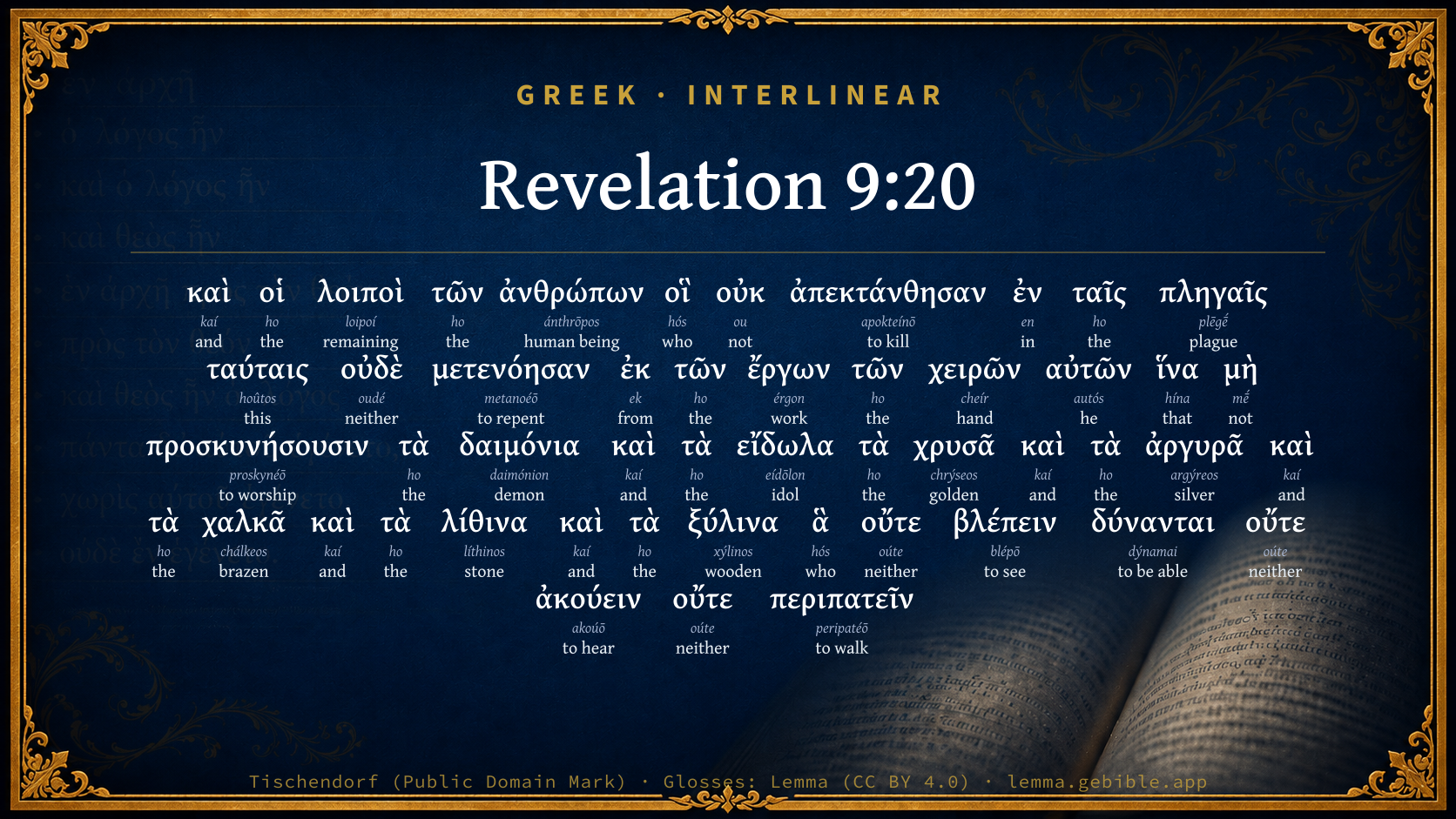
The rest of mankind, who were not killed with these plagues, didn't repent of the works of their hands, that they wouldn't worship demons, and the idols of gold, and of silver, and of brass, and of stone, and of wood; which can neither see, nor hear, nor walk.
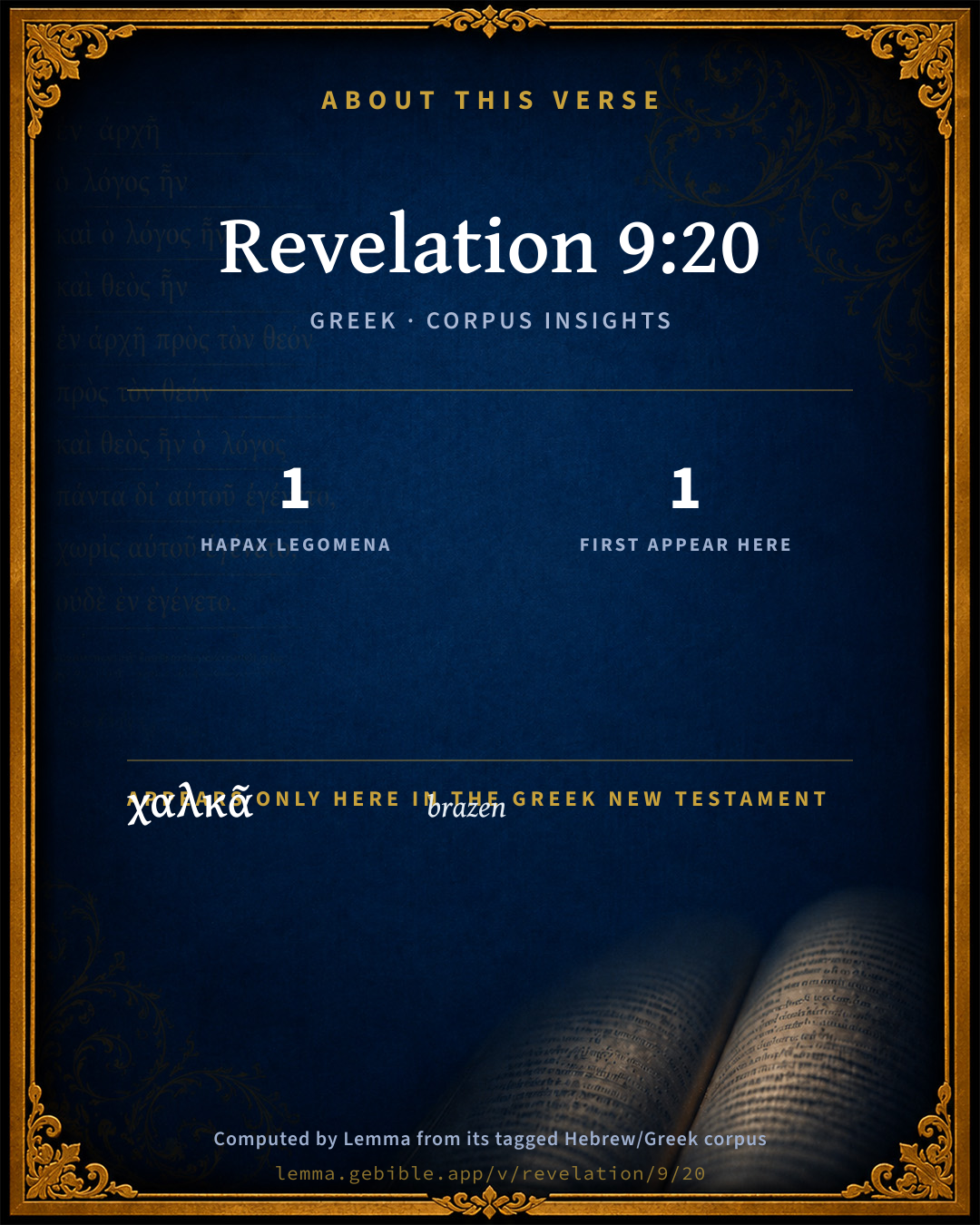
- 1 hapax legomenon — only here in the Greek New Testament
- 1 first appearance in the Greek New Testament
Download a study sheet
One document with this verse’s original text, its word-by-word gloss line, the meaning frame, cross-references with their text, attributed commentary, and full source and license credits — printable, and it pastes into notes with its structure intact.
This verse Autodidact and up
A passage Seminary Student
Up to 50 verses in one chapter. A passage sheet keeps up to 6 commentary sources and 12 cross-references per verse, in the order this page ranks them, and says so on the sheet whenever that leaves anything out. Ask for a single verse and you get the Autodidact verse sheet above.
Everything on this page stays free to read, with no account — the sheet is a download of what is already on screen, not access to it.
Compare translations 3
The same verse in 3 English versions, stacked beneath the original-language interlinear above. Click any original word for its lexicon entry.
Each is an independent rendering of the whole verse — the interlinear is not word-aligned to these translations.
Highlighted words mark where these versions differ — a whole-verse word diff, not a word-by-word alignment.
-
World English Bible Public Domain
The rest of mankind, who were not killed with these plagues, didn't repent of the works of their hands, that they wouldn't worship demons, and the idols of gold, and of silver, and of brass, and of stone, and of wood; which can neither see, nor hear, nor walk.
-
King James Version Public Domain
And the rest of the men which were not killed by these plagues yet repented not of the works of their hands, that they should not worship devils, and idols of gold, and silver, and brass, and stone, and of wood: which neither can see, nor hear, nor walk:
-
unfoldingWord Literal Text CC BY-SA 4.0
And the rest of men, the ones not killed in these plagues, did not repent of the works of their hands, so that they will not worship demons and idols of gold and silver and bronze and stone and wood, which are able neither to see nor to hear nor to walk.
unfoldingWord Literal Text — © unfoldingWord, licensed CC BY-SA 4.0. Word-aligned USFM3 via Door43 (git.door43.org/unfoldingWord/en_ult).
Show all 19 translations
Every available English version of this verse, each an independent rendering of the whole verse.
-
World English Bible Public Domain
The rest of mankind, who were not killed with these plagues, didn't repent of the works of their hands, that they wouldn't worship demons, and the idols of gold, and of silver, and of brass, and of stone, and of wood; which can neither see, nor hear, nor walk.
-
Berean Standard Bible Public Domain
Now the rest of mankind who were not killed by these plagues still did not repent of the works of their hands. They did not stop worshiping demons and idols of gold, silver, bronze, stone, and wood, which cannot see or hear or walk.
-
Majority Standard Bible Public Domain
Now the rest of mankind who were not killed by these plagues still did not repent of the works of their hands. They did not stop worshiping demons and idols of gold, silver, bronze, stone, and wood, which cannot see or hear or walk.
-
King James Version Public Domain
And the rest of the men which were not killed by these plagues yet repented not of the works of their hands, that they should not worship devils, and idols of gold, and silver, and brass, and stone, and of wood: which neither can see, nor hear, nor walk:
-
American Standard Version (1901) Public Domain
And the rest of mankind, who were not killed with these plagues, repented not of the works of their hands, that they should not worship demons, and the idols of gold, and of silver, and of brass, and of stone, and of wood; which can neither see, nor hear, nor walk:
-
Revised Version (1885) Public Domain
And the rest of mankind, which were not killed with these plagues, repented not of the works of their hands, that they should not worship devils, and the idols of gold, and of silver, and of brass, and of stone, and of wood; which can neither see, nor hear, nor walk:
-
Geneva Bible (1599) Public Domain
And the remnant of the men which were not killed by these plagues, repented not of the works of their handes that they should not worship deuils, and idoles of golde and of siluer, and of brasse, and of stone, and of wood, which neither can see, neither heare nor goe.
-
Douay-Rheims (1899) Public Domain
And the rest of the men, who were not slain by these plagues, did not do penance from the works of their hands, that they should not adore devils, and idols of gold, and silver, and brass, and stone, and wood, which neither can see, nor hear, nor walk:
-
Young's Literal Translation Public Domain
and the rest of men, who were not killed in these plagues, neither did reform from the works of their hands, that they may not bow before the demons, and idols, those of gold, and those of silver, and those of brass, and those of stone, and those of wood, that are neither able to see, nor to hear, nor to walk,
-
Literal Standard Version CC BY-SA 4.0
And the rest of mankind, who were not killed in these plagues, neither converted from the works of their hands, that they may not worship the demons, and idols, those of gold, and those of silver, and those of brass, and those of stone, and those of wood, that are neither able to see, nor to hear, nor to walk,
-
Unlocked Literal Bible CC BY-SA 4.0
The rest of mankind, those who were not killed by these plagues, did not repent of the deeds they had done, nor did they stop worshiping demons and idols of gold, silver, bronze, stone, and wood—things that cannot see, hear, or walk.
-
unfoldingWord Literal Text CC BY-SA 4.0
And the rest of men, the ones not killed in these plagues, did not repent of the works of their hands, so that they will not worship demons and idols of gold and silver and bronze and stone and wood, which are able neither to see nor to hear nor to walk.
-
Darby Bible Public Domain
And the rest of men who were not killed with these plagues repented not of the works of their hands, that they should not worship demons, and the golden and silver and brazen and stone and wooden idols, which can neither see nor hear nor walk.
-
World Messianic Bible Public Domain
The rest of mankind, who were not killed with these plagues, didn’t repent of the works of their hands, that they wouldn’t worship demons, and the idols of gold, and of silver, and of brass, and of stone, and of wood, which can’t see, hear, or walk.
-
Webster's Bible Public Domain
And the rest of the men who were not killed by these plagues yet repented not of the works of their hands, that they should not worship demons, and idols of gold, and silver, and brass, and stone, and of wood: which neither can see, nor hear, nor walk:
-
Free Bible Version CC BY-SA 4.0
But the rest of humanity who were not killed by these plagues did not repent of what they were doing. They did not stop worshiping demons and idols of gold, silver, bronze, and stone—which can't see or hear or walk!
-
Bible in Basic English Public Domain
And the rest of the people, who were not put to death by these evils, were not turned from the works of their hands, but went on giving worship to evil spirits, and images of gold and silver and brass and stone and wood which have no power of seeing or hearing or walking:
-
Text-Critical English NT CC BY 4.0
The rest of mankind, who were not killed by these plagues, did not repent from the works of their hands; they did not stop worshiping demons and idols of gold, silver, bronze, stone, and wood, which cannot see, hear, or walk.
-
Tyndale New Testament (1534) Public Domain
And the remnaunt of the men which were not kylled by these plages repented not of the dedes of their hondes that they shulde not worshyppe devyls and ymages of golde and sylver and brasse and stone and of wood which nether can se nether heare nether goo.
Literal Standard Version (2020), Covenant Press — licensed CC BY-SA 4.0. Text via the HelloAO Bible API (eBible.org). Unlocked Literal Bible (unfoldingWord) — licensed CC BY-SA 4.0. Text via the HelloAO Bible API (eBible.org). unfoldingWord Literal Text — © unfoldingWord, licensed CC BY-SA 4.0. Word-aligned USFM3 via Door43 (git.door43.org/unfoldingWord/en_ult). Free Bible Version, Dr. Jonathan Gallagher — licensed CC BY-SA 4.0. Text via the HelloAO Bible API (eBible.org).
Word by word
More ways to search: Search by grammar → Find every occurrence → Compare this word →
Practice this passage: Drill this verse → Learn its vocabulary →
- Appears 1× in the Greek New Testament
- First appears here
- Part of Speech
- Adjective
- Case
- Accusative
- Number
- Plural
- Gender
- Neuter
Full Thayer's Definition
- καὶ kaí G2532 “and” Conjunction
- οἱ ho G3588 “the” Article, Nominative, Plural, Masculine
- λοιποὶ loipoí G3062 “remaining” Adjective, Nominative, Plural, Masculine
- τῶν ho G3588 “the” Article, Genitive, Plural, Masculine
- ἀνθρώπων ánthrōpos G444 “human being” Noun, Genitive, Plural, Masculine
- οἳ hós G3739 “who” Relative pronoun, Nominative, Plural, Masculine
- οὐκ ou G3756 “not” Particle, Negative
- ἀπεκτάνθησαν apokteínō G615 “to kill” Verb, Aorist, Passive, Indicative, 3rd person, Plural
- ἐν en G1722 “in” Preposition
- ταῖς ho G3588 “the” Article, Dative, Plural, Feminine
- πληγαῖς plēgḗ G4127 “plague” Noun, Dative, Plural, Feminine
- ταύταις hoûtos G3778 “this” Demonstrative pronoun, Dative, Plural, Feminine
- οὐδὲ oudé G3761 “neither” Conjunction, Negative
- μετενόησαν metanoéō G3340 “to repent” Verb, Aorist, Active, Indicative, 3rd person, Plural
- ἐκ ek G1537 “from” Preposition
- τῶν ho G3588 “the” Article, Genitive, Plural, Neuter
- ἔργων érgon G2041 “work” Noun, Genitive, Plural, Neuter
- τῶν ho G3588 “the” Article, Genitive, Plural, Feminine
- χειρῶν cheír G5495 “hand” Noun, Genitive, Plural, Feminine
- αὐτῶν autós G846 “he” Personal pronoun, Genitive, Plural, Masculine
- ἵνα hína G2443 “that” Conjunction
- μὴ mḗ G3361 “not” Particle, Negative
- προσκυνήσουσιν proskynéō G4352 “to worship” Verb, Future, Active, Indicative, 3rd person, Plural
- τὰ ho G3588 “the” Article, Accusative, Plural, Neuter
- δαιμόνια daimónion G1140 “demon” Noun, Accusative, Plural, Neuter
- καὶ kaí G2532 “and” Conjunction
- τὰ ho G3588 “the” Article, Accusative, Plural, Neuter
- εἴδωλα eídōlon G1497 “idol” Noun, Accusative, Plural, Neuter
- τὰ ho G3588 “the” Article, Accusative, Plural, Neuter
- χρυσᾶ chrýseos G5552 “golden” Adjective, Accusative, Plural, Neuter
- καὶ kaí G2532 “and” Conjunction
- τὰ ho G3588 “the” Article, Accusative, Plural, Neuter
- ἀργυρᾶ argýreos G693 “silver” Adjective, Accusative, Plural, Neuter
- καὶ kaí G2532 “and” Conjunction
- τὰ ho G3588 “the” Article, Accusative, Plural, Neuter
- χαλκᾶ chálkeos G5470 “brazen” Adjective, Accusative, Plural, Neuter
- καὶ kaí G2532 “and” Conjunction
- τὰ ho G3588 “the” Article, Accusative, Plural, Neuter
- λίθινα líthinos G3035 “stone” Adjective, Accusative, Plural, Neuter
- καὶ kaí G2532 “and” Conjunction
- τὰ ho G3588 “the” Article, Accusative, Plural, Neuter
- ξύλινα xýlinos G3585 “wooden” Adjective, Accusative, Plural, Neuter
- ἃ hós G3739 “who” Relative pronoun, Accusative, Plural, Neuter
- οὔτε oúte G3777 “neither” Conjunction, Negative
- βλέπειν blépō G991 “to see” Verb, Present, Active, Infinitive
- δύνανται dýnamai G1410 “to be able” Verb, Present, Middle or Passive deponent, Indicative, 3rd person, Plural
- οὔτε oúte G3777 “neither” Conjunction, Negative
- ἀκούειν akoúō G191 “to hear” Verb, Present, Active, Infinitive
- οὔτε oúte G3777 “neither” Conjunction, Negative
- περιπατεῖν peripatéō G4043 “to walk” Verb, Present, Active, Infinitive
About this verse
These counts appear in no published source. They are computed here, from the morphology-tagged text and Lemma’s own curated glosses. What Lemma adds →
- 50
- words
- 31
- distinct lemmas
- Revelation
- section
Notable vocabulary
1 hapax legomenon — a word that appears only here in the entire Greek New Testament:
- χαλκᾶ brazen G5470
First appearance in Scripture
This word makes its first canonical appearance in the Greek New Testament here:
- χαλκᾶ brazen G5470
Shared distinctive vocabulary
ξύλινα wooden G3585 occurs in 2 verses of the Greek New Testament. Also found in:
Cross-references
38Topical passages linked to Revelation 9:20 in the Treasury of Scripture Knowledge — connected by theme and wording, ordered by reader-vote popularity; previews shown in the World English Bible.
- Daniel 5:23 but have lifted up yourself against the Lord of heaven; and they have brought the vessels of his house before you, and you and your lords, your wives and your concubines, have drunk wine from them; and you have praised the gods of silver and gold, of brass, iron, wood, and stone, which don't see, nor hear, nor know; and the God in whose hand your breath is, and whose are all your ways, you have not glorified.
- Deuteronomy 31:29 For I know that after my death you will utterly corrupt yourselves, and turn aside from the way which I have commanded you; and evil will happen to you in the latter days; because you will do that which is evil in the sight of Yahweh, to provoke him to anger through the work of your hands.
- Romans 1:21–23 Because, knowing God, they didn't glorify him as God, neither gave thanks, but became vain in their reasoning, and their senseless heart was darkened.
- 1 Timothy 4:1 But the Spirit says expressly that in later times some will fall away from the faith, paying attention to seducing spirits and doctrines of demons,
- Jeremiah 1:16 I will utter my judgments against them touching all their wickedness, in that they have forsaken me, and have burned incense to other gods, and worshiped the works of their own hands.
- Acts 19:26 You see and hear, that not at Ephesus alone, but almost throughout all Asia, this Paul has persuaded and turned away many people, saying that they are no gods, that are made with hands.
- Revelation 9:21 They didn't repent of their murders, nor of their sorceries, nor of their sexual immorality, nor of their thefts.
- Jeremiah 10:14–15 Every man is become brutish [and is] without knowledge; every goldsmith is disappointed by his engraved image; for his molten image is falsehood, and there is no breath in them.
- Acts 7:41 They made a calf in those days, and brought a sacrifice to the idol, and rejoiced in the works of their hands.
- 1 Corinthians 10:20–21 But I say that the things which the Gentiles sacrifice, they sacrifice to demons, and not to God, and I don't desire that you would have communion with demons.
- 2 Corinthians 12:21 that again when I come my God would humble me before you, and I would mourn for many of those who have sinned before now, and not repented of the uncleanness and sexual immorality and lustfulness which they committed.
- Jeremiah 51:17 Every man is become brutish [and is] without knowledge; every goldsmith is disappointed by his image; for his molten image is falsehood, and there is no breath in them.
- Habakkuk 2:18–20 "What value does the engraved image have, that its maker has engraved it; the molten image, even the teacher of lies, that he who fashions its form trusts in it, to make mute idols?
- Matthew 21:32 For John came to you in the way of righteousness, and you didn't believe him, but the tax collectors and the prostitutes believed him. When you saw it, you didn't even repent afterward, that you might believe him.
- Deuteronomy 32:17 They sacrificed to demons, [which were] no God, To gods that they didn't know, To new [gods] that came up of late, Which your fathers didn't dread.
- 2 Kings 22:17 Because they have forsaken me, and have burned incense to other gods, that they might provoke me to anger with all the work of their hands, therefore my wrath shall be kindled against this place, and it shall not be quenched.
- 2 Chronicles 34:25 Because they have forsaken me, and have burned incense to other gods, that they might provoke me to anger with all the works of their hands; therefore is my wrath poured out on this place, and it shall not be quenched.
- Psalms 106:37 Yes, they sacrificed their sons and their daughters to demons.
- Psalms 135:15–18 The idols of the nations are silver and gold, The work of men's hands.
- Isaiah 40:19–20 The image, a workman has cast [it], and the goldsmith overlays it with gold, and casts [for it] silver chains.
- Isaiah 42:17–18 They shall be turned back, they shall be utterly disappointed, who trust in engraved images, who tell molten images, You are our gods.
- Isaiah 44:9–20 Those who fashion an engraved image are all of them vanity; and the things that they delight in shall not profit; and their own witnesses don't see, nor know: that they may be disappointed.
- Isaiah 46:5–7 To whom will you liken me, and make me equal, and compare me, that we may be like?
- Jeremiah 5:3 O Yahweh, don't your eyes look on truth? you have stricken them, but they were not grieved; you have consumed them, but they have refused to receive correction: they have made their faces harder than a rock; they have refused to return.
- Jeremiah 8:4–6 Moreover you shall tell them, Thus says Yahweh: Shall men fall, and not rise up again? Shall one turn away, and not return?
- Jeremiah 10:3–5 For the customs of the peoples are vanity; for one cuts a tree out of the forest, the work of the hands of the workman with the axe.
- Jeremiah 10:8–9 But they are together brutish and foolish: the instruction of idols! it is but a stock.
- Jeremiah 15:19–20 Therefore thus says Yahweh, If you return, then will I bring you again, that you may stand before me; and if you take forth the precious from the vile, you shall be as my mouth: they shall return to you, but you shall not return to them.
- Jeremiah 25:6 and don't go after other gods to serve them or worship them, and don't provoke me to anger with the work of your hands; and I will do you no harm.
- Jeremiah 44:8 in that you provoke me to anger with the works of your hands, burning incense to other gods in the land of Egypt, where you are gone to sojourn; that you may be cut off, and that you may be a curse and a reproach among all the nations of the earth?
- Acts 17:29 Being then the offspring of God, we ought not to think that the Divine Nature is like gold, or silver, or stone, engraved by art and design of man.
- Leviticus 17:7 They shall no more sacrifice their sacrifices to the goat idols, after which they play the prostitute. This shall be a statute forever to them throughout their generations.'
- 2 Chronicles 28:22 In the time of his distress did he trespass yet more against Yahweh, this same king Ahaz.
- Psalms 115:4–8 Their idols are silver and gold, The work of men's hands.
- Isaiah 2:8 Their land also is full of idols. They worship the work of their own hands, That which their own fingers have made.
- Isaiah 41:7 So the carpenter encourages the goldsmith, [and] he who smoothes with the hammer him who strikes the anvil, saying of the soldering, It is good; and he fastens it with nails, that is should not be moved.
- Revelation 2:21–22 I gave her time to repent, but she refuses to repent of her sexual immorality.
- Revelation 16:8 The fourth poured out his bowl on the sun, and it was given to him to scorch men with fire.
Cross-references courtesy of OpenBible.info (CC BY 4.0).
Lesson kit
Teaching starters — assembled from the data on this page, not authored interpretation. Every prompt links to the verse data it draws on. Edit before teaching.
Revelation, in the Revelation, opens this verse with 50 words (31 distinct Greek lemmas). Its most distinctive word is chálkeos (“brazen”). A historical commentator’s framing appears above. Read the whole chapter for the surrounding context.
Discussion questions
- What does “brazen” (chálkeos) contribute to the verse as a whole?
- This verse holds 1 word here found nowhere else in the Greek New Testament. What might the rare word draw attention to?
- The word “brazen” first appears here in Scripture. What is being introduced at this debut?
- 2 Timothy 2:20 shares the word «wooden» with this verse. How do the two illuminate each other?
- “neither” occurs 3× in this one verse. What is the effect of the repetition?
- The translations on this page render this verse differently — a whole-verse word diff, not a word-by-word alignment. What might account for the different wordings?
- Reading how Albert Barnes' Notes on the Bible and Joseph Benson's Commentary read this verse, where do the two commentators agree and where do they part?
Things to notice
- 1 word in this verse appears nowhere else in the Greek New Testament.
- 1 word makes its first canonical appearance in Scripture here.
- These translations choose different wording for 17 words in this verse.
- “neither” occurs 3× in this single verse.
- 31 distinct Greek lemmas span 50 words in this verse.
Commentary
Notes on Revelation 9:20 from classic Christian and Jewish commentators (each source and its license shown beneath its notes). The classic Christian expositions comment on the surrounding passage and are grouped to its opening verse, so a note may address several verses; the Jewish commentaries on the Tanakh (Rashi and others) are per-verse, so they appear only where the commentator wrote on this verse.
Lemma curates 59 commentaries, every one of them public domain or Creative Commons licensed, each selected and text-cleaned for this edition rather than reprinted as found. About our sources →
Albert Barnes' Notes on the Bible
Albert Barnes' Notes on the Bible (1834–1885) — public domain. Text from a community e-Sword/MySword module.
Joseph Benson's Commentary
Joseph Benson's Commentary on the Old and New Testaments (1811–1818) — public domain. Text from a community e-Sword module.
Tyndale Open Study Notes
Tyndale Open Resources
Tyndale Open Study Notes — © Tyndale Open Resources, licensed CC BY-SA 4.0. Text via the HelloAO Bible API.
Bengel's Gnomon
Johann Albrecht Bengel
Bengel's Gnomon of the New Testament — English translation (T&T Clark, Edinburgh, 1860) — public domain. Text from a community e-Sword module.
Meyer's Critical & Exegetical Commentary
Heinrich August Wilhelm Meyer
Meyer — Critical and Exegetical Commentary on the New Testament — English translation by Peter Christie, edited by Frederick Crombie (T&T Clark, 1880) — public domain. Text from a community e-Sword module.
Expositor's Greek Testament
ed. W. Robertson Nicoll
The Expositor's Greek Testament, edited by W. Robertson Nicoll (1897–1910) — public domain. Text from a community e-Sword module.
Geneva Bible (1599)
Geneva Bible translators
Geneva Bible (1599) marginal notes — public domain. Text via Bolls.life.
Jamieson, Fausset & Brown
Robert Jamieson, A. R. Fausset & David Brown
Jamieson, Fausset & Brown — Commentary Critical and Explanatory on the Whole Bible (1871) — public domain (CC PDM 1.0). Text via the HelloAO Bible API.
Adam Clarke's Commentary
Adam Clarke's Commentary on the Bible (1810–1826) — public domain. Text from a community e-Sword/MySword module.
Ellicott's Commentary for English Readers
A Bible Commentary for English Readers, edited by Charles John Ellicott (1878–1897) — public domain. Text from a community e-Sword module.
The Cambridge Bible for Schools and Colleges
gen. ed. J. J. S. Perowne
The Cambridge Bible for Schools and Colleges (gen. ed. J. J. S. Perowne; Cambridge University Press, 1878–1918) — public domain. Text from a community e-Sword module.
John Gill's Exposition
John Gill's Exposition of the Whole Bible (1746–1763) — public domain (CC PDM 1.0). Text via the HelloAO Bible API.
Trapp's Complete Commentary
John Trapp
John Trapp, A Commentary or Exposition upon All the Books of the Old and New Testament (1647–1656) — public domain. Text from a community e-Sword module.
Haydock's Catholic Bible Commentary
George Leo Haydock (1774–1849), Haydock's Catholic Family Bible and Commentary, 1859 edition — public domain. Excludes Psalms (Douay-Rheims chapter numbering differs from Protestant) and Deuterocanonical books (Catholic canon only).
Matthew Poole's English Annotations
Matthew Poole's English Annotations on the Holy Bible (1683–1685) — public domain. Text from a community e-Sword/MySword module.
Whedon's Commentary on the Bible
Daniel D. Whedon
Daniel D. Whedon (gen. ed.), Commentary on the Old and New Testaments (1874–1909) — public domain. Text from a community e-Sword module.
The Pulpit Commentary
The Pulpit Commentary (1880–1919), ed. H.D.M. Spence-Jones & Joseph S. Exell — public domain. Text from a community e-Sword module.
John Wesley's Explanatory Notes
John Wesley, Explanatory Notes Upon the Whole Bible (1754–1765) — public domain. Text via the GEBible commentary corpus.
The People's New Testament
B. W. Johnson
B. W. Johnson's The People's New Testament with Notes (1889–1891) — public domain. Electronic text from the Christian Classics Ethereal Library (CCEL) ThML edition.
unfoldingWord translationNotes
Door43 World Missions Community
unfoldingWord translationNotes — © Distant Shores Media and the Door43 World Missions Community, licensed CC BY-SA 4.0. Source: git.door43.org/Door43/en_tn.
Cambridge Greek Testament for Schools and Colleges
Cambridge Greek Testament for Schools and Colleges (Cambridge University Press, 1896; 21 vols, various authors incl. Carr, Maclear, Plummer, Farrar, Lumby, Moule, M. R. James, Simcox) — public domain. Text from a community e-Sword module.
Vincent's Word Studies in the New Testament
Marvin R. Vincent
Marvin R. Vincent, Word Studies in the New Testament (1887–1900) — public domain. Text from a community e-Sword/MySword module.