
John 18:37

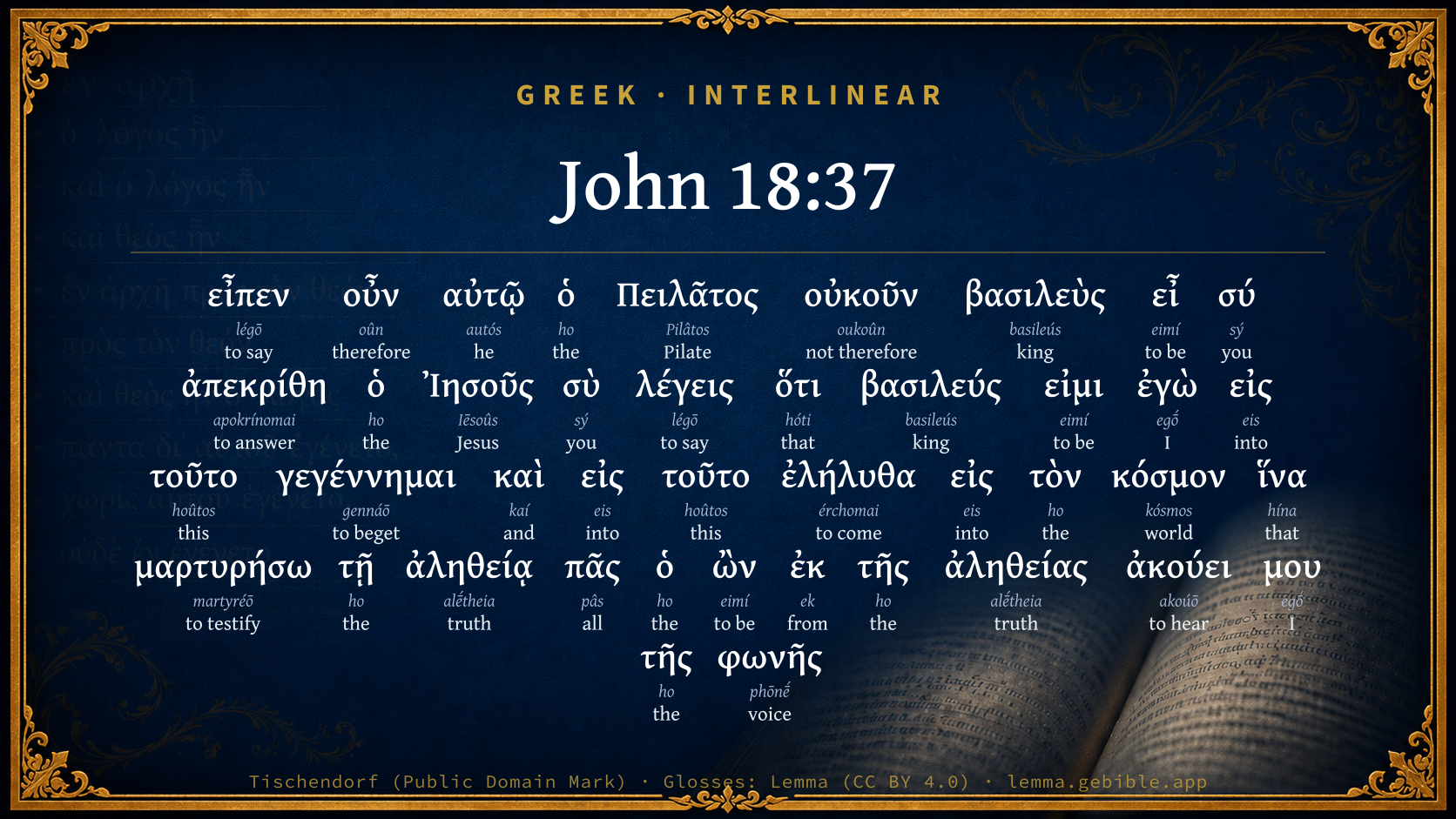
Greek (Tischendorf 8th ed.) John 18:37 appears in the Greek New Testament. The text above is from the Tischendorf 8th edition. Each word links to its Strong’s number and a concise gloss. Click any word for its full Thayer’s Greek Lexicon entry.
Download image
Cite this verse

John 18:37 (World English Bible). Public Domain. Lemma interlinear Bible study tool, https://lemma.gebible.app/v/john/18/37.

Show BibTeX & RIS
BibTeX
RIS
English Translation
Pilate therefore said to him, "Are you a king then?" Jesus answered, "You say that I am a king. For this reason I have been born, and for this reason I have come into the world, that I should testify to the truth. Everyone who is of the truth listens to my voice."
World English Bible · Public Domain
Highlights
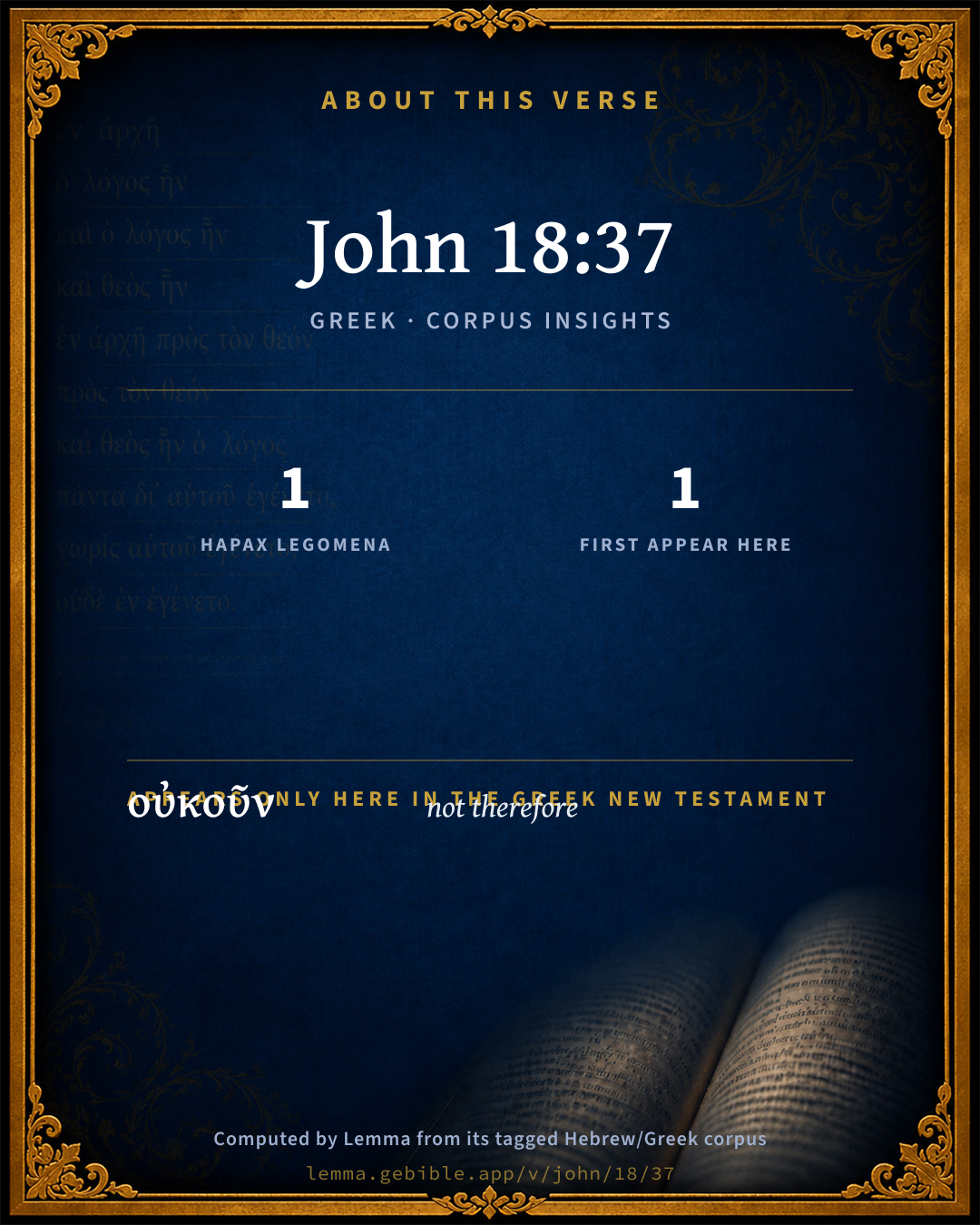
  • 1 hapax legomenon — only here in the Greek New Testament
  • 1 first appearance in the Greek New Testament
Full analysis ↓
Download a study sheet

One document with this verse’s original text, its word-by-word gloss line, the meaning frame, cross-references with their text, attributed commentary, and full source and license credits — printable, and it pastes into notes with its structure intact.

This verse Autodidact and up

Study sheet (.html) Plain text (.txt)

A passage Seminary Student

Up to 50 verses in one chapter. A passage sheet keeps up to 6 commentary sources and 12 cross-references per verse, in the order this page ranks them, and says so on the sheet whenever that leaves anything out. Ask for a single verse and you get the Autodidact verse sheet above.

Everything on this page stays free to read, with no account — the sheet is a download of what is already on screen, not access to it.

Want to remove ads? Support Godless Engineer
Compare translations 3

The same verse in 3 English versions, stacked beneath the original-language interlinear above. Click any original word for its lexicon entry.

Each is an independent rendering of the whole verse — the interlinear is not word-aligned to these translations.

Highlighted words mark where these versions differ — a whole-verse word diff, not a word-by-word alignment.

  • World English Bible Public Domain
    Pilate therefore said to him, "Are you a king then?" Jesus answered, "You say that I am a king. For this reason I have been born, and for this reason I have come into the world, that I should testify to the truth. Everyone who is of the truth listens to my voice."
  • King James Version Public Domain
    Pilate therefore said unto him, Art thou a king then? Jesus answered, Thou sayest that I am a king. To this end was I born, and for this cause came I into the world, that I should bear witness unto the truth. Every one that is of the truth heareth my voice.
  • unfoldingWord Literal Text CC BY-SA 4.0
    Pilate then said to him, “So then, are you a king?” Jesus answered, “You say that I am a king. For this I have been born, and for this I have come into the world, so that I would bear witness to the truth. Everyone being from the truth hears my voice.”

unfoldingWord Literal Text — © unfoldingWord, licensed CC BY-SA 4.0. Word-aligned USFM3 via Door43 (git.door43.org/unfoldingWord/en_ult).

Versions to compare (up to 4)

3 of 4 selected

Show all 19 translations

Every available English version of this verse, each an independent rendering of the whole verse.

  • World English Bible Public Domain
    Pilate therefore said to him, "Are you a king then?" Jesus answered, "You say that I am a king. For this reason I have been born, and for this reason I have come into the world, that I should testify to the truth. Everyone who is of the truth listens to my voice."
  • Berean Standard Bible Public Domain
    “Then You are a king!” Pilate said. “You say that I am a king,” Jesus answered. “For this reason I was born and have come into the world, to testify to the truth. Everyone who belongs to the truth listens to My voice.”
  • Majority Standard Bible Public Domain
    “Then You are a king!” Pilate said. “You say that I am a king,” Jesus answered. “For this reason I was born and have come into the world, to testify to the truth. Everyone who belongs to the truth listens to My voice.”
  • King James Version Public Domain
    Pilate therefore said unto him, Art thou a king then? Jesus answered, Thou sayest that I am a king. To this end was I born, and for this cause came I into the world, that I should bear witness unto the truth. Every one that is of the truth heareth my voice.
  • American Standard Version (1901) Public Domain
    Pilate therefore said unto him, Art thou a king then? Jesus answered, Thou sayest that I am a king. To this end have I been born, and to this end am I come into the world, that I should bear witness unto the truth. Every one that is of the truth heareth my voice.
  • Revised Version (1885) Public Domain
    Pilate therefore said unto him, Art thou a king then? Jesus answered, Thou sayest that I am a king. To this end have I been born, and to this end am I come into the world, that I should bear witness unto the truth. Every one that is of the truth heareth my voice.
  • Geneva Bible (1599) Public Domain
    Pilate then said vnto him, Art thou a King then? Iesus answered, Thou sayest that I am a King: for this cause am I borne, and for this cause came I into the world, that I should beare witnes vnto the trueth: euery one that is of the trueth, heareth my voyce.
  • Douay-Rheims (1899) Public Domain
    Pilate therefore said to him: Art thou a King then Jesus answered: Thou sayest that I am a king. For this was I born, and for this came I into the world; that I should give testimony to the truth. Every one that is of the truth, heareth my voice.
  • Young's Literal Translation Public Domain
    Pilate, therefore, said to him, `Art thou then a king?' Jesus answered, `Thou dost say `it'; because a king I am, I for this have been born, and for this I have come to the world, that I may testify to the truth; every one who is of the truth, doth hear my voice.'
  • Literal Standard Version CC BY-SA 4.0
    Pilate, therefore, said to Him, “Are You then a king?” Jesus answered, “You say [it], because I am a king; I have been born for this, and I have come into the world for this, that I may testify to the truth; everyone who is of the truth, hears My voice.”
  • Unlocked Literal Bible CC BY-SA 4.0
    Pilate then said to him, “Are you a king then?” Jesus answered, “You say that I am a king. For this purpose I have been born, and for this purpose I have come into the world, so that I would bear witness to the truth. Everyone who belongs to the truth listens to my voice.”
  • unfoldingWord Literal Text CC BY-SA 4.0
    Pilate then said to him, “So then, are you a king?” Jesus answered, “You say that I am a king. For this I have been born, and for this I have come into the world, so that I would bear witness to the truth. Everyone being from the truth hears my voice.”
  • Darby Bible Public Domain
    Pilate therefore said to him, Thou art then a king? Jesus answered, Thou sayest [it], that I am a king. I have been born for this, and for this I have come into the world, that I might bear witness to the truth. Every one that is of the truth hears my voice.
  • World Messianic Bible Public Domain
    Pilate therefore said to him, “Are you a king then?” Yeshua answered, “You say that I am a king. For this reason I have been born, and for this reason I have come into the world, that I should testify to the truth. Everyone who is of the truth listens to my voice.”
  • Webster's Bible Public Domain
    Pilate therefore said to him, Art thou a King then? Jesus answered, Thou sayest that I am a King. To this end was I born, and for this cause came I into the world, that I should testify to the truth. Every one that is of the truth heareth my voice.
  • Free Bible Version CC BY-SA 4.0
    Then Pilate asked, “So you are a king, then?” “You say that I'm a king,” Jesus replied. “The reason why I was born and I came to the world was to give evidence for the truth. All those who accept the truth pay attention to what I say.”
  • Bible in Basic English Public Domain
    Then Pilate said to him, Are you then a king? Jesus made answer, You say that I am a king. For this purpose was I given birth, and for this purpose I came into the world, that I might give witness to what is true. Every lover of what is true gives ear to my voice.
  • Text-Critical English NT CC BY 4.0
    Pilate said to him, “So yoʋ are a king?” Jesus answered, “Yoʋ have said yoʋrself that I am a king. The reason I was born and the reason I came into the world is to testify to the truth. Everyone who is of the truth listens to my voice.”
  • Tyndale New Testament (1534) Public Domain
    Pylate sayde vnto him: Arte thou a kynge then? Iesus answered: Thou sayst that I am a kynge. For this cause was I borne and for this cause came I into the worlde that I shuld beare witnes vnto the trueth. And all that are of the trueth heare my voyce.

Literal Standard Version (2020), Covenant Press — licensed CC BY-SA 4.0. Text via the HelloAO Bible API (eBible.org). Unlocked Literal Bible (unfoldingWord) — licensed CC BY-SA 4.0. Text via the HelloAO Bible API (eBible.org). unfoldingWord Literal Text — © unfoldingWord, licensed CC BY-SA 4.0. Word-aligned USFM3 via Door43 (git.door43.org/unfoldingWord/en_ult). Free Bible Version, Dr. Jonathan Gallagher — licensed CC BY-SA 4.0. Text via the HelloAO Bible API (eBible.org).

Word by word

More ways to search: Search by grammar → Find every occurrence → Compare this word →

Practice this passage: Drill this verse → Learn its vocabulary →

οὐκοῦν
oukoûn
G3766
“not therefore”
Adverb, Negative
Part of Speech
Adverb
Degree
Negative
Full Thayer's Definition

Origin: from G3756 and G3767

TDNT: None

1. not therefore
  1. εἶπεν légō G3004 “to say” Verb, Aorist, Active, Indicative, 3rd person, Singular
  2. οὖν oûn G3767 “therefore” Conjunction
  3. αὐτῷ autós G846 “he” Personal pronoun, Dative, Singular, Masculine
  4. ὁ ho G3588 “the” Article, Nominative, Singular, Masculine
  5. Πειλᾶτος Pilâtos G4091 “Pilate” Noun, Nominative, Singular, Masculine
  6. βασιλεὺς basileús G935 “king” Noun, Nominative, Singular, Masculine
  7. εἶ eimí G1510 “to be” Verb, Present, Active, Indicative, 2nd person, Singular
  8. σύ sý G4771 “you” Personal pronoun, 2nd person, Nominative, Singular
  9. ἀπεκρίθη apokrínomai G611 “to answer” Verb, Aorist, Middle deponent, Indicative, 3rd person, Singular
  10. ὁ ho G3588 “the” Article, Nominative, Singular, Masculine
  11. Ἰησοῦς Iēsoûs G2424 “Jesus” Noun, Nominative, Singular, Masculine
  12. σὺ sý G4771 “you” Personal pronoun, 2nd person, Nominative, Singular
  13. λέγεις légō G3004 “to say” Verb, Present, Active, Indicative, 2nd person, Singular
  14. ὅτι hóti G3754 “that” Conjunction
  15. βασιλεύς basileús G935 “king” Noun, Nominative, Singular, Masculine
  16. εἰμι eimí G1510 “to be” Verb, Present, Active, Indicative, 1st person, Singular
  17. ἐγὼ egṓ G1473 “I” Personal pronoun, 1st person, Nominative, Singular
  18. εἰς eis G1519 “into” Preposition
  19. τοῦτο hoûtos G3778 “this” Demonstrative pronoun, Accusative, Singular, Neuter
  20. γεγέννημαι gennáō G1080 “to beget” Verb, Perfect, Passive, Indicative, 1st person, Singular
  21. καὶ kaí G2532 “and” Conjunction
  22. εἰς eis G1519 “into” Preposition
  23. τοῦτο hoûtos G3778 “this” Demonstrative pronoun, Accusative, Singular, Neuter
  24. ἐλήλυθα érchomai G2064 “to come” Verb, Perfect, Active, Indicative, 1st person, Singular
  25. εἰς eis G1519 “into” Preposition
  26. τὸν ho G3588 “the” Article, Accusative, Singular, Masculine
  27. κόσμον kósmos G2889 “world” Noun, Accusative, Singular, Masculine
  28. ἵνα hína G2443 “that” Conjunction
  29. μαρτυρήσω martyréō G3140 “to testify” Verb, Aorist, Active, Subjunctive, 1st person, Singular
  30. τῇ ho G3588 “the” Article, Dative, Singular, Feminine
  31. ἀληθείᾳ alḗtheia G225 “truth” Noun, Dative, Singular, Feminine
  32. πᾶς pâs G3956 “all” Adjective, Nominative, Singular, Masculine
  33. ὁ ho G3588 “the” Article, Nominative, Singular, Masculine
  34. ὢν eimí G1510 “to be” Verb, Present, Active, Participle, Nominative, Singular, Masculine
  35. ἐκ ek G1537 “from” Preposition
  36. τῆς ho G3588 “the” Article, Genitive, Singular, Feminine
  37. ἀληθείας alḗtheia G225 “truth” Noun, Genitive, Singular, Feminine
  38. ἀκούει akoúō G191 “to hear” Verb, Present, Active, Indicative, 3rd person, Singular
  39. μου egṓ G1473 “I” Personal pronoun, 1st person, Genitive, Singular
  40. τῆς ho G3588 “the” Article, Genitive, Singular, Feminine
  41. φωνῆς phōnḗ G5456 “voice” Noun, Genitive, Singular, Feminine

About this verse

These counts appear in no published source. They are computed here, from the morphology-tagged text and Lemma’s own curated glosses. What Lemma adds →

42
words
26
distinct lemmas
Gospels
section

Notable vocabulary

1 hapax legomenon — a word that appears only here in the entire Greek New Testament:

  • οὐκοῦν not therefore G3766

First appearance in Scripture

This word makes its first canonical appearance in the Greek New Testament here:

  • οὐκοῦν not therefore G3766

Shared distinctive vocabulary

Πειλᾶτος Pilate G4091 occurs in 53 verses of the Greek New Testament. Also found in:
Repetition

Words recur within this verse:

  • εἶ to be G1510 ×3
  • εἰς into G1519 ×3
  • εἶπεν to say G3004 ×2
  • βασιλεὺς king G935 ×2
  • ἀληθείᾳ truth G225 ×2
  • ὁ the G3588 ×7
  • σύ you G4771 ×2
  • ἐγὼ I G1473 ×2
  • τοῦτο this G3778 ×2

Cross-references

21

Topical passages linked to John 18:37 in the Treasury of Scripture Knowledge — connected by theme and wording, ordered by reader-vote popularity; previews shown in the World English Bible.

  • John 8:47 He who is of God hears the words of God. For this cause you don't hear, because you are not of God."
  • 1 John 4:6 We are of God. He who knows God listens to us. He who is not of God doesn't listen to us. By this we know the spirit of truth, and the spirit of error.
  • John 8:14 Jesus answered them, "Even if I testify about myself, my testimony is true, for I know where I came from, and where I am going; but you don't know where I came from, or where I am going.
  • John 10:26–27 But you don't believe, because you are not of my sheep, as I told you.
  • 1 John 3:19 And by this we know that we are of the truth, and persuade our hearts before him,
  • John 14:6 Jesus said to him, "I am the way, the truth, and the life. No one comes to the Father, except through me.
  • Isaiah 55:4 Behold, I have given him for a witness to the peoples, a leader and commander to the peoples.
  • John 7:17 If anyone desires to do his will, he will know about the teaching, whether it is from God, or if I am speaking from myself.
  • Mark 15:2 Pilate asked him, "Are you the King of the Jews?" He answered, "So you say."
  • Luke 23:3 Pilate asked him, "Are you the King of the Jews?" He answered him, "So you say."
  • 1 Timothy 6:13 I charge you before God, who gives life to all things, and before Christ Jesus, who before Pontius Pilate testified the good confession,
  • Matthew 26:64 Jesus said to him, "You have said it. Nevertheless, I tell you, henceforth you will see the Son of Man sitting at the right hand of Power, and coming on the clouds of the sky."
  • John 3:32 What he has seen and heard, of that he testifies; and no one receives his witness.
  • 1 Peter 1:22 Seeing you have purified your souls in your obedience to the truth through the Spirit in sincere brotherly affection, love one another from the heart fervently:
  • 1 John 5:20 We know that the Son of God has come, and has given us an understanding, that we know him who is true, and we are in him who is true, in his Son Jesus Christ. This is the true God, and eternal life.
  • Matthew 27:11 Now Jesus stood before the governor: and the governor asked him, saying, "Are you the King of the Jews?" Jesus said to him, "So you say."
  • 1 John 3:14 We know that we have passed out of death into life, because we love the brothers. He who doesn't love his brother remains in death.
  • Revelation 1:4 John, to the seven assemblies that are in Asia: Grace to you and peace, from God, who is and who was and who is to come; and from the seven Spirits who are before his throne;
  • Revelation 3:14 "To the angel of the assembly in Laodicea write: "The Amen, the Faithful and True Witness, the Head of God's creation, says these things:
  • Mark 14:62 Jesus said, "I AM. You will see the Son of Man sitting at the right hand of Power, and coming with the clouds of the sky."
  • Luke 22:70 They all said, "Are you then the Son of God?" He said to them, "You say it, because I AM."

Cross-references courtesy of OpenBible.info (CC BY 4.0).

Commentary

Notes on John 18:37 from classic Christian and Jewish commentators (each source and its license shown beneath its notes). The classic Christian expositions comment on the surrounding passage and are grouped to its opening verse, so a note may address several verses; the Jewish commentaries on the Tanakh (Rashi and others) are per-verse, so they appear only where the commentator wrote on this verse.

Lemma curates 59 commentaries, every one of them public domain or Creative Commons licensed, each selected and text-cleaned for this edition rather than reprinted as found. About our sources →

Bengel's Gnomon

Johann Albrecht Bengel

Joh 18:37. Ἐγώ. ἐγὼ, I. I) A powerful Anadiplosis [The repetition of the same word in the end of the preceding and beginning of the following member of a sentence. Append.]—εἰς τοῦτο, for this) So twice. The first εἰς τοῦτο may be referred to the preceding clause, concerning His being “a King,” in order to intimate that He was born a King: Mat 2:2, “Where is He that is born King of the Jews?” The second may be referred to what follows as to “bearing witness unto the truth.” Comp. οὗτοι, καὶ οὗτοι in Deu 27:12-13, “These shall stand upon Mount Gerizim to bless—and these upon—Ebal to curse.”—γεγέννημαι, I was born) Herein His human nativity is signified. Pilate was not capable of comprehending His divine Sonship. Yet it is declared here, notwithstanding, that not the whole origin of Jesus is contained in His human nativity, when there is subjoined, I came into the world.—τῇ ἀληθείᾳ, unto the truth) The truth, which previously had been told to the people (Jewish), in His passion is preached to princes also, and to the Gentiles. This then is the crowning point of His preaching. All heard and saw the Christ: the truth was offered even to Pilate. The kingdom of the truth is opposed to the kingdom of this world.—πᾶς, every one) Jesus appeals from the blindness of Pilate to the capability of comprehension existing on the part of believers.—ὁ ὢν ἐκ τῆς ἀληθείας, he who is of the truth) To be of the truth precedes: to hear follows.—ἀκούει, heareth) with pleasure and intelligence. And these are the citizens of the kingdom of Christ.—τῆς φωνῆς, My voice) which is true, in its assertion of My kingdom.

Bengel's Gnomon of the New Testament — English translation (T&T Clark, Edinburgh, 1860) — public domain. Text from a community e-Sword module.

Meyer's Critical & Exegetical Commentary

Heinrich August Wilhelm Meyer

Joh_18:37. A βασιλεία Jesus had actually ascribed to Himself in Joh_18:36, which Pilate certainly did not expect; hence he asks, in surprise and not without a flash of haughty scorn: Nonne igitur rex tu es? since thou, that is, speakest of thy βασιλεία. On οὐκοῦν, not elsewhere found in the N. T., see Kühner, ad Xen. Mem. Exc. III. p. 517 ff.; Baeumlein, Partik. p. 198. The sentence is an inference, but asking (is it not then true, that thou art a king?) whether the questioned person agrees.

ὅτι] Confirmation of the assertion expressed by σὺ λέγεις (comp. Mat_26:25).

ἐγώ] Corresponding to the contemptuously emphasized σύ at the end of Pilates question, emphasized with noble self-consciousness, and still more emphatically brought into prominence by the ἐγώ, which immediately begins the next sentence (potens anadiplosis, Bengel); the repetition of εἰς τοῦτο twice also adds weight.

γεγένν. and ἐλήλ. εἰς τ. κόσμ.] must, according to Grotius, Lücke, and De Wette, designate the birth and the official appearance; a separation which is not justified by the Johannean ἔρχεσθαι εἰς τ. κόσμ., in which the birth is substantially included (Joh_3:17, Joh_9:39, Joh_11:27, Joh_12:47, Joh_16:28, Joh_1:9). The ἐλήλ. εἰς τ. κόσμ. sets forth the birth once again, but in relation to its specific higher nature, as the entrance of the sent of God into the world, so that the divine ἀποστέλλειν εἰς τὸν κόσμον (Joh_3:17, Joh_10:36, Joh_17:18) is correlative.[232] The coming into the world is related to the conception of being born, as the leaving of the world (Joh_16:28) and going to the Father to the conception of dying.

ἵνα μαρτυρ. τῇ ἀληθ.] He was to bear testimony on behalf of the divine truth; for He had seen and heard it with God. Comp. Joh_3:11; Joh_3:32, Joh_1:17-18.

ὁ ὤν ἐκ τ. ἀληθ.] Genetic designation (comp. on Gal_3:7) of the adherents of His kingdom; their origin is the divine truth, i.e. their entire spiritual nature is so constituted, that divine truth exercises its formative influence upon them. These are the souls drawn by the Father (Joh_6:44 ff.), and given to Christ as His own. Comp. Joh_8:47. Bengel correctly observes: Esse ex veritate praecedit, audire sequitur.

ἀκούει μου τ. φωνῆς] hears from me the voice, i.e. (otherwise, Joh_12:47), he gives ear to that which I speak, follows my call, command, etc. With this Jesus has declared Himself regarding His kingdom, to the effect partly that He is a king, and with what definition He is so, partly as to what subjects He has; and thus He has completely answered the question; in no sense, however, as Hengstenberg thinks, has He omitted to answer it as too difficult for Pilates comprehension, and expressed Himself instead concerning His prophetic office. The πᾶς ὁ ὢν, κ.τ.λ. belongs essentially to the characteristic of His kingdom; a special design, however, entertained in this point, with reference to Pilate (an appeal to his religious consciousness, Chrysostom, Olshausen, Neander; justification as to why Jesus has not more adherents, Calvin; a reminder for Pilate, how he would have to lay hold upon salvation), lies entirely remote from the sense, equally remote with an appeal a caecitate Pilati ad captum fidelium, Bengel, or from the judge to the man (Hengstenberg).

[232] Calovius aptly says: Christ was so born, ut quum antea fuerit apud patrem, in tempore nascendo in mundum venerit, a patre in mundum missus. Contrary to the words and the context is Scholtens view, that γεγένν. denotes the premundane procession from God.

Meyer — Critical and Exegetical Commentary on the New Testament — English translation by Peter Christie, edited by Frederick Crombie (T&T Clark, 1880) — public domain. Text from a community e-Sword module.

Expositor's Greek Testament

ed. W. Robertson Nicoll

Joh 18:37 . Pilate understands only so far as to interrupt with Οὐκοῦν … σύ ; “So then you are a king?” On οὐκοῦν see Klotz’s Devarius , p. 173. To which Jesus replies with the explicit statement: Σὺ λέγεις … ἐγώ . “Thou sayest.” This, says Schoettgen (Mat 26:25 ), is “solennis adfirmantium apud Judaeos formula”; so that ὅτι must be rendered with R.V [92] marg. “because” I am a king. Erasmus, Westcott, Plummer, and others render, “Thou sayest that I am a king,” neither definitely accepting nor rejecting the title. But this interpretation seems impossible in the face of the simple σὺ λέγεις of the synoptists, Mat 27:2 , Mar 15:2 , Luk 23:3 . We must then render, “Thou art right, for a king I am”. In what sense a king, He explains: ἐγὼ εἰς τοῦτο γεγέννημαι κ . τ . λ . “For this end have I been born, and for this end am I come into the world;” the latter expression, by being added to the former, certainly seems to suggest a prior state. Cf. Joh 1:9 . The end is expressed in ἵνα μαρτυρήσω τῇ ἀληθείᾳ , “that I might witness to the truth,” especially regarding God and His relation to men. The consequence is that every one who belongs to the truth (moral affinity expressed by ἐκ ) obeys Him, ἀκούει in a pregnant sense, cf. Joh 10:8-16 . They become His subjects, and form His kingdom, a kingdom of truth. For which Pilate has only impatient scorn: τί ἐστιν ἀλήθεια ; “Tush, what is Aletheia?” It was a kingdom which could not injure the empire. What have I to do with provinces that can yield no tribute, and threaten no armed rebellion?

[92] Revised Version.

The Expositor's Greek Testament, edited by W. Robertson Nicoll (1897–1910) — public domain. Text from a community e-Sword module.

Jamieson, Fausset & Brown

Robert Jamieson, A. R. Fausset & David Brown

Art thou a king then?--There was no sarcasm or disdain in this question (as THOLUCK, ALFORD, and others, allege), else our Lord's answer would have been different. Putting emphasis upon "thou," his question betrays a mixture of surprise and uneasiness, partly at the possibility of there being, after all, something dangerous under the claim, and partly from a certain awe which our Lord's demeanor probably struck into him.

Thou sayest that I am a king--It is even so.

To this end was I--"have I been."

born and for this cause came I--am I come.

into the world, that I may bear witness to the truth--His birth expresses His manhood; His coming into the world, His existence before assuming humanity: The truth, then, here affirmed, though Pilate would catch little of it, was that His Incarnation was expressly in order to the assumption of Royalty in our nature. Yet, instead of saying, He came to be a King, which is His meaning, He says He came to testify to the truth. Why this? Because, in such circumstances it required a noble courage not to flinch from His royal claims; and our Lord, conscious that He was putting forth that courage, gives a turn to His confession expressive of it. It is to this that Paul alludes, in those remarkable words to Timothy: "I charge thee before God, who quickeneth all things, and before Christ Jesus, who, in the presence of Pontius Pilate, witnessed the good confession" (Ti1 6:13). This one act of our Lord's life, His courageous witness-bearing before the governor, was selected as an encouraging example of the fidelity which Timothy ought to display. As the Lord (says OLSHAUSEN beautifully) owned Himself the Son of God before the most exalted theocratic council, so He confessed His regal dignity in presence of the representative of the highest political authority on earth.

Every one that is of the truth heareth my voice--Our Lord here not only affirms that His word had in it a self-evidencing, self-recommending power, but gently insinuated the true secret of the growth and grandeur of His kingdom--as A KINGDOM OF TRUTH, in its highest sense, into which all souls who have learned to live and count all things but loss for the truth are, by a most heavenly attraction, drawn as into their proper element; THE KING of whom Jesus is, fetching them in and ruling them by His captivating power over their hearts.

Jamieson, Fausset & Brown — Commentary Critical and Explanatory on the Whole Bible (1871) — public domain (CC PDM 1.0). Text via the HelloAO Bible API.

Adam Clarke's Commentary

Verse 37. Thou sayest] A common form of expression for, yes, it is so. I was born into the world that I might set up and maintain a spiritual government: but this government is established in and by truth. All that love truth, hear my voice and attend to the spiritual doctrines I preach. It is by truth alone that I influence the minds and govern the manners of my subjects.

Adam Clarke's Commentary on the Bible (1810–1826) — public domain. Text from a community e-Sword/MySword module.

John Calvin's Commentaries

37. Thou sayest that I am a king. Although Pilate had already learned, from the former answer, that Christ claims for himself some sort of kingdom, yet now Christ asserts the same thing more firmly; and, not satisfied with this, he makes an additional statement, which serves for a seal, as it were, to ratify what he had said. Hence we infer, that the doctrine concerning Christ’s kingdom is of no ordinary importance, since he has deemed it worthy of so solemn an affirmation.

For this cause was I born, that I may bear witness to the truth. This is, no doubt, a general sentiment; but it must be viewed in relation to the place which it holds in the present passage. The words mean, that it is natural for Christ to speak the truth; and, next, that he was sent for this purpose by the Father; and, consequently, that this is his peculiar office. There is no danger, therefore, that we shall be deceived by trusting him, since it is impossible that he who has been commissioned by God, and whose natural disposition leads him to maintain the truth, shall teach any thing that is not true.

Every one that is of the truth. Christ added this, not so much for the purpose of exhorting Pilate, (for he knew that he would gain nothing by doing so,) as of defending his doctrine against the base reproaches which had been cast on it; as if he had said, “It is imputed to me as a crime that I have asserted that I am a king; and yet this is an unquestionable truth, which is received with reverence and without hesitation by all who have a correct judgment and a sound understanding.” When he says, that they are of the truth he does not mean that they naturally know the truth, but that they are directed by the Spirit of God.

John Calvin's Commentaries (1540-1563) — public domain. Text from the Calvin Translation Society English edition (1840s-50s) via the Christian Classics Ethereal Library (ccel.org). Calvin's coverage is partial (roughly two-thirds of the Bible); uncommented books and verses are honest gaps, never fabricated. The 19th-century editor's footnotes and remarks are omitted so the notes are faithfully Calvin's own voice.

Ellicott's Commentary for English Readers

(37) Art thou a king then?—The sentence is both a question and an inference from the word “kingdom” of the previous verse. There is a strong emphasis, and it may be sarcasm, expressed in the pronoun, “Does it not follow then that Thou art a king?”

Thou sayest that I am a king.—Or, perhaps, Thou sayest; for I am a king. (Comp. Mat_26:25.)

To this end was I born, and for this cause came I into the world.—Better, Unto this end have I been born, and unto this end am I come unto the world. Our translators have rendered the same Greek words by different English words—“To this end,” “for this cause,” intending probably that the first phrase should be understood of the words which precede, and the second of those which follow: “To this end (that I may be a king) was I born, and for this (that I may bear witness unto the truth) came I into the world.” Had this been the meaning, it would have been almost certainly expressed by the usual distinction in Greek; and in the absence of any such distinction, the natural interpretation is, “To be king have I been born, and to be a king came I into the world, in order that I may bear witness unto the truth.” The birth and the entrance into the world both refer to the Incarnation, but make emphatic the thought that the birth in time of Him who existed with the Father before all time, was the manifestation in the world of Him who came forth from the Father. This thought of “coming into the world” is frequent in St. John. (Comp. especially Joh_10:36; Joh_16:28.)

That I should bear witness unto the truth.—Comp. Note on Joh_1:8. He has indeed a kingdom, and He came into the world to be a king; but His rule is that of the majesty of Truth, and His kingdom is to be established by His witness of the eternal truth which He had known with His Father, and which He alone could declare to man. (Comp. Notes on Joh_1:18; Joh_16:13.) He came to be a witness—a martyr—to the truth, and to send forth others to be witnesses and martyrs to the same truth, through the Holy Spirit, who should guide them into all truth. Such was His kingdom; such the power by which it was to rule. It was not of this world: it possessed neither land nor treasury, neither senate nor legions, neither consuls nor procurators; but it was to extend its sceptre over all the kingdoms of the earth.

Every one that is of the truth heareth my voice.—He has spoken of His kingdom. Who are its subjects, and what its power over them? Every one is included who, following the light which God has placed in his soul, comes to “the true Light which lighteth every man;” who, made in the image of God, and with capacities for knowing God, seeks truly to know Him; every one who, in an honest and true heart, is of the truth, and-therefore hears the voice of Him who is the Truth. The thought is familiar to us from the earlier chapters of the Gospel. (Comp. e.g., Joh_3:21; Joh_7:17; Joh_8:47; Joh_10:16.)

A Bible Commentary for English Readers, edited by Charles John Ellicott (1878–1897) — public domain. Text from a community e-Sword module.

The Cambridge Bible for Schools and Colleges

gen. ed. J. J. S. Perowne

37. Art thou a king then] The Greek for ‘then’ (oukoun) occurs here only in N.T. The ‘Thou’ is even more emphatic than in Joh_18:33. The two together give a tone of scorn to the question, which is half an exclamation. ‘So then, Thou art a king!’ Comp. Joh_1:21.

Thou sayest that, &c.] This may be rendered, Thou sayest (truly); because, &c. But the A. V. is better: Christ leaves the title and explains the nature of His kingdom—the realm of truth.

To this end … for this cause] The Greek for both is the same, and should be rendered in the same way in English; to this end. Both refer to what precedes; not one to what precedes and one to what follows. To be a king, He became incarnate; to be a king, He entered the world.

was I born … came I] Better, have I been born … am I come. Both verbs are perfects and express not merely a past event but one which continues in its effects; Christ has come and remains in the world. The pronoun is very emphatic; in this respect Christ stands alone among men. The verbs point to His previous existence with the Father, although Pilate would not see this. The expression ‘come into the world’ is frequent in S. John (Joh_1:9, Joh_9:39, Joh_11:27, Joh_16:28): as applied to Christ it includes the notion of His mission (Joh_3:17, Joh_10:36, Joh_12:47; Joh_12:49, Joh_17:18).

that I should] This is the Divine purpose of His royal power.

bear witness unto the truth] Not merely ‘witness the truth,’ i.e. give a testimony that is true, but bear witness to the objective reality of the Truth: again, not merely ‘bear witness of,’ i.e. respecting the Truth (Joh_1:7; Joh_1:15, Joh_2:25, Joh_5:31-39, Joh_8:13-18, &c.), but ‘bear witness to,’ i.e. in support and defence of the Truth (Joh_5:33). Both these expressions, ‘witness’ and ‘truth,’ have been seen to be very frequent in S. John (see especially chaps. 1, 3, 5, 8. passim). We have them combined here, as in Joh_5:33. This is the object of Christ’s sovereignty,—to bear witness to the Truth. It is characteristic of the Gospel that it claims to be ‘the Truth.’ “This title of the Gospel is not found in the Synoptists, Acts, or Apocalypse; but it occurs in the Catholic Epistles (Jas_1:18; 1Pe_1:22; 2Pe_2:2) and in S. Paul (2Th_2:12; 2Co_13:8; Eph_1:13, &c.). It is specially characteristic of the Gospel and Epistles of S. John.” Westcott, Introduction to S. John, p. 44.

that is of the truth] That has his root in it, so as to draw the power of his life from it. Comp. Joh_18:36, Joh_3:31, Joh_8:47, and especially 1Jn_2:21; 1Jn_3:19.

“It is of great interest to compare this confession before Pilate with the corresponding confession before the high priest (Mat_26:64). The one addressed to the Jews is in the language of prophecy, the other addressed to a Roman appeals to the universal testimony of conscience. The one speaks of a future manifestation of glory, the other of a present manifestation of truth … It is obvious how completely they answer severally to the circumstances of the two occasions.” Westcott, in loco.

The Cambridge Bible for Schools and Colleges (gen. ed. J. J. S. Perowne; Cambridge University Press, 1878–1918) — public domain. Text from a community e-Sword module.

John Gill's Exposition

Pilate therefore said unto him,.... Upon this free and full declaration of Christ, concerning his kingly office, and the nature of his kingdom:

art thou a king then? or thou art a king then: for, from his having a kingdom, it might be very justly inferred that he was a king:

Jesus answered, thou sayest that I am a king; and which was very rightly said; and Christ by these words owns and confesses, that he was one: adding,

to this end was I born, and for this cause came I into the world, that I should bear witness unto the truth. The end of Christ's being born, which was of a virgin, in a very miraculous manner, and of his coming into the world, which was by the assumption of human nature, among many other things, was to bear testimony to truth in general; to the whole Gospel, the word of truth, and every branch of it, which he brought with him, constantly preached in life, and confirmed by his death; and particularly to this truth, that he was a King, and had a kingdom in a spiritual sense:

everyone that is of the truth; that is of God, belongs to the sheep of Christ, knows the truth as it is in Jesus, and is on the side of truth, and stands by it:

heareth my voice; the voice of his Gospel; and that not only externally, but internally; so as to approve of it, rejoice at it, and distinguish it; and the voice of his commands, so as cheerfully to obey them from a principle of love to him.

John Gill's Exposition of the Whole Bible (1746–1763) — public domain (CC PDM 1.0). Text via the HelloAO Bible API.

Trapp's Complete Commentary

John Trapp

37 Pilate therefore said unto him, Art thou a king then? Jesus answered, Thou sayest that I am a king. To this end was I born, and for this cause came I into the world, that I should bear witness unto the truth. Every one that is of the truth heareth my voice.

Ver. 37. That I should bear witness of the truth] Our Saviour speaketh religiously to a profane person; so doth Jacob to Esau, Gen 33:5. Each countryman is known by his language. God will turn to all his people a pure lip, Zep 3:9. They are none of his that can shift their sails to the setting of every wind, tune their fiddles to other men’s bass, and as the planet Mercury, be good in conjunction with good, and bad with bad.

John Trapp, A Commentary or Exposition upon All the Books of the Old and New Testament (1647–1656) — public domain. Text from a community e-Sword module.

Albert Barnes' Notes on the Bible

Art thou a king then? - Dost thou admit the charge in any sense, or dost thou lay claim to a kingdom of any kind?

Thou sayest ... - This is a form of expression denoting affirmation. It is equivalent to yes.

That I am a king - This does not mean simply that Pilate affirmed that he was a king; it does not appear that he had done this; but it means, “Thou affirmest the truth; thou declarest what is correct, for I am a king.” I am a king in a certain sense, and do not deny it.

To this end ... - Compare Joh 3:11-12, etc. Jesus does not here affirm that he was born to reign, or that this was the design of his coming; but it was to bear witness to and to exhibit the truth. By this he showed what was the nature of his kingdom. It was not to assert power; not to collect armies; not to subdue nations in battle. It was simply to present truth to men, and to exercise dominion only by the truth. Hence, the only power put forth in restraining the wicked, in convincing the sinner, in converting the heart, in guiding and leading his people, and in sanctifying them, is that which is produced by applying truth to the mind. Men are not forced or compelled to be Christians. They are made to see that they are stoners, that God is merciful, that they need a Redeemer, and that the Lord Jesus is fitted to their case, and yield themselves then wholly to his reign. This is all the power ever used in the kingdom of Christ, and no men in his church have a right to use any other. Alas! how little have persecutors remembered this! And how often, under the pretence of great regard for the kingdom of Jesus, have bigots attempted by force and flames to make all men think as they do! We see here the importance which Jesus attached to truth. It was his sole business in coming into the world. He had no other end than to establish it. We therefore should value it, and seek for it as for hid treasures, Pro 23:23.

Every one ... - See Joh 8:47.

Albert Barnes' Notes on the Bible (1834–1885) — public domain. Text from a community e-Sword/MySword module.

Matthew Poole's English Annotations

Art thou a king then? Pilate seems to have spoken this rather in derision and mockery, than out of any desire to catch him in his words. Christ neither owneth himself to be a king, nor yet denieth it, but tells Pilate that he said so; and to this end he was born, and for this cause he came into the world, to bear testimony to the truth: i.e. I cannot deny but that I have a spiritual kingdom, that is truth, and I must attest the truth; it was a part of my errand into the world; and every one who is by Divine grace disposed to believe and love the truth, will hear and obey my doctrine.

Matthew Poole's English Annotations on the Holy Bible (1683–1685) — public domain. Text from a community e-Sword/MySword module.

Whedon's Commentary on the Bible

Daniel D. Whedon

37. Was I born—Alluding to his human birth.

Came I into the world— Alluding to his origin from God.

Bear witness unto the truth—The truth that overlies all earthly and political truth; the truth verified by the highest intuitions of the human soul; the truth of God and eternal life.

Bear witness—Confirm its reality as revealed in the Old Testament, and as written on the heart of man, both by reassertion and new revelation, demonstrated by miracle and by the perfection of my own character.

Every one that is of the truth—Wherever there is a human spirit anxious to attain to the possession of truth and righteousness, let his eye be directed to me.

Heareth my voice—Such an earnest, convicted inquirer will at once feel that my voice answers his inquiries. Wherever, in all lands and in all ages, there is a human soul that aspires to holiness, my voice will be to him a divine response; and thus my subjects are attracted to me from all the world by a secret power that has nothing to do with warlike force. And thus I am truly a Divine King, ruling in the realm of truth over countless millions of true-hearted subjects; and this kingdom, immaterial and invisible, pervades and overlies all other kingdoms. It exerts a mighty power over them, and, perhaps, will yet dissolve them all into one universal kingdom of truth. But for all this the Roman had but little ear. Such a kingdom for him is but a phantasm; and true, genuine imperial power is the only fact that is fact. Inasmuch as this kingdom of righteousness is over all, it condemns all wickedness, whether of individuals, of princes, of administrations, or of political parties. Sin is sin, and condemned by the laws of Christ’s kingdom, whether committed by a single man, by a government, or by a people. The Church and the ministry have indeed nothing to do with purely secular measures, involving no moral question. But whenever an administration or party adopts sin into its platform or its measures, it is none the less the duty of the Christian Church to “bear witness to the truth.”

Daniel D. Whedon (gen. ed.), Commentary on the Old and New Testaments (1874–1909) — public domain. Text from a community e-Sword module.

The Pulpit Commentary

Pilate therefore said to him, Art thou a King then? The precise mean-lug of this exclamation depends on the accentuation of oukoun whether it be oukoun equivalent to igitur, "therefore:" "Therefore on your own showing you are a King!" or whether oukoun be the form; then it would have the force of nonne igitur? expecting an affirmative response. It is an apax legomenon in the New Testament, but it generally implies an inference and a question expecting agreement with the questioner. Here Pilate flashes out with haughty rebuke. He had satisfied himself that Jesus was no political rival; hut, in wonderment and scorn, he would sound a little deeper the mystery of the kingly claim. It is not a judicial inquiry, but a burst of ironical surprise: So then, after all, thou art a King, even then? wavering between positive and negative reply. Hengstenberg sees neither irony nor scorn in the obsess, but a certain amount of disturbed equanimity. Jesus answered, Thou sayest it, that I am a King. This mode of affirmation is not found in classical Greek or the LXX, but occurs in the New Testament, and in the synoptists also it is given as the great answer of Jesus. Some have translated the oti as "for" or "because," and added "well" and "rightly" to the legeiv . Thus: Thou sayest well, for I am a King. Hengstenberg and Lampe separate this declaration from what follows, which they interpret exclusively of the prophetic office of Jesus: but the eiv touto points backwards as well as forwards, and our Lord accepts that which he proceeds to explain as his royal functions. Westcott, however, says that Jesus neither accepts nor rejects the title of King, but simply reiterates Pilate"s words, "Thou sayest that I am a King; I will proceed to explain what I mean by my royal mission." Seeing, however, that our Lord had already implicitly avowed his kingly state, it is far better to discern in the reply an acknowledgment of the inference which Pilate had scornfully drawn. (see parallel method of answering the question, "Art thou the Son of God?" Luk_22:70, "Ye say that I am;" oti egw eimi compared with Mar_14:62) This is the "good confession" to which St. Paul referred. (1Ti_6:13) This is the assumption, before the tribunal of the whole world, that he was and would forever remain its true King. To this end have I been born. Gegennhmai is an important admission of his true humanity, which Keim and others are unwilling to find in the Fourth Gospel. And to this end have I come into the world. These words are not tautological. In the first clause he asserts his birth as a man, in the second he refers to the state of being which preceded his incarnation (cf. here Joh_16:28, note), out of which he came, and to which he is now returning. The being "born" of woman is one fact, the "coming into this world" is another which he makes antithetical to his return to the Father. Elhluya , present perfect, being used instead of hlyon , and implies that his "coming is permanent in its effects, and not simply a past historic fact" (Westcott). In order that I might bear witness unto the truth. This is his supreme claim. There is an absolute reality. God"s way of thinking about things is the closest approximation we can make to the concept of "truth per se." In this is comprehended all the reality of the Divine nature and character; all that the eternal God thinks concerning man and the laws which have been given him, and concerning the failure of man to realize God"s idea of what he ought to have been; all the absolute fact, just as it really is, of man"s peril and his prospects, the actual relations between body and spirit, between the individual and the community; all man"s positive need of redemption; all the deep mystery of Christ"s own Person and work. These constitute the mighty realm of things, beings, duties, and prospects, which we call truth.

Jesus said he had been born and had come into the world in order to bear witness to truth. From John the Baptist"s standpoint, that prophet bore witness concerning the light, (Joh_1:7, Joh_1:8) and, according to the range of his vision, he too (Joh_5:33) bore "witness to the truth" (i.e. so far as he knew it) of the Christ. Our Lord now solemnly declares that he himself came to bear witness to THE TRUTH in all its amplitude. Hengstenberg sees in these words simply a reference here to the prophetic office of Christ; but the next clause shows that our Lord is actually defining by this claim the extent of the kingdom that is "not from hence" or from this world as its origin. Every one that is of the truth heareth my voice. To "hear the voice" is to obey as a supreme authority, (Joh_10:8, Joh_10:16, Joh_10:27) and the phrase shows how widely the thought ranges. Every mind open to the influence of truth, every one who is set against the unrealities of mere opinion or tradition, who derives life and joy from the realm of reality, every one who therefore knows how different he might be, how much he needs, who is "of God," as the Source and Beginning and Ground of all things. Compare here the remarkable parallel to this sentiment, Joh_10:17; and also the words of the high-priestly prayer, "All thine are mine, and mine are thine," and "Those whom thou hast given me are thine; thine they were, and thou gavest them me." The same large embrace of human souls is conspicuous here, Every one that is of the truth heareth the voice of Christ, and will accept his authority as final and supreme. The sublime witness to the truth which he had been bearing, in this manifestation of the Name of the Father, would make the voice of Jesus the imperial and august authority for all who fell how much they needed truth. The Sanhedrists said that "truth is the seal of God," and they played upon the word tma or "truth," by making it equivalent to the first and middle and last of all things, seeing that a m t, are the first, middle, and last of the letters of the alphabet.

"The King of the Jews.

It is the peculiarity of some people that a plain "Yes" and "No" can hardly ever be got out of them. After all, however, it is only an irritating peculiarity, not a dangerous one. The real danger is when people say "Yes" and "No" too easily, too thoughtlessly. Here is the question of Pilate to Jesus," Art thou the King of the Jews?" What at first sight could look simpler and easier to answer? Yet it was not simple and easy. Thus we have to consider

I JESUS IN HIS TREATMENT OF PILATE"S QUESTION. TO Pilate the question was simple enough. He meant, of course, a king in the ordinary acceptation of the term. If Jesus had said "No" to this question, the answer would have been right enough, but it would only have led on to other questions, without any real result to the interests of truth. Jesus evidently did not wish to talk much at this season. The time for teaching was past; the time for submission and suffering had now fully come. Still, whatever Jesus had to say must be significant, and mere "Yes" or "No" to ignorant human questionings would have told nothing. Hence, without saying he was a king, Jesus talks about his kingdom and its principles of defense, which, of course, were equally its principles of attack.

II Thus we see Jesus answering the question by showing THE ELEMENTS OF HIS POWER AND THE METHOD OF HIS PROGRESS.

1. The elements of his power. He looks a lonely man before the representatives of the greatest power in the then world. Whatever could be done by force of numbers and discipline, Rome could do. But quantity of a lower kind can do nothing against quality of a higher kind. Jesus is not concerned to maintain the integrity of a fleshly body, though even that he could have done if needful. It was the integrity of the inner life Jesus had to maintain against temptation. Jesus had his own personal battle to fight and victory to win, before he could lead men in their greatest battle and most decisive victory. The risen Savior is the Man Christ Jesus made fully manifest in his abiding sinlessness. If Pilate will only wait a little while, and open his mind to the truth, he will see by deeds that Jesus is a King. Not what a man says, but what he does, proves his claim.

2. The method of his progress. Jesus wants us to get above the ideas of mere conflict and victory and overcoming of opposition. What he desires is the free, joyous, and entire submission of the individual, because of the truth which is made clear to him in Jesus. Jesus is the only one who can distinguish reality from appearance, truth from falsehood, and the abiding from the perishing. Jesus, as he says, came into the world. The world was ever in his thoughts, for the world"s good. He no more belonged to the land he happened to live in than the sun belongs to that particular part of the earth where he happens to be shining. The sun belongs to the whole world, and so does Jesus. The sun belongs to every age, and so does Jesus. He came into the world to bear witness to the truth, and wherever there is a soul wrapped in delusion and falsehood, mistaking realities for dreams, and dreams for realities, Jesus is there to tell the truth, the whole truth, and nothing but the truth. Y.

The Pulpit Commentary (1880–1919), ed. H.D.M. Spence-Jones & Joseph S. Exell — public domain. Text from a community e-Sword module.

John Wesley's Explanatory Notes

Thou sayest - The truth. To this end was I born - Speaking of his human origin: his Divine was above Pilate's comprehension. Yet it is intimated in the following words, I came into the world, that I might witness to the truth - Which was both declared to the Jews, and in the process of his passion to the princes of the Gentiles also. Everyone that is of the truth - That is, a lover of it, heareth my voice - A universal maxim. Every sincere lover of truth will hear him, so as to understand and practice what he saith.

John Wesley, Explanatory Notes Upon the Whole Bible (1754–1765) — public domain. Text via the GEBible commentary corpus.

Scofield Reference Notes

C. I. Scofield

world

kosmos = mankind. (See Scofield "Mat 4:8").

The Scofield Reference Bible (1917 edition), notes by C. I. Scofield — public domain. Text from a community e-Sword module.

Burkitt's Expository Notes on the New Testament

William Burkitt

Pilate asks him again directly and expressly, Art thou a king or not?

Our Saviour answers, "Thou sayest that I am a king, and so it is indeed as thou sayest, I am a king, and the king of the Jews too; but not a temporal king, to rule over them after the manner of earthly kings with temporal power, and worldly pomp and splendour: but I am a spiritual king, to rule and govern, not only the Jews, but my whole church, consisting both of Jews and Gentiles, after a spiritual manner."

Observe here, 1. The dominion and sovereignty of Jesus Christ; he has a kingdom: My kingdom.

Observe, 2. The condition and qualification of this kingdom, negatively expressed: My kingdom is not of this world.

Observe, 3. The use and end of this kingdom: that the truth may have place among the children of men for their salvation: To this end was I born, and came into the world, to bear witness unto the truth.

Observe, 4. The subjects of Christ’s kingdom declared: Every one that is of the truth heareth my voice; that is, every one who is by divine grace disposed to believe and love the truth, will hear and obey Christ’s doctrine.

William Burkitt's Expository Notes on the New Testament (1700–1703) — public domain. Text from a community e-Sword module.

The People's New Testament

B. W. Johnson

37. Art thou a king then? If Christ has a kingdom he must be a King.

B. W. Johnson's The People's New Testament with Notes (1889–1891) — public domain. Electronic text from the Christian Classics Ethereal Library (CCEL) ThML edition.

Cambridge Greek Testament for Schools and Colleges

37. οὐκοῦν. Here only in N.T. Combined with the position of σύ it gives a tone of scorn to the question, which is half an exclamation: ‘So then, Thou art a King!, We might write οὔκουν and render, ‘Art Thou not then a King?’ or, ‘Thou art not then a King.’ But οὐκοῦν is simpler and is preferred by most editors. See Winer, p. 643.

σὺ λέγεις ὅτι. The rendering, Thou sayest (well), because, is much less natural than Thou sayest that. Christ leaves the royal title which Pilate misunderstands and explains the nature of His kingdom—the realm of truth.

εἰς τοῦτο. To this end have I been born and to this end am I come into the world. To be a King, He became incarnate; to be a King, He entered the world: and this in order to witness to the truth. The second εἰς τοῦτο does not, any more than the first, refer exclusively to what follows; both refer partly to what precedes, partly (1Jn 3:8) to what follows. The perfects express a past act continuing in the present; Christ has come and remains in the world. Ἐγώ is very emphatic; in this respect Christ stands alone among men. Ἔρχεσθαι εἰς τ. κόσμον is frequent in S. John (Joh 1:9, Joh 9:39, Joh 11:27, Joh 16:28). Applied to Christ it includes the notions of His mission and of His pre-existence: but Pilate would not see this.

ἵνα μαρτ. τῇ ἀλ. This is the Divine purpose of His royal power: not merely ‘witness the truth,’ i.e. give a testimony that is true, but bear witness to the objective reality of the Truth: again, not merely ‘bear witness of,’ i.e. respecting the Truth (Joh 1:7; Joh 1:15, Joh 2:25, Joh 5:31-39, Joh 8:13-18, &c.), but ‘bear witness to,’ i.e. in support and defence of the Truth (Joh 5:33). Both these expressions, ‘witness’ and ‘truth,’ have been seen to be very frequent in S. John (see especially chaps. 1, 3, 5, 8 passim). We have them combined here, as in Joh 5:33. This is the object of Christ’s sovereignty,—to bear witness to the Truth. It is characteristic of the Gospel that it claims to be ‘the Truth.’ “This title of the Gospel is not found in the Synoptists, Acts, or Apocalypse; but it occurs in the Catholic Epistles (Jas 1:19; 1Pe 1:22; 2Pe 2:2) and in S. Paul (2Th 2:12; 2Co 13:8; Eph 1:13, &c.). It is specially characteristic of the Gospel and Epistles of S. John.” Westcott, Introduction to S. John, p. xliv.

ὁ ὢν ἐκ τ. ἀλ. That has his root in the Truth, so as to draw the power of his life from it: comp. Joh 18:36, Joh 3:31, Joh 8:47, and especially 1Jn 2:21; 1Jn 3:19. “It is of great interest to compare this confession before Pilate with the corresponding confession before the high priest (Mat 26:64). The one addressed to the Jews is in the language of prophecy, the other addressed to a Roman appeals to the universal testimony of conscience. The one speaks of a future manifestation of glory, the other of a present manifestation of truth.… It is obvious how completely they answer severally to the circumstances of the two occasions.” Westcott, in loco.

Cambridge Greek Testament for Schools and Colleges (Cambridge University Press, 1896; 21 vols, various authors incl. Carr, Maclear, Plummer, Farrar, Lumby, Moule, M. R. James, Simcox) — public domain. Text from a community e-Sword module.

Alford’s Greek Testament

Henry Alford

37.] It is best to take οὐκοῦν β. εἶ σύ as interrogative, Art Thou then a King? on account of what follows.

σύ, emphatic and sarcastic.

σὺ λέγεις] A formula neither classical nor found in the LXX, but frequent in the Rabbinical writings: see Schöttgen, Hor. Hebr. on Mat 26:25. It seems best to punctuate at λέγεις, and regard ὅτι as the reason for the affirmation conveyed in σὺ λέγεις. This agrees best with the order of the words, β. εἰμ. [ἐγώ], and with the continued affirmation which follows. The first ἐγώ, if genuine, refers to Pilate’s σύ.

ἐγὼ … τῇ ἀληθείᾳ] Our Lord here preached the Truth of his mission, upholding that side of it best calculated for the doubting philosophic mind of the day, of which Pilate was a partaker. He declares the unity and objectivity of Truth;—and that Truth must come from above, and must come through a Person sent by God, and that that Person was Himself.

ἐγώ, both times emphatic, and majestically set (see above) against the preceding scornful σύ.

εἰς τοῦτο γεγέννημαι implies that He was born a King, and that He was born with a definite purpose. The words are a pregnant proof of an Incarnation of the Son of God. This great truth is further expressed by ἐλήλυθα εἰς τ. κ.: ‘I have been born, but not therein commencing my being—I have come into the world.’ Thus certainly are the words to be understood, and not of his public appearance, his ἀνάδειξις (as Lücke, De Wette), nor as synonymous with γεγέννημαι. It is this saying which began the fear in Pilate, which the charge of the Jews, ch. 19:7, increased.

τῇ ἀληθείᾳ, not τὴν ἀλήθειαν: not ‘the truth,’ so that what He said should be true,—but to the Truth, in its objective reality: see ch. 17:17, 19, of which deep saying this is the popular exposition for his present hearer.

The Lord, besides, sets forth here in the depth of these words, the very idea of all kinghood. The King is the representative of the truth: the truth of dealing between man and man;—the truth of that power, which in its inmost truth belongs to the great and only Potentate, the King of Kings.

Again, the Lord, the King of manhood and the world, the second Adam, came to testify to the truth of manhood and the world, which sin and Satan had concealed. This testimony to the Truth is to be the weapon whereby His Kingdom will be spread;—‘every one who is of the truth,’ i.e. here in the most general sense, every one who is a true dealer with his own heart, who has an ear to hear,—‘of such are my subjects composed:—they hear my voice.’ But for the putting this true dealing on its proper and only ground, see ch. 8:47; 6:44.

Henry Alford, The Greek Testament (1849–1861) — public domain. Text from a community e-Sword module.

International Critical Commentary

37. Οὐκοῦν βασιλεὺς εἶ σύ; Pilate fastens on this mention of Jesus’ kingdom: “Well then, are you a king?” The concluding σύ is incredulous in its emphasis: “you poor prisoner.” οὐκοῦν is found again in the Greek Bible only in the A text of 2Ki 5:23.

ἀπεκρίθη ὁ Ἰησοῦς. The art. is omitted, according to Jn.’s usual habit when using this phrase (see on 1:29, 50), by LWΓΔ but it must be retained here, being read by אABDsuppN.

Σὺ λέγεις ὅτι βασιλεύς εἰμι. Westcott-Hort note in the margin that this might be taken as a question: “Do you say that I am a king?” But the Synoptists agree in giving as the reply of Jesus to the question “Art thou the King of the Jews?” the words σὺ λέγεις (Mar 15:2, Mat 27:11, Luk 23:3), which is neither a clear affirmation nor a denial, but an assent given as a concession. But cf. the answer ὑμεῖς λέγετε ὅτι ἐγώ εἰμι to the question of the priests, “Art thou the Son of God?” in Luk 22:70. Here, in like manner, we must translate, “Thou sayest that I am a king.” This is the point on which Pilate has been insisting, that Jesus’ claim seemed to be one of kingship, and Jesus admits it again (cf. v. 36), but adds some explanatory words.

The R.V. margin offers the alternative rendering, “Thou sayest it, because I am a king,” but the Synoptic parallels do not support this.

It has been alleged that σὺ λέγεις or σὺ εἶπας was a Rabbinic formula of solemn affirmation (Schöttgen on Mat 26:25), but Dalman has shown that this cannot be sustained. Where “thou hast said” appears in the Talmud, it is merely equivalent to “you are right.”1 In any case, we have here not an ellipse such as σὺ λέγεις, with nothing added, but a complete sentence, “Thou sayest that I am a king.”

After εἰμι the rec. adds ἐγώ (repeating it again in the next sentence, ἐγὼ εἰς τοῦτο κτλ.) with AΓΔNΘ, but אBDsuppL omit the first ἐγώ. If it were genuine, it might carry a reference to the contemptuous σύ in Pilate’s question; but the answer is more dignified, without any emphasis on the “I”: “Thou sayest that I am a king.”

ἐγὼ εἰς τοῦτο γεγέννημαι. Here the ἐγώ is impressive: “To this end I have been born.”1 See note on 1:13; and cf. Luk 1:35 τὸ γεννώμενον ἅγιον, Joh 16:21 ἐγεννήθη. The reference is to the Nativity, not to the Incarnation; cf. also Rom 14:9.

καὶ εἰς τοῦτο ἐλήλυθα εἰς τὸν κόσμον, a favourite Johannine phrase, e.g. 9:39, 16:28; see on 11:27.

ἵνα μαρτυρήσω τῇ ἀληθείᾳ. Truth is one of the keywords of the Fourth Gospel (see on 1:14). It was John the Baptist’s privilege to bear witness to the truth (5:33), but in a deeper and fuller measure was this the purpose of Jesus mission. His witness to the truth was not confined to this “good confession” before Pilate (1Ti 6:13), but was continuous throughout His ministry (3:11, 32, 7:7, 8:14). Cf Rev 1:5.

πᾶς ὁ ὢν ἐκ τῆς ἀληθείας (for this description of a candid mind, cf. 1Jn 3:19) ἀκούει μου τῆς φωνῆς, “heareth my voice,” i.e. hears with appreciation and obedience, for such is the force of ἀκούειν followed by the gen. (see on 3:8). The sheep hear the voice of the Shepherd (10:16, 27); and the spiritual deafness which does not hear it is blameworthy (see on 8:47, and cf. 1Jn 4:6). No such claim on man’s allegiance was ever made by any other master: “Every one who is of the truth heareth my voice.”

Pilate Suggests to the Jews, Unavailingly, that Jesus Should Be Released (vv. 38-40)

International Critical Commentary — older volumes (1896–1929), various authors — public domain. Text from a community e-Sword module.

Vincent's Word Studies in the New Testament

Marvin R. Vincent

Art thou then [ουκουν ει συ] . The interrogative particle oujkoun, not therefore, occurs only here in the New Testament. It is ironical. In ver. 33 the emphasis is on thou : here upon king. So then, after all, thou art a king.

Was I born - came I [γεγεννημαι - εληλυθα] . Both perfects. Have I been born - am I come. So Rev. The Greek order is I for this have been born, etc., throwing the emphasis on Christ 's person and destiny. The perfect describes His birth and coming not merely as historical facts, but as abiding in their results. Compare this confession before Pilate (1Ti 6:13) with the corresponding confession before the high - priest (Mt 26:64). "The one, addressed to the Jews, is framed in the language of prophecy; the other, addressed to a Roman, appeals to the universal testimony of conscience. The one speaks of a future manifestation of glory, the other speaking of a present manifestation of truth. The one looks forward to the Return, the other looks backward to the Incarnation" (Westcott).

Of the truth [εκ της αληθειας] . Literally, out of : sprung from : whose life and words issue from the truth. See on 14 6, and compare Joh 8:47.

Marvin R. Vincent, Word Studies in the New Testament (1887–1900) — public domain. Text from a community e-Sword/MySword module.

Lesson kit

Teaching starters — assembled from the data on this page, not authored interpretation. Every prompt links to the verse data it draws on. Edit before teaching.

John, in the Gospels, opens this verse with 42 words (26 distinct Greek lemmas). Its most distinctive word is oukoûn (“not therefore”). A historical commentator’s framing appears above. Read the whole chapter for the surrounding context.

Discussion questions

  1. How does “not therefore” (oukoûn) shape what this verse is saying?
  2. This verse holds 1 word here found nowhere else in the Greek New Testament. What might the rare word draw attention to?
  3. The word “not therefore” first appears here in Scripture. What is being introduced at this debut?
  4. Matthew 27:2 shares the word «Pilate» with this verse. How do the two illuminate each other?
  5. “to be” occurs 3× in this one verse. What is the effect of the repetition?
  6. The translations on this page render this verse differently — a whole-verse word diff, not a word-by-word alignment. What might account for the different wordings?
  7. Reading how Bengel's Gnomon and Meyer's Critical & Exegetical Commentary read this verse, where do the two commentators agree and where do they part?

Things to notice

  • 1 word in this verse appears nowhere else in the Greek New Testament.
  • 1 word makes its first canonical appearance in Scripture here.
  • These translations choose different wording for 24 words in this verse.
  • “to be” occurs 3× in this single verse.
  • 26 distinct Greek lemmas span 42 words in this verse.

Reading settings

Reading text

Shown beneath each verse's original-language words.

Old Testament
Old Testament edition

Read the OT as the Masoretic Hebrew (MT) or the Greek Septuagint (LXX).

English shown for the Greek Septuagint (in the Hebrew ↔ Greek comparison).

Comparing translations? Open the Compare panel on any verse page to stack up to four side by side.