James 2:5

Greek (Tischendorf 8th ed.) James 2:5 appears in the Greek New Testament. The text above is from the Tischendorf 8th edition. Each word links to its Strong’s number and a concise gloss. Click any word for its full Thayer’s Greek Lexicon entry.
Download image
Cite this verse

James 2:5 (World English Bible). Public Domain. Lemma interlinear Bible study tool, https://lemma.gebible.app/v/james/2/5.

Show BibTeX & RIS
BibTeX
RIS
English Translation
Listen, my beloved brothers. Didn't God choose those who are poor in this world to be rich in faith, and heirs of the Kingdom which he promised to those who love him?
World English Bible · Public Domain
Download a study sheet

One document with this verse’s original text, its word-by-word gloss line, the meaning frame, cross-references with their text, attributed commentary, and full source and license credits — printable, and it pastes into notes with its structure intact.

This verse Autodidact and up

Study sheet (.html) Plain text (.txt)

A passage Seminary Student

Up to 50 verses in one chapter. A passage sheet keeps up to 6 commentary sources and 12 cross-references per verse, in the order this page ranks them, and says so on the sheet whenever that leaves anything out. Ask for a single verse and you get the Autodidact verse sheet above.

Everything on this page stays free to read, with no account — the sheet is a download of what is already on screen, not access to it.

Want to remove ads? Support Godless Engineer
Compare translations 3

The same verse in 3 English versions, stacked beneath the original-language interlinear above. Click any original word for its lexicon entry.

Each is an independent rendering of the whole verse — the interlinear is not word-aligned to these translations.

Highlighted words mark where these versions differ — a whole-verse word diff, not a word-by-word alignment.

  • World English Bible Public Domain
    Listen, my beloved brothers. Didn't God choose those who are poor in this world to be rich in faith, and heirs of the Kingdom which he promised to those who love him?
  • King James Version Public Domain
    Hearken, my beloved brethren, Hath not God chosen the poor of this world rich in faith, and heirs of the kingdom which he hath promised to them that love him?
  • unfoldingWord Literal Text CC BY-SA 4.0
    Listen, my beloved brothers, did not God choose the poor in the world rich in faith and heirs of the kingdom that he promised to the ones loving him?

unfoldingWord Literal Text — © unfoldingWord, licensed CC BY-SA 4.0. Word-aligned USFM3 via Door43 (git.door43.org/unfoldingWord/en_ult).

Versions to compare (up to 4)

3 of 4 selected

Show all 19 translations

Every available English version of this verse, each an independent rendering of the whole verse.

  • World English Bible Public Domain
    Listen, my beloved brothers. Didn't God choose those who are poor in this world to be rich in faith, and heirs of the Kingdom which he promised to those who love him?
  • Berean Standard Bible Public Domain
    Listen, my beloved brothers: Has not God chosen the poor of this world to be rich in faith and to inherit the kingdom He promised those who love Him?
  • Majority Standard Bible Public Domain
    Listen, my beloved brothers: Has not God chosen the poor of this world to be rich in faith and to inherit the kingdom He promised those who love Him?
  • King James Version Public Domain
    Hearken, my beloved brethren, Hath not God chosen the poor of this world rich in faith, and heirs of the kingdom which he hath promised to them that love him?
  • American Standard Version (1901) Public Domain
    Hearken, my beloved brethren; did not God choose them that are poor as to the world `to be' rich in faith, and heirs of the kingdom which he promised to them that love him?
  • Revised Version (1885) Public Domain
    Hearken, my beloved brethren; did not God choose them that are poor as to the world to be rich in faith, and heirs of the kingdom which he promised to them that love him?
  • Geneva Bible (1599) Public Domain
    Hearken my beloued brethren, hath not God chosen the poore of this worlde, that they should be rich in faith, and heires of the kingdome which he promised to them that loue him?
  • Douay-Rheims (1899) Public Domain
    Hearken, my dearest brethren: hath not God chosen the poor in this world, rich in faith, and heirs of the kingdom which God hath promised to them that love him?
  • Young's Literal Translation Public Domain
    Hearken, my brethren beloved, did not God choose the poor of this world, rich in faith, and heirs of the reign that He promised to those loving Him?
  • Literal Standard Version CC BY-SA 4.0
    Listen, my beloved brothers, did God not choose the poor of this world, rich in faith, and heirs of the kingdom that He promised to those loving Him?
  • Unlocked Literal Bible CC BY-SA 4.0
    Listen, my beloved brothers, did not God choose the poor of the world to be rich in faith and to be heirs of the kingdom that he promised to those who love him?
  • unfoldingWord Literal Text CC BY-SA 4.0
    Listen, my beloved brothers, did not God choose the poor in the world rich in faith and heirs of the kingdom that he promised to the ones loving him?
  • Darby Bible Public Domain
    Hear, my beloved brethren: Has not God chosen the poor as to the world, rich in faith, and heirs of the kingdom, which he has promised to them that love him?
  • World Messianic Bible Public Domain
    Listen, my beloved brothers. Didn’t God choose those who are poor in this world to be rich in faith and heirs of the Kingdom which he promised to those who love him?
  • Webster's Bible Public Domain
    Hearken, my beloved brethren, Hath not God chosen the poor of this world rich in faith, and heirs of the kingdom which he hath promised to them that love him?
  • Free Bible Version CC BY-SA 4.0
    Listen, my dear friends: Didn't God choose those who the world considers poor to be rich in their trust in him, and to inherit the kingdom he promised to those who love him?
  • Bible in Basic English Public Domain
    Give ear, my dear brothers; are not those who are poor in the things of this world marked out by God to have faith as their wealth, and for their heritage the kingdom which he has said he will give to those who have love for him?
  • Text-Critical English NT CC BY 4.0
    Listen, my beloved brothers, has not God chosen the poor of the world to be rich in faith and heirs of the kingdom that he has promised to those who love him?
  • Tyndale New Testament (1534) Public Domain
    Harken my deare beloved brethren. Hath not God chosen the poore of this worlde which are ryche in fayth and heyres of the kyngdom which he promysed to them that love him?

Literal Standard Version (2020), Covenant Press — licensed CC BY-SA 4.0. Text via the HelloAO Bible API (eBible.org). Unlocked Literal Bible (unfoldingWord) — licensed CC BY-SA 4.0. Text via the HelloAO Bible API (eBible.org). unfoldingWord Literal Text — © unfoldingWord, licensed CC BY-SA 4.0. Word-aligned USFM3 via Door43 (git.door43.org/unfoldingWord/en_ult). Free Bible Version, Dr. Jonathan Gallagher — licensed CC BY-SA 4.0. Text via the HelloAO Bible API (eBible.org).

Word by word

More ways to search: Search by grammar → Find every occurrence → Compare this word →

Practice this passage: Drill this verse → Learn its vocabulary →

κληρονόμους
klēronómos
G2818
“heir”
Noun, Accusative, Plural, Masculine
Part of Speech
Noun
Case
Accusative
Number
Plural
Gender
Masculine
Full Thayer's Definition

Origin: from G2819 and the base of G3551 (in its original sense of partitioning, i.e. [reflexively] getting by apportionment)

TDNT: 15:47,4

1. one who receives by lot, an heir a. an heir b. in Messianic usage, one who receives his allotted possession by right of sonship 2. one who has acquired or obtained the portion allotted to him
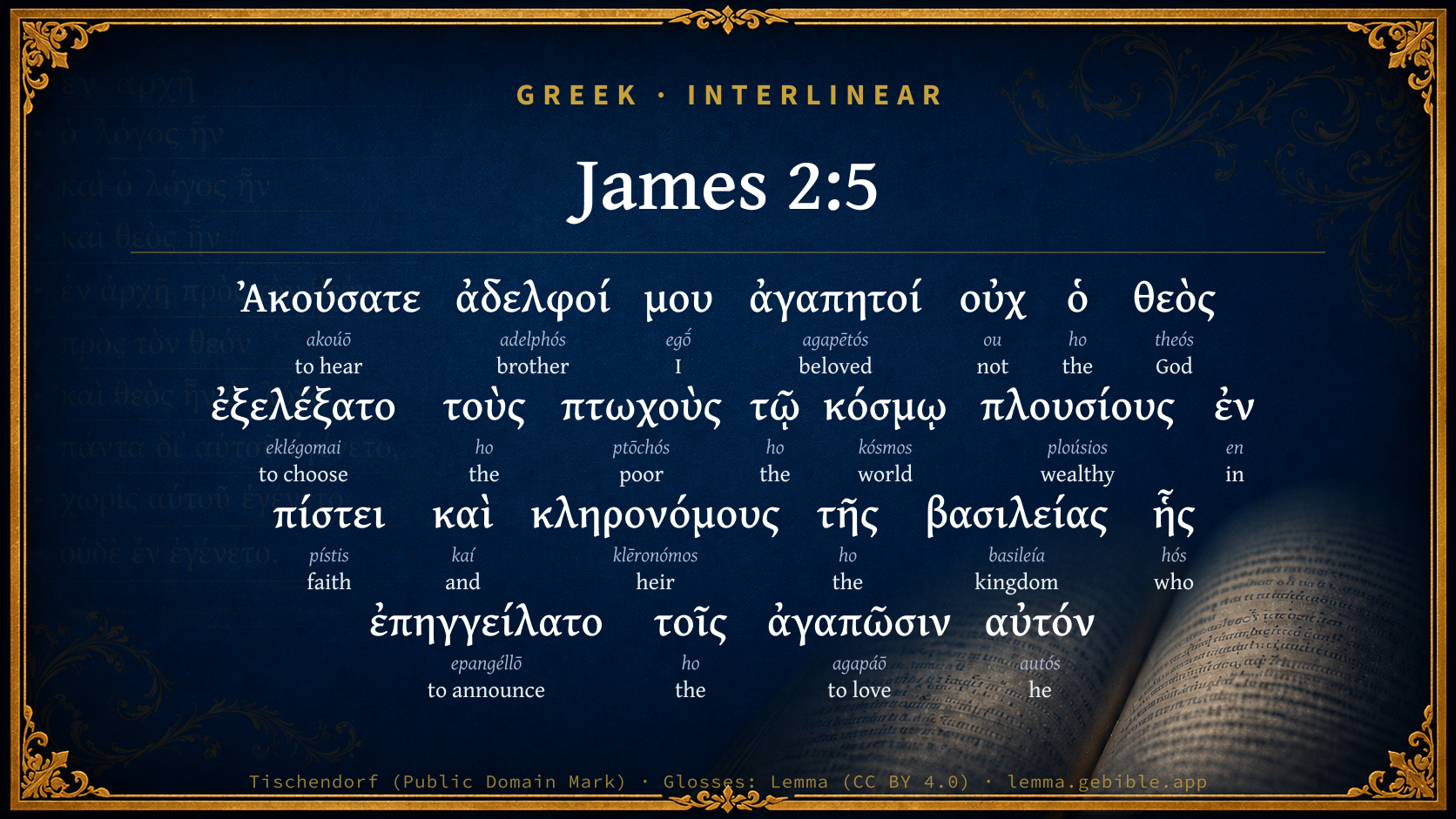
  1. Ἀκούσατε akoúō G191 “to hear” Verb, Aorist, Active, Imperative, 2nd person, Plural
  2. ἀδελφοί adelphós G80 “brother” Noun, Vocative, Plural, Masculine
  3. μου egṓ G1473 “I” Personal pronoun, 1st person, Genitive, Singular
  4. ἀγαπητοί agapētós G27 “beloved” Adjective, Vocative, Plural, Masculine
  5. οὐχ ou G3756 “not” Particle, Negative
  6. ὁ ho G3588 “the” Article, Nominative, Singular, Masculine
  7. θεὸς theós G2316 “God” Noun, Nominative, Singular, Masculine
  8. ἐξελέξατο eklégomai G1586 “to choose” Verb, Aorist, Middle, Indicative, 3rd person, Singular
  9. τοὺς ho G3588 “the” Article, Accusative, Plural, Masculine
  10. πτωχοὺς ptōchós G4434 “poor” Adjective, Accusative, Plural, Masculine
  11. τῷ ho G3588 “the” Article, Dative, Singular, Masculine
  12. κόσμῳ kósmos G2889 “world” Noun, Dative, Singular, Masculine
  13. πλουσίους ploúsios G4145 “wealthy” Adjective, Accusative, Plural, Masculine
  14. ἐν en G1722 “in” Preposition
  15. πίστει pístis G4102 “faith” Noun, Dative, Singular, Feminine
  16. καὶ kaí G2532 “and” Conjunction
  17. τῆς ho G3588 “the” Article, Genitive, Singular, Feminine
  18. βασιλείας basileía G932 “kingdom” Noun, Genitive, Singular, Feminine
  19. ἧς hós G3739 “who” Relative pronoun, Genitive, Singular, Feminine
  20. ἐπηγγείλατο epangéllō G1861 “to announce” Verb, Aorist, Middle deponent, Indicative, 3rd person, Singular
  21. τοῖς ho G3588 “the” Article, Dative, Plural, Masculine
  22. ἀγαπῶσιν agapáō G25 “to love” Verb, Present, Active, Participle, Dative, Plural, Masculine
  23. αὐτόν autós G846 “he” Personal pronoun, Accusative, Singular, Masculine

About this verse

These counts appear in no published source. They are computed here, from the morphology-tagged text and Lemma’s own curated glosses. What Lemma adds →

24
words
20
distinct lemmas
General Epistles
section

Notable vocabulary

The rarest word here is κληρονόμους heir G2818 — appearing just 15 times in the whole Greek New Testament.

Shared distinctive vocabulary

κληρονόμους heir G2818 occurs in 14 verses of the Greek New Testament. Also found in:

Repetition

A word recurs within this verse:

Cross-references

51

Topical passages linked to James 2:5 in the Treasury of Scripture Knowledge — connected by theme and wording, ordered by reader-vote popularity; previews shown in the World English Bible.

  • Matthew 5:3 "Blessed are the poor in spirit, For theirs is the Kingdom of Heaven.
  • Luke 6:20 He lifted up his eyes to his disciples, and said, "Blessed are you who are poor, For yours is the Kingdom of God.
  • Revelation 2:9 "I know your works, oppression, and your poverty (but you are rich), and the blasphemy of those who say they are Jews, and they are not, but are a synagogue of Satan.
  • 1 Corinthians 1:26–28 For you see your calling, brothers, that not many are wise according to the flesh, not many mighty, and not many noble;
  • 2 Corinthians 8:9 For you know the grace of our Lord Jesus Christ, that, though he was rich, yet for your sakes he became poor, that you through his poverty might become rich.
  • Luke 12:21 So is he who lays up treasure for himself, and is not rich toward God."
  • Hebrews 11:26 accounting the reproach of Christ greater riches than the treasures of Egypt; for he looked to the reward.
  • Luke 12:32 Don't be afraid, little flock, for it is your Father's good pleasure to give you the Kingdom.
  • 1 Peter 1:4 to an incorruptible and undefiled inheritance that doesn't fade away, reserved in heaven for you,
  • James 1:12 Blessed is the man who endures temptation, for when he has been approved, he will receive the crown of life, which the Lord promised to those who love him.
  • Matthew 25:34 Then the King will tell those on his right hand, 'Come, blessed of my Father, inherit the Kingdom prepared for you from the foundation of the world;
  • 1 Corinthians 2:9 But as it is written, "Things which an eye didn't see, and an ear didn't hear, Which didn't enter into the heart of man, These God has prepared for those who love him."
  • 2 Corinthians 6:10 as sorrowful, yet always rejoicing; as poor, yet making many rich; as having nothing, and yet possessing all things.
  • James 1:9 But let the brother in humble circumstances glory in his high position;
  • Luke 16:25 "But Abraham said, 'Son, remember that you, in your lifetime, received your good things, and Lazarus, in like manner, bad things. But now here he is comforted and you are in anguish.
  • 2 Timothy 4:8 From now on, there is stored up for me the crown of righteousness, which the Lord, the righteous judge, will give to me on that day; and not to me only, but also to all those who have loved his appearing.
  • Revelation 3:18 I counsel you to buy from me gold refined by fire, that you may become rich; and white garments, that you may clothe yourself, and that the shame of your nakedness may not be revealed; and eye salve to anoint your eyes, that you may see.
  • Revelation 21:7 He who overcomes, I will give him these things. I will be his God, and he will be my son.
  • 1 Samuel 2:30 Therefore Yahweh, the God of Israel, says, I said indeed that your house, and the house of your father, should walk before me forever: but now Yahweh says, Be it far from me; for those who honor me I will honor, and those who despise me shall be lightly esteemed.
  • Proverbs 8:17–21 I love those who love me. Those who seek me diligently will find me.
  • Isaiah 29:19 The humble also shall increase their joy in Yahweh, and the poor among men shall rejoice in the Holy One of Israel.
  • Matthew 11:5 the blind receive their sight, the lame walk, the lepers are cleansed, the deaf hear, the dead are raised up, and the poor have good news preached to them.
  • Ephesians 3:8 To me, the very least of all saints, was this grace given, to preach to the Gentiles the unsearchable riches of Christ,
  • 2 Thessalonians 1:5 This is an obvious sign of the righteous judgment of God, to the end that you may be counted worthy of the Kingdom of God, for which you also suffer.
  • 1 Timothy 6:18 that they do good, that they be rich in good works, that they be ready to distribute, willing to communicate;
  • 2 Timothy 4:18 And the Lord will deliver me from every evil work, and will preserve me for his heavenly Kingdom; to whom be the glory forever and ever. Amen.
  • Exodus 20:6 and showing loving kindness to thousands of those who love me and keep my commandments.
  • Job 34:10 "Therefore listen to me, you men of understanding: Far be it from God, that he should do wickedness, From the Almighty, that he should commit iniquity.
  • Job 34:19 Who doesn't respect the persons of princes, Nor regards the rich more than the poor; For they all are the work of his hands.
  • Isaiah 14:32 What then shall one answer the messengers of the nation? That Yahweh has founded Zion, and in her shall the afflicted of his people take refuge.
  • Zechariah 11:7 So I fed the flock of slaughter, especially the oppressed of the flock. I took for myself two staffs. The one I called "Favor," and the other I called "Union," and I fed the flock.
  • Luke 9:57–58 As they went on the way, a certain man said to him, "I want to follow you wherever you go, Lord."
  • Luke 16:22 It happened that the beggar died, and that he was carried away by the angels to Abraham's bosom. The rich man also died, and was buried.
  • Romans 8:17 and if children, then heirs; heirs of God, and joint-heirs with Christ; if indeed we suffer with him, that we may also be glorified with him.
  • 1 Corinthians 3:21–23 Therefore let no one boast in men. For all things are yours,
  • 2 Peter 1:11 For thus will be richly supplied to you the entrance into the eternal Kingdom of our Lord and Savior, Jesus Christ.
  • 1 Kings 22:28 Micaiah said, If you return at all in peace, Yahweh has not spoken by me. He said, Hear, you peoples, all of you.
  • Job 38:14 It is changed as clay under the seal, And stands forth as a garment.
  • Proverbs 7:24 Now therefore, sons, listen to me. Pay attention to the words of my mouth.
  • Proverbs 8:32 "Now therefore, my sons, listen to me, For blessed are those who keep my ways.
  • Zephaniah 3:12 But I will leave in the midst of you an afflicted and poor people, and they will take refuge in the name of Yahweh.
  • Zechariah 11:11 It was broken in that day; and thus the poor of the flock that listened to me knew that it was the word of Yahweh.
  • Mark 7:14 He called all the multitude to himself, and said to them, "Hear me, all of you, and understand.
  • Luke 22:29 I confer on you a kingdom, even as my Father conferred on me,
  • John 7:48 Have any of the rulers believed in him, or of the Pharisees?
  • Ephesians 1:18 having the eyes of your hearts enlightened, that you may know what is the hope of his calling, and what are the riches of the glory of his inheritance in the saints,
  • 1 Thessalonians 2:12 to the end that you should walk worthily of God, who calls you into his own Kingdom and glory.
  • James 1:16 Don't be deceived, my beloved brothers.
  • Judges 9:7 When they told it to Jotham, he went and stood on the top of Mount Gerizim, and lifted up his voice, and cried, and said to them, Listen to me, you men of Shechem, that God may listen to you.
  • Acts 7:2 He said, "Brothers and fathers, listen. The God of glory appeared to our father Abraham, when he was in Mesopotamia, before he lived in Haran,
  • 2 Corinthians 4:15 For all things are for your sakes, that the grace, being multiplied through the many, may cause the thanksgiving to abound to the glory of God.

Cross-references courtesy of OpenBible.info (CC BY 4.0).

Commentary

Notes on James 2:5 from classic Christian and Jewish commentators (each source and its license shown beneath its notes). The classic Christian expositions comment on the surrounding passage and are grouped to its opening verse, so a note may address several verses; the Jewish commentaries on the Tanakh (Rashi and others) are per-verse, so they appear only where the commentator wrote on this verse.

Lemma curates 59 commentaries, every one of them public domain or Creative Commons licensed, each selected and text-cleaned for this edition rather than reprinted as found. About our sources →

Joseph Benson's Commentary

Jas 2:5-7. Hearken — As if he had said, Stay, consider, ye that judge thus. Does not the presumption lie rather in favour of the poor man? Hath not God chosen the poor — That is, are not they whom God hath chosen, generally speaking, poor in this world, who yet are rich in faith, and heirs of the kingdom — Consequently the most honourable of men? And those whom God so highly honours, ought not ye to honour likewise? But ye — Christians, that know better; have despised — Ητιμασατε, have dishonoured, or disgraced; the poor — By such conduct. Do not rich men, &c. — As if he had said, You have little reason to show so much respect to them, if you consider what their carriage toward you has been; those whom you court with so much respect and assiduity, oppress — Καταδυναστευουσιν, tyrannise over you, and draw — Or drag; you before the judgment-seats — Are not most of the rich men your persecutors, rather than your friends? Do not they blaspheme that worthy name — Of God and of Christ; by which ye are called — And which deserves to be had in the highest esteem and veneration by all intelligent beings? The apostle speaks chiefly of rich heathen: but are Christians, so called, a whit behind them in persecuting the disciples of Jesus?

Joseph Benson's Commentary on the Old and New Testaments (1811–1818) — public domain. Text from a community e-Sword module.

Whedon's Commentary on the Bible

Daniel D. Whedon

4. For the rich are generally persecutors and blasphemers, Jas_2:5-7.

5. Hearken… brethren—In this earnest expostulation (Jas_2:5-7) St. James makes two points:

1. The poor are the chosen, and so wrong is done to them.

2. The rich are the oppressors and blasphemers, and so a wicked preference is given to them.

Chosen—The (aorist) tense, Did not God choose? that is, (Gr. middle,) prefer for himself. The objects of his choice present three objective characteristics; they are poor in worldly goods, but (antithetically) rich in faith, and even heirs (heightening the antithesis) of a future royalty. The very nature of the antithesis shows the inadmissibility of Huther’s interpolating (followed by Alford) the words to be, and reading, chosen to be rich in faith. This to be, might just as authoritatively be interposed before poor, and so render, has not God chosen them to be poor? The worldly poverty, the spiritual richness, and the celestial heirship, all precede this choice, which is simply the divine preference in contrast with this, their human, rejection in the synagogue. God chose, but men (next verse) despised them.

The kingdom—The future kingdom of heaven, as being yet subject of promise.

Daniel D. Whedon (gen. ed.), Commentary on the Old and New Testaments (1874–1909) — public domain. Text from a community e-Sword module.

The Expositor's Bible

Chapter 11

THE INIQUITY OF RESPECTING THE RICH AND DESPISING THE POOR-THE SOLIDARITY OF THE DIVINE LAW.

Jam_2:5-10

ST. JAMES is varied in his style. Sometimes he writes short, maxim-like sentences, which remind us of the Book of Proverbs; sometimes, as in the passage before us, he is as argumentative as St. Paul. Having condemned worldly respect of persons as practical infidelity, he proceeds to prove the justice of this estimate; and he does so with regard to both items of the account: these respecters of persons are utterly wrong, both in their treatment of the poor and in their treatment of the rich. The former is the worse of the two; for it is in flat contradiction of the Divine decree, and is an attempt to reverse it. God has said one thing about the poor mans estate, and these time-servers, publicly in the house of God, say another.

"Hearken, my beloved brethren." He invites their attention to an affectionate and conclusive statement of the case. "Did not God choose them that are poor as to the world to be rich in faith, and heirs of the kingdom? But ye have dishonored the poor man." By the humble life which, by Divine decree, Gods Son led upon the earth, by the social position of the men whom He chose as His Apostles and first disciples, by blessings promised to the poor and to the friends of the poor, both under the Law and under the Gospel, God has declared His special approbation of the poor mans estate. "But ye" (υμεις δε, with great emphasis on the pronoun) "have dishonored the poor man." With Haman-like impiety ye would disgrace "the man whom the King delights to honor."

Let us not misunderstand St. James. He does not say or imply that the poor man is promised salvation on account of his poverty, or that his poverty is in any way meritorious. That is not the case, any more than that the wealth of the rich is a sin. But so far as God has declared any preference, it is for the poor, rather than for the rich. The poor man has fewer temptations, and he is more likely to live according to Gods will, and to win the blessings that are in store for those who love Him. His dependence upon God for the means of life is perpetually brought home to him, and he is spared the peril of trusting in riches, which is so terrible a snare to the wealthy. He has greater opportunities of the virtues which make man Christlike, and fewer occasions of falling into those sins which separate him most fatally from Christ. But opportunities are not virtues, and poverty is not salvation. Nevertheless, to a Christian a poor man is an object of reverence, rather than of contempt.

But the error of the worldly Christians whom St. James is here rebuking does not end with dishonoring the poor whom God has honored; they also pay special respect to the rich. Have the rich, as a class, shown that they deserve anything of the kind? Very much the reverse, as experience is constantly proving. "Do not the rich oppress you, and themselves drag you before the judgment-seats? Do not they blaspheme the honorable name by the which ye are called?" Unless we consider the "synagogue" mentioned above to be a Jewish one, in which Christians still worship, as in the Temple at Jerusalem, the gold-ringed worshipper is to be understood as a Christian; and reasons have been given above for believing that the "synagogue" is a Christian place of worship. But in any case the rich oppressors here spoken of are not to be thought of as exclusively or principally Christian. They are the wealthy as a class, whether converts to Christianity or not; and apparently, as in Jam_5:1-6, it is the wealthy, unbelieving Jews who are principally in the writers mind. St. James is thinking of the rich Sadducees, who at this period (A.D. 35-65) were among the worst oppressors of the poorer Jews, and were of course specially bitter against those who had become adherents of "the Way," and who seemed to them to be renegades from the faith of their forefathers. It was precisely to this kind of oppression that St. Paul devoted himself with fanatical zeal previous to his conversion. {Act_9:1-2; 1Co_15:9; Php_3:6}

"The judgment-seats" before which these wealthy Jews drag their poorer brethren may be either heathen or Jewish courts, {comp. 1Co_6:2; 1Co_6:4} but are probably the Jewish courts frequently held in the synagogues. The Roman government allowed the Jews very considerable powers of jurisdiction over their own people, not only in purely ecclesiastical matters, but in civil matters as well. The Mosaic Law penetrated into almost all the relations of life, and where it was concerned it was intolerable to a Jew to be tried by heathen law. Consequently the Romans found that their control over the Jews was more secure, and less provocative of rebellion, when the Jews were permitted to retain a large measure of self-government. This applied not only to Palestine, but to all places in which there were large settlements of Jews. Even in the New Testament we find ample evidence of this. The high-priest grants Saul "letters to Damascus, unto the synagogues" to arrest all who had become converts to "the Way". {Act_9:2} And St. Paul before Herod Agrippa II declares that, in his fury against converts to Christianity, he "persecuted them even unto foreign cities". {Act_26:11} Most, if not all, of the five occasions on which he himself "received of the Jews forty stripes save one" {2Co_11:24} must have been during his travels outside Palestine. The proconsul Gallio told the Jews of Corinth, not only that they might, but that they must, take their charges against Paul, for breaking a Jewish law, to a Jewish tribunal; and when they ostentatiously beat Sosthenes before his own tribunal, for some Jewish offence, he abstained from interfering. It is likely enough that provincial governors, partly from policy, partly from indifference, allowed Jewish officials to exercise more power than they legally possessed; but they possessed quite enough to enable them to handle severely those who contravened the letter or the traditional interpretation of the Mosaic Law. That the dragging before the judgment seats refers to bringing Christians before Roman magistrates, in a time of persecution, is a gratuitous hypothesis which does not fit the context. It was the mob, rather than the rich, that in the earlier persecutions acted in this way. The rich were contemptuously indifferent. There is, therefore, no evidence here that the letter was written during the persecution under Domitian or under Trajan. Nevertheless, their Christianity, rather than their debt, was probably the reason why these poor Jewish Christians were prosecuted in the synagogue courts by the wealthy Jews.

So far from this passage being evidence that the Epistle was written at a time long after the death of St. James, it is, as Renan has carefully shown, almost a proof that it was written during his lifetime. As regards the relations between rich and poor, "the Epistle of James is a perfect picture of the Ebionim at Jerusalem in the years which preceded the revolt." The destruction of Jerusalem introduced so complete a change into the situation of Judaism and of Christianity, that it is easy to distinguish a writing subsequent to the catastrophe of the year 70 from a writing contemporary with the third Temple. Pictures evidently "referring to the internal contests between the different classes in Jerusalem society, such as that which is presented to us in the Epistle of James, are inconceivable after the revolt of the year 66, which put an end to the reign of the Sadducees." These were the times when women bought the priesthood for their husbands from Herod Agrippa II, and went to see them officiate, over carpets spread from their own door to the Temple; when wealthy priests were too fastidious to kill the victims for sacrifice without first putting on silk gloves; when their kitchens were furnished with every appliance for luxurious living, and their tables with every delicacy; and when, supported by the Romans, to whom they truckled, they made war upon the poor priests, who were supported by the people. Like Hophni and Phinehas, they sent out their servants to collect what they claimed as offerings, and if payment was refused the servants took what they claimed by force. Facts like these help us to understand the strong language used here by St. James, and the still sterner words at the beginning of the fifth chapter. In such a state of society the mere possession of wealth certainly established no claims upon the reverence of a Christian congregation; and the fawning upon rich people, degrading and unchristian at all times, would seem to St. James to be specially perilous and distressing then.

"Do not they blaspheme the honorable Name by which ye are called?" The last clause literally means "which was called upon you" (το επικληθεν εφ υμας); and we need not doubt that the reference is to the Name of Christ which was invoked upon them at their baptism; quod invocatum est super vos, as the Vulgate has it. The same expression is found in tile Septuagint of those who are called by Gods name. {2Ch_7:14; Jer_14:9; Jer_15:16; Amo_9:12} Some have suggested that the name here indicated is that of "poor," or of "brethren," or of "Christian"; but none of these is at all probable. It may be doubted whether the last was already in common use; and "blaspheme" would be a very strong expression to use of any of them; whereas both it and "honorable" are quite in keeping if the name be that of Christ. The word rendered "honorable" (καλον) cannot be adequately translated. It is the same as that which is rendered "good" when we read of "the Good Shepherd". {Joh_10:11} It suggests what is beautiful, noble, and good, as opposed to what is foul, mean, and wicked; and such is the Name of Christ, which is called in a special sense "the Name." {Act_5:41; 3Jn_1:7} Comp. Ignatius, "Ephesians" 3., 7.; "Philad." 10.; Clem. {Rom_2:13} That the blasphemers are not Christians is shown by the clause "which was called upon you." Had Christians been intended, St. James would have written "Do not they blaspheme the honorable Name which was called upon them?" That they blasphemed the Name in which they were baptized would have been such an aggravation of their offence that he would not have failed to indicate it. These blasphemers were no doubt Jews; and St. James has in his mind the anathemas against Jesus Christ which were frequent utterances among the Jews, both in the synagogues and in conversation. St. Paul alludes to these when he says, "No man speaking in the Spirit of God saith, Jesus is anathema"; and Justin Martyr writes, "That which is said in the Law, Cursed is every one that hangeth on a tree, confirms our hope which is hung upon the crucified Christ, not as if God were cursing that crucified One, but because God foretold that which would be done by all of you (Jews) and those like you…And you may see with your eyes this very thing coming to pass; for in your synagogues you curse all those who from Him have become Christians" ("Trypho," 96.). The text, "Cursed is every one that hangeth on a tree," was a favorite one with the Jews in their controversies with Christians, as St. James would know well; {see Gal_3:13} and all this tends to show that he refers to literal blasphemy by word of mouth, and not to the virtual blasphemy which is involved in conduct that dishonors Christ.

His argument, therefore, amounts to this, that the practice of honoring the rich for their riches is (quite independently of any dishonor done to the poor) doubly reprehensible. It involves the meanness of flattering their own oppressors, and the wickedness of reverencing those who blaspheme Christ. It is a servile surrender of their own rights, and base disloyalty to their Lord.

But, perhaps (the argument continues), some will defend this respect paid to the rich as being no disloyalty to Christ, but, on the contrary, simple fulfillment of the royal law, "Thou shalt love thy neighbor as thyself." Be it so, that the rich as a class are unworthy of respect and honor, yet nevertheless they are our neighbors, and no misconduct on their side can cancel the obligation on our side to treat them as we should wish to be treated ourselves. We ourselves like to be respected and honored, and therefore we pay respect and honor to them. To those who argue thus the reply is easy. Certainly, if that is your motive, ye do well. But why do you love your neighbor as yourselves if he chances to be rich, and treat him like a dog if he chances to be poor? However excellent your reasons for honoring the wealthy may be, you still do not free yourselves from the blame of showing an unchristian respect of persons, and therefore of committing sin, "being convicted by the law as transgressors."

The law of loving ones neighbor as oneself is a "royal law," not as having emanated from God or from Christ as King, still less as being a law which binds even kings, or which makes kings of those who observe it. It is a royal law, as being sovereign over other laws, inasmuch as it is one of those two on which "hang all the Law and the Prophets". {Mat_22:40} Indeed, either of the two may be interpreted so as to cover the whole duty of man. Thus St. Paul says of this royal law, "The whole law is fulfilled in one word, even in this, Thou shalt love thy neighbor as thyself." {Gal_5:14} And St. John teaches the same truth in a different way, when he declares that "he that loveth not his brother whom he hath seen cannot love God whom he hath not seen". {1Jn_4:20} The expression "royal law" occurs nowhere else, either in the New Testament or in the Septuagint, but it is found in a dialogue entitled "Minos", which is sometimes wrongly attributed to Plato. It is one which might readily occur to any one as a name for a supreme moral principle.

"Whosoever shall keep the whole law, and yet stumble in one point, he is become guilty of all." The law is the expression of one and the same principle-love; and of one and the same will-the will of God. Therefore he who deliberately offends against any one of its enactments, however diligently he may keep all the rest, is guilty of offending against the whole. His guiding principle is not love, but selfishness-not Gods will, but his own. He keeps nine tenths of the law because he likes to do so, and he breaks one tenth because he likes to do so. The fact of his willful disobedience proves that his obedience is not the fruit of love or loyalty, but of self-seeking. If we ask what his character is, the answer must be, "He is a lawbreaker." These respecters of persons claimed to be observers of the law, because they treated their rich neighbors as they would have liked to be treated themselves. St. James shows them that, on the contrary, they are transgressors of the law, because they pick and choose as to what neighbors shall be treated thus kindly. They keep the law when it is convenient to keep it, and break it when it is inconvenient to keep it. Such keeping of the law is in its essence, not obedience, but disobedience. He who follows honesty only because honesty is the best policy is not an honest man, and he who obeys the law only because obedience suits him is not an obedient man. There is no serving God with reservations. However small the reservation may be, it vitiates all the rest. In order to "fulfill the law" (a rare expression, found only here and in Rom_2:27), we must keep it all round, independently of our own likes and dislikes.

St. James is not here countenancing the severity of Draco, that small crimes deserve death, and that there is no worse punishment for great crimes; nor yet the paradox of the Stoics, that the theft of a penny is as bad as parricide, because in either case the path of virtue is left, and one is drowned as surely in seven feet of water as in seventy fathoms. He is not contending that all sins are equal and that to break one of Gods commands is as bad as to break them all. What he maintains is that no one can claim to be a fulfiller of the law in virtue of his extensive obedience so long as there is any portion of the law which he willfully disobeys. Why does he disobey in this? Because it pleases him to do so. Then he would disobey in the rest if it pleased him to do so. The motive of his conduct is not submission, but self-will. He is in character "a transgressor of the law."

Both defects are common enough still, and are likely to remain so. Paying respect to persons, dignities, and positions is a frequent form of meanness, especially in the manner here condemned, of courting the rich and slighting the poor. It is a Christian duty to respect the rank or the office of those whom God has placed in a position superior to ourselves, and it is also a Christian duty to reverence those who by Gods grace are leading lives of virtue and holiness; hut it is unchristian partiality to honor a man merely for his wealth, or to dishonor him merely for his poverty. And, secondly, we are all of us prone to plead, both before the world and our own consciences, the particulars in which we do not offend as a set-off against those in which we do. To detect ourselves thus balancing a transgression here, against many observances there, ought at once to startle us into the conviction that the whole principle of our lives must be faulty. Our aim is, not to love God, or to obey Him, but to get to heaven, or at least to escape hell, on the cheapest terms.

William Robertson Nicoll, ed., The Expositor's Bible (London: Hodder & Stoughton, 1887–1910) — public domain. 65 of 66 books (1 Corinthians is not separately keyed, as that volume carries no machine-parseable verse references); section-level commentary keyed to the opening verse. Introductory and overview sections not keyed to a specific passage are excluded.

Tyndale Open Study Notes

Tyndale Open Resources

2:5 Listen to me: Employing this rhetorical device for emphasis (see Deut 6:3; Amos 3:1; Matt 13:18; Acts 15:13), James presents his argument against favoring the rich. • Hasn’t God chosen the poor? God’s special concern for the poor is reflected in the Old Testament (Exod 23:11; 1 Sam 2:8; Ps 12:5) and in the ministries of Jesus and Paul (Luke 4:18; 6:20; 1 Cor 1:26-28). This concern was emphasized by the Jerusalem church (Gal 2:9-10), of which James was the leader. • inherit the Kingdom: The Kingdom of God was central to the teaching of Jesus (Matt 12:8; Mark 1:15; Luke 17:21). Christ already rules from his place at the right hand of the Father, yet his Kingdom will be fully realized only when the Son of Man comes (Matt 25:31, 34; 1 Cor 15:24-28).

Tyndale Open Study Notes — © Tyndale Open Resources, licensed CC BY-SA 4.0. Text via the HelloAO Bible API.

Bengel's Gnomon

Johann Albrecht Bengel

Jas 2:5. Ἀκούσατε, hearken) By this address he brings to trial and restrains rash judges, showing that the presumption ought to be in favour of the poor, rather than the rich.—ὁ Θεὸς, God) Our judgment ought to be in conformity with the judgment of God, even in ceremonies and outward gestures.—ἐξελέξατο τοὺς πτωχοὺς, chose the poor) They who are chosen, are needy. This description does not include all the poor, nor is it confined to the poor only; for poverty and riches of themselves do not render any man good or evil; and yet the poor are in various places pronounced happy in preference to the rich: ch. Jas 5:1. And the terms, wicked and rich, righteous and poor, are generally synonymous. Isa 53:9; Amo 2:6; Amo 5:12. The rich man, if he is good, renounces his riches; the poor man, if he is wicked, neglects that which is the advantage of poverty. Many Christians were of the poor, few from among the rich; especially at Jerusalem, and among those to whom James writes. Comp. the notes on ch. Jas 5:1 and following verses. So also, 1Co 1:27, God hath chosen, etc.—πλουσίους ἐν πίστει, καὶ κληρονόμους, rich in faith, and heirs) Beza thus explains it: He chose the poor, that they might become rich in faith, and heirs, etc. E. Schmid thus takes it: He chose the poor, who are however rich in faith, to be also heirs, etc. The latter puts asunder two points which are most intimately connected, rich and heirs. The former, contrary to the design of the apostle, places faith and love after election. For James treats concerning the order of election, faith, and love, just as that order becomes known to us: and moreover he thus furnishes us with a rule for forming a right judgment respecting the poor; in which point of view not only faith, but also love, precedes election in the order of our knowledge. The meaning of the apostle is this: God chose the poor, who are rich in faith, and who are also heirs, etc. Whence this argument is derived: “Whoever are rich in faith and heirs, them we ought to acknowledge and treat as chosen by God; but the poor are rich in faith,” etc. Thus election is so far from preceding faith, that even the inheritance precedes election; and if we duly consider the antithesis between He chose, and ye have despised, this conclusion presents itself. Both God highly esteems, and we ought to have highly esteemed, those who are rich in faith, and heirs of the kingdom.—ἐν πίστει, in faith) which has for its object the Lord of glory. To this faith are assigned as a consequence the riches of heaven and of the world to come, even as the inheritance is assigned to love.—κληρονόμους, heirs) because sons.—τῆς βασιλείας, of the kingdom) The highest dignity.

Bengel's Gnomon of the New Testament — English translation (T&T Clark, Edinburgh, 1860) — public domain. Text from a community e-Sword module.

Meyer's Critical & Exegetical Commentary

Heinrich August Wilhelm Meyer

Jam_2:5. With this verse the proof of the reprehensibleness of the conduct found fault with commences: James showing that the conduct toward the poor is in contradiction with the mercy of God directed to the poor, and that the conduct toward the rich is in contradiction with their conduct toward Christians. The impressive exhortation to attention precedes ἀκούσατε with the address ἀδελφοί μου ἀγαπητοί; see chap. Jam_1:16; Jam_1:19. The proof itself (as in Jam_2:4) is expressed in a lively manner in the form of a question: Has not God chosen those who are the poor of the world (i.e. accounted as such) to be rich in faith, and heirs of the kingdom which He has promised to them that love Him?

The verb ἐξελέξατο is to be retained in its usual acceptation, in that which it has in 1Co_1:27. Wiesinger, without sufficient reason, will understand it here as equivalent to God has so highly honoured the poor; and Lange incorrectly maintains that the word here rather signifies calling with reference to ethical good behaviour to the divine revelation.

The correct reading: τοὺς πτωχοὺς τῷ κόσμῳ, is to be explained in the same manner as the expressions ἀστεῖος τῷ Θεῷ, Act_7:20, and δυνατὰ τῷ Θεῷ, 2Co_10:4 (see Meyer on these passages, and Winer, p. 190 [E. T. 265]; Al. Buttmann, p. 156 [E. T. 179]). The world esteems those as poor who possess no visible earthly riches. Wiesinger prefers to explain the dative as the dative of reference, thus poor in respect of the world; yet the former explanation, which also Brückner and Lange adopt, in which ὁ Θεός and τῷ κόσμῳ form a sharp contrast, is more appropriate, and more in correspondence with the meaning of the word κόσμος with James. In the Receptus πτωχοὺς τοῦ κόσμου the genitive is to be understood as in the expression τὰ μωρὰ τοῦ κόσμου, etc., 1Co_1:27; see Meyer in loco.

πλουσίους ἐν πίστει] is not in apposition with τοὺς πτωχοὺς (Luther, Baumgarten, Semler, Hottinger, Gebser, Bouman, Lange, and others),[114] but the completion of ἐξελέξατο, stating to what God has chosen the poor (Beza, Wolf, Morus, Knapp, Storr, Schneckenburger, Kern, Theile, de Wette, Wiesinger, and others); see 2Co_3:6.

By ἐν πίστει, as in the expression πλούσιος ἐν ἐλέει, Eph_2:4 (see 1Co_1:5; 2Co_9:11; 1Ti_6:18), the object is not stated wherein they are rich (Luther: who are rich in the faith), but the sphere within which riches is imparted to them; similarly Wiesinger explains it: rich in their position as believers. James wished primarily to mark the contrast that the poor are appointed to be rich, namely, so far as they are believers; the context gives the more exact statement of their riches: riches in the possessions of the heavenly kingdom is meant; this the following clause indicates.

Calvin: non qui fidei magnitudine abundant, sed quos Deus variis Spiritus sui donis locupletavit, quae fide percipimus.[115]

The expression ἡ βασιλεία occurs also elsewhere, without the addition of ΤΟῦ ΘΕΟῦ or similar terms, as a designation of the kingdom of God, e.g. Mat_13:38. No stress rests on the article τῆς (= ἘΚΕΊΝΗς), as the relative Ἧς referred to it. The relative clause serves not for a more definite statement of the idea ΒΑΣΙΛΕΊΑ, as if by it this βασιλεία was to be distinguished from another, but the statement ἘΞΕΛ.… ΚΛΗΡΟΝΌΜΟΥς Τ. ΒΑΣΙΛΕΊΑς is confirmed, as a kingdom founded on the promise of God.

From the expressions ΚΛΗΡΟΝΌΜΟς and ἘΠΗΓΓΕΊΛΑΤΟ of the relative clause, it is evident that James considered here ΒΑΣΙΛΕΊΑ as the future perfected kingdom of God, not the joint participation in the ΥἹΟΘΕΣΊΑ of the Jews (Lange). On Ἧς ἘΠΗΓΓΕΊΛΑΤΟ Κ.Τ.Λ. see the remark on Jam_1:12. The addition of this clause shows that with James faith and love to God are most closely connected.

James puts ΤΟῪς ΠΤΏΧΟΥς, to whom ΟἹ ΠΛΟΎΣΙΟΙ are opposed, as the object of ἘΞΕΛΈΞΑΤΟ. He accordingly (the article is not to be overlooked) divides men into these two classes, the poor and the rich, and designates, not the latter, but the former, as those whom God has chosen and appointed to be rich in faith,[116] namely, to be heirs of the kingdom; not as if all the poor received the κληρονομία, but his meaning is that those whom God has chosen belong to this class, whereas those belonging to the class of the rich had not been chosen. James did not require to point out the truth of this statement; the Christians, to whom he wrote, were a living testimony of it, for they all belonged to that class; and although some among them were πλούσιοι, yet, on the one hand, what Christ says in Mat_19:23-26 holds good, and, on the other hand, 1Co_1:26-28 is to be compared.

With this divine choice the conduct of his readers stood in direct contradiction when they treated a poor manthus one who belonged to the class of those chosen by Godcontemptuously, and that on account of his poverty. What directly follows expresses this contradiction.

[114] If πλουσίους is taken as in apposition, then here riches in faith forms the reason of the choice; but by this the keenness of the thought contained in the oxymorum is entirely blunted: it is also arbitrary to separate the two ideas πλουσίους and κληρονόμους united by καί.

[115] Kern: ἐν πίστει indicates that it is faith itself which makes the Christian inwardly rich.

[116] It is to be observed that ἐξελέξατο does not here refer only to πλουσίους, as if πίστις were to be considered as the condition on which the πτωχοί were chosen to be rich, but to the combined expression πλουσίους ἐν πίστει, so that also πίστις is to be considered as an effect of the divine choice. The same view lies at the foundation of what Paul in 1Co_1:30 (see Meyer in loco) and elsewhere often expresses.

Meyer — Critical and Exegetical Commentary on the New Testament — English translation by Peter Christie, edited by Frederick Crombie (T&T Clark, 1880) — public domain. Text from a community e-Sword module.

Expositor's Greek Testament

ed. W. Robertson Nicoll

Jas 2:5 . Ἀκούσατε , ἀδελφοί μου ἀγαπητοί : This expression, which one would expect to hear rather in a vigorous address, reveals the writer as one who was also an impassioned speaker; cf. in the same spirit, the frequent ἀδελφοί , and especially, ἄγε νῦν , Jas 4:13 , Jas 5:1 . ἐξελέξατο : a very significant term in the mouth of a Jew when addressing Jews; cf. Deu 14:1-2 , Υἱοί ἐστε Κυρίου τοῦ θεοῦ ὑμῶν … ὅτι λαὸς ἅγιος εἶ Κυρίῳ τῷ Θεῷ σου , καὶ σὲ ἐξελέξατο Κύριος ὁ θεός σου γενέσθαι σε αὐτῷ λαὸν περιούσιον … cf. Act 13:17 ; 1Co 1:27 . There is an interesting saying in Chag . 9 b where it is said that poverty is the quality most befitting Israel as the chosen people. πτωχοὺς τῷ κόσμῳ : i.e. , poor in the estimation of the world; the reading τοῦ κόσμου or ἐν τῷ κόσμῳ τούτῳ loses this point; cf. Mat 10:9 ; Luk 6:20 . πλουσίους ἐν πίστει : “Oblique predicate” (Mayor). In the Testaments of the Twelve Patriarchs , Gad. vii. 6 we read: “For the poor man, if, free from envy, he pleaseth the Lord in all things, is blessed beyond all men” (the Greek text reads πλουτεῖ which Charles holds to be due to a corruption in the original Hebrew text which reads יְאֻשַּׁר = μακαριστός ἐστι ). See, for the teaching of our Lord, Mat 6:19 ; Luk 12:21 . Πίστις is used here rather in the sense of trust than in the way in which it is used in Jas 2:1 . κληρονόμους τῆς βασιλείας : the Kingdom must refer to that of the Messiah, see Jas 5:7-9 , and Mat 25:35 , δεῦτε οἱ εὐλογημένοι τοῦ πατρός μου κληρονομήσατε τὴν ἡτοιμασμένην ὑμῖν βασιλείαν ἀπὸ καταβολῆς κόσμου , but not Mat 5:3 which treats of a different subject. It is of importance to remember that the Messianic Kingdom to which reference is made in this verse was originally, among the Jews, differentiated from the “future life” which is apparently referred to in Jas 1:12 , … λήμψεται τὸν στέφανον τῆς ζωῆς , ὃν ἐπηγγείλατο τοῖς ἀγαπῶσιν αὐτόν . There was a distinction, fundamentally present, though later on confused, in Jewish theology, between the “Kingdom of Heaven” over which God reigns, and that of the Kingdom of Israel over which the Messiah should reign. An integral part of the Messianic hope was the doctrine of a resurrection ( cf. Isa 24:10 ; Dan 12:2 ). This first assumed definite form, apparently, under the impulse of the idea that those who had suffered martyrdom for the Law ( Torah ) were worthy to share in the future glories of Israel. In the crudest form of the doctrine the resurrection was confined to the Holy Land those buried elsewhere would have to burrow through the ground to Palestine and to Israelites. And the trumpet-blast which was to be the signal for the ingathering of the exiles would also arouse the sleeping dead ( cf. Berachoth , 15 b , 4 Ezr 4:23 ff.; 1Co 15:52 ; 1Th 4:16 ). According to the older view, the Kingdom was to follow the resurrection and judgment; but the later and more widely held view was that a temporary Messianic Kingdom would be established on the earth, and that this would be followed by the Last Judgment and the Resurrection which would close the Messianic Era. This was to be followed by a new heaven and a new earth. In the eschatological development which took place during the first century B.C. Paradise came to be regarded as the abode of the righteous and elect in an intermediate state; from there they will pass to the Messianic Kingdom, and then, after the final judgment they enter heaven and eternal life. In our Epistle there are some reflections of these various conceptions and beliefs, but they have entered into a simpler and more spiritual phase. That the reference in the verse before us is to the Messianic Kingdom seems indubitable both on account of the mention of the “Lord Jesus Christ” (Messiah) with which the section opens, showing that the thought of our Lord was in the mind of the writer, and because of the mention of the “Kingdom,” and also on account of the direct mention of the coming of the Messiah as Judge, later on in Jas 5:7-9 . And if this is so then we may perhaps see in the words ὁ θεὸς ἐξελέξατο a reference to Christ.

The Expositor's Greek Testament, edited by W. Robertson Nicoll (1897–1910) — public domain. Text from a community e-Sword module.

Geneva Bible (1599)

Geneva Bible translators

He showeth that they are perverse and naughty Judges, which prefer the rich before the poor, by that that God on the contrary side preferreth the poor, whom he hath enriched with true riches, before the rich.

The needy and wretched, and (if we measure it after the opinion of the world) the veriest abjects of all men.

Geneva Bible (1599) marginal notes — public domain. Text via Bolls.life.

Jamieson, Fausset & Brown

Robert Jamieson, A. R. Fausset & David Brown

Hearken--James brings to trial the self-constituted "judges" (Jam 2:4).

poor of this world--The best manuscripts read, "those poor in respect to the world." In contrast to "the rich in this world" (Ti1 6:17). Not of course all the poor; but the poor, as a class, furnish more believers than the rich as a class. The rich, if a believer, renounces riches as his portion; the poor, if an unbeliever, neglects that which is the peculiar advantage of poverty (Mat 5:3; Co1 1:26-28).

rich in faith--Their riches consist in faith. Luk 12:21, "rich toward God." Ti1 6:18, "rich in good works" (Rev 2:9; compare Co2 8:9). Christ's poverty is the source of the believer's riches.

kingdom . . . promised-- (Luk 12:32; Co1 2:9; Ti2 4:8).

Jamieson, Fausset & Brown — Commentary Critical and Explanatory on the Whole Bible (1871) — public domain (CC PDM 1.0). Text via the HelloAO Bible API.

Adam Clarke's Commentary

Verse 5. Hath not God chosen the poor of this world] This seems to refer to Mt 11:5: And the poor have the Gospel preached to them. These believed on the Lord Jesus, and found his salvation; while the rich despised, neglected, and persecuted him. These had that faith in Christ which put them in possession of the choicest spiritual blessings, and gave them a right to the kingdom of heaven. While, therefore, they were despised of men, they were highly prized of God.

Adam Clarke's Commentary on the Bible (1810–1826) — public domain. Text from a community e-Sword/MySword module.

John Calvin's Commentaries

5 Hearken, my beloved brethren. He proves now by a two-fold argument, that they acted preposterously, when for the sake of the rich they despised the poor: The first is, that it is unbecoming and disgraceful to cast down those whom God exalts, and to treat reproachfully those whom he honors. As God honors the poor, then every one who repudiates them, reverses the order of God. The other argument is taken from common experience; for since the rich are for the most part vexatious to the good and innocent, it is very unreasonable to render such a reward for the wrongs they do, so that they should be more approved by us than the poor, who aid us more than they wrong us. We shall now see how he proceeds with these two points.

Hath not God chosen the poor of this world? Not indeed alone, but he wished to begin with them, that he might beat down the pride of the rich. This is also what Paul says, that God hath chosen, not many noble, not many mighty in the world, but those who are weak, that he might make ashamed such as are strong (1 Corinthians 1:25.) In short, though God pours forth his grace on the rich in common with the poor, yet his will is to prefer these to those, that the mighty might learn not to flatter themselves, and that the ignoble and the obscure might ascribe in what they are to the mercy of God, and that both might be trained up to meekness and humility.

The rich in faith are not those who abound in the greatness of faith, but such as God has enriched with the various gifts of his Spirit, which we receive by faith. For, doubtless, since the Lord deals bountifully with all, every one becomes partaker of his gifts according to the measure of his own faith. If, then, we are empty or needy, that proves the deficiency of our faith; for if we only enlarge the bosom of faith, God is always ready to fill it.

He says, that a kingdom is promised to those who love God: not that the promise depends on love; but he reminds us that we are called by God unto the hope of eternal life, on this condition and to this end, that we may love him. Then the end, and not the beginning, is here pointed out.

John Calvin's Commentaries (1540-1563) — public domain. Text from the Calvin Translation Society English edition (1840s-50s) via the Christian Classics Ethereal Library (ccel.org). Calvin's coverage is partial (roughly two-thirds of the Bible); uncommented books and verses are honest gaps, never fabricated. The 19th-century editor's footnotes and remarks are omitted so the notes are faithfully Calvin's own voice.

Ellicott's Commentary for English Readers

(5) Hearken, my beloved brethren.—With complete change of manner the Apostle writes now as if he were speaking, in brief quivering sentences, appealing to the hearts which his stronger words may not compel.

Hath not God chosen . . .?—There is, then, an election on the part of God. It were folly to deny it. But this passage, like so many others, gives the reason for that choice. “The poor of this world” are His chosen; not merely for their poverty, although it may have been the air, so to speak, in which the virtues which endeared them to Him have flourished most. And these are rich for present and for future. They know Him “now by faith,” and “after this life have the fruition of His glorious Godhead.” “Blessed be ye poor, for yours is the kingdom of God” (Luk_6:20). The way thereto for them is nearer and less cumbered than for the rich, if only they fulfil the Scripture (comp. Mat_6:3), and be poor “in spirit:” then, indeed, are they “heirs of the kingdom which He hath promised to them that love Him.” The world must always measure by its own standard, and consider poverty a curse, just as it looks on pain and trouble as evil. But the teaching of God, declared most eloquently in the life of His blessed Son, is the direct opposite to this. In a worship which demands of its votaries costly gifts and offerings—and every religion tends downwards to such desires—the rich man has a golden pavement to his future bliss. No wonder, therefore, that again and again the voice of the Spirit of God has pointed out the narrow way, and the eternal excellency of truth, and faith, and love, the riches easiest of acquisition by the poor.

A Bible Commentary for English Readers, edited by Charles John Ellicott (1878–1897) — public domain. Text from a community e-Sword module.

The Cambridge Bible for Schools and Colleges

gen. ed. J. J. S. Perowne

5. Hath not God chosen …] Better, perhaps, did not God choose? as referring to the special election of the poor by Christ as the heirs of blessings and the messengers of His Kingdom (Mat_5:3; Luk_6:20; comp. also 1Co_1:27).

the poor of this world] Literally, in this world, i. e. “as far as this world is concerned.”

rich in faith] The construction of the words is (to use a technical phrase) that of a secondary predicate, “God had chosen the poor in this world as, i.e. to be, rich in faith, as in the region in which they lived and moved.”

heirs of the kingdom which he hath promised …] Here, as before (ch. Jas_1:12), it is scarcely possible to exclude a direct reference to the words of Christ, as in Luk_6:20; Luk_12:31-32, and so we get indirect proof of a current knowledge, at the early period at which St James wrote, of teaching that was afterwards recorded in the written Gospels. Some of the better MSS., however, give “heirs of the promise.”

to them that love him?] Care is taken not to lead men to suppose that poverty itself, apart from spiritual conditions, was a sufficient title to the inheritance. There must be the love of God which has its root in faith. What is pressed is that poverty and not wealth was the true object of respect; partly as predisposing men to the spiritual conditions, partly as having been singled out by Christ for special blessings.

The Cambridge Bible for Schools and Colleges (gen. ed. J. J. S. Perowne; Cambridge University Press, 1878–1918) — public domain. Text from a community e-Sword module.

John Gill's Exposition

Hearken, my beloved brethren,.... As to a matter of importance, and worthy of attention and regard; being an instance of the divine conduct towards the poor, and carries in it a strong argument against respect of persons:

hath not God chosen the poor of this world? this interrogative is equal to a strong affirmative; and the sense is, that God has chosen the poor of this world; and which is to be understood, not of the choice of them to an office, either in church or state; though sometimes this has been the case, as the instances of David, and the apostles of Christ, show; nor merely to the Gospel, and the outward means of grace, though the poor have the Gospel preached unto them; nor of the effectual calling, though this is true; but of eternal election, which is the act of God the Father, and passed before the foundation of the world; and is an act of sovereign grace, and is irrespective of faith, holiness, and good works; and is the source of all grace, and remains immutable and irrevocable: now the objects of this are, "the poor of this world"; that is, who are poor with respect to the things of this world, but not with respect to the things of another world; for they are chosen to be heirs of a kingdom, and shall enjoy it; though these are not all chosen by God, nor are they the only persons that are chosen; there are some poor men that are not chosen, and are miserable here and hereafter; and there are some rich men that are chosen; but for the most part, or generally speaking, they are not many mighty, nor noble, but the poorer sort, which God has made choice of to partake both of grace and glory. It may be the apostle has some peculiar respect to the poor among the Gentiles, whom God had chosen; it was usual with the Jews to call the Gentiles the world, and they were Jews the apostle now writes to, and who were scattered abroad among the Gentiles; and therefore he might very aptly call them "this world", among whom they lived; and suggest to them, that God had chosen some of the Gentiles, as well as of the Jews, and even some of the poorer sort of them; and it was usual with the Jews to distinguish between , "the poor of Israel", and , "the poor of the world", or "the poor of the nations of the world" (u): the Alexandrian copy, and some others, leave out the word "this", and so the Syriac and Arabic versions, which makes the phrase more agreeable to the Jewish way of speaking. The Gentiles, in common, were despicable with the Jews, and especially the poor of them; and yet God chose these:

rich in faith; not that they were so, or were considered as such, when chosen, and so were chosen because of their faith; for then also they were, or were considered as heirs of the kingdom, which would be monstrously absurd; and yet there is as much reason, from the text, for the one, as for the other; but the sense is, that they were chosen "to be rich in faith"; and so the Syriac version supplies in the next clause, "that they might be heirs"; which if it had been placed before this clause also, would have been right; election to grace is signified in the one, and election to glory in the other: men are chosen, not because they do believe, or shall believe, but that they might believe; and which faith they have in consequence of election; and which when they have, they are rich: faith is a rich precious grace itself; it is a part of the riches of grace, and is more worth than thousands of gold and silver; and it is the means of receiving and enjoying much riches, as Christ the pearl of great price himself, and all spiritual blessings along with him; such as the rich robe of his righteousness, full pardon of sin, which is according to the riches of his grace, and adoption, which makes men heirs of God, and joint heirs with Christ, and even the eternal inheritance itself, both the promise of it, and a right unto it; all which are said to be received by faith; and therefore believers, how poor soever they may be, to this world's goods, are truly rich men:

and heirs of the kingdom; of glory, which is prepared for all the chosen ones, from the foundation of the world; and is freely given to them by their Father, and to which they are called in the effectual calling; and hence they are made kings and priests unto God, and have crowns and thrones provided for them: the Alexandrian copy reads, "heirs of the promise which he hath promised to them that love him"; that is, which God has promised them, as the Vulgate Latin and Syriac versions read; not that their love to God is the cause of this kingdom, or of their choice to it, or of the promise of it to them; all which flow from the love of God to them; but this is descriptive of the persons who shall enjoy it, and may expect to enjoy it, as in Jam 1:12.

(u) T. Bab. Gittin, fol. 30. 1. & Bava Bathra, fol. 10. 2.

John Gill's Exposition of the Whole Bible (1746–1763) — public domain (CC PDM 1.0). Text via the HelloAO Bible API.

Trapp's Complete Commentary

John Trapp

5 Hearken, my beloved brethren, Hath not God chosen the poor of this world rich in faith, and heirs of the kingdom which he hath promised to them that love him?

Ver. 5. Chosen the poor] This the world wonders and stumbles at. The heathen Romans would not receive Christ (though they heard of his miracles and mighty works) into the number of their gods, because he preached poverty and made use of poor persons. Aigoland, king of Saragossa in Arragon, refused to be baptized because he saw many lazars {a} and poor people expecting alms from Charlemagne’s table; and asking what they were, was answered, that they were the messengers and servants of God. And can he keep his servants no better? said he. I will be none of his servants. (Turpine.) But what saith Christ? "I know thy poverty; but (that is nothing) thou art rich," Rev 2:9. And the poor are gospellized, not only receive it, but are changed by it, Mat 11:5. We usually call a poor man a poor soul: a poor soul may be a rich Christian, and a rich man may have a poor soul; as he in the Gospel that had animam triticeam, a wheaten soul, Luk 12:16-21, and as those other rich fools in David’s days, whose hearts were as fat as grease; they delighted not in God’s law, Psa 119:70.

Heirs of the kingdom] Heads destinated to the diadem, saith Tertullian.

{a} A poor and diseased person, usually one afflicted with a loathsome disease; esp. a leper. ŒD

John Trapp, A Commentary or Exposition upon All the Books of the Old and New Testament (1647–1656) — public domain. Text from a community e-Sword module.

Albert Barnes' Notes on the Bible

Hearken, my beloved brethren - The apostle now proceeds to show that the rich, as such, had no special claim on their favor, and that the poor in fact might be made more entitled to esteem than they were. For a view of the arguments by which he does this, compare the analysis of the chapter.

Hath not God chosen the poor of this world? - Those who are poor so far as this world is concerned, or those who have not wealth. This is the first argument which the apostle suggests why the poor should not be treated with neglect. It is, that God has had special reference to them in choosing those who should be his children. The meaning is not that he is not as willing to save the rich as the poor, for he has no partiality; but that there are circumstances in the condition of the poor which make it more likely that they will embrace the offers of the gospel than the rich; and that in fact the great mass of believers is taken from those who are in comparatively humble life. Compare the notes at 1Co 1:26-28. The fact that God has chosen one to be an “heir of the kingdom” is as good a reason now why he should not be treated with neglect, as it was in the times of the apostles.

Rich in faith - Though poor in this world’s goods, they are rich in a higher and more important sense. They have faith in God their Saviour; and in this world of trial and of sin, that is a more valuable possession than piles of hoarded silver or gold. A man who has that is sure that he will have all that is truly needful for him in this world and the next; a man who has it not, though he may have the wealth of Croesus, will be utterly without resources in respect to the great wants of his existence.

“Give what thou wilt, without thee we are poor;

And with thee rich, take what thou wilt away.”

Faith in God the Saviour will answer more purposes, and accomplish more valuable ends for man, than the wealth of the Indies could: and this the poor may have as well as the rich. Compare Rev 2:9.

And heirs of the kingdom ... - Margin, “that.” Compare the notes at Mat 5:3.

Albert Barnes' Notes on the Bible (1834–1885) — public domain. Text from a community e-Sword/MySword module.

Matthew Poole's English Annotations

Hath not God chosen the poor? Not that God hath chosen all the poor in the world, but his choice is chiefly of them, 1Co 1:26,28. Poor he means in the things of this world, and in the esteem of worldly men; they are opposed to those that Paul calls rich in this world, 1Ti 6:17,18.

Rich: some insert the verb substantive to be between this and the former clause, and read: Hath not God chosen the poor of this world to be rich, &c. So Rom 8:29, predestinate to be conformed: the like defective speeches we find, Joh 12:46; 2Co 3:6. And the verb understood here is expressed, Eph 1:4, after the same word we have in this text. And yet if we read the words as they stand in our translation, they do not prove that foresight of faith is previous to election, any more than that being heirs of the kingdom is so too.

In faith; either in the greatness and abundance of their faith, Mat 15:28; Rom 4:20; or rather, rich in those privileges and hopes to which by faith they have a title.

And heirs of the kingdom; an instance of their being rich, in that they are to inherit a kingdom.

Which he hath promised to them that love him: see Jam 1:12, where the same words occur, only that which is here a kingdom, is there a crown.

Matthew Poole's English Annotations on the Holy Bible (1683–1685) — public domain. Text from a community e-Sword/MySword module.

The Pulpit Commentary

Vers. 5-9. Proof of the sinfulness of respect of persons.

Hearken (ajkousate). This has been noticed as a coincidence with the speech of St. James in Act_15:13. It is, however, too slight to be worth much. (cf. Act_7:2 Act_13:16 Act_22:1) For tou kosmou toutou, read tw kosmw (a, A, B, C), "poor as to the world;" perhaps "in the estimation of the world." These God chose (to be) rich in faith, and heirs of the kingdom, etc. The kingdom; mentioned hero only by St. James (and even here, a, A read ejpaggeliav); cf. nomon basilikon in ver. 8. Which he hath promised. As Dean Plumptre has pointed out, "it is scarcely possible to exclude a direct reference to the words of Christ, as in Luk_6:20 Luk_12:31, Luk_12:32; and so we get indirect proof of a current knowledge, at the early period at which St. James wrote, of teaching which was afterwards recorded in the written Gospels.

Worldly poverty is by no means inconsistent with true riches:

rather it is often accompanied by them, for "God chose the poor as to the world to be rich in faith;" not as if poverty were necessarily accompanied by goodness, or as if all the rich were rejected. But "not many wise after the flesh, not many mighty, not many noble, are called;" while "the poor," as a class, "have the gospel preached to them." It has been well said that "the temptations of riches assumed in that age very gross forms of sensuality or of greed; but do they become less dangerous by losing a portion of their grossness?"

The Pulpit Commentary (1880–1919), ed. H.D.M. Spence-Jones & Joseph S. Exell — public domain. Text from a community e-Sword module.

John Wesley's Explanatory Notes

Hearken - As if he had said, Stay, consider, ye that judge thus. Does not the presumption lie rather in favour of the poor man? Hath not God chosen the poor - That is, are not they whom God hath chosen, generally speaking, poor in this world? who yet are rich in faith, and heirs of the kingdom - Consequently, the most honourable of men: and those whom God so highly honours, ought not ye to honour likewise?

John Wesley, Explanatory Notes Upon the Whole Bible (1754–1765) — public domain. Text via the GEBible commentary corpus.

Scofield Reference Notes

C. I. Scofield

world

kosmos = mankind. (See Scofield "Mat 4:8").

The Scofield Reference Bible (1917 edition), notes by C. I. Scofield — public domain. Text from a community e-Sword module.

Burkitt's Expository Notes on the New Testament

William Burkitt

To prevent the growing evil condemned in the foregoing verse, of undervaluing those that are rich in grace, because poor in estate, the apostle in this verse declares how God himself gives countenance to the contrary practice; he confers a threefold dignity upon them; they are chosen by him, they are rich in faith, and heirs of the kingdom of heaven now as if the apostle said, "Are they fit to be despised by you, that are thus highly dignified and enriched by God?" And to stir up their attention to what he speaks, he ushers in his interrogation with this, Hearken, my beloved brethren, hath not God chosen the poor of this world? &c.

Learn hence, that such as are poor in this world, and disesteemed of men, may yet be chosen of God, rich in grace, and heirs of glory. This he does, to demonstrate the sovereignty and freeness of his grace, and the glory of his wisdom. The first choice that Christ made of persons to be his followers were poor men; and ever since, generally speaking, they are the poor that receive the gospel: God has more rent, and better paid him, from a smokey cottage than from many stately palaces, where men wallow in wealth, and forget God.

William Burkitt's Expository Notes on the New Testament (1700–1703) — public domain. Text from a community e-Sword module.

The People's New Testament

B. W. Johnson

5–9. Hath not God chosen the poor, etc.? Ye choose out the rich for favor, but God hath chosen in most part the poor to be rich in faith, etc. See 1 Cor. 1:16, 17. God has made poor men heirs of the eternal inheritance.

B. W. Johnson's The People's New Testament with Notes (1889–1891) — public domain. Electronic text from the Christian Classics Ethereal Library (CCEL) ThML edition.

unfoldingWord translationNotes

Door43 World Missions Community

Listen, my beloved brothers

James was exhorting his readers as family. "Pay attention, my dear fellow believers"

did not God choose ... love him?

Here James uses a rhetorical question to teach his readers not to show favoritism. It can be made a statement. AT: "God has chosen ... love him" (See: Rhetorical Question)

the poor

This refers to poor people in general. AT: "poor people" (See: Nominal Adjectives)

be rich in faith

Having much faith is spoken of as being wealthy or rich. The object of faith may have to be specified. AT: "have strong faith in Christ" (See: Metaphor)

heirs

The people to whom God has made promises are spoken of as if they were to inherit property and wealth from a family member. (See: Metaphor)

But you have

James is speaking to his whole audience. (See: Forms of You)

have dishonored the poor

"you have shamed poor people"

Is it not the rich who oppress you?

Here James uses a rhetorical question to correct his readers. AT: "It is rich people who oppress you." (See: Rhetorical Question and Nominal Adjectives)

the rich

This refers to rich people in general. AT: "rich people" (See: Nominal Adjectives)

who oppress you

"who treat you badly"

Are they not the ones ... to court?

Here James uses a rhetorical question to correct his readers. It can be made a statement. AT: "The rich people are the ones ... to court." (See: Rhetorical Question)

drag you to court

"forcibly take you to court to accuse you in front of judges" (See: Assumed Knowledge and Implicit Information)

Do they not insult ... have been called?

Here James uses a rhetorical question to correct and teach his readers. It can be made a statement. AT: "The rich people insult ... have been called." (See: Rhetorical Question)

the good name by which you have been called

This refers to Christ's name. AT: "the name of Christ who called you" (See: Metonymy)

translationWords

beloved

brother

God

world

faith

inherit

kingdom

promise

love

unfoldingWord translationNotes — © Distant Shores Media and the Door43 World Missions Community, licensed CC BY-SA 4.0. Source: git.door43.org/Door43/en_tn.

Cambridge Greek Testament for Schools and Colleges

5–14. THE ROYAL LAW OF LOVE IS INFRINGED BY THE UNJUST AND SCORNFUL TREATMENT OF THE POOR DESCRIBED IN THE PRECEDING SECTION, AND THUS THE WHOLE LAW IS BROKEN

5. τῷ κόσμῳ with אA*BC*. The T. R. τοῦ κόσμου τούτου has very slight support; τοῦ κόσμου appears in A2C2KLP and other authorities. It is an instance of the more difficult giving place to the easier reading.

5. ἀκούσατε emphasizes the important reasoning which follows; comp. our Lord’s frequent formula ὁ ἔχων ὦτα ἀκούειν ἀκουέτω

ἐξελέξατο. Comp. 1Co 1:26-28 βλέπετε γὰρ τὴν κλῆσιν ὑμῶν, ἀδελφοί, ὅτι οὐ πολλοὶ σοφοὶ κατὰ σάρκα, οὐ πολλοὶ δυνατοί, οὐ πολλοὶ εὐγενεῖς· ἀλλὰ τὰ μωρὰ τοῦ κόσμου ἐξελέξατο ὁ θεός, ἵνα καταισχύνῃ τοὺς σοφούς, καὶ τὰ ἀσθενῆ τοῦ κόσμου ἐξελέξατο ὁ θεός, ἵνα καταισχύνῃ τὰ ἰσχυρά· καὶ τὰ ἀγενῆ τοῦ κόσμου καὶ τὰ ἐξουθενημένα ἐξελέξατο ὁ θεός, κ.τ.λ. But the statement rests immediately on the first beatitude: Μακάριοι οἱ πτωχοί, ὅτι ὑμετέρα ἐστὶν ἡ βασιλεία τοῦ θεοῦ, Luk 6:20. In Act 2:39 the Godward side of the thought is expressed: καὶ πᾶσι τοῖς εἰς μακρὰν ὅσους ἂν προσκαλέσηται Κύριος ὁ θεὸς ἡμῶν. Comp. also διὰ τοὺς ἐκλεκτοὺς οὓς ἐξελέξατο, Mar 13:20, and ἐκλεκτοί frequently as those chosen out to do the work of Christ in the world. So St Paul is σκεῦος ἐκλογῆς, Act 9:15.

τῷ κόσμῳ (for the reading see critical notes), in respect of the world, in the world’s regard. Comp. ἀστεῖος τῷ θεῷ, Act 7:20; δυνατὰ τῷ θεῷ, 2Co 10:4; νικᾶν πᾶσι τοῖς κριταῖς, Aristoph. Aves, 445; θεοῖσιν οὗτοι κἀνδράσιν ῥιψάσπιδες, Aristoph. Pax 1186, ‘in the judgment of.’ ἐμοὶ γὰρ ὅστις ἄδικος ὢν σοφὸς λέγειν │ πέφυκε πλείστην ζημίαν ὀφλισκάνει, Eur. Med. 580, Jelf 600, Winer, III. § xxxi. 4 a.

For κόσμος see on Jas 1:27.

πλουσίους ἐν πίστει, i.e. not that their riches consist in faith, but that faith is the sphere or region in which they are rich, in which their riches lie, they are rich as being οἱ πιστεύοντες. In fact ἐν πίστει qualifies πλουσίους much as τῷ κόσμῳ qualifies πτώχους. See Beyschlag ad loc. and Bp Westcott on Heb 11:2 ἐν ταύτῃ γὰρ ἑμαρτυρήθησαν οἱ πρεσβύτεροι. The expression is to be distinguished from πλούσιος ὢν ἐν ἐλέει, Eph 2:4, where the genitive would be required in the classical idiom, as πλούσιος κακῶν, Eur. Or. 394.

ἧς ἐπηγγείλατο. The reference may be to an ἄγραφον or unrecorded saying of the Lord’s, possibly of the Risen Lord to St James himself. But the words of the first beatitude cited above are the words of a promise, see also Mat 25:34. For the attraction of ἧς into the case of the antecedent comp. Acts 1 :1 περὶ πάντων ὧν ἤρξατο ὁ Ἰησοῦς ποιεῖν τε καὶ διδάσκειν.

Cambridge Greek Testament for Schools and Colleges (Cambridge University Press, 1896; 21 vols, various authors incl. Carr, Maclear, Plummer, Farrar, Lumby, Moule, M. R. James, Simcox) — public domain. Text from a community e-Sword module.

Alford’s Greek Testament

Henry Alford

5.] Listen, my beloved brethren (bespeaking attention to that which follows, as shewing them in a marked manner the sin of their προσωπολημψία), Did not God choose out (in His proceeding, namely, in the promulgation of the gospel by Christ, Mat 5:3 ff.: Luk 6:20. See also 1Co 1:27) the poor (τούς, as a class, set against οἱ πλούσιοι as a class, below) as regards the world (reff.: or, those who in the world’s estimation are accounted poor; but the dative of reference is most likely here, as in παιδία ταῖς φρεσίν, and the like) rich in faith (i. e. to be rich in faith, or so that they are rich in faith: the words are not in apposition with τοὺς πτωχούς, as Erasmus, al., but form a predicatory specification of them. ἐν πίστει, as the element, the world, so to speak, in which they pass for rich, as in ref. 1 Tim.: not as the material of which their riches consist, as in ref. Eph. Wiesinger well says, “Not the measure of faith, in virtue of which one man is richer than another, is before the Writer’s mind, but the substance of the faith, by virtue of which substance every believer is rich. The riches are the treasures of salvation, and especially, owing to the following κληρονόμους, the sonship in God’s family.” And similarly Calvin, “Non qui fidei magnitudine abundant, sed quos Deus variis Spiritus sui donis locupletavit, quæ fide percipimus”), and heirs of the kingdom which He promised (Luk 12:31, Luk 12:32 al.) to them that love Him?

Henry Alford, The Greek Testament (1849–1861) — public domain. Text from a community e-Sword module.

International Critical Commentary

5-7. The poor are the elect heirs of God, whereas the rich are your persecutors.

These verses are intended to reinforce the exhortation of v. 1 by pointing out how peculiarly heinous in the readers’ case is partiality in favour of the rich.

5. ἀκούσατε, as in diatribes, cf. Bultmann, Stil der paulinischen Predigt, p. 32, with foot-notes.

ἀδελφοί μου ἀγαπητοί, inserted here for emphasis, cf. 1:16, 3:12.

ὁ θεὸς ἐξελέξατο. Election is a Jewish idea, cf. e. g. Deu 4:37, Ps. Sol. 9:9; see Sanday, Romans, pp. 244 f. 248 ff.

τοὺς πτωχοὺς τῷ κόσμῳ, “the poor by the standard of the world,” τῷ κόσμῳ is dative of reference, or “interest,” cf. Act 7:20 ἀστεῖος τῷ θεῷ, 2Co 10:4, see Hadley-Allen, § 771; Winer, § 31, 4, a. Cf. 1Ti 6:17 f., on which Schöttgen quotes עולם עניי, Baba bathra 8, 2; עשׁיר בעלם, ibid. 4, 1.

Others (Weiss, etc.) take τῷ κόσμῳ as naming the possession which the poor lack. But the poor lack not “the world” but the world’s goods.

The election of the poor to privileges is not here said to be due to any merit of their poverty, but, in fact, poverty and election coincide. This does not deny that an occasional rich man may have become a Christian, nor affirm that all the poor have been chosen, cf. 1Co 1:26-28, Mat 19:23-26.

τῷ κόσμῳ] BאAC.

ἐν τῷ κόσμῳ] minn.

ἐν τούτῳ τῷ κόσμῳ] min1.

τοῦ κόσμου] A2C2KLP minn.

τοῦ κόσμου τούτου] minnpauc.

om min1.

The reading of the older uncials easily accounts for all the others.

πλουσίους ἐν πίστει, “rich in the sphere of faith,” “in the domain where faith is the chief good”; i. e. rich when judged by God’s standards. Cf. Luk 12:21, 1Co 1:5, 1Ti 1:2, 1Ti 6:18, Eph 2:4; and rabbinical “rich in the law” (i. e. learned), Wajjikra r. 33 on Pro 29:13 (Wetstein), Tanchuma 34, 3 (Schöttgen on 1Ti 6:17).

The contrast of poor and rich in different spheres is a natural one. See quotations in Mayor3, p. 86, and Spitta, p. 63; cf. Rev 2:9, Test. XII Patr. Gad 7:6.

Other modes of analysis of the meaning of ἐν πίστει do not affect the general sense of the phrase, but they seem less adapted to the context. Thus:

(1) “rich by reason of faith”;

(2) “rich in having an abundance of faith,” cf. Eph 2:4, 1Co 1:5, 1Ti 6:18. This unduly limits the range of the “riches.”

κληρονόμους τῆς βασιλείας.

This expression corresponds to Mat 25:34, 1Co 6:9, 1Co 6:10, 1Co 6:15:50 (κληρονομεῖν βασιλείαν), Gal 5:21, as well as to κληρονομεῖν ζωὴν αἰώνιον in Mat 19:29, Mat 25:34, Mar 10:17, Luk 10:25, Luk 18:18 (cf. Dalman, Worte Jesu, i, pp. 102-104; E. Tr. pp. 125-127.

“Heirs” are persons who are appointed to receive the inheritance. The kingdom is here thought of as still future (as is shown by ἐπηγγείλατο). The kingdom is not further described, nor does James use the term again, and it is possible to say of the term here only that it denotes the great blessing which God offers to his chosen, being thus practically equivalent to salvation. Cf. Mat 5:3, Mat 5:10, Luk 12:31 f.

See Westcott’s note on Heb 6:12 for the history of the use of the term κληρονόμος.

βασιλείας] AC read ἐπαγγελ[ε]ίας.

ἧς ἐπηγγείλατο τοῖς ἀγαπῶσιν αὐτόν. On the expression, cf. 2Ti 4:18, Ep. ad Diogn. 10.

Cf. 1:12, τὸν στέφανον τῆς ζωῆς κτλ., with note. Life and the kingdom are practically identical.

ἐπηγγείλατο does not refer to any one specific occasion, and hence is better translated “has promised.” Cf. Burton, Syntax of the Moods and Tenses of N. T. Greek, § 46, §52. The “promise” was implicit in the very conception of the kingdom.

International Critical Commentary — older volumes (1896–1929), various authors — public domain. Text from a community e-Sword module.

Vincent's Word Studies in the New Testament

Marvin R. Vincent

Hearken, my beloved brethren. Alford cites this phrase as one of the very few links which connect this epistle with the speech of Jas. in Act 14:13.

The poor of this world [τους πτωχους του κοσμου] . But the correct reading is tw kosmw, to the world; and the expression is to be explained in the same way as ajsteiov tw Qew, fair unto God, Act 7:20, and dunata tw Qew, mighty through (Rev., before) God, 2Co 10:4. So Rev., poor as to the world, in the world 's esteem. Poor, see on Mt 5:3. Rich in faith. The Rev., properly, inserts to be, since the words are not in apposition with poor, but express the object for which God has chosen them. Faith is not the quality in which they are to be rich, but the sphere or element; rich in their position as believers. "Not the measure of faith, in virtue of which one man is richer than another, is before the writer's mind, but the substance of the faith, by virtue of which every believer is rich" (Wiesinger, cited by Alford).

Marvin R. Vincent, Word Studies in the New Testament (1887–1900) — public domain. Text from a community e-Sword/MySword module.

Lesson kit

Teaching starters — assembled from the data on this page, not authored interpretation. Every prompt links to the verse data it draws on. Edit before teaching.

James, in the General Epistles, opens this verse with 24 words (20 distinct Greek lemmas). Its most distinctive word is klēronómos (“heir”). A historical commentator’s framing appears above. Read the whole chapter for the surrounding context.

Discussion questions

  1. What does “heir” (klēronómos) contribute to the verse as a whole?
  2. How does Matthew 21:38, which shares the word «heir», read alongside this verse?
  3. What does the repetition of “the” (5× in this one verse) do in this verse?
  4. These translations render this verse differently; the difference is in the English rendering, not the original. What questions does that raise?
  5. Compare how Joseph Benson's Commentary and Whedon's Commentary on the Bible read this verse. Where do they agree or differ?

Things to notice

Reading settings

Reading text

Shown beneath each verse's original-language words.

Old Testament
Old Testament edition

Read the OT as the Masoretic Hebrew (MT) or the Greek Septuagint (LXX).

English shown for the Greek Septuagint (in the Hebrew ↔ Greek comparison).

Comparing translations? Open the Compare panel on any verse page to stack up to four side by side.