Revelation 12:10

Greek (Tischendorf 8th ed.) Revelation 12:10 appears in the Greek New Testament. The text above is from the Tischendorf 8th edition. Each word links to its Strong’s number and a concise gloss. Click any word for its full Thayer’s Greek Lexicon entry.
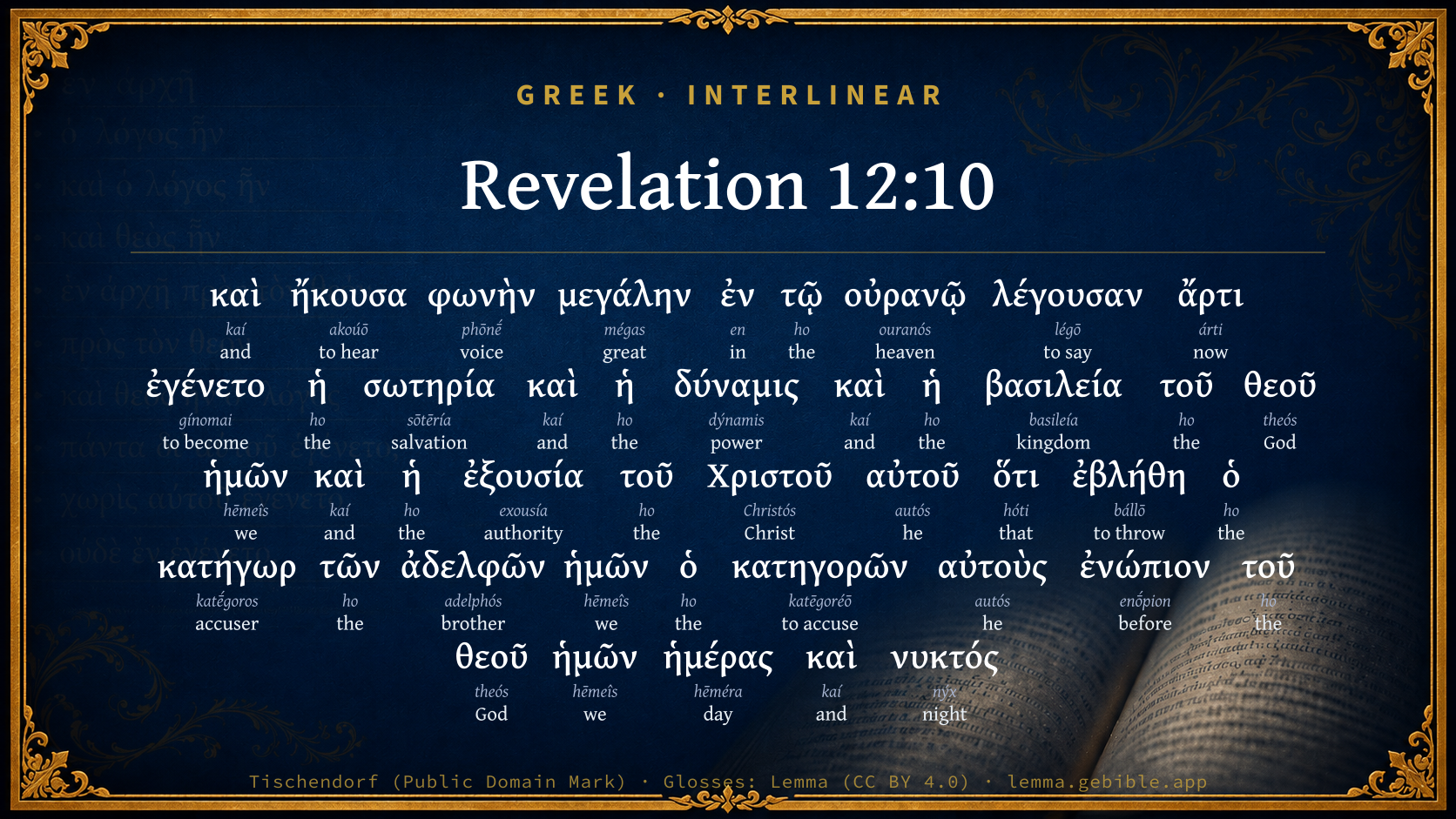
Download image
Cite this verse

Revelation 12:10 (World English Bible). Public Domain. Lemma interlinear Bible study tool, https://lemma.gebible.app/v/revelation/12/10.

Show BibTeX & RIS
BibTeX
RIS
English Translation
I heard a loud voice in heaven, saying, "Now is come the salvation, the power, and the Kingdom of our God, and the authority of his Christ; for the accuser of our brothers has been thrown down, who accuses them before our God day and night.
World English Bible · Public Domain
Download a study sheet

One document with this verse’s original text, its word-by-word gloss line, the meaning frame, cross-references with their text, attributed commentary, and full source and license credits — printable, and it pastes into notes with its structure intact.

This verse Autodidact and up

Study sheet (.html) Plain text (.txt)

A passage Seminary Student

Up to 50 verses in one chapter. A passage sheet keeps up to 6 commentary sources and 12 cross-references per verse, in the order this page ranks them, and says so on the sheet whenever that leaves anything out. Ask for a single verse and you get the Autodidact verse sheet above.

Everything on this page stays free to read, with no account — the sheet is a download of what is already on screen, not access to it.

Want to remove ads? Support Godless Engineer
Compare translations 3

The same verse in 3 English versions, stacked beneath the original-language interlinear above. Click any original word for its lexicon entry.

Each is an independent rendering of the whole verse — the interlinear is not word-aligned to these translations.

Highlighted words mark where these versions differ — a whole-verse word diff, not a word-by-word alignment.

  • World English Bible Public Domain
    I heard a loud voice in heaven, saying, "Now is come the salvation, the power, and the Kingdom of our God, and the authority of his Christ; for the accuser of our brothers has been thrown down, who accuses them before our God day and night.
  • King James Version Public Domain
    And I heard a loud voice saying in heaven, Now is come salvation, and strength, and the kingdom of our God, and the power of his Christ: for the accuser of our brethren is cast down, which accused them before our God day and night.
  • unfoldingWord Literal Text CC BY-SA 4.0
    And I heard a loud voice in heaven saying, “Now have come the salvation and the power and the kingdom of our God, and the authority of his Christ, because the accuser of our brothers has been thrown down, the one accusing them before our God day and night.

unfoldingWord Literal Text — © unfoldingWord, licensed CC BY-SA 4.0. Word-aligned USFM3 via Door43 (git.door43.org/unfoldingWord/en_ult).

Versions to compare (up to 4)

3 of 4 selected

Show all 19 translations

Every available English version of this verse, each an independent rendering of the whole verse.

  • World English Bible Public Domain
    I heard a loud voice in heaven, saying, "Now is come the salvation, the power, and the Kingdom of our God, and the authority of his Christ; for the accuser of our brothers has been thrown down, who accuses them before our God day and night.
  • Berean Standard Bible Public Domain
    And I heard a loud voice in heaven saying: “Now have come the salvation and the power and the kingdom of our God, and the authority of His Christ. For the accuser of our brothers has been thrown down—he who accuses them day and night before our God.
  • Majority Standard Bible Public Domain
    And I heard a loud voice in heaven saying: “Now have come the salvation and the power and the kingdom of our God, and the authority of His Christ. For the accuser of our brothers has been thrown down—he who accuses them day and night before our God.
  • King James Version Public Domain
    And I heard a loud voice saying in heaven, Now is come salvation, and strength, and the kingdom of our God, and the power of his Christ: for the accuser of our brethren is cast down, which accused them before our God day and night.
  • American Standard Version (1901) Public Domain
    And I heard a great voice in heaven, saying, Now is come the salvation, and the power, and the kingdom of our God, and the authority of his Christ: for the accuser of our brethren is cast down, who accuseth them before our God day and night.
  • Revised Version (1885) Public Domain
    And I heard a great voice in heaven, saying, Now is come the salvation, and the power, and the kingdom of our God, and the authority of his Christ: for the accuser of our brethren is cast down, which accuseth them before our God day and night.
  • Geneva Bible (1599) Public Domain
    Then I heard a loude voyce in heauen, saying, Now is saluation, and strength, and the kingdome of our God, and the power of his Christ: for the accuser of our brethren is cast downe, which accused them before our God day and night.
  • Douay-Rheims (1899) Public Domain
    And I heard a loud voice in heaven, saying: Now is come salvation, and strength, and the kingdom of our God, and the power of his Christ: because the accuser of our brethren is cast forth, who accused them before our God day and night.
  • Young's Literal Translation Public Domain
    And I heard a great voice saying in the heaven, `Now did come the salvation, and the power, and the reign, of our God, and the authority of His Christ, because cast down was the accuser of our brethren, who is accusing them before our God day and night;
  • Literal Standard Version CC BY-SA 4.0
    And I heard a great voice saying in Heaven, “Now came the salvation, and the power, and the kingdom, of our God, and the authority of His Christ, because the accuser of our brothers was cast down, who is accusing them before our God day and night;
  • Unlocked Literal Bible CC BY-SA 4.0
    Then I heard a loud voice in heaven: “Now have come the salvation and the power and the kingdom of our God, and the authority of his Christ. For the accuser of our brothers has been thrown down, the one who accused them before our God day and night.
  • unfoldingWord Literal Text CC BY-SA 4.0
    And I heard a loud voice in heaven saying, “Now have come the salvation and the power and the kingdom of our God, and the authority of his Christ, because the accuser of our brothers has been thrown down, the one accusing them before our God day and night.
  • Darby Bible Public Domain
    And I heard a great voice in the heaven saying, Now is come the salvation and the power and the kingdom of our God, and the authority of his Christ; for the accuser of our brethren has been cast out, who accused them before our God day and night:
  • World Messianic Bible Public Domain
    I heard a loud voice in heaven, saying, “Now the salvation, the power, and the Kingdom of our God, and the authority of his Messiah has come; for the accuser of our brothers has been thrown down, who accuses them before our God day and night.
  • Webster's Bible Public Domain
    And I heard a loud voice saying in heaven, Now is come salvation, and strength, and the kingdom of our God, and the power of his Christ: for the accuser of our brethren is cast down, who accused them before our God day and night.
  • Free Bible Version CC BY-SA 4.0
    Then I heard a loud voice in heaven saying, “Now salvation has come, and power, and the kingdom of our God, and the authority of his Christ. The Accuser of the believers has been thrown down—the one who accuses them in God's presence day and night.
  • Bible in Basic English Public Domain
    And a great voice in heaven came to my ears, saying, Now is come the salvation, and the power, and the kingdom of our God, and the authority of his Christ: because he who says evil against our brothers before our God day and night is forced down.
  • Text-Critical English NT CC BY 4.0
    Then I heard a loud voice in heaven saying, “The salvation, power, and kingdom of our God, and the authority of his Christ, have now come. For the accuser of our brothers has been thrown down, he who accuses them day and night before our God.
  • Tyndale New Testament (1534) Public Domain
    And I harde a lowde voyce sayinge: in heven is nowe made salvacion and strengthe and the kyngdome of oure God and the power of his Christ For he is cast doune which accused them before god daye and nyght.

Literal Standard Version (2020), Covenant Press — licensed CC BY-SA 4.0. Text via the HelloAO Bible API (eBible.org). Unlocked Literal Bible (unfoldingWord) — licensed CC BY-SA 4.0. Text via the HelloAO Bible API (eBible.org). unfoldingWord Literal Text — © unfoldingWord, licensed CC BY-SA 4.0. Word-aligned USFM3 via Door43 (git.door43.org/unfoldingWord/en_ult). Free Bible Version, Dr. Jonathan Gallagher — licensed CC BY-SA 4.0. Text via the HelloAO Bible API (eBible.org).

Word by word

More ways to search: Search by grammar → Find every occurrence → Compare this word →

Practice this passage: Drill this verse → Learn its vocabulary →

κατήγωρ
katḗgoros
G2725
“accuser”
Noun, Nominative, Singular, Masculine
Part of Speech
Noun
Case
Nominative
Number
Singular
Gender
Masculine
Full Thayer's Definition

Origin: from G2596 and G58

TDNT: 13:36,4

1. an accuser a. a name given to the devil by the rabbis
  1. καὶ kaí G2532 “and” Conjunction
  2. ἤκουσα akoúō G191 “to hear” Verb, Aorist, Active, Indicative, 1st person, Singular
  3. φωνὴν phōnḗ G5456 “voice” Noun, Accusative, Singular, Feminine
  4. μεγάλην mégas G3173 “great” Adjective, Accusative, Singular, Feminine
  5. ἐν en G1722 “in” Preposition
  6. τῷ ho G3588 “the” Article, Dative, Singular, Masculine
  7. οὐρανῷ ouranós G3772 “heaven” Noun, Dative, Singular, Masculine
  8. λέγουσαν légō G3004 “to say” Verb, Present, Active, Participle, Accusative, Singular, Feminine
  9. ἄρτι árti G737 “now” Adverb
  10. ἐγένετο gínomai G1096 “to become” Verb, Aorist, Middle deponent, Indicative, 3rd person, Singular
  11. ἡ ho G3588 “the” Article, Nominative, Singular, Feminine
  12. σωτηρία sōtēría G4991 “salvation” Noun, Nominative, Singular, Feminine
  13. καὶ kaí G2532 “and” Conjunction
  14. ἡ ho G3588 “the” Article, Nominative, Singular, Feminine
  15. δύναμις dýnamis G1411 “power” Noun, Nominative, Singular, Feminine
  16. καὶ kaí G2532 “and” Conjunction
  17. ἡ ho G3588 “the” Article, Nominative, Singular, Feminine
  18. βασιλεία basileía G932 “kingdom” Noun, Nominative, Singular, Feminine
  19. τοῦ ho G3588 “the” Article, Genitive, Singular, Masculine
  20. θεοῦ theós G2316 “God” Noun, Genitive, Singular, Masculine
  21. ἡμῶν hēmeîs G2249 “we” Personal pronoun, 1st person, Genitive, Plural
  22. καὶ kaí G2532 “and” Conjunction
  23. ἡ ho G3588 “the” Article, Nominative, Singular, Feminine
  24. ἐξουσία exousía G1849 “authority” Noun, Nominative, Singular, Feminine
  25. τοῦ ho G3588 “the” Article, Genitive, Singular, Masculine
  26. Χριστοῦ Christós G5547 “Christ” Noun, Genitive, Singular, Masculine
  27. αὐτοῦ autós G846 “he” Personal pronoun, Genitive, Singular, Masculine
  28. ὅτι hóti G3754 “that” Conjunction
  29. ἐβλήθη bállō G906 “to throw” Verb, Aorist, Passive, Indicative, 3rd person, Singular
  30. ὁ ho G3588 “the” Article, Nominative, Singular, Masculine
  31. τῶν ho G3588 “the” Article, Genitive, Plural, Masculine
  32. ἀδελφῶν adelphós G80 “brother” Noun, Genitive, Plural, Masculine
  33. ἡμῶν hēmeîs G2249 “we” Personal pronoun, 1st person, Genitive, Plural
  34. ὁ ho G3588 “the” Article, Nominative, Singular, Masculine
  35. κατηγορῶν katēgoréō G2723 “to accuse” Verb, Present, Active, Participle, Nominative, Singular, Masculine
  36. αὐτοὺς autós G846 “he” Personal pronoun, Accusative, Plural, Masculine
  37. ἐνώπιον enṓpion G1799 “before” Adverb
  38. τοῦ ho G3588 “the” Article, Genitive, Singular, Masculine
  39. θεοῦ theós G2316 “God” Noun, Genitive, Singular, Masculine
  40. ἡμῶν hēmeîs G2249 “we” Personal pronoun, 1st person, Genitive, Plural
  41. ἡμέρας hēméra G2250 “day” Noun, Genitive, Singular, Feminine
  42. καὶ kaí G2532 “and” Conjunction
  43. νυκτός nýx G3571 “night” Noun, Genitive, Singular, Feminine

About this verse

These counts appear in no published source. They are computed here, from the morphology-tagged text and Lemma’s own curated glosses. What Lemma adds →

44
words
26
distinct lemmas
Revelation
section

Notable vocabulary

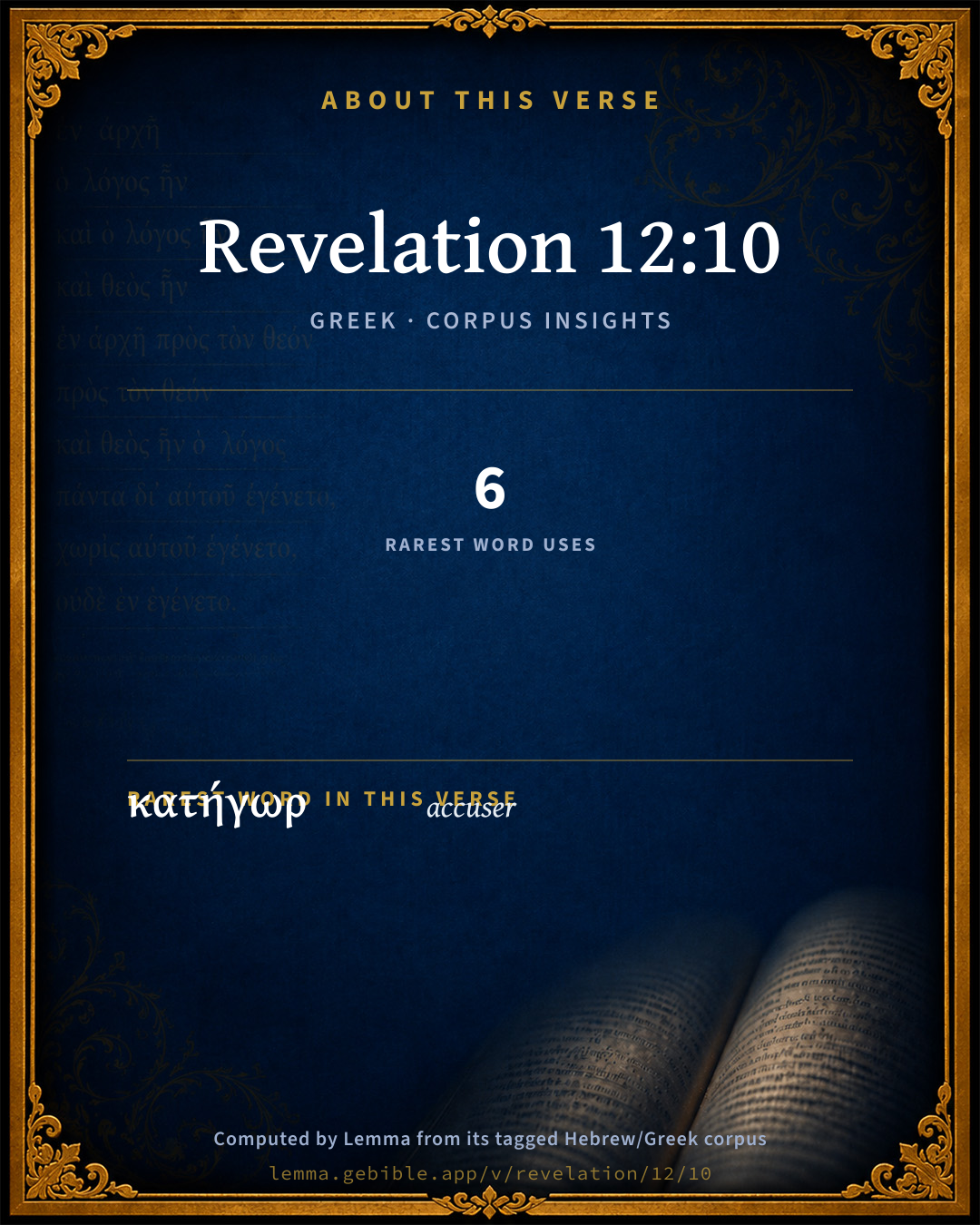
The rarest word here is κατήγωρ accuser G2725 — appearing just 6 times in the whole Greek New Testament.

Shared distinctive vocabulary

κατήγωρ accuser G2725 occurs in 6 verses of the Greek New Testament. Also found in:

Repetition

Words recur within this verse:

Cross-references

23

Topical passages linked to Revelation 12:10 in the Treasury of Scripture Knowledge — connected by theme and wording, ordered by reader-vote popularity; previews shown in the World English Bible.

  • Zechariah 3:1–2 He showed me Joshua the high priest standing before the angel of Yahweh, and Satan standing at his right hand to be his adversary.
  • Luke 22:31 The Lord said, "Simon, Simon, behold, Satan asked to have you, that he might sift you as wheat,
  • Revelation 11:15 The seventh angel sounded, and great voices in heaven followed, saying, "The kingdom of the world has become the Kingdom of our Lord, and of his Christ. He will reign forever and ever!"
  • Daniel 2:44 In the days of those kings shall the God of heaven set up a kingdom which shall never be destroyed, nor shall the sovereignty of it be left to another people; but it shall break in pieces and consume all these kingdoms, and it shall stand forever.
  • 1 Chronicles 29:11 Yours, Yahweh, is the greatness, the power, the glory, the victory, and the majesty: for all that is in the heavens and in the earth is yours. Yours is the kingdom, Yahweh, and you are exalted as head above all.
  • Matthew 28:18 Jesus came to them and spoke to them, saying, "All authority has been given to me in heaven and on earth.
  • Job 1:9 Then Satan answered Yahweh, and said, "Does Job fear God for nothing?
  • Job 1:11 But put forth your hand now, and touch all that he has, and he will renounce you to your face."
  • Psalms 2:8–12 Ask of me, and I will give the nations for your inheritance, The uttermost parts of the earth for your possession.
  • 2 Corinthians 12:9 He has said to me, "My grace is sufficient for you, for my power is made perfect in weakness." Most gladly therefore I will rather glory in my weaknesses, that the power of Christ may rest on me.
  • Revelation 2:26 He who overcomes, and he who keeps my works to the end, to him I will give authority over the nations.
  • Job 2:5 But put forth your hand now, and touch his bone and his flesh, and he will renounce you to your face."
  • Psalms 22:28 For the kingdom is Yahweh's. He is the ruler over the nations.
  • Psalms 145:11–13 They will speak of the glory of your kingdom, And talk about your power;
  • 1 Corinthians 5:4 In the name of our Lord Jesus Christ, you being gathered together, and my spirit, with the power of our Lord Jesus Christ,
  • Revelation 19:1–7 After these things I heard something like a loud voice of a great multitude in heaven, saying, "Hallelujah! Salvation, power, and glory belong to our God:
  • Psalms 45:6 Your throne, God, is forever and ever. A scepter of equity is the scepter of your kingdom.
  • Matthew 6:10 Let your Kingdom come. Let your will be done, as in heaven, so on earth.
  • Matthew 26:64 Jesus said to him, "You have said it. Nevertheless, I tell you, henceforth you will see the Son of Man sitting at the right hand of Power, and coming on the clouds of the sky."
  • Luke 11:2 He said to them, "When you pray, say, 'Our Father in heaven, May your name be kept holy. May your Kingdom come. May your will be done on Earth, as it is in heaven.
  • Titus 2:3 and that older women likewise be reverent in behavior, not slanderers nor enslaved to much wine, teachers of that which is good;
  • Psalms 110:5–6 The Lord is at your right hand. He will crush kings in the day of his wrath.
  • Revelation 7:10 They cried with a loud voice, saying, "Salvation be to our God, who sits on the throne, and to the Lamb!"

Cross-references courtesy of OpenBible.info (CC BY 4.0).

Commentary

Notes on Revelation 12:10 from classic Christian and Jewish commentators (each source and its license shown beneath its notes). The classic Christian expositions comment on the surrounding passage and are grouped to its opening verse, so a note may address several verses; the Jewish commentaries on the Tanakh (Rashi and others) are per-verse, so they appear only where the commentator wrote on this verse.

Lemma curates 59 commentaries, every one of them public domain or Creative Commons licensed, each selected and text-cleaned for this edition rather than reprinted as found. About our sources →

Albert Barnes' Notes on the Bible

And I heard a loud voice saying in heaven - The great enemy was expelled; the cause of God and truth was triumphant; and the conquering hosts united in celebrating the victory. This representation of a song, consequent on victory, is in accordance with the usual representations in the Bible. See the song of Moses at the Red Sea, Exo. 15; the song of Deborah, Judg. 5; the song of David when the Lord had delivered him out of the hand of all his enemies, 2 Sam. 22; and Isa 12:25. On no occasion could such a song be more appropriate than on the complete routing and discomfiture of Satan and his rebellious hosts. Viewed in reference to the time here symbolized, this would relate to the certain triumph of the church and of truth on the earth; in reference to the language, there is an allusion to the joy and triumph of the heavenly hosts when Satan and his apostate legions were expelled.

Now is come salvation - That is, complete deliverance from the power of Satan.

And strength - That is, now is the mighty power of God manifested in casting down and subduing the great enemy of the church.

And the kingdom of our God - The reign of our God. See the notes on Mat 3:2. That is now established among people, and God will henceforward rule. This refers to the certain ultimate triumph of his cause in the world.

And the power of his Christ - His anointed; that is, the kingdom of Christ as the Messiah, or as anointed and set apart to rule over the world. See the notes on Mat 1:1.

For the accuser of our brethren is cast down - The phrase “our brethren” shows by whom this song is celebrated. It is sung in heaven; but it is by those who belonged to the redeemed church, and whose brethren were still suffering persecution and trial on the earth. It shows the tenderness of the tie which unites all the redeemed as brethren, whether on earth or in heaven; and it shows the interest which they “who have passed the flood” have in the trials, the sorrows, and the triumphs of those who are still upon the earth. We have here another appellation given to the great enemy - “accuser of the brethren.” The word used here - κατήγορος katēgoros, in later editions of the New Testament κατήγωρ katēgōr - means properly “an accuser,” one who blames another, or charges another with crime. The word occurs in Joh 8:10; Act 23:30, Act 23:35; Act 24:8; Act 25:16, Act 25:18; Rev 12:10, in all which places it is rendered “accuser” or “accusers,” though only in the latter place applied to Satan. The verb frequently occurs, Mat 12:10; Mat 27:12; Mar 3:2; Mar 15:3, et al.

The description of Satan as an accuser accords with the opinion of the ancient Hebrews in regard to his character. Thus he is represented in Job 1:9-11; Job 2:4-5; Zec 3:1-2; 1Ch 21:1. The phrase “of the brethren” refers to Christians, or to the people of God; and the meaning here is, that one of the characteristics of Satan - a characteristic so well known as to make it proper to designate him by it - is that he is an accuser of the righteous; that he is employed in bringing against them charges affecting their character and destroying their influence. The propriety of this appellation cannot be doubted. It is, as it has always been, one of the characteristics of Satan - one of the means by which he keeps up his influence in the world - to bring accusations against the people of God. Thus, under his suggestions, and by his agents, they are charged with hypocrisy; with insincerity; with being influenced by bad motives; with pursuing sinister designs under the cloak of religion; with secret vices and crimes. Thus it was that the martyrs were accused; thus it is that unfounded accusations are often brought against ministers of the gospel, palsying their power and diminishing their influence, or that when a professed Christian falls the church is made to suffer by an effort to cast suspicion on all who bear the Christian name. Perhaps the most skillful thing that Satan does, and the thing by which he most contributes to diminish the influence of the church, is in thus causing “accusations” to be brought against the people of God.

Is cast down - The period here referred to was, doubtless, the time when the church was about to be established and to flourish in the world, and when accusations would be brought against Christians by various classes of calumniators and informers. It is well known that in the early ages of Christianity crimes of the most horrid nature were charged on Christians, and that it was by these slanders that the effort was made to prevent the extension of the Christian church.

Which accused them before our God - See the notes on Job 1:9-10. The meaning is, that he accused them, as it were, in the very presence of God.

Day and night - He never ceased bringing these accusations, and sought by the perseverance and constancy with which they were urged to convince the world that there was no sincerity in the church and no reality in religion.

Albert Barnes' Notes on the Bible (1834–1885) — public domain. Text from a community e-Sword/MySword module.

The Biblical Illustrator

Joseph S. Exell

Rev_12:10-17

Now is come salvation.

The heavenly song of victory

This is a song of heaven--of that heaven from which the dragon had been cast out.

I. The salvation. It is the salvation that is here sung of--the salvation of Him whose name is Jesus, the Saviour. It is salvation--not consisting of one blessing or one kind of blessing, but of many; made up of everything which can be indicated by the reversal of our lost condition. It is not done at once, but in parts and at sundry times, each age bringing with it more of salvation in every sense; unfolding it, building it up, gathering in new objects, overcoming new enemies, occupying new ground, erecting new trophies.

II. The power. This is the more common rendering of the word (not strength), as when Christs miracles are spoken of, or the powers of the world to come. As yet Gods power has not been fully manifested; it has been hidden. Many trophies, no doubt, it has won; many enemies it has defeated; many brands it has plucked from the burning; but the full revelation of its greatness is yet to come. When that day arrives, earth as well as heaven shall rejoice.

III. The kingdom of our God. It is the kingdom--the kingdom of kingdoms; not of Satan or man, as now, but of God, nay, our God. Our God, says heaven; our God, re-echoes earth.

IV. The authority of His Christ. The Christ of God is the full name for Jesus of Nazareth--Gods Messiah--He in whom all royal, priestly, judicial, prophetical power is invested. To this Messiah all power has been given, all authority entrusted, in heaven, and earth, and hell. (H. Bonar, D. D.)

Victory

1. By this song of thanksgiving we see what should be our rejoicing and duty in thanking God in like manner; to wit, that Christ, His Church and cause prevails; and that Satan and his instruments are foiled.

2. When the former prevail, we see the great benefit to man that redounds thereby; to wit, salvation comes, and strength, and the kingdom of our God to reign in mens hearts, and the power of His Christ to be seen in their lives.

3. Whereas it is said that the accuser of the brethren is cast down; then as it is said (Isa_1:9; Rom_8:33), who is it that can condemn, or lay anything to the charge of the Lords elect? It is He that helps and justifies us, and has cast down the accuser of the brethren.

4. Here is a great comfort likewise, that there is such a sweet communion between the glorious saints in heaven and the Church militant on earth; that when they speak of God they say, our God, and when of the Church on earth, our brethren. (Wm. Guild, D. D.)

The accuser of our brethren is cast down.

The accuser of the brethren

I. The accuser. The accuser, in this instance, is the enemy of our souls. An accuser need not necessarily be a foe--a friend may accuse; but his relationship to us depends upon the object he has in view by accusing us. If his intention be to harass and vex the accused, then he is an enemy; but if his design be to reform, then, indeed, he is a friend. Though the law accuses, the law is not our enemy. The law is our schoolmaster to bring us unto Christ. But the design of Satan in accusing the saints is to afflict them, and not that he may induce them to amend their ways; it is not zeal for the glory of God that urges him to blame them for their remissness; he merely takes advantage of their failings to molest them.

II. The accused. The brethren. He does not accuse his own subjects. He commends in them the works which in the children of God he censures. It is better for us that he should be our censor than that he should be our vindicator; preferable that he should impeach us than that he should be our advocate.

III. The accusation. The impeachments of Satan, however fictitious they may be found to be in the aggregate, always have a sprinkling of the truth in them; just so much as will give an air of justness to the whole; for our arch-enemy is well aware that falsehood in and of itself cannot injure. Were they charged with neglecting Gods house the accusation would be false, and consequently would not affect them; but when they are accused of alienating their affections from God, they feel the justness of the charges and are grieved--there is sufficient force in the accusation to afflict their conscience. A slander was never known to be either wholly true or entirely false. Satan is incapable of telling the truth as truth. It were as impossible for him to confine himself wholly to it as that the sun should shed showers of rain, or that water should burn. He is the father of lies; but he makes use of the truth to keep his inventions together. It is difficult to detect his devices and contrivances--he is capable of transforming himself into an angel of light. Yea, he usurps even the functions of the Holy Spirit; he approaches the Christian while he is meditating upon his performances, and insidiously breathes his charges of lukewarmness and worldliness, causing his heart to bleed thereby. Neither is he to be recognised by the doctrines he inculcates. What measures does the Holy Spirit make use of in convincing the sinner of his wickedness? Does He show the evil of sin? Satan also does this. Does He point to the stringency and rigour of the law? So does Satan. But although he is not recognisable in his doctrines, he may be easily detected in the inferences which he draws from those doctrines. The conclusions which he invariably draws from his teachings are couched in such language as the following: Firstly, thy sins are too great to be forgiven. Secondly, thou mayest as well suffer punishment for much as for little. Thirdly, God is very unrelenting.

IV. The tribunal. It is not to be imagined that Satan gains admittance into heaven, there to lay his charges against the saints, because he has been eternally banished thence. Neither is it by any means probable that, were permission granted him to enter there, he would avail himself of it. And the reason of this is quite plain. He that bruised his head sits triumphant there. His design is to create enmity between God and His children; his purpose is to effect a breach between the saints and their heavenly Father. He endeavours to embitter their spirits when they approach God in meditation and prayer. He strives to weaken their power in prayer, and so to crush their faith as to render it powerless to bear the blessing they came to seek.

V. The victory. They overcame him by the blood of the Lamb. (D. Roberts, D. D.)

Overcoming the accuser

1. The accuser charges the servants of God with guilt. They are not worthy, as he alleges, to stand in the Holy Presence. To this, however, they have a triumphant reply. They do not deny that they have sinned and are unworthy; but they have Gods free gift of pardon since Jesus has died. There is a Rabbinic tradition to the effect that Satan is compelled to refrain from accusations against Israel, and keep silence, on one day of the year--the great Day of Atonement. Though it be a mere legend, it indicates some true perception of the only ground on which the charge of guilt before God can be successfully met. But let us extend the statement. There is no respect of days. The peace of conscience which rests on the blood of the Lamb is not for one day, but for all the days of the year. There is a continual and unfaltering answer of the Satanic accusation.

2. The accuser rails against the servants of God as mere self-seekers. In this respect, wicked men are very like their father the devil. Their base instinct is to suspect and jibe at goodness. All virtue is in their eyes humbug. All who seem to be in earnest for any moral or religious object are seeking praise for themselves, and perhaps money also. Disinterestedness is a dream, and holiness a fraud. So says the devil; and so say his followers. Now it may be impracticable in many instances to meet this odious charge with a complete refutation. A good man cannot prove his inward motives to all the outside world, least of all to those who wish to think the worst. To some, however, both in early and in later times of the Church, opportunity and power have been given to make a triumphant answer to the unworthy accusation of selfishness. They were exposed to cruel persecution, and obliged to show whether their hearts were so knit to Christ that they would lay down their lives for His sake. These overcame because of the word of their testimony. Far from shirking the ordeal, they conquered by their firm endurance. What then could Satan allege?

3. We are not of the noble army of martyrs. But all Christians are called to be martyrs in the sense of witnesses, and all are subjected to some test of fidelity. Yet every one in his own order, and according to the measure of grace which he has received; not the least effective being the little ones that honour the Lord Jesus. (D. Fraser, D. D.)

They overcame him by the blood of the Lamb.--

How they conquered the dragon

I. All the blessed ones who are rejoicing in heaven were once warriors and victors here below. We too often think of the saints that have gone before as if they were men of another race from ourselves, capable of nobler things, endowed with graces which we cannot reach, and adorned with holiness impossible to us. The mediaeval artists were wont to paint the saints with rings of glory about their heads, but indeed they had no such halos; their brows were furrowed with care even as ours, and their hair grew grey with grief. Their light was within, and we may have it; their glory was by grace, and the same grace is available for us.

1. It is clear from our text that every one of the saints in heaven was assailed by Satan. How could there be a victory without a battle?

2. The glorified, in addition to having been attacked, were led to resist the evil one, for nobody overcomes an antagonist without fighting.

3. We find that these warriors all overcame, for heaven is not for those who fight merely, but for those who overcome. I do fight against my sin, says one. Brother, do you overcome it? Attack, resistance, and victory must be yours.

4. So, then, in heaven they all rejoice because they have overcome, for the next verse to our text puts it, Therefore rejoice, ye heavens, and ye that dwell in them. It is a theme for gladness in heaven that they did fight and resist and overcome. There is joy among the angels, for they had their conflict when they stood firm against temptation; but ours will be a victory peculiarly sweet, a song especially melodious, because our battle has been peculiarly severe.

II. The victors all fought with the same weapons.

1. First, the blood of the Lamb: it was theirs. The blood of the Lamb will not help us until it becomes our own. It is the blood of the covenant, and it secures all the covenant gifts of God to us. It is the life of our life. So, then, they had the blood of the Lamb, and they possessed the privilege which the blood brings with it.

2. They overcame him by the blood of the Lamb and by the word of their testimony. Now, what is the testimony of the saints? It is a testimony concerning the blood of the Lamb. If ever we are to conquer Satan in the world, we must preach the atoning blood.

III. While they all fought with the same weapons they all fought with the same spirit; for the text says, they loved not their lives unto the death.

1. The expression indicates dauntless courage. They were never afraid of the doctrine of a bleeding Saviour. Let us never be ashamed of our hope.

2. These men, in addition to dauntless courage, had unanswering fidelity. They loved not their lives unto the death. They thought it better to die than deny the faith.

3. More than that, they were perfect in their consecration. They loved not their lives unto the death. They gave themselves up, body soul, and spirit, to the cause of which the precious blood is the symbol, and that consecration led them to perfect self-sacrifice. No Christian of the true type counts anything to be his own. (C. H. Spurgeon.)

The blood of the Lamb, the conquering weapon

I. What is this conquering weapon?

1. The blood of the Lamb signifies, first, the death of the Son of God. The sufferings of Jesus Christ might be set forth by some other figure, but His death on the Cross requires the mention of blood. The death of Christ is the death of sin and the defeat of Satan, and hence it is the life of our hope, and the assurance of His victory. Because He poured out His soul unto the death, He divided the spoil with the strong.

2. Next, by the blood of the Lamb we understand our Lords death as a substitutionary sacrifice. It is not said that they overcame the arch-enemy by the blood of Jesus, or the blood of Christ, but by the blood of the Lamb; and the words are expressly chosen because, under the figure of a lamb, we have set before us a sacrifice. Sin must be punished; it is punished in Christs death. Here is the hope of men.

3. Furthermore, I understand by the expression, The blood of the Lamb, that our Lords death was effective for the taking away of sin. When John the Baptist first pointed to Jesus, he said, Behold the Lamb of God, which taketh away the sin of the world. Our Lord Jesus has actually taken away sin by His death.

II. I have shown you the sword; now I come to speak to the question, how do you use it? They overcame him by the blood of the Lamb. When a man gets a sword, you cannot be quite certain how he will use it. A gentleman has purchased a very expensive sword with a golden hilt and an elaborate scabbard; he hangs it up in his hall, and exhibits it to his friends. Occasionally he draws it out from the sheath, and he says, Feel how keen is the edge! The precious blood of Jesus is not meant for us merely to admire and exhibit. We must not be content to talk about it, and extol it, and do nothing with it; but we are to use it in the great crusade against unholiness and unrighteousness, till it is said of us, They overcame him by the blood of the Lamb. Let me show you your battle-field. Our first place of conflict is in the heavenlies, and the second is down below on earth.

1. First, then, you who believe in the blood of Jesus, have to do battle with Satan in the heavenlies; and there you must overcome him by the blood of the Lamb. How? say you. First, you are to regard Satan this day as being already literally and truly overcome through the death of the Lord Jesus. Satan is already a vanquished enemy. By faith grasp your Lords victory as your own, since He triumphed in your nature and on your behalf. I would have you overcome Satan in the heavenlies in another sense: you must overcome him as the accuser. At times you hear in your heart a voice arousing memory and startling conscience; a voice which seems in heaven to be a remembrance of your guilt. All comfort drawn from inward feelings or outward works will fall short; but the bleeding wounds of Jesus will plead with overwhelming argument, and answer all. Still further, the believer will have need to overcome the enemy in the heavenly places in reference to access to God. The sacred name of Jesus is one before which he flees. This will drive away his blasphemous suggestions and foul insinuations better than anything that you can invent. We next must overcome the enemy in prayer.

2. It is time that I now showed you how this same fight is carried on on earth. Amongst men in these lower places of conflict saints overcome through the blood of the Lamb by their testimony to that blood. Every believer is to bear witness to the atoning sacrifice and its power to save. He is to tell out the doctrine; he is to emphasise it by earnest faith in it; and he is to support it and prove it by his experience of the effect of it. You can bear witness to the power of the blood of Jesus in your own soul. If you do this, you will overcome men in many ways. First, you will arouse them out of apathy. This age is more indifferent to true religion than almost any other. The sight of the bleeding Saviour overcomes obduracy and carelessness. The doctrine of the blood of the Lamb prevents or scatters error. I do not think that by reason we often confute error to any practical purpose. We may confute it rhetorically and doctrinally, but men still stick to it. But the doctrine of the precious blood, when it once gets into the heart, drives error out of it, and sets up the throne of truth. We also overcome men in this way, by softening rebellious hearts. Men stand out against the law of God, and defy the vengeance of God; but the love of God in Christ Jesus disarms them. The Holy Spirit causes men to yield through the softening influence of the Cross. How wonderfully this same blood of the Lamb overcomes despair. Glory be to God, the blood is a universal solvent, and it has dissolved the iron bars of despair, until the poor captive conscience has been able to escape. There is nothing, indeed, which the blood of the Lamb will not overcome; for see how it overcomes vice, and every form of sin. The world is foul with evil. What can cleanse it? What but this matchless stream? Satan makes sin seem pleasure, but the Cross reveals its bitterness. This blood overcomes the natural lethargy of men towards obedience; it stimulates them to holiness. If anything can make a man holy it is a firm faith in the atoning sacrifice. When a man knows that Jesus died for him, he feels that he is not his own, but bought with a price, and therefore he must live unto Him that died for him and rose again. (C. H. Spurgeon.)

The Churchs victory

I. The churchs victory. The Church is here set before us in a state of triumph, having conquered all its enemies and received its reward.

II. The medium through which this victory is obtained, They overcame him by the blood of the Lamb.

III. The connection that subsists between the means and the end of the conflict.

1. The blood of the Lamb is the source of the disposition which regenerated men feel when entering upon this spiritual warfare.

2. It is the blood of the sacrifice that perpetuates the conflict, by carrying on the sanctification of the soul.

3. The blood of the Lamb alone can inspire fortitude and courage for this conflict.

4. The blood of the Lamb is the only source of spiritual life, and therefore they conquer by it. It was not spilt as water upon the ground, it was the opening of the fountain of immortality for the soul of man.

5. By the blood of the Lamb they learned the example of conflicting to the death, and gathered the assurance of a glorious triumph beyond it. Two things will tend to make a man a good soldier--a readiness to leave his body a corpse on the battlefield, and a thorough conviction that ultimately his cause must succeed. Both are requisite in the spiritual strife. (John Aldis.)

The encouragement to increased missionary effort to be derived from the assurance of final victory

I. We shall never be aroused to magnanimous efforts till we have a clear apprehension of the invisible enemy who foments all the opposition against Christ and His gospel.

1. In the general description, mark, first, his deadly hatred to God and goodness, implied in the names Satan, the Enemy, the Adversary, the Wicked One. Next, his rage and fury, as the great Red Dragon, the Apollyon or Destroyer. Further, his craft and subtilty, as the Old Serpent, in allusion to the form under which he seduced our first parents. Next, the extent of his dominion, the whole world lying in wickedness, or, in the wicked one.

2. And what is the general method of Satans opposition to Christ, and the salvation of men? His grand vantage-ground is the tendency in human corruption to listen to all his suggestions. He thus works his way unperceived into our hearts.

3. The place where Satan carries on this opposition is set forth in this symbolical passage as his heaven, from the popular notion of heaven as a place of eminence, of ease, safety, and enjoyment. It imports, here, the visible kingdom of Satan in its full pride and power; from which, when he is dispossessed, he is said to be cast down unto the earth.

II. The means of resisting this great adversary.

1. The faithful overcame by the blood of the Lamb; and in what manner did they do this?

(1) By trusting to it for their own salvation;

(2) By proclaiming it to others, as men touched with the love of Him who shed it;

(3) By seeing all the purposes of Almighty God centre in it.

III. The issue of the conflict. They overcame him by the blood of the Lamb. (Bp. Daniel Wilson.)

Missionary conflict and victory

I. Let us consider missions under the aspect of a victory gained.

1. Of course the word implies conflict. The Revelation, resonant with sounds of battle, exhibits the King of Heaven upon earth as engaged in a, struggle. This mode of representation only displays in pictures ideas common to the whole of the New Testament. The Church under the present dispensation is church militant. Let us not despise or underestimate our foe. To follow Christ and to take up His cause anywhere is to challenge the world, the flesh, and the devil.

2. But the point now is that a victory has been won, and this victory is distinguished by two features, celebrated in the song heard by John, which render it extremely interesting and important for those on the threshold of life, whose privilege it is to look forward to service.

(1) The accuser has been cast down, and in his casting down certain practical problems have been solved and doubts swept out of the way. No great and good movement has ever been inaugurated that did not stir up an accuser. He was maliciously busy at the outset of the missionary enterprise, and tried to raise obstacles to harass the timid.

(2) Then, too, in the gospel victories is to be included a beautiful, delightful social revolution, for now is come the kingdom of our God and the authority of His Christ.

II. The principles and instrumentalities whereby this victory was gained.

1. We would not lose sight of the fact that there was war in heaven. We have always had the supernatural support of a leader of invisible legions, whose name, Michael, suggests the question, Who is like unto God? and whose guarantee, conveyed along with the marching orders, is, Lo! I am with you alway unto the consummation of the age.

2. Looking at these words as a whole, we say they intimate conquests gained through dependence on spiritual forces. It was so, we may remind ourselves, in the conflict with the paganism of the ancient Roman world. It would be a mistake to suppose that the triumph of Christianity followed the so-called conversion of Constantine. On the contrary, he gave in his adhesion because Christianity was already on the march, firm and triumphant. The victory had been won, and it was won with the weapons of faith, hope, love, patience, forgiveness, and prayer. So also has it been in the conflict with the paganism of the modern world. God in nature, God in history, and God in grace is one God, and we may expect Him to be making each department of His rule dovetail in some way into the other, in order to the accomplishment of His purposes.

3. Three things are, we take it, specially necessary to meet the fundamental spiritual requirements of the human heart--viz., redemption; revelation; and these mediated and ministered by messengers of intense self-sacrificing sympathies. These are the very elements which are here displayed aa grounds of success.

(1) They overcame because of the blood of the Lamb. Readers must note that in this book, in which the general outlines of Church history are exhibited in symbolic pictures, the blood of the Lamb holds a most prominent place. It precisely forecasts what has happened in the actual event. By the atoning sacrifice of Calvary were the missionaries hearts first set on fire. The provision made in the death of Gods dear Son for meeting their condition as sinners was what deeply agitated, and, like the touch of the live coal from off the altar, flamed through them into the offer and entreaty, Here are we, send us. By the same sacrifice they were sustained in their surrender. The Saviours blood was their life. His dying wounds were not only fountains of expiation and cleansing, but also springs out of which pulsated the streams of life through the lips of faith into their thrilled hearts. Advancing with this experience, it turned out that the story of redemption through His blood was just the good news the heathen needed, and leaped excitedly to welcome.

(2) To meet the cry for light, the ministers of grace delivered the word of their testimony. Observe, testimony. Not an argument, but a testimony; not a denunciation, but a testimony; not a destructive attack, but a testimony; not a peradventure, but a testimony. This testimony, originally received by apostles from Christ and His Spirit, was by them embodied in a word. This word, again tasted and tested through the Spirit of Christ by believers, became in their lips and lives a testimony. They marched to the field with this testimony, a Pentecostal glory mitring their brows and firing their tongues, and breaking out in psalms and hymns and spiritual songs. They knew whom they believed, and, Philip-like, joining themselves unto the chariot of heathendom, they just preached and explained Him of whom every voice of truth in the Vedas also spoke to those in the darkness feeling after an unknown God to be their Shepherd and King.

(3) The third reason does not occupy precisely the same level as the other two. It is not joined to them with because. The proposal to surrender life, standing by itself, would be impotent and fruitless. It is when united with the blood of the Lamb and the word of testimony that it is energised into an important factor in the product. The mode of expression seems based upon a common course in human affairs. A man takes a stand from which it is sought to divert him by threats of poverty, want, and hardship. There are some in whom the love of life is so near the surface, and so sensitive and ready to take alarm, that the above threat would be enough to make it leap to its feet instantly and shriek out, You shall not. Others, however, are not conscious of this love at that point, and the threat does not move them. Then it is represented they will lose caste, be boycotted in society, be shut out of the road which leads to applause and power, and condemned to calumny, reprobation, scorn--or, what is worse, neglect. Some who resisted in the first stage would be sifted out here, whilst a remnant would continue yet untouched and resolute. But now I imagine the ghastly king of terrors drawing nigh to these and compelling them at close quarters to look into his cavernous, cruel face. Proud is this grisly monarch, and omnipotent in his own conceit. But many think that Deaths bark is worse than his bite. I know the prospect is under some conditions appalling, and yet I can fancy those who had stood the first two tests contemplating this almost with contempt. There is, however, another deeper, darker possibility suggested. It is not merely hardship; it is not merely shame; it is not merely physical extinction; it is the sacrifice of the opportunity of self-cultivation for what seems a grander destiny in this world, and even a better, higher standing in the world to come. Many missionaries, like, e.g., Carey and Livingstone, possessed surpassing powers. They would succeed splendidly anywhere. Had they stayed in this country no one can predict the distinction to which they might have risen. To go away, say into the wilds of Africa, as evangelists is to renounce magnificent chances. Nay more. They who feel the loss most will leave the stimulus of Christian society; the bracing impulse of Christian atmosphere; the sweet help of the first day of the week, with its sacred hush and uplifting worship; the very continuance of the life of piety will be imperilled. That education and development of the faculties and qualities of mind and spirit which in itself is so delightful must be relinquished, and, so far as this world is concerned, relinquished for ever. They must cease to love their own soul, and that unto death. I believe that scores of witnesses in all ages, and, thank God, in ours also, have risen to this height; and it is in this way and by this means they have gained the victory. If you want to capture others, you must abandon self. (R. H. Roberts, B. A.)

Victory over the foe

I hope it is possible for a few minutes to interest you in the fortunes of a battle. The fight is fought, and the victory is won. Your troops have engaged and conquered the foe. And we are told they overcame him by three modes and weapons of warfare--the blood of the Lamb, the word of their testimony, and the not loving their life even unto death. The several particulars are striking; their combination is wonderful. They overcame him because of the blood of the Lamb. Strange! But is it not true--true to a history none the less real because it is, in part at least, the history of souls? Is it not true that that Cross of pain and shame has in it the virtue of a thousand times ten thousand victories, compared with which Marathon and Salamis, Trafalgar and Waterloo, were events of temporary and fleeting significance? Is it not true that lives have been remade in their most secret, and yet in their most practical, being--remade for strength, remade for happiness, remade for usefulness, influence, and blessing to other lives, entirely by that sacrifice of the Son of God for sin which is here briefly characterised as the blood of the Lamb? The man who has conquered a besetting sin by reason of the blood of the Lamb is a greater hero, greater in kind as well as in degree, than the man who can count his slain enemies in some death-grapple on the Nile by tens and by twenties. But it is conceivable that there might be in some heart a strong sense of gratitude for the death of the Son of God, which as yet has nothing to say for itself as to a definite work to be done for Him. Therefore the voice from heaven speaks in the second place of the word of their testimony. The Christian owes his victory, secondly, to a word--that is, a message or revelation from God, to the truth of which he himself is witness. We have three thoughts here. First, God has spoken. A word is more than a sound. A word has meaning in it. It is the communication of mind to mind. Word is speech, and speech is, by definition, reason communicating itself. This is why Christ Himself is called by St. John the Word. In Christ God has spoken, not in precept and prohibition only, rather in revelation of will and mind, setting before us the Divine character in human action, and saying, This am I; this be thou. Made, and now remade in My image, bear, act, be this to thy brethren. Thus the word becomes next a testimony. The business of the Christian is witnessing, having, as St. John says, the witness in himself; able from experience, able from consciousness of the power and beauty of the gospel, to set to it his seal that it is true. He goes about his business, speaks his daily speech, does his everyday work, as one who believes, strives not to contradict, not to belie his conviction, lives as its witness, dies as its martyr. And thus, thirdly, he overcomes because of it. The blood of the Lamb is his motive, but the Word of His testimony is his direction. Without this he might be well-intentioned, but he would neither know his enemy nor know how to cope with him. They overcame him, therefore, because of the Word of which they were witnesses. Yet another principal cause remains. They loved not their life even unto death. Contempt for death is a great secret of victory. Even in the perpetration of deeds of darkness, the chance of success is infinitely enhanced by the willingness of the doer to die for it. The assassin who will give life for life is half assured of victory. The text speaks of a nobler strife, that of the Christian victor, and it says of him that side by side with two other things, faith in Christs sacrifice, and faith in Christs word, there stands this reason also for his victory, that he loved not his life. The earthly conqueror must have no friendship for his life in comparison with two other things--duty and honour. The earthly conqueror must have no charity for his life when it tries to stand between him and courage, or between him and the love of his country. Tis the peculiarity of the Christian victor, not always realised, perhaps, to the full, even in him, that, taking all things into account, he has a positive desire--positive desire--to depart and be with Christ. It is not only that there are so many dark features of the world he lives in, it is rather that he knows Someone on the other side of death, whom he longs to be with. He endures as seeing the Invisible, but all the time he is seeking a better country, that is, a heavenly. (Dean Vaughan.)

They loved not their lives unto the death.--

The evidence of Christianity from the persecution of Christians

The progress of Christianity is a most interesting object of speculation, and must appear truly wonderful when it is considered that it prevailed by means the very reverse of what might have been expected, and which have been used to establish other systems of religion or philosophy, and the corruptions of Christianity itself. Other religions had either the aid of power, or at least of the learning of the age and countries in which they were established. The founders of them were either conquerors, legislators, or men who were distinguished in life; so that independently of the doctrines they promulgated, they appeared in a respectable light to the world. On the contrary, the Founder of Christianity was an obscure person, a common mechanic, in a country the inhabitants of which were despised by the rest of the world; without the advantage of any learned education, where the greatest account was made of that advantage, and where persons destitute of it were held in contempt. The first followers of Christ were, in general, of the same low rank of life with Himself, wholly destitute in power, or of policy. They were all their lives persecuted, as He had been, and many of them died violent deaths. What then were the means by which Christianity, thus extraordinarily circumstanced, did make its way in the world, till, in the natural course of things, the very powers which opposed it came to be on its side? They were, as we are informed in my text, the death of the Founder of Christianity, and the testimony of His followers to His doctrine, miracles, and resurrection, sealed with their blood. If we consider the nature of Christianity, and the object of it, we shall see that it could not be established by any other means than these, how ill adapted soever they may, on a superficial view of things, appear to answer the end. What is Christianity but that firm belief in a future life which produces the proper regulation of mans conduct in this? Any attempt to gain belief to this, or any doctrine, by power, would have been unavailing and absurd. It is evident that nothing could make mankind believe that Christ wrought miracles, that He died, and rose from the dead, and therefore that there is a future life, to which themselves will be raised, but the proper evidence of the truth of those facts. And in distant ages, in which persons can have no opportunity of inquiring into the truth of the facts for themselves, the only evidence to them is the full conviction that they who had that opportunity did believe them. Now we cannot imagine in what manner any person can express his firm persuasion of the truth, or the value, of any set of principles, more strongly than by his suffering and dying for them. Still, however, there would have been room to doubt, if they had not persisted in their testimony, and if they had not also had both sufficient opportunity, and sufficient motives to consider lind reconsider the thing. Now the witnesses were numerous, and, living together, they must have had frequent opportunities of conversing with one another on the subject, and of comparing their observations. And surely no motive could be wanting, when all the happiness of their lives, and even life itself, was depending. How satisfactory, then, is the evidence of the truth of Christianity from the testimony of almost all its proper witnesses, as sealed with their blood, and therefore not given without the most deliberate consideration, and in opposition to the strongest inducements to declare the reverse of what they did. How much more convincing is this kind of evidence than that of men who draw their swords in defence of any cause? The man who fights hopes to get the victory, and most probably expects to secure to himself some temporal advantage. It cannot by any means, therefore, be inferred that a man may not fight for a falsehood, provided it promises to be a gainful one. We see, then, the infinite superiority of the pretensions of Christ to those of Mahomet, or of any who have endeavoured to establish a religion by violence. Our Lord, confiding in the power of truth, disclaimed all other aid, and therefore ordered His disciples not to fight, but to die. I would farther observe, that violence in support of truth is utterly contrary to the nature and genius of the Christian religion; and it supposes a temper of mind inconsistent with it, viz., hatred and revenge. And not only should we avoid all actual violence, but everything that approaches to it, as anger and abuse. If calm reasoning fail, these are not likely to succeed. As we must not make use of violence or abuse ourselves, so we should take it patiently when it is offered by others. It is generally a proof that our adversaries have nothing better to offer, and therefore is a presumption that we have truth on our side; and surely the sense of this may well enable us to bear up under any insult to which we may be exposed. A state of persecution has been the lot of truly good men, and especially of all great and distinguished characters whose aim has been to reform abuses, and introduce new light into the minds of men, in all ages. (J. Priestley, LL. D.)

Love triumphant

Geleazius, a gentleman of great wealth, who suffered martyrdom at St. Angelo, in Italy, being much entreated by his friends to recant, and thus save his life, replied, Death is much sweeter to me with the testimony of truth, than life with its least denial:

The Biblical Illustrator, edited by Joseph S. Exell (c. 1880s–1900s) — public domain. Text from a community e-Sword module.

Tyndale Open Study Notes

Tyndale Open Resources

12:10-11 Satan’s defeat is encouraging for Christians who, like the recipients of Revelation, are not afraid to die (see John 12:24-26).

Tyndale Open Study Notes — © Tyndale Open Resources, licensed CC BY-SA 4.0. Text via the HelloAO Bible API.

Bengel's Gnomon

Johann Albrecht Bengel

Rev 12:10. Ἀρτι, now) This particle teaches most evidently, that this twelfth chapter, from its very beginning, refers to the trumpet of the seventh angel; for the voice which was heard immediately under the sound of that trumpet, ch. Rev 11:15, respecting the kingdom, is here repeated with a remarkable increase of meaning by the figure, Epitasis [see Append.]; nor can it by any means be placed before this trumpet in particular. The accuser attacked the citizens, and not the king. Moreover, the latter part of the twelfth chapter, has a most close coherence with this very passage. In ch. Rev 2:15-18, these things are set forth, which this most important trumpet comprises; in Rev 2:19, and ch. 12–22 is an Exergasia [see Append. “Epexegesis.”], and copious description of its accomplishment.—ὁ κατήγωρ[127]) A name naturalized and adopted even in the East, and so used by the Syriac translator in this passage. Therefore in this very place it is not used as a Greek word (as Camero remarks), but as a Hebrew word, the purely Greek synonym, Ὁ ΚΑΤΗΓΟΡῶΝ, following. The two languages are joined together, as in Rev 12:9, and repeatedly in this book, which has reference to both Israelites and Gentiles. See Schoettgen, Hor. Hebr. p. 1120, and those winch follow; where also the office of Michaël, and the appellation, old serpent, are illustrated from the writings of the Hebrews.

[127] Κατήγωρ, A. Κατήγορος, BC and Rec. Text.—E.

Bengel's Gnomon of the New Testament — English translation (T&T Clark, Edinburgh, 1860) — public domain. Text from a community e-Sword module.

Meyer's Critical & Exegetical Commentary

Heinrich August Wilhelm Meyer

Rev_12:10-12. A loud voice in heaven[3113] celebrates the victory which has just occurred before the eye of the seer, over the adversary of Christ and his kingdom (Rev_12:10-12 a), as one in which believers also are to participate, Rev_12:10; but this voice proclaims, also, woe to the whole earth, because the dragon cast out upon it will make use of the short time given him for his wrath (Rev_12:12 b).

ἄρτι, now, since the victory over the dragon, Rev_12:8 sq., as also the conclusion from Rev_12:10, ὅτι ἐβλ., κ.τ.λ., once again expressly emphasizes.

ἘΓΈΝΕΤΟ Ἡ ΣΩΤΗΡΊΑ, Κ.Τ.Λ. Incorrectly, Hofm.: God and his Anointed have established their salvation and their power. Also De Wette, who properly refers to Rev_11:15, is incorrect in his remark: There is with respect to the ΣΩΤΗΡΊΑ a sort of zeugma or mingling of thoughts; the sentence, Salvation is God, Rev_7:10, Rev_19:1, becomes in this connection: Now it is shown that the salvation is Gods. De Wette, as also those who have wished to change the meaning of Ἡ ΣΩΤΗΡΊΑ, has correctly felt that it is just the idea of the ΣΩΤΗΡΊΑ whereby the mode of statement in this passage appears more difficult than in the entirely similar passage, Rev_11:15. But precisely as the ΔὙΝΑΜΙς and the ΒΑΣΙΛΕΊΑ, so also the ΣΩΤΗΡΊΑ, i.e., salvation in the specific Christian sense,not victory,[3114] which ΣΩΤΗΡΊΑ does not mean,is beheld with complete objectivity. The salvation, like the kingdom, the strength, and the power, has now become our Gods, since the dragon in heaven has been overcome; now his salvation, his power, his kingdom, are no longer attacked and injured by the violence of the dragon up to this time unbroken, and his power not yet overcome. This is the precise mode of the presentation, along with which the other view also co-exists, that it is essentially and alone Gods salvation, power, and kingdom which God seizes,[3115] or which becomes Gods. The individual ideas are very significant; ἡ σωτηρία is the salvation, not only inasmuch as saints are thereby delivered,[3116]this reference is necessary, nevertheless is too narrow,but[3117] the sum total of all righteousness, blessedness, and holiness, as they have been prepared for the creature by God through his Christ, the ΣΩΤΉΟ, but have been prevented from reaching the same by the dragon, the antichrist. The ΔΎΝΑΜΙς, the power of God, has been manifested in his victory over the dragon;[3118] the ΒΑΣΙΛΕΊΑ, where Gods majesty shows itself,[3119] is the royal glory of God,[3120] which is peculiar to him as the possessor of unconditioned power, and which he displays especially in creation and the imparting of salvation.[3121] The ἘΞΟΥΣΊΑ is ascribed to Gods Christ, because it is the definite, supreme power[3122] peculiar to Gods Christ as such.[3123] The reason for the ascription of praise, ἌΡΤΙ ἘΓΈΝΕΤΟ, Κ.Τ.Λ., lies in what is reported in Rev_12:8-9; for the entire undertaking of the dragon[3124] was nothing else than the truly antichristian attempt to frustrate the ΣΩΤΗΡΊΑ, to bid defiance to the ΔΎΝΑΜΙς of God, to oppose his ΒΑΣΙΛΕΊΑ, and to bring to naught the ἘΞΟΥΣΊΑ of Christ, ay, Christ himself. From a new side, not at all touched in Rev_12:3 sqq., and also very remote from that presentation, is the overcome adversary designated by the appellation Ὁ ΚΑΤΉΓΩΡ Τ. ἈΔΕΛΦ. ἩΜ., Κ.Τ.Λ. The form of the word is Hebraistic: קטיגור. Precisely analogous is the rabbinical designation of Michael as the סביגוד, the ΣΥΝΉΓΩΡ, i.e., ΣΥΝΉΓΟΡΟς, advocate, of the godly.[3125] In the later Greek there is also the analogous form ΔΙΆΚΩΝ for ΔΙΆΚΟΝΟς.[3126]

ΤῶΝ ἈΔΕΛΦῶΝ ἩΜῶΝ. The brethren of those by whom, in a loud voice, the song of praise is raised, are undoubtedly believers in the earthly life, for only they could be exposed to the accusation on the part of Satan; but an inference as to the designation of the heavenly persons who speak of believing men as their brethren is not to be made: it can in no way be decided as to whether the adoring voice proceeds from the angels,[3127] or from the twenty-four elders,[3128] or perhaps from the already perfected saints,[3129]who, however, would not be regarded as saints only of the O. T.[3130] The idea of a perpetual[3131] accusation of the godly on the part of Satan,[3132] which occurs neither in the N. nor the O. T. as an express doctrinal article, is derived and formulated by Jewish theology from Zechariah 3 and Job 1, 2.[3133] The N. T. contains an allusion to that conception only so far as the names ordinarily used in the N. T., ὁ διάβολος and ό σατανᾶς, also ὁ ἀντικείμενος, according to their original significance, point back to the same. In the latter circumstance, sufficient scriptural ground for receiving the accusing activity of Satan in dogmatical seriousness can be acknowledged only if the Scriptures were elsewhere to show expressly that they advocate such definite sense for that name already firmly fixed. But this occurs neither in Job 1, 2, nor in Zechariah 3; for the former mythically fashioned passage does not treat at all of a peculiar accusation, while, according to the nature of the subject, objective reality does not pertain to the vision of the prophet. Scripture, therefore, does not give us a doctrinal article, which would be just as incomprehensible to Christian thought, as the idea of an actual abode of the devil and his angels in heaven.[3134] But as there, so also here, every allegorizing interpretation of the text is to be rejected,[3135] and it is to be decided, according to the analogy of Scripture, that the idea of a perpetual accusation of believers by Satan, derived in its concrete formation from Jewish theology, makes no claim of objective truth, but is to be regarded as a point of the prophetic conception founded in the individuality of John.

[3113] Cf. Rev_11:15; Rev_11:12.

[3114] Eichh., Ew. ii.

[3115] Cf. (Rev_11:17) the τ. δύν. σου in connection with the εἴληφας.

[3116] Beng. Cf. Hengstenb., Ebrard.

[3117] Cf. the similar passages Rev_7:10, Rev_19:1.

[3118] Cf. Beng.

[3119] Beng.

[3120] Rev_11:15; Rev_11:17.

[3121] Cf. Rev_1:6, Rev_5:10.

[3122] Cf. Rev_13:2, where ἐξ. stands for the definite supreme power existent in a commission, office, etc.

[3123] Cf. Rev_13:2, where ἐξ. is with δύναμις; Rev_6:8, Rev_9:3, Rev_11:6, Rev_14:18, Rev_17:18, Rev_20:6, where ἐξ. is used with respect to definite supreme authority lying in a commission, office, etc.

[3124] Rev_12:3 sqq.

[3125] Cf. Schöttg.

[3126] Cf. Wetst.

[3127] Beda, etc.

[3128] Ew. i., etc.

[3129] Ew. ii., according to Rev_6:4 sqq., Rev_7:9 sqq

[3130] Beng.

[3131] ἡμέρας καὶ νυκτός. Cf. Rev_4:8.

[3132] Sohar Levit., p. 43: He always stands as accuser before the king of Israel (in Schöttg.).

[3133] Cf. examples in Schöttg.

[3134] Cf. Rev_12:7 sqq.

[3135] Against Beda: He suggests both that they abuse prosperity, and in adversity do not have patience. De Wette: Satan is at the same time wicked lust and the bad conscience.

Meyer — Critical and Exegetical Commentary on the New Testament — English translation by Peter Christie, edited by Frederick Crombie (T&T Clark, 1880) — public domain. Text from a community e-Sword module.

Expositor's Greek Testament

ed. W. Robertson Nicoll

Rev 12:10 . κατήγωρ ( קטיגוִר ) is the counterpart to the rabbinic (Lueken 22) title of συνήγορος given to Michael as a sort of Greatheart or advocate and protector of men (En. lx. 9). The Aramaic derivation of the word (Win. § 8. 13) is not absolutely necessary, as the papyri show that it might have sprung up on Greek soil ( cf. Thumb, 126; Rademacher, Rhein. Mus. lvii. 148). On the accuser’s rôle cf. Sohar Levit. fol. 43 (ille semper stat tanquam delator coram rege Israelis) and the prayer of Jub. Rev 1:20 : “let not the spirit of Beliar rule over them to accuse them before thee and to turn them deceitfully from all the paths of righteousness” (where both traits are combined, cf. above on 9).

The Expositor's Greek Testament, edited by W. Robertson Nicoll (1897–1910) — public domain. Text from a community e-Sword module.

Geneva Bible (1599)

Geneva Bible translators

The song of victory or triumph containing first, a proposition of the glory of God and of Christ showed in that victory: secondly, it containeth a reason of the same proposition taken from the effects, as that the enemy is overcome in battle in this verse, and that the godly are made conquerors (and more than conquerors, Rom. 8:37) verse 11. Thirdly, a conclusion wherein is an exhortation unto the Angels, and the Saints, and unto the world, a prophecy of great misery, and of destruction procured by the devil against mankind, lest himself should shortly be miserable alone, verse 12.

Geneva Bible (1599) marginal notes — public domain. Text via Bolls.life.

Jamieson, Fausset & Brown

Robert Jamieson, A. R. Fausset & David Brown

Now--Now that Satan has been cast out of heaven. Primarily fulfilled in part at Jesus' resurrection and ascension, when He said (Mat 28:18), "All power [Greek, 'exousia,' 'authority,' as here; see below] is given unto Me in heaven and in earth"; connected with Rev 12:5, "Her child was caught up unto God and to His throne." In the ulterior sense, it refers to the eve of Christ's second coming, when Israel is about to be restored as mother-church of Christendom, Satan, who had resisted her restoration on the ground of her unworthiness, having been cast out by the instrumentality of Michael, Israel's angelic prince (see on Rev 12:7). Thus this is parallel, and the necessary preliminary to the glorious event similarly expressed, Rev 11:15, "The kingdom of this world is become (the very word here, Greek, 'egeneto,' 'is come,' 'hath come to pass') our Lord's and His Christ's," the result of Israel's resuming her place.

salvation, &c.--Greek, "the salvation (namely, fully, finally, and victoriously accomplished, Heb 9:28; compare Luk 3:6, yet future; hence, not till now do the blessed raise the fullest hallelujah for salvation to the Lamb, Rev 7:10; Rev 19:1) the power (Greek, 'dunamis'), and the authority (Greek, 'exousia'; 'legitimate power'; see above) of His Christ."

accused them before our God day and night--Hence the need that the oppressed Church, God's own elect (like the widow, continually coming, so as even to weary the unjust judge), should cry day and night unto Him.

Jamieson, Fausset & Brown — Commentary Critical and Explanatory on the Whole Bible (1871) — public domain (CC PDM 1.0). Text via the HelloAO Bible API.

Adam Clarke's Commentary

Verse 10. The accuser of our brethren] There is scarcely any thing more common in the rabbinical writings than Satan as the accuser of the Israelites. And the very same word κατηγορος, accuser, or, as it is in the Codex Alexandrinus, κατηγωρ, is used by them in Hebrew letters, קטיגור katigor; e. gr., Pirkey Eliezer, c. 46, speaking of the day of expiation; "And the holy blessed God hears their testimony from their accuser, הקטיגור מן min hakkatigor; and expiates the altar, the priests, and the whole multitude, from the greatest to the least."

In Shemoth Rabba, sec. 31, fol. 129, 2, are these words; "If a man observes the precepts, and is a son of the law, and lives a holy life, then Satan stands and accuses him."

"Every day, except the day of expiation Satan is the accuser of men."-Vayikra Rabba, sec. 21, fol. 164.

"The holy blessed God said to the seventy princes of the world, Have ye seen him who always accuses my children?"-Yalcut Chadash, fol. 101, 3.

"The devil stands always as an accuser before the King of Israel."-Sohar Levit., fol. 43, col. 171. See much more in Schoettgen.

NOTES ON CHAP. XII., BY J. E. C.

Ver. 10. And I heard a loud voice, saying,-Now is come salvation, c.] This is a song of triumph of the Christian Church over the heathen idolatry, and is very expressive of the great joy of the Christians upon this most stupendous event. The loud voice of triumph is said to be heard in heaven, to show that the Christian religion was now exalted to the heaven or throne of the Roman. empire. "It is very remarkable," as Bishop Newton observes, "that Constantine himself, and the Christians of his time, describe his conquests under the image of a dragon, as if they had understood that this prophecy had received its accomplishment in him. Constantine himself, in his epistle to Eusebius and other bishops concerning the re-edifying and repairing of the churches, saith that 'liberty being now restored, and that the dragon being removed from the administration of public affairs, by the providence of the great God and by my ministry, I esteem the great power of God to have been made manifest to all.' Moreover, a picture of Constantine was set up over the palace gate, with the cross over his head, and under his feet the great enemy of mankind, who persecuted the Church by means of impious tyrants, in the form of a dragon, transfixed with a dart through the midst of his body, and falling headlong into the depth of the sea." See Eusebius de Vita Constantini, lib. ii. c. 46 and lib. iii. c. 3, and Socratis Hist. Eccles., lib. i. c. 9. Constantine added to the other Roman ensigns the labarum, or standard of the cross, and constituted it the principal standard of the Christian Roman empire. To this labarum Prudentius refers, when speaking of the Christian soldiers, in his first hymn περι στεφανων,

Caesaris vexilla linquunt, eligunt SIGNUM CRUCIS,

Proque ventosis Draconum, quae gerebant, palliis,

Proferunt INSIGNE LIGNUM, quod Draconem subdidit.

"They leave the ensigns of Caesar; they choose the standard of the cross; and instead of the dragon flags which they carried, moved about with the wind, they bring forward the illustrious wood that subdued the dragon."

When the apostle saw the woman in heaven, well might he call it, in the spirit of prophecy, a great wonder.

Adam Clarke's Commentary on the Bible (1810–1826) — public domain. Text from a community e-Sword/MySword module.

Ellicott's Commentary for English Readers

(10) And I heard a loud voice . . .—Better, And I heard a great voice in the heavens saying, Now is come the salvation, and the might, and the kingdom of our God, and the power of his Christ. The definite article is placed before the words “salvation” and “might.” The words of this doxology are like an echo of the close of the Lord’s Prayer. The prayer “Thy kingdom come” seems answered. Now is come the kingdom. But it is not the full establishment of the kingdom which is here described; it is rather the manifestation of it. Since our Master passed into the heavens—and His victory is achieved, we know Him to be King, and even while we pray “Thy kingdom come” we yet confess “Thine is the kingdom”—the salvation so anxiously looked for (1Pe_1:10); the power so much needed by weak and sinful men (1Pe_1:5 and 1Co_1:24); and the kingdom which cannot be shaken (Heb_12:28). The accuser of the brethren is cast down. This is another reason for joy and another feature of the salvation. The habit of the accuser is expressed by the use of the present tense. We should read not “who accused,” but “who accuseth.” Night and day he accused. (Comp. Zec_3:1, and Job_1:9; Job_2:5.) In Jewish writings, Michael is called “the advocate” (sunegor), and stands in opposition to the accuser (kategor); but now the accuser is cast down; for who shall lay anything to the charge of God’s elect, when it is God that justifieth, when it is Christ that died? (Rom_8:33-34.)

A Bible Commentary for English Readers, edited by Charles John Ellicott (1878–1897) — public domain. Text from a community e-Sword module.

The Cambridge Bible for Schools and Colleges

gen. ed. J. J. S. Perowne

10. a loud voice] See on Rev_6:6 : and cf. Rev_11:12 : the word “loud” here is literally “great” as there. Here, “our brethren” seems to imply, that it is a number of angels that speak.

salvation, and strength] Rather, the salvation and the might and the kingdom of.…”

power] Differs from the preceding word “strength” or “might” as implying that it is derivative—cf. 1Co_15:27-28.

the accuser] In Jewish tradition, Satan is spoken of under this title, the Greek word here used being Hebraical, and here, though of course written in Greek letters, it has the Hebraical, not the classical form. St Michael was called by the correlative term, “the Advocate.”

which accused] More literally accuseth, but the context shews that the meaning of the tense is to mark the act as habitual rather than as present. The “Prologue in Heaven” of the Book of Job, and Zec_3:1, of course illustrate the sense.

The Cambridge Bible for Schools and Colleges (gen. ed. J. J. S. Perowne; Cambridge University Press, 1878–1918) — public domain. Text from a community e-Sword module.

John Gill's Exposition

And I heard a loud voice saying in heaven,.... Which was a song of praise on account of the victory obtained by Michael and his angels over the dragon and his, or for the overthrow and downfall of Paganism in the Roman empire; for by "heaven" is meant the empire, now become Christian, or the Christian church state in it; and the "loud voice" heard in it by John shows that there was a great number in it, who rejoiced on this occasion, and that they were full of affection and fervency, and therefore expressed themselves in such manner, and in form following:

now is come salvation and strength, and the kingdom of our God, and the power of his Christ; "salvation" was come when Christ obtained it by his sufferings and death, and comes to particular persons in the effectual calling, and it will only be fully come when it is perfectly enjoyed in heaven: but here it designs a deliverance from Satan, as the god of this world, who was now dethroned, and cast down from his power, authority, and influence in the empire; and from Pagan idolatry and superstition, and from the ten days of tribulation, the cruel and bloody persecutions under the Heathen emperors; and denotes that safety and security, comfort, peace, and happiness, the churches enjoyed under the government of a Christian emperor: and now was come "strength"; not the strength of Christ personal, displayed in the redemption of his people; but rather of Christ mystical, of his church and interest, which had been very weak and low, and under oppression and persecution, but was now exalted, and in a flourishing condition, and was become strong and mighty; or it may design the strength and power of Christ, shown in destroying his enemies, in casting the dragon out of heaven down to the earth, and in bringing to confusion and destruction the Heathen emperors, princes, and others, who fled to the rocks and mountains for fear of him, and because of his great wrath: also now came "the kingdom of our God", the Gospel of the kingdom was preached everywhere and Gospel churches were set up in all parts of the empire, both which are sometimes signified by the kingdom of God; here was now an illustrious appearance of the kingdom of God in the world, such as had never been before; and which was a pledge and presage of the greatness of the kingdom, or of that everlasting kingdom which will be set up hereafter, when all other kingdoms will be at an end: to which is added "the power of his Christ"; or his authority as Lord and Christ, which took place at his resurrection, ascension, and session at the right hand of God, and which will more fully appear at the last day, when he shall come in glory, and exercise his authority in judging the quick and dead, of which there was some resemblance at this time, in dethroning Satan, destroying Paganism, and putting an end to the power of the Heathen emperors and empire; and which is expressed in such language as the day of judgment is, Rev 6:12; for to the opening of the sixth seal does this passage belong: a further account is given of the matter of this song, and the reason of it:

for the accuser of our brethren is cast down; hence it appears that this is not a song of the angels in heaven, since the saints are never called their brethren, nor the angels theirs, but their fellow servants; rather it may be thought to be the song of the saints in heaven, acknowledging those on earth to be their brethren, as they are, for there is but one family in heaven and in earth, and the saints on earth are called the of the souls under the altar, Rev 6:9; but as this refers to the state of the church in Constantine's time, it must be the song of the saints in that state, who call the martyrs, that had been slain under the former persecutions, their brethren; for that they are the persons meant is clear from the following verse, whom Satan is an accuser of, for he is designed here; the word rendered "devil" signifies an accuser, and a false one, and is so translated Tit 2:3; this is a name frequently given to Satan by the Jews, and have adopted into their language the very Greek word (q) that is here used; and often say of him that he accuses Israel, and particularly that he accuses Israel above, that is, in heaven; and that he stands and (r), "continually accuses them", the very phrase used in the next clause: when Israel came out of Egypt, they say (s) the angel Samael (the devil) stood and accused them; the first day of the month Tisri, according to them (t), is appointed a day for blowing of trumpets, to confound Satan, who comes to accuse at that time; so they say (u) that Satan stood and accused Abraham, and others; and indeed he was an accuser from the beginning, both of God to men, and of men to God; we have instances in Job and Joshua the high priest, Job 1:8 Zac 3:1; but here it refers to the accusations brought against the Christians in the primitive times, during the ten persecutions, which were very horrid ones indeed; as that they had their private suppers, at which they ate their own infants, and their nightly meetings, for the gratifying of their lusts, in which they committed adultery, incest, and all manner of uncleanness; if ever a fire happened in a city, they were charged with it; and whenever there were any famine, or pestilence, or wars, or any public calamity, they were accused as the cause and occasion of it; as appears from the apologies for them written by Justin, Tertullian, Cyprian, Minutius Felix, &c. so that Satan at this time was remarkably the accuser of the brethren; but now this father of lies was cast down, he was cast out of heaven, and deprived of that power and authority he had in the empire, and lost his influence over men, and could not spread his lies, and get his false charges and accusations credited and received as before; he was not indeed wholly destroyed, nor even shut up in the bottomless pit, but he was cast down to the earth; he was in a low condition, his power was greatly diminished, and he was conquered by Christ, and cast down and bruised under the feet of the saints,

which accused them before our God day and night; so the evil spirit in Ahab's time, and Satan in Job's time, are said to stand before the Lord: and this shows the malice, and also the insolence of the devil, that he should stand and accuse the saints before God, who he knew was their God, and was on their side, and therefore his accusations could be of no avail; and though Christ appears in the presence of God for them, and is their advocate with the Father, yet he is constant and indefatigable in going about, and picking up charges against them, and carrying them to God.

(q) Pirke Abot, c. 4. sect. 11. Maimon. & Bartenora in ib. (r) Shaare Ora, fol. 21. 4. & 24. 2. (s) Shemot Rabba, sect. 21. fol. 106. 4. (t) Targum Jon. in Numb. xxix. 1. (u) Zohar in Numb. fol. 107. 2.

John Gill's Exposition of the Whole Bible (1746–1763) — public domain (CC PDM 1.0). Text via the HelloAO Bible API.

Trapp's Complete Commentary

John Trapp

10 And I heard a loud voice saying in heaven, Now is come salvation, and strength, and the kingdom of our God, and the power of his Christ: for the accuser of our brethren is cast down, which accused them before our God day and night.

Ver. 10. And I heard a loud voice] Great joy was throughout the Churches of Christ, as great cause there was, when Constantine came to the empire. That was very remarkable, that Constantine being now a conqueror, should cause a table to be hanged up on high before the doors of his palace, wherein was painted a dragon that lay thrust through with a dart under his own and his subjects’ feet. (Euseb. in Vita Constan.)

For the accuser of our brethren] So the devil is called, saith one, in direct and full opposition to that special name and office of the Holy Ghost, the Comforter, or pleader for us, παρακλητος. The Russians are so malicious one towards another, that you shall have a man hide some of his own goods in the house of him whom he hateth, and then accuse him for the stealth of them; just so deals the devil many times by God’s dearest servants. The word κατηγορος, here rendered the accuser, signifieth not any kind of accuser, saith a learned divine, but such a one as accuseth before a king.

Which accuseth them] And upon some such articles too as he is able to prove against them. Hence he is said to stand at Joshua’s right hand, at the upper hand, because his accusation was as true as vehement, Zec 3:3. But here is the comfort, Christ appears in heaven for his (as a lawyer appears for his client), to nonsuit all the devil’s accusations, Heb 9:24. The Spirit also (as an advocate, παρακλητος) makes request in our hearts to God for us, and helpeth us to make apologies for ourselves, 2Co 7:11. But may not the saints say to Satan (first drawing them to sin, and then accusing them) as he did to Joab? 2Sa 18:12-13.

John Trapp, A Commentary or Exposition upon All the Books of the Old and New Testament (1647–1656) — public domain. Text from a community e-Sword module.

Haydock's Catholic Bible Commentary

Now is come salvation....rejoice, O ye heavens. The blessed in heaven rejoice for the victories of the faithful on earth, and also for the reward and glory which would shortly be given them in heaven. (Witham) --- Woe to the earth, &c. Both Pastorini and Calmet refer this woe to the persecution of Dioclesian. The dragon, the devil, is more irritated than ever against the Christians; he therefore stimulates the pagans to exercise their utmost cruelty against them, knowing that a Christian emperor (Constantine) would in a short time extend the reign of Jesus Christ over the whole world.

George Leo Haydock (1774–1849), Haydock's Catholic Family Bible and Commentary, 1859 edition — public domain. Excludes Psalms (Douay-Rheims chapter numbering differs from Protestant) and Deuterocanonical books (Catholic canon only).

Matthew Poole's English Annotations

And I heard a loud voice saying in heaven: John undoubtedly heard this voice as in the third heaven, whither he was caught; but it is not only expressive of the joy and satisfaction which the glorious angels and glorified saints had, upon their knowledge of what was done upon the earth, but prophetical of the great joy which should be over all the church, upon Constantine’s stopping the persecution. and restoring peace to the church, by casting out all pagan idolatries and superstitions.

Now is come salvation; temporal salvation, and deliverance from persecutors.

And strength; now God hath showed himself a strong and mighty God.

And the kingdom of our God; and the King of kings, who reigneth over all the earth.

And the power of his Christ; now Christ hath shown his power.

For the accuser of our brethren is cast down, who accused them before our God day and night; for the devil, who incessantly accuseth the saints, is overcome. Two things are here observable:

1. That the holy angels call the saints brethren.

2. That the accusers of Christians, for their piety towards God, are of their father the devil, for his works they do.

Informers show who is their father, by accusing others, by murdering the servants of God; they differ no more than as elder and younger brethren, both are children of the same father.

Matthew Poole's English Annotations on the Holy Bible (1683–1685) — public domain. Text from a community e-Sword/MySword module.

Whedon's Commentary on the Bible

Daniel D. Whedon

10. And a similar exultation rings through heaven.

A loud voice—He hears the voice but knows not the utterer. Yet apparently it comes from the redeemed spirits of the previous martyrs under pagan supremacy, now in paradise; for Christians on earth are to them our brethren.

Now—In the glad hour of the pagan dragon’s downfall. Sublime is their song even over an incomplete victory; for it is a special instalment of that salvation, strength, kingdom, power, which shall be terrenely exhibited in their reign on earth, (Rev_20:4,) and consummated in Rev_21:22. Thus far the pagan dragon had impeded their power; he has fallen from heaven, but survives, alas, on earth and sea. Rev_12:12.

Accused them—As Satan did Job. Satan suggested the accusation that Christians who opposed the pagan gods were atheists; charged them with atrocious crimes, and brought terrible persecutions upon them.

Daniel D. Whedon (gen. ed.), Commentary on the Old and New Testaments (1874–1909) — public domain. Text from a community e-Sword module.

The Pulpit Commentary

And I heard a loud voice saying in heaven. The "great voice" is characteristic of all the heavenly utterances. (cf. Rev_5:2 Rev_6:1, 10 16:17, etc.) The personality of the speaker is not indicated. From the following chorus the voice would seem to proceed from many inhabitants of heaven. Now is come salvation, and strength, and the kingdom of our God, and the power of his Christ; the salvation and the power, and the kingdom of our God, and the authority of his Christ (Revised Version). The Revised Version marginal reading may also be noticed, Now is the salvation... become our God"s, and the authority is become his Christ"s. The heavenly inhabitants celebrate the triumphant confirmation of God"s supremacy, which has been vindicated by the defeat and expulsion of the rebellious hosts. "The salvation of God" (swthria) is that which proceeds from him; "that salvation which belongs to God as its Author" (Alford); cf. Rev_7:10 Rev_19:1. "The authority of his Christ" is first manifested in heaven; Satan is cast down to the earth, and here again at a subsequent epoch the authority of Christ is displayed, and another victory won over the devil. This seems to be the conclusion of the heavenly song. As before stated (see on ver. 7), the three and a half verses now concluded seem to relate to a period previous to the creation of the world. It seems equally probable that the following two and a half verses refer to those earthly martyrs and suffering Christians for whom this book is specially written. These two views can be reconciled by supposing the song of the heavenly voice to cease at the word "Christ" (ver. 10); and then the writer adds words of his own, as if he would say, "The cause of the victorious song which I have just recited was the fact that the devil was cast down, the same who is constantly accusing (o kathgorwn ) our brethren. But they (our brethren) overcame him, and valued not their lives, etc. Well may ye heavens rejoice over your happy lot, though it means woe to the earth for a short time." For the accuser of our brethren is cast down, which accused them before our God day and night. The one accusing them (o kathrorwn); not the past tense. Satan does not cease to accuse, though he may not do so with effect, since he may be overcome by the "blood of the Lamb." The heavenly beings are henceforth beyond his reach. He can yet accuse men our brethren says St. John; but even here his power is limited by the victory of the death and resurrection of Christ referred to in ver. 5. "Accuser" (kathgorov ) is found in a, B, C, P, Andreas, Arethas. The form kathgwr , found in A, is rather the Targumic and rabbinic corruption of the word rwgyfq, than the Greek word itself. "Of our brethren," the saints and martyrs (see above); "is cast down" (or, "was cast down") from heaven.

The Pulpit Commentary (1880–1919), ed. H.D.M. Spence-Jones & Joseph S. Exell — public domain. Text from a community e-Sword module.

John Wesley's Explanatory Notes

Now is come - Hence it is evident that all this chapter belongs to the trumpet of the seventh angel. In the eleventh chapter, from the fifteenth to the eighteenth verse, are proposed the contents of this extensive trumpet; the execution of which is copiously described in this and the following chapters. The salvation - Of the saints. The might - Whereby the enemy is cast out. The kingdom - Here the majesty of God is shown. And the power of his Christ - Which he will exert against the beast; and when he also is taken away, then will the kingdom be ascribed to Christ himself, chap. xix, 16; xx, 4. The accuser of our brethren -- so long as they remained on earth. This great voice, therefore, was the voice of men only. Who accused them before our God day and night - Amazing malice of Satan, and patience of God!

John Wesley, Explanatory Notes Upon the Whole Bible (1754–1765) — public domain. Text via the GEBible commentary corpus.

Scofield Reference Notes

C. I. Scofield

kingdom of our God

The Dispensation of the Kingdom (2Sa 7:16 refs.) begins with the return of Christ to the earth, runs through the "thousand years" of His earth-rule, and ends when He has delivered up the kingdom to the Father. (See Scofield "1Co 15:24").

salvation (See Scofield "Rom 1:16").

The Scofield Reference Bible (1917 edition), notes by C. I. Scofield — public domain. Text from a community e-Sword module.

Burkitt's Expository Notes on the New Testament

William Burkitt

After Michael and his angels’, Christ and his followers’ victory over the dragon and his angels, over Satan and his instruments, here follows a solemn thanksgiving for the devil’s downfall: the saints in heaven join with believers on earth in this song of confidence and triumph: when they speak of God, they say our God: and when they speak of the church below, they say our brethren: behold a sweet communion between the church militant and the church triumphant; indeed they constitute and make up but one church, one family, one household: the whole family of heaven and earth is but one.

Observe farther, Another name here given to Satan, the accuser of the brethren; he accuses them continually before God, and by his instruments before men; the primitive Christians were accused by their enemies to the magistrates as guilty of the most villanous practices in their religious assemblies: and behold the assuduity of Satan in accusing the saints day and night; but blessed be God, as Satan is a continual accuser, Christ is a continual mediator.

Observe again, How the saints overcame Satan.

1. By the blood of the Lamb; that is, by faith in his blood.

2. By the word of their testimony; that is, by their preaching, professing, and practising the word of God.

3. By their sufferings and martyrdom, they loved not their lives unto the death: that is, they loved not their lives so well but that they were willing to expose them to death, rather than renounce the cause of Christ, and desert their holy profession.

Observe lastly, After this great exultation and joy in heaven for the devil’s downfall, here is a denunciation of woe to the inhabiters of the earth, and of the sea, upon that account; that is, to all earthly sensual men, whether they inhabit the continent, or any island in the sea; because the devil is come down full of rage, knowing that his time is short to execute his malice in.

Learn hence, 1. Who is the author of wrath, and malice, and revenge; and whose children they are that partake of that spirit and temper: the devil has great wrath; that is his character, and the very soul and spirit of the apostate nature.

Learn, 2. That something good may be learned from the evil one; Satan is very busy, doubly diligent, because his time is short; so should we be; our grave and coffin is at hand, our glass has but a little sand; since but a few leaves are remaining in the book of our lives unfilled up, it concerns us to write the closer, and the faster too: as Satan’s time for mischief is short, so is our time for doing good.

William Burkitt's Expository Notes on the New Testament (1700–1703) — public domain. Text from a community e-Sword module.

The People's New Testament

B. W. Johnson

10–12. Now is come salvation, etc. We have next the songs of triumph sung in heaven. “Now is come salvation and strength and the kingdom of our God, and the power of his Christ. For the accuser of our brethren is cast down,” etc. These songs of triumph are always heard when the symbolism portrays any great triumph of righteousness. See 7:12; 11:15. The triumphant songs here seem to exult over the overthrow of Paganism in the fourth century.

B. W. Johnson's The People's New Testament with Notes (1889–1891) — public domain. Electronic text from the Christian Classics Ethereal Library (CCEL) ThML edition.

unfoldingWord translationNotes

Door43 World Missions Community

I

The word "I" refers to John.

I heard a loud voice in heaven

The word "voice" refers to someone who speaks. AT: "I heard someone saying loudly from heaven" (See: Metonymy)

Now have come the salvation and the power and the kingdom of our God, and the authority of his Christ

God saving people by his power is spoken of as if his salvation and power were things that have come. God's ruling and Christ's authority are also spoken of as if they have come. AT: "Now God has saved his people by his power, God rules as king, and his Christ has all authority" (See: Metaphor)

have come

"have begun to really exist" or "have appeared" or "have become real." God is revealing these things because their time to occur has "come." It is not that they did not exist before.

the accuser of our brothers has been thrown down

This is the dragon that was thrown down in Revelation 12:9.

our brothers

Fellow believers are spoken of as if they were brothers. AT: "our fellow believers" (See: Metaphor)

day and night

These two parts of the day are used together to mean "all the time" or "without stopping" (See: Merism)

translationWords

voice

heaven

save

power

kingdom

God

authority

Christ

accuse

brother

unfoldingWord translationNotes — © Distant Shores Media and the Door43 World Missions Community, licensed CC BY-SA 4.0. Source: git.door43.org/Door43/en_tn.

Cambridge Greek Testament for Schools and Colleges

10. ὁ κατήγορος. All editors but Treg[414] read ὁ κατήγωρ which is only preserved by A.

[414] Tregelles.

αὐτῶν. So Text. Rec[415] and Treg[416] with אB2C; Lach[417], Tisch[418], W. H[419], Weiss read αὐτοὺς with Revelation 1.

[415] Rec. Textus Receptus as printed by Scrivener.

[416] Tregelles.

[417] Lachmann’s larger edition.

[418] Tischendorf: eighth edition; where the text aud notes differ the latter are cited.

[419] H. Westcott aud Hort.

10. φωνὴν μεγάλην. See on Rev 6:6, and cf. Rev 11:12. The “great voice,” as appears from “our brethren” below, is the voice of a multitude whether of angels or of men. We are told that the saints are fellow-citizens of the angels, and the angels fellow-servants of the saints: nowhere that the two are brethren: perhaps that is a tie that can only be between creatures of flesh and blood.

ἡ σωτηρία καὶ ἡ δύναμις. Probably the salvation and the might of God; but the view of A. V[440] that ἡ βασ. τοῦ θεοῦ ἡμῶν and ἡ ἐξ. τοῦ χριστοῦ αὐτοῦ correspond exactly and exclusively is not indefensible. The previous articles would then merely mark salvation or strength in general, and have no idiomatic equivalent in English.

[440] Authorised Version.

ἡ ἐξουσία. Here, as generally, a derivative committed power, cf. 1Co 15:27-28. See also Rev 16:9 n.

ὁ κατήγορος. The true reading is ὁ κατήγωρ. The word was borrowed and distorted by the Rabbins, and is found in Hebrew letters in the Talmud applied to Satan. St Michael was called by the correlative term “the Advocate.”

ὁ κατηγορῶν. Literally “who accuseth,” but the context shews that the meaning of the tense is to mark the act as habitual rather than as present. The “Prologue in Heaven” of the Book of Job, and Zec 3:1, of course illustrate the sense. Sometimes the conflict between good and evil is a conflict of ideas and principles: then Satan accuses the brethren in heaven, not always falsely (St Luk 16:15); sometimes on one side or on both it is a clashing of passions and interests: then Satan is cast down to earth: it goes ill with all who have their conversation there.

Cambridge Greek Testament for Schools and Colleges (Cambridge University Press, 1896; 21 vols, various authors incl. Carr, Maclear, Plummer, Farrar, Lumby, Moule, M. R. James, Simcox) — public domain. Text from a community e-Sword module.

Alford’s Greek Testament

Henry Alford

10.] These verses bear various meanings, according to the reading which we adopt. If the rec. be taken, they express a consolation to the persecuted saints in the form of a jus talionis: the judgment of God will overtake the persecutors, and in that form in which their persecution was exercised. If we take the reading in the text, they form a prophetic declaration how it shall fare with the saints in the day of persecution, and declare also that in holy suffering of captivity and death consists their faith and patience. The latter appears to me, both from critical and contextual considerations, by far the more eligible. Thus we have what is so frequent in this book, an O. T. citation (see below): and all falls into its place in connexion with the victorious war of the beast against the saints: whereas the other declaration is at least out of place in the context. If any man hath an ear, let him hear (see reff. This notice is given to bespeak solemn attention to what follows, as warning Christians of their fate in the days of the beast’s persecution). If any one is for captivity, into captivity he goeth: if any to be slain (ἀποκτανθῆναι = εἰς τὸ ἀποκτανθῆναι) with (see reff. and note on ch. 6:8) the sword, that (i. e. it is necessary that: δεῖ, as the other reading supplies) he should be slain with the sword (so ref. Jer., “Such as are for death, to death: and such as are for the sword, to the sword: and such as are for the famine, to the famine: and such as are for captivity, to captivity:” cf. also Jer 43:11 and Zec 11:9. As that was the order and process of God’s anger in his judgments on his people of old, so shall the issue be with the saints in the war of persecution which the beast shall wage with them). Here is (reff., viz. in the endurance of these persecutions) the endurance and the faith of the saints.

Henry Alford, The Greek Testament (1849–1861) — public domain. Text from a community e-Sword module.

Vincent's Word Studies in the New Testament

Marvin R. Vincent

Saying in heaven [λεγουσαν εν τω ουρανω] . The correct reading joins in heaven with great voice. So Rev. I heard a great voice in heaven. Now [αρτι] . See on Joh 13:33.

Is come [εγενετο] . Lit., came to pass. Alford says : "It is impossible in English to join to a particle of present time, such as arti now, a verb in aoristic time. We are driven to the perfect in such cases."

Salvation, power, the kingdom. All have the article : the salvation, etc. So Rev. The phrase, now is come the salvation, etc., means that these are realized and established. Some, less correctly, render, now is the salvation, etc., become our God 's Compare Luk 3:6.

Power [εξουσια] . See on Mr 2:10. Rev., authority.

The accuser of our brethren [ο κατηγορος των αδελφων ημων] . The correct form of the Greek for accuser is a transcript of the Rabbinical Hebrew, kathgwr. The Rabbins had a corresponding term sunhgwr for Michael, as the advocate of God 's people. The phrase is applied to Satan nowhere else in the New Testament.

Is cast down [κατεβληθη] . The aorist tense. Once and for all. Compare Joh 12:31; Joh 16:8, 11.

Which accuseth [ο κατηγορων] . Lit., the one. The article with the present participle expresses what is habitual.

Marvin R. Vincent, Word Studies in the New Testament (1887–1900) — public domain. Text from a community e-Sword/MySword module.

Lesson kit

Teaching starters — assembled from the data on this page, not authored interpretation. Every prompt links to the verse data it draws on. Edit before teaching.

Revelation, in the Revelation, opens this verse with 44 words (26 distinct Greek lemmas). Its most distinctive word is katḗgoros (“accuser”). A historical commentator’s framing appears above. Read the whole chapter for the surrounding context.

Discussion questions

  1. The word katḗgoros carries the sense “accuser.” How does it shape the verse?
  2. How does John 8:10, which shares the word «accuser», read alongside this verse?
  3. What does the repetition of “God” (2× in this one verse) do in this verse?
  4. These translations render this verse differently. What is at stake in choosing one wording over another?
  5. Compare how Albert Barnes' Notes on the Bible and The Biblical Illustrator read this verse. Where do they agree or differ?

Things to notice

Reading settings

Reading text

Shown beneath each verse's original-language words.

Old Testament
Old Testament edition

Read the OT as the Masoretic Hebrew (MT) or the Greek Septuagint (LXX).

English shown for the Greek Septuagint (in the Hebrew ↔ Greek comparison).

Comparing translations? Open the Compare panel on any verse page to stack up to four side by side.