1 John 4:5

Greek (Tischendorf 8th ed.) 1 John 4:5 appears in the Greek New Testament. The text above is from the Tischendorf 8th edition. Each word links to its Strong’s number and a concise gloss. Click any word for its full Thayer’s Greek Lexicon entry.
Download image
Cite this verse

1 John 4:5 (World English Bible). Public Domain. Lemma interlinear Bible study tool, https://lemma.gebible.app/v/1-john/4/5.

Show BibTeX & RIS
BibTeX
RIS
English Translation
They are of the world. Therefore they speak of the world, and the world hears them.
World English Bible · Public Domain
Download a study sheet

One document with this verse’s original text, its word-by-word gloss line, the meaning frame, cross-references with their text, attributed commentary, and full source and license credits — printable, and it pastes into notes with its structure intact.

This verse Autodidact and up

Study sheet (.html) Plain text (.txt)

A passage Seminary Student

Up to 50 verses in one chapter. A passage sheet keeps up to 6 commentary sources and 12 cross-references per verse, in the order this page ranks them, and says so on the sheet whenever that leaves anything out. Ask for a single verse and you get the Autodidact verse sheet above.

Everything on this page stays free to read, with no account — the sheet is a download of what is already on screen, not access to it.

Want to remove ads? Support Godless Engineer
Compare translations 3

The same verse in 3 English versions, stacked beneath the original-language interlinear above. Click any original word for its lexicon entry.

Each is an independent rendering of the whole verse — the interlinear is not word-aligned to these translations.

Highlighted words mark where these versions differ — a whole-verse word diff, not a word-by-word alignment.

  • World English Bible Public Domain
    They are of the world. Therefore they speak of the world, and the world hears them.
  • King James Version Public Domain
    They are of the world: therefore speak they of the world, and the world heareth them.
  • unfoldingWord Literal Text CC BY-SA 4.0
    They are from the world. Because of this, they speak from the world, and the world listens to them.

unfoldingWord Literal Text — © unfoldingWord, licensed CC BY-SA 4.0. Word-aligned USFM3 via Door43 (git.door43.org/unfoldingWord/en_ult).

Versions to compare (up to 4)

3 of 4 selected

Show all 19 translations

Every available English version of this verse, each an independent rendering of the whole verse.

  • World English Bible Public Domain
    They are of the world. Therefore they speak of the world, and the world hears them.
  • Berean Standard Bible Public Domain
    They are of the world. That is why they speak from the world’s perspective, and the world listens to them.
  • Majority Standard Bible Public Domain
    They are of the world. That is why they speak from the world’s perspective, and the world listens to them.
  • King James Version Public Domain
    They are of the world: therefore speak they of the world, and the world heareth them.
  • American Standard Version (1901) Public Domain
    They are of the world: therefore speak they `as' of the world, and the world heareth them.
  • Revised Version (1885) Public Domain
    They are of the world: therefore speak they as of the world, and the world heareth them.
  • Geneva Bible (1599) Public Domain
    They are of this worlde, therefore speake they of this world, and this world heareth them.
  • Douay-Rheims (1899) Public Domain
    They are of the world: therefore of the world they speak, and the world heareth them.
  • Young's Literal Translation Public Domain
    They -- of the world they are; because of this from the world they speak, and the world doth hear them;
  • Literal Standard Version CC BY-SA 4.0
    They are of the world, because they speak of this from the world, and the world hears them;
  • Unlocked Literal Bible CC BY-SA 4.0
    They are from the world; therefore what they say is from the world, and the world listens to them.
  • unfoldingWord Literal Text CC BY-SA 4.0
    They are from the world. Because of this, they speak from the world, and the world listens to them.
  • Darby Bible Public Domain
    *They* are of the world; for this reason they speak [as] of the world, and the world hears them.
  • World Messianic Bible Public Domain
    They are of the world. Therefore they speak of the world, and the world hears them.
  • Webster's Bible Public Domain
    They are of the world: therefore they speak from the world, and the world heareth them.
  • Free Bible Version CC BY-SA 4.0
    They belong to the world, so they speak like people of the world, and the world listens to them.
  • Bible in Basic English Public Domain
    They are of the world, so their talk is the world's talk, and the world gives ear to them.
  • Text-Critical English NT CC BY 4.0
    They are from the world; therefore what they say is from the world, and the world listens to them.
  • Tyndale New Testament (1534) Public Domain
    They are of the worlde and therfore speake they of the worlde and the worlde heareth them.

Literal Standard Version (2020), Covenant Press — licensed CC BY-SA 4.0. Text via the HelloAO Bible API (eBible.org). Unlocked Literal Bible (unfoldingWord) — licensed CC BY-SA 4.0. Text via the HelloAO Bible API (eBible.org). unfoldingWord Literal Text — © unfoldingWord, licensed CC BY-SA 4.0. Word-aligned USFM3 via Door43 (git.door43.org/unfoldingWord/en_ult). Free Bible Version, Dr. Jonathan Gallagher — licensed CC BY-SA 4.0. Text via the HelloAO Bible API (eBible.org).

Word by word

More ways to search: Search by grammar → Find every occurrence → Compare this word →

Practice this passage: Drill this verse → Learn its vocabulary →

κόσμου
kósmos
G2889
“world”
Noun, Genitive, Singular, Masculine
Part of Speech
Noun
Case
Genitive
Number
Singular
Gender
Masculine
Full Thayer's Definition

Origin: probably from the base of G2865

TDNT: 17:28,5

1. an apt and harmonious arrangement or constitution, order, government 2. ornament, decoration, adornment, i.e. the arrangement of the stars, 'the heavenly hosts', as the ornament of the heavens. 1 Pet. 3:3 3. the world, the universe 4. the circle of the earth, the earth 5. the inhabitants of the earth, men, the human family 6. the ungodly multitude; the whole mass of men alienated from God, and therefore hostile to the cause of Christ 7. world affairs, the aggregate of things earthly a. the whole circle of earthly goods, endowments riches, advantages, pleasures, etc, which although hollow and frail and fleeting, stir desire, seduce from God and are obstacles to the cause of Christ 8. any aggregate or general collection of particulars of any sort a. the Gentiles as contrasted to the Jews ( Rom. 11:12 etc) b. of believers only, John 1:29 ; 3:16 ; 3:17 ; 6:33 ; 12:47 1 Cor. 4:9 ; 2 Cor. 5:19
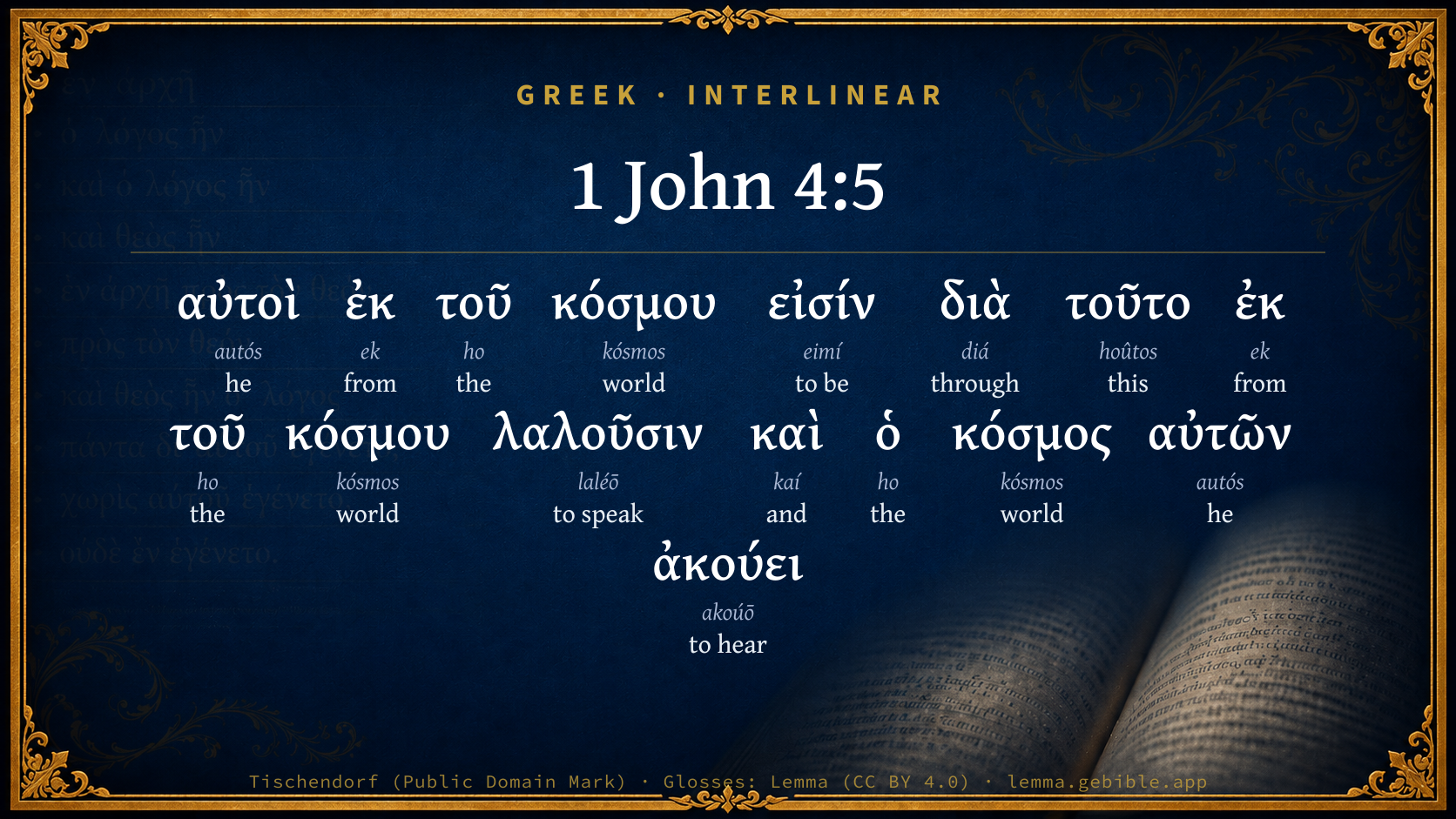
  1. αὐτοὶ autós G846 “he” Personal pronoun, Nominative, Plural, Masculine
  2. ἐκ ek G1537 “from” Preposition
  3. τοῦ ho G3588 “the” Article, Genitive, Singular, Masculine
  4. εἰσίν eimí G1510 “to be” Verb, Present, Active, Indicative, 3rd person, Plural
  5. διὰ diá G1223 “through” Preposition
  6. τοῦτο hoûtos G3778 “this” Demonstrative pronoun, Accusative, Singular, Neuter
  7. ἐκ ek G1537 “from” Preposition
  8. τοῦ ho G3588 “the” Article, Genitive, Singular, Masculine
  9. κόσμου kósmos G2889 “world” Noun, Genitive, Singular, Masculine
  10. λαλοῦσιν laléō G2980 “to speak” Verb, Present, Active, Indicative, 3rd person, Plural
  11. καὶ kaí G2532 “and” Conjunction
  12. ὁ ho G3588 “the” Article, Nominative, Singular, Masculine
  13. κόσμος kósmos G2889 “world” Noun, Nominative, Singular, Masculine
  14. αὐτῶν autós G846 “he” Personal pronoun, Genitive, Plural, Masculine
  15. ἀκούει akoúō G191 “to hear” Verb, Present, Active, Indicative, 3rd person, Singular

About this verse

These counts appear in no published source. They are computed here, from the morphology-tagged text and Lemma’s own curated glosses. What Lemma adds →

16
words
10
distinct lemmas
General Epistles
section

Repetition

Words recur within this verse:

  • κόσμου world G2889 ×3
  • τοῦ the G3588 ×3
  • αὐτοὶ he G846 ×2
  • ἐκ from G1537 ×2

Cross-references

15

Topical passages linked to 1 John 4:5 in the Treasury of Scripture Knowledge — connected by theme and wording, ordered by reader-vote popularity; previews shown in the World English Bible.

  • John 8:23 He said to them, "You are from beneath. I am from above. You are of this world. I am not of this world.
  • 2 Peter 2:2–3 Many will follow their immoral ways, and as a result, the way of the truth will be maligned.
  • John 17:14 I have given them your word. The world hated them, because they are not of the world, even as I am not of the world.
  • John 3:31 He who comes from above is above all. He who is from the Earth belongs to the Earth, and speaks of the Earth. He who comes from heaven is above all.
  • John 17:16 They are not of the world even as I am not of the world.
  • 2 Timothy 4:3 For the time will come when they will not listen to the sound doctrine, but, having itching ears, will heap up for themselves teachers after their own lusts;
  • Revelation 12:9 The great dragon was thrown down, the old serpent, he who is called the devil and Satan, the deceiver of the whole world. He was thrown down to the earth, and his angels were thrown down with him.
  • Psalms 17:4 As for the works of men, by the word of your lips I have kept myself from the ways of the violent.
  • Isaiah 30:10–11 who tell the seers, "Don't see;" and to the prophets, "Don't prophesy to us right things, speak to us smooth things, prophesy deceits,
  • Jeremiah 5:31 the prophets prophesy falsely, and the priests bear rule by their means; and my people love to have it so: and what will you do in the end of it?
  • Micah 2:11 If a man walking in a spirit of falsehood lies: 'I will prophesy to you of wine and of strong drink;' He would be the prophet of this people.
  • John 15:19–20 If you were of the world, the world would love its own. But because you are not of the world, since I chose you out of the world, therefore the world hates you.
  • Luke 16:8 "His lord commended the dishonest manager because he had done wisely, for the children of this world are, in their own generation, wiser than the children of the light.
  • John 7:6–7 Jesus therefore said to them, "My time has not yet come, but your time is always ready.
  • Jeremiah 29:8 For thus says Yahweh of hosts, the God of Israel: Don't let your prophets who are in the midst of you, and your diviners, deceive you; neither listen you to your dreams which you cause to be dreamed.

Cross-references courtesy of OpenBible.info (CC BY 4.0).

Commentary

Notes on 1 John 4:5 from classic Christian and Jewish commentators (each source and its license shown beneath its notes). The classic Christian expositions comment on the surrounding passage and are grouped to its opening verse, so a note may address several verses; the Jewish commentaries on the Tanakh (Rashi and others) are per-verse, so they appear only where the commentator wrote on this verse.

Lemma curates 59 commentaries, every one of them public domain or Creative Commons licensed, each selected and text-cleaned for this edition rather than reprinted as found. About our sources →

Tyndale Open Study Notes

Tyndale Open Resources

4:5 The world’s viewpoint is one of systematic evil, opposed to God (2:15-17).

Tyndale Open Study Notes — © Tyndale Open Resources, licensed CC BY-SA 4.0. Text via the HelloAO Bible API.

Bengel's Gnomon

Johann Albrecht Bengel

1Jn 4:5. Αὐτοὶ) they themselves.—ἐκ τοῦ κόσμου λαλοῦσι, speak of the world) They derive their language from the life and perception of the world.—ἀκούει, heareth) on account of its agreement with them.

Bengel's Gnomon of the New Testament — English translation (T&T Clark, Edinburgh, 1860) — public domain. Text from a community e-Sword module.

Meyer's Critical & Exegetical Commentary

Heinrich August Wilhelm Meyer

1Jn_4:5. In chap. 1Jn_2:19, John had said of the false teachers: οὐκ εἰσὶν ἐξ ἡμῶν; now he states from what source they spring; this is the κόσμος; the antichristian nature in them belonged to the world, quatenus Satanas est ejus princeps (Calvin). The manifestation of life corresponds with the source of it; because they are of the world, διὰ τοῦτο ἐκ τοῦ κόσμου λαλοῦσι; ἐκ τ. κόσμου λαλεῖν means: to speak that which the κόσμος supplies, to take the burden of their speech from the κόσμος, ex mundi vita ac sensu sermones suos promere (Bengel). This is not identical with ἐκ τῆς γῆς λαλεῖν (Joh_3:31), for ἡ γῆ is not an ethical idea like ὁ κόσμος.

καὶ ὁ κόσμος αὐτῶν ἀκούει] The false prophets had gone out from the Church into the world, to which they inwardly belonged, and proclaimed to it a wisdom which originated in it; therefore the world heard them, i.e. gave to their words applause and assent: τῷ γὰρ ὁμοίῳ τὸ ὅμοιον προστρέχει (Oecumenius); in contrast to which believers were hated and persecuted by the world.

Meyer — Critical and Exegetical Commentary on the New Testament — English translation by Peter Christie, edited by Frederick Crombie (T&T Clark, 1880) — public domain. Text from a community e-Sword module.

Expositor's Greek Testament

ed. W. Robertson Nicoll

1Jn 4:5 . αὐτοὶ (as opposed to ὑμεῖς ) ἐκ τοῦ κόσμου εἰσίν , as its delegates, messengers, representatives, and as such ἐκ τοῦ κόσμου λαλοῦσιν . λαλεῖν , not “speak” ( λέγειν ), but “talk,” with a suggestion of prating ( cf. Joh 4:42 ). ἀκούειν takes accus. of the thing heard, genit. of the person from whom it is heard. Cf. Luk 5:1 ; Act 1:4 (where both are combined). The world listens to those who speak its own language.

The Expositor's Greek Testament, edited by W. Robertson Nicoll (1897–1910) — public domain. Text from a community e-Sword module.

Geneva Bible (1599)

Geneva Bible translators

He bringeth a reason: why the world receiveth these teachers more willingly than the true: to wit, because they breathe out nothing but that which is worldly: which is another note also to know the doctrine of Antichrist by.

Geneva Bible (1599) marginal notes — public domain. Text via Bolls.life.

Jamieson, Fausset & Brown

Robert Jamieson, A. R. Fausset & David Brown

of the world--They derive their spirit and teaching from the world, "unregenerate human nature, ruled over and possessed by Satan, the prince of this world" [ALFORD].

speak they of the word--They draw the matter of their conversation from the life, opinions, and feelings of the world.

the world heareth them-- (Joh 15:18-19). The world loves its own.

Jamieson, Fausset & Brown — Commentary Critical and Explanatory on the Whole Bible (1871) — public domain (CC PDM 1.0). Text via the HelloAO Bible API.

John Calvin's Commentaries

5 They are of the world It is no small consolation that they who dare to assail God in us, have only the world to aid and help them. And by the world the Apostle means that portion of which Satan is the prince. Another consolation is also added, when he says that the world embraces through the false prophets that which it acknowledges as its own. We see what great propensity to vanity and falsehood there is in men. Hence false doctrines easily penetrate and spread far and wide. The Apostle intimates that there is no reason why we should on this account be disturbed, for it is nothing new or unusual that the world, which is wholly fallacious, should readily hearken to what is false.

John Calvin's Commentaries (1540-1563) — public domain. Text from the Calvin Translation Society English edition (1840s-50s) via the Christian Classics Ethereal Library (ccel.org). Calvin's coverage is partial (roughly two-thirds of the Bible); uncommented books and verses are honest gaps, never fabricated. The 19th-century editor's footnotes and remarks are omitted so the notes are faithfully Calvin's own voice.

The Cambridge Bible for Schools and Colleges

gen. ed. J. J. S. Perowne

5. They are of the world] This follows, though it has not yet been stated, from their not being ‘of us’ (1Jn_2:19): for there is no middle position. The verse is another reminiscence of the Lord’s farewell discourses: ‘If ye were of the world, the world would love its own’ (Joh_15:19; comp. Joh_17:14).

therefore speak they of the world] Or, therefore of the world they speak: as in Joh_3:31, the Greek order is impressive and worth preserving. (See on 1Jn_3:1; but here διὰ τοῦτο is not followed by ὅτι.) The impressive repetition of ‘the world’ is very characteristic of S. John’s style; e.g. Joh_1:10; Joh_3:17; Joh_15:19; Joh_17:14. Comp. ‘He that is of the earth, of the earth he is, and of the earth he speaketh’ (Joh_3:31): where, however, ‘to speak of the earth’ or ‘earthly things’ is to speak of God’s work on earth; whereas ‘to speak of the world’ is to speak what is alien from God’s work and opposed to it. ‘To speak of’ (λαλεῖν ἐκ) is not the same as ‘to speak concerning’ (λέγειν περί) 1Jn_5:16; Joh_1:22; Joh_1:47; Joh_2:21, &c. ‘To speak of the world’ is to have the world as the source of one’s words, so that one’s inspiration flows from it: and of course the world ‘heareth’, i.e. loves to hear, the wisdom derived from itself.

The Cambridge Bible for Schools and Colleges (gen. ed. J. J. S. Perowne; Cambridge University Press, 1878–1918) — public domain. Text from a community e-Sword module.

John Gill's Exposition

They are of the world,.... That is, the false prophets and teachers that were gone into the world, and had the spirit of antichrist in them; these were as they were when they came into the world, under the pollution, guilt, and dominion of sin, in a state of unregeneracy, carnality, and darkness; they properly belonged unto it, and walked after the course of it, and were under the influence of the god of it, who led them into error; and were sensual, and indulged themselves in worldly lusts, and were seeking after worldly things; supposed that gain was godliness, and had men's persons in admiration because of advantage; their nature and disposition, their principles and practices, and their ends and views, were worldly; and were quite different from Christ and his apostles, Joh 17:14,

therefore speak they of the world; they speak the wisdom of the world, or that in which the world thinks wisdom lies, and cry up for true knowledge, and right principles; and this they do with the enticing words of man's wisdom, or in words which man's wisdom teacheth; speaking great swelling words of vanity, which take with vain and carnal minds; and preach doctrines suited to their own taste, and the taste of others, as carnal and worldly men; such as the purity of human nature, in its first conception and birth, its freedom from any original corruption, and from any concern with the sin of Adam, only with actual sin of its own; and the power of it to do that which is good, keep the law of God, and obtain his favour; the non-necessity of any internal work of efficacious grace, a reformation of life and manners being thought sufficient to render a man acceptable to God, and prepare him for eternal happiness; the doctrine of justification and salvation by works; all which are pleasing to carnal men: hence it follows,

and the world heareth them; the wicked of the world; worldly and unregenerate men attend on their ministry, approve of what they deliver, and receive it with pleasure, and believe it: this expresses both the quality of the hearers of false teachers, that they are that part of the world, the worse part of it, which lies in wickedness; and the quantity of them, the greater part of the world, as it was foretold by Christ, and his apostles, that they should deceive many, that many should follow their pernicious ways, and that they should draw many disciples after them; wherefore the numbers that attend such persons, as it need not be wondered at, since both preachers and hearers, and the doctrines preached and heard, are all alike, they are of the world, so it should not be stumbling to the people of God.

John Gill's Exposition of the Whole Bible (1746–1763) — public domain (CC PDM 1.0). Text via the HelloAO Bible API.

Trapp's Complete Commentary

John Trapp

5 They are of the world: therefore speak they of the world, and the world heareth them.

Ver. 5. They are of the world] i.e. The seducers; fit lettuce for such lips; Dignum patella operculum. Vos infernates estis. "Ye are from beneath, I am from above," saith Christ, Joh 8:23.

Therefore speak they of the world] The water riseth not (unless forced) above its source. Out of the warehouse, the shop is furnished. Carnal teachers gratify their hearers with pleasing positions. The Papists in their petition to King James for a toleration, plead this as an argument, That their religion is agreeable to men’s nature: and indeed it is an alluring, tempting, bewitching religion, giving way to all licentiousness and lasciviousness. So Mahomet in his Koran tells his followers concerning venery, That God did not give men such appetites to have them frustrated, but enjoyed, as made for the gust {a} of man, not for his torment; and a great deal more of such paltry stuff.

{a} Keen relish, appreciation, or enjoyment, esp. as displayed in speech or action. ŒD

John Trapp, A Commentary or Exposition upon All the Books of the Old and New Testament (1647–1656) — public domain. Text from a community e-Sword module.

Albert Barnes' Notes on the Bible

They are of the world - This was one of the marks by which those who had the spirit of antichrist might be known. They belonged not to the church of God, but to the world. They had its spirit; they acted on its principles; they lived for it. Compare the notes at 1Jo 2:15.

Therefore speak they of the world - Compare the notes at Joh 3:31. This may mean either that their conversation pertained to the things of this world, or that they were wholly influenced by the love of the world, and not by the Spirit of God, in the doctrines which they taught. The general sense is, that they had no higher ends and aims than they have who are influenced only by worldly plans and expectations. It is not difficult to distinguish, even among professed Christians and Christian teachers, those who are heavenly in their conversation from those who are influenced solely by the spirit of the world. “Out of the abundance of the heart the mouth speaketh,” and the general turn of a man’s conversation will show what “spirit is within him.”

And the world heareth them - The people of the world - the frivoulous ones, the rich, the proud, the ambitious, the sensual - receive their instructions, and recognize them as teachers and guides, for their views accord with their own. See the notes at Joh 15:19. A professedly religious teacher may always determine much about himself by knowing what class of people are pleased with him. A professed Christian of any station in life may determine much about his evidences of piety, by asking himself what kind of persons desire his friendship, and wish him for a companion.

Albert Barnes' Notes on the Bible (1834–1885) — public domain. Text from a community e-Sword/MySword module.

Haydock's Catholic Bible Commentary

They are of the world. Such antichrists and heretics are guided by a worldly spirit, teaching men to follow the corrupt customs and inclinations of the world and the flesh, therefore the world heareth them, and men are more easily seduced by them. (Witham)

George Leo Haydock (1774–1849), Haydock's Catholic Family Bible and Commentary, 1859 edition — public domain. Excludes Psalms (Douay-Rheims chapter numbering differs from Protestant) and Deuterocanonical books (Catholic canon only).

Matthew Poole's English Annotations

He giveth here a further rule whereby to judge of doctrines and teachers, viz. what they severally savour of, and tend to. The doctrines and teachers whereby these Christians were assaulted and tempted, were of an earthly savour and gust, tending only to gratify worldly lusts and inclinations, and to serve secular interests and designs; and therefore men only of a worldly spirit and temper were apt to listen and give entertainment to them. On the other hand, says he, (in the name of the asserters and followers of true and pure Christianity, comprehended with himself):

We are of God; i.e. our doctrine and way proceed from God, and tend only to serve, please, and glorify him, and draw all to him; therefore such as

know God, i.e. are his friends, and converse much with him,

hear us; the things we propose and offer are grateful and savoury to them, {as Joh 8:37,47} having manifestly no other aim than to promote serious godliness. And hereby may the spirit of truth and the spirit of error in matters of this nature be distinguished; the one being next of kin to purity, and holiness, and a godly life; the other, to sensuality, and a design only of gratifying the animal life.

Matthew Poole's English Annotations on the Holy Bible (1683–1685) — public domain. Text from a community e-Sword/MySword module.

Whedon's Commentary on the Bible

Daniel D. Whedon

5. Speak they of (rather from) the world—They draw their inspiration, not from Christ, but from the world-spirit; and their doctrines are but the expression of the world’s feelings; and themselves are the organs of the Satan-inspired world.

Daniel D. Whedon (gen. ed.), Commentary on the Old and New Testaments (1874–1909) — public domain. Text from a community e-Sword module.

The Pulpit Commentary

The source of their character and their teaching is the world; from it they derive their inspiration; and of course the world listens to them. Once again (see on 1Jn_3:23) we have an echo of Christ"s last discourses: "If ye were of the world, the world would love its own". (Joh_15:19)

The Pulpit Commentary (1880–1919), ed. H.D.M. Spence-Jones & Joseph S. Exell — public domain. Text from a community e-Sword module.

John Wesley's Explanatory Notes

They - Those false prophets. Are of the world - Of the number of those that know not God. Therefore speak they of the world - From the same principle, wisdom, spirit; and, of consequence, the world heareth them - With approbation.

John Wesley, Explanatory Notes Upon the Whole Bible (1754–1765) — public domain. Text via the GEBible commentary corpus.

Burkitt's Expository Notes on the New Testament

William Burkitt

Here we have, 1. The character given of these seducers and false teachers, They are of the world; that is, men of worldly minds and interests, They speak of the world; that is, they preach a doctrine suitable to the lusts and inclinations of worldly men, who greedily hear them, and easily believe them; ordinarily our words are such as we are; they who are of the world must needs speak of the world, for they have nothing else to speak of. THe covetous man speaks covetously, and the proud man proudly.

Observe, 2. The character which the apostle gives of himself and his fellow-apostles, we are of God; that is, taught and instructed by God. We have our mission and our message from God, and he has given us his attestation, by opening the ears and hearts of those that attend upon our ministry, to receive and embrace our doctrine; but such as are not taught of God, reject both it and us.

Observe, 3. The inference and conclusion which our apostle draws from hence, namely, that by the doctrine and writings of the apostles and evangelists, the truth or falsehood of doctrines may and must be judged; for, says he, Hereby we know the spirit of truth, and the spirit of error; he that knoweth God, heareth us; he that is not of God, heareth not us.

William Burkitt's Expository Notes on the New Testament (1700–1703) — public domain. Text from a community e-Sword module.

The People's New Testament

B. W. Johnson

5. They are of the world. The false teachers. They are not of God. The world hears them because they are of its spirit and speak of it.

B. W. Johnson's The People's New Testament with Notes (1889–1891) — public domain. Electronic text from the Christian Classics Ethereal Library (CCEL) ThML edition.

Cambridge Greek Testament for Schools and Colleges

5. αὐτοὶ ἐκ τ. κ. εἰσίν. The pronouns at the beginning of all three verses are in emphatic opposition; ὑμεῖς … αὐτοὶ … ἡμεῖς. That they, the antichristian teachers, are ‘of the world’ was implied in 1Jn 2:19, where it is stated that they are ‘not of us’: for there is no middle neutral position. The verse is another reminiscence of the Lord’s farewell discourses: ‘If ye were of the world, the world would love its own’ (Joh 15:19; comp. Joh 17:14).

διὰ τοῦτο ἐκ τ. κ. λαλοῦσιν. Therefore of the world they speak: as in Joh 3:31, the Greek order is impressive and worth preserving. (See on 1Jn 3:1; but here διὰ τοῦτο is not followed by ὄτι.) The impressive repetition of ‘the world’ is very characteristic of S. John’s style; e.g. Joh 1:10; Joh 3:17; Joh 15:19; Joh 17:14. Comp. ‘He that is of the earth, of the earth he is, and of the earth he speaketh’ (Joh 3:31): where, however, ἐκ τῆς γῆς λαλεῖν is to speak of God’s work on earth; whereas ἐκ τ. κόσμου λ. is to speak what is alien from God’s work and opposed to it. ‘To speak of’ (λαλεῖν ἐκ) is not the same as ‘to speak concerning’ (λέγειν περί) 1Jn 5:16; Joh 1:22; Joh 1:47; Joh 2:21, &c. ‘To speak of the world’ is to have the world as the source of one’s words, so that one’s inspiration flows from it: and of course the world ‘heareth,’ i.e. loves to hear, the wisdom derived from itself. It expects to secure everything, the honour of the Christian name and the credit of lofty spiritual γνῶσις, without any humiliation or crucifixion of the flesh.

Cambridge Greek Testament for Schools and Colleges (Cambridge University Press, 1896; 21 vols, various authors incl. Carr, Maclear, Plummer, Farrar, Lumby, Moule, M. R. James, Simcox) — public domain. Text from a community e-Sword module.

Alford’s Greek Testament

Henry Alford

5.] They are of the world (this description is not ethical, as Socinus and Grot.,—“affectus habent, quales habet mundus, i. e. pars longe maxima humani generis: amant splendorem hujus vitæ, opulentiam et voluptates:”—but betokens the origin and source of that which they are and teach, as ἐκ τοῦ θεοῦ ἐστέ did on the other side. That origin and source is the world, unregenerate human nature, ruled over and possessed by the devil, the prince of this world): for this cause they speak of (not concerning, but of, as out of and from; the material of what they say being cosmic: “ex mundi vita et sensu sermones suos promunt,” Bengel) the world, and the world heareth them (loving as it does its own, who aro of it, Joh 15:19, from which our verse is mainly taken: see also Joh 8:47, Joh 18:37).

Henry Alford, The Greek Testament (1849–1861) — public domain. Text from a community e-Sword module.

International Critical Commentary

5. ἐκ τοῦ κόσμου εἰσίν] See the notes on ver. 4. The false teaching drew its strength from the wider knowledge of the world, rejecting or failing to appreciate the essential truth of the revelation made in Jesus Christ incarnate.

ἐκ τοῦ κόσμου λαλοῦσιν]Their teaching corresponds to their sphere. And it is welcomed by the like-minded.

ἀκούει]Cf. Oecumenius, τῷ γὰρ ὁμοίῳ τὸ ὅμοιον προστρέχει. There was apparently need of encouragement in view of the success which the false teachers had secured. Cf. again Oecumenius, εἰκὸς γάρ τινας τούτων καὶ ἀσχάλλειν ὁρῶντας ἐκείνους μὲν τοῖς πολλοῖς περισπουδάστους, ἑαυτοὺς δὲ καταφρονουμένους.

δια τουτο] pr. και69 ascr: και68. 103 Did.

λαλουσιν] om. Ib 62 (498).

ακουει αυτον (?) ο κοσμοςIa 65 (317).

International Critical Commentary — older volumes (1896–1929), various authors — public domain. Text from a community e-Sword module.

Vincent's Word Studies in the New Testament

Marvin R. Vincent

Of the world [εκ του κοσμου] . Proceeding from, as their source [εκ] . Different from ejk thv ghv from the earth (Joh 3:31), as marking the whole worldly economy morally considered.

Speak they of the world (ejk tou kosmou lalousin) An ambiguous rendering, which might readily be interpreted "they speak concerning the world." Literally it is : "they speak out of the world; i e., the character of their utterances corresponds to their origin. Rev.," speak they as of the world. "The position of the world in the sentence is emphatic :" it is out of the world that they speak. "

Marvin R. Vincent, Word Studies in the New Testament (1887–1900) — public domain. Text from a community e-Sword/MySword module.

Westcott on Hebrews & the Epistles of John

Brooke Foss Westcott

5. αὐτοὶ... ipet V., they, the false prophets, through whom the false spirits work.

The nom. pl. αὐτοί, which occurs here only in the Hpistles, emphasises the contrast. Comp. James ii. 6, 7; Hebr. xiii. 17; Luke xi. 48. See c. ii. 25 note.

ἐκ τ. x. εἰσίν] de mundo sunt V., are of the world and not simply of the earth (John iii. 31). The ‘earth’ expresses the necessary limitations of the present order: the ‘world’ the moral characteristics of the order, as separated from God. For the phrase compare 6. ii. 16; John xv. 19, xvii

14, 16 and the cognate phrase ‘to be of this world’: John viii. 23, xviii. 36.

διὰ τοῦτο] tdeo V., for this cause, The character of their speech and the character of their hearers are determined by their own character. They draw the spirit and the substance of their teaching from (out of) the world and therefore it finds acceptance with kindred natures. The words ‘of the world’ answer to ‘the world’ in the order of the original: ‘tt is of the world they speak, and the world heareth them.

For the threefold repetition of ‘the world’ see John iii. 17, 31; 2 Macc. Vii. II.

ἀκούει) Comp. John xv. 19.

Brooke Foss Westcott (1825–1901), The Epistle to the Hebrews (1889) and The Epistles of St John (1883) — public domain (pre-1929). Text recovered from Internet Archive / Google Books OCR scans. Westcott’s Gospel of John commentary is not included (its OCR lost the chapter running-heads required for reliable verse-keying). Some Greek quoted in the Hebrews volume is imperfectly rendered by the OCR.

Lesson kit

Teaching starters — assembled from the data on this page, not authored interpretation. Every prompt links to the verse data it draws on. Edit before teaching.

1 John, in the General Epistles, opens this verse with 16 words (10 distinct Greek lemmas). Its most distinctive word is kósmos (“world”). A historical commentator’s framing appears above. Read the whole chapter for the surrounding context.

Discussion questions

  1. How does “world” (kósmos) shape what this verse is saying?
  2. How does John 8:23, which shares this passage’s theme, read alongside this verse?
  3. What does the repetition of “world” (3× in this one verse) do in this verse?
  4. These translations render this verse differently. What is at stake in choosing one wording over another?
  5. Compare how Tyndale Open Study Notes and Bengel's Gnomon read this verse. Where do they agree or differ?

Things to notice

  • These translations choose different wording for 5 words in this verse.
  • “world” occurs 3× in this single verse.
  • 10 distinct Greek lemmas span 16 words in this verse.

Reading settings

Reading text

Shown beneath each verse's original-language words.

Old Testament
Old Testament edition

Read the OT as the Masoretic Hebrew (MT) or the Greek Septuagint (LXX).

English shown for the Greek Septuagint (in the Hebrew ↔ Greek comparison).

Comparing translations? Open the Compare panel on any verse page to stack up to four side by side.