
2 Thessalonians 3:11

Greek (Tischendorf 8th ed.) 2 Thessalonians 3:11 appears in the Greek New Testament. The text above is from the Tischendorf 8th edition. Each word links to its Strong’s number and a concise gloss. Click any word for its full Thayer’s Greek Lexicon entry.
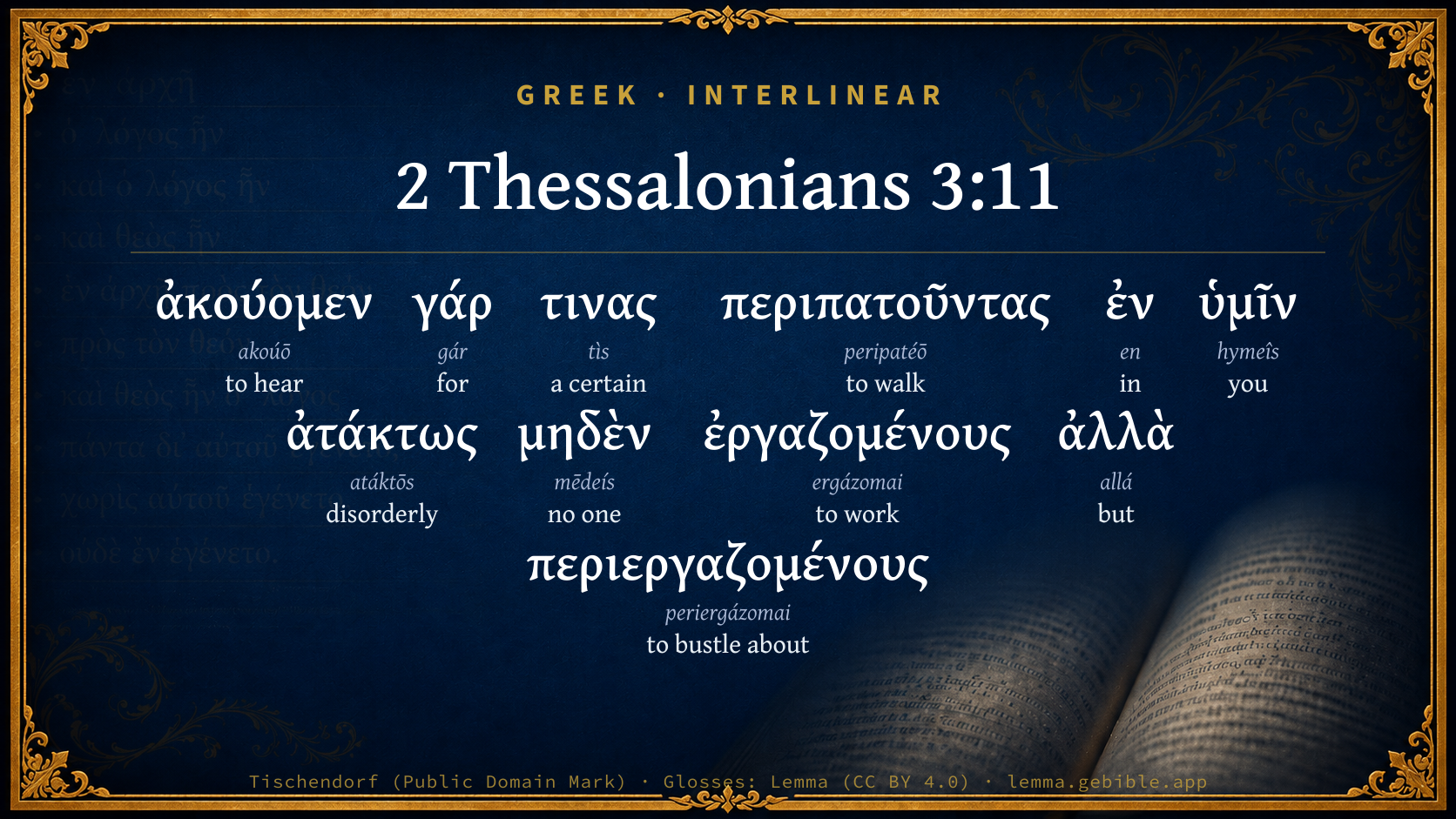
Download image
Cite this verse

2 Thessalonians 3:11 (World English Bible). Public Domain. Lemma interlinear Bible study tool, https://lemma.gebible.app/v/2-thessalonians/3/11.

Show BibTeX & RIS
BibTeX
RIS
English Translation
For we hear of some who walk among you in rebellion, who don't work at all, but are busybodies.
World English Bible · Public Domain
Highlights
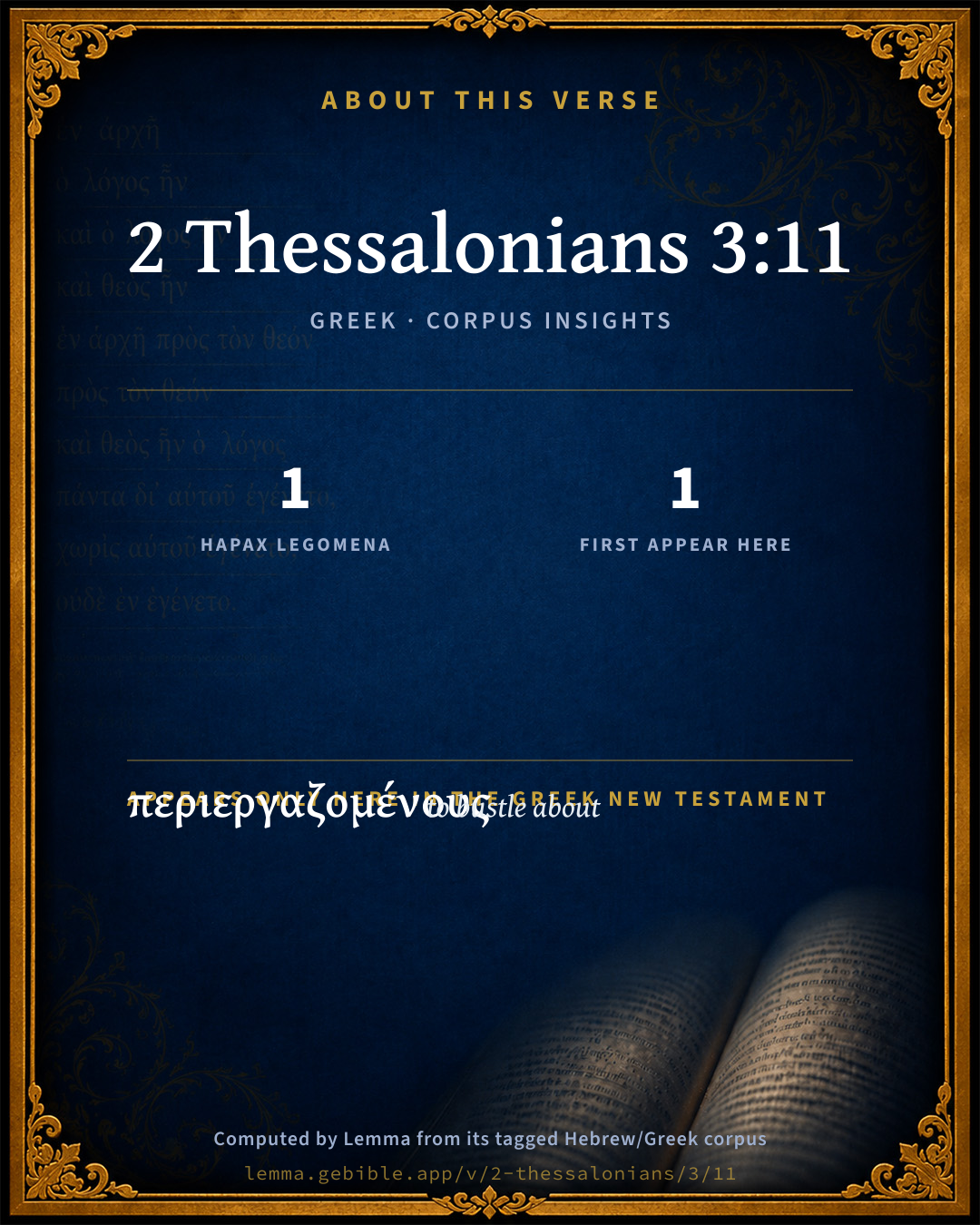
  • 1 hapax legomenon — only here in the Greek New Testament
  • 1 first appearance in the Greek New Testament
Full analysis ↓
Download a study sheet

One document with this verse’s original text, its word-by-word gloss line, the meaning frame, cross-references with their text, attributed commentary, and full source and license credits — printable, and it pastes into notes with its structure intact.

This verse Autodidact and up

Study sheet (.html) Plain text (.txt)

A passage Seminary Student

Up to 50 verses in one chapter. A passage sheet keeps up to 6 commentary sources and 12 cross-references per verse, in the order this page ranks them, and says so on the sheet whenever that leaves anything out. Ask for a single verse and you get the Autodidact verse sheet above.

Everything on this page stays free to read, with no account — the sheet is a download of what is already on screen, not access to it.

Want to remove ads? Support Godless Engineer
Compare translations 3

The same verse in 3 English versions, stacked beneath the original-language interlinear above. Click any original word for its lexicon entry.

Each is an independent rendering of the whole verse — the interlinear is not word-aligned to these translations.

Highlighted words mark where these versions differ — a whole-verse word diff, not a word-by-word alignment.

  • World English Bible Public Domain
    For we hear of some who walk among you in rebellion, who don't work at all, but are busybodies.
  • King James Version Public Domain
    For we hear that there are some which walk among you disorderly, working not at all, but are busybodies.
  • unfoldingWord Literal Text CC BY-SA 4.0
    For we hear about some walking idly among you, not working, but meddling.

unfoldingWord Literal Text — © unfoldingWord, licensed CC BY-SA 4.0. Word-aligned USFM3 via Door43 (git.door43.org/unfoldingWord/en_ult).

Versions to compare (up to 4)

3 of 4 selected

Show all 19 translations

Every available English version of this verse, each an independent rendering of the whole verse.

  • World English Bible Public Domain
    For we hear of some who walk among you in rebellion, who don't work at all, but are busybodies.
  • Berean Standard Bible Public Domain
    Yet we hear that some of you are leading undisciplined lives and accomplishing nothing but being busybodies.
  • Majority Standard Bible Public Domain
    Yet we hear that some of you are leading undisciplined lives and accomplishing nothing but being busybodies.
  • King James Version Public Domain
    For we hear that there are some which walk among you disorderly, working not at all, but are busybodies.
  • American Standard Version (1901) Public Domain
    For we hear of some that walk among you disorderly, that work not at all, but are busybodies.
  • Revised Version (1885) Public Domain
    For we hear of some that walk among you disorderly, that work not at all, but are busybodies.
  • Geneva Bible (1599) Public Domain
    For we heare, that there are some which walke among you inordinately, and worke not at all, but are busie bodies.
  • Douay-Rheims (1899) Public Domain
    For we have heard there are some among you who walk disorderly, working not at all, but curiously meddling.
  • Young's Literal Translation Public Domain
    for we hear of certain walking among you disorderly, nothing working, but over working,
  • Literal Standard Version CC BY-SA 4.0
    for we hear of some walking disorderly among you, working nothing, but being busybodies,
  • Unlocked Literal Bible CC BY-SA 4.0
    For we hear that some walk idly among you. They do not work but are instead meddlers.
  • unfoldingWord Literal Text CC BY-SA 4.0
    For we hear about some walking idly among you, not working, but meddling.
  • Darby Bible Public Domain
    For we hear that [there are] some walking among you disorderly, not working at all, but busybodies.
  • World Messianic Bible Public Domain
    For we hear of some who walk among you in rebellion, who don’t work at all, but are busybodies.
  • Webster's Bible Public Domain
    For we hear that there are some who walk among you disorderly, working not at all, but are busy-bodies.
  • Free Bible Version CC BY-SA 4.0
    But now we hear that there are some lazy busybodies among you who don't work at all.
  • Bible in Basic English Public Domain
    For it has come to our ears that there are some among you whose behaviour is uncontrolled, who do no work at all, but are over-interested in the business of others.
  • Text-Critical English NT CC BY 4.0
    For we hear that some among you are walking in idleness, not working at all, but being busybodies.
  • Tyndale New Testament (1534) Public Domain
    We have hearde saye no doute that ther are some which walke amonge you inordinatly and worke not at all but are besy bodies.

Literal Standard Version (2020), Covenant Press — licensed CC BY-SA 4.0. Text via the HelloAO Bible API (eBible.org). Unlocked Literal Bible (unfoldingWord) — licensed CC BY-SA 4.0. Text via the HelloAO Bible API (eBible.org). unfoldingWord Literal Text — © unfoldingWord, licensed CC BY-SA 4.0. Word-aligned USFM3 via Door43 (git.door43.org/unfoldingWord/en_ult). Free Bible Version, Dr. Jonathan Gallagher — licensed CC BY-SA 4.0. Text via the HelloAO Bible API (eBible.org).

Word by word

More ways to search: Search by grammar → Find every occurrence → Compare this word →

Practice this passage: Drill this verse → Learn its vocabulary →

περιεργαζομένους
periergázomai
G4020
“to bustle about”
Verb, Present, Middle or Passive deponent, Participle, Accusative, Plural, Masculine
Part of Speech
Verb
Tense
Present
Voice
Middle or Passive deponent
Mood
Participle
Case
Accusative
Number
Plural
Gender
Masculine
Full Thayer's Definition

Origin: from G4012 and G2038

TDNT: None

1. to bustle about uselessly, to busy one's self about trifling, needless, useless matters a. used apparently of a person officiously inquisitive about other's affairs
  1. ἀκούομεν akoúō G191 “to hear” Verb, Present, Active, Indicative, 1st person, Plural
  2. γάρ gár G1063 “for” Conjunction
  3. τινας tìs G5100 “a certain” Indefinite pronoun, Accusative, Plural, Masculine
  4. περιπατοῦντας peripatéō G4043 “to walk” Verb, Present, Active, Participle, Accusative, Plural, Masculine
  5. ἐν en G1722 “in” Preposition
  6. ὑμῖν hymeîs G5210 “you” Personal pronoun, 2nd person, Dative, Plural
  7. ἀτάκτως atáktōs G814 “disorderly” Adverb
  8. μηδὲν mēdeís G3367 “no one” Adjective, Accusative, Singular, Neuter, Negative
  9. ἐργαζομένους ergázomai G2038 “to work” Verb, Present, Middle or Passive deponent, Participle, Accusative, Plural, Masculine
  10. ἀλλὰ allá G235 “but” Conjunction

About this verse

These counts appear in no published source. They are computed here, from the morphology-tagged text and Lemma’s own curated glosses. What Lemma adds →

11
words
11
distinct lemmas
Pauline Epistles
section

Notable vocabulary

1 hapax legomenon — a word that appears only here in the entire Greek New Testament:

  • περιεργαζομένους to bustle about G4020

First appearance in Scripture

This word makes its first canonical appearance in the Greek New Testament here:

  • περιεργαζομένους to bustle about G4020

Shared distinctive vocabulary

ἀτάκτως disorderly G814 occurs in 2 verses of the Greek New Testament. Also found in:
Cross-references

4

Topical passages linked to 2 Thessalonians 3:11 in the Treasury of Scripture Knowledge — connected by theme and wording, ordered by reader-vote popularity; previews shown in the World English Bible.

  • 1 Timothy 5:13 Besides, they also learn to be idle, going about from house to house. Not only idle, but also gossips and busybodies, saying things which they ought not.
  • 1 Thessalonians 4:11 and that you make it your ambition to lead a quiet life, and to do your own business, and to work with your own hands, even as we charged you;
  • 2 Thessalonians 3:6 Now we command you, brothers, in the name of our Lord Jesus Christ, that you withdraw yourselves from every brother who walks in rebellion, and not after the tradition which they received from us.
  • 1 Peter 4:15 For let none of you suffer as a murderer, or a thief, or an evil doer, or as a meddler in other men's matters.

Cross-references courtesy of OpenBible.info (CC BY 4.0).

Commentary

Notes on 2 Thessalonians 3:11 from classic Christian and Jewish commentators (each source and its license shown beneath its notes). The classic Christian expositions comment on the surrounding passage and are grouped to its opening verse, so a note may address several verses; the Jewish commentaries on the Tanakh (Rashi and others) are per-verse, so they appear only where the commentator wrote on this verse.

Lemma curates 59 commentaries, every one of them public domain or Creative Commons licensed, each selected and text-cleaned for this edition rather than reprinted as found. About our sources →

The Biblical Illustrator

Joseph S. Exell

2Th_3:11-12

For we hear that there are some which walk among you disorderly, working not at all, but are busybodies

A busybody

Apelles, who flourished in the time of Alexander the Great, never permitted a day to pass without practice in his art.

He was accustomed, when he bad completed any one of his pieces, to expose it in some public place to the view of the passers-by, and seating himself behind it to hear the remarks which were made. On one of these occasions a shoemaker censured the painter for having given to the slippers a less number of ties than it ought to have. Apelles, knowing the man must be correct, at once rectified the mistake. The next day the shoemaker, emboldened, criticised one of the legs, when Apelles indignantly put forth his head and bid him keep to that line of criticism which he justly understood. Here we have the disorderliness of 2Th_3:6-7 defined. There is a scornful play of words here in the Greek which is lost sight of in the English: the word for busybodies being merely a compound form of the word working. Quite literally, the compound means working enough and to spare, being over busy, overdoing; then, as a man cannot possibly overdo what it is his own duty to do, it comes to signify--

I. Doing useless things, things which concern no one, and might as well be left alone: as, e.g., magic, which is described by this word (Act_19:19); or natural science, which is so described in the Athenians accusation of Socrates!

II. Meddling with matters which do not concern the doer, but do concern other people (1Ti_5:18). Bishop Lightfoot suggests, that the play can be kept up through the words business and busy; we might perhaps say, not being business men, but busy bodies. But which of the two notions mentioned above is to be considered most prominent here, we cannot tell for certain.

1. The Thessalonians do not seem to have been much carried away by the first class of dangers--idle speculations such as those of the Ephesian and Colossian churches. Yet we cannot altogether exclude this meaning here. St. Pauls readers had been overbusy in theorizing about the position of the departed at Christs coming (1Th_4:15), and had been so eager over their idle doctrines of the Advent as to falsify, if not actually to forge, communications from St. Paul (2Th_2:2). Such false inquisitiveness and gossiping discussions might well be described by the Greek word we are now considering.

2. Everything, however, points to a more practical form of the same disposition to mask idleness under cloak of work; feverish excitement, which leads men to meddle and interfere with others, perhaps to spend time in religious work which ought not to have been spared from everyday duties (1Th_4:11-12). There is nothing to shew definitely how this busy idleness arose, but it may very probably be the troubled and shaken condition of mind spoken of in 2Th_2:2. (Canon Mason.)

That with quietness they work--

The blessedness of work

1. There is probably no means of grace more strengthening against temptation, more healthful for the spirit, more uplifting towards God, than honest, earnest work. When God placed man in the Garden of Eden, He placed him there not for the sole purpose of contemplation, but to dress the garden and keep it. The Saviour is reputed to have worked at His foster fathers bench, and thus to have consecrated all human toil. Even His Sabbaths were spent in worship and in doing good. The most religious life is often thus a life of unremitting toil.

2. Upon the scroll of Nature is written the gospel of work. For Nature seldom supplies our necessities or meets our conveniences by provisions ready made for use. Nature furnishes the raw material: the Clay to be fashioned into bricks, the iron to be converted into machinery, the fertility of the soil to be husbanded by cultivation, the produce of distant lands to be first transferred by the seamans endurance and the merchants enterprise to the place of manufacture, and then to be spun and woven by the diligence of the artizan into cloth suitable for wear. Even Nature declines to satisfy our wants unless we work in her laboratories, and recognize the Divine obligation of earning our bread by the sweat of the brow. Nature thus exalts every labourer into a disciple of God, learning in the Book of Nature the dignity and value of toil.

3. History harmonizes with Nature in the pronouncement of this verdict upon the blessedness of work. The most forward nations of the world are those which have been compelled by the necessities of climate and geographical position to labour most diligently for their daily sustenance. The most backward races are those which dwell in sunny lands, where fruits grow without strenuous husbandry, and where the glow and inspiration of effort are only partial and weak.

4. The experience of the Church may be added in favour of the elevating influence of work. Where does infidelity most abound? Not among the busy and industrious classes, but among the luxurious, the leisurely, the indolent. Doubters may not be always drones, but drones are commonly doubters. The pests of the commonwealth and the poisons of society are its loungers, its idlers, its non-working element; those who simply eat the fruits of the earth and do no good and die; who neither work for their own private advantage, nor devote themselves to the public weal. The idle man is in the full glare of temptation, and upon the high road to iniquity.

5. Work is a great preservative for the soul. It drains off the evil humours of the flesh; it parries the thrusts of temptation; it yields the fruits of a peacable heart; it delights with the reflection of useful service to others; it gives to man the exalted sense of being a cooperator with God in Nature, in the world, and in the Church, (J. W. Diggle, M. A.)

The Biblical Illustrator, edited by Joseph S. Exell (c. 1880s–1900s) — public domain. Text from a community e-Sword module.

Bengel's Gnomon

Johann Albrecht Bengel

2Th 3:11. Ἀλλὰ, but) From a state of idleness, the disposition of men is naturally prone to pass to the indulgence of curiosity. For nature always seeks something to do.[28]—ΠΕΡΙΕΡΓΑΖΟΜΈΝΟΝς, busybodies [curiously-inquisitive]) Opposed to doing one’s own business,[29] 1Th 4:11.

[28] And if not doing one’s own business, a man for want of something to do meddles with his neighbour’s business. For “Nature abhors a vacuum.”—ED.

[29] The antithesis is conveyed by the very sound of the words in the original, μηδὲν ἐργαζομένους, ἀλλὰ περιεργαζομέυους, doing none of their own business, and yet over-officious in the business of others.—ED.

Bengel's Gnomon of the New Testament — English translation (T&T Clark, Edinburgh, 1860) — public domain. Text from a community e-Sword module.

Meyer's Critical & Exegetical Commentary

Heinrich August Wilhelm Meyer

2Th_3:11. The reason for reminding them of this saying, 2Th_3:10. Arbitrarily, Hofmann: γάρ refers to the whole section 2Th_3:6-10. The verb περιεργάζεσθαι is only found here in the N. T. (but comp. περίεργος, 1Ti_5:13, and τὰ περίεργα πράσσειν, Act_19:19). It denotes a bustling disposition, busy in useless and superfluous things, about which one should not trouble himself. Paul thinks on the fanatical excitement, on account of which one busied himself about everything except the fulfilment of the duties of his earthly calling. περιεργαζομένους forms a paronomasia with μηδὲν ἐργαζομένους.[71] Comp. Quintilian, inst. orat. vi. 3. 54: Afer enim venuste Mallium Suram, multum in agendo discursantem, salientem, manus jactantem, togam dejicientem et reponentem, non agere dixit sed satagere.

[71] Ewald translates it: nicht Arbeit treibend, sondern sich herumtreibend.

Meyer — Critical and Exegetical Commentary on the New Testament — English translation by Peter Christie, edited by Frederick Crombie (T&T Clark, 1880) — public domain. Text from a community e-Sword module.

Expositor's Greek Testament

ed. W. Robertson Nicoll

2Th 3:11 . The γάρ goes back to 2Th 3:6 . “Whereas I am told that some of your number are behaving in a disorderly fashion, not busy but busybodies,” fussy and officious, doing anything but attending to their daily trade. “Ab otio ualde procliue est hominum ingenium ad curiositatem” (Bengel). The first persecution at Thessalonica had been fostered by a number of fanatical loungers (Act 17:5 ). On the sensible attitude of the primitive church to labour, see Harnack’s Expansion , i. 215 f. M. Aurelius (iii. 4) warns people against idle, fussy habits, but especially against τὸ περίεργον καὶ κακόηθες , and an apt parallel to this use of ἀτάκτως lies in Dem. Olynth. , iii. 34: ὅσα (funds or food) οὗτος ἀτάκτως νῦν λαμβάνων ( i.e. , takes without rendering personal service in the field) οὐκ ὠφελεῖ , ταῦτʼ ἐν ἰσῇ τάξει λαμβανέτω .

The Expositor's Greek Testament, edited by W. Robertson Nicoll (1897–1910) — public domain. Text from a community e-Sword module.

Geneva Bible (1599)

Geneva Bible translators

He reprehendeth a vice which is joined with the former, whereupon follow an infinite sort of mischiefs: to wit, that there are none more busy in other men’s matters than they which neglect their own.

How great a fault idleness is, he declareth by that that God created no man in vain or to no purpose, neither is there any unto whom he hath not allotted as it were a certain standing and room. Whereupon it followeth, that the order which God hath appointed, is troubled by the idle, yea, broken, which is great sin and wickedness.

Geneva Bible (1599) marginal notes — public domain. Text via Bolls.life.

Jamieson, Fausset & Brown

Robert Jamieson, A. R. Fausset & David Brown

busy bodies--In the Greek the similarity of sound marks the antithesis, "Doing none of their own business, yet overdoing in the business of others." Busy about everyone's business but their own. "Nature abhors a vacuum"; so if not doing one's own business, one is apt to meddle with his neighbor's business. Idleness is the parent of busybodies (Ti1 5:13). Contrast Th1 4:11.

Jamieson, Fausset & Brown — Commentary Critical and Explanatory on the Whole Bible (1871) — public domain (CC PDM 1.0). Text via the HelloAO Bible API.

Adam Clarke's Commentary

Verse 11. For we hear that there are some] It is very likely that St. Paul kept up some sort of correspondence with the Thessalonian Church; for he had heard every thing that concerned their state, and it was from this information that he wrote his second epistle.

Disorderly] ατακτως. Out of their rank-not keeping their own place.

Working not at all] Either lounging at home, or becoming religious gossips; μηδεν εργαζομενους, doing nothing.

Busybodies.] περιεργαζομενους. Doing every thing they should not do-impertinent meddlers with other people's business; prying into other people's circumstances and domestic affairs; magnifying or minifying, mistaking or underrating, every thing; newsmongers and telltales; an abominable race, the curse of every neighbourhood where they live, and a pest to religious society. There is a fine paronomasia in the above words, and evidently intended by the apostle.

Adam Clarke's Commentary on the Bible (1810–1826) — public domain. Text from a community e-Sword/MySword module.

John Calvin's Commentaries

11 We hear that there are some among you. It is probable that this kind of drones were, as it were, the seed of idle monkhood. For, from the very beginning, there were some who, under pretext of religion, either made free with the tables of others, or craftily drew to themselves the substance of the simple. They had also, even in the time of Augustine, come to prevail so much, that he was constrained to write a book expressly against idle monks, where he complains with good reason of their pride, because, despising the admonition of the Apostle, they not only excuse themselves on the ground of infirmity, but they wish to appear holier than all others, on the ground that they are exempt from labors. He inveighs, with good reason, against this unseemliness, that, while the senators are laborious, the workman, or person in humble life, does not merely live in idleness, but would fain have his indolence pass for sanctity. Such are his views. In the mean time, however, the evil has increased to such an extent, that idle bellies occupy nearly the tenth part of the world, whose only religion is to be well stuffed, and to have exemption from all annoyance of labor. And this manner of life they dignify, sometimes with the name of the Order, sometimes with that of the Rule, of this or that personage.

But what does the Spirit say, on the other hand, by the mouth of Paul? He pronounces them all to be irregular and disorderly, by whatever name of distinction they may be dignified. It is not necessary to relate here how much the idle life of monks has invariably displeased persons of sounder judgment. That is a memorable saying of an old monk, which is recorded by Socrates in the Eighth Book of the Tripartite History — that he who does not labor with his hands is like a plunderer. I do not mention other instances, nor is it necessary. Let this statement of the Apostle suffice us, in which he declares that they are dissolute, and in a manner lawless.

Doing nothing. In the Greek participles there is, an elegant (προσωνομασία) play upon words, which I have attempted in some manner to imitate, by rendering it as meaning that they do nothing, but have enough to do in the way of curiosity. He censures, however, a fault with which idle persons are, for the most part, chargeable, that, by unseasonably bustling about, they give trouble to themselves and to others. For we see, that those who have nothing to do are much more fatigued by doing nothing, than if they were employing themselves in some very important work; they run hither and thither; wherever they go, they have the appearance of great fatigue; they gather all sorts of reports, and they put them in a confused way into circulation. You would say that they bore the weight of a kingdom upon their shoulders. Could there be a more remarkable exemplification of this than there is in the monks? For what class of men have less repose? Where does curiosity reign more extensively? Now, as this disease has a ruinous effect upon the public, Paul admonishes that it ought not to be encouraged by idleness.

John Calvin's Commentaries (1540-1563) — public domain. Text from the Calvin Translation Society English edition (1840s-50s) via the Christian Classics Ethereal Library (ccel.org). Calvin's coverage is partial (roughly two-thirds of the Bible); uncommented books and verses are honest gaps, never fabricated. The 19th-century editor's footnotes and remarks are omitted so the notes are faithfully Calvin's own voice.

Ellicott's Commentary for English Readers

(11) For we hear.—Explaining how St. Paul came to speak upon the topic at all. Hitherto he has only been giving directions, without saying why. News had been brought back, no doubt, by the bearers of the First Epistle.

Walk among you disorderly.—A verbal repetition of 2Th_3:6. It is not quite the same as “some among you which walk disorderly,” for the words “among you” represent the vague and various directions taken by those aimless feet, going about from house to house, workshop to workshop.

Working not at all, but are busybodies.—This is what the disorderliness consists in, as we should have seen from 2Th_3:10. There is a scornful play of words here in the Greek which is lost sight of in the English: the word for “busybodies” being merely a compound form of the word “working.” Quite literally, the compound means “working enough and to spare,” “being overbusy,” “overdoing;” then, as a man cannot possibly overdo what it is his own duty to do, it comes to signify (1) doing useless things, things which concern no one, and might as well be left alone: as, for instance, magic, which is described by this word in Act_19:19; or natural science, which is so described in the Athenians’ accusation of Socrates! (2) Meddling with matters which do not concern the doer, but do concern other people: so used in 1Ti_5:13. Prof Lightfoot suggests (On a Fresh Revision, p. 59; comp. p. xviii., 2nd ed.) that the play can be kept up through the words “business” and “busy”: we might perhaps say, “not being business men, but busybodies.” But which of the two notions mentioned above is to be considered most prominent here we cannot tell for certain. (a) The Thessalonians do not seem to have been much carried away by the first class of danger—idle speculations, such as those of the Colossian or Ephesian Churches. Yet we cannot altogether exclude this meaning here. St. Paul’s readers had been overbusy in theorising about the position of the departed at Christ’s coming (1Th_4:15, Note), and had been so eager over their idle doctrines of the Advent as to falsify, if not actually to forge, communications from St. Paul (2Th_2:2). Such false inquisitiveness and gossiping discussions might well be described by the Greek word with which we are dealing. (b) Everything, however, points to a more practical form of the same disposition to mask idleness under cloak of work; feverish excitement, which leads men to meddle and interfere with others, perhaps to spend time in “religious” work which ought not to have been spared from every-day duties. (See 1Th_4:11-12, and Notes.) There is nothing to show definitely how this busy idleness arose, but it may very probably be the shaken and troubled condition of mind spoken of in 2Th_2:2.

A Bible Commentary for English Readers, edited by Charles John Ellicott (1878–1897) — public domain. Text from a community e-Sword module.

The Cambridge Bible for Schools and Colleges

gen. ed. J. J. S. Perowne

11. For we hear that there are some which walk among you disorderly] Rather, we hear of some walking, &c. It was not simply that the Apostle heard that there were such people at Thessalonica; he knew about them,—who they were, and how they were behaving. Further news had come since he wrote the First Epistle, in which he touched briefly, in mild and general terms, upon the subject (1Th_4:11-12; 1Th_5:14). Now he is compelled to single out the offenders and to address them with pointed censure. For similar allusions to reports from a distant Church, comp. 1Co_1:11; 1Co_10:18.

He writes, “some which walk among you disorderly” (not “some among you which walk,” &c.), which implies that their public conduct and relations with the rest of the Church were irregular.

On “walk disorderly,” see note to 2Th_3:6.

This disorder was not merely negative, consisting in refusal to work: mischief and idleness are proverbially companions; and we are not surprised to find the Apostle adding the further condemnation, that work not at all, but are busybodies (R.V.).

There is a play of words in the Greek, which gives to this reproach a keener edge, whose one business is to be busybodies; or rendered still more freely, minding everybody’s business but their own,—idly busy with the concerns of others. These mischief-makers the Apostle had already bidden to “study to be quiet and to do their own work” (1Th_4:11); comp. the extended note on 2Th_3:8 above. For the same disposition St Paul in 1Ti_5:13 reproves certain “younger widows”—“not only idlers, but tattlers also and busybodies.”

For similar examples of paronomasia in St Paul, see 2Th_3:2-3 (“faith … faithful”), Rom_1:20 (“The unseen … clearly seen”); Introd. p. 33.

The Cambridge Bible for Schools and Colleges (gen. ed. J. J. S. Perowne; Cambridge University Press, 1878–1918) — public domain. Text from a community e-Sword module.

John Gill's Exposition

For we hear that there are some,.... This is the reason of the order or command given in Th2 3:6 for withdrawing from disorderly persons. When the apostle was with them, he observed that there were idle persons among them, and therefore gave orders then, that if they would not work, they should not eat; and in his former epistle, having intelligence that there were still such persons among them, he exhorts them to their duty, and puts the church upon admonishing them; and still information is given him, that there were some such persons yet among them; for as the apostle had the care of all the churches upon him, so he kept a correspondence with them, and by one means or another, by sending messengers to them, or by receiving letters from those he corresponded with, he learned the state of them; and his information was generally good, and what might be depended upon; see Co1 1:11 as it was in this case relating to some persons: which walk among you disorderly; and who they were, and which also explains Th2 3:6, are immediately observed: working not at all; at their callings, trades, and businesses in which they were brought up, but lived an idle and lazy life: and this was walking disorderly indeed, even contrary to the order of things before the fall, when man was in a state of innocence; for before sin entered into the world, Adam was put into the garden of Eden to keep and dress it; man was created an active creature, and made for work and business; and to live without, is contrary to the order of creation, as well as to the order of civil societies, and of religious ones, or churches, and even what irrational creatures do not.

But are busy bodies; though they work not at all at their own business, yet are very busy in other men's matters, and have the affairs of kingdoms, and cities, and towns, and neighbourhoods, and churches, and families, upon their hands; which they thrust themselves into, and intermeddle with, though they have no business at all with them: these wander from house to house, and curiously inquire into personal and family affairs, are tattlers, full of prate and talk, and, like the Athenians, spend all their time in telling or hearing new things; and they also speak things which they should not; they carry tales from one to another, and privately whisper things to the disadvantage of their fellow creatures and Christians, and backbite and slander them. These are the pests of nations and neighbourhoods, the plagues of churches, and the scandal of human nature; see Ti1 5:13.

John Gill's Exposition of the Whole Bible (1746–1763) — public domain (CC PDM 1.0). Text via the HelloAO Bible API.

Trapp's Complete Commentary

John Trapp

11 For we hear that there are some which walk among you disorderly, working not at all, but are busybodies.

Ver. 11. Working not at all] But making religion a mask for idleness; whose whole life is to eat, and drink, and sleep, and sport, and sit, and talk and laugh themselves fat. These are an odious sort of Christians; a kind of vagrant people that, having little to do, are set to work by the devil; for idleness is the hour of temptation. Standing pools are full of vermin. Behemoth lieth in the fens, Job 40:21.

But are busybodles] Nihil agentes, sed curiose satagentes: Not working at home, but over working abroad, though to no purpose or profit.

John Trapp, A Commentary or Exposition upon All the Books of the Old and New Testament (1647–1656) — public domain. Text from a community e-Sword module.

Albert Barnes' Notes on the Bible

For we hear - It is not known in what way this was made known to Paul, whether by Timothy, or by some other one. He had no doubt of its truth, and he seems to have been prepared to believe it the more readily from what he saw when he was among them.

Which walk disorderly - See the notes, 2Th 3:6.

But are busy-bodies - Compare the 1Ti 5:13 note; 1Pe 4:15 note. That is, they meddled with the affairs of others - a thing which they who have nothing of their own to busy themselves about will be very likely to do. The apostle had seen that there was a tendency to his when he was in Thessalonica, and hence he had commanded them to “do their own business;” 1Th 4:11. The injunction, it seems, had availed little, for there is no class of persons who will heed good counsel so little as those who have a propensity to intermeddle with the affairs of others. One of the indispensable things to check this is, that each one should have enough to do himself; and one of the most pestiferous of all persons is he who has nothing to do but to look after the affairs of his neighbors. In times of affliction and want, we should be ready to lend our aid. At other times, we should feel that he can manage his own affairs as well as we can do it for him; or if he cannot, it is his business, not ours. The Greek word used occurs only here, and in 1Ti 5:13; compare the notes on Phi 2:4.

Albert Barnes' Notes on the Bible (1834–1885) — public domain. Text from a community e-Sword/MySword module.

Matthew Poole's English Annotations

For we hear: the apostle gives the reason of this discourse he fell into about disorder, and commends, yea, commands, a remedy against it. He had heard of this disorderly walking, else his discourse might have been esteemed vain and needless. Reports are to obtain credit according to the quality of the person that makes them, his end therein, and probability of truth. He took notice of reports brought to him about the divisions that were at Corinth, 1Co 11:18.

That there are some among you: and the persons that he here chargeth the report upon, are not all, but some only, and he nameth none; for as to the body of the church, he had confidence they did, and would do, the things he commanded, 2Th 3:4. And he requires them to withdraw from the disorderly.

Which walk among you disorderly, working not at all: and the disorder he chargeth upon these some is:

1. Μηδεν εργαζομενους, that they worked not at all, at least not the work of their own place, as it follows.

2. But are busybodies; busy, and yet idle, and not working; περιεργαζομενους curieusement, French Bible; as the curious arts of sorcerers are called περιεργα, Act 19:19. The word signifies working about, and denotes either vain curiosity, meddling in matters that they ought not, or going round their proper work, but not falling or fixing upon it. The same the apostle speaks of younger widows, 1Ti 5:13, who learnt to be idle, and yet were busybodies; and such are called αλλοτριοεπισκοποι, 1Pe 4:15. And the one follows from the other; for they that are idle and neglect their own business will be apt to intermeddle in another’s: and they that are not keepers at home, will be gadders abroad, and so not eat their own, but others’ bread, which the apostle here reproves, as dishonourable to the Christian profession; and, as a further remedy, doth with much earnestness address his speech particularly to them.

Matthew Poole's English Annotations on the Holy Bible (1683–1685) — public domain. Text from a community e-Sword/MySword module.

Whedon's Commentary on the Bible

Daniel D. Whedon

11. Not business men, but… busybodies. For there is such a play upon words in the apostle’s Greek. He describes people who mind no business of their own, and so have time and fancy to “meddle and muddle” in the business of others. The parasites of Greece were a class that lived by dining out, flattering the patrons who fed them, sometimes being made heirs of estates by their rare skill in obsequiousness.

Daniel D. Whedon (gen. ed.), Commentary on the Old and New Testaments (1874–1909) — public domain. Text from a community e-Sword module.

The Pulpit Commentary

For; the reason for the allusion to this proverb. We hear. The apostle had either heard from Timothy who had rejoined him from Thessalonica, or from the report of the bearers of the First Epistle. That there are some which walk among you disorderly, working not at all, but are busybodies. There is here a paranomasia or play upon words, the words "working" and "busybodies" being cognate. It is difficult to preserve the resemblance in a translation. "Busy only with what is not their own business" (Jowett); "Working at no business, but being busybodies" (Ellicott); "Not busy, but busybodies" (Wordsworth). The word "busybodies" denotes busy in useless and superfluous things, about which one need not trouble himself occupied about trifles. The apostle refers to the fanatical excitement in the Church on account of which the Thessalonians, instead of occupying themselves with the fulfilment of the duties of their earthly calling, busied themselves about matters which were unprofitable and vain.

Evil of being busybodies.

Busybodies are idle, yet busy; idle as regards their own work, but busy with the business of others; ever meddling with what belongs not to them; always counselling others and interfering with their concerns, whilst neglecting their own; a character at once mean and degrading, the cause of much annoyance to themselves and of mischief to others.

The Pulpit Commentary (1880–1919), ed. H.D.M. Spence-Jones & Joseph S. Exell — public domain. Text from a community e-Sword module.

John Wesley's Explanatory Notes

Doing nothing, but being busybodies - To which idleness naturally disposes.

John Wesley, Explanatory Notes Upon the Whole Bible (1754–1765) — public domain. Text via the GEBible commentary corpus.

McGarvey & Pendleton's Commentaries

J. W. McGarvey

For we hear [probably by the returning messenger who carried his first epistle] of some that walk among you disorderly, that work not at all, but are busybodies . [A paranomasia, or play on words; "work" and "busybodies" being cognate; so it may be translated, "who have no business, and yet are busy with everybody's business"--such as lead a lounging, gadding, gossiping, meddlesome life.]

J. W. McGarvey (with Philip Y. Pendleton), Commentaries on the New Testament (The Fourfold Gospel, 1914; Acts; and the epistles) — public domain. Text from a community e-Sword/MySword module.

The People's New Testament

B. W. Johnson

11–13. We hear. The word was brought, no doubt, by the messenger who returned to him. Which walk among you disorderly. By doing nothing. It is a sin to be an idler. God requires industry. Busybodies. “The devil finds some mischief, still, for idle hands to do.”

B. W. Johnson's The People's New Testament with Notes (1889–1891) — public domain. Electronic text from the Christian Classics Ethereal Library (CCEL) ThML edition.

Cambridge Greek Testament for Schools and Colleges

11. ἀκούομεν γάρ τινας περιπατοῦντας ἐν ὑμῖν ἀτάκτως. For we hear of certain persons walking amongst you in disorderly fashion. On the last word, see. 2Th 3:6. Ἐν ὑμῖν (cf. οὐκ ἠτακτήσαμεν ἐν ὑμῖν, 2Th 3:7),—for their relations with the Church were irregular. Not “that there are some” (A.V.; after the Vulg., “inter vos quosdam ambulare inquiete”; Beza, “inordinate”): the Apostles do not simply know that such people are to be found in this Church; they know about them—who they are, and how they are behaving. For ἀκούω with accus. of the content or matter of report, cf. Gal 1:13, Eph 1:15; Eph 3:2, Act 17:32, &c.; and for τινές relating to persons known but not named (quosdam), 2Co 2:5; 2Co 10:2; 2Co 10:12, Gal 1:7; Gal 2:12, Col 2:8, 1Ti 1:3, Tit 1:12. The writers state this on hearsay (cf. 1Co 1:11; 1Co 5:1; 1Co 11:18); the matter was not officially communicated to them, though probably letters had passed to and fro (see Introd. p. xxxv., and note on 1Th 5:2). This verse gives the reason (γάρ) for recalling the severe maxim of 2Th 3:10, or perhaps for the entire reproof (2Th 3:6-10). In the Didaché (i. 10–12), probably the oldest Post-apostolic document extant, there is a warning addressed both to givers and receivers of alms, which shows how prevalent was the danger of similar abuse of Church charities: Μακάριος ὁ διδοὺς κατὰ τὴν ἐντολήν … οὐαὶ τῷ λαμβάνοντι· εἰ μὲν γὰρ χρείαν ἔχων λαμβάνει τις, ἀθῶος ἔσται· ὁ δὲ μὴ χρείαν ἔχων δώσει δικήν, ἱνατί ἔλαβε καὶ εἰς τί· ἐν συνοχῇ δὲ γενόμενος ἐξετασθήσεται περὶ ὧν ἔπραξεν, καὶ οὐκ ἐξελεύσεται ἐκεῖθεν μέχρις οὗ ἀποδῷ τὸν ἔσχατον κωδράντην· ἀλλὰ καὶ περὶ τούτου δὴ εἴρηται· Ἰδρωτάτω ἡ ἐλεημοσύνη σου εἰς τὰς χειράς σου, μέχρις ἂν γνῷς τίνι δῷς—“let thine alms sweat into thine hands, till thou knowest to whom thou shouldst give.”

μηδὲν ἐργαζομένους ἀλλὰ περιεργαζομένους, working at nothing, but being busybodies; or—to imitate the play on ἐργάζομαι—“whose one business is to be busybodies,” “minding every body’s business but their own.” Lightfoot quotes the same verbal play from Demosthenes, Philip. 4., p. 150. 21 f., σοὶ μὲν ἐξ ὧν ἐργάζει καὶ περιεργάζει τοὺς ἐσχάτους ὄντας κινδύνους; the like appears in Quintilian’s Latin, Instit. Orat. 6:3. 53: “After venuste Mallium Suram, multum in agendo discursantem, salientem, manus jactantem, togam dejicientem et reponentem, non agere dixit sed satagere.” So Calvin and Beza here: “nihil agentes, sed curiose (inaniter) satagentes”; Vulg., “nihil operantes, sed curiose agentes.” The verb περιεργάζομαι is hap. leg. in N.T.; but the adj. περίεργος—associated with ἀργαί, φλύαροι and περιερχόμεναι—is applied in 1Ti 5:13, in its well-established sense, to good-for-nothing, gossiping women; τὰ περίεργα, in Act 19:19, signifying impertinent, superfluous, describes the magic (“curious”) practices prevalent in Ephesus. So in Polybius xviii.34. 2, Antiochus protests against the Romans “meddling” (πολυπραγμονεῖν) with affairs in Asia, οὐδὲ γὰρ αὐτὸς περιεργάζεται τῶν κατὰ τὴν Ἰταλίαν ἁπλῶς οὐδέν, “for he does not on his part interfere in the least with Italian politics.” In earlier Greek the verb meant to overdo things. For similar epigrams of St Paul, cf. 2Th 3:2 f. above (πίστις, πιστός), Rom 1:20, 1Co 7:31, 2Co 6:10, Php 3:2 f.; see also Heb 5:8.

This troublesome activity of the ἄτακτοι was probably connected with the agitation about the Parousia censured in 2Th 2:2. Having thrown up their proper work, the mischief-makers went about ventilating the latest sensational rumours on this subject, and thus disturbing the quiet of the Church and interrupting their diligent brethren.

Cambridge Greek Testament for Schools and Colleges (Cambridge University Press, 1896; 21 vols, various authors incl. Carr, Maclear, Plummer, Farrar, Lumby, Moule, M. R. James, Simcox) — public domain. Text from a community e-Sword module.

Alford’s Greek Testament

Henry Alford

11.] Ground for reminding them of this his saying.

περιεργαζομένους] being busybodies; or, being active about trifles; ‘busy only with what is not their own business’ (Jowett: who refers to Quintilian’s ‘non agere sed satagere’): see reff. So in the charge against Socrates, Plato, Apol. § 3, Σωκράτης ἀδικεῖ κ. περιεργάζεται ζητῶν τά τε ὑπὸ γῆς κ. τὰ ἐπουράνια, κ. τὸν ἥττω λόγον κρείττω ποιῶν, κ. ἄλλους ταὐτὰ ταῦτα διδάσκων.

Henry Alford, The Greek Testament (1849–1861) — public domain. Text from a community e-Sword module.

International Critical Commentary

11. ἀκύομεν γάρ κτλ With γά (parallel to γά in vv. 7, 10), Paul explains (just why we do not know) that he is giving the command of v. 6 on the basis of information received orally or by letter, or both. “For we are informed that some among you are living in idleness.” In saying “some (τινά) among them”(ἐν ὑμῖν not ὑμῶ v. 8, or ἐξ ὑμῶ; cf. Rom 11:14), Paul speaks indefinitely (cf. Gal 1:7, Gal 1:2:12, 2Co 10:2, 2Co 10:12, etc.); but he has in mind definite persons whose names may have been known to him from his source of information. Idleness is an affair of the brotherhood (I 4:9-12, 5:12-14), and the brethren as a whole are responsible for the few among them who “do nothing but fetch frisks and vagaries” (Leigh).

μηδὲν ἐργαζομένους ἀλλὰ περιεργαζομένους In a paronomasia elegans (Wetstein), common to both Greek and Roman writers, Paul defines περιπατεῖν ἀτάκτω (cf. v. 6) both negatively “working not at all,” and positively “being busybodies.” The point is not simply that some of the brethren are living in idleness, but also that these idlers, instead of minding their own business (I 4:11), are meddling in the affairs of the brotherhood (ἐν ἑμῖ), seeking in their poverty and want to exact funds from the treasury of the group (see on πράσσειν τὰ ἴδι I 4:11), instead of working to support themselves as they are able and as they ought to do.

The present tense ἀκούομε (cf. 1Co 11:18, and contrast the aorist in Col 1:4, Eph 1:15) indicates not “we have just heard,” but either “we keep hearing,” a progressive present, or “we hear, are told, are informed,” a present for the perfect (BMT 16; Vulg. has audivimus). ἀκοὐει may refer to hearsay (Find., Dob.; cf. 1Co 5:1, 1Co 11:18); but it may just as well indicate information received by letter, by word of mouth, or both (cf. Luk 4:23, Act 7:12, 3Jn 1:4); note in P. Oxy. 294 ἁντιφώνησι of a “reply” to a letter, and ἀκούειν φἀσιν “to get word” by letter.—If there is a distinction (cf. Bl 73:5) between ἀκούει with an infinitive (1Co 11:18) and ἀκούει with the participle, the former construction will refer simply to the fact that they walk, the latter, to the continuous state of walking.—In the light of ἠιακτήσαμεν ἐν ὑμῖ (v. 7), the περιπατοῦντας ἀτάκτω may be joined directly with ἐν ὑμῖ; since, however, Paul does not elsewhere use περιπατεῖν ἐ in the sense of “walk among,” it may be better to connect ἐν ὐμῖ with τινα, the separation being emphatic; cf. 1Co 10:27 (possibly also 3:18, 15:12), and Schmiedel, Moff., Dob. Rutherford. D, et al., obscure the emphasis by reading τινὰς ἐν ὑυῖν περιπατοῦντα Vulg has inter vos quosdam ambulare.—To illustrate the “elegant paronomasia,” commentators refer among others to Demosthenes (Phil. IV, 72) ἐργάζη καὶ περιεργάζ, and to Quintilian (VI, 3:54) non agere dixit sed satagere. Various translations have been attempted (see Lillie); e. g. “keine Arbeit treibend sondern sich herumtreibend” (Ewald); “doing nothing, but overdoing; not busy in work, but busybodies” (Edward Robinson, Lex. 1850); “working at no business, but being busybodies” (Ell.). For other instances in Paul of this play on words, Lft. refers to Php 3:3, 1Co 7:31, 2Co 1:13, 2Co 1:3:2, 2Co 1:6:10, 2Co 1:10:12; see also Bl 82:4.—περιεργάζεσθα is found elsewhere in Gk. Bib. only Sir. 3:23 (cf. Sap. 8:5 א); cf. Test. xii, Reub. 3:10 and Hermas, Sim. IX, 2:7; it is sometimes equivalent to πολυπραγμονεῖ (2 Mac. 2:30). See further, Deissmann, NBS 52, and cf. περίεργο in 1Ti 5:13.

International Critical Commentary — older volumes (1896–1929), various authors — public domain. Text from a community e-Sword module.

Vincent's Word Studies in the New Testament

Marvin R. Vincent

Working not at all - busybodies [μηδεν εργαζομενους - περιεργαζομενους] . One of Paul 's frequent wordplays. See on reprobate mind, Rom 1:28. Not busy, but busybodies. Periergazesqai (N. T. o.) is to bustle about a thing : here, to be officious in others' affairs. See on ta perierga curious arts, Act 19:19, and 1Ti 5:13.

Marvin R. Vincent, Word Studies in the New Testament (1887–1900) — public domain. Text from a community e-Sword/MySword module.

Lesson kit

Teaching starters — assembled from the data on this page, not authored interpretation. Every prompt links to the verse data it draws on. Edit before teaching.

2 Thessalonians, in the Pauline Epistles, opens this verse with 11 words (11 distinct Greek lemmas). Its most distinctive word is periergázomai (“to bustle about”). A historical commentator’s framing appears above. Read the whole chapter for the surrounding context.

Discussion questions

  1. What does “to bustle about” (periergázomai) contribute to the verse as a whole?
  2. 1 word here appears nowhere else in the Greek New Testament. Why might the author reach for such rare wording?
  3. This is the first place “to bustle about” appears in Scripture (first appears here). What does its debut here establish?
  4. How does 2 Thessalonians 3:6, which shares the word «disorderly», read alongside this verse?
  5. These translations render this verse differently. What is at stake in choosing one wording over another?
  6. Compare how The Biblical Illustrator and Bengel's Gnomon read this verse. Where do they agree or differ?

Things to notice

  • 1 word in this verse appears nowhere else in the Greek New Testament.
  • 1 word makes its first canonical appearance in Scripture here.
  • These translations choose different wording for 15 words in this verse.
  • 11 distinct Greek lemmas span 11 words in this verse.

Reading settings

Reading text

Shown beneath each verse's original-language words.

Old Testament
Old Testament edition

Read the OT as the Masoretic Hebrew (MT) or the Greek Septuagint (LXX).

English shown for the Greek Septuagint (in the Hebrew ↔ Greek comparison).

Comparing translations? Open the Compare panel on any verse page to stack up to four side by side.