
Exodus 15:14

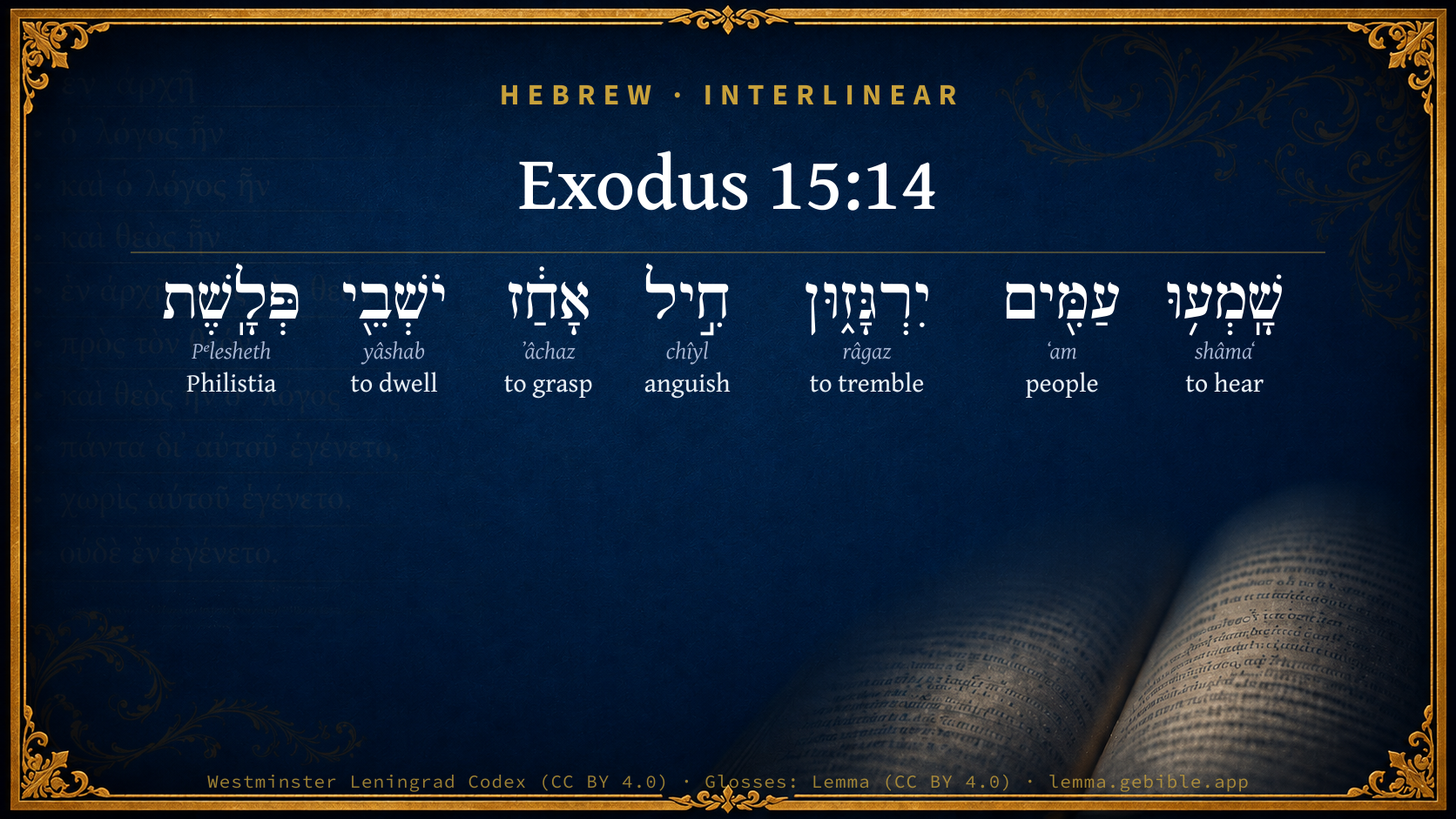
Hebrew (Westminster Leningrad Codex) Exodus 15:14 appears in the Hebrew Old Testament. The text above is from the Westminster Leningrad Codex. Each word links to its Strong’s number, a concise gloss, and parsing drawn from the Open Scriptures Hebrew Bible morphology. Click any word for its full Brown-Driver-Briggs (BDB) entry.
Download image
Cite this verse

Exodus 15:14 (World English Bible). Public Domain. Lemma interlinear Bible study tool, https://lemma.gebible.app/v/exodus/15/14.

Show BibTeX & RIS
BibTeX
RIS
English Translation
The peoples have heard. They tremble. Pangs have taken hold on the inhabitants of Philistia.
World English Bible · Public Domain
Highlights
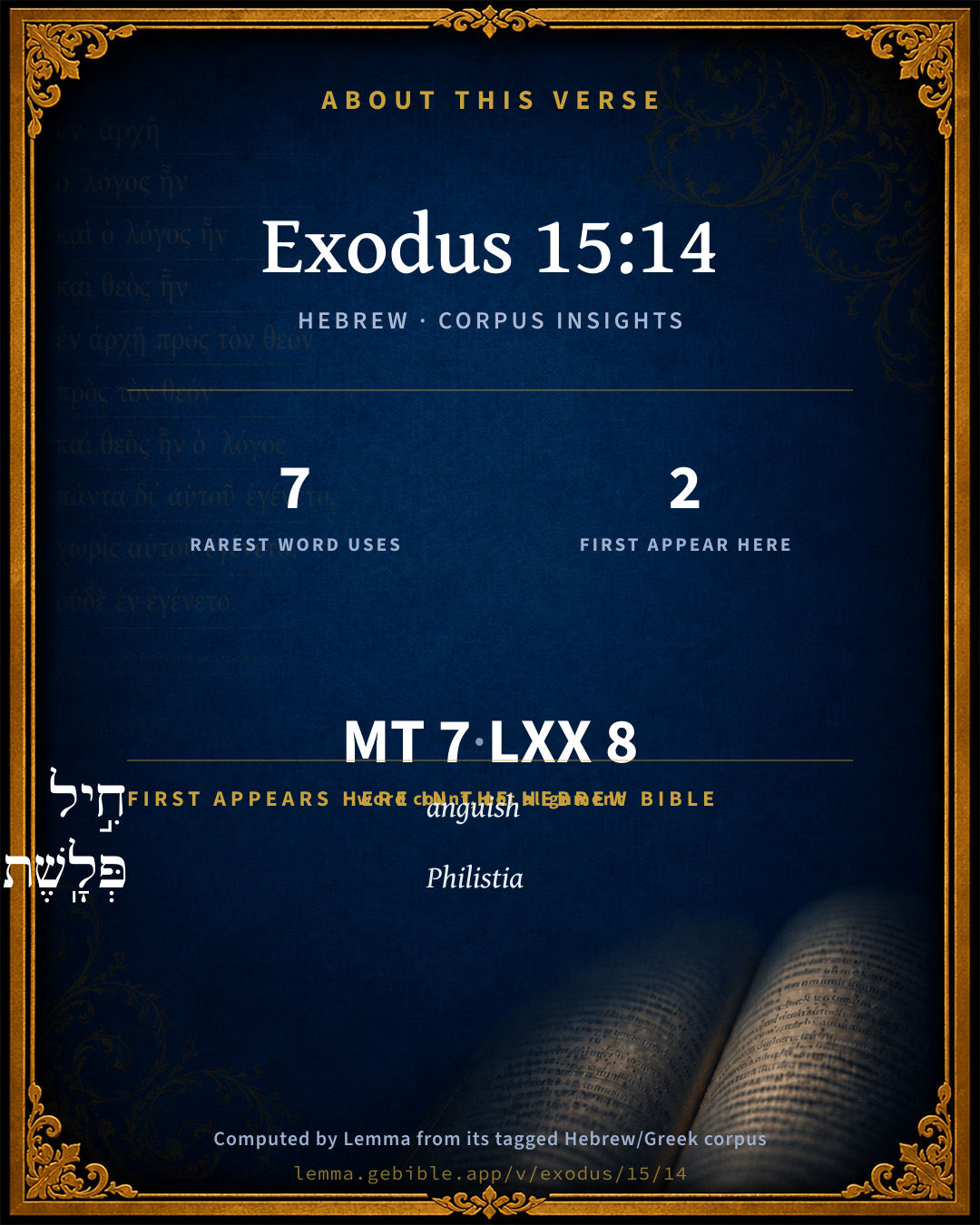
  • 2 first appearances in the Hebrew Bible
Full analysis ↓
Download a study sheet

One document with this verse’s original text, its word-by-word gloss line, the meaning frame, cross-references with their text, attributed commentary, and full source and license credits — printable, and it pastes into notes with its structure intact.

This verse Autodidact and up

Study sheet (.html) Plain text (.txt)

A passage Seminary Student

Up to 50 verses in one chapter. A passage sheet keeps up to 6 commentary sources and 12 cross-references per verse, in the order this page ranks them, and says so on the sheet whenever that leaves anything out. Ask for a single verse and you get the Autodidact verse sheet above.

Everything on this page stays free to read, with no account — the sheet is a download of what is already on screen, not access to it.

Want to remove ads? Support Godless Engineer
Compare translations 3

The same verse in 3 English versions, stacked beneath the original-language interlinear above. Click any original word for its lexicon entry.

Each is an independent rendering of the whole verse — the interlinear is not word-aligned to these translations.

Highlighted words mark where these versions differ — a whole-verse word diff, not a word-by-word alignment.

  • World English Bible Public Domain
    The peoples have heard. They tremble. Pangs have taken hold on the inhabitants of Philistia.
  • King James Version Public Domain
    The people shall hear, and be afraid: sorrow shall take hold on the inhabitants of Palestina.
  • unfoldingWord Literal Text CC BY-SA 4.0
    The peoples heard; they shake; anguish seized the inhabitants of Philistia.

unfoldingWord Literal Text — © unfoldingWord, licensed CC BY-SA 4.0. Word-aligned USFM3 via Door43 (git.door43.org/unfoldingWord/en_ult).

Versions to compare (up to 4)

3 of 4 selected

Show all 18 translations

Every available English version of this verse, each an independent rendering of the whole verse.

  • World English Bible Public Domain
    The peoples have heard. They tremble. Pangs have taken hold on the inhabitants of Philistia.
  • Berean Standard Bible Public Domain
    The nations will hear and tremble; anguish will grip the dwellers of Philistia.
  • Majority Standard Bible Public Domain
    The nations will hear and tremble; anguish will grip the dwellers of Philistia.
  • King James Version Public Domain
    The people shall hear, and be afraid: sorrow shall take hold on the inhabitants of Palestina.
  • American Standard Version (1901) Public Domain
    The peoples have heard, they tremble: Pangs have taken hold on the inhabitants of Philistia.
  • Revised Version (1885) Public Domain
    The peoples have heard, they tremble: Pangs have taken hold on the inhabitants of Philistia.
  • Geneva Bible (1599) Public Domain
    The people shall heare and be afraide: sorow shall come vpon the inhabitants of Palestina.
  • Douay-Rheims (1899) Public Domain
    Nations rose up, and were angry: sorrows took hold on the inhabitants of Philisthiim.
  • Young's Literal Translation Public Domain
    Peoples have heard, they are troubled; Pain hath seized inhabitants of Philistia.
  • Literal Standard Version CC BY-SA 4.0
    Peoples have heard, they are troubled; Pain has seized inhabitants of Philistia.
  • Unlocked Literal Bible CC BY-SA 4.0
    The peoples will hear, and they will tremble; terror will seize the inhabitants of Philistia.
  • unfoldingWord Literal Text CC BY-SA 4.0
    The peoples heard; they shake; anguish seized the inhabitants of Philistia.
  • Darby Bible Public Domain
    The peoples heard it, they were afraid: A thrill seized the inhabitants of Philistia.
  • World Messianic Bible Public Domain
    The peoples have heard. They tremble. Pangs have taken hold of the inhabitants of Philistia.
  • Webster's Bible Public Domain
    The people shall hear, and be afraid: sorrow shall take hold on the inhabitants of Palestina.
  • Free Bible Version CC BY-SA 4.0
    The nations will hear what has happened and will shake with fear. The people who live in Philistia will experience agonizing distress.
  • Bible in Basic English Public Domain
    Hearing of you the peoples were shaking in fear: the people of Philistia were gripped with pain.
  • JPS Tanakh (1917) Public Domain
    The peoples have heard, they tremble; pangs have taken hold on the inhabitants of Philistia.

Literal Standard Version (2020), Covenant Press — licensed CC BY-SA 4.0. Text via the HelloAO Bible API (eBible.org). Unlocked Literal Bible (unfoldingWord) — licensed CC BY-SA 4.0. Text via the HelloAO Bible API (eBible.org). unfoldingWord Literal Text — © unfoldingWord, licensed CC BY-SA 4.0. Word-aligned USFM3 via Door43 (git.door43.org/unfoldingWord/en_ult). Free Bible Version, Dr. Jonathan Gallagher — licensed CC BY-SA 4.0. Text via the HelloAO Bible API (eBible.org).

Word by word

More ways to search: Search by grammar → Find every occurrence → Compare this word →

Practice this passage: Drill this verse → Learn its vocabulary →

About this verse

These counts appear in no published source. They are computed here, from the morphology-tagged text and Lemma’s own curated glosses. What Lemma adds →

7
words
7
distinct lemmas
Pentateuch
section

Notable vocabulary

The rarest word here is חִ֣יל anguish H2427 — appearing just 7 times in the whole Hebrew Bible.

First appearance in Scripture

These words make their first canonical appearance in the Hebrew Bible here:

  • חִ֣יל anguish H2427
  • פְּלָֽשֶׁת Philistia H6429

Shared distinctive vocabulary

חִ֣יל anguish H2427 occurs in 7 verses of the Hebrew Bible. Also found in:

Grammatical profile

  • 4 verbs
  • 3 nouns

Verb forms

  • שָֽׁמְע֥וּ Qal · Perfect
  • יִרְגָּז֑וּן Qal · Imperfect
  • אָחַ֔ז Qal · Perfect
  • יֹשְׁבֵ֖י Qal · Participle Active

Hebrew & Septuagint length

In English translation the verse runs 15 words from the Hebrew and 15 from the Septuagint (LXX English) — the same length.

A rough comparison of the two English renderings, which tokenize alike — not a word-level alignment.

Word counts can differ between the Hebrew and the Greek without any difference in meaning — e.g. the Hebrew direct-object marker אֵת has no separate Greek word, and Greek often adds the article ὁ.

In the original languages it is 7 Hebrew tokens and 8 Greek tokens — but the two are counted differently (Hebrew bundles its prefixes and suffixes into one token; the Greek is in lemma form), so that isn’t a like-for-like length.

Cross-references

9

Topical passages linked to Exodus 15:14 in the Treasury of Scripture Knowledge — connected by theme and wording, ordered by reader-vote popularity; previews shown in the World English Bible.

  • Deuteronomy 2:25 This day will I begin to put the dread of you and the fear of you on the peoples who are under the whole sky, who shall hear the report of you, and shall tremble, and be in anguish because of you.
  • Joshua 2:9–10 and she said to the men, I know that Yahweh has given you the land, and that the fear of you is fallen on us, and that all the inhabitants of the land melt away before you.
  • Psalms 48:6 Trembling took hold of them there, Pain, as of a woman in travail.
  • Numbers 14:14 and they will tell it to the inhabitants of this land. They have heard that you Yahweh are in the midst of this people; for you Yahweh are seen face to face, and your cloud stands over them, and you go before them, in a pillar of cloud by day, and in a pillar of fire by night.
  • Joshua 9:24 They answered Joshua, and said, Because it was certainly told your servants, how that Yahweh your God commanded his servant Moses to give you all the land, and to destroy all the inhabitants of the land from before you; therefore we were sore afraid for our lives because of you, and have done this thing.
  • Isaiah 14:31 Howl, gate; cry, city; you are melted away, Philistia, all of you; for there comes a smoke out of the north, and there is no straggler in his ranks.
  • Numbers 22:5 He sent messengers to Balaam the son of Beor, to Pethor, which is by the River, to the land of the children of his people, to call him, saying, Behold, there is a people come out from Egypt: behold, they cover the surface of the earth, and they abide over against me.
  • Deuteronomy 2:4–5 Command you the people, saying, You are to pass through the border of your brothers the children of Esau, who dwell in Seir; and they will be afraid of you: take good heed to yourselves therefore;
  • Isaiah 14:29 Don't rejoice, O Philistia, all of you, because the rod that struck you is broken; for out of the serpent's root shall come forth an adder, and his fruit shall be a fiery flying serpent.

Cross-references courtesy of OpenBible.info (CC BY 4.0).

Hebrew and Greek witnesses Masoretic Hebrew ↔ Greek Septuagint

The same verse in the two great witnesses to the Old Testament, shown verse-for-verse.

These are two independent witnesses, not word-aligned to each other, and the Septuagint is shown in lemma (dictionary) form.

Hebrew Exodus 15:14 Masoretic · Westminster Leningrad Codex

שָֽׁמְע֥וּ עַמִּ֖ים יִרְגָּז֑וּן חִ֣יל אָחַ֔ז יֹשְׁבֵ֖י פְּלָֽשֶׁת

The peoples have heard. They tremble. Pangs have taken hold on the inhabitants of Philistia.

World English Bible · Public Domain

Greek LXX Exodus 15:14 Septuagint · lemma form

ἀκούω ἔθνος καί ὀργίζω ὠδίν λαμβάνω καταοἰκέω φυλιστιιμ

The nations heard and were angry, pangs have seized on the dwellers among the Phylistines.

LXX2012 (modern English Septuagint) · Public Domain

Hebrew: Westminster Leningrad Codex (CC BY 4.0). Greek: Septuagint (public domain); English from LXX2012 (modern English Septuagint) (Public Domain). How the Septuagint differs from the Hebrew →

Targum (Aramaic paraphrase)

2

The Targum is the ancient Jewish Aramaic paraphrase of the Hebrew Scriptures — an interpretive translation, not the Hebrew text itself. Onkelos (literal) and Pseudo-Jonathan (expansive) render the Torah, and Jonathan the Prophets. Coverage is partial: where no permissively-licensed English translation exists for a verse, only the Aramaic is shown. This is verse-level text, not a word-by-word alignment to the Hebrew.

  1. Targum Onkelos Torah (Genesis–Deuteronomy)
    שְׁמָעוּ עַמְמַיָא וְזָעוּ דַחֲלָא אַחֲדָתְנוּן דַהֲווֹ יָתְבִין בִּפְלָשֶׁת:

    (no public-domain English translation for this verse)

    Targum Onkelos — Aramaic: “Onkelos Genesis” (public domain); “Onkelos Exodus” (public domain); “Onkelos Leviticus” (public domain); “Onkelos Numbers” (public domain); “Onkelos Deuteronomy” (public domain). English: “Sefaria Community Translation” (CC0 1.0 (public-domain dedication)); “J.W. Etheridge. The Targums of Onkelos and Jonathan Ben Uzziel on the Pentateuch. London: Longmans, Green, 1862” (public domain). Text via Sefaria.

  2. Targum Pseudo-Jonathan Torah (Genesis–Deuteronomy)
    שְׁמָעוּ אוּמַיָא יִתְרַגְזוּן דְּחִילָא אֲחָדַת יַת כָּל עַמּוּדֵי דַיְירֵי אַרְעֲהוֹן דִּפְּלִשְׁתָּאֵי

    The nations will hear and be afraid; terror will lay hold upon them, even upon all the pillars of the inhabitants of the Palestinian land.

    Targum Pseudo-Jonathan — Aramaic: “Targum Jonathan on Genesis” (public domain); “Targum Jonathan on Exodus” (public domain); “Targum Jonathan on Leviticus” (public domain); “Targum Jonathan on Numbers” (public domain); “Targum Jonathan on Deuteronomy” (public domain). English: “The Targum of Jonathan ben Uzziel, trans. J. W. Etheridge, London, 1862” (public domain). Text via Sefaria.

Commentary

Notes on Exodus 15:14 from classic Christian and Jewish commentators (each source and its license shown beneath its notes). The classic Christian expositions comment on the surrounding passage and are grouped to its opening verse, so a note may address several verses; the Jewish commentaries on the Tanakh (Rashi and others) are per-verse, so they appear only where the commentator wrote on this verse.

Lemma curates 59 commentaries, every one of them public domain or Creative Commons licensed, each selected and text-cleaned for this edition rather than reprinted as found. About our sources →

Trapp's Complete Commentary

John Trapp

Exo 15:14 The people shall hear, [and] be afraid: sorrow shall take hold on the inhabitants of Palestina.

Ver. 14. So, now shall take hold.] So it did. {1Sa 4:8}

John Trapp, A Commentary or Exposition upon All the Books of the Old and New Testament (1647–1656) — public domain. Text from a community e-Sword module.

The Biblical Illustrator

Joseph S. Exell

Exo_15:14-16

The people shall hear, and be afraid.

The world afraid of Gods people

What shall make these mighty men melt away? Seeing two or three millions of unwarlike folks marching towards them--an unarmed rabble, without military discipline, and without the appliances of war? Is it before such that the mighty men of Moab are to fall back, that the chivalrous sons of Edom are to be put to flight; that all the inhabitants of Palestine are to melt away? Nothing of the kind. Those Israelites were not going to terrify all these nations with any display of their own power or prowess. It was the story of the Exodus, the story of a divided sea, the story of a certain mysterious pillar of fire, the story of the wonderful overthrow of Pharaoh and his hosts in the Red Sea; it was this that was to fill them with despair. Many of us are at the outset terribly afraid of these hostile forces; is it not a comfort to know that on account of redemption they are actually afraid of us? In a very memorable period in our island story, when Admiral Howard and Drake had defeated the Spanish Armada after the first great battle, they continued to pursue them for a fortnight without having a single shot or a single charge of powder left in their ships. They had nothing left but air to fill their guns with. Yet thus without any ammunition our fleet went sailing on and sailing on, while the terrified strangers fled before them, until they were driven right into the Northern Sea. Then the Admiral thought they could not do much harm there, and so he left them and came back to get powder and shot for his own ships. Our fleet, with empty guns, chased their enemies because that enemy was afraid of them. They had had one terrible defeat, and that was enough. And even so may we deal with the forces of this world. Count upon your enemies being afraid of you. If instead of being afraid of them you will only carry the war into the enemys camp, and seek to win them for Christ, instead of allowing them to draw you away from Him, you will find that redemption has already stripped them of their courage and paralyzed their power to do you any injury. (W. Hay Aitken, M. A.)

The Biblical Illustrator, edited by Joseph S. Exell (c. 1880s–1900s) — public domain. Text from a community e-Sword module.

Tyndale Open Study Notes

Tyndale Open Resources

15:14-15 Philistia, Edom, Moab, and Canaan are the four peoples that would most feel the hand of God’s judgment as he dispossessed them to give the land to the people of Israel. What God had done to Egypt would have been common news throughout that part of the world (see Rahab’s report in Josh 2:9-11, where the same imagery as in Exod 15:15, to melt away, is used).

Tyndale Open Study Notes — © Tyndale Open Resources, licensed CC BY-SA 4.0. Text via the HelloAO Bible API.

Ellicott's Commentary for English Readers

(14) The people.—Heb., The peoples: i.e., all the various tribes and nations of the desert and of Palestine—the Amalekites, Edomites, Philistines, Moabites, Amorites, &c.

Shall hear, and be afraid.—On the fear which was actually felt, see Num_22:3; Jos_2:11; Jos_5:1; Jos_9:3-15, &c.

The inhabitants of Palestina are the Philistines, from whom the Holy Land derived the name which it still retains in most of the languages of modern Europe. The Hebrew word is Phĕlâsheth, of which the nearest English equivalent would be “Philistia.”

A Bible Commentary for English Readers, edited by Charles John Ellicott (1878–1897) — public domain. Text from a community e-Sword module.

The Cambridge Bible for Schools and Colleges

gen. ed. J. J. S. Perowne

14.The peoples heard, they trembled;

Pangs took hold on the inhabitants of Philistia.

Pangs] Properly, as of a woman in travail. Cf. Psa_48:6, Jer_6:24; Jer_50:43.

14–16. The poet pictures the neighbouring nations as seized with alarm, when they hear that Israel is advancing on its way to Canaan. The description is idealized: Edom, for instance, according to Num_20:18-21, was in no fear of Israel whatever.

The Cambridge Bible for Schools and Colleges (gen. ed. J. J. S. Perowne; Cambridge University Press, 1878–1918) — public domain. Text from a community e-Sword module.

John Gill's Exposition

And the people shall hear, and be afraid,.... What follows from hence to the end of the song is plainly prophetic, a prediction of future events; and this clause respects the case of all the nations of the earth, who should hear the report of the plagues, brought upon the Egyptians for the sake of Israel, and of their being brought out of Egypt, and of their being led through the Red sea as on dry land, and of the destruction of Pharaoh and his host in it, which report would strike a panic in all that heard it, throughout the whole world; as well as of what the Lord would after this do for them in the wilderness, see Deu 2:25.

sorrow shall take hold of the inhabitants of Palestina; which was adjoining to the land of Canaan, and through which in the common way their road lay to it.

John Gill's Exposition of the Whole Bible (1746–1763) — public domain (CC PDM 1.0). Text via the HelloAO Bible API.

Whedon's Commentary on the Bible

Daniel D. Whedon

14-17. Fifth strain. The Egyptians were conquered, but other foes yet lay between the Israelites and the promised inheritance. The Canaanites filled the land, and Philistia barred one gate of entrance, while Moab and Edom held the other. It is a noteworthy mark of the genuineness of this prophecy that Canaan and Phllistia, Edom and Moab, are all spoken of in the same terms; yet, while the Canaanites were exterminated, Israel passed by Edom, (Num_20:18, etc.,) while Moab and Philistia were rival nations through all the centuries of the Hebrew commonwealth and monarchy. A poet would naturally have written thus at the time of the exodus, when he had simply the general revelation that Israel would triumph over all these enemies; but after the conquest of Canaan some distinction would naturally have been made between nations which were exterminated and those which never lost their independence.

The theme of this last stanza is introduced with wonderful boldness and vigour, hurling out the words without article or connective.

Palestina — Palestuth, Philistia; the meaning of the word Palestine or Palestina throughout the Bible. This was the dwelling-place of the Philistines, the long, fertile plain, about fifteen miles wide, which skirts the Mediterranean from the coast to the foot-hills of the mountains of Judah, and now, as probably then, an enormous wheat field. The name was afterwards extended to the whole of Canaan. Note Act_8:40.

Edom — Idumea, Mount Seir, and the adjacent desert; the mountainous and desert country east of the Arabah, stretching from the head of the eastern gulf of the Red Sea to the Jordan valley; separated by the brook Zered from Moab, which skirts the eastern shore of the Dead Sea.

Till thy people pass through — Through the desert to the Land of Promise. The strain closes with a beautiful parallelism and climax.

Thou shalt… plant them in the mountain — Israel, like a fruitful tree, is to be planted in God’s mountain-land, God’s dwelling-place, God’s sanctuary, country, home, altar. (Murphy.) How calm the close! How delightful to repose under the vine and fig tree, to rest in the peaceful home, to cling to the sacred altar, after this tempest of emotions! And then from the whole congregation bursts forth the grand chorus,

Jehovah shall reign for ever and ever — And the hearts of the vast host are all lifted heavenward and left before the Throne.

The saints on “the sea of glass” will sing the “song of Moses the servant of God, and the song of the Lamb.” Rev_15:3. The birth-song of ransomed Israel is, in its deeper meanings, the birth-song of the spiritual Israel of all ages — of the great redemption from the darkness and death of sin. The profound and far-reaching spiritual significance of these Old Testament events will be fully felt when “God’s mystery is finished;”

when type and antitype, prophecy and history, law and gospel, will blend in one blaze of light. Christ is in all the Old Covenant as Moses is in all the New; the “Song of Moses” is the “Song of the Lamb.” “The word is nigh” us, though it comes to us across so many centuries, for it is a word from Jehovah, and not to Israel alone, but to mankind — to me and thee.

Daniel D. Whedon (gen. ed.), Commentary on the Old and New Testaments (1874–1909) — public domain. Text from a community e-Sword module.

The Pulpit Commentary

The people shall hear. Rather, "the peoplesi.e. , the tribes, or nations, of these parts Philistines, Amalekites, Edomites, Moabites, etc. will hear of the wonders done in Egypt, especially of the crowning wonder of all Israel"s passage through the Red Sea and Egypt"s destruction in it and will in consequence tremble with fear when the Israelites approach them, and offer them no effectual opposition. Palestine. This is a Greek form. The Hebrew is Phelasheth, which would perhaps be best translated "Philistia." (Compare Psa_60:8 Psa_87:4 Psa_108:9) The Philistine country was a strip of territory extending along the coast of the Mediterranean from a little below Gaze on the south, nearly to Mount Carmel on the north. It is curious that the philistines are not mentioned under that name on any of the early Egyptian monuments. They may perhaps be the Purusaia of the time of Rameses III, whom some however identify with the Pelasgi.

The Pulpit Commentary (1880–1919), ed. H.D.M. Spence-Jones & Joseph S. Exell — public domain. Text from a community e-Sword module.

unfoldingWord translationNotes

Door43 World Missions Community

tremble

This means to shake because you are afraid.

terror will seize the inhabitants of Philistia

Moses speaks of terror as if it were a person that could forcefully grab hold of someone and make them extremely afraid. AT: "the inhabitants of Philistia will be afraid" (See: Personification)

will melt away

Moses speaks of people becoming weak from their fear as melting away. AT: "will be weak from fear" or "will be afraid and faint" (See: Metaphor)

translationWords

people group

seize

Philistines

Edom

Moab

Canaan

unfoldingWord translationNotes — © Distant Shores Media and the Door43 World Missions Community, licensed CC BY-SA 4.0. Source: git.door43.org/Door43/en_tn.

Rashi

Rabbi Shlomo Yitzchaki (Rashi)

ירגזון means THEY TREMBLE (not they will tremble).

ישבי פלשת [REIGS SEIZED] THE INHABITANTS OF PALESTINE, because they slew the children of Ephraim who anticipated the end fixed for the period of slavery and left Egypt forcibly, as is explained in Chronicles (1 7:21) “[The sons of Ephraim…] whom the men of Gath slew” (Mekhilta).

Rashi on the Tanakh — English translations: “The Judaica Press complete Tanach with Rashi, translated by A. J. Rosenberg” (CC BY 4.0); “Pentateuch with Rashi's commentary by M. Rosenbaum and A.M. Silbermann, 1929-1934” (public domain); “The Metsudah Tanach series, Lakewood, N.J” (CC BY 4.0); and “The Book of Joshua, Metsudah Publications, 1997” (CC BY 4.0). Text via Sefaria.

Ramban (Nachmanides)

Rabbi Moshe ben Nachman (Ramban / Nachmanides)

THE PEOPLES HAVE HEARD, THEY TREMBLE. The purport thereof is: “when the people will hear [of Thy visitation upon the Egyptians], they will tremble from the blow of Thy hands, and pangs will take hold of the inhabitants of Philistia when they will hear [of those deeds].” It is possible that Moses is saying that the peoples have already heard all that G-d has done in the land of Egypt, and that they will always tremble from the disease He has put upon them. Thus Moses continues to pray that He should let fall upon them terror and dread so that they should not go out to war against Israel.Rabbi Abraham ibn Ezra explained that the verse, Horror and dread shall fall upon them, refers only to Philistia, [mentioned in Verse 14] and Edom and Moab, [mentioned in Verse 15], but not to the inhabitants of Canaan, [who are also mentioned at the end of Verse 15]. This is because Moses said afterward, [i.e., at the end of Verse 16 before us], till Thy people pass over, O Eternal. It was over them [Philistia, Edom and Moab] that the Israelites passed before they came into the land of Canaan, and these peoples really did not war against them. Even when Edom came out against him with much people, and a strong hand, it was only so that the Israelites should not pass over his land, but he did not war against them. But were it not for the terror and dread that fell upon them, they would have wanted to battle against them out of their hatred of them. Now Moses did not mention Ammon, because Ammon and Moab are as one nation. It is possible that the dread of the Israelites fell on the Canaanite too, and he did not war against them until they had passed over [the Jordan], for the Canaanite, the king of Arad, who dwelt in the south, 21:1. [and who warred against Israel when they were still in the wilderness], was not a Canaanite by descent, according to the opinion of our Rabbis. 18. The explanation there is that this was Amalek, but he purposely changed his speech to the Canaanite language so that Israel might be misled and would pray that G-d should give the Canaanites into their hands. Since Amalek was actually not a Canaanite, their prayers would therefore be ineffectual. This interpretation is quoted by Rashi to Numbers 21:1.

Ramban (Nachmanides) on the Tanakh — English translation: “Commentary on the Torah by Ramban (Nachmanides). Translated and annotated by Charles B. Chavel. New York, Shilo Pub. House, 1971-1976” (CC BY 4.0). Text via Sefaria.

Lesson kit

Teaching starters — assembled from the data on this page, not authored interpretation. Every prompt links to the verse data it draws on. Edit before teaching.

Exodus, in the Pentateuch, opens this verse with 7 words (7 distinct Hebrew lemmas). Its most distinctive word is chîyl (“anguish”). A historical commentator’s framing appears above. Read the whole chapter for the surrounding context.

Discussion questions

  1. How does “anguish” (chîyl) shape what this verse is saying?
  2. 2 words make their first appearance in Scripture here. What does this debut establish?
  3. How does Job 6:10, which shares the word «anguish», read alongside this verse?
  4. The translations on this page render this verse differently — a whole-verse word diff, not a word-by-word alignment. What might account for the different wordings?
  5. «שָֽׁמְע֥וּ» is a Qal Perfect verb. How does that grammatical form shape the action described?
  6. Compare how Trapp's Complete Commentary and The Biblical Illustrator read this verse. Where do they agree or differ?

Things to notice

Reading settings

Reading text

Shown beneath each verse's original-language words.

Old Testament
Old Testament edition

Read the OT as the Masoretic Hebrew (MT) or the Greek Septuagint (LXX).

English shown for the Greek Septuagint (in the Hebrew ↔ Greek comparison).

Comparing translations? Open the Compare panel on any verse page to stack up to four side by side.