
Revelation 8:13

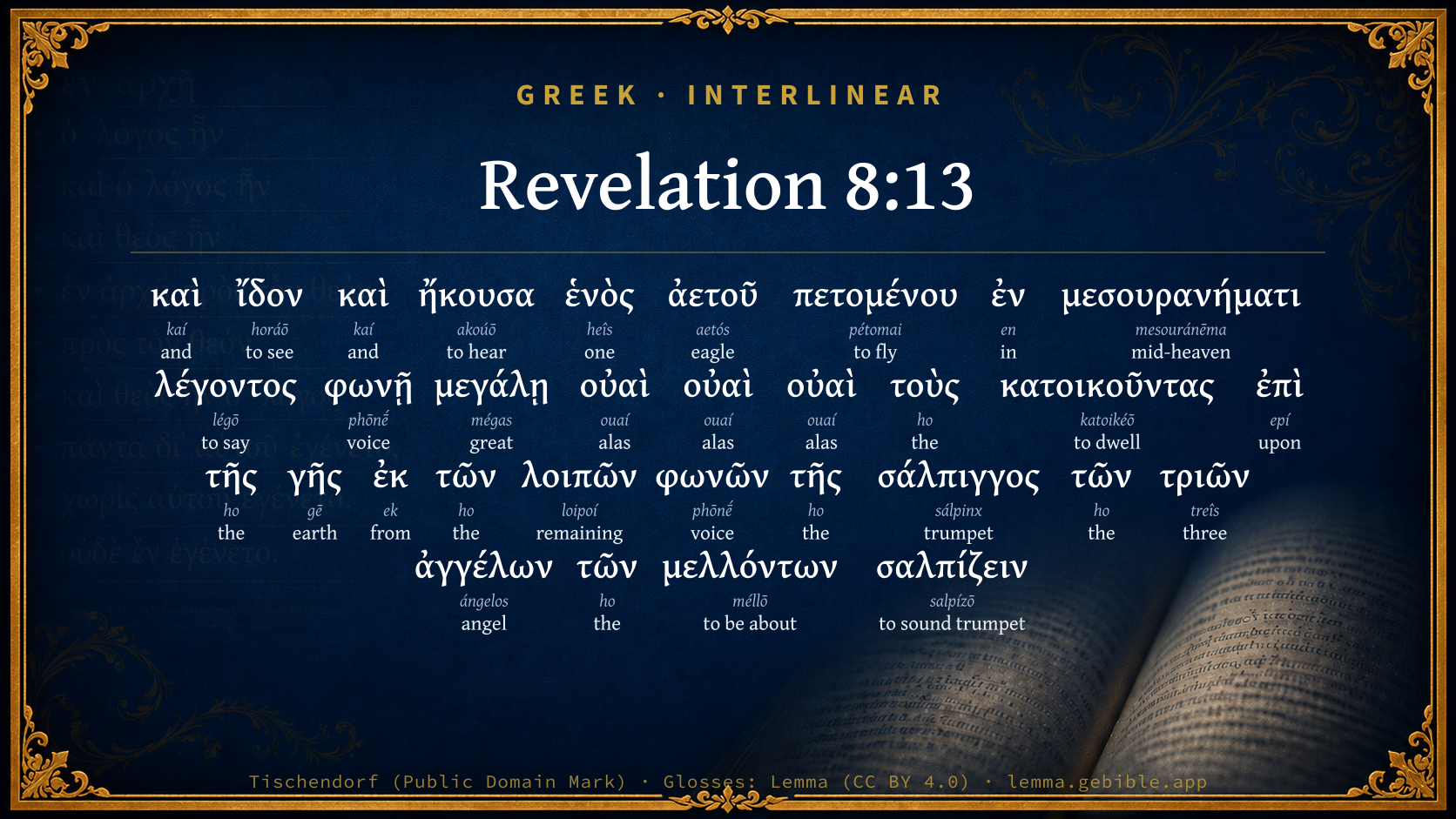
Greek (Tischendorf 8th ed.) Revelation 8:13 appears in the Greek New Testament. The text above is from the Tischendorf 8th edition. Each word links to its Strong’s number and a concise gloss. Click any word for its full Thayer’s Greek Lexicon entry.
Download image
Cite this verse

Revelation 8:13 (World English Bible). Public Domain. Lemma interlinear Bible study tool, https://lemma.gebible.app/v/revelation/8/13.

Show BibTeX & RIS
BibTeX
RIS
English Translation
I saw, and I heard an eagle, flying in mid heaven, saying with a loud voice, "Woe! Woe! Woe for those who dwell on the earth, because of the other voices of the trumpets of the three angels, who are yet to sound!"
World English Bible · Public Domain
Highlights
  • 1 first appearance in the Greek New Testament
Full analysis ↓
Download a study sheet

One document with this verse’s original text, its word-by-word gloss line, the meaning frame, cross-references with their text, attributed commentary, and full source and license credits — printable, and it pastes into notes with its structure intact.

This verse Autodidact and up

Study sheet (.html) Plain text (.txt)

A passage Seminary Student

Up to 50 verses in one chapter. A passage sheet keeps up to 6 commentary sources and 12 cross-references per verse, in the order this page ranks them, and says so on the sheet whenever that leaves anything out. Ask for a single verse and you get the Autodidact verse sheet above.

Everything on this page stays free to read, with no account — the sheet is a download of what is already on screen, not access to it.

Want to remove ads? Support Godless Engineer
Compare translations 3

The same verse in 3 English versions, stacked beneath the original-language interlinear above. Click any original word for its lexicon entry.

Each is an independent rendering of the whole verse — the interlinear is not word-aligned to these translations.

Highlighted words mark where these versions differ — a whole-verse word diff, not a word-by-word alignment.

  • World English Bible Public Domain
    I saw, and I heard an eagle, flying in mid heaven, saying with a loud voice, "Woe! Woe! Woe for those who dwell on the earth, because of the other voices of the trumpets of the three angels, who are yet to sound!"
  • King James Version Public Domain
    And I beheld, and heard an angel flying through the midst of heaven, saying with a loud voice, Woe, woe, woe, to the inhabiters of the earth by reason of the other voices of the trumpet of the three angels, which are yet to sound!
  • unfoldingWord Literal Text CC BY-SA 4.0
    And I looked, and I heard an eagle flying in mid-heaven saying in a loud voice, “Woe, woe, woe, to the ones living on the earth from the remaining sounds of the trumpet of the three angels who are going to trumpet.”

unfoldingWord Literal Text — © unfoldingWord, licensed CC BY-SA 4.0. Word-aligned USFM3 via Door43 (git.door43.org/unfoldingWord/en_ult).

Versions to compare (up to 4)

3 of 4 selected

Show all 19 translations

Every available English version of this verse, each an independent rendering of the whole verse.

  • World English Bible Public Domain
    I saw, and I heard an eagle, flying in mid heaven, saying with a loud voice, "Woe! Woe! Woe for those who dwell on the earth, because of the other voices of the trumpets of the three angels, who are yet to sound!"
  • Berean Standard Bible Public Domain
    And as I observed, I heard an eagle flying overhead, calling in a loud voice, “Woe! Woe! Woe to those who dwell on the earth, because of the trumpet blasts about to be sounded by the remaining three angels!”
  • Majority Standard Bible Public Domain
    And as I observed, I heard an eagle flying overhead, calling in a loud voice, “Woe! Woe! Woe to those who dwell on the earth, because of the trumpet blasts about to be sounded by the remaining three angels!”
  • King James Version Public Domain
    And I beheld, and heard an angel flying through the midst of heaven, saying with a loud voice, Woe, woe, woe, to the inhabiters of the earth by reason of the other voices of the trumpet of the three angels, which are yet to sound!
  • American Standard Version (1901) Public Domain
    And I saw, and I heard an eagle, flying in mid heaven, saying with a great voice, Woe, woe, woe, for them that dwell on the earth, by reason of the other voices of the trumpet of the three angels, who are yet to sound.
  • Revised Version (1885) Public Domain
    And I saw, and I heard an eagle, flying in mid heaven, saying with a great voice, Woe, woe, woe, for them that dwell on the earth, by reason of the other voices of the trumpet of the three angels, who are yet to sound.
  • Geneva Bible (1599) Public Domain
    And I beheld, and heard one Angel flying thorow the middes of heauen, saying with a loude voyce, Woe, woe, woe to the inhabitants of the earth, because of the sounds to come of the trumpet of the three Angels, which were yet to blowe the trumpets.
  • Douay-Rheims (1899) Public Domain
    And I beheld, and heard the voice of one eagle flying through the midst of heaven, saying with a loud voice: Woe, woe, woe to the inhabitants of the earth: by reason of the rest of the voices of the three angels, who are yet to sound the trumpet.
  • Young's Literal Translation Public Domain
    And I saw, and I heard one messenger, flying in the mid-heaven, saying with a great voice, `Wo, wo, wo, to those dwelling upon the land from the rest of the voices of the trumpet of the three messengers who are about to sound.'
  • Literal Standard Version CC BY-SA 4.0
    And I saw, and I heard one messenger, flying in midair, saying with a great voice, “Woe, woe, woe, to those dwelling on the earth because of the rest of the voices of the trumpet of the three messengers being about to sound trumpets.”
  • Unlocked Literal Bible CC BY-SA 4.0
    I looked, and I heard an eagle that was flying overhead calling out with a loud voice, “Woe, woe, woe, to those who live on the earth, because of the remaining trumpet blasts that are about to be sounded by the three angels.”
  • unfoldingWord Literal Text CC BY-SA 4.0
    And I looked, and I heard an eagle flying in mid-heaven saying in a loud voice, “Woe, woe, woe, to the ones living on the earth from the remaining sounds of the trumpet of the three angels who are going to trumpet.”
  • Darby Bible Public Domain
    And I saw, and I heard an eagle flying in mid-heaven, saying with a loud voice, Woe, woe, woe, to them that dwell upon the earth, for the remaining voices of the trumpet of the three angels who are about to sound.
  • World Messianic Bible Public Domain
    I saw, and I heard an eagle, flying in mid heaven, saying with a loud voice, “Woe! Woe! Woe to those who dwell on the earth, because of the other blasts of the shofars of the three angels, who are yet to sound!”
  • Webster's Bible Public Domain
    And I beheld, and heard an angel flying through the midst of heaven, saying with a loud voice, Woe, woe, woe, to the inhabiters of the earth, by reason of the other voices of the trumpet of the three angels, which are yet to sound!
  • Free Bible Version CC BY-SA 4.0
    I saw and heard an eagle flying in mid-heaven, shouting loudly, “Disaster, disaster, disaster is coming to those who live on the earth because of what is going to happen when the three remaining angels blow their trumpets.”
  • Bible in Basic English Public Domain
    And there came to my ears the cry of an eagle in flight in the middle of heaven, saying with a great voice, Trouble, trouble, trouble, to all on the earth, because of the other voices of the horns of the three angels, whose sounding is still to come.
  • Text-Critical English NT CC BY 4.0
    Then I looked, and I heard an eagle saying with a loud voice as it flew directly overhead, “Woe, woe, woe to those who dwell on the earth, because of the remaining blasts of the trumpet from the three angels who are about to sound!”
  • Tyndale New Testament (1534) Public Domain
    And I behelde and herd an angell flyinge thorowe the myddes of heven sayinge with a lowde voyce: Woo wo to the inhabiters of the erth because of the voyces to come of the trompe of the.iii. angells which were yet to blowe.

Literal Standard Version (2020), Covenant Press — licensed CC BY-SA 4.0. Text via the HelloAO Bible API (eBible.org). Unlocked Literal Bible (unfoldingWord) — licensed CC BY-SA 4.0. Text via the HelloAO Bible API (eBible.org). unfoldingWord Literal Text — © unfoldingWord, licensed CC BY-SA 4.0. Word-aligned USFM3 via Door43 (git.door43.org/unfoldingWord/en_ult). Free Bible Version, Dr. Jonathan Gallagher — licensed CC BY-SA 4.0. Text via the HelloAO Bible API (eBible.org).

Word by word

More ways to search: Search by grammar → Find every occurrence → Compare this word →

Practice this passage: Drill this verse → Learn its vocabulary →

μεσουρανήματι
mesouránēma
G3321
“mid-heaven”
Noun, Dative, Singular, Neuter
Part of Speech
Noun
Case
Dative
Number
Singular
Gender
Neuter
Full Thayer's Definition

Origin: from a presumed compound of G3319 and G3772

TDNT: None

1. mid-heaven 2. the highest point in the heavens, which the sun occupies at noon, where what is done can be seen and heard by all
  1. καὶ kaí G2532 “and” Conjunction
  2. ἴδον horáō G3708 “to see” Verb, Aorist, Active, Indicative, 1st person, Singular
  3. καὶ kaí G2532 “and” Conjunction
  4. ἤκουσα akoúō G191 “to hear” Verb, Aorist, Active, Indicative, 1st person, Singular
  5. ἑνὸς heîs G1520 “one” Adjective, Genitive, Singular, Masculine
  6. ἀετοῦ aetós G105 “eagle” Noun, Genitive, Singular, Masculine
  7. πετομένου pétomai G4072 “to fly” Verb, Present, Middle or Passive deponent, Participle, Genitive, Singular, Masculine
  8. ἐν en G1722 “in” Preposition
  9. λέγοντος légō G3004 “to say” Verb, Present, Active, Participle, Genitive, Singular, Masculine
  10. φωνῇ phōnḗ G5456 “voice” Noun, Dative, Singular, Feminine
  11. μεγάλῃ mégas G3173 “great” Adjective, Dative, Singular, Feminine
  12. οὐαὶ ouaí G3759 “alas” Interjection
  13. οὐαὶ ouaí G3759 “alas” Interjection
  14. οὐαὶ ouaí G3759 “alas” Interjection
  15. τοὺς ho G3588 “the” Article, Accusative, Plural, Masculine
  16. κατοικοῦντας katoikéō G2730 “to dwell” Verb, Present, Active, Participle, Accusative, Plural, Masculine
  17. ἐπὶ epí G1909 “upon” Preposition
  18. τῆς ho G3588 “the” Article, Genitive, Singular, Feminine
  19. γῆς gē G1093 “earth” Noun, Genitive, Singular, Feminine
  20. ἐκ ek G1537 “from” Preposition
  21. τῶν ho G3588 “the” Article, Genitive, Plural, Masculine
  22. λοιπῶν loipoí G3062 “remaining” Adjective, Genitive, Plural, Masculine
  23. φωνῶν phōnḗ G5456 “voice” Noun, Genitive, Plural, Feminine
  24. τῆς ho G3588 “the” Article, Genitive, Singular, Feminine
  25. σάλπιγγος sálpinx G4536 “trumpet” Noun, Genitive, Singular, Feminine
  26. τῶν ho G3588 “the” Article, Genitive, Plural, Masculine
  27. τριῶν treîs G5140 “three” Adjective, Genitive, Plural, Masculine
  28. ἀγγέλων ángelos G32 “angel” Noun, Genitive, Plural, Masculine
  29. τῶν ho G3588 “the” Article, Genitive, Plural, Masculine
  30. μελλόντων méllō G3195 “to be about” Verb, Present, Active, Participle, Genitive, Plural, Masculine
  31. σαλπίζειν salpízō G4537 “to sound trumpet” Verb, Present, Active, Infinitive

About this verse

These counts appear in no published source. They are computed here, from the morphology-tagged text and Lemma’s own curated glosses. What Lemma adds →

32
words
23
distinct lemmas
Revelation
section

Notable vocabulary

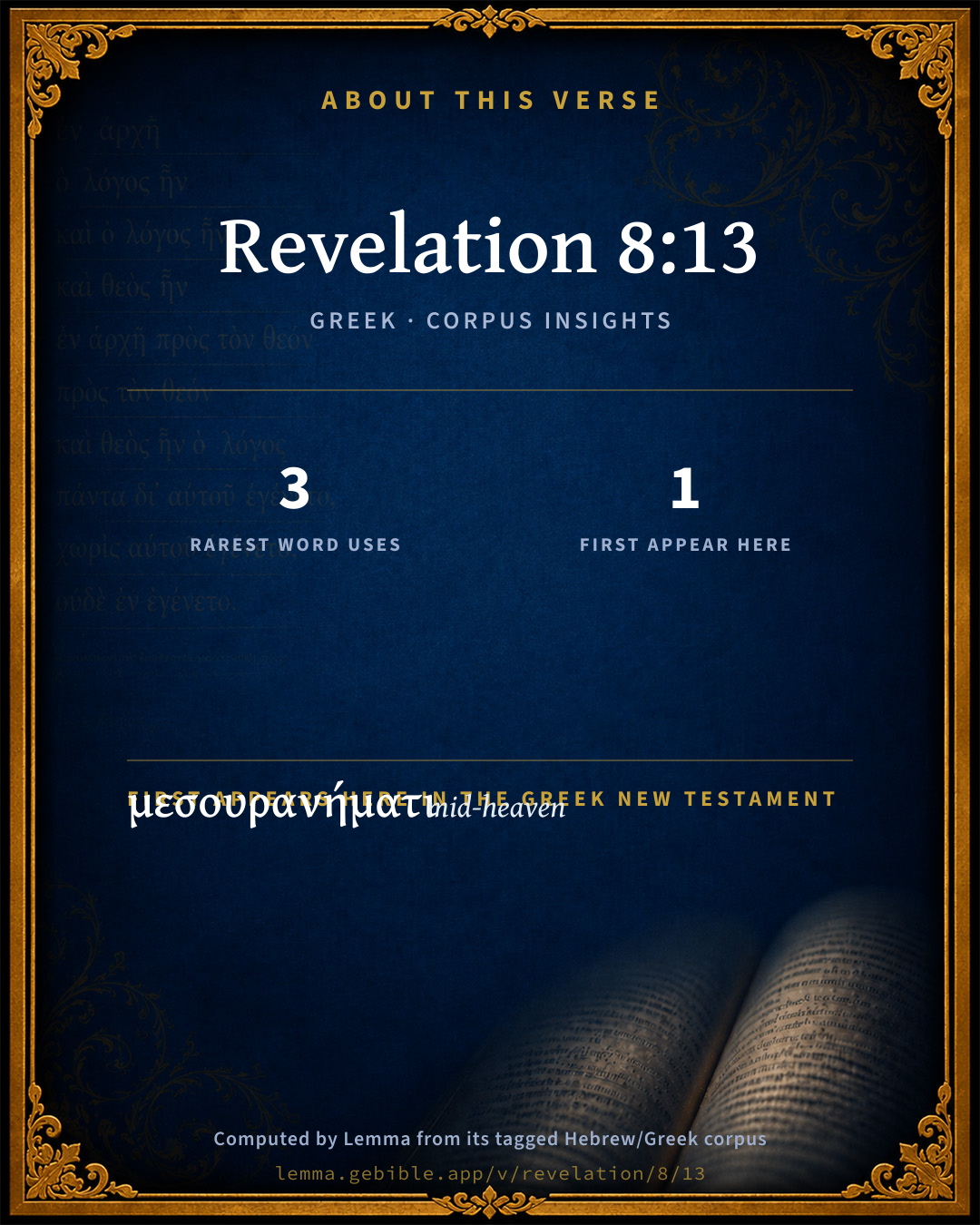
The rarest word here is μεσουρανήματι mid-heaven G3321 — appearing just 3 times in the whole Greek New Testament.

First appearance in Scripture

This word makes its first canonical appearance in the Greek New Testament here:

  • μεσουρανήματι mid-heaven G3321

Shared distinctive vocabulary

μεσουρανήματι mid-heaven G3321 occurs in 3 verses of the Greek New Testament. Also found in:
Repetition

Words recur within this verse:

Cross-references

9

Topical passages linked to Revelation 8:13 in the Treasury of Scripture Knowledge — connected by theme and wording, ordered by reader-vote popularity; previews shown in the World English Bible.

  • Revelation 9:12 The first woe is past. Behold, there are still two woes coming after this.
  • Revelation 11:14 The second woe is past. Behold, the third woe comes quickly.
  • Ezekiel 2:10 He spread it before me: and it was written within and without; and there were written therein lamentations, and mourning, and woe.
  • Hebrews 1:14 Aren't they all ministering spirits, sent out to do service for the sake of those who will inherit salvation?
  • Revelation 14:6 I saw an angel flying in mid heaven, having an eternal Gospel to proclaim to those who dwell on the earth, and to every nation, tribe, language, and people.
  • Revelation 9:1 The fifth angel sounded, and I saw a star from the sky which had fallen to the earth. The key to the pit of the abyss was given to him.
  • Revelation 19:17 I saw an angel standing in the sun. He cried with a loud voice, saying to all the birds that fly in the sky, "Come! Be gathered together to the great supper of God,
  • Psalms 103:20 Praise Yahweh, you angels of his, Who are mighty in strength, who fulfill his word, Obeying the voice of his word.
  • Revelation 14:3 They sing a new song before the throne, and before the four living creatures and the elders. No one could learn the song except the one hundred forty-four thousand, those who had been redeemed out of the earth.

Cross-references courtesy of OpenBible.info (CC BY 4.0).

Where the printed editions differ

1 variant

Places in this verse where the major printed Greek editions disagree on the wording in a way that affects the translation — a comparison of editions, not a manuscript-by-manuscript collation. The editions are the modern critical texts (Nestlé-Aland 28/27, SBL, Westcott-Hort, Tregelles, Tyndale House) and the traditional texts behind the KJV (the Textus Receptus and the Byzantine/Majority text). It is not a claim about which reading is original.

  1. Different wording
    ἀετοῦ

    “eagle”

    In NA28NA27TynSBLWHTregByz Not in TR

    ἀγγέλου (angelou) 'angel' occurs in traditional manuscripts (TR) instead of ἀετοῦ (aetou) 'eagle' in older manuscripts (NA28+NA27+Tyn+SBL+WH+Treg+Byz)

Textual data: Translators Amalgamated Greek New Testament (STEPBible TAGNT) · CC BY 4.0.

Commentary

Notes on Revelation 8:13 from classic Christian and Jewish commentators (each source and its license shown beneath its notes). The classic Christian expositions comment on the surrounding passage and are grouped to its opening verse, so a note may address several verses; the Jewish commentaries on the Tanakh (Rashi and others) are per-verse, so they appear only where the commentator wrote on this verse.

Lemma curates 59 commentaries, every one of them public domain or Creative Commons licensed, each selected and text-cleaned for this edition rather than reprinted as found. About our sources →

Joseph Benson's Commentary

Rev 8:13. And I beheld an angel flying through the midst of heaven — Between the trumpets of the fourth and fifth angels; saying with a loud voice — That is, proclaiming for the information of all, Wo, wo, wo, to the inhabitants of the earth — All, without exception: heavy calamities were coming on all; by reason of the other voices of the trumpet, &c. — As if he had said, Though the judgments signified by the four trumpets which have already sounded are very great and dreadful, yet greater judgments still remain to be inflicted on the earth, in the events that are to follow upon sounding the three remaining trumpets. Several interpreters suppose this part of the vision to be a representation of some faithful witnesses against the superstition, idolatry, and growing corruptions of those times; and that the dreadfulness of the woes of the three remaining trumpets is proclaimed to the corrupt members of the church, because as they were endued, by the divine revelation, with more knowledge than before, being all Christians by name, they therefore deserved to suffer more for their crimes than plain heathen, such as were chiefly concerned in the former judgments. Be this as it may, whether this angel was designed to represent any such faithful witnesses against these corruptions, and to signify that such should arise, or not, it must at least be allowed, as Bishop Newton observes, that the design of this messenger, in conformity with the design of the angels that sounded the preceding trumpets, was to raise men’s attention especially to the three following trumpets, predicting events of a more calamitous nature, or more terrible plagues, than any of the preceding, and therefore distinguished from them by the name of woes. And they are not woes of a light or common nature, but such in the extreme; for the Hebrews, having no superlative degree, in the manner of other languages, express their superlative by repeating the positive three times, as in this place. The foregoing calamities relate chiefly to the downfall of the western empire, the two following to the downfall of the eastern empire. The foregoing are described more succinctly, and contain a less compass of time; the following are set forth with more particular circumstances, and are of longer duration, as well as larger description.

Joseph Benson's Commentary on the Old and New Testaments (1811–1818) — public domain. Text from a community e-Sword module.

Tyndale Open Study Notes

Tyndale Open Resources

8:13 The ancients regarded the eagle as a symbolic messenger of God (see 4 Ezra 11:7-8; 2 Baruch 77:19-26). • Terror, terror, terror: A threefold announcement would be recognized as a message from God (see Acts 10:16). • The terror (Greek ouai) that sounded like an eagle’s screech was directed against humans of this world who were not among God’s faithful people (Rev 6:10; 9:4, 20).

Tyndale Open Study Notes — © Tyndale Open Resources, licensed CC BY-SA 4.0. Text via the HelloAO Bible API.

Bengel's Gnomon

Johann Albrecht Bengel

Rev 8:13. Ἀετοῦ) Others, ἀγγέλου.[94] But see App. Crit. Ed. ii. on this passage. The Italian Version, and other most ancient authorities, widely apart from each other in age and clime, and in very great numbers, clearly vindicate the reading ἀετοῦ from all suspicion of a gloss. Another angel flying in the midst of heaven, ch. Rev 14:6, altogether refers to the present passage: but the reading ἀετοῦ does not destroy this reference. The very appellation, an eagle, and not an angel, in this former passage, shows that it is not an angel, in the proper sense’ of the expression, who is meant; and the reference in the other passage to this former one teaches, that by the word another angel is denoted, an illustrious herald belonging to the human race, as distinguished interpreters acknowledge.—μεσουρανήματι) Μεσουράνημα is a verbal, derived from the verb ΜΕΣΟΥΡΑΝΕῖΝ, which is said respecting a star which has risen three signs of the zodiac before the sun, and thus possesses the meridian, as Tzetzes demonstrates in his Exegesis of Hesiod, on the passage,

[94] AB Vulg. Memph. Syr. support ἀετοῦ. Rec. Text, without good authority, ἀγγέλου.—E.

ΕὖΤʼ ἊΝ Δʼ ὨΡΊΩΝ ΚΑῚ ΣΕΊΡΙΟς Ἐς ΜΈΣΟΝ ἜΛΘῌ ΟὐΡΑΝΌΝ:

ἔργ. 607, 608.—οὐαὶ οὐαὶ οὐαὶ, woe, woe, woe) About the end of the fifth century there were not wanting presages of future calamities. The second woe is more disastrous than the first; the third than the second.—ἐπὶ τῆς γῆς, upon the earth) D. Lange says: Bengel not only refers to past times the three woes, which refer to the vengeance yet to come upon the beast and the whore, but he also recalls the beginning of the papacy itself to the third woe, and so declares that the third woe has come a thousand years ago, and more than this. But when it is said of the second woe, Rev 11:14, “The second woe is past; behold the third woe cometh quickly:” and immediately after the seventh trumpet follows, which refers to the completion of the judgments, and the enlargement of the kingdom of Christ, it can easily be imagined that the third woe cannot be thrown back so far.—Epicr. p. 406. I reply: The three woes have reference to the inhabiters of the earth; and I have shown that they have come long ago, and that the third woe has come, not indeed a thousand years ago, but yet almost eight hundred. The trumpet of the seventh angel, after the second woe is past, first sets forth things which are most desirable: then it describes the third woe; and when that is exhausted, a completion of the judgments is made and an enlargement of the kingdom of Christ. The interpretation of the Divine of Halle changes this order; and, without any cause, restricts the three woes denounced against the inhabiters of earth to the last times of the enemies; and accounts as the second woe the rage of the beast, which is really in the third woe. By which method the well-arranged order of the text is violently disjointed.—τῆς σάλπιγγος, of the trumpet) The singular number, put distributively for the plural, of the trumpets.

Bengel's Gnomon of the New Testament — English translation (T&T Clark, Edinburgh, 1860) — public domain. Text from a community e-Sword module.

Meyer's Critical & Exegetical Commentary

Heinrich August Wilhelm Meyer

Rev_8:13. An eagle flying in the zenith proclaims, by a threefold annunciation of woe, the three trumpets still remaining.[2506]

εἱδον καὶ ἤκουσα. Cf. Rev_5:11, Rev_6:1.

ἑνὸς ἀετοῦ. Concerning the indefinite meaning of the είς,[2507] cf. Winer, p. 111. An eagle is mentioned, not an angel in the form of an eagle.[2508] That it is an eagle which appears as the harbinger of the still impending woe, has its foundation, not in the prophecy of Christ, Mat_24:28,for that passage contains no prophecy at all, but a proverbial assertion of the moral law upon which the threatening prophecies of the Lord depend,nor is it to be regarded as an antithesis to the dove, Joh_1:32;[2509] nor does the eagle come into consideration as a bird of omen,[2510] for, apart even from the unchristian character of the idea, the evil omen does not lie in the eagle as such. But it is in the same way appropriate that the far-sounding, menacing cry of the mighty, dreadful eagle be raised, in which the irruption of devastating enemies is compared with the flight of the eagle to its plunder.[2511]

πετομένου-g0- ἐν-g0- μεσουρανήματι-g0-. Cf. Rev_14:6, Rev_19:17. Μεσουρανεῖν designates the suns position in its meridian altitude; hence μεσουράνημα is first of all the astronomical relation which is occasioned by the suns standing in the zenith.[2512] According to this, the expression may designate the ΜΈΣΟΝ ΟὔΡΑΝΟΝ[2513] as the place for the ΜΕΣΟΥΡΑΝΕῖΝ of the sun, but not the space between the vault of heaven and the earth.[2514] The eagle flies to the meridian altitude of heaven, because the idea is thus given, that it can be seen and heard of all to whom its message pertains.

ΤΟῖς ΚΑΤΟΙΚΟῦΣΙΝ ἘΠῚ Τῆς Γῆς, as Rev_6:10.

ἘΚ Τ. ΛΟΙΠ. ΦΩΝ. The ἘΚ, for the same reason as Rev_8:11.[2515]

τῆς σάλπιγγος. The sing, is not distributive,[2516] but by its close connection with τῶν φωνῶν shows itself to be one conception.

[2506] Cf. Rev_9:12, Rev_11:14.

[2507] Rev_19:17.

[2508] Eich., Ew., Stern, De Wette, Bleek, etc. Cf. Critical Notes.

[2509] Hengstenb.: The eagle is sent to those who do not want the dove to descend upon them.

[2510] Ewald.

[2511] Deu_28:29; Hos_8:1; Hab_1:8. Cf. Hengstenb.

[2512] Eustathius, on Il., ix. 68: αἴξησις ἡμέρας λέγεται

τὸ ἀπὸ πρωίας μἐχρις ἡλιακοῦ μεσουρανήματος. In Wetst.

[2513] De Wette.

[2514] Ew. i.

[2515] Cf. Mat_18:7 : ἀπό.

[2516] Beng.

Who or what the eagle properly is, cannot be properly decided here, as in Mat_24:28. Yet even here allegorical explanations are found. Beda: The voice of this eagle daily penetrates the Church through the mouths of eminent teachers. C. a Lap.:[2517] Some prophet or other to be expected at the end of the world. According to Joachim, the eagle is Gregory the Great; according to N. de Lyra, John himself; according to Zeger, the Apostle Paul. Herder, etc, also Böhmer and Volkm., propose the eagle of the Roman legions.

[2517] Cf. Rib.

Meyer — Critical and Exegetical Commentary on the New Testament — English translation by Peter Christie, edited by Frederick Crombie (T&T Clark, 1880) — public domain. Text from a community e-Sword module.

Expositor's Greek Testament

ed. W. Robertson Nicoll

Rev 8:13 . An ominous introduction to the last three trumpets. An eagle, here as in Apoc. Bar. lxxvii. 17 22, lxxxvii. 1 ( cf. Rest of Words of Bar. 7.) a messenger and herald of catastrophe (its associations are punitive and bodeful, Deu 28:49 , Hos 8:1 , Hab 1:8 , Eurip. Rhes. 528 536) flies in the zenith, i.e. , swooping exactly over the heads of men. For the eagle (Simurgh in Zoroastrianism) as the servant of Deity in ancient (Syrian) mythology, see E. Bi. “Cherub,” § 8, and Acts of Thomas (Hymn of Soul, 51). “Woe … for the rest of the trumpet voices.” The first woe finishes at Rev 9:12 , the second (after the interlude of Rev 10:1 to Rev 11:13 ) at Rev 11:14 , the third apparently at Rev 12:12 though as usual one series of phenomena melts irregularly at the close into another.

The Expositor's Greek Testament, edited by W. Robertson Nicoll (1897–1910) — public domain. Text from a community e-Sword module.

Geneva Bible (1599)

Geneva Bible translators

A lamentable prediction or foretelling of those parts of the divine execution which are yet behind: which also is a passage unto the argument of the next Chapter. Of all these things in a manner Christ himself expressly foretold in Luke 12:24, and they are common plagues generally denounced, without particular note of time.

Geneva Bible (1599) marginal notes — public domain. Text via Bolls.life.

Jamieson, Fausset & Brown

Robert Jamieson, A. R. Fausset & David Brown

an angel--A, B, Vulgate, Syriac, and Coptic read for "angel," which is supported by none of the oldest manuscripts, "an eagle": the symbol of judgment descending fatally from on high; the king of birds pouncing on the prey. Compare this fourth trumpet and the flying eagle with the fourth seal introduced by the fourth living creature, "like a flying eagle," Rev 4:7; Rev 6:7-8 : the aspect of Jesus as presented by the fourth Evangelist. John is compared in the cherubim (according to the primitive interpretation) to a flying eagle: Christ's divine majesty in this similitude is set forth in the Gospel according to John, His judicial visitations in the Revelation of John. Contrast "another angel," or messenger, with "the everlasting Gospel," Rev 14:6.

through the midst of heaven--Greek, "in the mid-heaven," that is, in the part of the sky where the sun reaches the meridian: in such a position as that the eagle is an object conspicuous to all.

the inhabiters of the earth--the ungodly, the "men of the world," whose "portion is in this life," upon whom the martyrs had prayed that their blood might be avenged (Rev 6:10). Not that they sought personal revenge, but their zeal was for the honor of God against the foes of God and His Church.

the other--Greek, "the remaining voices."

Next: Revelation Chapter 9

Jamieson, Fausset & Brown — Commentary Critical and Explanatory on the Whole Bible (1871) — public domain (CC PDM 1.0). Text via the HelloAO Bible API.

Adam Clarke's Commentary

Verse 13. I - heard an angel flying] Instead of αγγελου πετωμενου, an angel flying, almost every MS. and version of note has αετου πετωμενον, an eagle flying. The eagle was the symbol of the Romans, and was always on their ensigns. The three woes which are here expressed were probably to be executed by this people, and upon the Jews and their commonwealth. Taken in this sense the symbols appear consistent and appropriate; and the reading eagle instead of angel is undoubtedly genuine, and Griesbach has received it into the text.

Adam Clarke's Commentary on the Bible (1810–1826) — public domain. Text from a community e-Sword/MySword module.

Ellicott's Commentary for English Readers

INTRODUCTION TO THE LAST THREE, OR WOE, TRUMPETS. AN EAGLE UTTERS THE THREEFOLD WOE.

(13) And I beheld . . .—Better, And I saw, and I heard a single eagle (not “angel,” as in English version) flying in mid-heaven, saying with a mighty voice, Woe, woe, woe, to those that dwell upon the earth by reason of the remaining voices of the trumpet of the three angels who are about to sound! The best MS. authority is against the reading “angel,” and in favour of eagle. It is, then, an eagle, a solitary eagle, that moves across the heaven, and utters the warning Woe! It flies through the meridian sky, and is thus visible to the very horizon. It was an appropriate emblem: high-soaring as the spirit of the seer, the eagle-glance scanned the borders of the earth, and caught sight of the coming troubles, and gave warning; swift and strong as the judgments of God, its very form gave emphasis to the warnings of its voice (Deu_28:49; Hos_8:1; and Mat_24:28). And yet the emblem must bring to the minds of God’s children the care of Him who led Israel, instructed him, and kept him as the apple of His eye, and cherished him as “an eagle stirreth up her nest, fluttereth over her young, spreadeth abroad her wings, taketh them, and beareth them on her wings” (Deu_32:11). Is it not also a precursor of those eagle-like judgments which fall upon the carcase of dead nations or a dead society?

A Bible Commentary for English Readers, edited by Charles John Ellicott (1878–1897) — public domain. Text from a community e-Sword module.

The Cambridge Bible for Schools and Colleges

gen. ed. J. J. S. Perowne

13. an angel] Read, an eagle: or more literally one eagle. But apparently there was a tendency in late Hebrew for the numeral to sink, as in modern languages, into a mere indefinite article; and here, and perhaps in one or two other places, we seem to have it so used in the N. T.: e.g. Mat_8:19; Mat_26:69, and probably Rev_9:18.

through the midst of heaven] Rather, in mid-heaven: it is a single compound word. It occurs again in Rev_14:6, Rev_19:17, and nowhere else in the N. T.: but in the later classical Greek it is not uncommon for the position of the sun at noonday. Yet the last of the places cited from this book, where all natural birds are said to fly “in mid-heaven,” seems rather as if St John used it of the air, the space between earth and sky.

Woe, woe, woe] We see by Rev_9:12, Rev_11:14 that three distinct woes are meant, one for each of the three trumpets.

The Cambridge Bible for Schools and Colleges (gen. ed. J. J. S. Perowne; Cambridge University Press, 1878–1918) — public domain. Text from a community e-Sword module.

John Gill's Exposition

And I beheld, and heard an angel flying through the midst of heaven,.... The Alexandrian copy, the Complutensian edition, the Vulgate Latin, Syriac, and Ethiopic versions, instead of "an angel", read "an eagle"; and to "fly" agrees with either of them, and the sense is the same let it be read either way; and this angel may design either Christ, or a created angel, or a minister of the Gospel, as in Rev 14:6; did the next trumpet introduce Popery, as some have supposed, Gregory bishop of Rome might be thought, as he is by some, to be the angel here intended, since he gave notice and warning of antichrist being at hand:

saying with a loud voice; that all might hear, and as having something of importance to say, and delivering it with great fervour and affection:

woe, woe, woe; three times, answerable to the three trumpets yet to be blown; and which are therefore called the woe trumpets: and these woes are denounced

to the inhabiters of the earth; the Roman empire, particularly the eastern part of it, which the fifth and sixth trumpets relate unto; and even the whole world, with which the seventh trumpet is concerned:

by reason of the other voices of the trumpet of the three angels which are yet to sound! the design of this loud cry of the angel is to show, that though the distresses and ruin which the barbarous nations had brought upon the western empire were very great; yet those which would come upon the eastern empire by the Saracens and Turks, under the sounding of the fifth and sixth trumpets, would be much more grievous; and especially the judgments which the seventh trumpet would bring upon the whole world, when all the nations of the earth will be judged. From the sounding of the fourth trumpet, to the sounding of the fifth, was a space of a hundred and thirty five years, that is, from the deposition of Augustulus, A. D. 476, to the public preaching of Mahomet, A. D. 612.

Next: Revelation Chapter 9

John Gill's Exposition of the Whole Bible (1746–1763) — public domain (CC PDM 1.0). Text via the HelloAO Bible API.

Trapp's Complete Commentary

John Trapp

13 And I beheld, and heard an angel flying through the midst of heaven, saying with a loud voice, Woe, woe, woe, to the inhabiters of the earth by reason of the other voices of the trumpet of the three angels, which are yet to sound!

Ver. 13. And I beheld and heard an angel] αγγελου αετου, or, an eagle, as some copies read it. {See Trapp on "Rev 8:12"} Gregory the Great seems to be pointed at, who is said to be the worst of all the popes that went before him, and the best of those that came after him. Hence he is brought in flying between heaven and earth. And that he cried with a loud voice; pointing at and painting out that to be Antichrist that should challenge to himself the title of universal bishop, and had a host of priests ready to follow him. Hic prope est, et in foribus, said he, and he said right; for his immediate successor, Boniface III, fulfilled the same that he had foretold.

John Trapp, A Commentary or Exposition upon All the Books of the Old and New Testament (1647–1656) — public domain. Text from a community e-Sword module.

Albert Barnes' Notes on the Bible

And I beheld - My attention was attracted by a new vision.

And heard an angel flying, ... - I heard the voice of an angel making this proclamation.

Woe, woe, woe - That is, there will be great woe. The repetition of the word is intensive, and the idea is, that the sounding of the three remaining trumpets would indicate great and fearful calamities. These three are grouped together as if they pertained to a similar series of events, as the first four had been. The two classes are separated from each other by this interval and by this proclamation - implying that the first series had been completed, and that there would be some interval, either of space or time, before the other series would come upon the world. All that is fairly implied here would be fulfilled by the supposition that the former referred to the West, and that the latter pertained to the East, and were to follow when those should have been completed.

Albert Barnes' Notes on the Bible (1834–1885) — public domain. Text from a community e-Sword/MySword module.

Haydock's Catholic Bible Commentary

The voice of one eagle: in divers Greek copies, of an Angel, saying, Woe, woe, woe! It is to fortell, in general, greater punishments and miseries. The Protestant translation has followed those Greek copies that read an Angel; but Dr. Wells, in his amendments, has restored that reading of an eagle which the ancient Latin interpreter had met with. (Witham) --- An eagle, on account of its swiftness, is here represented as chosen to announce by its cry of woe on the three succeeding ages of the Church, greater disasters to be sustained than in the preceding ages. (Pastorini)

====================

George Leo Haydock (1774–1849), Haydock's Catholic Family Bible and Commentary, 1859 edition — public domain. Excludes Psalms (Douay-Rheims chapter numbering differs from Protestant) and Deuterocanonical books (Catholic canon only).

Matthew Poole's English Annotations

This verse is but an introduction to the other three angels sounding, declaring that the times which were to follow would be much more full of miseries and woes

to the inhabitants of the earth; by which I understand all those countries which lately were subject to the Roman empire. Others understand the more earthy, unsound, hypocritical part of the church. The

woe is thrice repeated, either to show the greatness of the calamities, or rather correspondently to the number of the angels yet to sound.

Matthew Poole's English Annotations on the Holy Bible (1683–1685) — public domain. Text from a community e-Sword/MySword module.

Whedon's Commentary on the Bible

Daniel D. Whedon

13. Annunciation of the three woe trumpets—The four creational are succeeded by the three spiritual trumpets.

An angel—The reading now adopted by all scholars is an eagle. Alford rejects Ewald’s idea that the eagle is a bird of ill-omen, as also Hengstenberg’s idea that it is the contrast to the dove, (Joh_1:32;) and holds it to be “the symbol of judgment rushing to its prey, as in Deu_28:49; Hos_8:1; Hab_1:8. We see not why all these Scripture uses do not blend together to characterize the eagle as a symbol. He is here certainly a bird of evil omen, the reverse of the dove, and an announcer of judgment; yet all this does not impute to the present announcer an evil or demoniac character, for a good messenger, a prophet, may be the divine announcer of woe. Hence we venture to suggest that an eagle messenger is not here a strange thing, as the fourth living being (Rev_4:7) was like a flying eagle, the very phrase here used; and as this living being represents not, like an angel, the celestial, but the earthly, so he announces that even the three spiritual trumpets are to bring woes to the inhabitants of the earth.

Midst of heaven—A single Greek compound for which the English compound mid-heaven is an exact equivalent. To an English reader the natural idea suggested by the word would be mid-air, the space conceptually half way between sky and earth. But Wetstein shows by copious examples that it means in classic Greek the middle or highest point of the sun’s course in the sky, the zenith. But the same word in Rev_19:17, clearly means the heavens where all the birds fly. The angel in that passage stands in the zenith, and the birds fly in the mid-air below. And in Rev_14:6, it is the region where an angel flies so low as to be supposed to be heard from the earth. It is in these three places alone of the Greek Testament that the word occurs, and we hold it to be unquestionable that St. John uses it in a sense of his own, and not the classic, meaning the mid-space between earth and the apparent sky.

Inhabiters of the earth—An adverse descriptive phrase. The earthy announcer utters a menace against earthy men. The woes are for the evil and profane, “who have not the seal of God,” Rev_9:4. The third woe trumpet will be terrible to such, but ultimately glorious for the sealed. The three woes are, 1. The infernal locust demons of Rev_9:1-11; Revelation 2. The war-horse demons of Rev_9:12-21; Revelation , 3. The antichristic dragon of Rev_12:1-12; entailing as consequences the war between Christ and antichrist, resulting in the eternal triumph of the former.

Daniel D. Whedon (gen. ed.), Commentary on the Old and New Testaments (1874–1909) — public domain. Text from a community e-Sword module.

The Pulpit Commentary

And I beheld, and heard an angel. "An eagle" (Revised Version) is read in a, A, B, Vulgate, Syriac, Coptic, etc., while "angel" is found in P, 1, 16, 34, 47, etc. One manuscript (13) has aggelou wv aetou . St. John sees one eagle, the symbol of what is swift and unerring in swooping upon its prey. Thus Job_9:26, "The eagle that hasteth to the prey". (see also Hab_1:8 2Sa_1:23) This is the meaning of the appearance of the eagle, which announces the swiftness and certainty of the coming woes. De Wette and others unnecessarily understand "an angel in the form of an eagle." De Lyra interprets it as St. John himself. Wordsworth, relying chiefly on the force of eiv , believes that Christ is signified; but it is extremely doubtful whether the force of the numeral can be pressed so far. Others see a reference to the Roman legions, etc. The figure may have been suggested by Mat_24:28. Flying through the midst of heaven; flying in mid heaven (Revised Version). Not "midway between earth and heaven," but "in the direct line of the sun." The word is found only here and in Rev_14:6 and Rev_19:17. In the former it is rendered as in this place, in the latter it is translated "in the sun." The eagle is thus plainly visible to all. Saying with a loud voice, Woe, woe, woe, to the inhabiters of the earth! "Woe" is followed by "inhabiters" in the accusative case, according to a, B; though the dative is read in A, P, and some cursives. "The inhabiters of the earth" are the ungodly, the worldly, those on whom God"s wrath had been invoked by the saints at rest, (Rev_6:10) whose prayer is now answered The triple denunciation renders the threatened judgments more emphatic and terrible. By reason of the other voices of the trumpet of the three angels, which are yet to sound; Greek, out of the other voices (denoting front whence the woe proceeds) who are yet to sound. "Trumpet," in the singular, because taken distributively each trumpet." The three woes are described in

(1) Rev_9:1-11;

(2) Rev_9:12-21;

(3) Rev_11:15-19.

They perhaps refer to spiritual troubles. instead of being concerned (as in the case of the first four trumpets) with temporal judgments.

The body and the bird.

"And I saw, and I heard an eagle, flying in mid heaven,... Woe, woe, woe, for them that dwell on the earth!" The true reading of the text is given in the Revised Version. It was not "an angel flying," but a solitary eagle or vulture, that St. John saw. Hovering high overhead, a mere speck in the sky, and its harsh cry sounding as if it uttered over and over again the ominous words, "Woe, woe, woe!" Now in vision, but often in reality, he had doubtless seen such hovering bird, and heard its bitter cry. And when we think of this vision, and remember who they were on whom the judgments of God were coming, we are reminded of our Lord"s words, "Wheresoever the carcase is, there shall the eagles be gathered together". (Mat_24:28) For he and his apostle had the same scenes in view, the same sinful people, and the same dread judgments of God. Both beheld both the body and the bird the eagle of judgment and the corruption that it would seize upon. When our Lord spoke, and yet more when his apostle wrote, the ill-omened bird was clearly visible, and its woeful cry could be distinctly heard. What the Lord said St. John saw. "For in the lands of the East, when a wild beast falls in the desert, or a horse or camel on the highway, there is for a time no stir in heaven. But far above human ken the vulture is floating poised on his wings and looking downward. His eye soon distinguishes the motionless thing, for he hunts by an eyesight unequalled in power among all living things, and like a stone he drops through miles of air. Others floating in the same upper region see their brother"s descent, and know its meaning. One dark speck after another grows swiftly upon the horizon, and in a few moments fifty vultures are around the carrion. Now, thus inevitable, swift, unerring, as the vultures" descent on the carcase, is the judgment coming of the Son of man to corrupt communities and corrupt men" (Stopford Brooke). Given the body, the bird will not be far off; where the carcase, there the vulture. In God"s government it has ever been so, is now, and will be in all ages, in all lands, and under all circumstances.

I THIS EAGLE HAS OFTEN BEEN SEEN. It has long hovered over and at last descended upon:

1. Corrupt communities. As the inhabitants of the earth in Noah"s day, on whom "the Flood came and swept them all away;" the cities of the plain ere the fire storm felt; the Canaanitish nations whose judgment was long delayed "until the iniquity of the Amorites was full." It hung over Jerusalem in the days of Jeremiah, over Babylon in the old age of Daniel, and over the Jewish nation when St. John beheld it "in mid heaven." And over Rome the eagles of judgment were indeed gathering. For she had become so corrupt and hateful to God and man that there was nothing for it but to let the long delayed sentence be executed, and in the pages of this Book of the Revelation, and in those of the secular historian, he who will may read of, perhaps, the most tremendous fulfilment the worm has as yet ever seen of the inexorable law that "wheresoever the carcase is, there," etc. "Rome shall perish write that word In the blood that she hath spilt; Perish hopeless and abhorred, Deep in ruin as in guilt. Yet further illustrations. The Reformation, which was the judgment of the Catholic Church; the French Revolution, etc.

2. Corrupt men. "The mills of God," says the poet," grind slowly, but they grind exceeding small. Many imagine that the great laws of God will be, no doubt, fulfilled amid nations and Churches and other bodies of men, but they will not take note of individuals. That, however, is not true, though many think it is. Look over the lives of the many bad men and women of whom the Bible tells; but where amid them all can the sinner find any encouragement to go on in his sin? Are they not all of them illustrations of God"s law of judgment? And so universally is this law recognized that no poorest novelist will write his wretchedest story, and no tawdry theatre dare represent on its stage a drama which ignores or fails to pay homage to this law. They all know and confess that over the vile and bad the vulture of judgment hovers, and will swoop down on them ere long. And today this law is at work. See that blear eyed, ragged, shivering, and every way disreputable looking wretch who is reeling out of the gin shop, and, as he staggers along, poisoning the air with his foul breath and yet fouler words what a wreck the man is! Health gone; and character, and home, andfriends, and livelihood, and all that made life worth having, gone; and life itself going likewise. The vultures of judgment have plucked him bare of all, and they are at their awful work still. Go into the wards of our hospitals, and amid many whom misfortunes and not sin have brought there, you will yet see not a few dying a miserable death, horrible to look at, to listen to, to speak or even think of. Go to the cells of our prisons, to lunatic asylums, to convict yards, or where mounting the steps of the gallows on which they are to suffer the last penalty of the law, in all such places, and amid all such scenes, and branded as it were on the brow of all such transgressors you may read the eternal law, "Wheresoever the carcase is, there," etc. That eagle St. John saw, and

II IT IS GOOD THAT IT SHOULD BE SEEN. In the physical world, if there were no scavengers, no agents whereby what is corrupt and corrupting could be rendered harmless, life could not go on. And so in the moral world, floods and sulphur fires, and Joshua-led armies, hosts from Babylon or from Rome, French Revolutions and the like, it is awful, terrible, but still beneficent and essential work that they do upon the moral and spiritual corruptions against whom they have been sent. But blessed is that sinful community and that sinful man who sees the eagle in mid heaven, and fears and turns from his wickedness and so lives.

III MEN SOMETIMES THINK THEY SEE IT WHEN THEY DO NOT. Poor Job his friends, his comforters, would have it that his dreadful sufferings were judgments of God upon him. It was the common and cruel, though baseless, belief of their day. "Lord, who did sin, this man or his parents, that he was horn blind?" There we find the same notion yet living on, even in our Lord"s day. And it is not dead yet. But, thank God, there are many sorrows and distresses which are not judgments at all, any more than the hard lesson which a master may set his pupil to learn is a sign of his displeasure. It is not so, but a means of discipline and improvement and honour to the pupil; therefore, and for no other reason, is it given. And so with not a few of the sorrows God sends to us, as he sent such to Job.

IV AND OFTEN FAIL TO SEE IT WHEN THEY MIGHT AND SHOULD. Job, and many another since, failed to see it. He asserts that there are villains godless, cruel, all that is bad and yet they prosper wonderfully. "They are not in trouble as other men, neither are they plagued like other men. There are no bands in their death, and their strength is firm:" so said another perplexed one. There seems to be the corrupt and corrupting carcase, but no vulture descends upon it. The body there, that is certain, but not the bird. But let such perplexed ones remember:

1. The bird may be invisible. It may be so far up in the sky, so far away, that our limited eyesight cannot travel so far, it is out of our range. That may be. Or:

2. It may be restrained. God is "long suffering, not willing that any should perish." Or:

3. It may have already descended, and be doing its work, and you not know it. Conscience may rend and tear like a vulture, and the man may carry a very hell within him thousands do that makes all outward prosperity a mockery, and powerless to relieve. There is not one drop of water in it all wherewith he can cool his tongue, so tormented in this fire is he. Read "Macbeth." And:

4. If it come not now it will fasten on him the moment he reaches the next world"s shore. Ah, yes; if a man have made his soul carrion like, the eagle of judgment will find him sooner or later in trouble; from without or within, here or yonder there is no escape. Remember, then:

(1) They are fools who make a mock at sin.

(2) Turn from it, and pray for the heart to love and dread the Lord, and to diligently live after his commandments. S.C.

The bitter consequences of iniquity.

Before the fifth angel sounds his trumpet, a vision is granted of a flying eagle, which, with "a great voice," declared "Woe for them that dwell upon the earth, by reason of the other voices of the trumpet of the three angels who are yet to sound!" Corrective judgments have already been manifested, but the full fruits of evil, in themselves judgments and designed for correction and restraint, have not been developed. The voice of the great eagle anticipates them, and prepares for their delineation. The general principle, therefore, claims thought at presentwoe follows from the working of evil.

I THE INEVITABLE CONSEQUENCE OF WRONG DOING IS SUFFERING.

1. The laws of righteousness are absolutely and only good.

2. They describe the true path of the human life.

3. In the observance of the true laws of life the laws of righteousness conditions of blessedness are secured; for it cannot but be that life held according to the laws of life is only good.

4. Any departure from the laws of life righteousness must bring a proportionate disturbance, pain and sorrow.

II THE DIVINE WISDOM AND BENIGNITY SHOWN IN MAKING THE CONSEQUENCES OF WRONG DOING PAINFUL. By this means men are warned away from wrong. The sharp pain of burning is a merciful provision. The hand incautiously laid in the fire might be consumed for want of the sharp twinge of pain to apprise of danger. It is well that the way of transgressors is hard. The prickly hedge guards the path of life, lest men straying from it should fall into untold evils.

III THE PAINFULNESS OF WRONG DOING A JUST WARNING AGAINST TRANSGRESSION. Although virtue that is founded on a mere escape from the evils of disobedience is a low form of virtue, it is nevertheless a worthy motive for avoiding that its consequences are painful.

IV THE NATURAL CONSEQUENCES OF WRONG DOING AN ADMONITORY INDICATION OF THE DIVINE DISPLEASURE, and a worthy expression of it. It is a testimony on the level of the human heart. Higher testimonies to be given. But the cold and thoughtless arrested by these means.

V IN PUNISHMENTS BY PAIN LIES THE PLEDGE AND FIRST ELEMENT OF MORAL CORRECTION. The punishment and bitterness of evil not a final end. High moral purposes are graciously contemplated. "Woe, woe, woe!" is the sad prediction of the ever coming bitterness of all wrong doing. R.G.

The Pulpit Commentary (1880–1919), ed. H.D.M. Spence-Jones & Joseph S. Exell — public domain. Text from a community e-Sword module.

John Wesley's Explanatory Notes

And I saw, and heard an angel flying - Between the trumpets of the fourth and fifth angel. In the midst of heaven - The three woes, as we shall see, stretch themselves over the earth from Persia eastward, beyond Italy, westward; all which space had been filled with the gospel by the apostles. In the midst of this lies Patmos, where St. John saw this angel, saying, Woe, woe, woe - Toward the end of the fifth century, there were many presages of approaching calamities. To the inhabitants of the earth - All without exception. Heavy trials were coming on them all. Even while the angel was proclaiming this, the preludes of these three woes were already in motion. These fell more especially on the Jews. As to the prelude of the first woe in Persia, Isdegard II., in 454, was resolved to abolish the sabbath, till he was, by Rabbi Mar, diverted from his purpose. Likewise in the year 474, Phiruz afflicted the Jews much, and compelled many of them to apostatize. A prelude of the second woe was the rise of the Saracens, who, in 510, fell into Arabia and Palestine. To prepare for the third woe, Innocent I., and his successors, not only endeavoured to enlarge their episcopal jurisdiction beyond all bounds, but also their worldly power, by taking every opportunity of encroaching upon the empire, which as yet stood in the way of their unlimited monarchy.

John Wesley, Explanatory Notes Upon the Whole Bible (1754–1765) — public domain. Text via the GEBible commentary corpus.

Scofield Reference Notes

C. I. Scofield

angel

(See Scofield "Heb 1:4").

The Scofield Reference Bible (1917 edition), notes by C. I. Scofield — public domain. Text from a community e-Sword module.

The People's New Testament

B. W. Johnson

13. And I beheld, and heard an angel. An eagle in the Revision. The flight of this messenger through the midst of heaven shows that an epoch has been passed with the four trumpet visions, and that another epoch is about to begin. The voice proclaims, Woe, woe, woe. There are three woes; there are three woe angels. Upon the inhabitants of the earth. Upon the earth as known to John. The geographical scene of those events which are historical must be looked for somewhere within the bounds of the great Roman world.

THE FULFILLMENT.

I have explained briefly the symbolical significance of the visions which follow each trumpet blast of the first four angels. The next question is whether history has anything corresponding which follows the overthrow of Paganism and triumph of Christianity as predicted in the sixth seal. Thus far we have a complete correspondence between the series of symbols and the events of history, following each in regular order, events and symbols corresponding. Does this correspondence continue? Do we find that, as the four trumpet blasts are blown, four hurtful agencies long held back (the four winds) rush to the destruction of the Roman Empire? Let us see:

1. About a.d. 400, the “four winds” could be held no longer. The Goths gathered out of the mysterious lands of the unexplored North, and, like a mighty torrent, threw themselves, a mighty, dauntless, savage host, upon Rome. Barbarous as the Indians of the desert, they left behind their march, scarred, scorched, blackened, bloody and desolated lands. Countries blooming like garden were turned into treeless deserts. In a.d. 409, under Alaric, their king, they descended on Italy. It had not seen the face of a foreign enemy for eight hundred years. At last the hosts gathered around the Imperial City. After a long siege, in the dead hour of night, the gates were opened by the hands of traitors and the barbarians rushed in. For three days the sack went on before they were glutted with blood and spoil. Then, their leader having died, they retired, loaded with spoil. The iron hail of war, the fire of burning towns and cities, mingled with the blood of the slain defenders, the scorched and blackened lands denuded of their fruit trees, and the grass trodden under foot by the march of armies all correspond surprisingly with the language of the Scripture. It is strange, also, how the infidel Gibbon has chosen the very language of inspiration to describe some of the events of this period. I will quote a few phrases found in his thirty-first chapter and descriptive of the great invasion of Alaric and the Goths. “The tremendous sound of the Gothic trumpet” stirred the host to invasion. “At the first sound of the trumpet the Goths left their farms” to rush on in invasion. “The Gothic conflagration” consumed the empire. “Blood and conflagration and the burning of trees and herbage marked their path.” Here is surely a remarkable fulfillment of the symbolism that follows the First Trumpet.

2. The second trumpet implies a warfare upon the sea. Let us turn to history. The Goths completed their work about a.d. 409. About ten years later another mighty horde of northern barbarians was sweeping south. The principal tribe was called the Vandals, from whence our word vandalism. They rushed over Gaul, swept through Spain, leaped over the narrow straits of Gibraltar, and wrested northern Africa from the Roman dominion. Then they threw themselves like a burning mountain upon the sea and filled it with fire and blood. In order that they might assail Rome on the seas and carry their armies to the islands and to Italy, they built fleets and struggled for the mastery of the Mediterranean. For six hundred years no ship hostile to Rome had disputed the mastery of the sea, but now it becomes the theatre of war. Fleets meet in the shock of battle; the sea is reddened with the blood of the slain; the Roman ensign goes down, dyed in blood; the islands of the sea fall into the hands of the fierce barbarian, and at last, near thirty years after the contest began, their fleets land their armies in Italy, and they rush upon Rome. The city is besieged, falls, and for fourteen days a pitiless barbarian soldiery spare neither age nor sex. The spoil gathered for eight hundred years, from a hundred conquered nations, is carried away and loaded upon the Vandal fleets, and the blasted, scourged, and pillaged Capital is abandoned as unworthy to be held as a permanent possession. Surely these facts correspond to the Second Trumpet vision.

3. The blazing meteor that follows the sound of the third trumpet has been found to imply some mighty leader who suddenly appears and enters upon a baleful work. Is there such a leader? Before a.d. 440, the Romans knew nothing of the Hungarian nation. About that time there suddenly appeared, as a meteor would flash in the sky, a warrior upon the banks of the river Danube, with eight hundred thousand fighting men under his banners. They had come from the depths of Central Asia, marched north of the Euxine Sea through Russia, and now knocked at the river boundary of the Roman Empire. Overcoming opposition to their passage of the Danube, they rushed westward, crossed the river Rhine, and on the river Marne were met in conflict by the hosts of Rome. The historians tell us that the blood of slaughtered heroes made the river run with blood, and that from one hundred and fifty thousand to three hundred thousand bodies of the dead attested the fury of the conflict. Then they desolated the river Rhine to its mouth. Turning southward, on the banks of the river Rhone, the hosts met again in fury. Then, descending from the Alps, the fierce warrior, on the banks of the river Po, contended for the mastery of Italy. Victorious, he marched southward to seize the imperial prize. Unable to contend longer, Rome sent a priestly deputation to ask him to depart. By rich bribes and by work on his superstition they succeeded, and he retired, made Buda, on the river Danube, his capital and founded the Hungarian nation. When he died, his followers turned the waters of the Danube from its course, buried him in its bed, and then let them return to flow over the grave of the hero. Beneath the waters of the river Danube still lie the bones of the star called Wormwood, that fell upon the rivers. The trumpets have blown, three awful blows have been struck, and the weakened empire is ready to fall when the fourth trumpet blows.

4. The fourth trumpet. Read again the 12th verse. We have found that the Goths struck their blow about a.d. 409; the Vandals from the sea about a.d. 422; and Attila upon the rivers about a.d. 440. What follows? We are to seek the fulfillment in the next and final invasion of Rome. It occurred a.d. 476. Odoacer, king of the Heruli, a Northern race, encouraged by the apparent weakness of the falling empire, besieged and took the almost helpless city. Augustulus, the feeble emperor, was hurled down, the Roman Senate that had met for twelve hundred and twenty-eight years, was driven from the Senate chambers, the mighty fabric of the empire fell to the dust, and the great men were humbled never to rise again. Sun, moon, and stars, emperor, princes, and great men, are smitten, lose their power, and cease to give light. Nay, more. There now began the period called by all historians the “Dark Ages.” The fall of Rome introduced the period when, intellectually and spiritually, the day and night were darkened; when the minds of men were blinded, and when the Church, falling gradually into apostasy, gave forth for ages only a feeble light to human souls. Again the correspondence is complete.

The Third Part. —The third part is named each of these four judgments. The first falls on a third part of the earth the second on a third part of the sea, the third on a third part of the rivers, and the fourth on a third part of the sun, moon, and stars. If they were to fall upon a third part of the great Roman world, (1) upon its land provinces, (2) upon its seas, (3) upon its river systems, and (4) upon emperors and rulers (sun, moon and stars), the whole would thus be fulfilled. This is just what took place. During a great part of the period when the events were taking place which are covered by the seven trumpets, the great Roman world was divided into three parts. Gibbon, Chapter LIII., says: “From the age of Charlemagne to that of the Crusades, the world (for I overlook the remote monarchy of China) was occupied and disputed by the three great empires, or nations of the Greeks, the Saracens, and the Franks.” “The three great nations of the world, the Greeks, the Saracens, and the Franks, encountered each other on the plains of Italy.”—Chapter LVI. “Three classes of men during the interval are conspicuous, the Saracens, or Arabians, the Latins or Franks, inhabitants of Western Europe, and the Byzantine Greeks.“—Phil. Inquiries, Part III. These quotations, which might be multiplied, show that during the long period of a thousand years, a period embraced in the fulfillment of the visions of John, the civilized world was divided into three distinct parts, and that these were clearly marked in history. It is upon one of these parts, a third part, the Western third part, called the Latin or Frank part, that all the calamities of the four invasions of Goths, Vandals, Huns, and Heruli fell. It was the Western third part, the Old Roman Empire, which fell forever under their blows.

B. W. Johnson's The People's New Testament with Notes (1889–1891) — public domain. Electronic text from the Christian Classics Ethereal Library (CCEL) ThML edition.

unfoldingWord translationNotes

Door43 World Missions Community

because of the remaining trumpet ... angels

This can be stated in active form. AT: "because the three angels who have not yet sounded their trumpets are about to sound them" (See: Active or Passive)

translationWords

eagle

heaven

voice

woe

life

earth

trumpet

angel

unfoldingWord translationNotes — © Distant Shores Media and the Door43 World Missions Community, licensed CC BY-SA 4.0. Source: git.door43.org/Door43/en_tn.

Cambridge Greek Testament for Schools and Colleges

13. ἀετοῦ. Text. Rec[305] reads ἀγγέλου with P 1 arm[306]

[305] Rec. Textus Receptus as printed by Scrivener.

[306] Armenian.

ἐν μεσουρανήματι. Syr[307] reads in medio caudae cui est sanguis, and at Rev 14:6 in caelo cum sanguine.

[307] Syriac.

τοὺς κατοικοῦντας. Text. Rec[308] and Lachmann read τοῖς κατοικοῦσιν with Revelation 1.

[308] Rec. Textus Receptus as printed by Scrivener.

13. ἑνὸς ἀετοῦ. ἀγγέλον is no doubt a correct and very ancient gloss. Literally “one eagle.” But apparently there was a tendency in late Hebrew for the numeral to sink, as in modern languages, into a mere indefinite article; and here, and perhaps in one or two other places, we seem to have it so used in the N.T.: e.g. Mat 8:19; Mat 26:69, and probably Rev 9:18.

ἐν μεσουρανήματι. “In mid-heaven.” The compound occurs again in Rev 14:6, Rev 19:17, and nowhere else in the N.T.: but in the later classical Greek it is not uncommon for the position of the sun at noonday. Yet the last of the places cited from this book, where all natural birds are said to fly “in mid-heaven,” seems rather as if St John used it of the air, the space between earth and sky.

οὐαί, οὐαί, οὐαί. We see by Rev 9:12, Rev 11:14 that three distinct woes are meant, one for each of the Three Trumpets.

Cambridge Greek Testament for Schools and Colleges (Cambridge University Press, 1896; 21 vols, various authors incl. Carr, Maclear, Plummer, Farrar, Lumby, Moule, M. R. James, Simcox) — public domain. Text from a community e-Sword module.

Alford’s Greek Testament

Henry Alford

13.] Introduction of the three remaining trumpets by three woes. And I saw and heard (the construction is zeugmatic) an (ἑνός indefinite, as in reff.: see Winer, edn. 6, § 18. 9. Or it may carry meaning—a single or solitary eagle,—as might also be the case in one of the reff., ch. 18:21, see there) eagle (hardly to be identified with the eagles of Mat 24:28: for 1) that saying is more proverbial than prophetic: and 2) any application of that saying would be far more aptly reserved for our ch. 19:17. Nor again is the eagle a bird of ill omen, as Ewald: nor a contrast to the dove in Joh 1:32, as Hengstb.: but far more probably the symbol of judgment and vengeance rushing to its prey, as in Deu 28:49; Hos 8:1; Hab 1:8. Nor again is it to be understood as an angel in eagle’s shape: but a veritable eagle in the vision. Thus we have the altar speaking, ch. 16:7) flying in mid-heaven (i. e. in the south or noon-day sky where the sun reaches the meridian, for which μεσουρανεῖν is the word. Wetst. cites from Eustath. on Il. θ. 68, αὔξησις ἡμέρας λέγεται καθʼ Ὅμηρον τὸ ἀπὸ πρωΐας μέχρις ἡλιακοῦ μεσουρανήματος, τὸ δὲ ἐντεῦθεν φθίνειν ἡμέρα δοκεῖ. See his many other examples. So that the word does not signify the space intermediate between heaven and earth, but as above. And the eagle flies there, to be seen and heard of all. I may also notice that the whole expression favours the true reading ἀετοῦ as against the substituted ἀγγέλου) saying with a loud voice, Woe, woe, woe, to those that dwell (the government of an accus. after οὐαί is also found in ch. 12:12) upon the earth (the objects of the vengeance invoked in the prayers of the martyrs, ch. 6:10: the ungodly world, as distinguished from the church) by reason of (so E. V., well: ἐκ denoting, as in ver. 11, the source whence the woe springs) the remaining voices of the trumpet (the sing, is used generically: the three voices all having this common to them, that they are the sound of a trumpet) of the three angels who are about to blow.

Henry Alford, The Greek Testament (1849–1861) — public domain. Text from a community e-Sword module.

Vincent's Word Studies in the New Testament

Marvin R. Vincent

An angel [ενος αγγελου] . For angel read ajetou eagle. Lit., one eagle. The eagle is a symbol of vengeance in Deu 28:49; Hos 8:1; Hab 1:8.

Mid heaven [μεσουρανηματι] . Only in Revelation, here, Rev 14:6; Rev 19:17. It means, properly, the meridian, the highest point in the heavens which the sun occupies at noon; not the space between heaven and earth.

Marvin R. Vincent, Word Studies in the New Testament (1887–1900) — public domain. Text from a community e-Sword/MySword module.

Lesson kit

Teaching starters — assembled from the data on this page, not authored interpretation. Every prompt links to the verse data it draws on. Edit before teaching.

Revelation, in the Revelation, opens this verse with 32 words (23 distinct Greek lemmas). Its most distinctive word is mesouránēma (“mid-heaven”). A historical commentator’s framing appears above. Read the whole chapter for the surrounding context.

Discussion questions

  1. How does “mid-heaven” (mesouránēma) shape what this verse is saying?
  2. This is the first place “mid-heaven” appears in Scripture (first appears here). What does its debut here establish?
  3. How does Revelation 14:6, which shares the word «mid-heaven», read alongside this verse?
  4. What does the repetition of “alas” (3× in this one verse) do in this verse?
  5. These translations render this verse differently. What is at stake in choosing one wording over another?
  6. Compare how Joseph Benson's Commentary and Tyndale Open Study Notes read this verse. Where do they agree or differ?

Things to notice

  • 1 word makes its first canonical appearance in Scripture here.
  • These translations choose different wording for 26 words in this verse.
  • “alas” occurs 3× in this single verse.
  • 23 distinct Greek lemmas span 32 words in this verse.

Reading settings

Reading text

Shown beneath each verse's original-language words.

Old Testament
Old Testament edition

Read the OT as the Masoretic Hebrew (MT) or the Greek Septuagint (LXX).

English shown for the Greek Septuagint (in the Hebrew ↔ Greek comparison).

Comparing translations? Open the Compare panel on any verse page to stack up to four side by side.