
1 Corinthians 2:9

Greek (Tischendorf 8th ed.) 1 Corinthians 2:9 appears in the Greek New Testament. The text above is from the Tischendorf 8th edition. Each word links to its Strong’s number and a concise gloss. Click any word for its full Thayer’s Greek Lexicon entry.
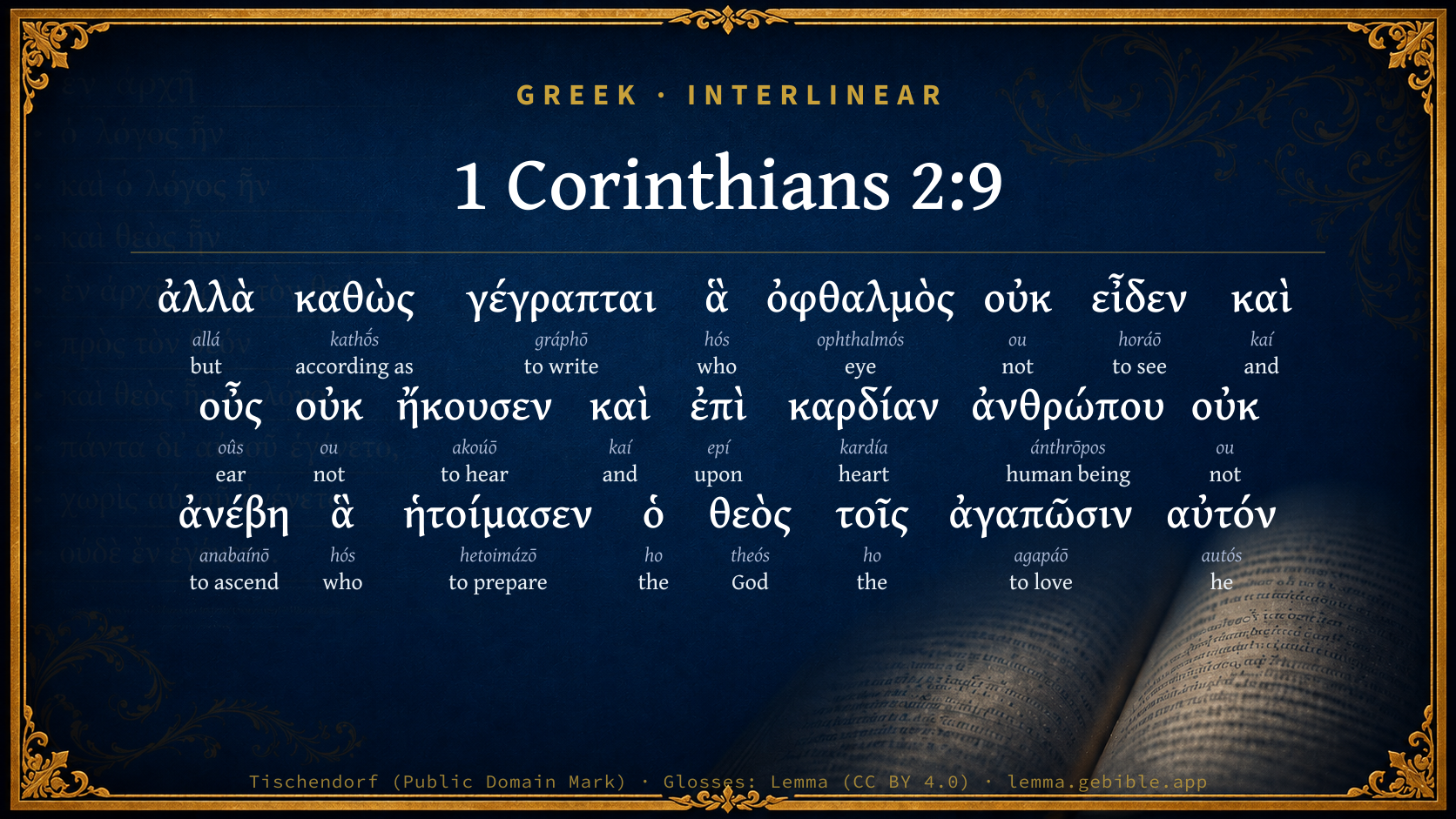
Download image
Cite this verse

1 Corinthians 2:9 (World English Bible). Public Domain. Lemma interlinear Bible study tool, https://lemma.gebible.app/v/1-corinthians/2/9.

Show BibTeX & RIS
BibTeX
RIS
English Translation
But as it is written, "Things which an eye didn't see, and an ear didn't hear, Which didn't enter into the heart of man, These God has prepared for those who love him."
World English Bible · Public Domain
Download a study sheet

One document with this verse’s original text, its word-by-word gloss line, the meaning frame, cross-references with their text, attributed commentary, and full source and license credits — printable, and it pastes into notes with its structure intact.

This verse Autodidact and up

Study sheet (.html) Plain text (.txt)

A passage Seminary Student

Up to 50 verses in one chapter. A passage sheet keeps up to 6 commentary sources and 12 cross-references per verse, in the order this page ranks them, and says so on the sheet whenever that leaves anything out. Ask for a single verse and you get the Autodidact verse sheet above.

Everything on this page stays free to read, with no account — the sheet is a download of what is already on screen, not access to it.

Want to remove ads? Support Godless Engineer
Compare translations 3

The same verse in 3 English versions, stacked beneath the original-language interlinear above. Click any original word for its lexicon entry.

Each is an independent rendering of the whole verse — the interlinear is not word-aligned to these translations.

Highlighted words mark where these versions differ — a whole-verse word diff, not a word-by-word alignment.

  • World English Bible Public Domain
    But as it is written, "Things which an eye didn't see, and an ear didn't hear, Which didn't enter into the heart of man, These God has prepared for those who love him."
  • King James Version Public Domain
    But as it is written, Eye hath not seen, nor ear heard, neither have entered into the heart of man, the things which God hath prepared for them that love him.
  • unfoldingWord Literal Text CC BY-SA 4.0
    But just as it is written, “What eye has not seen, and ear has not heard, and has not arisen in the heart of man, these things God has prepared for the one loving him.”

unfoldingWord Literal Text — © unfoldingWord, licensed CC BY-SA 4.0. Word-aligned USFM3 via Door43 (git.door43.org/unfoldingWord/en_ult).

Versions to compare (up to 4)

3 of 4 selected

Show all 19 translations

Every available English version of this verse, each an independent rendering of the whole verse.

  • World English Bible Public Domain
    But as it is written, "Things which an eye didn't see, and an ear didn't hear, Which didn't enter into the heart of man, These God has prepared for those who love him."
  • Berean Standard Bible Public Domain
    Rather, as it is written: “No eye has seen, no ear has heard, no heart has imagined, what God has prepared for those who love Him.”
  • Majority Standard Bible Public Domain
    Rather, as it is written: “No eye has seen, no ear has heard, no heart has imagined, what God has prepared for those who love Him.”
  • King James Version Public Domain
    But as it is written, Eye hath not seen, nor ear heard, neither have entered into the heart of man, the things which God hath prepared for them that love him.
  • American Standard Version (1901) Public Domain
    but as it is written, Things which eye saw not, and ear heard not, And `which' entered not into the heart of man, Whatsoever things God prepared for them that love him.
  • Revised Version (1885) Public Domain
    but as it is written, Things which eye saw not, and ear heard not, And which entered not into the heart of man, Whatsoever things God prepared for them that love him.
  • Geneva Bible (1599) Public Domain
    But as it is written, The thinges which eye hath not seene, neither eare hath heard, neither came into mans heart, are, which God hath prepared for them that loue him.
  • Douay-Rheims (1899) Public Domain
    But, as it is written: That eye hath not seen, nor ear heard, neither hath it entered into the heart of man, what things God hath prepared for them that love him.
  • Young's Literal Translation Public Domain
    but, according as it hath been written, `What eye did not see, and ear did not hear, and upon the heart of man came not up, what God did prepare for those loving Him --'
  • Literal Standard Version CC BY-SA 4.0
    but according as it has been written: “What eye did not see, and ear did not hear, and on the heart of man did not come up, what God prepared for those loving Him”;
  • Unlocked Literal Bible CC BY-SA 4.0
    But as it is written, “Things that no eye has seen, no ear has heard, no mind has imagined, the things that God has prepared for those who love him.”
  • unfoldingWord Literal Text CC BY-SA 4.0
    But just as it is written, “What eye has not seen, and ear has not heard, and has not arisen in the heart of man, these things God has prepared for the one loving him.”
  • Darby Bible Public Domain
    but according as it is written, Things which eye has not seen, and ear not heard, and which have not come into man's heart, which God has prepared for them that love him,
  • World Messianic Bible Public Domain
    But as it is written, “Things which an eye didn’t see, and an ear didn’t hear, which didn’t enter into the heart of man, these God has prepared for those who love him.”
  • Webster's Bible Public Domain
    But as it is written, Eye hath not seen, nor ear heard, neither have entered into the heart of man, the things which God hath prepared for them that love him.
  • Free Bible Version CC BY-SA 4.0
    But as Scripture says, “No one has ever seen, and no one has ever heard, and no one has ever imagined what God has prepared for those who love him.”
  • Bible in Basic English Public Domain
    But as it says in the holy Writings, Things which the eye saw not, and which had not come to the ears or into the heart of man, such things as God has made ready for those who have love for him.
  • Text-Critical English NT CC BY 4.0
    But, as it is written, “No eye has seen, no ear has heard, and no heart has imagined what God has prepared for those who love him.”
  • Tyndale New Testament (1534) Public Domain
    But as it is written: The eye hath not sene and the eare hath not hearde nether have entred into the herte of man the thinges which God hath prepared for them that love him.

Literal Standard Version (2020), Covenant Press — licensed CC BY-SA 4.0. Text via the HelloAO Bible API (eBible.org). Unlocked Literal Bible (unfoldingWord) — licensed CC BY-SA 4.0. Text via the HelloAO Bible API (eBible.org). unfoldingWord Literal Text — © unfoldingWord, licensed CC BY-SA 4.0. Word-aligned USFM3 via Door43 (git.door43.org/unfoldingWord/en_ult). Free Bible Version, Dr. Jonathan Gallagher — licensed CC BY-SA 4.0. Text via the HelloAO Bible API (eBible.org).

Word by word

More ways to search: Search by grammar → Find every occurrence → Compare this word →

Practice this passage: Drill this verse → Learn its vocabulary →

οὖς
oûs
G3775
“ear”
Noun, Nominative, Singular, Neuter
Part of Speech
Noun
Case
Nominative
Number
Singular
Gender
Neuter
Full Thayer's Definition

Origin: apparently a primary word

TDNT: 14:03,7

1. the ear 2. metaph. the faculty of perceiving with the mind, the faculty of understanding and knowing
  1. ἀλλὰ allá G235 “but” Conjunction
  2. καθὼς kathṓs G2531 “according as” Adverb
  3. γέγραπται gráphō G1125 “to write” Verb, Perfect, Passive, Indicative, 3rd person, Singular
  4. ἃ hós G3739 “who” Relative pronoun, Accusative, Plural, Neuter
  5. ὀφθαλμὸς ophthalmós G3788 “eye” Noun, Nominative, Singular, Masculine
  6. οὐκ ou G3756 “not” Particle, Negative
  7. εἶδεν horáō G3708 “to see” Verb, Aorist, Active, Indicative, 3rd person, Singular
  8. καὶ kaí G2532 “and” Conjunction
  9. οὐκ ou G3756 “not” Particle, Negative
  10. ἤκουσεν akoúō G191 “to hear” Verb, Aorist, Active, Indicative, 3rd person, Singular
  11. καὶ kaí G2532 “and” Conjunction
  12. ἐπὶ epí G1909 “upon” Preposition
  13. καρδίαν kardía G2588 “heart” Noun, Accusative, Singular, Feminine
  14. ἀνθρώπου ánthrōpos G444 “human being” Noun, Genitive, Singular, Masculine
  15. οὐκ ou G3756 “not” Particle, Negative
  16. ἀνέβη anabaínō G305 “to ascend” Verb, Aorist, Active, Indicative, 3rd person, Singular
  17. ἃ hós G3739 “who” Relative pronoun, Accusative, Plural, Neuter
  18. ἡτοίμασεν hetoimázō G2090 “to prepare” Verb, Aorist, Active, Indicative, 3rd person, Singular
  19. ὁ ho G3588 “the” Article, Nominative, Singular, Masculine
  20. θεὸς theós G2316 “God” Noun, Nominative, Singular, Masculine
  21. τοῖς ho G3588 “the” Article, Dative, Plural, Masculine
  22. ἀγαπῶσιν agapáō G25 “to love” Verb, Present, Active, Participle, Dative, Plural, Masculine
  23. αὐτόν autós G846 “he” Personal pronoun, Accusative, Singular, Masculine

About this verse

These counts appear in no published source. They are computed here, from the morphology-tagged text and Lemma’s own curated glosses. What Lemma adds →

24
words
19
distinct lemmas
Pauline Epistles
section

Shared distinctive vocabulary

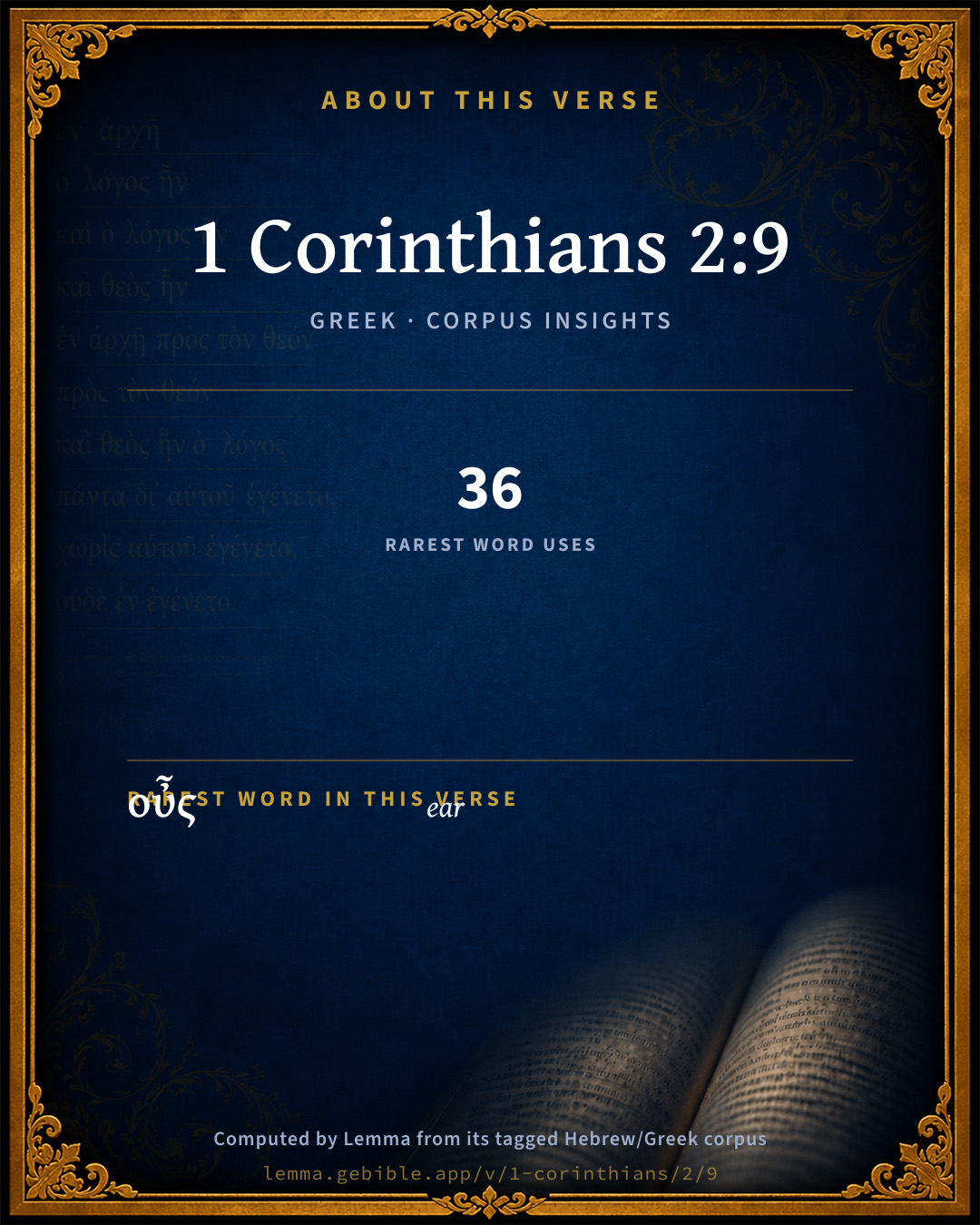
οὖς ear G3775 occurs in 34 verses of the Greek New Testament. Also found in:
Repetition

Words recur within this verse:

Cross-references

12

Topical passages linked to 1 Corinthians 2:9 in the Treasury of Scripture Knowledge — connected by theme and wording, ordered by reader-vote popularity; previews shown in the World English Bible.

  • Isaiah 64:4 For from of old men have not heard, nor perceived by the ear, neither has the eye seen a God besides you, who works for him who waits for him.
  • Psalms 31:19 Oh how great is your goodness, Which you have laid up for those who fear you, Which you have worked for those who take refuge in you, Before the sons of men!
  • James 1:12 Blessed is the man who endures temptation, for when he has been approved, he will receive the crown of life, which the Lord promised to those who love him.
  • Romans 8:28 We know that all things work together for good for those who love God, to those who are called according to his purpose.
  • Isaiah 65:17 For, behold, I create new heavens and a new earth; and the former things shall not be remembered, nor come into mind.
  • James 2:5 Listen, my beloved brothers. Didn't God choose those who are poor in this world to be rich in faith, and heirs of the Kingdom which he promised to those who love him?
  • Hebrews 11:16 But now they desire a better country, that is, a heavenly one. Therefore God is not ashamed of them, to be called their God, for he has prepared a city for them.
  • Matthew 25:34 Then the King will tell those on his right hand, 'Come, blessed of my Father, inherit the Kingdom prepared for you from the foundation of the world;
  • 1 John 4:19 We love Him, because he first loved us.
  • John 3:16 For God so loved the world, that he gave his one and only Son, that whoever believes in him should not perish, but have eternal life.
  • 1 Peter 1:12 To them it was revealed, that not to themselves, but to you, did they minister these things, which now have been announced to you through those who preached the Gospel to you by the Holy Spirit sent out from heaven; which things angels desire to look into.
  • Matthew 20:23 He said to them, "You will indeed drink my cup, and be baptized with the baptism that I am baptized with, but to sit on my right hand and on my left hand is not mine to give; but it is for whom it has been prepared by my Father."

Cross-references courtesy of OpenBible.info (CC BY 4.0).

Where the printed editions differ

1 variant

Places in this verse where the major printed Greek editions disagree on the wording in a way that affects the translation — a comparison of editions, not a manuscript-by-manuscript collation. The editions are the modern critical texts (Nestlé-Aland 28/27, SBL, Westcott-Hort, Tregelles, Tyndale House) and the traditional texts behind the KJV (the Textus Receptus and the Byzantine/Majority text). It is not a claim about which reading is original.

  1. Different wording
    ἃ

    “what”

    In NA28NA27TynTRByz Not in SBLWHTreg

    ὅσα (hosa) 'how much' occurs in a few manuscripts (SBL+WH+Treg) instead of ἃ (ha) 'what' in older manuscripts (NA28+NA27+Tyn+TR+Byz)

Textual data: Translators Amalgamated Greek New Testament (STEPBible TAGNT) · CC BY 4.0.

Commentary

Notes on 1 Corinthians 2:9 from classic Christian and Jewish commentators (each source and its license shown beneath its notes). The classic Christian expositions comment on the surrounding passage and are grouped to its opening verse, so a note may address several verses; the Jewish commentaries on the Tanakh (Rashi and others) are per-verse, so they appear only where the commentator wrote on this verse.

Lemma curates 59 commentaries, every one of them public domain or Creative Commons licensed, each selected and text-cleaned for this edition rather than reprinted as found. About our sources →

Joseph Benson's Commentary

1Co 2:9-11. But — This ignorance fulfils what is written concerning the blessings of the Messiah’s kingdom; eye hath not seen, &c. — No merely natural or unenlightened man hath either seen, heard, or known; the things which God hath prepared, saith the prophet, for them that love him — “These words do not immediately respect the blessings of another world, but are spoken by the prophet of the gospel state, and the blessings then to be enjoyed by them that should love God, Rom 8:28. For all the prophets, say the Jews, prophesied only of the days of the Messiah.” — Whitby. Indeed, as he adds, both the context and the opposition of these words to the revelation of these things by the Spirit, show the primary intent of the apostle to be, that no human wisdom, by any thing that may be seen, heard of, or conceived by us, can acquaint us with the things taught by the Holy Spirit, without a supernatural illumination. But God hath revealed — Yea, and freely given, 1Co 2:12, them to us by his Spirit — Who intimately and fully knows them; for the Spirit searcheth — Knows and enables us to search and find out; all things — Which it concerns us, and would be for our profit, to be acquainted with; even the deep things of God — Be they ever so hidden and mysterious; the depths both of his nature and attributes, and of his kingdom of providence and grace. Or, these deep things of God “are the various parts of that grand plan which the wisdom of God hath formed for the salvation of mankind, their relation to and dependance on each other, and operation and effect upon the system of the universe, the dignity of the person by whom that plan had been executed, and the final issue thereof in the salvation of believers; with many other particulars, which we shall not know till the light of the other world break in upon us.” — Macknight. For what man knoweth the things of a man — What individual of the human race could know the things belonging to human nature; save the spirit of man which is in him — Unless he were possessed of a human spirit? Surely the spirit of a creature inferior to man, can neither discern nor comprehend the things peculiar to the human nature. Even so the things of God — Things that belong to the divine nature; knoweth no man — No mere man; no man devoid of divine teaching; the teaching of the Spirit of God. In other words, as soon might brute creatures, by the help of the faculties peculiar to them, understand human things, as a man, only possessed of human faculties, could, merely by the aid of them, understand divine things; and indeed much sooner; for God is infinitely more elevated above man, than man is above the brutes.

Joseph Benson's Commentary on the Old and New Testaments (1811–1818) — public domain. Text from a community e-Sword module.

Tyndale Open Study Notes

Tyndale Open Resources

2:9 This quotation (cp. Isa 64:4) supports Paul’s point (1 Cor 2:8): Those with no spiritual sensitivity do not understand God’s work of redemption.

Tyndale Open Study Notes — © Tyndale Open Resources, licensed CC BY-SA 4.0. Text via the HelloAO Bible API.

Bengel's Gnomon

Johann Albrecht Bengel

1Co 2:9. Ἀλλὰ, but) viz. it has happened, comp. Rom 15:3; Rom 15:21, and 1Co 1:31.—καθὼς, as) He shows that the princes of the world knew not wisdom.—ἃ ὀφθαλμὸς) Isa 64:4, in the LXX., ἀπὸ τοῦ αἰῶνος οὐκ ἠκούσαμεν, οὐδε οἱ ὀφθαλμοὶ ἡμῶν εἰδον Θεὸν πλήν σου, καὶ τὰ ἔργα σου, ἃ ποιήσεις τοῖς ὑπομενοῦσιν ἔλεος. “Since the beginning we have not heard, nor have our eyes seen any god besides Thee and Thy works, which Thou wilt do to them that wait for mercy.”—ἃ, which) what eye hath not seen are those things, which God hath prepared.—ὀφθαλμὸς, οὖς, the eye, the ear) of man.—οὐκ ἀνέβη) neither have ascended [entered], that is, have not come into the mind.—ἡτοίμασεν, prepared) Hebr. יעשה, he will do; what was future in the time of Isaiah, had been actually accomplished in the time of Paul. Hence the one was speaking to them that were waiting for Him [Isa 64:4], the other to men that love [Him, who has appeared, 1Jn 4:19]: comp. things that are freely given, 1Co 2:12, by the grace of the New Testament, the fruits of which are perfected in eternity.—[Rom 8:28; Jas 2:5.]

Bengel's Gnomon of the New Testament — English translation (T&T Clark, Edinburgh, 1860) — public domain. Text from a community e-Sword module.

Meyer's Critical & Exegetical Commentary

Heinrich August Wilhelm Meyer

1Co_2:9. Ἀλλά] but, antithesis to ἣν οὐδεὶς τῶν ἀρχόντων τ. αἰ. τ. ἔγνωκεν.

The passage of Scripture, which Paul now adduces, is to be translated: What an eye hath not seen, nor an ear heard, and (what) hath not risen into the heart of a man, (namely:) all that God hath prepared for them that love Him. In the connection of our passage these words are still dependent upon λαλοῦμεν. Paul, that is to say, instead of affirming something further of the wisdom itself, and so continuing with another ἥν (which none of the rulers have known, but which), describes now the mysterious contents of this wisdom, and expresses himself accordingly in the neuter form (by ἅ), to which he was induced in the flow of his discourse by the similar form of the language of Scripture which floated before his mind. The construction therefore is not anacoluthic (Rückert hesitatingly; de Wette and Osiander, both of whom hold that it loses itself in the conception of the mysteries referred to); neither is it to be supplemented by γέγονε (Theophylact, Grotius). The connection with 1Co_2:10, adopted by Lachmann (in his ed. min[373]), and in my first and second editions, and again resorted to by Hofmann: what no eye has seen, etc., God, on the other hand (δέ, see on 1Co_1:23), has revealed to us, etc., is not sufficiently simple, mars the symmetry of the discourse, and is finally set aside by the consideration that, since the quotation manifestly does not go beyond ἀγαπῶσιν αὐτόν, καθὼς γέγραπται logically would need to stand, not before, but after ἅ, because in reality this Ἅ, and not the ΚΑΘῺς ΓΈΓΡΑΠΤΑΙ, would introduce the object of ἈΠΕΚΆΛΥΨΕΝ.

ΚΑΘῺς ΓΈΓΡ.] Chrysostom and Theophylact are in doubt as to what passage is meant, whether a lost prophecy (so Theodoret), or Isa_52:15. Origen, again, and other Fathers (Fabricius, a[374] Cod. Apocr. N. T. p. 342; Pseudepigr. N. T. I. p. 1072; Lücke, Einleit. z. Offenb. I. p. 235), with whom Schrader and Ewald agree, assume, amidst vehement opposition on the part of Jerome, that the citation is from the Revelation of Elias, in which Zacharias of Chrysopolis avers (Harmonia Evang. p. 343) that he himself had actually read the words. Grotius regards them as e scriptis Rabbinorum, qui ea habuerunt ex traditione vetere. Most interpreters, however, including Osiander and Hofmann, agree with Jerome (on Isaiah 64 and a[375] Pammach. epist. ci.) in finding here a free quotation from Isa_64:4 (some holding that there is, besides, a reference to Isa_52:15, Isa_65:17); see especially Surenhusius, ΚΑΤΑΛΛ. p. 526 ff., also Riggenbach in the Stud. u. Krit. 1855, p. 596 f. But the difference in sensenot to be got over by forced and artificial interpretation of the passage in Isaiah (see especially Hofmann)and the dissimilarity in expression are too great, hardly presenting even faint resemblances; which is never elsewhere the case with Paul, however freely he may make his quotations. There seems, therefore, to remain no other escape from the difficulty than to give credit to the assertionhowever much repugnance may have been shown to it in a dogmatic interest from Jerome downwardsmade by Origen and others, that the words were from the Apocalypsis Eliae. So, too, Bleek in the Stud. u. Krit. 1853, p. 330. But since it is only passages from the canonical Scriptures that are ever cited by Paul with καθὼς γέγρ., we must at the same time assume that he intended to do so here also, but by some confusion of memory took the apocryphal saying for a canonical passage possibly from the prophecies, to which the passages of kindred sound in Isaiah might easily give occasion. Comp also Weiss, biblische Theol. p. 298.

ἃ ὀφθαλμὸς οὐκ εἶδε Κ.Τ.Λ[377]] For similar designations in the classics and Rabbins of what cannot be apprehended by the senses or intellect, see Wetstein and Lightfoot, Horae, p. 162. Comp Empedocles in Plutarch, Mor. p. 17 E: οὔτʼ ἐπιδερκτὰ τάδʼ ἀνδράσιν, οὔτʼ ἐπακουστὰ, οὔτε νόῳ περιληπτά. With respect to ἀναβ. ἐπὶ καρδ., עָלָה עַל לֵב, to rise up to the heart, that is, become a consciously apprehended object of feeling and thought, so that the thing enters as a conception into the sphere of activity of the inner life, comp on Act_7:23.

ΤΟῖς ἈΓΑΠ. ΑὐΤΌΝ] i.e. in the apostles view: for the true Christians.[380] See on Rom_8:28. What God has prepared for them is the salvation of the Messianic kingdom. Comp Mat_25:34. Constitt. Apost. vii. 32. 2 : οἱ δὲ δίκαιοι πορεύσονται εἰς ζωὴν αἰώνιον κληρονομοῦντες ἐκεῖνα, ἃ ὀφθαλμὸς οὐκ εἶδε Κ.Τ.Λ[382]

[373] in. codices minusculi, manuscripts in cursive writing. Where these are individually quoted, they are marked by the usual Arabic numerals, as 33, 89.

[374] d refers to the note of the commentator or editor named on the particular passage.

[375] d refers to the note of the commentator or editor named on the particular passage.

[377] .τ.λ. καὶ τὰ λοιπά.

[380] Clement, ad Cor. I. 34, in quoting this same passage (with his usual formula for scriptural quotations, λέγει γάρ), has here τοῖς ὑπομένουσιν αὐτόν, remembering perhaps Isa_64:4 in the LXX. Clement also, there can be no doubt, held the passage to be canonical, which is explained, however, by the fact of his being acquainted with our Epistle. The Constitt. apost. too, vii. 32. 2, have τοῖς ἀγαπῶσιν αὐτόν. The so-called second Epistle of Clement, chap. 11, has the passage only as far as ἀνέβη.

[382] .τ.λ. καὶ τὰ λοιπά.

Meyer — Critical and Exegetical Commentary on the New Testament — English translation by Peter Christie, edited by Frederick Crombie (T&T Clark, 1880) — public domain. Text from a community e-Sword module.

Expositor's Greek Testament

ed. W. Robertson Nicoll

1Co 2:9 confirms by the language of Scripture ( καθὼς γέγραπται ) what has just been said. The verse is open to three different constructions: (1) It seems best to treat the relatives, ἅ , ὅσα , as in apposition to the foregoing ἣν clauses of 1Co 2:7-8 (the form of the pronoun being dictated by the LXX original), and thus supplying a further obj [356] to the emphatically repeated λαλοῦμεν of 1Co 2:6-7 : “but (we speak), as it is written, things which eye,” etc. (so Er [357] , Mr [358] , Hn [359] , Al [360] , Ed [361] , El [362] , Bt [363] ). (2) Hf [364] , Ev [365] , after Lachmann, prefix the whole sentence to ἀπεκάλυψεν of 1Co 2:10 ; but this subordination requires the doubtful reading δέ (for γάρ ) in 1Co 2:10 , to which it improperly extends the ref [366] of the formula καθὼς γέγραπται , while it breaks the continuity between the quotation and the foregoing assertions ( cf. 1Co 1:19 ; 1Co 1:31 ). (3) Bg [367] , D.W [368] , Gd [369] , Lt [370] , and others, see an anacoluthon here, and supply ἐστίν , factum est , or the like, as a peg for the ver. to hang upon, as in Rom 15:3 “But, as it is written, (there have come to pass) things which eye,” etc. This, however, seems needless after the prominent λαλοῦμεν , and weakens the concatenation of 1Co 2:6-9 . The ἀλλὰ follows on the οὐδεὶς of 1Co 2:8 , as ἀλλὰ in 1Co 2:7 (see note) on the οὐ of 1Co 2:6 . The entire sentence may be thus arranged:

[356] grammatical object.

[357] Erasmus’ In N.T. Annotationes .

[358] Meyer’s Critical and Exegetical Commentary (Eng. Trans.).

[359] C. F. G. Heinrici’s Erklärung der Korintherbriefe (1880), or 1 Korinther in Meyer’s krit.-exegetisches Kommentar (1896).

[360] Alford’s Greek Testament .

[361] T. C. Edwards’ Commentary on the First Ep. to the Corinthians . 2

[362] C. J. Ellicott’s St. Paul’s First Epistle to the Corinthians .

[363] J. A. Beet’s St. Paul’s Epp. to the Corinthians (1882).

[364] J. C. K. von Hofmann’s Die heilige Schrift N.T. untersucht , ii. 2 (2te Auflage, 1874).

[365] T. S. Evans in Speaker’s Commentary .

[366] reference.

[367] Bengel’s Gnomon Novi Testamenti.

[368] .W. De Wette’s Handbuch z. N. T.

[369] F. Godet’s Commentaire sur la prem. Ép. aux Corinthiens (Eng. Trans.).

[370] J. B. Lightfoot’s (posthumous) Notes on Epp. of St. Paul (1895).

λαλοῦμεν Θεοῦ σοφίαν … τ . ἀποκεκρυμμένην ,

ἢν προώρισεν ὁ Θεὸς κ . τ . λ .,

ἢν οὐδεὶς τ . ἀρχόντων … ἔγνωκν κ . τ . λ .·

ἀλλὰ … ἃ ὀφθαλμὸς οὐκ εἶδεν …

ὅσα ἡτοίμασεν ὁ Θεὸς τ . ἀγαπῶσιν αὐτόν .

The words cited do not appear, connectedly, in the O.T. Of the four clauses, the 1James , 2 nd, and 4th recall Isa 64:4 f. (Hebrews , Isa 64:3 f.) after the Hebrew text; the 3rd occurs in a similar strain in Isa 65:17 (LXX, 16); see other parls. In thought , as Hf [371] and Bt [372] point out, this passage corresponds to Isaiah 64 : in P. God does, as in Isaiah He is besought to do, things unlooked for by the world, to the confusion of its unbelief; in each case these things are done for fit persons Isaiah’s “him that waiteth for Him,” etc., being translated into Paul’s “those that love Him”; ἐποίησεν is changed to ἡτοίμασεν , in conformity with προώρισεν (1Co 2:7 ). A further analogy appears between the “terrible things in righteousness” which the prophet foresees in the coming theophany, and the καταργεῖν that P. announces for “the rulers of this world”. Clement of Rome ( ad Cor [373] , xxxiv. 8) cites the text briefly as a Christian saying, but reverts from Paul’s τ . ἀγαπῶσιν to the Isaianic τ . ὑπομένουσιν αὐτόν , manifestly identifying the O. and N.T. sayings.

[371] J. C. K. von Hofmann’s Die heilige Schrift N.T. untersucht , ii. 2 (2te Auflage, 1874).

[372] J. A. Beet’s St. Paul’s Epp. to the Corinthians (1882).

[373] Corinth, Corinthian or Corinthians.

Or [374] wrote (on Mat 27:9 ), “In nullo regulari libro hoc positum invenitur, nisi in Secretis Eliæ prophetæ ” a lost Apocryphum; Jerome found the words both in the Ascension of Isaiah and the Apocalypse of Elias , but denies Paul’s indebtedness to these sources; and Lt [375] makes out (see note, ad loc [376] ) that these books were later than Paul. Origen’s suggestion has been adopted by many expositors, but is really needless; this is only an extreme example of the Apostle’s freedom in adopting and combining O.T. sayings whose substance he desires to use. The Gnostics quoted the passage in favour of their method of esoteric teaching.

[374] Origen.

[375] J. B. Lightfoot’s (posthumous) Notes on Epp. of St. Paul (1895).

[376] ad locum , on this passage.

ὅσα , of the last clause, is a climax to ἃ of the first “so many things as God prepared for those that love Him”: cf. a Cor. 1Co 1:20 , Phi 4:8 , for the pronominal idiom. In ἡτοίμασεν κ . τ . λ . Paul is not thinking so much of the heavenly glory (see note on δόξα , 1Co 2:7 ), as of the magnificence of blessing, undreamed of in former ages, which comes already to believers in Christ ( cf. 1Co 1:5-7 ). τ . ἀγαπ . αὐτὸν affirms the moral precondition for this full blessedness ( cf. Joh 14:23 ) a further designation of the ἅγιοι , πιστεύοντες , κλητοί , ἐκλεκτοὶ of chap. 1.

The Expositor's Greek Testament, edited by W. Robertson Nicoll (1897–1910) — public domain. Text from a community e-Sword module.

International Critical Commentary

9. ἀλλά. ‘On the contrary (so far from any, even among the great ones of this world, knowing this wisdom, the event was) just as it stands written.’ There is no difficulty in understanding γέγονεν, or some such word, with καθὼς γέγραπται. But the construction can be explained otherwise, and perhaps better. See below, and on 1:19.

ἃ ὀφθαλμὸς οὐκ εἶδεν. The relative is co-ordinate with ἥν in v. 8, refers to σοφία, and therefore is indirectly governed by λαλοῦμεν in v. 7 (so Heinrici, Meyer, Schmiedel). It might (so Evans) be governed by ἀπεκάλυψεν, if we read ἡμῖν δέ and take v. 10 as an apodosis. But this is awkward, especially as ἅ does not precede καθῶς γέγραπται. The only grammatical irregularity which it is necessary to acknowledge is that ἅ serves first as an accusative governed by εἶδεν and ἤκουσεν, then as nominative to ἀνέβη, and once more in apposition to ὅσα (or ἅ) in the accusative. Such an anacoluthon is not at all violent.

ἐπὶ καρδίαν … οὑκ ἀνέβη. Cf. Act 7:23; Isa 65:17; Jer 3:16, etc. ‘Heart’ in the Bible includes the mind, as here, Rom 1:21, Rom 10:6, etc.

ὅσα. In richness and scale they exceed sense and thought (Joh 14:2).

ἡτοίμασεν. Here only does St Paul use the verb of God. When it is so used, it refers to the blessings of final glory, with (Luk 2:31) or without (Mat 20:23, Mat 20:25:34; Mar 10:40; Heb 11:16) including present grace; or else to the miseries of final punishment (Mat 25:41). See note on δόξα, v. 7. The analogy of N.T. language, and the dominant thought of the context here, compel us to find the primary reference in the consummation of final blessedness. See Aug. De catech. rud. 27; Const. Apost. VII. xxxii. 2; with Irenaeus, Cyprian, Clement of Alexandria and Origen. This does not exclude, but rather carries with it, the thought of ‘present insight into Divine things’ (Edwards). See on v. 10, and last note on v. 7.

τοῖς ἀγαπῶσιν αὐτόν. See Rom 8:28-30. Clement of Rome (Cor. 34), in quoting this passage, restores τοῖς ὑπομένουσιν from Isa 64:4 in place of τοῖς ἀγαπῶσιν. This seems to show that he regards the καθὼς γέγραπται is introducing a quotation from Isaiah.

We ought possibly to read ὃσα ἡτοίμασεν with A B C, Clem-Rom. But ἅ ἡτοίμασεν is strongly supported (א D E F G L P, Clem-Alex. Orig. Polyc-Mart.). Vulg. has quae with d e f g r.

The much debated question of the source of St Paul’s quotation must be solved within the limits imposed by his use of καθὼς γέγραπται. See on 1:19 and 31. The Apostle unquestionably intends to quote Canonical Scripture. Either, then, he actually does so, or he unintentionally (Meyer) slips into a citation from some other source. The only passages of the O.T. which come into consideration are three from Isaiah. (1) 54:4, ἀπὸ τοῦ αἰῶνος οὐκ ἡκούσαμεν οὐδὲ οἱ ὀφθαλμοὶ ἡμῶν εἶδον Θεὸν πλὴν σοῦ καὶ τὰ ἔργα σοῦ, ἅ ποιήσεις τοῖς ὑπομένουσιν ἔλεον (Heb. ‘From eternity they have not heard, they have not hearkened, neither bath eye seen, a God save Thee, who shall do gloriously for him that awaiteth Him’). (2) 65:17, καὶ οὐ μὴ ἐπέλθῃ αὐτῶν ἐπὶ τὴν καρδίαν (observe the context). Also (3) 52:15, as quoted Rom 15:21, a passage very slightly to the purpose. The first of these three passages is the one that is nearest to the present quotation. Its general sense is, ‘The only living God, who, from the beginning of the world, has proved Himself to be such by helping all who trust in His mercy, is Jehovah’; and it must be admitted that, although germane, it is not very close to St Paul’s meaning here. But we must remember that St Paul quotes with great freedom, often compounding different passages and altering words to suit his purpose. Consider the quotations in 1:19, 20, 31, and in Rom 9:27, Rom 9:29, and especially in Rom 9:33, Rom 9:10:6, Rom 9:8, Rom 9:15. Freedom of quotation is a vera causa; and if there are degrees of freedom, an extreme point will be found somewhere. With the possible exception of the doubtful case in Eph 5:14, it is probable that we reach an extreme point here. This view is confirmed by the fact that Clement of Rome, in the earliest extant quotation from our present passage, goes back to the LXX of Isa 64:4, which is evidence that he regarded that to be the source of St Paul’s quotation. At the very least, it proves that Clement felt that there was resemblance between 1Co 2:9 and Isa 64:4.

Of other solutions, the most popular has been that of Origen (in Mat 27:9); in nullo regulari libro hoc positum invenitur, nisi in Secretis Eliae Prophetae. Origen was followed by others, but was warmly contradicted by Jerome (in Esai. lxiv. 4: see also Prol. in Gen. ix. and Ep. lvii. [ci.] 7), who nevertheless allows that the passage occurs not only in the Apocalypse of Elias, but also in the Ascension of Esaias. This, however, by no means proves that the Apostle quotes from either book; for the writers of those books may both of them be quoting from him. Indeed, it is fairly certain that this is true of the Apocalypse of Elias; unless we reject the testimony of Epiphanius (Haer. xlii.), who says that this Apocalypse also contains the passage in Eph 5:14, which (if St Paul quotes it without adaptation) is certainly from a Christian source. And there is no good reason for doubting the statement of Epiphanius. The Apocalypse of Elias, if it existed at all before St Paul’s time, would be sure to be edited by Christian copyists, who, as in the case of many other apocalyptic writings, inserted quotations from N.T. books, especially from passages like the present one. The Ascension of Esaias, as quoted by Epiphanius (67:3), was certainly Christianized, for it contained allusions to the Holy Trinity. It is probably identical with the Ascension and Vision of Isaiah, published by Laurence in an Ethiopic, and by Gieseler in a Latin, version. The latter (11:34) contains our passage, and was doubtless the one known to Jerome; the Ethiopic, though Christian, does not contain it. See Tisserant, Ascension d’Isaie, p. 211.

On the whole, therefore, we have decisive ground for regarding our passage as the source whence these Christian or Christianized apocrypha derived their quotation, and not vice versa. Still more strongly does this hold good of the paradox of “oversanguine liturgiologists” (Lightfoot), who would see in our passage a quotation from the Liturgy of St James, a document of the Gentile Church of Aelia far later than Hadrian, and full of quotations from the N.T.*

Resch, also over-sanguine, claims the passage for his collection of Agrapha, or lost Sayings of our Lord, but on no grounds which call for discussion here.

Without, therefore, denying that St Paul, like other N.T. writers, might quote a non-canonical book, we conclude with Clement of Rome and Jerome, that he meant to quote, and actually does quote—very freely and with reminiscence of 65:17—from Isa 64:4. He may, as Origen saw, be quoting from a lost Greek version which was textually nearer to our passage than the Septuagint is, but such an hypothesis is at best only a guess, and, in view of St Paul’s habitual freedom, it is not a very helpful guess.

The above view, which is substantially that of the majority of modern commentators, including Ellicott, Edwards, and Lightfoot (to whose note this discussion has special obligations) is rejected by Meyer-Heinr, Schmiedel, and some others, who think that St Paul, perhaps per incuriam, quotes one of the apocryphal writings referred to above. It has been shown already that this hypothesis is untenable. For further discussion, see Lightfoot, S. Clement of Rome, I. p. 390, and on Clem. Rom. Cor. 34; Resch, Agrapha, pp. 102, 154, 281; Thackeray, St Paul and Contemporary Jewish Thought, pp. 240 f. On the seemingly hostile reference of Hegesippus to this verse, see Lightfoot’s last note in loc.

These two verses (9, 10) give a far higher idea of the future revelation than is found in Jewish apocalyptic writings, which deal rather with marvels than with the unveiling of spiritual truth. See Hastings, DB. iv. pp. 186, 187; Schürer, J.P., II. iii. pp. 129-132; Ency. Bib. i:210.

International Critical Commentary — older volumes (1896–1929), various authors — public domain. Text from a community e-Sword module.

Godet's Commentaries

Frédéric Louis Godet

Vv. 9: “but as it is written: things which the eye hath not seen, and which the ear hath not heard, and which have not entered into the heart of man, which God hath prepared for them that love Him.”

The grammatical connection of this verse has been variously understood. Erasmus, Estius, Meyer (last ed.), Heinrici, Edwards make ἅ, things which, the object of λαλοῦμεν, we speak, 1Co 2:7, and consequently in apposition to the wisdom of God. But this relation is grammatically forced and logically inadmissible: the apostle does not mean to point out what he speaks among the perfect, but to prove the nature of that wisdom to be sublime and inaccessible to man. Hofmann thinks we should begin a new sentence with 1Co 2:9; the verb on which the ἅ depends would then be ἀπεκάλυψεν, He revealed, 1Co 2:10: “What eye hath not seen...God hath revealed to us...” The δέ of 1Co 2:10 would not be absolutely opposed to this explanation (see on 1Co 1:23). But the καθὼς γέγραπται, as it is written, would be strangely placed at the beginning of this subordinate sentence. And then, instead of beginning 1Co 2:10 with ἡμῖν δέ, but unto us, the apostle ought rather to have written ἀπεκάλυψεν δὲ ἡμῖν ὁ θεός; for the antithesis between the idea of keeping concealed and that of revealing would alone account for the δέ placed at the beginning of the principal sentence. De Wette and Osiander prefer to hold an anacolouthon; the phrase, “things which no eye hath seen,” is thrown in, they say, as a description which remains grammatically suspended, “being lost,” as de Wette says, “in a mysterious remoteness.” It seems to us more natural simply to understand the notion of the verb to be in this sense: “It is indeed this very wisdom which is described in the words: Things which the eye hath not seen, etc.”

The ἀλλά, but, signifies, “But it could not be otherwise, for Scripture had spoken in these terms.” It is difficult to know to what passage of our holy books this quotation refers. Nowhere in the Old Testament are these words literally found. Chrysostom and Theophylact did not know whether they belonged to a prophecy now lost, or if they were taken from Isa 52:15 : “They to whom it had not been told shall see, and they who had not heard it shall understand.” Origen thought they were taken from an apocryphal writing entitled the Apocalypse of Elias. But nowhere do we find the apostle making similar quotations from uncanonical books, and it cannot be supposed that he would have applied to such books the formula as it is written, which would evidently imply the idea of Divine authority. Meyer acknowledges this; only he holds that, by a slip of memory, the apostle, while quoting this apocryphal book, thought he was quoting Isaiah; so also Weiss (Bibl. Theol., p. 274). I cannot see the necessity of so strange a supposition. Jerome already pointed out the true source of this quotation: it is the passage Isa 64:4 combined with Isa 65:17 : “Men have not heard nor perceived, neither hath the eye seen a God beside Thee which worketh for him that waiteth for Him...”; and, “The former things shall not be remembered, nor come into mind.” Clement of Rome, who, in chap. xxxiv. of his Epistle to the Corinthians, quotes this passage from Paul (with the combination of the two sayings of Isaiah), so well understands it is from the book of this prophet that Paul draws, that he substitutes for the last words of our verse: τοῖς ἀγαπῶσιν αὐτόν, for them that love Him, the exact expression of Isaiah (in the LXX.: τοῖς ὑπομενοῦσιν αὐτόν, for them that wait for Him. Similar combinations of several prophetic quotations are not rare in Paul’s writings; comp. Rom 9:33, where are united Isa 28:16; Isa 8:14; and Rom 11:26-27, where Isa 59:20; Isa 27:9 are blended in one). — In the first passage, the prophet, speaking of the work which God will accomplish in favour of His exiled people when He will restore them, says to God: “We can wait until such a God as Thou, like whom is no other, do for us things which surpass all that has been seen and told until now, and all that can be imagined.” Or indeed we may suppose that Isaiah transfers himself to the time when all will be accomplished, and that he means: “Never will there have been seen or heard or imagined such things as those which Thou shalt have done for us.” No doubt the expression, come into the mind of man, taken from Isa 65:17, refers in the context to the memory of things already accomplished, but accomplished merely in prophetic intuition. By combining the three terms seeing, hearing, and entering into the heart, the apostle wishes to designate the three means of natural knowledge: sight, or immediate experience; hearing, or knowledge by way of tradition; finally, the inspirations of the heart, the discoveries of the understanding proper. By none of these means can man reach the conception of the blessings which God has destined for him. From Irenaeus to Meyer, a host of commentators have applied the ἅ, things which, in Paul’s sense, to the felicities and glories of heaven. But we have seen, 1Co 2:6 a, that the Divine wisdom of which Paul speaks embraces the kingdom of God in its present form; and the words of 1Co 2:12: “That we might know the things that are freely given to us of God,” clearly show that Paul is thinking of the knowledge the believer receives of all the riches of the Divine plans toward him and toward the Church, of what he himself calls, Eph 3:18, “their breadth and length, and depth and height.” The blessings to come are of course comprehended in such phrases.

The reading ὅσα of A B C has been admitted by Lachmann, Tischendorf, Westcott and Hort, and rightly, as it seems to me, for there is somewhat of enthusiasm in the saying: “those great things which God has prepared.” For the will do, ποιήσει (LXX.), Paul substitutes the word ἡτοίμασεν, has prepared, used also by Clement. The idea is the same, for what God will do in the future is precisely what He has prepared in the past. The term ἑτοιμάζειν, to prepare, recalls the words of Jesus: “the kingdom prepared for you from the foundation of the world” (Mat 25:34), Instead of τοῖς ὑπομενοῦσιν αὐτόν, “for them that wait for Him with perseverance,” the apostle substitutes τοῖς ἀγαπῶσιν αὐτόν, for them that love Him. This change arises from the fact that the Christian now enjoys the salvation which the Israelite was still waiting for, and is grateful for it to its Author. Thus is exhausted the development of the idea of wisdom (1Co 2:6 a).

Frédéric Louis Godet — Commentaries on Luke, John, Romans, and 1 Corinthians — English translation (T&T Clark, Edinburgh, 1870s–1890s) — public domain. Text from a community e-Sword module.

Hodge's Commentary on Romans, Ephesians & First Corinthians

Charles Hodge

1Co_2:9

But as it is written, Eye hath not seen, nor ear heard, neither have entered into the heart of man, the things which God hath prepared for them that love him.

The meaning of this verse is plain, although there are several difficulties connected with it. Paul had said, he preached the hidden wisdom of God, which none of the princes of this world knew; he taught what no eye hath seen, nor ear heard, nor heart conceived. That is, he preached truth undiscoverable by human reason. To enter into the heart means to occur to the mind. Compare in the Hebrew, Isa_65:17.

The first difficulty connected with this verse is a grammatical one, which does not appear in our version because of the freedom of the translation. Literally the passage reads, What no eye saw, and no ear heard, and no heart conceived, what God has prepared for those who love him . The sentence is incomplete. This difficulty may be met either by a reference to the usage referred to in the note on the last verse of the preceding chapter, 1Co_1:31, the custom of the apostles to quote passages from the Old Testament without weaving them grammatically into their own discourses. Or, we may supply, as many do, the word (λαλοῦμεν) we speak what God hath prepared for those who love him. Or this verse may be connected with what follows: What eye hath not seen what (namely) God hath prepared for his people, he hath revealed to us by his Spirit. The first of these explanations is generally adopted and is the most satisfactory.

The second difficulty relates to the passage quoted. As the formula, As it is written, is never used by the apostles except in the citation of the canonical books of the Old Testament, it cannot be admitted that Paul intended to quote either some book now lost, or some apocryphal writing. If it be assumed that he intended to quote Isa_64:4 the difficulty is twofold, first, the language or words are different, and secondly, the sense is different. Isa_64:4 (or 3 in the Hebrew) is literally translated by Dr. J. A. Alexander, is: And from eternity they have not heard, they have not perceived by the ear, the eye hath not seen, a God beside thee (who) will do for (one) waiting for him. The idea is, that men had never known any other God than Jehovah who did, or could do, what he threatened to do. The Septuagint expresses the same idea. The meaning in Isaiah as connected with what precedes, seems to be that the reason why such fearful things as had been predicted were to be expected from Jehovah is, that he alone had proved himself able to perform them. To get over this difficulty some propose a different interpretation of the passage in the prophet. By connecting it with what follows, and by taking the word God in the vocative, the sense may be, From eternity they have not heard, nor perceived by the ear, eye hath not seen, O God, without thee, (i.e. without a revelation) what he, (or, by change of person) what thou hast prepared for those that wait for thee. This is the version given in the Vulgate, and brings the passage into harmony with the apostles quotation.

Others, assuming the first-mentioned interpretation of the passage in Isaiah to be the true one, consider the apostle as using scriptural language without intending to give the sense of the original. This we often do, and it is not unfrequently done in the New Testament, Rom_10:18. As it is written is not, in this case, the form of quotation, but is rather equivalent to saying, To use the language of Scripture.

A third explanation of this difficulty is, that the apostle did not intend to quote any one passage of Scripture, but to appeal to its authority for a clearly revealed truth. It is certainly taught in the Old Testament that the human mind cannot penetrate into the counsels of God; his purposes can only be known by a supernatural revelation. This is the truth for which the apostle cites the authority of the Old Testament. There is, therefore, not the slightest ground for imputing failure of memory, or an erroneous interpretation to the inspired apostle.

Charles Hodge — Commentary on Romans (1835), First Corinthians (1857), and Ephesians (1856) — public domain. Text from a community e-Sword module.

Geneva Bible (1599)

Geneva Bible translators

Man cannot so much as think of them, much less conceive them with his senses.

Another objection: But how could it be that those witty men could not perceive this wisdom? Paul answereth: Because we preach those things which pass all man’s understanding.

Geneva Bible (1599) marginal notes — public domain. Text via Bolls.life.

Jamieson, Fausset & Brown

Robert Jamieson, A. R. Fausset & David Brown

But--(it has happened) as it is written.

Eye hath not seen, &c.--ALFORD translates, "The things which eye saw not . . . the things which God prepared . . . to us God revealed through His Spirit." Thus, however, the "but" of Co1 2:10 is ignored. Rather construe, as ESTIUS, "('We speak,' supplied from Co1 2:8), things which eye saw not (heretofore), . . . things which God prepared . . . But God revealed them to us," &c. The quotation is not a verbatim one, but an inspired exposition of the "wisdom" (Co1 2:6, from Isa 64:4). The exceptive words, "O God, beside (that is, except) Thee," are not quoted directly, but are virtually expressed in the exposition of them (Co1 2:10), "None but thou, O God, seest these mysteries, and God hath revealed them to us by His Spirit."

entered--literally, "come up into the heart." A Hebraism (compare, Jer 3:16, Margin). In Isa 64:4 it is "Prepared (literally, 'will do') for him that waiteth for Him"; here, "for them that love Him." For Isaiah spake to them who waited for Messiah's appearance as future; Paul, to them who love Him as having actually appeared (Jo1 4:19); compare Co1 2:12, "the things that are freely given to us of God"

Jamieson, Fausset & Brown — Commentary Critical and Explanatory on the Whole Bible (1871) — public domain (CC PDM 1.0). Text via the HelloAO Bible API.

Adam Clarke's Commentary

Verse 9. But, as it is written] The quotation is taken from Isa 64:4. The sense is continued here from verse seven, and λαλουμεν, we speak, is understood-We do not speak or preach the wisdom of this world; but that mysterious wisdom of God, of which the prophet said: Eye hath not seen, nor ear heard, neither have entered into the heart of man the things which God has prepared for them that love him. These words have been applied to the state of glory in a future world; but they certainly belong to the present state, and express merely the wondrous light, life, and liberty which the Gospel communicates to them that believe in the Lord Jesus Christ in that way which the Gospel itself requires. To this the prophet himself refers; and it is evident, from the following verse, that the apostle also refers to the same thing. Such a scheme of salvation, in which God's glory and man's felicity should be equally secured, had never been seen, never heard of, nor could any mind but that of God have conceived the idea of so vast a project; nor could any power but his own have brought it to effect.

Adam Clarke's Commentary on the Bible (1810–1826) — public domain. Text from a community e-Sword/MySword module.

John Calvin's Commentaries

9. As it is written, “What eye hath not seen.” All are agreed that this passage is taken from Isaiah 64:4, and as the meaning is at first view plain and easy, interpreters do not give themselves much trouble in expounding it. On looking, however, more narrowly into it, two very great difficulties present themselves. The first is, that the words that are here quoted by Paul do not correspond with the words of the Prophet. The second is, that it seems as though Paul had perverted the Prophet’s declaration to a purpose quite foreign to his design.

First then as to the words; and as they may be taken in different senses, they are explained variously by interpreters. Some render the passage thus: “From the beginning of the world men have not heard, nor perceived with their ears, and eye hath not seen any god beside Thee, who doth act in such a manner towards him that waiteth for him.” Others understand the discourse as addressed to God, in this manner: “Eye hath not seen, nor hath ear heard, O God, besides thee, the things which thou dost for those that wait for thee.” Literally, however, the Prophet’s meaning is: “From the beginning of the world men have not heard, nor have they perceived with the ears, hath not seen a god, (or O God,) besides thee, will do (or will prepare) for him that waiteth for him.” If we understand אלהים (God) to be in the accusative, the relative who must be supplied. This exposition, too, appears, at first view, to suit better with the Prophet’s context in respect of the verb that follows being used in the third person; but it is farther removed from Paul’s meaning, on which we ought to place more dependence than on any other consideration. For where shall we find a surer or more faithful interpreter than the Spirit of God of this authoritative declaration, which He himself dictated to Isaiah — in the exposition which He has furnished by the mouth of Paul. With the view of obviating, however, the calumnies of the wicked, I observe that the Hebrew idiom admits of our understanding the Prophets true meaning to be this: “O God, neither hath eye seen, nor hath ear heard: but thou alone knowest the things which thou art wont to do to those that wait for thee.” The sudden change of person forms no objection, as we know that it is so common in the writings of the Prophets, that it needs not be any hindrance in our way. If any one, however, prefers the former interpretation, he will have no occasion for charging either us or the Apostle with departing from the simple meaning of the words, for we supply less than they do, as they are under the necessity of adding a mark of comparison to the verb, rendering it thus: “who doth act in such a manner.”

As to what follows respecting the entering of these things into the heart of man, though the expression is not made use of by the Prophet, it does not differ materially from the clause besides thee For in ascribing this knowledge to God alone, he excludes from it not merely the bodily senses of men, but also the entire faculty of the understanding. While, therefore, the Prophet makes mention only of sight and hearing, he includes at the same time by implication all the faculties of the soul. And without doubt these are the two instruments by which we attain the knowledge of those things that find their way into the understanding. In using the expression them that love him, he has followed the Greek interpreters, who have translated it in this way from having been misled by the resemblance between one letter and another; but as that did not affect the point in hand, he did not choose to depart from the common reading, as we frequently have occasion to observe how closely he follows the received version. Though the words, therefore, are not the same, there is no real difference of meaning.

I come now to the subject-matter. The Prophet in that passage, when mentioning how signally God had on all occasions befriended his people in their emergencies, exclaims, that his acts of kindness to the pious surpass the comprehension of human intellect. “But what has this to do,” some one will say, “with spiritual doctrine, and the promises of eternal life, as to which Paul is here arguing?” There are three ways in which this question may be answered. There were no inconsistency in affirming that the Prophet, having made mention of earthly blessings, was in consequence of this led on to make a general statement, and even to extol that spiritual blessedness which is laid up in heaven for believers. I prefer, however, to understand him simply as referring to those gifts of God’s grace that are daily conferred upon believers. In these it becomes us always to observe their source, and not to confine our views to their present aspect. Now their source is that unmerited goodness of God, by which he has adopted us into the number of his sons. He, therefore, who would estimate these things aright, will not contemplate them in their naked aspect, but will clothe them with God’s fatherly love, as with a robe, and will thus be led forward from temporal favors to eternal life. It might also be maintained that the argument is from the less to the greater; for if man’s intellect is not competent to measure God’s earthly gifts, how much less will it reach the height of heaven? (John 3:12.) I have, however, already intimated which interpretation I prefer.

John Calvin's Commentaries (1540-1563) — public domain. Text from the Calvin Translation Society English edition (1840s-50s) via the Christian Classics Ethereal Library (ccel.org). Calvin's coverage is partial (roughly two-thirds of the Bible); uncommented books and verses are honest gaps, never fabricated. The 19th-century editor's footnotes and remarks are omitted so the notes are faithfully Calvin's own voice.

Ellicott's Commentary for English Readers

(9) As it is written.—Where do the words which follow occur? They are not to be found as here given anywhere in the Old Testament. It has therefore been suggested (Origen) that they are from some apocryphal book, or some book which has been lost, as is supposed many have been. Chrysostom also suggests that it may be a reference, not to a writing, but to historical facts, as in Mat_2:23. None of these explanations would justify the use of that phrase, “it is written,” with which these words are introduced, and which in the apostolic writings is confined to quotations from the Old Testament scriptures. It is not used where the words are taken from other sources (see, e.g., Jud_1:9; Jud_1:14). Although the words given here are not to be found in the same sequence in any passage in the Old Testament, still there are phrases scattered through the writings of Isaiah (see Isa_64:4; Isa_65:17; see also Isa 62:15 in the LXX.), which would easily be joined together in memory and resemble even verbally the passage as written here by the Apostle. This is not the only place in which St. Paul would seem to thus refer to the Old Testament scriptures (see 1Co_1:19-20) when he is not basing any argument upon a particular sentence in the Scriptures, but merely availing himself of some thoughts or words in the Old Testament as an illustration of some truth which he is enforcing.

A Bible Commentary for English Readers, edited by Charles John Ellicott (1878–1897) — public domain. Text from a community e-Sword module.

The Cambridge Bible for Schools and Colleges

gen. ed. J. J. S. Perowne

9. But as it is written, Eye hath not seen] There has been much discussion whence these words are derived, but they are quite sufficiently near to the passage in Isa_64:4 to be regarded as a quotation from thence. It is unreasonable to require greater literal accuracy in the citation of words from the O. T. than is customary in a modern preacher, who is frequently content with giving the general drift of the passage he quotes. Such a practice was even more likely to exist in days when the cumbrous nature of books prevented them from being so readily at hand as at present We can hardly suppose, with some modern divines, that the passage is a quotation from the liturgy of the Apostolic Church, for Origen, Chrysostom, and Jerome, are alike ignorant of the fact.

The Cambridge Bible for Schools and Colleges (gen. ed. J. J. S. Perowne; Cambridge University Press, 1878–1918) — public domain. Text from a community e-Sword module.

John Gill's Exposition

But God hath revealed them unto us,.... Should it be said, that since this wisdom is so hidden and mysterious, the doctrines of the Gospel are so unknown, so much out of the sight and understanding of men, how come any to be acquainted with them? The answer is ready, God has made a revelation of them, not only in his word, which is common to men, nor only to his ministers, but to private Christians and believers,

by his Spirit; which designs not the external revelation made in the Scriptures, though that also is by the Spirit; but the internal revelation and application of the truths of the Gospel to the souls of men, which is sometimes ascribed to the Father of Christ. Mat 16:17 sometimes to Christ himself, Gal 1:12 and sometimes to the Spirit of Christ, Eph 1:17 and who guides into all truth, Joh 16:13, and here to the Father by the Spirit:

for the Spirit searcheth all things, yea, the deep things of God; which does not suppose any ignorance of these things in the Spirit, antecedent to his searching of them; but his complete and perfect knowledge of them; even as God's searching of the hearts of men expresses his omniscience, and through knowledge of all that is in them: the "all things" the Spirit searches into, and has a perfect knowledge of, do not design in the utmost extent everything which comes within the compass of his infinite understanding; but every thing that is in, or belongs to the Gospel of Christ, even the more mysterious and sublime, as well as the more plain and easy doctrines: for the "deep things of God" intend not the perfections of his nature, which are past finding out unto perfection by men; nor the depths of his wise and righteous providence; but the mysterious doctrines of the Gospel, the fellowship of the mystery which was hid in God, his wise counsels of old concerning man's salvation, the scheme of things drawn in his eternal mind, and revealed in the word.

John Gill's Exposition of the Whole Bible (1746–1763) — public domain (CC PDM 1.0). Text via the HelloAO Bible API.

Trapp's Complete Commentary

John Trapp

9 But as it is written, Eye hath not seen, nor ear heard, neither have entered into the heart of man, the things which God hath prepared for them that love him.

Ver. 9. Eye hath not seen, &c.] It is reported of one Adrianus, that seeing the martyrs suffer such grievous things, he asked the cause; one of them answered, "Eye hath not seen, nor ear heard, neither have entered into the heart of man, the things that God hath prepared for them that love him." The naming of which text so wrought upon him that afterward he became a martyr.

The things which God hath prepared] As he prepared Paradise for Adam, so heaven for all his. Yet he reserves not all for the life to come, but gives a few grapes of Canaan in this wilderness. And so this text is to be understood of gospel joy and those present comforts that the saints have here, that praemium ante praemium; for not only after, but in the doing of God’s will there is great reward, Psa 19:11, such as natural eye hath not seen nor ear heard: the stranger meddleth not with this joy; it is the sparkle of that white stone, it is that new name known to none but those that have it; it is a comfort confined to the communion of saints.

John Trapp, A Commentary or Exposition upon All the Books of the Old and New Testament (1647–1656) — public domain. Text from a community e-Sword module.

Albert Barnes' Notes on the Bible

But as it is written - This passage is quoted from Isa 64:4. It is not quoted literally; but the sense only is given. The words are found in the apocryphal books of Elijah; and Origen and Jerome supposed that Paul quoted from those books. But it is evident that Paul had in his eye the passage in Isaiah; and intended to apply it to his present purpose. These words are often applied by commentators and others to the future life, and are supposed by them to be descriptive of the state of the blessed there. But against the supposition that they refer directly to the future state, there are insuperable objections:

(1) The first is, that the passage in Isaiah has no such reference. In that place it is designed clearly to describe the blessedness of those who were admitted to the divine favor; who had communion with God; and to whom God manifested himself as their friend. That blessedness is said to be superior to all that people elsewhere enjoy; to be such as could be found no where else but in God. See Isa 64:1, Isa 64:4-5, Isa 64:8. It is used there, as Paul uses it, to denote the happiness which results from the communication of the divine favor to the soul.

(2) The object of the apostle is not to describe the future state of the redeemed. It is to prove that those who are Christians have true wisdom 1Co 2:6-7; or that they have views of truth, and of the excellence of the plan of salvation which the world has not, and which those who crucified the Lord Jesus did not possess. The thing which he is describing here, is not merely the happiness of Christians, but their views of the wisdom of the plan of salvation. They have views of that which the eyes of other people have not seen; a view of wisdom, and fitness, and beauty which can be found in no other plan. It is true that this view is attended with a high degree of comfort; but the comfort is not the immediate thing in the eye of the apostle.

(3) The declaration in 1Co 2:10, is conclusive proof that Paul does not refer to the happiness of heaven. He there says that God has revealed these things to Christians by his Spirit. But if already revealed, assuredly it does not refer to that which is yet to come. But although this does not refer directly to heaven, there may be an application of the passage to a future state in an indirect manner, which is not improper. If there are such manifestations of wisdom in the plan here; if Christians see so much of its beauty here on earth; and if their views so far surpass all that the world sees and enjoys, how much greater and purer will be the manifestations of wisdom and goodness in the world of glory.

Eye hath not seen - This is the same as saying, that no one had ever fully perceived and understood the value and beauty of those things which God has prepared for his people. All the world had been strangers to this until God made a revelation to his people by his Spirit. The blessedness which the apostle referred to had been unknown alike to the Jews and the Gentiles.

Nor ear heard - We learn the existence and quality of objects by the external senses; and those senses are used to denote any acquisition of knowledge. To say that the eye had not seen, nor the ear heard, was, therefore, the same as saying that it was not known at all. All people had been ignorant of it.

Neither have entered into the heart of man - No man has conceived it; or understood it. It is new; and is above all that man has seen, and felt, and known.

The things which God hath prepared - The things which God “has held in reserve” (Bloomfield); that is, what God has appointed in the gospel for his people. The thing to which the apostle here refers particularly, is the wisdom which was revealed in the gospel; but he also intends, doubtless, to include all the provisions of mercy and happiness which the gospel makes known to the people of God. Those things relate to the pardon of sin; to the atonement, and to justification by faith; to the peace and joy which religion imparts; to the complete and final redemption from sin and death which the gospel is suited to produce, and which it will ultimately effect. In all these respects, the blessings which the gospel confers, surpass the full comprehension of people; and are infinitely beyond all that man could know or experience without the religion of Christ. And if on earth the gospel confers such blessings on its friends, how much higher and purer shall be the joys which it shalt bestow in heaven!

Albert Barnes' Notes on the Bible (1834–1885) — public domain. Text from a community e-Sword/MySword module.

Matthew Poole's English Annotations

The place where this is written is by all agreed to be Isa 64:4, where the words are, For since the beginning of the world men have not heard, nor perceived by the ear, neither hath the eye seen, O God, beside thee, what he hath prepared for him that waiteth for him. It is so usual with the penmen of holy writ to quote the sense of texts in the Old Testament, not tying themselves to letters and syllables, that it is mightily vain for any to object against this quotation, as no where written in the Old Testament, but taken out of some apocryphal writings. The sense of what is written, Isa 64:4, is plainly the same with what he speaketh in this place; the greatest difference is, the apostle saith,

them that love him; the prophet, him that waiteth for him (which is the certain product and effect of love). The whole 64th chapter of Isaiah, {Isa 64:1-12} and some chapters following, treat concerning Christ; so doth this text. Christ and his benefits are to be understood here, by

the things which God hath prepared for them that love him; which are set out as things not obvious to sense, nor to be comprehended by reason. It could never have entered into the heart of men to conceive, that God should give his only begotten Son out of his own bosom, to take upon him our nature, and to die upon the cross; or, that Christ should so far humble himself, and become obedient unto death.

Matthew Poole's English Annotations on the Holy Bible (1683–1685) — public domain. Text from a community e-Sword/MySword module.

Whedon's Commentary on the Bible

Daniel D. Whedon

9. Written—Isa_64:4 paraphrased by Paul, and adapted to his purpose. The words, of course, describe not the future happiness of the redeemed in heaven, but their present.

Daniel D. Whedon (gen. ed.), Commentary on the Old and New Testaments (1874–1909) — public domain. Text from a community e-Sword module.

The Pulpit Commentary

But as it is written. The whole sentence in the Greek is unfinished. The thought seems to be, "But God has revealed to us things which eye hath not seen, etc., though the princes of this world were ignorant of them." Scriptural quotations are often thus introduced, apart from the general grammar of the sentence, as in the Greek of 1Co_1:31. Eye hath not seen, etc. The Revised Version is here more literal and accurate. The quotation as it stands is not found in the Old Testament. It most resembles Isa_64:4, but also vaguely resembles Isa_53:1-5 Isa_65:17. It may be another instance of a loose generalreminiscence. (comp 1Co_14:21; Rom_9:33) "Non verbum e verbo expressit," says St. Jerome, "sed parafrastikwv eundem sensum aliis sermonibus indicavit." St. Chrysostom regards the words as part of a lost prophecy. Origen, Zacharias of Chrysopolis, and others say that the words occurred in an apocryphal book, the "Apocalypse of Elias," but if so the apocryphal writer must have had the passage of Isaiah in his mind. Some regard the words as a fragment of some ancient liturgy. Origen thought that they came from the "Revelation of Elijah." They were also to be found in the "Ascension of Isaiah". (Jeremiah on Isa_64:4) and they occur in the Talmud (Sanhedr. 99 a). In a curious fragment of Hegesippus (circ. A.D. 150) preserved in Photius (Cod. 232.), that old writer indignantly repudiates this passage, saying that it is futile and "utterly belies (katayeudesqai) the Holy Scriptures and the Lord, who says, "Blessed are your eyes which see, and your ears which hear. Photius cannot understand why (oti kai paqwn) Hegesippus should speak thus. Routh ("Rel. Sacr.," 253) hardly knows how to excuse him; but perhaps if we had the context of the fragment we should see that he is attacking, not the words themselves, but some perversion of them by heretics, like the Docetae. The phrase, "As it is written," decisively marks an intention to refer to Scripture. Neither have entered into the heart of man; literally, things which have not set foot upon the heart. The general thought is that God"s revelations (for the immediate reference is to these, and not to future bliss) pass all understanding. The quotation of these words as referring to heaven is one of the numberless instances of texts inaccurately applied.

Vers. 9, 10.

The revelation of things unseen and unheard.

It may perhaps have been complained, though unreasonably enough, that Paul"s compositions were lacking in logic, and his language in eloquence. There was in the substance of his teaching enough to compensate any deficiencies of such kinds. No sage communicated such wisdom, no poet such wonders, as he. Deep things, drawn by the Spirit from the ocean of God"s unfathomable nature, were brought up, and were by him presented to the Church of Christ to all who possess the spiritual capacity to recognize their meaning and to appreciate their worth.

I CONSIDER WHAT THESE REVELATIONS WERE. In the original prophecy the reference was to marvellous and Divine deliverances wrought for Israel; the apostle "accommodates" the prophet"s language to his own purpose, to express the display of Divine wisdom and power evinced in the gospel, in which Christ is made unto his people wisdom and righteousness, sanctification and redemption. The privileges of the Christian calling enjoyed in the present are an earnest of the higher joys of the eternal future. The gospel manifests the favour and fellowship of God, assures of sonship and of heirship. It reveals Divine truth, and it imparts Divine grace.

II OBSERVE HOW INACCESSIBLE THESE BLESSINGS WERE TO THE ORDINARY POWERS OF MEN. The eye can range over the surface of this beautiful earth, and can explore the glories of the majestic firmament. The ear has receptivity for the manifold sounds of nature and for the intricacies and the charms of music. The heart speaks often and profoundly: "A man"s mind is sometimes wont to tell him more than seven watchmen that sit in a tower." But the revelations here alluded to are not like the features of nature, which are recognizable by sense, or like the inspirations of practical sagacity. The eye can see the works of God, but not the Artificer; the ear can hear the voice of God, but knows not the Speaker; the heart can echo the appeals of God, but these appeals must reach it from above.

III REMARK THAT THESE REVELATIONS ARE MADE BY THE SPIRIT OF GOD HIMSELF, We possess a spiritual nature susceptible of Divine impression and appeal, and with this nature, created after his own likeness, the Father of spirits is in direct communication. Not that truth is miraculously conveyed; the Spirit takes the revealed facts and applies them to the mind, quickening and illumining the powers so that they receive and rejoice in the truth of God.

IV PONDER THE CONDITION OF RECEIVING THIS KNOWLEDGE. The revelations are for those who love God. Not the great, or the wise, or the outwardly righteous are the recipients of Heaven"s best blessing; but those who possess this moral and spiritual qualification. They who "wait for God," as Isaiah puts it; they who "love God," as it is phrased by Paul, are the enlightened and the enriched. The spirit that is filled with gratitude and with love is thereby prepared to understand and appreciate the mysteries of Divine grace. The true love, which puts on the form of obedience, is the path to spiritual perfection. Love grows, and with it knowledge; and heaven is attractive because it is at once the abode of perfect love and the sphere of perfect knowledge. T.

Vers. 9, 10, 14.

The revelation of the things of God.

It may be that we have here a free quotation of Isa_64:4. But whether a quotation or not, it expresses a principle true in every age. The great "things of God" have ever been beyond the reach of the unaided powers of man. What are these "things which God hath prepared for them that love him"? To apply this expression, as is sometimes done, merely to the glories and joys of the heaven of the future, is to narrow its meaning.

Those heavenly things, indeed, are purely matters of faith, above sense, above reason, above experience, above the loftiest flights of imagination. The most suggestive teachings of Scripture, even the grand apocalyptic visions, do not enable us in the remotest degree to conceive of them.

In vain our fancy strives to paint The moment after death.

But the "deep things of God" here spoken of, "the things freely given to us of God" (ver. 12), are matters of present realization, facts of consciousness, and not merely anticipations of faith. They are those great moral and spiritual truths of which the Name of Christ is the symbol, and those privileges and joys which are the distinguishing marks of Christian life. Consider what is here asserted about them:

(1) Negatively treat the eye and the ear and the hearst have not apprehended them;

(2) positively that they are revealed to us by the Spirit of God.

I THE NATURAL POWERS OF MAN CANNOT APPREHEND THESE THINGS. We may take the eye and the ear and the heart as equivalent to the whole sum of our natural faculties. They are those of the "natural man" as contrasted with the "spiritual" (Ver. 14). Every faculty of our nature has its own proper sphere, the "things" that belong to it and with which it is conversant. Sense perceives material things, and, according to the delicacy of its organization, it appreciates the truth of these beauty of form and colour, variety and harmony of sound, etc. Intellect moves in a region of abstract thought, entertains ideas, judges their relations, etc. Conscience deals with moral questions, determines the dictates of duty, the distinctions of right and wrong. The heart is the seat and tribunal of the affections, love and hate, desire and aversion, hope and fear. Each faculty has its particular part to play in the economy of our life. But when we come to the higher region of the "things of God," we find that which lies beyond the range of these mere natural powers. These Greeks of Corinth and Athens with whom Paul had to do were many of them men of fine native capacity and high culture, men of subtle thought and delicate sensibility. There were "princes" among them, men who had risen above their fellows in the particular departments of human interest for which nature qualified them. The ruler, the senator, the economist, could discern the exigencies of state, and judge matters of law and policy. The philosopher could weigh the evidences of science and thread the mazes of speculative thought. The poet knew what the "fine frenzy" of imagination meant, and could portray in glowing speech the changeful phases of human passion and life. The sculptor and painter had souls alive to the beauty of form and colour, and conversant with the canons of aesthetic taste. And no doubt there were among them men of tender feeling and noble character benevolent citizens; honourable merchants; faithful, loving fathers, husbands, brothers, friends. And yet how utterly in the dark were they as to the real nature and character of the Deity, and the way of access to him; as to how their being might be redeemed from the power of evil; and how they might solve the mystery and soothe the sadness of death and of the tomb! There had been among them many

A grey spirit yearning with desire To follow knowledge like a sinking star, Beyond the utmost bounds of human thought.

But they could not gain the most distant glimpse of this higher knowledge. It was as a star that had not risen upon them and of the beauty of whose light they could not dream. Indeed, the shadow of their ignorance had settled down so deeply upon them that they had lost the hope of ever seeing the light. They could not recognize it when it came. Paul"s preaching was "foolishness" to them. He was but one of the tribe of "babblers," a "setter forth of strange gods." His voice was like that of "one that crieth in the wilderness." It awakened for the most part no responsive echo, but died away upon the empty air. The powers of the natural man are as ineffectual for any saving purpose now as ever they were; as incapable of receiving the deep things of God as they were of discovering them. To be assured of this, we have only to remember to how large an extent the intellect of the age goes darkly and wildly astray from Christ; how men of scientific genius, dealing with the phenomena and laws of the universe, fail often to find in them anything Divine; and how many there are whose very natural virtues condemn them because they refuse to exercise on the heavenward side of their being affections that give so much charm to their lower earthly life. All this tells us that men must be inspired by a Power higher than any that is latent in their own nature before they can rise to the apprehension of Divine things and to the beauty and dignity of the life of God.

II THESE THINGS ARE REVEALED TO US BY THE SPIRIT OF GOD. The Spirit is plainly spoken of here as a personal Being, entering into personal contact and converse with the human soul, imparting to it a faculty of spiritual apprehension which it would not otherwise possess, Note:

1. The Spirit who inspired the apostles to deliver their gospel message prepared men, rightly to receive and interpret it. It was the same power in Joh_15:26, 27 16:13; vers. 4-8; (1Jn_2:20-27)

2. This interpretive faculty is far less a matter of mental perpetration than of spiritual sympathy. This is seen in rite contrast instituted between the "spirit of the world" and the "spirit that is of God." The spirit of the world is ever a captious, sophistical spirit, distrustful, carnal, vain, self willed. The spirit that is of God is simple, lowly, loving, trustful, submissive, childlike. Coming from God, it is in true affinity with the mind of God, and with that Word which is the reflex of the thought and of the heart of God. When, in answer to the wondering question of the Jews, "How knoweth this man letters," etc.? (Joh_7:15) Jesus answered, "My teaching is not mine," etc., he placed himself on a level which they also might occupy. Let them emulate his loving loyalty to the will of the Father, and they also shall "know." We must have something of the spirit of the well beloved Son in us if we would rightly apprehend "the things that are freely given to us of God. W.

Vers. 9, 10.

The true wisdom.

Often in the Epistles there is a single word on which the whole discussion turns. In the letter to the Romans, it is "righteousness;" to the Colossians, it is "fulness;" to the Hebrews, it is "perfection." In the letter to the Corinthians, it is "wisdom." Those Greeks sought after wisdom. It was nothing to them that the gospel might relieve a troubled conscience or reform an unworthy life, if it did not correspond with their ideas of philosophy. But St. Paul had an answer to give them for which they were not at all prepared. He calmly affirmed that they were incompetent judges of a heavenly wisdom, and that in his gospel to the people there was a philosophy beyond their power of apprehension manifold wisdom of God." Greek philosophy at its best sought to ascertain how man may, by knowledge and the pursuit of virtue, reach up towards the highest good. But the gospel taught that the highest Good had come down to dwell among men; and that, by union in faith to that highest Good, man becomes more than a philosopher a saint.

I THE INAPTITUDE OF MAN TO RECEIVE THE DIVINE WISDOM OF THE GOSPEL. This is expressed by a quotation from the Old Testament: (Isa_64:4) "Eye hath not seen it." The reference is not, as in a well known poem, to "the better land," but to the wisdom of God. When Jesus, the incarnate Wisdom, was on earth, many eyes saw him that could not discern the glory of God in him. And many an eye today sees the position of Christianity in the world, the width of its influence, and the dignity of its institutions, yet does not "see Jesus," and the things which God has prepared in Jesus for those that love him. "Ear hath not heard it." That organ which receives so impartially all communications fails to drink in the wisdom of the gospel. It is closed by earthliness of mind, till the power of God"s Spirit unstops it, so to hear that the soul may live. "Neither have entered into the heart," etc. (ver. 9). The heart is hardened, as well as the eye closed and the ear stopped. The spirit of a man of itself knows only "the things of a man," conceives of wisdom and goodness after the manner and measure of man, and so fails to conceive the ways and thoughts of God, and the things which are freely given by him. So the apostle denied that a man untaught by the Spirit, even though he were a Greek, could rightly estimate the gospel. He could remind the disputers and rhetoricians of Greece that their philosophy might sound as jargon to the unlettered, who could not bring to it a sufficient intellectual appreciation. In like manner, the gospel which he preached might seem to them a jargon or a piece of "foolishness," merely because they were out of moral sympathy with it, and had not sufficient spiritual enlightenment to discern and value it. It was the same lesson which our Lord impressed on Nicodemus, "Except a man be born again, he cannot see the kingdom of God." He can see Churches, preachers, forms of service, but not the kingdom which is "righteousness, peace, and joy in the Holy Ghost," till he is born again.

II THE REVELATION OF THE HEAVENLY WISDOM BY THE HOLY SPIRIT.

1. It was made known to holy apostles and prophets in the Spirit. By them it was communicated to the Churches. But all who heard them required the unction of the Spirit, that they might receive and know the truth. No one can say that this is unreasonable. Every kind of knowledge requires for its reception a healthy state of the human understanding; and, when it relates to morals, a healthy condition of the imagination, conscience, and affections, because of the effect which these have on the understanding. In like manner, spiritual things can be interpreted only to spiritual men. The all searching Spirit of God must act on the spirits of men to whom the gospel is proclaimed, and so enlighten and empower them to receive "the deep things of God." Thus boasting is excluded at every point. Boasting of our righteousness is excluded by the work of the Son of God, all sufficient for us; and boasting of our wisdom by the work of the Spirit of God, all sufficient in us. By the Spirit all things are made new. Eye and ear and heart are new. The eye can see, the ear hear, the heart conceive, "the things which are freely given to us of God." What a dignity is this! What a joy! "We have received, not the spirit of the world, but the Spirit which is of God." We are taught of God, so as to enter with a new power of discernment into the secret of his covenant and the glory of his gospel. F.

The surprising freshness of the new dispensation.

The precise words, as quoted by the apostle, are not found in the Old Testament. They are probably Isa_64:4, given from memory andmodified by the thought of phrases found in other parts of Isaiah. Only an unreasonable sentiment concerning verbal inspiration would make difficulty about the inexactness of quotations given from memory. The sense of a passage may be precisely indicated when the words are set in a different order and form. This text has often been used as the basis of elaborate descriptions of heaven, but such treatment is only possible when ver. 9 is separated from ver. 10. The apostle is plainly dealing with some glory which has been revealed and is now realized, lie conceived of the Divine dealings with men as having been arranged in "ages," or "dispensations." We may thus distinguish the Adamic, Patriarchal, Mosaic, Davidic, Exilic, and post-Exilic. In the passage before us St. Paul shows, not merely that the Christian is another and a succeeding dispensation, but also that, in important respects, it differs from others, and is superior to others. Previous dispensations have given only faint suggestions of the surpassing glory of this one, just as Solomon"s magnificent temple did but hint the exceeding glory of that later and spiritual temple, Christ"s Church. We may dwell on some of those points in which the Christian revelation seems so new, so surprisingly fresh, so utterly beyond what human imagination could have conceived or human experience suggested.

I RELIGION IS NOT A CEREMONIAL, BUT A LIFE. To a Jew this was so fresh a conception as to be even bewildering. A less thoughtful Jew would be in peril of cherishing the sentiment that religion was only a ceremonial, a round of ordinances, festivals, and sacrifices. And this view of religion had become the general and prevailing notion in the time of our Lord. A more thoughtful and pious Jew would connect personal godliness with outward ceremonial, and strive to culture an inner life of trust, obedience, and communion with the outward observance of rites and ceremonies. But the new thing revealed in Christianity is, that religion is, essentially and only, the soul"s life, and that all ceremonial is mere expression and agency in the work of culture. The relations are manifestly reversed. Formerly there must be ceremonial, and there ought to be life. now there must be life, and there may be ceremonial. On fully maintaining these later relations, the health and vigour of Christianity must ever depend.

II SALVATION BY A SUFFERING AND DYING SAVIOUR. This is indeed a fresh and surprising thing. Triumph is to lie in defeat. Glory is to blossom out of shame. A sublime mission is to be accomplished by a seeming failure. Life for men is to come forth out of death for Christ. It is the introduction of a new force, a moral force. Christ lifted up is to draw men. The story of the crucified One is to melt men into penitence, win their faith, and ensure such a love as shall make even self sacrifice for Christ possible. Men knew before of love that would work for those it loved, and love that would fight for those it loved, and love that would bear for those it loved; but it was new that love should die such a death, not for the loved only, but for the ungodly and enemies by wicked works. "While we were yet sinners, Christ died for us.

III SANCTIFICATION BY THE PRESENT POWER OF HIM WHO DIED. This is altogether new. Christ, as the exalted One, by his Spirit, is now carrying out his redeeming purpose in all hearts and lives that are open to him by faith. We do not struggle for righteousness by unaided personal efforts. Unseen, indeed, still the Living Christ is ever with us. Untraced, indeed, the mighty Spirit of Christ is ever working within us, sanctifying us wholly. And so, in face of all difficulties, perplexities, frailties, or hindrances to spiritual progress, we may calmly say, "If God be for us, who can be against us? "Greater is he who is with us than all who can be against us.

IV MAN THE DWELLING PLACE OF GOD THROUGH THE SPIRIT. This is also new; for hitherto the common sentiment had been that God dwelt in places, on the mountain"s crown, at the altar, in shining pillar clouds, in tabernacle or in temple. Our Lord Jesus Christ, as the God man, shows us that God can dwell in man and make man"s body his temple. He can even dwell in us; and an apostle may plead with his people, saying, "Know ye not that your body is the temple of the Holy Ghost, which is in you?" Surely such an honour for us is beyond all that "eye has seen, ear heard, or heart conceived.

Illustrate that aged Simeon loved God and knew something of him, but he never could have dreamed what God had in store for him even to hold the world"s Babe Saviour in his own trembling arms. What could Abraham, who saw Christ"s day; or Moses, who spoke of the great prophet to come; or David, who sang of his Lord making his foes his footstool, have really known of the Christian glories, the spiritual mysteries of the revelation in Christ? These spiritual things broke more and more clearly on the minds of Peter and John and Paul, until, in utter ravishment and wonder, they exclaimed, "Oh the depth of the riches both of the wisdom and knowledge of God! How unsearchable are his judgments, and his ways past finding out! R T.

The Pulpit Commentary (1880–1919), ed. H.D.M. Spence-Jones & Joseph S. Exell — public domain. Text from a community e-Sword module.

John Wesley's Explanatory Notes

But this ignorance of theirs fulfils what is written concerning the blessings of the Messiah's kingdom. No natural man hath either seen, heard, or known, the things which God hath prepared, saith the prophet, for them that love him. Isaiah lxiv, 4

John Wesley, Explanatory Notes Upon the Whole Bible (1754–1765) — public domain. Text via the GEBible commentary corpus.

Burkitt's Expository Notes on the New Testament

William Burkitt

These words, Eye hath not seen, &c. do not immediately respect the happiness of heaven and a future state, though very often they are so applied; but they are primarily spoken of the gospel state, and of the blessings to be enjoyed by them that love God here: from whence a good argument may be drawn to prove the inconceivable happiness of the saints hereafter. Though they have felt and tasted joys unspeakable and full of glory, in the actings of their faith and love upon God at present; yet all that they have seen and heard, all that they have tasted and felt, in the way to heaven, falls infinitely short of the perfection and blessedness of that place and state.

Lord! how will thy immediate presence, when we come into it, be a great surprise to those of us that have now the greatest acquaintance with it!

Observe farther, The care and kindness of God towards his servants, in revealing to them by his Spirit those great and good things prepared for them, which surpass man’s understanding: though "eye hath not seen, nor ear heard, nor heart conceived, the things which God hath prepared for them that love him, yet God hath revealed them to us by his Spirit."

There is a two-fold revelation of the happiness of a future state: Revelatio fidei, et revelatio visionis, a revelation of faith, and a revelation by vision and sight; the former, believers have by the help of the Holy Spirit in this life, as viatores; the latter they shall ere long enjoy in heaven, as comprehensores, where they shall see as they are seen, and know as they are known.

Observe lastly, That the Holy Spirit, which thus revealeth hidden counsels to man, and searcheth the deep things of God, is omniscient, and really God.

Mark , 1. He searcheth deep things; he is not only acquainted with and privy to the surface and outside of things, but searcheth things to the bottom.

And, 2. He searcheth not only the deep things of man, as of kings and princes, whose hearts are a great deep, but the deep things of God: therefore the Spirit is God; for as the apostle argues, ver 11. No man knoweth the things of a man, save the spirit of man that is in him; even so, the things of God knoweth no man, but the Spirit of God, or he that is with God, in God, yea, God himself, as intimately with him as the soul is in the body. If the spirit that is in man were not man, it could never know the deep things of man, and if the Spirit of God were not God, he could never search and know the deep things of God.

William Burkitt's Expository Notes on the New Testament (1700–1703) — public domain. Text from a community e-Sword module.

Godbey's Commentary on the New Testament

William B. Godbey

9. “But as has been written: Those things which eye hath not seen, ear hath not heard, and it hath not entered into the heart of man,” i. e., “those things which God hath prepared for those who love him.” What are “those things”? Why, they are the deep things of God, the unutterable truths of the Almighty, the sweet, rich and unearthly things of the heavenly kingdom, the transcendent glories of the “coming age,” the supernal and unutterable realities of spiritual life, immortality and ineffable glory. A popular mistake has generally prevailed in reference to the allusions of this verse, i. e., that we have to die to receive these revelations. This delusion is swept away by the next verse.

William B. Godbey, Commentary on the New Testament (1896–1900) — public domain. Text from a community e-Sword module.

McGarvey & Pendleton's Commentaries

J. W. McGarvey

but as it is written, Things which eye saw not, and ear heard not, And which entered not into the heart of man, Whatsoever things God prepared for them that love him . [This passage is taken from Isa 64:4; but it is an exposition, and not a verbatim quotation. The words form an unfinished sentence, and, as is not infrequent with Paul's quotations, do not fit nicely into the general structure of his discourse. To understand them we should supply the words "we speak" from verse 7; i. e., we fulfill the prophecy by telling those things which God prepared for those that love him (the mystery of the gospel), but which no uninspired man ever in any way surmised or anticipated. The prophecy includes the unseen glories of heaven.]

J. W. McGarvey (with Philip Y. Pendleton), Commentaries on the New Testament (The Fourfold Gospel, 1914; Acts; and the epistles) — public domain. Text from a community e-Sword/MySword module.

The People's New Testament

B. W. Johnson

9. As it is written (Isa. 54:4). There was no human conception, as shown by the prophet, of the glory to be revealed in the mystery of the gospel. And indeed that glory is still beyond the power of mere human conception.

B. W. Johnson's The People's New Testament with Notes (1889–1891) — public domain. Electronic text from the Christian Classics Ethereal Library (CCEL) ThML edition.

Cambridge Greek Testament for Schools and Colleges

9. ἀλλὰ καθὼς γέγραπται. Translate as R.V. ‘Things which the eye saw not,’ &c. There has been much discussion whence these words are derived, but they are quite sufficiently near to the passage in Isa 64:4 to be regarded as a quotation from thence. It is unreasonable to require greater literal accuracy in the citation of words in the N. T. from the O. T. than is customary in a modern preacher, who is frequently content with giving the general drift of the passage he quotes. Such a practice was even more likely to exist in days when the cumbrous nature of books prevented them from being so readily at hand as at present. Dean Colet (Commentary on Romans, MS. in Corpus Christi Coll. Library, p. 26) speaks disparagingly of any other citations. ‘Annotandum est hoc loco quam simplex allegatio erat Apostolorum si quid ex veteri testamento commemoraverint. Haec nostra quae in modo in usu est, et apud recentiores theologos et leguleios tam capitulatim undecunque testimoniorum citatio, ex ignorantia orta est hominum, sibi suaeque doctrinae diffidentium, veriti alioquin ne eis credatur, et sua ipsorum conscientia cadentes nisi istius modi adminiculis sustineantur.’ We can hardly suppose, with some modern divines, that the passage is a quotation from the liturgy of the Apostolic Church, for Origen, Chrysostom, and Jerome, are alike ignorant of the fact. Origen says so expressly. See Tischendorf’s note.

ἡτοίμασεν. The A.V. ‘hath prepared’ gives a correct sense here. The time when it was preached is indefinite. See note on 1Co 2:12. There is an anacolouthon here, as in Rom 15:3.

Cambridge Greek Testament for Schools and Colleges (Cambridge University Press, 1896; 21 vols, various authors incl. Carr, Maclear, Plummer, Farrar, Lumby, Moule, M. R. James, Simcox) — public domain. Text from a community e-Sword module.

Vincent's Word Studies in the New Testament

Marvin R. Vincent

Eye hath not seen, etc. From Isa 64:4, freely rendered by Septuagint. The Hebrew reads : "From of old men have not heard, not perceived with the ear, eye has not seen a God beside Thee who does (gloriously) for him who waits on Him." Septuagint, "From of old we have not heard, nor have our eyes seen a God beside Thee, and Thy works which Thou wilt do for those who wait for mercy." Paul takes only the general idea from the Old - Testament passage. The words are not to be limited to future blessings in heaven. They are true of the present. Have entered [ανεβη] . Lit., went up. See on Act 7:23. Compare Dan 2:29, Sept.

Heart [καρδιαν] . See on Rom 1:21.

Marvin R. Vincent, Word Studies in the New Testament (1887–1900) — public domain. Text from a community e-Sword/MySword module.

Lesson kit

Teaching starters — assembled from the data on this page, not authored interpretation. Every prompt links to the verse data it draws on. Edit before teaching.

1 Corinthians, in the Pauline Epistles, opens this verse with 24 words (19 distinct Greek lemmas). Its most distinctive word is oûs (“ear”). A historical commentator’s framing appears above. Read the whole chapter for the surrounding context.

Discussion questions

  1. What does “ear” (oûs) contribute to the verse as a whole?
  2. Matthew 10:27 shares the word «ear» with this verse. How do the two illuminate each other?
  3. “not” occurs 3× in this one verse. What is the effect of the repetition?
  4. These translations render this verse differently; the difference is in the English rendering, not the original. What questions does that raise?
  5. Reading how Joseph Benson's Commentary and Tyndale Open Study Notes read this verse, where do the two commentators agree and where do they part?

Things to notice

Reading settings

Reading text

Shown beneath each verse's original-language words.

Old Testament
Old Testament edition

Read the OT as the Masoretic Hebrew (MT) or the Greek Septuagint (LXX).

English shown for the Greek Septuagint (in the Hebrew ↔ Greek comparison).

Comparing translations? Open the Compare panel on any verse page to stack up to four side by side.