

Acts 9:21
Greek (Tischendorf 8th ed.) Acts 9:21 appears in the Greek New Testament. The text above is from the Tischendorf 8th edition. Each word links to its Strong’s number and a concise gloss. Click any word for its full Thayer’s Greek Lexicon entry.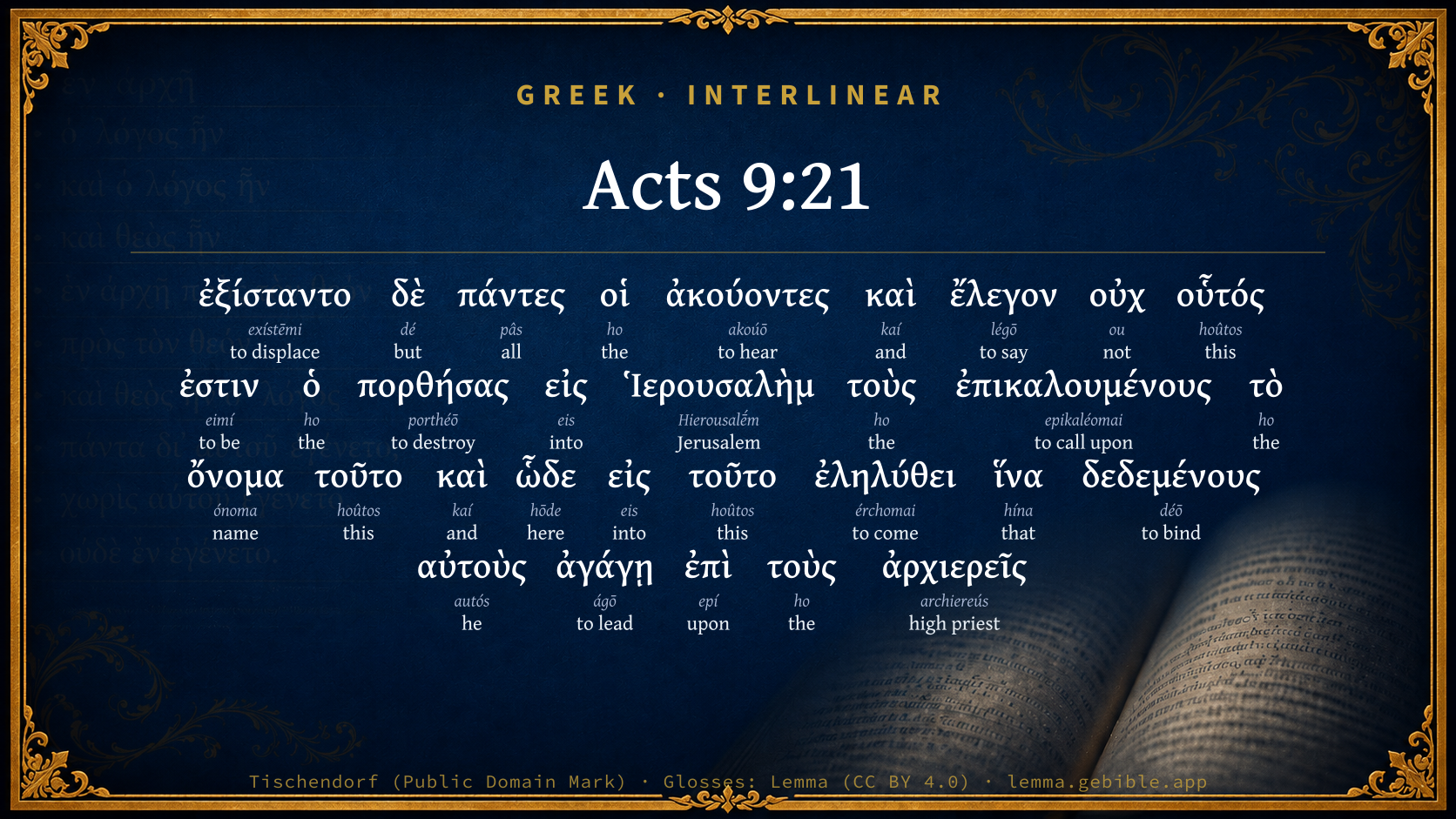
All who heard him were amazed, and said, "Isn't this he who in Jerusalem made havoc of those who called on this name? And he had come here intending to bring them bound before the chief priests!"
Download a study sheet
One document with this verse’s original text, its word-by-word gloss line, the meaning frame, cross-references with their text, attributed commentary, and full source and license credits — printable, and it pastes into notes with its structure intact.
This verse Autodidact and up
A passage Seminary Student
Up to 50 verses in one chapter. A passage sheet keeps up to 6 commentary sources and 12 cross-references per verse, in the order this page ranks them, and says so on the sheet whenever that leaves anything out. Ask for a single verse and you get the Autodidact verse sheet above.
Everything on this page stays free to read, with no account — the sheet is a download of what is already on screen, not access to it.
Compare translations 3
The same verse in 3 English versions, stacked beneath the original-language interlinear above. Click any original word for its lexicon entry.
Each is an independent rendering of the whole verse — the interlinear is not word-aligned to these translations.
Highlighted words mark where these versions differ — a whole-verse word diff, not a word-by-word alignment.
-
World English Bible Public Domain
All who heard him were amazed, and said, "Isn't this he who in Jerusalem made havoc of those who called on this name? And he had come here intending to bring them bound before the chief priests!"
-
King James Version Public Domain
But all that heard him were amazed, and said; Is not this he that destroyed them which called on this name in Jerusalem, and came hither for that intent, that he might bring them bound unto the chief priests?
-
unfoldingWord Literal Text CC BY-SA 4.0
And all the ones hearing were marveling and were saying, “Is not this the one having destroyed in Jerusalem the ones calling on this name? And he had come here for this, that he might bring them bound to the chief priests?”
unfoldingWord Literal Text — © unfoldingWord, licensed CC BY-SA 4.0. Word-aligned USFM3 via Door43 (git.door43.org/unfoldingWord/en_ult).
Show all 19 translations
Every available English version of this verse, each an independent rendering of the whole verse.
-
World English Bible Public Domain
All who heard him were amazed, and said, "Isn't this he who in Jerusalem made havoc of those who called on this name? And he had come here intending to bring them bound before the chief priests!"
-
Berean Standard Bible Public Domain
All who heard him were astounded and asked, “Isn’t this the man who wreaked havoc in Jerusalem on those who call on this name? And hasn’t he come here to take them as prisoners to the chief priests?”
-
Majority Standard Bible Public Domain
All who heard him were astounded and asked, “Isn’t this the man who wreaked havoc in Jerusalem on those who call on this name? And hasn’t he come here to take them as prisoners to the chief priests?”
-
King James Version Public Domain
But all that heard him were amazed, and said; Is not this he that destroyed them which called on this name in Jerusalem, and came hither for that intent, that he might bring them bound unto the chief priests?
-
American Standard Version (1901) Public Domain
And all that heard him were amazed, and said, Is not this he that in Jerusalem made havoc of them that called on this name? and he had come hither for this intent, that he might bring them bound before the chief priests.
-
Revised Version (1885) Public Domain
And all that heard him were amazed, and said, Is not this he that in Jerusalem made havock of them which called on this name? and he had come hither for this intent, that he might bring them bound before the chief priests.
-
Geneva Bible (1599) Public Domain
So that all that heard him, were amased, and sayde, Is not this hee, that made hauocke of them which called on this Name in Hierusalem, and came hither for that intent, that hee should bring them bound vnto the hie Priests?
-
Douay-Rheims (1899) Public Domain
And all that heard him, were astonished, and said: Is not this he who persecuted in Jerusalem those that called upon this name: and came hither for that intent, that he might carry them bound to the chief priests?
-
Young's Literal Translation Public Domain
And all those hearing were amazed, and said, `Is not this he who laid waist in Jerusalem those calling on this name, and hither to this intent had come, that he might bring them bound to the chief priests?'
-
Literal Standard Version CC BY-SA 4.0
And all those hearing were amazed and said, “Is this not he who laid waste in Jerusalem those calling on this Name, and here to this intent had come, that he might bring them bound to the chief priests?”
-
Unlocked Literal Bible CC BY-SA 4.0
All who heard him were amazed and said, “Is not this the man who destroyed those in Jerusalem who called on this name? He has come here to take them bound to the chief priests.”
-
unfoldingWord Literal Text CC BY-SA 4.0
And all the ones hearing were marveling and were saying, “Is not this the one having destroyed in Jerusalem the ones calling on this name? And he had come here for this, that he might bring them bound to the chief priests?”
-
Darby Bible Public Domain
And all who heard were astonished and said, Is not this *he* who destroyed in Jerusalem those who called on this name, and here was come for this purpose, that he might bring them bound to the chief priests?
-
World Messianic Bible Public Domain
All who heard him were amazed, and said, “Isn’t this he who in Jerusalem made havoc of those who called on this name? And he had come here intending to bring them bound before the chief priests!”
-
Webster's Bible Public Domain
But all that heard him were amazed, and said, Is not this he that destroyed them who called on this name in Jerusalem, and came hither for that intent, that he might bring them bound to the chief priests?
-
Free Bible Version CC BY-SA 4.0
All who heard him were amazed, and asked, “Isn't this the man who caused so much trouble in Jerusalem for those who believed in Jesus? Wasn't he coming here to have the believers arrested and taken in chains to the chief priests?”
-
Bible in Basic English Public Domain
And all those hearing him were full of wonder and said, Is not this the man who in Jerusalem was attacking all the worshippers of this name? and he had come here so that he might take them as prisoners before the chief priests.
-
Text-Critical English NT CC BY 4.0
All who heard it were amazed and said, “Is this not the man who in Jerusalem tried to destroy those who call upon this name, and has he not come here for the purpose of bringing them as prisoners to the chief priests?”
-
Tyndale New Testament (1534) Public Domain
All that hearde him were amased and sayde: is not this he that spoyled the which called on this name in Ierusalem and came hyther for the entent that he shuld bringe the bounde vnto the hye prestes?
Literal Standard Version (2020), Covenant Press — licensed CC BY-SA 4.0. Text via the HelloAO Bible API (eBible.org). Unlocked Literal Bible (unfoldingWord) — licensed CC BY-SA 4.0. Text via the HelloAO Bible API (eBible.org). unfoldingWord Literal Text — © unfoldingWord, licensed CC BY-SA 4.0. Word-aligned USFM3 via Door43 (git.door43.org/unfoldingWord/en_ult). Free Bible Version, Dr. Jonathan Gallagher — licensed CC BY-SA 4.0. Text via the HelloAO Bible API (eBible.org).
Word by word
More ways to search: Search by grammar → Find every occurrence → Compare this word →
Practice this passage: Drill this verse → Learn its vocabulary →
- Appears 3× in the Greek New Testament
- First appears here
- Part of Speech
- Verb
- Tense
- Aorist
- Voice
- Active
- Mood
- Participle
- Case
- Nominative
- Number
- Singular
- Gender
- Masculine
Full Thayer's Definition
- ἐξίσταντο exístēmi G1839 “to displace” Verb, Imperfect, Middle, Indicative, 3rd person, Plural
- δὲ dé G1161 “but” Conjunction
- πάντες pâs G3956 “all” Adjective, Nominative, Plural, Masculine
- οἱ ho G3588 “the” Article, Nominative, Plural, Masculine
- ἀκούοντες akoúō G191 “to hear” Verb, Present, Active, Participle, Nominative, Plural, Masculine
- καὶ kaí G2532 “and” Conjunction
- ἔλεγον légō G3004 “to say” Verb, Imperfect, Active, Indicative, 3rd person, Plural
- οὐχ ou G3756 “not” Particle, Negative
- οὗτός hoûtos G3778 “this” Demonstrative pronoun, Nominative, Singular, Masculine
- ἐστιν eimí G1510 “to be” Verb, Present, Active, Indicative, 3rd person, Singular
- ὁ ho G3588 “the” Article, Nominative, Singular, Masculine
- πορθήσας porthéō G4199 “to destroy” Verb, Aorist, Active, Participle, Nominative, Singular, Masculine
- εἰς eis G1519 “into” Preposition
- Ἱερουσαλὴμ Hierousalḗm G2419 “Jerusalem” Noun, Proper, indeclinable
- τοὺς ho G3588 “the” Article, Accusative, Plural, Masculine
- ἐπικαλουμένους epikaléomai G1941 “to call upon” Verb, Present, Middle, Participle, Accusative, Plural, Masculine
- τὸ ho G3588 “the” Article, Accusative, Singular, Neuter
- ὄνομα ónoma G3686 “name” Noun, Accusative, Singular, Neuter
- τοῦτο hoûtos G3778 “this” Demonstrative pronoun, Accusative, Singular, Neuter
- καὶ kaí G2532 “and” Conjunction
- ὧδε hōde G5602 “here” Adverb
- εἰς eis G1519 “into” Preposition
- τοῦτο hoûtos G3778 “this” Demonstrative pronoun, Accusative, Singular, Neuter
- ἐληλύθει érchomai G2064 “to come” Verb, Pluperfect, Active, Indicative, 3rd person, Singular
- ἵνα hína G2443 “that” Conjunction
- δεδεμένους déō G1210 “to bind” Verb, Perfect, Passive, Participle, Accusative, Plural, Masculine
- αὐτοὺς autós G846 “he” Personal pronoun, Accusative, Plural, Masculine
- ἀγάγῃ ágō G71 “to lead” Verb, Aorist, Active, Subjunctive, 3rd person, Singular
- ἐπὶ epí G1909 “upon” Preposition
- τοὺς ho G3588 “the” Article, Accusative, Plural, Masculine
- ἀρχιερεῖς archiereús G749 “high priest” Noun, Accusative, Plural, Masculine
About this verse
These counts appear in no published source. They are computed here, from the morphology-tagged text and Lemma’s own curated glosses. What Lemma adds →
- 31
- words
- 23
- distinct lemmas
- Acts
- section
Notable vocabulary
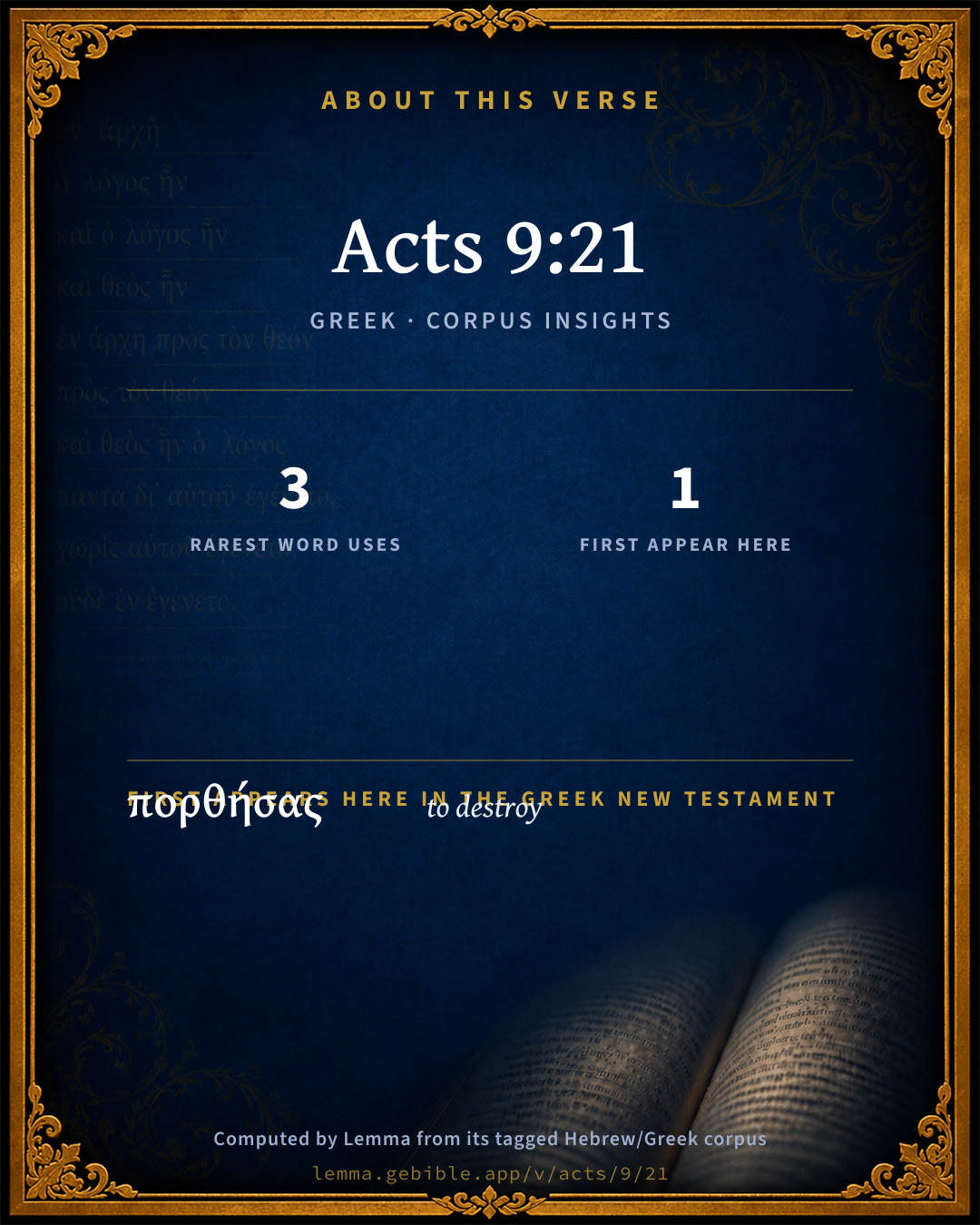
The rarest word here is πορθήσας to destroy G4199 — appearing just 3 times in the whole Greek New Testament.
First appearance in Scripture
This word makes its first canonical appearance in the Greek New Testament here:
- πορθήσας to destroy G4199
Shared distinctive vocabulary
πορθήσας to destroy G4199 occurs in 3 verses of the Greek New Testament. Also found in:
Cross-references
17Topical passages linked to Acts 9:21 in the Treasury of Scripture Knowledge — connected by theme and wording, ordered by reader-vote popularity; previews shown in the World English Bible.
- Acts 8:3 But Saul ravaged the assembly, entering into every house, and dragged both men and women off to prison.
- Acts 9:13–14 But Ananias answered, "Lord, I have heard from many about this man, how much evil he did to your saints at Jerusalem.
- 2 Thessalonians 1:10 when he comes to be glorified in his saints, and to be admired among all those who have believed (because our testimony to you was believed) in that day.
- Matthew 13:54–55 Coming into his own country, he taught them in their synagogue, so that they were astonished, and said, "Where did this man get this wisdom, and these mighty works?
- Galatians 1:13–24 For you have heard of my way of living in time past in the Jews' religion, how that beyond measure I persecuted the assembly of God, and ravaged it.
- Psalms 71:7 I am a marvel to many, But you are my strong refuge.
- Isaiah 8:18 Behold, I and the children whom Yahweh has given me are for signs and for wonders in Israel from Yahweh of Hosts, who dwells in Mount Zion.
- Zechariah 3:8 Hear now, Joshua the high priest, you and your fellows who sit before you; for they are men who are a sign: for, behold, I will bring forth my servant, the Branch.
- Mark 5:15–20 They came to Jesus, and saw him who had been possessed by demons sitting, clothed, and in his right mind, even him who had the legion; and they were afraid.
- John 9:8–9 The neighbors therefore, and those who saw that he was blind before, said, "Isn't this he who sat and begged?"
- Acts 2:6 When this sound was heard, the multitude came together, and were bewildered, because everyone heard them speaking in his own language.
- Acts 2:12 They were all amazed, and were perplexed, saying one to another, "What does this mean?"
- Acts 3:10 They recognized him, that it was he who used to sit begging for gifts for the needy at the Beautiful Gate of the temple. They were filled with wonder and amazement at what had happened to him.
- Acts 4:13 Now when they saw the boldness of Peter and John, and had perceived that they were unlearned and ignorant men, they marveled. They recognized that they had been with Jesus.
- Acts 9:1–2 But Saul, still breathing threats and slaughter against the disciples of the Lord, went to the high priest,
- 1 John 3:1 Behold, how great a love the Father has bestowed on us, that we should be called children of God! For this cause the world doesn't know us, because it didn't know him.
- Numbers 23:23 Surely there is no enchantment with Jacob; Neither is there any divination with Israel: Now shall it be said of Jacob and of Israel, What has God done!
Cross-references courtesy of OpenBible.info (CC BY 4.0).
Lesson kit
Teaching starters — assembled from the data on this page, not authored interpretation. Every prompt links to the verse data it draws on. Edit before teaching.
Acts, in the Acts, opens this verse with 31 words (23 distinct Greek lemmas). Its most distinctive word is porthéō (“to destroy”). A historical commentator’s framing appears above. Read the whole chapter for the surrounding context.
Discussion questions
- How does “to destroy” (porthéō) shape what this verse is saying?
- This is the first place “to destroy” appears in Scripture (first appears here). What does its debut here establish?
- How does Galatians 1:13, which shares the word «to destroy», read alongside this verse?
- What does the repetition of “into” (2× in this one verse) do in this verse?
- These translations render this verse differently; the difference is in the English rendering, not the original. What questions does that raise?
- Compare how Expositor's Greek Testament and Adam Clarke's Commentary read this verse. Where do they agree or differ?
Things to notice
- 1 word makes its first canonical appearance in Scripture here.
- These translations choose different wording for 27 words in this verse.
- “into” occurs 2× in this single verse.
- 23 distinct Greek lemmas span 31 words in this verse.
Commentary
Notes on Acts 9:21 from classic Christian and Jewish commentators (each source and its license shown beneath its notes). The classic Christian expositions comment on the surrounding passage and are grouped to its opening verse, so a note may address several verses; the Jewish commentaries on the Tanakh (Rashi and others) are per-verse, so they appear only where the commentator wrote on this verse.
Lemma curates 59 commentaries, every one of them public domain or Creative Commons licensed, each selected and text-cleaned for this edition rather than reprinted as found. About our sources →
Expositor's Greek Testament
ed. W. Robertson Nicoll
The Expositor's Greek Testament, edited by W. Robertson Nicoll (1897–1910) — public domain. Text from a community e-Sword module.
Adam Clarke's Commentary
Adam Clarke's Commentary on the Bible (1810–1826) — public domain. Text from a community e-Sword/MySword module.
John Calvin's Commentaries
John Calvin's Commentaries (1540-1563) — public domain. Text from the Calvin Translation Society English edition (1840s-50s) via the Christian Classics Ethereal Library (ccel.org). Calvin's coverage is partial (roughly two-thirds of the Bible); uncommented books and verses are honest gaps, never fabricated. The 19th-century editor's footnotes and remarks are omitted so the notes are faithfully Calvin's own voice.
Ellicott's Commentary for English Readers
A Bible Commentary for English Readers, edited by Charles John Ellicott (1878–1897) — public domain. Text from a community e-Sword module.
The Cambridge Bible for Schools and Colleges
gen. ed. J. J. S. Perowne
The Cambridge Bible for Schools and Colleges (gen. ed. J. J. S. Perowne; Cambridge University Press, 1878–1918) — public domain. Text from a community e-Sword module.
John Gill's Exposition
John Gill's Exposition of the Whole Bible (1746–1763) — public domain (CC PDM 1.0). Text via the HelloAO Bible API.
Trapp's Complete Commentary
John Trapp
John Trapp, A Commentary or Exposition upon All the Books of the Old and New Testament (1647–1656) — public domain. Text from a community e-Sword module.
Albert Barnes' Notes on the Bible
Albert Barnes' Notes on the Bible (1834–1885) — public domain. Text from a community e-Sword/MySword module.
Matthew Poole's English Annotations
Matthew Poole's English Annotations on the Holy Bible (1683–1685) — public domain. Text from a community e-Sword/MySword module.
Whedon's Commentary on the Bible
Daniel D. Whedon
Daniel D. Whedon (gen. ed.), Commentary on the Old and New Testaments (1874–1909) — public domain. Text from a community e-Sword module.
The Pulpit Commentary
The Pulpit Commentary (1880–1919), ed. H.D.M. Spence-Jones & Joseph S. Exell — public domain. Text from a community e-Sword module.
McGarvey & Pendleton's Commentaries
J. W. McGarvey
J. W. McGarvey (with Philip Y. Pendleton), Commentaries on the New Testament (The Fourfold Gospel, 1914; Acts; and the epistles) — public domain. Text from a community e-Sword/MySword module.
The People's New Testament
B. W. Johnson
B. W. Johnson's The People's New Testament with Notes (1889–1891) — public domain. Electronic text from the Christian Classics Ethereal Library (CCEL) ThML edition.
Cambridge Greek Testament for Schools and Colleges
Cambridge Greek Testament for Schools and Colleges (Cambridge University Press, 1896; 21 vols, various authors incl. Carr, Maclear, Plummer, Farrar, Lumby, Moule, M. R. James, Simcox) — public domain. Text from a community e-Sword module.
Alford’s Greek Testament
Henry Alford
Henry Alford, The Greek Testament (1849–1861) — public domain. Text from a community e-Sword module.
Vincent's Word Studies in the New Testament
Marvin R. Vincent
Marvin R. Vincent, Word Studies in the New Testament (1887–1900) — public domain. Text from a community e-Sword/MySword module.