
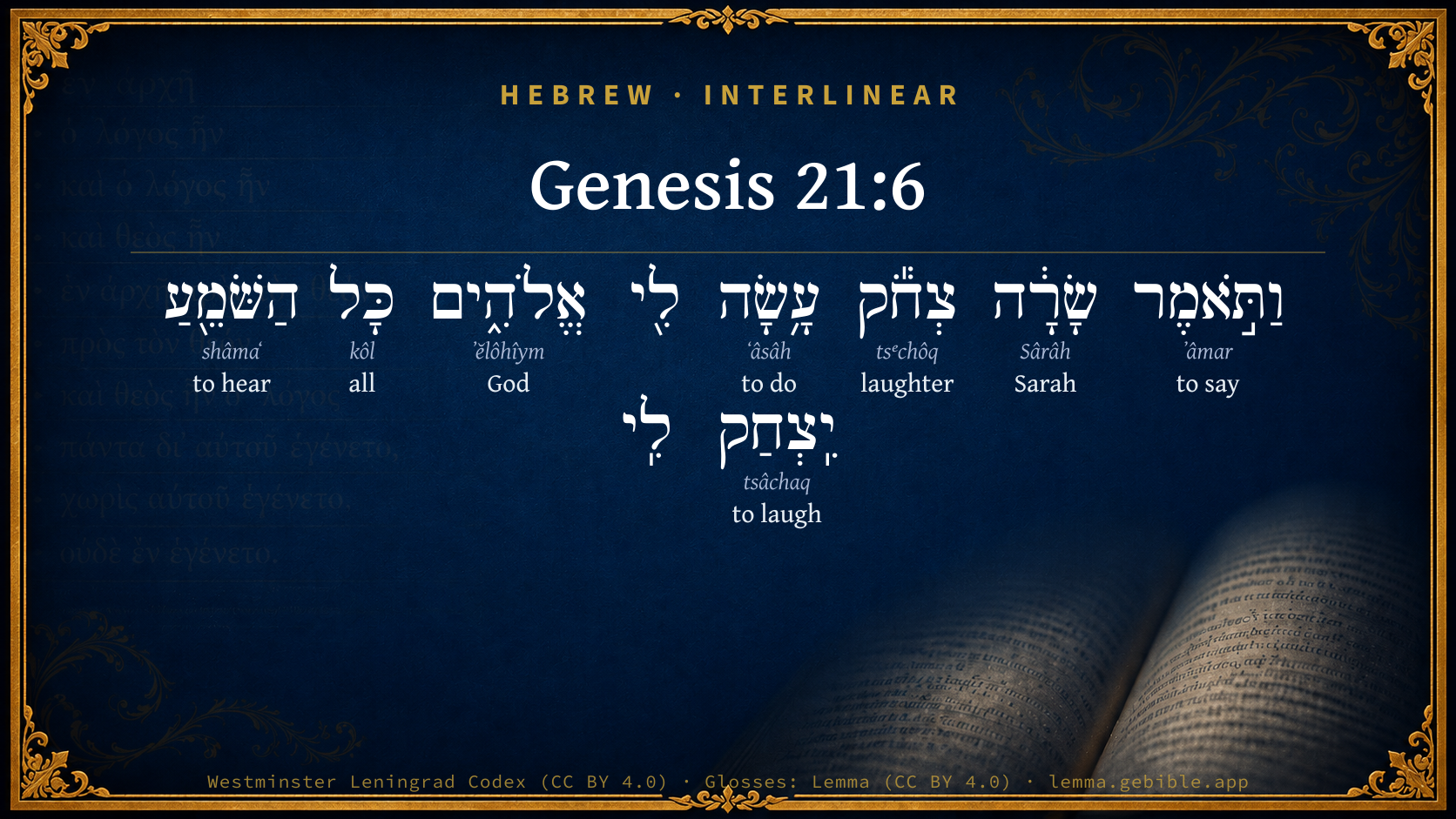
Genesis 21:6

Hebrew (Westminster Leningrad Codex) Genesis 21:6 appears in the Hebrew Old Testament. The text above is from the Westminster Leningrad Codex. Each word links to its Strong’s number, a concise gloss, and parsing drawn from the Open Scriptures Hebrew Bible morphology. Click any word for its full Brown-Driver-Briggs (BDB) entry.
Download image
Cite this verse

Genesis 21:6 (World English Bible). Public Domain. Lemma interlinear Bible study tool, https://lemma.gebible.app/v/genesis/21/6.

Show BibTeX & RIS
BibTeX
RIS
English Translation
Sarah said, "God has made me laugh. Everyone who hears will laugh with me."
World English Bible · Public Domain
Highlights
  • 1 first appearance in the Hebrew Bible
Full analysis ↓
Download a study sheet

One document with this verse’s original text, its word-by-word gloss line, the meaning frame, cross-references with their text, attributed commentary, and full source and license credits — printable, and it pastes into notes with its structure intact.

This verse Autodidact and up

Study sheet (.html) Plain text (.txt)

A passage Seminary Student

Up to 50 verses in one chapter. A passage sheet keeps up to 6 commentary sources and 12 cross-references per verse, in the order this page ranks them, and says so on the sheet whenever that leaves anything out. Ask for a single verse and you get the Autodidact verse sheet above.

Everything on this page stays free to read, with no account — the sheet is a download of what is already on screen, not access to it.

Want to remove ads? Support Godless Engineer
Compare translations 3

The same verse in 3 English versions, stacked beneath the original-language interlinear above. Click any original word for its lexicon entry.

Each is an independent rendering of the whole verse — the interlinear is not word-aligned to these translations.

Highlighted words mark where these versions differ — a whole-verse word diff, not a word-by-word alignment.

  • World English Bible Public Domain
    Sarah said, "God has made me laugh. Everyone who hears will laugh with me."
  • King James Version Public Domain
    And Sarah said, God hath made me to laugh, so that all that hear will laugh with me.
  • unfoldingWord Literal Text CC BY-SA 4.0
    And Sarah said, “God has brought laughter to me! Everyone who hears will laugh with me!”

unfoldingWord Literal Text — © unfoldingWord, licensed CC BY-SA 4.0. Word-aligned USFM3 via Door43 (git.door43.org/unfoldingWord/en_ult).

Versions to compare (up to 4)

3 of 4 selected

Show all 18 translations

Every available English version of this verse, each an independent rendering of the whole verse.

  • World English Bible Public Domain
    Sarah said, "God has made me laugh. Everyone who hears will laugh with me."
  • Berean Standard Bible Public Domain
    Then Sarah said, “God has made me laugh, and everyone who hears of this will laugh with me.”
  • Majority Standard Bible Public Domain
    Then Sarah said, “God has made me laugh, and everyone who hears of this will laugh with me.”
  • King James Version Public Domain
    And Sarah said, God hath made me to laugh, so that all that hear will laugh with me.
  • American Standard Version (1901) Public Domain
    And Sarah said, God hath made me to laugh. Every one that heareth will laugh with me.
  • Revised Version (1885) Public Domain
    And Sarah said, God hath made me to laugh; every one that heareth will laugh with me.
  • Geneva Bible (1599) Public Domain
    Then Sarah said, God hath made me to reioyce: all that heare will reioyce with me.
  • Douay-Rheims (1899) Public Domain
    And Sara said: God hath made a laughter for me: whosoever shall hear of it will laugh with me.
  • Young's Literal Translation Public Domain
    and Sarah saith, `God hath made laughter for me; every one who is hearing laugheth for me.'
  • Literal Standard Version CC BY-SA 4.0
    and Sarah says, “God has made laughter for me; everyone who is hearing laughs for me.”
  • Unlocked Literal Bible CC BY-SA 4.0
    Sarah said, “God has made me laugh; every one who hears will laugh with me.”
  • unfoldingWord Literal Text CC BY-SA 4.0
    And Sarah said, “God has brought laughter to me! Everyone who hears will laugh with me!”
  • Darby Bible Public Domain
    And Sarah said, God has made me laugh: all that hear will laugh with me.
  • World Messianic Bible Public Domain
    Sarah said, “God has made me laugh. Everyone who hears will laugh with me.”
  • Webster's Bible Public Domain
    And Sarah said, God hath made me to laugh, so that all that hear will laugh with me.
  • Free Bible Version CC BY-SA 4.0
    Sarah declared, “God has made me laugh, and all those who hear about this will laugh with me.”
  • Bible in Basic English Public Domain
    And Sarah said, God has given me cause for laughing, and everyone who has news of it will be laughing with me.
  • JPS Tanakh (1917) Public Domain
    And Sarah said: 'God hath made laughter for me; every one that heareth will laugh on account of me.'

Literal Standard Version (2020), Covenant Press — licensed CC BY-SA 4.0. Text via the HelloAO Bible API (eBible.org). Unlocked Literal Bible (unfoldingWord) — licensed CC BY-SA 4.0. Text via the HelloAO Bible API (eBible.org). unfoldingWord Literal Text — © unfoldingWord, licensed CC BY-SA 4.0. Word-aligned USFM3 via Door43 (git.door43.org/unfoldingWord/en_ult). Free Bible Version, Dr. Jonathan Gallagher — licensed CC BY-SA 4.0. Text via the HelloAO Bible API (eBible.org).

Word by word

More ways to search: Search by grammar → Find every occurrence → Compare this word →

Practice this passage: Drill this verse → Learn its vocabulary →

About this verse

These counts appear in no published source. They are computed here, from the morphology-tagged text and Lemma’s own curated glosses. What Lemma adds →

10
words
8
distinct lemmas
Pentateuch
section

Notable vocabulary

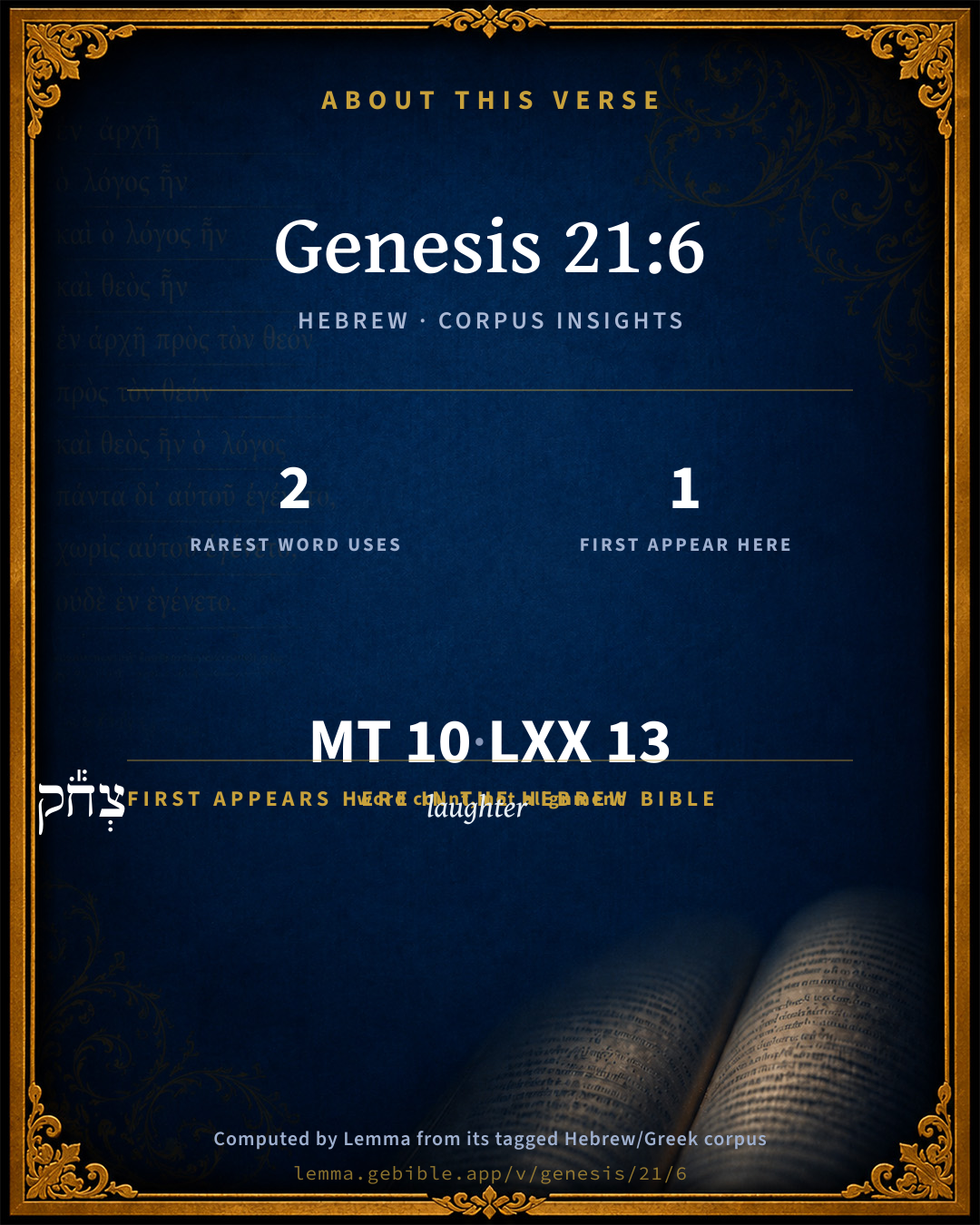
The rarest word here is צְחֹ֕ק laughter H6712 — appearing just 2 times in the whole Hebrew Bible.

First appearance in Scripture

This word makes its first canonical appearance in the Hebrew Bible here:

  • צְחֹ֕ק laughter H6712

Shared distinctive vocabulary

צְחֹ֕ק laughter H6712 occurs in 2 verses of the Hebrew Bible. Also found in:

Grammatical profile

  • 4 verbs
  • 4 nouns
  • 2 prepositions

Verb forms

  • וַתֹּ֣אמֶר Qal · Sequential Imperfect
  • עָ֥שָׂה Qal · Perfect
  • הַשֹּׁמֵ֖עַ Qal · Participle Active
  • יִֽצְחַק Qal · Imperfect

Hebrew & Septuagint length

In English translation the verse runs 14 words from the Hebrew and 18 from the Septuagint (LXX English) — closely comparable.

A rough comparison of the two English renderings, which tokenize alike — not a word-level alignment.

Word counts can differ between the Hebrew and the Greek without any difference in meaning — e.g. the Hebrew direct-object marker אֵת has no separate Greek word, and Greek often adds the article ὁ.

In the original languages it is 10 Hebrew tokens and 13 Greek tokens — but the two are counted differently (Hebrew bundles its prefixes and suffixes into one token; the Greek is in lemma form), so that isn’t a like-for-like length.

Cross-references

15

Topical passages linked to Genesis 21:6 in the Treasury of Scripture Knowledge — connected by theme and wording, ordered by reader-vote popularity; previews shown in the World English Bible.

  • Psalms 126:2 Then our mouth was filled with laughter, And our tongue with singing. Then they said among the nations, "Yahweh has done great things for them."
  • Isaiah 54:1 Sing, barren, you who didn't bear; break forth into singing, and cry aloud, you who did not travail with child: for more are the children of the desolate than the children of the married wife, says Yahweh.
  • Genesis 17:17 Then Abraham fell on his face, and laughed, and said in his heart, "Will a child be born to him who is one hundred years old? Will Sarah, who is ninety years old, give birth?"
  • Luke 1:58 Her neighbors and her relatives heard that the Lord had magnified his mercy towards her, and they rejoiced with her.
  • Psalms 113:9 He settles the barren woman in her home, As a joyful mother of children. Praise Yah!
  • Isaiah 49:21 Then shall you say in your heart, Who has conceived these for me, seeing I have been bereaved of my children, and am solitary, an exile, and wandering back and forth? and who has brought up these? Behold, I was left alone; these, where were they?
  • Luke 1:14 You will have joy and gladness; and many will rejoice at his birth.
  • Luke 1:46–55 Mary said, "My soul magnifies the Lord.
  • Galatians 4:27–28 For it is written, "Rejoice, you barren who don't bear. Break forth and shout, you that don't travail. For more are the children of the desolate than of her who has a husband."
  • Romans 12:15 Rejoice with those who rejoice. Weep with those who weep.
  • Genesis 18:12–15 Sarah laughed within herself, saying, "After I have grown old will I have pleasure, my lord being old also?"
  • John 16:21–22 A woman, when she gives birth, has sorrow, because her time has come. But when she has delivered the child, she doesn't remember the anguish any more, for the joy that a human being is born into the world.
  • Hebrews 11:11 By faith, even Sarah herself received power to conceive, and she bore a child when she was past age, since she counted him faithful who had promised.
  • 1 Samuel 1:26–2:10 She said, Oh, my lord, as your soul lives, my lord, I am the woman who stood by you here, praying to Yahweh.
  • Isaiah 49:15 Can a woman forget her sucking child, that she should not have compassion on the son of her womb? yes, these may forget, yet I will not forget you.

Cross-references courtesy of OpenBible.info (CC BY 4.0).

Hebrew and Greek witnesses Masoretic Hebrew ↔ Greek Septuagint

The same verse in the two great witnesses to the Old Testament, shown verse-for-verse.

These are two independent witnesses, not word-aligned to each other, and the Septuagint is shown in lemma (dictionary) form.

Hebrew Genesis 21:6 Masoretic · Westminster Leningrad Codex

וַתֹּ֣אמֶר שָׂרָ֔ה צְחֹ֕ק עָ֥שָׂה לִ֖י אֱלֹהִ֑ים כָּל הַשֹּׁמֵ֖עַ יִֽצְחַק לִֽי

Sarah said, "God has made me laugh. Everyone who hears will laugh with me."

World English Bible · Public Domain

Greek LXX Genesis 21:6 Septuagint · lemma form

εἶπον δέ σαρρα γέλως ἐγώ ποιέω κύριος ὅς γάρ ἄν ἀκούω συνχαίρω ἐγώ

And Sarrha said, The Lord has made laughter for me, for whoever shall hear shall rejoice with me.

LXX2012 (modern English Septuagint) · Public Domain

On this verse, The Cambridge Bible for Schools and Colleges discusses the Septuagint’s reading. Read the note in Commentary ↓

Hebrew: Westminster Leningrad Codex (CC BY 4.0). Greek: Septuagint (public domain); English from LXX2012 (modern English Septuagint) (Public Domain). How the Septuagint differs from the Hebrew →

Targum (Aramaic paraphrase)

2

The Targum is the ancient Jewish Aramaic paraphrase of the Hebrew Scriptures — an interpretive translation, not the Hebrew text itself. Onkelos (literal) and Pseudo-Jonathan (expansive) render the Torah, and Jonathan the Prophets. Coverage is partial: where no permissively-licensed English translation exists for a verse, only the Aramaic is shown. This is verse-level text, not a word-by-word alignment to the Hebrew.

  1. Targum Onkelos Torah (Genesis–Deuteronomy)
    וַאֲמֶרֶת שָׂרָה חֶדְוָא עֲבַד לִי יְיָ כָּל דִּשְׁמַע יֶחֱדֵּי לִי

    (no public-domain English translation for this verse)

    Targum Onkelos — Aramaic: “Onkelos Genesis” (public domain); “Onkelos Exodus” (public domain); “Onkelos Leviticus” (public domain); “Onkelos Numbers” (public domain); “Onkelos Deuteronomy” (public domain). English: “Sefaria Community Translation” (CC0 1.0 (public-domain dedication)); “J.W. Etheridge. The Targums of Onkelos and Jonathan Ben Uzziel on the Pentateuch. London: Longmans, Green, 1862” (public domain). Text via Sefaria.

  2. Targum Pseudo-Jonathan Torah (Genesis–Deuteronomy)
    וַאֲמָרַת שָרָה תֵּימָהָא עָבַד לִי יְיָ כָּל דִשָּׁמַע יִתְמַהּ עָלַי

    And Sarah said, The Lord hath done wondrously for me; all who hear will wonder at me.

    Targum Pseudo-Jonathan — Aramaic: “Targum Jonathan on Genesis” (public domain); “Targum Jonathan on Exodus” (public domain); “Targum Jonathan on Leviticus” (public domain); “Targum Jonathan on Numbers” (public domain); “Targum Jonathan on Deuteronomy” (public domain). English: “The Targum of Jonathan ben Uzziel, trans. J. W. Etheridge, London, 1862” (public domain). Text via Sefaria.

Commentary

Notes on Genesis 21:6 from classic Christian and Jewish commentators (each source and its license shown beneath its notes). The classic Christian expositions comment on the surrounding passage and are grouped to its opening verse, so a note may address several verses; the Jewish commentaries on the Tanakh (Rashi and others) are per-verse, so they appear only where the commentator wrote on this verse.

Lemma curates 59 commentaries, every one of them public domain or Creative Commons licensed, each selected and text-cleaned for this edition rather than reprinted as found. About our sources →

Trapp's Complete Commentary

John Trapp

Gen 21:6 And Sarah said, God hath made me to laugh, [so that] all that hear will laugh with me.

Ver. 6. God hath made me to laugh.] "A wise son maketh a glad father". {Pro 10:1} Monstri autem simil est, quando pro risu sunt fletus, sunt flagellum . And yet this is many a good man’s case. How many parents are put to wish Moses’ wish, {Num 11:15} "Lord, if I have found favour in thy sight, kill me, that I behold not my misery!" Had he lived to see what ways his grandchild Jonathan took, what a grief would it have been unto him! {Jdg 18:30} "Jonathan, the son of Gershom, the son of Manasseh," &c. In the best Hebrew copies, Nun is suspended in that name: whereupon the Hebrews descant, that this Gershom was the son of Moses; but because he and his posterity walked not in the ways of Moses, but rather of Manasses, {2Ki 21:1-9} and did his works: therefore the penman of this book would not so far disgrace Moses, as to make him his son, as indeed he was, {Exo 2:1-2; Exo 2:10 1Ch 23:14-15} but rather of Manasses, whom he imitated and resembled. {a} How much better and happier had it been for them both if they had expressed their father’s manners, as Constantine’s sons did: of whom it is said, that they had put on whole Constantine, and in all good things did exactly resemble him. {b}

{a} Ac proinde studio inseruisse literam Nun, suspensam tamen; in signum, eam adesse vel abesse posse, ut sit et filius משׁה vel מבשׁה, istius prosapia, huius imitatione. - Buxtorf. Tiber.

{b} δλον ενεδυσαντο τον Kονσταντινον, εμπρεποντες τοις του πατρος καλλωπισμασιν - Euseb.

John Trapp, A Commentary or Exposition upon All the Books of the Old and New Testament (1647–1656) — public domain. Text from a community e-Sword module.

The Biblical Illustrator

Joseph S. Exell

Gen_21:6-7

Sarah said, God hath made me to laugh

The rejoicing of Isaacs birth

I.

IT WAS THE REWARD OF FAITH AND PATIENCE.

II. IT WAS HAILED WITH A SONG OF GRATITUDE.

1. There was an element of amazement and wonder.

2. There was an element touchingly human.

3. There was a confident expectation of universal sympathy. All that hear will laugh with me.

4. There was an acknowledgment of the Divine source of the joy. God hath made me to laugh. (T. H. Leale.)

The Biblical Illustrator, edited by Joseph S. Exell (c. 1880s–1900s) — public domain. Text from a community e-Sword module.

Joseph Benson's Commentary

Gen 21:6. Sarah said, God has made me to laugh — Not through diffidence and irreverence, as my own distrustful heart before made me to laugh; but through excess of holy joy. He hath given me both cause and a heart to rejoice. And it adds to the comfort of any mercy to have our friends rejoice with us in it, Luk 1:58. They that hear will laugh with me — Will rejoice in this instance of God’s power and goodness; and be encouraged to trust in him.

Joseph Benson's Commentary on the Old and New Testaments (1811–1818) — public domain. Text from a community e-Sword module.

The Preacher's Complete Homiletical Commentary

Joseph S. Exell (gen. ed.)

MAIN HOMILETICS OF THE PARAGRAPH.—Gen_21:6-7

THE REJOICING AT ISAAC’S BIRTH

I. It was the reward of faith and patience. There were peculiar circumstances connected with the birth of this child which made it an extraordinary occasion. The promise had long been given, and the parents had waited patiently through many years of disappointment, and sorrows of hope deferred. The time when they could expect offspring in the ordinary course of nature had long, since passed away. They were thrown entirely upon the strength of their faith, and upon that hope whose substance and foundation is faith. At length the time arrived when their faith and patient waiting are rewarded. What joy must they have felt when they found that their confidence in God—a confidence tried by long and anxious waiting—was justified by the bestowal of such a blessing! That is the deepest and most plentiful joy which comes after a long trial of faith and patience. Such is the joy into which the pious enter after death. The glory of heaven is the reward of the faith and patience of the saints.

II. It was hailed with a song of gratitude. The words of Sarah have been called “the first cradle hymn.” This song is the first of its kind recorded in literature. The peculiarity of the occasion justify its strong expressions.

1. There was an element of amazement and wonder. “Who would have said unto Abraham, that Sarah should have given children suck? for I have borne him a son in his old age” (Gen_21:7). No one could naturally have expected such an event, and all who beheld it must have been filled with amazement. The miraculous nature of the blessing made it the occasion of an extraordinary joy. So all the gifts of grace excite our wonder and amazement. We are constrained continually to say, “This is the Lord’s doing, and it is marvellous in our eyes.”

2. There was an element touchingly human. The song is put into the mouth of the mother, for the birth of this child would affect her feelings more intensely. The father’s would be a sober and thoughtful joy, but the mother’s would be an uncontrollable tide of emotion. Her feeling would be too great for many words, and could only have its humanly natural expression in laughter.

3. There was a confident expectation of universal sympathy. “All that hear me will laugh with me.” She could not imagine any one regarding her happiness with indifference. All who knew the fact, and were capable of judging of its importance, would have full sympathy with her. Though her words were expressions of human feeling proper to the time, yet we may justly regard them as prophetic. How many have rejoiced because of the chosen race whose seed was to be reckoned in Isaac! How many incalculable blessings have they given to mankind!—above all, the Saviour of the world. The child-bearing of this mother of the chosen race is the human channel along which salvation has been borne to us. “Salvation is of the Jews.” The mother of our Lord had this grateful confidence in the sympathy of the good throughout all time. “All generations shall call me blessed.”

4. There was an acknowledgment of the Divine source of the joy. “God hath made me to laugh” (Gen_21:6). In all her wild amazement of joy, she was not forgetful of God, from whom the blessing came. She triumphed because she had faith in a Living Person who was able to perform His gracious word. We do not read of any doctrines that she held, but she had faith in a personal God. Through all the degrees and stages of Divine revelation, this is the one distinguishing characteristic mark of the saints of God. They had faith, not in anything about Him, but in Him; not faith in His attributes, or in any intellectual conceptions of them, but directly lodged and reposed in Himself. Their individual existence was united to His personal being. This is the simplification of theology—God hath made me to know, to feel, and to rejoice. In His favour is life, with all its gladness and blessed issues.

SUGGESTIVE COMMENTS ON THE VERSES

Gen_21:6. The expression carries an allusion to Isaac’s name, and to the circumstance mentioned (ch. Gen_17:17-19), on which it was founded. It was a mode of speech which not only showed how sincerely she recognised the propriety of Abraham’s laughing on the occasion referred to, and how cordially she assents to the name thus bestowed on the child, but intimates also that God had made her, as well as Abraham, to laugh; which was, in fact, a virtual condemnation of her former incredulity. We meet in the prophets with some striking allusions to this incident, where Sarah is considered a symbol of the Church. Thus Isa_54:1., “Sing, O barren, thou that didst not bear,” etc. (Comp. Isa_51:2-3; Gal_4:22-28). All that bear will laugh with me. Will sympathise with my joy, and tender to me their congratulations. To this also the prophet alludes, Isa_66:10 : “Rejoice ye with Jerusalem, and be glad with her, all ye that love her; rejoice with joy with her;” where the Jerusalem mentioned is expressly said by the apostle (Gal_4:22; Gal_4:27) to be mystically shadowed out by Sarah.—(Bush.)

The children of faith, though they may have their time of weeping, and be exposed to the ridicule of the world, will also have their time to laugh. Gladness is sown for the upright in heart.

God gave this laughter to vindicate His promise, and to rebuke her unbelief.

Gen_21:7. The natural incredibility of the event enhances her joy and wonder. And so her testimony is here recorded to the amazing power and grace of God in making good His covenant promises. God is wont to get such clear and express testimonies to His miraculous works, to show that they were not by any means natural. And it was most important that this event be witnessed to by the glad mother as being not according to nature, but beyond nature; natural indeed in its progress and issue, but not therefore in its origin. Who would have said. How naturally unsupposable. Who ever would have reported such a thing would have been counted mad. Sarah should, etc. Heb.—Sarah is suckling children. Yet it is even so! For I have born him, etc. This is the mother’s new-found joy which she herself can scarcely credit. This laughter is referred to in Isa_49:13; Isa_52:9, and by St. Paul in Gal_4:7.—(Jacobus.)

In her joy Sarah speaks of many children when she had borne only one son, who, however, was better to her than ten sons. She will say, not only has my dead body received strength from God to bring a child into the world, but I am conscious of such strength that I can supply its food, which sometimes fails much younger and more vigorous mothers. Sarah nursed her child although she was a princess (ch. Gen_23:6) and of noble blood, for the law of nature itself requires this from all, since, with this very end in view, God has given breasts to all and filled them with milk. The Scriptures united these two functions, the bearing of children and nursing them, as belonging to the mother. (Luk_11:27; Luk_23:29; Psa_22:10.) Thus these two things were reckoned among the blessings and kindness of the great God (Gen_49:25), while an unfruitful body and dry breasts are a punishment from Him. (Hos_9:11-14.)—(Lange.)

Though she were a great lady, yet she was a nurse. Let it not be niceness but necessity that hinders any mother from so doing, lest she be found more monstrous than the “sea-monsters,” that draw out their breast, and give suck to their young. (Lam_4:3.)—(Trapp.)

The Preacher's Complete Homiletical Commentary (gen. ed. Joseph S. Exell; Funk & Wagnalls, c. 1892) — public domain (pre-1929). A full-Bible homiletical/sermon-outline anthology covering 65 of 66 books (2 John is absent from the source module). Text from a community e-Sword module.

Tyndale Open Study Notes

Tyndale Open Resources

21:6-7 Sarah was filled with joy and praise for this amazing event—only God could enable her to have a child.

21:6 Sarah’s wordplay on the name Isaac (Hebrew yitskhaq, “he laughs”) shows that the laughter of unbelief when the promise was given (18:12) had changed to the laughter of joy at its fulfillment. Isaac’s name could refer to the pleasure of God and of his parents at his birth. Sarah knew that everyone who heard about this would laugh with her and rejoice at the news.

Tyndale Open Study Notes — © Tyndale Open Resources, licensed CC BY-SA 4.0. Text via the HelloAO Bible API.

Adam Clarke's Commentary

Verse 6. God hath made me to laugh] Sarah alludes here to the circumstance mentioned Ge 18:12; and as she seems to use the word to laugh in this place, not in the sense of being incredulous but to express such pleasure or happiness as almost suspends the reasoning faculty for a time, it justifies the observation on the above-named verse. See a similar case in Lu 24:41, where the disciples were so overcome with the good news of our Lord's resurrection, that it is said, They believed not for joy.

Adam Clarke's Commentary on the Bible (1810–1826) — public domain. Text from a community e-Sword/MySword module.

Ellicott's Commentary for English Readers

(6, 7) God hath made me to laugh.—Sarah’s laugh was one of mingled emotions. Joy was uppermost in her mind, but women do not laugh for joy at the birth of a child. Doubtless she called to mind the feelings with which she listened to the announcement of her bearing a son, made by those whom she then regarded as mere passing wayfarers (Gen_18:12), but whom she had now long known to be the messengers of God. And still the event seemed to her marvellous and astonishing, so that “all that hear,” she said, “will laugh with me”—Heb., for me, or over me—not “will ridicule me,” but will be merry at the thought of an old woman of ninety having a son. Deeper feelings would come afterwards, and the acknowledgment that that which was contrary to nature was wrought by Him whom nature must obey; but surprise is uppermost in the little poem in which Sarah gives utterance to her first feelings:—

Who would have said unto Abraham

Sarah suckleth sons?

For I have borne a son to his old age.

A Bible Commentary for English Readers, edited by Charles John Ellicott (1878–1897) — public domain. Text from a community e-Sword module.

The Cambridge Bible for Schools and Colleges

gen. ed. J. J. S. Perowne

6. God hath made me to laugh] R.V. marg. prepared laughter for me. Once more in connexion with the birth of Isaac the thought of laughter recurs: see Gen_17:17 (P), Gen_18:12-15 (J). This time we have the tradition preserved by E. It is not clear that the two clauses of this verse mean the same thing. According to R.V. text, the first clause refers the laughter to Sarah’s own happiness and exultation: the second clause refers it to the merry reception of the unexpected news by those who would laugh incredulously. According to R.V. marg., the latter meaning attaches also to the first clause; and both clauses, meaning the same thing, are explained by Gen_21:7. The R.V. text is perhaps to be preferred. It preserves two traditional explanations of the laughter associated with Isaac’s birth. Certainly the laughter of Sarah’s personal happiness seems to be the point of St Paul’s quotation from Isa_54:1, “rejoice thou barren that bearest not,” in a passage where the Apostle is allegorizing this chapter (Gal_4:22-31).

with me] Better, at me. The preposition “with” is hardly correct, though it is supported by the LXX συγχαρεῖται, Lat. corridebit mihi. The original represents Sarah as the object of the laughter; and amusement, not derision, as its cause.

The Cambridge Bible for Schools and Colleges (gen. ed. J. J. S. Perowne; Cambridge University Press, 1878–1918) — public domain. Text from a community e-Sword module.

John Gill's Exposition

And she said, who would have said unto Abraham,.... No one a year ago could ever have thought of such a thing, much less have come and told Abraham that he should have a child or children by Sarah; the thing was incredible, and next to impossible; none but God himself, or an angel from him, could have declared this, as none but he could bring it about, the thing is so marvellous and astonishing:

that Sarah should have given children suck? that she who was ninety years of age should bear a child, and suckle it, as she did; and in doing which she set an example to her daughters to do the like, since neither age nor grandeur, nor the business of her family, were any objection to this duty of nature; and her being able to do this was a clear proof that this was truly a child of her own. The plural number may be put for the singular, as it often is, see Gen 46:23; or Sarah might think, as she had strength given her to bear and suckle one child, she might bear and suckle more; though the phrase seems only to be expressive and descriptive of her as a nursing mother:

for I have borne him a son in his old age; See Gill on Gen 21:2.

John Gill's Exposition of the Whole Bible (1746–1763) — public domain (CC PDM 1.0). Text via the HelloAO Bible API.

Matthew Poole's English Annotations

Before, my own distrustful heart made me to laugh, now God makes me laugh, not through diffidence and irreverence, as before, Gen 18:12, but through excess of holy joy.

All that hear will laugh with me; or, at me; some through sympathy rejoicing with me and for me, laughter being oft put for joy, as Isa 54:1; Gal 4:27, &c.; other’s through scorn and derision, as at a thing which well may seem incredible to them, because it did so to me. See Gen 17:17; 18:12,13,15.

Matthew Poole's English Annotations on the Holy Bible (1683–1685) — public domain. Text from a community e-Sword/MySword module.

Whedon's Commentary on the Bible

Daniel D. Whedon

6. Sarah said — This is the magnificat of Sarah, and may be compared with Luk_1:46-55. Never before had Sarah felt such thrills of joy, or uttered language of such prophetic fervour. The passage may be put in poetic form as follows:

And Sarah said,

God has made me to laugh;

All who hear will laugh with me.

And she said,

Who would have told to Abraham,

Sons shall be nursed by Sarah.

For I have begotten a son to his old age.

Daniel D. Whedon (gen. ed.), Commentary on the Old and New Testaments (1874–1909) — public domain. Text from a community e-Sword module.

The Pulpit Commentary

And Sarah said, the spiritual elevation of her soul being indicated by the poetical form of her speech. Differing from Mary s magnificat in having been uttered after, and not before, the birth of the promised seed, the anthem of Sarah was obviously designed as a prelude to that loftier song of the Virgin (cf. Luk_1:46) It consists of two sentences, the first containing two, and the second three linesGod hath made me to laugh. Or, retaining the order of the Hebrew, To laugh hath made me Elohim; the emphatic position of qjox, containing an allusion to the name Isaac, probably indicating that Sarah"s laughter was of a different character now from what it had previously been; (Gen_18:12) and her ascription of it to Elohim intimating that him whom she formerly mistook for a traveler she now recognized to be Divine ("Speaker"s Commentary"). So that all that hear me will laugh with me. Not, will laugh at me, deridebit me (Peele), a sense the words will bear (Rosenm "Speaker"s Commentary"), though in the instances adduced (Job_5:22 Job_39:7, Job_39:18, Job_39:22) l qjx; rather conveys the idea of despising difficulties (Kalisch); but, will laugh with me, sugcareitai mou, congaudebit mihi (LXX, Vulgate, Targums, Calvin, Dathe, Keil).

The Pulpit Commentary (1880–1919), ed. H.D.M. Spence-Jones & Joseph S. Exell — public domain. Text from a community e-Sword module.

John Wesley's Explanatory Notes

And Sarah said, God has made me to laugh - He hath given me both cause to rejoice, and a heart to rejoice. And it adds to the comfort of any mercy to have our friends rejoice with us in it, See Luke i, 58. They that hear will laugh with me - Others will rejoice in this instance of God's power and goodness, and be encouraged to trust in him.

John Wesley, Explanatory Notes Upon the Whole Bible (1754–1765) — public domain. Text via the GEBible commentary corpus.

Rashi

Rabbi Shlomo Yitzchaki (Rashi)

יצחק לי means will rejoice on my account. The Midrashic statement is (Genesis Rabbah 53:8): Many barren women were remembered together with her, many sick were healed in that day, many prayers were answered with hers and there was great rejoicing in the world.

Rashi on the Tanakh — English translations: “The Judaica Press complete Tanach with Rashi, translated by A. J. Rosenberg” (CC BY 4.0); “Pentateuch with Rashi's commentary by M. Rosenbaum and A.M. Silbermann, 1929-1934” (public domain); “The Metsudah Tanach series, Lakewood, N.J” (CC BY 4.0); and “The Book of Joshua, Metsudah Publications, 1997” (CC BY 4.0). Text via Sefaria.

Radak

Rabbi David Kimhi (Radak)

ותאמר שרה צחק, she said that she really called the boy יצחק in order to give expression to the joy G’d had granted her. She was convinced that everyone hearing about her good fortune of having given birth in her old age would share her joy at this. Any person being surprised by some unexpected happy event laughs for joy.

Radak on the Tanakh — English translations: “Sefaria Community Translation” (CC0 1.0 (public-domain dedication)); “Eliyahu Munk, HaChut Hameshulash” (CC BY 4.0); “Rabbi Mike Feuer, Jerusalem Anthology” (CC BY 4.0); and “R. David Kimhi on the first book of Psalms, Translated by R.G. Finch, London, 1919” (public domain). Text via Sefaria.

Lesson kit

Teaching starters — assembled from the data on this page, not authored interpretation. Every prompt links to the verse data it draws on. Edit before teaching.

Genesis, in the Pentateuch, opens this verse with 10 words (8 distinct Hebrew lemmas). Its most distinctive word is tsᵉchôq (“laughter”). A historical commentator’s framing appears above. Read the whole chapter for the surrounding context.

Discussion questions

  1. What does “laughter” (tsᵉchôq) contribute to the verse as a whole?
  2. This is the first place “laughter” appears in Scripture (first appears here). What does its debut here establish?
  3. How does Ezekiel 23:32, which shares the word «laughter», read alongside this verse?
  4. These translations render this verse differently. What is at stake in choosing one wording over another?
  5. «וַתֹּ֣אמֶר» is a Qal Sequential Imperfect verb. How does that grammatical form shape the action described?
  6. Compare how Trapp's Complete Commentary and The Biblical Illustrator read this verse. Where do they agree or differ?

Things to notice

Reading settings

Reading text

Shown beneath each verse's original-language words.

Old Testament
Old Testament edition

Read the OT as the Masoretic Hebrew (MT) or the Greek Septuagint (LXX).

English shown for the Greek Septuagint (in the Hebrew ↔ Greek comparison).

Comparing translations? Open the Compare panel on any verse page to stack up to four side by side.