Matthew 13:18

Greek (Tischendorf 8th ed.) Matthew 13:18 appears in the Greek New Testament. The text above is from the Tischendorf 8th edition. Each word links to its Strong’s number and a concise gloss. Click any word for its full Thayer’s Greek Lexicon entry.
Download image
Cite this verse

Matthew 13:18 (World English Bible). Public Domain. Lemma interlinear Bible study tool, https://lemma.gebible.app/v/matthew/13/18.

Show BibTeX & RIS
BibTeX
RIS
English Translation
"Hear, then, the parable of the farmer.
World English Bible · Public Domain
Download a study sheet

One document with this verse’s original text, its word-by-word gloss line, the meaning frame, cross-references with their text, attributed commentary, and full source and license credits — printable, and it pastes into notes with its structure intact.

This verse Autodidact and up

Study sheet (.html) Plain text (.txt)

A passage Seminary Student

Up to 50 verses in one chapter. A passage sheet keeps up to 6 commentary sources and 12 cross-references per verse, in the order this page ranks them, and says so on the sheet whenever that leaves anything out. Ask for a single verse and you get the Autodidact verse sheet above.

Everything on this page stays free to read, with no account — the sheet is a download of what is already on screen, not access to it.

Want to remove ads? Support Godless Engineer
Compare translations 3

The same verse in 3 English versions, stacked beneath the original-language interlinear above. Click any original word for its lexicon entry.

Each is an independent rendering of the whole verse — the interlinear is not word-aligned to these translations.

Highlighted words mark where these versions differ — a whole-verse word diff, not a word-by-word alignment.

  • World English Bible Public Domain
    "Hear, then, the parable of the farmer.
  • King James Version Public Domain
    Hear ye therefore the parable of the sower.
  • unfoldingWord Literal Text CC BY-SA 4.0
    You, therefore, listen to the parable of the sower.

unfoldingWord Literal Text — © unfoldingWord, licensed CC BY-SA 4.0. Word-aligned USFM3 via Door43 (git.door43.org/unfoldingWord/en_ult).

Versions to compare (up to 4)

3 of 4 selected

Show all 19 translations

Every available English version of this verse, each an independent rendering of the whole verse.

  • World English Bible Public Domain
    "Hear, then, the parable of the farmer.
  • Berean Standard Bible Public Domain
    Consider, then, the parable of the sower:
  • Majority Standard Bible Public Domain
    Consider, then, the parable of the sower:
  • King James Version Public Domain
    Hear ye therefore the parable of the sower.
  • American Standard Version (1901) Public Domain
    Hear then ye the parable of the sower.
  • Revised Version (1885) Public Domain
    Hear then ye the parable of the sower.
  • Geneva Bible (1599) Public Domain
    Heare ye therefore ye parable of ye sower.
  • Douay-Rheims (1899) Public Domain
    Hear you therefore the parable of the sower.
  • Young's Literal Translation Public Domain
    `Ye, therefore, hear ye the simile of the sower:
  • Literal Standard Version CC BY-SA 4.0
    You, therefore, hear the allegory of the sower:
  • Unlocked Literal Bible CC BY-SA 4.0
    Listen then to the parable of the farmer who sowed his seed.
  • unfoldingWord Literal Text CC BY-SA 4.0
    You, therefore, listen to the parable of the sower.
  • Darby Bible Public Domain
    *Ye*, therefore, hear the parable of the sower.
  • World Messianic Bible Public Domain
    “Hear, then, the parable of the farmer.
  • Webster's Bible Public Domain
    Hear ye therefore the parable of the sower.
  • Free Bible Version CC BY-SA 4.0
    So listen to the story of the sower.
  • Bible in Basic English Public Domain
    Give ear, then, to the story of the man who put the seed in the earth.
  • Text-Critical English NT CC BY 4.0
    “So hear what the parable of the sower means:
  • Tyndale New Testament (1534) Public Domain
    Heare ye therfore the similitude of the sower.

Literal Standard Version (2020), Covenant Press — licensed CC BY-SA 4.0. Text via the HelloAO Bible API (eBible.org). Unlocked Literal Bible (unfoldingWord) — licensed CC BY-SA 4.0. Text via the HelloAO Bible API (eBible.org). unfoldingWord Literal Text — © unfoldingWord, licensed CC BY-SA 4.0. Word-aligned USFM3 via Door43 (git.door43.org/unfoldingWord/en_ult). Free Bible Version, Dr. Jonathan Gallagher — licensed CC BY-SA 4.0. Text via the HelloAO Bible API (eBible.org).

Word by word

More ways to search: Search by grammar → Find every occurrence → Compare this word →

Practice this passage: Drill this verse → Learn its vocabulary →

παραβολὴν
parabolḗ
G3850
“parable”
Noun, Accusative, Singular, Feminine
Part of Speech
Noun
Case
Accusative
Number
Singular
Gender
Feminine
Full Thayer's Definition

Origin: from G3846

TDNT: 17:24,8

1. a placing of one thing by the side of another, juxtaposition, as of ships in battle 2. metaph. a. a comparing, comparison of one thing with another, likeness, similitude b. an example by which a doctrine or precept is illustrated c. a narrative, fictitious but agreeable to the laws and usages of human life, by which either the duties of men or the things of God, particularly the nature and history of God's kingdom are figuratively portrayed d. a parable: an earthly story with a heavenly meaning 3. a pithy and instructive saying, involving some likeness or comparison and having preceptive or admonitory force a. an aphorism, a maxim 4. a proverb 5. an act by which one exposes himself or his possessions to danger, a venture, a risk
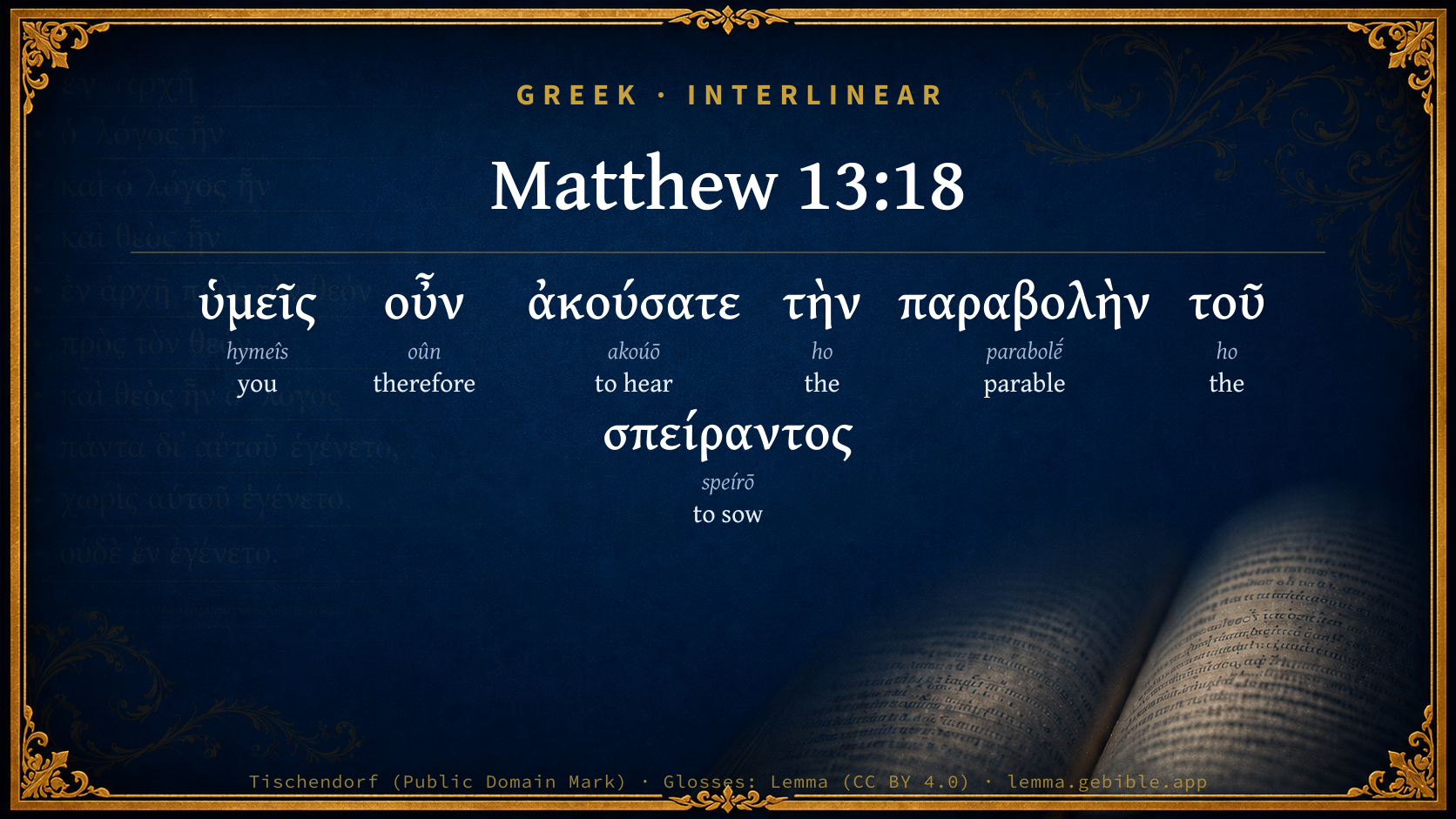
  1. ὑμεῖς hymeîs G5210 “you” Personal pronoun, 2nd person, Nominative, Plural
  2. οὖν oûn G3767 “therefore” Conjunction
  3. ἀκούσατε akoúō G191 “to hear” Verb, Aorist, Active, Imperative, 2nd person, Plural
  4. τὴν ho G3588 “the” Article, Accusative, Singular, Feminine
  5. τοῦ ho G3588 “the” Article, Genitive, Singular, Masculine
  6. σπείραντος speírō G4687 “to sow” Verb, Aorist, Active, Participle, Genitive, Singular, Masculine

About this verse

These counts appear in no published source. They are computed here, from the morphology-tagged text and Lemma’s own curated glosses. What Lemma adds →

7
words
6
distinct lemmas
Gospels
section

Shared distinctive vocabulary

παραβολὴν parable G3850 occurs in 48 verses of the Greek New Testament. Also found in:

Repetition

A word recurs within this verse:

Cross-references

3

Topical passages linked to Matthew 13:18 in the Treasury of Scripture Knowledge — connected by theme and wording, ordered by reader-vote popularity; previews shown in the World English Bible.

  • Matthew 13:11–12 He answered them, "To you it is given to know the mysteries of the Kingdom of Heaven, but it is not given to them.
  • Luke 8:11–15 Now the parable is this: The seed is the word of God.
  • Mark 4:13–20 He said to them, "Don't you understand this parable? How will you understand all of the parables?

Cross-references courtesy of OpenBible.info (CC BY 4.0).

Commentary

Notes on Matthew 13:18 from classic Christian and Jewish commentators (each source and its license shown beneath its notes). The classic Christian expositions comment on the surrounding passage and are grouped to its opening verse, so a note may address several verses; the Jewish commentaries on the Tanakh (Rashi and others) are per-verse, so they appear only where the commentator wrote on this verse.

Lemma curates 59 commentaries, every one of them public domain or Creative Commons licensed, each selected and text-cleaned for this edition rather than reprinted as found. About our sources →

Joseph Benson's Commentary

Mat 13:18-19. Hear ye therefore the parable of the sower — A parable which our Lord judged to be so important that he introduced it with a double demand of attention, Hearken, behold; Mar 4:3; and concluded it with a third, and still more solemn demand thereof, who hath ears to hear, let him hear; and here, proceeding to the explanation of it, he calls for attention the fourth time. And the reason of this is evident: the parable sets before us, in a summary point of view, all the grand hinderances of our bearing fruit, and that in the same order in which they occur. The first danger is, lest the birds should devour the seed, or it should be trodden down. If it escape this, there is then another danger, namely, lest it be scorched, and wither away. It is long after this that the thorns spring up and choke the good seed. A vast number of those who hear the word of God, receive the seed as by the way-side. Of those who do not lose it by the birds, yet many receive it as on stony places. Many of them who receive it on a better soil, yet suffer the thorns to grow up and choke it: so that few even of these endure to the end, and bear fruit unto perfection: yet in all these cases, it is not the will of God that hinders, but their own voluntary perverseness. When any one heareth, &c. — The parable, it must be observed, only concerns the hearers of the gospel. As to those who decline, or neglect to hear it, their portion is frequently given them elsewhere, and their danger and misery declared with sufficient clearness; the word of the kingdom — Namely, of the kingdom of Christ, generally termed in the gospels, the kingdom of God, or of heaven: the word which describes the nature, and shows the excellency and necessity of the kingdom of grace, preparatory to that of glory, and points out the way leading thereto. See notes on Rom 14:17; and Mar 1:15. This is the good seed, which every sower sent by Jesus Christ will be careful to sow. Not the chaff of metaphysical speculations, of human traditions, and empty notions, nor the light corn of mere moral doctrines, much less the tares of superstitious injunctions, or of enthusiastical, or Pharisaic, or antinomian delusions; but the solid and well-bodied grain of the essential truths of the gospel of Christ. And understandeth it not — For the truths that are not understood, how often soever they are heard, are in this parable fitly compared to the seed which lies uncovered on the surface of the ground, exposed to be instantly picked up by the fowls of heaven. But why is not the word of the kingdom understood? Either, 1st, because, while delivered, it is not attended to; or, 2d, because it is not heard in a spirit of prayer for divine illumination, without which divine things are not understood, Luk 24:45; 1Co 2:11; 1Co 2:14. But the Greek expression, μη συνιεντος, may with equal propriety be rendered considereth it not. Considering or meditating upon the word heard, is like harrowing in and covering up the seed sown on the ploughed ground; in consequence whereof, and not otherwise, imbibing moisture from the earth, it vegetates and springs up. When the word is not thus understood and considered, then cometh the wicked one; Satan cometh immediately; (so Mark;) either inwardly filling the mind with thoughts of other things, and exciting earthly and carnal desires and dispositions in the heart; or by his agents, such as all they are that introduce other subjects when people should be considering what they have heard. And catcheth away that which was sown in his heart — Which was intended deeply to impress and sink into it; and to remain, not only in the understanding and memory, but also in the affections, as a seed of true piety and virtue. And now the seed, the truths heard, being taken away, with the good impressions produced thereby, no fruit is to be looked for. It is justly observed here by Dr. Whitby, that this industry of Satan to snatch the word out of our hearts, as it discovers his enmity against the gospel, so doth it highly commend the excellency and efficacy of it: for were it not of great importance to preserve it there, he would not be so industrious to snatch it thence. And were it not, when there, a powerful instrument to work within us that faith which purifies the heart, why doth he do this lest we should believe? See Luk 8:12. This is he that receiveth seed by the way-side — And a great proportion of most congregations are of this description.

Joseph Benson's Commentary on the Old and New Testaments (1811–1818) — public domain. Text from a community e-Sword module.

The Preacher's Complete Homiletical Commentary

Joseph S. Exell (gen. ed.)

CRITICAL NOTES

Mat_13:19. Which received seed.—That was sown (R. V.). A change in the figure quite common among Orientals. It should have been: This is he in whose case the seed was sown by the wayside (Meyer). But there is a deeper meaning in this change. The loss of the seed becomes in reality the loss of one’s own life, just as the seed sown on good soil, so to speak, becomes identified with our personality (Lange). See Mat_13:23, R.V.

MAIN HOMILETICS OF THE PARAGRAPH.—Mat_13:18-23

The art of hearing.—We have before us here the Saviour’s own explanation (Mat_13:18) of the first of His parables at this time. And we find, appropriately enough, that the subject of it is the subject of “hearing.” There are three wrong ways—there is only one right way—of hearing the word. That, in brief, is what His explanation amounts to. The consideration of the three wrong ways will make the consideration of the one right way a comparatively easy proceeding.

I. The first wrong way of hearing may be described as hardly hearing at all. It is hearing without understanding (Mat_13:19). It is hearing the sound only, and not the sense. To such a “hearer” it matters little what message is sent him. He takes in as much—or rather as little—whatever is said. He is well represented, therefore, by that “wayside” soil which is trodden so hard that the seed which falls on it cannot enter into it. Just so is it of such a hearer, and of the truth which he hears. When all has been said, the truth in question remains outside of his mind. Naturally, therefore, the result of such “hearing” is just nothing at all. No seed that only lies on the surface can germinate or increase. It cannot even take the first step in that vital direction. It can only lie there till one of the birds of the air carries it off, and “devours” it. Even so of that truth, by whomsoever spoken, which does not even enter the mind. Not only, in that condition, can it then do nothing at all; there are influences at work which will soon take away its chance of doing anything in the future (end of Mat_13:19).

II. The second wrong way of hearing may be described as only hearing in part. It is not in this case, as in the previous one, that nothing at all is received. On the contrary a good deal—and that “straightway”—and even “with joy.”—is received (Mat_13:20). But it is not so received for all that, but that a good deal more is left out. As it were the pleasant side of the message of the “kingdom,” the peace it offers, the hope it sets forth, the glory it promises are appreciated in full. But the sterner and less alluring side of the question, the probability of “persecution or tribulation arising because of the word,” is not considered as it should be, if considered at all. When this comes about, therefore, as come it must, such a hearer is not prepared for such a stumbling-block in his way. The first consequence is that he is as quickly displeased now (end of Mat_13:21 R.V. “straightway”) as he had been quickly pleased at the first. And the consequence of that is, that he goes back again wholly from such good as he had. Precisely as happens, in short, where the seed of the sower falls upon one of those “rocky places” where there is “no deepness of earth” (Mat_13:4-5). The only thing quicker than the subsequent growth of that seed is its still later decay. And the only relic it leaves is a “withered” blade (Mat_13:6), which tells of what had been hoped at one time.

III. The third wrong way of hearing may be described as that of not hearing in truth. It is indeed, “receiving” the word, but it is also receiving together with it that which is inconsistent therewith. Rather, perhaps, it is not making sufficient room for it by previously casting all such other things out. When the seed of the sower falls into soil in which “the thorns” (Mat_13:7; Mat_13:22)—“the thorns” that ought not to be there—are there in germ, if not in anything more, that seems to describe exactly the kind of thing that is meant. Really, in such soil, there is not “room enough” for that seed. It cannot possibly grow there as it should. Precisely so, is it too, with the hearer who does indeed receive the word of God into his heart; but only to find there such things as “the care of this world, and the deceitfulness of riches” ready to grow by its side. Not even the word of God in such a case, can do what it should. It does effect indeed—even so—a good deal for a time. Such a hearer of the word becomes also a doer of it to a certain extent. In this case there would appear to be even the “setting” of fruit. But not anything more. Not the growth of it—not the ripening of it—not the “full corn in the ear” (Mar_4:28). Even the power of the word cannot do this in that pre-occupied soil. There are rival powers there which “choke” even its powers, and cause it to become “unfruitful” at last (end Mat_13:22).

IV. From these wrong ways of hearing it should be easy now to put together the right way.—The right way is one which escapes the evils of each of these three. It is to hear the sense as well as the sound. It is to hear the whole and not only a part. It is to hear in sincerity, and not in any way in pretence. Also we see, thus, by what results the right way may be known. Not mere sterility, as a matter of course—nor yet “withered” blades only, however abundant—nor yet abortive fruit only, however advanced—prove the ground to be good. Nothing proves this except the actual presence of “something to be reaped.” Not however, that this something, be it observed in conclusion, must always be of the “most.” This seems the comforting lesson with which the parable ends. There are “some thirty, some sixty, some a hundred-fold” in return. Of course, this last, to all true hearts, will be far away best. Of course this “most” will be desired most by every one who “hears” rightly. But even the “less” in this field of the “kingdom,” will not be set on one side. True “fruit” means true life, even if not in greatest abundance. True obedience means true hearing, even if there might have been more. “She hath done what she could” (Mar_14:8).

The Preacher's Complete Homiletical Commentary (gen. ed. Joseph S. Exell; Funk & Wagnalls, c. 1892) — public domain (pre-1929). A full-Bible homiletical/sermon-outline anthology covering 65 of 66 books (2 John is absent from the source module). Text from a community e-Sword module.

Godbey's Commentary on the New Testament

William B. Godbey

STORM ON THE GALILEAN SEA

Mat 13:18-27; Mar 4:35-41; & Luk 8:22-25; Luk 9:57-62. Mark: “And He says to them on that day, it being evening, Let us cross over to the other side. And leaving the multitude, they receive Him, as he was in the ship; and there were many other ships along with Him. And there is a great storm of wind, and the waves poured into the ship, so that it was already sinking.” Matthew says is was covered with the waves, and Luke says they were being filled up and were in danger. The Sea of Galilee, seven hundred feet below the Mediterranean, as a natural consequence of this deep depression, is surrounded by mountains on all sides, except the deep valley through which the Jordan flows from the north and out toward the south. Consequently it is very liable to sudden tornadoes; the atmosphere, pouring down in all directions from the highlands, gets turned about, and develops whirlwinds, which are very dangerous, as it is sixteen and one-half miles long and seven and one-half miles wide, with a coast of seventy-five miles. We were warned by the guidebooks to beware of storms. This we heeded, lighting on the good fortune to get a very valuable boat, which was built last year, in Beyroot, for the especial accommodation of the German emperor. We found it splendid, and, sailing over the sea two days, encountered no storm. “He was lying in the stern, sleeping on a pillow; they arouse Him up, and say to Him, Master, is there no care to Thee that we perish?” Matthew: “And He says to them, Why are ye cowardly, O ye of little faith?” This was a just rebuke; because they might have known that they were in no danger with Him on hoard. This is the secret of perfect love, which always takes Jesus aboard, casting out fear. Mark “And rising, He rebuked the wind and said to the sea, Be quiet!

be calm! And the wind ceased, and there was a great calm. And He said to them, Why are ye afraid? How have you not faith? And they feared with great fear, and continued to say to one another, Who then is this, because the wind and the sea obey Him?” This was a most incontestable miracle, commanding the elements of nature, illustrating to all that He had made the sea and the storms, and had nothing to do but speak, and they promptly obey. We sailed over the same route last November, meanwhile we read the account of this storm and the miraculous calm.

William B. Godbey, Commentary on the New Testament (1896–1900) — public domain. Text from a community e-Sword module.

Bengel's Gnomon

Johann Albrecht Bengel

Mat 13:18. Ὑμεῖς, you) in contradistinction to the people.—τοῦ σπείροντος, of the Sower) i.e. so called from the Sower.

Bengel's Gnomon of the New Testament — English translation (T&T Clark, Edinburgh, 1860) — public domain. Text from a community e-Sword module.

Meyer's Critical & Exegetical Commentary

Heinrich August Wilhelm Meyer

Mat_13:18 f. Ὑμεῖς] emphatic, as in Mat_13:16.

οὖν] for it is with you precisely as has been said in Mat_13:16.

ἀκούσατε] not: understand (de Wette), but: hear, attend to the parable, that is, with a view to see the meaning that it is intended to convey.

παντὸς, κ.τ.λ.] an anacoluthon. The evangelist had perhaps intended to write: παντὸς ἀκούοντος

συνιέντος ἐκ τῆς καρδίας ἁρπάζει ὁ πονηρὸς τὸ ἐσπαρμένον, from the heart of every one that hears without understanding, the wicked one, and so on; but, from the circumstance of the ἔρχεται coming in the way, he was led to break off the construction with which he had set out. Bornemann in the Stud. u. Krit. 1849, p. 107.

τ. λόγον τ. βας.] the preaching of the Messianic kingdom, Mat_4:23, Mat_24:14; Act_1:3; Act_28:31.

συνιέντος] understands, not: attends to it, which is grammatically and contextually (ἐν τῇ καρδίᾳ) wrong (in answer to Beza, Grotius). Mark and Luke say nothing whatever here about the not understanding; it does not appear to have been found in the collection of our Lords sayings (λογία), but to have been added to the original narrative by way of explanation (Ewald), its adoption being now rendered further necessary owing to the turn given to the sentence by παντός, which latter would otherwise be out of place. The explanation given in this addition happens, however, to be correct; for the word that is not understood, that is, not appropriated through the understanding, lies on the surface of the heart without being incorporated with the inner life, and therefore, in presence of the devils temptations, is the more liable to be forgotten again, and cast away, so that faith fails to take possession of the heart (Rom_10:10).

οὗτός ἐστιν, κ.τ.λ.] a cutting short of a similitude before it is fully worked out, that is not uncommon owing to the liveliness of the Oriental imagination. Not the man, but the truth taught, is ὁ σπαρείς. What is meant is to this effect: This is he in whose case the seed was sown upon the road. Others (Euth. Zigabenus, Erasmus, Beza, Erasmus Schmid, Maldonatus, Grotius, Bengel, Rosenmüller, Kuinoel) interpret: This is he who was sown upon the road. Paulus and Vater refer οὗτος to λόγος. Neither of the explanations harmonizes with Mat_13:20; Mat_13:22-23. That the loss of the seed is tantamount to the loss of ones own life, though not stated in so many words (Lange), is implied in the nature of the case.

Meyer — Critical and Exegetical Commentary on the New Testament — English translation by Peter Christie, edited by Frederick Crombie (T&T Clark, 1880) — public domain. Text from a community e-Sword module.

Expositor's Greek Testament

ed. W. Robertson Nicoll

Mat 13:18-23 . Interpretation of the Sower (Mar 4:14-20 ; Luk 8:11-15 ).

Mat 13:18 . ὑμεῖς , emphatic, ye privileged ones. οὖν referring to the happiness on which they have been congratulated.

Mat 13:18 . ἀκούσατε τ . π .: not, hear it over again, but, what it means. σπείραντος , aorist, of the man who sowed in the story just told.

The Expositor's Greek Testament, edited by W. Robertson Nicoll (1897–1910) — public domain. Text from a community e-Sword module.

Ellicott's Commentary for English Readers

(18) Hear ye therefore.—The “ye” is emphatic. The interpretation which is withheld from others is given to you.

A Bible Commentary for English Readers, edited by Charles John Ellicott (1878–1897) — public domain. Text from a community e-Sword module.

John Gill's Exposition

But he that receiveth the seed into stony places,.... Such a hearer, who is like to the stony ground on which the seed fell, is one that is not an accidental hearer of the word, as the former, but a settled constant hearer of it; and not one that is careless and negligent, but diligent and attentive, and has some understanding of what he hears;

the same is he that heareth the word, and anon with joy receiveth it: he is one that not only constantly attends upon it, but he receives it; he gives an assent to it, he believes in it historically, makes a profession of his faith in it, and holds it for a while, being under some convictions of the truth of it: and having some speculative notions of it, and light in his understanding and judgment in it, he has some flashes of natural affection for it, and delivers some outward expressions of pleasure and delight in it, like Herod, and the hearers of John the Baptist; but has no heart work, and so is like to the rock in stony ground; the natural hardness of his heart continues, it remains unbroken by the word, without any true sense of sin, and repentance for it, and destitute of spiritual life, and of true faith, love, and joy: hence, as his profession is taken up in haste, immediately, upon a flash of affection, and a little head knowledge, it does not last long, nor prove honourable.

John Gill's Exposition of the Whole Bible (1746–1763) — public domain (CC PDM 1.0). Text via the HelloAO Bible API.

Trapp's Complete Commentary

John Trapp

18 Hear ye therefore the parable of the sower.

Ver. 18. Hear ye therefore the parable, &c.] The disciples had asked him concerning the multitude, Mat 13:10; "Why speakest thou to them in parables?" They pretended that the multitude understood him not, and therefore he should do well to show them the meaning. They were ashamed, belike, to bewray their own ignorance, but our Saviour calls to them also to hear the parable explained. We are all willing to make the best of our own case, to hide our crooked legs with long garments, &c. Nature need not be taught to tell her own tale.

John Trapp, A Commentary or Exposition upon All the Books of the Old and New Testament (1647–1656) — public domain. Text from a community e-Sword module.

Albert Barnes' Notes on the Bible

See also Mar 4:13-20; Luk 8:11-15. “Hear ye, therefore, the parable of the sower.” That is, hear the “explanation” or the “spiritual meaning” of the narrative given before. Mark adds Mar 4:13, “Know ye not this parable? And how, then, shall ye know all parables?” By which it seems that the Saviour regarded this as one of the simplest and plainest of the parables, and gave an explanation of it that they might understand the general principles of interpreting others.

Mat 13:19

When any one heareth ... - The seed represents the word of God communicated in any manner to the minds of people - by the Scriptures, by preaching, by acts of Providence, or by the direct influences of the Holy Spirit.

Then cometh the wicked one - That is, Satan Mar 4:15, or the devil Luk 8:12 - the one eminently “wicked,” the accuser, the tempter.

He is represented by the fowls that came and picked up the seed by the way-side. The gospel is preached to people hardened in sin. It makes no impression. It lies like seed on the “hard path;” it is easily taken away, and never suffered to take root.

Mat 13:20, Mat 13:21

But he that received the seed into stony places - Jesus explains this as denoting those who hear the gospel; who are caught with it as something new or pleasing; who profess to be greatly delighted with it, and who are full of zeal for it.

Yet they have no root in themselves. They are not true Christians. Their hearts are not changed. They have not seen their guilt and danger, and the true excellency of Christ. They are not “really” attached to the gospel; and when they are tried and persecution comes, they fall - as the rootless grain withers before the scorching rays of the noonday sun.

Anon - “Quickly,” or “readily.”

With joy receiveth it - They are under deep distress for sin; they are apprehensive of danger; they hear the offer of mercy, and they seem to themselves to embrace the gospel. It offers them peace, pardon, salvation, and religion assumes for a time a lovely aspect. They imagine that they are pardoned, and they have a temporary peace and joy. Their anxieties subside. Their fears are gone. They are for a time happy. “The mere subsiding of anxious feeling from any cause will make the mind for a time happy.” They have only to imagine, therefore, that their sins are forgiven, to produce a certain kind of peace and joy. But there is no ground of permanent joy, as there is in true pardon, and soon their joy subsides, and all evidence of piety disappears. There is no strength of principle to resist temptation; there is no real love of the Saviour; and in times of trial and persecution they show that they have no true religion, and fall away.

By and by - Mark, “Immediately.” That is, it soon occurs, or this is an effect which may be expected soon to follow.

Is offended - Stumbles or falls, for this is the meaning of the word “offend” in the New Testament. See the notes at Mat 5:29. Persecution and trial are placed in his path, and he falls as he would over a “stumbling-block.” He has no strength of principle - no real confidence in God - no true religion. Mere excited animal feeling is all that he ever had, and that is not sufficient to sustain him when the trial comes.

Mat 13:22

He also that received seed among the thorns - These represent the cares, the anxieties, and the deceitful lure of riches, or the way in which a desire to be rich deceives people.

They take the time and attention. They do not leave opportunity to examine the state of the soul. Besides, riches allure, and promise what they do not yield. They promise to make us happy; but, when gained, they do not do it. The soul is not satisfied. There is the same desire to possess more wealth. And to this there is no end “but death.” In doing it there is every temptation to be dishonest, to cheat, to take advantage of others, to oppress others, and to wring their hard earnings from the poor. Every evil passion is therefore cherished by the love of gain; and it is no wonder that the word is choked, and every good feeling destroyed, by this “execrable love of gold.” See the notes at 1Ti 6:7-11. How many, O how many, thus foolishly drown themselves in destruction and perdition! How many more might reach heaven, if it were not for this deep-seated love of that which fills the mind with care, deceives the soul, and finally leaves it naked, and guilty, and lost!

Mat 13:23

Into good ground - Those whose hearts are prepared by grace to receive it honestly, and to give it full opportunity to grow.

In a rich and mellow soil - in a heart that submits itself to the full influence of truth, unchecked by cares and anxieties; under the showers and summer suns of divine grace; with the heart spread open, like a broad, luxuriant field, to the rays of the morning and to evening dews, the gospel takes deep root and grows; it has full room, and then and there only shows “what it is.”

Albert Barnes' Notes on the Bible (1834–1885) — public domain. Text from a community e-Sword/MySword module.

Matthew Poole's English Annotations

Mark addeth a little check he gave them, Mar 4:13, Know ye not this parable? and how then will ye know all parables? Luke saith, The parable is this, that is, My meaning in and by the parable was this. You, seeing that you cannot satisfy yourselves, as the most that heard me, hearing a sound of words without understanding what they meant, and seeing that to you it is given to know the mysteries of the kingdom of God, and seeing that you see, God hath opened your eyes and ears to spiritual mysteries.

Hear ye therefore the parable of the sower: my true sense and meaning in this parable, my scope in it, was to show you the different effects which the word of God preached hath upon men’s hearts, and the reasons of that difference.

Matthew Poole's English Annotations on the Holy Bible (1683–1685) — public domain. Text from a community e-Sword/MySword module.

Whedon's Commentary on the Bible

Daniel D. Whedon

18. Hear ye therefore the parable of the sower — It was important for the disciples and for us, that the first and some others of the parables should be explained, in order to furnish the key, not only to them but to other parables.

The parable of the sower divides the hearers of the Gospel into four classes. 1. The mere unintelligent hearer, who hears but receives not. 2. The shallow hearer, whose emotions are superficially touched, but whose heart is still hard. 3. The hearer whose heart is fully right, but is at last conquered by outer temptation. 4. The persevering and fruitful receiver of the word. Of the four classes, alas! only one can be saved.

Daniel D. Whedon (gen. ed.), Commentary on the Old and New Testaments (1874–1909) — public domain. Text from a community e-Sword module.

The Pulpit Commentary

Vers. 18-23. The explanation of the parable of the sower. Parallel passages: Mar_4:13-20 Luk_8:11-15. Observe that after the preceding verses St. Matthew"s readers would the more easily catch the lesson of the parable.

Matthew only. Hear ye therefore; Revised Version, hear ye then, which leaves more room for the rightful emphasis on ye (umeiv) than the Authorized Version, but hardly gives the full force of oun (therefore), i.e. in accordance with the privileges that have been given you. The parable of the sower.

Vers. 18-23. The Sower.

(See ante on vers. 1-9) J.A.M.

The Pulpit Commentary (1880–1919), ed. H.D.M. Spence-Jones & Joseph S. Exell — public domain. Text from a community e-Sword module.

Kretzmann's Popular Commentary

Paul E. Kretzmann

The interpretation of the parable:

v. 18. Hear ye, therefore, the parable of the sower.

v. 19. When any one heareth the Word of the Kingdom, and understandeth it not, then cometh the Wicked One, and catcheth away that which was sown in his heart: this is he which received seed by the wayside,

v. 20. But he that received the seed into stony places, the same is he that heareth the Word, and anon with joy receiveth it.

v. 21. Yet hath he not root in himself, but dureth for a while; for when tribulation or persecution ariseth because of the Word, by and by he is offended.

v. 22. He also that received seed among the thorns is he that heareth the Word, and the care of this world and the deceitfulness of riches choke the Word, and he becometh unfruitful.

v. 23. But he that received seed into the good ground is he that heareth the Word and understandeth it, which also beareth fruit, and bringeth forth, some an hundredfold, some sixty, some thirty.

He sets His disciples apart: Ye therefore hear, and, in hearing, learn the lesson. The seed that is sown in the Kingdom and for the purpose of winning for the Kingdom, is always the same, the Word of God, just as He is the same that does the sowing, either personally, as in the days of His earthly career, or through His servants, as at the present time. But there are also four different kinds of soil in spiritual matters. Some there are (and it is true of all that act in the same way) that pay fleeting attention to the Message of the Kingdom. They have somehow come into contact with the Church, some phase of church-work has struck their fancy. But there is no understanding, they literally do not take it into their hearts and minds, the Word never becomes a real factor in their lives. In this case the Evil One, Satan, has little difficulty in snatching away the truth which they have just barely grasped with their intellect, 2Ti 4:4; 2Th 2:11. "To us it does not seem a dangerous matter to hear the Word of God, and yet not keep it; those that do it we regard as bad, inattentive people and think it is natural that they hear the sermon and still forget it. But Christ judges differently here and says: The devil takes the Word out of the heart of the people. Therefore, if thou seest a person who permits himself to be talked to and preached to as to a log, and the whole matter amounts to as much as if one strikes into water,... then think nothing else than that the devil has sat down in his heart and snatches the seed, the Word of God, away, that he does not believe and is not saved."

Another class of people that are temporary Christians are characterized by the eagerness and apparent joy with which they accept the Word. Their avidity for instruction is sometimes almost embarrassing. But they are quick, emotional, shallow natures. Their faith, though genuine, is not rooted deeply enough to withstand disappointment, especially tribulation, suspicion, hatred, enmity, and the resulting open or hidden persecution on account of the Word. Their rapid acceptance of the Word is equaled only by their hasty offense when they are asked to suffer for the sake of Christ. They want the crown, but not the cross. Not much different is the case of another class, whose members are said to hear the Word, probably with at least an intellectual acceptance. Their hearts have not properly been cleared of the roots of worldly cares and desires. They are not sincere toward the Word, do not use it to purify their hearts. The cares and worries of this world, the love and the desire of riches, fill their hearts and engross their attention. There is no real Christianity in their souls.

Only the fourth class of hearers present soil ready for a crop and fruit hat is well-pleasing to the Lord. They are they who hear and heed the Word in fine and good hearts. In this instance the soil of the hearts has been well prepared by the plowing of the Law, which incidentally weeded out all earthly love and care of this world, all selfishness and self-righteousness. Then the Master has sowed His good seed, the Gospel of His mercy. He also sends the fountains of His grace and the sun of His righteousness. And, behold, there is good fruit, though the measure depends upon differences of gifts, of disposition, and of the capacity for receiving and spreading the kingdom of God.

Paul E. Kretzmann, Popular Commentary of the Bible (1921–1924) — public domain. Text from a community e-Sword module.

Burkitt's Expository Notes on the New Testament

William Burkitt

As if our Lord has said, "You my disciples, who are not satisfied with a sound of words, I will explain to you the sense and signification of this parable: the scope of which is, to shew the different effects which the word of God has upon men’s hearts, and the reason of that difference.

The seed is the word, the sower is the preacher, the soil is the heart and soul of man."

Now our Saviour assures us, that both the hearts of some hearers are like highway ground; in which the seed is not covered with the harrow of meditation; others are like stony ground, in which the word has no root; no root in their understandings, memories, conscience, will, or affections: but they are offended, either at the depth and profoundness of the word, or at the sanctity and strictness of it, or at the plainness and simplicity of it.

Again, some hearers our Lord compares to the thorny ground. Thorns are covetous desires, which choke the good seed, shadow the blade when sprung up, keep off the influences of the sun and draw away the fatness of the soil from the seed. All these effects have thorns in and among the seed; and the like effects have worldly affections and covetous desires in the heart of man, rendering the word unfruitful and unprofitable.

But the good Christian hears the word attentively, keeps it retentively, believes it stedfastly, applies it particularly, practises it universally, and brings forth fruit with patience and perseverance; fruit that will redound to his account, in the great day of account.

Learn, 1. That no hearers are in Christ’s account good hearers of the word, but such as bring forth the fruits of an holy, humble, and peaceable conversation.

2. That a person may be a good hearer of the word, if he brings forth the best fruit he can, though it be not in so great a proportion as others do: as some ground brings forth thirty, some sixty, and some an hundred-fold: in like manner do all the sincere hearers of the word, they all bring forth fruit, though not all alike; all in sincerity and reality, though not all to the same degree, and none to perfection.

Observe lastly, Satan is here compared to the fowls of the air, which pick up the seed before it takes any root in the earth. The devil is very jealous of the success of the word, and therefore labours all he can to destroy the word before it comes to operate upon the heart; which he doth sometimes by the cares of the world, sometimes by vain companions, who prove mere quench-coals unto early convictions; if he can steal away the word or choke it, he has his desire and design.

William Burkitt's Expository Notes on the New Testament (1700–1703) — public domain. Text from a community e-Sword module.

unfoldingWord translationNotes

Door43 World Missions Community

Connecting Statement:

Here Jesus begins to explain to his disciples the parable about a person who sows seeds, which he began in Matthew 13:3.

the word of the kingdom

"the message about God's rule as king"

the evil one comes and snatches away what has been sown in his heart

Jesus speaks of Satan causing the person to forget what he has heard as if Satan were a bird snatching the seed from the ground. AT: "The evil one causes him to forget the message that he has heard just as a bird snatches away seed from the ground" (See: Metaphor)

the evil one

This refers to Satan. (See: Assumed Knowledge and Implicit Information)

snatches away

Try to use a word that means to grab something away from someone who is the rightful owner.

what has been sown in his heart

This can be translated in active form: AT: "the message that God sowed in his heart" or "the message that he heard" (See: Active or Passive)

in his heart

Here "heart" refers to the mind of the hearer. (See: Metonymy)

This is the seed that was sown beside the road

"This is the meaning of the seed that was sown beside the road" or "The road where seed was sown represents this person"

beside the road

See how you translated this in Matthew 13:4.

translationWords

parable

plant

word

kingdom

understand

Satan

unfoldingWord translationNotes — © Distant Shores Media and the Door43 World Missions Community, licensed CC BY-SA 4.0. Source: git.door43.org/Door43/en_tn.

Cambridge Greek Testament for Schools and Colleges

18–23. THE PARABLE OF THE SOWER IS EXPLAINED

Mar 4:14-20; Luk 8:11-15

18. σπείραντος, for σπείροντος. 24. σπείραντι for σπείροντι. The first change is less well supported than the second, but the tendency to assimilate in the first case to ὁ σπείρων (Mat 13:3) would be greater.

Cambridge Greek Testament for Schools and Colleges (Cambridge University Press, 1896; 21 vols, various authors incl. Carr, Maclear, Plummer, Farrar, Lumby, Moule, M. R. James, Simcox) — public domain. Text from a community e-Sword module.

Alford’s Greek Testament

Henry Alford

18-23.] Interpretation of the parable of the sower. Mar 4:10-20. Luk 8:9-18. Both of them incorporate with the answer of our Lord to the request of the disciples, much of our last section.

18.] ἀκούσατε, in the sense of the verse before—hear the true meaning of, ‘hear in your hearts.’ With regard to the parable itself, we may remark that its great leading idea is that μυστήριον τῆς βασιλείας, according to which the grace of God, and the receptivity of it by man, work ever together in bringing forth fruit. The seed is one and the same every where and to all: but seed does not spring up without earth, nor does earth bring forth without seed; and the success or failure of the seed is the consequence of the adaptation to its reception, or otherwise, of the spot on which it falls. But of course, on the other hand, as the enquiry, ‘Why is this ground rich, and that barren?’ leads us up into the creative arrangements of God,—so a similar enquiry in the spiritual interpretation would lead us into the inscrutable and sovereign arrangements of Him who ‘preventeth us that we may have a good will, and worketh with us when we have that will’ (Art. X. of the Church of England). See, on the whole, my Sermons before the University of Cambridge, February, 1858.

Henry Alford, The Greek Testament (1849–1861) — public domain. Text from a community e-Sword module.

International Critical Commentary

(E) 18. Ye therefore hear the parable of the sower.] The words are inserted by the editor.—ὐμεῖς] “Because your eyes see, you are able to understand and to receive the ‘secrets’ which the parable enfolds.”

International Critical Commentary — older volumes (1896–1929), various authors — public domain. Text from a community e-Sword module.

Lesson kit

Teaching starters — assembled from the data on this page, not authored interpretation. Every prompt links to the verse data it draws on. Edit before teaching.

Matthew, in the Gospels, opens this verse with 7 words (6 distinct Greek lemmas). Its most distinctive word is parabolḗ (“parable”). A historical commentator’s framing appears above. Read the whole chapter for the surrounding context.

Discussion questions

  1. What does “parable” (parabolḗ) contribute to the verse as a whole?
  2. How does Matthew 13:3, which shares the word «parable», read alongside this verse?
  3. What does the repetition of “the” (2× in this one verse) do in this verse?
  4. The translations on this page render this verse differently — a whole-verse word diff, not a word-by-word alignment. What might account for the different wordings?
  5. Compare how Joseph Benson's Commentary and The Preacher's Complete Homiletical Commentary read this verse. Where do they agree or differ?

Things to notice

  • These translations choose different wording for 6 words in this verse.
  • “the” occurs 2× in this single verse.
  • 6 distinct Greek lemmas span 7 words in this verse.

Reading settings

Reading text

Shown beneath each verse's original-language words.

Old Testament
Old Testament edition

Read the OT as the Masoretic Hebrew (MT) or the Greek Septuagint (LXX).

English shown for the Greek Septuagint (in the Hebrew ↔ Greek comparison).

Comparing translations? Open the Compare panel on any verse page to stack up to four side by side.