
Genesis 37:21

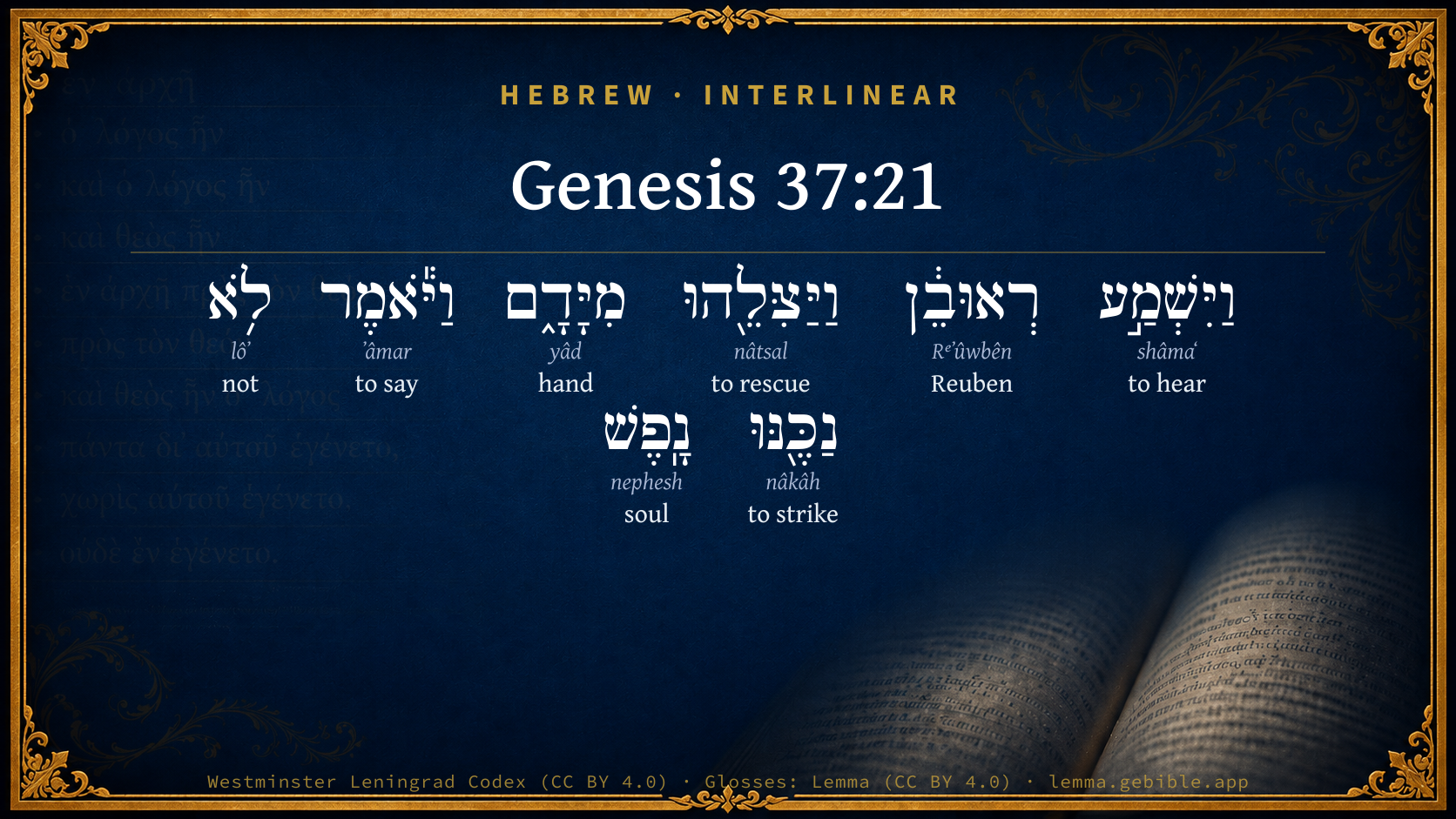
Hebrew (Westminster Leningrad Codex) Genesis 37:21 appears in the Hebrew Old Testament. The text above is from the Westminster Leningrad Codex. Each word links to its Strong’s number, a concise gloss, and parsing drawn from the Open Scriptures Hebrew Bible morphology. Click any word for its full Brown-Driver-Briggs (BDB) entry.
Download image
Cite this verse

Genesis 37:21 (World English Bible). Public Domain. Lemma interlinear Bible study tool, https://lemma.gebible.app/v/genesis/37/21.

Show BibTeX & RIS
BibTeX
RIS
English Translation
Reuben heard it, and delivered him out of their hand, and said, "Let's not take his life."
World English Bible · Public Domain
Download a study sheet

One document with this verse’s original text, its word-by-word gloss line, the meaning frame, cross-references with their text, attributed commentary, and full source and license credits — printable, and it pastes into notes with its structure intact.

This verse Autodidact and up

Study sheet (.html) Plain text (.txt)

A passage Seminary Student

Up to 50 verses in one chapter. A passage sheet keeps up to 6 commentary sources and 12 cross-references per verse, in the order this page ranks them, and says so on the sheet whenever that leaves anything out. Ask for a single verse and you get the Autodidact verse sheet above.

Everything on this page stays free to read, with no account — the sheet is a download of what is already on screen, not access to it.

Want to remove ads? Support Godless Engineer
Compare translations 3

The same verse in 3 English versions, stacked beneath the original-language interlinear above. Click any original word for its lexicon entry.

Each is an independent rendering of the whole verse — the interlinear is not word-aligned to these translations.

Highlighted words mark where these versions differ — a whole-verse word diff, not a word-by-word alignment.

  • World English Bible Public Domain
    Reuben heard it, and delivered him out of their hand, and said, "Let's not take his life."
  • King James Version Public Domain
    And Reuben heard it, and he delivered him out of their hands; and said, Let us not kill him.
  • unfoldingWord Literal Text CC BY-SA 4.0
    But Reuben heard, and he rescued him from their hand and said, “Let us not strike his life.”

unfoldingWord Literal Text — © unfoldingWord, licensed CC BY-SA 4.0. Word-aligned USFM3 via Door43 (git.door43.org/unfoldingWord/en_ult).

Versions to compare (up to 4)

3 of 4 selected

Show all 18 translations

Every available English version of this verse, each an independent rendering of the whole verse.

  • World English Bible Public Domain
    Reuben heard it, and delivered him out of their hand, and said, "Let's not take his life."
  • Berean Standard Bible Public Domain
    When Reuben heard this, he tried to rescue Joseph from their hands. “Let us not take his life,” he said.
  • Majority Standard Bible Public Domain
    When Reuben heard this, he tried to rescue Joseph from their hands. “Let us not take his life,” he said.
  • King James Version Public Domain
    And Reuben heard it, and he delivered him out of their hands; and said, Let us not kill him.
  • American Standard Version (1901) Public Domain
    And Reuben heard it, and delivered him out of their hand, and said, Let us not take his life.
  • Revised Version (1885) Public Domain
    And Reuben heard it, and delivered him out of their hand; and said, Let us not take his life.
  • Geneva Bible (1599) Public Domain
    But when Reuben heard that, he deliuered him out of their handes, and saide, Let vs not kill him.
  • Douay-Rheims (1899) Public Domain
    And Ruben hearing this, endeavoured to deliver him out of their hands, end said:
  • Young's Literal Translation Public Domain
    And Reuben heareth, and delivereth him out of their hand, and saith, `Let us not smite the life;'
  • Literal Standard Version CC BY-SA 4.0
    And Reuben hears, and delivers him out of their hand, and says, “Let us not strike the life”;
  • Unlocked Literal Bible CC BY-SA 4.0
    Reuben heard it and rescued him from their hand. He said, “Let us not take his life.”
  • unfoldingWord Literal Text CC BY-SA 4.0
    But Reuben heard, and he rescued him from their hand and said, “Let us not strike his life.”
  • Darby Bible Public Domain
    And Reuben heard [it], and delivered him out of their hand, and said, Let us not take his life.
  • World Messianic Bible Public Domain
    Reuben heard it, and delivered him out of their hand, and said, “Let’s not take his life.”
  • Webster's Bible Public Domain
    And Reuben heard it, and he delivered him from their hands: and said, Let us not kill him.
  • Free Bible Version CC BY-SA 4.0
    When Reuben heard all this, he tried to save Joseph from them.
  • Bible in Basic English Public Domain
    But Reuben, hearing these words, got him out of their hands, saying, Let us not take his life.
  • JPS Tanakh (1917) Public Domain
    And Reuben heard it, and delivered him out of their hand; and said: 'Let us not take his life.'

Literal Standard Version (2020), Covenant Press — licensed CC BY-SA 4.0. Text via the HelloAO Bible API (eBible.org). Unlocked Literal Bible (unfoldingWord) — licensed CC BY-SA 4.0. Text via the HelloAO Bible API (eBible.org). unfoldingWord Literal Text — © unfoldingWord, licensed CC BY-SA 4.0. Word-aligned USFM3 via Door43 (git.door43.org/unfoldingWord/en_ult). Free Bible Version, Dr. Jonathan Gallagher — licensed CC BY-SA 4.0. Text via the HelloAO Bible API (eBible.org).

Word by word

More ways to search: Search by grammar → Find every occurrence → Compare this word →

Practice this passage: Drill this verse → Learn its vocabulary →

רְאוּבֵ֔ן
Rᵉʼûwbên
H7205
“Reuben”
Noun, Proper
Part of Speech
Noun
Type
Proper
Full BDB Definition

Origin: from the imperative of H7200 and H1121

TWOT: None

Reuben = "behold a son" - the eldest son of Jacob by Leah - the tribe descended from Reuben - the territory inhabited by the tribe of Reuben
  1. וַיִּשְׁמַ֣ע shâmaʻ H8085 “and · to hear” Conjunction + Verb, Qal, Sequential Imperfect, 3rd Person, Masculine, Singular
  2. וַיַּצִּלֵ֖הוּ nâtsal H5337 “and · to rescue · him” Conjunction + Verb, Hiphil, Sequential Imperfect, 3rd Person, Masculine, Singular + Suffix, Personal, 3rd Person, Masculine, Singular
  3. מִיָּדָ֑ם yâd H3027 “from · hand · their” Preposition + Noun, Common, Both, Singular, Construct + Suffix, Personal, 3rd Person, Masculine, Plural
  4. וַיֹּ֕אמֶר ʼâmar H559 “and · to say” Conjunction + Verb, Qal, Sequential Imperfect, 3rd Person, Masculine, Singular
  5. לֹ֥א lôʼ H3808 “not” Particle, Negative
  6. נַכֶּ֖נּוּ nâkâh H5221 “to strike · him” Verb, Hiphil, Cohortative, 1st Person, Common, Plural + Suffix, Personal, 3rd Person, Masculine, Singular
  7. נָֽפֶשׁ nephesh H5315 “soul” Noun, Common, Both, Singular, Absolute

About this verse

These counts appear in no published source. They are computed here, from the morphology-tagged text and Lemma’s own curated glosses. What Lemma adds →

8
words
8
distinct lemmas
Pentateuch
section

Grammatical profile

  • 4 verbs
  • 3 nouns
  • 1 particle

Verb forms

  • וַיִּשְׁמַ֣ע Qal · Sequential Imperfect
  • וַיַּצִּלֵ֖הוּ Hiphil · Sequential Imperfect
  • וַיֹּ֕אמֶר Qal · Sequential Imperfect
  • נַכֶּ֖נּוּ Hiphil · Cohortative

Hebrew & Septuagint length

In English translation the verse runs 17 words from the Hebrew and 18 from the Septuagint (LXX English) — closely comparable.

A rough comparison of the two English renderings, which tokenize alike — not a word-level alignment.

Word counts can differ between the Hebrew and the Greek without any difference in meaning — e.g. the Hebrew direct-object marker אֵת has no separate Greek word, and Greek often adds the article ὁ.

Cross-references

5

Topical passages linked to Genesis 37:21 in the Treasury of Scripture Knowledge — connected by theme and wording, ordered by reader-vote popularity; previews shown in the World English Bible.

  • Genesis 42:22 Reuben answered them, saying, "Didn't I tell you, saying, 'Don't sin against the child,' and you wouldn't listen? Therefore also, behold, his blood is required."
  • Genesis 9:5 I will surely require your blood of your lives. At the hand of every animal I will require it. At the hand of man, even at the hand of every man's brother, I will require the life of man.
  • Genesis 35:22 It happened, while Israel lived in that land, that Reuben went and lay with Bilhah, his father's concubine, and Israel heard of it. Now the sons of Jacob were twelve.
  • Joshua 10:28 Joshua took Makkedah on that day, and struck it with the edge of the sword, and the king of it: he utterly destroyed them and all the souls who were therein; he left none remaining; and he did to the king of Makkedah as he had done to the king of Jericho.
  • Matthew 10:28 Don't be afraid of those who kill the body, but are not able to kill the soul. Rather, fear him who is able to destroy both soul and body in Gehenna.

Cross-references courtesy of OpenBible.info (CC BY 4.0).

Hebrew and Greek witnesses Masoretic Hebrew ↔ Greek Septuagint

The same verse in the two great witnesses to the Old Testament, shown verse-for-verse.

These are two independent witnesses, not word-aligned to each other, and the Septuagint is shown in lemma (dictionary) form.

Hebrew Genesis 37:21 Masoretic · Westminster Leningrad Codex

וַיִּשְׁמַ֣ע רְאוּבֵ֔ן וַיַּצִּלֵ֖הוּ מִיָּדָ֑ם וַיֹּ֕אמֶר לֹ֥א נַכֶּ֖נּוּ נָֽפֶשׁ

Reuben heard it, and delivered him out of their hand, and said, "Let's not take his life."

World English Bible · Public Domain

Greek LXX Genesis 37:21 Septuagint · lemma form

ἀκούω δέ ρουβην ἐκαἱρέω αὐτός ἐκ ὁ χείρ αὐτός καί εἶπον οὐ πατάσσω αὐτός εἰς ψυχή

And Ruben having heard it, rescued him out of their hands, and said, Let us not kill him.

LXX2012 (modern English Septuagint) · Public Domain

Hebrew: Westminster Leningrad Codex (CC BY 4.0). Greek: Septuagint (public domain); English from LXX2012 (modern English Septuagint) (Public Domain). How the Septuagint differs from the Hebrew →

Targum (Aramaic paraphrase)

2

The Targum is the ancient Jewish Aramaic paraphrase of the Hebrew Scriptures — an interpretive translation, not the Hebrew text itself. Onkelos (literal) and Pseudo-Jonathan (expansive) render the Torah, and Jonathan the Prophets. Coverage is partial: where no permissively-licensed English translation exists for a verse, only the Aramaic is shown. This is verse-level text, not a word-by-word alignment to the Hebrew.

  1. Targum Onkelos Torah (Genesis–Deuteronomy)
    וּשְׁמַע רְאוּבֵן וְשֵׁזְבֵהּ מִידֵיהוֹן וַאֲמַר לָא נִקְטְלִנֵּהּ נְפָשׁ

    (no public-domain English translation for this verse)

    Targum Onkelos — Aramaic: “Onkelos Genesis” (public domain); “Onkelos Exodus” (public domain); “Onkelos Leviticus” (public domain); “Onkelos Numbers” (public domain); “Onkelos Deuteronomy” (public domain). English: “Sefaria Community Translation” (CC0 1.0 (public-domain dedication)); “J.W. Etheridge. The Targums of Onkelos and Jonathan Ben Uzziel on the Pentateuch. London: Longmans, Green, 1862” (public domain). Text via Sefaria.

  2. Targum Pseudo-Jonathan Torah (Genesis–Deuteronomy)
    וּשְׁמַע רְאוּבֵן וְשֵׁזְבֵיהּ מִן יְדֵיהוֹן וַאֲמַר לָא נַקְטְלִינֵהּ דְלָא נִתְחַיֵיב בְּאַדְמֵיהּ

    And Reuben heard, and delivered him from their hands, and said, We will not kill him nor become guilty of his blood.

    Targum Pseudo-Jonathan — Aramaic: “Targum Jonathan on Genesis” (public domain); “Targum Jonathan on Exodus” (public domain); “Targum Jonathan on Leviticus” (public domain); “Targum Jonathan on Numbers” (public domain); “Targum Jonathan on Deuteronomy” (public domain). English: “The Targum of Jonathan ben Uzziel, trans. J. W. Etheridge, London, 1862” (public domain). Text via Sefaria.

Commentary

Notes on Genesis 37:21 from classic Christian and Jewish commentators (each source and its license shown beneath its notes). The classic Christian expositions comment on the surrounding passage and are grouped to its opening verse, so a note may address several verses; the Jewish commentaries on the Tanakh (Rashi and others) are per-verse, so they appear only where the commentator wrote on this verse.

Lemma curates 59 commentaries, every one of them public domain or Creative Commons licensed, each selected and text-cleaned for this edition rather than reprinted as found. About our sources →

Trapp's Complete Commentary

John Trapp

Gen 37:21 And Reuben heard [it], and he delivered him out of their hands; and said, Let us not kill him.

Ver. 21. And he delivered him out of their hands.] Josephus relates his arguments, whereby he prevailed with them: as (1.) That God would surely see them; (2.) Their father would extremely grieve at it; (3.) That Joseph was but a child, and their brother; (4.) That they would bring upon themselves the guilt of innocent blood, &c. It was happy they hearkened to him. God would have it so: and he will ever have one Reuben or another, to deliver his. It is not in vain for some one to stand for God and his people against many adverreties. When the Pharisees had destined our Saviour to death, {Joh 7:1} Nicodemus, though he had none in the council to second him, spoke in his behalf, {Joh 7:51} and for that time frustrated their bloody intention. See the like, Jer 26:24.

John Trapp, A Commentary or Exposition upon All the Books of the Old and New Testament (1647–1656) — public domain. Text from a community e-Sword module.

Joseph Benson's Commentary

Gen 37:21. Reuben heard it — God can raise up friends for his people, even among their enemies. Reuben, of all the brothers, had most reason to be jealous of Joseph; for he was the firstborn, and so entitled to those distinguishing favours which Jacob was conferring on Joseph; yet he proves his best friend. Reuben’s temper seems to have been soft and effeminate, which had betrayed him into the sin of uncleanness; while the temper of the two next brothers, Simeon and Levi, was fierce, which betrayed them into the sin of murder, a sin which Reuben startled at the thought of. He made a proposal which they thought would effectually destroy Joseph, and yet which he designed should answer his intention of rescuing him out of their hands, probably hoping thereby to recover his father’s favour, which he had lately lost; but God overruled all to serve his own purpose of making Joseph an instrument to save much people alive. Joseph was here a type of Christ. Though he was the beloved Son of his Father, and hated by a wicked world, yet the Father sent him out of his bosom to visit us; he came from heaven to earth to seek and save us; yet then malicious plots were laid against him; he came to his own, and his own not only received him not, but consulted, This is the heir, come, let us kill him. This he submitted to, in pursuance of his design to save us.

Joseph Benson's Commentary on the Old and New Testaments (1811–1818) — public domain. Text from a community e-Sword module.

Tyndale Open Study Notes

Tyndale Open Resources

37:21-24 Reuben was perhaps trying to get back into his father’s good graces (35:22) by exercising the leadership of the firstborn (cp. 42:22). Reuben succeeded in saving Joseph’s life, but he failed to earn his father’s favor (37:29-30).

Tyndale Open Study Notes — © Tyndale Open Resources, licensed CC BY-SA 4.0. Text via the HelloAO Bible API.

Geneva Bible (1599)

Geneva Bible translators

Hebrew, let us not smite his life.

Geneva Bible (1599) marginal notes — public domain. Text via Bolls.life.

Adam Clarke's Commentary

Verse 21. Reuben heard it] Though Reuben appears to have been a transgressor of no ordinary magnitude, if we take Ge 35:22 according to the letter, yet his bosom was not the habitation of cruelly. He determined, if possible, to save his brother from death, and deliver him safely to his father, with whose fondness for him he was sufficiently acquainted. Josephus, in his usual way, puts a long flourishing speech in the mouth of Reuben on the occasion, spoken in order to dissuade his brethren from their barbarous purpose; but as it is totally unfounded, it is worthy of no regard.

Adam Clarke's Commentary on the Bible (1810–1826) — public domain. Text from a community e-Sword/MySword module.

John Calvin's Commentaries

21. And Reuben heard it. It may be well to observe, while others were hastening to shed his blood, by whose care Joseph was preserved. Reuben doubtless, in one affair, was the most wicked of them all, when he defiled his father’s couch; and that unbridled lust, involving other vices, was the sign of a depraved nature: now suddenly, he alone, having a regard to piety, and being mindful of fraternal duty, dissolves the impious conspiracy. It is uncertain whether he was now seeking the means of making some compensation, for the sake of which he might be restored to his father’s favor. Moses declares that it was his intention to restore the boy in safety to his father: whence the conjecture which I have stated is probable, that he thought the life of his brother would be a sufficient price by which he might reconcile his father’s mind to himself. However this may be, yet the humanity which he showed in attempting to liberate his brother, is a proof that he was not abandoned to every kind of wickedness. And perhaps God, by this testimony of his penitence, designed in some degree to lessen his former disgrace. Whence we are taught that the characters of men are not to be estimated by a single act, however atrocious, so as to cause us to despair of their salvation.

John Calvin's Commentaries (1540-1563) — public domain. Text from the Calvin Translation Society English edition (1840s-50s) via the Christian Classics Ethereal Library (ccel.org). Calvin's coverage is partial (roughly two-thirds of the Bible); uncommented books and verses are honest gaps, never fabricated. The 19th-century editor's footnotes and remarks are omitted so the notes are faithfully Calvin's own voice.

The Cambridge Bible for Schools and Colleges

gen. ed. J. J. S. Perowne

21. Reuben] Reuben’s name is probably here substituted by the Compiler (R) for that of Judah. Reuben speaks in Gen_37:22; and it is unlikely that two consecutive clauses would begin with Reuben speaking. Probably this verse comes from J, and is carried on in Gen_37:26-27, with Judah’s attempt to rescue Joseph.

The Cambridge Bible for Schools and Colleges (gen. ed. J. J. S. Perowne; Cambridge University Press, 1878–1918) — public domain. Text from a community e-Sword module.

John Gill's Exposition

And Reuben said unto them, shed no blood,.... Innocent blood, as the Targum of Jonathan; the blood of a man, a brother's blood, one that had not done anything wherefore it should be shed, and which would involve in guilt, and bring vengeance on them: he seems to put them in mind of the original law in Gen 9:6,

but cast him into this pit that is in the wilderness, and lay no hand upon him: which might seem to answer the same purpose, namely, by depriving him of his life in another way, by starving him; but this was not Reuben's intention, as appears by the next clause, and by his going to the pit afterwards, as it should seem, with a view to take him out of it privately; this advice he gave:

that he might rid him out of their hands, to deliver him to his father again; safe and sound, in order, as it is thought by many interpreters, to reconcile his father to him, whose bed he had abused.

John Gill's Exposition of the Whole Bible (1746–1763) — public domain (CC PDM 1.0). Text via the HelloAO Bible API.

Matthew Poole's English Annotations

He

delivered him, as to the violent and certain despatch of his life which was intended. Or the act is here put for the purpose and endeavour of doing it, in which sense Balak is said to fight against Israel, Jos 24:9, and Abraham to offer up Isaac, Heb 11:17. So here, he delivered him, i.e. used his utmost power to deliver him, that so he might recover his father’s favour lost by his incestuous action.

Matthew Poole's English Annotations on the Holy Bible (1683–1685) — public domain. Text from a community e-Sword/MySword module.

Whedon's Commentary on the Bible

Daniel D. Whedon

21. Reuben — He whom we might expect to be most offended by the princely garment (Gen_37:3, note) is the readiest to show him favour.

Delivered him out of their hands — Prevented his being slain, and purposed, as the next verse shows, to deliver him to his father again.

Daniel D. Whedon (gen. ed.), Commentary on the Old and New Testaments (1874–1909) — public domain. Text from a community e-Sword module.

The Pulpit Commentary

Vers. 21, 22. And Reuben (the eldest son, and therefore probably regarding himself as in some degree responsible for Joseph"s safety) heard it, and he delivered him out of their hands; and said, Let us not kill him literally, Let us not destroy his life (nephesh). And Reuben said (further) unto them, Shed no blood, but cast him into this pit that is in the wilderness (i.e. into a dry pit that was near), and lay no hand upon him; that (the adverb indicates the purpose Reuben had in view) he might rid him (translated above deliver him) out of their hands, to deliver him (or, more correctly, to return him) to his father again.

The Pulpit Commentary (1880–1919), ed. H.D.M. Spence-Jones & Joseph S. Exell — public domain. Text from a community e-Sword module.

John Wesley's Explanatory Notes

And Reuben heard it - God can raise up friends for his people, even among their enemies. Reuben of all the brothers had most reason to be jealous of Joseph, for he was the first-born, and so entitled to those distinguishing favours which Jacob was conferring on Joseph, yet he proves his best friend. Reuben's temper seems to have been soft and effeminate, which had betrayed him to the sin of uncleanness, while the temper of the two next brothers, Simeon and Levi, was fierce, which betrayed them to the sin of murder, a sin which Reuben startled at the thought of. He made a proposal which they thought would effectually destroy Joseph, and yet which he designed should answer his intention of rescuing Joseph out of their hands, probably hoping thereby to recover his father's favour which he had lately lost; but God over-ruled all to serve his own purpose of making Joseph an instrument to save much people alive. Joseph was here a type of Christ. Though he was the beloved Son of his Father, and hated by a wicked world; yet the Father sent him out of his bosom to visit us; he came from heaven to earth to seek and save us; yet then malicious plots were laid against him; he came to his own, and his own not only received him not, but consulted, This is the heir, come let us kill him. This he submitted to, in pursuance of his design to save us.

John Wesley, Explanatory Notes Upon the Whole Bible (1754–1765) — public domain. Text via the GEBible commentary corpus.

Keil & Delitzsch

C. F. Keil & F. Delitzsch

Reuben, who was the eldest son, and therefore specially responsible for his younger brother, opposed this murderous proposal. He dissuaded his brethren from killing Joseph (נפשׁ פ הכּה ), and advised them to throw him "into this pit in the desert," i.e., into a dry pit that was near. As Joseph would inevitably perish even in that pit, their malice was satisfied; but Reuben intended to take Joseph out again, and restore him to his father. As soon, therefore, as Joseph arrived, they took off his coat with sleeves and threw him into the pit, which happened to be dry.

Keil & Delitzsch — Biblical Commentary on the Old Testament (1861–1891) — public domain (CC PDM 1.0). Text via the HelloAO Bible API. (Old Testament only.)

unfoldingWord translationNotes

Door43 World Missions Community

heard it

"heard what they were saying"

from their hand

The phrase "their hand" refers to the brothers' plan to kill him. AT: "from them" or "from their plans" (See: Metonymy)

Let us not take his life

The phrase "take his life" is a euphemism for killing someone. AT: "Let us not kill Joseph" (See: Euphemism)

Shed no blood

The negation can be placed on the verb. Also, "shedding blood" is a euphemism for killing someone. AT: "Do not spill any blood" or "Do not kill him" (See: Litotes and Euphemism)

lay no hand upon him

This means not to harm or injure him. AT: "do not harm him" (See: Idiom)

that he might rescue him

This can be translated as a new sentence: "Rueben said this so that he might rescue Joseph"

out of their hand

The phrase "their hand" refers to the brothers' plan to kill him. AT: "from them" or "from their plans" (See: Metonymy)

to bring him back

"and return him"

translationWords

Reuben

hand

blood

pit

desert

unfoldingWord translationNotes — © Distant Shores Media and the Door43 World Missions Community, licensed CC BY-SA 4.0. Source: git.door43.org/Door43/en_tn.

Rashi

Rabbi Shlomo Yitzchaki (Rashi)

לא נכנו נפש — supply the word מכת so that the meaning will be “Let us not smite him with a smiting of his life” — it means killing.

Rashi on the Tanakh — English translations: “The Judaica Press complete Tanach with Rashi, translated by A. J. Rosenberg” (CC BY 4.0); “Pentateuch with Rashi's commentary by M. Rosenbaum and A.M. Silbermann, 1929-1934” (public domain); “The Metsudah Tanach series, Lakewood, N.J” (CC BY 4.0); and “The Book of Joshua, Metsudah Publications, 1997” (CC BY 4.0). Text via Sefaria.

Radak

Rabbi David Kimhi (Radak)

וישמע...לא נכנו נפש, killing.

Radak on the Tanakh — English translations: “Sefaria Community Translation” (CC0 1.0 (public-domain dedication)); “Eliyahu Munk, HaChut Hameshulash” (CC BY 4.0); “Rabbi Mike Feuer, Jerusalem Anthology” (CC BY 4.0); and “R. David Kimhi on the first book of Psalms, Translated by R.G. Finch, London, 1919” (public domain). Text via Sefaria.

Lesson kit

Teaching starters — assembled from the data on this page, not authored interpretation. Every prompt links to the verse data it draws on. Edit before teaching.

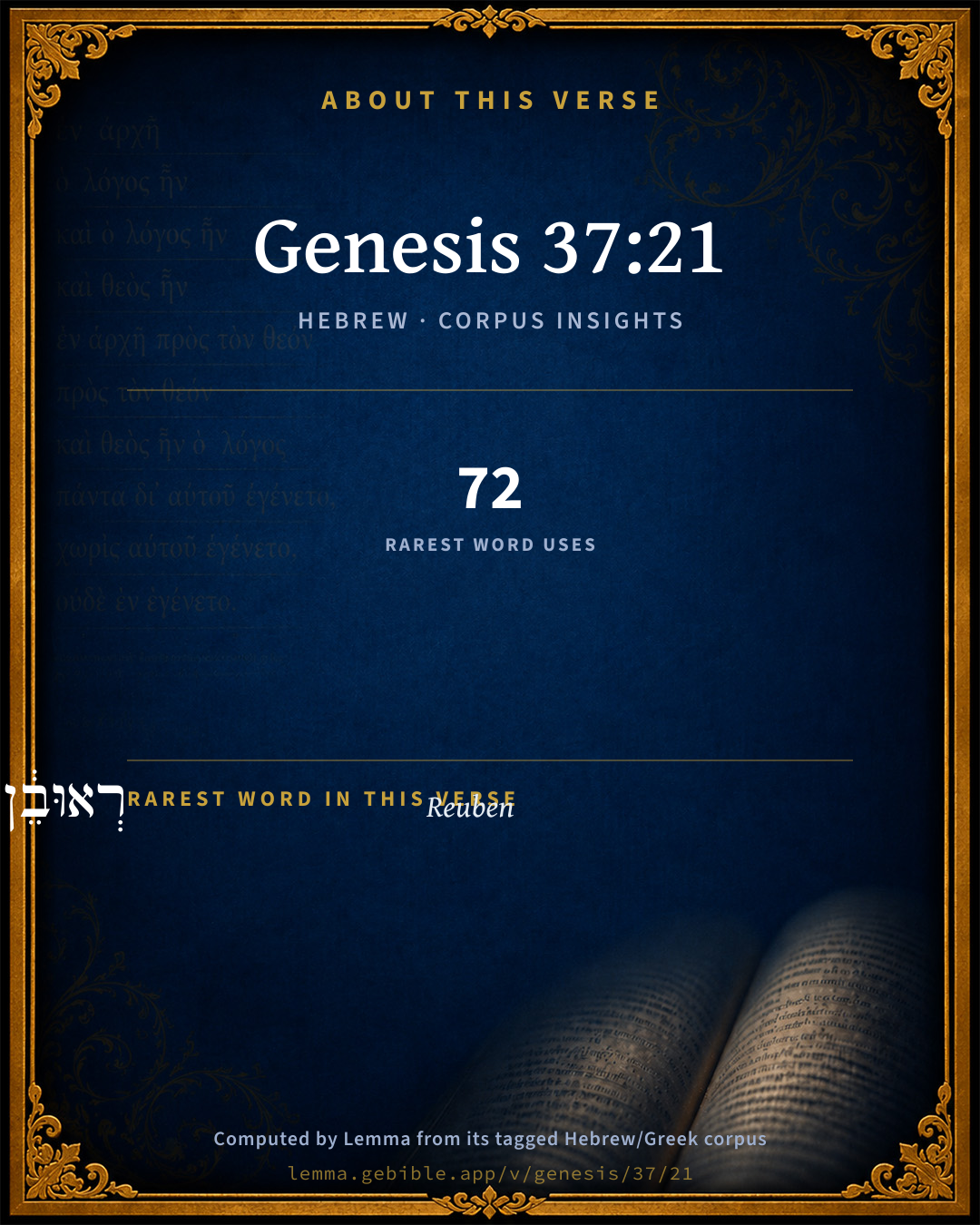
Genesis, in the Pentateuch, opens this verse with 8 words (8 distinct Hebrew lemmas). Its most distinctive word is Rᵉʼûwbên (“Reuben”). A historical commentator’s framing appears above. Read the whole chapter for the surrounding context.

Discussion questions

  1. The word Rᵉʼûwbên carries the sense “Reuben.” How does it shape the verse?
  2. How does Genesis 42:22, which shares this passage’s theme, read alongside this verse?
  3. These translations render this verse differently; the difference is in the English rendering, not the original. What questions does that raise?
  4. «וַיִּשְׁמַ֣ע» is a Qal Sequential Imperfect verb. How does that grammatical form shape the action described?
  5. Compare how Trapp's Complete Commentary and Joseph Benson's Commentary read this verse. Where do they agree or differ?

Things to notice

Reading settings

Reading text

Shown beneath each verse's original-language words.

Old Testament
Old Testament edition

Read the OT as the Masoretic Hebrew (MT) or the Greek Septuagint (LXX).

English shown for the Greek Septuagint (in the Hebrew ↔ Greek comparison).

Comparing translations? Open the Compare panel on any verse page to stack up to four side by side.