Acts 21:12

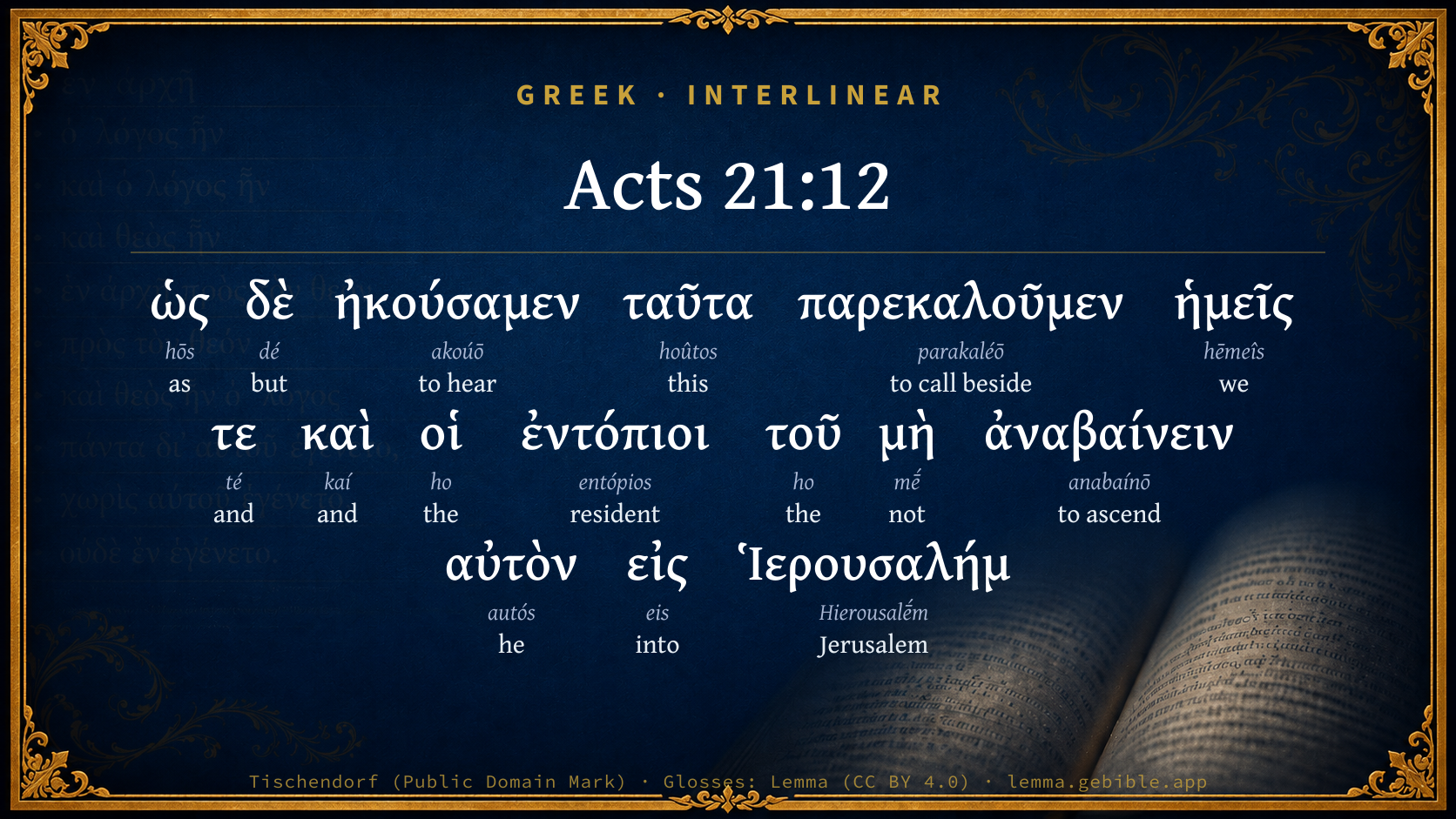
Greek (Tischendorf 8th ed.) Acts 21:12 appears in the Greek New Testament. The text above is from the Tischendorf 8th edition. Each word links to its Strong’s number and a concise gloss. Click any word for its full Thayer’s Greek Lexicon entry.
Download image
Cite this verse

Acts 21:12 (World English Bible). Public Domain. Lemma interlinear Bible study tool, https://lemma.gebible.app/v/acts/21/12.

Show BibTeX & RIS
BibTeX
RIS
English Translation
When we heard these things, both we and they of that place begged him not to go up to Jerusalem.
World English Bible · Public Domain
Highlights
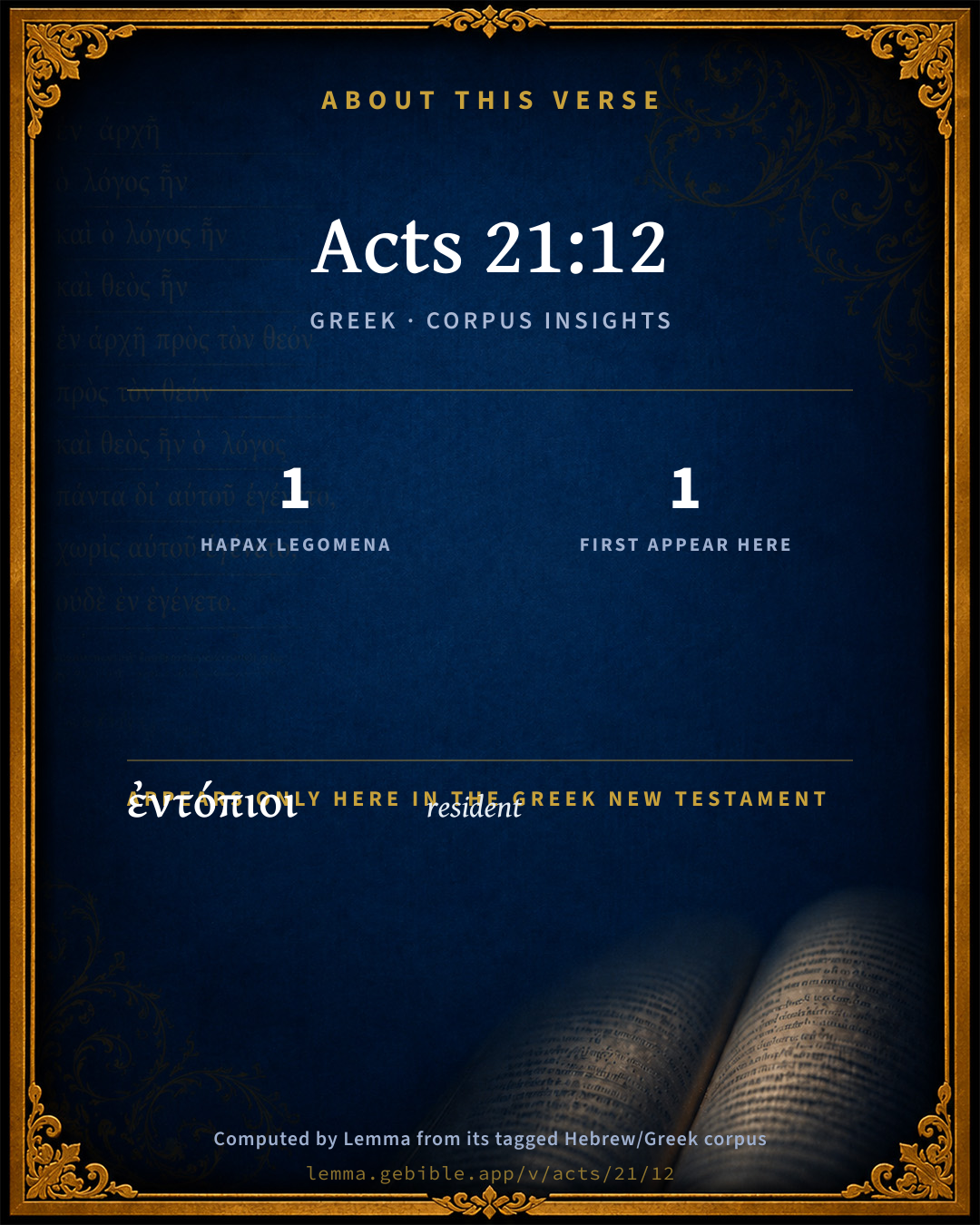
  • 1 hapax legomenon — only here in the Greek New Testament
  • 1 first appearance in the Greek New Testament
Full analysis ↓
Download a study sheet

One document with this verse’s original text, its word-by-word gloss line, the meaning frame, cross-references with their text, attributed commentary, and full source and license credits — printable, and it pastes into notes with its structure intact.

This verse Autodidact and up

Study sheet (.html) Plain text (.txt)

A passage Seminary Student

Up to 50 verses in one chapter. A passage sheet keeps up to 6 commentary sources and 12 cross-references per verse, in the order this page ranks them, and says so on the sheet whenever that leaves anything out. Ask for a single verse and you get the Autodidact verse sheet above.

Everything on this page stays free to read, with no account — the sheet is a download of what is already on screen, not access to it.

Want to remove ads? Support Godless Engineer
Compare translations 3

The same verse in 3 English versions, stacked beneath the original-language interlinear above. Click any original word for its lexicon entry.

Each is an independent rendering of the whole verse — the interlinear is not word-aligned to these translations.

Highlighted words mark where these versions differ — a whole-verse word diff, not a word-by-word alignment.

  • World English Bible Public Domain
    When we heard these things, both we and they of that place begged him not to go up to Jerusalem.
  • King James Version Public Domain
    And when we heard these things, both we, and they of that place, besought him not to go up to Jerusalem.
  • unfoldingWord Literal Text CC BY-SA 4.0
    And when we heard these things, both we and the locals were urging him not to go up to Jerusalem.

unfoldingWord Literal Text — © unfoldingWord, licensed CC BY-SA 4.0. Word-aligned USFM3 via Door43 (git.door43.org/unfoldingWord/en_ult).

Versions to compare (up to 4)

3 of 4 selected

Show all 19 translations

Every available English version of this verse, each an independent rendering of the whole verse.

  • World English Bible Public Domain
    When we heard these things, both we and they of that place begged him not to go up to Jerusalem.
  • Berean Standard Bible Public Domain
    When we heard this, we and the people there pleaded with Paul not to go up to Jerusalem.
  • Majority Standard Bible Public Domain
    When we heard this, we and the people there pleaded with Paul not to go up to Jerusalem.
  • King James Version Public Domain
    And when we heard these things, both we, and they of that place, besought him not to go up to Jerusalem.
  • American Standard Version (1901) Public Domain
    And when we heard these things, both we and they of that place besought him not to go up to Jerusalem.
  • Revised Version (1885) Public Domain
    And when we heard these things, both we and they of that place besought him not to go up to Jerusalem.
  • Geneva Bible (1599) Public Domain
    And when we had heard these things, both we and other of the same place besought him that he would not go vp to Hierusalem.
  • Douay-Rheims (1899) Public Domain
    Which when we had heard, both we and they that were of that place, desired him that he would not go up to Jerusalem.
  • Young's Literal Translation Public Domain
    And when we heard these things, we called upon `him' -- both we, and those of that place -- not to go up to Jerusalem,
  • Literal Standard Version CC BY-SA 4.0
    And when we heard these things, we called on [him]—both we, and those of that place—not to go up to Jerusalem,
  • Unlocked Literal Bible CC BY-SA 4.0
    When we heard these things, both we and the people who lived in that place begged Paul not to go up to Jerusalem.
  • unfoldingWord Literal Text CC BY-SA 4.0
    And when we heard these things, both we and the locals were urging him not to go up to Jerusalem.
  • Darby Bible Public Domain
    And when we heard these things, both we and those of the place besought [him] not to go up to Jerusalem.
  • World Messianic Bible Public Domain
    When we heard these things, both we and the people of that place begged him not to go up to Jerusalem.
  • Webster's Bible Public Domain
    And when we heard these things, both we, and they of that place, besought him not to go up to Jerusalem.
  • Free Bible Version CC BY-SA 4.0
    When we heard this, we and the believers there pleaded with Paul not to go to Jerusalem.
  • Bible in Basic English Public Domain
    And hearing these things, we and those who were living in that place made request to him not to go to Jerusalem.
  • Text-Critical English NT CC BY 4.0
    When we heard this, we and the local residents urged Paul not to go up to Jerusalem.
  • Tyndale New Testament (1534) Public Domain
    When we hearde this both we and other of the same place besought him that he wolde not goo vp to Ierusalem.

Literal Standard Version (2020), Covenant Press — licensed CC BY-SA 4.0. Text via the HelloAO Bible API (eBible.org). Unlocked Literal Bible (unfoldingWord) — licensed CC BY-SA 4.0. Text via the HelloAO Bible API (eBible.org). unfoldingWord Literal Text — © unfoldingWord, licensed CC BY-SA 4.0. Word-aligned USFM3 via Door43 (git.door43.org/unfoldingWord/en_ult). Free Bible Version, Dr. Jonathan Gallagher — licensed CC BY-SA 4.0. Text via the HelloAO Bible API (eBible.org).

Word by word

More ways to search: Search by grammar → Find every occurrence → Compare this word →

Practice this passage: Drill this verse → Learn its vocabulary →

ἐντόπιοι
entópios
G1786
“resident”
Adjective, Nominative, Plural, Masculine
Part of Speech
Adjective
Case
Nominative
Number
Plural
Gender
Masculine
Full Thayer's Definition

Origin: from G1722 and G5117

TDNT: None

1. a dweller in a place 2. a resident or native of a place
  1. ὡς hōs G5613 “as” Adverb
  2. δὲ dé G1161 “but” Conjunction
  3. ἠκούσαμεν akoúō G191 “to hear” Verb, Aorist, Active, Indicative, 1st person, Plural
  4. ταῦτα hoûtos G3778 “this” Demonstrative pronoun, Accusative, Plural, Neuter
  5. παρεκαλοῦμεν parakaléō G3870 “to call beside” Verb, Imperfect, Active, Indicative, 1st person, Plural
  6. ἡμεῖς hēmeîs G2249 “we” Personal pronoun, 1st person, Nominative, Plural
  7. τε té G5037 “and” Particle
  8. καὶ kaí G2532 “and” Conjunction
  9. οἱ ho G3588 “the” Article, Nominative, Plural, Masculine
  10. τοῦ ho G3588 “the” Article, Genitive, Singular, Neuter
  11. μὴ mḗ G3361 “not” Particle, Negative
  12. ἀναβαίνειν anabaínō G305 “to ascend” Verb, Present, Active, Infinitive
  13. αὐτὸν autós G846 “he” Personal pronoun, Accusative, Singular, Masculine
  14. εἰς eis G1519 “into” Preposition
  15. Ἱερουσαλήμ Hierousalḗm G2419 “Jerusalem” Noun, Proper, indeclinable

About this verse

These counts appear in no published source. They are computed here, from the morphology-tagged text and Lemma’s own curated glosses. What Lemma adds →

16
words
15
distinct lemmas
Acts
section

Notable vocabulary

1 hapax legomenon — a word that appears only here in the entire Greek New Testament:

  • ἐντόπιοι resident G1786

First appearance in Scripture

This word makes its first canonical appearance in the Greek New Testament here:

  • ἐντόπιοι resident G1786

Repetition

A word recurs within this verse:

Cross-references

3

Topical passages linked to Acts 21:12 in the Treasury of Scripture Knowledge — connected by theme and wording, ordered by reader-vote popularity; previews shown in the World English Bible.

  • Matthew 16:21–23 From that time, Jesus began to show his disciples that he must go to Jerusalem and suffer many things from the elders, chief priests, and scribes, and be killed, and the third day be raised up.
  • Acts 20:22 Now, behold, I go bound by the Spirit to Jerusalem, not knowing what will happen to me there;
  • Acts 21:4 Having found disciples, we stayed there seven days. These said to Paul through the Spirit, that he should not go up to Jerusalem.

Cross-references courtesy of OpenBible.info (CC BY 4.0).

Commentary

Notes on Acts 21:12 from classic Christian and Jewish commentators (each source and its license shown beneath its notes). The classic Christian expositions comment on the surrounding passage and are grouped to its opening verse, so a note may address several verses; the Jewish commentaries on the Tanakh (Rashi and others) are per-verse, so they appear only where the commentator wrote on this verse.

Lemma curates 59 commentaries, every one of them public domain or Creative Commons licensed, each selected and text-cleaned for this edition rather than reprinted as found. About our sources →

Bengel's Gnomon

Johann Albrecht Bengel

Act 21:12. Παρεκαλοῦμεν, we besought) Paul knew that in that prediction there was the force of a precept: his companions and the people of that place did not know it.

Bengel's Gnomon of the New Testament — English translation (T&T Clark, Edinburgh, 1860) — public domain. Text from a community e-Sword module.

Meyer's Critical & Exegetical Commentary

Heinrich August Wilhelm Meyer

Act_21:12-14. Οἱ ἐντόπιοι] the natives (the Christians of Caesarea), only here in the N.T., but classical.

τί ποιεῖτε κλαίοντες;] What do ye, that ye weep? Certainly essentially the same in sense with τί κλαίετε, but the form of the conception is different. Comp. Mar_11:5, also the classical οἷον ποιεῖς with the participle (Heind. ad Plat. Charm. p. 166 C).

κ. συνθρ. μ. τ. καρδ.] and break my heart, make me quite sorrowful and disconsolate. The συνθρύπτειν had actually commenced on the part of those assembled, but the firm ἑτοίμως ἔχω κ.τ.λ. of the apostle had immediately retained the upper hand over the enervating impressions which they felt. Vere incipit actus, sed ob impedimenta caret eventu. Schaefer, ad Eur. Phoen., Pors. 79. Comp. on Rom_2:4. The verb itself is not preserved elsewhere, yet comp. θρύπτειν τὴν ψυχήν, and the like, in Plutarch and others.

γάρ] refers to the direct sense lying at the foundation of the preceding question: do not weep and break my heart, for I, I for my part, etc. Observe the holy boldness of consciousness in this ἐγώ.

εἰς Ἱερουσ.] Having come to Jerusalem. Comp. Act_8:40. Isaeus, de Dicaeog. hered. p. 55: πολέμου, εἰς ὃν … ἀποθνήσκουσι. Buttmann, neut. Gr. p. 287 [E. T. 334]. ὑπὲρ τοῦ ὀν.] See on Act_5:41, Act_9:16.

ἡσυχάσαμεν] we left off further address. Comp. Act_11:18.

τ. Κυρίου] not quod Deus de te decrevit (Kuinoel and de Wette, following Chrysostom, Calvin, and others), hut the will of Christ. The submission of his friends expresses itself with reference to the last words of the apostle, Act_21:13, in which they recognised his consciousness of the Lords will.

Meyer — Critical and Exegetical Commentary on the New Testament — English translation by Peter Christie, edited by Frederick Crombie (T&T Clark, 1880) — public domain. Text from a community e-Sword module.

Expositor's Greek Testament

ed. W. Robertson Nicoll

Act 21:12 . παρεκ . ἡμεῖς : St. Luke joins in the entreaty. ἐντόπ ., i.e. , the Christians of Cæsarea, including of course the inmates of Philip’s house; not in LXX or Apocr., but in classical Greek. τοῦ μὴ ἀναβ ., Burton, p. 159.

The Expositor's Greek Testament, edited by W. Robertson Nicoll (1897–1910) — public domain. Text from a community e-Sword module.

Jamieson, Fausset & Brown

Robert Jamieson, A. R. Fausset & David Brown

we and they at that place--the Cæsarean Christians.

besought him--even with tears, Act 21:13.

not to go to Jerusalem.

Jamieson, Fausset & Brown — Commentary Critical and Explanatory on the Whole Bible (1871) — public domain (CC PDM 1.0). Text via the HelloAO Bible API.

Adam Clarke's Commentary

Verse 12. Besought him not to go up to Jerusalem.] For they all understood the prophecy to be conditional and contingent; and that it was in Paul's power to turn the scale.

Adam Clarke's Commentary on the Bible (1810–1826) — public domain. Text from a community e-Sword/MySword module.

John Calvin's Commentaries

12. Both we. Because they had not all one revelation, it is no marvel if their judgments were diverse. For seeing these holy men knew that there consisted much in the life or death of one man, they would not have him to come in danger rashly. And their desire is worthy [of] praise, in that they desired to provide for the common safety of the Church by keeping back Paul. But, on the other side, Paul’s constancy deserveth so much the more praise, when as he continueth so steadfast in the calling of God. For he was not ignorant what great trouble he should suffer by reason of his bands. But because he knoweth the will of God, which was his only rule in taking counsel, he maketh no account of all other things, that he may follow it. And, assuredly, we must be so subject to the will and pleasure of God, that no profit, no kind of reason may remove us from obeying him. When Paul doth reprehend the brethren, because they afflict his heart with weeping, he doth sufficiently declare that he was not hardened, but that he was brought unto some feeling and suffering together with them. Therefore, the tears of the godly did wound his heart; but that softness did not turn him out of the way, but that he proceeded to follow God with a straight course. Therefore, we must use such courtesy toward our brethren, that the beck or will of God have always the upper hand. Now Paul doth again declare by his answer, that the servants of Christ cannot be prepared to do their duty, unless they despise death; and that none can ever be well encouraged to live to the Lord, but those who will willingly lay down their lives for the testimony of the truth.

John Calvin's Commentaries (1540-1563) — public domain. Text from the Calvin Translation Society English edition (1840s-50s) via the Christian Classics Ethereal Library (ccel.org). Calvin's coverage is partial (roughly two-thirds of the Bible); uncommented books and verses are honest gaps, never fabricated. The 19th-century editor's footnotes and remarks are omitted so the notes are faithfully Calvin's own voice.

Ellicott's Commentary for English Readers

(12) Both we, and they of that place . . .—For the first time the courage even of the Apostle’s companions began to fail, and St. Luke admits that he himself had joined in the entreaty. Could not they, who were less known, and therefore in less danger, go up without him, pay over the fund that had been collected among the Gentiles to St. James and the elders, and return to him at Cæsarea? “They of that place” would of course include Philip and his daughters, and possibly, if he were still there, Cornelius and his friends, or, at any rate, those of the latter who were still residing in the city. They besought him, it will be noted, even with tears.

A Bible Commentary for English Readers, edited by Charles John Ellicott (1878–1897) — public domain. Text from a community e-Sword module.

The Cambridge Bible for Schools and Colleges

gen. ed. J. J. S. Perowne

12. we, and they of that place] We (i.e. St Luke and the rest who were his fellow-travellers) and the Christians of Cæsarea. The act of Agabus was in all probability done with some publicity.

The Cambridge Bible for Schools and Colleges (gen. ed. J. J. S. Perowne; Cambridge University Press, 1878–1918) — public domain. Text from a community e-Sword module.

John Gill's Exposition

And when we heard these things,.... These prophecies, concerning the binding of the apostle by the Jews, and the delivery of him to the Romans, and saw the symbolical representations of these things:

both we; the companions of the apostle, Luke and the rest:

and they of that place; of Caesarea, Philip and his daughters, and the disciples that lived there:

besought him not to go up to Jerusalem; which was an instance of weakness in them, though an expression of their affection to the apostle; in the disciples of Caesarea it might arise from pure love to him, and a concern for his safety, and the continuance of his useful life; and in his companions it might be owing partly to their sincere love to him, and partly to the fear of danger which they themselves might conclude they should be exposed to; and this request was made with tears, as is evident from what follows.

John Gill's Exposition of the Whole Bible (1746–1763) — public domain (CC PDM 1.0). Text via the HelloAO Bible API.

Matthew Poole's English Annotations

They of that place; the converts or believers that were in Caesarea, pitying him, and having a tender affection for him: See Poole on "Act 21:4".

Besought him with tears, so earnest were they, as in the following verse. {see Act 21:13}

Matthew Poole's English Annotations on the Holy Bible (1683–1685) — public domain. Text from a community e-Sword/MySword module.

Whedon's Commentary on the Bible

Daniel D. Whedon

12. We—Luke and the other attendants of Paul, joined by the Cesarean Christians. Philip and his inspired daughters, in lovely and loving human weakness, joined in the grief and the entreaties that Paul would avoid Jerusalem.

Daniel D. Whedon (gen. ed.), Commentary on the Old and New Testaments (1874–1909) — public domain. Text from a community e-Sword module.

The Pulpit Commentary

They of that place; oiJ ejntopioi, a word found only here in the New Testament, and not found in the LXX or the Apocrypha, but good classical Greek (for the sentiment, see ver. 4).

The Pulpit Commentary (1880–1919), ed. H.D.M. Spence-Jones & Joseph S. Exell — public domain. Text from a community e-Sword module.

John Wesley's Explanatory Notes

Both we, (his fellow travelers,) and they of the place, besought him not to go up to Jerusalem - St. Paul knew that this prediction had the force of a command. They did not know this.

John Wesley, Explanatory Notes Upon the Whole Bible (1754–1765) — public domain. Text via the GEBible commentary corpus.

Burkitt's Expository Notes on the New Testament

William Burkitt

Observe here, 1. The entire affection of the disciples to the holy apostles; Both we and they of that place besought him, that he would not go up to Jerusalem.

Learn, That the lives and liberties of those who are eminent instruments of God’s glory, are very dear and precious to the faithful servants of God. Who can blame St. Paul’s companions or the disciples here, for desiring and endeavouring the preservation of so precious an instrument as the apostle was? and yet it is not improbable but Satan might have a hand in this matter, and endeavour by the apostle’s friends’ persuasion to weaken his resolution; for the devil oft endeavoureth to take us off from our duty by the entreaties of our friends, who mean well in what they say.

Thus when St. Peter lovingly advised our Saviour against his sufferings, Be it far from thee, Lord: this shall not be unto thee, Mat 16:22.

Get thee behind me, Satan, says Christ. It was Peter’s tongue, but Satan tuned it. Who would have thought that Christ’s disciples would have been Satan’s instruments? We must not measure our friends’ counsel by their good meaning, but by God’s word; we must be deaf to all relations, that we may discharge our duty to God.

Thus we find the apostle here, He would not be persuaded, but expostulates with them, What mean ye to weep, and to break mine heart?

Observe, 2. St. Paul’s entire affection to God, and his firm resolution for his duty: He would not be persuaded. But did the apostle do well in this, to withstand all the importunities, and reject the unanimous advice, of all his friends? How doth this carriage agree with that character of heavenly wisdom, That it is easy to be entreated? Jas 3:17

I answer, To the practice of our duty, it is praise-worthy to be easy to be entreated; but not from our duty. St. Paul knew his duty, and understood the will of God: and therefoe his friends might sooner break his heart, than break his purpose.

Learn hence, That no persuasions of friends, no apprehensions of danger, should ever be able to turn us out of the way of our duty. When Peter dissuaded Christ from suffering, our Saviour rebuked him with the same indignation as he did the devil tempting him to idolatry.

Observe, 3. How the apostle lovingly and gently rebukes their fond and inordinate sorrow for his departure: What mean ye to weep, and to break mine heart? As if he had said, "What mean these passionate tears and entreaties? Alas! whether you think it so or not, they are but so many snares and temptations of Satan, to turn my feet out of the way of obedience: you do as much as in you lies to break my heart; but, by the grace of God, nothing shall break me off from my purpose, nor weaken my courage and resolution for God." When a saint is once satisfied in the call and command of God to any duty, he fears neither impending nor approaching dangers in the way of duty.

Observe, 4. The apostle’s quieting and calming arguments, with which he labours to charm their unruly passions: I am ready both to be bound, and to die for Christ.

I am ready, 1. That is, God hath fitted me for suffer-work; flesh and blood is overruled in me by the Spirit of God; I am prepared for whatever God pleaseth; be it a prison, be it a scaffold, be it life, be it death, I am provided for both.

Liberty is dear, and life is dear, but Christ is dearer than either: therefore what mean you to work against the design of God, who hath fitted and prepared my heart for suffering-service?

I am ready, 2. That is, my will and resolution stands in a full bent: my heart is fixed,-- my friends, my heart is fixed; do not therefore disorder and discompose my spirits, by casting such temptations and stumbling-blocks in my way; for I am come to a point, nothing shall divert me from this noble enterprise for God.

I am ready, 3. That is, fully determined to comply with the call and command of God; whatever befalls me, I am not so solicitous about that: my Captain that leads me on, I am sure, will bring me off safe, either dead or alive. Therefore all your tears and entreaties are but cast away upon me; ye had better be quiet, and cheerfully resign me up to the will of God; for I am ready both to be bound and to die.

From whence learn, That it is a blessed and excellent frame of spirit, when the servants of God are prepared and ready for the hardest services and sharpest sufferings, to which the Lord may at any time call them: I am ready not only to be bound, but also to die at Jerusalem for the name of the Lord Jesus.

Observe, 5. The disciple’s discretion: When he would not be persuaded they ceased; that is, they gave over their importunities, and urged him no farther beyond his own inclinations and resolutions.

It is the disposition of humble spirits to submit to those that are wiser than themselves, and not to be too stiff and peremtory in their own opinions and conceits; a lesson which most men have great need to learn.

Observe, 6. The pious ground of this their discretion; namely, acquiescence in the divine will: The will of the Lord be done. They refer the event to God’s determination, and submit all to his sovereign pleasure.

Thence learn, That it is the duty and desire, and ought to be the care and endeavour, of all the children of God, to be willing to submit themselves and theirs to the dispensation of God’s providence, in whatever befalls either them or theirs.

For this we have Christ’s example, Father, not as I will, but as thou wilt. Mat 26:39

The example of David, Here I am, let him do what seemeth good in his sight. 2Sa 15:26

The example of Eli, It is the Lord, let him do whatsoever he pleaseth. 1Sa 3:18

Such is his justice and righteousness, that he can do his children no wrong; and such is his tender mercy and loving kindness, that he will do them no harm. The absolute sovereignty of God over us, and the sight of God in all his providential dispensations towards us, influences at once our judgments, our wills, and our affections, our expressions and actions, that we neither dare to think, speak, or act any thing in contradiction to, or in opposition against, the wisdom and will of God.

That which is oft against our will, is not always against our interest; but if we belong to God, all afflictions upon us are federal dispensations and covenant blessings to us, and either are good or shall work for good; therefore it is both our duty and interest to submit to the wisdom of Providence, and say with these disciples, The will of the Lord be done.

William Burkitt's Expository Notes on the New Testament (1700–1703) — public domain. Text from a community e-Sword module.

McGarvey & Pendleton's Commentaries

J. W. McGarvey

See notes on verse 10

J. W. McGarvey (with Philip Y. Pendleton), Commentaries on the New Testament (The Fourfold Gospel, 1914; Acts; and the epistles) — public domain. Text from a community e-Sword/MySword module.

unfoldingWord translationNotes

Door43 World Missions Community

General Information:

Here the word "we" refers to Luke and the other believers but does not include the reader. (See: Exclusive and Inclusive "We")

What are you doing, weeping and breaking my heart

Paul asks this question to show the believers they should stop trying to persuade him. AT: "Stop what you are doing. Your weeping is breaking my heart" (See: Rhetorical Question)

breaking my heart

To make someone sad or to discourage someone is spoken of as if it were a heart being broken. Here "heart" stands for a person's emotions. AT: "discouraging me" or "making me very sad" (See: Metaphor and Metonymy)

not only to be tied up

This can be stated in active form. AT: "not only for them to tie me up" (See: Active or Passive)

for the name of the Lord Jesus

Here "name" refers to the person of Jesus. AT: "for the sake of the Lord Jesus" or "because I believe in the Lord Jesus" (See: Metonymy)

did not wish to be persuaded

This can be stated in active form. AT: "did not want us to try to persuade him not to go to Jerusalem" (See: Active or Passive)

May the will of the Lord be done

This can be stated in active form. AT: "May everything happen as the Lord has planned it" (See: Active or Passive)

translationWords

Paul

Jerusalem

die

name

lord

Jesus

will of God

unfoldingWord translationNotes — © Distant Shores Media and the Door43 World Missions Community, licensed CC BY-SA 4.0. Source: git.door43.org/Door43/en_tn.

Cambridge Greek Testament for Schools and Colleges

12. ἡμεῖς τε καὶ οἱ ἐντόπιοι, we and they of that place. We (i.e. St Luke and the rest who were fellow-travellers with St Paul) and the Christian congregation of Cæsarea. The act of Agabus was in all probability done with some publicity; perhaps in some meeting where St Paul had laid aside his girdle for greater freedom while he spoke.

Cambridge Greek Testament for Schools and Colleges (Cambridge University Press, 1896; 21 vols, various authors incl. Carr, Maclear, Plummer, Farrar, Lumby, Moule, M. R. James, Simcox) — public domain. Text from a community e-Sword module.

Alford’s Greek Testament

Henry Alford

12. τοῦ μή] A similar gen. after exhortation, is found ch. 15:20.

Henry Alford, The Greek Testament (1849–1861) — public domain. Text from a community e-Sword module.

Vincent's Word Studies in the New Testament

Marvin R. Vincent

Besought him not to go up. This suggests the case of Luther when on his journey to the Diet of Worms, and the story of Regulus the Roman, who, being, permitted to return to Rome with an embassy from the Carthaginians, urged his countrymen to reject the terms of peace, and to continue the war, and then, against the remonstrances of his friends, insisted on fulfilling his promise to the Carthaginians to return in the event of the failure of negotiations, and went back to certain torture and death.

Marvin R. Vincent, Word Studies in the New Testament (1887–1900) — public domain. Text from a community e-Sword/MySword module.

Lesson kit

Teaching starters — assembled from the data on this page, not authored interpretation. Every prompt links to the verse data it draws on. Edit before teaching.

Acts, in the Acts, opens this verse with 16 words (15 distinct Greek lemmas). Its most distinctive word is entópios (“resident”). A historical commentator’s framing appears above. Read the whole chapter for the surrounding context.

Discussion questions

  1. How does “resident” (entópios) shape what this verse is saying?
  2. 1 word here appears nowhere else in the Greek New Testament. Why might the author reach for such rare wording?
  3. This is the first place “resident” appears in Scripture (first appears here). What does its debut here establish?
  4. How does Matthew 16:21–23, which shares this passage’s theme, read alongside this verse?
  5. What does the repetition of “the” (2× in this one verse) do in this verse?
  6. The translations on this page render this verse differently — a whole-verse word diff, not a word-by-word alignment. What might account for the different wordings?
  7. Compare how Bengel's Gnomon and Meyer's Critical & Exegetical Commentary read this verse. Where do they agree or differ?

Things to notice

  • 1 word in this verse appears nowhere else in the Greek New Testament.
  • 1 word makes its first canonical appearance in Scripture here.
  • These translations choose different wording for 5 words in this verse.
  • “the” occurs 2× in this single verse.
  • 15 distinct Greek lemmas span 16 words in this verse.

Reading settings

Reading text

Shown beneath each verse's original-language words.

Old Testament
Old Testament edition

Read the OT as the Masoretic Hebrew (MT) or the Greek Septuagint (LXX).

English shown for the Greek Septuagint (in the Hebrew ↔ Greek comparison).

Comparing translations? Open the Compare panel on any verse page to stack up to four side by side.