Revelation 10:4

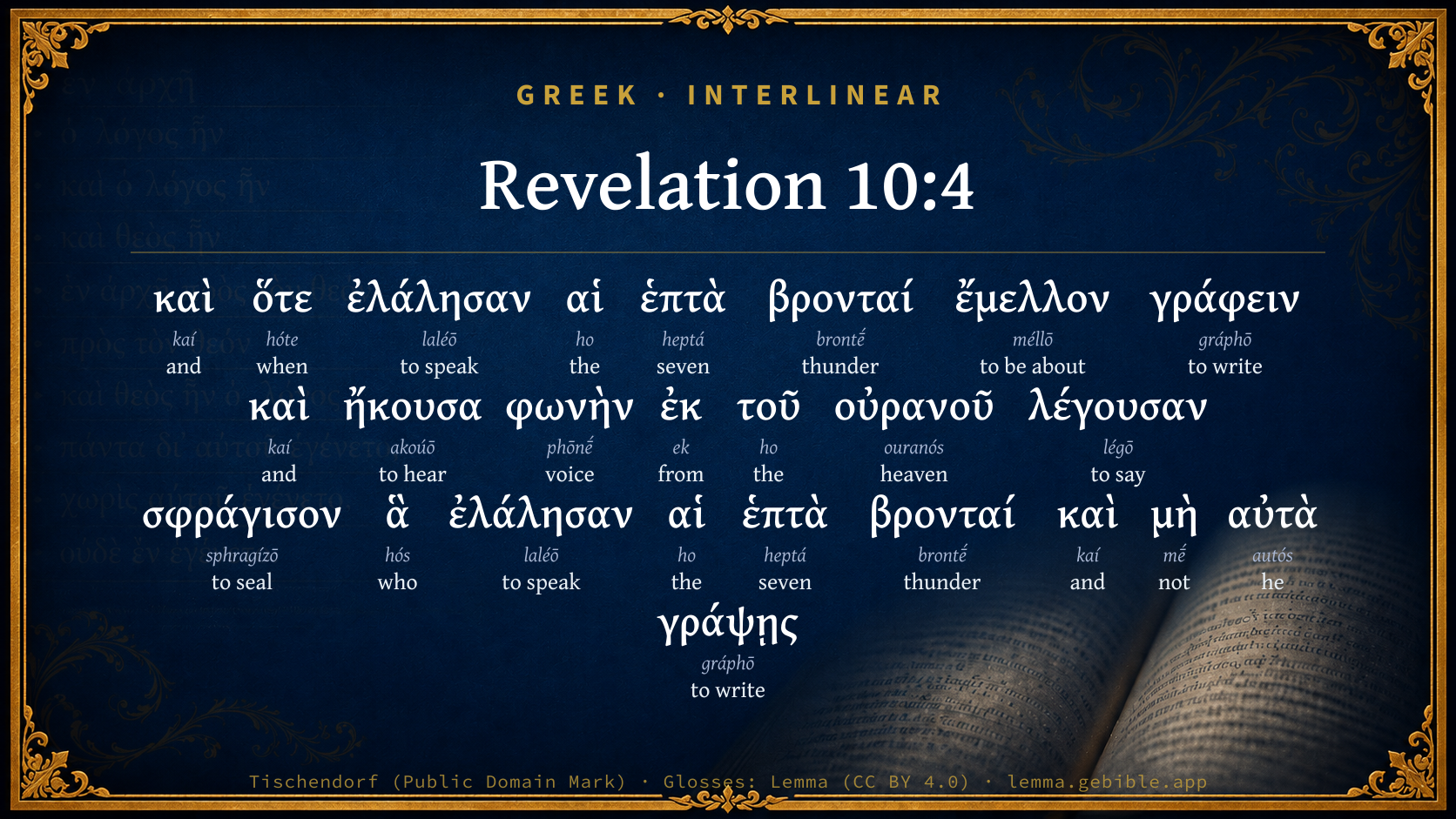
Greek (Tischendorf 8th ed.) Revelation 10:4 appears in the Greek New Testament. The text above is from the Tischendorf 8th edition. Each word links to its Strong’s number and a concise gloss. Click any word for its full Thayer’s Greek Lexicon entry.
Download image
Cite this verse

Revelation 10:4 (World English Bible). Public Domain. Lemma interlinear Bible study tool, https://lemma.gebible.app/v/revelation/10/4.

Show BibTeX & RIS
BibTeX
RIS
English Translation
When the seven thunders sounded, I was about to write; but I heard a voice from the sky saying, "Seal up the things which the seven thunders said, and don't write them."
World English Bible · Public Domain
Download a study sheet

One document with this verse’s original text, its word-by-word gloss line, the meaning frame, cross-references with their text, attributed commentary, and full source and license credits — printable, and it pastes into notes with its structure intact.

This verse Autodidact and up

Study sheet (.html) Plain text (.txt)

A passage Seminary Student

Up to 50 verses in one chapter. A passage sheet keeps up to 6 commentary sources and 12 cross-references per verse, in the order this page ranks them, and says so on the sheet whenever that leaves anything out. Ask for a single verse and you get the Autodidact verse sheet above.

Everything on this page stays free to read, with no account — the sheet is a download of what is already on screen, not access to it.

Want to remove ads? Support Godless Engineer
Compare translations 3

The same verse in 3 English versions, stacked beneath the original-language interlinear above. Click any original word for its lexicon entry.

Each is an independent rendering of the whole verse — the interlinear is not word-aligned to these translations.

Highlighted words mark where these versions differ — a whole-verse word diff, not a word-by-word alignment.

  • World English Bible Public Domain
    When the seven thunders sounded, I was about to write; but I heard a voice from the sky saying, "Seal up the things which the seven thunders said, and don't write them."
  • King James Version Public Domain
    And when the seven thunders had uttered their voices, I was about to write: and I heard a voice from heaven saying unto me, Seal up those things which the seven thunders uttered, and write them not.
  • unfoldingWord Literal Text CC BY-SA 4.0
    And when the seven thunders spoke, I was going to write, but I heard a voice from heaven saying, “Seal what the seven thunders said and do not write it.”

unfoldingWord Literal Text — © unfoldingWord, licensed CC BY-SA 4.0. Word-aligned USFM3 via Door43 (git.door43.org/unfoldingWord/en_ult).

Versions to compare (up to 4)

3 of 4 selected

Show all 19 translations

Every available English version of this verse, each an independent rendering of the whole verse.

  • World English Bible Public Domain
    When the seven thunders sounded, I was about to write; but I heard a voice from the sky saying, "Seal up the things which the seven thunders said, and don't write them."
  • Berean Standard Bible Public Domain
    When the seven thunders had spoken, I was about to put it in writing. But I heard a voice from heaven saying, “Seal up what the seven thunders have said, and do not write it down.”
  • Majority Standard Bible Public Domain
    When the seven thunders had spoken, I was about to put it in writing. But I heard a voice from heaven saying, “Seal up what the seven thunders have said, and do not write it down.”
  • King James Version Public Domain
    And when the seven thunders had uttered their voices, I was about to write: and I heard a voice from heaven saying unto me, Seal up those things which the seven thunders uttered, and write them not.
  • American Standard Version (1901) Public Domain
    And when the seven thunders uttered `their voices', I was about to write: and I heard a voice from heaven saying, Seal up the things which the seven thunders uttered, and write them not.
  • Revised Version (1885) Public Domain
    And when the seven thunders uttered their voices, I was about to write: and I heard a voice from heaven saying, Seal up the things which the seven thunders uttered, and write them not.
  • Geneva Bible (1599) Public Domain
    And whe the seuen thunders had vttered their voyces, I was about to write: but I heard a voice from heauen saying vnto me, Seale vp those things which the seuen thunders haue spoken, and write them not.
  • Douay-Rheims (1899) Public Domain
    And when the seven thunders had uttered their voices, I was about to write: and I heard a voice from heaven saying to me: Seal up the things which the seven thunders have spoken; and write them not.
  • Young's Literal Translation Public Domain
    and when the seven thunders spake their voices, I was about to write, and I heard a voice out of the heaven saying to me, `Seal the things that the seven thunders spake,' and, `Thou mayest not write these things.'
  • Literal Standard Version CC BY-SA 4.0
    and when the seven thunders spoke their voices, I was about to write, and I heard a voice out of Heaven saying to me, “Seal the things that the seven thunders spoke,” and, “You may not write these things.”
  • Unlocked Literal Bible CC BY-SA 4.0
    When the seven thunders spoke out, I was about to write, but I heard a voice from heaven saying, “Keep secret what the seven thunders said. Do not write it down.”
  • unfoldingWord Literal Text CC BY-SA 4.0
    And when the seven thunders spoke, I was going to write, but I heard a voice from heaven saying, “Seal what the seven thunders said and do not write it.”
  • Darby Bible Public Domain
    And when the seven thunders spoke, I was about to write: and I heard a voice out of the heaven saying, Seal the things which the seven thunders have spoken, and write them not.
  • World Messianic Bible Public Domain
    When the seven thunders sounded, I was about to write; but I heard a voice from the sky saying, “Seal up the things which the seven thunders said, and don’t write them.”
  • Webster's Bible Public Domain
    And when the seven thunders had uttered their voices, I was about to write: and I heard a voice from heaven saying to me, Seal up those things which the seven thunders uttered, and write them not.
  • Free Bible Version CC BY-SA 4.0
    When the seven thunders spoke, I was about to write down what they said when I heard a voice from heaven that told me, “Keep under seal what the seven thunders said. Don't write them down.”
  • Bible in Basic English Public Domain
    And when the seven thunders had given out their voices, I was about to put their words down: and a voice from heaven came to my ears, saying, Keep secret the things which the seven thunders said, and do not put them in writing.
  • Text-Critical English NT CC BY 4.0
    And when the seven thunders spoke, I was about to write. But I heard a voice from heaven saying, “Seal up what the seven thunders have said, and do not write it down.”
  • Tyndale New Testament (1534) Public Domain
    And when the vii. thondres had spoken their voyces I was aboute to wryte. And I herde a voyce from heven sayinge vnto me seale vp thoo thynges which the vii. thondres spake and write them not.

Literal Standard Version (2020), Covenant Press — licensed CC BY-SA 4.0. Text via the HelloAO Bible API (eBible.org). Unlocked Literal Bible (unfoldingWord) — licensed CC BY-SA 4.0. Text via the HelloAO Bible API (eBible.org). unfoldingWord Literal Text — © unfoldingWord, licensed CC BY-SA 4.0. Word-aligned USFM3 via Door43 (git.door43.org/unfoldingWord/en_ult). Free Bible Version, Dr. Jonathan Gallagher — licensed CC BY-SA 4.0. Text via the HelloAO Bible API (eBible.org).

Word by word

More ways to search: Search by grammar → Find every occurrence → Compare this word →

Practice this passage: Drill this verse → Learn its vocabulary →

βρονταί
brontḗ
G1027
“thunder”
Noun, Nominative, Plural, Feminine
Part of Speech
Noun
Case
Nominative
Number
Plural
Gender
Feminine
Full Thayer's Definition

Origin: akin to bremo (to roar)

TDNT: 11:40,1

1. thunder
  1. καὶ kaí G2532 “and” Conjunction
  2. ὅτε hóte G3753 “when” Adverb
  3. ἐλάλησαν laléō G2980 “to speak” Verb, Aorist, Active, Indicative, 3rd person, Plural
  4. αἱ ho G3588 “the” Article, Nominative, Plural, Feminine
  5. ἑπτὰ heptá G2033 “seven” Adjective, Numeral (indeclinable)
  6. ἔμελλον méllō G3195 “to be about” Verb, Imperfect, Active, Indicative, 3rd person, Plural
  7. γράφειν gráphō G1125 “to write” Verb, Present, Active, Infinitive
  8. καὶ kaí G2532 “and” Conjunction
  9. ἤκουσα akoúō G191 “to hear” Verb, Aorist, Active, Indicative, 1st person, Singular
  10. φωνὴν phōnḗ G5456 “voice” Noun, Accusative, Singular, Feminine
  11. ἐκ ek G1537 “from” Preposition
  12. τοῦ ho G3588 “the” Article, Genitive, Singular, Masculine
  13. οὐρανοῦ ouranós G3772 “heaven” Noun, Genitive, Singular, Masculine
  14. λέγουσαν légō G3004 “to say” Verb, Present, Active, Participle, Accusative, Singular, Feminine
  15. σφράγισον sphragízō G4972 “to seal” Verb, Aorist, Active, Imperative, 2nd person, Singular
  16. ἃ hós G3739 “who” Relative pronoun, Accusative, Plural, Neuter
  17. ἐλάλησαν laléō G2980 “to speak” Verb, Aorist, Active, Indicative, 3rd person, Plural
  18. αἱ ho G3588 “the” Article, Nominative, Plural, Feminine
  19. ἑπτὰ heptá G2033 “seven” Adjective, Numeral (indeclinable)
  20. βρονταί brontḗ G1027 “thunder” Noun, Nominative, Plural, Feminine
  21. καὶ kaí G2532 “and” Conjunction
  22. μὴ mḗ G3361 “not” Particle, Negative
  23. αὐτὰ autós G846 “he” Personal pronoun, Accusative, Plural, Neuter
  24. γράψῃς gráphō G1125 “to write” Verb, Aorist, Active, Subjunctive, 2nd person, Singular

About this verse

These counts appear in no published source. They are computed here, from the morphology-tagged text and Lemma’s own curated glosses. What Lemma adds →

25
words
17
distinct lemmas
Revelation
section

Notable vocabulary

The rarest word here is βρονταί thunder G1027 — appearing just 12 times in the whole Greek New Testament.

Shared distinctive vocabulary

βρονταί thunder G1027 occurs in 11 verses of the Greek New Testament. Also found in:

Repetition

Words recur within this verse:

  • ἐλάλησαν to speak G2980 ×2
  • ἑπτὰ seven G2033 ×2
  • βρονταί thunder G1027 ×2
  • γράφειν to write G1125 ×2
  • καὶ and G2532 ×3
  • αἱ the G3588 ×3

Cross-references

11

Topical passages linked to Revelation 10:4 in the Treasury of Scripture Knowledge — connected by theme and wording, ordered by reader-vote popularity; previews shown in the World English Bible.

  • Daniel 12:4 But you, Daniel, shut up the words, and seal the book, even to the time of the end: many shall run back and forth, and knowledge shall be increased."
  • Daniel 8:26 The vision of the evenings and mornings which has been told is true: but seal up the vision; for it belongs to many days [to come].
  • Daniel 12:9 He said, Go your way, Daniel; for the words are shut up and sealed until the time of the end.
  • Deuteronomy 29:29 The secret things belong to Yahweh our God; but the things that are revealed belong to us and to our children forever, that we may do all the words of this law.
  • Revelation 22:10 He said to me, "Don't seal up the words of the prophecy of this book, for the time is at hand.
  • Isaiah 8:16 Bind up the testimony, seal the law among my disciples.
  • Isaiah 29:11 All vision is become to you as the words of a book that is sealed, which men deliver to one who is learned, saying, Read this, I pray you; and he says, I can't, for it is sealed:
  • Habakkuk 2:2–3 Yahweh answered me, "Write the vision, and make it plain on tablets, that he may run who reads it.
  • Revelation 1:11 saying, "What you see, write in a book and send to the seven assemblies: to Ephesus, Smyrna, Pergamum, Thyatira, Sardis, Philadelphia, and to Laodicea."
  • Isaiah 8:1 Yahweh said to me, "Take a large tablet, and write on it with a man's pen, 'For Maher Shalal Hash Baz;'
  • Revelation 2:1–3 To the angel of the assembly in Ephesus write: "He who holds the seven stars in his right hand, he who walks among the seven golden lampstands says these things:

Cross-references courtesy of OpenBible.info (CC BY 4.0).

Where the printed editions differ

2 variants

Places in this verse where the major printed Greek editions disagree on the wording in a way that affects the translation — a comparison of editions, not a manuscript-by-manuscript collation. The editions are the modern critical texts (Nestlé-Aland 28/27, SBL, Westcott-Hort, Tregelles, Tyndale House) and the traditional texts behind the KJV (the Textus Receptus and the Byzantine/Majority text). It is not a claim about which reading is original.

  1. Extra text
    τὰς φωνὰς ἑαυτῶν

    “the voices of themselves”

    In TR Not in NA28NA27TynSBLWHTregByz

    τὰς φωνὰς ἑαυτῶν (tas phōnas he'autōn) 'the voices of themselves' is only in traditional manuscripts (TR)

  2. Extra text
    μοι,

    “to me”

    In TR Not in NA28NA27TynSBLWHTregByz

    μοι, (moi) 'to me' is only in traditional manuscripts (TR)

Textual data: Translators Amalgamated Greek New Testament (STEPBible TAGNT) · CC BY 4.0.

Commentary

Notes on Revelation 10:4 from classic Christian and Jewish commentators (each source and its license shown beneath its notes). The classic Christian expositions comment on the surrounding passage and are grouped to its opening verse, so a note may address several verses; the Jewish commentaries on the Tanakh (Rashi and others) are per-verse, so they appear only where the commentator wrote on this verse.

Lemma curates 59 commentaries, every one of them public domain or Creative Commons licensed, each selected and text-cleaned for this edition rather than reprinted as found. About our sources →

Tyndale Open Study Notes

Tyndale Open Resources

10:4 Revelation reveals God’s intentions in the world without eliminating the mystery of God’s ways. The martyrs did not receive an immediate answer to their cries (6:10), the meaning of the seventh seal is cloaked in silence (8:1), and here the seven thunders are kept secret (cp. Dan 12:9).

Tyndale Open Study Notes — © Tyndale Open Resources, licensed CC BY-SA 4.0. Text via the HelloAO Bible API.

Expositor's Greek Testament

ed. W. Robertson Nicoll

Rev 10:4 . To seal or shut up a vision is to keep it secret from mankind, i.e. , in the present case (by a sequence of thought which is scarcely logical) to leave it unwritten. In a similar passage (Apoc. Bar. xx. 3) “seal” means to lay up fast in one’s memory (because the realisation is not immediate); but this meaning is suggested by the context, although it might suit the present passage. The seer describes himself as prohibited by a heavenly voice (which reverence leaves as usual undefined, 4 Ezr 6:17 : Dalman viii. 1) from obeying his impulse. No reason is assigned; but the plain sense of the passage is that the author wishes (Weizs., Schön, Bs., Holtzm., Pfleid.) to justify his omission of a seven-thunder source or set of visions circulating in contemporary circles of prophecy (Rev 10:7 ). In view oi the authoritative character of such fragments or traditions John justifies his procedure by the explanation that he felt inspired to do so, and also to substitute other oracles. Thus in the middle, as at the opening and end of his book, he reiterates his prophetic authority. The episode may further indicate that the written contents of the Apocalypse represents merely a part of the author’s actual vision ( cf. Joh 21:25 ), or it may serve to heighten the effect of what is now to be introduced, or it may suggest that while the seer is to write (Rev 1:11 ), he is to write only what is revealed through the medium of angels. In Slav. En. xxiii. 3, 6 the seer spends thirty days in writing the remarks of his angel-instructor. To hear ἄρρητα ῥήματα , ἃ οὐκ ἐξὸν ἀνθρώπῳ λαλῆσαι was not incompatible, however, with an ἀποκάλυψις κυρίου (2Co 12:1-4 ), cf. Weinel, 162 f. There was an inspiration of restraint as well as an inspiration of impulse. Thus Hermas ( Vis. i. 3) listens with wonder to glories of God which he could not remember, “for all the words were awful, such as man cannot bear. The last words, however, I did remember; they were fit for us and mild”. Possibly the seven-thunders source was of a severely punitive character (Rev 8:5 ), traversing ground which had been alre ady (6-9) and was to be again ( 15 16.) covered.

The Expositor's Greek Testament, edited by W. Robertson Nicoll (1897–1910) — public domain. Text from a community e-Sword module.

Geneva Bible (1599)

Geneva Bible translators

Keep them close.

A godly care is laudable, but must be joined with knowledge. Therefore nothing is to be taken in hand, but by calling: which must be expected and waiting for of the godly.

Geneva Bible (1599) marginal notes — public domain. Text via Bolls.life.

Jamieson, Fausset & Brown

Robert Jamieson, A. R. Fausset & David Brown

when--Aleph reads, "Whatsoever things." But most manuscripts support English Version.

uttered their voices--A, B, C, and Aleph omit "their voices." Then translate, "had spoken."

unto me--omitted by A, B, C, Aleph, and Syriac.

Seal up--the opposite command to Rev 22:20. Even though at the time of the end the things sealed in Daniel's time were to be revealed, yet not so the voices of these thunders. Though heard by John, they were not to be imparted by him to others in this book of Revelation; so terrible are they that God in mercy withholds them, since "sufficient unto the day is the evil thereof." The godly are thus kept from morbid ponderings over the evil to come; and the ungodly are not driven by despair into utter recklessness of life. ALFORD adds another aim in concealing them, namely, "godly fear, seeing that the arrows of God's quiver are not exhausted." Besides the terrors foretold, there are others unutterable and more horrifying lying in the background.

Jamieson, Fausset & Brown — Commentary Critical and Explanatory on the Whole Bible (1871) — public domain (CC PDM 1.0). Text via the HelloAO Bible API.

Ellicott's Commentary for English Readers

(4) And when the seven . . .—Translate, And when the seven thunders spoke, I was about to write: and I heard a voice out of the heaven, saying, Seal up the things which the. seven thunders spoke, and write them not. He could have written down their utterances. It was no mere thunder-like sound he heard: the thunders spoke; and he would have continued his writing as he had been commanded (Rev_1:11) had not the voice out of heaven forbidden him. The utterances, then, are for those who hear them; they are not to be made generally known. Is it not the solemn, sacred, divine voice not to be known by all, but by those who have ears to hear when “the God of glory thundereth?” “Lo ! He doth send forth His voice, yea, and that a mighty voice” (Psa_68:33). Mankind may hear the thunder; only those whose ears God has opened can hear the utterances and the inspiriting messages which they bring. So was it once in our Lord’s life. The people said it thundered; some thought an angel spake; but there were articulate words which He who came to do God’s will, in whose heart was God’s law, heard, and to Him that thunderlike voice promised to “glorify His name” (Joh_12:28-29). Similarly here, the Evangelist (who is in this but a type of the true witnesses for God), who is to prophecy before peoples and kings (Rev_10:11), hears words spoken by the divine voice which make him strong for his mission. It is so evermore. Dull ears there are who hear thunder, but never God’s voice; dim eyes there are which see no trace of the divine craftsman in all nature, though

“Earth’s crammed with God,

And every common bush aglow with Him.”

The thunders are not to be written down; they are for those who have ears to hear.

A Bible Commentary for English Readers, edited by Charles John Ellicott (1878–1897) — public domain. Text from a community e-Sword module.

The Cambridge Bible for Schools and Colleges

gen. ed. J. J. S. Perowne

4. I was about to write] See Rev_1:19. It is useless to speculate how far the book was written at the same time that the vision was seen: possibly it may have been in part, but it is enough to suppose that, having been bidden to write, the seer seemed to himself to write, or (so to speak) saw himself writing, at appropriate points of the vision.

Seal up] Cf. Dan_12:4; Dan_12:9. There the use of the words is more logical: Daniel is to write the vision, but not to let it be read: contrast in this book Rev_22:10. Here the use of the word is suggested by the passage in Daniel—in the impassioned style of this book it is forgotten that what is not written cannot and need not be sealed. Why the voices of the thunders were not to be written it is idle to guess: it is worse than idle to guess what they were. And in our ignorance of this it is hardly possible that we should be able to identity the mission of this angel with any special dispensation of God yet known.

The Cambridge Bible for Schools and Colleges (gen. ed. J. J. S. Perowne; Cambridge University Press, 1878–1918) — public domain. Text from a community e-Sword module.

John Gill's Exposition

And when the seven thunders had uttered their voices,.... Or declared all they had to denounce upon the enemies of Christ and his church:

I was about to write; John taking particular notice of what they said, and believing it might be for the advantage, comfort, and support of the church of Christ under its suffering circumstances, to be informed of what God had in reserve among the treasures of his wrath for their adversaries, was going to put it down in writing, that he might retain it, and the better communicate it, and in obedience to the order given him, Rev 1:19;

and I heard a voice from heaven; from God the Father, for the Son of God in a visionary way was come down from heaven, in the form before described; and this voice answers to the Bath Kol of the Jews, and is the same which ordered John to write, Rev 14:13, though it here forbad him:

saying unto me, seal up those things; treasure them up in thy mind, keep them within thy breast, hide them from men, for the present, and say nothing of them:

which the seven thunders have uttered, and write them not; that they may not be seen and read at present, because the same things were to be exhibited in another form, and at another time, under the seven vials; only it was thought proper that John should have some intimations of them for his own advantage, and to prepare him for the following vision, for the eating of the book, and for his prophesying before people, nations, tongues, and kings. Mr. Daubuz is of opinion, that by these "seven thunders" are meant seven kingdoms which have received the Reformation, and established it by law within their several dominions, whereby the doctrine and worship of the reformers are become the established religion there; and the laws by which it is established are "the voices" uttered by those supreme authorities; and they are these, 1. The German princes, making one republic. 2. The Swiss cantons. 3. Sweden. 4. Denmark, with Norway. 5. England and Ireland. 6. Scotland. 7. The United Provinces of the Netherlands. And whereas John, who represents the first reformers, and other faithful men, was for writing what these thunders uttered, this denotes the zeal and earnest desires of these good men to push the Reformation further, and make a thorough work of it, as well as their expectation that now was the time in which the mystery of God was to be fulfilled, in which they were mistaken; wherefore John is bid to seal up these things, and not write them, which shows that the progress of the Reformation was to be stopped from doing fully what the first reformers were prompted to by the supreme powers which encouraged them, and that by the opposition of other temporal princes; it not being the will of God that the glorious state of the church should arise from these thunders, and be built on their laws and establishments; and suggests, that this is not the time in which, nor these the ways and means by which the mystery of God will be finished, which will not be until the seventh angel has sounded his trumpet, Rev 10:7; whereas this period of time, to which the Reformation belongs, is an event of the sixth trumpet: and this exposition bids very fair to be the right one.

John Gill's Exposition of the Whole Bible (1746–1763) — public domain (CC PDM 1.0). Text via the HelloAO Bible API.

Trapp's Complete Commentary

John Trapp

4 And when the seven thunders had uttered their voices, I was about to write: and I heard a voice from heaven saying unto me, Seal up those things which the seven thunders uttered, and write them not.

Ver. 4. Had uttered their voices] Not audible only, but articulate; so as what John heard and was much affected. Nescio quid divinum in auscultatione eat: there is no small efficacy in a lively voice to work upon the heart. (Diestius.) In Demosthene aliquid deest Demosthenis, quando legitur non auditur. (Val. Max.)

Seal up these things] viz. Till the time appointed. See Dan 8:26; Dan 12:9. Or, for that the things were the secrets of God’s kingdom, Mat 13:10-17, not fit or possible to be revealed, 2Co 12:4.

John Trapp, A Commentary or Exposition upon All the Books of the Old and New Testament (1647–1656) — public domain. Text from a community e-Sword module.

Albert Barnes' Notes on the Bible

And when the seven thunders had uttered their voices - After he had listened to those thunders; or when they had passed by.

I was about to write - That is, he was about to record what was uttered, supposing that that was the design for which he hart been made to hear them. From this it would seem that it was not mere thunder - brutum fulmen - but that the utterance had a distinct and intelligible enunciation, or that words were employed that could be recorded. It may be observed, by the way, as Prof. Stuart has remarked, that this proves that John wrote down what he saw and heard as soon as practicable, and in the place where he was; and that the supposition of many modern critics, that the Apocalyptic visions were written at Ephesus a considerable time after the visions took place, has no good foundation.

And I heard a voice from heaven saying unto me - Evidently the voice of God: at all events it came with the clear force of command,

Seal up those things - On the word “seal,” see the notes on Rev 5:1. The meaning here is, that he was not to record those things, but what he heard he was to keep to himself as if it was placed under a seal which was not to be broken.

And write them not - Make no record of them. No reason is mentioned why this was not to be done, and none can now be given that can be proved to be the true reason. Vitringa, who regards the seven thunders as referring to the Crusades, supposes the reason to have been that a more full statement would have diverted the mind from the course of the prophetic narrative, and from more important events which pertained to the church, and that nothing occurred in the Crusades which was worthy to be recorded at length: Nec dignae erant quae prolixius exponerentur - “for,” he adds, “these expeditions were undertaken with a foolish purpose, and resulted in real detriment to the church,” pp. 431, 432. Prof. Stuart (vol. ii. pp. 204-206) supposes that these “thunders” refer to the destruction of the city and temple of God, and that they were a sublime introduction to the last catastrophe, and that the meaning is not that he should keep “entire silence,” but only that he should state the circumstances in a general manner, without going into detail. Mede supposes that John was commanded to keep silence because it was designed that the meaning should not then be known, but should be disclosed in future times; Forerius, because it was the design that the wise should be able to understand them, but that they were not to be disclosed to the wicked and profane. Without attempting to examine these and other solutions which have been proposed, the question which, from the course of the exposition, is properly before us is, whether, on the supposition that the voice of the seven thunders referred to the papal anathemas, a rational and satisfactory solution of the reasons of this silence can be given. Without pretending to know the reasons which existed, the following may be referred to as not improbable, and as those which would meet the case:

(1) In these papal anathemas there was nothing that was worthy of record; there was nothing that was important as history; there was nothing that communicated truth; there was nothing that really indicated progress in human affairs. In themselves there was nothing more that deserved record than the acts and doings of wicked people at any time; nothing that fell in with the main design of this book.

(2) Such a record would have retarded the progress of the main statements of what was to occur, and would have turned off the attention from these to less important matters.

(3) All that was necessary in the case was simply to state that such threaders were heard: that is, on the supposition that this refers to the Reformation, that that great change in human affairs would not be permitted to occur without opposition and noise - as if the thunders of wrath should follow those who were engaged in it.

(4) John evidently mistook this for a real revelation, or for something that was to be recorded as connected with the divine will in reference to the progress of human affairs. He was naturally about to record this as he did what was uttered by the other voices which he heard; and if he had made the record, it would have been with this mistaken view. There was nothing in the voices, or in what was uttered, that would manifestly mark it as distinct from what had been uttered as coming from God, and he was about to record it under this impression. If this was a mistake, and if the record would do anything, as it clearly would, to perpetuate the error, it is easy to see a sufficient reason why the record should not be made.

(5) It is remarkable that there was an entire correspondence with this in what occurred in the Reformation; in the fact that Luther and his fellow-laborers were, at first, and for a long time - such was the force of education, and of the habits of reverence for the papal authority in which they had been reared - disposed to receive the announcements of the papacy as the oracles of God, and to show to them the deference which was due to divine communications. The language of Luther himself, if the general view here taken is correct, will be the best commentary on the expressions used here. “When I began the affairs of the Indulgences,” says he, “I was a monk, and a most mad papist. So intoxicated was I, and drenched in papal dogmas, that I would have been most ready to murder, or assist others in murdering, any person who should have uttered a syllable against the duty of obedience to the pope.”

And again: “Certainly at that time I adored him in earnest.” He adds, “How distressed my heart was in that year 1517 - how submissive to the hierarchy, not feignedly but really - those little knew who at this day insult the majesty of the pope with so much pride and arrogance. I was ignorant of many things which now, by the grace of God, I understand. I disputed; I was open to conviction; not finding satisfaction in the works of theologians, I wished to consult the living members of the church itself. There were some godly souls that entirely approved my propositions. But I did not consider their authority of weight with me in spiritual concerns. The popes, bishops, cardinals, monks, priests, were the objects of my confidence. After being enabled to answer every objection that could be brought against me from sacred Scripture, one difficulty alone remained, that the Church ought to be obeyed.

If I had then braved the pope as I now do, I should have expected every hour that the earth would have opened to swallow me up alive, like Korah and Abiram.” It was in this frame of mind that, in the summer of 1518, a few months after the affair with Tetzel, he wrote that memorable letter to the pope, the tenor of which can be judged of by the following sentences: and what could more admirably illustrate the passage before us, on the interpretation suggested, than this language? “Most blessed Father! Prostrate at the feet of thy blessedness I offer myself to thee, with all that I am, and that I have. Kill me, or make me live; call or recall; approve or reprove, as shall please thee. I will acknowledge thy voice as the voice of Christ presiding and speaking in thee.” See the authorities for these quotations in Elliott, vol. ii. pp. 116, 117.

(6) The command not to record what the seven thunders uttered was of the nature of a caution not to regard what was said in this manner; that is, not to be deceived by these utterances as if they were the voice of God. Thus understood, if this is the proper explanation and application of the passage, it should be regarded as an injunction not to regard the decrees and decisions of the papacy as containing any intimation of the divine will, or as of authority in the church. That this is to be so regarded is the opinion of all Protestants; and if this is so, it is not a forced supposition that this might have been intimated by such a symbol as that before us.

Albert Barnes' Notes on the Bible (1834–1885) — public domain. Text from a community e-Sword/MySword module.

Haydock's Catholic Bible Commentary

And when the seven thunders had, &c. St. John is not permitted to write, but ordered to seal up the things which the seven thunders had spoken; which circumstance seems to insinuate, that the things spoken by the seven thunders were seven particulars of antichrist’s persecution, as the word thunder is generally used in the Apocalypse to denote some disaster; and these seven particulars being most dreadful and severe, the Almighty chose to have them sealed up, or kept concealed, lest the foreknowledge of them should too much terrify and damp the human mind.

George Leo Haydock (1774–1849), Haydock's Catholic Family Bible and Commentary, 1859 edition — public domain. Excludes Psalms (Douay-Rheims chapter numbering differs from Protestant) and Deuterocanonical books (Catholic canon only).

Matthew Poole's English Annotations

I was about to write; to write what he understood of the voices of these thunders.

Seal up those things which the seven thunders uttered, and write them not; he was forbidden the publication of them, because they concerned things to be fulfilled at some distance of time, and should be afterward more fully revealed.

Matthew Poole's English Annotations on the Holy Bible (1683–1685) — public domain. Text from a community e-Sword/MySword module.

Whedon's Commentary on the Bible

Daniel D. Whedon

4. About to write—A phrase which suggests that the apostle was immediate reporter and recorder of all he heard and saw.

A voice from heaven—One of the monitory directions occurring along the course of the apocalyptic movements. The thunders were God’s prophetic voice; these were divine directions for the panorama.

Seal up… write them not—As if the blank space were really contained in the seer’s scroll, and could there be sealed even though by him unwritten.

The seer seems about, in his simplicity, to undertake an impossible task; namely, to translate the uttered meanings of the thunders into human words. If the full import of death, judgment, and eternity could come upon our souls it would be too much for us; we would be struck by it to the earth, as Saul of Tarsus was overthrown. Only by divine mental exaltation could John receive the uttered conceptions; and when obedience induces him to purpose the writing, divine wisdom excuses and peremptorily forbids the attempt.

Daniel D. Whedon (gen. ed.), Commentary on the Old and New Testaments (1874–1909) — public domain. Text from a community e-Sword module.

The Pulpit Commentary

And when the seven thunders had uttered their voices, I was about to write; and when the seven thunders spoke, I was, etc. It seems that St. John, in his vision, thought himself to be writing down the incidents as they were displayed before him. This he supposed himself to be doing in obedience to the command in Rev_1:11, Rev_1:19. He accordingly is proceeding to do so here, when he is stopped by the angel. And I heard a voice from heaven saying unto me. Omit "unto me," with a, A, B, C, P, all the versions, Andreas, Arethas, Primasius, etc. Throughout the Apocalypse we find frequent mention of a voice, without any definite statement as to the possessor. In Rev_1:11, Rev_1:12, 13 4:1 18:4 21:5, 15, the voice appears to be that of Christ or God the Father. In Rev_14:13 it may be that of Christ or an angel; in Rev_19:9 it seems to be the angel"s voice; and in Rev_6:6 it apparently proceeds from the four living beings; while in Rev_9:13, although the command appears to be the command of God, the locality from which the voice issues appears to bear reference to the souls of the saints, and their cry for vengeance. Here it seems best to identify the "voice from heaven" with that of Revelation 1, where it is probably Christ himself. (see on Rev_1:10) Seal up those things which the seven thunders uttered, and write them not (cf. Dan_12:4, "But thou, O Daniel, shut up the words and seal the book, even to the time of the end;" also Act_1:7, "It is not for you to know the times or the seasons, which the Father hath put in his own power;" also Rev_22:10, "And he saith unto me. Seal not the sayings of the prophecy of this book: for the time is at hand"). As stated in the note on ver. 2, not all God"s purposes are revealed. Here we have a positive indication that some truths are withheld. It is useless to speculate on the nature of that which is purposely concealed from us. The probable conclusions which we may deduce are well put by Alford: "From the very character of thunder, that the utterances were of fearful import; from the place which they hold, that they relate to the Church; from the command to conceal them, first, encouragement, that God in his tender mercy to his own does not reveal all his terrors; secondly, godly fear, seeing that the arrows of his quiver are not exhausted, but besides things expressly foretold, there are more behind not revealed to us."

The Pulpit Commentary (1880–1919), ed. H.D.M. Spence-Jones & Joseph S. Exell — public domain. Text from a community e-Sword module.

John Wesley's Explanatory Notes

And I heard a voice from heaven - Doubtless from him who had at first commanded him to write, and who presently commands him to take the book; namely, Jesus Christ. Seal up those things which the seven thunders have uttered, and write them not - These are the only things of all which he heard that he is commanded to keep secret: so something peculiarly secret was revealed to the beloved John, besides all the secrets that are written in this book. At the same time we are prevented from inquiring what it was which these thunders uttered: suffice that we may know all the contents of the opened book, and of the oath of the angel.

John Wesley, Explanatory Notes Upon the Whole Bible (1754–1765) — public domain. Text via the GEBible commentary corpus.

Kretzmann's Popular Commentary

Paul E. Kretzmann

The message of the angel:

v. 4. And when the seven thunders had uttered their voices, I was about to write; and I heard a voice from heaven saying unto me, Seal up those things which the seven thunders uttered, and write them not.

v. 5. And the angel which I saw stand upon the sea and upon the earth lifted up his hand to heaven,

v. 6. and sware by Him that liveth forever and ever, who created heaven, and the things that therein are, and the earth, and the things that therein are, and the sea, and the things which are therein, that there should be time no longer;

v. 7. but in the days of the voice of the seventh angel, when he shall begin to sound, the mystery of God should be finished, as He hath declared to His servants, the prophets.

Here is a strange interlude: And when the seven thunders had spoken, I intended to write, and I heard a voice out of heaven saying, Seal what the seven thunders have spoken, and do not write that. The message which the thunders reechoed must have been articulate, since John had evidently understood the words. And hardly had the sound rolled away, when he was ready to put the message to paper. But a voice from heaven interfered, bidding him seal or shut up the vision, keep it secret from mankind, at least for the time being. It is not necessary for men to know all the mysteries and secrets of the future. Note that John here emphasizes his prophetic authority.

Meanwhile the angel also had gotten ready for another exhibition of power and wisdom: And the angel whom I saw standing on the sea and on the earth lifted up his right hand to heaven, and swore by Him that lives forever and ever, who created the heaven and what is in it, and the earth and what is in it, and the sea and what is in it that there should be no further delay, but in the days of the voice of the seventh angel, when he would sound his trumpet, the mystery of God would be fulfilled, as He had proclaimed the good news to His servants, the prophets. Here the extraordinary wisdom and power of the angel again appears. With great solemnity he swears by the living God, by the almighty Creator of the universe. He knows that the last woe is about to be revealed, that there will be no further delay. God’s activity in creation and providence would culminate in judgment; all is ripe for the end, just as the promise had been given to the prophets of the Lord. This is good news to the servants of God, to the believers; it shows them that their deliverance is near.

Paul E. Kretzmann, Popular Commentary of the Bible (1921–1924) — public domain. Text from a community e-Sword module.

The People's New Testament

B. W. Johnson

4. When the seven thunders had uttered their voices, etc. The seven thunders (definite article in the Revision) uttered their voices when the angel cried in a loud voice. John was forbidden to record what they uttered. Certain facts will help us to understand what is meant. 1. The apostate power which had taken away and closed the book of the New Testament was called the seven-hilled city, and is alluded to in Revelation as the woman that sat on seven mountains (chap. 17:9). 2. The word thunder has been constantly used to describe the threatening, blasphemous, and authoritative fulminations issued by the seven-hilled power against its enemies. To illustrate this, Le Bas says in his life of Wiclif, page 198: “The thunders which shook the world when they issued from the seven hills, sent forth an uncertain sound, comparatively faint and powerless, when launched from a region of less devoted sanctity.” These ecclesiastical thunders derived their power from the fact that they were hurled from the seven-hilled city. Very appropriately the bulls and anathemas of Rome may then be called the seven thunders. 3. It is a historic fact that the opening of the book by the Reformation, called forth the loudest voices of the seven thunders. The anathemas that had been wont to shake the nations were hurled at Luther and his supporters.

John says that he was about to write what they uttered. His act is symbolic. He becomes himself a part of the symbolism. His act shows that the voices of the seven thunders claimed a record as of divine authority. There was something uttered, and what was uttered was so presented that John was about to record it in the word of God. Then he heard a voice from heaven which bade him seal up what was uttered and write it not. When we remember that the thunders that issued from the Vatican were regarded by the nations as the voice of God, and that the Pope claimed to be the vicar of Christ, we can understand the meaning of John's symbolical purpose to record them as a part of the word of God, and also that of the heavenly voice which forbade them to be written. It simply represents what did take place among the reformers. There was an open book offered to the world. This resulted in the voices of thunder of the seven-hilled city. At first there was a disposition on the part even of Martin Luther, to listen to these thunders as divine, but finally he committed the Papal Bull issued against his teachings to the flames to be rejected, and it was rejected by the Reformers.

B. W. Johnson's The People's New Testament with Notes (1889–1891) — public domain. Electronic text from the Christian Classics Ethereal Library (CCEL) ThML edition.

Cambridge Greek Testament for Schools and Colleges

4. ὅτε. א and Primas[349] read ὅσα.

[349] Primasius, edited by Haussleiter.

σφράγισον. Primas[350] and Tyc[351] translate nota tibi, signa tibi = σφράγισαι.

[350] Primasius, edited by Haussleiter.

[351] Tyconius.

4. ἔμελλον γράφειν. See Rev 1:19. It is useless to speculate how far the Book was written at the same time that the Vision was seen: possibly it may have been in part, but it is enough to suppose that, having been bidden to write, the Seer seemed to himself to write, or (so to speak) saw himself writing, at appropriate points of the Vision.

σφράγισον. Cf. Dan 12:4; Dan 12:9. There the use of the words is more logical: Daniel is to write the vision, but not to let it be read: contrast in this book Rev 22:10. Here the use of the word is suggested by the passage in Daniel—in the impassioned style of this book it is forgotten that what is not written cannot and need not be sealed. It may be noted that μὴ αὐτὰ γράψῃς in this verse and Rev 11:2 μὴ αὐτὴν μετρήσης are the only certain instances in this book of an accusative pronoun other than a relative coming before the verb except Rev 1:7, Rev 12:15; cf. Rev 11:5, Rev 18:14. Why the voices of the thunders were not to be written it is idle to guess: it is worse than idle to guess what they were. And in our ignorance of this it is hardly possible that we should be able to identify the mission of this angel with any special dispensation of God yet known.

Cambridge Greek Testament for Schools and Colleges (Cambridge University Press, 1896; 21 vols, various authors incl. Carr, Maclear, Plummer, Farrar, Lumby, Moule, M. R. James, Simcox) — public domain. Text from a community e-Sword module.

Vincent's Word Studies in the New Testament

Marvin R. Vincent

To write. According to the injunction in ch. 1 11.

Marvin R. Vincent, Word Studies in the New Testament (1887–1900) — public domain. Text from a community e-Sword/MySword module.

Lesson kit

Teaching starters — assembled from the data on this page, not authored interpretation. Every prompt links to the verse data it draws on. Edit before teaching.

Revelation, in the Revelation, opens this verse with 25 words (17 distinct Greek lemmas). Its most distinctive word is brontḗ (“thunder”). A historical commentator’s framing appears above. Read the whole chapter for the surrounding context.

Discussion questions

  1. How does “thunder” (brontḗ) shape what this verse is saying?
  2. Mark 3:17 shares the word «thunder» with this verse. How do the two illuminate each other?
  3. “to speak” occurs 2× in this one verse. What is the effect of the repetition?
  4. These translations render this verse differently; the difference is in the English rendering, not the original. What questions does that raise?
  5. Reading how Tyndale Open Study Notes and Expositor's Greek Testament read this verse, where do the two commentators agree and where do they part?

Things to notice

  • These translations choose different wording for 17 words in this verse.
  • “to speak” occurs 2× in this single verse.
  • 17 distinct Greek lemmas span 25 words in this verse.

Reading settings

Reading text

Shown beneath each verse's original-language words.

Old Testament
Old Testament edition

Read the OT as the Masoretic Hebrew (MT) or the Greek Septuagint (LXX).

English shown for the Greek Septuagint (in the Hebrew ↔ Greek comparison).

Comparing translations? Open the Compare panel on any verse page to stack up to four side by side.