
Acts 9:7

Greek (Tischendorf 8th ed.) Acts 9:7 appears in the Greek New Testament. The text above is from the Tischendorf 8th edition. Each word links to its Strong’s number and a concise gloss. Click any word for its full Thayer’s Greek Lexicon entry.
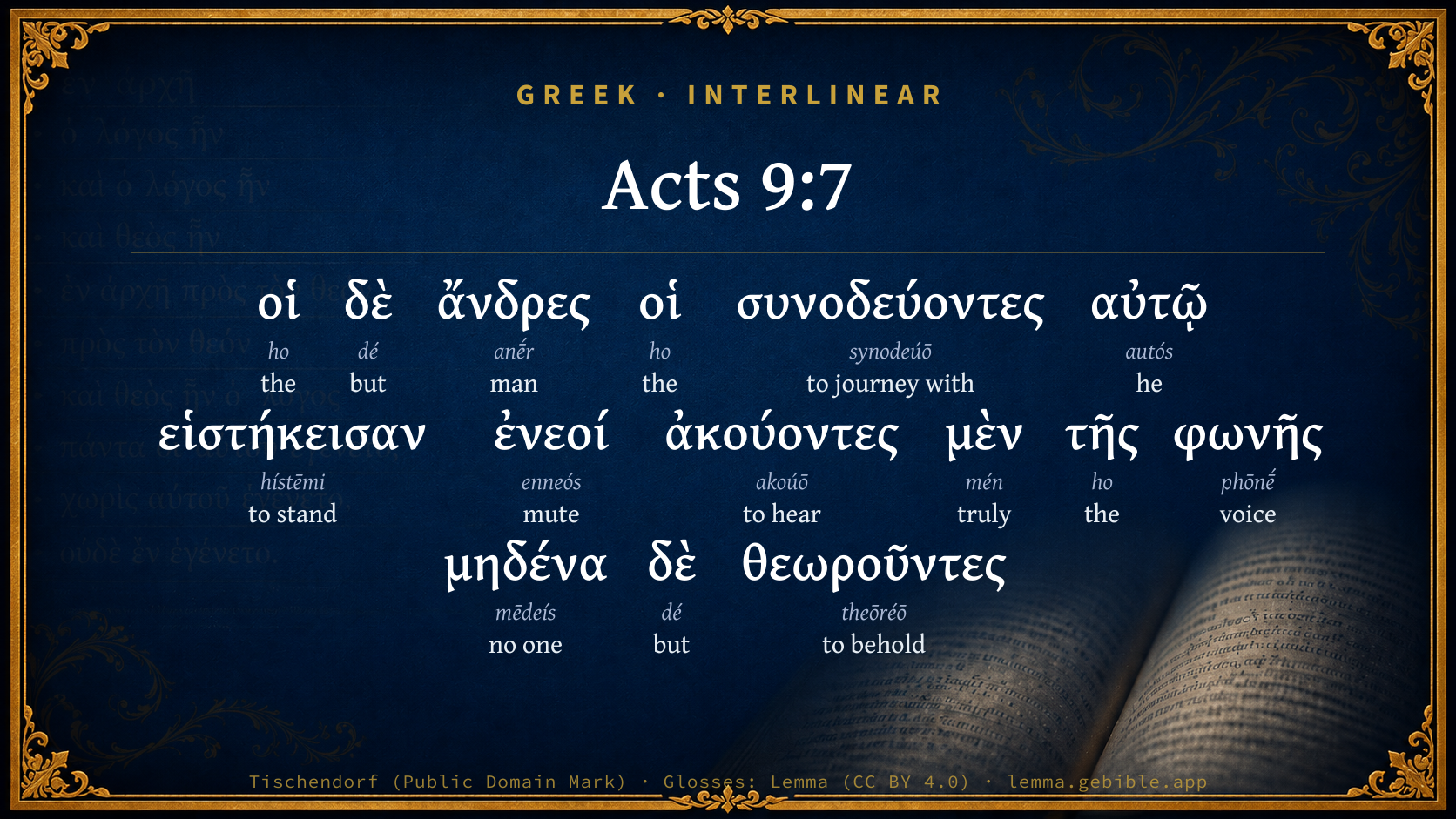
Download image
Cite this verse

Acts 9:7 (World English Bible). Public Domain. Lemma interlinear Bible study tool, https://lemma.gebible.app/v/acts/9/7.

Show BibTeX & RIS
BibTeX
RIS
English Translation
The men who traveled with him stood speechless, hearing the sound, but seeing no one.
World English Bible · Public Domain
Highlights
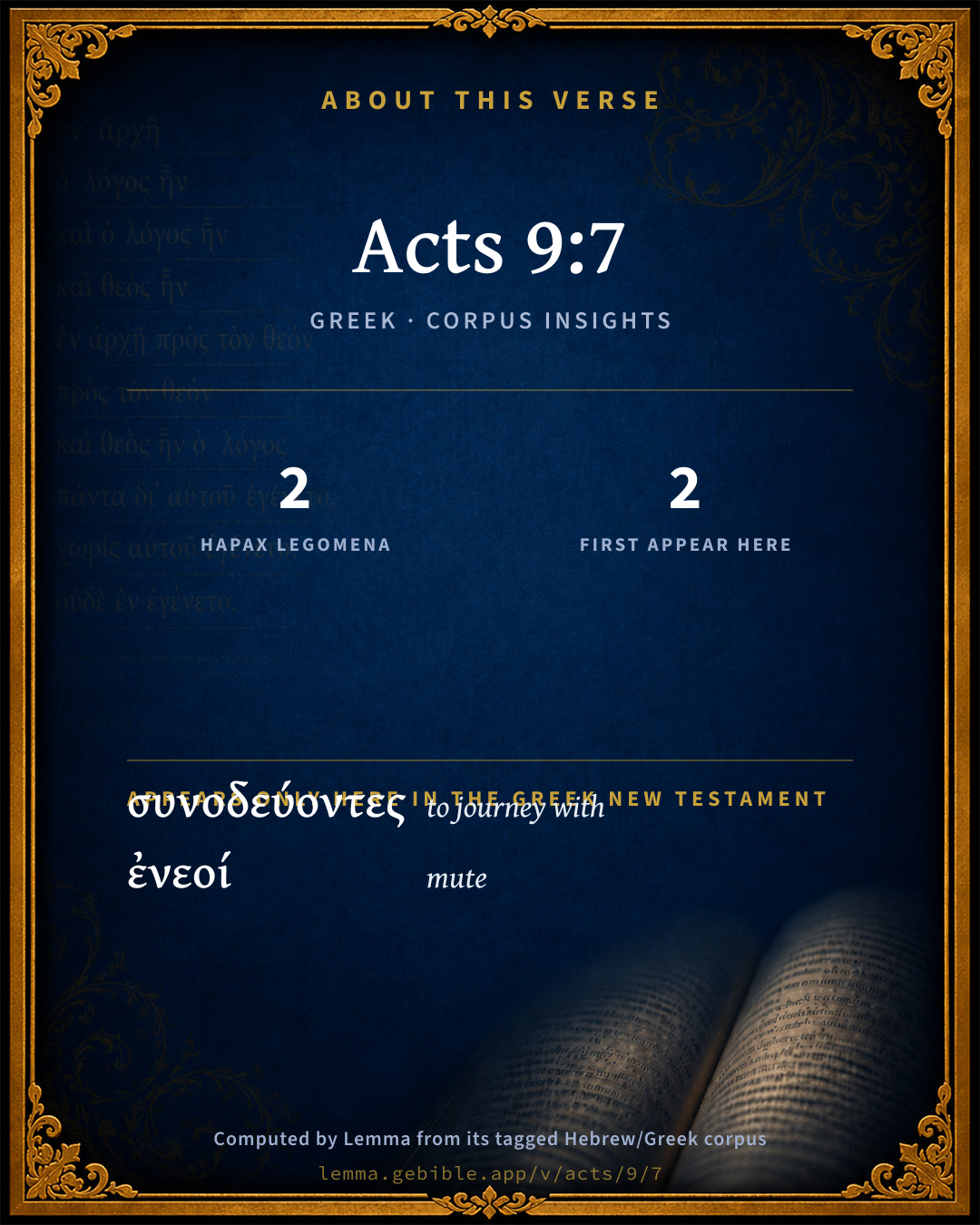
  • 2 hapax legomena — only here in the Greek New Testament
  • 2 first appearances in the Greek New Testament
Full analysis ↓
Download a study sheet

One document with this verse’s original text, its word-by-word gloss line, the meaning frame, cross-references with their text, attributed commentary, and full source and license credits — printable, and it pastes into notes with its structure intact.

This verse Autodidact and up

Study sheet (.html) Plain text (.txt)

A passage Seminary Student

Up to 50 verses in one chapter. A passage sheet keeps up to 6 commentary sources and 12 cross-references per verse, in the order this page ranks them, and says so on the sheet whenever that leaves anything out. Ask for a single verse and you get the Autodidact verse sheet above.

Everything on this page stays free to read, with no account — the sheet is a download of what is already on screen, not access to it.

Want to remove ads? Support Godless Engineer
Compare translations 3

The same verse in 3 English versions, stacked beneath the original-language interlinear above. Click any original word for its lexicon entry.

Each is an independent rendering of the whole verse — the interlinear is not word-aligned to these translations.

Highlighted words mark where these versions differ — a whole-verse word diff, not a word-by-word alignment.

  • World English Bible Public Domain
    The men who traveled with him stood speechless, hearing the sound, but seeing no one.
  • King James Version Public Domain
    And the men which journeyed with him stood speechless, hearing a voice, but seeing no man.
  • unfoldingWord Literal Text CC BY-SA 4.0
    But the men traveling with him stood speechless, hearing the voice but seeing no one.

unfoldingWord Literal Text — © unfoldingWord, licensed CC BY-SA 4.0. Word-aligned USFM3 via Door43 (git.door43.org/unfoldingWord/en_ult).

Versions to compare (up to 4)

3 of 4 selected

Show all 19 translations

Every available English version of this verse, each an independent rendering of the whole verse.

  • World English Bible Public Domain
    The men who traveled with him stood speechless, hearing the sound, but seeing no one.
  • Berean Standard Bible Public Domain
    The men traveling with Saul stood there speechless. They heard the voice but did not see anyone.
  • Majority Standard Bible Public Domain
    The men traveling with Saul stood there speechless. They heard the voice but did not see anyone.
  • King James Version Public Domain
    And the men which journeyed with him stood speechless, hearing a voice, but seeing no man.
  • American Standard Version (1901) Public Domain
    And the men that journeyed with him stood speechless, hearing the voice, but beholding no man.
  • Revised Version (1885) Public Domain
    And the men that journeyed with him stood speechless, hearing the voice, but beholding no man.
  • Geneva Bible (1599) Public Domain
    The men also which iourneyed with him, stood amased, hearing his voyce, but seeing no man.
  • Douay-Rheims (1899) Public Domain
    And the Lord said to him: Arise, and go into the city, and there it shall be told thee what thou must do. Now the men who went in company with him, stood amazed, hearing indeed a voice, but seeing no man.
  • Young's Literal Translation Public Domain
    And the men who are journeying with him stood speechless, hearing indeed the voice but seeing no one,
  • Literal Standard Version CC BY-SA 4.0
    And the men who are journeying with him stood speechless, indeed hearing the voice but seeing no one,
  • Unlocked Literal Bible CC BY-SA 4.0
    The men who traveled with Saul stood speechless, hearing the voice, but seeing no one.
  • unfoldingWord Literal Text CC BY-SA 4.0
    But the men traveling with him stood speechless, hearing the voice but seeing no one.
  • Darby Bible Public Domain
    But the men who were travelling with him stood speechless, hearing the voice but beholding no one.
  • World Messianic Bible Public Domain
    The men who traveled with him stood speechless, hearing the sound, but seeing no one.
  • Webster's Bible Public Domain
    And the men who journeyed with him stood speechless, hearing a voice, but seeing no man.
  • Free Bible Version CC BY-SA 4.0
    The men who were traveling with Saul stood there speechless. They heard the voice speaking, but they didn't see anyone.
  • Bible in Basic English Public Domain
    And the men who were with him were not able to say anything; hearing the voice, but seeing no one.
  • Text-Critical English NT CC BY 4.0
    The men who were traveling with Saul stood speechless, hearing the voice but seeing no one.
  • Tyndale New Testament (1534) Public Domain
    The men which iornayed with him stode amased for they herde a voyce but sawe no man.

Literal Standard Version (2020), Covenant Press — licensed CC BY-SA 4.0. Text via the HelloAO Bible API (eBible.org). Unlocked Literal Bible (unfoldingWord) — licensed CC BY-SA 4.0. Text via the HelloAO Bible API (eBible.org). unfoldingWord Literal Text — © unfoldingWord, licensed CC BY-SA 4.0. Word-aligned USFM3 via Door43 (git.door43.org/unfoldingWord/en_ult). Free Bible Version, Dr. Jonathan Gallagher — licensed CC BY-SA 4.0. Text via the HelloAO Bible API (eBible.org).

Word by word

More ways to search: Search by grammar → Find every occurrence → Compare this word →

Practice this passage: Drill this verse → Learn its vocabulary →

συνοδεύοντες
synodeúō
G4922
“to journey with”
Verb, Present, Active, Participle, Nominative, Plural, Masculine
Part of Speech
Verb
Tense
Present
Voice
Active
Mood
Participle
Case
Nominative
Number
Plural
Gender
Masculine
Full Thayer's Definition

Origin: from G4862 and G3593

TDNT: None

1. to journey with, travel in company with
  1. οἱ ho G3588 “the” Article, Nominative, Plural, Masculine
  2. δὲ dé G1161 “but” Conjunction
  3. ἄνδρες anḗr G435 “man” Noun, Nominative, Plural, Masculine
  4. οἱ ho G3588 “the” Article, Nominative, Plural, Masculine
  5. αὐτῷ autós G846 “he” Personal pronoun, Dative, Singular, Masculine
  6. εἱστήκεισαν hístēmi G2476 “to stand” Verb, Pluperfect, Active, Indicative, 3rd person, Plural
  7. ἐνεοί enneós G1769 “mute” Adjective, Nominative, Plural, Masculine
  8. ἀκούοντες akoúō G191 “to hear” Verb, Present, Active, Participle, Nominative, Plural, Masculine
  9. μὲν mén G3303 “truly” Particle
  10. τῆς ho G3588 “the” Article, Genitive, Singular, Feminine
  11. φωνῆς phōnḗ G5456 “voice” Noun, Genitive, Singular, Feminine
  12. μηδένα mēdeís G3367 “no one” Adjective, Accusative, Singular, Masculine, Negative
  13. δὲ dé G1161 “but” Conjunction
  14. θεωροῦντες theōréō G2334 “to behold” Verb, Present, Active, Participle, Nominative, Plural, Masculine

About this verse

These counts appear in no published source. They are computed here, from the morphology-tagged text and Lemma’s own curated glosses. What Lemma adds →

15
words
12
distinct lemmas
Acts
section

Notable vocabulary

2 hapax legomena — words that appear only here in the entire Greek New Testament:

  • συνοδεύοντες to journey with G4922
  • ἐνεοί mute G1769

First appearance in Scripture

These words make their first canonical appearance in the Greek New Testament here:

  • συνοδεύοντες to journey with G4922
  • ἐνεοί mute G1769

Shared distinctive vocabulary

θεωροῦντες to behold G2334 occurs in 55 verses of the Greek New Testament. Also found in:
Repetition

Words recur within this verse:

Cross-references

5

Topical passages linked to Acts 9:7 in the Treasury of Scripture Knowledge — connected by theme and wording, ordered by reader-vote popularity; previews shown in the World English Bible.

  • Acts 22:9 "Those who were with me indeed saw the light and were afraid, but they didn't understand the voice of him who spoke to me.
  • Daniel 10:7 I, Daniel, alone saw the vision; for the men who were with me didn't see the vision; but a great quaking fell on them, and they fled to hide themselves.
  • Acts 26:13–14 at noon, O King, I saw on the way a light from the sky, brighter than the sun, shining around me and those who traveled with me.
  • John 12:29 The multitude therefore, who stood by and heard it, said that it had thundered. Others said, "An angel has spoken to him."
  • Matthew 24:40–41 Then two men will be in the field: one will be taken and one will be left;

Cross-references courtesy of OpenBible.info (CC BY 4.0).

Commentary

Notes on Acts 9:7 from classic Christian and Jewish commentators (each source and its license shown beneath its notes). The classic Christian expositions comment on the surrounding passage and are grouped to its opening verse, so a note may address several verses; the Jewish commentaries on the Tanakh (Rashi and others) are per-verse, so they appear only where the commentator wrote on this verse.

Lemma curates 59 commentaries, every one of them public domain or Creative Commons licensed, each selected and text-cleaned for this edition rather than reprinted as found. About our sources →

Albert Barnes' Notes on the Bible

And the men which journeyed with him - Why these men attended him is unknown. They might have been appointed to aid him, or they may have been travelers with whom Saul had accidentally fallen in.

Stood speechless - In Act 26:14, it is said that they all fell to the earth at the appearance of the light. But there is no contradiction. The narrative in that place refers to the immediate effect of the appearance of the light. They were immediately smitten to the ground together. This was before the voice spake to Saul, Act 26:14. In this place Act 9:7 the historian is speaking of what occurred after the first alarm. There is no improbability that they rose from the ground immediately, and surveyed the scene with silent amazement and alarm. The word “speechless” ἐννεοὶ enneoi properly denotes “those who are so astonished or stupefied as to be unable to speak.” In the Greek writers it means those who are deaf-mutes.

Hearing a voice - Hearing a sound or noise. The word here rendered “voice” is thus frequently used, as in Gen 3:8; 1Sa 12:18; Psa 29:3-4; Mat 24:31 (Greek); 1Th 4:16. In Act 22:9, it is said, “They which were with me (Paul) saw indeed the light, and were afraid, but they heard not the voice of him that spake to me.” In this place, the words “heard not the voice” must be understood in the sense of “understanding the words,” of hearing the address, the distinct articulation, which Paul heard. They heard a “noise”; they were amazed and alarmed, but they did not hear the distinct words addressed to Saul. A similar instance occurs in Joh 12:28-29, when the voice of God came from heaven to Jesus, “The people who stood by and heard it said it thundered.” They heard the sound, the noise; they did not distinguish the words addressed to him. See also Dan 10:7, and 1Ki 19:11-13.

Albert Barnes' Notes on the Bible (1834–1885) — public domain. Text from a community e-Sword/MySword module.

The Biblical Illustrator

Joseph S. Exell

Act_9:7

And the men who Journeyed with him stood speechless, hearing a voice, but seeing no man (text, and Act_22:9):

The sights and sounds of life

Here is a record of the supernatural in the life of Paul and his companions.

The fact that these phenomena were at midday, and that the apostles fellow travellers were also sensible of them demonstrates that both the voice and the light were objective realities. The slight discrepancy between the two accounts confirms their authenticity. Identity of statement by two different persons after an interval of twenty-five years would excite suspicion. But it may fairly be supposed that all that Paul means is that they heard not articulate voice but mere sound. The same sound that communicated no idea in the one case, conveyed a message from Christ in the other. And the same light which revealed nothing to the men revealed the Son of God to Paul. This extraordinary circumstance indicates what is common in human life. A voice fraught with deep meaning to some, is a mere empty sound to others; a light revealing the grandest realities to some, discloses nothing to others.

I. Mens lives in relation to material nature show this.

1. The lights of nature reveal--

(1) To the thoughtless multitude nothing but mere sensuous forms--just what they reveal to the brute.

(2) To the superstitious, unearthly existences--dreaded as demons or worshipped as gods.

(3) To the sceptical philosopher, nothing but a grand system of well-organised forces working by its own inherent impulse resistless as fate.

(4) To the enlightened Christian, a wise and loving Father.

2. The voices of nature, too, which are boundlessly varied, and set in every key, convey different impressions to different minds.

(1) Nothing but mere sensation.

(2) Superstitious awe.

(3) Scientific intelligence.

(4) Thoughts from God.

II. Mens lives in relation to human history show this. The lights and voices of history reveal varied and almost opposite things.

1. To some it is without any governing law. Its social, mercantile, political movements are ascribable only to blind impulse and capricious passions.

2. To others it has only the governing law of human might. Some explain all on the principle that the strong preys on the weak. The progress and decline of commerce, the rise and fall of empires, the fate of battles are all ascribable to superior might.

3. To others it is governed exclusively by evil. The devil is in the schemes of the trader, the thunders of the orator, the craft of the priest, and shapes the destiny of the race.

4. To others it is governed by the mediatorial plan of God. The restorative purpose of heaven is seen running through the ages. Even the bitterest sufferings are regarded as parturition throes giving birth to a higher order of things.

III. Mens lives in relation to the inspired oracle show this. The Bible has wonderful lights and sounds, but nothing is more true than that they differently affect different men. Ecclesiastical history, theological polemics, as well as the religious life of our own age, are fraught with illustrations of this. The sceptic and the believer, the Papist and the Protestant, the Socinian and the Trinitarian, the Churchman and the Nonconformist are striking examples.

IV. Mens lives in relation to the gospel ministry show this. How differently the same sermon is regarded by various members of the congregation. The sermon which as a Divine voice speaks to the conscience of some, has no meaning to others; or which, as a Divine light, flashes moral conviction and reveals Christ to some, is either not seen at all, or regarded as a mere glare of human genius or enthusiasm. Conclusion: This subject--

1. Reveals a distinguishing attribute of human nature. Men have the power of hearing and seeing with the soul. All that the brutes see and hear terminates in the region of sensation. Ezekiel, Isaiah, John, our own Milton show what men can see and hear with the organs of their soul. The pure in heart see God. Man, in one word, has the power or receiving, modifying, and interpreting the impression the outward makes upon him.

2. Explains the great difference between spiritually and carnally minded men. Men are divided into two classes, those who live to and for the flesh, and those who live to and for the Spirit. Why is this? The one hears and sees in the sounds and sights of life what the other does not. The spiritual realises the spiritual even here.

3. Presents an object in life after which all should strive--viz., to get the eyes and ears of his soul so quickened as to see and hear the Divine everywhere, as the Lord did for Elishas servant. (D. Thomas, D. D.)

The Biblical Illustrator, edited by Joseph S. Exell (c. 1880s–1900s) — public domain. Text from a community e-Sword module.

Joseph Benson's Commentary

Act 9:7. And the men which journeyed with him — Who at first fell to the ground, as Saul did: upon recovering themselves and rising up; stood speechless — With astonishment and terror; hearing a voice — Ακουοντες μεν της φωνης, hearing indeed the voice; namely, the sound of that voice which had spoken to Saul; but without distinctly understanding the sense of what was said. This seems the most probable way of reconciling this with Act 22:9; and it is confirmed by Joh 12:29; where we learn that some present, when the voice from heaven came to Christ, took it for thunder. But seeing no man — Nor perceiving who it was that had been speaking to Saul. So it was with the men who were with Daniel, when he saw the vision, mentioned Dan 10:7; and the heathen, however they came by the notion, thought their deities often rendered themselves visible to one only, in a company consisting of many.

Joseph Benson's Commentary on the Old and New Testaments (1811–1818) — public domain. Text from a community e-Sword module.

Bengel's Gnomon

Johann Albrecht Bengel

Act 9:7. Οἱ συνοδεύοντες, who journeyed with him) some of whom he had been about to employ as executioners.—εἱστήκεισαν, were standing) They too had fallen, ch. Act 26:14; but they had arisen before Saul, of their own accord.—ἀκούοντες, hearing) ch. Act 22:9, They saw indeed the bight, but heard not the voice. Therefore they must have seen the light (ch. Act 26:13-14), but not Jesus Himself: they heard the voice alone, not the voice accompanied with the words. Comp. Joh 12:29.—μηδένα, no man) It is not said, They did not see Jesus, but, they saw no man: for they did not know that Jesus had been seen by Paul.

Bengel's Gnomon of the New Testament — English translation (T&T Clark, Edinburgh, 1860) — public domain. Text from a community e-Sword module.

Meyer's Critical & Exegetical Commentary

Heinrich August Wilhelm Meyer

Act_9:7. Εἰστήκεισαν ἐνεοί[239]] According to Act_26:14, they all fell to the earth with Saul. This diversity is not, with Bengel, Haselaar, Kuinoel, Baumgarten, and others, to be obviated by the purely arbitrary assumption, that the companions at the first appearance of the radiance had fallen down, but then had risen again sooner than Saul; but it is to be recognised as an unessential non-agreement of the several accounts, whereby both the main substance of the event itself, and the impartial conscientiousness of Luke in not arbitrarily harmonizing the different sources, are simply confirmed.

ἈΚΟΎΟΝΤΕς ΜῈΝ Τῆς ΦΩΝῆς] does not agree with Act_22:9. See the note on Act_9:3 ff. The artificial attempts at reconciliation are worthless, namely: that Τῆς ΦΩΝῆς, by which Christs voice is meant, applies to the words of Paul (so, against the context, Chrysostom, Ammonius, Oecumenius, Camerarius, Castalio, Beza, Vatablus, Clarius, Erasmus Schmid, Heumann, and others); or, that φωνή is here a noise (thunder), but in Act_22:9 an articulate voice (so erroneously, in opposition to Act_9:4, Hammond, Elsner, Fabricius, ad Cod. Apocr. N. T., p. 442, Rosenmüller, Morus, Heinrichs); or, that ἤκουσαν in Act_22:9 denotes the understanding of the voice (so, after Grotius and many older interpreters, in Wolf, Kuinoel, and Hackett), or the definite giving ear in reference to the speaker (Bengel, Baumgarten), which is at variance with the fact, that in both places there is the simple contradistinction of seeing and hearing; hence the appeal to Joh_12:28-29 is not suitable, and still less the comparison of Dan_10:7.

ΜΗΔΈΝΑ ΔῈ ΘΕΩΡ.] But seeing no one, from whom the voice might have come; μηδένα is used, because the participles contain the subjective cause of their standing perplexed and speechless. It is otherwise in Act_9:8 : οὐδὲν ἔβλεπε.

[239] ἐνεός, dump, speechless (here, from terror), is to be written with one ν (not ἐννεός), as is done by Lachm. Tisch. Born. after A B C E H א. See on the word, Valck. ad h. I.; Bornem. ad Xen. Anab. iv. 5. 33; Ruhnk. ad Tim. p. 102.

Meyer — Critical and Exegetical Commentary on the New Testament — English translation by Peter Christie, edited by Frederick Crombie (T&T Clark, 1880) — public domain. Text from a community e-Sword module.

Expositor's Greek Testament

ed. W. Robertson Nicoll

Act 9:7 . οἱ συνοδεύοντες : probably riding in company with him; not found in classical Greek, but used in the same sense as here in Plutarch not elsewhere in N. T; but see Wis 6:23 , and Tob 5:16 ( [223] [224] al. ), so according to in Zec 8:21 ( [225] [226] S al. ), cf. also Symm. in Gen 33:12 . εἱστήκεισαν ἐννεοί . The form ἐννεός is incorrect, see critical notes: in LXX, cf. Pro 17:28 , Isa 56:10 , Epist. of Jer 41 (Symm. in Hos 9:7 ); see critical notes. It is frivolous to find a contradiction here with Act 26:14 . No stress is laid upon εἱστήκ ., which may be used like εἶναι , and even if there is, it does not preclude a previous falling. We have merely to suppose that the sight and sound had affected Saul’s companions in a less degree than Saul, and that they rose from the ground before him, to make the narratives quite consistent (see Felten, p. 193, Hackett, in loco; B.D. 1 , iv., “Paul” p. 733). Or it is quite possible, as Weiss points out on Act 26:14 , that here the narrative emphasises the impression made by the hearing of the voice, and in Act 26:14 the immediate result produced by the light, and that the narrator is quite unconscious of any contradiction in his recital (see notes below on 22, 26). μηδένα δὲ θεωροῦντες : there is no contradiction between this statement and Act 26:9 , where it is said that they saw the light here it is not denied that they saw a light, but only that they saw no person. Holtzmann apparently forgets this, and says that whilst in Act 22:9 they see the light, in Act 9:7 they see nothing; but the pronoun is not neuter, but masculine; μηδένα (see critical notes and reading in [227] ). The inference is that Saul saw Jesus, but although this is not stated in so many words here, it is also to be inferred from the words of Ananias in Act 9:17 , and Act 22:14 , and from St. Paul’s own statement in 1Co 15:8 ; 1Co 9:1 . St. Chrysostom refers ἀκούοντες μὲν τῆς φ . to the words of Saul, but this is certainly not natural, for τῆς φ . evidently refers back to ἤκουσα φωνήν in Act 9:4 .

[223] Codex Alexandrinus (sæc. v.), at the British Museum, published in photographic facsimile by Sir E. M. Thompson (1879).

[224] Codex Vaticanus (sæc. iv.), published in photographic facsimile in 1889 under the care of the Abbate Cozza-Luzi.

[225] Codex Alexandrinus (sæc. v.), at the British Museum, published in photographic facsimile by Sir E. M. Thompson (1879).

[226] Codex Vaticanus (sæc. iv.), published in photographic facsimile in 1889 under the care of the Abbate Cozza-Luzi.

[227] R(omana), in Blass, a first rough copy of St. Luke.

The Expositor's Greek Testament, edited by W. Robertson Nicoll (1897–1910) — public domain. Text from a community e-Sword module.

Geneva Bible (1599)

Geneva Bible translators

Stood still and could not go one step forward, but abode amazed as if they had been very stones.

They heard Paul’s voice: for afterwards it is said in flattering, that they heard not his voice that speak: as beneath, Acts 22:9. But others go about to set these places at one which seem to be at ajar, after this sort, to wit, that they heard a sound of a voice, but no perfect voice.

Geneva Bible (1599) marginal notes — public domain. Text via Bolls.life.

Jamieson, Fausset & Brown

Robert Jamieson, A. R. Fausset & David Brown

the men . . . stood speechless--This may mean merely that they remained so; but if the standing posture be intended, we have only to suppose that though at first they "all fell to the earth" (Act 26:14), they arose of their own accord while Saul yet lay prostrate.

hearing a--rather "the"

voice--Paul himself says, "they heard not the voice of Him that spake to me" (Act 22:9). But just as "the people that stood by heard" the voice that saluted our Lord with recorded words of consolation and assurance, and yet heard not the articulate words, but thought "it thundered" or that some "angel spake to Him" (Joh 12:28-29) --so these men heard the voice that spake to Saul, but heard not the articulate words. Apparent discrepancies like these, in the different narratives of the same scene in one and the same book of Acts, furnish the strongest confirmation both of the facts themselves and of the book which records them.

Jamieson, Fausset & Brown — Commentary Critical and Explanatory on the Whole Bible (1871) — public domain (CC PDM 1.0). Text via the HelloAO Bible API.

Adam Clarke's Commentary

Verse 7. Stood speechless, hearing a voice, but seeing no man.] The men were εννεοι, stupified, hearing τηςφωνης, the voice or thunder, but not distinguishing the words, which were addressed to Saul alone; and which were spoken out of the thunder, or in a small, still voice, after the peal had ceased. The remarkable case, 1Kg 19:11-13, may serve to illustrate that before us. And he said, Go forth, and stand upon the mount before the Lord; and the Lord passed by, and a great and strong wind rent the mountains, and brake in pieces the rocks before the Lard; and after the wind an earthquake; and after the earthquake a fire; and after the fire a still small voice; and when Elijah heard it, he wrapped his face in his mantle, and went out, and stood in the entering in of the cave, and behold, there came a voice unto him, and said, WHAT DOST THOU HERE, ELIJAH! The thunder must have been heard by all; the small, still voice by Saul alone. This consideration amply reconciles the passage in the text with that in Ac 22:9, where Paul says, They that were with me saw the light and were afraid, but they heard not the voice of him that spoke with one. They had heard the thunder which followed the escape of the lightning, but they heard not the voice of him that spake to Saul; they did not hear the words, I am Jesus whom thou persecutest, c. but they saw and heard enough to convince them that the whole was supernatural; for they were all struck down to the earth with the splendour of the light, and the sound of the thunder, which I suppose took place on this occasion. It has been a question among divines, whether Jesus Christ did really appear to Saul on this occasion. The arguments against the real appearance are not strong. St. Luke tells us that those who were with him heard the voice, but they saw no man; which is a strong intimation that he saw what they did not. Ananias, it seems, was informed that there had been a real appearance, for, in addressing Saul, Ac 9:17, he says, The Lord Jesus that APPEARED unto THEE in the way as thou camest, c. And Barnabas intimates thus much, when he brought him before the apostles at Jerusalem, for he declared unto them how he had SEEN the Lord in the way, and that he had spoken unto him and, Ac 22:14, where the discourse of Ananias is given more at large, he says, The God of our fathers hath chosen thee that thou shouldest know his will, and SEE that JUST ONE, and shouldest HEAR the voice of his mouth; so we find that hearing the voice, or words of his mouth, was not what is called the appearance; for, besides this, there was an actual manifestation of the person of Christ. But St. Paul's own words, 1Co 9:1, put the subject out of dispute: Am I not an apostle? Am I not free? HAVE I NOT SEEN JESUS CHRIST OUR LORD? To which may be added, 1Co 15:8, And last of all, HE WAS SEEN OF ME ALSO, as of one born out of due time.

Adam Clarke's Commentary on the Bible (1810–1826) — public domain. Text from a community e-Sword/MySword module.

John Calvin's Commentaries

7. And the men. He speaketh now briefly of the companions of Paul, that they were witnesses of the vision. Yet it seemeth that this narration doth not in all points agree with that of Paul, which we shall see in the 22nd chapter, (Acts 22:9.) For he will say there, that his companions were terrified with the light, but they heard no voice. Some there be who think that it was a fault, and that through ignorance of the writer the negation is placed out of its right place. I think that it is no hard matter to answer it; because it may be that they heard the sound of the voice, yet did they not discern either who it was that spake, or what was spoken. “They heard not,” saith he, “the voice of him that spake with me.” Surely this is the meaning of these words, that he alone knew the speech of Christ. It followeth not thereupon, but that the rest might have heard a dark and doubtful voice. Whereas Luke saith in this place that there was a voice heard, and no man seen, his meaning is, that the voice proceeded from no man, but that it was uttered by God. Therefore, to the end the miracle may carry the greater credit, Paul’s companions see a light like to lightning; they see Paul lie prostrate; a voice they hear (though not distinctly ) sounding from heaven; and yet, nevertheless, Paul alone is taught what he must do.

John Calvin's Commentaries (1540-1563) — public domain. Text from the Calvin Translation Society English edition (1840s-50s) via the Christian Classics Ethereal Library (ccel.org). Calvin's coverage is partial (roughly two-thirds of the Bible); uncommented books and verses are honest gaps, never fabricated. The 19th-century editor's footnotes and remarks are omitted so the notes are faithfully Calvin's own voice.

Ellicott's Commentary for English Readers

(7) Hearing a voice, but seeing no man.—We are told by St. Paul himself (Act_22:9) that they “did not hear the voice.” What is meant is clearly that they did not hear the words—could attach no meaning to the sounds which for Saul himself had so profound a significance. So, in like manner, they saw the light, but did not see the form. In Act_26:14, they also are said to have fallen on the ground in terror.

A Bible Commentary for English Readers, edited by Charles John Ellicott (1878–1897) — public domain. Text from a community e-Sword module.

The Cambridge Bible for Schools and Colleges

gen. ed. J. J. S. Perowne

7. And the men which journeyed with him stood speechless] Cp. Dan_10:7, “I Daniel alone saw the vision, for the men that were with me saw not the vision, but a great quaking fell upon them.”

Saul was not only furnished with authority, but also with men who were to carry out his intentions and bring the prisoners to Jerusalem. Painters have represented the travellers as riding on horseback, but there is no warrant for this in any form of the narrative.

stood here means “remained fixed,” “did not move.” They had been stricken down as well as Saul (Act_26:14).

hearing a [the] voice] On the variation of case here, and the probable difference of meaning, see note on Act_9:4.

but seeing [beholding] no man] The verb is the same that is used by Stephen (Act_7:56), “Behold, I see the heavens opened.” In their astonishment, and guided by the sound, Saul’s companions lifted up their faces to the sky, but as with the words so with the appearance of Jesus; it was unseen by all but one, but to him was manifest enough to form a ground of his confidence in his Apostolic mission: “Have I not seen Jesus Christ our Lord?” (1Co_9:1).

The Cambridge Bible for Schools and Colleges (gen. ed. J. J. S. Perowne; Cambridge University Press, 1878–1918) — public domain. Text from a community e-Sword module.

John Gill's Exposition

And the men which journeyed with him,.... Out of respect to him, to keep him company; or rather to assist him in his designs:

stood speechless: astonished and amazed, they had not power to speak one word, nor to rise from the ground, and move one step forward; they were as if they were thunderstruck, and fastened to the earth; for this standing is not opposed to their being fallen to the earth, but to their going forward, and only expresses the surprise and stupidity that had seized them:

hearing a voice, but seeing no man; that is, they heard the voice of Saul, saying, who art thou? and what wilt thou have me to do? but saw nobody that he spoke to, which surprised them; for it is certain they did not hear the voice of Christ, that spake to him, Act 22:9 or if they heard the voice of Christ, it was only the sound of his voice, but did not understand what he said; but the former seems rather to be the sense, and the best way of reconciling the two passages.

John Gill's Exposition of the Whole Bible (1746–1763) — public domain (CC PDM 1.0). Text via the HelloAO Bible API.

Trapp's Complete Commentary

John Trapp

7 And the men which journeyed with him stood speechless, hearing a voice, but seeing no man.

Ver. 7. Hearing a voice] Not Christ’s voice, but Saul’s only, Act 22:9.

John Trapp, A Commentary or Exposition upon All the Books of the Old and New Testament (1647–1656) — public domain. Text from a community e-Sword module.

Haydock's Catholic Bible Commentary

There it shall be told thee, &c. The Almighty having established a Church, and ministry, the depositories of his doctrines, does not, even on this extraordinary occasion, transgress his own laws; but sends him to the ministers of religion, that instruction may be imparted through them, as through its proper channel. This observation is worthy the notice of the self-inspired of the present day, who pretend to receive their light direct from heaven. Nothing can be more opposite to the spirit of the gospel than such delusion. (Haydock) --- Hear the great St. Augustine: "Paul, though with the divine and heavenly voice prostrated and instructed, yet was sent to a man to receive the sacraments, and to be joined to the Church." (De Doct. Chris. lib. i. in prœm. --- Hearing, &c. This may be reconciled with what is said in the 22nd chapter by supposing they heard only St. Paul speak, or heard only a confused noise, which they could not understand. (Calmet)

George Leo Haydock (1774–1849), Haydock's Catholic Family Bible and Commentary, 1859 edition — public domain. Excludes Psalms (Douay-Rheims chapter numbering differs from Protestant) and Deuterocanonical books (Catholic canon only).

Matthew Poole's English Annotations

Stood speechless: in Act 26:14, these men are said to be fallen to the earth as well as Saul, which they might at first be, and now rose up; or rather, by standing still here is only meant, they, being sorely amazed, remained in the place in which they were, without going forward: thus the angel forbade Lot and his family to stay or stand in the plain, Gen 19:17, meaning that they should hasten forward.

Hearing a voice; the greater difficulty is, to reconcile these words with Act 22:9, where it is expressly said, that these men did not hear the voice; but it is there added, of him that spake unto Saul; so that they might hear the voice of Saul, as it is said in this place, and wonder whom he spake unto, or what he spake about, they not hearing the voice or him that spake unto him, as in Act 22:9 it is said: and it seems very likely that they should not hear the voice of Christ, for we read not that any of them were converted; and being left in their infidelity, they were in some respects the more undeniable witnesses of a great part of that miracle. But if it be understood of the voice of Christ in both places, then they might hear it, as it is said here, inarticulately, or the noise which that voice made; but not hear it articulately, or so as to understand it, as in a parallel case, Joh 12:29, the people are said to hear the voice that spake nnto Christ from heaven, yet they heard so confusedly, as that they thought it had only, been thunder. To be sure, they who are converted, and they who are not converted, by the word of God, may hear the word; but after a very different manner; they that are converted by it only hearing it inwardly, spiritually, effectually.

But seeing no man; these fellow travellers with St. Paul are said to see no man, but the expression here imports their doing their utmost for to see him that spake: thus God made a difference, Dan 10:7, in the vision we read of there.

Matthew Poole's English Annotations on the Holy Bible (1683–1685) — public domain. Text from a community e-Sword/MySword module.

Whedon's Commentary on the Bible

Daniel D. Whedon

7. Hearing a voice—The Greek word for voice, like our word utterance, may signify either the vocal sound or the articulate words. So a man partially deaf would be said, popularly but truly, to hear and not to hear the same utterance. It is here said they heard, and in Act_22:9, it is said they heard not, the utterance.

Seeing no man—They saw not, as Saul did, the speaker. How in the midst of that luminous splendour the form of Jesus loomed forth upon Saul’s sight—whether standing on the earth, or in the space exalted above him—we know not. We suppose the latter.

And thus to Paul, as to none of the other apostles, Jesus appeared, never in his humble terrene flesh, but solely in his glorification. Thenceforward, consequently, he was troubled with no low Ebionite conceptions of Jesus, but ever thought of him, purely, with intense self-consecration, as the exalted and divine Master of his own soul and body.

Yet Saul’s sight of Jesus could have been but for a moment. By its power he forthwith fell to the earth, (Act_9:4,) and when he arose from the earth (Act_9:8) he saw no man, being blinded by the glory that prostrated him.

Daniel D. Whedon (gen. ed.), Commentary on the Old and New Testaments (1874–1909) — public domain. Text from a community e-Sword module.

The Pulpit Commentary

That journeyed for which journeyed, A.V.; the voice for a voice, A.V.; beholding for seeing, A.V. Speechless; ejnneoi (or rather ejneoi) is found nowhere else in the New Testament, but is not uncommon in the LXX (e.g. Isa_56:10) and in classical Greek. Here it means speechless from terror, struck dumb. The description here given by St. Luke seems to be contradictory in two particulars to St. Paul"s own account in Act_22:9; Act_26:14. For St. Paul"s companions are said here to have "stood speechless;" but in Act_26:14 they were "all fallen to the earth." Here they "hear the voice," but in Act_22:9 they "heard not the voice of him that spake." It is obvious, however, that in such descriptions all depends upon the particular moment of the transaction described which happens to be uppermost in the mind of the speaker or writer at the time, and the particular purpose in relation to which he is giving the description. Thus at one moment the spectators might be standing dumfounded, and at the next they might be prostrate on the ground, or vice versa. Either description of their attitude would be a true one, though not true with regard to the same moment. Again, if the purpose of the speaker was to affirm that the whole company were conscious of both the vision and the sound of a voice speaking, but that only Saul saw the Divine Speaker, the description "hearing the voice, but beholding no man" would be tile natural one. Whereas, if the purpose was to express that Saul alone heard the words spoken to him by the Lord, the description of his companions," They saw indeed the light but they heard not the voice of him that spake to me," would be equally natural.

The Pulpit Commentary (1880–1919), ed. H.D.M. Spence-Jones & Joseph S. Exell — public domain. Text from a community e-Sword module.

John Wesley's Explanatory Notes

The men - stood - Having risen before Saul; for they also fell to the ground, chap. xxvi, 14. It is probable they all journeyed on foot. Hearing the noise - But not an articulate voice. And seeing the light, but not Jesus himself, chap. xxvi, 13, &c.

John Wesley, Explanatory Notes Upon the Whole Bible (1754–1765) — public domain. Text via the GEBible commentary corpus.

MacLaren's Expositions of Holy Scripture

Alexander MacLaren

Acts

GRACE TRIUMPHANT

Act 9:1 - Act 9:12; Act 9:17 - Act 9:20.

This chapter begins with ‘but,’ which contrasts Saul’s persistent hatred, which led him to Gentile lands to persecute, with Philip’s expansive evangelistic work. Both men were in profound earnest, both went abroad to carry on their work, but the one sought to plant what the other was eager to destroy. If the ‘but’ in Act 9:1 contrasts, the ‘yet’ connects the verse with Act 8:3. Saul’s fury was no passing outburst, but enduring. Like other indulged passions, it grew with exercise, and had come to be as his very life-breath, and now planned, not only imprisonment, but death, for the heretics.

Not content with carrying his hateful inquisition into the homes of the Christians in Jerusalem, he will follow the fugitives to Damascus. The extension of the persectution was his own thought. He was not the tool of the Sanhedrin, but their mover. They would probably have been content to cleanse Jerusalem, but the young zealot would not rest till he had followed the dispersed poison into every corner where it might have trickled. The high priest would not discourage such useful zeal, however he might smile at its excess.

So Saul got the letters he asked, and some attendants, apparently, to help him in his hunt, and set off for Damascus. Painters have imagined him as riding thither, but more probably he and his people went on foot. It was a journey of some five or six days. The noon of the last day had come, and the groves of Damascus were, perhaps, in sight. No doubt, the young Pharisee’s head was busy settling what he was to begin with when he entered the city, and was exulting in the thought of how he would harry the meek Christians, when the sudden light shone.

At all events, the narrative does not warrant the view, often taken now, that there had been any preparatory process in Saul’s mind, which had begun to sap his confidence that Jesus was a blasphemer, and himself a warrior for God. That view is largely adopted in order to get rid of the supernatural, and to bolster up the assumption that there are no sudden conversions; but the narrative of Luke, and Paul’s own references, are dead against it. At one moment he is ‘yet breathing threatening and slaughter against the disciples of the Lord,’ and in almost the next he is prone on his face, asking, ‘Lord, what wilt Thou have me to do?’ It was not a case of a landslide suddenly sweeping down, but long prepared for by the gradual percolation of water to the slippery understrata, but the solid earth was shaken, and the mountain crashed down in sudden ruin.

The causes of Saul’s conversion are plain in the narrative, even though the shortened form is adopted, which is found in the Revised Version. The received text has probably been filled out by additions from Paul’s own account in Act 26:1 - Act 26:32 First came the blaze of light outshining the midday sun, even in that land where its beams are like swords. That blinding light ‘shone round about him,’ enveloping him in its glory. Act 26:13 tells that his companions also were wrapped in the lustre, and that all fell to the earth, no doubt in terror.

Saul is not said, either in this or in his own accounts, to have seen Jesus, but 1Co 15:8 establishes that he did so, and Ananias {Act 9:17} refers to Jesus as having ‘appeared.’ That appearance, whatever may have been the psychological account of it, was by Paul regarded as being equal in evidential value to the flesh-and-blood vision of the risen Lord which the other Apostles witnessed to, and as placing him in the same line as a witness.

It is to be noted also, that, while the attendants saw the light, they were not blinded, as Saul was; from which it may be inferred that he saw with his bodily eyes the glorified manhood of Jesus, as we are told that one day, when He returns as Judge, ‘every eye shall see Him.’ Be that as it may,-and we have not material for constructing a theory of the manner of Christ’s appearance to Saul,- the overwhelming conviction was flooded into his soul, that the Jesus whom he had thought of as a blasphemer, falsely alleged to have risen from the dead, lived in heavenly glory, amid celestial brightness too dazzling for human eyes.

The words of gentle remonstrance issuing from the flashing glory went still further to shake the foundations of the young Pharisee’s life; for they, as with one lightning gleam, laid hare the whole madness and sin of the crusade which he had thought acceptable to God. ‘Why persecutest thou Me?’ Then the odious heretics were knit by some mysterious bond to this glorious One, so that He bled in their wounds and felt their pains! Then Saul had been, as his old teacher dreaded they of the Sanhedrin might be, fighting against God! How the reasons for Saul’s persecution had crumbled away, till there were none left with which to answer Jesus’ question! Jesus lived, and was exalted to glory. He was identified with His servants. He had appeared to Saul, and deigned to plead with him.

No wonder that the man who had been planning fresh assaults on the disciples ten minutes before, was crushed and abject as he lay there on the road, and these tremendous new convictions rushed like a cataract over and into his soul! No wonder that the lessons burned in on him in that hour of destiny became the centre-point of all his future teaching! That vision revolutionised his thinking and his life. None can affirm that it was incompetent to do so.

Luke’s account here, like Paul’s in Act 22:1 - Act 22:30, represents further instructions from Jesus as postponed till Saul’s meeting with Ananias, while Paul’s other account in Act 26:1 - Act 26:32 omits mention of the latter, and gives the substance of what he said in Damascus as said on the road by Jesus. The one account is more detailed than the other, that is all. The gradual unfolding of the heavenly purpose which our narrative gives is in accord with the divine manner. For the moment enough had been done to convert the persecutor into the servant, to level with the ground his self-righteousness, to reveal to him the glorified Jesus, to bend his will and make it submissive. The rest would be told him in due time.

The attendants had fallen to the ground like him, but seem to have struggled to their feet again, while he lay prostrate. They saw the brightness, but not the Person: they heard the voice, but not the words. Saul staggered by their help to his feet, and then found that with open eyes he was blind. Imagination or hallucination does not play tricks of that sort with the organs of sense.

The supernatural is too closely intertwined with the story to be taken out of it without reducing it to tatters. The greatest of Christian teachers, who has probably exercised more influence than any man who ever lived, was made a Christian by a miracle. That fact is not to be got rid of. But we must remember that once when He speaks of it He points to God’s revelation of His Son ‘in Him’ as its essential character. The external appearance was the vehicle of the inward revelation. It is to be remembered, too, that the miracle did not take away Saul’s power of accepting or rejecting the Christ; for he tells Agrippa that he was ‘not disobedient to the heavenly vision.’

What a different entry he made into Damascus from what he expected, and what a different man it was that crawled up to the door of Judas, in the street that is called Straight, from the self-confident young fanatic who had left Jerusalem with the high priest’s letters in his bosom and fierce hate in his heart!

Ananias was probably not one of the fugitives, as his language about Saul implies that he knew of his doings only by hearsay. The report of Saul’s coming and authority to arrest disciples had reached Damascus before him, with the wonderful quickness with which news travels in the East, nobody knows how. Ananias’s fears being quieted, he went to the house where for three days Saul had been lying lonely in the dark, fasting, and revolving many things in his heart. No doubt his Lord had spoken many a word to him, though not by vision, but by whispering to his spirit. Silence and solitude root truth in a soul. After such a shock, absolute seclusion was best.

Ananias discharged his commission with lovely tenderness and power. How sweet and strange to speaker and hearer would that ‘Brother Saul’ sound! How strong and grateful a confirmation of his vision would Ananias’s reference to the appearance of the Lord bring! How humbly would the proud Pharisee bow to receive, laid on his head, the hands that he had thought to bind with chains! What new eyes would look out on a world in which all things had become new, when there fell from them as it had been scales, and as quickly as had come the blinding, so quickly came the restored vision!

Ananias was neither Apostle nor official, yet the laying on of his hands communicated ‘the Holy Ghost.’ Saul received that gift before baptism, not after or through the ordinance. It was important for his future relations to the Apostles that he should not have been introduced to the Church by them, or owed to them his first human Christian teaching. Therefore he could say that he was ‘an Apostle, not from men, neither through man.’ It was important for us that in that great instance that divine gift should have been bestowed without the conditions accompanying, which have too often been regarded as necessary for, its possession.

Alexander MacLaren, Expositions of Holy Scripture (1904–1910) — public domain. Text from a community e-Sword module.

Scofield Reference Notes

C. I. Scofield

voice

Cf Act 22:9; Act 26:14.

A contradiction has been imagined. The three statements should be taken together. The men heard the "voice" as a sound (Greek - ἀναφωνέω), but did not hear the "voice" as articulating the words, "Saul, Saul," etc).

The Scofield Reference Bible (1917 edition), notes by C. I. Scofield — public domain. Text from a community e-Sword module.

Kretzmann's Popular Commentary

Paul E. Kretzmann

The end of the vision:

v. 7. And the men which journeyed with him stood speechless, hearing a voice, but seeing no man.

v. 8. And Saul arose from the earth; and when his eyes were opened, he saw no man; but they led him by the hand, and brought him into Damascus.

v. 9. And he was three days without sight, and neither did eat nor drink.

Luke here for the first time mentions the companions of Saul, and describes their behavior. The men that accompanied him stood stupefied when the miracle occurred; for they heard the sound of the voice, but were unable to see any one. If we here add the witness of chap. 22:6-11 and chap. 26:13-18, in which passages the same event is described, we obtain the following picture. The great light from heaven was seen by all, but only upon Saul was its immediate effect that of throwing him to the ground. His companions stood stupefied for a few moments, as though frozen stiff with fear and apprehension, trying to realize the meaning of the vision. But after the first shock their limbs would no longer support them, and they also fell to the ground. And it was while they were lying down that the men heard the voice, the utterance of someone speaking, and Saul caught every word, but they did not hear definitely, nor could they understand who it was that spoke. And while the form of Jesus was clearly revealed to Saul in the midst of the light, the others saw nothing but the light. So much, then, these companions of Saul could testify to: that a great light appeared, that a voice was heard from the midst of it, that Saul became blind as a result of the miracle. Saul now arose from the earth, but when he tried to open his eyes, he found that he had lost his sight and could see nothing. It was necessary for his companions to take him by the hand and thus lead him into the city. And there his blindness continued for three days, during which time he neither ate nor drank. That was the result of the experience which he had gone through, by which he had been shaken in the innermost parts of his being. The conversion of a person is not always attended with such miracles as in the case of Saul, but it is always as miraculous. It is the Lord that conquers and vanquishes the sinners, His enemies. His holy Law strikes them to the ground, drives them to fear and despair. But He immediately follows with the comforting message of the Gospel, and then the wonder is performed. The resistance and enmity of the unregenerated heart is changed to a cordial acceptance of the love of God. That is the miracle of conversion.

The Early History of Paul’s Life.

Paul, the great missionary of the Gentiles, was born in Tarsus, the ancient, famous capital of Cilicia in Asia Minor, on the Cydnus River, twelve miles from the sea. in the midst of a productive plain, Act 22:3. The city was renowned for its culture as well as its learning, one historian placing it above even Athens and Alexandria in this respect. In this seat of Greek learning the boy, himself the son of a Pharisee and therefore a strict Jew, acquired a knowledge of the Greek language and of the manners and customs of the Greeks, which stood him in good stead in after-life. Incidentally, it should be noted that the inhabitants of Tarsus, having shown themselves friendly to the Romans at the time of Julius Caesar, mere given the privileges of Roman citizens (or Paul’s father may have obtained the right as a reward of merit), and it was on this account that, Paul, a Roman citizen by birth, claimed the rights of such a citizen on different occasions, thus rendering the cause in which he was engaged considerable service. Paul was of pure Jewish descent, a Hebrew of the Hebrews, of the tribe of Benjamin, and descended from pious ancestors, Php 3:4-5; 2Ti 1:3. The instruction in the Law of Moses which he received at home and in the local synagogue was as thorough as that of any Jewish boy in Palestine.

According to Jewish custom some form of manual training was a necessary part of every boy’s education. The young boy Saul also learned a trade, that of a tent-maker, Act 18:3; Act 20:34. The goats’ hair which was used for the manufacture of rude garments and tent cloth, was produced in great quantities in the mountains of Cilicia, whence the finished cloth acquired the name cilicium. This trade was of great service, to Paul in some of the dark days of after-years, Act 18:3; Act 20:34; 1Th 2:9. As soon as little Saul was ready for the great high school of the Jews At Jerusalem, he was sent there by his father, and was thus brought up at the feet of Gamaliel, one of the most learned doctors of the Jews, whose prudence and calmness made him conspicuous among the members of the Sanhedrin, Act 22:3. His advance in the religion of the Jews was beyond that of many of his own age, since he was more exceedingly zealous for the traditions of the fathers, Gal 1:14. He lived up to the demands of the Jewish Law and of all the traditions of the elders with all strictness, so that he could, in after-years, appeal to those that knew to testify to his having lived the life of a strict Pharisee, Act 26:4-5; Php 3:6.

Very likely Saul left. Jerusalem before John the Baptist began his work, and was absent during the years of Christ’s ministry; for there is no indication in Paul’s writings of a personal knowledge of events in the life of Jesus. It seems that he returned to Jerusalem about the time that Stephen began his debates in the interest of the Christian religion and took part in at least one of these discussions as a member of the synagogue of Cilicia. Paul’s later life is largely described in the Book of Acts and in his epistles, and the probable facts as to his last years will be discussed in connection with some of his last letters.

Paul E. Kretzmann, Popular Commentary of the Bible (1921–1924) — public domain. Text from a community e-Sword module.

Burkitt's Expository Notes on the New Testament

William Burkitt

Observe here, The testimony or witnesses of Saul’s conversion, to writ, the men that journeyed with him; it is probable that he had a considerable number of officers with him, to bring both men and women that professed Christianity bound to Jerusalem. These saw the light shining and heard a confused noise like thunder, but they saw not Christ himself, as he did, nor heard the articulate voice of Christ that he heard, which spake so powerfully, so convincingly, and so convertingly to his soul.

Lord, how many are there that come under thine ordinances, who hear only (like Saul’s companions) a confused noise and empty sound! They do not hear the distinct voice of Christ speaking to their hearts with a strong hand, inwardly and effectually, and so remanin under the power of unbelief, in an unconverted state.

William Burkitt's Expository Notes on the New Testament (1700–1703) — public domain. Text from a community e-Sword module.

McGarvey & Pendleton's Commentaries

J. W. McGarvey

7. While the conversation was passing between Saul and Jesus, the conduct of his companions is thus described by Luke. (7) " Now, the men who were journeying with him stood speechless, hearing the voice, but seeing no man. " Paul gives a different account of their demeanor, by saying that they all fell to the ground; but the two accounts harmonize very naturally. The first effect of such an apparition would naturally to be prostrate them all; but his companions, not being held in this position by any direct address to them, would naturally arise after the first shock was over, and fleeing to a safe distance, there stand gazing, in mute terror, upon the glory which enveloped their leader. This supposition is confirmed by the fact that Paul represents the falling to the earth as occurring before the voice was heard, while their standing speechless is connected by Luke with the close of the conversation.

This supposition helps to account for a well-known verbal discrepancy between these two accounts. Luke says they heard the voice; Paul says "they heard not the voice of him that spoke to me." The discrepancy arises from the ambiguous use of the verb hear. There is nothing more common, among all nations, than for one who is listening to a speaker, but, either from his own confusion or the indistinctness of the speaker's articulation, can only catch an occasional word, to exclaim "I don't hear you;" although the sound of the voice reaches him continually. It is in this sense of the word hear, that the companions of Saul, in the confusion of their effort to escape from the scene, failed to hear the voice. They heard the sound, but did not understand the words.

J. W. McGarvey (with Philip Y. Pendleton), Commentaries on the New Testament (The Fourfold Gospel, 1914; Acts; and the epistles) — public domain. Text from a community e-Sword/MySword module.

The People's New Testament

B. W. Johnson

7. And the men … hearing a voice, but seeing no man. They were dumb with amazement, but did not see Christ, who was only revealed to Saul. They heard the sound, but the words were for Saul and only understood by him. Compare with Acts 22:9. The two passages taken together mean that they heard a sound, but no words.

B. W. Johnson's The People's New Testament with Notes (1889–1891) — public domain. Electronic text from the Christian Classics Ethereal Library (CCEL) ThML edition.

Cambridge Greek Testament for Schools and Colleges

7. οἱ δὲ ἄνδρες κ.τ.λ., and the men which journeyed with him stood speechless. Cf. Dan 10:7, ‘I Daniel alone saw the vision, for the men that were with me saw not the vision, but a great quaking fell upon them.’

Saul was not only furnished with authority, but also with men who were to carry out his intentions and bring the prisoners to Jerusalem. Painters have represented the travellers as riding on horseback, but there is no warrant for this in any form of the narrative.

εἱστήκεισαν means here ‘remained fixed,’ ‘did not move.’ For they were not on their feet, but had been stricken down as well as Saul (Act 26:14).

ἐνεός is found in LXX. Isa 56:10 κύνες ἐνεοί, and in Epist. Jeremiah 41 ἐνεὸν μὴ δυνάμενον λαλῆσαι.

ἀκούοντες μὲν τῆς φωνῆς, hearing the voice. On the case and its probable significance see above on Act 9:4.

μηδένα δὲ θεωροῦντες, but beholding no man. θεωρέω is used by Stephen. (Act 7:56), ‘I behold the heavens opened.’ So here of the glorious vision of Jesus which Saul beheld but not his companions. In their astonishment, and guided by the sound, Saul’s companions lifted up their faces to the sky, but as with the words so with the appearance of Jesus; it was unseen by all but one, but to him was manifest enough to form a ground of his confidence in his Apostolic mission: ‘Have I not seen Jesus Christ our Lord?’ (1Co 9:1).

Cambridge Greek Testament for Schools and Colleges (Cambridge University Press, 1896; 21 vols, various authors incl. Carr, Maclear, Plummer, Farrar, Lumby, Moule, M. R. James, Simcox) — public domain. Text from a community e-Sword module.

Alford’s Greek Testament

Henry Alford

7.] In ch. 22:9, οἱ δὲ σὺν ἐμοὶ ὄντες τὸ μὲν φῶς ἐθεάσαντο [κ. ἔμφοβοι ἐγένοντο], τὴν δὲ φωνὴν οὐκ ἤκουσαν τοῦ λαλοῦντός μοι. Two accounts seemingly (and certainly, in the letter) discrepant; but exceedingly instructive when their spirit is compared,—the fact being this: that the companions of Saul saw and were struck to the ground by the light, but saw οὐδένα, no person:—that they stood (or ‘were fixed:’ but I should acknowledge the discrepancy here, and recognize the more accurate detail of ch. 26:14, that they fell to the ground) mute, hearing τῆς φωνῆς, the sound of the voice, but not τὴν φωνὴν τοῦ λαλοῦντός μοι, the words spoken and their meaning. Compare Joh 12:29, note. (Only no stress must be laid on the difference between the gen. and acc. government of φωνή, nor indeed on the mere verbal difference of the two expressions;—but their spirit considered, in the possible reference which they might have to one and the same fact.)

Two classes of readers only will stumble at this difference of the forms of narration; those who from enmity to the faith are striving to create or magnify discrepancies,—and those who, by the suicidal theory of verbal inspiration, are effectually doing the work of the former. The devout and intelligent student of Scripture will see in such examples a convincing proof of the simple truth of the narrative,—the absence of all endeavour to pare away apparent inconsistencies or revise them into conformity,—the bonâ fide work of holy truthful men, bearing each his testimony to things seen and heard under the guidance, not of the spirit of bondage, but of that Spirit of whom it is said, οὗ τὸ πνεῦμα κυρίου, ἐλευθερία.

I should not too hastily determine that this account has not come from Saul himself, on account of the above differences: they are no more than might arise in narrations at different times by the same person.

εἱστήκεισαν] It will be well to warn younger readers against an error often found in English Commentators (e.g. Dr. Burton here),—that ἕστηκα is past, and εἱστήκειν pluperfect in signification,—ἕστηκα, ‘I have been standing,’ and εἱστήκεισαν, ‘had been standing.’ This error arises from forgetting the peculiar character of the verb ἵστημι with regard to transitive and intransitive meanings. ἕστηκα is strictly present,—εἱστήκειν imperfect: as much so as sto and stabam. See Matthiæ, § 206. And this accuracy is important here: they had not ‘been standing,’ but had fallen. See ch. 26:14, πάντων τε καταπεσόντων ἡμῶν εἰς τὴν γῆν. Wordsw.’s explanation, that εἱστήκεισαν refers to the standing still of the cavalcade, not to the standing of Saul’s companions, is untenable: for 1) the ἐνεοί, which qualifies the εἱστήκεισαν, forbids it: and 2) his justifying instances are all aorists, Luk 7:14; Luk 8:44; ch. 8:38, not perfect, which surely will not bear this sense of mere arrestation in a course.

Henry Alford, The Greek Testament (1849–1861) — public domain. Text from a community e-Sword module.

Vincent's Word Studies in the New Testament

Marvin R. Vincent

Speechless [ενεοι] . Only here in New Testament.

Marvin R. Vincent, Word Studies in the New Testament (1887–1900) — public domain. Text from a community e-Sword/MySword module.

Lesson kit

Teaching starters — assembled from the data on this page, not authored interpretation. Every prompt links to the verse data it draws on. Edit before teaching.

Acts, in the Acts, opens this verse with 15 words (12 distinct Greek lemmas). Its most distinctive word is synodeúō (“to journey with”). A historical commentator’s framing appears above. Read the whole chapter for the surrounding context.

Discussion questions

  1. How does “to journey with” (synodeúō) shape what this verse is saying?
  2. 2 words here appear nowhere else in the Greek New Testament. Why might the author reach for such rare wording?
  3. 2 words make their first appearance in Scripture here. What does this debut establish?
  4. How does Matthew 27:55, which shares the word «to behold», read alongside this verse?
  5. What does the repetition of “the” (3× in this one verse) do in this verse?
  6. The translations on this page render this verse differently — a whole-verse word diff, not a word-by-word alignment. What might account for the different wordings?
  7. Compare how Albert Barnes' Notes on the Bible and The Biblical Illustrator read this verse. Where do they agree or differ?

Things to notice

  • 2 words in this verse appear nowhere else in the Greek New Testament.
  • 2 words make their first canonical appearance in Scripture here.
  • These translations choose different wording for 9 words in this verse.
  • “the” occurs 3× in this single verse.
  • 12 distinct Greek lemmas span 15 words in this verse.

Reading settings

Reading text

Shown beneath each verse's original-language words.

Old Testament
Old Testament edition

Read the OT as the Masoretic Hebrew (MT) or the Greek Septuagint (LXX).

English shown for the Greek Septuagint (in the Hebrew ↔ Greek comparison).

Comparing translations? Open the Compare panel on any verse page to stack up to four side by side.