Revelation 19:6

Greek (Tischendorf 8th ed.) Revelation 19:6 appears in the Greek New Testament. The text above is from the Tischendorf 8th edition. Each word links to its Strong’s number and a concise gloss. Click any word for its full Thayer’s Greek Lexicon entry.
Download image
Cite this verse

Revelation 19:6 (World English Bible). Public Domain. Lemma interlinear Bible study tool, https://lemma.gebible.app/v/revelation/19/6.

Show BibTeX & RIS
BibTeX
RIS
English Translation
I heard something like the voice of a great multitude, and like the voice of many waters, and like the voice of mighty thunders, saying, "Hallelujah! For the Lord our God, the Almighty, reigns!
World English Bible · Public Domain
Download a study sheet

One document with this verse’s original text, its word-by-word gloss line, the meaning frame, cross-references with their text, attributed commentary, and full source and license credits — printable, and it pastes into notes with its structure intact.

This verse Autodidact and up

Study sheet (.html) Plain text (.txt)

A passage Seminary Student

Up to 50 verses in one chapter. A passage sheet keeps up to 6 commentary sources and 12 cross-references per verse, in the order this page ranks them, and says so on the sheet whenever that leaves anything out. Ask for a single verse and you get the Autodidact verse sheet above.

Everything on this page stays free to read, with no account — the sheet is a download of what is already on screen, not access to it.

Want to remove ads? Support Godless Engineer
Compare translations 3

The same verse in 3 English versions, stacked beneath the original-language interlinear above. Click any original word for its lexicon entry.

Each is an independent rendering of the whole verse — the interlinear is not word-aligned to these translations.

Highlighted words mark where these versions differ — a whole-verse word diff, not a word-by-word alignment.

  • World English Bible Public Domain
    I heard something like the voice of a great multitude, and like the voice of many waters, and like the voice of mighty thunders, saying, "Hallelujah! For the Lord our God, the Almighty, reigns!
  • King James Version Public Domain
    And I heard as it were the voice of a great multitude, and as the voice of many waters, and as the voice of mighty thunderings, saying, Alleluia: for the Lord God omnipotent reigneth.
  • unfoldingWord Literal Text CC BY-SA 4.0
    And I heard as it were the sound of a great crowd and as it were the sound of many waters and as it were the sound of powerful thunder, saying, “Hallelujah! For the Lord our God, the Ruler of All, reigns.

unfoldingWord Literal Text — © unfoldingWord, licensed CC BY-SA 4.0. Word-aligned USFM3 via Door43 (git.door43.org/unfoldingWord/en_ult).

Versions to compare (up to 4)

3 of 4 selected

Show all 19 translations

Every available English version of this verse, each an independent rendering of the whole verse.

  • World English Bible Public Domain
    I heard something like the voice of a great multitude, and like the voice of many waters, and like the voice of mighty thunders, saying, "Hallelujah! For the Lord our God, the Almighty, reigns!
  • Berean Standard Bible Public Domain
    And I heard a sound like the roar of a great multitude, like the rushing of many waters, and like a mighty rumbling of thunder, crying out: “Hallelujah! For the Lord our God the Almighty reigns.
  • Majority Standard Bible Public Domain
    And I heard a sound like the roar of a great multitude, like the rushing of many waters, and like a mighty rumbling of thunder, crying out: “Hallelujah! For the Lord our God the Almighty reigns.
  • King James Version Public Domain
    And I heard as it were the voice of a great multitude, and as the voice of many waters, and as the voice of mighty thunderings, saying, Alleluia: for the Lord God omnipotent reigneth.
  • American Standard Version (1901) Public Domain
    And I heard as it were the voice of a great multitude, and as the voice of many waters, and as the voice of mighty thunders, saying, Hallelujah: for the Lord our God, the Almighty, reigneth.
  • Revised Version (1885) Public Domain
    And I heard as it were the voice of a great multitude, and as the voice of many waters, and as the voice of mighty thunders, saying, Hallelujah: for the Lord our God, the Almighty, reigneth.
  • Geneva Bible (1599) Public Domain
    And I heard like a voyce of a great multitude, and as the voyce of many waters, and as the voyce of strong thundrings, saying, Hallelu-iah: for the Lord that God that almightie God hath reigned.
  • Douay-Rheims (1899) Public Domain
    And I heard as it were the voice of a great multitude, and as the voice of many waters, and as the voice of great thunders, saying, Alleluia: for the Lord our God the Almighty hath reigned.
  • Young's Literal Translation Public Domain
    and I heard as the voice of a great multitude, and as the voice of many waters, and as the voice of mighty thunderings, saying, `Alleluia! because reign did the Lord God -- the Almighty!
  • Literal Standard Version CC BY-SA 4.0
    and I heard as the voice of a great multitude, and as the voice of many waters, and as the voice of mighty thunderings, saying, “Hallelujah! Because our Lord, the God, the Almighty, has reigned!
  • Unlocked Literal Bible CC BY-SA 4.0
    Then I heard what sounded like the voice of a great number of people, like the roar of many waters, and like loud crashes of thunder, saying, “Hallelujah! For the Lord reigns, the God who rules over all.
  • unfoldingWord Literal Text CC BY-SA 4.0
    And I heard as it were the sound of a great crowd and as it were the sound of many waters and as it were the sound of powerful thunder, saying, “Hallelujah! For the Lord our God, the Ruler of All, reigns.
  • Darby Bible Public Domain
    And I heard as a voice of a great crowd, and as a voice of many waters, and as a voice of strong thunders, saying, Hallelujah, for [the] Lord our God the Almighty has taken to himself kingly power.
  • World Messianic Bible Public Domain
    I heard something like the voice of a great multitude, and like the voice of many waters, and like the voice of mighty thunders, saying, “Hallelujah! For the Lord our God, the Almighty, reigns!
  • Webster's Bible Public Domain
    And I heard as it were the voice of a great multitude, and as the voice of many waters, and as the voice of mighty thunderings, saying, Alleluia: for the Lord God omnipotent reigneth.
  • Free Bible Version CC BY-SA 4.0
    Then I heard what sounded like the noise of an enormous crowd, like rushing water and loud thunder, shouting, “Hallelujah! For the Lord our God, the All-powerful One, he reigns!
  • Bible in Basic English Public Domain
    And there came to my ears the voice of a great army, like the sound of waters, and the sound of loud thunders, saying, Praise to the Lord: for the Lord our God, Ruler of all, is King.
  • Text-Critical English NT CC BY 4.0
    Then I heard what sounded like the voice of a great multitude, like the roar of many waters and like the sound of mighty peals of thunder, saying, “Hallelujah! For the Lord our God the Almighty reigns.
  • Tyndale New Testament (1534) Public Domain
    And I herde the voyce of moche people even as the voyce of many waters and as the voyce of stronge thondrynges sayinge: Alleluya for god omnipotent raigneth.

Literal Standard Version (2020), Covenant Press — licensed CC BY-SA 4.0. Text via the HelloAO Bible API (eBible.org). Unlocked Literal Bible (unfoldingWord) — licensed CC BY-SA 4.0. Text via the HelloAO Bible API (eBible.org). unfoldingWord Literal Text — © unfoldingWord, licensed CC BY-SA 4.0. Word-aligned USFM3 via Door43 (git.door43.org/unfoldingWord/en_ult). Free Bible Version, Dr. Jonathan Gallagher — licensed CC BY-SA 4.0. Text via the HelloAO Bible API (eBible.org).

Word by word

More ways to search: Search by grammar → Find every occurrence → Compare this word →

Practice this passage: Drill this verse → Learn its vocabulary →

ἁλληλουϊά
allēlouïa
G239
“Hallelujah”
Hebrew transliteration
Part of Speech
Hebrew transliteration
Full Thayer's Definition

Origin: of hebrew origin from G1984 and G3050

TDNT: 05:24,4

1. praise ye the Lord, Hallelujah
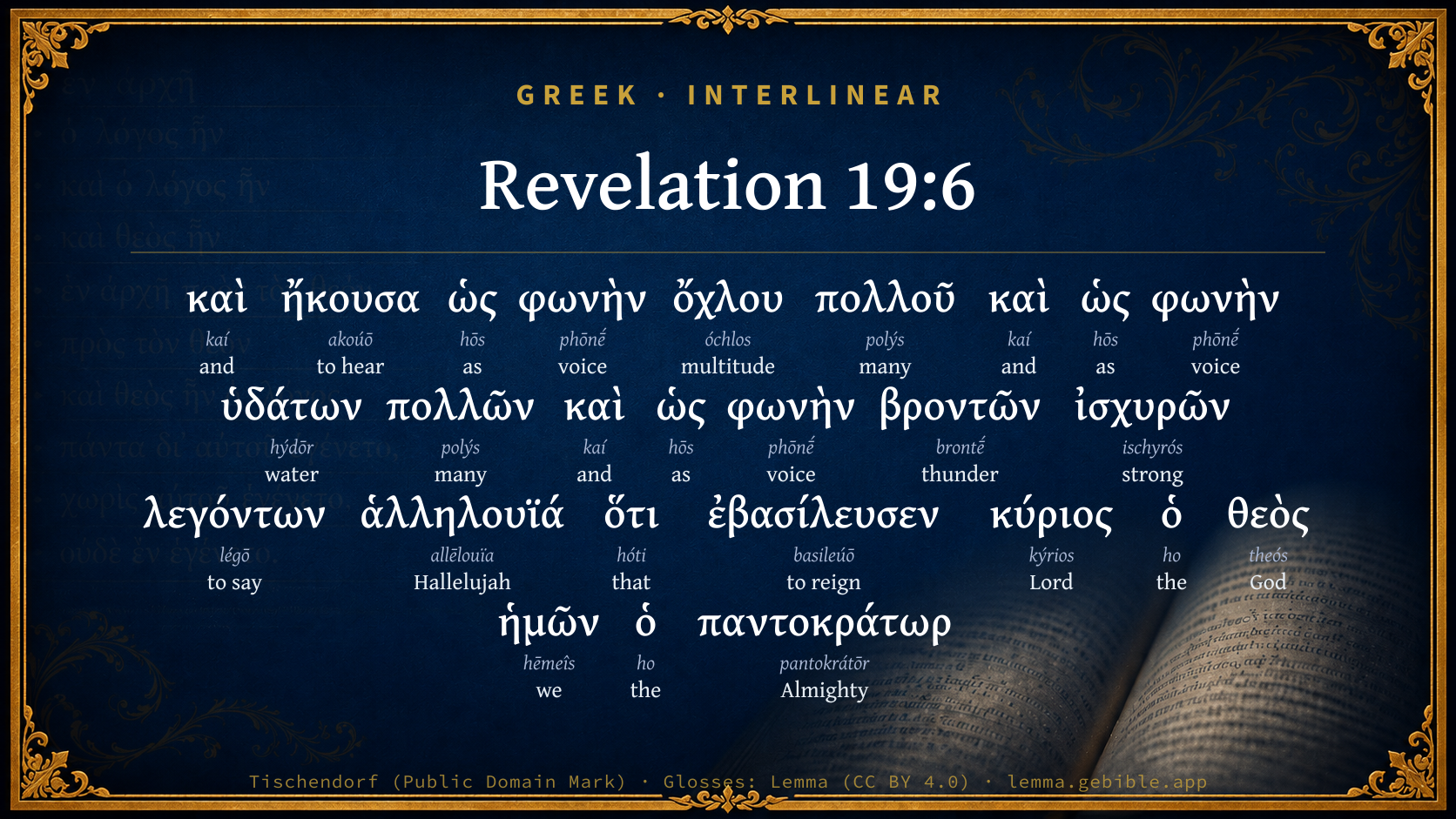
  1. καὶ kaí G2532 “and” Conjunction
  2. ἤκουσα akoúō G191 “to hear” Verb, Aorist, Active, Indicative, 1st person, Singular
  3. ὡς hōs G5613 “as” Adverb
  4. φωνὴν phōnḗ G5456 “voice” Noun, Accusative, Singular, Feminine
  5. ὄχλου óchlos G3793 “multitude” Noun, Genitive, Singular, Masculine
  6. πολλοῦ polýs G4183 “many” Adjective, Genitive, Singular, Masculine
  7. καὶ kaí G2532 “and” Conjunction
  8. ὡς hōs G5613 “as” Adverb
  9. φωνὴν phōnḗ G5456 “voice” Noun, Accusative, Singular, Feminine
  10. ὑδάτων hýdōr G5204 “water” Noun, Genitive, Plural, Neuter
  11. πολλῶν polýs G4183 “many” Adjective, Genitive, Plural, Neuter
  12. καὶ kaí G2532 “and” Conjunction
  13. ὡς hōs G5613 “as” Adverb
  14. φωνὴν phōnḗ G5456 “voice” Noun, Accusative, Singular, Feminine
  15. βροντῶν brontḗ G1027 “thunder” Noun, Genitive, Plural, Feminine
  16. ἰσχυρῶν ischyrós G2478 “strong” Adjective, Genitive, Plural, Feminine
  17. λεγόντων légō G3004 “to say” Verb, Present, Active, Participle, Genitive, Plural, Masculine
  18. ὅτι hóti G3754 “that” Conjunction
  19. ἐβασίλευσεν basileúō G936 “to reign” Verb, Aorist, Active, Indicative, 3rd person, Singular
  20. κύριος kýrios G2962 “Lord” Noun, Nominative, Singular, Masculine
  21. ὁ ho G3588 “the” Article, Nominative, Singular, Masculine
  22. θεὸς theós G2316 “God” Noun, Nominative, Singular, Masculine
  23. ἡμῶν hēmeîs G2249 “we” Personal pronoun, 1st person, Genitive, Plural
  24. ὁ ho G3588 “the” Article, Nominative, Singular, Masculine
  25. παντοκράτωρ pantokrátōr G3841 “Almighty” Noun, Nominative, Singular, Masculine

About this verse

These counts appear in no published source. They are computed here, from the morphology-tagged text and Lemma’s own curated glosses. What Lemma adds →

26
words
18
distinct lemmas
Revelation
section

Notable vocabulary

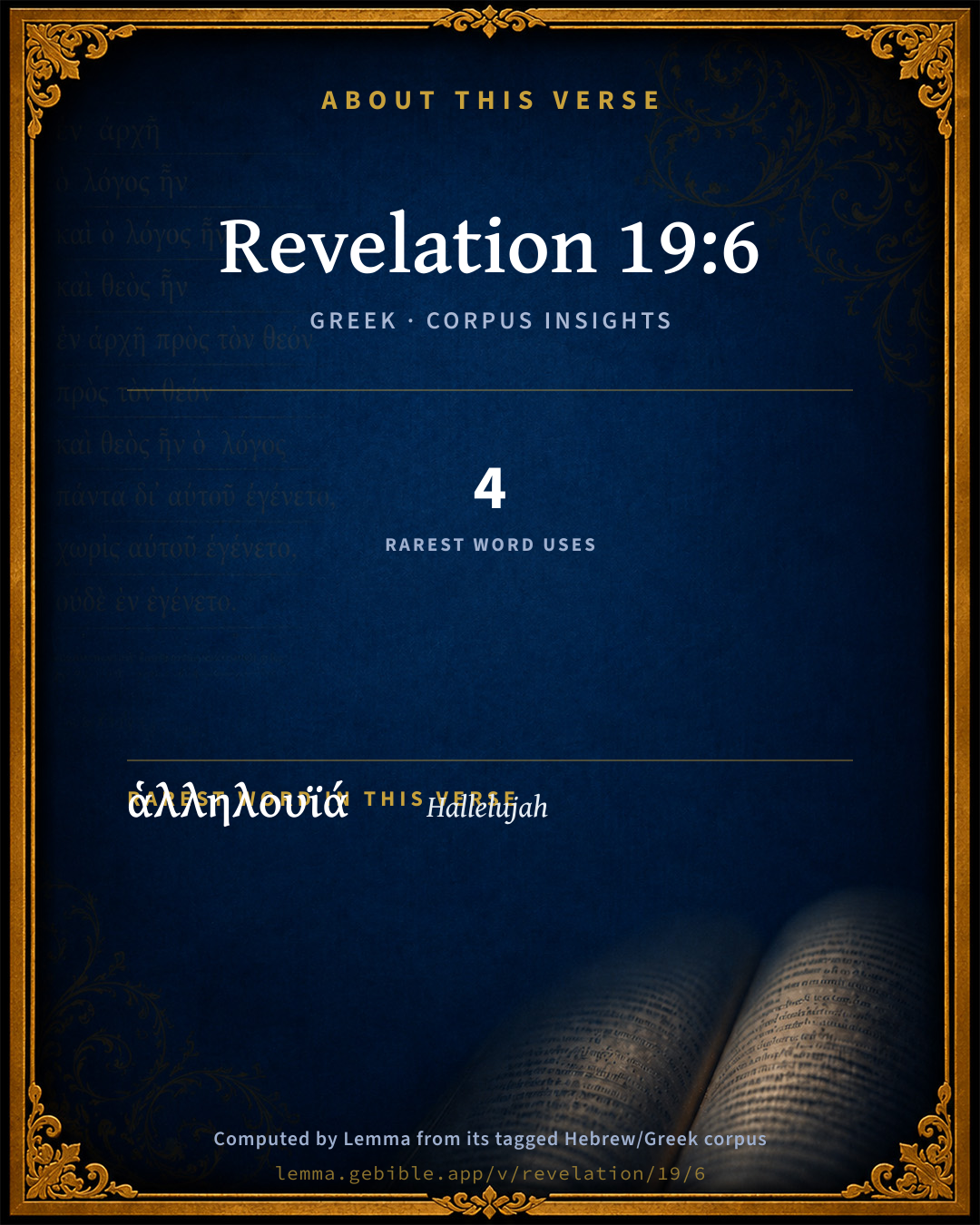
The rarest word here is ἁλληλουϊά Hallelujah G239 — appearing just 4 times in the whole Greek New Testament.

Shared distinctive vocabulary

ἁλληλουϊά Hallelujah G239 occurs in 4 verses of the Greek New Testament. Also found in:

Repetition

Words recur within this verse:

Cross-references

23

Topical passages linked to Revelation 19:6 in the Treasury of Scripture Knowledge — connected by theme and wording, ordered by reader-vote popularity; previews shown in the World English Bible.

  • Psalms 97:1 Yahweh reigns! Let the earth rejoice! Let the multitude of islands be glad!
  • Revelation 14:2 I heard a sound from heaven, like the sound of many waters, and like the sound of a great thunder. The sound which I heard was like that of harpists playing on their harps.
  • Psalms 29:3–9 Yahweh's voice is on the waters. The God of glory thunders, even Yahweh on many waters.
  • Psalms 93:1 Yahweh reigns! He is clothed with majesty! Yahweh is armed with strength. The world also is established. It can't be moved.
  • Psalms 99:1 Yahweh reigns! Let the peoples tremble. He sits enthroned among the cherubim. Let the earth be moved.
  • Ezekiel 1:24 When they went, I heard the noise of their wings like the noise of great waters, like the voice of the Almighty, a noise of tumult like the noise of a host: when they stood, they let down their wings.
  • Revelation 1:15 His feet were like burnished brass, as if it had been refined in a furnace. His voice was like the voice of many waters.
  • Revelation 6:1 I saw that the Lamb opened one of the seven seals, and I heard one of the four living creatures saying, as with a voice of thunder, "Come and see!"
  • Revelation 19:1 After these things I heard something like a loud voice of a great multitude in heaven, saying, "Hallelujah! Salvation, power, and glory belong to our God:
  • Psalms 97:12 Be glad in Yahweh, you righteous people! Give thanks to his holy Name.
  • Revelation 11:15–18 The seventh angel sounded, and great voices in heaven followed, saying, "The kingdom of the world has become the Kingdom of our Lord, and of his Christ. He will reign forever and ever!"
  • Job 40:9 Or have you an arm like God? Can you thunder with a voice like him?
  • Psalms 77:18 The voice of your thunder was in the whirlwind. The lightnings lit up the world. The earth trembled and shook.
  • Isaiah 52:7 How beautiful on the mountains are the feet of him who brings good news, who publishes peace, who brings good news of good, who publishes salvation, who says to Zion, Your God reigns!
  • Ezekiel 43:2 Behold, the glory of the God of Israel came from the way of the east: and his voice was like the sound of many waters; and the earth shined with his glory.
  • Revelation 4:5 Out of the throne proceed lightnings, sounds, and thunders. There were seven lamps of fire burning before his throne, which are the seven Spirits of God.
  • Revelation 8:5 The angel took the censer, and he filled it with the fire of the altar, and threw it on the earth. There followed thunders, sounds, lightnings, and an earthquake.
  • Revelation 12:10 I heard a loud voice in heaven, saying, "Now is come the salvation, the power, and the Kingdom of our God, and the authority of his Christ; for the accuser of our brothers has been thrown down, who accuses them before our God day and night.
  • Revelation 21:22 I saw no temple in it, for the Lord God, the Almighty, and the Lamb, are its temple.
  • Psalms 47:2 For Yahweh Most High is awesome. He is a great King over all the earth.
  • Psalms 47:7 For God is the King of all the earth. Sing praises with understanding.
  • Jeremiah 51:48 Then the heavens and the earth, and all that is therein, shall sing for joy over Babylon; for the destroyers shall come to her from the north, says Yahweh.
  • Matthew 6:13 Bring us not into temptation, but deliver us from the evil one. For yours is the Kingdom, the power, and the glory forever. Amen.'

Cross-references courtesy of OpenBible.info (CC BY 4.0).

Where the printed editions differ

1 variant

Places in this verse where the major printed Greek editions disagree on the wording in a way that affects the translation — a comparison of editions, not a manuscript-by-manuscript collation. The editions are the modern critical texts (Nestlé-Aland 28/27, SBL, Westcott-Hort, Tregelles, Tyndale House) and the traditional texts behind the KJV (the Textus Receptus and the Byzantine/Majority text). It is not a claim about which reading is original.

  1. Extra text
    ἡμῶν

    “of us”

    In NA28NA27TynWHTregByz Not in SBLTR

    ἡμῶν (hēmōn) 'of us' is only in older manuscripts (NA28+NA27+Tyn+WH+Treg+Byz)

Textual data: Translators Amalgamated Greek New Testament (STEPBible TAGNT) · CC BY 4.0.

Commentary

Notes on Revelation 19:6 from classic Christian and Jewish commentators (each source and its license shown beneath its notes). The classic Christian expositions comment on the surrounding passage and are grouped to its opening verse, so a note may address several verses; the Jewish commentaries on the Tanakh (Rashi and others) are per-verse, so they appear only where the commentator wrote on this verse.

Lemma curates 59 commentaries, every one of them public domain or Creative Commons licensed, each selected and text-cleaned for this edition rather than reprinted as found. About our sources →

Joseph Benson's Commentary

Rev 19:6-8. And I heard, &c. — Upon this order from the oracle, the whole church, in obedience to it, began to praise God with loud voices; which might be compared to the sound of many waters, or of mighty thunderings, saying, Alleluia, for the Lord God omnipotent — The Almighty Maker and Upholder of universal nature; reigneth — Among men, more eminently and gloriously than ever before. Let us be glad, &c. — Χαιρωμεν και αγαλλιωμεθα, let us rejoice and exult with transport, and ascribe to him the glory which is so justly due; for the marriage of the Lamb is come — Is near at hand, and will be speedily solemnized. His true church, his faithful servants, are now about to receive public and peculiar marks of his affection in a state of happiness and dignity suitable to their relation to him. The ancient prophets frequently express the favour of God to his people by the affection of a bridegroom to his spouse. See Isa 62:5; Hos 2:19-20; Zep 3:17. And the Church of Christ in the New Testament is often represented under the same similitude of a bride. See Rom 7:4; 2Co 11:2; Eph 5:25, &c. And as marriages used to be celebrated with great joy, this is a proper emblem to show the state of prosperity and happiness to which God will raise his church, after all its sufferings for the sake of truth and righteousness. And his wife hath made herself ready — Even while upon earth, being acquitted from all guilt, purified from all pollution, and adorned with all those graces and virtues which are most excellent in themselves, and most agreeable to him. As if he had said, She is not a harlot tainted with idolatry, but a spouse prepared for her heavenly husband. And to her was granted — By God, from whom all her good qualities proceed; that she should be arrayed in fine linen — Expressive of her purity and holiness; for the fine linen is an emblem of the righteousness of the saints — Including both their justification and sanctification. Thus St. Paul, (Ephesians 5.,) Christ gave himself for his church, that he might sanctify and cleanse it, and present it to himself a glorious church, not having spot, or wrinkle, or any such thing.

Joseph Benson's Commentary on the Old and New Testaments (1811–1818) — public domain. Text from a community e-Sword module.

Tyndale Open Study Notes

Tyndale Open Resources

19:6-8 The focus of the final thunderous Praise the Lord! is that God reigns as the Almighty in complete supremacy (see 1:8; 4:8; 11:17; 15:3; 16:7, 14; 19:15; 21:22).

Tyndale Open Study Notes — © Tyndale Open Resources, licensed CC BY-SA 4.0. Text via the HelloAO Bible API.

Meyer's Critical & Exegetical Commentary

Heinrich August Wilhelm Meyer

Rev_19:6-8. The final chorus, which is likewise opened with hallelujah, passing by the judgment in which already the adorable glory of God has been occupied, points forward especially to the marriage of the Lamb, and, therefore, to the revelation of the glory of God, wherebyafter all enemies have been judgedbelievers are to be beatified. Thus, therefore, the point carried to the full end appears in the pause in the Apocalyptic development marked by the ascriptions of praise (Rev_19:1 sqq.).

ὡς φωνὴν, κ.τ.λ. The explanation given at Rev_19:1 is here established by the fact that the comparison is satisfied not with the ὄχλ. πολλ., but introduces still other things in the same sense.[4038]

λέγοντες. The nom. stands still more out of construction than the ace. See Critical Notes, and cf. Rev_4:1, Rev_5:13.

ὅτι ἐβασίλευσεν. The ὅτι specifying the reason as in Rev_19:2. On the conception ἐβασίλ., cf. Rev_11:17.

ὅτι ἧλθεν ὁ γάμος του ἀρνίου. As the foundation of the present joy, this is likewise to be understood proleptically, like the ἡλθεν, Rev_11:18.[4039] So, correctly, De Wette.[4040] Vitr. is mistaken in his opinion of the state of affairs described, as he even states that the expression ὁ γάμος τοῦ ἀρνίου is synonymous with τὸ δεῖπνον τοῦ γάμου τ. ἀρν., in order that both may in the same way[4041] refer to the glorious state of the Church still to be expected within this temporal life. In the directly opposite interest, Züll. reaches the statement that ὁ γάμος τοῦ ἀρνίου is like τὸ δεῖπν. τ. γάμ. τ. ἀρν., and that both expressions designate, not the future marriage itself,[4042] but the preliminary festival of the Messiahs marriage, i.e., the one thousand years reign.[4043] But the marriage of the Lamb with his bride, i.e., the entire assembly of believers,[4044] is, in fact, nothing else than the distribution of the eternal reward of grace on the part of the coming Lord to his believers, who then enter with Him into the full glory of the heavenly life.[4045] What the final promises of the epistles, chs. 2 and 3, proclaim under various figures with respect to individuals,[4046] is represented as pertaining to the entire Church as the bride of the coming Lord, under the figure of the marriage of the Lamb, and, therefore, as the most intimate and eternally uninterrupted fellowship with Him who has redeemed the Church with his own blood.[4047] An application to individuals follows also in Rev_19:9. The proleptical (ὴλθεν, ἡτοίμασεν, ἐδόθη) allusion to the blessed fulfilment of the mystery of God,[4048] that has now not yet, in fact, occurred, is here the more suitable in the mouths of the heavenly beings, since, in fact, an act already of the final judgmentviz., the destruction of the great harlothas been executed, and, consequently, the actual beginning of that fulfilment has been made.

ἠ γννὴ αὐτ. The expression is entirely appropriate to the bride,[4049] so that the alteration ἡ νύμφη αὐτ.[4050] appears groundless.

ἡτοίμασεν ἑαυτήν. As becomes the bride who with joy awaits the coming of her bridegroom.[4051] An important part of her is expressly emphasized in Rev_19:8, in conformity with the figure ΚΑῚ ἘΔΌΘΗ ΑὙΤῇ, Κ.Τ.Λ., and then interpreted by John, ΤῸ ΓᾺΡ ΒΎΣΣΙΝΟΝ, Κ.Τ.Λ.

On ἘΔΌΘΗ ΑὐΤῆ ἽΝΑ, cf. Rev_6:4.

ΒΎΣΣ. ΛΑΜΠΡῸΝ ΚΑΘΑΡΌΝ. Excellently, Grot.: You see here the dignified garb, as that of a matron, not ostentatious, like that of the harlot previously described. That really distinct references are intended by ΛΑΜΠΡΌΝ and ΚΑΘΑΡΌΝ,[4052] is not to be inferred at all events from the interpretation that follows. Cf. also Rev_7:14. Meanwhile, it is in itself correct to distinguish the negative innocency of the life from the positive practice of virtue.

ΤᾺ ΔΙΚΑΙΏΜΑΤΑ ΤῶΝ ἉΓΊΩΝ ἘΣΤΊΝ. Cf. a similar interpretation, Rev_5:8. The form of the expression,[4053] and the real parallel,[4054] suggest only just deeds in which the saints have maintained their fidelity. On the contrary, Ew. ii.: declaration of righteousness; also Meyer, on Rom_5:16 : the divine sentence of justification which the saints have received. But the plural form resists this mode of exposition, which, so far as the subject itself is concerned, refers to the writer of the Apocalypse a thought of so peculiarly a Pauline stamp as does not occur elsewhere in the Apoc. Of course, an allusion to the grace bestowed by God, as the ground and source of the δικαιώματα belonging to the saints, is contained in a delicate way in the ἘΔΌΘΗ ΑὐΤῇ ἽΝΑ, Κ.Τ.Λ.; but just this reference to the Divine giving prevents us, on the other hand, from defining the ΔΙΚΑΙὩΜΑΤΑ as a Divine activity, but allows us to think only of the just deeds of saints.[4055] In this result Gebhardt[4056] and Klief. also harmonize. [See Note LXXXIV., p. 461.]

[4038] Cf. Rev_1:15.

[4039] Cf. Rev_14:7.

[4040] Cf. also Hengstenb.

[4041] Cf. Rev_21:9 sqq.

[4042] Rev_21:9 sqq.

[4043] Rev_20:4 sqq.

[4044] Rev_21:9. Rev_22:17. Cf. Rev_12:1; Isa_54:1 sqq.; Hos_2:19 sq.; Eze_16:7 sqq.; Eph_5:25.

[4045] Cf. Rev_11:18, Rev_22:12.

[4046] Cf. especially Rev_3:20.

[4047] Cf. Rev_5:6; Rev_5:9, Rev_7:17, Rev_14:1.

[4048] Cf. Rev_10:7.

[4049] Gen_29:20; Deu_22:24; Mat_1:20.

[4050] א. Cf. Rev_21:9.

[4051] Cf. Rev_22:17, Rev_21:2; Mat_25:10 : αἱ ἔτοιμοι.

[4052] Hengstenb.: The brilliant glory of a virtuous life, and spotless purity from sins.

[4053] Cf. Rev_15:4.

[4054] Cf. Rev_14:4 sq.

[4055] Cf. the ἀδικήματα, Rev_18:5.

[4056] p. 176.

NOTES BY THE AMERICAN EDITOR

LXXXIV. Rev_19:8. τὰ δικαιώματα τῶν ἁγίων

Some of the older Protestant interpreters explain the plural δικαιώματα, as determined by the fact that it comprises the two righteousnesses of the believer, the imputed righteousness of Christ and his own inherent righteousness. So Forbes in Pooles Synopsis. Calov. also, upon the ground that the imputation of Christs righteousness to the believer will never cease. Others, like Cluverus, maintain that each saint has a δικαίωμα; and, therefore, there are δικαιώματα, because there are many saints. So Alford: The plural is probably distributive, implying not many δικαιώματα to each one, as if they were merely good deeds, but one δικαίωμα to each of the saints, enveloping him as in a pure white robe of righteousness. John Gerhard (L. C., viii. 167) also adopts the distributive use of the plural, although referring it to imputed righteousness. Philippi (Kirch. Glaubenslehre, v. 1, 252), however, concurs with Düsterdieck: The right deeds of the saints are the robe of fine linen, to be clothed in which is granted them (Rev_19:8).

Meyer — Critical and Exegetical Commentary on the New Testament — English translation by Peter Christie, edited by Frederick Crombie (T&T Clark, 1880) — public domain. Text from a community e-Sword module.

Expositor's Greek Testament

ed. W. Robertson Nicoll

Rev 19:6 . S ingeniously but awkwardly punctuates after “Hallelujah,” connecting ὅτι κ . τ . λ ., with the subsequent χαίρωμεν . ἐβασίλευσε κ . τ . λ . A sublimated version of the old watchword ΚΥΡΙΟΣ ΑΥΤΟΣ ΒΑΣΙΛΕΥΣ ΗΜΩΝ which had been the rallying cry of pious Jews and especially of the Pharisees ( e.g. , Ps. Sol. 17:1, 2, 38, 51, 2:34 36, 5:20, 21) during the conflict with Roman aggression. This divine epithalamium is the last song of praise in the Apocalypse. At this point also the writer reverts for a moment to the Lamb, absent since Rev 17:14 from his pages, and absent again till Rev 21:9 .

The Expositor's Greek Testament, edited by W. Robertson Nicoll (1897–1910) — public domain. Text from a community e-Sword module.

Geneva Bible (1599)

Geneva Bible translators

Without the Temple in heaven.

Geneva Bible (1599) marginal notes — public domain. Text via Bolls.life.

Jamieson, Fausset & Brown

Robert Jamieson, A. R. Fausset & David Brown

many waters--Contrast the "many waters" on which the whore sitteth (Rev 17:1). This verse is the hearty response to the stirring call, "Alleluia! Praise our God" (Rev 19:4-5).

the Lord God omnipotent--Greek, "the Omnipotent."

reigneth--literally, "reigned": hence reigneth once for all. His reign is a fact already established. Babylon, the harlot, was one great hindrance to His reign being recognized. Her overthrow now clears the way for His advent to reign; therefore, not merely Rome, but the whole of Christendom in so far as it is carnal and compromised Christ for the world, is comprehended in the term "harlot." The beast hardly arises when he at once "goeth into perdition": so that Christ is prophetically considered as already reigning, so soon does His advent follow the judgment on the harlot.

Jamieson, Fausset & Brown — Commentary Critical and Explanatory on the Whole Bible (1871) — public domain (CC PDM 1.0). Text via the HelloAO Bible API.

Adam Clarke's Commentary

Verse 6. The voice of a great multitude] This is the catholic or universal Church of God gathered from among the Gentiles.

The Lord God Omnipotent reigneth.] Εβασιλευσε Κυριος ὁ Θεος ὁ παντοκρατωρ. Many excellent MSS., most of the versions, with Andreas and Arethas, the two most ancient commentators on this book, add ημων, our, after ο θεος and according to this the text reads emphatically thus: OUR Lord God, the Almighty, reigneth. What consolation to every genuine Christian that HIS Lord and God is the Almighty, and that this Almighty never trusts the reins of the government of the universe out of his hands! What therefore has his Church to fear?

Adam Clarke's Commentary on the Bible (1810–1826) — public domain. Text from a community e-Sword/MySword module.

The Cambridge Bible for Schools and Colleges

gen. ed. J. J. S. Perowne

6. great multitude] Rev_19:1, where the words rendered “much people” are the same.

many waters] Rev_1:15, Rev_14:2.

mighty thunderings] Rev_6:1, Rev_14:2.

the Lord God Omnipotent] Read, the Lord our God: and the last word is that usually rendered “Almighty”—rather a name “the Almighty” than an epithet—see on Rev_1:8.

reigneth] The only translation that will give the sense without cumbrousness; though “hath taken the kingdom” might express the tense of the original more accurately.

The Cambridge Bible for Schools and Colleges (gen. ed. J. J. S. Perowne; Cambridge University Press, 1878–1918) — public domain. Text from a community e-Sword module.

John Gill's Exposition

And I heard, as it were, the voice of a great multitude,.... Even of all the servants of the Lord, and them that fear him, small and great; a vast multitude of converted Jews and Gentiles, in the several parts of the world, who in answer to the voice out of the throne, which came with great power and energy, lift up their voices in praise to God, both for their own conversion, and for the downfall of Babylon:

and as the voice of many waters: falling down in a descent, or in rough and rocky places, which make a great noise, and is heard afar off; and such must be the united voice of so great a multitude of converts as will be gathered together everywhere at this time: the same metaphor is used of the voice of Christ in Rev 1:15

and as the voice of mighty thunderings; violent claps of it, which are sometimes so loud that they rend the very heavens, and strike the inhabitants of the earth with the utmost consternation: these are the same voices which will be heard in the church when the seventh angel sounds his trumpet, Rev 11:15

saying, Alleluia; or praise ye the Lord; they will call upon one another to celebrate the praises of God, on account of the above things, in the same manner, and using the same word the people in heaven, and the four and twenty elders and four living creatures, do; and this is the fourth time the word is used in this context, and confirms the observation that has been made, that this vision refers to the conversion of the Jews, which will quickly follow the destruction of Rome: and the Jews themselves have a notion, that when Rome is destroyed the Messiah will come; and so he will in his spiritual reign. They say (o),

"our redemption will be immediately upon the destruction of Rome.''

And again (p),

"the root of our redemption depends upon the destruction of Rome.''

The reason for their saying "hallelujah" follows,

for the Lord God omnipotent reigneth; by whom is meant the Lord Jesus Christ, who is Lord of all, and God over all, blessed for ever, and is the Almighty; and though he was set up as King over the holy hill of Zion, and has reigned over the church in every age, and came as King into this world, though his kingdom was not of it, and at his resurrection was declared Lord and Christ, and his kingdom was then more manifest, and he has ever since displayed his kingly power in defending his church, and defeating the enemies of it; yet now will he reign more visibly and gloriously, his kingdom will be enlarged from one end of the earth to the other, and he will be King over all the earth, which will occasion great joy to Jews and Gentiles; see Psa 47:1 and See Gill on Rev 11:17.

(o) Tzeror Hammor, fol. 148. 1. (p) Tzeror Hammor, fol. 163. 4.

John Gill's Exposition of the Whole Bible (1746–1763) — public domain (CC PDM 1.0). Text via the HelloAO Bible API.

Trapp's Complete Commentary

John Trapp

6 And I heard as it were the voice of a great multitude, and as the voice of many waters, and as the voice of mighty thunderings, saying, Alleluia: for the Lord God omnipotent reigneth.

Ver. 6. And I heard as it were the voice] See how morigerous the saints are, and ready-hearted to obey God. No sooner are they bidden to praise God, but they are at it, dicto citius. See the like Psa 27:8.

Saying, Alleluia] This was the Hosanna Rabba, as the Jews call it; the victoria Halleluiatica, as the old Britons called their victory over the Saxons. The story is this. Under the conduct of Germanus (here in Britain), who came over from France to subdue the Pelagian heresy (which then prevailed among us), against a mighty army of Saxons and Picts, the Britons prevailed only by the three times pronouncing the word Hallelujah; which voice echoing and redoubling from the acclamation of his followers among the mountains, near to which the enemy had encamped, frightened them and won the conquest, upon which it was called victoria Halleluiatica. (Dr Ussier, de Brit. Eccles. Primord. p. 332.)

Reigneth] i.e. He now maketh it appear that he reigneth, which Averroes and some other of the world’s wizards doubted, yea, denied; because they saw bad men prosper, good men suffer.

John Trapp, A Commentary or Exposition upon All the Books of the Old and New Testament (1647–1656) — public domain. Text from a community e-Sword module.

Albert Barnes' Notes on the Bible

And I heard as it were the voice of a great multitude - In Rev 19:1 he says that he “heard a great voice of much people”; here he says he “heard as it were a voice of a great multitude.” That is, in the former case he heard a shout that he at once recognized as the voice of a great multitude of persons; here he says that he heard a sound not distinctly recognized at first as such, but which resembled such a shout of a multitude. In the former case it was distinct; here it was confused - bearing a resemblance to the sound of roaring waters, or to muttering thunder, but less distinct than the former. This phrase would imply:

(a)A louder sound; and,

(b)That the sound was more remote, and therefore less clear and distinct.

And as the voice of many waters - The comparison of the voices of a host of people with the roar of mighty waters is not uncommon in the Scriptures. See the notes on Isa 17:12-13. So in Homer:

“The monarch spoke, and straight a murmur rose,

Loud as the surges when the tempest blows;

That dash’d on broken rocks tumultuous roar,

And foam and thunder on the stony shore.”

And as the voice of mighty thunderings - The loud, deep, heavy voice of thunder. The distant shouts of a multitude may properly be represented by the sound of heavy thunder.

Saying, Alleluia - See the notes on Rev 19:1. This is the fourth time in which this is uttered as expressive of the joy of the heavenly hosts in view of the overthrow of the enemies of the church. The occasion will be worthy of this emphatic expression of joy.

For the Lord God omnipotent reigneth - Yahweh - God Almighty - the true God. The meaning is, that as the last enemy of the church is destroyed, he now truly reigns. This is the result of his power, and therefore it is proper that he should be praised as the “omnipotent” or “Almighty God” - for he has shown that he can overcome all his enemies, and bring the world to his feet.

Albert Barnes' Notes on the Bible (1834–1885) — public domain. Text from a community e-Sword/MySword module.

Haydock's Catholic Bible Commentary

The voice of a great multitude. Menochius applies this voice to the multitude of Angels and saints, which from its strength may be compared to the voice of rushing waters, and because of the terror with which it strikes the wicked. Pastorini understands by this voice of many waters, the voices of many Angels that preside over the nations, denoted by waters, which had all before groaned under the tyranny of antichrist; and the voice of great thunders, that of the Angel who presides over fire, which, as employed in military engines, by its explosion resembles thunder. It must be observed that the latter author refers it to the last stage of the world.

George Leo Haydock (1774–1849), Haydock's Catholic Family Bible and Commentary, 1859 edition — public domain. Excludes Psalms (Douay-Rheims chapter numbering differs from Protestant) and Deuterocanonical books (Catholic canon only).

Matthew Poole's English Annotations

By this multitude most understand the church. Some understand the Jews as well as the Gentiles, supposing that they shall be before this time converted and added to the church. Others think their conversion is the marriage spoken of in the next verse. The saints do not rejoice in the ruin of their adversaries, but in the glory of God advanced by it, and as his kingdom is by it promoted.

Matthew Poole's English Annotations on the Holy Bible (1683–1685) — public domain. Text from a community e-Sword/MySword module.

Whedon's Commentary on the Bible

Daniel D. Whedon

6. The responsive song has now come to a climax. First, there was a great voice from heaven; then, a repeat; third, a response from the elders; fourth, a response from the throne; and last, this universal voice as of waters and thunderings, in which the seer is drowned.

Reigneth—Aorist, has reigned. That is, has acted the king—has decisively ruled in destroying the harlot; for that is the theme of all these responsive chants.

Daniel D. Whedon (gen. ed.), Commentary on the Old and New Testaments (1874–1909) — public domain. Text from a community e-Sword module.

The Pulpit Commentary

And I heard as it were the voice of a great multitude. This is the response to the invitation just uttered in ver. 5. Again "the voice of a multitude," as in ver. 1. And as the voice of many waters. That is, in its suggestiveness of great power and magnitude. (cf. Rev_1:15 Rev_14:2 Psa_93:3 Jer_51:16) And as the voice of mighty thunderings, saying. A repetition of the idea contained in the preceding clause. The case of the participle is doubtful; A, P, and others have legontwn ; many cursives a has legontav ; legouswn ; the nominative legontev is found in B and others. Alleluia: for the Lord God omnipotent reigneth. (On "Hallelujah," see ver. 1) These words connect the present passage with Rev_17:14. They exhibit, as it were, the culminating reason for this adoration of God. He has exhibited his almighty power in the overthrow of Babylon, who said, "I sit a queen;" and in the overthrow (which has yet to be narrated more fully) of the kings of the earth.

The Pulpit Commentary (1880–1919), ed. H.D.M. Spence-Jones & Joseph S. Exell — public domain. Text from a community e-Sword module.

John Wesley's Explanatory Notes

And I heard the voice of a great multitude. So all his servants did praise him. The Almighty reigneth - More eminently and gloriously than ever before.

John Wesley, Explanatory Notes Upon the Whole Bible (1754–1765) — public domain. Text via the GEBible commentary corpus.

Burkitt's Expository Notes on the New Testament

William Burkitt

In the former verses an exhortation was given to all the saints to abound in the duty of thanksgiving; here we find them unanimously addressing themselves to the practice and peformance of that duty; and accordingly they are called here a great multitiude, their voice like many waters for unity, and like mighty thunderings, denoting that zeal and fervour which is in their thanksgivings.

Where note, How exceedingly the church doth rejoice and triumph, not so much in Babylon’s ruin, as in the glory of God advanced, and as his own kingdom is promoted by it.

Observe, 2. A superadded ground and reason for this extraordinary joy and rejoicing, For the marriage of the Lamb is come, and his wife hath made herself ready.

By the marriage of the Lamb, Mr. Mede and Dr. More do understand the conversion of the Jews; by the Lamb’s wife, the nation of the Jews, so called in regard of that relation which they stand in to God, by virtue of the covenant; and she is said to have made herself ready, namely, by the wedding-garment of faith, to accept of her formerly despised Bridegroom.

Note, That it is probably conjectured by some, that the conversion of the Jews shall soon follow the destruction of antichrist, for his idolatry and persecution are great scandals to the Jews, and mighty stumbling-blocks in the way of their conversion.

And whereas it is added, That it was granted to her to be arrayed in fine linen, the words do seem to import, that the Jews shall in due time be brought in to be clothed with it, and that an holy emulation shall be found between the Gentiles and them, which shall most and best adorn the profession of the gospel.

From the whole note, How the church is called Christ’s wife. Christ and she are here betrothed to each other, but at the great day the marriage will be consummated.

Note farther, The church’s spiritual nakedness in herself considered, It was granted to her to be arrayed in fine linen; she had it not of herself, but it was put on by Christ; he decks and dresses his own bride with the ornaments of grace here, and glory hereafter, that he may present it to himself a glorious church, without spot or wrinkle, holy, and without blemish.

William Burkitt's Expository Notes on the New Testament (1700–1703) — public domain. Text from a community e-Sword module.

The People's New Testament

B. W. Johnson

6, 7. I heard … a great multitude. This is in response to the call from the throne. The Lord God omnipotent reigneth. This is demonstrated in the overthrow of the wicked.

B. W. Johnson's The People's New Testament with Notes (1889–1891) — public domain. Electronic text from the Christian Classics Ethereal Library (CCEL) ThML edition.

unfoldingWord translationNotes

Door43 World Missions Community

Then I heard what sounded like the voice of a great number of people, like the roar of many waters, and like loud crashes of thunder

John speaks of what he is hearing as if it were like the sound made by a very large crowd of people, a large body of rushing water, and very loud thunder. (See: Simile)

Hallelujah

This word means "Praise God" or "Let us praise God." See how you translated this in Revelation 19:1.

For the Lord

"Because the Lord"

translationWords

voice

water

lord

reign

God

unfoldingWord translationNotes — © Distant Shores Media and the Door43 World Missions Community, licensed CC BY-SA 4.0. Source: git.door43.org/Door43/en_tn.

Cambridge Greek Testament for Schools and Colleges

6–9. THE PROCLAMATION OF THE MARRIAGE OF THE LAMB

6. ὡς φωνήν. 1* Primas[704] omit ὡς.

[704] Primasius, edited by Haussleiter.

ὄχλου πολλοῦ. Primas[705] tubarum multarum. So Amb. Aut[706], Beat[707] quasi vocem tubae magnae.

[705] Primasius, edited by Haussleiter.

[706] Aut. Ambrosius Autpertus or Ansbertus.

[707] Beatus, quoted by Haussleiter.

λεγόντων. א λεγούσων, B2 λέγοντες.

δῶμεν. Lach[708] reads δώσομεν with אcA.

[708] Lachmann’s larger edition.

6. ὄχλου πολλοῦ. Rev 19:1.

ὑδάτων πολλῶν. Rev 1:15, Rev 14:2.

βροντῶν ἰσχυρῶν. Rev 6:1, Rev 14:2.

ἐβασίλευσεν. The aorist is quite appropriate though quite untranslateable. By destroying Babylon which reigned over all kings, God took the Kingdom and is glorified for this act. R. V[748] rightly retains the present of A. V[749]

[748] Revised Version.

[749] Authorised Version.

ὁ παντοκράτωρ. Rather a name than an epithet, see on Rev 1:8.

Cambridge Greek Testament for Schools and Colleges (Cambridge University Press, 1896; 21 vols, various authors incl. Carr, Maclear, Plummer, Farrar, Lumby, Moule, M. R. James, Simcox) — public domain. Text from a community e-Sword module.

Lesson kit

Teaching starters — assembled from the data on this page, not authored interpretation. Every prompt links to the verse data it draws on. Edit before teaching.

Revelation, in the Revelation, opens this verse with 26 words (18 distinct Greek lemmas). Its most distinctive word is allēlouïa (“Hallelujah”). A historical commentator’s framing appears above. Read the whole chapter for the surrounding context.

Discussion questions

  1. The word allēlouïa carries the sense “Hallelujah.” How does it shape the verse?
  2. How does Revelation 19:1, which shares the word «Hallelujah», read alongside this verse?
  3. What does the repetition of “voice” (3× in this one verse) do in this verse?
  4. These translations render this verse differently; the difference is in the English rendering, not the original. What questions does that raise?
  5. Compare how Joseph Benson's Commentary and Tyndale Open Study Notes read this verse. Where do they agree or differ?

Things to notice

Reading settings

Reading text

Shown beneath each verse's original-language words.

Old Testament
Old Testament edition

Read the OT as the Masoretic Hebrew (MT) or the Greek Septuagint (LXX).

English shown for the Greek Septuagint (in the Hebrew ↔ Greek comparison).

Comparing translations? Open the Compare panel on any verse page to stack up to four side by side.