

James 5:11
Greek (Tischendorf 8th ed.) James 5:11 appears in the Greek New Testament. The text above is from the Tischendorf 8th edition. Each word links to its Strong’s number and a concise gloss. Click any word for its full Thayer’s Greek Lexicon entry.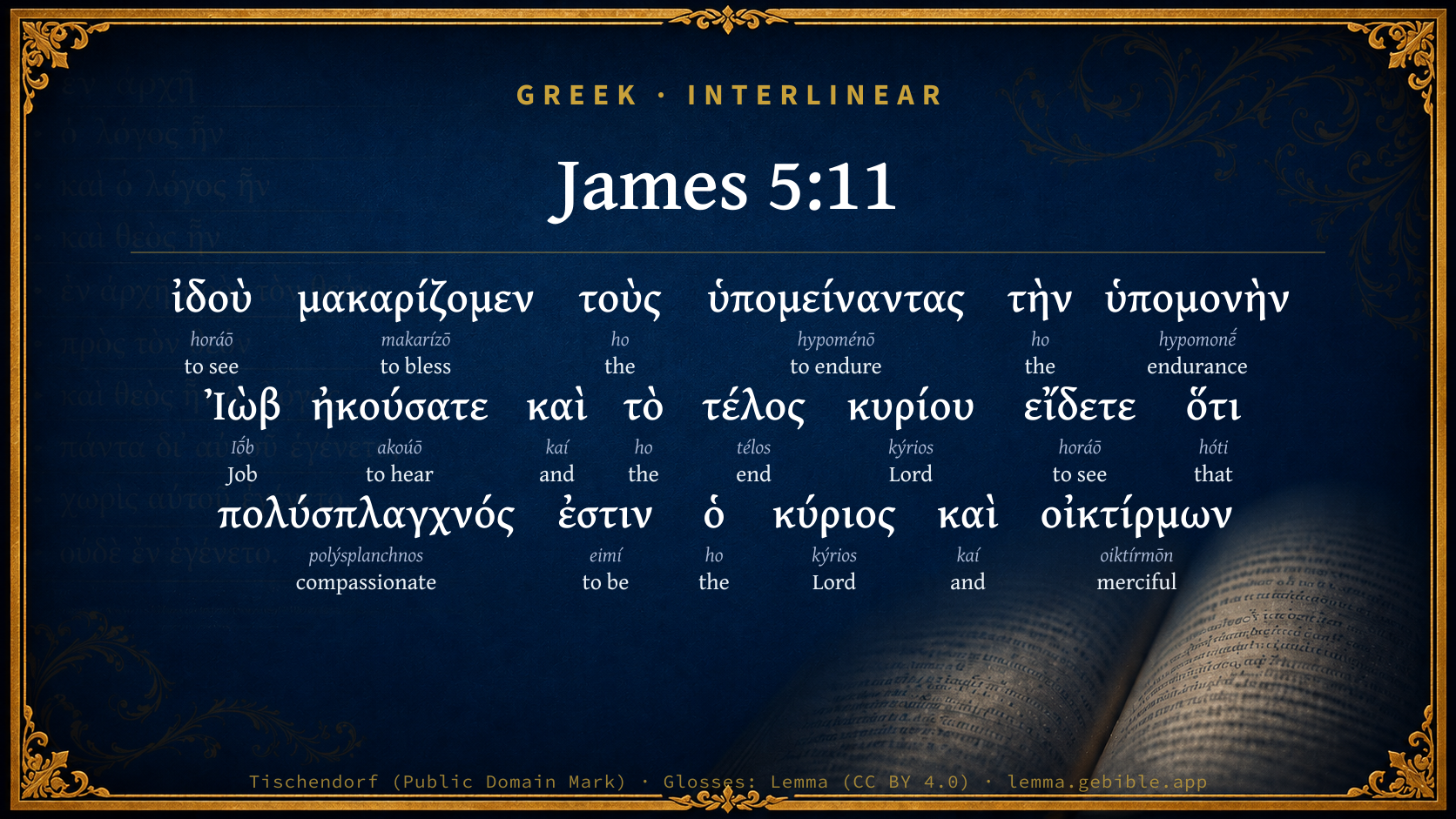
Behold, we call them blessed who endured. You have heard of the patience of Job, and have seen the Lord in the outcome, and how the Lord is full of compassion and mercy.
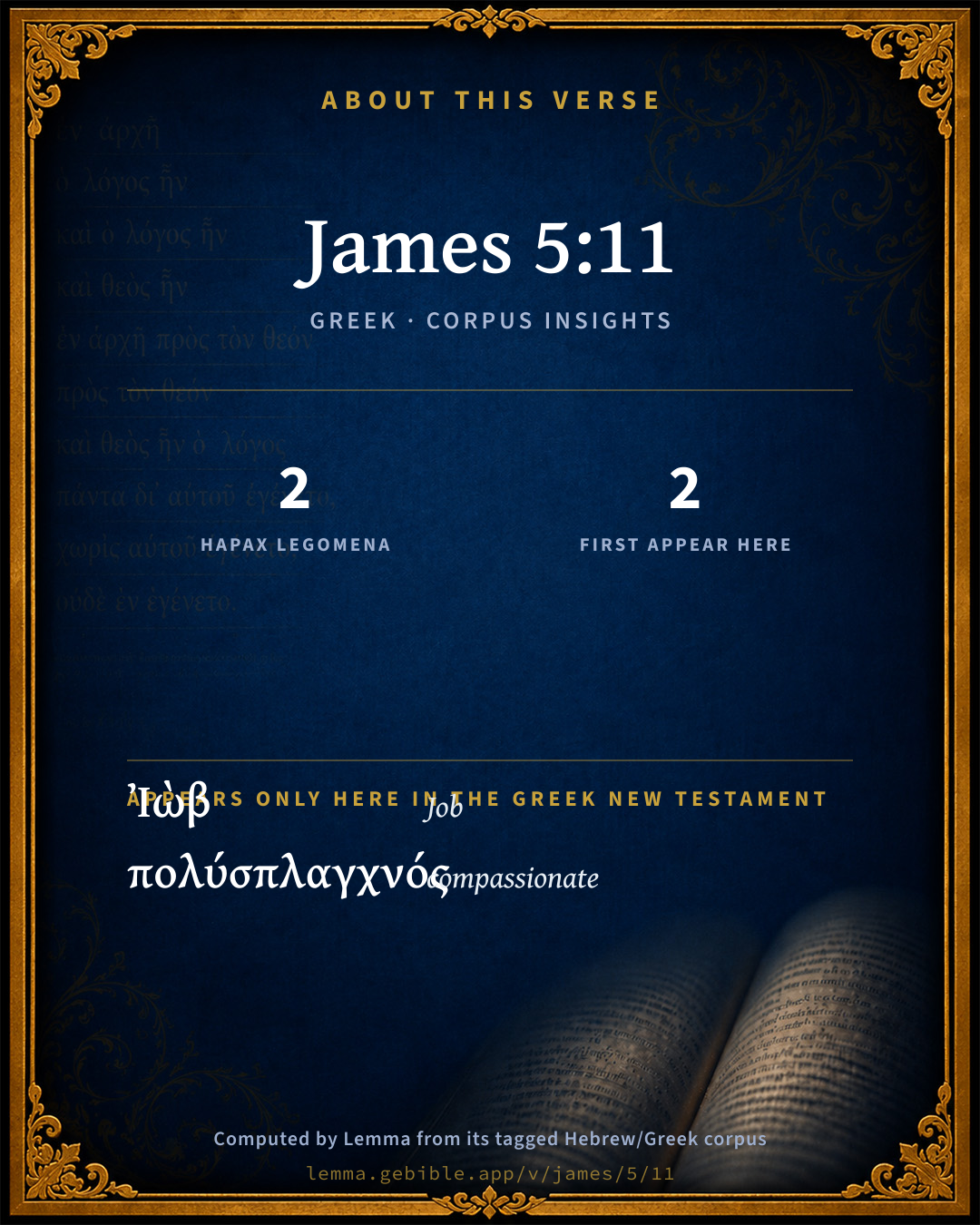
- 2 hapax legomena — only here in the Greek New Testament
- 2 first appearances in the Greek New Testament
Download a study sheet
One document with this verse’s original text, its word-by-word gloss line, the meaning frame, cross-references with their text, attributed commentary, and full source and license credits — printable, and it pastes into notes with its structure intact.
This verse Autodidact and up
A passage Seminary Student
Up to 50 verses in one chapter. A passage sheet keeps up to 6 commentary sources and 12 cross-references per verse, in the order this page ranks them, and says so on the sheet whenever that leaves anything out. Ask for a single verse and you get the Autodidact verse sheet above.
Everything on this page stays free to read, with no account — the sheet is a download of what is already on screen, not access to it.
Compare translations 3
The same verse in 3 English versions, stacked beneath the original-language interlinear above. Click any original word for its lexicon entry.
Each is an independent rendering of the whole verse — the interlinear is not word-aligned to these translations.
Highlighted words mark where these versions differ — a whole-verse word diff, not a word-by-word alignment.
-
World English Bible Public Domain
Behold, we call them blessed who endured. You have heard of the patience of Job, and have seen the Lord in the outcome, and how the Lord is full of compassion and mercy.
-
King James Version Public Domain
Behold, we count them happy which endure. Ye have heard of the patience of Job, and have seen the end of the Lord; that the Lord is very pitiful, and of tender mercy.
-
unfoldingWord Literal Text CC BY-SA 4.0
Behold, we call blessed the ones having endured. You have heard of the endurance of Job, and you have seen the end of the Lord, that the Lord is greatly compassionate and merciful.
unfoldingWord Literal Text — © unfoldingWord, licensed CC BY-SA 4.0. Word-aligned USFM3 via Door43 (git.door43.org/unfoldingWord/en_ult).
Show all 19 translations
Every available English version of this verse, each an independent rendering of the whole verse.
-
World English Bible Public Domain
Behold, we call them blessed who endured. You have heard of the patience of Job, and have seen the Lord in the outcome, and how the Lord is full of compassion and mercy.
-
Berean Standard Bible Public Domain
See how blessed we consider those who have persevered. You have heard of Job’s perseverance and have seen the outcome from the Lord. The Lord is full of compassion and mercy.
-
Majority Standard Bible Public Domain
See how blessed we consider those who have persevered. You have heard of Job’s perseverance and have seen the outcome from the Lord. He is full of compassion and mercy.
-
King James Version Public Domain
Behold, we count them happy which endure. Ye have heard of the patience of Job, and have seen the end of the Lord; that the Lord is very pitiful, and of tender mercy.
-
American Standard Version (1901) Public Domain
Behold, we call them blessed that endured: ye have heard of the patience of Job, and have seen the end of the Lord, how that the Lord is full of pity, and merciful.
-
Revised Version (1885) Public Domain
Behold, we call them blessed which endured: ye have heard of the patience of Job, and have seen the end of the Lord, how that the Lord is full of pity, and merciful.
-
Geneva Bible (1599) Public Domain
Beholde, we count them blessed which endure. Ye haue heard of the patience of Iob, and haue knowen what ende the Lord made. For the Lord is very pitifull and mercifull.
-
Douay-Rheims (1899) Public Domain
Behold, we account them blessed who have endured. You have heard of the patience of Job, and you have seen the end of the Lord, that the Lord is merciful and compassionate.
-
Young's Literal Translation Public Domain
lo, we call happy those who are enduring; the endurance of Job ye heard of, and the end of the Lord ye have seen, that very compassionate is the Lord, and pitying.
-
Literal Standard Version CC BY-SA 4.0
behold, we call those who are enduring blessed; you heard of the endurance of Job, and you have seen the end from the LORD, that the LORD is very compassionate, and pitying.
-
Unlocked Literal Bible CC BY-SA 4.0
See, we regard those who endured as blessed. You have heard of the endurance of Job, and you know the purpose of the Lord, how he is very compassionate and merciful.
-
unfoldingWord Literal Text CC BY-SA 4.0
Behold, we call blessed the ones having endured. You have heard of the endurance of Job, and you have seen the end of the Lord, that the Lord is greatly compassionate and merciful.
-
Darby Bible Public Domain
Behold, we call them blessed who have endured. Ye have heard of the endurance of Job, and seen the end of the Lord; that the Lord is full of tender compassion and pitiful.
-
World Messianic Bible Public Domain
Behold, we call them blessed who endured. You have heard of the perseverance of Job and have seen the Lord in the outcome, and how the Lord is full of compassion and mercy.
-
Webster's Bible Public Domain
Behold, we count them happy who endure. Ye have heard of the patience of Job, and have seen the end of the Lord; that the Lord is very pitiful, and of tender mercy.
-
Free Bible Version CC BY-SA 4.0
Notice that we say that those who endure are blessed. You've heard about the patience of Job, and you've seen how the Lord brought this to a positive conclusion—for the Lord is full of compassion and mercy.
-
Bible in Basic English Public Domain
We say that those men who have gone through pain are happy: you have the story of Job and the troubles through which he went and have seen that the Lord was full of pity and mercy in the end.
-
Text-Critical English NT CC BY 4.0
Behold, we regard as blessed those who endure. You have heard of the endurance of Job, and you have seen the purpose of the Lord, how he is full of compassion and mercy.
-
Tyndale New Testament (1534) Public Domain
Beholde we counte them happy which endure. Ye have hearde of the pacience of Iob and have knowen what ende the lorde made. For the lorde is very pitifull and mercifull.
Literal Standard Version (2020), Covenant Press — licensed CC BY-SA 4.0. Text via the HelloAO Bible API (eBible.org). Unlocked Literal Bible (unfoldingWord) — licensed CC BY-SA 4.0. Text via the HelloAO Bible API (eBible.org). unfoldingWord Literal Text — © unfoldingWord, licensed CC BY-SA 4.0. Word-aligned USFM3 via Door43 (git.door43.org/unfoldingWord/en_ult). Free Bible Version, Dr. Jonathan Gallagher — licensed CC BY-SA 4.0. Text via the HelloAO Bible API (eBible.org).
Word by word
More ways to search: Search by grammar → Find every occurrence → Compare this word →
Practice this passage: Drill this verse → Learn its vocabulary →
- Appears 1× in the Greek New Testament
- First appears here
- Part of Speech
- Noun · Proper, indeclinable
Full Thayer's Definition
- ἰδοὺ horáō G3708 “to see” Verb, Aorist, Middle, Imperative, 2nd person, Singular
- μακαρίζομεν makarízō G3106 “to bless” Verb, Present, Active, Indicative, 1st person, Plural
- τοὺς ho G3588 “the” Article, Accusative, Plural, Masculine
- ὑπομείναντας hypoménō G5278 “to endure” Verb, Aorist, Active, Participle, Accusative, Plural, Masculine
- τὴν ho G3588 “the” Article, Accusative, Singular, Feminine
- ὑπομονὴν hypomonḗ G5281 “endurance” Noun, Accusative, Singular, Feminine
- Ἰὼβ Iṓb G2492 “Job” Noun, Proper, indeclinable
- ἠκούσατε akoúō G191 “to hear” Verb, Aorist, Active, Indicative, 2nd person, Plural
- καὶ kaí G2532 “and” Conjunction
- τὸ ho G3588 “the” Article, Accusative, Singular, Neuter
- τέλος télos G5056 “end” Noun, Accusative, Singular, Neuter
- κυρίου kýrios G2962 “Lord” Noun, Genitive, Singular, Masculine
- εἴδετε horáō G3708 “to see” Verb, Aorist, Active, Indicative, 2nd person, Plural
- ὅτι hóti G3754 “that” Conjunction
- πολύσπλαγχνός polýsplanchnos G4184 “compassionate” Adjective, Nominative, Singular, Masculine
- ἐστιν eimí G1510 “to be” Verb, Present, Active, Indicative, 3rd person, Singular
- ὁ ho G3588 “the” Article, Nominative, Singular, Masculine
- κύριος kýrios G2962 “Lord” Noun, Nominative, Singular, Masculine
- καὶ kaí G2532 “and” Conjunction
- οἰκτίρμων oiktírmōn G3629 “merciful” Adjective, Nominative, Singular, Masculine
About this verse
These counts appear in no published source. They are computed here, from the morphology-tagged text and Lemma’s own curated glosses. What Lemma adds →
- 20
- words
- 14
- distinct lemmas
- General Epistles
- section
Notable vocabulary
2 hapax legomena — words that appear only here in the entire Greek New Testament:
First appearance in Scripture
These words make their first canonical appearance in the Greek New Testament here:
Shared distinctive vocabulary
μακαρίζομεν to bless G3106 occurs in 2 verses of the Greek New Testament. Also found in:
Cross-references
49Topical passages linked to James 5:11 in the Treasury of Scripture Knowledge — connected by theme and wording, ordered by reader-vote popularity; previews shown in the World English Bible.
- James 1:12 Blessed is the man who endures temptation, for when he has been approved, he will receive the crown of life, which the Lord promised to those who love him.
- Exodus 34:6 Yahweh passed by before him, and proclaimed, "Yahweh! Yahweh, a merciful and gracious God, slow to anger, and abundant in loving kindness and truth,
- Job 1:21–22 He said, "Naked I came out of my mother's womb, and naked shall I return there. Yahweh gave, and Yahweh has taken away. Blessed be the name of Yahweh."
- Isaiah 55:6–7 Seek you Yahweh while he may be found; call you on him while he is near:
- Matthew 5:10–11 Blessed are those who have been persecuted for righteousness' sake, For theirs is the Kingdom of Heaven.
- Matthew 10:22 You will be hated by all men for my name's sake, but he who endures to the end will be saved.
- Job 42:10–17 Yahweh turned the captivity of Job, when he prayed for his friends. Yahweh gave Job twice as much as he had before.
- Job 2:10 But he said to her, "You speak as one of the foolish women would speak. What? Shall we receive good at the hand of God, and shall we not receive evil?" In all this Job didn't sin with his lips.
- Psalms 86:15 But you, Lord, are a merciful and gracious God, Slow to anger, and abundant in loving kindness and truth.
- 2 Peter 2:9 the Lord knows how to deliver the godly out of temptation and to keep the unrighteous under punishment for the day of judgment;
- Numbers 14:18 Yahweh is slow to anger, and abundant in loving kindness, forgiving iniquity and disobedience; and that will by no means clear [the guilty], visiting the iniquity of the fathers on the children, on the third and on the fourth generation.
- Job 13:15–16 Behold, he will kill me; I have no hope. Nevertheless, I will maintain my ways before him.
- Psalms 103:8 Yahweh is merciful and gracious, Slow to anger, and abundant in loving kindness.
- Lamentations 3:22 [It is of] Yahweh's loving kindnesses that we are not consumed, because his compassion doesn't fail.
- Luke 6:36 Therefore be merciful, Even as your Father is also merciful.
- 1 Peter 1:6–7 Wherein you greatly rejoice, though now for a little while, if need be, you have been put to grief in various trials,
- 1 Peter 1:13 Therefore, prepare your minds for action, be sober and set your hope fully on the grace that will be brought to you at the revelation of Jesus Christ--
- Hebrews 10:39 But we are not of those who shrink back to destruction, but of those who have faith to the saving of the soul.
- 1 Chronicles 21:13 David said to Gad, I am in a great strait: let me fall, I pray, into the hand of Yahweh; for very great are his mercies: and let me not fall into the hand of man.
- Daniel 9:18–19 My God, turn your ear, and hear; open your eyes, and see our desolations, and the city which is called by your name: for we do not present our petitions before you for our righteousness, but for your great mercies' sake.
- Micah 7:18 Who is a God like you, who pardons iniquity, And passes over the disobedience of the remnant of his heritage? He doesn't retain his anger forever, Because he delights in loving kindness.
- Ephesians 2:4 But God, being rich in mercy, for his great love with which he loved us,
- Hebrews 3:14 For we have become partakers of Christ, if we hold fast the beginning of our confidence firm to the end:
- 2 Chronicles 30:9 For if you turn again to Yahweh, your brothers and your children shall find compassion before those who led them captive, and shall come again into this land: for Yahweh your God is gracious and merciful, and will not turn away his face from you, if you return to him.
- Nehemiah 9:17 and refused to obey, neither were mindful of your wonders that you did among them, but hardened their neck, and in their rebellion appointed a captain to return to their bondage. But you are a God ready to pardon, gracious and merciful, slow to anger, and abundant in loving kindness, and didn't forsake them.
- Job 1:2 There were born to him seven sons and three daughters.
- Job 23:10 But he knows the way that I take. When he has tried me, I shall come forth like gold.
- Psalms 25:6–7 Yahweh, remember your tender mercies and your loving kindness, For they are from old times.
- Psalms 37:37 Mark the perfect man, and see the upright, For there is a future for the man of peace.
- Psalms 78:38 But he, being merciful, forgave iniquity, and didn't destroy them. Yes, many times he turned his anger away, And didn't stir up all his wrath.
- Psalms 86:5 For you, Lord, are good, and ready to forgive; Abundant in loving kindness to all those who call on you.
- Psalms 94:12 Blessed is the man whom you discipline, Yah, And teach out of your law;
- Psalms 103:13 Like a father has compassion on his children, So Yahweh has compassion on those who fear him.
- Psalms 116:5 Gracious is Yahweh, and righteous; Yes, our God is merciful.
- Psalms 119:132 Turn to me, and have mercy on me, As you always do to those who love your name.
- Psalms 136:1–26 Give thanks to Yahweh, for he is good; For his loving kindness endures forever.
- Ecclesiastes 7:8 Better is the end of a thing than its beginning. The patient in spirit is better than the proud in spirit.
- Isaiah 63:7 I will make mention of the loving kindnesses of Yahweh, [and] the praises of Yahweh, according to all that Yahweh has bestowed on us, and the great goodness toward the house of Israel, which he has bestowed on them according to his mercies, and according to the multitude of his loving kindnesses.
- Isaiah 63:9 In all their affliction he was afflicted, and the angel of his presence saved them: in his love and in his pity he redeemed them; and he bore them, and carried them all the days of old.
- Joel 2:13 Tear your heart, and not your garments, And turn to Yahweh, your God; For he is gracious and merciful, Slow to anger, and abundant in loving kindness, And relents from sending calamity.
- Jonah 4:2 He prayed to Yahweh, and said, "Please, Yahweh, wasn't this what I said when I was still in my own country? Therefore I hurried to flee to Tarshish, for I knew that you are a gracious God, and merciful, slow to anger, and abundant in loving kindness, and you repent of the evil.
- Luke 1:50 His mercy is for generations of generations on those who fear him.
- Ephesians 1:6 to the praise of the glory of his grace, by which he freely bestowed favor on us in the Beloved,
- Hebrews 3:6 but Christ is faithful as a Son over his house; whose house we are, if we hold fast our confidence and the glorying of our hope firm to the end.
- Psalms 51:1 Have mercy on me, God, according to your loving kindness. According to the multitude of your tender mercies, blot out my transgressions.
- Psalms 145:8 Yahweh is gracious, merciful, Slow to anger, and of great loving kindness.
- Daniel 9:9 To the Lord our God belong mercies and forgiveness; for we have rebelled against him;
- Romans 2:4 Or do you despise the riches of his goodness, forbearance, and patience, not knowing that the goodness of God leads you to repentance?
- Nehemiah 9:31 Nevertheless in your manifold mercies you did not make a full end of them, nor forsake them; for you are a gracious and merciful God.
Cross-references courtesy of OpenBible.info (CC BY 4.0).
Lesson kit
Teaching starters — assembled from the data on this page, not authored interpretation. Every prompt links to the verse data it draws on. Edit before teaching.
James, in the General Epistles, opens this verse with 20 words (14 distinct Greek lemmas). Its most distinctive word is Iṓb (“Job”). A historical commentator’s framing appears above. Read the whole chapter for the surrounding context.
Discussion questions
- The word Iṓb carries the sense “Job.” How does it shape the verse?
- 2 words here appear nowhere else in the Greek New Testament. Why might the author reach for such rare wording?
- 2 words make their first appearance in Scripture here. What does this debut establish?
- How does Luke 1:48, which shares the word «to bless», read alongside this verse?
- What does the repetition of “to see” (2× in this one verse) do in this verse?
- The translations on this page render this verse differently — a whole-verse word diff, not a word-by-word alignment. What might account for the different wordings?
- Compare how Adam Clarke's Commentary and Ellicott's Commentary for English Readers read this verse. Where do they agree or differ?
Things to notice
- 2 words in this verse appear nowhere else in the Greek New Testament.
- 2 words make their first canonical appearance in Scripture here.
- These translations choose different wording for 25 words in this verse.
- “to see” occurs 2× in this single verse.
- 14 distinct Greek lemmas span 20 words in this verse.
Commentary
Notes on James 5:11 from classic Christian and Jewish commentators (each source and its license shown beneath its notes). The classic Christian expositions comment on the surrounding passage and are grouped to its opening verse, so a note may address several verses; the Jewish commentaries on the Tanakh (Rashi and others) are per-verse, so they appear only where the commentator wrote on this verse.
Lemma curates 59 commentaries, every one of them public domain or Creative Commons licensed, each selected and text-cleaned for this edition rather than reprinted as found. About our sources →
Adam Clarke's Commentary
Adam Clarke's Commentary on the Bible (1810–1826) — public domain. Text from a community e-Sword/MySword module.
Ellicott's Commentary for English Readers
A Bible Commentary for English Readers, edited by Charles John Ellicott (1878–1897) — public domain. Text from a community e-Sword module.
The Biblical Illustrator
Joseph S. Exell
The Biblical Illustrator, edited by Joseph S. Exell (c. 1880s–1900s) — public domain. Text from a community e-Sword module.
Tyndale Open Study Notes
Tyndale Open Resources
Tyndale Open Study Notes — © Tyndale Open Resources, licensed CC BY-SA 4.0. Text via the HelloAO Bible API.
Bengel's Gnomon
Johann Albrecht Bengel
Bengel's Gnomon of the New Testament — English translation (T&T Clark, Edinburgh, 1860) — public domain. Text from a community e-Sword module.
Meyer's Critical & Exegetical Commentary
Heinrich August Wilhelm Meyer
Meyer — Critical and Exegetical Commentary on the New Testament — English translation by Peter Christie, edited by Frederick Crombie (T&T Clark, 1880) — public domain. Text from a community e-Sword module.
Expositor's Greek Testament
ed. W. Robertson Nicoll
The Expositor's Greek Testament, edited by W. Robertson Nicoll (1897–1910) — public domain. Text from a community e-Sword module.
Geneva Bible (1599)
Geneva Bible translators
Geneva Bible (1599) marginal notes — public domain. Text via Bolls.life.
Jamieson, Fausset & Brown
Robert Jamieson, A. R. Fausset & David Brown
Jamieson, Fausset & Brown — Commentary Critical and Explanatory on the Whole Bible (1871) — public domain (CC PDM 1.0). Text via the HelloAO Bible API.
John Calvin's Commentaries
John Calvin's Commentaries (1540-1563) — public domain. Text from the Calvin Translation Society English edition (1840s-50s) via the Christian Classics Ethereal Library (ccel.org). Calvin's coverage is partial (roughly two-thirds of the Bible); uncommented books and verses are honest gaps, never fabricated. The 19th-century editor's footnotes and remarks are omitted so the notes are faithfully Calvin's own voice.
The Cambridge Bible for Schools and Colleges
gen. ed. J. J. S. Perowne
The Cambridge Bible for Schools and Colleges (gen. ed. J. J. S. Perowne; Cambridge University Press, 1878–1918) — public domain. Text from a community e-Sword module.
John Gill's Exposition
John Gill's Exposition of the Whole Bible (1746–1763) — public domain (CC PDM 1.0). Text via the HelloAO Bible API.
Trapp's Complete Commentary
John Trapp
John Trapp, A Commentary or Exposition upon All the Books of the Old and New Testament (1647–1656) — public domain. Text from a community e-Sword module.
Albert Barnes' Notes on the Bible
Albert Barnes' Notes on the Bible (1834–1885) — public domain. Text from a community e-Sword/MySword module.
Matthew Poole's English Annotations
Matthew Poole's English Annotations on the Holy Bible (1683–1685) — public domain. Text from a community e-Sword/MySword module.
Whedon's Commentary on the Bible
Daniel D. Whedon
Daniel D. Whedon (gen. ed.), Commentary on the Old and New Testaments (1874–1909) — public domain. Text from a community e-Sword module.
The Pulpit Commentary
The Pulpit Commentary (1880–1919), ed. H.D.M. Spence-Jones & Joseph S. Exell — public domain. Text from a community e-Sword module.
John Wesley's Explanatory Notes
John Wesley, Explanatory Notes Upon the Whole Bible (1754–1765) — public domain. Text via the GEBible commentary corpus.
Burkitt's Expository Notes on the New Testament
William Burkitt
William Burkitt's Expository Notes on the New Testament (1700–1703) — public domain. Text from a community e-Sword module.
The People's New Testament
B. W. Johnson
B. W. Johnson's The People's New Testament with Notes (1889–1891) — public domain. Electronic text from the Christian Classics Ethereal Library (CCEL) ThML edition.
Cambridge Greek Testament for Schools and Colleges
Cambridge Greek Testament for Schools and Colleges (Cambridge University Press, 1896; 21 vols, various authors incl. Carr, Maclear, Plummer, Farrar, Lumby, Moule, M. R. James, Simcox) — public domain. Text from a community e-Sword module.
Alford’s Greek Testament
Henry Alford
Henry Alford, The Greek Testament (1849–1861) — public domain. Text from a community e-Sword module.
International Critical Commentary
International Critical Commentary — older volumes (1896–1929), various authors — public domain. Text from a community e-Sword module.
Vincent's Word Studies in the New Testament
Marvin R. Vincent
Marvin R. Vincent, Word Studies in the New Testament (1887–1900) — public domain. Text from a community e-Sword/MySword module.