Revelation 10:8

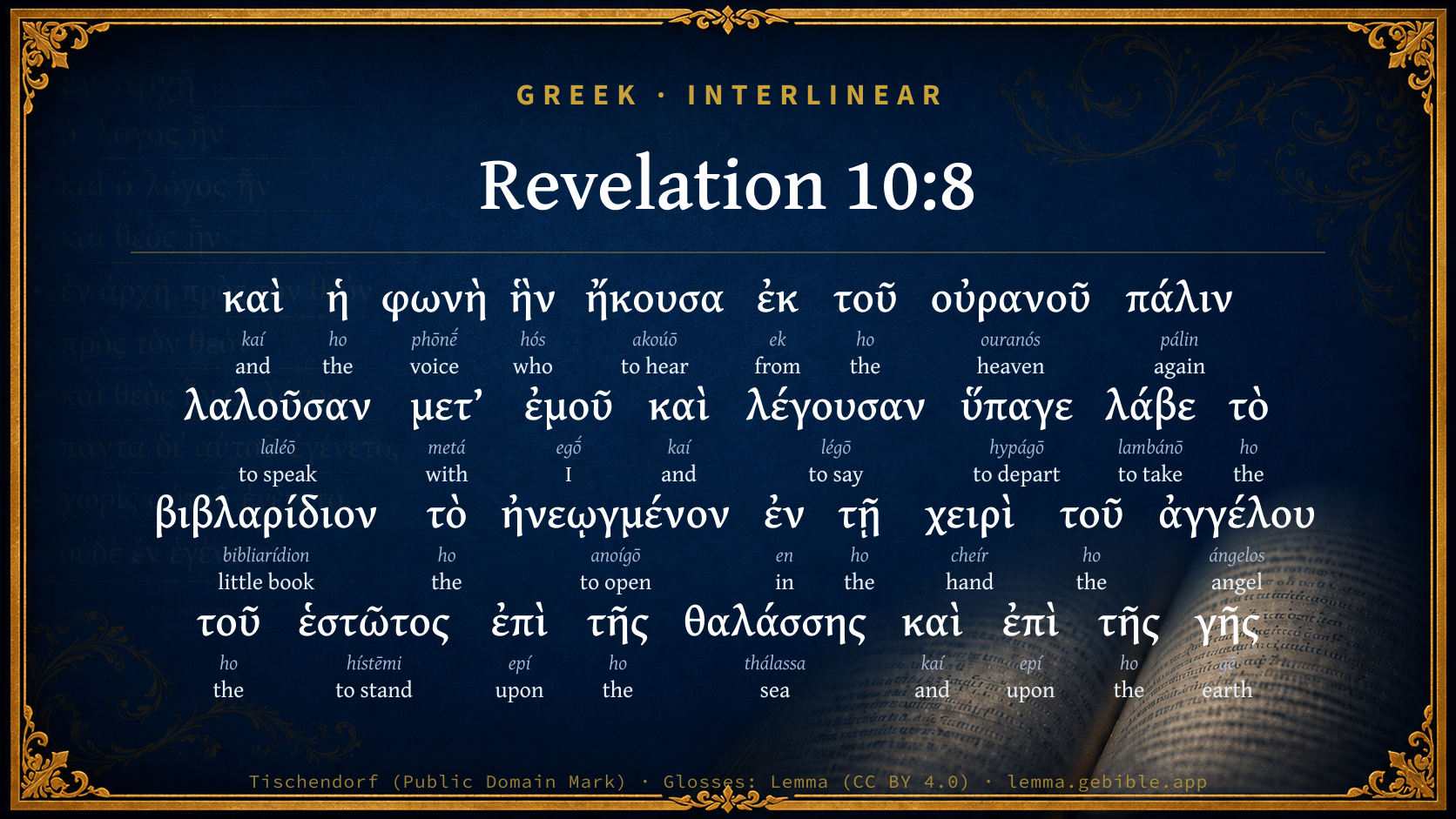
Greek (Tischendorf 8th ed.) Revelation 10:8 appears in the Greek New Testament. The text above is from the Tischendorf 8th edition. Each word links to its Strong’s number and a concise gloss. Click any word for its full Thayer’s Greek Lexicon entry.
Download image
Cite this verse

Revelation 10:8 (World English Bible). Public Domain. Lemma interlinear Bible study tool, https://lemma.gebible.app/v/revelation/10/8.

Show BibTeX & RIS
BibTeX
RIS
English Translation
The voice which I heard from heaven, again speaking with me, said, "Go, take the book which is open in the hand of the angel who stands on the sea and on the land."
World English Bible · Public Domain
Download a study sheet

One document with this verse’s original text, its word-by-word gloss line, the meaning frame, cross-references with their text, attributed commentary, and full source and license credits — printable, and it pastes into notes with its structure intact.

This verse Autodidact and up

Study sheet (.html) Plain text (.txt)

A passage Seminary Student

Up to 50 verses in one chapter. A passage sheet keeps up to 6 commentary sources and 12 cross-references per verse, in the order this page ranks them, and says so on the sheet whenever that leaves anything out. Ask for a single verse and you get the Autodidact verse sheet above.

Everything on this page stays free to read, with no account — the sheet is a download of what is already on screen, not access to it.

Want to remove ads? Support Godless Engineer
Compare translations 3

The same verse in 3 English versions, stacked beneath the original-language interlinear above. Click any original word for its lexicon entry.

Each is an independent rendering of the whole verse — the interlinear is not word-aligned to these translations.

Highlighted words mark where these versions differ — a whole-verse word diff, not a word-by-word alignment.

  • World English Bible Public Domain
    The voice which I heard from heaven, again speaking with me, said, "Go, take the book which is open in the hand of the angel who stands on the sea and on the land."
  • King James Version Public Domain
    And the voice which I heard from heaven spake unto me again, and said, Go and take the little book which is open in the hand of the angel which standeth upon the sea and upon the earth.
  • unfoldingWord Literal Text CC BY-SA 4.0
    And the voice that I heard from heaven was speaking with me again and saying: “Go, take the opened scroll in the hand of the angel standing on the sea and on the land.”

unfoldingWord Literal Text — © unfoldingWord, licensed CC BY-SA 4.0. Word-aligned USFM3 via Door43 (git.door43.org/unfoldingWord/en_ult).

Versions to compare (up to 4)

3 of 4 selected

Show all 19 translations

Every available English version of this verse, each an independent rendering of the whole verse.

  • World English Bible Public Domain
    The voice which I heard from heaven, again speaking with me, said, "Go, take the book which is open in the hand of the angel who stands on the sea and on the land."
  • Berean Standard Bible Public Domain
    Then the voice that I had heard from heaven spoke to me again, saying, “Go, take the small scroll that lies open in the hand of the angel standing on the sea and on the land.”
  • Majority Standard Bible Public Domain
    Then the voice that I had heard from heaven spoke to me again, saying, “Go, take the small scroll that lies open in the hand of the angel standing on the sea and on the land.”
  • King James Version Public Domain
    And the voice which I heard from heaven spake unto me again, and said, Go and take the little book which is open in the hand of the angel which standeth upon the sea and upon the earth.
  • American Standard Version (1901) Public Domain
    And the voice which I heard from heaven, `I heard it' again speaking with me, and saying, Go, take the book which is open in the hand of the angel that standeth upon the sea and upon the earth.
  • Revised Version (1885) Public Domain
    And the voice which I heard from heaven, I heard it again speaking with me, and saying, Go, take the book which is open in the hand of the angel that standeth upon the sea and upon the earth.
  • Geneva Bible (1599) Public Domain
    And the voyce which I heard from heauen, spake vnto me againe, and said, Go and take the litle booke which is open in the hand of the Angel, which standeth vpon the sea and vpon the earth.
  • Douay-Rheims (1899) Public Domain
    And I heard a voice from heaven again speaking to me, and saying: Go, and take the book that is open, from the hand of the angel who standeth upon the sea, and upon the earth.
  • Young's Literal Translation Public Domain
    And the voice that I heard out of the heaven is again speaking with me, and saying, `Go, take the little scroll that is open in the hand of the messenger who hath been standing upon the sea, and upon the land:'
  • Literal Standard Version CC BY-SA 4.0
    And the voice that I heard out of Heaven is again speaking with me, and saying, “Go, take the little scroll that is open in the hand of the messenger who has been standing on the sea, and on the land”:
  • Unlocked Literal Bible CC BY-SA 4.0
    The voice I heard from heaven spoke to me again: “Go, take the open scroll that is in the hand of the angel standing on the sea and on the land.”
  • unfoldingWord Literal Text CC BY-SA 4.0
    And the voice that I heard from heaven was speaking with me again and saying: “Go, take the opened scroll in the hand of the angel standing on the sea and on the land.”
  • Darby Bible Public Domain
    And the voice which I heard out of the heaven [was] again speaking with me, and saying, Go, take the little book which is opened in the hand of the angel who is standing on the sea and on the earth.
  • World Messianic Bible Public Domain
    The voice which I heard from heaven, again speaking with me, said, “Go, take the book which is open in the hand of the angel who stands on the sea and on the land.”
  • Webster's Bible Public Domain
    And the voice which I heard from heaven spoke to me again, and said, Go, and take the little book which is open in the hand of the angel which standeth upon the sea and upon the earth.
  • Free Bible Version CC BY-SA 4.0
    Then I heard again the voice from heaven telling me, “Go and take the scroll that is open in the hand of the angel that stands on the sea and on the land.”
  • Bible in Basic English Public Domain
    And the voice came to me again from heaven, saying, Go, take the book which is open in the hand of the angel who has his place on the sea and on the earth.
  • Text-Critical English NT CC BY 4.0
    Then the voice I had heard from heaven spoke to me again, saying, “Go take the little scroll that is open in the hand of the angel who is standing on the sea and on the land.”
  • Tyndale New Testament (1534) Public Domain
    And the voyce which I herde from heven spake vnto me agayne and sayde: goo and take the lytle boke which ys open in the honde of the angell which stondeth apon the see and apon the erth.

Literal Standard Version (2020), Covenant Press — licensed CC BY-SA 4.0. Text via the HelloAO Bible API (eBible.org). Unlocked Literal Bible (unfoldingWord) — licensed CC BY-SA 4.0. Text via the HelloAO Bible API (eBible.org). unfoldingWord Literal Text — © unfoldingWord, licensed CC BY-SA 4.0. Word-aligned USFM3 via Door43 (git.door43.org/unfoldingWord/en_ult). Free Bible Version, Dr. Jonathan Gallagher — licensed CC BY-SA 4.0. Text via the HelloAO Bible API (eBible.org).

Word by word

More ways to search: Search by grammar → Find every occurrence → Compare this word →

Practice this passage: Drill this verse → Learn its vocabulary →

βιβλαρίδιον
bibliarídion
G974
“little book”
Noun, Accusative, Singular, Neuter
Part of Speech
Noun
Case
Accusative
Number
Singular
Gender
Neuter
Full Thayer's Definition

Origin: a diminutive of G975

TDNT: None

1. a little book
  1. καὶ kaí G2532 “and” Conjunction
  2. ἡ ho G3588 “the” Article, Nominative, Singular, Feminine
  3. φωνὴ phōnḗ G5456 “voice” Noun, Nominative, Singular, Feminine
  4. ἣν hós G3739 “who” Relative pronoun, Accusative, Singular, Feminine
  5. ἤκουσα akoúō G191 “to hear” Verb, Aorist, Active, Indicative, 1st person, Singular
  6. ἐκ ek G1537 “from” Preposition
  7. τοῦ ho G3588 “the” Article, Genitive, Singular, Masculine
  8. οὐρανοῦ ouranós G3772 “heaven” Noun, Genitive, Singular, Masculine
  9. πάλιν pálin G3825 “again” Adverb
  10. λαλοῦσαν laléō G2980 “to speak” Verb, Present, Active, Participle, Accusative, Singular, Feminine
  11. μετ’ metá G3326 “with” Preposition
  12. ἐμοῦ egṓ G1473 “I” Personal pronoun, 1st person, Genitive, Singular
  13. καὶ kaí G2532 “and” Conjunction
  14. λέγουσαν légō G3004 “to say” Verb, Present, Active, Participle, Accusative, Singular, Feminine
  15. ὕπαγε hypágō G5217 “to depart” Verb, Present, Active, Imperative, 2nd person, Singular
  16. λάβε lambánō G2983 “to take” Verb, Aorist, Active, Imperative, 2nd person, Singular
  17. τὸ ho G3588 “the” Article, Accusative, Singular, Neuter
  18. τὸ ho G3588 “the” Article, Accusative, Singular, Neuter
  19. ἠνεῳγμένον anoígō G455 “to open” Verb, Perfect, Passive, Participle, Accusative, Singular, Neuter
  20. ἐν en G1722 “in” Preposition
  21. τῇ ho G3588 “the” Article, Dative, Singular, Feminine
  22. χειρὶ cheír G5495 “hand” Noun, Dative, Singular, Feminine
  23. τοῦ ho G3588 “the” Article, Genitive, Singular, Masculine
  24. ἀγγέλου ángelos G32 “angel” Noun, Genitive, Singular, Masculine
  25. τοῦ ho G3588 “the” Article, Genitive, Singular, Masculine
  26. ἑστῶτος hístēmi G2476 “to stand” Verb, Perfect, Active, Participle, Genitive, Singular, Masculine
  27. ἐπὶ epí G1909 “upon” Preposition
  28. τῆς ho G3588 “the” Article, Genitive, Singular, Feminine
  29. θαλάσσης thálassa G2281 “sea” Noun, Genitive, Singular, Feminine
  30. καὶ kaí G2532 “and” Conjunction
  31. ἐπὶ epí G1909 “upon” Preposition
  32. τῆς ho G3588 “the” Article, Genitive, Singular, Feminine
  33. γῆς gē G1093 “earth” Noun, Genitive, Singular, Feminine

About this verse

These counts appear in no published source. They are computed here, from the morphology-tagged text and Lemma’s own curated glosses. What Lemma adds →

34
words
23
distinct lemmas
Revelation
section

Notable vocabulary

The rarest word here is βιβλαρίδιον little book G974 — appearing just 4 times in the whole Greek New Testament.

Shared distinctive vocabulary

βιβλαρίδιον little book G974 occurs in 4 verses of the Greek New Testament. Also found in:

Repetition

Words recur within this verse:

Cross-references

3

Topical passages linked to Revelation 10:8 in the Treasury of Scripture Knowledge — connected by theme and wording, ordered by reader-vote popularity; previews shown in the World English Bible.

  • Revelation 10:2 He had in his hand a little open book. He set his right foot on the sea, and his left on the land.
  • Revelation 10:4–5 When the seven thunders sounded, I was about to write; but I heard a voice from the sky saying, "Seal up the things which the seven thunders said, and don't write them."
  • Isaiah 30:21 and your ears shall hear a word behind you, saying, This is the way, walk you in it; when you turn to the right hand, and when you turn to the left.

Cross-references courtesy of OpenBible.info (CC BY 4.0).

Commentary

Notes on Revelation 10:8 from classic Christian and Jewish commentators (each source and its license shown beneath its notes). The classic Christian expositions comment on the surrounding passage and are grouped to its opening verse, so a note may address several verses; the Jewish commentaries on the Tanakh (Rashi and others) are per-verse, so they appear only where the commentator wrote on this verse.

Lemma curates 59 commentaries, every one of them public domain or Creative Commons licensed, each selected and text-cleaned for this edition rather than reprinted as found. About our sources →

Albert Barnes' Notes on the Bible

And the voice which I heard from heaven - Rev 10:4. This is not the voice of the angel, but a direct divine command,

Said, Go and take the little book which is open, ... - That is, take it out of his hand, and do with it as you shall be commanded. There is a very strong resemblance between this passage and the account contained in Eze 2:9-10; Eze 3:1-3. Ezekiel was directed to go to the house of Israel and deliver a divine message, whether they would hear or forbear; and in order that he might understand what message to deliver, there was shown to him a roll of a book, written within and without. That roll he was commanded to eat, and he found it to be “in his mouth as honey for sweetness.” John has added to this the circumstance that, though “sweet in the mouth,” it made “the belly bitter.” The additional command Rev 10:11, that he must yet “prophecy before many people,” leads us to suppose that he had the narrative in Ezekiel in his eye; for, as the result of his eating the roll, he was commanded to go and prophesy to the people of Israel. The passage here Rev 10:8 introduces a new symbol, that of “eating the book,” and evidently refers to something that was to occur before the “mystery should be finished”; that is, before the seventh trumpet should sound.

“Which is open in the hand ...” On the symbolical meaning of the word “open,” as applied to the book, see the notes on Rev 10:2.

Albert Barnes' Notes on the Bible (1834–1885) — public domain. Text from a community e-Sword/MySword module.

The Biblical Illustrator

Joseph S. Exell

Rev_10:8-11

Go and take the little book.

The making of a minister

(with Eze_2:8-10; Eze_3:1-3):--The symbolical scene in the case of Ezekiel was enacted over again in the case of John; only with such surroundings of majesty and magnificence as were but befitting after Johns humiliated but glorified Master had sat down on His throne in heaven. Now, in the first place, we see in that fine symbolical scene Gods own immediate way of making a minister--a book. A book plays a great part in the salvation of men. A book is brought down from heaven to earth--a book written in heaven lies open in the hand of the heavenly messenger, and the salvation of many peoples, and nations, and tongues, and kings lies wrapped up in that little book. Go thou, said the voice from heaven to John, Go thou and take the book. Now that is being both said and done every day among ourselves. There is the Book, and there are the people, and there somewhere among the people is the man chosen of God to take the Book, and to make the Book his own, and then to carry it to the people; Go, the Spirit of God says to that man, Go, leave all other occupations and all other pursuits; give thyself, body and soul, day and night, and all the days of thy life, to that Book. Take the book and eat it, said the angel to the seer. You will observe that the angel did not say, Take the book and read it. Had it been any other book but the Book it was, to read it himself and to have it written out and sent to all the Churches would have been enough. But that was not enough for this Book. Interpret the Bible like any other book, it is the fashion of our day to say, and in some senses that is an excellent enough rule; but that was not the angels rule that day to John, All other books in Johns day were to be read, but this Book was to be eaten. Yes, eaten. Clearly, then, this is not an ordinary Book. Clearly this is like no other book. Job said: Neither have I gone back from the commandment of His lips. I have esteemed the words of His mouth more than my necessary food. Eat, then, this same meal; eat it both minister and people; and eat it for your first food every morning. It will do for you what no earthly food, the best and the most necessary, can do; see that all its strength and all its sweetness fills your heart before you eat any other meat; read Gods Book, and have it next your heart to defend yourself against the influences of men that attempt to overthrow you. Enough of that; bring me my Bible, his widow told me one of my old elders used to say, as they read to him the morning newspaper; enough of that; bring me my Bible. The Word of God was more to that saint than all else, and his widow and I rejoice to tell the story after he has gone home to his rest. The Word of God was more to him than that which is to some of you your necessary food. But what does this mean--this extraordinary thing, It was in my mouth sweet as honey, but as soon as I had eaten it my belly was bitter? The best way, the only way indeed to find out all that means is to eat the same roll ourselves, and then to observe what passes within ourselves. Religion is an experimental science. Just you eat the Book now before you as Ezekiel and John ate it, and then tell us what takes place with you. I will tell you what will take place. The Word of God will be bitter in your mouth every morning, bitter with memories of yesterday and yester-night. Yes, the grace of God, and the abiding and abounding mercy of God, they are in His blessed Word always passing sweet to a penitent sinner. Ah, the truth is that the power, and the holiness, and the heavenly beauty of Gods Word is the daily and the sweet experience of all those who make the Word of God their earliest and their most necessary food. But after this, when this sweet Book descends into what David calls our inward parts; when the holy, and the just, and the good Word of God enters our guilty conscience and our corrupt heart, then there is bitterness indeed; for a sense of sin, as we so lightly speak, is then awakened in the soul, and with that new sense comes a new bitterness, compared with which the waters of Marah are milk and honey. Son of man, eat that thou findest, says Jehovah to Ezekiel in the vision. Take it, and eat it up, said the angel in like manner to John. Neither the prophet nor the apostle was asked or allowed to pick and choose, as we say. They were not to eat the sweet, and spit out the bitter. They were not to keep rolling the sweet morsels under their tongue, and to keep their inward parts strangers to their inward share of the Divine Book. I know this Scripture will not be sweet to all who hear it; but if it is at first bitter it must not be cast out. We must allow ourselves to read and preach and hear the whole Word of God. Son of man, eat that thou findest; and again, Take the roll and eat it up. It is a fine study to take up the Old Testament, and to trace all through it how prophet follows prophet, and psalmist follows psalmist, each several prophet and psalmist taking home to himself all that the prophets and the psalmist had said and sung before him; and then, having made the Book their own by reading it, by praying ever it, by singing it, by eating it, as the figure is, then when their own call came they prophesied prophecies, and sang psalms, new psalms, new prophecies as the peoples need was--never contenting themselves with just countersigning and repeating what any former prophet had said, what any former psalmist had sung, however great and however good in his time that prophet and psalmist had been. (A. Whyte, D. D.)

Gods Word

The little book may be taken to illustrate Gods redemptive truth, or the gospel.

I. The gospel is brought to man from heaven. The was in which alienated humanity can be brought into a loving sympathy with God transcends human discovery. Divine messengers brought this little book to man, and Christ embodied it.

II. This gospel is to be appropriated by man. Eat it up. The spirit of this little book must become the inspiring and the regnant spirit of our being.

III. This gospel has a twofold effect on man. Sweet in its disclosures of infinite love and promises of future blessedness; bitter in its convictions of sin, reproofs, and denunciations. It produces in the soul sorrow and joy, sighs and songs; and its bitterness will remain as long as one particle of depravity continues in the heart.

IV. This gospel, appropriated, qualifies man for his mission (verse 11). (D. Thomas, D. D.)

Take it, and eat it up.

On eating books

There are many different kinds of books in the world.

I. There are some which have nothing in them. They are not directly harmful, but neither are they of much good. When you have read them you can scarcely remember anything that they contained. They are very much like a kind of pastry which we call trifle. The moment you put it into your mouth it vanishes into thin air. Beware of books which only please you for the moment, and do nothing that would make you better or wiser.

II. There are other books which are stupefying. They dull the senses. They are like what we call opiates, which make men feel heavy and stupid. Be careful never to read books which merely please by soothing and dulling the senses.

III. There are other books which are unduly exciting. I do not object to a reasonable amount of interest. Every book worth the reading must in one sense excite us; but I am not now speaking of books which excite you by the amount of true knowledge which they give, or noble enthusiasm which they impart, but those which excite you by the feverish curiosity with which they fire you. I earnestly warn you against every book which makes it more difficult for you to do your every-day duty.

IV. There are other books which are very hard to digest, I have no doubt some of you think, for instance, that books on arithmetic or English grammar are very indigestible; but if you take a little at a time, and masticate that well before you take more, you will find that even hard books will agree with you wonderfully, and that you will be stronger and better for having taken them. Children suffer from indigestion, in learning difficult tasks, by taking too much at a time. The great secret of success is to take a little often, and to see that you learn well every little lesson, and thus make it your own, before you take more.

V. There are other books which are decidedly poisonous. Take care that you do not eat them. These books speak well of sin, and kindly of evil. Beware of any book that does not agree with the Bible in its estimate of good and of evil.

VI. And now I want to tell you of this one Book--The Bible--Of which you need never grow weary. (D. Davies.)

The proper use of Divine truth

Divine truth is not something for intellectual speculation, it is not something for memory, but diet for the life. It must be transmuted into the moral blood, and sent through the heart into every fibre of our being. (D. Thomas, D. D.)

The Word of God to be pondered

Read the Word of God much, said General Gordon, but chew it more. That is pondering. Make a practice of it; make a rule of it. (Bp. Talbot.)

Thou must prophesy again.--

Rules for Christian effort

I. Christian effort must be personal. Thou. The faculties of the individual man must be excited to activity in the cause of God. The most magnificent achievements of the human mind have been wrought out in lonely musings and lonely labours. If we would hew the rugged forms of our fellow-men into the symmetry and grace of Christian discipleship we must not be content to give subscriptions for evangelistic purposes; but we must feel a responsibility that is all our own, and while acting in brotherly union we must also act as if we had been specially called to a task in which no one has so much to do as ourselves.

II. Christian effort must be proportioned to personal ability. Thou must prophesy. John had the prophetic gift, and he was to use it. God has called thousands to His work, and though all cannot do the same thing, all are to do their best in that which they can do. A man with a divided mind, with his mind in part intent on his own ease, and in part only on the work of the Lord, will accomplish nothing worth naming. But let him unite his faculties, let him bring all the strength and all the determination of his soul to bear on the task to which he is called, let him throw the glow and enthusiasm of his nature into his duty with the bold avowal, This one thing I do, and though a thousand difficulties withstand him, he will sweep on to the consummation of his plains.

III. Christian effort must be repeated. Thou must prophesy again. Nothing great can be done all at once. It was only after many struggles that Wilberforce succeeded in the abolition of the slave trade. Nor are we to think that any strange thing has befallen us, or to deem it a reason for suspending our labours, if months or even years elapse before we see the moral and religious reformation at which we are aiming. We cannot reasonably expect that rude, ignorant, vicious men will all at once be transformed into melodious Davids, magnificent Isaiahs, or saintly Johns. We cannot reasonably expect that Babylon will come crashing to the ground at our first shout, and its ruins start at a touch into the majesty of a holy city. We shall have to prophesy again; we shall have to repeat our efforts before we see the pleasure of the Lord prosper in our hand.

IV. Christian effort must enlarge the scope of its movements. Thou must prophesy again before many peoples, etc. The more we do, the more we see there is to do. Patriotism owns that this is a land which, from white cliff in the south to sternest precipice in the north, is worthy of any labour and any self-sacrifice. If the statesman will contend from early evening until the morning crimsons the windows of the Senate House for measures by which he intends to enlarge the liberties and increase the happiness of the people--if the soldier will stride over the field of deadly fight and rush through the fiery breach that the foemans drum may not be beaten in our street, nor the foemans flag be lifted among our old ancestral oaks, it surely becomes us to raise ourselves to the level of Christian patriotism, and to stretch out our prayers and our labours so that they shall include the whole nation. (G. Marrat.)

.

The Biblical Illustrator, edited by Joseph S. Exell (c. 1880s–1900s) — public domain. Text from a community e-Sword module.

Joseph Benson's Commentary

Rev 10:8-10. And the voice said, Go up to the angel standing upon the sea and the earth, and take the little book which is open — To signify that its contents were not to be kept secret like those of the seven thunders, but revealed for the instruction, direction, encouragement, or warning of mankind, as well as those of the larger book; for it was a kind of second prophecy added to the former, and as it concerned kings and nations, so it was to be made public for their use and information. And I went unto the angel — As I was directed; and said — With boldness, in consequence of the divine command; Give me the little book. And he said, Take it, and eat it up — As Ezekiel did that which was shown to him upon a like occasion; that is, consider its contents carefully, and digest them well in thy mind: and it shall make thy belly bitter, but it shall be in thy mouth sweet as honey — The knowledge of future things was, at first, pleasant, but the sad contents of the little book afterward filled his soul with sorrow. As this prophecy was to reveal the providences of God during the period of the seventh trumpet, in which, as there was a revelation of great opposition to true religion, and persecution of the faithful professors of it, so was there also a revelation of divine protection during the time of trial, and of a sure accomplishment of the promises concerning the glorious and happy state of the church in the end. The consideration of such a dispensation of Providence might well occasion a mixture of joy and grief in the apostle’s mind, as it must do in the minds of all who understand and reflect upon it.

Joseph Benson's Commentary on the Old and New Testaments (1811–1818) — public domain. Text from a community e-Sword module.

Tyndale Open Study Notes

Tyndale Open Resources

10:8-10 As in Ezekiel’s experience, the scroll tasted sweet in the mouth (Ezek 3:1-3; see Jer 15:16; see also Pss 19:10; 119:103). The experiences yet to come for God’s people would be sweet, including the victory of God’s plan and the vindication of his people. John’s sour . . . stomach resembles the effects of Ezekiel’s hard message for Israel (Ezek 3:8-9). The process of bringing God’s plan to fruition involves hardship.

Tyndale Open Study Notes — © Tyndale Open Resources, licensed CC BY-SA 4.0. Text via the HelloAO Bible API.

Meyer's Critical & Exegetical Commentary

Heinrich August Wilhelm Meyer

Rev_10:8-11. At the command of the heavenly voice (Rev_10:4), John eats the little book given him by the angel, and receives the instruction that he must once again prophesy.

ἡ φωνὴ, ἣν ἤκουσα

καὶ-g0- λέγουσαν-g0-. The construction in this correct reading[2752] is like that of Rev_4:1, but yet unsymmetrical, as here not only the ΛΈΓΩΝ in the mind of the author is received into the relative clause by attraction, but also the ΠΆΛΙΝ is placed before ΛΑΛΟῦΣΑΝ because of the connection of the declaration just repeated with that mentioned, Rev_10:4. If the sentence in which, in any case, the aor. ἬΚΟΥΣΑ is intended as a plusquam-perfect, were altogether symmetrical in its reference to Rev_10:4 (cf. Rev_4:1), its construction in accord with the nom. Ἡ ΦΩΝΉ would run: Κ. Ἡ ΦΩΝ., ἫΝ ἬΚ. ἘΚ Τ. ΟὐΡ. ΛΑΛΟῦΣΑΝ ΜΕΤʼ ἘΜΟῦ, ΠΆΛΙΝ ἘΛΆΛΗΣΕΝ ΜΕΤʼ ἘΜΟῦ ΛΈΓΟΥΣΑ (ΛΈΓΩΝ). Likewise De Wette, Ebrard.

ὝΠΑΓΕ. As in Rev_16:1, Mat_5:24; Mat_8:4, etc.,[2753] an actual going is represented, accordingly in Rev_10:9 it is said ἈΠῆΛΘΑ.

ΛΆΒΕ, cf. Rev_5:7. John is to take this book to himself (Rev_10:9).

ΑΠῆΛΘΑ ΠΡῸς ΤῸΝ ἌΓΓ. How John, who continues to have his standpoint in heaven (cf. Rev_10:1), could go to the angel who stands on the earth and sea, is not made perceptible to sober view, because in the vision the question is only concerning the act of going. But even if one, like De Wette, consider that John, even prior to ch. 10, had occupied the standpoint of Zechariah, Ezekiel, and Daniel, the difficulty of the ἈΠῆΛΘΑ remains essentially the same; hence De Wette has properly reached no conclusion from this expression concerning the standpoint of John.

δοῦναι. Concerning this inf.,[2754] dependent on the ΛΈΓΩΝ, cf. Winer, p. 296.

ΚΑΤΆΦΑΓΕ ΑὐΤΌ. The eating of the book[2755] is within the entire visionary scene not to be regarded an expression intended allegorically, but as a real act of John; just as Ezekiel (Rev_2:9 sqq.) by eating a book receives the contents of its prophetic discourses. The meaning of the visionary fact is correctly given already by Beda: Take into your inward parts, and contain within the space of thy heart. What Jer_15:16 in figurative language calls an eating of the words of divine revelation, which must be converted by the prophet into marrow and blood,[2756] we find here, as in Ezekiel, represented in an actual visionary transaction.[2757]

καὶ πικρανεῖ

μέλι. From the fact that the angel speaks first of the bitter effect and then of the sweet taste of the little book, but John himself (Rev_10:10) the reverse, it does not follow that both vigorously struggled for priority.[2758] According to the context, the priority belongsnot only as to order, but also as to minor dignityto the sweetness, because the book comes first into the mouth and last into the belly. According to this most simple order, John himself reports, Rev_10:10. The angel looks at it differently, since he speaks,as the combination of the two expressions into one antithesis shows,not according to the mere consequences, but with respect to the inner nature and effect. The angel intends first to prepare John for the bitter effect, but then he also says that the book will be in his mouth sweet as honey. This is also against Beng., who, by a comparison of Rev_10:9-10, immediately infers two kinds of sweetness, one before and one after the bitterness.

The relation of ΠΙΚΡΑΝΕῖ ΣΟΥ ΤῊΝ ΚΟΙΛΊΑΝ (ἘΠΙΚΡΆΝΘΗ Ἡ ΚΟΙΛ. Μ., Rev_10:10; cf. Rev_8:11) and ΓΛΥΚῪ Ὡς ΜΈΛΙ is, in accordance with the context, to be determined according to both norms: that one and the same book is sweet and bitter according as it enters the mouth or the belly; then, that the distinction between the mouth and the belly is understood only with reference to the eating. Incorrect, therefore, are both the explanation which refers the sweetness and bitterness to the difference between the joyful and the sad contents of the book,[2759]in connection with which a further error is readily intruded, that, with a result contrary to the context, speaks of bitter-sweet contents, indicating that only after a sad visitation could glorious joy enter;[2760] and also that whichin connection with a false interpretation of the little book itself, of the ΠΆΛΙΝ ΠΡΟΦΗΤ., Rev_10:11, yea even of the angel, Rev_10:1; Rev_10:8regards the mouth of John not as the organ of eating (receiving), but of speaking, and then refers the bitterness to the persecutions and all the hinderances with which the evangelical preaching of John or the entire Church met.[2761] With correctness, Vitr., C. a Lap., De Wette, Stern, Hengstenb., etc., have interpreted, that, as the mouth refers to the receiving of the revelation given in the little book, so the ΚΟΙΛΊΑnot ΚΑΡΔΊΑ, as Cod. A reads, and Andr. explains, disturbing the clearness of the idea of the text by mingling therewith a rash interpretationis directed to the comprehension, i.e., the further scrutiny[2762] and perception, of the revelation received. [See Note LXVI., p. 309.] How little the sweetness of the reception, as such, was hindered by the bitterness of the contents of revelation, is shown by the symbol of Ezekiel, in whose mouth the book written with mourning and woe is Ὡς ΜΈΛΙ ΓΛΥΚΆΖΟΝ.[2763] But he also went bitterly, after he had filled his belly therewith,[2764] in the heat of his spirit.[2765]

By eating the book, John is made able to proclaim its contents. Therefore Rev_10:11 follows: καὶ λἐγουσῖν μοι, κ.τ.λ. The plur.[2766] makes the speaking subject entirely indefinite; the modified var. points to the angel.

δεῖ σε πάλιν προφ. The δεῖ designates not the inner, subjective necessity, that John now cannot help prophesying, because by eating the book he has been capacitated for prophesying,[2767] but the objective necessity depending upon the will of God, who accordingly gives his revelation.[2768] The πάλιν does not contrast Johns prophecy with that of the ancient prophets,[2769] but designates a second προφητεῦσαι of John himself, yet not a preaching after a return from exile,[2770] but the new prophecy for which the eaten book has fitted him in its relation to the prophesying practised upon the ground of previous visions. This πάλιν προφητεῦσαι occurs therefore in the succeeding part of the Apoc.[2771]

ἐπὶ λαοῖς

πολλοῖς. Incorrectly, Beng: To nationsbeyond, in the sense that there are still many nations, etc., which are, meantime, to come before that is fulfilled which is here described prior to the transition to the second woe. Ἐπί has this meaning neither in Heb_9:17, 1Co_14:26, nor elsewhere. Likewise incorrectly, Ebrard: Before nations, i.e., so that the nations have it declared to them. The ἐπὶ with the dat. designates, precisely as in Joh_12:16, the object which the prophecy grasps, i.e., concerning which the prophecy is made. The grammatical relation is precisely the same as in the construction of ἐπί with the dative accompanying verbs designating joy, astonishment, etc., concerning any thing.[2772] The occasion for the false construction of the ἐπὶ lies, in Ebrard, in the view of the contents of the book, and the range of the prophecy conditioned thereby. If the πάλιν προφητεῦσαι is completed with Rev_11:13, and is intended for the Church, it cannot be said here, Rev_10:11, that John is to prophesy concerning nations and kings; and if Hengstenb., who likewise[2773] finds in Rev_11:1-13 the prophecy announced in Rev_10:11, and refers it to the degenerate churches, yet explains correctly the ἐπὶ λαοῖς, κ.τ.λ., and compares therewith what is said of kings, chs. 16, 17, 19, this is inconsistent with his view of the little book and the πάλ. προφ., just to the extent that it is correct according to the context. Ewaldwho agrees formally with Hengstenb. and Ebrard, since he also finds in Rev_11:1-13 the contents of the eaten book, but interprets this new prophecy as referring to the destruction of Jerusalemrefers the ἐπὶ λαοῖς, κ.τ.λ., to Rev_11:2; Rev_11:7; Rev_11:9; but since the prophecy Rev_11:1-13 is actually one concerning Jerusalem, it cannot well be called at Rev_10:11 a prophecy concerning peoples, nations, languages, and many kings.[2774] Besides, Ew. has understood the significant position of the angel, Rev_10:2, with relation to Rome as capital of the world. The result, therefore, is not that the ἘΠῚ is explained ungrammatically, but that we must seek the correct reference of the ΠΆΛΙΝ ΠΡΟΦΗΤΕῦΣΑΙ, which must concur with the correct view of the contents of the little book eaten. Upon this depends the ultimate determination of the view of the entire transaction in ch. 10.

[2752] See Critical Notes.

[2753] Cf. the ἦλθε, Rev_5:7; also the ἕρχου, Rev_6:4-5; Rev_6:7.

[2754] Act_21:21.

[2755] Cf. Rev_10:10, where the command is fulfilled by John.

[2756] Cf., besides, Psa_40:9.

[2757] Ew., etc. Cf. Knobel, Proph., I. p. 373.

[2758] Hengstenb.

[2759] Heinr., Ewald.

[2760] Herd., Rinck.

[2761] Beda, Aret., Par., etc.

[2762] Cf. 1Pe_1:10 sq.

[2763] Eze_3:3; cf. Eze_2:10.

[2764] Rev_10:3 : ἠ κοιλία σου πλησθήσεται.

[2765] Rev_10:4 : מַר, which the LXX. do not at all translate.

[2766] Cf. Rev_12:6.

[2767] Beng., Hengstenb.

[2768] Cf., in general, Rev_1:1 sqq.

[2769] Beng.

[2770] Primas, Beda, Vieg.

[2771] Grot., Alcas., De Wette, Hengstenb., Ebrard, etc., who, in the more accurate determination, vary much in other respects from one another.

[2772] Winer, p. 368.

[2773] Cf. also Klief.

[2774] i.e., all the world, those κατοικοῦντες ἐπὶ τῆς γῆς. Cf. Rev_5:9.

The allegorical explanations are to be rejected, as entirely in violation of the context, which betray their arbitrariness by their infinite diversity. The mighty angel, Rev_10:1, can as little stand for the Emperor Justin, the defender of the Church against the Arians, and the Emperor Justinian,[2775] or[2776] the evangelical preachers, as whose representative others, like Beda already, understand John, or indeed the Pope,[2777] as the little book eaten by John can be the Codex Justinianus,[2778] or the N. T.[2779] The most important interpreters[2780] are unanimous in regarding the contents of this little book, which is eaten, as prophecy which is written in the Apoc. itself, and that, too, in the part which follows ch. 10. But there is controversy both as to the more accurate determination of the section which is regarded as containing the prophecy proceeding from the book that is eaten, and also, which is essentially connected therewith, as to the relation between the book that is eaten, and the seal-book, ch. 5. The opinion that both books are identical[2781] is answered already by the fact that John, after having thus far prophesied upon the ground of the book of ch. 5, now is to prophesy anew upon the ground of the little book that is eaten. Accordingly, the directly opposite view is readily suggested, that both books have nothing whatever to do with one another, but that the little book, ch. 10, contains something entirely peculiar, viz., what is described in Rev_11:1-13 : i.e., according to Grot., Wetst., Eichh., Ew., the fate of Jerusalem; according to Hengstenb., the fate of the degenerate Church.[2782] But it is neither correct that the contents of the book of fate, ch. 5, are already fully settled in what has been hitherto given,[2783] nor is it conceivable that that book of fate should contain nothing of the fate of Jerusalem, the degenerate Church,[2784] which is not to be revealed to the prophet until by the little book, ch. 10;[2785] neither, if the contents of the book that is eaten be limited to Rev_11:1-13, whether in Ewalds or Hengstenb.s sense, does it agree with the statement of Rev_10:11, according to which John is to prophesy concerning peoples and many kings. The instance deduced from Rev_10:11[2786] applies also against Vitr., who, in the little book of ch. 10, finds a part of the book of ch. 5, limits its contents likewise to Rev_11:1-13, and interprets it as a prophecy concerning the calamities of the Western Church. The correct point in Vitr. is the view that the little book of ch. 10 comprises a part of all that which is to happen contained in the book of fate of ch. 5; viz., all that which has not, as yet, issued from the book of fate through the succession of seal- and trumpet-visions; in other words, all that from Rev_11:1 has been written by John in consequence of the δεῖ σε πάλιν προφητεῦσαι, κ.τ.λ.;[2787] therefore not in the false sense[2788] that the book of completion only substantially repeats, in its way, the contents already present in the preceding book of declaration. This follows from what in Rev_10:11 is said concerning the prophecy of John, which proceeds from the book which was eaten; but it admits the less a restriction to Rev_11:1-13 (where what is said is concerning Jerusalem), and rather requires the more certainly the further reference to what is written, ch. 12 sqq., as the discourse of the angel, Rev_10:6 sq., extending to the full end, stands in more significant parallel with the contents of the book brought by him. For it also agrees with this, that the ΠΆΛΙΝ ΠΡΟΦΗΤΕῦΣΑΙ of John in no way stands out of connection with the book of fate including of itself the entire prophecy concerning what was to occur; but rather not only does Rev_11:1-13 belong in the series of the woes, but also all that from Rev_11:15 succeeds the trumpets, which by means of the seals, from the last of which they have proceeded, belongs to the sphere of the book of fate. And when the angel, who brings the little book, looks towards Jerusalem, Rev_10:2, it agrees with this, that the most immediate object of the new prophecy, Rev_10:11, is in fact Jerusalem (Rev_11:1 sq.); but the perspective opened, Rev_10:7, extends to the ultimate end; so that from the little book, in the fulness corresponding to Rev_10:11, there follow also the prophecies of ch. 12 sqq. Thus the little book which was brought to John opened, and was eaten by him, appears to be an inner instruction and interpretation given the seer concerning visions still impending, and which are to continue until the full end. And the more important the subjects of the prophecy that now follow,for we come now to the proper goal, while all that precedes is only preparatory,the more natural appears the new special preparation of the prophet.

[2775] Rev_10:8. N. de Lyra.

[2776] According to the older Protestant expositors.

[2777] Luther.

[2778] N. de Lyra.

[2779] Aret., etc.

[2780] C. a Lap., Grot., Calov., Vitr., Beng., Ew., De Wette, Hengstenb., etc.

[2781] C. a Lap., Zeger, Calov.

[2782] Cf. also Ebrard.

[2783] Against Hengstenb.

[2784] Hengstenb.

[2785] Against Ewald, etc.

[2786] Cf. Rev_10:6 sqq.

[2787] Beng., De Wette.

[2788] Volkm.

NOTES BY THE AMERICAN EDITOR

LXVI. Rev_10:9. ποικρανεῖ τὴν κοιλίαν

J. Gerhard (quoted by Calov.): The pleasure of the mouth is a symbol of the pleasure which the godly derive from the revelation of divine mysteries before they fully perceive them. The dolor ventris is a symbol of the pain which they derive from the consideration of the persecution to be described in the succeeding prophecy, which antichrist will exercise against the Church at the end of the world. Primasius: When you have received it, you will be delighted by the sweetness of the Divine speech (Ps. 19:15), the hope of promised salvation, and the charm of Divine justice. But you will experience the bitterness when this is to be preached to both devout and undevout. Stier: The evangelizing to the prophets must always have been fraught with a certain degree of bitterness to human nature. Luthardt: Bitter poison to the belly, i.e., to man so far as he belongs to this transitory world (cf. 1Co_6:13); but so far as he is Gods, it is sweet joy (cf. Psa_19:11), for it is a word of judgment to the world, but redemption to the Church, which, with its mouth, preaches God.

Meyer — Critical and Exegetical Commentary on the New Testament — English translation by Peter Christie, edited by Frederick Crombie (T&T Clark, 1880) — public domain. Text from a community e-Sword module.

Expositor's Greek Testament

ed. W. Robertson Nicoll

Rev 10:8 . ἡ φωνὴ ( cf. Rev 10:4 ) left ungrammatically without a predicate, the two participles being irregularly attracted into the case of ἥν ( cf. Rev 1:1 , Rev 4:11 ).

The Expositor's Greek Testament, edited by W. Robertson Nicoll (1897–1910) — public domain. Text from a community e-Sword module.

Geneva Bible (1599)

Geneva Bible translators

The other part of this Chapter, concerning the particular calling of Saint John to the receiving of the prophecy following which is enjoined him, first by sign in three verses, then in plain words in the last verse. Unto the setting forth of the sign belong these things: That Saint John is taught from heaven to demand the book of the Prophecy in this verse: for these motions and desires God doth inspire: that demanding the book, he is charged to take it in a figurative manner, the use whereof also is expounded, the ninth verse, (as in the second Chapter of Ezekiel and the ninth verse) whence this similitude is borrowed: lastly, for that Saint John at the commandment of Christ took the book, and found by experience that the same as proceeding from Christ was most sweet, but in that it foretelleth the afflictions of the Church it was most bitter unto his spirit.

Geneva Bible (1599) marginal notes — public domain. Text via Bolls.life.

Matthew Henry's Commentary

Here we have, I. A strict charge given to the apostle, which was, 1. That he should go and take the little book out of the hands of that mighty angel mentioned before. This charge was given, not by the angel himself who stood upon the earth, but by the same voice from heaven that in the fourth verse had lain an injunction upon him not to write what he had discerned by the seven thunders. 2. To eat the book; this part of the charge was given by the angel himself, hinting to the apostle that before he should publish what he had discovered he must more thoroughly digest the predictions, and be in himself suitably affected with them.

II. An account of the taste and relish which this little book would have, when the apostle had taken it in; at first, while in his mouth, sweet. All persons feel a pleasure in looking into future events, and in having them foretold; and all good men love to receive a word from God, of what import soever it be. But, when this book of prophecy was more thoroughly digested by the apostle, the contents would be bitter; these were things so awful and terrible, such grievous persecutions of the people of God, and such desolation made in the earth, that the foresight and foreknowledge of them would not be pleasant, but painful to the mind of the apostle: thus was Ezekiel's prophecy to him, Eze 3:3.

III. The apostle's discharge of the duty he was called to (Rev 10:10): He took the little book out of the angel's hand, and ate it up, and he found the relish to be as was told him. 1. It becomes the servants of God to digest in their own souls the messages they bring to others in his name, and to be suitably affected therewith themselves. 2. It becomes them to deliver every message with which they are charged, whether pleasing or unpleasing to men. That which is least pleasing may be most profitable; however, God's messengers must not keep back any part of the counsel of God.

IV. The apostle is made to know that this book of prophecy, which he had now taken in, was not given him merely to gratify his own curiosity, or to affect him with pleasure or pain, but to be communicated by him to the world. Here his prophetical commission seems to be renewed, and he is ordered to prepare for another embassy, to convey those declarations of the mind and will of God which are of great importance to all the world, and to the highest and greatest men in the world, and such should be read and recorded in many languages. This indeed is the case; we have them in our language, and are all obliged to attend to them, humbly to enquire into the meaning of them, and firmly to believe that every thing shall have its accomplishment in the proper time; and, when the prophecies shall be fulfilled, the sense and truth of them will appear, and the omniscience, power, and faithfulness of the great God will be adored.

Matthew Henry's Commentary on the Whole Bible (1708–1710) — public domain (CC PDM 1.0). Text via the HelloAO Bible API.

Jamieson, Fausset & Brown

Robert Jamieson, A. R. Fausset & David Brown

spake . . . and said--So Syriac and Coptic read. But A, B, C, "(I heard) again speaking with me, and saying" (Greek, "lalousan . . . legousan").

little book--So Aleph and B read. But A and C, "the book."

Jamieson, Fausset & Brown — Commentary Critical and Explanatory on the Whole Bible (1871) — public domain (CC PDM 1.0). Text via the HelloAO Bible API.

Adam Clarke's Commentary

Verse 8. Take the little book which is open] Learn from this angel what should be published to the world.

Adam Clarke's Commentary on the Bible (1810–1826) — public domain. Text from a community e-Sword/MySword module.

Ellicott's Commentary for English Readers

(8-9) And the voice . . .—Translate, And the voice which I heard out of the heaven (I heard it) again talking with me (it is not the angel that speaks, but the voice which had bidden him seal up the thunders is heard again speaking), and saying, Go, take the roll (or, the little roll; there is a difference in the MSS.) which is opened in the hand of the angel who stands upon the sea and upon the earth. And I went away to the angel, telling him to give me the little book. And he saith to me, Take and eat it up; and it shall make bitter thy belly, but in thy mouth it shall be sweet as honey. The image of eating the roll is derived from the Old Testament. We meet with it in Ezekiel (Eze_3:1-3) and Jeremiah (Jer_15:16). The passage in Ezekiel is probably the basis of the present passage, and the chapter in which it occurs gives us the meaning of the symbol: the eating of the roll, or the words of the roll, is the complete mastering of the contents of the book—the digesting, as we say, its meaning, till the principles and truths are thoroughly familiar and loved. “All my words” (so runs the explanatory verse, Eze_3:10) “that I shall speak unto thee receive in thine heart and hear with thine ears.” It is similar to the Psalmist’s practice: “Thy words have I hid within my heart;” he made himself so familiar with them that they were no longer a code of laws, but a constant instinct, a second nature to him. Thus preeminently should he be familiar with his Master’s words and heart, saturated with his Master’s principles, who is to be a witness and a prophet for his Lord. “He who would carry God’s words to another must first be impressed and penetrated with them himself. He must not only hear, read, mark, and learn, but also (according to the Scriptural figure) inwardly digest them.”

A Bible Commentary for English Readers, edited by Charles John Ellicott (1878–1897) — public domain. Text from a community e-Sword module.

The Cambridge Bible for Schools and Colleges

gen. ed. J. J. S. Perowne

8. spake unto me again] The true reading is scarcely grammatical, but must mean “[I heard] again speaking unto me.”

The Cambridge Bible for Schools and Colleges (gen. ed. J. J. S. Perowne; Cambridge University Press, 1878–1918) — public domain. Text from a community e-Sword module.

John Gill's Exposition

And the voice which I heard from heaven,.... In Rev 10:4;

spake to me again, and said, go and take the little book which is open in the hand of the angel which standeth upon the sea and upon the earth; as John was to prophesy, Rev 10:11; it was necessary that he should have a mission and a commission from heaven; and that he should have the open book of prophecy to prophesy out of; and that he should receive this from the angel's hands, who had unloosed its seals, and opened it: and just so to ordinary prophesying, or preaching, it is necessary that men should have their commission from heaven, should be called of God, and sent by him; and that they should have the book of the Scriptures before them, and open to them, and speak according to these oracles, agreeably to the law and to the testimony, which are profitable for doctrine; and that they should also receive the Gospel, and the doctrines of it, with gifts, and a commission to preach it, from the Angel of the covenant, Jesus Christ, who has all power both in heaven and in earth; see Rev 10:2.

John Gill's Exposition of the Whole Bible (1746–1763) — public domain (CC PDM 1.0). Text via the HelloAO Bible API.

Trapp's Complete Commentary

John Trapp

8 And the voice which I heard from heaven spake unto me again, and said, Go and take the little book which is open in the hand of the angel which standeth upon the sea and upon the earth.

Ver. 8. In the hand of the angel which standeth] This description of Christ is here purposely repeated, that we may learn to trust in his power and fly to his wisdom, as Agur did, Pro 30:1-2, for the understanding of divine mysteries.

John Trapp, A Commentary or Exposition upon All the Books of the Old and New Testament (1647–1656) — public domain. Text from a community e-Sword module.

Matthew Poole's English Annotations

And the voice which I heard from heaven; the voice mentioned Rev 10:4.

Go and take the little book; the little book mentioned Rev 10:2. John is bid to take this book, by which some understand the Scriptures; but it is most probably the book mentioned Rev 5:1, before sealed, now open.

Matthew Poole's English Annotations on the Holy Bible (1683–1685) — public domain. Text from a community e-Sword/MySword module.

Whedon's Commentary on the Bible

Daniel D. Whedon

3. The third prophetic commission bestowed on St. John , vv8-11.

8. The object of the appearance of the commissioning angel to John now becomes apparent. It is to give him HIS THIRD COMMISSION to unfold to the world the prophetic volumen which the angel’s utterances have indicated. The voice which I heard, in Rev_10:4. Go—The seer is standing on the plane of vision, note Rev_5:14; the angel’s feet are on the lower ground of earth and sea. It might be easy for him to move to the level of the angel’s hand, and take the little book.

Daniel D. Whedon (gen. ed.), Commentary on the Old and New Testaments (1874–1909) — public domain. Text from a community e-Sword module.

The Pulpit Commentary

And the voice which I heard from heaven spake unto me again, and said; and the voice which I heard out of heaven, I heard again talking with me and saying. The construction is irregular." The voice, viz. that mentioned in ver. 4, which is probably that of Christ himself (see on ver. 4). Go and take the little book which is open in the hand of the angel which standeth upon the sea and upon the earth; (Go, take the book, etc., according to A, C, which is adopted in the Revised Version. Little book, biblaridion , as in ver. 2, is found in a, P, Andreas; and biblidarion in B, Andress, Arethas. (On the signification of the "little book," see on ver. 2; and also for the meaning of the last clause, see the same place)

Vers. 8-11. The little book and its mission.

In one of the most interesting chapters in Mr. Elliott"s "Horae Apocalypticae," the correspondence between this vision of "the little book open" and the bringing forth of the open Bible at the time of the Reformation is indicated at considerable length. According, however, to the plan of exposition which alone seems to us to accord with the aim of the Apocalypse, the production of an open Bible at the Reformation was but one illustration at a particular time of that which this chapter teaches for all time. We shall get far more light from the chapter if we regard it as indicating principles that are eternally true, than as forecasting what, was a passing incident in the course of history. We have before seen how largely the imagery of the Apocalypse is based on that of the Old Testament. The precise analogue of this section will be found in the Book of the Prophet Ezekiel, the second and third chapters, which should be studied side by side with this. The paragraph now under review is literally laden with riches of Divine teaching.

I THERE IS A WIDE CONTRAST BETWEEN THE BOOK "SEALED WITH SEVEN SEALS" AND "THE LITTLE BOOK OPEN." Obviously, the thought first suggested thereby is that in the one case we have enclosed that which is wrapped in impenetrable secrecy; in the other, that which is meant to be opened to all. This of itself sets us on a clear track of thought. The scaled book contains the secret plans of Providence; the open one the revealed teachings of his will, and the disclosures of his grace. The former is only and wholly in the hands of him who is seen in the midst of the throne Lamb as it had been slain." The latter is meant for the guidance of men on earth, and as such is put into human hands. In the one case "no one in heaven or on earth is found able or worthy to open and to read the book, or even to look thereon." In the other case the book is already open, and the apostle is bidden to take the book out of the angel"s hand.

II THE LITTLE BOOK, OPEN, IS COMMITTED TO THE APOSTLE"S CARE. The charm of this symbolism is that it is so luminous that he who readeth may run. The message of God"s revealed will, and the counsels of his redeeming grace, are entrusted first to the "angel," and then by him to the exiled apostle. This is the same process of transmission as is given to us in Rev_1:1-3. Our Lord Jesus Christ is the Supreme Revealer. All the angelic hosts are commissioned by him. They are the immediate instruments by whom the word is handed down to the apostles and prophets of the New Testament. Under the new dispensation, as under the old, holy men of God spoke as they were moved by the Holy Ghost.

III THE APOSTLE, HAVING RECEIVED THE BOOK, HAS TO EAT IT UP. Eating a book? Yes; where is the difficulty? The phrase is familiar enough mark, learn, and inwardly digest, etc. What is eaten comes to be assimilated, and so to become a portion of one"s own flesh and blood. Before the eating, it lies outside us. Until it is eaten, it is only that which would nourish if it were eaten, but by no other process than by our eating it, can it serve its purpose or ours. This is one of God"s parables in nature, His words of truth and grace are meant to be the life of human souls, on which they grow and thrive. If the words of God are not so used, they so far miss their aim, and souls miss their support. So long as God"s Word is something outside us, it will profit us little. It is to be received by faith as God"s own message to us, and on it we may live day by day, esteeming the words of his mouth more than our necessary food. And specially is this spiritual digestion of God"s words needed when a man"s mission is to give out those words to others for their life. We cannot speak to others of the virtues of heavenly food when we have not fed on it ourselves. Nor can we tell to others the soul thriving power it conveys when we ourselves are spiritually starving. The assimilation by reading, thinking, faith, and prayer is necessary if God"s Word is to be the support of our souls. None should aim at this more earnestly than those who have a Divine impulse to teach and preach Jesus Christ.

IV THE LITTLE BOOK, WHEN EATEN, PRESENTED A STRANGE MIXTURE OF SWEETNESS AND BITTERNESS. The words of the Bible, says a late eminent divine, "nourish him by their bitter qualities as much as by their pleasant; he needs both and accepts both" "There must be a sweetness unspeakable in the actual living taste of a Divine communication; in the assurance... that the love which lies beneath all law... is showing itself forth in our very selves... But then the sense of this law defied in the world, defied in ourselves? Is there no revulsion in that? Does not the book become the bitterer afterwards, in proportion as it was delicious at first?" Even so. Tonics are often bitter. The working out of God"s grace in the salvation of those that believe are sweet enough. But the woes which must follow the rejection of grace are bitter indeed, and yet the prophet must be prepared to accept both, to feed on both, and to speak forth both.

V WHEN THE BOOK IS EATEN, THE WORK OF PROPHESYING IS TO FOLLOW. "Thou must prophesy again over many peoples, and nations, and tongues, and kings" (ver. 11).

1. The work of God under the New Testament is to be carried forward by the prophet, not by the priest. There are no official priests now. Those who call themselves such are shams. All believers, indeed, as such, are priests unto God; but there is no order of a priesthood under the Christian dispensation. Even under the old economy God set aside the priest, again and again, so that the prophet might come to the front.

2. Then, too, the prophet can only do his work rightly when God"s message has been so digested that it is a part of himself. No one to whom God"s Word is merely a something outside of him can ever show the people the way of life.

3. See the breadth over which the Divine Word is to be promulgated. "Many nations and tongues." Every child of man is to hear the Word.

4. See the entire social scale included: "peoples" and "kings." From the lowest to the highest. The Word is as needed by, and as suited for, the palace as the hut. It is a common message for all.

5. There was to be a reissue of the prophetic Word under the Christian economy. Such we take to be the meaning of palin . Of old the prophets had borne witness for God. But now the institution of prophecy is to recommence under Christ, and to be extended over a wider field than ever it had been before.

6. This open book entrusted to the prophet"s care is never to be handed to any who would close it up again. Rome forbids the use of the Bible by the common people. Why? Because with her the priest smothers the prophet. Ever let us insist on keeping "the little book open;" and, in letting its contents, sweet or bitter, as they may be, be known to all the people.

The theme of this homily is a most appropriate one as a basis for opening up either the value of a Christian ministry or the essential principle of Protestantism, that "the little book" should ever be kept open, and its contents unfolded to the people. It suggest two queries.

1. What has come out of the principles of this chapter, historically

(1) The demand for a free and open Bible, in the language of the people.

(2) The institution of preaching as an ordinance of God.

(3) The contention for liberty of prophesying according to God"s order, apart from the restrictions imposed by man.

(4) The incessant publication and republication of it as the wilt of God That none should walk in darkness, but should know the Word of light and life.

2. What should come out of them, practically?

(1) A perpetual protest against the closing, withholding, or neglect of "the little book.

(2) The constant prayer that prophets may ever be raised up and qualified to go everywhere, preaching the Word.

(3) Every teacher and preacher should take care to eat the book, and to digest its contents, in order that he may fulfil his function of prophesying.

(4) That which the prophet must digest in order to prophesy, the people themselves must feed upon in order that they may live and grow and thrive. God"s Word in the heart is the only certain nutriment of a noble life.

Vers. 8-11. The little book; or, the sweetness and bitterness of the prophetic office.

The consolation of an assured end having been given, the holy seer, and in him the Church in all ages, becomes prepared to receive tidings that shall prove "bitter" and painful. The final victory is assured. The word is "sweet as honey" in the mouth of him who receives it, which reception is represented by the figure of "eating the little book." It is sweet, for it is impossible to be an agent of God for any work without a certain pleasurableness. But the sweetness is temporary. So is it a pleasant thing to receive a message from the Lord, but it may be a very painful thing to communicate it to men. The reception of "the little book," whatever that book may mean, is a preparation to prophesying "again concerning many peoples, and nations, and tongues, and kings." The words which follow are mingled words of sadness and comfort comfort for the Church in her obedience; sadness for the ungodly, rebellious, and opposing nations. In the symbol before us there seems to shine out from the midst of many teachings one respecting the prophetic office itself. For a moment attention is directed to the seer himself and his own states. Thus have we set forth the prophetic office the honourableness of its calling; the painfulness of its duties. Nothing is said as to the twofold character of the message little book but only the twofold effect upon the seer. Our thoughts, then, are upon him.

I THE HOLY OFFICE OF PROPHET IS THE MOST HONOURABLE AND EXALTED AMONGST MEN. To speak for God, as his agent; to declare his message; to receive the Word from his lips, by his inspiration; to be entrusted with his Word to men be it a word of condemnation, of warning, of promise, of mercy, or hope is a most sacred, hallowed burden. To speak to men in God"s Name is higher than to speak for kings. The "ambassador for Christ" stands at the head of diplomatic agents. How holy, how awful, how responsible, his office! The calling to such office cannot but have its sweetness to the faithful servant.

II OF ALL OFFICES THIS, WHEN RIGHTLY COMPREHENDED, IS THE MOST PAINFUL. To deal with words of judgment and threatening; to speak of sin; to warn of punishment; to have close alliance with righteousness amongst men who reject it; to he burdened with spiritual care; to stand in antagonism to prevalent sentiment, and strive to raise men to altitudes of goodness; cannot but be a burden too heavy to be borne were the prophet unaided. He is in error who views the calling to the prophetic office too lightly; he is also in error who thinks triflingly of the painfulness of its responsibilities. R. G.

HOMILIES BY D. THOMAS Vers. 8-11. God"s Word.

"And the voice which I heard from heaven," etc. The "little book," or roll, here might be fairly taken to illustrate God"s redemptive truth, or the gospel. The following thoughts are suggested.

I THIS GOSPEL IS BROUGHT TO MAN FROM HEAVEN. "The voice which I heard from heaven spake unto me again, and said, Go, and take the little book." Redemptive truth is a special revelation to man sent by God from heaven, Men could never have reached the redemptive idea by the study of nature or by philosophic research; or, were the human mind to traverse through the whole world of natural science and to search into every part, it would never discover this "little book." The way in which alienated humanity can be brought into a loving sympathy with God transcends human discovery. "Ear hath not heard, eye hath not seen." Divine messengers brought this "little book" to man, and Christ embodied it.

II THIS GOSPEL IS TO BE APPROPRIATED BY MAN. "And he said, Take it, and eat it up." The object of the gospel is not merely to enlighten the mind, to stimulate inquiry, or to excite emotions, but to be appropriated as food, to satisfy the hunger and to invigorate the faculties of the soul. "The Word must become flesh," it must course through every vein, beat in every pulse, and strengthen every fibre of our being. It is the bread of life that came down from heaven, the fruit of the tree of life. The spirit of this "little book" must become the inspiring and the regnant spirit of our being.

III THIS GOSPEL HAS A TWOFOLD EFFECT OF MAN. "It shall make thy belly bitter, but it shall be in thy mouth sweet as honey." It is both sweet and bitter. In its disclosures of infinite love and promises of future blessedness it is indeed "sweet," but in its convictions of sin, reproofs, and denunciations it is indeed "bitter." It produces in the soul sorrow and joys, sighs and songs, and its bitterness will remain as long as one particle of depravity continues in the heart. The experience of a Christly man is a very mixed experience during his life on earth; yonder it is all sweetness.

IV THIS GOSPEL, APPROPRIATED, QUALIFIES MAN FOR HIS MISSION. "And he said unto me, Thou must prophesy again before many peoples, and nations, and tongues, and kings." Prophesying, or indoctrinating men with Divine ideas, is the grand mission of every man; but this mission can only be realized after the teacher himself has appropriated the Divine Word. When he has it in him, not merely as an idea or a theory, but as a living power, then he will be able to "prophesy" with regard to "peoples, and nations, and tongues, and kings. D. T.

The Pulpit Commentary (1880–1919), ed. H.D.M. Spence-Jones & Joseph S. Exell — public domain. Text from a community e-Sword module.

John Wesley's Explanatory Notes

And - what follows from this verse to chap. xi, 13, runs parallel with the oath of the angel, and with "the fulfilling of the mystery of God," as it follows under the trumpet of the seventh angel; what is said, verse 11, concerning St. John's "prophesying again," is unfolded immediately after; what is said, verse 7, concerning "the fulfilling the mystery of God," is unfolded, chap. xi, 15-19 and in the following chapters.

John Wesley, Explanatory Notes Upon the Whole Bible (1754–1765) — public domain. Text via the GEBible commentary corpus.

Scofield Reference Notes

C. I. Scofield

angel

See note, (See Scofield "Heb 1:4").

The Scofield Reference Bible (1917 edition), notes by C. I. Scofield — public domain. Text from a community e-Sword module.

Kretzmann's Popular Commentary

Paul E. Kretzmann

John swallows the little book:

v. 8. And the voice which I heard from heaven spake unto me again and said, Go and take the little book which is open in the hand of the angel which standeth upon the sea and upon the earth.

v. 9. And I went unto the angel and said unto him, Give me the little book. And he said unto me, Take it and eat it up; and it shall make thy belly bitter, but it shall be in thy mouth sweet as honey.

v. 10. And I took the little book out of the angel’s hand and ate it up; and it was in my mouth sweet as honey; and as soon as I had eaten it, my belly was bitter.

v. 11. And he said unto me, Thou must prophesy again before many peoples and nations and tongues and kings.

This is another interlude with a strange cast: And the voice which I had heard out of heaven I (once more heard) speaking to me and saying, Go take the opened booklet out of the hand of the angel that stands on the sea and on the earth. This vision resembles that related Eze 3:1-27, l-3, and it has much the same meaning. The voice from heaven is again distinguished from that of the angel, as it bids John take the open booklet from the angel.

The scene grows in strangeness: And I went to the angel, saying to him, Give me the booklet; and he said to me, Take and swallow it, and it will make thy stomach bitter, but in thy mouth it will be sweet as honey. Surely a most peculiar situation which has the angel voice such a command, that the seer devour the small scroll, which, though it would taste sweet, would be bitter to digest. But John obeyed: And I took the booklet out of the hand of the angel and swallowed it, and it was in my mouth sweet as honey; and when I had eaten it, my stomach was bitter. As he had been told, he eagerly devoured the scroll, and the effects were just as the angel had foretold, a sweet taste in the mouth, but a feeling of great bitterness in the stomach.

John now receives a last command: And he said to me, It is necessary that thou prophesy again of peoples and nations and tongues and many kings. The revelation had been made, and John was commissioned to make known the visions. The message which he should proclaim concerned all men of all nations and of all tongues, rulers and subjects alike. Thus we again have evidence that the seer wrote at the command and by the inspiration of the Lord, that we have, in this book, eternal truth.

It now remains to see what this vision, as a whole, signifies. The force of the entire picture seems to point to a preparation for the last woe, and in this sense it was understood by most Lutheran commentators. The entire appearance of the angel symbolizes the essence and the character of the last woe. He came with great spiritual show, as one that personified Christ Himself, as one that represented Christ’s work, Christ’s truth, Christ’s kingdom, His threatening voice demanded acknowledgement of his person and of his doctrine, of his decrees, as they were contained in the booklet, in the small scroll. As John found, these decrees and doctrines were indeed sweet to the taste and pleasant to the flesh, but he was later convinced that they were dangerous for heart and conscience, that they destroyed faith. Thus this angel, under the guise of the highest sanctity, represents the power of hell, which appeared with great spiritual show and under the name and the mask of Christ, but whose intention was through doctrines of men, which pleased the perverted flesh, to destroy both faith and conscience. This description, as we shall see, fits the Pope of Rome as the true Anti-Christ.

Summary

The seer beholds an angel with a booklet coming down from heaven, bearing a threatening message; he swallows the little scroll and experiences a sweet taste in the mouth, followed by a bitter feeling in the stomach.

Paul E. Kretzmann, Popular Commentary of the Bible (1921–1924) — public domain. Text from a community e-Sword module.

Burkitt's Expository Notes on the New Testament

William Burkitt

Expositors generally make this little book the emblem of the holy scriptures; and the command given by the angel to St. John to eat this book, imports the great duty of studying diligently the holy scriptures, inwardly digesting them, and making them our own by particular application. What we eat is turned into nourishment, and becomes one substance with ourselves; thus the mysteries of the gospel must be eaten by the interpreters of gospel-mysteries. It is not enough that we know divine things, but we must know them divinely; we must have a savoury knowledge of them, and an experimental acquaintance with them.

Observe, 2. The effect which the eating of this book had upon St. John, it was in his mouth sweet as honey, in his belly very bitter: that is, the knowledge he had of divine mysteries, was in itself very pleasant, but the knowledge of the persecutions and cruelties which the Christians were to suffer and undergo, was very bitter to his soul.

Learn hence, That though communication of light from God, and the revelation of the mind and will of God, be in itself very delightful to his ministers, yet in respect to the said messages contained in his word, it is very burdensome and bitter to them; however, it being the burden of the Lord, they must bear it, they must carry it.

Every good man, much more every gracious minister, has a very high estimation of the word of God, he esteems it as food, he esteems it as necessary food, he esteems it more than his necessary food; but when God sends us to denounce judgments upon sinners, our belly trembles, our lips quiver, anguish takes hold upon us; we desire not the woeful day, Lord, thou knowest.

Observe lastly, The assurance God gives St. John of farther revelations of his mind unto him, As thou hast prophesied, so thou must prophesy again before many people, and nations, and tongues, and kings: see here in St. John’s person the true end and reason why God calls his ministers, and fits them with gifts, and why they furnish themselves the more serviceable in his work, that they may speak of his word before kings and not be ashamed.

William Burkitt's Expository Notes on the New Testament (1700–1703) — public domain. Text from a community e-Sword module.

The People's New Testament

B. W. Johnson

8–11. Go and take the little book … eat it up. I will give a synopsis of the events of the chapter. 1. The angel holds in his hand an open book. 2. He calls attention to it in a loud voice. 3. The seven thunders launch their thunderbolts against the reception of the open book by the world. 4. John is about to record their words, but is forbidden. 5. The angel affirms with an oath, that the duration of the power and terror of the seven thunders shall be short, and that soon the seventh angel shall sound universal redemption and triumph. 6. John is bidden to take the book. 7. He receives it and is told to eat it, or to receive and devour its contents. 8. Its words are sweet like honey. In the nineteenth Psalm the word of the Lord is compared to the sweetness of honey. 9. There are bitter effects that follow. The great object of this angel seems to be to present the open book to the world. The book is mentioned four times in the chapter; twice it is stated that the book was open. John, in behalf of humanity, receives the book; a symbol of the reception of the New Testament in their own tongues, received by the nations as a result of the Reformation. The word of the Lord was received by the people with great eagerness and joy. They found it “sweeter also than honey and the honey comb.” But while they devoured the word with great enjoyment, there were bitter effects that followed. Millions, perhaps, in all, were persecuted and put to death because they had accepted the book and suffered it to determine their lives and worship.

There is portrayed last another consequence of eating the book. “Thou must prophesy again before many peoples, and nations, and tongues, and kings.” To prophesy is not only to foretell future events, but to declare the message of God. This message had been declared once by the apostles, both in person, and by those who preached their words. Apostolic preaching had almost ceased for many ages before the Reformation. John, the representative of the apostolic body, commanded to prophesy, implies a revival of apostolic preaching among all people and nations.

B. W. Johnson's The People's New Testament with Notes (1889–1891) — public domain. Electronic text from the Christian Classics Ethereal Library (CCEL) ThML edition.

unfoldingWord translationNotes

Door43 World Missions Community

Connecting Statement:

John hears the voice from heaven, which he had heard in Revelation 10:4, speak to him again.

The voice I heard from heaven

The word "voice" refers to the speaker. AT: "The one I heard speak from heaven" or "The one who had spoken to me from heaven" (See: Synecdoche)

I heard

John heard

He said to me

"The angel said to me"

make ... bitter

"make ... sour" or "make ... acid." This refers to a bad taste from the stomach after eating something that is not good.

translationWords

voice

heaven

scroll

angel

honey

unfoldingWord translationNotes — © Distant Shores Media and the Door43 World Missions Community, licensed CC BY-SA 4.0. Source: git.door43.org/Door43/en_tn.

Cambridge Greek Testament for Schools and Colleges

8. καὶ ἡ φωνή ἣν ἤκ.… λαλοῦσαν … καὶ λέγουσαν. Primas[361] reads et audivi vocem … iterum loquentem; Text. Rec[362] reads λαλοῦσα καὶ λέγουσα with 1 and And[363]

[361] Primasius, edited by Haussleiter.

[362] Rec. Textus Receptus as printed by Scrivener.

[363] Andreas Archbishop of Caesarea.

8. ἡ φωνὴ ἣν ἤκουσα … πάλιν λαλοῦσαν. The participles are made to depend upon ἤκουσα by an irregular attraction, which would be less puzzling if it did not leave ἡ φωνὴ without any construction at all.

Cambridge Greek Testament for Schools and Colleges (Cambridge University Press, 1896; 21 vols, various authors incl. Carr, Maclear, Plummer, Farrar, Lumby, Moule, M. R. James, Simcox) — public domain. Text from a community e-Sword module.

Alford’s Greek Testament

Henry Alford

8-11.] The delivery of the little book to John, and announcement of a further work of prophecy to be carried on by him. And the voice which I heard out of heaven, (I) again (heard) talking with me and saying (the sentence is a curious instance of mixed construction. One of its simple forms would be κ. ἡ φωνὴ ἣν ἤκ. ἐκ τ. οὐρ. πάλιν ἐλάλει μετʼ ἐμοῦ λέγονσα: the other, κ. τὴν φωνὴν ἤκουσα ἐκ τ. οὐρ. πάλ. λαλοῦσαν μετʼ ἐμοῦ κ. λἐγουσαν. The former member of the first of these, and the latter member of the second, are united in the text), Go take the book which lieth open in the hand of the angel which standeth upon the sea and upon the earth. And I went away (from my former place as a spectator in heaven: from which, however, the Seer docs not seem wholly to remove, cf. ch. 11:16; 19:1 ff., although his principal spot of observation is henceforth the earth: cf. ch. 11:1, 14:1, 17:3, &c.) to the angel telling him (the pres. part. contains the reason of the ἀπῆλθον) to give me the little book. And he saith to me, Take and eat it up (cf. Eze 3:1 ff.; Jer 15:16; Psa 40:9): and it shall embitter thy belly, but in thy mouth shall be sweet as honey. And I took the book out of the hand of the angel and ate it up: and it was in my mouth as honey, sweet; and when I had eaten it up, my belly was embittered (there is the difference between Ezekiel’s roll and this, that, in the prophet’s case, only the sweetness in the mouth is mentioned. The Angel, dwelling most on the most important thing, the working of the contents of the book, puts the bitterness first: the Evangelist, in relating what happened, follows the order of time. The text itself will guard us against some misinterpretations of this bitterness and sweetness. It is plain that we must understand these to belong, not to differing characters of different portions of the contents of the book (as Heinr., Ewald), but to different sensations of the Evangelist in different parts of his body respecting one and the same content of the book. Nor again must we invert the order, imagining (as Herder and Rinck) that the first bitterness leads afterwards to sweetness and joy, or (as Bede, Aretius, al.) that the bitterness in the belly indicates the reception by the Evangelist, but the sweetness in the mouth, the declaration to others; proceeding on a misunderstanding of ver. 11. For further particulars, see below). And they say (λέγουσιν leaves the speakers quite indefinite; amounting in fact to no more than “it was said”) to me, Thou must (i. e. it is God’s will that thou shouldest: a command is laid upon thee so to do) again prophesy (as thou hast done before in writing the former part of the ἀποκάλυψις: see in the interpretation below) concerning (not, as E.V. “before:” nor can ἐπί with a dat. bear such a meaning. The substantives which follow the preposition are the objects of the προφητεῦσαι. So in reff. See Winer, edn. 6, § 48, c. c) peoples and nations and languages and many kings (i. e. concerning the inhabitants of the earth, as before: cf. ch. 5:9, where the Lamb’s worthiness to open the former βιβλίον is connected with His having redeemed ἐκ πάσης φυλῆς κ. γλώσσης κ. λαοῦ κ. ἔθνους).

I have postponed till this point the question, what we are to understand by the βιβλαρίδιον, and the Seer’s concern with it. And I will at once say, before discussing the various differing interpretations, that I conceive the simple acceptation of the description and symbolism here can lead but to one conclusion; viz. that it represents the μυστήριον τοῦ θεοῦ above spoken of, the subject of the remainder of the apocalyptic prophecies. So far, many of the principal Commentators are at one. Indeed it is difficult to conceive how any other interpretation can have been thought of, except as made necessary by some previous self-committal of the Expositor regarding the sealed book of ch. 5, or by the exigencies of some historical system. But within the limits of this agreed meaning, there are many different views as to the extent of the reference of the “little book” to that which follows, and as to its relation to the seven-sealed book of ch. 5. As regards these points, we may remark, 1) that the contents of the “little book” cannot well be confined to ch. 11:1-13, or we should not have had so solemn an inauguration of it, nor so wide-reaching an announcement of the duty of the Apostle consequent on the receipt of it: 2) that the oath of the Angel must necessarily be connected with his bearing of the open book on his hand, and if so, makes it necessary to infer that the contents of the book are identical with the mystery, respecting which he swears: 3) that the episode which follows, containing the first work of the Apostle under this his new prophetic commission, inchoates an entirely new matter—the things which befall the Church of God and the holy city, which new character of incidents continues to prevail until the very end of the book: 4) that the relation of this “little book” to the sealed book of ch. 5 can hardly be doubtful to the readers of this Commentary, seeing that we have maintained that book to be the sum of the divine purposes, which is not opened at all within the limits of the apocalyptic vision, but only prepared to be opened by the removal of its seven seals. That this is not that complete record of the divine purposes, nor, technically speaking, any portion of it, must be evident to us. For it forms a small detached roll or volume, lying open on the angel’s hand: it is destined for the especial individual behoof of the Seer, into whom it passes, and becomes assimilated with himself, to be given forth as he should be directed to utter it. 5) That it contained more than we possess in the remaining portion of this book, is probable. St. John doubtless knew more than he has told us. Previously to this, he knew what the seven thunders uttered: and subsequently to this, we can hardly imagine that he was ignorant of the name of the wild beast, whose number he has given us.

It remains that we say something on the circumstances accompanying the Apostle’s reception of the mysterious book. Its sweetness, when he tasted it, allusive as it is to the same circumstance in Ezekiel’s eating the roll which was all lamentation, mourning, and woe, doubtless represents present satisfaction at being informed of, and admitted to know, a portion of God’s holy will: of those words of which the Psalmist said, Psa 119:103, “How sweet are thy words unto my taste, yea sweeter than honey unto my mouth!” But when the roll came to be not only tasted, but digested,—the nature of its contents felt within the man,—bitterness took the place of sweetness: the persecutions, the apostasies, the judgments, of the church and people of the Lord, saddened the spirit of the Seer, and dashed his joy at the first reception of the mystery of God.

Henry Alford, The Greek Testament (1849–1861) — public domain. Text from a community e-Sword module.

Vincent's Word Studies in the New Testament

Marvin R. Vincent

Spake unto me. Render, as Rev., "I heard it again speaking."

Marvin R. Vincent, Word Studies in the New Testament (1887–1900) — public domain. Text from a community e-Sword/MySword module.

Lesson kit

Teaching starters — assembled from the data on this page, not authored interpretation. Every prompt links to the verse data it draws on. Edit before teaching.

Revelation, in the Revelation, opens this verse with 34 words (23 distinct Greek lemmas). Its most distinctive word is bibliarídion (“little book”). A historical commentator’s framing appears above. Read the whole chapter for the surrounding context.

Discussion questions

  1. How does “little book” (bibliarídion) shape what this verse is saying?
  2. Revelation 10:2 shares the word «little book» with this verse. How do the two illuminate each other?
  3. “upon” occurs 2× in this one verse. What is the effect of the repetition?
  4. These translations render this verse differently. What is at stake in choosing one wording over another?
  5. Reading how Albert Barnes' Notes on the Bible and The Biblical Illustrator read this verse, where do the two commentators agree and where do they part?

Things to notice

Reading settings

Reading text

Shown beneath each verse's original-language words.

Old Testament
Old Testament edition

Read the OT as the Masoretic Hebrew (MT) or the Greek Septuagint (LXX).

English shown for the Greek Septuagint (in the Hebrew ↔ Greek comparison).

Comparing translations? Open the Compare panel on any verse page to stack up to four side by side.