Acts 22:14

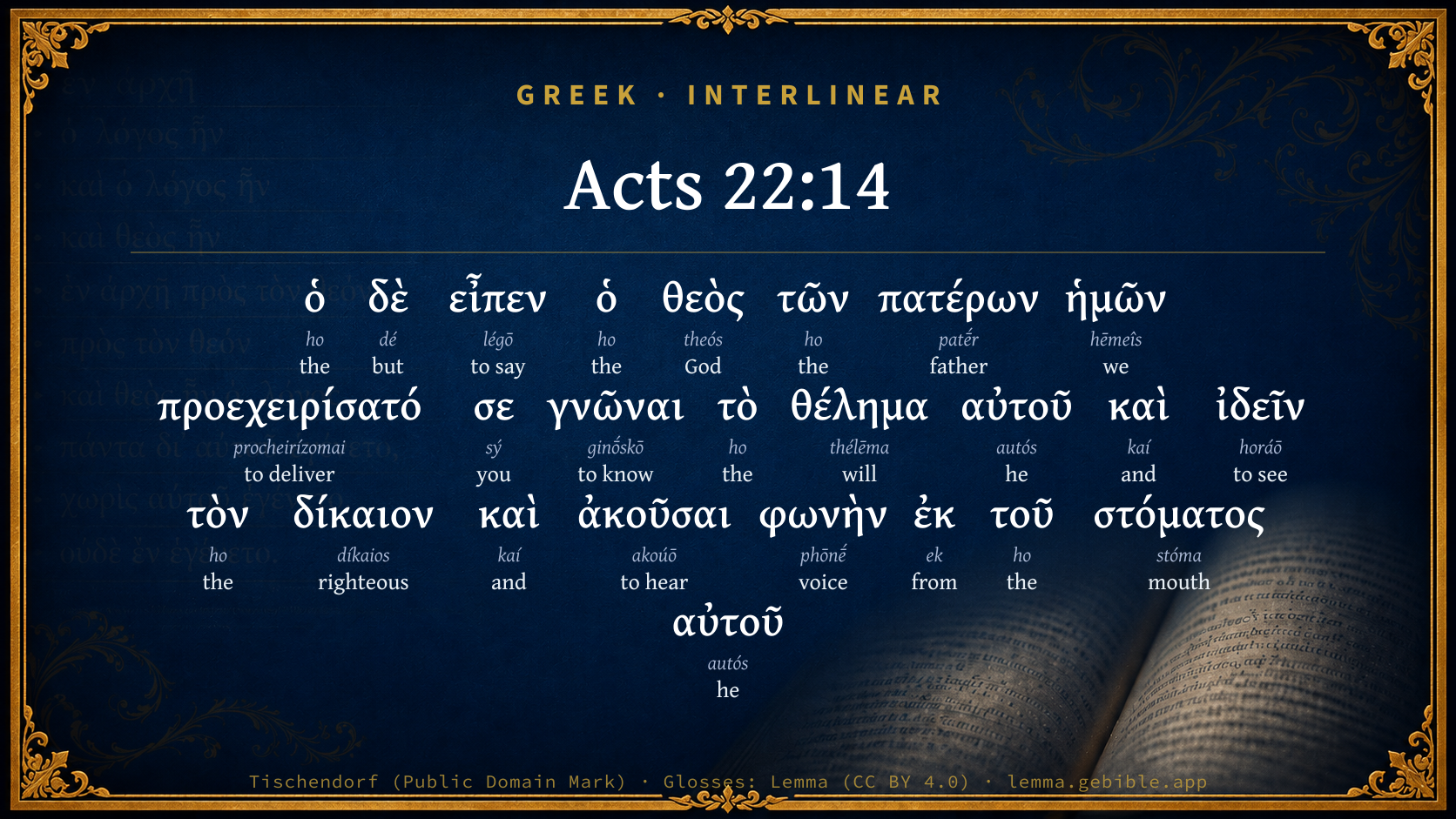
Greek (Tischendorf 8th ed.) Acts 22:14 appears in the Greek New Testament. The text above is from the Tischendorf 8th edition. Each word links to its Strong’s number and a concise gloss. Click any word for its full Thayer’s Greek Lexicon entry.
Download image
Cite this verse

Acts 22:14 (World English Bible). Public Domain. Lemma interlinear Bible study tool, https://lemma.gebible.app/v/acts/22/14.

Show BibTeX & RIS
BibTeX
RIS
English Translation
He said, 'The God of our fathers has appointed you to know his will, and to see the Righteous One, and to hear a voice from his mouth.
World English Bible · Public Domain
Download a study sheet

One document with this verse’s original text, its word-by-word gloss line, the meaning frame, cross-references with their text, attributed commentary, and full source and license credits — printable, and it pastes into notes with its structure intact.

This verse Autodidact and up

Study sheet (.html) Plain text (.txt)

A passage Seminary Student

Up to 50 verses in one chapter. A passage sheet keeps up to 6 commentary sources and 12 cross-references per verse, in the order this page ranks them, and says so on the sheet whenever that leaves anything out. Ask for a single verse and you get the Autodidact verse sheet above.

Everything on this page stays free to read, with no account — the sheet is a download of what is already on screen, not access to it.

Want to remove ads? Support Godless Engineer
Compare translations 3

The same verse in 3 English versions, stacked beneath the original-language interlinear above. Click any original word for its lexicon entry.

Each is an independent rendering of the whole verse — the interlinear is not word-aligned to these translations.

Highlighted words mark where these versions differ — a whole-verse word diff, not a word-by-word alignment.

  • World English Bible Public Domain
    He said, 'The God of our fathers has appointed you to know his will, and to see the Righteous One, and to hear a voice from his mouth.
  • King James Version Public Domain
    And he said, The God of our fathers hath chosen thee, that thou shouldest know his will, and see that Just One, and shouldest hear the voice of his mouth.
  • unfoldingWord Literal Text CC BY-SA 4.0
    And he said, ‘The God of our fathers appointed you to know his will and to see the Righteous One and to hear the voice from his mouth,

unfoldingWord Literal Text — © unfoldingWord, licensed CC BY-SA 4.0. Word-aligned USFM3 via Door43 (git.door43.org/unfoldingWord/en_ult).

Versions to compare (up to 4)

3 of 4 selected

Show all 19 translations

Every available English version of this verse, each an independent rendering of the whole verse.

  • World English Bible Public Domain
    He said, 'The God of our fathers has appointed you to know his will, and to see the Righteous One, and to hear a voice from his mouth.
  • Berean Standard Bible Public Domain
    Then he said, ‘The God of our fathers has appointed you to know His will, and to see the Righteous One, and to hear His voice.
  • Majority Standard Bible Public Domain
    Then he said, ‘The God of our fathers has appointed you to know His will and to see the Righteous One and to hear His voice.
  • King James Version Public Domain
    And he said, The God of our fathers hath chosen thee, that thou shouldest know his will, and see that Just One, and shouldest hear the voice of his mouth.
  • American Standard Version (1901) Public Domain
    And he said, The God of our fathers hath appointed thee to know his will, and to see the Righteous One, and to hear a voice from his mouth.
  • Revised Version (1885) Public Domain
    And he said, The God of our fathers hath appointed thee to know his will, and to see the Righteous One, and to hear a voice from his mouth.
  • Geneva Bible (1599) Public Domain
    And he sayd, The God of our fathers hath appointed thee, that thou shouldest knowe his wil, and shouldest see that Iust one, and shouldest heare the voyce of his mouth.
  • Douay-Rheims (1899) Public Domain
    But he said: The God of our fathers hath preordained thee that thou shouldst know his will, and see the Just One, and shouldst hear the voice from his mouth.
  • Young's Literal Translation Public Domain
    and he said, The God of our fathers did choose thee beforehand to know His will, and to see the Righteous One, and to hear a voice out of his mouth,
  • Literal Standard Version CC BY-SA 4.0
    and he said, The God of our fathers chose you beforehand to know His will, and to see the Righteous One, and to hear a voice out of His mouth,
  • Unlocked Literal Bible CC BY-SA 4.0
    Then he said, 'The God of our fathers has chosen you to know his will, to see the Righteous One, and to hear the voice coming from his own mouth.
  • unfoldingWord Literal Text CC BY-SA 4.0
    And he said, ‘The God of our fathers appointed you to know his will and to see the Righteous One and to hear the voice from his mouth,
  • Darby Bible Public Domain
    And he said, The God of our fathers has chosen thee beforehand to know his will, and to see the just one, and to hear a voice out of his mouth;
  • World Messianic Bible Public Domain
    He said, ‘The God of our fathers has appointed you to know his will, and to see the Righteous One, and to hear a voice from his mouth.
  • Webster's Bible Public Domain
    And he said, The God of our fathers hath chosen thee, that thou shouldst know his will, and see that Just One, and shouldst hear the voice of his mouth.
  • Free Bible Version CC BY-SA 4.0
    He told me, ‘The God of our fathers has appointed you to know his will, to see the one who is truly good and right, and to listen to what he has to say to you.
  • Bible in Basic English Public Domain
    And he said, You have been marked out by the God of our fathers to have knowledge of his purpose, and to see the Upright One and to give ear to the words of his mouth.
  • Text-Critical English NT CC BY 4.0
    Then he said, ‘The God of our fathers has appointed yoʋ to know his will, to see the Righteous One, and to hear the voice coming from his mouth.
  • Tyndale New Testament (1534) Public Domain
    And he sayde the God of oure fathers hath ordeyned the before that thou shuldest knowe his will and shuldest se that which is rightfull and shuldest heare the voyce of his mouth:

Literal Standard Version (2020), Covenant Press — licensed CC BY-SA 4.0. Text via the HelloAO Bible API (eBible.org). Unlocked Literal Bible (unfoldingWord) — licensed CC BY-SA 4.0. Text via the HelloAO Bible API (eBible.org). unfoldingWord Literal Text — © unfoldingWord, licensed CC BY-SA 4.0. Word-aligned USFM3 via Door43 (git.door43.org/unfoldingWord/en_ult). Free Bible Version, Dr. Jonathan Gallagher — licensed CC BY-SA 4.0. Text via the HelloAO Bible API (eBible.org).

Word by word

More ways to search: Search by grammar → Find every occurrence → Compare this word →

Practice this passage: Drill this verse → Learn its vocabulary →

προεχειρίσατό
procheirízomai
G4400
“to deliver”
Verb, Aorist, Middle deponent, Indicative, 3rd person, Singular
Part of Speech
Verb
Tense
Aorist
Voice
Middle deponent
Mood
Indicative
Person
3rd person
Number
Singular
Full Thayer's Definition

Origin: middle voice from G4253 and a derivative of G5495

TDNT: 6:862,*

1. to put into the hand, to deliver into the hands 2. to take into one's hands 3. to set before one's self, to prostrate, to determine 4. to choose, to appoint a. for one's use b. for one's salvation
  1. ὁ ho G3588 “the” Article, Nominative, Singular, Masculine
  2. δὲ dé G1161 “but” Conjunction
  3. εἶπεν légō G3004 “to say” Verb, Aorist, Active, Indicative, 3rd person, Singular
  4. ὁ ho G3588 “the” Article, Nominative, Singular, Masculine
  5. θεὸς theós G2316 “God” Noun, Nominative, Singular, Masculine
  6. τῶν ho G3588 “the” Article, Genitive, Plural, Masculine
  7. πατέρων patḗr G3962 “father” Noun, Genitive, Plural, Masculine
  8. ἡμῶν hēmeîs G2249 “we” Personal pronoun, 1st person, Genitive, Plural
  9. σε sý G4771 “you” Personal pronoun, 2nd person, Accusative, Singular
  10. γνῶναι ginṓskō G1097 “to know” Verb, Aorist, Active, Infinitive
  11. τὸ ho G3588 “the” Article, Accusative, Singular, Neuter
  12. θέλημα thélēma G2307 “will” Noun, Accusative, Singular, Neuter
  13. αὐτοῦ autós G846 “he” Personal pronoun, Genitive, Singular, Masculine
  14. καὶ kaí G2532 “and” Conjunction
  15. ἰδεῖν horáō G3708 “to see” Verb, Aorist, Active, Infinitive
  16. τὸν ho G3588 “the” Article, Accusative, Singular, Masculine
  17. δίκαιον díkaios G1342 “righteous” Adjective, Accusative, Singular, Masculine
  18. καὶ kaí G2532 “and” Conjunction
  19. ἀκοῦσαι akoúō G191 “to hear” Verb, Aorist, Active, Infinitive
  20. φωνὴν phōnḗ G5456 “voice” Noun, Accusative, Singular, Feminine
  21. ἐκ ek G1537 “from” Preposition
  22. τοῦ ho G3588 “the” Article, Genitive, Singular, Neuter
  23. στόματος stóma G4750 “mouth” Noun, Genitive, Singular, Neuter
  24. αὐτοῦ autós G846 “he” Personal pronoun, Genitive, Singular, Masculine

About this verse

These counts appear in no published source. They are computed here, from the morphology-tagged text and Lemma’s own curated glosses. What Lemma adds →

25
words
18
distinct lemmas
Acts
section

Notable vocabulary

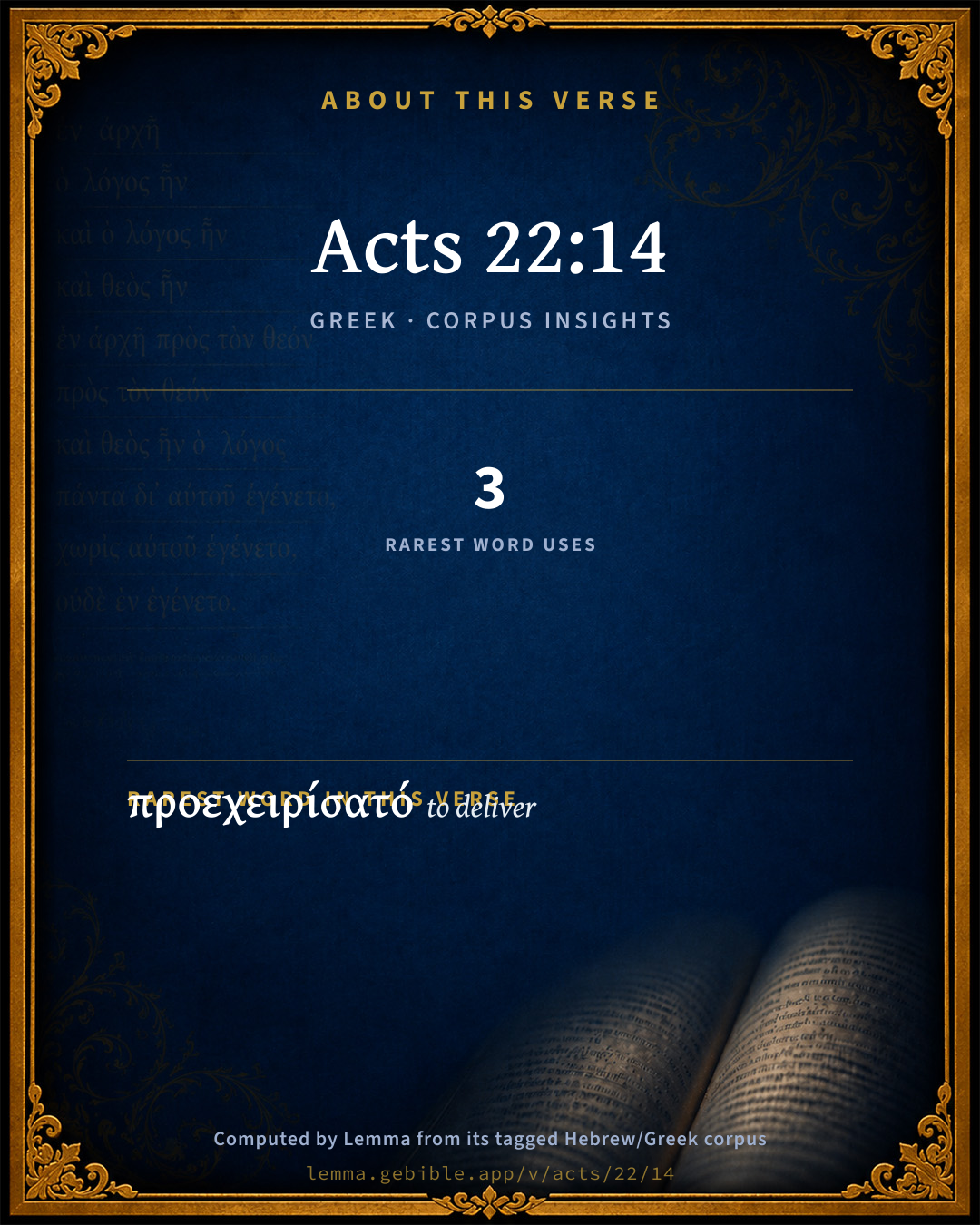
The rarest word here is προεχειρίσατό to deliver G4400 — appearing just 3 times in the whole Greek New Testament.

Shared distinctive vocabulary

προεχειρίσατό to deliver G4400 occurs in 3 verses of the Greek New Testament. Also found in:

Repetition

Words recur within this verse:

Cross-references

31

Topical passages linked to Acts 22:14 in the Treasury of Scripture Knowledge — connected by theme and wording, ordered by reader-vote popularity; previews shown in the World English Bible.

  • Galatians 1:12 For neither did I receive it from man, nor was I taught it, but it came to me through revelation of Jesus Christ.
  • 1 Corinthians 15:8 and last of all, as to the child born at the wrong time, he appeared to me also.
  • Acts 26:16 But arise, and stand on your feet, for I have appeared to you for this purpose: to appoint you a servant and a witness both of the things which you have seen, and of the things which I will reveal to you;
  • 1 Corinthians 9:1 Am I not free? Am I not an apostle? Haven't I seen Jesus Christ, our Lord? Aren't you my work in the Lord?
  • Acts 9:15 But the Lord said to him, "Go your way, for he is my chosen vessel to bear my name before the nations and kings, and the children of Israel.
  • Acts 3:13–14 The God of Abraham, Isaac, and Jacob, the God of our fathers, has glorified his Servant Jesus, whom you delivered up, and denied in the presence of Pilate, when he had determined to release him.
  • Acts 7:52 Which of the prophets didn't your fathers persecute? They killed those who foretold the coming of the Righteous One, of whom you have now become betrayers and murderers.
  • Acts 9:17 Ananias departed, and entered into the house. Laying his hands on him, he said, "Brother Saul, the Lord, who appeared to you on the road by which you came, has sent me, that you may receive your sight, and be filled with the Holy Spirit."
  • Romans 1:1 Paul, a servant of Jesus Christ, called to be an apostle, set apart for the Gospel of God,
  • 1 John 2:1 My little children, I write these things to you so that you may not sin. If anyone sins, we have a Counselor with the Father, Jesus Christ, the righteous.
  • Exodus 15:2 Yah is my strength and song, He has become my salvation: This is my God, and I will praise him; My father's God, and I will exalt him.
  • 1 Chronicles 29:18 Yahweh, the God of Abraham, of Isaac, and of Israel, our fathers, keep this forever in the imagination of the thoughts of the heart of your people, and prepare their heart to you;
  • Ezra 7:27 Blessed be Yahweh, the God of our fathers, who has put such a thing as this in the king's heart, to beautify the house of Yahweh which is in Jerusalem;
  • Jeremiah 1:5 Before I formed you in the belly I knew you, and before you came forth out of the womb I sanctified you; I have appointed you a prophet to the nations.
  • Daniel 2:23 I thank you, and praise you, you God of my fathers, who have given me wisdom and might, and have now made known to me what we desired of you; for you have made known to us the king's matter.
  • John 15:16 You didn't choose me, but I chose you, and appointed you, that you should go and bear fruit, and that your fruit should remain; that whatever you will ask of the Father in my name, he may give it to you.
  • Acts 5:30 The God of our fathers raised up Jesus, whom you killed, hanging him on a tree.
  • Acts 13:17 The God of this people chose our fathers, and exalted the people when they stayed as aliens in the land of Egypt, and with an uplifted arm, he led them out of it.
  • Acts 22:18 and saw him saying to me, 'Hurry and get out of Jerusalem quickly, because they will not receive testimony concerning me from you.'
  • Acts 24:14 But this I confess to you, that after the Way, which they call a sect, so I serve the God of our fathers, believing all things which are according to the law, and which are written in the prophets;
  • 1 Corinthians 11:23 For I received from the Lord that which also I delivered to you, that the Lord Jesus on the night in which he was betrayed took bread.
  • Exodus 3:13–16 Moses said to God, "Behold, when I come to the children of Israel, and tell them, 'The God of your fathers has sent me to you;' and they ask me, 'What is his name?' What should I tell them?"
  • 2 Kings 21:22 and he forsook Yahweh, the God of his fathers, and didn't walk in the way of Yahweh.
  • 1 Chronicles 12:17 David went out to meet them, and answered them, If you be come peaceably to me to help me, my heart shall be knit to you; but if [you be come] to betray me to my adversaries, seeing there is no wrong in my hands, the God of our fathers look thereon, and rebuke it.
  • 2 Chronicles 28:25 In every city of Judah he made high places to burn incense to other gods, and provoked to anger Yahweh, the God of his fathers.
  • 2 Chronicles 30:19 who sets his heart to seek God, Yahweh, the God of his fathers, though not [cleansed] according to the purification of the sanctuary.
  • 1 Corinthians 15:3 For I delivered to you first of all that which I also received: that Christ died for our sins according to the Scriptures,
  • 2 Corinthians 5:21 For him who knew no sin he made to be sin on our behalf; so that in him we might become the righteousness of God.
  • Galatians 1:15 But when it was the good pleasure of God, who separated me from my mother's womb, and called me through his grace,
  • 2 Timothy 1:1 Paul, an apostle of Jesus Christ through the will of God, according to the promise of the life which is in Christ Jesus,
  • Titus 1:1 Paul, a servant of God, and an apostle of Jesus Christ, according to the faith of God's chosen ones, and the knowledge of the truth which is according to godliness,

Cross-references courtesy of OpenBible.info (CC BY 4.0).

Commentary

Notes on Acts 22:14 from classic Christian and Jewish commentators (each source and its license shown beneath its notes). The classic Christian expositions comment on the surrounding passage and are grouped to its opening verse, so a note may address several verses; the Jewish commentaries on the Tanakh (Rashi and others) are per-verse, so they appear only where the commentator wrote on this verse.

Lemma curates 59 commentaries, every one of them public domain or Creative Commons licensed, each selected and text-cleaned for this edition rather than reprinted as found. About our sources →

Tyndale Open Study Notes

Tyndale Open Resources

22:14 the Righteous One: See also 3:14; 7:52; 1 Jn 2:1. Righteousness was one of the Messiah’s characteristics (see Isa 32:1; 53:11).

Tyndale Open Study Notes — © Tyndale Open Resources, licensed CC BY-SA 4.0. Text via the HelloAO Bible API.

Bengel's Gnomon

Johann Albrecht Bengel

Act 22:14. Ὁ Θεὸς τῶν πατέρων ἡμῶν, the God of our fathers) ch. Act 3:13, note [a frequent appellation in the Acts above the other books of the New Testament, appropriate to that time, when the promises made to “the fathers” were being fulfilled].—προεχειρίσατό σε, hath appointed thee [beforehand]) Ananias affirms that this vision was vouchsafed to Paul as an act of grace, not in wrath.—τὸ θέλημα αὐτοῦ) His will, a righteous will, which is set forth in Christ: ch. Act 20:27; Joh 6:38-39.—ἰδεῖν τὸν Δίκαιον, to see the Just One) An extraordinary benefit. Christ, who was always just (righteous), is now also altogether exempt even from the sin of others, which had been imposed on Him: Heb 9:28. Since His having gone to the Father, as our “Advocate” or Paraclete, 1Jn 2:1, we do not now see Him, Joh 16:10: and yet He was beheld by Paul. Moreover He is the Just One, because He fulfilled all the will of the Father in (by) Himself, and fulfils it in us. This His justice, or righteousness, is the sum of the Gospel, of which Paul is made the witness. Paul also afterwards saw this Just One: Act 22:18, ch. Act 26:16.

Bengel's Gnomon of the New Testament — English translation (T&T Clark, Edinburgh, 1860) — public domain. Text from a community e-Sword module.

Expositor's Greek Testament

ed. W. Robertson Nicoll

Act 22:14 . ὁ Θεὸς τῶν πατ . ἡμῶν : again a conciliatory phrase, cf. Act 7:32 , so St. Peter in Act 3:13 , Act 5:30 . προεχειρ .: “hath appointed,” only in Acts in N.T., Act 3:20 , and in Act 26:16 , again used by Paul in narrating his conversion and call. In LXX, cf. Exo 4:13 , Jos 3:12 , 2MMal 3:7 ; 2Ma 8:9 , always with the notion of some one selected for an important duty (Lumby): to which may be added Dan., LXX, Act 3:22 (see H. and R.), cf. note on Act 3:20 . τὸν δίκαιον , see on Act 3:14 , and Act 7:52 . φ . ἐκ τοῦ στ .: “a voice from his mouth,” R.V., so Rhem., as the Apostle heard it at his conversion. στ . is often used in phrases of a Hebraistic character, so here fitly by Ananias, cf. Act 15:7 .

The Expositor's Greek Testament, edited by W. Robertson Nicoll (1897–1910) — public domain. Text from a community e-Sword module.

Jamieson, Fausset & Brown

Robert Jamieson, A. R. Fausset & David Brown

that thou shouldest . . . see that--"the"

Just One--compare Act 3:14; Act 7:52.

hear the voice of his mouth--in order to place him on a level with the other apostles, who had "seen the [risen] Lord."

Jamieson, Fausset & Brown — Commentary Critical and Explanatory on the Whole Bible (1871) — public domain (CC PDM 1.0). Text via the HelloAO Bible API.

Adam Clarke's Commentary

Verse 14. And see that Just One] The Lord Jesus, called the Just One, in opposition to the Jews, who crucified him as a malefactor: See Clarke on Ac 7:52. This is an additional proof that Jesus Christ did actually appear unto Saul of Tarsus.

Adam Clarke's Commentary on the Bible (1810–1826) — public domain. Text from a community e-Sword/MySword module.

John Calvin's Commentaries

14. The God of our fathers. As nothing is more fit to provoke us joyfully to go forward toward God, than when we know that God doth prevent us with his free goodness, that he may call us back from destruction to life; so Ananias beginneth here. God, saith he, hath ordained thee to know his will. For by this means Paul is taught that God had respect unto him at such time as he went astray, and was altogether an enemy to his own salvation; and so God’s predestination doth abolish all preparations which sophisters imagine, as if man did prevent God’s grace by his own free will. In calling him the God of the fathers, he reneweth the remembrance of the promises, that the Jews may know that the new calling of Paul is joined with them, and that those fall not away from the law who pass over unto Christ. Therefore Paul confirmeth that by these words which he avouched before in his own person, that he had not made any departure from the God of Abraham, whom the Jews had in times past worshipped, but that he continueth in the ancient worship which the fathers did use, which he had learned out of the law.

Wherefore, when the question is about religion, let us learn by the example of Paul, not to imagine any new God, (as the Papists and Mahometans have done, and as all heretics use to do) but let us retain that God who hath revealed himself in times past to the fathers, both by the law, and also by diverse oracles. This is that antiquity wherein we must remain, and not in that whereof the Papists boast in vain, who have invented to themselves a strange God, seeing they have forsaken the lawful fathers.

The same is to be said at this day of the Jews, whose religion, seeing it disagreeth with the law and the prophets, their God must also be degenerate and feigned. For he who would in times past be called the God of Abraham and of the fathers, appeared at length in the person of his Son, that he may now be called by his own name, or title, the Father of Christ. Therefore, he which rejecteth the Son hath not the Father, who cannot be separated from him. And Ananias saith, that it cometh to pass, through the free election of God, that the truth of the gospel doth now appear to Paul; whereupon it followeth, that he did not attain unto this by his own industry, which the experience of the thing did also declare. For nothing was more stubborn than Paul until Christ did tame him. And if we desire to know the cause and beginning, Ananias calleth us back unto the counsel of God, whereby he was appointed and ordained; and assuredly it is a more precious thing to know the will of God, than that men can attain unto it by their own industry. That which Ananias affirmeth of Paul ought to be translated unto all, that the treasure of faith is not common to all; but it is offered peculiarly to the elect. Furthermore, it appeareth more plainly by the next member what this will of God is. For God spake at sundry times and many ways by his prophets, but last of all, he revealed and made known his will and himself wholly in his Son (Hebrews 1:1).

To see the Just. Seeing all the Greek books in a manner agree together in the masculine gender, I wonder why Erasmus would rather translate it in the neuter, Which is Just; which sense the readers see to be cold and far let [fetched]. Therefore, I do not doubt but that Just is taken in this place for Christ; and the text runneth very finely thus, because it followeth immediately after, and hear a voice from his mouth. And it is certain that all the godly and holy men did most of all desire that they might see Christ. Thence flowed that confession of Simeon,

“Lord, now lettest thou thy servant depart in peace; because mine eyes have seen thy salvation,” (Luke 2:29).

Therefore this seeing, which godly kings and prophets did most earnestly desire, as Christ himself doth witness, (Luke 10:24) is not without cause extolled as a singular benefit of God. But because the sight of the eyes should profit little or nothing, which we know was to many deadly, he adjoineth the hearing of the voice. Ananias setteth down the cause why God did vouchsafe Paul of so great honor, to wit, that he might be to his Son a public witness; and he doth so prepare him, that he may learn not only for himself alone, but that he may have so much the more care to profit, because he shall be the teacher of all the whole Church.

John Calvin's Commentaries (1540-1563) — public domain. Text from the Calvin Translation Society English edition (1840s-50s) via the Christian Classics Ethereal Library (ccel.org). Calvin's coverage is partial (roughly two-thirds of the Bible); uncommented books and verses are honest gaps, never fabricated. The 19th-century editor's footnotes and remarks are omitted so the notes are faithfully Calvin's own voice.

Ellicott's Commentary for English Readers

(14) The God of our fathers . . .—The report of what was said by Ananias is somewhat fuller than in Act_9:17, and gives in outline what had been spoken to him by the Lord. It is obviously implied in Act_9:15-16, that those words were to be reproduced to Saul. We note the recurrence of the same formula in speaking of God that had been used by Stephen (Act_7:32).

Hath chosen thee.—The Greek verb is not that commonly rendered by “chosen,” and is better translated fore-appointed.

And see that Just One.—See Note on Act_7:52, in reference to the use of this name to designate the Lord Jesus.

A Bible Commentary for English Readers, edited by Charles John Ellicott (1878–1897) — public domain. Text from a community e-Sword module.

The Cambridge Bible for Schools and Colleges

gen. ed. J. J. S. Perowne

14. The God of our fathers, &c.] Ananias spake naturally as one Jew to another. At the commencement of the Christian Church there was no thought of a rupture with Judaism, and nothing is more to be noticed in the Acts than the gradual advance made by the Apostles and their companions in apprehending what the result of their mission would be.

hath chosen thee] The verb, which is found only in the Acts in the N. T., has the sense of committing a work into anyone’s hands. So Rev. Ver. “appointed.”

that thou shouldest know his will] For this reason it is that St Paul so often in the commencement of his Epistles speaks of himself as an Apostle according to the will of God. 1Co_1:1; 2Co_1:1; Eph_1:1; Col_1:1, &c. The whole passage Eph_1:1-11 is a comment on this clause.

and see that Just One] Rev. Ver. “see the righteous One,” i.e. Jesus, called “the Holy One and the Just” (Act_3:14) and “the Just One” (Act_7:52), in both which places the R. V. reads “Righteous,” thus connecting all the passages with 1Jn_2:1, “We have an Advocate with the Father, Jesus Christ the righteous.”

and shouldest hear the voice of his mouth] Rev. Ver. “a voice from, &c.” In this way Paul was taught of Jesus as the other Apostles.

The Cambridge Bible for Schools and Colleges (gen. ed. J. J. S. Perowne; Cambridge University Press, 1878–1918) — public domain. Text from a community e-Sword module.

John Gill's Exposition

And now why tarriest thou?.... Though it might not be the apostle's case, yet it is often the case of many, to procrastinate and delay obedience to the commands of Christ, and particularly to the ordinance of baptism: the reasons of which delay are, the strength of their corruptions, and the weakness of their graces, which cause them to question whether they have any interest in Christ; as also fears of falling away, and so of dishonouring Christ, his Gospel, and ordinance: and in some the reproaches of men; and sometimes such a delay is made, waiting for more comfortable frames, or for a greater fitness; but no such delay, nor on such accounts, ought to be; for it is a command of Christ, and ought to be forthwith complied with, as soon as a man believes; and to obey it is a following of Christ, in which no time should be lost: and the consequences of a delay are very bad: it is a prevention of the glory of Christ, as well as shows ingratitude to him, and a bereaving of ourselves of that comfort, which might be hoped to be enjoyed; and it often induces a carelessness about the ordinance, and even a losing the sense of the duty:

arise, and be baptized; this shows that Ananias was a Christian, since he directs to an ordinance of Christ, and that he was a preacher of the word, and had a right to administer baptism; for that it was administered by him, though not in express terms yet seems to be naturally concluded from Act 9:18 as also this passage shows, that baptism was not administered by sprinkling, since Saul might have sat still, and have had some water brought to him, and sprinkled on him; but by immersion, seeing he is called upon to arise, and go to some place proper and convenient for the administration of it, according to the usage of John, and the apostles of Christ. "And wash away thy sins"; or "be washed from thy sins"; not that it is in the power of man to cleanse himself from his sins; the Ethiopian may as soon change his skin, or the leopard his spots, as a creature do this; nor is there any such efficacy in baptism as to remove the filth of sin; persons may submit unto it, and yet be as Simon Magus was, in the gall of bitterness, and bond of iniquity; but the ordinance of baptism, may be, and sometimes is, a means of leading the faith of God's children to the blood of Christ, which cleanses from all sin;

calling on the name of the Lord; the name of the Lord is not only to be used by the administrator of baptism in the performance of it; but it should be called upon by the person who submits to it, both before and at the administration of it, for the presence of Christ in it; and this invocation of the name of the Lord in baptism, signifies an exercise of faith in Christ at this time, a profession of him, and obedience to him.

John Gill's Exposition of the Whole Bible (1746–1763) — public domain (CC PDM 1.0). Text via the HelloAO Bible API.

Trapp's Complete Commentary

John Trapp

11 And when I could not see for the glory of that light, being led by the hand of them that were with me, I came into Damascus.

12 And one Ananias, a devout man according to the law, having a good report of all the Jews which dwelt there,

13 Came unto me, and stood, and said unto me, Brother Saul, receive thy sight. And the same hour I looked up upon him.

14 And he said, The God of our fathers hath chosen thee, that thou shouldest know his will, and see that Just One, and shouldest hear the voice of his mouth.

Ver. 14. Hath chosen thee] Gr. προεχειρισατο hath handled thee beforehand. Beza, "hath designed thee," Erasmus, "hath prepared thee," viz by unhorsing and blinding thee. Schola Crucis schola lucis. The school of the cross is the school of light.

John Trapp, A Commentary or Exposition upon All the Books of the Old and New Testament (1647–1656) — public domain. Text from a community e-Sword module.

Albert Barnes' Notes on the Bible

Shouldest know his will - His will in the plan of salvation, and in regard to your future life.

And see that Just One - The Messiah. See the notes on Act 3:14. As Paul was to be an apostle, and as it was the special office of an apostle to bear witness to the person and deeds of the Lord Jesus (see the notes on Act 1:21-22), it was necessary that he should see him, that thus he might be a competent witness of his resurrection.

Shouldest hear the voice of his mouth - Shouldst hear and obey his commands.

Albert Barnes' Notes on the Bible (1834–1885) — public domain. Text from a community e-Sword/MySword module.

Haydock's Catholic Bible Commentary

Shouldst...see the Just One. Our Saviour appeared to St. Paul, as it is said; (chap. ix. 7.) and he is divers times, both in the Prophets and in the Testament, called the Just One. (Witham) --- To see and hear the Just One; Him, who is just by excellence, that you also may prove a witness of his resurrection from the dead.

George Leo Haydock (1774–1849), Haydock's Catholic Family Bible and Commentary, 1859 edition — public domain. Excludes Psalms (Douay-Rheims chapter numbering differs from Protestant) and Deuterocanonical books (Catholic canon only).

Matthew Poole's English Annotations

The God of our fathers; nothing could please the people better than to hear God so styled; for this they gloried in, above all things, that they and theirs had God to their Father, Joh 8:41. And nothing could better suit St. Paul’s purpose, who would not lie under that scandal of endeavouring an apostacy from the Jewish religion, (for the gospel which he preached was but the substance and perfection of the law), or that he served or worshipped any other God than the God of Abraham.

Hath chosen thee; he hath taken thee, as by the hand, and by his wonderful providence brought thee into that condition in which thou art.

See that Just One; Christ is the Holy One, spotless and without blemish; God’s righteous servant, Isa 53:11. But this is here the rather spoken, that he might convince them of their sin in putting our Lord to death: for though he sweetened his speech to them in what he might, he would not flatter them to their destruction; like a skilful surgeon, he would not heal too fast. Now Paul saw Christ with the eye of his mind, it being enlightened to believe in him; and he saw him in his journey also with the eyes of his body. Some read, το, not τον δικαιον. And then Ananias tells St. Paul, that he was sent to show him that which was just and right in God’s sight; which he, being blinded by his zeal for the law, could not perceive.

Matthew Poole's English Annotations on the Holy Bible (1683–1685) — public domain. Text from a community e-Sword/MySword module.

The Pulpit Commentary

Appointed for chosen, A.V.; to know for that thou shouldest know, A.V.; to see the Righteous One for see that Just One, A.V.; to hear a voice from for shouldest hear the voice of, A.V. Hath appointed thee; proeceirisato se, a word found in the New Testament only here and in Act_26:16, and in Act_3:20 (R.T.). In classical Greek it means mostly "to get anything ready beforehand;" to cause anything to be proceirov, ready to hand. And in the LXX it means "to choose," or appoint," as Jos_3:12; Exo_4:13, where it is not a translation of jl but a paraphrase of the sentence, "Appoint one by whom thou wilt send." Here it may be rendered indifferently either "choose" or "appoint." The Righteous One. The designation of Messiah in such passages as Isa_53:11; Psa_72:2, etc. (see in the New Testament Luk_23:47; 1Jn_2:1 Rev_19:11, etc.) A voice from his mouth is a very awkward though literal rendering. The A.V. expresses the sense much better.

Vers. 14, 15. The will of God in Christ Jesus concerning us.

I DIVINE ELECTION. "The God of our fathers hath chosen thee" (ver. 14). It will always be a difficulty to know what to think of the electing grace of God. But we are on safe ground when we say:

1. That God desires the well-being of every member of his human family. We may surely argue that it must be so; we may boldly affirm that it is so. Is it not written that God is one "who will have all men to be saved, and to come unto the knowledge of the truth" (1Ti_2:4; see Eze_18:23 Eze_33:11; 2Pe_3:9)

2. That he bestows special favors and privileges on some men; to some as not to others he gives intellectual faculty, material resources, educational advantages, domestic influences, providential guidance, knowledge of Christian truth in its purity and integrity, etc. These he "elects," or "chooses;" on them he confers distinguishing goodness.

II A VISION OF THE RIGHTEOUS SAVIOR. "That thou shouldest... see that Just One, and shouldest hear the voice of his mouth" (ver. 14). To Saul there was vouchsafed a very special and peculiar manifestation of the risen Lord. In such wise as we do not, he saw the Just One himself and heard his voice. But Christ does present himself now to the sons of men, and he manifests himself as the Just One, as the Lord of righteousness. By a spiritual act we recognize Jesus Christ as:

1. That Being who is in himself the Holy and Righteous One, in whom is no trace of sin.

2. That Divine One who summons us to a new life of holiness and sacred service.

3. That Just One who, by his atoning death, has made the way open to our immediate justification, who has made it possible for us to attain to "the righteousness which is of God by faith". (Php_3:9) In the presence of him, the Just One, we are filled with shame; but by faith in his finished work we have acceptance with God and are accounted righteous (or, just) in his sight; and we yield ourselves to him and his service that his righteousness may be reproduced in us and in our human lives. Thus we come to do

III THAT WORK OF MAN WHICH IS THE WILL OF GOD. Paul was to "know his will" (ver. 14), and was to do that will by the accomplishment of his life-work, viz. by "being his witness unto all men." This, too, in our way and measure is to be our lifework, even as it was our Lord"s. (Joh_18:37) We are to bear witness of Christian truth by

(1) exemplary behavior;

(2) a devout and generous spirit;

(3) the word of testimony and exhortation,

this latter is to be experimental, such as is suggested by our own actual experience. Every Christian life is a failure if it be not an epistle read and known of all who are there to read it. C.

That Just One.

Paul here quotes from Ananias a term used to designate Jesus Christ. Its Scripture history as applied to Christ, and its significance as touching some of the deepest aspects of Christ"s relations to humanity, are very worthy of some fixed attention. Notice

I THE SCRIPTURE HISTORY OF THE EPITHET, "THAT JUST ONE," AS APPLIED TO CHRIST. Six occasions in the historical portions of the New Testament illustrate its use, namely, when it comes from the lips of Pilate"s wife and afterwards of Pilate; (Mat_27:19, Mat_27:24) from the lips of the Roman centurion; (Luk_23:47) of Peter; (Act_3:14) of Stephen; (Act_7:52) and of Ananias in the special quotation of Paul now (ver. 14). These testimonies are noticeable for the directness of their language, for the special identification of Christ as this just Man," or that just Man," or the Just One," and for the character in each case of those who uttered them.

II THE DEEPER SIGNIFICANCE OF THE SAME EPITHET AS APPLIED TO CHRIST.

1. Christ is the perfectly "righteous" One, and the only perfectly righteous One. All others have sinned and fallen short of God"s glory. No other has kept the Law entirely kept it in deed, in word, in thought, in affection, in zeal.

2. Christ"s perfect righteousness is the qualification of the Mediator, that real, solemn, thrilling relationship which he sustained as between God and man.

3. Christ"s perfect righteousness constituted the essential qualification of the propitiatory sacrifice. He suffered for sins, the just for the unjust". (1Pe_3:18) The "Advocate with the Father, and the Propitiation for out" sins, and not for ours only, but also for the whole world, is Jesus Christ the Righteous" (1Jn_2:2)

4. Christ"s perfect righteousness constitutes the perfection of his fitness to be Teacher and Exemplar to men on earth.

5. Christ"s perfect righteousness is the stability of his throne of judgment, to be ere very long beheld and approached by every man who is or ever has been. He is "the Lord, the righteous Judge". B. (2Ti_4:8)

Vers. 14, 15. The calling and the gifts of God.

The apostle himself elsewhere speaks (Rom_11:29) of" the gifts and the calling of God;" and of them he says that they "are without repentance." The glorious occasion to which he gives prominence in the words of these verses exhibits the "calling" first, and the "gifts" next. At the same time, this same passage describes the calling of God (separate and sovereign act though it be in itself) as introductory to responsibilities, privileges, and gifts that followed upon it. There is not such a thing as a calling of God, to lie dormant. There is not such a thing as a calling of God, to terminate in the mere use or enjoyment of the person called. A calling of God infers a commission consequent upon it nay, nothing less than involved in it under any circumstances. Here, however, it is not implied only, it is expressed as well, and that in a very significant mode. For immediate upon the mention of the calling or choosing comes that of

I A GREAT QUALIFICATION.

1. The Christian apostle, minister, teacher, must be one who "knows the will" of God.

2. He must be one who knows it very directly from the fountain-head. Hearsay will not suffice, imagination will not suffice, reason will not suffice.

II A GRAND PRIVILEGE IN CONNECTION WITH THAT QUALIFICATION. Though Paul "was as one born out of clue season," these things are vouchsafed to him, namely, to "see" and to "hear" the "Just One." Some think Saul had seen Christ in the flesh. This passage may contribute something confessedly inconclusive to the disadvantage of the supposition. It is overwhelmingly improbable, in that Paul never speaks of it, as surely he would have done if it had been the case, even as he speaks of having seen Stephen and assisted at his martyrdom. This great grace, however, is now vouchsafed to Saul, that with vision of thousandfold force he is given to see the very Jesus ascended, and that with a keenness to hear beyond anything that he had experienced before he is granted to hear the own voice of the glorified Man Jesus. It is not that Saul had earned the gift nay, it is not that to the end of a devoted life of fullest self-surrender hewill ever be able to earn the gift. Paul is the disclaimer of merit. Nor is all the grace for Paul. How many lesser successors to him have taken their share of benefit, and the whole Church its share, when these have recalled that Jesus teaches:

1. How near a connection is necessary between himself and his servant-pioneers of the truth and heralds of salvation.

2. To this end how near he is willing to condescend to come to those servants.

3. And how he would embolden them to draw near to him in most believing faith and most loving trust of the heart, when the times should be such that he would no longer come in vision to them.

III A VAST RESPONSIBILITY. It needs an angel intellect and an archangel heart to set an estimate at all equal to the truth upon the work committed into human hands when the ministry of Christ is accepted by them. They are then "witnesses for Christ to men." And three features of their great responsibility are here shadowed forth.

1. They are witnesses to a living One, a Personage, and not to a mere truth.

2. They are witnesses to him of the things that they know of "the Word of, (1Jn_1:1) through having seen him, heard him, looked upon him, and handled him, all in the deepest sense.

3. They are witnesses" to all men," as far as they can possibly in any way reach all men, and under any circumstances to all impartially. Deep was the impression that these communications (unmentioned elsewhere) had made on the mind of Paul. The words of Ananias, inspired most freshly as he was from the source, had dwelt deep-stored in his memory. And now, some twenty-five years afterwards, at a crisis most opportune, they come to the surface, they are full-charged with their own vitality; and are practically commended by Paul as embodying the charter of all who should be "witnesses for Christ. B.

The Pulpit Commentary (1880–1919), ed. H.D.M. Spence-Jones & Joseph S. Exell — public domain. Text from a community e-Sword module.

McGarvey & Pendleton's Commentaries

J. W. McGarvey

See notes on verse 3

J. W. McGarvey (with Philip Y. Pendleton), Commentaries on the New Testament (The Fourfold Gospel, 1914; Acts; and the epistles) — public domain. Text from a community e-Sword/MySword module.

unfoldingWord translationNotes

Door43 World Missions Community

Connecting Statement:

Paul finishes telling what had happened to him in Damascus. He quotes what Ananias said to him. This is still part of his speech to the crowd in Jerusalem.

General Information:

The word "he" refers to Ananias. (See: Acts 22:12)

his will

"what God is planning and will cause to happen"

to hear the voice coming from his own mouth

Both "voice" and "mouth" refer to the one speaking. AT: "to hear him speak directly to you" (See: Synecdoche)

to all men

Here "men" means all people whether male or female. AT: "to all people" (See: When Masculine Words Include Women)

Now

Here "now" does not mean "at this moment," but is used to draw attention to the important point that follows.

why are you waiting?

This question was asked to exhort Paul to be baptized. AT: "Do not wait!" or "Do not delay!" (See: Rhetorical Question)

be baptized

This can be stated in active form. AT: "let me baptize you" or "receive baptism" (See: Active or Passive)

wash away your sins

As washing one's body removes dirt, calling on the name of Jesus for forgiveness cleanses one's inner being from sin. AT: "ask forgiveness for your sins" (See: Metaphor)

calling on his name

Here "name" refers to the Lord. AT: "calling on the Lord" or "trusting in the Lord"

translationWords

God

ancestor

will of God

righteous

voice

testimony

baptize

sin

call

unfoldingWord translationNotes — © Distant Shores Media and the Door43 World Missions Community, licensed CC BY-SA 4.0. Source: git.door43.org/Door43/en_tn.

Cambridge Greek Testament for Schools and Colleges

14. ὁ θεὸς τῶν πατέρων ἡμῶν, the God of our fathers. Ananias spake naturally as one Jew to another. At the commencement of the Christian Church there was no thought of a rupture with Judaism, and nothing is more to be noticed in the Acts than the gradual advance made by the Apostles and their companions in apprehending what the result of their mission would be.

προεχειρίσατό σε, hath appointed thee. The verb is only here and in Act 26:16 in N.T. In the LXX. it is found Exo 4:13, προχείρισαι ἄλλον δυνάμενον ὃν ἀποστελεῖς, where Moses would excuse himself from going unto Pharaoh; also Jos 3:12; 2Ma 3:7; 2Ma 8:9: always with the notion of selecting some one into whose hands an important duty can be committed.

γνῶναι τὸ θέλημα αὐτοῦ, to know His will. For this reason it is that St Paul so often in the commencement of his Epistles speaks of himself as an Apostle according to the will of God. 1Co 1:1; 2Co 1:1; Eph 1:1-2 Col 1:1, &c. The whole passage Eph 1:1-11 forms a comment on this clause.

καὶ ἰδεῖν τὸν δίκαιον, and to see the righteous One, i.e. Jesus. See note on Act 7:52 above.

καὶ ἀκοῦσαι φωνὴν ἐκ τοῦ στόματος αὐτοῦ, and to hear a voice from His mouth. That in this way St Paul might, even as the other Apostles, be taught of Jesus.

Cambridge Greek Testament for Schools and Colleges (Cambridge University Press, 1896; 21 vols, various authors incl. Carr, Maclear, Plummer, Farrar, Lumby, Moule, M. R. James, Simcox) — public domain. Text from a community e-Sword module.

Alford’s Greek Testament

Henry Alford

14. ὁ θ. τ. πατ. ἡμ.] So Peter, ch. 3:13; 5:30. In ch. 9:17, ὁ κύριος is the word: this title is given for the Jews.

τὸν δίκαιον] So Stephen, ch. 7:52. How forcibly must the whole scene have recalled him, whom presently (ver. 20) he mentions by name.

Henry Alford, The Greek Testament (1849–1861) — public domain. Text from a community e-Sword module.

Vincent's Word Studies in the New Testament

Marvin R. Vincent

The God of our fathers - Just One. A conciliatory touch in Paul 's speech, mentioning both God and Christ by their Jewish names. Compare ch. Act 3:14; Act 7:52.

Hath chosen [προεχειρισατο] . See on ch. Act 3:20. Better, as Rev., appointed.

Marvin R. Vincent, Word Studies in the New Testament (1887–1900) — public domain. Text from a community e-Sword/MySword module.

Lesson kit

Teaching starters — assembled from the data on this page, not authored interpretation. Every prompt links to the verse data it draws on. Edit before teaching.

Acts, in the Acts, opens this verse with 25 words (18 distinct Greek lemmas). Its most distinctive word is procheirízomai (“to deliver”). A historical commentator’s framing appears above. Read the whole chapter for the surrounding context.

Discussion questions

  1. How does “to deliver” (procheirízomai) shape what this verse is saying?
  2. Acts 3:20 shares the word «to deliver» with this verse. How do the two illuminate each other?
  3. “the” occurs 6× in this one verse. What is the effect of the repetition?
  4. The translations on this page render this verse differently — a whole-verse word diff, not a word-by-word alignment. What might account for the different wordings?
  5. Reading how Tyndale Open Study Notes and Bengel's Gnomon read this verse, where do the two commentators agree and where do they part?

Things to notice

Reading settings

Reading text

Shown beneath each verse's original-language words.

Old Testament
Old Testament edition

Read the OT as the Masoretic Hebrew (MT) or the Greek Septuagint (LXX).

English shown for the Greek Septuagint (in the Hebrew ↔ Greek comparison).

Comparing translations? Open the Compare panel on any verse page to stack up to four side by side.